
Stony Brook Medicine Comprehensive Stroke Program
CM
Published · 22 slides · 0 views
1 / 1


Description
Stony Brook Medicine Comprehensive Stroke Program Stroke Program Orientation for Medical Staff Objectives: Familiarize with acute stroke response time targets Familiarize with the available acute stroke codes and call criteria - CODE BAT
Related Topics
Share
Embed code
Download this presentation From Below
"Stony Brook Medicine Comprehensive Stroke Program" is the property of its rightful owner. Permission is granted to download and print the materials on this website for personal, non-commercial use only, and to display it on your personal computer provided you do not modify the materials and that you retain all copyright notices contained in the materials. By downloading content from our website, you accept the terms of this agreement.
Presentation Transcript
01
Stony Brook Medicine Comprehensive Stroke Program Stroke Program Orientation for Medical Staff<br>
02
Objectives: Familiarize with acute stroke response time targets
Familiarize with the available acute stroke codes and call criteria -
CODE BAT (Brain Attack Team)
CODE CSI (Complex Stroke Intervention)
Understand responsibilities of the primary team during an Inpatient
CODE BAT
Verbalize where to locate stroke-related clinical practice guidelines and protocols
Familiarize with Joint Commission, New York State Department of Health and Stroke:Get-With-The-Guidelines core measures and quality requirements STROKE PROGRAM ORIENTATION – MEDICAL STAFF<br>
Familiarize with the available acute stroke codes and call criteria -
CODE BAT (Brain Attack Team)
CODE CSI (Complex Stroke Intervention)
Understand responsibilities of the primary team during an Inpatient
CODE BAT
Verbalize where to locate stroke-related clinical practice guidelines and protocols
Familiarize with Joint Commission, New York State Department of Health and Stroke:Get-With-The-Guidelines core measures and quality requirements STROKE PROGRAM ORIENTATION – MEDICAL STAFF<br>
03
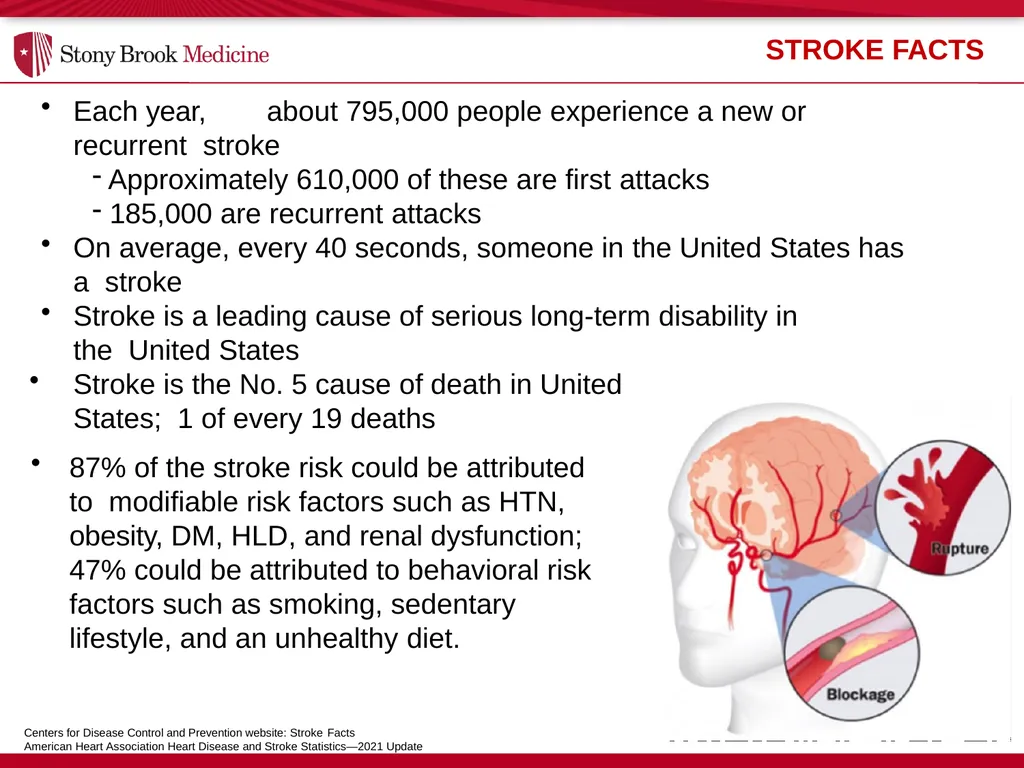
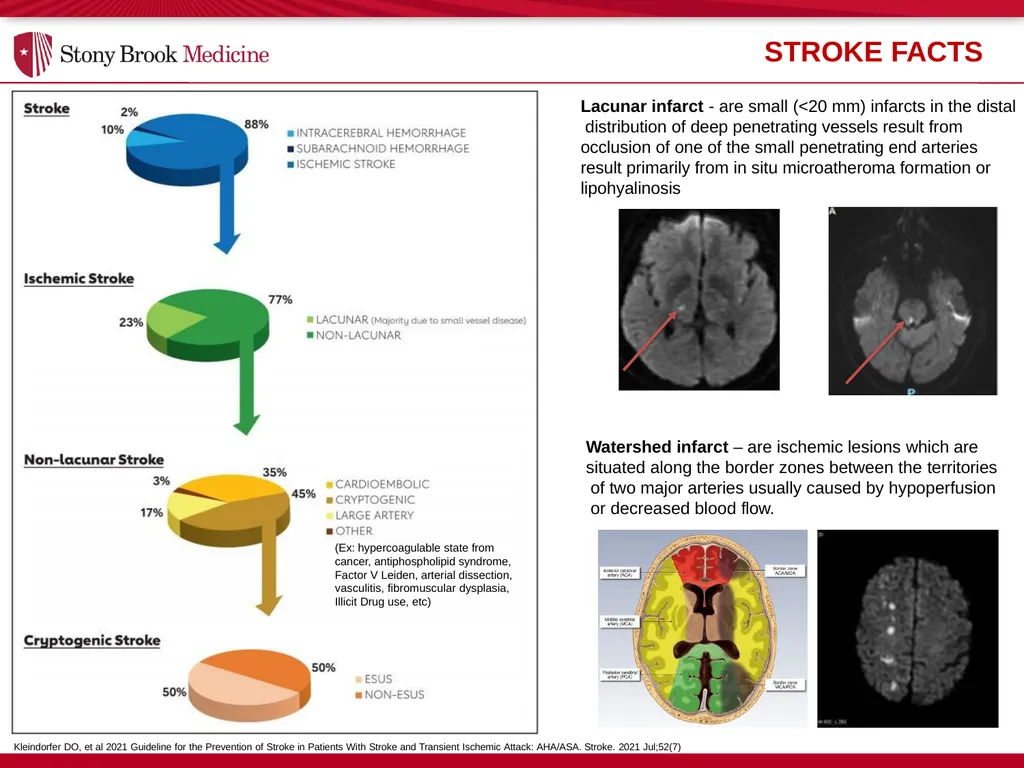
STROKE FACTS Each year, about 795,000 people experience a new or recurrent stroke
Approximately 610,000 of these are first attacks
185,000 are recurrent attacks
On average, every 40 seconds, someone in the United States has a stroke
Stroke is a leading cause of serious long-term disability in the United States
Stroke is the No. 5 cause of death in United States; 1 of every 19 deaths
87% of the stroke risk could be attributed to modifiable risk factors such as HTN, obesity, DM, HLD, and renal dysfunction; 47% could be attributed to behavioral risk factors such as smoking, sedentary lifestyle, and an unhealthy diet. Centers for Disease Control and Prevention website: Stroke Facts
American Heart Association Heart Disease and Stroke Statistics—2021 Update<br>
Approximately 610,000 of these are first attacks
185,000 are recurrent attacks
On average, every 40 seconds, someone in the United States has a stroke
Stroke is a leading cause of serious long-term disability in the United States
Stroke is the No. 5 cause of death in United States; 1 of every 19 deaths
87% of the stroke risk could be attributed to modifiable risk factors such as HTN, obesity, DM, HLD, and renal dysfunction; 47% could be attributed to behavioral risk factors such as smoking, sedentary lifestyle, and an unhealthy diet. Centers for Disease Control and Prevention website: Stroke Facts
American Heart Association Heart Disease and Stroke Statistics—2021 Update<br>
04
Lacunar infarct - are small (<20 mm) infarcts in the distal distribution of deep penetrating vessels result from occlusion of one of the small penetrating end arteries result primarily from in situ microatheroma formation or lipohyalinosis (Ex: hypercoagulable state from cancer, antiphospholipid syndrome, Factor V Leiden, arterial dissection, vasculitis, fibromuscular dysplasia, Illicit Drug use, etc) Kleindorfer DO, et al 2021 Guideline for the Prevention of Stroke in Patients With Stroke and Transient Ischemic Attack: AHA/ASA. Stroke. 2021 Jul;52(7) Watershed infarct – are ischemic lesions which are situated along the border zones between the territories of two major arteries usually caused by hypoperfusion or decreased blood flow. STROKE FACTS<br>
05
The direct and indirect cost of stroke in the United States was $49.8 billion
Common complications after stroke include both short-term complications such as seizures, DVT, PE, urinary infection, aspiration pneumonia, decubitus ulcers, and constipation and long-term sequelae, including pain syndromes, pseudobulbar affect, depression and anxiety, cognitive impairment and dementia, epilepsy, gait instability, and falls and fractures American Heart Association Heart Disease and Stroke Statistics—2021 Update STROKE FACTS<br>
Common complications after stroke include both short-term complications such as seizures, DVT, PE, urinary infection, aspiration pneumonia, decubitus ulcers, and constipation and long-term sequelae, including pain syndromes, pseudobulbar affect, depression and anxiety, cognitive impairment and dementia, epilepsy, gait instability, and falls and fractures American Heart Association Heart Disease and Stroke Statistics—2021 Update STROKE FACTS<br>
06
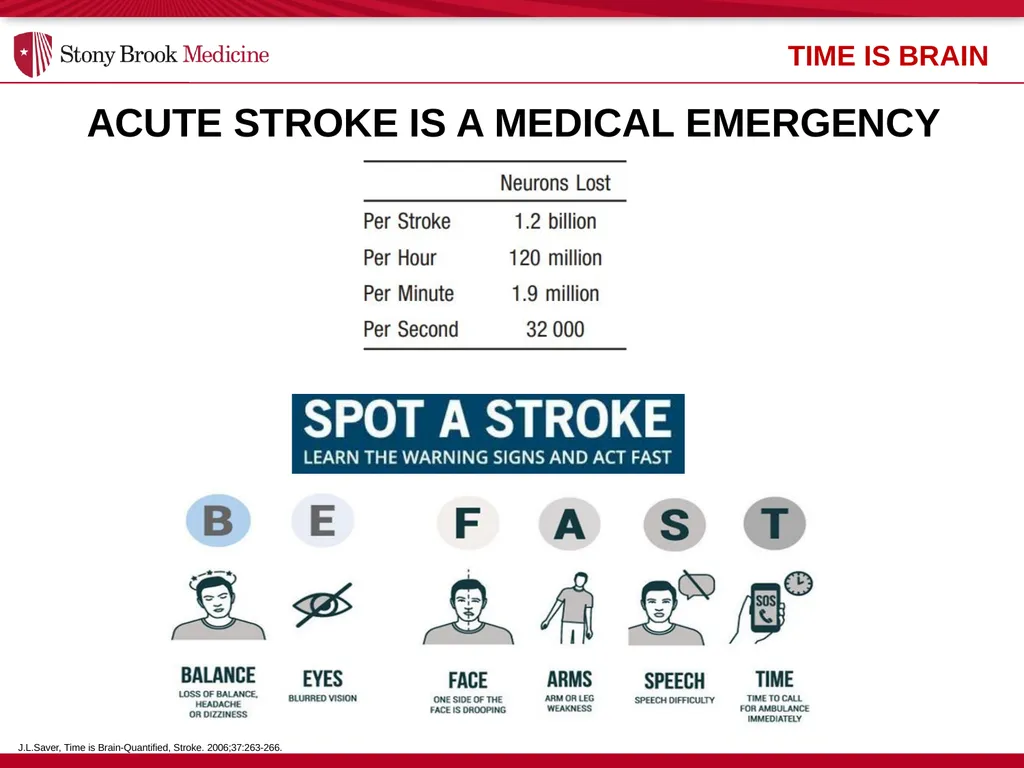
ACUTE STROKE IS A MEDICAL EMERGENCY J.L.Saver, Time is Brain-Quantified, Stroke. 2006;37:263-266. TIME IS BRAIN<br>
07
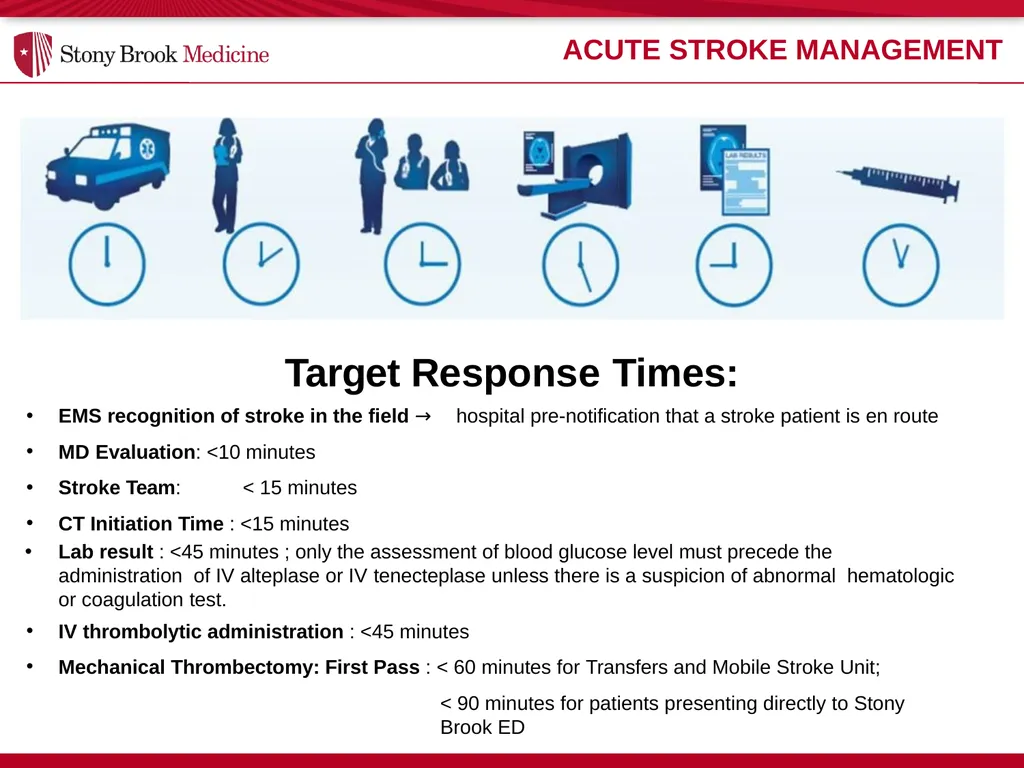
Target Response Times:
EMS recognition of stroke in the field → hospital pre-notification that a stroke patient is en route
MD Evaluation: <10 minutes
Stroke Team: < 15 minutes
CT Initiation Time : <15 minutes
Lab result : <45 minutes ; only the assessment of blood glucose level must precede the administration of IV alteplase or IV tenecteplase unless there is a suspicion of abnormal hematologic or coagulation test.
IV thrombolytic administration : <45 minutes
Mechanical Thrombectomy: First Pass : < 60 minutes for Transfers and Mobile Stroke Unit;
< 90 minutes for patients presenting directly to Stony Brook ED ACUTE STROKE MANAGEMENT<br>
EMS recognition of stroke in the field → hospital pre-notification that a stroke patient is en route
MD Evaluation: <10 minutes
Stroke Team: < 15 minutes
CT Initiation Time : <15 minutes
Lab result : <45 minutes ; only the assessment of blood glucose level must precede the administration of IV alteplase or IV tenecteplase unless there is a suspicion of abnormal hematologic or coagulation test.
IV thrombolytic administration : <45 minutes
Mechanical Thrombectomy: First Pass : < 60 minutes for Transfers and Mobile Stroke Unit;
< 90 minutes for patients presenting directly to Stony Brook ED ACUTE STROKE MANAGEMENT<br>
08
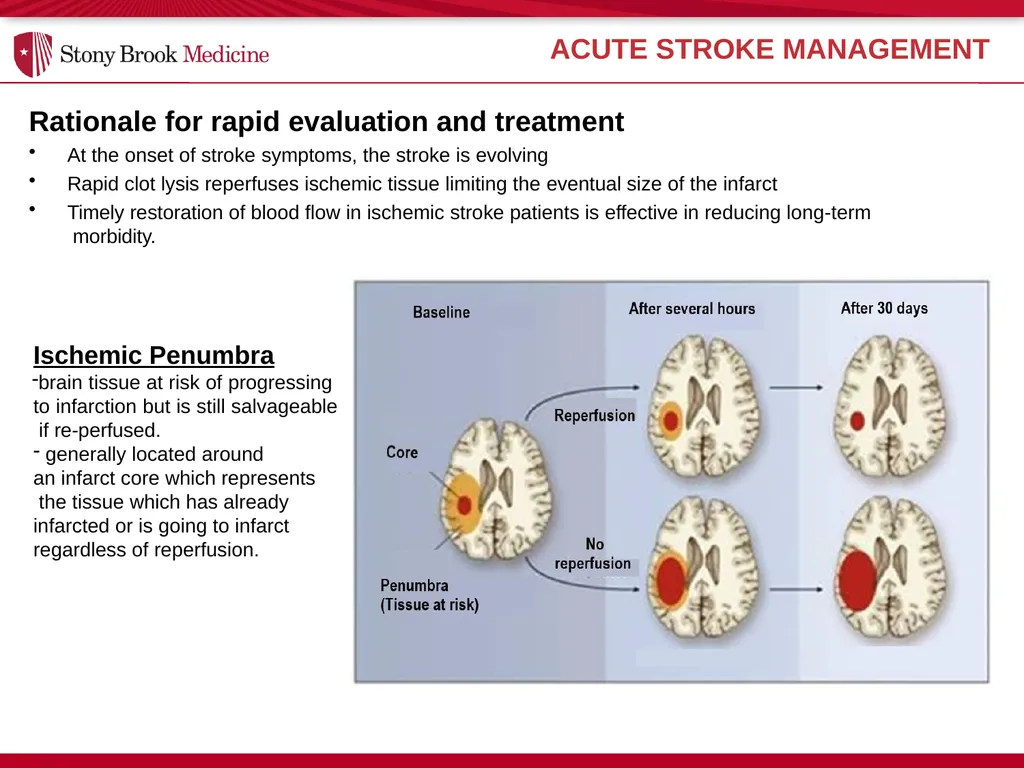
Rationale for rapid evaluation and treatment
At the onset of stroke symptoms, the stroke is evolving
Rapid clot lysis reperfuses ischemic tissue limiting the eventual size of the infarct
Timely restoration of blood flow in ischemic stroke patients is effective in reducing long-term morbidity. ACUTE STROKE MANAGEMENT Ischemic Penumbra
brain tissue at risk of progressing to infarction but is still salvageable if re-perfused.
generally located around
an infarct core which represents the tissue which has already infarcted or is going to infarct regardless of reperfusion.<br>
At the onset of stroke symptoms, the stroke is evolving
Rapid clot lysis reperfuses ischemic tissue limiting the eventual size of the infarct
Timely restoration of blood flow in ischemic stroke patients is effective in reducing long-term morbidity. ACUTE STROKE MANAGEMENT Ischemic Penumbra
brain tissue at risk of progressing to infarction but is still salvageable if re-perfused.
generally located around
an infarct core which represents the tissue which has already infarcted or is going to infarct regardless of reperfusion.<br>
09
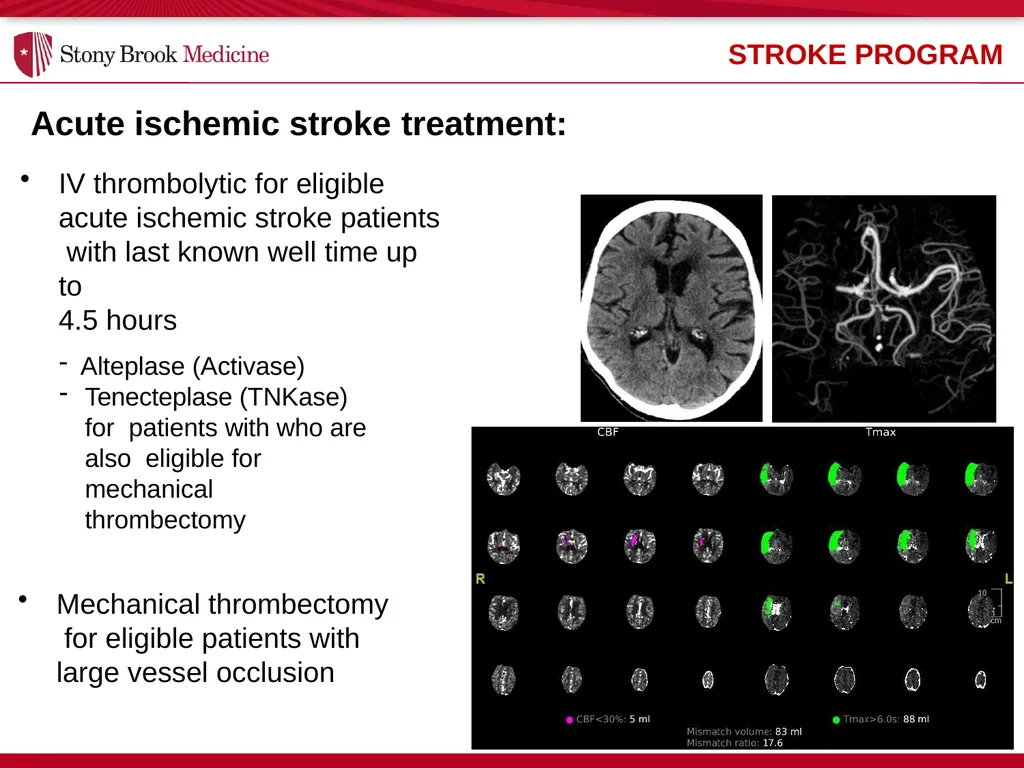
Acute ischemic stroke treatment: IV thrombolytic for eligible acute ischemic stroke patients with last known well time up to
4.5 hours
Alteplase (Activase)
Tenecteplase (TNKase) for patients with who are also eligible for mechanical thrombectomy
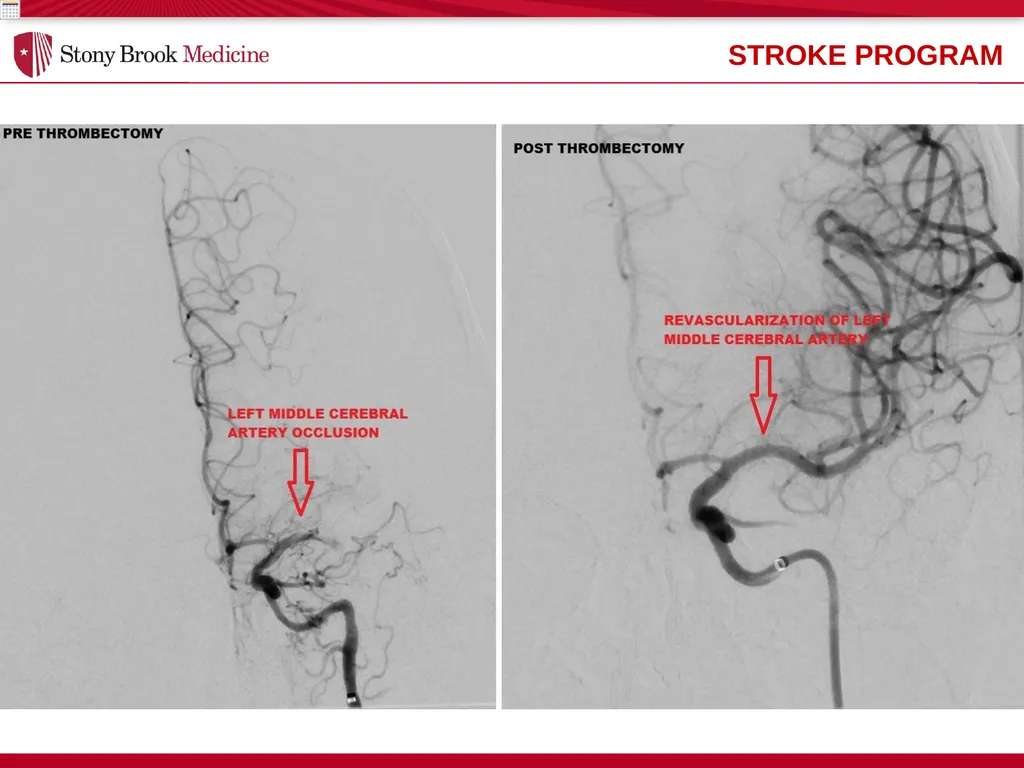
Mechanical thrombectomy for eligible patients with large vessel occlusion STROKE PROGRAM<br>
4.5 hours
Alteplase (Activase)
Tenecteplase (TNKase) for patients with who are also eligible for mechanical thrombectomy
Mechanical thrombectomy for eligible patients with large vessel occlusion STROKE PROGRAM<br>
10
STROKE PROGRAM<br>
11
Stony Brook Em,ergency Departm,ent Acute Strok,e Teaim Activations ,. 'I ... ... Pathway#l
Patient arrives to ED via EMS or walk In with
AC71VE signs and or symproms of a stroke
{Parioots wM remlvea symptoms wW fol/aw the T.IA parl1WfIJ1}
. Triage stuff member performs and dowment5 LAMS +Speech 5co{:e ,. ""I ,. ,. ' Score<4 AND
>6hours
fmmlast
known well at Srore<4AND
6hours
from last known wefl at
presentlltion presentation Score 4 AND
0-24 hours
from last
known well at presentation ... -' ... ... ' • --,, ""I ' Triage Nurse actNates CODE SAT Triage Nurse octJwttes CODECS/ ... ' NOCOOE
.Notlfy MD '"pom,tia1stroke" MD may .aalvofe
CODE SAT or .,- II IF APPROPRIATE \. r ""I , ,. --, Neurology responds :- f-----,"" 1/ ICH or LVO ls d/so:Jvered the dlrddtm will ac:tJvote I,,._ ... Iii,.. r to rapidly evaluate the patient forTPA and intervention
... Pathw:ay# 2
Patient Is transferred from another hospital With an lschemlc:stroke or spontaneou.s; non
troumatk /m:t:fJCronJQI ge EMS natifies Stroke Neurolorn Resident and NeumS11rgei:,y PA/NP of the es.timam:t time of arrival. 11ie ptlng PbyslcJan or wlR notify EMS lf a CODE BAT orCODE est fs tobemHed,. ff QITf ls . on amvol and lf thepatient ·l'lfH bypm:, theED/w sulte \._ ' ,. "I EMS actlYates
CODESAT
TRANSFER"
at1.0 minute ETA "' ... , II 1 .., .,) r Neurology, Neurosurgery and
Cerebrovascular Team
respond to rapidly evaluate the
patient for intervention Pathway#3
An)IEDpatlent NCIT'pnvlousl,J
asseSstM as part of a stroke
..C. ODE"" found to hove anew
sponw non-traumatfc m tnxtanioJ heroormage \. Revi ewed: August .25, .20 .21<br>
Patient arrives to ED via EMS or walk In with
AC71VE signs and or symproms of a stroke
{Parioots wM remlvea symptoms wW fol/aw the T.IA parl1WfIJ1}
. Triage stuff member performs and dowment5 LAMS +Speech 5co{:e ,. ""I ,. ,. ' Score<4 AND
>6hours
fmmlast
known well at Srore<4AND
6hours
from last known wefl at
presentlltion presentation Score 4 AND
0-24 hours
from last
known well at presentation ... -' ... ... ' • --,, ""I ' Triage Nurse actNates CODE SAT Triage Nurse octJwttes CODECS/ ... ' NOCOOE
.Notlfy MD '"pom,tia1stroke" MD may .aalvofe
CODE SAT or .,- II IF APPROPRIATE \. r ""I , ,. --, Neurology responds :- f-----,"" 1/ ICH or LVO ls d/so:Jvered the dlrddtm will ac:tJvote I,,._ ... Iii,.. r to rapidly evaluate the patient forTPA and intervention
... Pathw:ay# 2
Patient Is transferred from another hospital With an lschemlc:stroke or spontaneou.s; non
troumatk /m:t:fJCronJQI ge EMS natifies Stroke Neurolorn Resident and NeumS11rgei:,y PA/NP of the es.timam:t time of arrival. 11ie ptlng PbyslcJan or wlR notify EMS lf a CODE BAT orCODE est fs tobemHed,. ff QITf ls . on amvol and lf thepatient ·l'lfH bypm:, theED/w sulte \._ ' ,. "I EMS actlYates
CODESAT
TRANSFER"
at1.0 minute ETA "' ... , II 1 .., .,) r Neurology, Neurosurgery and
Cerebrovascular Team
respond to rapidly evaluate the
patient for intervention Pathway#3
An)IEDpatlent NCIT'pnvlousl,J
asseSstM as part of a stroke
..C. ODE"" found to hove anew
sponw non-traumatfc m tnxtanioJ heroormage \. Revi ewed: August .25, .20 .21<br>
12
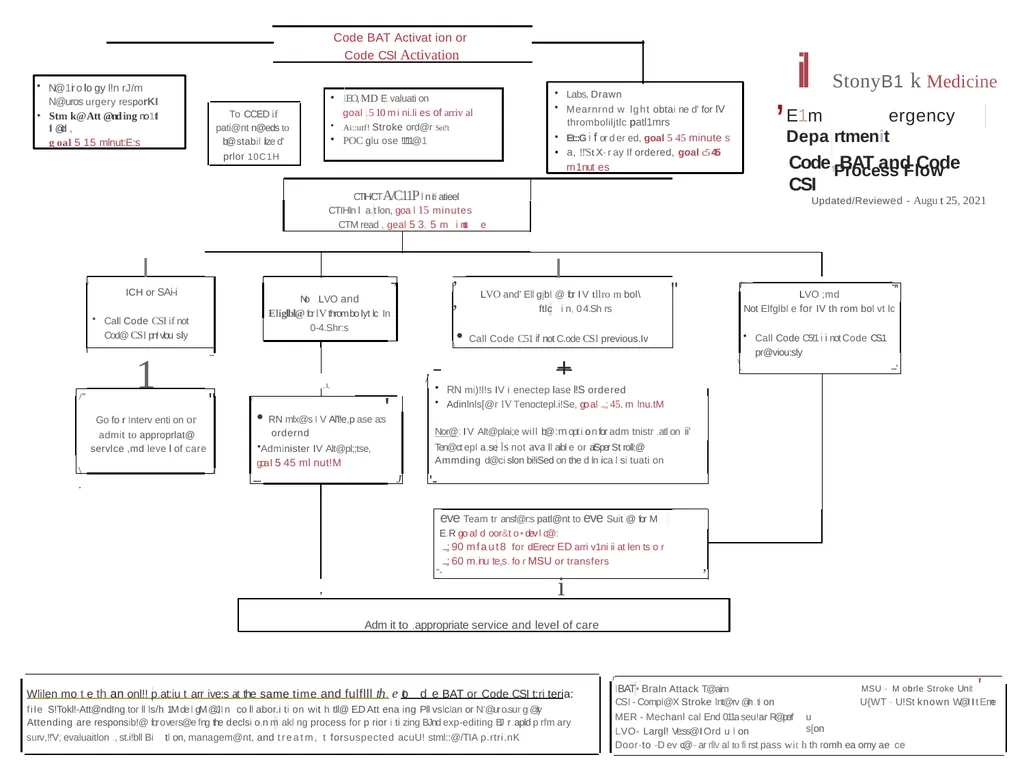
Code BAT Activat ion or Code CSI Activation N@1ir o lo gy l!n rJ/m N@uros urgery resporKI
Stm k@ Att @nd ing no1tl fi @d ,
g oal 5 15 mlnut:E:s To CCED if pati@nt n@eds to b@ stabil lize d'
prlor 10C1H Labs, Drawn
Mearnrnd w lght obtai ne d' for IV
thromboliljtlc patl1mrs
Et::G i f or d er ed, goal 5 45 minute s
a, !!'St X- r ay If ordered, goal c5 45
m 1nut es CTIH/CTA/C11P l n iti atieel CTIHln l a,t lon, goa l 15 minutes
CTM read , geal 5 3, 5 m i nut e I I / .., ,, ICH or SAi-i " LVO and' Ell gjbl @ for I V tllro m bol\ftlc i n, 0 4.Sh rs Call Code CSI if not Cod@ CSI pn! vlou sly No LVO and
Eliglbl@ for IV throm bo lyt lc In 0-4.Shr:s Call Code C51 if not C.ode CSI previous.Iv \. --' 1 + \ I' -.,,
LVO ;md
Not Elfglbl e for IV th rom bol vt lc
Call Code C5!1 i i not Code CS.1 pr@viou:sly
. --' , I, /" " /
RN mi)!l!s IV i enectep lase l!S ordered / ' Adinlnls[@r IV Tenoctepl.i!Se, go al ..,; 45. m lnu.tM Go fo r Interv enti on or admit to approprlat@ servlce ,md leve l of care \. Nor@: I V Alt@plai;e will b@ :m opt i o n for adm tnistr ,atl on ii' Ten@ct epl a,se Is not ava ll aibl e or aiS per St roll:@ Ammding d@ci slon bi!iSed on the d ln ica l si tuati on _,I RN mlx@s I V Al'l!e,p ase a:s ordernd
Administer IV Alt@pl;;tse, goa l 5 45 ml nut!M
.... J '- . eve Team tr ansf@r:s patl@nt to eve Suit @ for M E.R go al d oor&t o • dev l c@:
..,; 90 mfaut8 for dErecr ED arri v1ni ii at len ts o r
..,; 60 m,inu te,s. fo r MSU or transfers "- , , i Adm it to .appropriate service and level of care ,1 il StonyB1 k Medicine E1m ergency Depa rtmenit
Code, BAT and Code CSI Process Flow Updated/Reviewed - Augu t 25, 2021 Wlilen mo t e th an onl!! p,at:iu t arr ive:s at the same time and fulflll th, e to d e BAT or Code CSI t:ri teria:
file S!Tokl!-Att@ndIng tor ll ls/h 1M de l gM @J, I n co ll abor.i ti on wit h tll@ E.D Att ena ing Pll vslclan or N'@ur o.sur g @ry Attending are responsib!@ for o vers@e fng the d eclsi o,n m akl ng process for p rior i ti zing BJnd exp-editing BJ r .apld p rfm ary
surv,!!'V; evaluaitlon ., st.i!bll Bi tl on, managem@nt, and treatm, t forsuspected acuU! stml::@/TIA p.rtri.nK u s[on r
IBAT• BraIn Attack T@aim
CSI - Cornpl@X Stroke lnt@rv @n ti on
MER - Mechanl cal End 011a seu!ar R@perf LVO- Largl! Ve:ss@I Ord u l on Door-to -D ev c@ - ar rllv al to fi rst pass wit h th romh ea omy ae ce MSU - M obrle Stroke Unit '
U{WT - U!St known W@I I t Eme<br>
Stm k@ Att @nd ing no1tl fi @d ,
g oal 5 15 mlnut:E:s To CCED if pati@nt n@eds to b@ stabil lize d'
prlor 10C1H Labs, Drawn
Mearnrnd w lght obtai ne d' for IV
thromboliljtlc patl1mrs
Et::G i f or d er ed, goal 5 45 minute s
a, !!'St X- r ay If ordered, goal c5 45
m 1nut es CTIH/CTA/C11P l n iti atieel CTIHln l a,t lon, goa l 15 minutes
CTM read , geal 5 3, 5 m i nut e I I / .., ,, ICH or SAi-i " LVO and' Ell gjbl @ for I V tllro m bol\ftlc i n, 0 4.Sh rs Call Code CSI if not Cod@ CSI pn! vlou sly No LVO and
Eliglbl@ for IV throm bo lyt lc In 0-4.Shr:s Call Code C51 if not C.ode CSI previous.Iv \. --' 1 + \ I' -.,,
LVO ;md
Not Elfglbl e for IV th rom bol vt lc
Call Code C5!1 i i not Code CS.1 pr@viou:sly
. --' , I, /" " /
RN mi)!l!s IV i enectep lase l!S ordered / ' Adinlnls[@r IV Tenoctepl.i!Se, go al ..,; 45. m lnu.tM Go fo r Interv enti on or admit to approprlat@ servlce ,md leve l of care \. Nor@: I V Alt@plai;e will b@ :m opt i o n for adm tnistr ,atl on ii' Ten@ct epl a,se Is not ava ll aibl e or aiS per St roll:@ Ammding d@ci slon bi!iSed on the d ln ica l si tuati on _,I RN mlx@s I V Al'l!e,p ase a:s ordernd
Administer IV Alt@pl;;tse, goa l 5 45 ml nut!M
.... J '- . eve Team tr ansf@r:s patl@nt to eve Suit @ for M E.R go al d oor&t o • dev l c@:
..,; 90 mfaut8 for dErecr ED arri v1ni ii at len ts o r
..,; 60 m,inu te,s. fo r MSU or transfers "- , , i Adm it to .appropriate service and level of care ,1 il StonyB1 k Medicine E1m ergency Depa rtmenit
Code, BAT and Code CSI Process Flow Updated/Reviewed - Augu t 25, 2021 Wlilen mo t e th an onl!! p,at:iu t arr ive:s at the same time and fulflll th, e to d e BAT or Code CSI t:ri teria:
file S!Tokl!-Att@ndIng tor ll ls/h 1M de l gM @J, I n co ll abor.i ti on wit h tll@ E.D Att ena ing Pll vslclan or N'@ur o.sur g @ry Attending are responsib!@ for o vers@e fng the d eclsi o,n m akl ng process for p rior i ti zing BJnd exp-editing BJ r .apld p rfm ary
surv,!!'V; evaluaitlon ., st.i!bll Bi tl on, managem@nt, and treatm, t forsuspected acuU! stml::@/TIA p.rtri.nK u s[on r
IBAT• BraIn Attack T@aim
CSI - Cornpl@X Stroke lnt@rv @n ti on
MER - Mechanl cal End 011a seu!ar R@perf LVO- Largl! Ve:ss@I Ord u l on Door-to -D ev c@ - ar rllv al to fi rst pass wit h th romh ea omy ae ce MSU - M obrle Stroke Unit '
U{WT - U!St known W@I I t Eme<br>
13
CTH Init i at ed
goal :5a 25 rn imut es
str etch goaI ::, 1 5 m inu t es CTH read
goa l :<o 3 5 rn imut e s ' ' St n Br okM d i cni
Inpati ent Cod e IBAl
Pro cess Flow
Updated/ Re vie wed:
May :mo , 2022 Stroke Att end ing or d esi gn ee ooIlab orat es. w it h eve Team
for pati ents wit h lVO eve gro up page Neu rn su rgery ConsuIt Tra nsp ort to CT by th e Pr im ary Team
Phy sic ian / PA/ NP, ICU comp et ent RN or
St ro k e IICR oom p et en t R N No t ify Prim ary Team if no t yet aware
Primary Team and / o r RN stay at bed si de t o gjve SBAR i nfo rm at i on to St ro k e Team
EJ(<1mp l e : l KW,T Sympto m s disoovery ti m,e pert in ent PM H and h ospita l
c::o u rs,e if o n an tiicoa gulati on, re cen t
sur ge ifY
Primary Team orders Co die BAT CT
ima ging Obt ain Bloo d Su g ar leve l
Obt <1i n Vit al Sig ns
Send lab w ork i f n eeded
Make su re p at ien t has wo rking IV access
Con nect t o t ransport monit or
M e asur ed we ight o bt ained for IV th ro mb olyti c pat ients Go for inte rv,ent ion or continue mana gem ent p er Pr im ary Team o r
t ransfer to a pp ro pr iate service and level of c<1re l r 'i'ES IV tllro mbolytk For IV tlhrombolytic ad111in i str ation :
Call 13 N Charge RN if the Co de BAI is in t h e o ld h os pi t al
bu il din g
ca ll N OOU/ NICR Cha r ge RN if th e Gode BAI is in t he n ew ho.s.p i t c1I
p av ili on
13 N or NCCU / NICR RN w ill b r ing t he I V t hro mb olytti c t o t he Cod e BA T loc at ion 13N or NCCU / NIOR RN m i x es IV t h ro m bolyt ic <1.s. ord ere d
Adm in iste rs I V t PA go al :::: 6 0 m i n u t es
str etc h goa l 45 m in ut es IH >Jo
fo do11a oular
lnte,rventi on l'ES
E11dovasc111 l ar Interv ention l If going for ndo11am.1lar Interv enti on
j Transfe r t o
St ro ke Unit or IOU for
fu rt her mc1n agem ent M an ageme nt per Pr im ary Tea m or t ransfer t o
app ropriate l evel of ,ca re CVC Team ev<1I u <1t e s p ati en t P at ient t ra nsfer re dl to CVCS uite When the,ire is m or e t h an one Co de BAT callied sim ult an e0. 111s l y :
T h e Stro ke Att en ding (or desi gneel in coll abor at ion w ith t h e Pr im ary Team are r esp on sib le for ove rse eing t he d eci.s.i on-m c1k i n g p ro ce ss. fo r p ri or iti zing and e x:p edit ing a rap id primary surve,y eva lu.i t i on, st abili z.itio n,
..,m_ anagem en, t and tr eatm en t for su sp ect ed acut e stroke pat ient s. BAT- Bra in At ta dk Team
LKWT - Last Kno w n W e iI Time or last kn o w n t ime t o b e at b asel in e LVO - large Vessel Occlu 1sio n
CVC - Cerebrov ascular Cen te r<br>
goal :5a 25 rn imut es
str etch goaI ::, 1 5 m inu t es CTH read
goa l :<o 3 5 rn imut e s ' ' St n Br okM d i cni
Inpati ent Cod e IBAl
Pro cess Flow
Updated/ Re vie wed:
May :mo , 2022 Stroke Att end ing or d esi gn ee ooIlab orat es. w it h eve Team
for pati ents wit h lVO eve gro up page Neu rn su rgery ConsuIt Tra nsp ort to CT by th e Pr im ary Team
Phy sic ian / PA/ NP, ICU comp et ent RN or
St ro k e IICR oom p et en t R N No t ify Prim ary Team if no t yet aware
Primary Team and / o r RN stay at bed si de t o gjve SBAR i nfo rm at i on to St ro k e Team
EJ(<1mp l e : l KW,T Sympto m s disoovery ti m,e pert in ent PM H and h ospita l
c::o u rs,e if o n an tiicoa gulati on, re cen t
sur ge ifY
Primary Team orders Co die BAT CT
ima ging Obt ain Bloo d Su g ar leve l
Obt <1i n Vit al Sig ns
Send lab w ork i f n eeded
Make su re p at ien t has wo rking IV access
Con nect t o t ransport monit or
M e asur ed we ight o bt ained for IV th ro mb olyti c pat ients Go for inte rv,ent ion or continue mana gem ent p er Pr im ary Team o r
t ransfer to a pp ro pr iate service and level of c<1re l r 'i'ES IV tllro mbolytk For IV tlhrombolytic ad111in i str ation :
Call 13 N Charge RN if the Co de BAI is in t h e o ld h os pi t al
bu il din g
ca ll N OOU/ NICR Cha r ge RN if th e Gode BAI is in t he n ew ho.s.p i t c1I
p av ili on
13 N or NCCU / NICR RN w ill b r ing t he I V t hro mb olytti c t o t he Cod e BA T loc at ion 13N or NCCU / NIOR RN m i x es IV t h ro m bolyt ic <1.s. ord ere d
Adm in iste rs I V t PA go al :::: 6 0 m i n u t es
str etc h goa l 45 m in ut es IH >Jo
fo do11a oular
lnte,rventi on l'ES
E11dovasc111 l ar Interv ention l If going for ndo11am.1lar Interv enti on
j Transfe r t o
St ro ke Unit or IOU for
fu rt her mc1n agem ent M an ageme nt per Pr im ary Tea m or t ransfer t o
app ropriate l evel of ,ca re CVC Team ev<1I u <1t e s p ati en t P at ient t ra nsfer re dl to CVCS uite When the,ire is m or e t h an one Co de BAT callied sim ult an e0. 111s l y :
T h e Stro ke Att en ding (or desi gneel in coll abor at ion w ith t h e Pr im ary Team are r esp on sib le for ove rse eing t he d eci.s.i on-m c1k i n g p ro ce ss. fo r p ri or iti zing and e x:p edit ing a rap id primary surve,y eva lu.i t i on, st abili z.itio n,
..,m_ anagem en, t and tr eatm en t for su sp ect ed acut e stroke pat ient s. BAT- Bra in At ta dk Team
LKWT - Last Kno w n W e iI Time or last kn o w n t ime t o b e at b asel in e LVO - large Vessel Occlu 1sio n
CVC - Cerebrov ascular Cen te r<br>
14
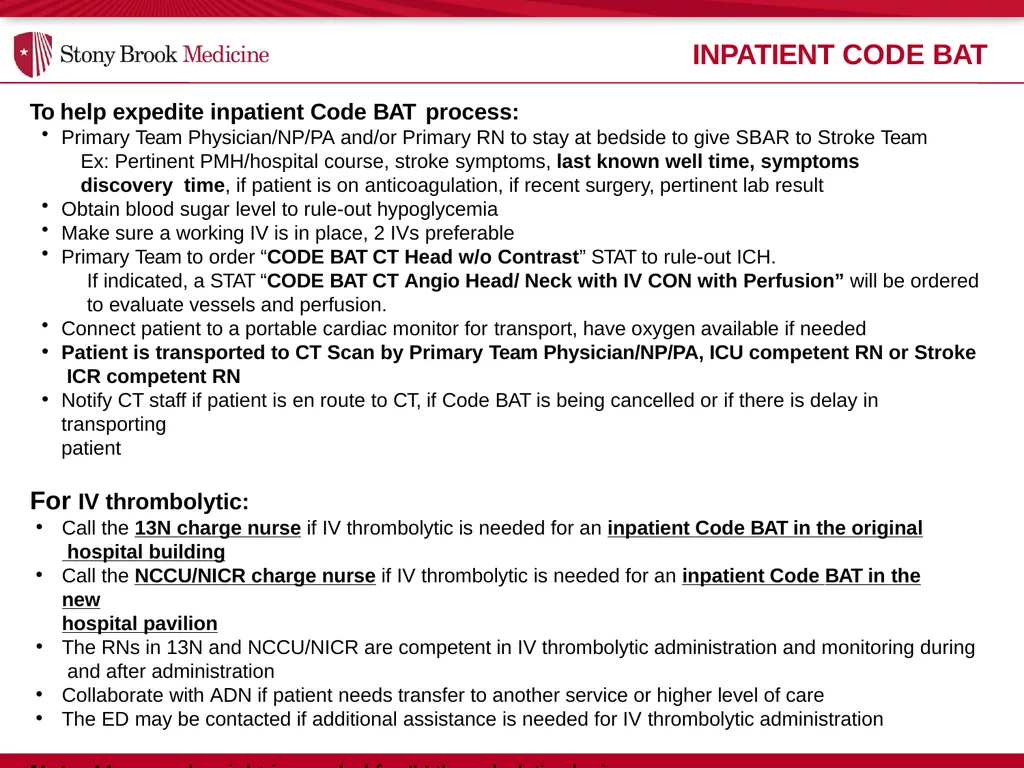
INPATIENT CODE BAT To help expedite inpatient Code BAT process:
Primary Team Physician/NP/PA and/or Primary RN to stay at bedside to give SBAR to Stroke Team
Ex: Pertinent PMH/hospital course, stroke symptoms, last known well time, symptoms discovery time, if patient is on anticoagulation, if recent surgery, pertinent lab result
Obtain blood sugar level to rule-out hypoglycemia
Make sure a working IV is in place, 2 IVs preferable
Primary Team to order “CODE BAT CT Head w/o Contrast” STAT to rule-out ICH.
If indicated, a STAT “CODE BAT CT Angio Head/ Neck with IV CON with Perfusion” will be ordered to evaluate vessels and perfusion.
Connect patient to a portable cardiac monitor for transport, have oxygen available if needed
Patient is transported to CT Scan by Primary Team Physician/NP/PA, ICU competent RN or Stroke ICR competent RN
Notify CT staff if patient is en route to CT, if Code BAT is being cancelled or if there is delay in transporting
patient
For IV thrombolytic:
Call the 13N charge nurse if IV thrombolytic is needed for an inpatient Code BAT in the original hospital building
Call the NCCU/NICR charge nurse if IV thrombolytic is needed for an inpatient Code BAT in the new
hospital pavilion
The RNs in 13N and NCCU/NICR are competent in IV thrombolytic administration and monitoring during and after administration
Collaborate with ADN if patient needs transfer to another service or higher level of care
The ED may be contacted if additional assistance is needed for IV thrombolytic administration
Note: Measured weight is needed for IV thrombolytic dosing<br>
Primary Team Physician/NP/PA and/or Primary RN to stay at bedside to give SBAR to Stroke Team
Ex: Pertinent PMH/hospital course, stroke symptoms, last known well time, symptoms discovery time, if patient is on anticoagulation, if recent surgery, pertinent lab result
Obtain blood sugar level to rule-out hypoglycemia
Make sure a working IV is in place, 2 IVs preferable
Primary Team to order “CODE BAT CT Head w/o Contrast” STAT to rule-out ICH.
If indicated, a STAT “CODE BAT CT Angio Head/ Neck with IV CON with Perfusion” will be ordered to evaluate vessels and perfusion.
Connect patient to a portable cardiac monitor for transport, have oxygen available if needed
Patient is transported to CT Scan by Primary Team Physician/NP/PA, ICU competent RN or Stroke ICR competent RN
Notify CT staff if patient is en route to CT, if Code BAT is being cancelled or if there is delay in transporting
patient
For IV thrombolytic:
Call the 13N charge nurse if IV thrombolytic is needed for an inpatient Code BAT in the original hospital building
Call the NCCU/NICR charge nurse if IV thrombolytic is needed for an inpatient Code BAT in the new
hospital pavilion
The RNs in 13N and NCCU/NICR are competent in IV thrombolytic administration and monitoring during and after administration
Collaborate with ADN if patient needs transfer to another service or higher level of care
The ED may be contacted if additional assistance is needed for IV thrombolytic administration
Note: Measured weight is needed for IV thrombolytic dosing<br>
15
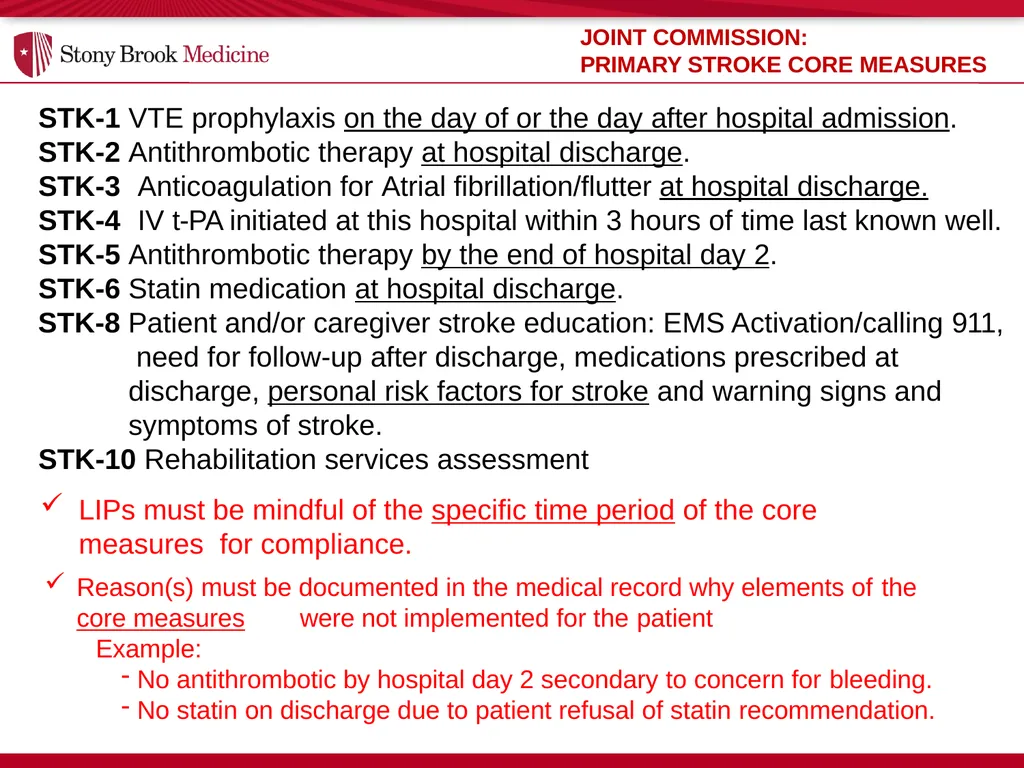
JOINT COMMISSION:
PRIMARY STROKE CORE MEASURES STK-1 VTE prophylaxis on the day of or the day after hospital admission.
STK-2 Antithrombotic therapy at hospital discharge. STK-3 Anticoagulation for Atrial fibrillation/flutter at hospital discharge.
STK-4 IV t-PA initiated at this hospital within 3 hours of time last known well.
STK-5 Antithrombotic therapy by the end of hospital day 2.
STK-6 Statin medication at hospital discharge.
STK-8 Patient and/or caregiver stroke education: EMS Activation/calling 911, need for follow-up after discharge, medications prescribed at discharge, personal risk factors for stroke and warning signs and symptoms of stroke.
STK-10 Rehabilitation services assessment
LIPs must be mindful of the specific time period of the core measures for compliance.
Reason(s) must be documented in the medical record why elements of the
core measures were not implemented for the patient
Example:
No antithrombotic by hospital day 2 secondary to concern for bleeding.
No statin on discharge due to patient refusal of statin recommendation.<br>
PRIMARY STROKE CORE MEASURES STK-1 VTE prophylaxis on the day of or the day after hospital admission.
STK-2 Antithrombotic therapy at hospital discharge. STK-3 Anticoagulation for Atrial fibrillation/flutter at hospital discharge.
STK-4 IV t-PA initiated at this hospital within 3 hours of time last known well.
STK-5 Antithrombotic therapy by the end of hospital day 2.
STK-6 Statin medication at hospital discharge.
STK-8 Patient and/or caregiver stroke education: EMS Activation/calling 911, need for follow-up after discharge, medications prescribed at discharge, personal risk factors for stroke and warning signs and symptoms of stroke.
STK-10 Rehabilitation services assessment
LIPs must be mindful of the specific time period of the core measures for compliance.
Reason(s) must be documented in the medical record why elements of the
core measures were not implemented for the patient
Example:
No antithrombotic by hospital day 2 secondary to concern for bleeding.
No statin on discharge due to patient refusal of statin recommendation.<br>
16
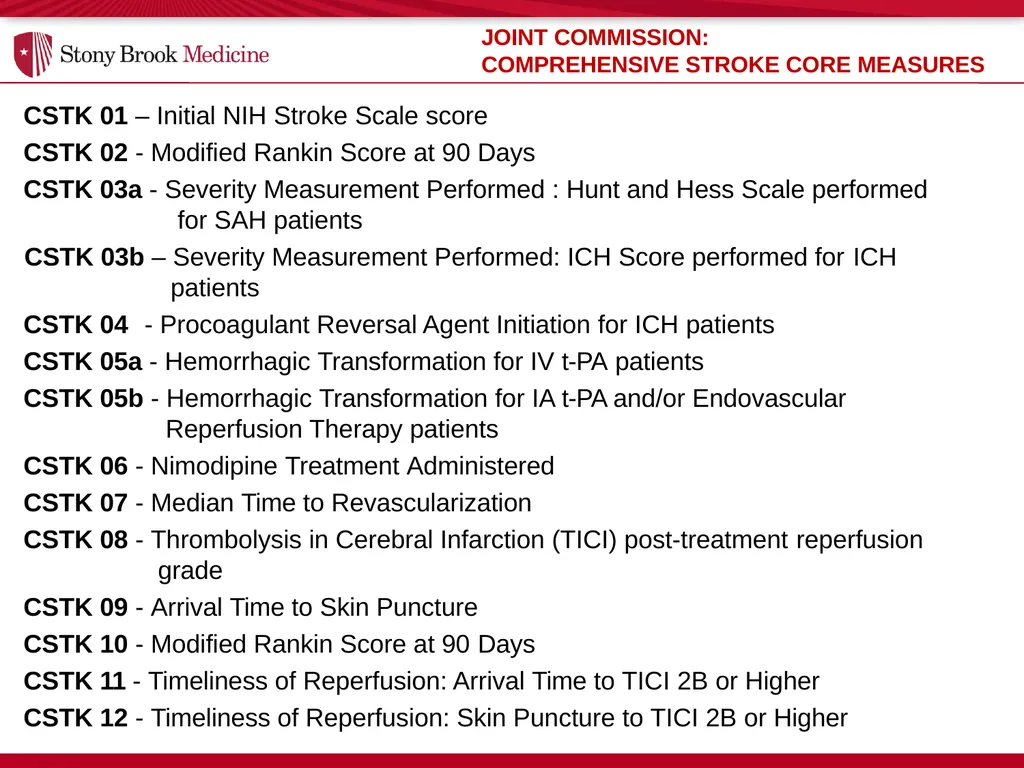
JOINT COMMISSION:
COMPREHENSIVE STROKE CORE MEASURES
CSTK 01 – Initial NIH Stroke Scale score
CSTK 02 - Modified Rankin Score at 90 Days
CSTK 03a - Severity Measurement Performed : Hunt and Hess Scale performed for SAH patients
CSTK 03b – Severity Measurement Performed: ICH Score performed for ICH
patients
CSTK 04 - Procoagulant Reversal Agent Initiation for ICH patients
CSTK 05a - Hemorrhagic Transformation for IV t-PA patients
CSTK 05b - Hemorrhagic Transformation for IA t-PA and/or Endovascular
Reperfusion Therapy patients
CSTK 06 - Nimodipine Treatment Administered
CSTK 07 - Median Time to Revascularization
CSTK 08 - Thrombolysis in Cerebral Infarction (TICI) post-treatment reperfusion
grade
CSTK 09 - Arrival Time to Skin Puncture
CSTK 10 - Modified Rankin Score at 90 Days
CSTK 11 - Timeliness of Reperfusion: Arrival Time to TICI 2B or Higher
CSTK 12 - Timeliness of Reperfusion: Skin Puncture to TICI 2B or Higher<br>
COMPREHENSIVE STROKE CORE MEASURES
CSTK 01 – Initial NIH Stroke Scale score
CSTK 02 - Modified Rankin Score at 90 Days
CSTK 03a - Severity Measurement Performed : Hunt and Hess Scale performed for SAH patients
CSTK 03b – Severity Measurement Performed: ICH Score performed for ICH
patients
CSTK 04 - Procoagulant Reversal Agent Initiation for ICH patients
CSTK 05a - Hemorrhagic Transformation for IV t-PA patients
CSTK 05b - Hemorrhagic Transformation for IA t-PA and/or Endovascular
Reperfusion Therapy patients
CSTK 06 - Nimodipine Treatment Administered
CSTK 07 - Median Time to Revascularization
CSTK 08 - Thrombolysis in Cerebral Infarction (TICI) post-treatment reperfusion
grade
CSTK 09 - Arrival Time to Skin Puncture
CSTK 10 - Modified Rankin Score at 90 Days
CSTK 11 - Timeliness of Reperfusion: Arrival Time to TICI 2B or Higher
CSTK 12 - Timeliness of Reperfusion: Skin Puncture to TICI 2B or Higher<br>
17
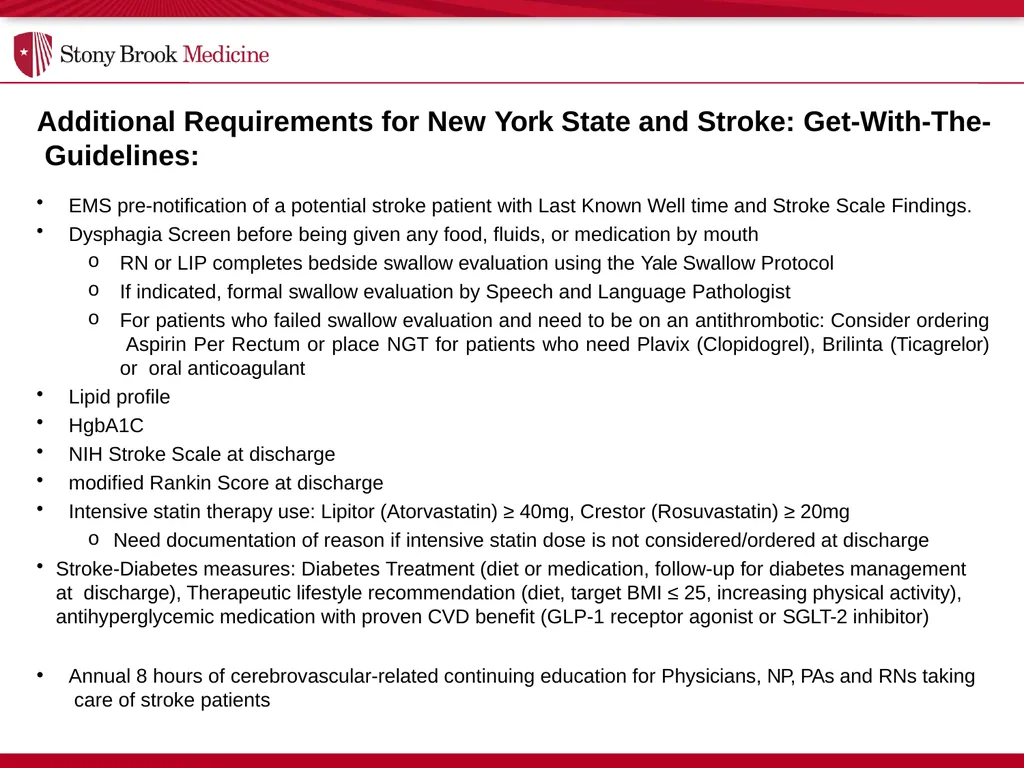
Additional Requirements for New York State and Stroke: Get-With-The- Guidelines: EMS pre-notification of a potential stroke patient with Last Known Well time and Stroke Scale Findings.
Dysphagia Screen before being given any food, fluids, or medication by mouth
RN or LIP completes bedside swallow evaluation using the Yale Swallow Protocol
If indicated, formal swallow evaluation by Speech and Language Pathologist
For patients who failed swallow evaluation and need to be on an antithrombotic: Consider ordering Aspirin Per Rectum or place NGT for patients who need Plavix (Clopidogrel), Brilinta (Ticagrelor) or oral anticoagulant
Lipid profile
HgbA1C
NIH Stroke Scale at discharge
modified Rankin Score at discharge
Intensive statin therapy use: Lipitor (Atorvastatin) ≥ 40mg, Crestor (Rosuvastatin) ≥ 20mg
Need documentation of reason if intensive statin dose is not considered/ordered at discharge
Stroke-Diabetes measures: Diabetes Treatment (diet or medication, follow-up for diabetes management at discharge), Therapeutic lifestyle recommendation (diet, target BMI ≤ 25, increasing physical activity), antihyperglycemic medication with proven CVD benefit (GLP-1 receptor agonist or SGLT-2 inhibitor)
Annual 8 hours of cerebrovascular-related continuing education for Physicians, NP, PAs and RNs taking care of stroke patients<br>
Dysphagia Screen before being given any food, fluids, or medication by mouth
RN or LIP completes bedside swallow evaluation using the Yale Swallow Protocol
If indicated, formal swallow evaluation by Speech and Language Pathologist
For patients who failed swallow evaluation and need to be on an antithrombotic: Consider ordering Aspirin Per Rectum or place NGT for patients who need Plavix (Clopidogrel), Brilinta (Ticagrelor) or oral anticoagulant
Lipid profile
HgbA1C
NIH Stroke Scale at discharge
modified Rankin Score at discharge
Intensive statin therapy use: Lipitor (Atorvastatin) ≥ 40mg, Crestor (Rosuvastatin) ≥ 20mg
Need documentation of reason if intensive statin dose is not considered/ordered at discharge
Stroke-Diabetes measures: Diabetes Treatment (diet or medication, follow-up for diabetes management at discharge), Therapeutic lifestyle recommendation (diet, target BMI ≤ 25, increasing physical activity), antihyperglycemic medication with proven CVD benefit (GLP-1 receptor agonist or SGLT-2 inhibitor)
Annual 8 hours of cerebrovascular-related continuing education for Physicians, NP, PAs and RNs taking care of stroke patients<br>
18
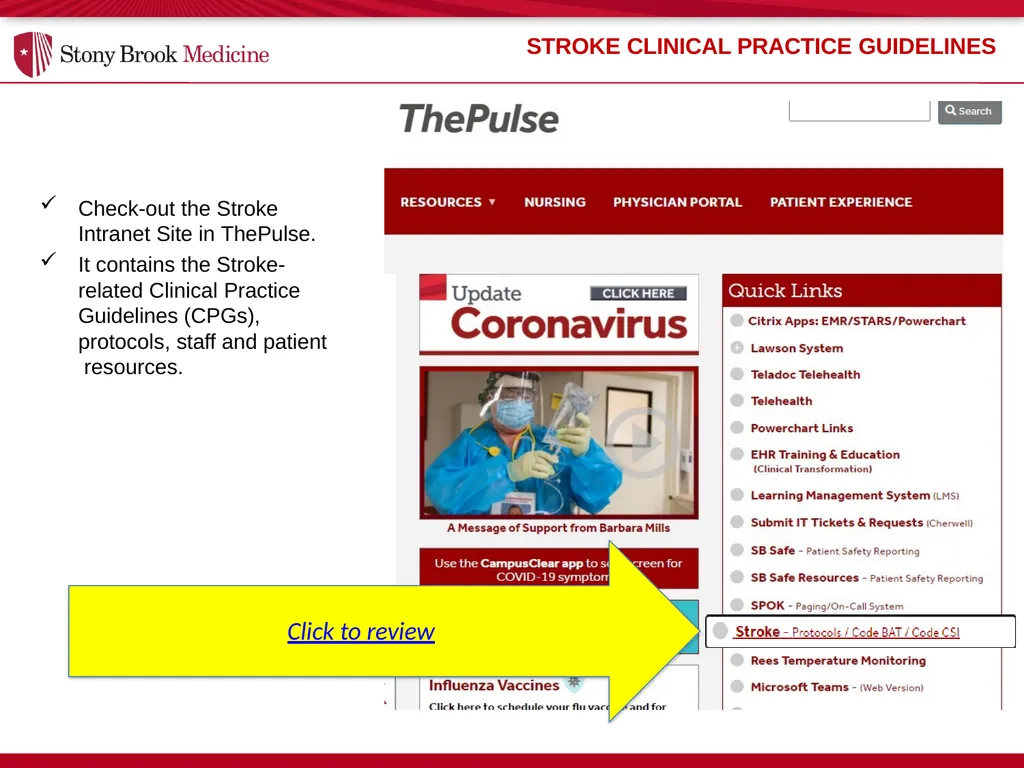
Check-out the Stroke Intranet Site in ThePulse.
It contains the Stroke- related Clinical Practice Guidelines (CPGs), protocols, staff and patient resources. Click to review STROKE CLINICAL PRACTICE GUIDELINES<br>
It contains the Stroke- related Clinical Practice Guidelines (CPGs), protocols, staff and patient resources. Click to review STROKE CLINICAL PRACTICE GUIDELINES<br>
19
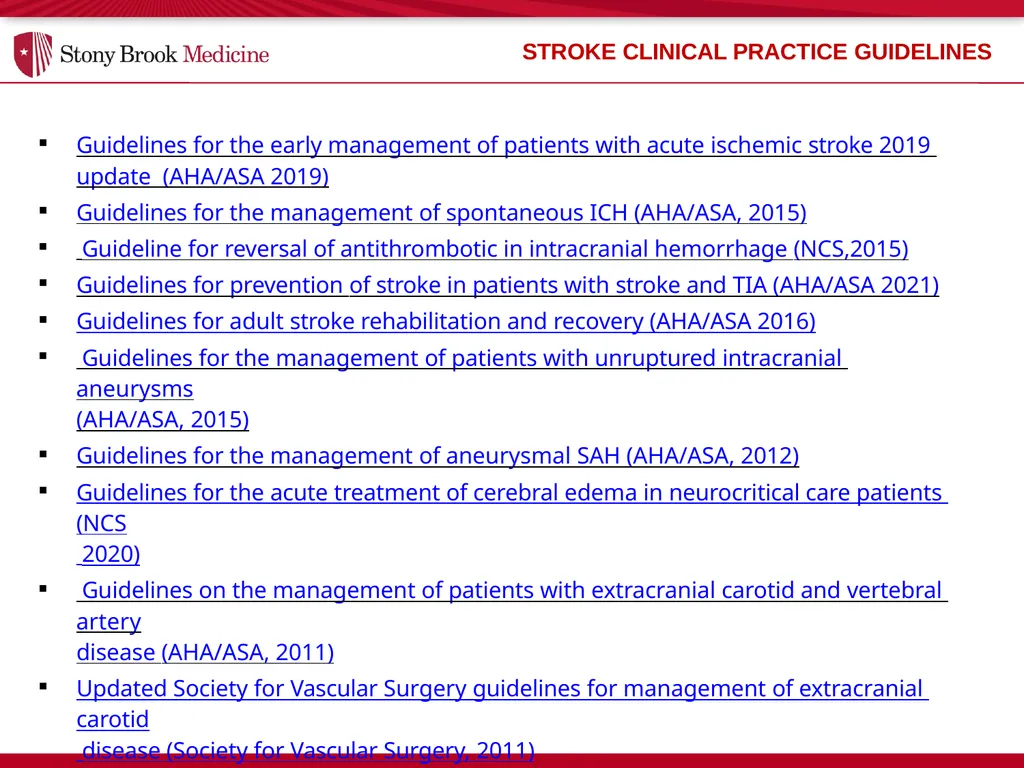
STROKE CLINICAL PRACTICE GUIDELINES
Guidelines for the early management of patients with acute ischemic stroke 2019 update (AHA/ASA 2019)
Guidelines for the management of spontaneous ICH (AHA/ASA, 2015)
Guideline for reversal of antithrombotic in intracranial hemorrhage (NCS,2015)
Guidelines for prevention of stroke in patients with stroke and TIA (AHA/ASA 2021)
Guidelines for adult stroke rehabilitation and recovery (AHA/ASA 2016)
Guidelines for the management of patients with unruptured intracranial aneurysms
(AHA/ASA, 2015)
Guidelines for the management of aneurysmal SAH (AHA/ASA, 2012)
Guidelines for the acute treatment of cerebral edema in neurocritical care patients (NCS
2020)
Guidelines on the management of patients with extracranial carotid and vertebral artery
disease (AHA/ASA, 2011)
Updated Society for Vascular Surgery guidelines for management of extracranial carotid
disease (Society for Vascular Surgery, 2011)
The Society for Vascular Surgery practice guidelines on follow-up after vascular surgery
arterial procedures (Society for Vascular Surgery, 2018)<br>
Guidelines for the early management of patients with acute ischemic stroke 2019 update (AHA/ASA 2019)
Guidelines for the management of spontaneous ICH (AHA/ASA, 2015)
Guideline for reversal of antithrombotic in intracranial hemorrhage (NCS,2015)
Guidelines for prevention of stroke in patients with stroke and TIA (AHA/ASA 2021)
Guidelines for adult stroke rehabilitation and recovery (AHA/ASA 2016)
Guidelines for the management of patients with unruptured intracranial aneurysms
(AHA/ASA, 2015)
Guidelines for the management of aneurysmal SAH (AHA/ASA, 2012)
Guidelines for the acute treatment of cerebral edema in neurocritical care patients (NCS
2020)
Guidelines on the management of patients with extracranial carotid and vertebral artery
disease (AHA/ASA, 2011)
Updated Society for Vascular Surgery guidelines for management of extracranial carotid
disease (Society for Vascular Surgery, 2011)
The Society for Vascular Surgery practice guidelines on follow-up after vascular surgery
arterial procedures (Society for Vascular Surgery, 2018)<br>
20
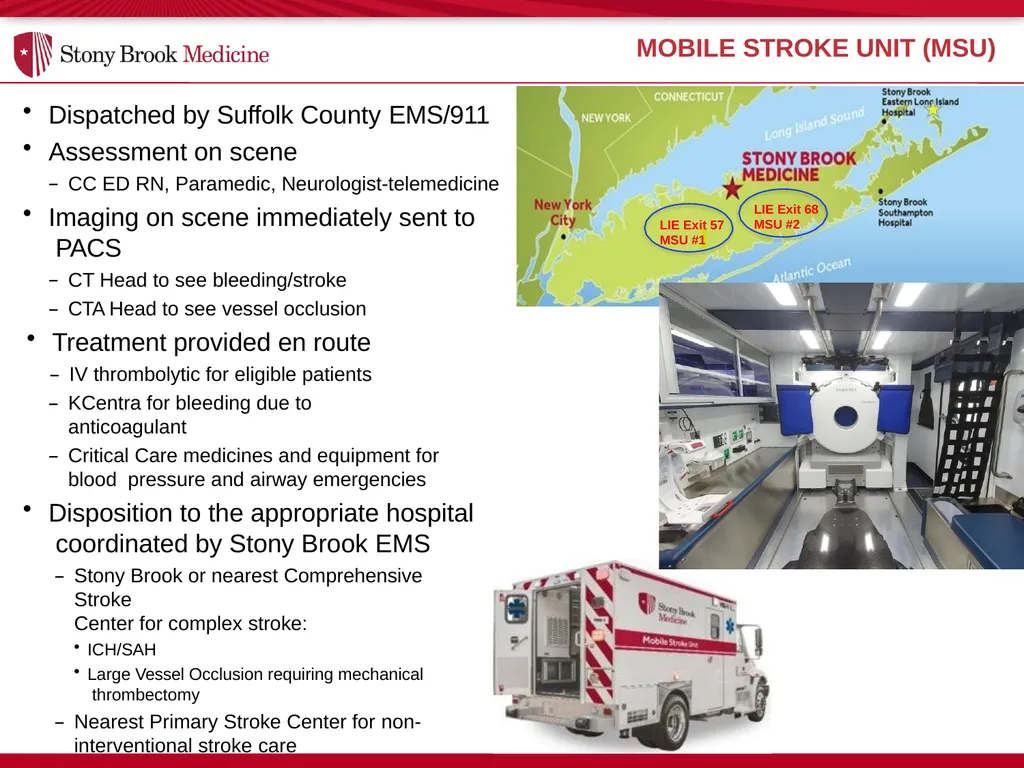
Dispatched by Suffolk County EMS/911
Assessment on scene
CC ED RN, Paramedic, Neurologist-telemedicine
Imaging on scene immediately sent to PACS
CT Head to see bleeding/stroke
CTA Head to see vessel occlusion
Treatment provided en route
IV thrombolytic for eligible patients
KCentra for bleeding due to anticoagulant
Critical Care medicines and equipment for blood pressure and airway emergencies
Disposition to the appropriate hospital coordinated by Stony Brook EMS
Stony Brook or nearest Comprehensive Stroke
Center for complex stroke:
ICH/SAH
Large Vessel Occlusion requiring mechanical thrombectomy
Nearest Primary Stroke Center for non-
interventional stroke care MOBILE STROKE UNIT (MSU) LIE Exit 57
MSU #1 LIE Exit 68
MSU #2<br>
Assessment on scene
CC ED RN, Paramedic, Neurologist-telemedicine
Imaging on scene immediately sent to PACS
CT Head to see bleeding/stroke
CTA Head to see vessel occlusion
Treatment provided en route
IV thrombolytic for eligible patients
KCentra for bleeding due to anticoagulant
Critical Care medicines and equipment for blood pressure and airway emergencies
Disposition to the appropriate hospital coordinated by Stony Brook EMS
Stony Brook or nearest Comprehensive Stroke
Center for complex stroke:
ICH/SAH
Large Vessel Occlusion requiring mechanical thrombectomy
Nearest Primary Stroke Center for non-
interventional stroke care MOBILE STROKE UNIT (MSU) LIE Exit 57
MSU #1 LIE Exit 68
MSU #2<br>
21
Stroke Support Group
Receive encouragement, feedback and inspiration. Gain knowledge. Learn about helpful programs and resources. Open to all stroke survivors, family members and caregivers. Stroke Caregiver Support Group - Meets the second Tuesday of every month, 7pm-8pm Stroke Survivor Support Group - Meets the last Tuesday of every Month, 7pm-8pm
For more information, contact:
Tel: (631) 638-2638
Email: marret.anderson@stonybrookmedicine.edu, anne.froehlich@stonybrookmedicine.edu
Brain Aneurysm/ Arteriovenous Malformations (AVM) Support Group
This support group is co-sponsored by Stony Brook Medicine and the Brain Aneurysm Foundation.
Meets: Third Monday of each month (no meetings in July and August)
Time: 6PM to 7:30 PM
For more information, contact:
Tel: (631) 444-8121
Email: dawn.madigan@stonybrookmedicine.edu SUPPORT GROUPS<br>
Receive encouragement, feedback and inspiration. Gain knowledge. Learn about helpful programs and resources. Open to all stroke survivors, family members and caregivers. Stroke Caregiver Support Group - Meets the second Tuesday of every month, 7pm-8pm Stroke Survivor Support Group - Meets the last Tuesday of every Month, 7pm-8pm
For more information, contact:
Tel: (631) 638-2638
Email: marret.anderson@stonybrookmedicine.edu, anne.froehlich@stonybrookmedicine.edu
Brain Aneurysm/ Arteriovenous Malformations (AVM) Support Group
This support group is co-sponsored by Stony Brook Medicine and the Brain Aneurysm Foundation.
Meets: Third Monday of each month (no meetings in July and August)
Time: 6PM to 7:30 PM
For more information, contact:
Tel: (631) 444-8121
Email: dawn.madigan@stonybrookmedicine.edu SUPPORT GROUPS<br>
22
Thank you for all you do everyday for our stroke patients. For questions, contact:
Dr. Michael Guido
Stroke Program Medical Director michael.guido@stonybrookmedicine.edu
Antonieta Rosenberg
Nurse Practitioner - Stroke Service Antonieta.Rosenberg@stonybrookmedicine.edu
Anne Froehlich
Stroke Program Coordinator
anne.froehlich@stonybrookmedicine.edu<br>
Dr. Michael Guido
Stroke Program Medical Director michael.guido@stonybrookmedicine.edu
Antonieta Rosenberg
Nurse Practitioner - Stroke Service Antonieta.Rosenberg@stonybrookmedicine.edu
Anne Froehlich
Stroke Program Coordinator
anne.froehlich@stonybrookmedicine.edu<br>