Strategic Financial Management The Valuation of Long-Term Securities Khuram Raza ACMA, MS Finance Scholar Bond Valuation A bond is a long-term debt instrument issued by a corporation or government. Face Value Coupon Rate Different Types of
Related Topics
Share
Embed code
Download this presentation From Below
"Strategic Financial Management The Valuation of" is the property of its rightful owner. Permission is granted to
download and print the materials on this website for personal, non-commercial use only, and to display it
on your personal computer provided you do not modify the materials and that you retain all copyright
notices contained in the materials. By downloading content from our website, you accept the terms of this
agreement.
Presentation Transcript
01
Strategic Financial Management The Valuation of Long-Term Securities Khuram Raza
ACMA, MS Finance Scholar<br>
02
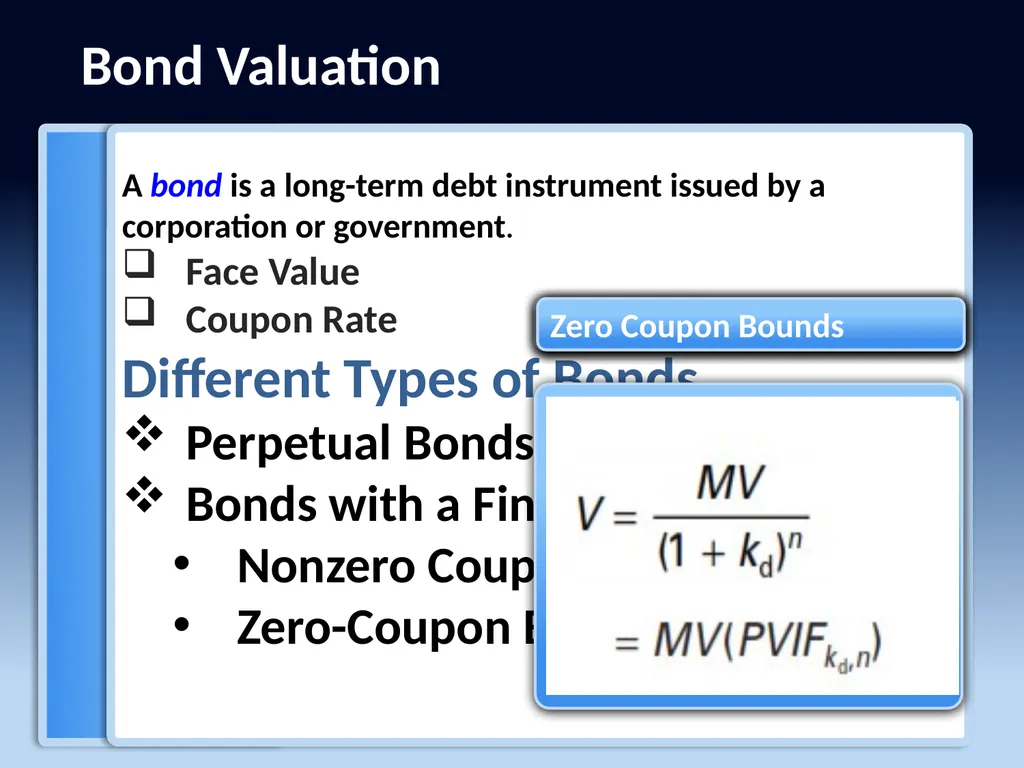
Bond Valuation A bond is a long-term debt instrument issued by a corporation or government.
Face Value
Coupon Rate
Different Types of Bonds
Perpetual Bonds
Bonds with a Finite Maturity
Nonzero Coupon Bonds.
Zero-Coupon Bonds Perpetual Bonds V = I / kd Nonzero Coupon Bounds Zero Coupon Bounds<br>
03
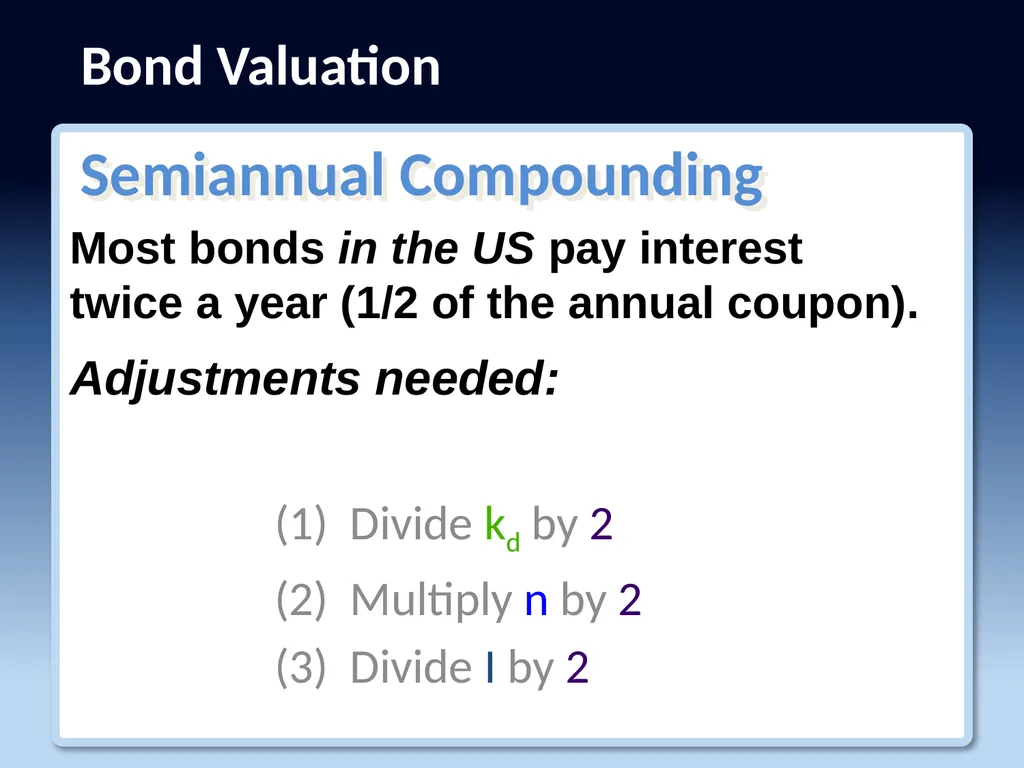
Bond Valuation Semiannual Compounding (1) Divide kd by 2
(2) Multiply n by 2
(3) Divide I by 2 Most bonds in the US pay interest twice a year (1/2 of the annual coupon).
Adjustments needed:<br>
04
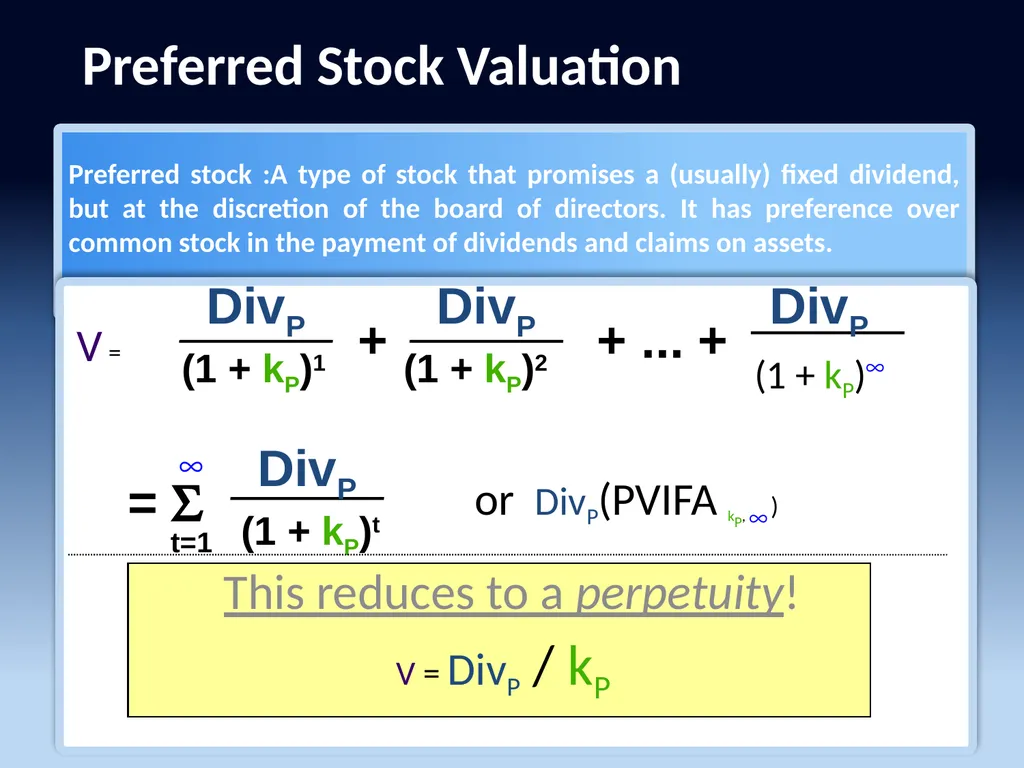
Preferred stock :A type of stock that promises a (usually) fixed dividend, but at the discretion of the board of directors. It has preference over common stock in the payment of dividends and claims on assets. Preferred Stock Valuation This reduces to a perpetuity! (1 + kP)1 (1 + kP)2 (1 + kP)¥ V = + + ... + DivP DivP DivP = S ¥ t=1 (1 + kP)t DivP or DivP(PVIFA kP, ¥ ) V = DivP / kP<br>
05
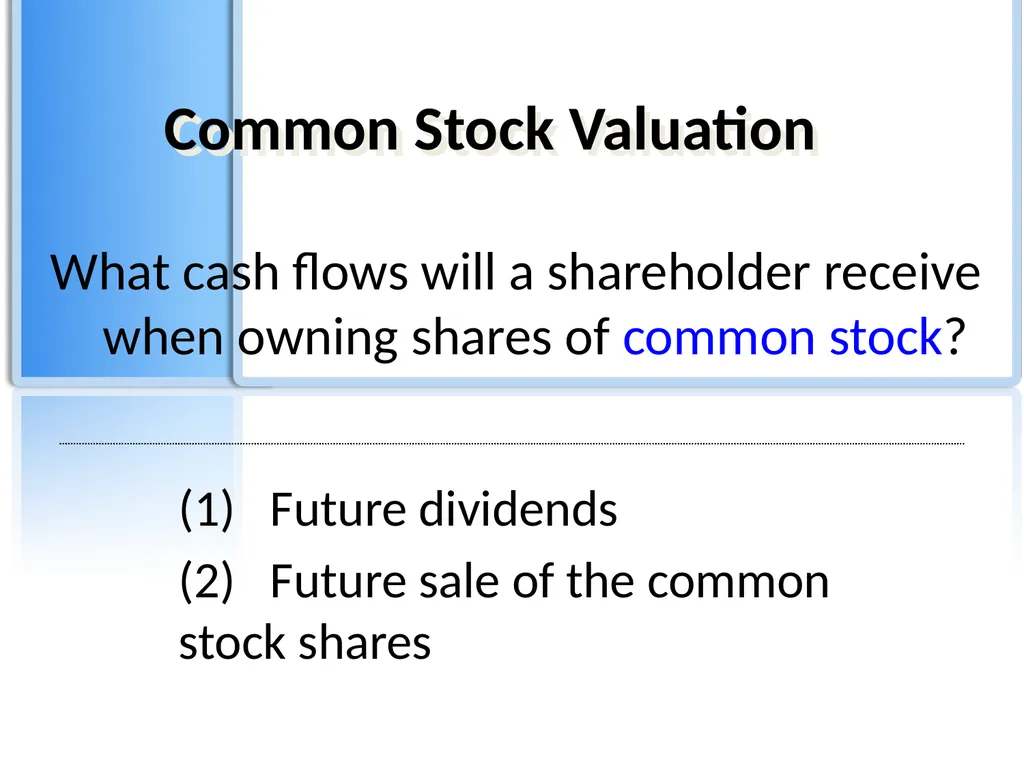
Common Stock Valuation (1) Future dividends
(2) Future sale of the common stock shares What cash flows will a shareholder receive when owning shares of common stock?<br>
06
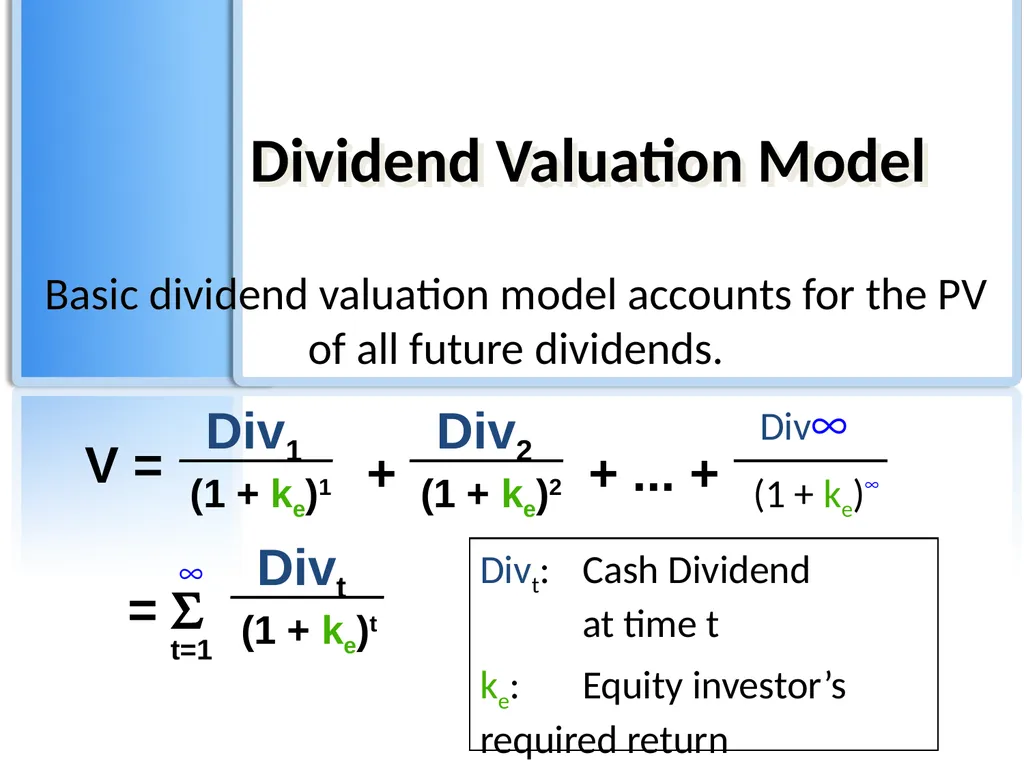
Dividend Valuation Model Basic dividend valuation model accounts for the PV of all future dividends. (1 + ke)1 (1 + ke)2 (1 + ke)¥ V = + + ... + Div1 Div¥ Div2 = S ¥ t=1 (1 + ke)t Divt Divt: Cash Dividend at time t
ke: Equity investor’s required return<br>
07
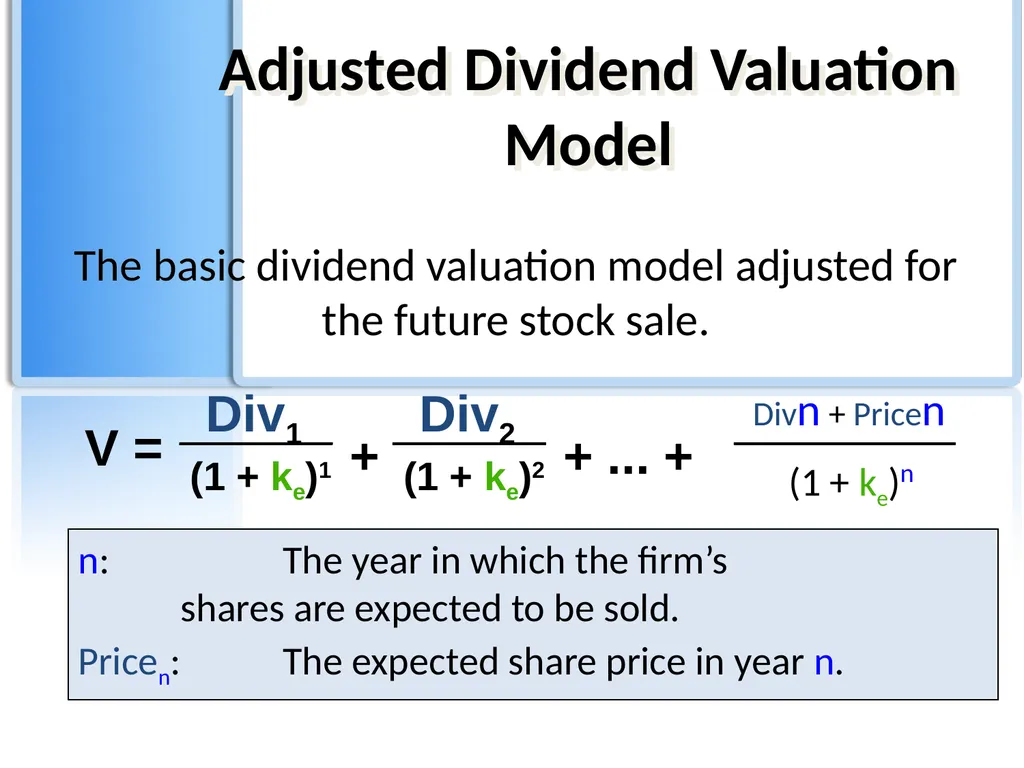
Adjusted Dividend Valuation Model The basic dividend valuation model adjusted for the future stock sale. (1 + ke)1 (1 + ke)2 (1 + ke)n V = + + ... + Div1 Divn + Pricen Div2 n: The year in which the firm’s shares are expected to be sold.
Pricen: The expected share price in year n.<br>
08
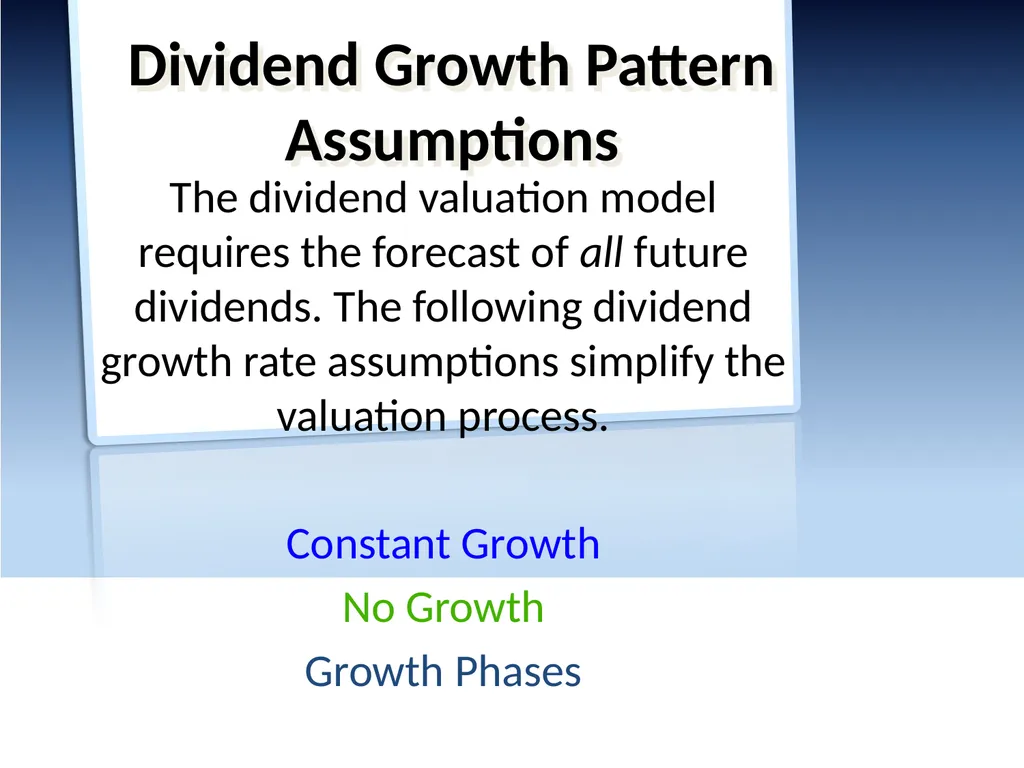
Dividend Growth Pattern Assumptions The dividend valuation model requires the forecast of all future dividends. The following dividend growth rate assumptions simplify the valuation process.
Constant Growth
No Growth
Growth Phases<br>
09
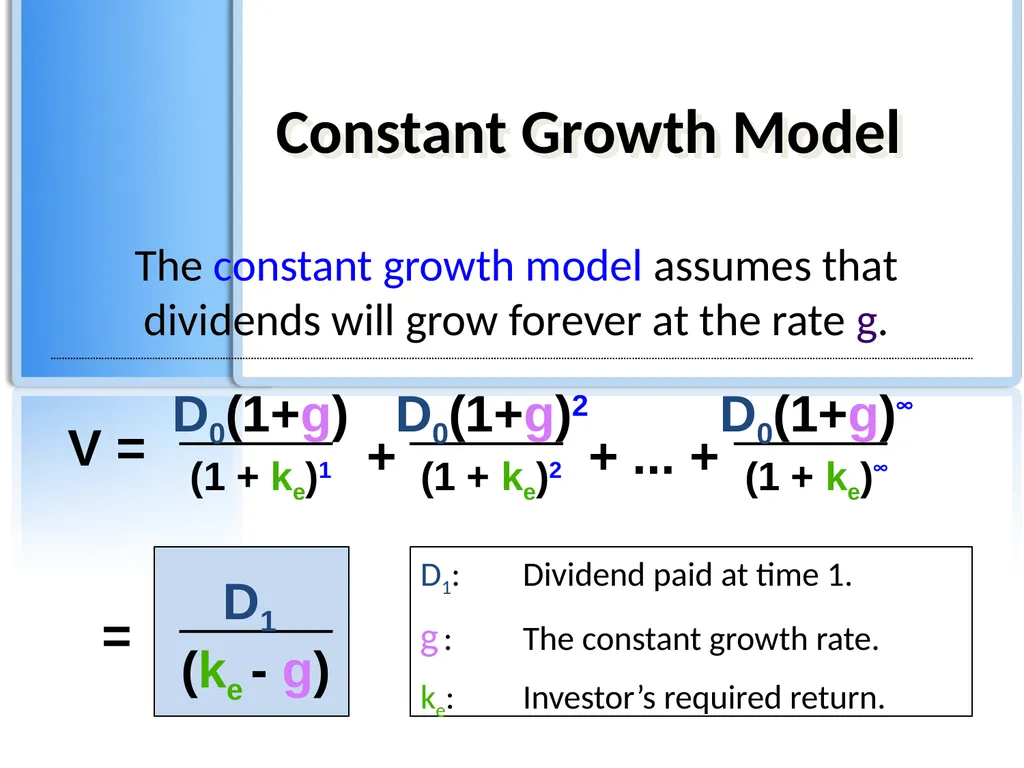
Constant Growth Model The constant growth model assumes that dividends will grow forever at the rate g. (1 + ke)1 (1 + ke)2 (1 + ke)¥ V = + + ... + D0(1+g) D0(1+g)¥ = (ke - g) D1 D1: Dividend paid at time 1.
g : The constant growth rate.
ke: Investor’s required return. D0(1+g)2<br>
10
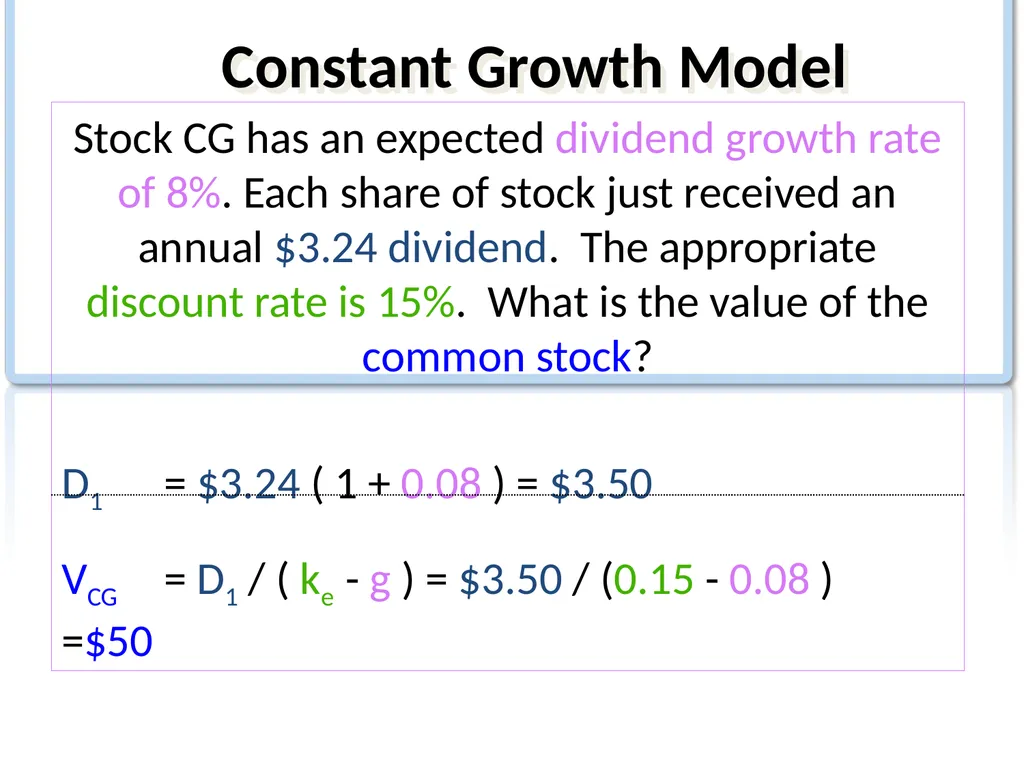
Constant Growth Model Stock CG has an expected dividend growth rate of 8%. Each share of stock just received an annual $3.24 dividend. The appropriate discount rate is 15%. What is the value of the common stock?
D1 = $3.24 ( 1 + 0.08 ) = $3.50
VCG = D1 / ( ke - g ) = $3.50 / (0.15 - 0.08 ) =$50<br>
11
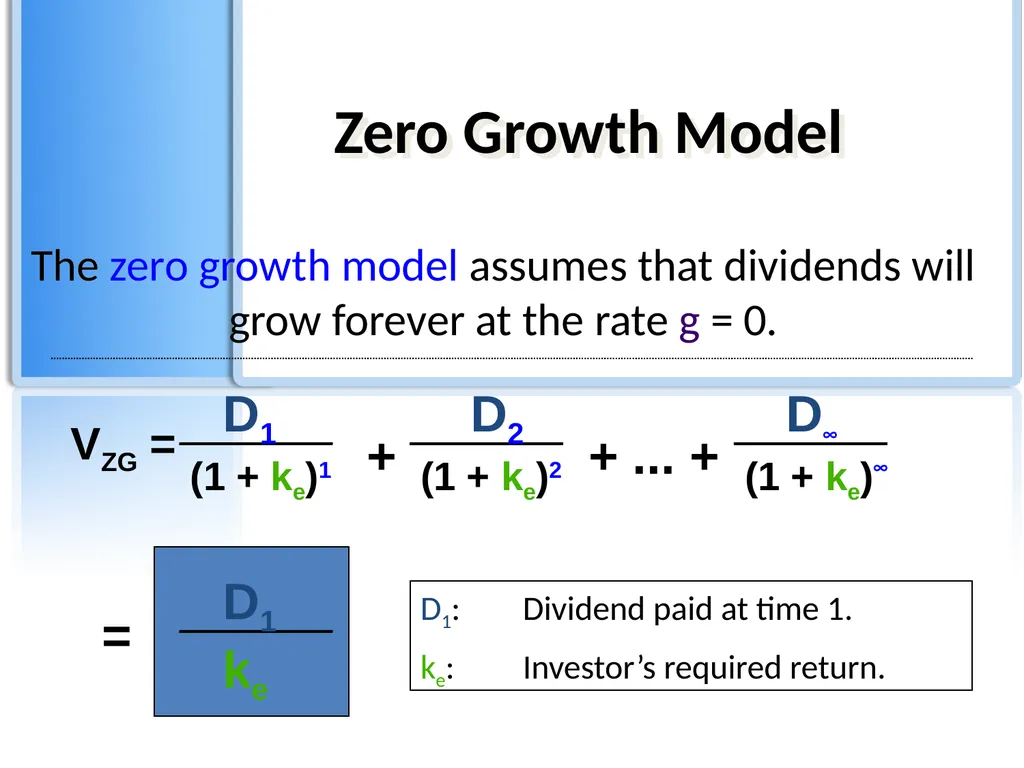
Zero Growth Model The zero growth model assumes that dividends will grow forever at the rate g = 0. (1 + ke)1 (1 + ke)2 (1 + ke)¥ VZG = + + ... + D1 D¥ = ke D1 D1: Dividend paid at time 1.
ke: Investor’s required return. D2<br>
12
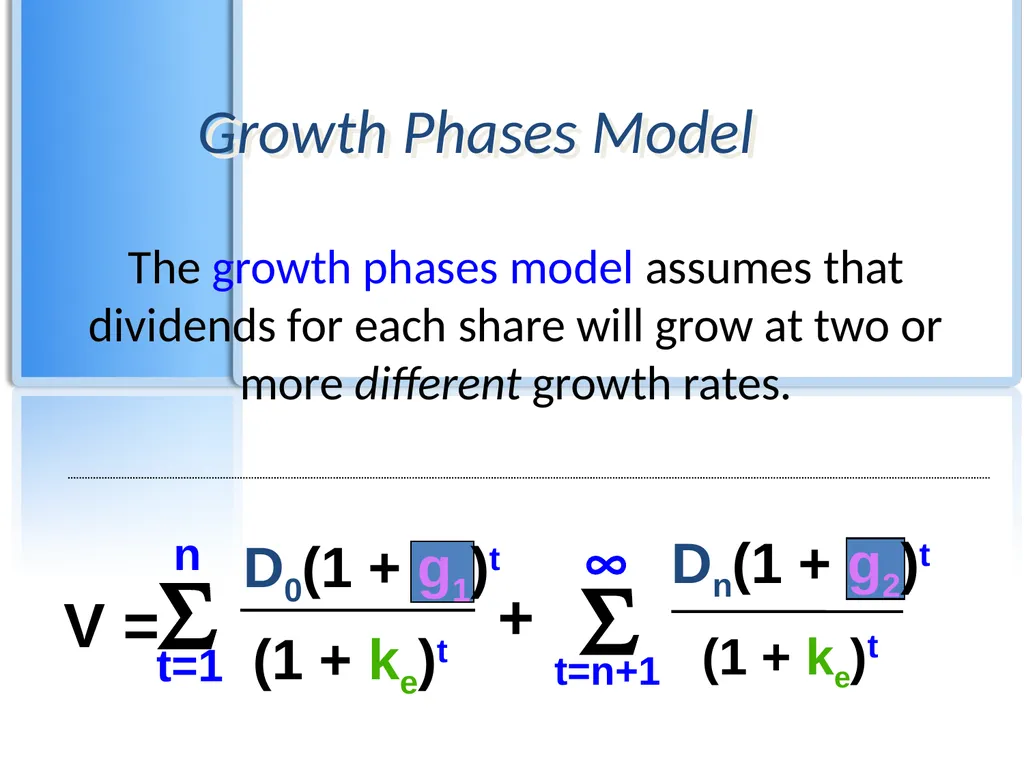
The growth phases model assumes that dividends for each share will grow at two or more different growth rates. (1 + ke)t (1 + ke)t V =S t=1 n S t=n+1 ¥ + D0(1 + g1)t Dn(1 + g2)t Growth Phases Model<br>
13
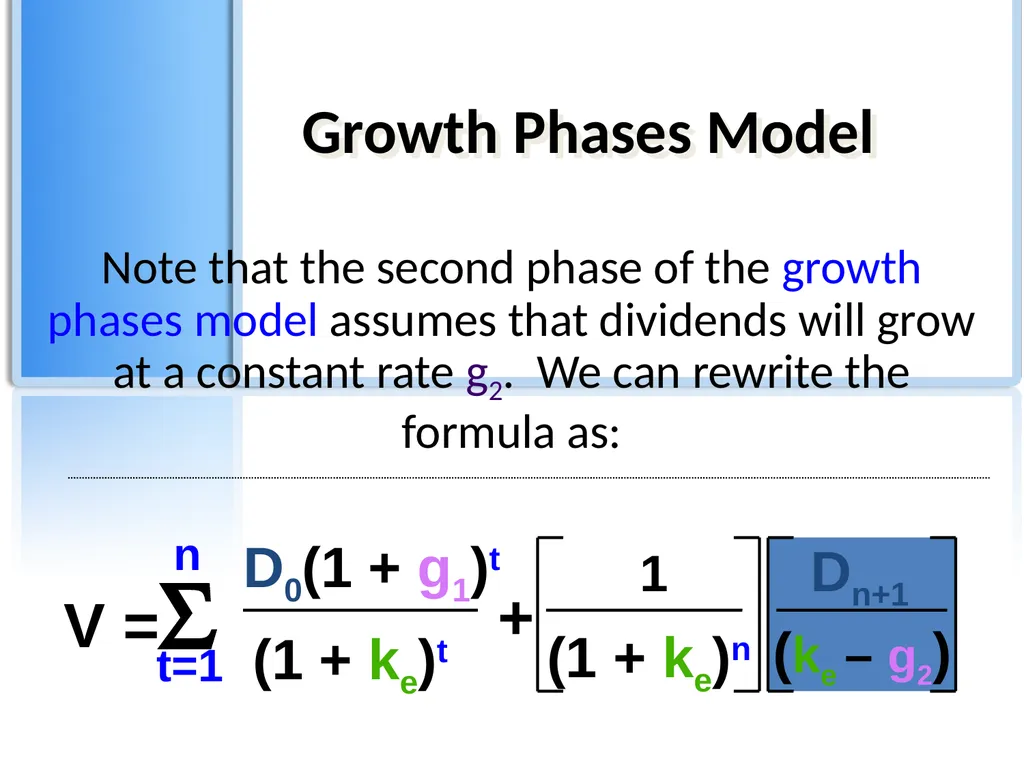
D0(1 + g1)t Dn+1 Growth Phases Model Note that the second phase of the growth phases model assumes that dividends will grow at a constant rate g2. We can rewrite the formula as: (1 + ke)t (ke – g2) V =S t=1 n + 1 (1 + ke)n<br>
14
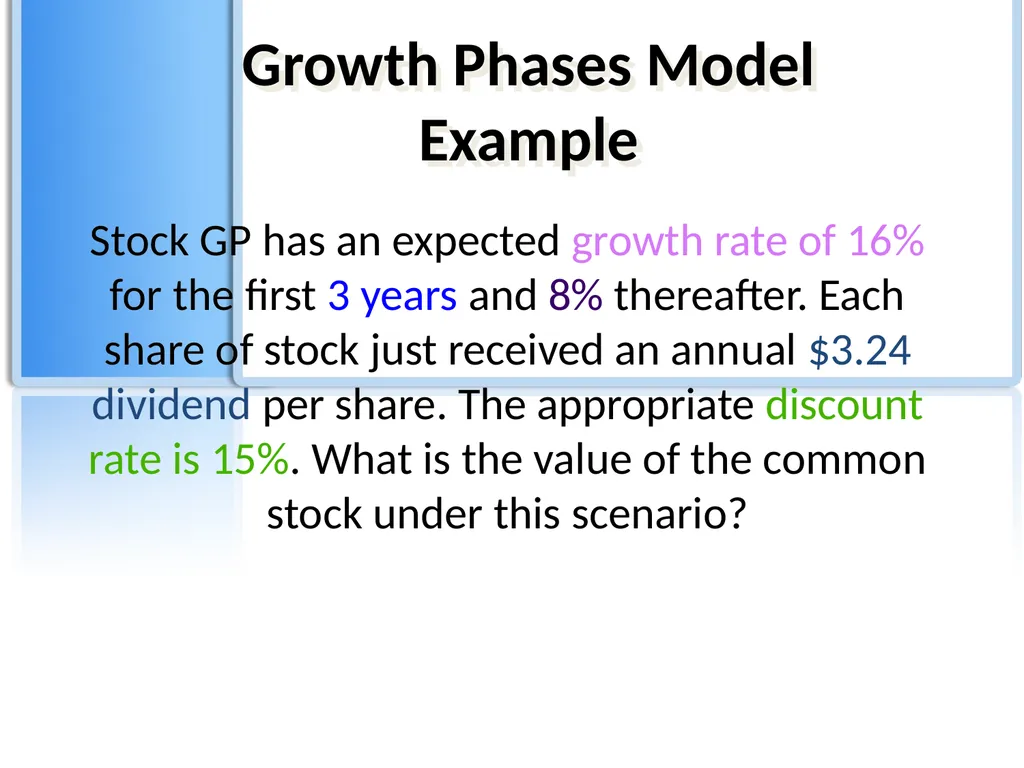
Growth Phases Model Example Stock GP has an expected growth rate of 16% for the first 3 years and 8% thereafter. Each share of stock just received an annual $3.24 dividend per share. The appropriate discount rate is 15%. What is the value of the common stock under this scenario?<br>
15
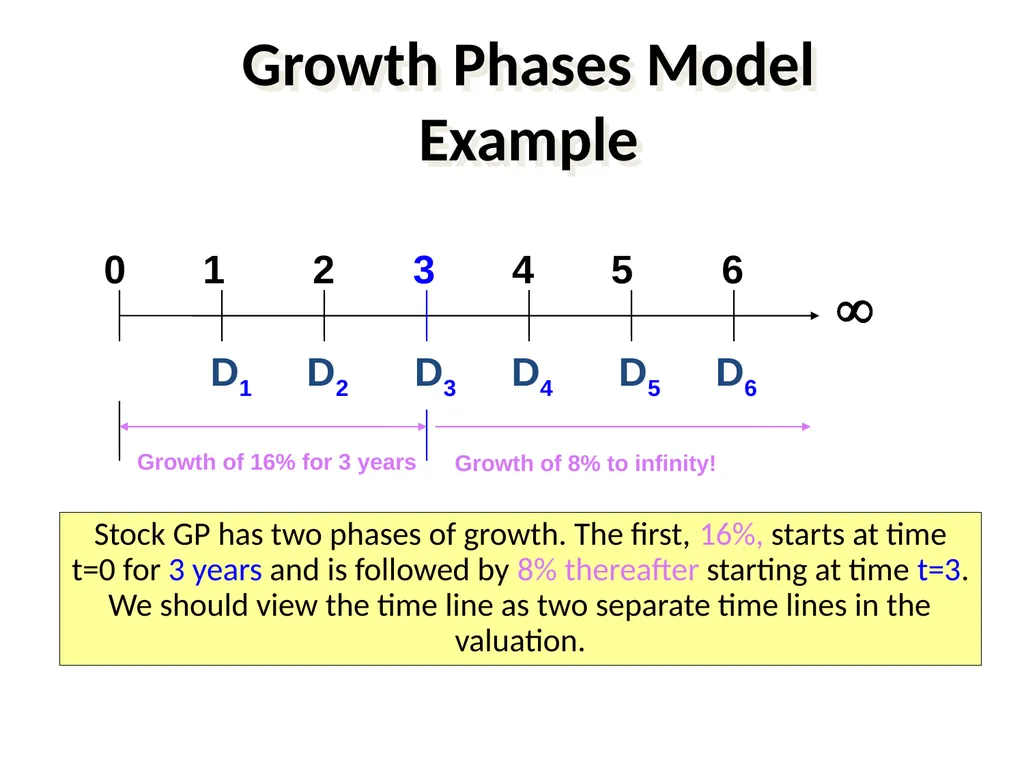
Growth Phases Model Example Stock GP has two phases of growth. The first, 16%, starts at time t=0 for 3 years and is followed by 8% thereafter starting at time t=3. We should view the time line as two separate time lines in the valuation. 0 1 2 3 4 5 6 D1 D2 D3 D4 D5 D6 Growth of 16% for 3 years Growth of 8% to infinity!<br>
16
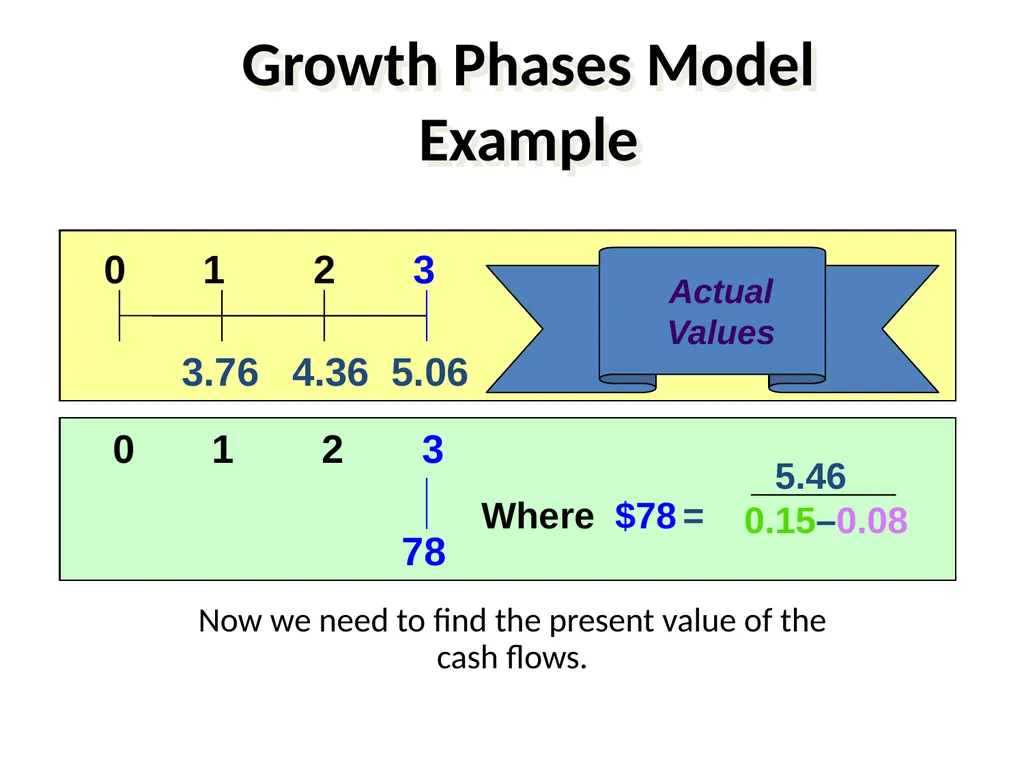
Growth Phases Model Example Now we need to find the present value of the cash flows. 0 1 2 3 3.76 4.36 5.06 78 0 1 2 3 Actual
Values 5.46
0.15–0.08 Where $78 =<br>
17
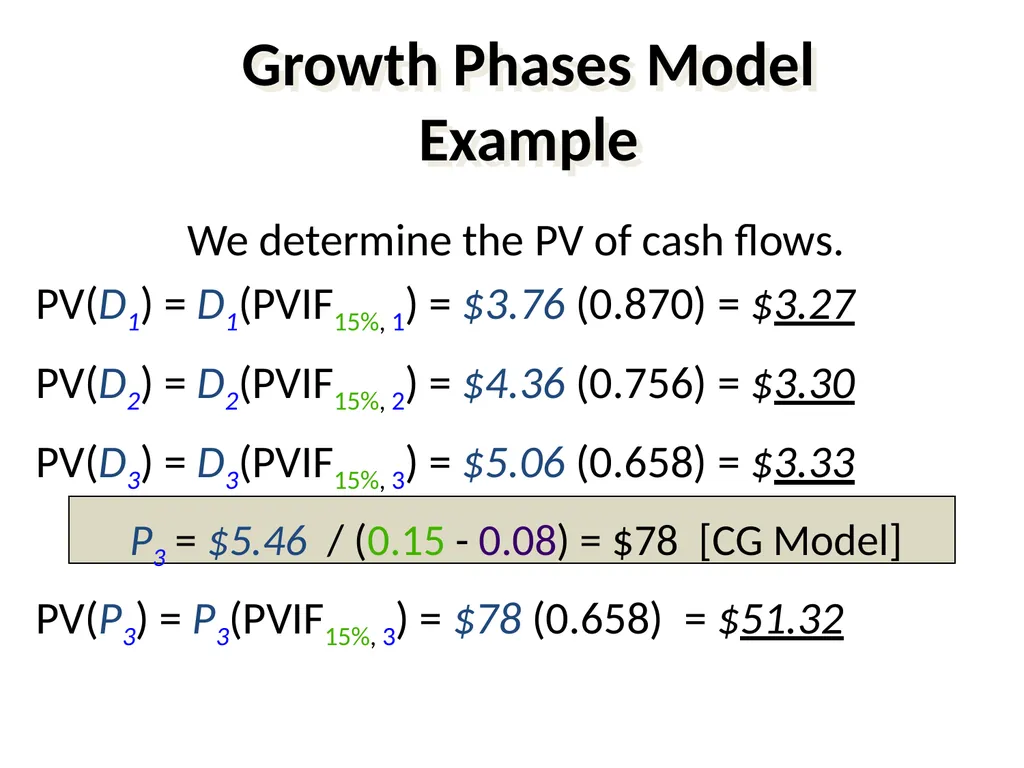
Growth Phases Model Example We determine the PV of cash flows.
PV(D1) = D1(PVIF15%, 1) = $3.76 (0.870) = $3.27
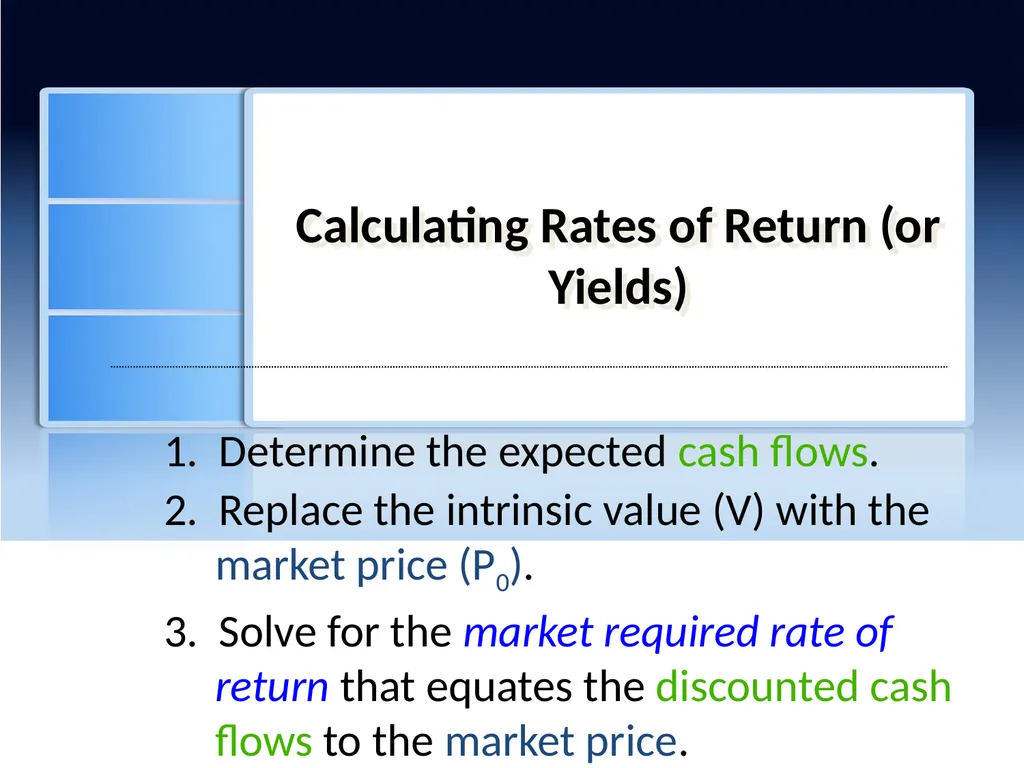
Calculating Rates of Return (or Yields) 1. Determine the expected cash flows.
2. Replace the intrinsic value (V) with the market price (P0).
3. Solve for the market required rate of return that equates the discounted cash flows to the market price.<br>
19
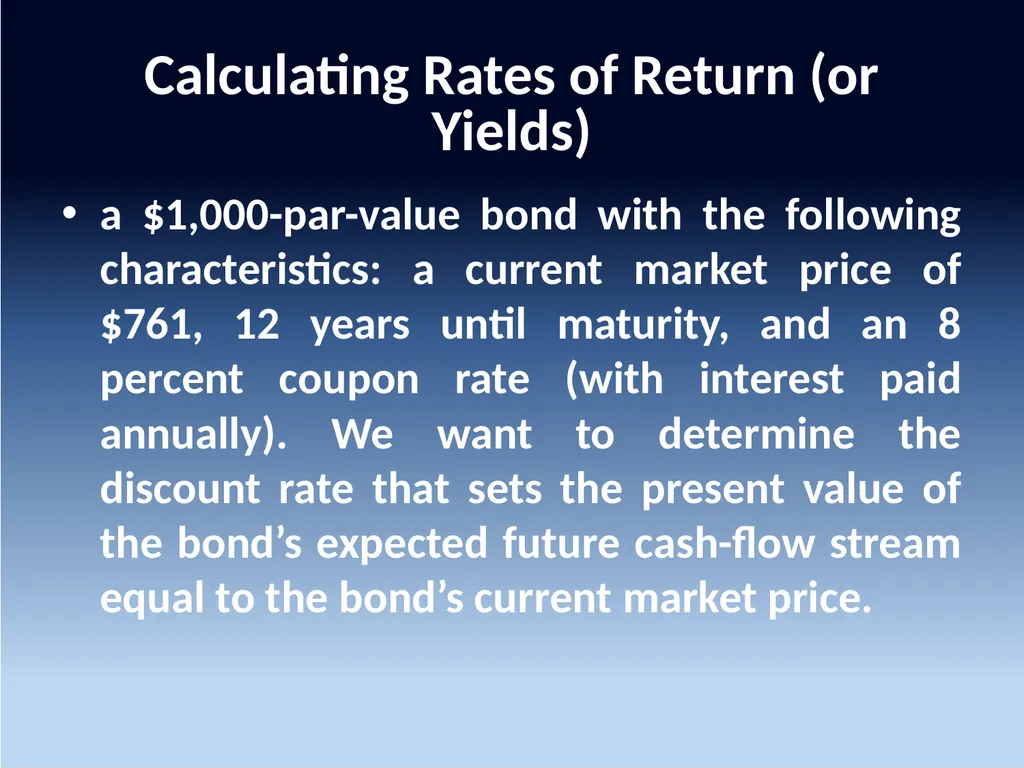
Calculating Rates of Return (or Yields) a $1,000-par-value bond with the following characteristics: a current market price of $761, 12 years until maturity, and an 8 percent coupon rate (with interest paid annually). We want to determine the discount rate that sets the present value of the bond’s expected future cash-flow stream equal to the bond’s current market price.<br>
20
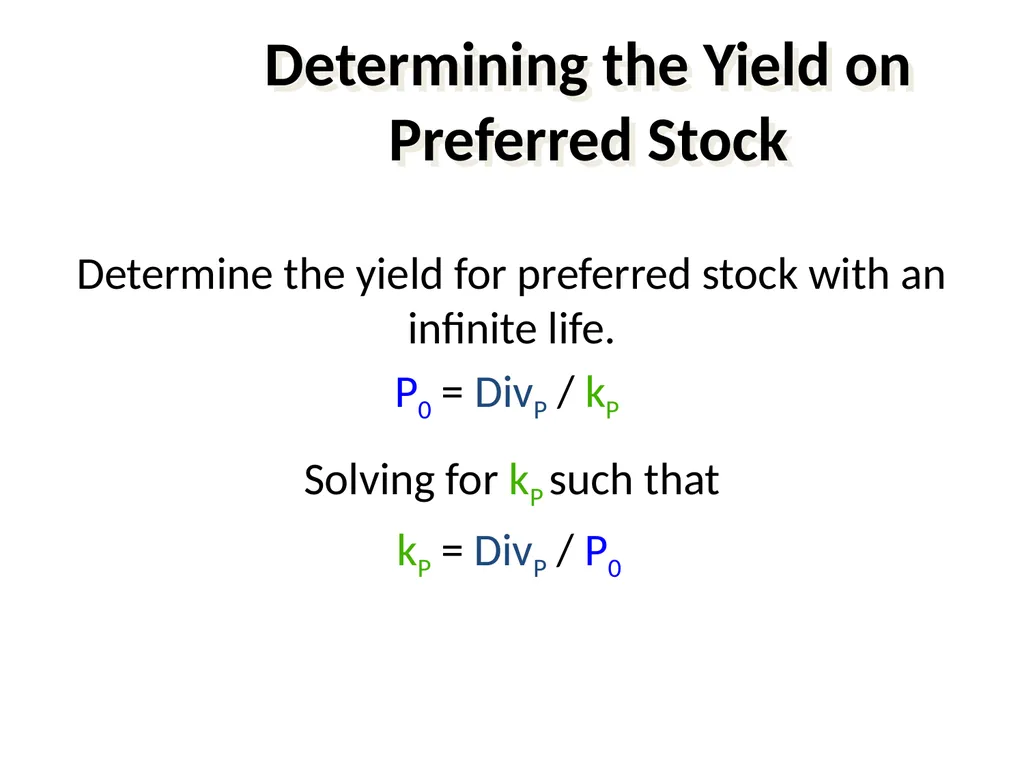
Determining the Yield on Preferred Stock Determine the yield for preferred stock with an infinite life.
P0 = DivP / kP
Solving for kP such that
kP = DivP / P0<br>
21
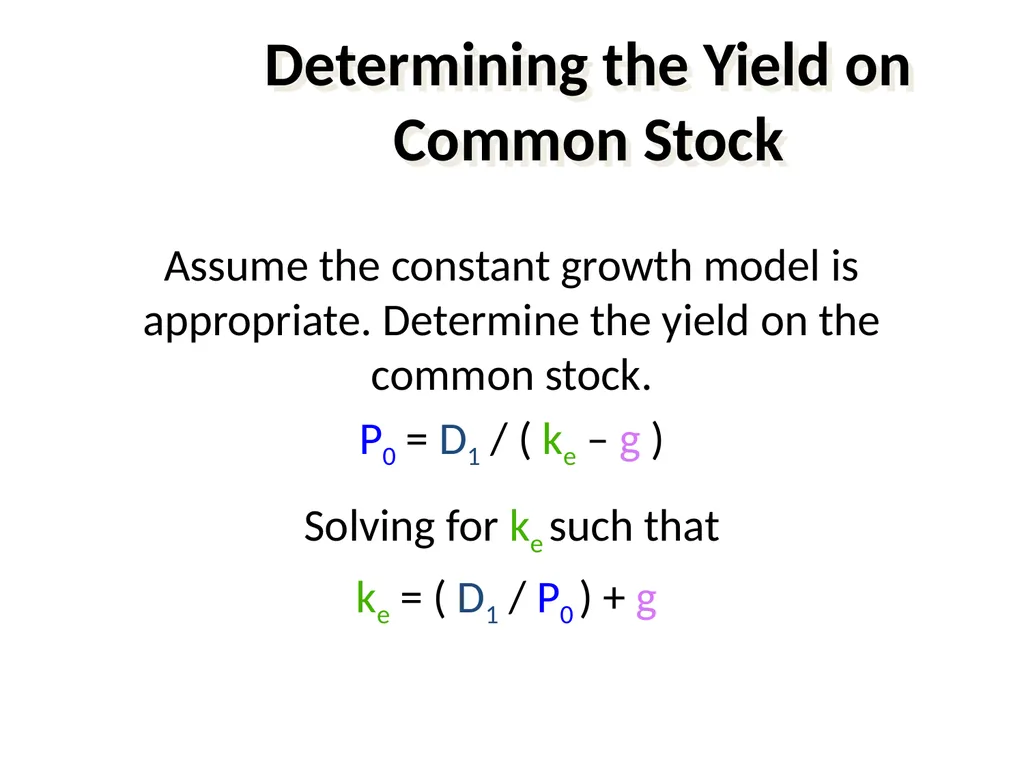
Determining the Yield on Common Stock Assume the constant growth model is appropriate. Determine the yield on the common stock.
P0 = D1 / ( ke – g )