
Strategy for Improving Stroke Treatment Response
LV
Published · 51 slides · 0 views
1 / 1




Description
Strategy for Improving Stroke Treatment Response Study Coordinator Training Contacts SISTER Project Managers Rebeca Aragon Garcia aragonraucmail.uc.edu (973) 668-8644 Pam Plummer plummepaucmail.uc.edu (513) 885-2437 NDMC Data Manager
Related Topics
Share
Embed code
Download this presentation From Below
"Strategy for Improving Stroke Treatment Response" is the property of its rightful owner. Permission is granted to download and print the materials on this website for personal, non-commercial use only, and to display it on your personal computer provided you do not modify the materials and that you retain all copyright notices contained in the materials. By downloading content from our website, you accept the terms of this agreement.
Presentation Transcript
01
Strategy for Improving Stroke Treatment Response<br>
02
Study Coordinator Training<br>
03
Contacts SISTER Project Managers
Rebeca Aragon Garcia aragonra@ucmail.uc.edu (973) 668-8644
Pam Plummer plummepa@ucmail.uc.edu (513) 885-2437
NDMC Data Manager
Riley Luckmann luckmann@musc.edu (843) 792-2077
NDMC Monitoring Manager
Jessica Griffin simmonsjl@musc.edu
Email & Clinical Hotline # sister-trial@ucmail.uc.edu (866) 212-7187(
Randomization Hotline # (866) 450-2016<br>
Rebeca Aragon Garcia aragonra@ucmail.uc.edu (973) 668-8644
Pam Plummer plummepa@ucmail.uc.edu (513) 885-2437
NDMC Data Manager
Riley Luckmann luckmann@musc.edu (843) 792-2077
NDMC Monitoring Manager
Jessica Griffin simmonsjl@musc.edu
Email & Clinical Hotline # sister-trial@ucmail.uc.edu (866) 212-7187(
Randomization Hotline # (866) 450-2016<br>
04
Learning Goals The Coordinator will understand:
The process for their site to be released to enroll (site readiness).
Screening criteria to identify the appropriate subject.
The consenting process using the ICF or eConsent.
Study Medication Procedures
Study Labs
WebDCU™
Subject Visits
Study payments
Toolbox Resources
Quiz – link will be displayed so you can follow along and complete<br>
The process for their site to be released to enroll (site readiness).
Screening criteria to identify the appropriate subject.
The consenting process using the ICF or eConsent.
Study Medication Procedures
Study Labs
WebDCU™
Subject Visits
Study payments
Toolbox Resources
Quiz – link will be displayed so you can follow along and complete<br>
05
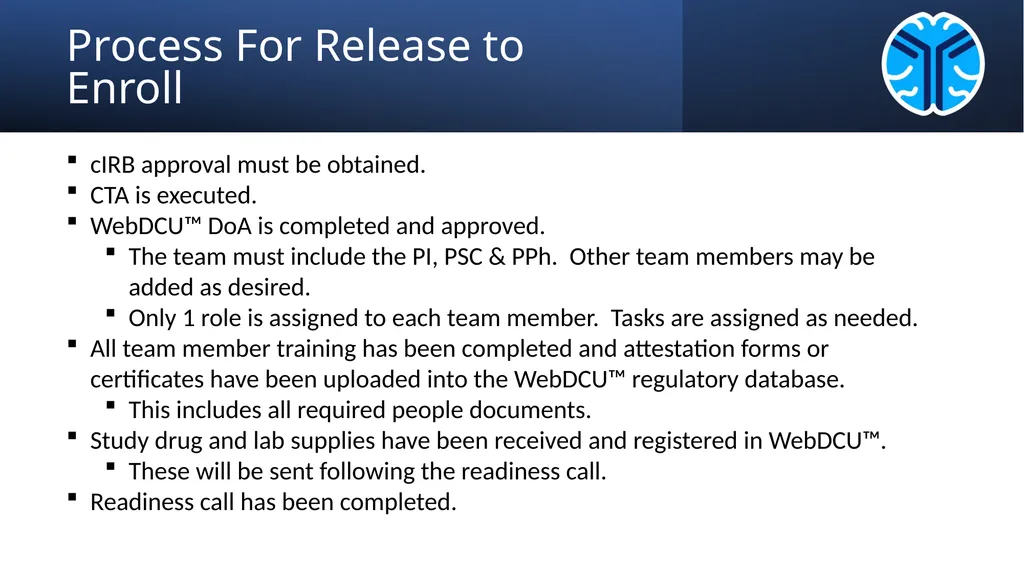
Process For Release to Enroll cIRB approval must be obtained.
CTA is executed.
WebDCU™ DoA is completed and approved.
The team must include the PI, PSC & PPh. Other team members may be added as desired.
Only 1 role is assigned to each team member. Tasks are assigned as needed.
All team member training has been completed and attestation forms or certificates have been uploaded into the WebDCU™ regulatory database.
This includes all required people documents.
Study drug and lab supplies have been received and registered in WebDCU™.
These will be sent following the readiness call.
Readiness call has been completed.<br>
CTA is executed.
WebDCU™ DoA is completed and approved.
The team must include the PI, PSC & PPh. Other team members may be added as desired.
Only 1 role is assigned to each team member. Tasks are assigned as needed.
All team member training has been completed and attestation forms or certificates have been uploaded into the WebDCU™ regulatory database.
This includes all required people documents.
Study drug and lab supplies have been received and registered in WebDCU™.
These will be sent following the readiness call.
Readiness call has been completed.<br>
06
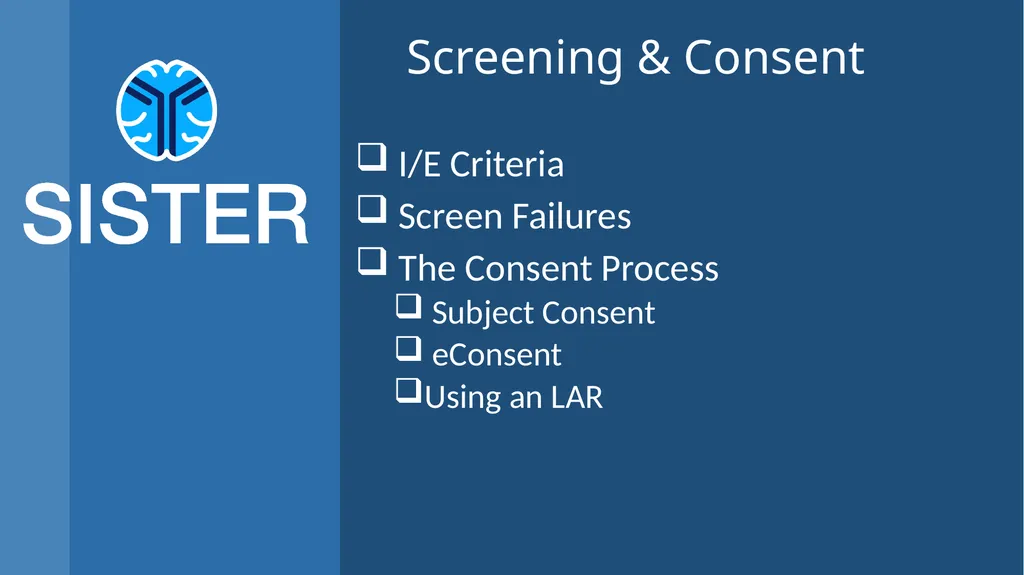
I/E Criteria
Screen Failures
The Consent Process
Subject Consent
eConsent
Using an LAR Screening & Consent<br>
Screen Failures
The Consent Process
Subject Consent
eConsent
Using an LAR Screening & Consent<br>
07
>18 years of age
Suspected anterior circulation acute ischemic stroke
NIHSS >6 on presentation
Baseline neuroimaging consisting of all of the following:
ASPECTS score of >6 on CT or >7 on MRI
Favorable perfusion imaging on CTP / MR-perfusion weighted imaging (PWI) consisting of the following
Mismatch ration of penumbra : core >1.2
Mismatch volume >10 cc
Core <70 cc
Able to receive assigned study drug within 4.5 to 24 hours of stroke onset or last know well
Able to receive assigned study drug within 90 minutes of qualifying perfusion imaging (administration is encouraged within 60 minutes but up to 90 minutes is allowed. After 90 minutes, another perfusion image is needed to ensure that inclusion criteria are met)
Informed consent for study participation obtained from participant or their LAR Screening Criteria - Inclusion<br>
Suspected anterior circulation acute ischemic stroke
NIHSS >6 on presentation
Baseline neuroimaging consisting of all of the following:
ASPECTS score of >6 on CT or >7 on MRI
Favorable perfusion imaging on CTP / MR-perfusion weighted imaging (PWI) consisting of the following
Mismatch ration of penumbra : core >1.2
Mismatch volume >10 cc
Core <70 cc
Able to receive assigned study drug within 4.5 to 24 hours of stroke onset or last know well
Able to receive assigned study drug within 90 minutes of qualifying perfusion imaging (administration is encouraged within 60 minutes but up to 90 minutes is allowed. After 90 minutes, another perfusion image is needed to ensure that inclusion criteria are met)
Informed consent for study participation obtained from participant or their LAR Screening Criteria - Inclusion<br>
08
Plan to receive endovascular treatment
Received or plan to receive IV thrombolysis
Pre-stroke mRS >2
Previous treatment with TS23 or known allergy to antibody therapy
Known pregnancy, breastfeeding or plan to breastfeed within 3 months or have a positive urine or serum pregnancy test.
Known previous stroke in the past 90 days.
Known previous ICH, intracranial neoplasm, subarachnoid hemorrhage or AV malformation.
Know active diagnosis of intracranial neoplasm
Clinical presentation suggestive of a subarachnoid hemorrhage, even if initial CT scan was normal.
Surgery or biopsy of parenchymal organ in the past 30 days
Known trauma with internal injuries or persistent ulcerative wounds in the past 30 days.
Severe head trauma in the past 90 days. Screening Criteria - Exclusion<br>
Received or plan to receive IV thrombolysis
Pre-stroke mRS >2
Previous treatment with TS23 or known allergy to antibody therapy
Known pregnancy, breastfeeding or plan to breastfeed within 3 months or have a positive urine or serum pregnancy test.
Known previous stroke in the past 90 days.
Known previous ICH, intracranial neoplasm, subarachnoid hemorrhage or AV malformation.
Know active diagnosis of intracranial neoplasm
Clinical presentation suggestive of a subarachnoid hemorrhage, even if initial CT scan was normal.
Surgery or biopsy of parenchymal organ in the past 30 days
Known trauma with internal injuries or persistent ulcerative wounds in the past 30 days.
Severe head trauma in the past 90 days. Screening Criteria - Exclusion<br>
09
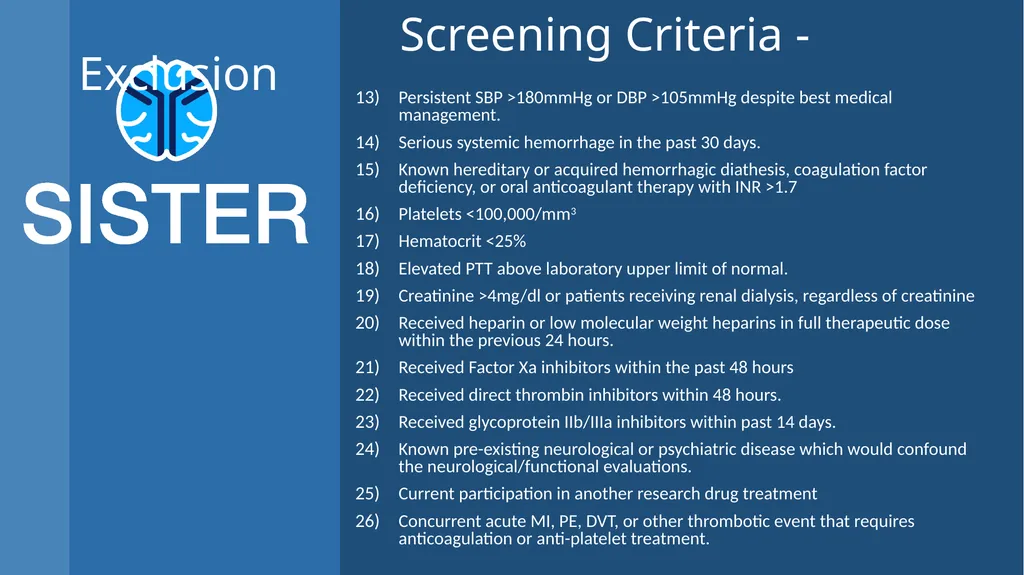
Persistent SBP >180mmHg or DBP >105mmHg despite best medical management.
Serious systemic hemorrhage in the past 30 days.
Known hereditary or acquired hemorrhagic diathesis, coagulation factor deficiency, or oral anticoagulant therapy with INR >1.7
Platelets <100,000/mm3
Hematocrit <25%
Elevated PTT above laboratory upper limit of normal.
Creatinine >4mg/dl or patients receiving renal dialysis, regardless of creatinine
Received heparin or low molecular weight heparins in full therapeutic dose within the previous 24 hours.
Received Factor Xa inhibitors within the past 48 hours
Received direct thrombin inhibitors within 48 hours.
Received glycoprotein IIb/IIIa inhibitors within past 14 days.
Known pre-existing neurological or psychiatric disease which would confound the neurological/functional evaluations.
Current participation in another research drug treatment
Concurrent acute MI, PE, DVT, or other thrombotic event that requires anticoagulation or anti-platelet treatment. Screening Criteria - Exclusion<br>
Serious systemic hemorrhage in the past 30 days.
Known hereditary or acquired hemorrhagic diathesis, coagulation factor deficiency, or oral anticoagulant therapy with INR >1.7
Platelets <100,000/mm3
Hematocrit <25%
Elevated PTT above laboratory upper limit of normal.
Creatinine >4mg/dl or patients receiving renal dialysis, regardless of creatinine
Received heparin or low molecular weight heparins in full therapeutic dose within the previous 24 hours.
Received Factor Xa inhibitors within the past 48 hours
Received direct thrombin inhibitors within 48 hours.
Received glycoprotein IIb/IIIa inhibitors within past 14 days.
Known pre-existing neurological or psychiatric disease which would confound the neurological/functional evaluations.
Current participation in another research drug treatment
Concurrent acute MI, PE, DVT, or other thrombotic event that requires anticoagulation or anti-platelet treatment. Screening Criteria - Exclusion<br>
10
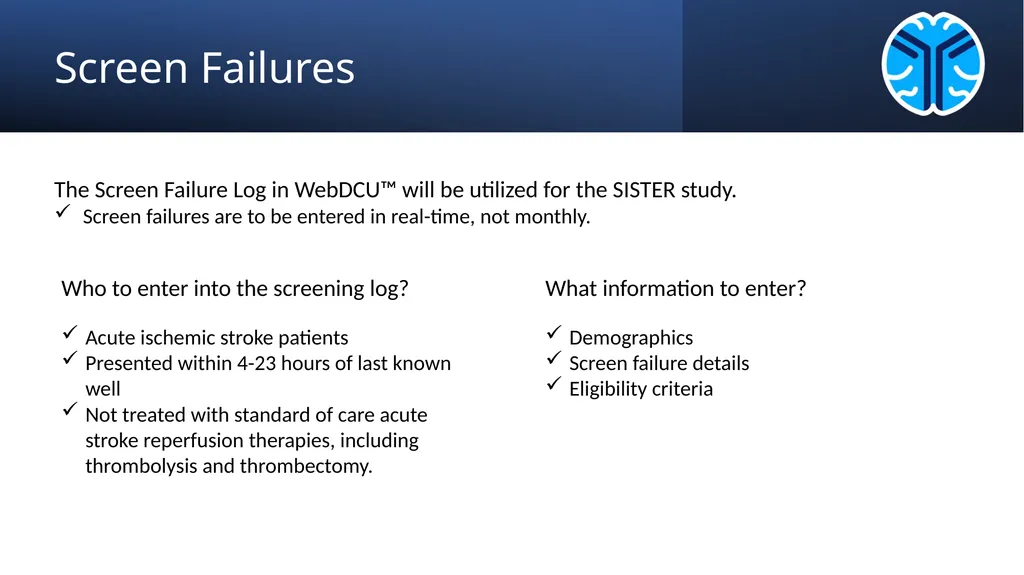
Screen Failures Who to enter into the screening log?
Acute ischemic stroke patients
Presented within 4-23 hours of last known well
Not treated with standard of care acute stroke reperfusion therapies, including thrombolysis and thrombectomy. What information to enter?
Demographics
Screen failure details
Eligibility criteria The Screen Failure Log in WebDCU™ will be utilized for the SISTER study.
Screen failures are to be entered in real-time, not monthly.<br>
Acute ischemic stroke patients
Presented within 4-23 hours of last known well
Not treated with standard of care acute stroke reperfusion therapies, including thrombolysis and thrombectomy. What information to enter?
Demographics
Screen failure details
Eligibility criteria The Screen Failure Log in WebDCU™ will be utilized for the SISTER study.
Screen failures are to be entered in real-time, not monthly.<br>
11
The Consenting Process Obtaining informed consent is not just having the potential participant sign a document. It is an interactive process of presenting the study to the potential participant and/or family, allowing the patient/family time to review, and answering all questions. After all is understood and the patient wants to participate, the ICF is then signed.
The informed consent process should encompass the following:
A copy of the ICF for the potential participant &/or family to review.
Disclosure to potential participant the information that is needed to make an informed decision.
Ensuring the potential participant understands what has been disclosed
Promotion of decision to participate is voluntary
SISTER will use a standard version of the ICF. The ICF will have HIPAA language included however, if required, the site may have a stand-alone HIPAA document approved.
All research activities will take place after the ICF has been signed by the participant or LAR.<br>
The informed consent process should encompass the following:
A copy of the ICF for the potential participant &/or family to review.
Disclosure to potential participant the information that is needed to make an informed decision.
Ensuring the potential participant understands what has been disclosed
Promotion of decision to participate is voluntary
SISTER will use a standard version of the ICF. The ICF will have HIPAA language included however, if required, the site may have a stand-alone HIPAA document approved.
All research activities will take place after the ICF has been signed by the participant or LAR.<br>
12
The Consenting Process - eConsent The SISTER ICF can also be produced in eConsent form for ease of signing. The eConsent process must be approved by the cIRB.
It is highly recommended that you use the eConsent. Having the eConsent available on your site’s tablet is a more efficient and error-free process of obtaining the patient or LARs consent.
The patient or LAR may sign the eConsent.
Before having access to an eConsent, your site must be approved by submitting the “Implementation Form” to the cIRB that indicates your desire to use the eConsent and/or remote consent.
Our eConsent documents will use the REDCap platform. Your eConsent will be produced using your cIRB approved documents.
You will be provided a user ID, a user guide and training to use the REDCap platform and your eConsent.<br>
It is highly recommended that you use the eConsent. Having the eConsent available on your site’s tablet is a more efficient and error-free process of obtaining the patient or LARs consent.
The patient or LAR may sign the eConsent.
Before having access to an eConsent, your site must be approved by submitting the “Implementation Form” to the cIRB that indicates your desire to use the eConsent and/or remote consent.
Our eConsent documents will use the REDCap platform. Your eConsent will be produced using your cIRB approved documents.
You will be provided a user ID, a user guide and training to use the REDCap platform and your eConsent.<br>
13
The Consenting Process - LAR An LAR is a Legally Authorized Representative that can act make decisions on behalf of another person. An LAR can be but is not limited to,
Spouse Legal Guardian
Adult child Parent
Does the subject have the cognitive capacity to decide about study participation? This assessment should be made by a study investigator and documented in the subject’s records.
No, then LAR signs and dates
When subject regains capacity, they should sign a new consent themself
Yes, the subject signs and dates the ICF
If the subject is physically incapable of signature, illiterate, visually impaired, or signing a short form consent, utilize witness of consent process and signature
All research activities will take place after the ICF has been signed by the participant or LAR.<br>
Spouse Legal Guardian
Adult child Parent
Does the subject have the cognitive capacity to decide about study participation? This assessment should be made by a study investigator and documented in the subject’s records.
No, then LAR signs and dates
When subject regains capacity, they should sign a new consent themself
Yes, the subject signs and dates the ICF
If the subject is physically incapable of signature, illiterate, visually impaired, or signing a short form consent, utilize witness of consent process and signature
All research activities will take place after the ICF has been signed by the participant or LAR.<br>
14
Receipt of study drug
Randomization
Administration
Documentation Study Medication Procedures<br>
Randomization
Administration
Documentation Study Medication Procedures<br>
15
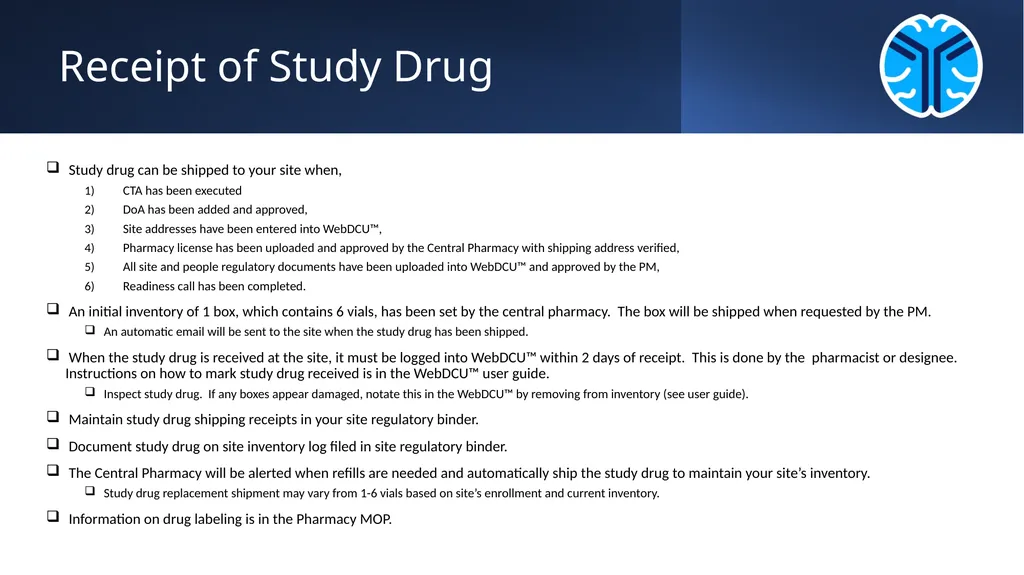
Receipt of Study Drug Study drug can be shipped to your site when,
CTA has been executed
DoA has been added and approved,
Site addresses have been entered into WebDCU™,
Pharmacy license has been uploaded and approved by the Central Pharmacy with shipping address verified,
All site and people regulatory documents have been uploaded into WebDCU™ and approved by the PM,
Readiness call has been completed.
An initial inventory of 1 box, which contains 6 vials, has been set by the central pharmacy. The box will be shipped when requested by the PM.
An automatic email will be sent to the site when the study drug has been shipped.
When the study drug is received at the site, it must be logged into WebDCU™ within 2 days of receipt. This is done by the pharmacist or designee. Instructions on how to mark study drug received is in the WebDCU™ user guide.
Inspect study drug. If any boxes appear damaged, notate this in the WebDCU™ by removing from inventory (see user guide).
Maintain study drug shipping receipts in your site regulatory binder.
Document study drug on site inventory log filed in site regulatory binder.
The Central Pharmacy will be alerted when refills are needed and automatically ship the study drug to maintain your site’s inventory.
Study drug replacement shipment may vary from 1-6 vials based on site’s enrollment and current inventory.
Information on drug labeling is in the Pharmacy MOP.<br>
CTA has been executed
DoA has been added and approved,
Site addresses have been entered into WebDCU™,
Pharmacy license has been uploaded and approved by the Central Pharmacy with shipping address verified,
All site and people regulatory documents have been uploaded into WebDCU™ and approved by the PM,
Readiness call has been completed.
An initial inventory of 1 box, which contains 6 vials, has been set by the central pharmacy. The box will be shipped when requested by the PM.
An automatic email will be sent to the site when the study drug has been shipped.
When the study drug is received at the site, it must be logged into WebDCU™ within 2 days of receipt. This is done by the pharmacist or designee. Instructions on how to mark study drug received is in the WebDCU™ user guide.
Inspect study drug. If any boxes appear damaged, notate this in the WebDCU™ by removing from inventory (see user guide).
Maintain study drug shipping receipts in your site regulatory binder.
Document study drug on site inventory log filed in site regulatory binder.
The Central Pharmacy will be alerted when refills are needed and automatically ship the study drug to maintain your site’s inventory.
Study drug replacement shipment may vary from 1-6 vials based on site’s enrollment and current inventory.
Information on drug labeling is in the Pharmacy MOP.<br>
16
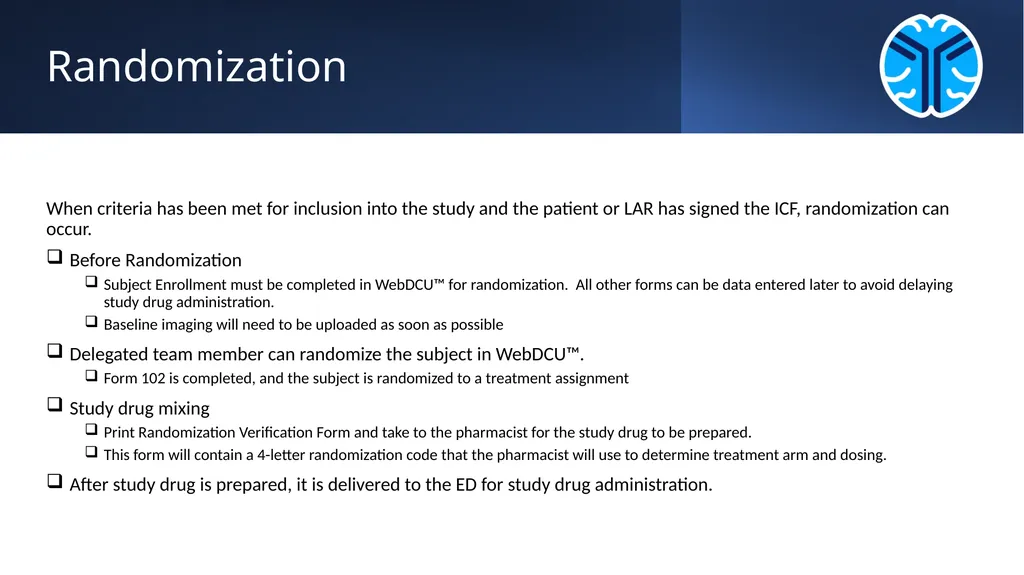
Randomization When criteria has been met for inclusion into the study and the patient or LAR has signed the ICF, randomization can occur.
Before Randomization
Subject Enrollment must be completed in WebDCU™ for randomization. All other forms can be data entered later to avoid delaying study drug administration.
Baseline imaging will need to be uploaded as soon as possible
Delegated team member can randomize the subject in WebDCU™.
Form 102 is completed, and the subject is randomized to a treatment assignment
Study drug mixing
Print Randomization Verification Form and take to the pharmacist for the study drug to be prepared.
This form will contain a 4-letter randomization code that the pharmacist will use to determine treatment arm and dosing.
After study drug is prepared, it is delivered to the ED for study drug administration.<br>
Before Randomization
Subject Enrollment must be completed in WebDCU™ for randomization. All other forms can be data entered later to avoid delaying study drug administration.
Baseline imaging will need to be uploaded as soon as possible
Delegated team member can randomize the subject in WebDCU™.
Form 102 is completed, and the subject is randomized to a treatment assignment
Study drug mixing
Print Randomization Verification Form and take to the pharmacist for the study drug to be prepared.
This form will contain a 4-letter randomization code that the pharmacist will use to determine treatment arm and dosing.
After study drug is prepared, it is delivered to the ED for study drug administration.<br>
17
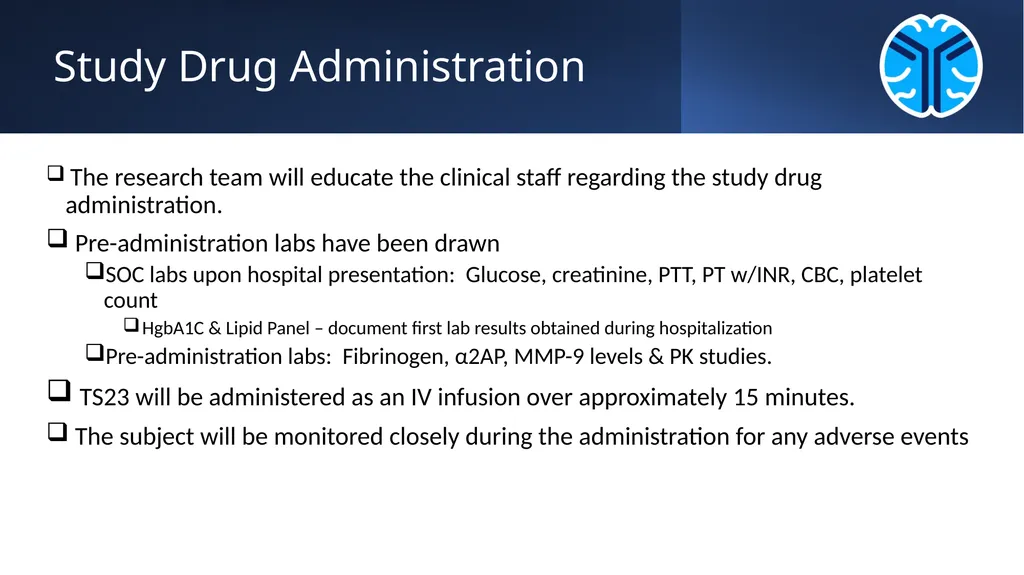
Study Drug Administration The research team will educate the clinical staff regarding the study drug administration.
Pre-administration labs have been drawn
SOC labs upon hospital presentation: Glucose, creatinine, PTT, PT w/INR, CBC, platelet count
HgbA1C & Lipid Panel – document first lab results obtained during hospitalization
Pre-administration labs: Fibrinogen, α2AP, MMP-9 levels & PK studies.
TS23 will be administered as an IV infusion over approximately 15 minutes.
The subject will be monitored closely during the administration for any adverse events<br>
Pre-administration labs have been drawn
SOC labs upon hospital presentation: Glucose, creatinine, PTT, PT w/INR, CBC, platelet count
HgbA1C & Lipid Panel – document first lab results obtained during hospitalization
Pre-administration labs: Fibrinogen, α2AP, MMP-9 levels & PK studies.
TS23 will be administered as an IV infusion over approximately 15 minutes.
The subject will be monitored closely during the administration for any adverse events<br>
18
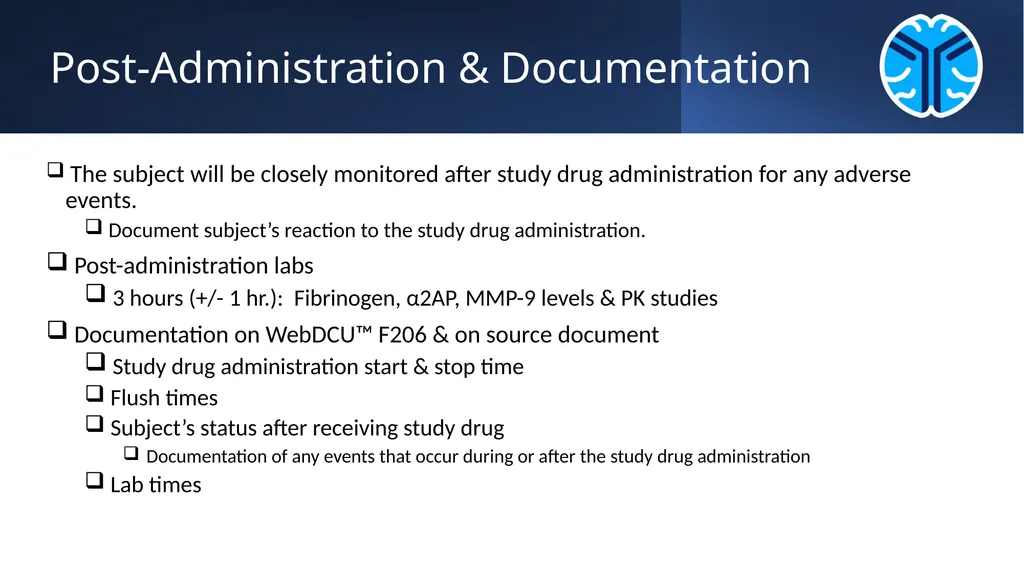
Post-Administration & Documentation The subject will be closely monitored after study drug administration for any adverse events.
Document subject’s reaction to the study drug administration.
Post-administration labs
3 hours (+/- 1 hr.): Fibrinogen, α2AP, MMP-9 levels & PK studies
Documentation on WebDCU™ F206 & on source document
Study drug administration start & stop time
Flush times
Subject’s status after receiving study drug
Documentation of any events that occur during or after the study drug administration
Lab times<br>
Document subject’s reaction to the study drug administration.
Post-administration labs
3 hours (+/- 1 hr.): Fibrinogen, α2AP, MMP-9 levels & PK studies
Documentation on WebDCU™ F206 & on source document
Study drug administration start & stop time
Flush times
Subject’s status after receiving study drug
Documentation of any events that occur during or after the study drug administration
Lab times<br>
19
Collection & Shipping Kits
Processing
Freezing
Shipping Study Labs<br>
Processing
Freezing
Shipping Study Labs<br>
20
Lab Collection & Shipping Kits You will be provided sample collection kits at the start of the study and throughout as needed. The initial shipment will contain 10 kits and will be resupplied when the inventory drops to 3 kits.
Upon receipt of the collection & shipping items, the site will confirm the kits received in WebDCU™.
If a kit is lost or misused, you will need to document that in the inventory in WebDCU™ so it can be replaced.
The items needed to obtain the labs will be the site’s responsibility.
Funds have been included in the in-hospital visit payment to cover the cost of the lab supplies.<br>
Upon receipt of the collection & shipping items, the site will confirm the kits received in WebDCU™.
If a kit is lost or misused, you will need to document that in the inventory in WebDCU™ so it can be replaced.
The items needed to obtain the labs will be the site’s responsibility.
Funds have been included in the in-hospital visit payment to cover the cost of the lab supplies.<br>
21
Sample Processing Obtain a collection kit
Obtain the blood samples following local institutional policies and procedures.
Process the sample according to the instructions in the Lab MOP.
If processing needs to be delayed, tubes can be held at 4oC for up to 4 hours prior to centrifugation
Transfer the plasma into the provided cryovials.
Apply the cryo-labels to the cryovials and record on form for input into WebDCU™<br>
Obtain the blood samples following local institutional policies and procedures.
Process the sample according to the instructions in the Lab MOP.
If processing needs to be delayed, tubes can be held at 4oC for up to 4 hours prior to centrifugation
Transfer the plasma into the provided cryovials.
Apply the cryo-labels to the cryovials and record on form for input into WebDCU™<br>
22
Freezing The samples will be stored in a -80oF freezer until shipment to the core lab.
Complete the sample box grid form and retain until shipment.<br>
Complete the sample box grid form and retain until shipment.<br>
23
Shipping The frozen samples will be shipped to the University of Arizona lab, every 6 months, using FedEx Priority Overnight courier service.
A copy of F181 Biospecimen Collection Processing will be included within the box along with the corresponding eCRF Cryobox Storage Matrix Form
Pack specimen and ship specimens as indicated in the core lab MOP
See core lab MOP for lab closures for holidays
Documentation of sample shipping will be made in WebDCU™. Receipt of labs will also be verified.
Once samples for each subject have been verified as received, this includes all required samples, the payment for those labs will be processed.
See the lab MOP for all instructions on obtaining, processing, and shipping the specimens.<br>
A copy of F181 Biospecimen Collection Processing will be included within the box along with the corresponding eCRF Cryobox Storage Matrix Form
Pack specimen and ship specimens as indicated in the core lab MOP
See core lab MOP for lab closures for holidays
Documentation of sample shipping will be made in WebDCU™. Receipt of labs will also be verified.
Once samples for each subject have been verified as received, this includes all required samples, the payment for those labs will be processed.
See the lab MOP for all instructions on obtaining, processing, and shipping the specimens.<br>
24
Data Collection Guidelines
Document Parameter Guidelines
User Manual
Training WebDCU™<br>
Document Parameter Guidelines
User Manual
Training WebDCU™<br>
25
Data Collection Guidelines The Data Collection Guidelines, published by NDMC, is a booklet to guide you through entering data into WebDCU™.
The booklet will be added to the WebDCU™ toolbox for the SISTER study.
All data is to be entered into the subject’s binder in WebDCU™ within 5 days of collection.
For randomization to occur, the subject enrollment form must be completed. Once randomization has occurred, you can then go back and complete the eligibility form (F101) and all other CRFs needed.
Screen Failures are entered into WebDCU™ as they occur, not monthly.
Site payments are contingent upon complete subject data being entered into WebDCU™, query free.<br>
The booklet will be added to the WebDCU™ toolbox for the SISTER study.
All data is to be entered into the subject’s binder in WebDCU™ within 5 days of collection.
For randomization to occur, the subject enrollment form must be completed. Once randomization has occurred, you can then go back and complete the eligibility form (F101) and all other CRFs needed.
Screen Failures are entered into WebDCU™ as they occur, not monthly.
Site payments are contingent upon complete subject data being entered into WebDCU™, query free.<br>
26
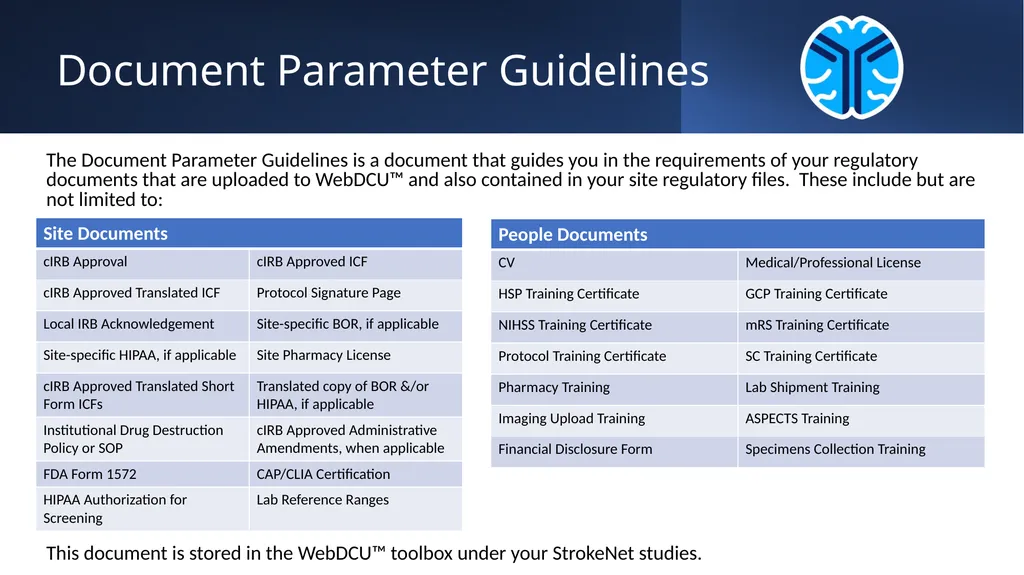
Document Parameter Guidelines The Document Parameter Guidelines is a document that guides you in the requirements of your regulatory documents that are uploaded to WebDCU™ and also contained in your site regulatory files. These include but are not limited to:
Site Documents
Site Documents
cIRB Approved Translated ICF
Protocol Signature Page
cIRB Approval Approved ICF
This document is stored in the WebDCU™ toolbox under your StrokeNet studies.<br>
Site Documents
Site Documents
cIRB Approved Translated ICF
Protocol Signature Page
cIRB Approval Approved ICF
This document is stored in the WebDCU™ toolbox under your StrokeNet studies.<br>
27
WebDCU™ User Manual The WebDCU™ User Manual is your go-to guide for working with our data collection management center.
The manual will cover the following and more:
Logging in & out
NDMC Study contact list
Uploading Regulatory Documents
Project Documents, i.e. worksheets
Data Entry how to
The WebDCU™ User Manual is available in the WebDCU™ toolbox.<br>
The manual will cover the following and more:
Logging in & out
NDMC Study contact list
Uploading Regulatory Documents
Project Documents, i.e. worksheets
Data Entry how to
The WebDCU™ User Manual is available in the WebDCU™ toolbox.<br>
28
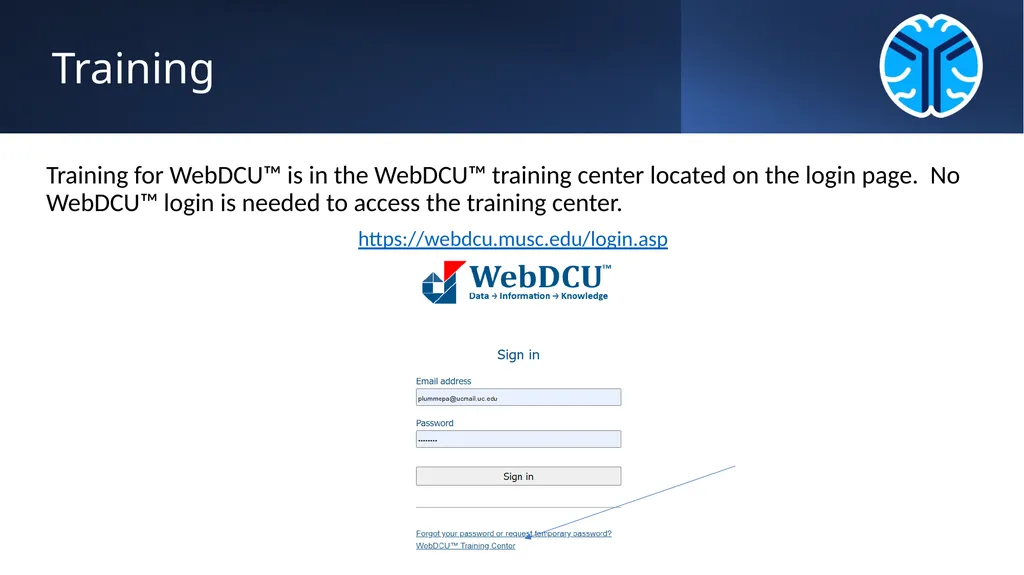
Training Training for WebDCU™ is in the WebDCU™ training center located on the login page. No WebDCU™ login is needed to access the training center.
https://webdcu.musc.edu/login.asp<br>
https://webdcu.musc.edu/login.asp<br>
29
Training continued… Multiple trainings are available in the training center, including:
mRS
NIHSS
WebDCU™ CTMS Training
Preparing for a Monitoring Visit
SISTER specific training as well as attestation forms for the training will be added
Protocol
Pharmacy
SC
Imaging<br>
mRS
NIHSS
WebDCU™ CTMS Training
Preparing for a Monitoring Visit
SISTER specific training as well as attestation forms for the training will be added
Protocol
Pharmacy
SC
Imaging<br>
30
In-Hospital
Day 30 Visit
Day 90 Visit Subject Visits<br>
Day 30 Visit
Day 90 Visit Subject Visits<br>
31
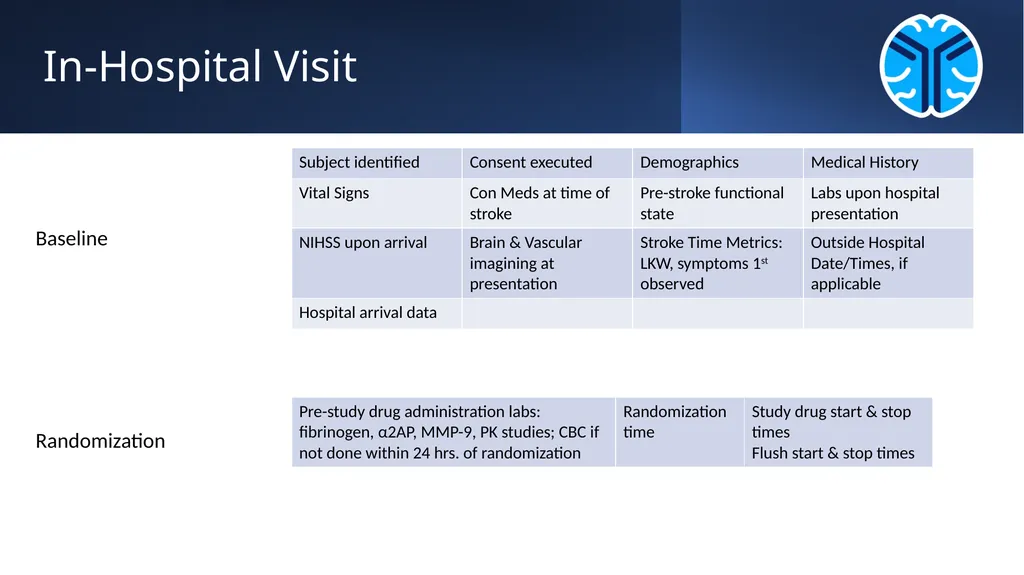
In-Hospital Visit Baseline
Randomization<br>
Randomization<br>
32
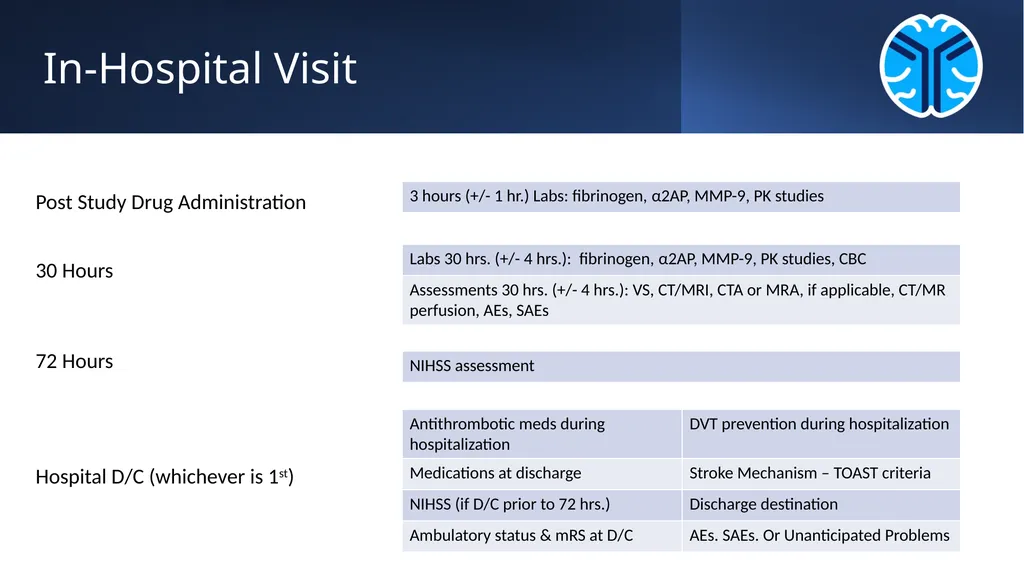
In-Hospital Visit Post Study Drug Administration
30 Hours
72 Hours
Hospital D/C (whichever is 1st)<br>
30 Hours
72 Hours
Hospital D/C (whichever is 1st)<br>
33
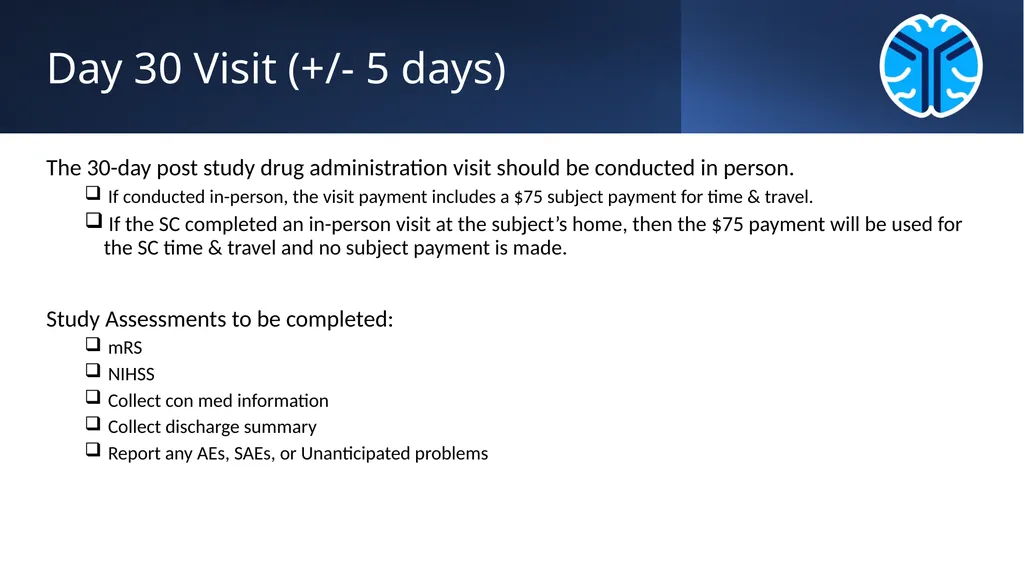
Day 30 Visit (+/- 5 days) The 30-day post study drug administration visit should be conducted in person.
If conducted in-person, the visit payment includes a $75 subject payment for time & travel.
If the SC completed an in-person visit at the subject’s home, then the $75 payment will be used for the SC time & travel and no subject payment is made.
Study Assessments to be completed:
mRS
NIHSS
Collect con med information
Collect discharge summary
Report any AEs, SAEs, or Unanticipated problems<br>
If conducted in-person, the visit payment includes a $75 subject payment for time & travel.
If the SC completed an in-person visit at the subject’s home, then the $75 payment will be used for the SC time & travel and no subject payment is made.
Study Assessments to be completed:
mRS
NIHSS
Collect con med information
Collect discharge summary
Report any AEs, SAEs, or Unanticipated problems<br>
34
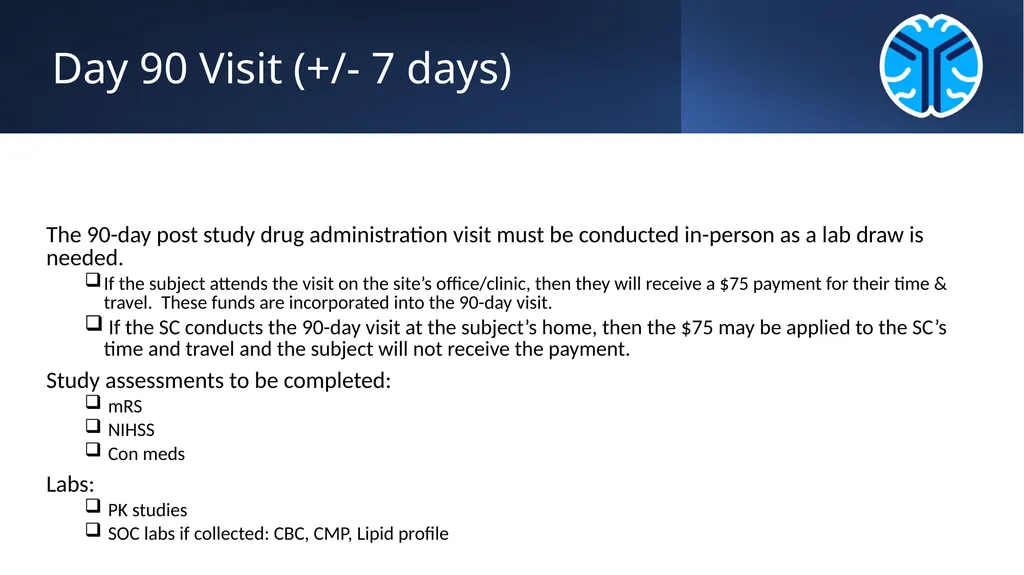
Day 90 Visit (+/- 7 days) The 90-day post study drug administration visit must be conducted in-person as a lab draw is needed.
If the subject attends the visit on the site’s office/clinic, then they will receive a $75 payment for their time & travel. These funds are incorporated into the 90-day visit.
If the SC conducts the 90-day visit at the subject’s home, then the $75 may be applied to the SC’s time and travel and the subject will not receive the payment.
Study assessments to be completed:
mRS
NIHSS
Con meds
Labs:
PK studies
SOC labs if collected: CBC, CMP, Lipid profile<br>
If the subject attends the visit on the site’s office/clinic, then they will receive a $75 payment for their time & travel. These funds are incorporated into the 90-day visit.
If the SC conducts the 90-day visit at the subject’s home, then the $75 may be applied to the SC’s time and travel and the subject will not receive the payment.
Study assessments to be completed:
mRS
NIHSS
Con meds
Labs:
PK studies
SOC labs if collected: CBC, CMP, Lipid profile<br>
35
Assessing
Reporting Adverse Events
Serious Adverse Events
Unanticipated Events<br>
Reporting Adverse Events
Serious Adverse Events
Unanticipated Events<br>
36
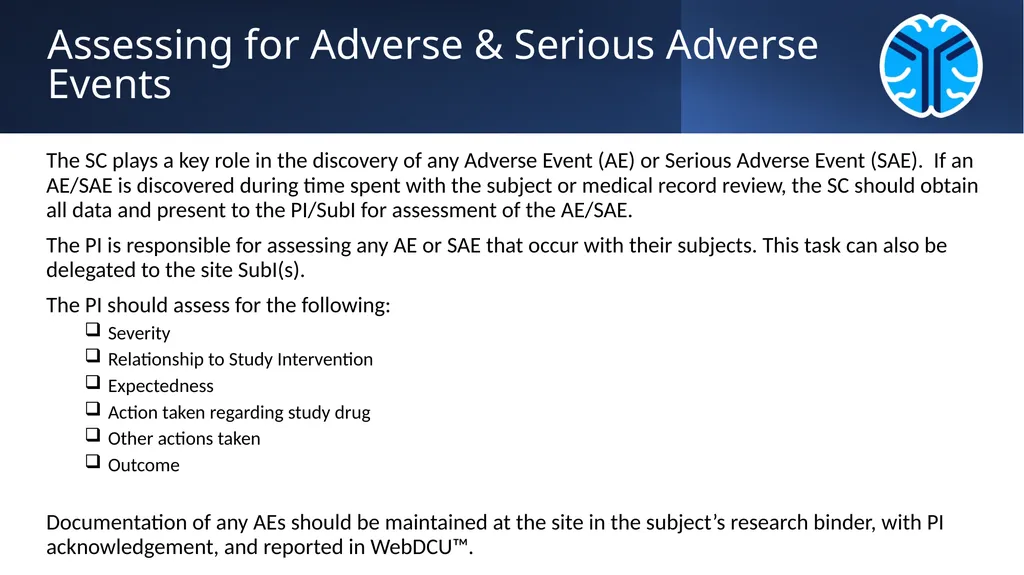
Assessing for Adverse & Serious Adverse Events The SC plays a key role in the discovery of any Adverse Event (AE) or Serious Adverse Event (SAE). If an AE/SAE is discovered during time spent with the subject or medical record review, the SC should obtain all data and present to the PI/SubI for assessment of the AE/SAE.
The PI is responsible for assessing any AE or SAE that occur with their subjects. This task can also be delegated to the site SubI(s).
The PI should assess for the following:
Severity
Relationship to Study Intervention
Expectedness
Action taken regarding study drug
Other actions taken
Outcome
Documentation of any AEs should be maintained at the site in the subject’s research binder, with PI acknowledgement, and reported in WebDCU™.<br>
The PI is responsible for assessing any AE or SAE that occur with their subjects. This task can also be delegated to the site SubI(s).
The PI should assess for the following:
Severity
Relationship to Study Intervention
Expectedness
Action taken regarding study drug
Other actions taken
Outcome
Documentation of any AEs should be maintained at the site in the subject’s research binder, with PI acknowledgement, and reported in WebDCU™.<br>
37
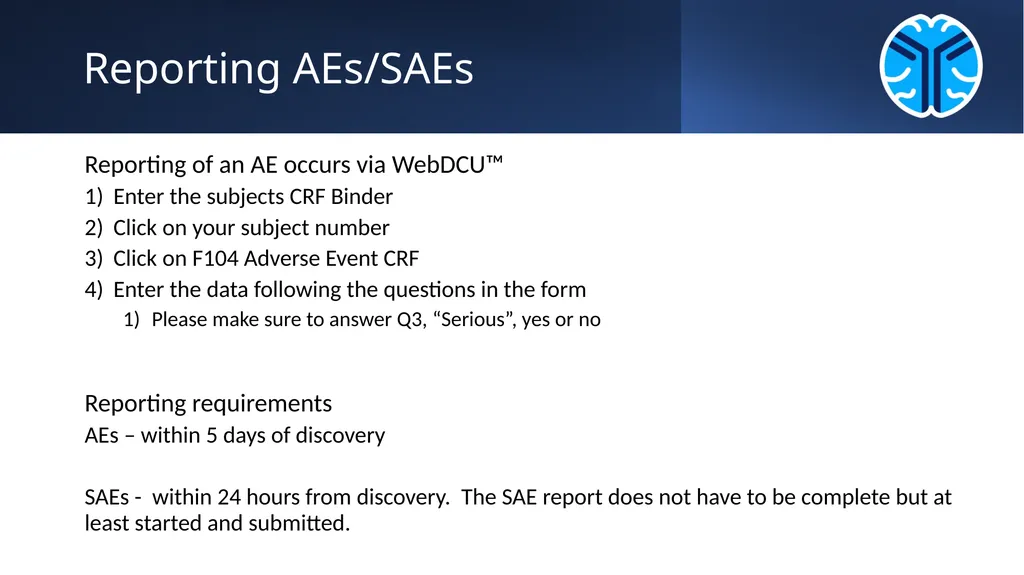
Reporting AEs/SAEs Reporting of an AE occurs via WebDCU™
Enter the subjects CRF Binder
Click on your subject number
Click on F104 Adverse Event CRF
Enter the data following the questions in the form
Please make sure to answer Q3, “Serious”, yes or no
Reporting requirements
AEs – within 5 days of discovery
SAEs - within 24 hours from discovery. The SAE report does not have to be complete but at least started and submitted.<br>
Enter the subjects CRF Binder
Click on your subject number
Click on F104 Adverse Event CRF
Enter the data following the questions in the form
Please make sure to answer Q3, “Serious”, yes or no
Reporting requirements
AEs – within 5 days of discovery
SAEs - within 24 hours from discovery. The SAE report does not have to be complete but at least started and submitted.<br>
38
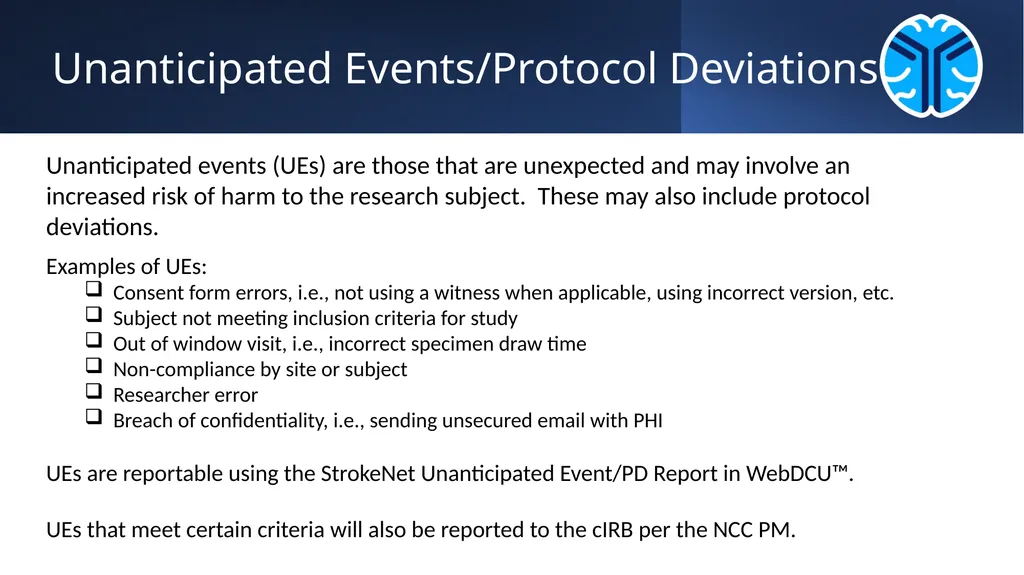
Unanticipated Events/Protocol Deviations Unanticipated events (UEs) are those that are unexpected and may involve an increased risk of harm to the research subject. These may also include protocol deviations.
Examples of UEs:
Consent form errors, i.e., not using a witness when applicable, using incorrect version, etc.
Subject not meeting inclusion criteria for study
Out of window visit, i.e., incorrect specimen draw time
Non-compliance by site or subject
Researcher error
Breach of confidentiality, i.e., sending unsecured email with PHI
UEs are reportable using the StrokeNet Unanticipated Event/PD Report in WebDCU™.
UEs that meet certain criteria will also be reported to the cIRB per the NCC PM.<br>
Examples of UEs:
Consent form errors, i.e., not using a witness when applicable, using incorrect version, etc.
Subject not meeting inclusion criteria for study
Out of window visit, i.e., incorrect specimen draw time
Non-compliance by site or subject
Researcher error
Breach of confidentiality, i.e., sending unsecured email with PHI
UEs are reportable using the StrokeNet Unanticipated Event/PD Report in WebDCU™.
UEs that meet certain criteria will also be reported to the cIRB per the NCC PM.<br>
39
SISTER Documents will be stored in the Toolbox in WebDCU™ .
Manuals & Protocol
Instruction Documents
Regulatory Documents
Pharmacy Documents
Tools for Site & Subjects Toolbox Resources<br>
Manuals & Protocol
Instruction Documents
Regulatory Documents
Pharmacy Documents
Tools for Site & Subjects Toolbox Resources<br>
40
Toolbox Resources – Manuals & Protocols Protocol
The most current version of the protocol will be maintained in the toolbox.
Investigator Brochure
The IB is available in the toolbox.
Manuals
All current MOPs are available in the toolbox; these include:
Protocol MOP
Pharmacy
Lab
Imaging<br>
The most current version of the protocol will be maintained in the toolbox.
Investigator Brochure
The IB is available in the toolbox.
Manuals
All current MOPs are available in the toolbox; these include:
Protocol MOP
Pharmacy
Lab
Imaging<br>
41
Toolbox Resources – Instruction Documents All instructional documents will be made available in the toolbox, these include but are not limited to,
Frequently Asked Questions (FAQ List)
How to create a digital signature
Readiness Checklist
Preparing PDFs for Upload into WebDCU™
Enrollment, Randomization & Visit Checklists<br>
Frequently Asked Questions (FAQ List)
How to create a digital signature
Readiness Checklist
Preparing PDFs for Upload into WebDCU™
Enrollment, Randomization & Visit Checklists<br>
42
Toolbox Resources
Regulatory & Pharmacy Documents All PRIME approval letters and Pharmacy documents will be added to the WebDCU™ toolbox which include,
Initial approval letter for the study
All modification letters
Temperature Excursion Report Form
PRIME approval letters will also be emailed to the site.<br>
Initial approval letter for the study
All modification letters
Temperature Excursion Report Form
PRIME approval letters will also be emailed to the site.<br>
43
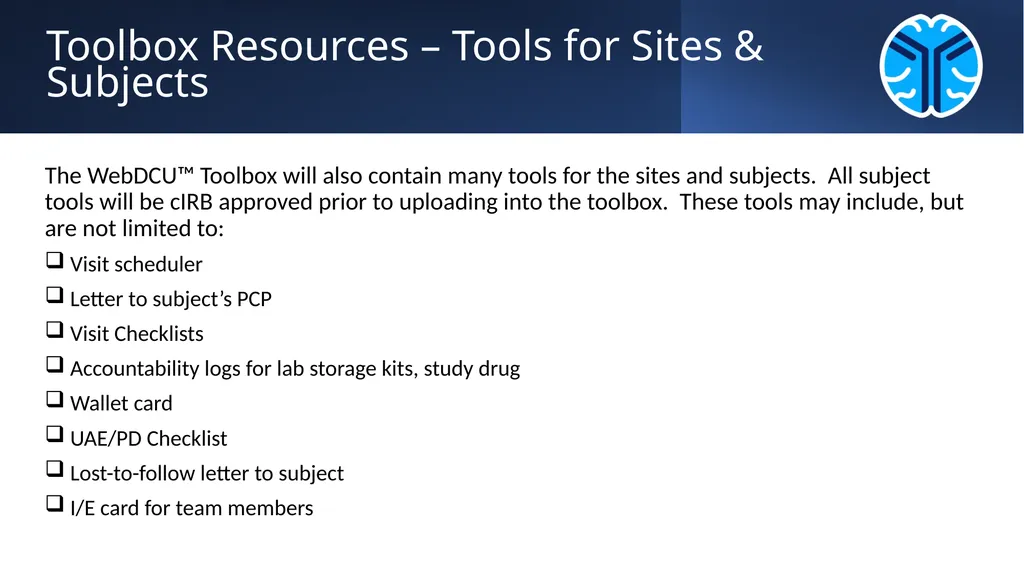
Toolbox Resources – Tools for Sites & Subjects The WebDCU™ Toolbox will also contain many tools for the sites and subjects. All subject tools will be cIRB approved prior to uploading into the toolbox. These tools may include, but are not limited to:
Visit scheduler
Letter to subject’s PCP
Visit Checklists
Accountability logs for lab storage kits, study drug
Wallet card
UAE/PD Checklist
Lost-to-follow letter to subject
I/E card for team members<br>
Visit scheduler
Letter to subject’s PCP
Visit Checklists
Accountability logs for lab storage kits, study drug
Wallet card
UAE/PD Checklist
Lost-to-follow letter to subject
I/E card for team members<br>
44
Start-Up
In-Hospital Visit
30-Day Visit
90-Day Visit
Other Payments Payment Schedule<br>
In-Hospital Visit
30-Day Visit
90-Day Visit
Other Payments Payment Schedule<br>
45
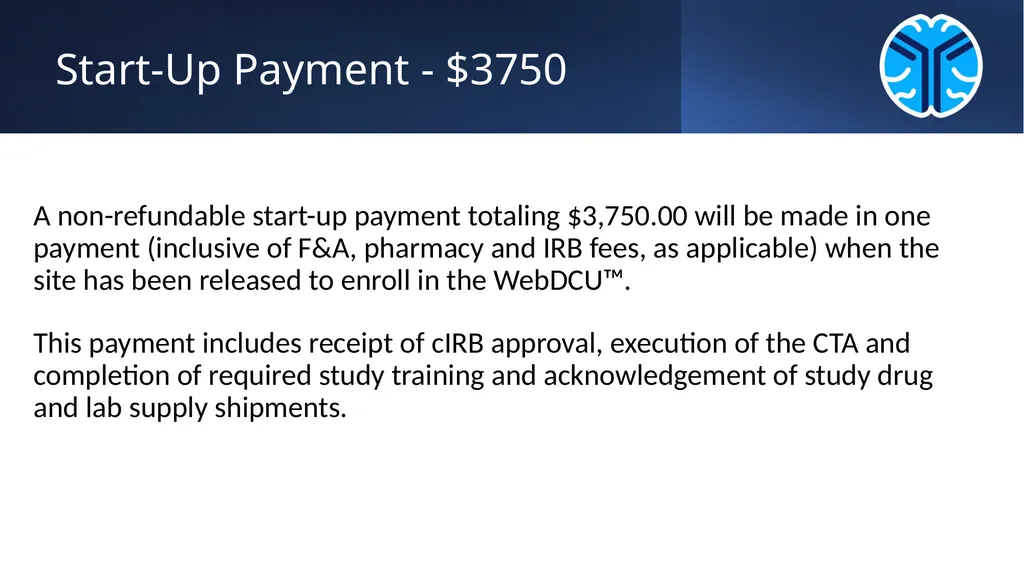
Start-Up Payment - $3750 A non-refundable start-up payment totaling $3,750.00 will be made in one payment (inclusive of F&A, pharmacy and IRB fees, as applicable) when the site has been released to enroll in the WebDCU™.
This payment includes receipt of cIRB approval, execution of the CTA and completion of required study training and acknowledgement of study drug and lab supply shipments.<br>
This payment includes receipt of cIRB approval, execution of the CTA and completion of required study training and acknowledgement of study drug and lab supply shipments.<br>
46
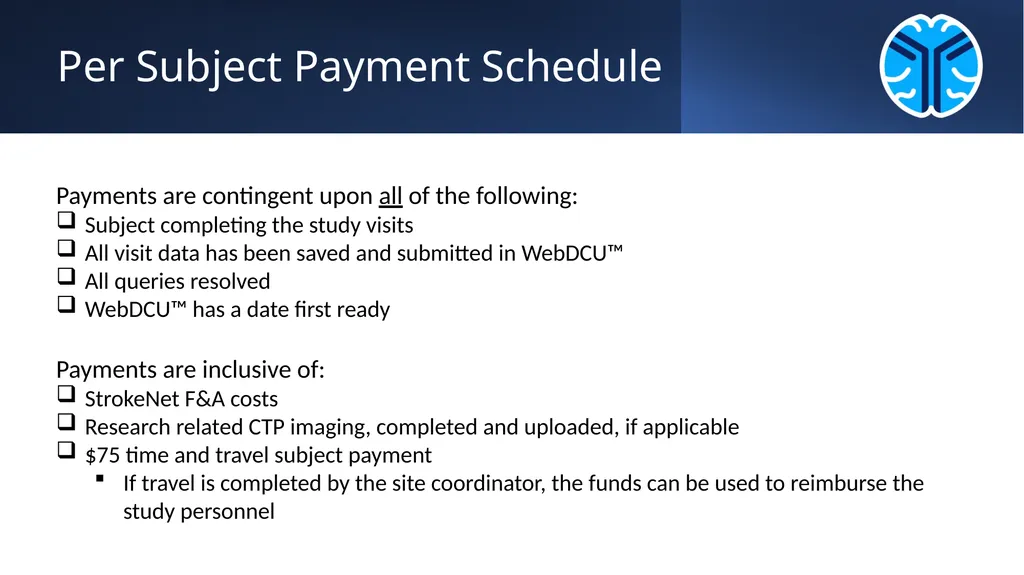
Per Subject Payment Schedule Payments are contingent upon all of the following:
Subject completing the study visits
All visit data has been saved and submitted in WebDCU™
All queries resolved
WebDCU™ has a date first ready
Payments are inclusive of:
StrokeNet F&A costs
Research related CTP imaging, completed and uploaded, if applicable
$75 time and travel subject payment
If travel is completed by the site coordinator, the funds can be used to reimburse the study personnel<br>
Subject completing the study visits
All visit data has been saved and submitted in WebDCU™
All queries resolved
WebDCU™ has a date first ready
Payments are inclusive of:
StrokeNet F&A costs
Research related CTP imaging, completed and uploaded, if applicable
$75 time and travel subject payment
If travel is completed by the site coordinator, the funds can be used to reimburse the study personnel<br>
47
In-Hospital Visit - $8999.60<br>
48
Payment includes:
NIHSS assessment
Con-med collection
AE/SAE Assessment & collection
Subject or site payment for travel
time & travel subject payment of $75.00 for each of the post hospital visits
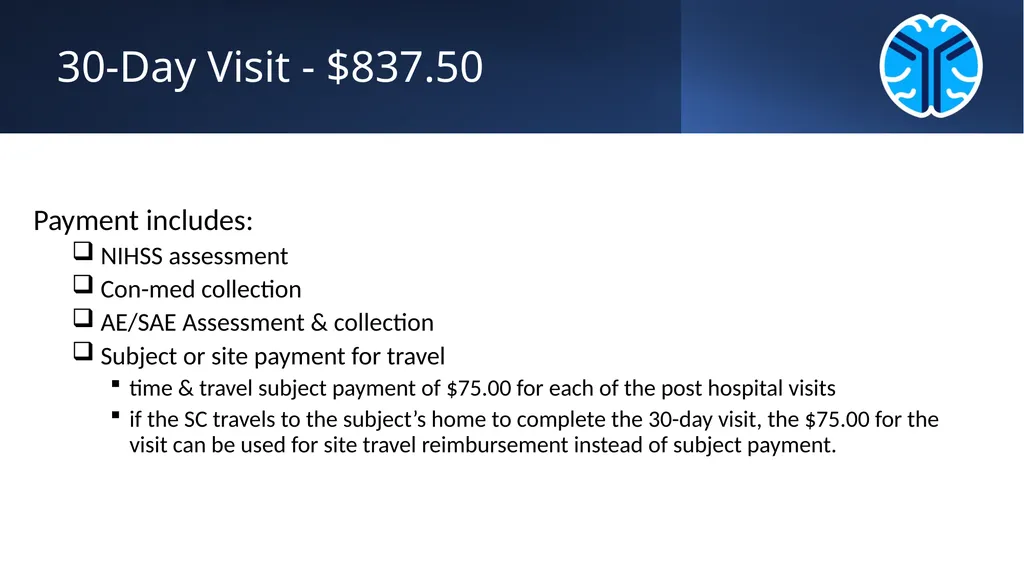
if the SC travels to the subject’s home to complete the 30-day visit, the $75.00 for the visit can be used for site travel reimbursement instead of subject payment. 30-Day Visit - $837.50<br>
NIHSS assessment
Con-med collection
AE/SAE Assessment & collection
Subject or site payment for travel
time & travel subject payment of $75.00 for each of the post hospital visits
if the SC travels to the subject’s home to complete the 30-day visit, the $75.00 for the visit can be used for site travel reimbursement instead of subject payment. 30-Day Visit - $837.50<br>
49
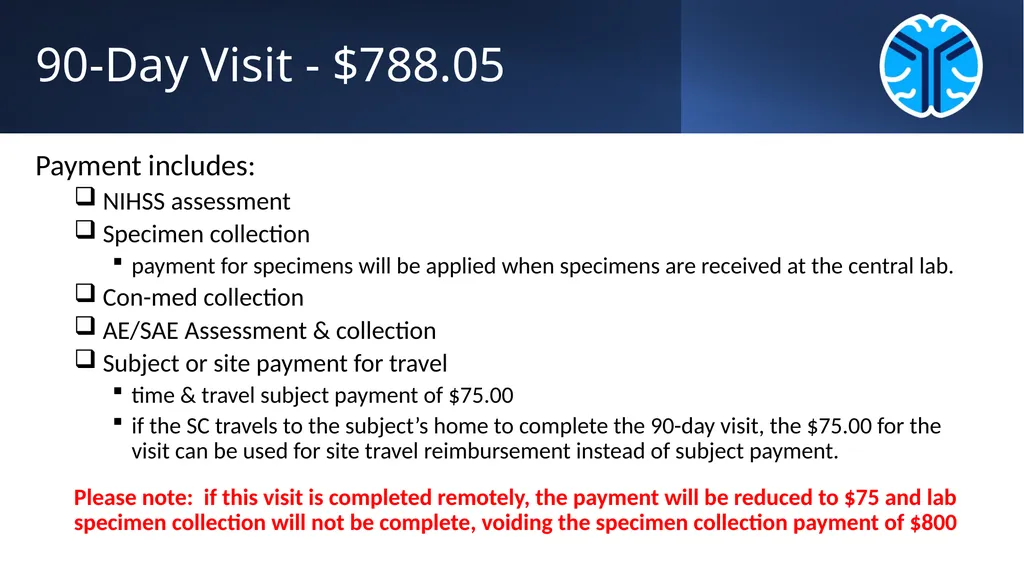
Payment includes:
NIHSS assessment
Specimen collection
payment for specimens will be applied when specimens are received at the central lab.
Con-med collection
AE/SAE Assessment & collection
Subject or site payment for travel
time & travel subject payment of $75.00
if the SC travels to the subject’s home to complete the 90-day visit, the $75.00 for the visit can be used for site travel reimbursement instead of subject payment.
Please note: if this visit is completed remotely, the payment will be reduced to $75 and lab specimen collection will not be complete, voiding the specimen collection payment of $800 90-Day Visit - $788.05<br>
NIHSS assessment
Specimen collection
payment for specimens will be applied when specimens are received at the central lab.
Con-med collection
AE/SAE Assessment & collection
Subject or site payment for travel
time & travel subject payment of $75.00
if the SC travels to the subject’s home to complete the 90-day visit, the $75.00 for the visit can be used for site travel reimbursement instead of subject payment.
Please note: if this visit is completed remotely, the payment will be reduced to $75 and lab specimen collection will not be complete, voiding the specimen collection payment of $800 90-Day Visit - $788.05<br>
50
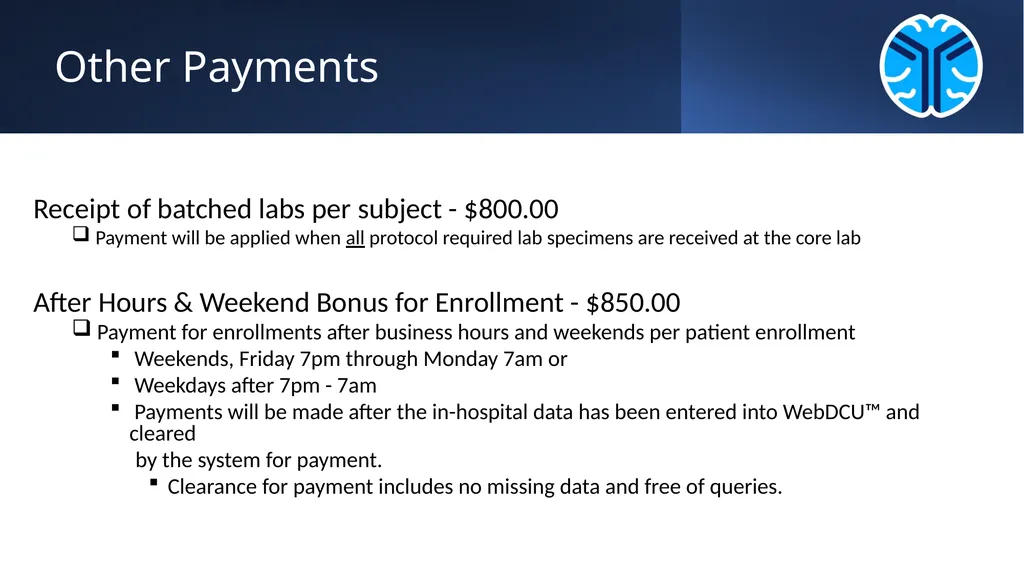
Receipt of batched labs per subject - $800.00
Payment will be applied when all protocol required lab specimens are received at the core lab
After Hours & Weekend Bonus for Enrollment - $850.00
Payment for enrollments after business hours and weekends per patient enrollment
Weekends, Friday 7pm through Monday 7am or
Weekdays after 7pm - 7am
Payments will be made after the in-hospital data has been entered into WebDCU™ and cleared
by the system for payment.
Clearance for payment includes no missing data and free of queries. Other Payments<br>
Payment will be applied when all protocol required lab specimens are received at the core lab
After Hours & Weekend Bonus for Enrollment - $850.00
Payment for enrollments after business hours and weekends per patient enrollment
Weekends, Friday 7pm through Monday 7am or
Weekdays after 7pm - 7am
Payments will be made after the in-hospital data has been entered into WebDCU™ and cleared
by the system for payment.
Clearance for payment includes no missing data and free of queries. Other Payments<br>
51
Questions?<br>