
Streamline: A Fast, Flushless Cache Covert-Channel


Description: Streamline: A Fast, Flushless Cache Covert-Channel Attack by Enabling Asynchronous Collusion Gururaj Saileshwar1, Christopher Fletcher2, Moinuddin Qureshi1 ASPLOS-2021 1 2 3x -6x higher bit-rate vs state-of-the-art covert-channel attacks
Related Topics
Download Presentation
"Streamline: A Fast, Flushless Cache Covert-Channel" is the property of its rightful owner. Permission is granted to download and print the materials on this website for personal, non-commercial use only, and to display it on your personal computer provided you do not modify the materials and that you retain all copyright notices contained in the materials. By downloading content from our website, you accept the terms of this agreement.
Presentation Transcript
slide1. Streamline: A Fast, Flushless Cache Covert-Channel
Attack by Enabling Asynchronous Collusion Gururaj Saileshwar1,
Christopher Fletcher2, Moinuddin Qureshi1 ASPLOS-2021 1 2 3x -6x higher bit-rate vs state-of-the-art covert-channel attacks Note: The authors reserve all rights to this presentation. Fair use for educational purposes is permissible.<br>
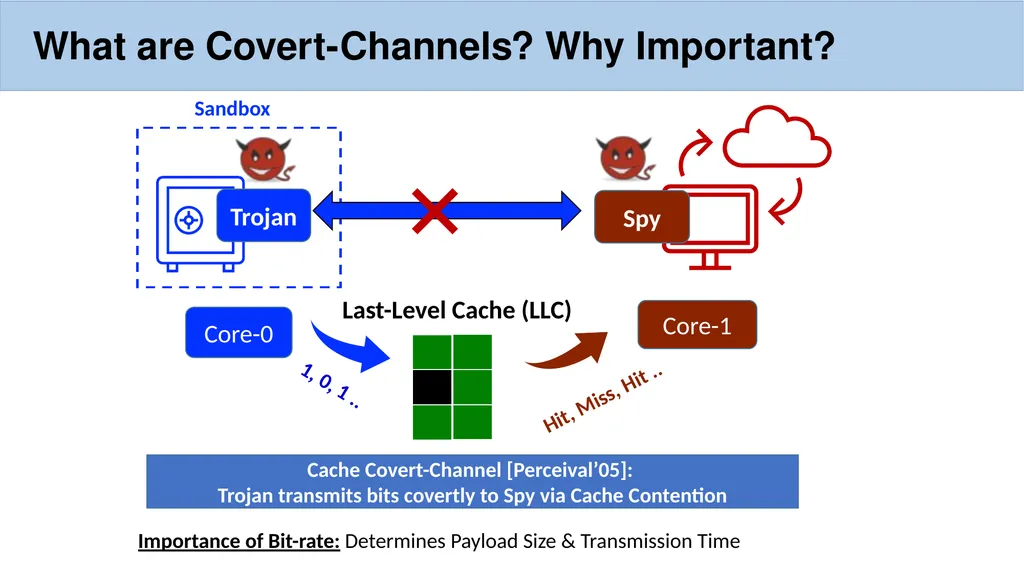
slide2. What are Covert-Channels? Why Important? Trojan Spy Sandbox Core-1 Core-0 Last-Level Cache (LLC) 1, 0, 1 .. Hit, Miss, Hit .. Cache Covert-Channel [Perceival’05]:
Trojan transmits bits covertly to Spy via Cache Contention Importance of Bit-rate: Determines Payload Size & Transmission Time<br>
slide3. State-of-the-art Covert-Channels CORE-0
(Trojan) CORE-1
(Spy) B LLC Shared Address
(Read-only) Flush+Reload Attack [USENIX-SEC’14] 1. Synchronous Operation
Bit-rate limited to < 500KB/s 2. Applicable to certain ISAs (x86) Requires unprivileged usage of Cacheline Flush Instruction (clflush) Q. Real Upper Bound on Bit-rate for Cache Covert-Channels?
Q. How to make these Universally Applicable to all ISAs? Limitations:<br>
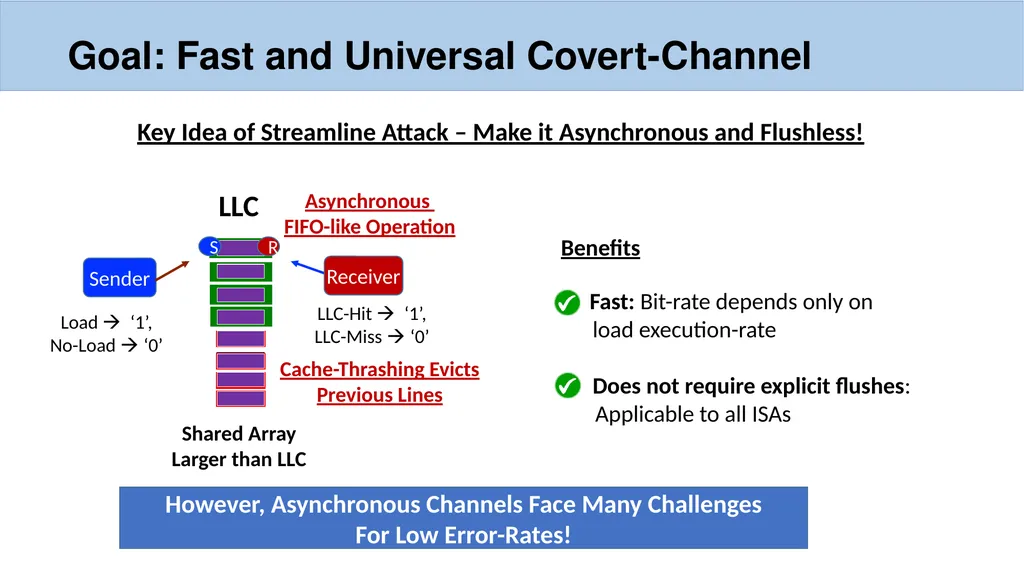
slide4. Goal: Fast and Universal Covert-Channel Key Idea of Streamline Attack – Make it Asynchronous and Flushless! LLC Sender Shared Array
Larger than LLC Asynchronous
FIFO-like Operation Cache-Thrashing Evicts Previous Lines Benefits
Fast: Bit-rate depends only on
load execution-rate
Does not require explicit flushes: Applicable to all ISAs However, Asynchronous Channels Face Many Challenges
For Low Error-Rates! Receiver R S Load ‘1’,
No-Load ‘0’ LLC-Hit ‘1’,
LLC-Miss ‘0’<br>
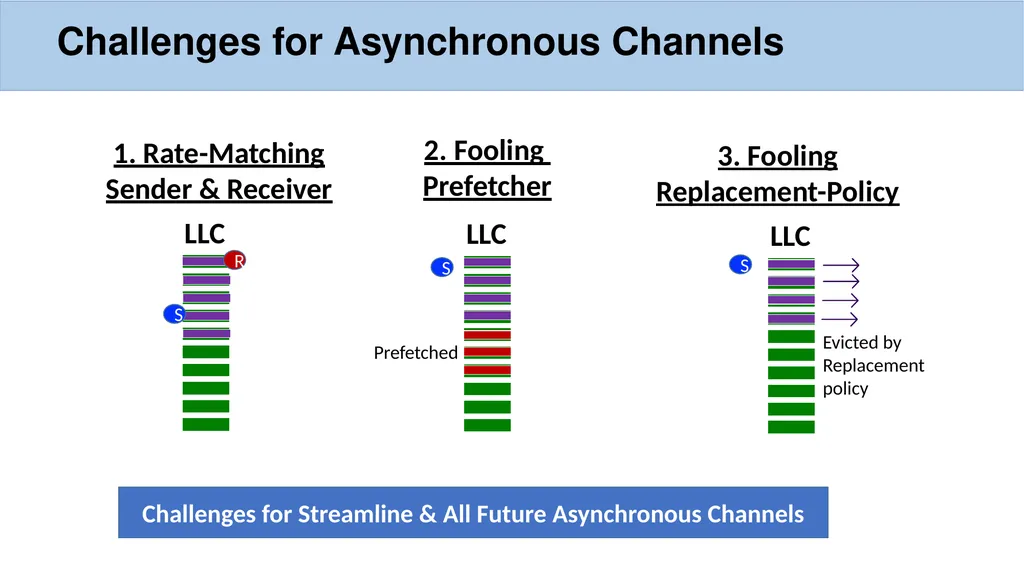
slide5. Challenges for Asynchronous Channels LLC S 2. Fooling
Prefetcher 3. Fooling Replacement-Policy S R S Challenges for Streamline & All Future Asynchronous Channels Prefetched Evicted by
Replacement policy<br>
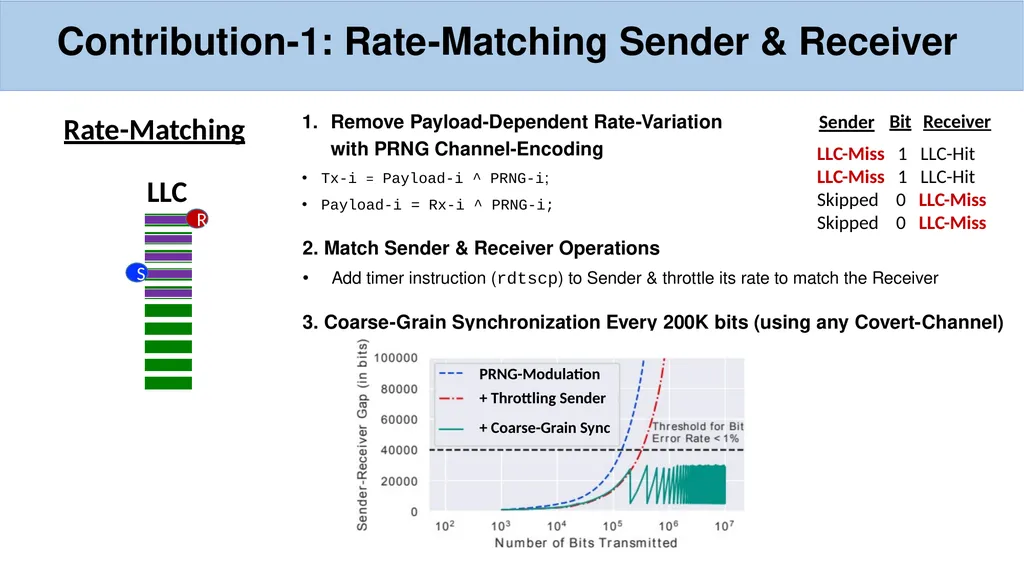
slide6. Contribution-1: Rate-Matching Sender & Receiver R S Remove Payload-Dependent Rate-Variation
with PRNG Channel-Encoding
Tx-i = Payload-i ^ PRNG-i;
Payload-i = Rx-i ^ PRNG-i;
2. Match Sender & Receiver Operations
Add timer instruction (rdtscp) to Sender & throttle its rate to match the Receiver
3. Coarse-Grain Synchronization Every 200K bits (using any Covert-Channel) PRNG-Modulation + Coarse-Grain Sync + Throttling Sender<br>
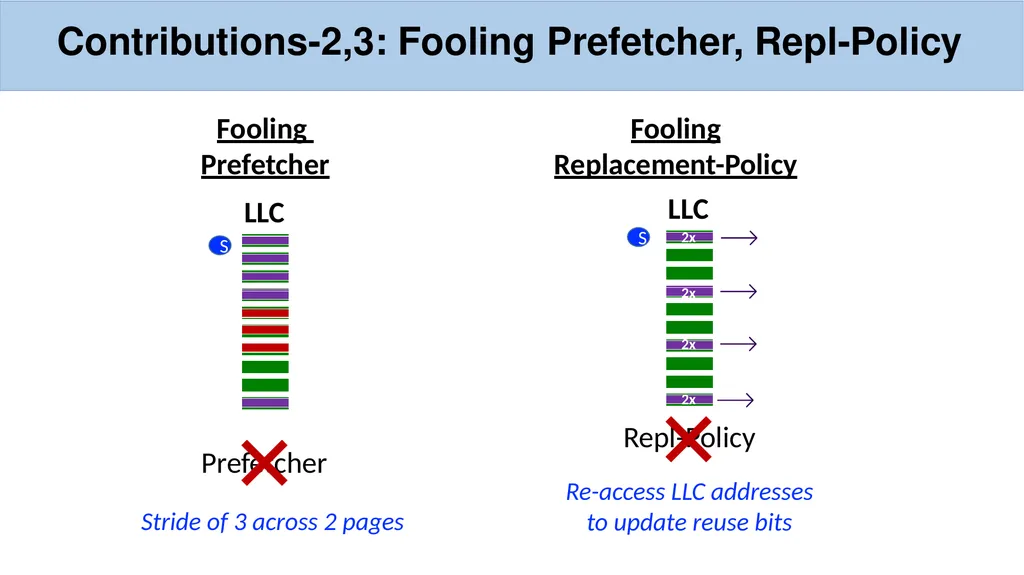
slide7. Contributions-2,3: Fooling Prefetcher, Repl-Policy LLC Prefetcher S Fooling
Prefetcher Fooling Replacement-Policy Stride of 3 across 2 pages 2x 2x 2x 2x Re-access LLC addresses
to update reuse bits Repl-Policy S<br>
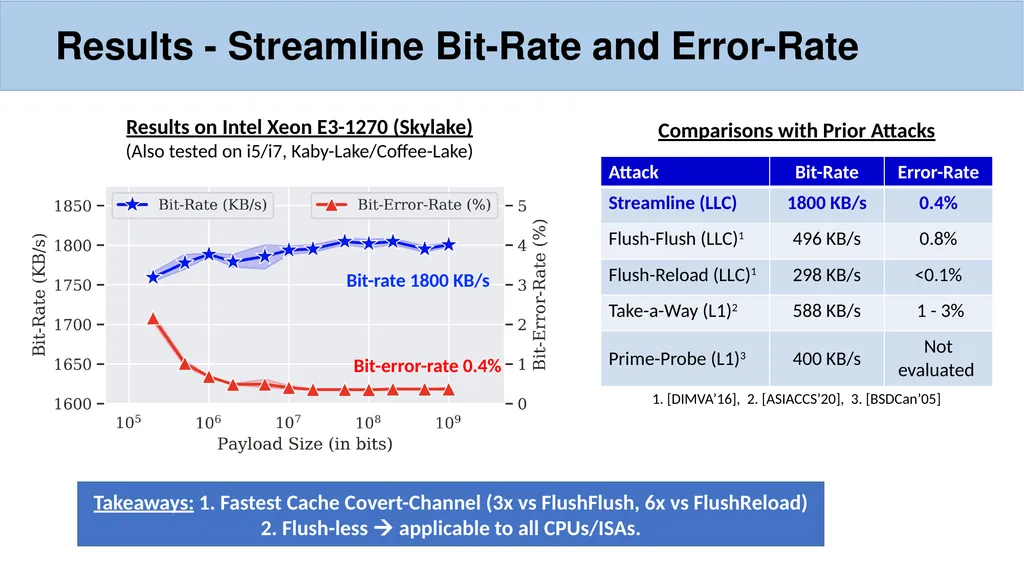
slide8. Results - Streamline Bit-Rate and Error-Rate Bit-rate 1800 KB/s Bit-error-rate 0.4% 1. [DIMVA’16], 2. [ASIACCS’20], 3. [BSDCan’05] Takeaways: 1. Fastest Cache Covert-Channel (3x vs FlushFlush, 6x vs FlushReload)
2. Flush-less applicable to all CPUs/ISAs. Results on Intel Xeon E3-1270 (Skylake)
(Also tested on i5/i7, Kaby-Lake/Coffee-Lake) Comparisons with Prior Attacks<br>
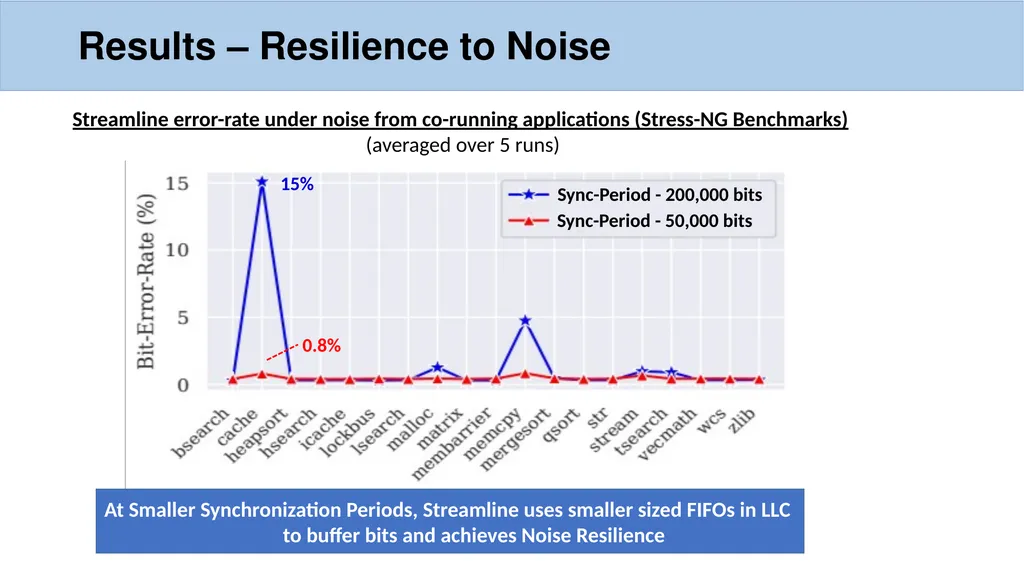
slide9. Results – Resilience to Noise Streamline error-rate under noise from co-running applications (Stress-NG Benchmarks)
(averaged over 5 runs) At Smaller Synchronization Periods, Streamline uses smaller sized FIFOs in LLC to buffer bits and achieves Noise Resilience Sync-Period - 200,000 bits 15%<br>
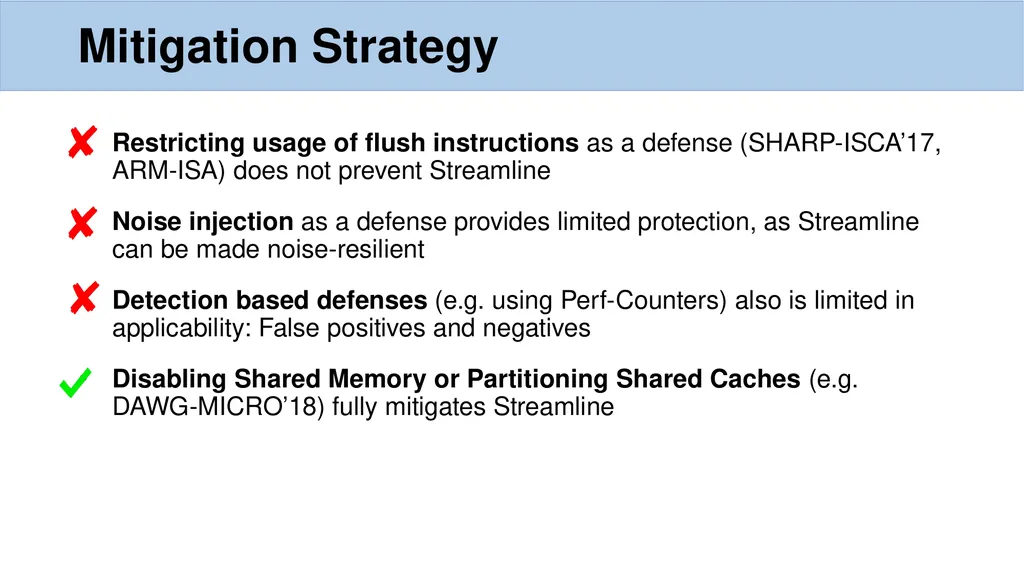
slide10. Mitigation Strategy Restricting usage of flush instructions as a defense (SHARP-ISCA’17, ARM-ISA) does not prevent Streamline
Noise injection as a defense provides limited protection, as Streamline can be made noise-resilient
Detection based defenses (e.g. using Perf-Counters) also is limited in applicability: False positives and negatives
Disabling Shared Memory or Partitioning Shared Caches (e.g. DAWG-MICRO’18) fully mitigates Streamline<br>
slide11. Limitation: New Bottleneck in Covert Channels Measurement Bottleneck: Fundamentally Limits Bit-Rate of Streamline & Future Attacks
Inability to Execute & Measure Latency of Multiple Loads in Parallel
Overcoming this bottleneck and measuring load-latency of multiple loads in parallel, can unlock ~10x increase in bitrate of covert-channel rdtscp //read timer
load x
rdtscp //read timer Using rdtscp [Intel SW Developer’s Manual] Serialized due to Fence-like semantics of rdtscp Using Counting-Thread [DIMVA’17] Thread-0
load ctr
load x
load ctr
--------
load ctr
load y
load ctr Thread-1
while(1){
ctr++;
} Serialized due to
TSO ordering in Intel CPUs --------
rdtscp //read timer
load y
rdtscp //read timer<br>
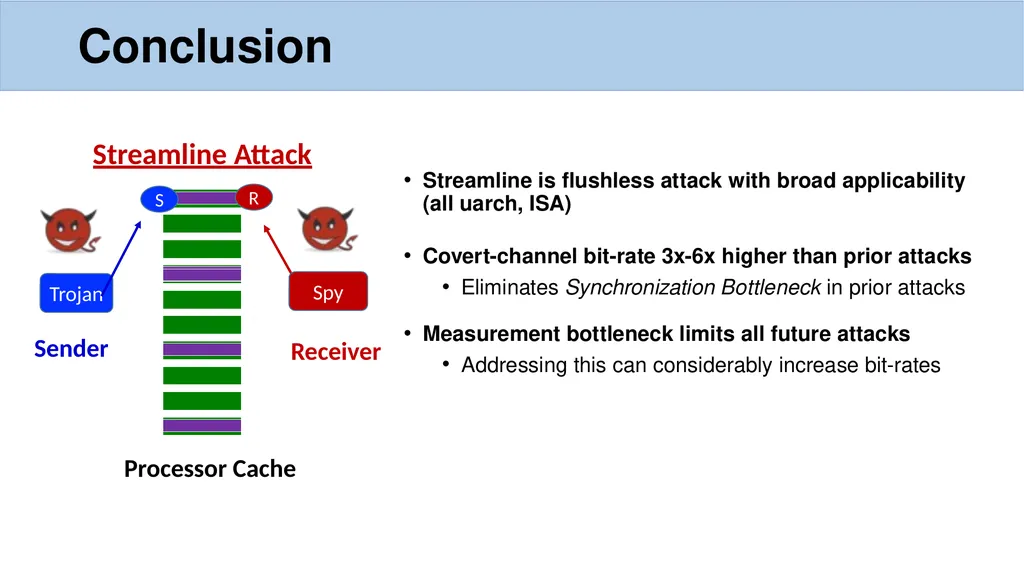
slide12. Conclusion Streamline is flushless attack with broad applicability (all uarch, ISA)
Covert-channel bit-rate 3x-6x higher than prior attacks
Eliminates Synchronization Bottleneck in prior attacks
Measurement bottleneck limits all future attacks
Addressing this can considerably increase bit-rates Trojan Sender Spy Receiver Processor Cache R S Streamline Attack<br>
Christopher Fletcher2, Moinuddin Qureshi1 ASPLOS-2021 1 2 3x -6x higher bit-rate vs state-of-the-art covert-channel attacks Note: The authors reserve all rights to this presentation. Fair use for educational purposes is permissible.<br>
slide2. What are Covert-Channels? Why Important? Trojan Spy Sandbox Core-1 Core-0 Last-Level Cache (LLC) 1, 0, 1 .. Hit, Miss, Hit .. Cache Covert-Channel [Perceival’05]:
Trojan transmits bits covertly to Spy via Cache Contention Importance of Bit-rate: Determines Payload Size & Transmission Time<br>
slide3. State-of-the-art Covert-Channels CORE-0
(Trojan) CORE-1
(Spy) B LLC Shared Address
(Read-only) Flush+Reload Attack [USENIX-SEC’14] 1. Synchronous Operation
Bit-rate limited to < 500KB/s 2. Applicable to certain ISAs (x86) Requires unprivileged usage of Cacheline Flush Instruction (clflush) Q. Real Upper Bound on Bit-rate for Cache Covert-Channels?
Q. How to make these Universally Applicable to all ISAs? Limitations:<br>
slide4. Goal: Fast and Universal Covert-Channel Key Idea of Streamline Attack – Make it Asynchronous and Flushless! LLC Sender Shared Array
Larger than LLC Asynchronous
FIFO-like Operation Cache-Thrashing Evicts Previous Lines Benefits
Fast: Bit-rate depends only on
load execution-rate
Does not require explicit flushes: Applicable to all ISAs However, Asynchronous Channels Face Many Challenges
For Low Error-Rates! Receiver R S Load ‘1’,
No-Load ‘0’ LLC-Hit ‘1’,
LLC-Miss ‘0’<br>
slide5. Challenges for Asynchronous Channels LLC S 2. Fooling
Prefetcher 3. Fooling Replacement-Policy S R S Challenges for Streamline & All Future Asynchronous Channels Prefetched Evicted by
Replacement policy<br>
slide6. Contribution-1: Rate-Matching Sender & Receiver R S Remove Payload-Dependent Rate-Variation
with PRNG Channel-Encoding
Tx-i = Payload-i ^ PRNG-i;
Payload-i = Rx-i ^ PRNG-i;
2. Match Sender & Receiver Operations
Add timer instruction (rdtscp) to Sender & throttle its rate to match the Receiver
3. Coarse-Grain Synchronization Every 200K bits (using any Covert-Channel) PRNG-Modulation + Coarse-Grain Sync + Throttling Sender<br>
slide7. Contributions-2,3: Fooling Prefetcher, Repl-Policy LLC Prefetcher S Fooling
Prefetcher Fooling Replacement-Policy Stride of 3 across 2 pages 2x 2x 2x 2x Re-access LLC addresses
to update reuse bits Repl-Policy S<br>
slide8. Results - Streamline Bit-Rate and Error-Rate Bit-rate 1800 KB/s Bit-error-rate 0.4% 1. [DIMVA’16], 2. [ASIACCS’20], 3. [BSDCan’05] Takeaways: 1. Fastest Cache Covert-Channel (3x vs FlushFlush, 6x vs FlushReload)
2. Flush-less applicable to all CPUs/ISAs. Results on Intel Xeon E3-1270 (Skylake)
(Also tested on i5/i7, Kaby-Lake/Coffee-Lake) Comparisons with Prior Attacks<br>
slide9. Results – Resilience to Noise Streamline error-rate under noise from co-running applications (Stress-NG Benchmarks)
(averaged over 5 runs) At Smaller Synchronization Periods, Streamline uses smaller sized FIFOs in LLC to buffer bits and achieves Noise Resilience Sync-Period - 200,000 bits 15%<br>
slide10. Mitigation Strategy Restricting usage of flush instructions as a defense (SHARP-ISCA’17, ARM-ISA) does not prevent Streamline
Noise injection as a defense provides limited protection, as Streamline can be made noise-resilient
Detection based defenses (e.g. using Perf-Counters) also is limited in applicability: False positives and negatives
Disabling Shared Memory or Partitioning Shared Caches (e.g. DAWG-MICRO’18) fully mitigates Streamline<br>
slide11. Limitation: New Bottleneck in Covert Channels Measurement Bottleneck: Fundamentally Limits Bit-Rate of Streamline & Future Attacks
Inability to Execute & Measure Latency of Multiple Loads in Parallel
Overcoming this bottleneck and measuring load-latency of multiple loads in parallel, can unlock ~10x increase in bitrate of covert-channel rdtscp //read timer
load x
rdtscp //read timer Using rdtscp [Intel SW Developer’s Manual] Serialized due to Fence-like semantics of rdtscp Using Counting-Thread [DIMVA’17] Thread-0
load ctr
load x
load ctr
--------
load ctr
load y
load ctr Thread-1
while(1){
ctr++;
} Serialized due to
TSO ordering in Intel CPUs --------
rdtscp //read timer
load y
rdtscp //read timer<br>
slide12. Conclusion Streamline is flushless attack with broad applicability (all uarch, ISA)
Covert-channel bit-rate 3x-6x higher than prior attacks
Eliminates Synchronization Bottleneck in prior attacks
Measurement bottleneck limits all future attacks
Addressing this can considerably increase bit-rates Trojan Sender Spy Receiver Processor Cache R S Streamline Attack<br>