
STRESS INDUCED DISORDERS, ALCOHOLISM & SUBSTANCE
EM
Published · 36 slides · 0 views

1 / 1






Description
STRESS INDUCED DISORDERS, ALCOHOLISM SUBSTANCE ABUSE LESSON -31 BY JITENDER YADAV INSPPH OBJECTIVES Upon completion of this lesson you will be able to: List the signs symptoms of Alcohol abuse and the steps in management Explain
Related Topics
Share
Embed code
Download this presentation From Below
"STRESS INDUCED DISORDERS, ALCOHOLISM & SUBSTANCE" is the property of its rightful owner. Permission is granted to download and print the materials on this website for personal, non-commercial use only, and to display it on your personal computer provided you do not modify the materials and that you retain all copyright notices contained in the materials. By downloading content from our website, you accept the terms of this agreement.
Presentation Transcript
01
STRESS INDUCED DISORDERS, ALCOHOLISM & SUBSTANCE ABUSE LESSON -31 BY
JITENDER YADAV
INSP/PH<br>
JITENDER YADAV
INSP/PH<br>
02
OBJECTIVES
Upon completion of this lesson you will be able to:
List the signs & symptoms of Alcohol abuse and the steps in management
Explain Delirium Tremens. List its signs, symptoms & management
Describe & classify the types of drugs which are abused
Enumerate the general signs & symptoms of drug abuse and list the complications<br>
Upon completion of this lesson you will be able to:
List the signs & symptoms of Alcohol abuse and the steps in management
Explain Delirium Tremens. List its signs, symptoms & management
Describe & classify the types of drugs which are abused
Enumerate the general signs & symptoms of drug abuse and list the complications<br>
03
OBJECTIVES
5. Enumerate the steps in management of
drug abuse
6. Explain Post-traumatic stress disorder
and list the signs & symptoms<br>
5. Enumerate the steps in management of
drug abuse
6. Explain Post-traumatic stress disorder
and list the signs & symptoms<br>
04
ALCOHOL ABUSE
Alcohol is a drug with wide social acceptance when ingested moderately. Abuse of this drug leads to alcoholism and serious chronic intoxication with great physical and mental deterioration. A patient under the influence of alcohol can be dangerous to him/herself and to others.<br>
Alcohol is a drug with wide social acceptance when ingested moderately. Abuse of this drug leads to alcoholism and serious chronic intoxication with great physical and mental deterioration. A patient under the influence of alcohol can be dangerous to him/herself and to others.<br>
05
ALCOHOL ABUSE
In the forces, an individual is often brought to unit hospitals for medical examination by Medical Officer to ascertain if he was found inebriated while on duty. Medics may also notice that some individuals in unit are heavy drinkers and are slowly deteriorating. It is the duty of the medic to assist the M.O in examination as well to bring to notice of the M.O about individuals who have a drinking problem.<br>
In the forces, an individual is often brought to unit hospitals for medical examination by Medical Officer to ascertain if he was found inebriated while on duty. Medics may also notice that some individuals in unit are heavy drinkers and are slowly deteriorating. It is the duty of the medic to assist the M.O in examination as well to bring to notice of the M.O about individuals who have a drinking problem.<br>
06
SPECIFIC SIGNS AND SYMPTOMS OF ACUTE ALCOHOL ABUSE/POISONING –
• Smell of alcohol on the breath and/or clothes.
• Staggering
• Slurred speech
• Nausea and vomiting
• Redness of the face
• Altered behavior
• Altered conscious level or unconsciousness ACUTE ALCOHOLIC ABUSE<br>
• Smell of alcohol on the breath and/or clothes.
• Staggering
• Slurred speech
• Nausea and vomiting
• Redness of the face
• Altered behavior
• Altered conscious level or unconsciousness ACUTE ALCOHOLIC ABUSE<br>
07
Verify whether it is strictly a case of alcohol abuse (also, determine if diabetic).
Keep the patient warm.
Monitor vital signs and stay alert for breathing problems. Be alert for vomiting and take steps to prevent aspiration.
Protect the patient from injury without using restrictive means.
Give oxygen TREATMENT FOR ACUTE ALCOHOL ABUSE<br>
Keep the patient warm.
Monitor vital signs and stay alert for breathing problems. Be alert for vomiting and take steps to prevent aspiration.
Protect the patient from injury without using restrictive means.
Give oxygen TREATMENT FOR ACUTE ALCOHOL ABUSE<br>
08
Establish IV access and give 5% Dextrose (if patient non-diabetic) and having altered consciousness
Transport the patient for hospital care if he is having abnormal vital signs, prolonged altered mental status.
If you suspect chronic alcoholism in the patient, refer the patient for counseling and de addiction treatment TREATMENT FOR ACUTE ALCOHOL ABUSE<br>
Transport the patient for hospital care if he is having abnormal vital signs, prolonged altered mental status.
If you suspect chronic alcoholism in the patient, refer the patient for counseling and de addiction treatment TREATMENT FOR ACUTE ALCOHOL ABUSE<br>
09
One unit of alcohol is 9g of alcohol and is equivalent to half a pint of beer or single measure of spirit or glass of table wine.
Chronic heavy drinking is identified as intake of more than 21 units weekly for men and 14 units weekly for women CHRONIC ALCOHOL ABUSE<br>
Chronic heavy drinking is identified as intake of more than 21 units weekly for men and 14 units weekly for women CHRONIC ALCOHOL ABUSE<br>
10
Chronic alcoholism can lead to –
i) Social problems
absenteeism from work
unemployment
marital tensions
child abuse
financial difficulties
problems with the law CHRONIC ALCOHOL ABUSE<br>
i) Social problems
absenteeism from work
unemployment
marital tensions
child abuse
financial difficulties
problems with the law CHRONIC ALCOHOL ABUSE<br>
11
ii) Psychological problems
depression
paranoid psychosis
moral and social deterioration
Chronic alcoholism can lead to physical ailments like peptic ulcer, alcoholic blackouts, liver disease, cirrhosis, encephalopathy, Korsakoff's syndrome, dementia, cardiomyopathy, hypertension, pancreatitis and fetal alcohol syndrome (in females)<br>
depression
paranoid psychosis
moral and social deterioration
Chronic alcoholism can lead to physical ailments like peptic ulcer, alcoholic blackouts, liver disease, cirrhosis, encephalopathy, Korsakoff's syndrome, dementia, cardiomyopathy, hypertension, pancreatitis and fetal alcohol syndrome (in females)<br>
12
Identification of individuals having family problems, professional strife and bringing it to the notice of medical officer
Advise about harmful effects of alcohol and supportive therapy when patient is in abstinence phase CHRONIC ALCOHOL ABUSE Management:<br>
Advise about harmful effects of alcohol and supportive therapy when patient is in abstinence phase CHRONIC ALCOHOL ABUSE Management:<br>
13
If patient is having withdrawal syndrome, administer Tab. Diazepam 10mg 6 hrly and refer for hospital care
Inj. Thiamine Hydrochloride 1 amp daily for a week or Cap. Multivitamin in high doses to correct underlying micronutrient deficiency and ensure individual is taking adequate nutritious diet CHRONIC ALCOHOL ABUSE Management:<br>
Inj. Thiamine Hydrochloride 1 amp daily for a week or Cap. Multivitamin in high doses to correct underlying micronutrient deficiency and ensure individual is taking adequate nutritious diet CHRONIC ALCOHOL ABUSE Management:<br>
14
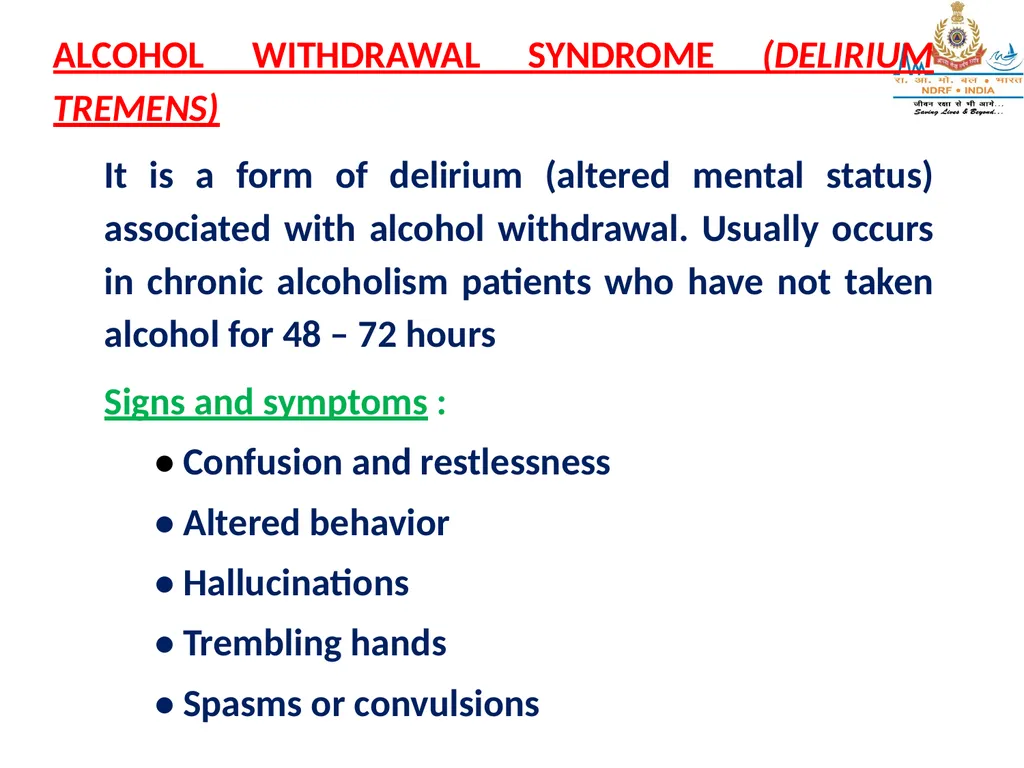
ALCOHOL WITHDRAWAL SYNDROME (DELIRIUM TREMENS)
It is a form of delirium (altered mental status) associated with alcohol withdrawal. Usually occurs in chronic alcoholism patients who have not taken alcohol for 48 – 72 hours
Signs and symptoms :
• Confusion and restlessness
• Altered behavior
• Hallucinations
• Trembling hands
• Spasms or convulsions<br>
It is a form of delirium (altered mental status) associated with alcohol withdrawal. Usually occurs in chronic alcoholism patients who have not taken alcohol for 48 – 72 hours
Signs and symptoms :
• Confusion and restlessness
• Altered behavior
• Hallucinations
• Trembling hands
• Spasms or convulsions<br>
15
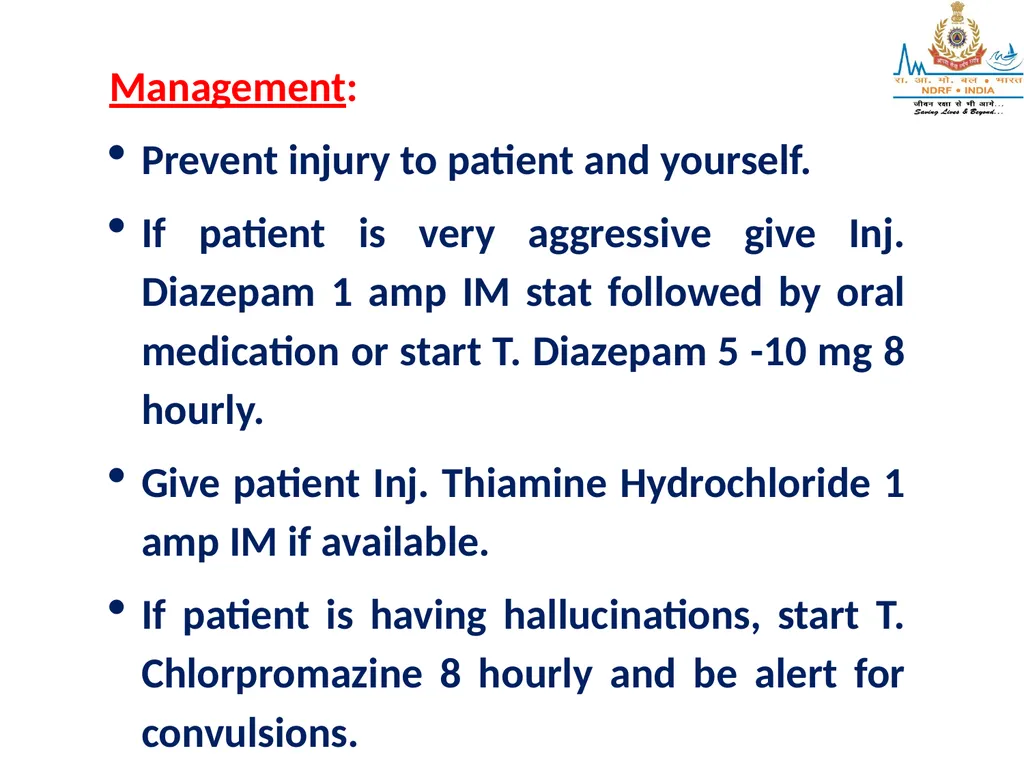
Management:
Prevent injury to patient and yourself.
If patient is very aggressive give Inj. Diazepam 1 amp IM stat followed by oral medication or start T. Diazepam 5 -10 mg 8 hourly.
Give patient Inj. Thiamine Hydrochloride 1 amp IM if available.
If patient is having hallucinations, start T. Chlorpromazine 8 hourly and be alert for convulsions.<br>
Prevent injury to patient and yourself.
If patient is very aggressive give Inj. Diazepam 1 amp IM stat followed by oral medication or start T. Diazepam 5 -10 mg 8 hourly.
Give patient Inj. Thiamine Hydrochloride 1 amp IM if available.
If patient is having hallucinations, start T. Chlorpromazine 8 hourly and be alert for convulsions.<br>
16
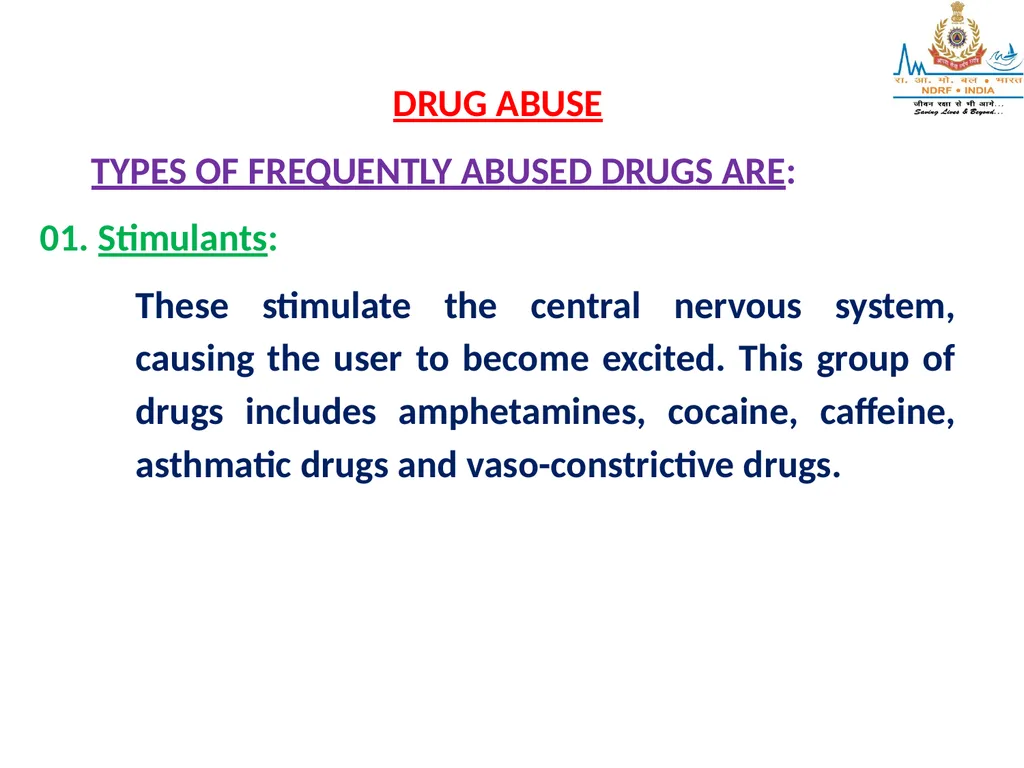
DRUG ABUSE
TYPES OF FREQUENTLY ABUSED DRUGS ARE:
01. Stimulants:
These stimulate the central nervous system, causing the user to become excited. This group of drugs includes amphetamines, cocaine, caffeine, asthmatic drugs and vaso-constrictive drugs.<br>
TYPES OF FREQUENTLY ABUSED DRUGS ARE:
01. Stimulants:
These stimulate the central nervous system, causing the user to become excited. This group of drugs includes amphetamines, cocaine, caffeine, asthmatic drugs and vaso-constrictive drugs.<br>
17
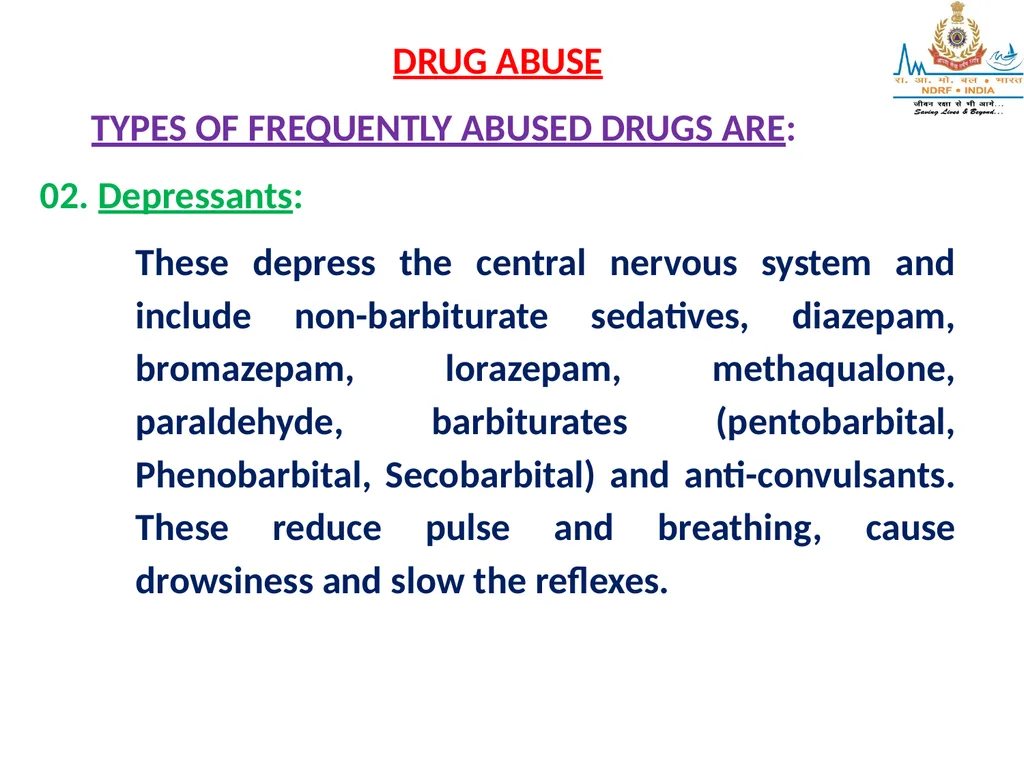
DRUG ABUSE
TYPES OF FREQUENTLY ABUSED DRUGS ARE:
02. Depressants:
These depress the central nervous system and include non-barbiturate sedatives, diazepam, bromazepam, lorazepam, methaqualone, paraldehyde, barbiturates (pentobarbital, Phenobarbital, Secobarbital) and anti-convulsants. These reduce pulse and breathing, cause drowsiness and slow the reflexes.<br>
TYPES OF FREQUENTLY ABUSED DRUGS ARE:
02. Depressants:
These depress the central nervous system and include non-barbiturate sedatives, diazepam, bromazepam, lorazepam, methaqualone, paraldehyde, barbiturates (pentobarbital, Phenobarbital, Secobarbital) and anti-convulsants. These reduce pulse and breathing, cause drowsiness and slow the reflexes.<br>
18
03. Analgesic narcotics (opium-derivatives):
Their use produces intense state of relaxation. Some are easily obtainable, such as codeine found in cough syrups. Morphine, heroin, and Demerol belong to this group of drugs. These drugs reduce body temperature, slow the pulse and breathing, relax the muscles, and cause pupil dilation, drowsiness, and sluggishness.<br>
Their use produces intense state of relaxation. Some are easily obtainable, such as codeine found in cough syrups. Morphine, heroin, and Demerol belong to this group of drugs. These drugs reduce body temperature, slow the pulse and breathing, relax the muscles, and cause pupil dilation, drowsiness, and sluggishness.<br>
19
04. Hallucinogens:
These drugs alter personality and distort perception. They include LSD, mescaline, peyote and psilocybin. Marijuana also has some hallucinogenic properties. Patients often imagine hearing unusual sounds and seeing strange colors. Persons using hallucinogens can become aggressive and pose a threat to you, others and themselves.<br>
These drugs alter personality and distort perception. They include LSD, mescaline, peyote and psilocybin. Marijuana also has some hallucinogenic properties. Patients often imagine hearing unusual sounds and seeing strange colors. Persons using hallucinogens can become aggressive and pose a threat to you, others and themselves.<br>
20
05. Volatile chemicals:
The vapors of certain chemical substances cause excitement, euphoria or the sensation of flying. In general these chemicals are solvents, cleaning fluids, glues and gasoline. The effects are temporary loss of reality, loss of the sense of smell, accelerated pulse and breathing and possible coma.<br>
The vapors of certain chemical substances cause excitement, euphoria or the sensation of flying. In general these chemicals are solvents, cleaning fluids, glues and gasoline. The effects are temporary loss of reality, loss of the sense of smell, accelerated pulse and breathing and possible coma.<br>
21
SOME OF THE COMMON DRUGS MISUSED ARE:
Cannabis:
Derived from Cannabis sativa and is usually smoked mixed with tobacco
Produces a sensation of relaxation and well being
Psychological dependence common but tolerance and withdrawal symptoms unusual<br>
Cannabis:
Derived from Cannabis sativa and is usually smoked mixed with tobacco
Produces a sensation of relaxation and well being
Psychological dependence common but tolerance and withdrawal symptoms unusual<br>
22
Opiates:
Morphine, Heroin and codeine are the main drugs in this group
Taken orally, intravenously or by inhalation it causes rapid, intensely pleasurable experience
Physical dependence occurs within a few weeks of regular intake
Withdrawal syndrome common and starts within 12 hours; symptoms include intense craving, rhinorrhorea, lacrimation, yawning, perspiration, shivering, piloerection, vomiting, diarrhea and abdominal cramps.
Tachycardia, hypertension, mydriasis and facial flushing may occur.<br>
Morphine, Heroin and codeine are the main drugs in this group
Taken orally, intravenously or by inhalation it causes rapid, intensely pleasurable experience
Physical dependence occurs within a few weeks of regular intake
Withdrawal syndrome common and starts within 12 hours; symptoms include intense craving, rhinorrhorea, lacrimation, yawning, perspiration, shivering, piloerection, vomiting, diarrhea and abdominal cramps.
Tachycardia, hypertension, mydriasis and facial flushing may occur.<br>
23
Cocaine:
Taken either intravenously or by sniffing or snorting powder into nostrils
Toxic psychosis and tactile hallucinations may be prominent
Chronic cocaine sniffing may cause ulceration of the nasal mucosa<br>
Taken either intravenously or by sniffing or snorting powder into nostrils
Toxic psychosis and tactile hallucinations may be prominent
Chronic cocaine sniffing may cause ulceration of the nasal mucosa<br>
24
Glue sniffing:
Solvents produce acute intoxication characterized by euphoria, excitement, dizziness and a floating sensation
Further inhalation leads to loss of consciousness
Death can occur due to asphyxia or direct toxic effect of the solvent<br>
Solvents produce acute intoxication characterized by euphoria, excitement, dizziness and a floating sensation
Further inhalation leads to loss of consciousness
Death can occur due to asphyxia or direct toxic effect of the solvent<br>
25
GENERAL COMPLICATIONS OF DRUG ABUSE:
Intravenous use predisposes to bacterial infections, Hepatitis B, HIV through needle contamination
Cardiac arrhythmias
Hyperthermia
Disseminated intravascular coagulation/ Renal failure
Cerebral hemorrhage
Chronic psychotic illness<br>
Intravenous use predisposes to bacterial infections, Hepatitis B, HIV through needle contamination
Cardiac arrhythmias
Hyperthermia
Disseminated intravascular coagulation/ Renal failure
Cerebral hemorrhage
Chronic psychotic illness<br>
26
The following list is a combination of the various signs and symptoms for the different drugs described above.
• Excitability
• Drowsiness and slow reflexes
• Reduced pulse and breathing
• Accelerated pulse and breathing
• Relaxed muscles
• Constricted or dilated pupils GENERAL SIGNS AND SYMPTOMS OF DRUG ABUSE:<br>
• Excitability
• Drowsiness and slow reflexes
• Reduced pulse and breathing
• Accelerated pulse and breathing
• Relaxed muscles
• Constricted or dilated pupils GENERAL SIGNS AND SYMPTOMS OF DRUG ABUSE:<br>
27
The following list is a combination of the various signs and symptoms for the different drugs described above.
• Distorted perception
• Aggressive behavior
• Euphoria
• Dizziness and unfocussed look GENERAL SIGNS AND SYMPTOMS OF DRUG ABUSE:<br>
• Distorted perception
• Aggressive behavior
• Euphoria
• Dizziness and unfocussed look GENERAL SIGNS AND SYMPTOMS OF DRUG ABUSE:<br>
28
Use universal precautions and secure the scene. When speaking with the patient, be tactful and ask directly if he/she is taking any “medication”.
Provide basic life support.
Induce vomiting if the patient is conscious and if the overdose was taken orally within the last 30 minutes.
If the patient is hyperactive, apply restraints to prevent self-injury and injury to others.
Speak with the patient to win his/her trust and to monitor level of consciousness. TREATMENT FOR DRUG ABUSE:<br>
Provide basic life support.
Induce vomiting if the patient is conscious and if the overdose was taken orally within the last 30 minutes.
If the patient is hyperactive, apply restraints to prevent self-injury and injury to others.
Speak with the patient to win his/her trust and to monitor level of consciousness. TREATMENT FOR DRUG ABUSE:<br>
29
Monitor the patient’s breathing carefully because sedatives can cause slow breathing and lead to possible respiratory arrest.
Comfort the patient and provide emotional support.
Watch for allergic reactions.
Keep all evidence of drug abuse.
Administer oxygen high flow, if respiratory distress present
Refer the patient for further treatment and counseling. TREATMENT FOR DRUG ABUSE:<br>
Comfort the patient and provide emotional support.
Watch for allergic reactions.
Keep all evidence of drug abuse.
Administer oxygen high flow, if respiratory distress present
Refer the patient for further treatment and counseling. TREATMENT FOR DRUG ABUSE:<br>
30
STRESS INDUCED DISORDERS
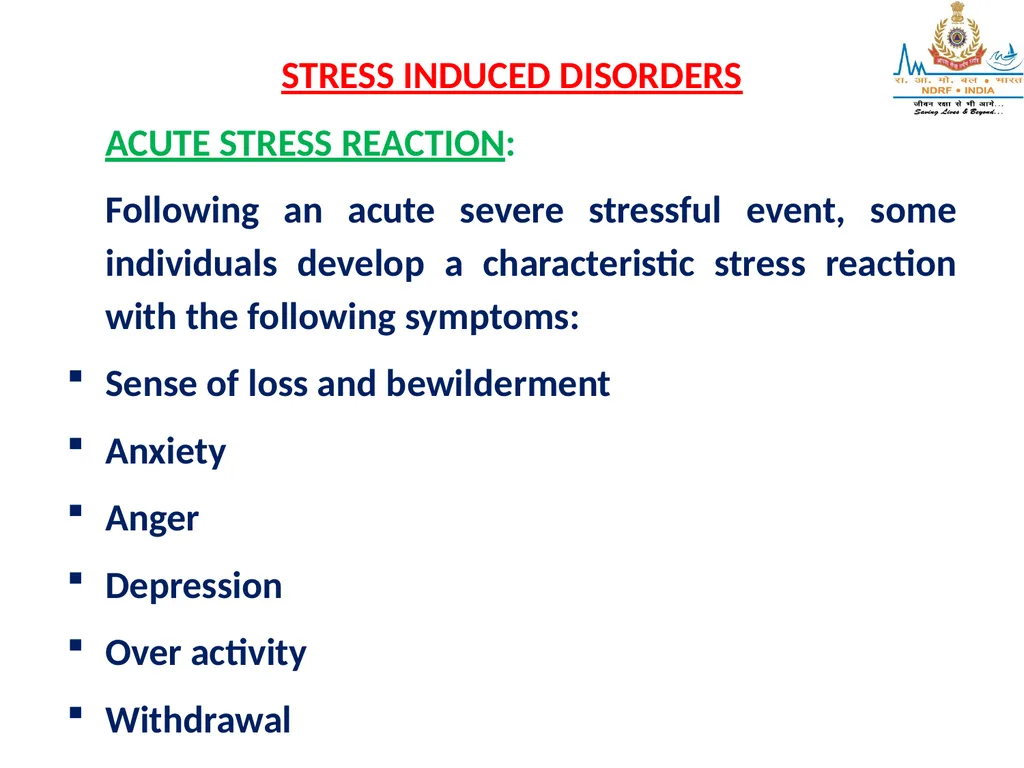
ACUTE STRESS REACTION:
Following an acute severe stressful event, some individuals develop a characteristic stress reaction with the following symptoms:
Sense of loss and bewilderment
Anxiety
Anger
Depression
Over activity
Withdrawal<br>
ACUTE STRESS REACTION:
Following an acute severe stressful event, some individuals develop a characteristic stress reaction with the following symptoms:
Sense of loss and bewilderment
Anxiety
Anger
Depression
Over activity
Withdrawal<br>
31
Precipitating events include occurrence of AIDS or cancer, death of a family member, major accident, assault or rape.
Recovery generally commences from within few hours to 3 days
Reassurance and support and at times, benzodiazapenes for a week are usually the only strategies required.<br>
Recovery generally commences from within few hours to 3 days
Reassurance and support and at times, benzodiazapenes for a week are usually the only strategies required.<br>
32
POST TRAUMATIC STRESS DISORDER (PTSD):
A delayed and protracted response to a stressful event of catastrophic nature which include natural disasters, terrorist activity, serious accidents and witnessing violent deaths.<br>
A delayed and protracted response to a stressful event of catastrophic nature which include natural disasters, terrorist activity, serious accidents and witnessing violent deaths.<br>
33
Typical symptoms -
recurrent intrusive memories (flashbacks) of the traumatic event
sleep disturbance
nightmares
autonomic arousal
emotional blunting<br>
recurrent intrusive memories (flashbacks) of the traumatic event
sleep disturbance
nightmares
autonomic arousal
emotional blunting<br>
34
Typical symptoms -
avoidance of any situation that evokes memories of the trauma
Recovery usually takes place within 2 years in most cases.
Management:
Post disaster counseling with support, advice and antidepressants in some cases.<br>
avoidance of any situation that evokes memories of the trauma
Recovery usually takes place within 2 years in most cases.
Management:
Post disaster counseling with support, advice and antidepressants in some cases.<br>
35
ANY QUESTIONS ?<br>
36
THANK YOU<br>