STROKE Dr Muhammah Ashraf Assistant Professor Medicine College of Medicine, Majmaah University. Objectives Define stroke and TIA (Transient Ischemic Attack) Enumerate types of stroke Discuss Localization Signs Describe mechanism of Stroke
"STROKE Dr Muhammah Ashraf Assistant Professor" is the property of its rightful owner. Permission is granted to
download and print the materials on this website for personal, non-commercial use only, and to display it
on your personal computer provided you do not modify the materials and that you retain all copyright
notices contained in the materials. By downloading content from our website, you accept the terms of this
agreement.
Presentation Transcript
01
STROKE Dr Muhammah Ashraf
Assistant Professor Medicine
College of Medicine, Majmaah University.<br>
02
Objectives Define stroke and TIA (Transient Ischemic Attack)
Enumerate types of stroke
Discuss Localization Signs
Describe mechanism of Stroke
Enlist the risk factor of Stroke
Identify the causes Of Stroke<br>
03
Definition Of Stroke “Rapidly developed clinical sign of focal disturbance of cerebral function of presumed vascular origin and of more than 24 hours” WHO
TIA (Transient Ischaemic Attack) recovery is complete within 24 hours. 10% of patients will go on to have a stroke.<br>
04
Stroke Stroke is the third largest killer in the Western World.
It accounts for up to 6% of in-patient hospital costs in Scotland.
Stroke is one of the major causes of disability, particularly in the elderly.
Stroke patients may present with a variety of physical, cognitive and psychosocial problems.
Most stroke patients show signs of recovery over time.<br>
05
Types Of Stroke Ischaemic – obstruction to one of major cerebral arteries, brainstem strokes are less common.
Haemorrhage – 9% are caused by haemorrhage to the deep parts of the brain. Patients are usually hypertensive.<br>
06
Localizing Signs & Symptoms Sudden numbness or weakness of face, arm or leg, especially on one side of the body
Sudden trouble walking, dizziness, loss of balance or coordination
Sudden confusion, trouble speaking or understanding
Sudden severe headache with no known cause
Sudden trouble seeing in one or both eyes<br>
07
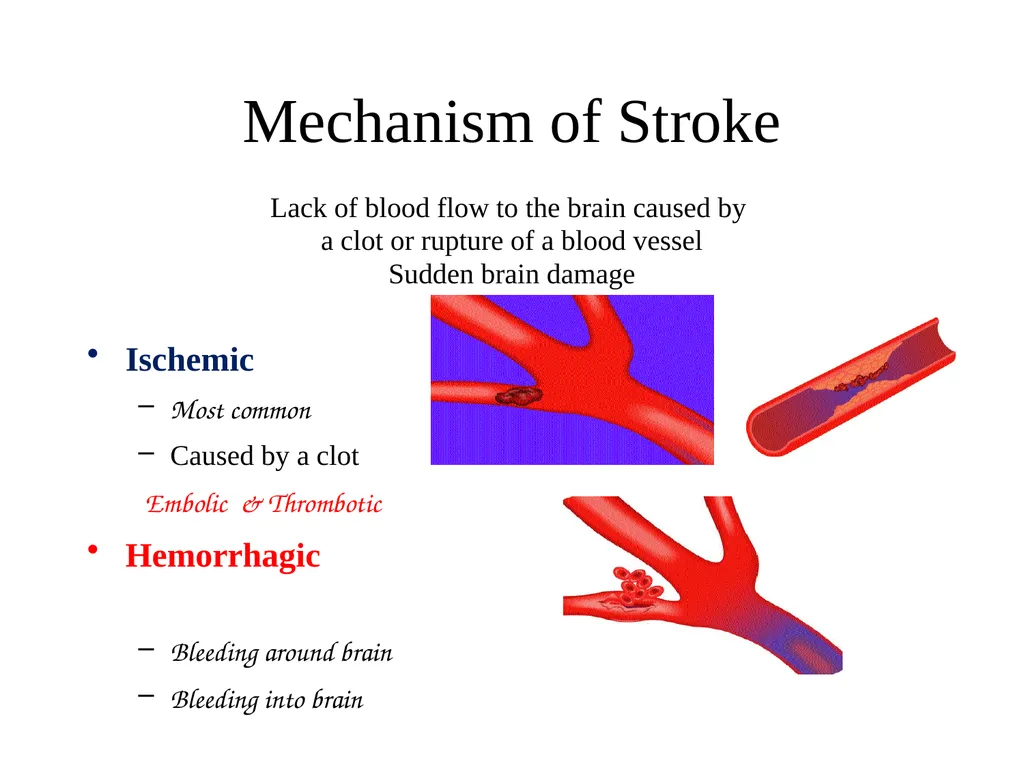
Mechanism of Stroke A stroke is a condition in which the brain cells suddenly die because of a lack of oxygen.
This can be caused by an obstruction in the blood flow, or the rupture of an artery that feeds the brain.<br>
08
Mechanism of Stroke Lack of blood flow to the brain caused by
a clot or rupture of a blood vessel
Sudden brain damage
Ischemic
Most common
Caused by a clot
Embolic & Thrombotic
Hemorrhagic
Bleeding around brain
Bleeding into brain<br>
09
Risk Factors<br>
10
Over age 55
Male
A family history of stroke
High Blood Pressure
High cholestrole
Smoking cigarettes<br>
11
Diabetes
Obesity & overweight
Cardiovascular diseases
A previous stroke or transient ischemic attack ( TIA )
Birth control or other hormone therapy<br>
12
Causes of Stroke Ischemic strokes are ultimately caused by a thrombus or embolus that blocks blood flow to the brain. Blood clots (thrombus clots) usually occur in areas of the arteries that have been damaged by atherosclerosis from a buildup of plaques.
Embolus type blood clots are often caused by atrial fibrillation - an irregular pattern of heart beat that leads to blood clot formation and poor blood flow.<br>
13
Hemorrhage strokes can be caused by uncontrolled high blood pressure, a head injury, or aneurysms.
High blood pressure is the most common cause of cerebral hemorrhage, as it causes small arteries inside the brain to burst.<br>
14
Aneurysms - abnormal blood-filled pouches that balloon out from weak spots in the wall of an artery - are the most common cause of subarachnoid hemorrhage.
A less common form of hemorrhage stroke is when an arteriovenous malformation (AVM) ruptures. AVM is an abnormal tangle of thin-walled blood vessels that is present at birth.<br>