
Structure of a report The Research Methodology

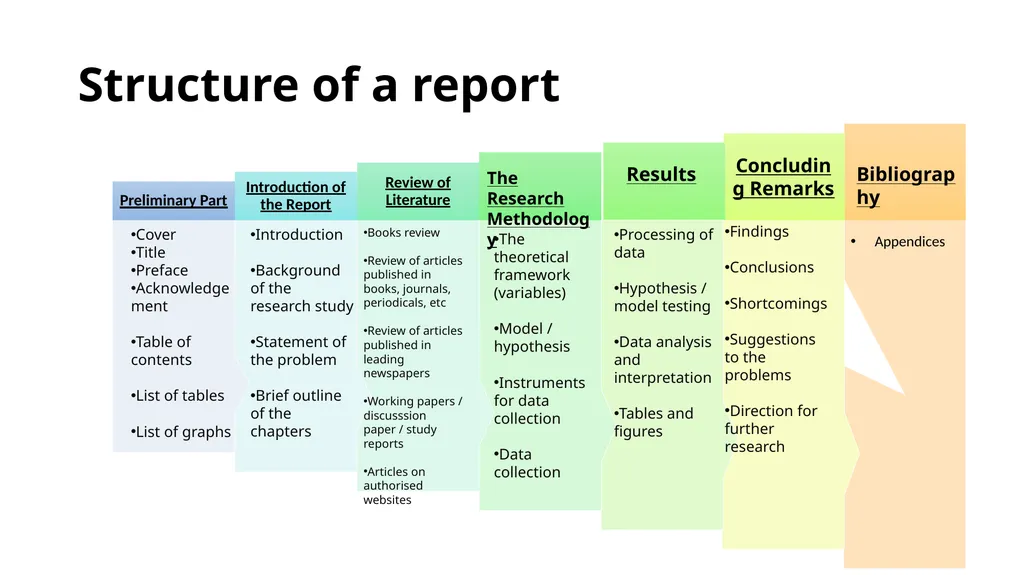



Description: Structure of a report The Research Methodology Results Concluding Remarks Bibliography The theoretical framework (variables) Model hypothesis Instruments for data collection Data collection Books review Review of articles published in
Related Topics
Download Presentation
"Structure of a report The Research Methodology" is the property of its rightful owner. Permission is granted to download and print the materials on this website for personal, non-commercial use only, and to display it on your personal computer provided you do not modify the materials and that you retain all copyright notices contained in the materials. By downloading content from our website, you accept the terms of this agreement.
Presentation Transcript
slide1. Structure of a report The Research Methodology Results Concluding Remarks Bibliography The theoretical framework (variables)
Model / hypothesis
Instruments for data collection
Data collection Books review
Review of articles published in books, journals, periodicals, etc
Review of articles published in leading newspapers
Working papers / discusssion paper / study reports
Articles on authorised websites Introduction
Background of the research study
Statement of the problem
Brief outline of the chapters Cover
Title
Preface
Acknowledgement
Table of contents
List of tables
List of graphs Processing of data
Hypothesis / model testing
Data analysis and interpretation
Tables and figures Findings
Conclusions
Shortcomings
Suggestions to the problems
Direction for further research Appendices<br>
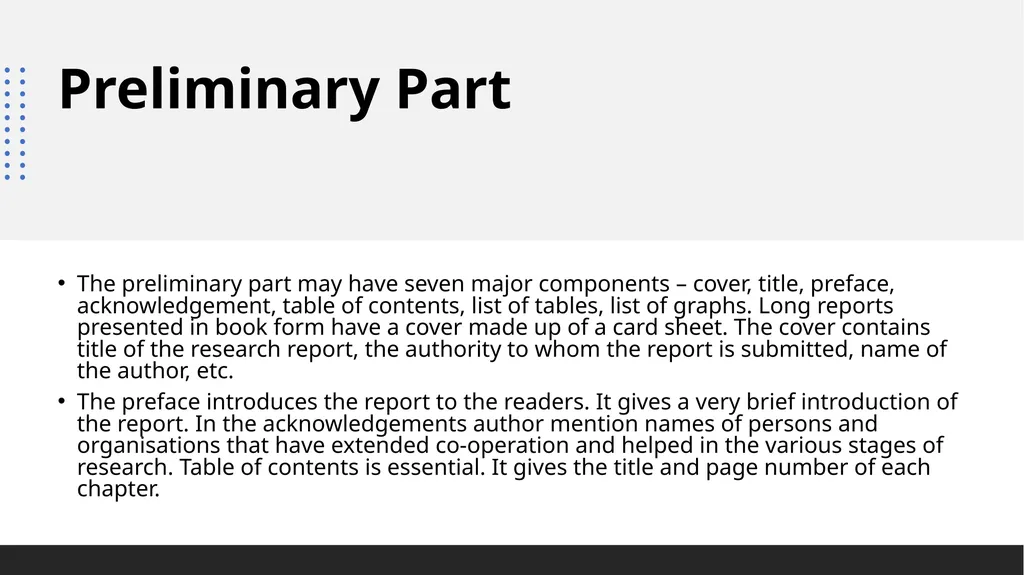
slide2. Preliminary Part The preliminary part may have seven major components – cover, title, preface, acknowledgement, table of contents, list of tables, list of graphs. Long reports presented in book form have a cover made up of a card sheet. The cover contains title of the research report, the authority to whom the report is submitted, name of the author, etc.
The preface introduces the report to the readers. It gives a very brief introduction of the report. In the acknowledgements author mention names of persons and organisations that have extended co-operation and helped in the various stages of research. Table of contents is essential. It gives the title and page number of each chapter.<br>
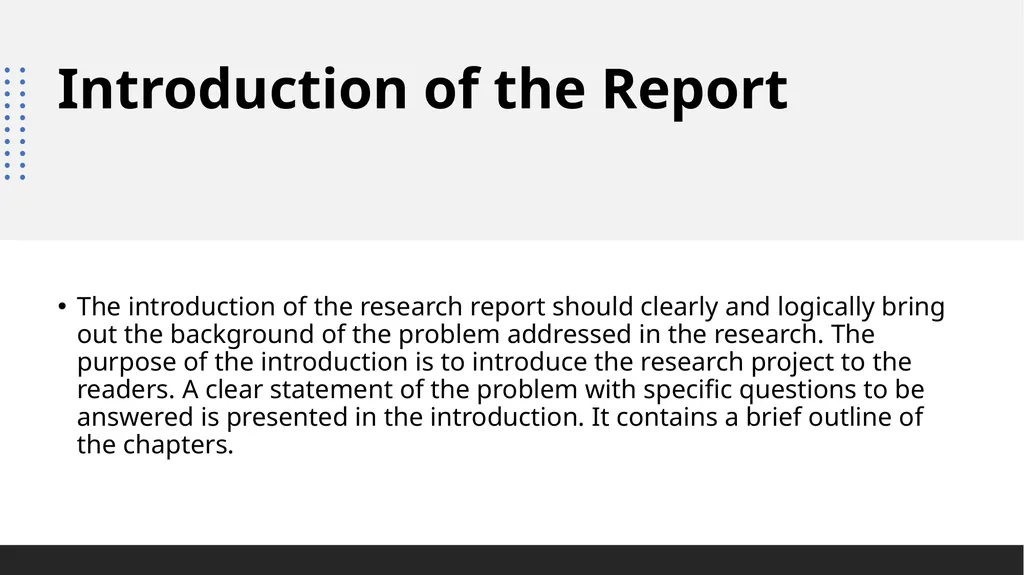
slide3. Introduction of the Report The introduction of the research report should clearly and logically bring out the background of the problem addressed in the research. The purpose of the introduction is to introduce the research project to the readers. A clear statement of the problem with specific questions to be answered is presented in the introduction. It contains a brief outline of the chapters.<br>
slide4. Review of Literature The third section reviews the important literature related to the study. A comprehensive review of the research literature referred to must be made. Previous research studies and the important writings in the area under study should be reviewed. Review of literature is helpful to provide a background for the development of the present study.
The researcher may review concerned books, articles published in edited books, journals and periodicals. Researcher may also take review of articles published in leading newspapers. A researcher should study working papers/discussion papers/study reports. It is essential for a broad conclusion and indications for further research.<br>
slide5. The Research Methodology Research methodology is an integral part of the research. It should clearly indicate the universe and the selection of samples, techniques of data collection, analysis and interpretation, statistical techniques, etc.<br>
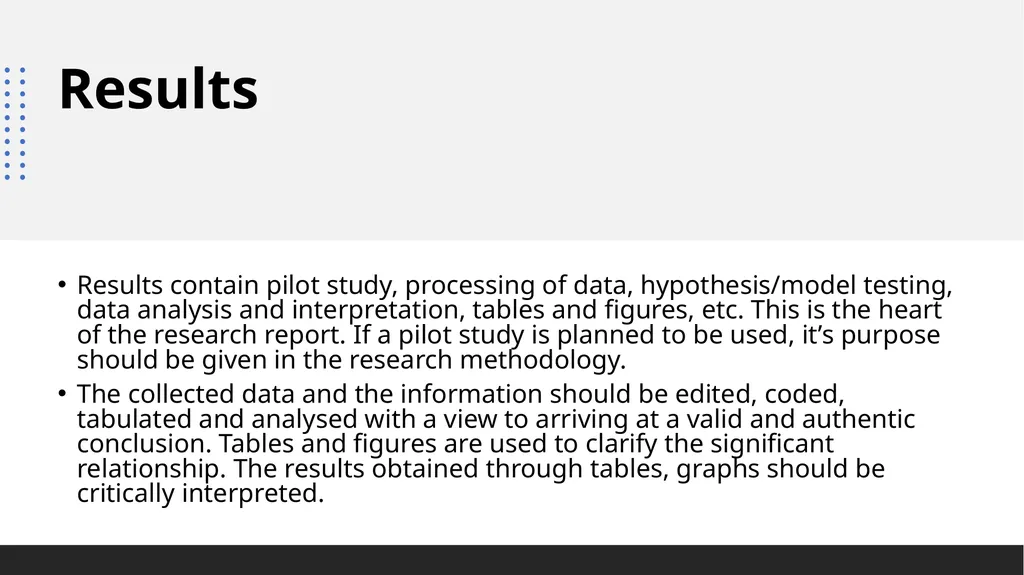
slide6. Results Results contain pilot study, processing of data, hypothesis/model testing, data analysis and interpretation, tables and figures, etc. This is the heart of the research report. If a pilot study is planned to be used, it’s purpose should be given in the research methodology.
The collected data and the information should be edited, coded, tabulated and analysed with a view to arriving at a valid and authentic conclusion. Tables and figures are used to clarify the significant relationship. The results obtained through tables, graphs should be critically interpreted.<br>
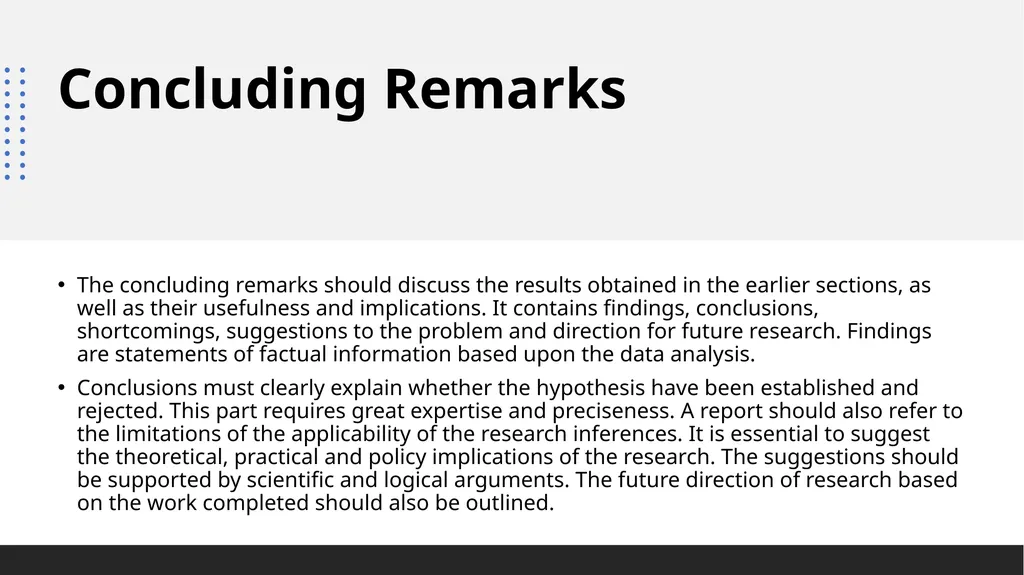
slide7. Concluding Remarks The concluding remarks should discuss the results obtained in the earlier sections, as well as their usefulness and implications. It contains findings, conclusions, shortcomings, suggestions to the problem and direction for future research. Findings are statements of factual information based upon the data analysis.
Conclusions must clearly explain whether the hypothesis have been established and rejected. This part requires great expertise and preciseness. A report should also refer to the limitations of the applicability of the research inferences. It is essential to suggest the theoretical, practical and policy implications of the research. The suggestions should be supported by scientific and logical arguments. The future direction of research based on the work completed should also be outlined.<br>
slide8. Bibliography The bibliography is an alphabetic list of books, journal articles, reports, etc, published or unpublished, read, referred to, examined by the researcher in preparing the report. The bibliography should follow standard formats for books, journal articles, research reports.
The end of the research report may consist of appendices, listed in respect of all technical data. Appendices are for the purpose of providing detailed data or information that would be too cumbersome within the main body of the research report.<br>
Model / hypothesis
Instruments for data collection
Data collection Books review
Review of articles published in books, journals, periodicals, etc
Review of articles published in leading newspapers
Working papers / discusssion paper / study reports
Articles on authorised websites Introduction
Background of the research study
Statement of the problem
Brief outline of the chapters Cover
Title
Preface
Acknowledgement
Table of contents
List of tables
List of graphs Processing of data
Hypothesis / model testing
Data analysis and interpretation
Tables and figures Findings
Conclusions
Shortcomings
Suggestions to the problems
Direction for further research Appendices<br>
slide2. Preliminary Part The preliminary part may have seven major components – cover, title, preface, acknowledgement, table of contents, list of tables, list of graphs. Long reports presented in book form have a cover made up of a card sheet. The cover contains title of the research report, the authority to whom the report is submitted, name of the author, etc.
The preface introduces the report to the readers. It gives a very brief introduction of the report. In the acknowledgements author mention names of persons and organisations that have extended co-operation and helped in the various stages of research. Table of contents is essential. It gives the title and page number of each chapter.<br>
slide3. Introduction of the Report The introduction of the research report should clearly and logically bring out the background of the problem addressed in the research. The purpose of the introduction is to introduce the research project to the readers. A clear statement of the problem with specific questions to be answered is presented in the introduction. It contains a brief outline of the chapters.<br>
slide4. Review of Literature The third section reviews the important literature related to the study. A comprehensive review of the research literature referred to must be made. Previous research studies and the important writings in the area under study should be reviewed. Review of literature is helpful to provide a background for the development of the present study.
The researcher may review concerned books, articles published in edited books, journals and periodicals. Researcher may also take review of articles published in leading newspapers. A researcher should study working papers/discussion papers/study reports. It is essential for a broad conclusion and indications for further research.<br>
slide5. The Research Methodology Research methodology is an integral part of the research. It should clearly indicate the universe and the selection of samples, techniques of data collection, analysis and interpretation, statistical techniques, etc.<br>
slide6. Results Results contain pilot study, processing of data, hypothesis/model testing, data analysis and interpretation, tables and figures, etc. This is the heart of the research report. If a pilot study is planned to be used, it’s purpose should be given in the research methodology.
The collected data and the information should be edited, coded, tabulated and analysed with a view to arriving at a valid and authentic conclusion. Tables and figures are used to clarify the significant relationship. The results obtained through tables, graphs should be critically interpreted.<br>
slide7. Concluding Remarks The concluding remarks should discuss the results obtained in the earlier sections, as well as their usefulness and implications. It contains findings, conclusions, shortcomings, suggestions to the problem and direction for future research. Findings are statements of factual information based upon the data analysis.
Conclusions must clearly explain whether the hypothesis have been established and rejected. This part requires great expertise and preciseness. A report should also refer to the limitations of the applicability of the research inferences. It is essential to suggest the theoretical, practical and policy implications of the research. The suggestions should be supported by scientific and logical arguments. The future direction of research based on the work completed should also be outlined.<br>
slide8. Bibliography The bibliography is an alphabetic list of books, journal articles, reports, etc, published or unpublished, read, referred to, examined by the researcher in preparing the report. The bibliography should follow standard formats for books, journal articles, research reports.
The end of the research report may consist of appendices, listed in respect of all technical data. Appendices are for the purpose of providing detailed data or information that would be too cumbersome within the main body of the research report.<br>