
Structured Knowledge Representation Dave Touretzky
LS
Published · 32 slides · 0 views
1 / 1



Description
Structured Knowledge Representation Dave Touretzky Read RN Chapter 12 What is knowledge representation? An attempt to formalize human knowledge in ways that will be computationally useful. A prerequisite for AGI (Artificial General
Related Topics
Share
Embed code
Download this presentation From Below
"Structured Knowledge Representation Dave Touretzky" is the property of its rightful owner. Permission is granted to download and print the materials on this website for personal, non-commercial use only, and to display it on your personal computer provided you do not modify the materials and that you retain all copyright notices contained in the materials. By downloading content from our website, you accept the terms of this agreement.
Presentation Transcript
01
Structured
Knowledge Representation Dave Touretzky
Read R&N Chapter 12<br>
Knowledge Representation Dave Touretzky
Read R&N Chapter 12<br>
02
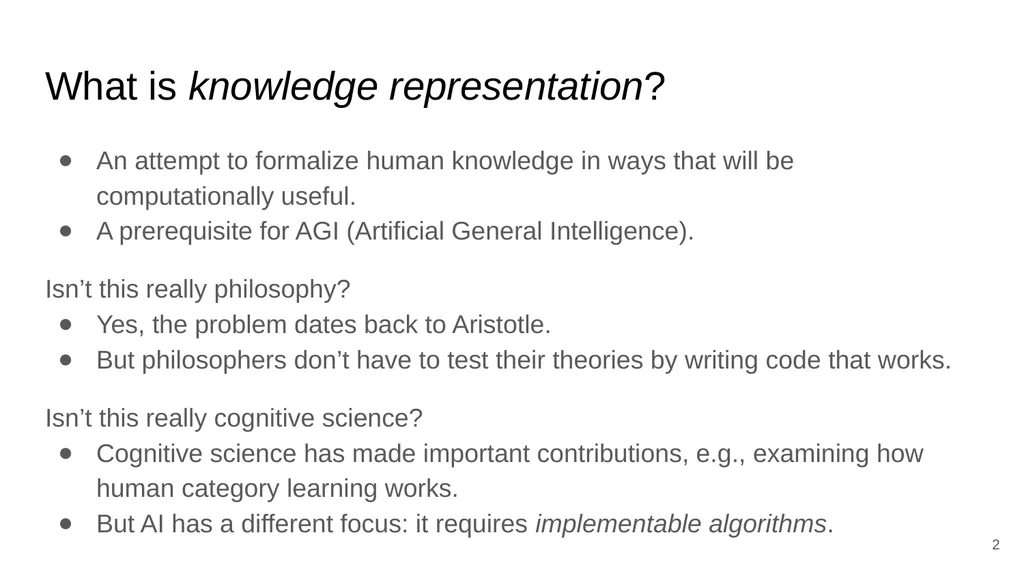
What is knowledge representation? An attempt to formalize human knowledge in ways that will be computationally useful.
A prerequisite for AGI (Artificial General Intelligence).
Isn’t this really philosophy?
Yes, the problem dates back to Aristotle.
But philosophers don’t have to test their theories by writing code that works.
Isn’t this really cognitive science?
Cognitive science has made important contributions, e.g., examining how human category learning works.
But AI has a different focus: it requires implementable algorithms. ‹#›<br>
03
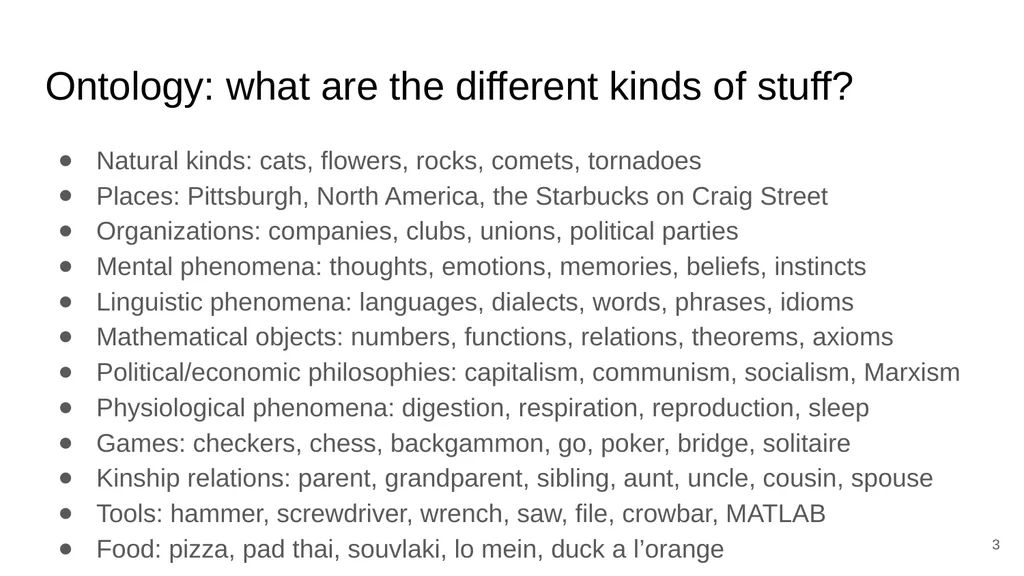
Natural kinds: cats, flowers, rocks, comets, tornadoes
Places: Pittsburgh, North America, the Starbucks on Craig Street
Organizations: companies, clubs, unions, political parties
Mental phenomena: thoughts, emotions, memories, beliefs, instincts
Linguistic phenomena: languages, dialects, words, phrases, idioms
Mathematical objects: numbers, functions, relations, theorems, axioms
Political/economic philosophies: capitalism, communism, socialism, Marxism
Physiological phenomena: digestion, respiration, reproduction, sleep
Games: checkers, chess, backgammon, go, poker, bridge, solitaire
Kinship relations: parent, grandparent, sibling, aunt, uncle, cousin, spouse
Tools: hammer, screwdriver, wrench, saw, file, crowbar, MATLAB
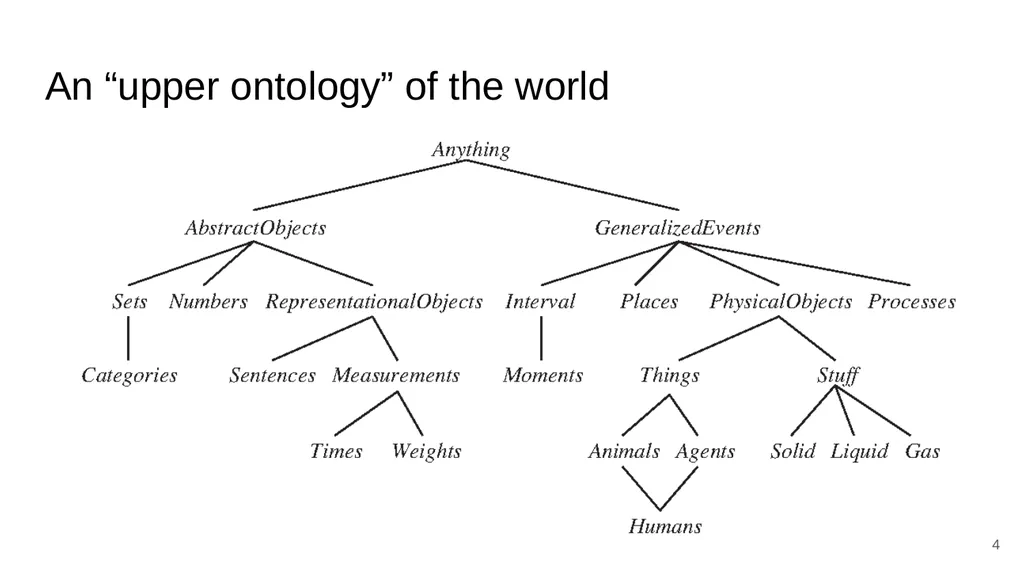
Food: pizza, pad thai, souvlaki, lo mein, duck a l’orange Ontology: what are the different kinds of stuff? ‹#›<br>
04
An “upper ontology” of the world ‹#›<br>
05
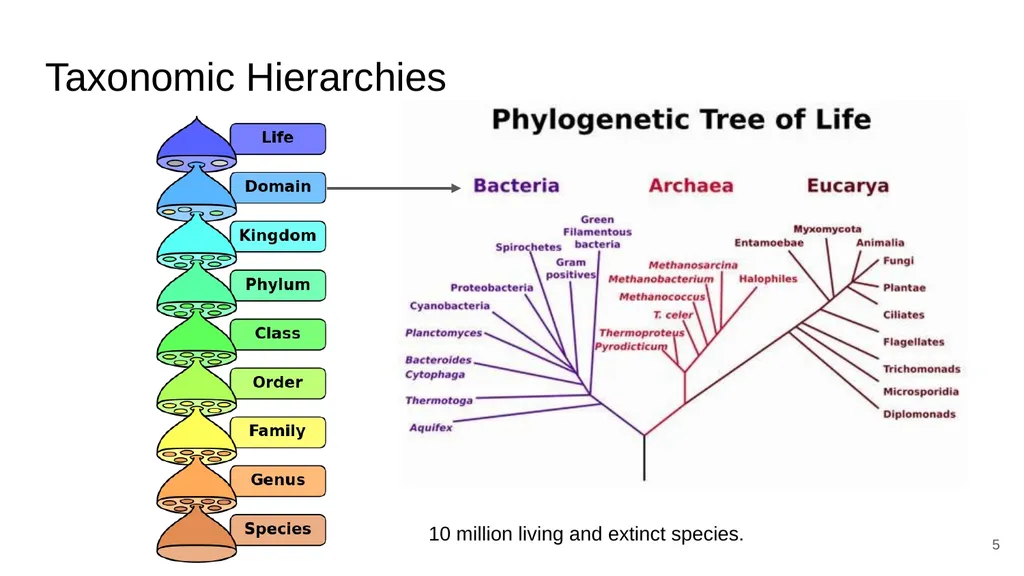
Taxonomic Hierarchies ‹#› 10 million living and extinct species.<br>
06
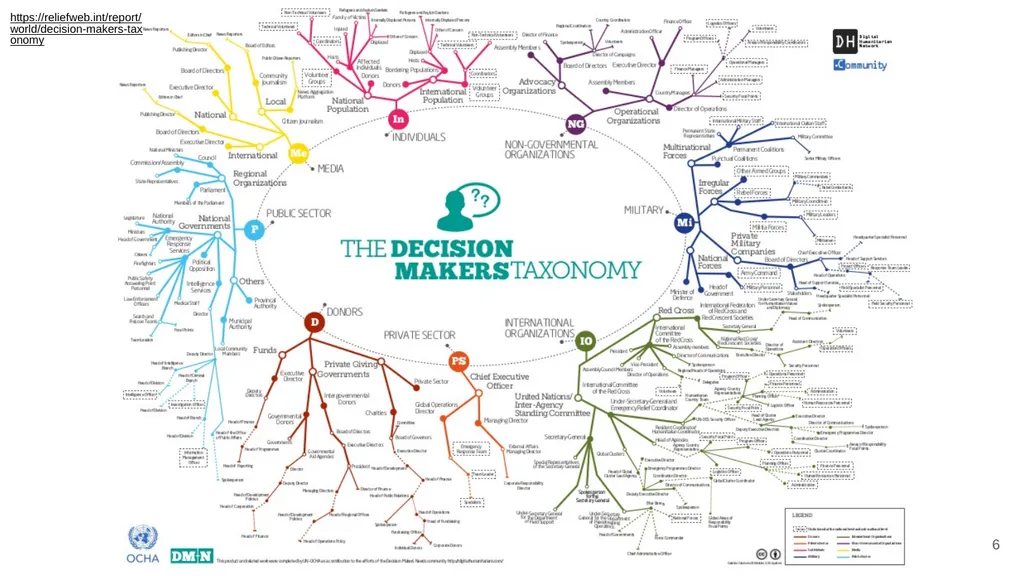
‹#› https://reliefweb.int/report/world/decision-makers-taxonomy<br>
07
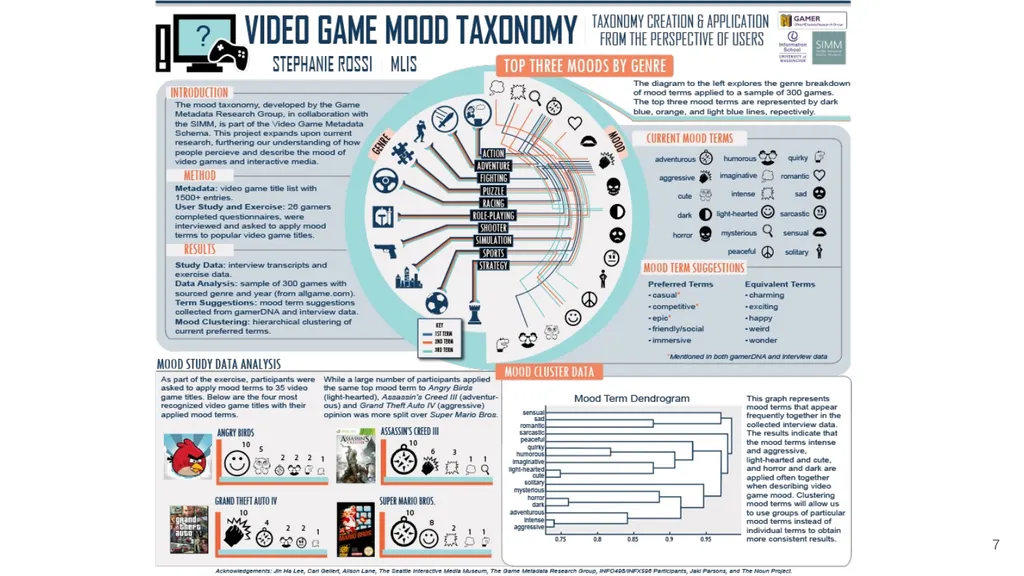
‹#›<br>
08
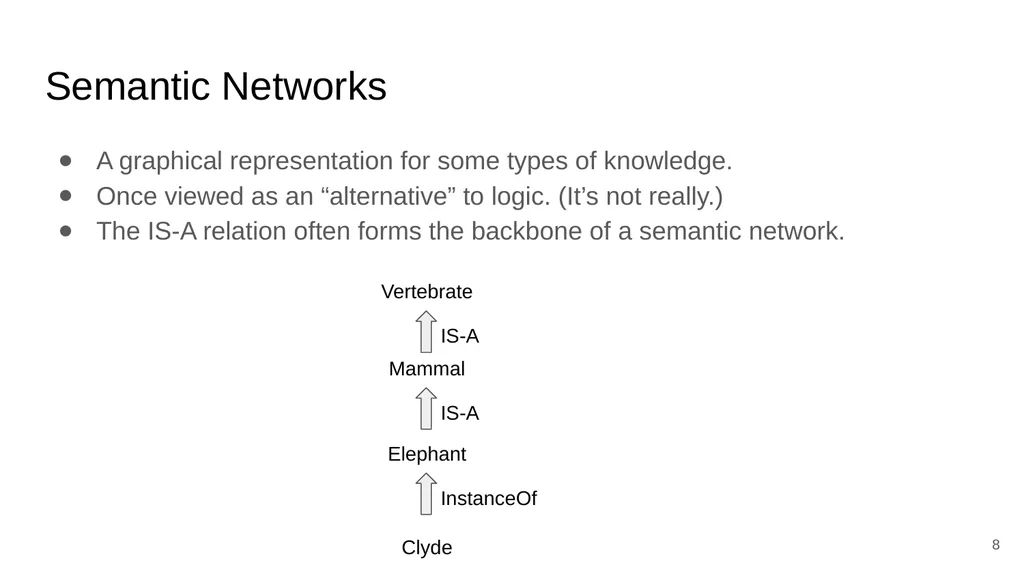
Semantic Networks A graphical representation for some types of knowledge.
Once viewed as an “alternative” to logic. (It’s not really.)
The IS-A relation often forms the backbone of a semantic network. ‹#› Clyde Elephant Mammal Vertebrate InstanceOf IS-A IS-A<br>
Once viewed as an “alternative” to logic. (It’s not really.)
The IS-A relation often forms the backbone of a semantic network. ‹#› Clyde Elephant Mammal Vertebrate InstanceOf IS-A IS-A<br>
09
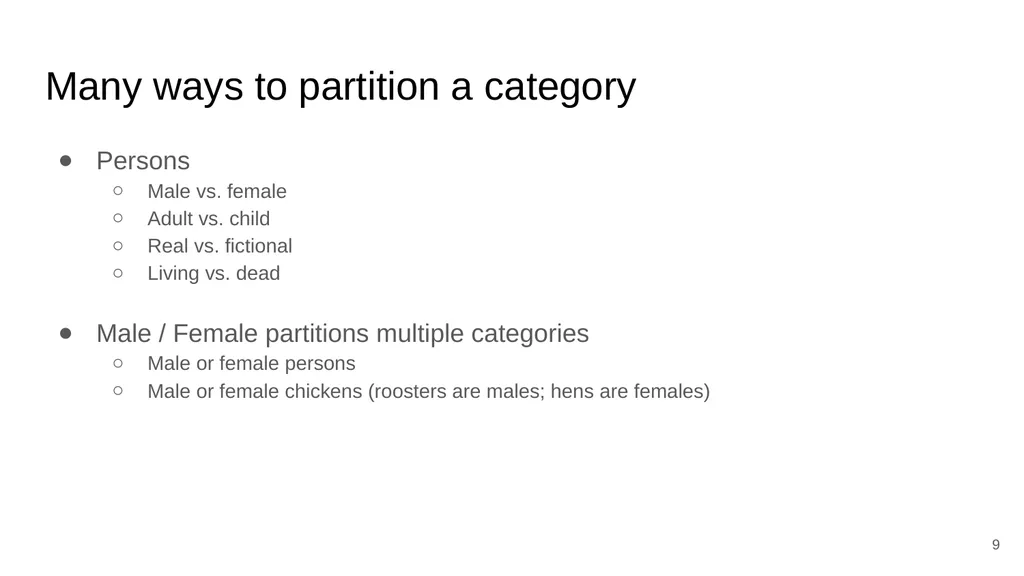
Many ways to partition a category Persons
Male vs. female
Adult vs. child
Real vs. fictional
Living vs. dead
Male / Female partitions multiple categories
Male or female persons
Male or female chickens (roosters are males; hens are females) ‹#›<br>
Male vs. female
Adult vs. child
Real vs. fictional
Living vs. dead
Male / Female partitions multiple categories
Male or female persons
Male or female chickens (roosters are males; hens are females) ‹#›<br>
10
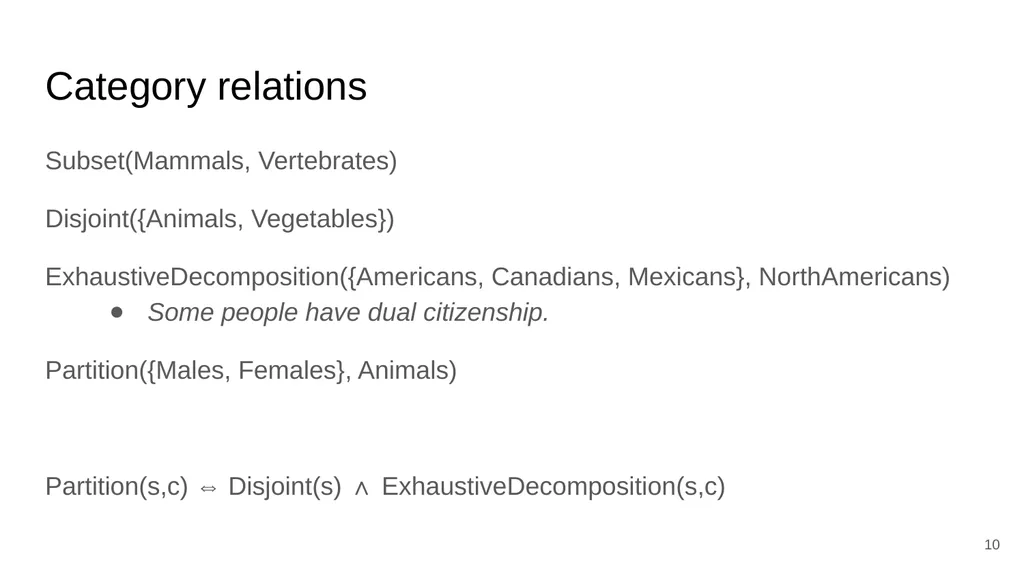
Category relations Subset(Mammals, Vertebrates)
Disjoint({Animals, Vegetables})
ExhaustiveDecomposition({Americans, Canadians, Mexicans}, NorthAmericans)
Some people have dual citizenship.
Partition({Males, Females}, Animals)
Partition(s,c) ⇔ Disjoint(s) ∧ ExhaustiveDecomposition(s,c) ‹#›<br>
Disjoint({Animals, Vegetables})
ExhaustiveDecomposition({Americans, Canadians, Mexicans}, NorthAmericans)
Some people have dual citizenship.
Partition({Males, Females}, Animals)
Partition(s,c) ⇔ Disjoint(s) ∧ ExhaustiveDecomposition(s,c) ‹#›<br>
11
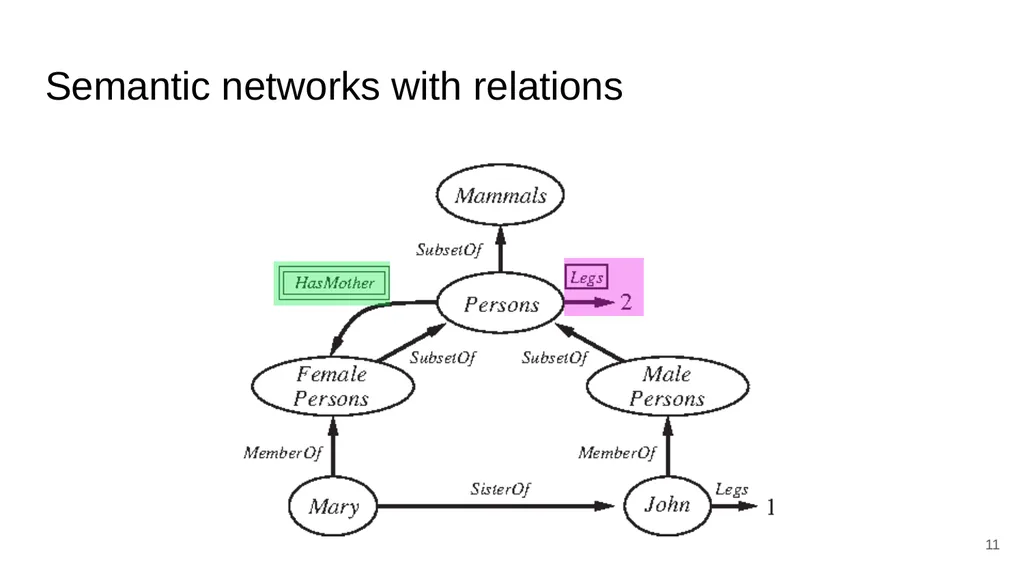
Semantic networks with relations ‹#›<br>
12
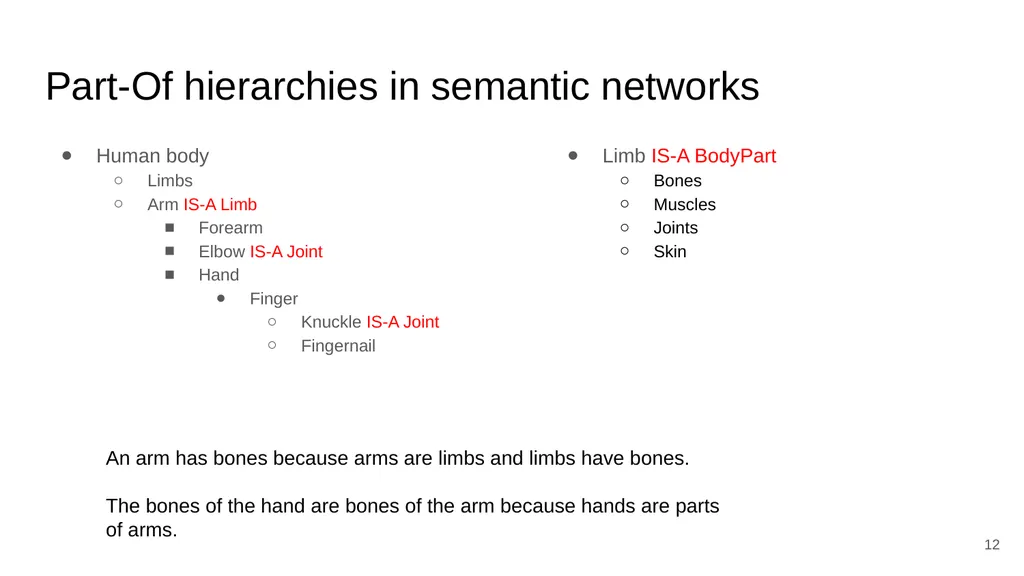
Part-Of hierarchies in semantic networks Human body
Limbs
Arm IS-A Limb
Forearm
Elbow IS-A Joint
Hand
Finger
Knuckle IS-A Joint
Fingernail ‹#› Limb IS-A BodyPart
Bones
Muscles
Joints
Skin An arm has bones because arms are limbs and limbs have bones.
The bones of the hand are bones of the arm because hands are parts of arms.<br>
Limbs
Arm IS-A Limb
Forearm
Elbow IS-A Joint
Hand
Finger
Knuckle IS-A Joint
Fingernail ‹#› Limb IS-A BodyPart
Bones
Muscles
Joints
Skin An arm has bones because arms are limbs and limbs have bones.
The bones of the hand are bones of the arm because hands are parts of arms.<br>
13
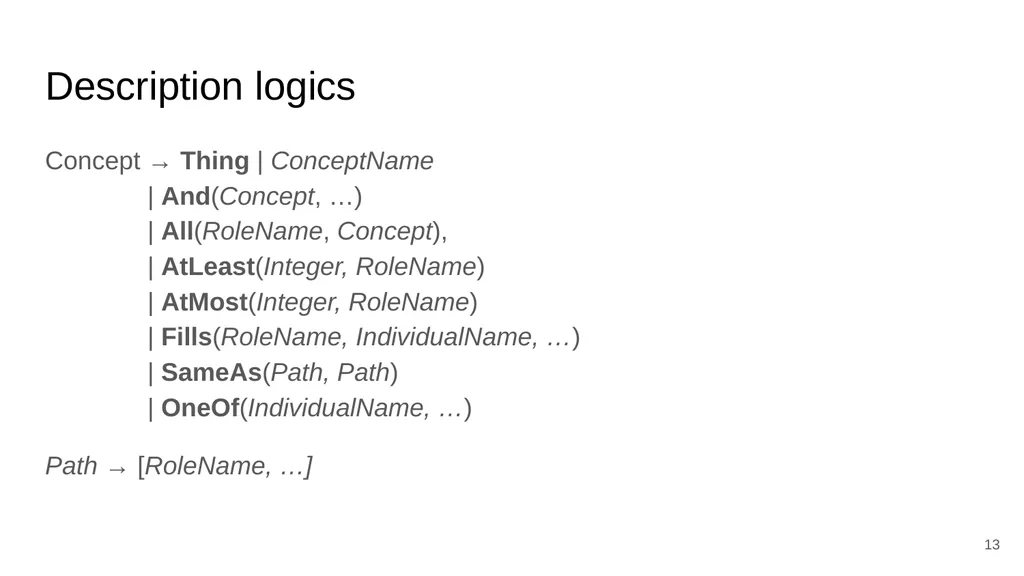
Description logics Concept → Thing | ConceptName
| And(Concept, …)
| All(RoleName, Concept),
| AtLeast(Integer, RoleName)
| AtMost(Integer, RoleName)
| Fills(RoleName, IndividualName, …)
| SameAs(Path, Path)
| OneOf(IndividualName, …)
Path → [RoleName, …] ‹#›<br>
Path → [RoleName, …] ‹#›<br>
14
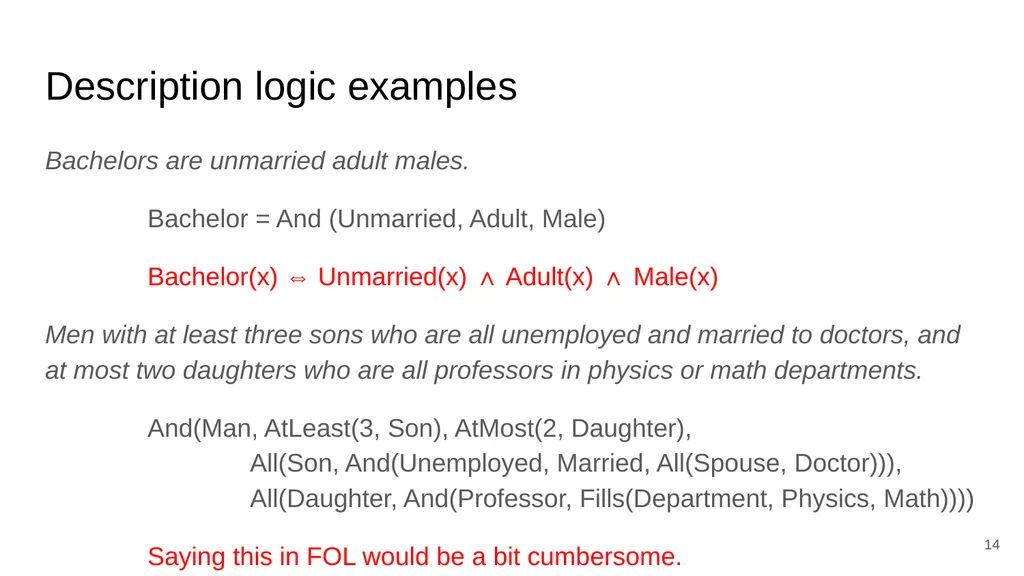
Description logic examples Bachelors are unmarried adult males.
Bachelor = And (Unmarried, Adult, Male)
Bachelor(x) ⇔ Unmarried(x) ∧ Adult(x) ∧ Male(x)
Men with at least three sons who are all unemployed and married to doctors, and at most two daughters who are all professors in physics or math departments.
And(Man, AtLeast(3, Son), AtMost(2, Daughter), All(Son, And(Unemployed, Married, All(Spouse, Doctor))), All(Daughter, And(Professor, Fills(Department, Physics, Math))))
Saying this in FOL would be a bit cumbersome. ‹#›<br>
15
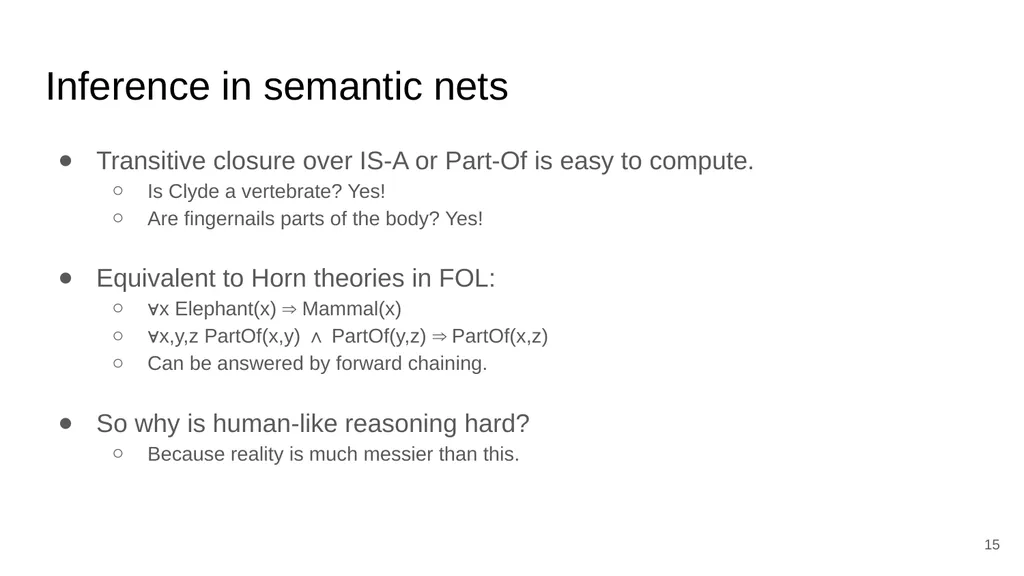
Inference in semantic nets Transitive closure over IS-A or Part-Of is easy to compute.
Is Clyde a vertebrate? Yes!
Are fingernails parts of the body? Yes!
Equivalent to Horn theories in FOL:
∀x Elephant(x) ⇒ Mammal(x)
∀x,y,z PartOf(x,y) ∧ PartOf(y,z) ⇒ PartOf(x,z)
Can be answered by forward chaining.
So why is human-like reasoning hard?
Because reality is much messier than this. ‹#›<br>
16
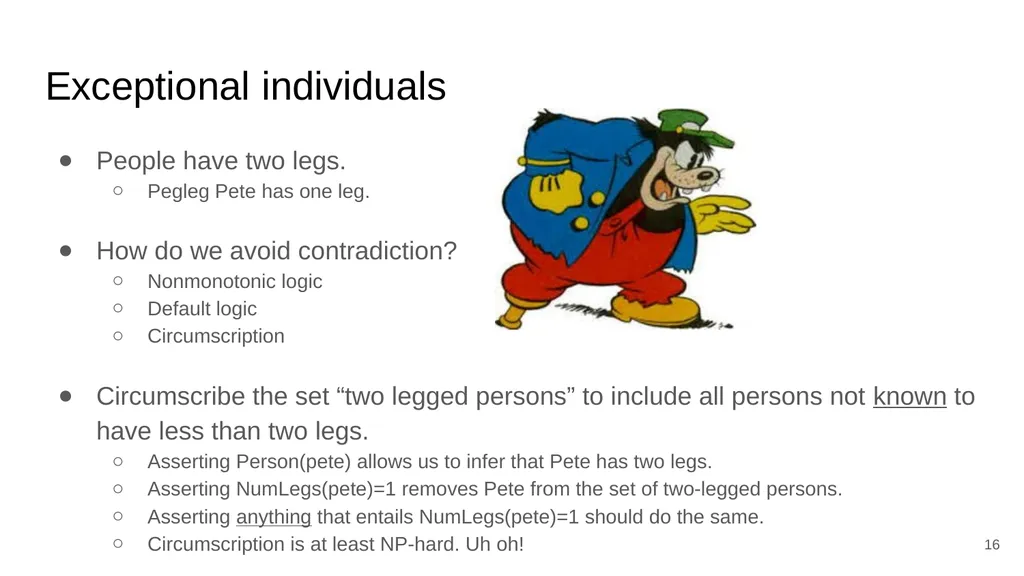
Exceptional individuals People have two legs.
Pegleg Pete has one leg.
How do we avoid contradiction?
Nonmonotonic logic
Default logic
Circumscription
Circumscribe the set “two legged persons” to include all persons not known to have less than two legs.
Asserting Person(pete) allows us to infer that Pete has two legs.
Asserting NumLegs(pete)=1 removes Pete from the set of two-legged persons.
Asserting anything that entails NumLegs(pete)=1 should do the same.
Circumscription is at least NP-hard. Uh oh! ‹#›<br>
17
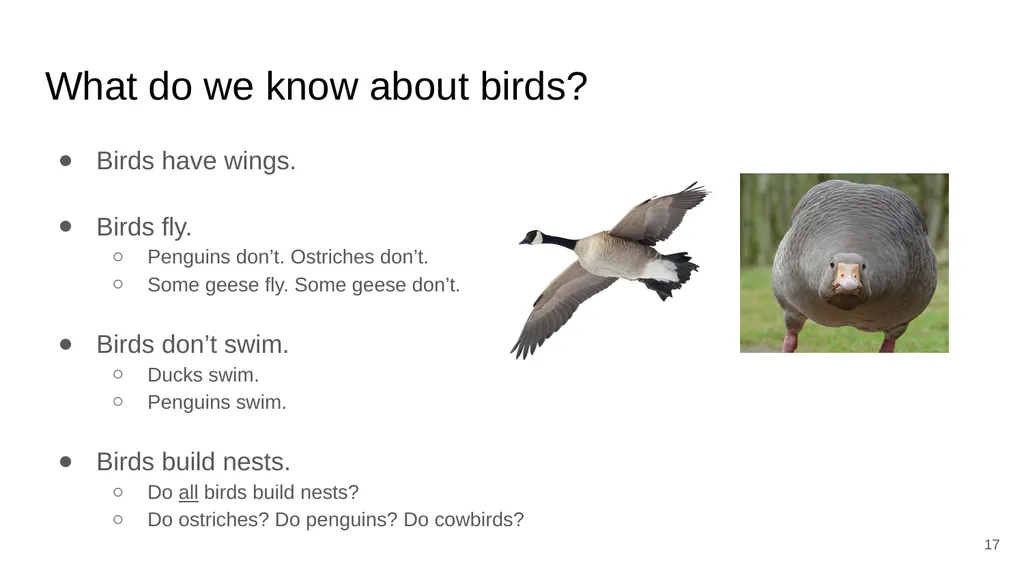
What do we know about birds? Birds have wings.
Birds fly.
Penguins don’t. Ostriches don’t.
Some geese fly. Some geese don’t.
Birds don’t swim.
Ducks swim.
Penguins swim.
Birds build nests.
Do all birds build nests?
Do ostriches? Do penguins? Do cowbirds? ‹#›<br>
Birds fly.
Penguins don’t. Ostriches don’t.
Some geese fly. Some geese don’t.
Birds don’t swim.
Ducks swim.
Penguins swim.
Birds build nests.
Do all birds build nests?
Do ostriches? Do penguins? Do cowbirds? ‹#›<br>
18
Typical exemplars; prototypes; outliers Typical birds:
Robin
Pigeon
The prototypical bird has wings, flies, doesn’t swim, builds a nest, is not domesticated, eats plants and bugs.
Common but not typical:
Chicken (domesticated)
Eagle (size, diet)
Duck (aquatic)
Confidence in inferences about birds may depend on their typicality. ‹#›<br>
Robin
Pigeon
The prototypical bird has wings, flies, doesn’t swim, builds a nest, is not domesticated, eats plants and bugs.
Common but not typical:
Chicken (domesticated)
Eagle (size, diet)
Duck (aquatic)
Confidence in inferences about birds may depend on their typicality. ‹#›<br>
19
Summing up semantic nets The graphical notation is only a win for binary relations, where we can trace paths.
With n-ary relations the graphical notation doesn’t contribute much. ‹#› Shankar NewDelhi India FlyTo Part-Of<br>
With n-ary relations the graphical notation doesn’t contribute much. ‹#› Shankar NewDelhi India FlyTo Part-Of<br>
20
Summing up semantic nets Can write ad hoc inference algorithms to efficiently handle things like nonmonotonicity. ‹#› How many legs does Mary have?
How many legs does John have?<br>
How many legs does John have?<br>
21
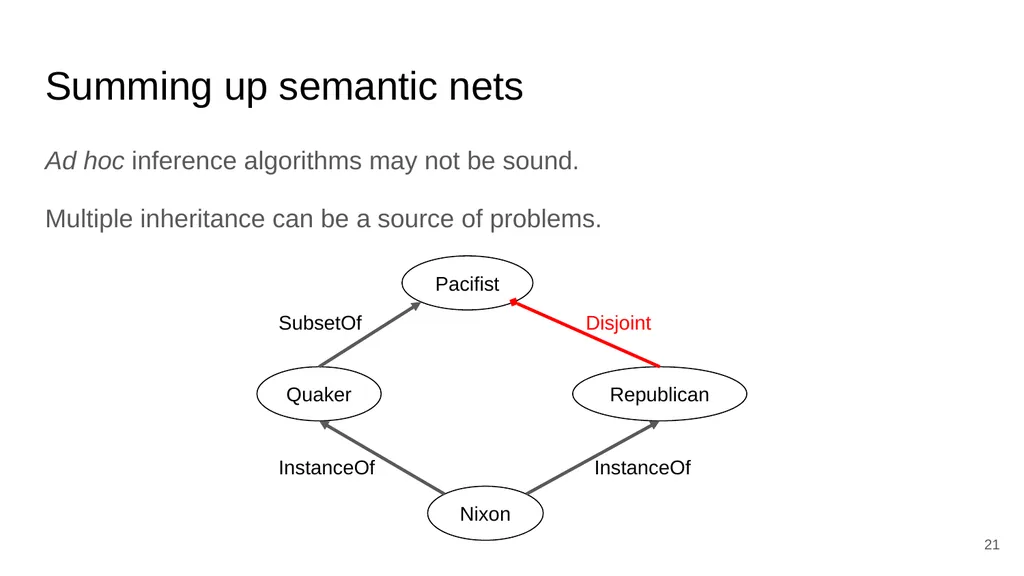
Summing up semantic nets Ad hoc inference algorithms may not be sound.
Multiple inheritance can be a source of problems. ‹#› Nixon Quaker Republican Pacifist InstanceOf InstanceOf SubsetOf Disjoint<br>
Multiple inheritance can be a source of problems. ‹#› Nixon Quaker Republican Pacifist InstanceOf InstanceOf SubsetOf Disjoint<br>
22
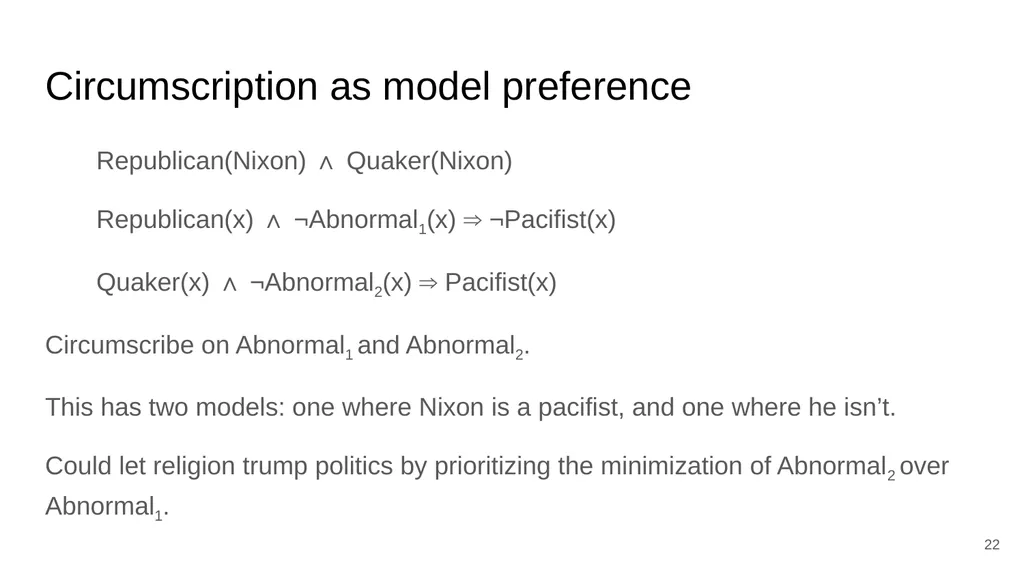
Circumscription as model preference Republican(Nixon) ∧ Quaker(Nixon)
Republican(x) ∧ ¬Abnormal1(x) ⇒ ¬Pacifist(x)
Quaker(x) ∧ ¬Abnormal2(x) ⇒ Pacifist(x)
Circumscribe on Abnormal1 and Abnormal2.
This has two models: one where Nixon is a pacifist, and one where he isn’t.
Could let religion trump politics by prioritizing the minimization of Abnormal2 over Abnormal1. ‹#›<br>
23
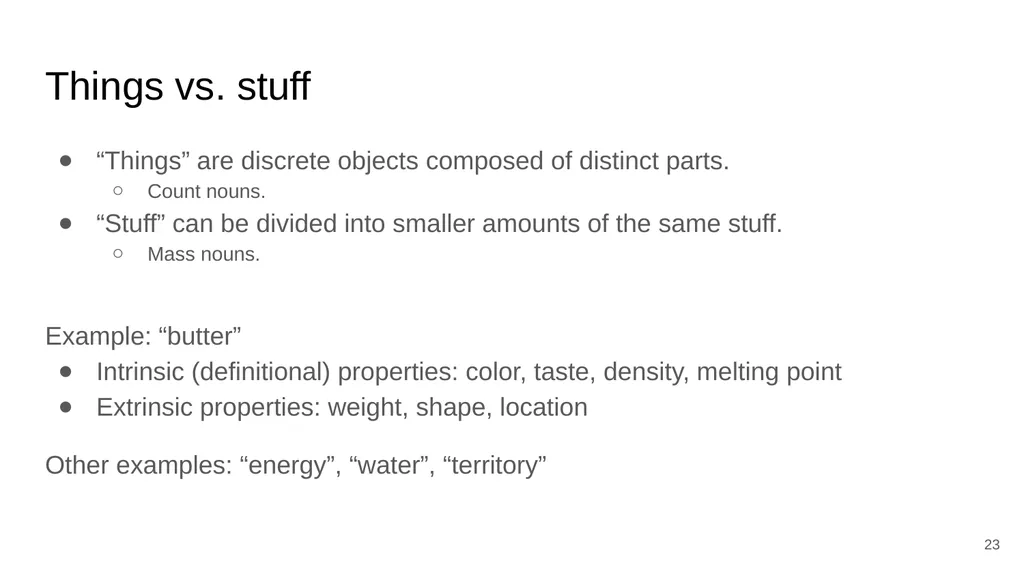
Things vs. stuff “Things” are discrete objects composed of distinct parts.
Count nouns.
“Stuff” can be divided into smaller amounts of the same stuff.
Mass nouns.
Example: “butter”
Intrinsic (definitional) properties: color, taste, density, melting point
Extrinsic properties: weight, shape, location
Other examples: “energy”, “water”, “territory” ‹#›<br>
Count nouns.
“Stuff” can be divided into smaller amounts of the same stuff.
Mass nouns.
Example: “butter”
Intrinsic (definitional) properties: color, taste, density, melting point
Extrinsic properties: weight, shape, location
Other examples: “energy”, “water”, “territory” ‹#›<br>
24
Words vs. concepts Words can refer to concepts.
But the mapping is ambiguous.
Words often have multiple meanings.
Example: “load” as a noun.
The cargo carried by a vehicle.
The contents of a shotgun shell.
The portion of a circuit that consumes electrical power.
Tasks or obligations, as in “he’s carrying a heavy load this semester”.
These meanings may be metaphorically related. The metaphors are often based on force or motion. ‹#›<br>
25
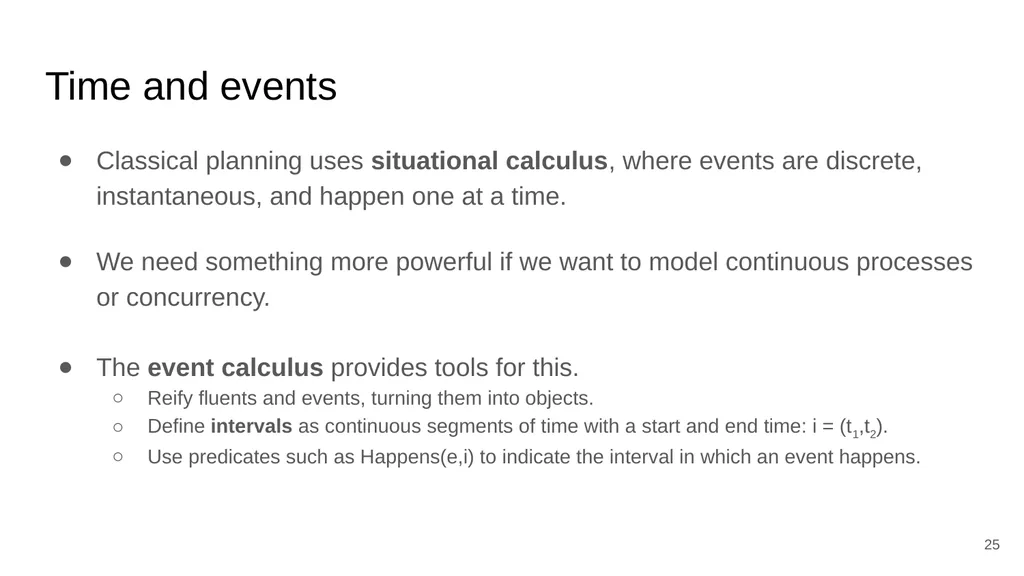
Time and events Classical planning uses situational calculus, where events are discrete, instantaneous, and happen one at a time.
We need something more powerful if we want to model continuous processes or concurrency.
The event calculus provides tools for this.
Reify fluents and events, turning them into objects.
Define intervals as continuous segments of time with a start and end time: i = (t1,t2).
Use predicates such as Happens(e,i) to indicate the interval in which an event happens. ‹#›<br>
26
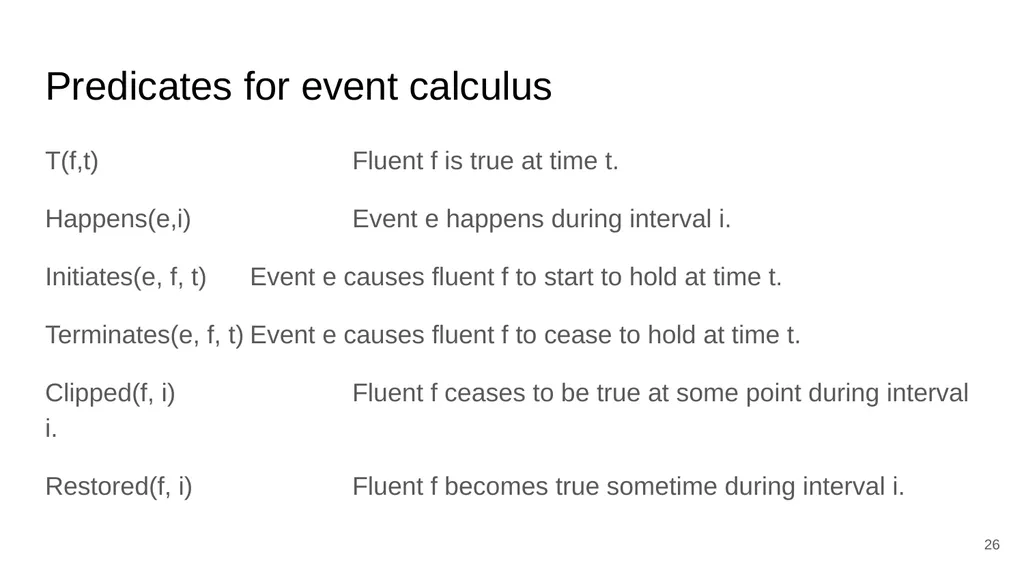
Predicates for event calculus T(f,t) Fluent f is true at time t.
Happens(e,i) Event e happens during interval i.
Initiates(e, f, t) Event e causes fluent f to start to hold at time t.
Terminates(e, f, t) Event e causes fluent f to cease to hold at time t.
Clipped(f, i) Fluent f ceases to be true at some point during interval i.
Restored(f, i) Fluent f becomes true sometime during interval i. ‹#›<br>
27
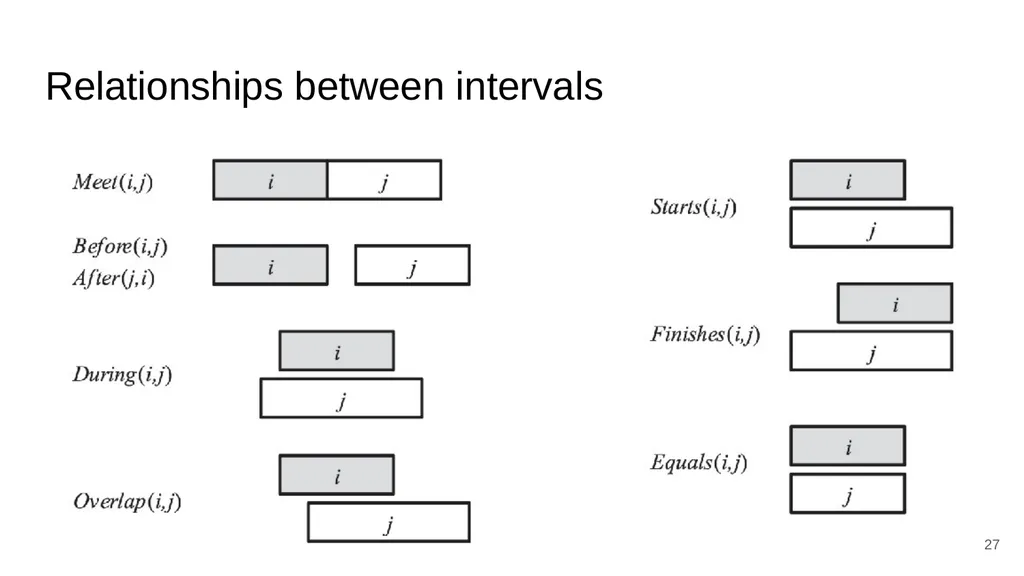
Relationships between intervals ‹#›<br>
28
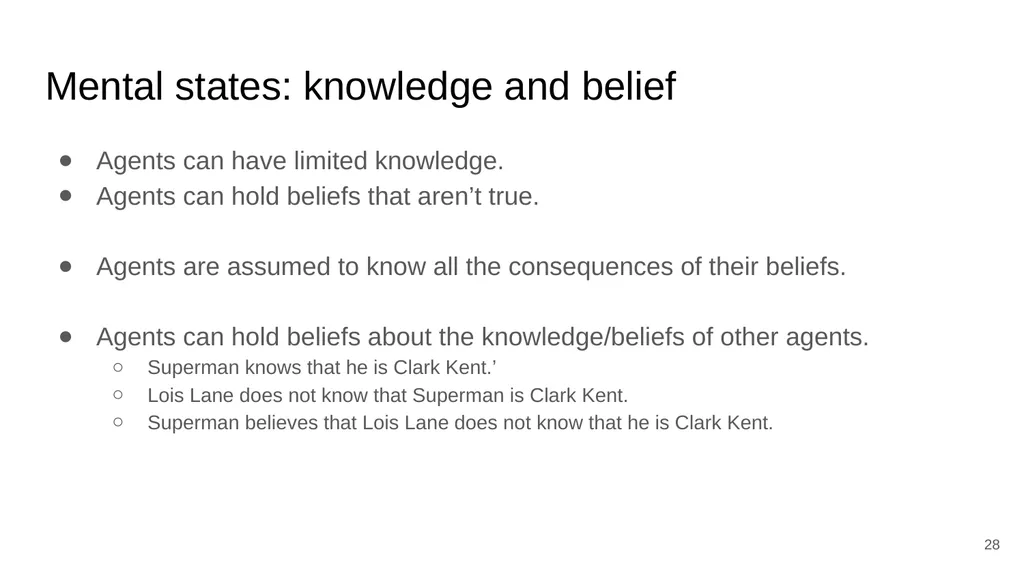
Mental states: knowledge and belief Agents can have limited knowledge.
Agents can hold beliefs that aren’t true.
Agents are assumed to know all the consequences of their beliefs.
Agents can hold beliefs about the knowledge/beliefs of other agents.
Superman knows that he is Clark Kent.’
Lois Lane does not know that Superman is Clark Kent.
Superman believes that Lois Lane does not know that he is Clark Kent. ‹#›<br>
29
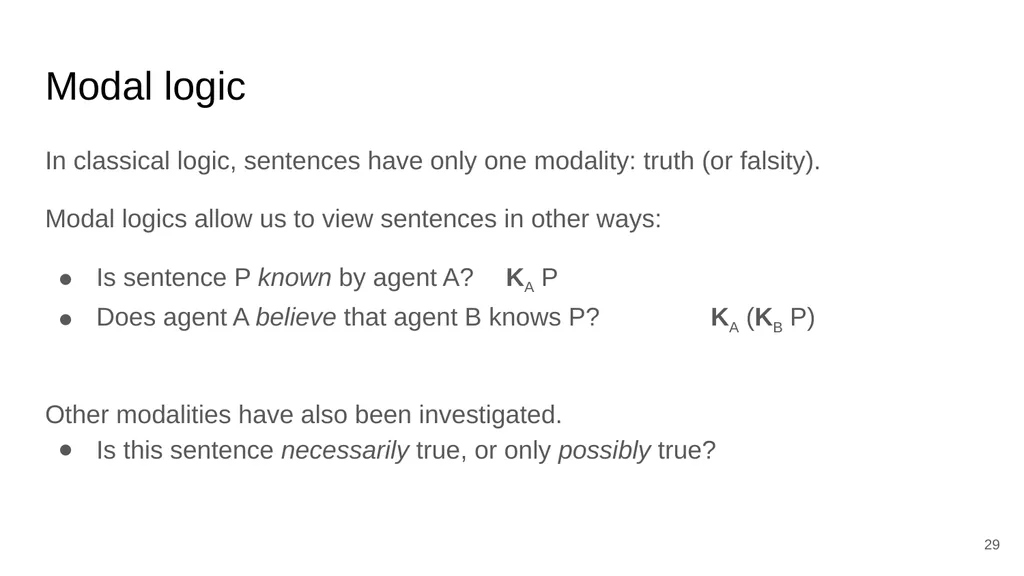
Modal logic In classical logic, sentences have only one modality: truth (or falsity).
Modal logics allow us to view sentences in other ways:
Is sentence P known by agent A? KA P
Does agent A believe that agent B knows P? KA (KB P)
Other modalities have also been investigated.
Is this sentence necessarily true, or only possibly true? ‹#›<br>
Modal logics allow us to view sentences in other ways:
Is sentence P known by agent A? KA P
Does agent A believe that agent B knows P? KA (KB P)
Other modalities have also been investigated.
Is this sentence necessarily true, or only possibly true? ‹#›<br>
30
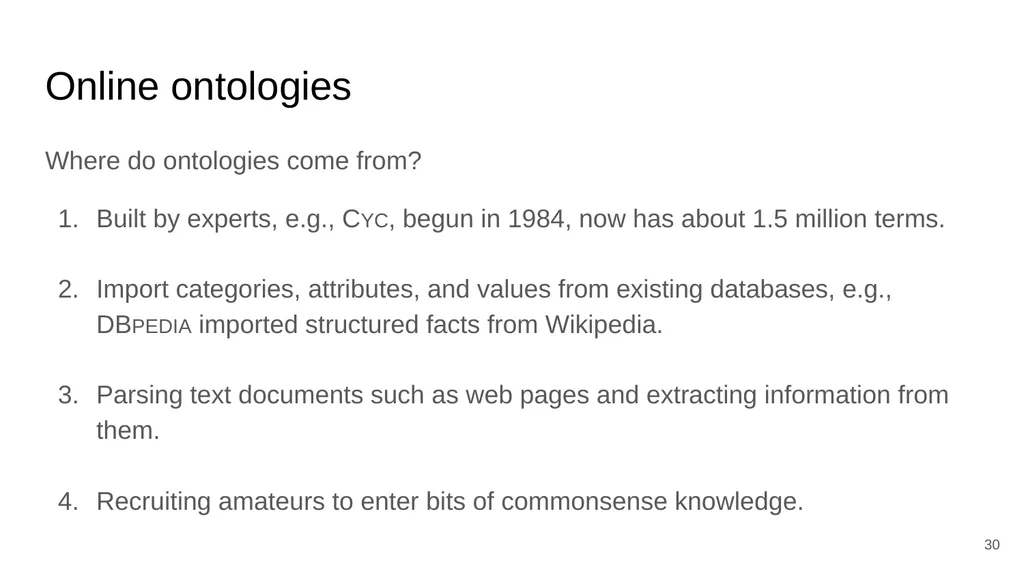
Online ontologies Where do ontologies come from?
Built by experts, e.g., CYC, begun in 1984, now has about 1.5 million terms.
Import categories, attributes, and values from existing databases, e.g., DBPEDIA imported structured facts from Wikipedia.
Parsing text documents such as web pages and extracting information from them.
Recruiting amateurs to enter bits of commonsense knowledge. ‹#›<br>
31
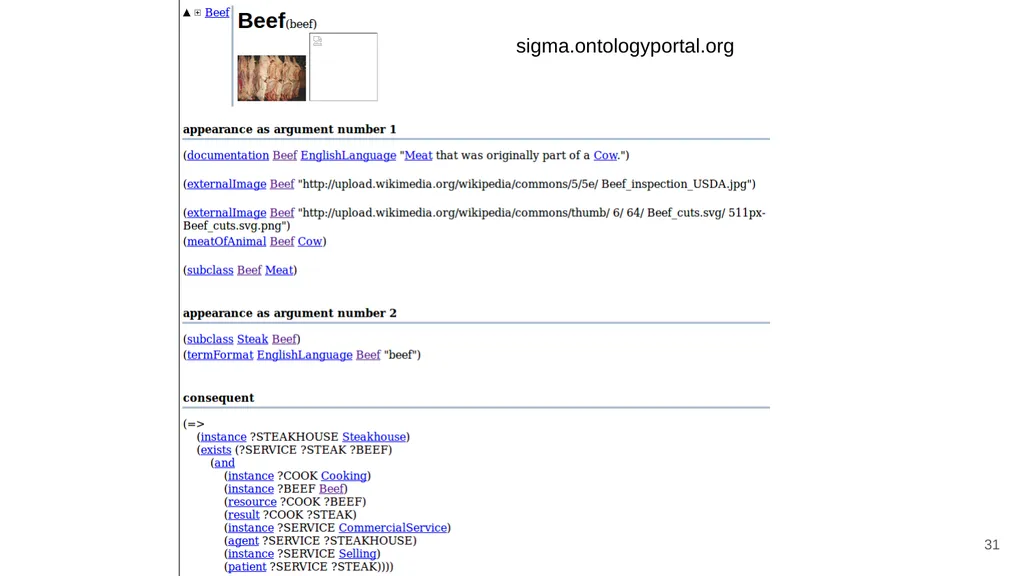
‹#› sigma.ontologyportal.org<br>
32
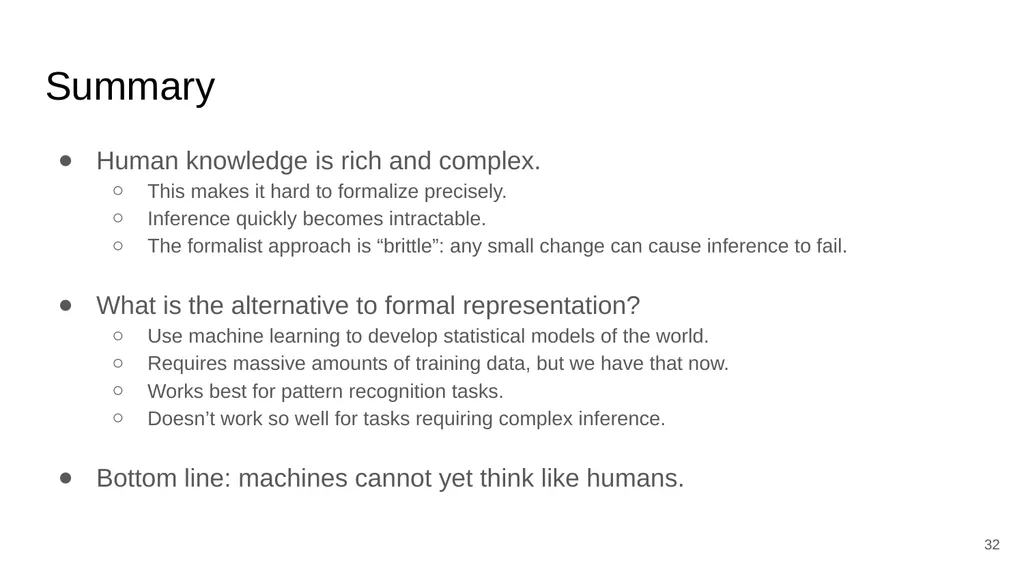
Summary Human knowledge is rich and complex.
This makes it hard to formalize precisely.
Inference quickly becomes intractable.
The formalist approach is “brittle”: any small change can cause inference to fail.
What is the alternative to formal representation?
Use machine learning to develop statistical models of the world.
Requires massive amounts of training data, but we have that now.
Works best for pattern recognition tasks.
Doesn’t work so well for tasks requiring complex inference.
Bottom line: machines cannot yet think like humans. ‹#›<br>