
Student Enterprise Report Deadline – December
LO
Published · 35 slides · 0 views
1 / 1

Description
Student Enterprise Report Deadline December debshoganteaching Resources Book, workbook, website videos. Internal - Brainstorming sessions. people coming together and creatively thinking up new ideas. - Sales personnel feedback from
Related Topics
Share
Embed code
Download this presentation From Below
"Student Enterprise Report Deadline – December" is the property of its rightful owner. Permission is granted to download and print the materials on this website for personal, non-commercial use only, and to display it on your personal computer provided you do not modify the materials and that you retain all copyright notices contained in the materials. By downloading content from our website, you accept the terms of this agreement.
Presentation Transcript
01
Student Enterprise Report Deadline – December
debshoganteaching Resources – Book, workbook, website – videos.<br>
debshoganteaching Resources – Book, workbook, website – videos.<br>
02
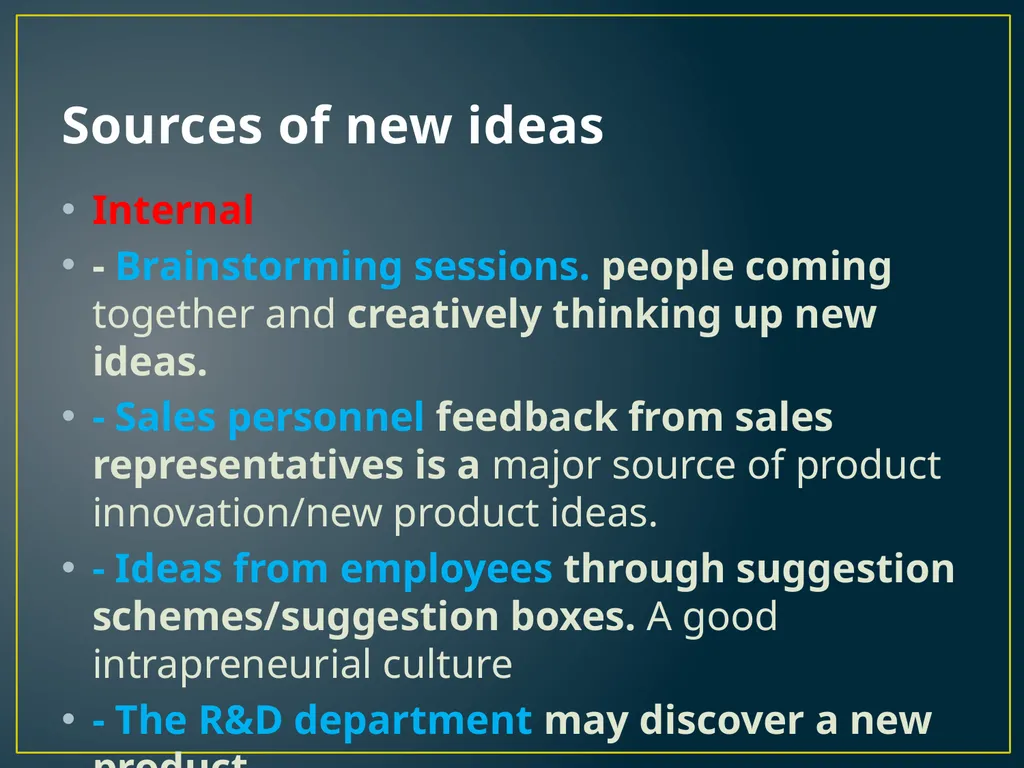
Internal
- Brainstorming sessions. people coming together and creatively thinking up new ideas.
- Sales personnel feedback from sales representatives is a major source of product innovation/new product ideas.
- Ideas from employees through suggestion schemes/suggestion boxes. A good intrapreneurial culture
- The R&D department may discover a new product Sources of new ideas<br>
- Brainstorming sessions. people coming together and creatively thinking up new ideas.
- Sales personnel feedback from sales representatives is a major source of product innovation/new product ideas.
- Ideas from employees through suggestion schemes/suggestion boxes. A good intrapreneurial culture
- The R&D department may discover a new product Sources of new ideas<br>
03
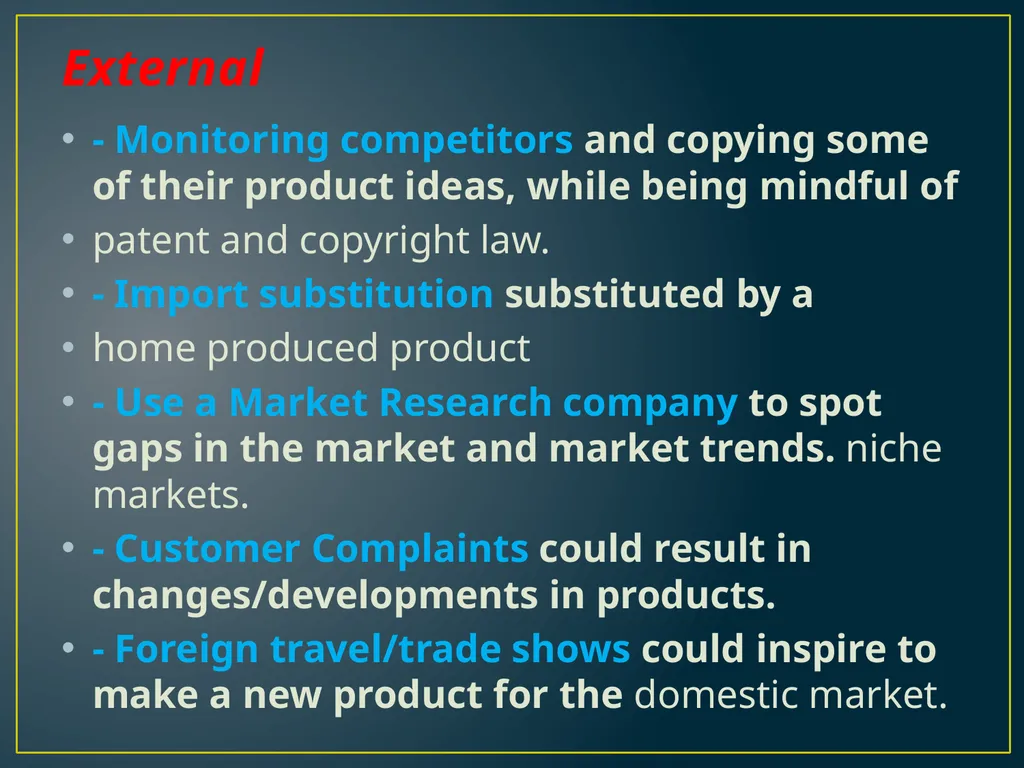
External - Monitoring competitors and copying some of their product ideas, while being mindful of
patent and copyright law.
- Import substitution substituted by a
home produced product
- Use a Market Research company to spot gaps in the market and market trends. niche markets.
- Customer Complaints could result in changes/developments in products.
- Foreign travel/trade shows could inspire to make a new product for the domestic market.<br>
patent and copyright law.
- Import substitution substituted by a
home produced product
- Use a Market Research company to spot gaps in the market and market trends. niche markets.
- Customer Complaints could result in changes/developments in products.
- Foreign travel/trade shows could inspire to make a new product for the domestic market.<br>
04
Reasons why businesses carry out Market Research Market: it provides information
about the size of the market
It also provides information about the characteristics of the market (age of people in it, their income, their location)
Competitors: their products, market share and their strengths and weaknesses.
Marketing Mix: it helps a business decide on the marketing. i.e. the Product, its Price, method of Promotion and the Place where it will be sold.<br>
about the size of the market
It also provides information about the characteristics of the market (age of people in it, their income, their location)
Competitors: their products, market share and their strengths and weaknesses.
Marketing Mix: it helps a business decide on the marketing. i.e. the Product, its Price, method of Promotion and the Place where it will be sold.<br>
05
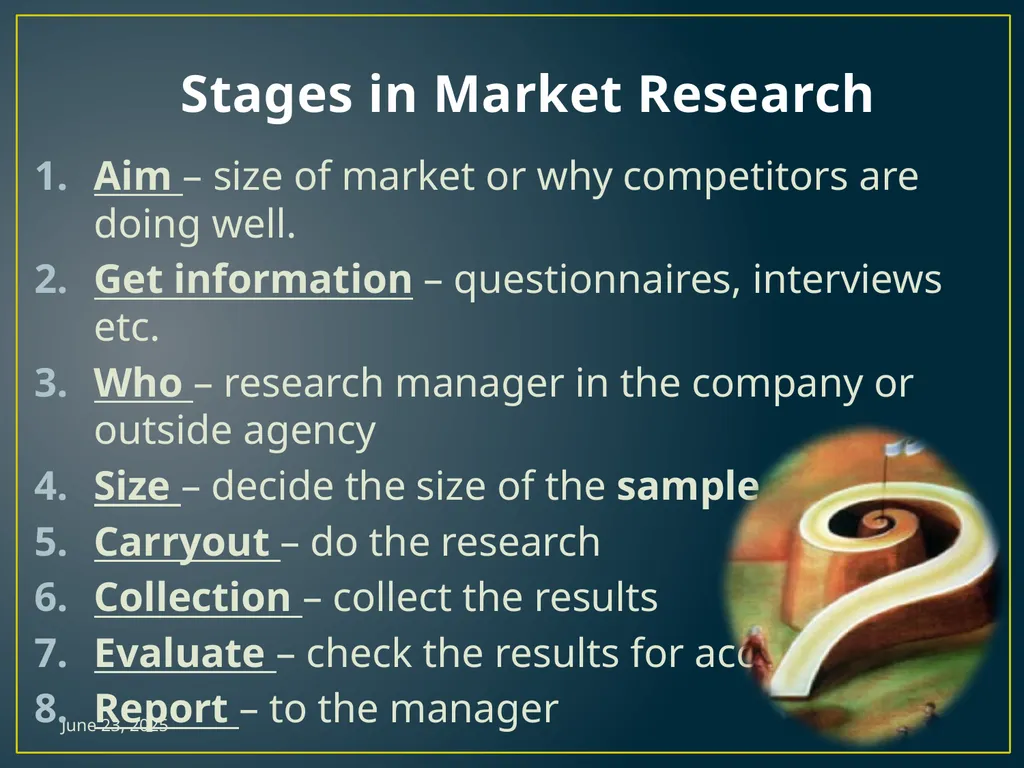
26 August 2017 Stages in Market Research Aim – size of market or why competitors are doing well.
Get information – questionnaires, interviews etc.
Who – research manager in the company or outside agency
Size – decide the size of the sample
Carryout – do the research
Collection – collect the results
Evaluate – check the results for accuracy
Report – to the manager<br>
Get information – questionnaires, interviews etc.
Who – research manager in the company or outside agency
Size – decide the size of the sample
Carryout – do the research
Collection – collect the results
Evaluate – check the results for accuracy
Report – to the manager<br>
06
Idea Generation Brainstorm
Research online
Video tutorials
Past Ideas
Visit In from LEO Rep.
Top Tips
1. Identify a problem and find a solution
2. Look at your hobbies
3. Be realistic!
4. Try improving an existing product / service
5. Don’t forget your research & development<br>
Research online
Video tutorials
Past Ideas
Visit In from LEO Rep.
Top Tips
1. Identify a problem and find a solution
2. Look at your hobbies
3. Be realistic!
4. Try improving an existing product / service
5. Don’t forget your research & development<br>
07
Stages involved in the
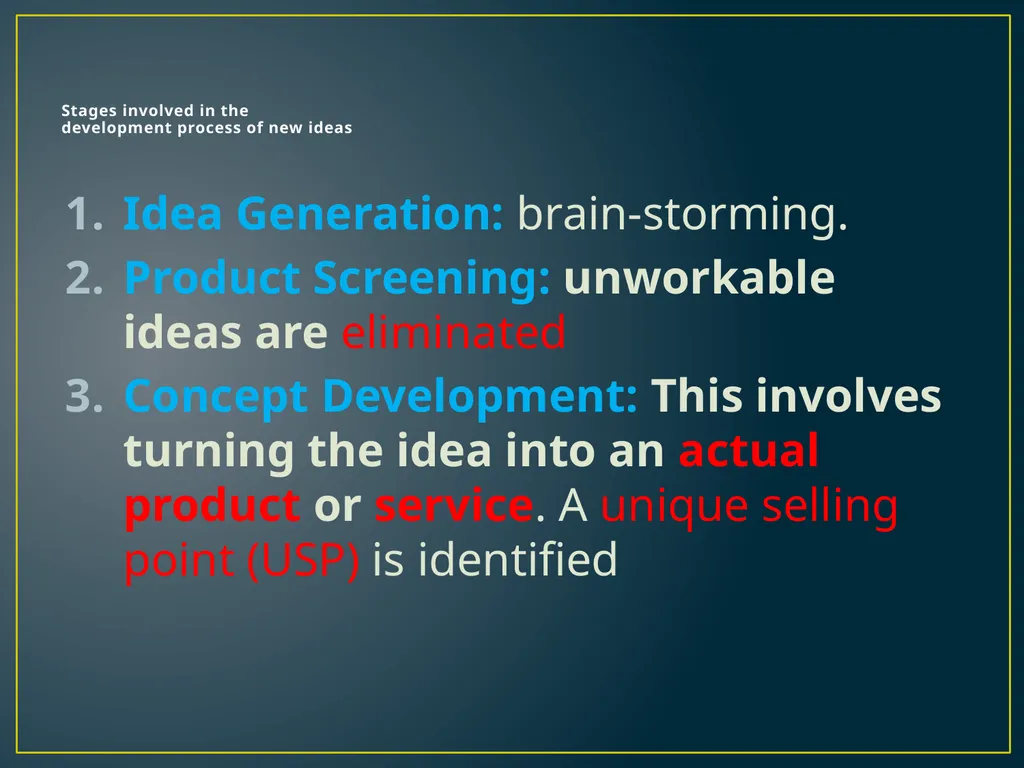
development process of new ideas Idea Generation: brain-storming.
Product Screening: unworkable ideas are eliminated
Concept Development: This involves turning the idea into an actual product or service. A unique selling point (USP) is identified<br>
Product Screening: unworkable ideas are eliminated
Concept Development: This involves turning the idea into an actual product or service. A unique selling point (USP) is identified<br>
08
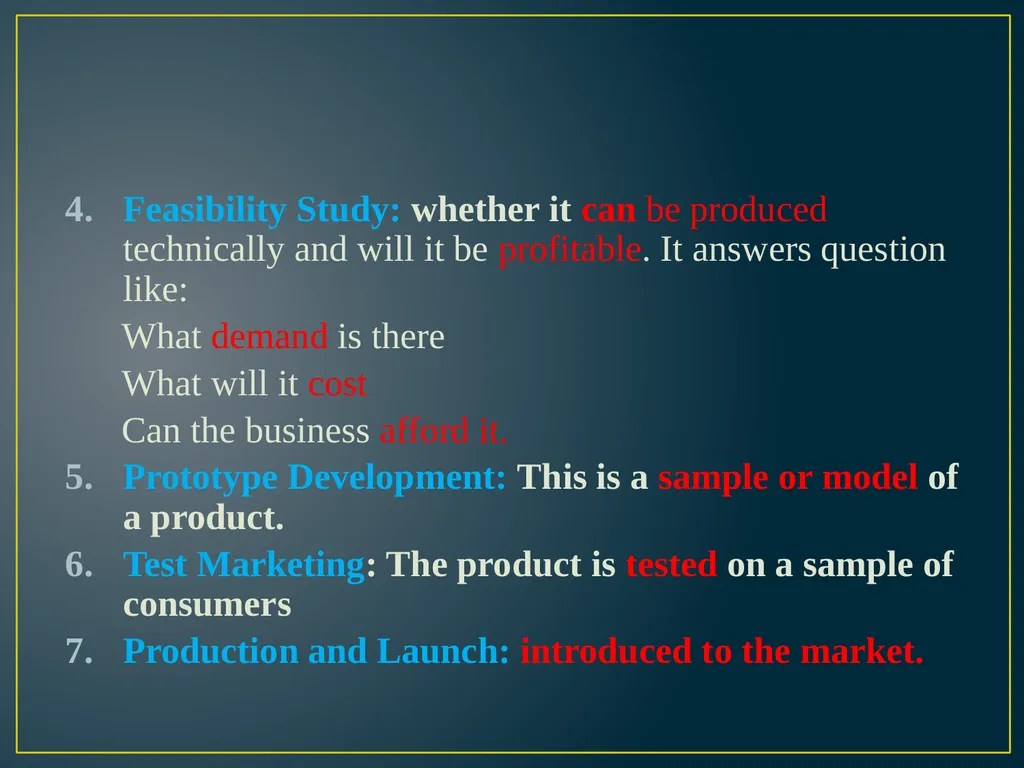
Feasibility Study: whether it can be produced technically and will it be profitable. It answers question like:
What demand is there
What will it cost
Can the business afford it.
Prototype Development: This is a sample or model of a product.
Test Marketing: The product is tested on a sample of consumers
Production and Launch: introduced to the market.<br>
What demand is there
What will it cost
Can the business afford it.
Prototype Development: This is a sample or model of a product.
Test Marketing: The product is tested on a sample of consumers
Production and Launch: introduced to the market.<br>
09
What is Market Research? Market research is the process of collecting valuable information to help you find out if there is a market for your proposed product or service.
Examine existing products / services
Look at other similar products / services on the market:
Can you learn from them?
What do they do well?
What do they do badly?<br>
Examine existing products / services
Look at other similar products / services on the market:
Can you learn from them?
What do they do well?
What do they do badly?<br>
10
How is your product going to be better than everything else that is available?
Examine your target audience
Look at your target customers:
What are their needs? A questionnaire is a good way of finding out what your customers want.<br>
Examine your target audience
Look at your target customers:
What are their needs? A questionnaire is a good way of finding out what your customers want.<br>
11
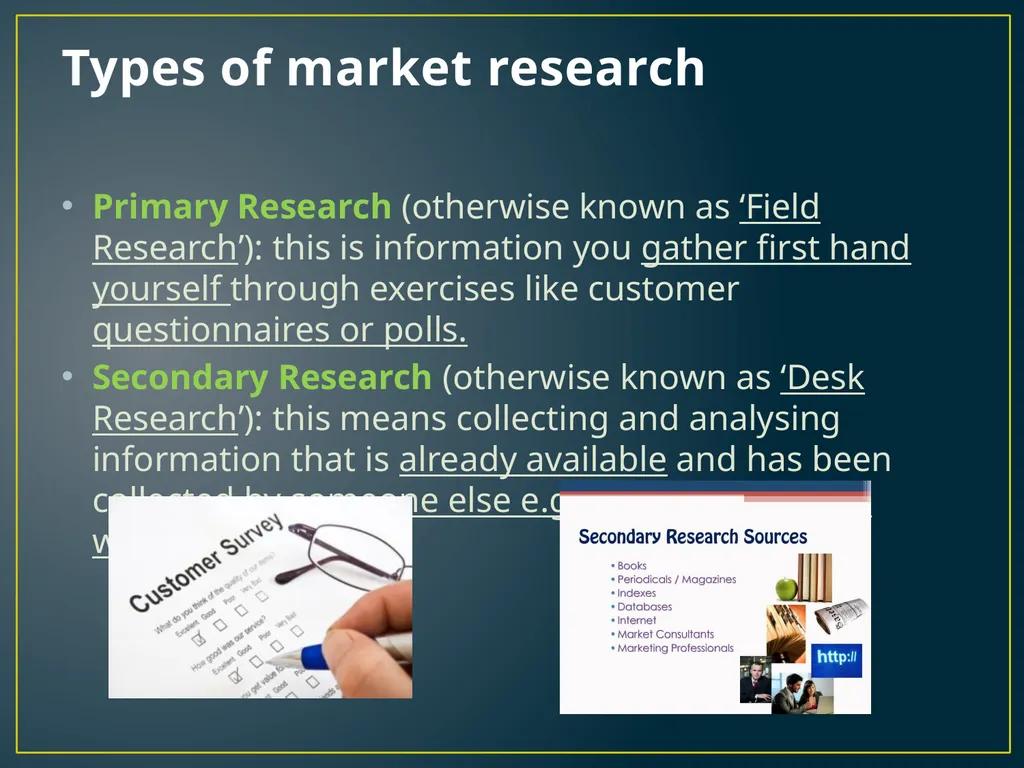
Types of market research Primary Research (otherwise known as ‘Field Research’): this is information you gather first hand yourself through exercises like customer questionnaires or polls.
Secondary Research (otherwise known as ‘Desk Research’): this means collecting and analysing information that is already available and has been collected by someone else e.g. reports, statistics, websites etc…<br>
Secondary Research (otherwise known as ‘Desk Research’): this means collecting and analysing information that is already available and has been collected by someone else e.g. reports, statistics, websites etc…<br>
12
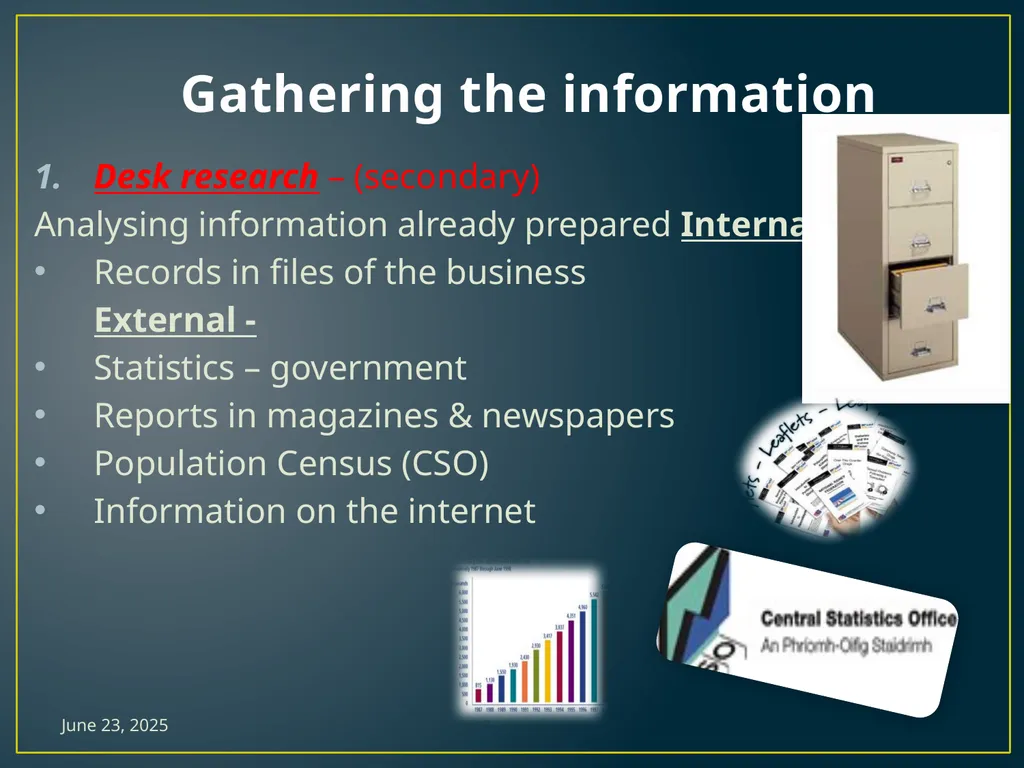
26 August 2017 Gathering the information Desk research – (secondary)
Analysing information already prepared Internally
Records in files of the business
External -
Statistics – government
Reports in magazines & newspapers
Population Census (CSO)
Information on the internet<br>
Analysing information already prepared Internally
Records in files of the business
External -
Statistics – government
Reports in magazines & newspapers
Population Census (CSO)
Information on the internet<br>
13
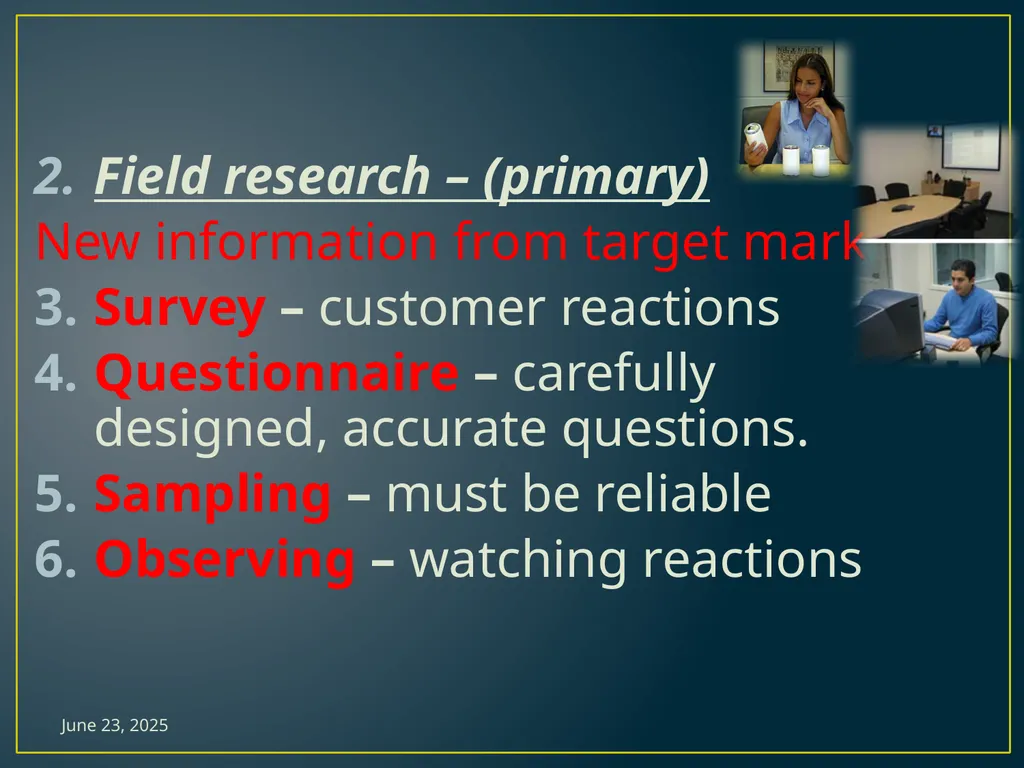
26 August 2017 Field research – (primary)
New information from target market
Survey – customer reactions
Questionnaire – carefully designed, accurate questions.
Sampling – must be reliable
Observing – watching reactions<br>
New information from target market
Survey – customer reactions
Questionnaire – carefully designed, accurate questions.
Sampling – must be reliable
Observing – watching reactions<br>
14
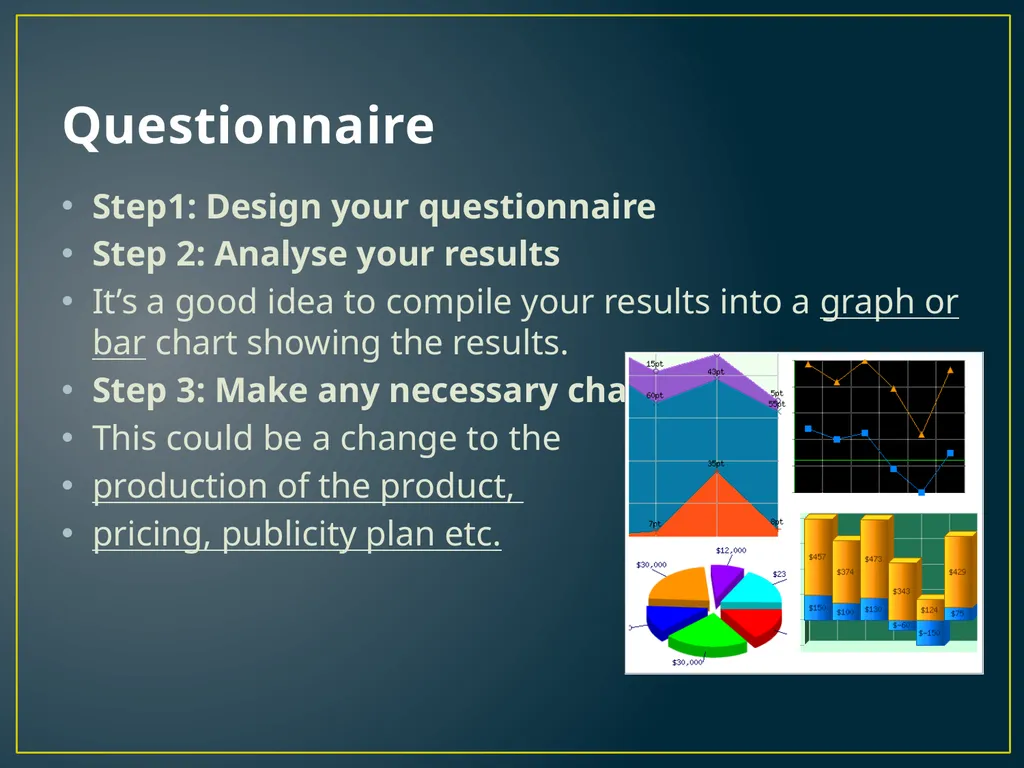
Questionnaire Step1: Design your questionnaire
Step 2: Analyse your results
It’s a good idea to compile your results into a graph or bar chart showing the results.
Step 3: Make any necessary changes
This could be a change to the
production of the product,
pricing, publicity plan etc.<br>
Step 2: Analyse your results
It’s a good idea to compile your results into a graph or bar chart showing the results.
Step 3: Make any necessary changes
This could be a change to the
production of the product,
pricing, publicity plan etc.<br>
15
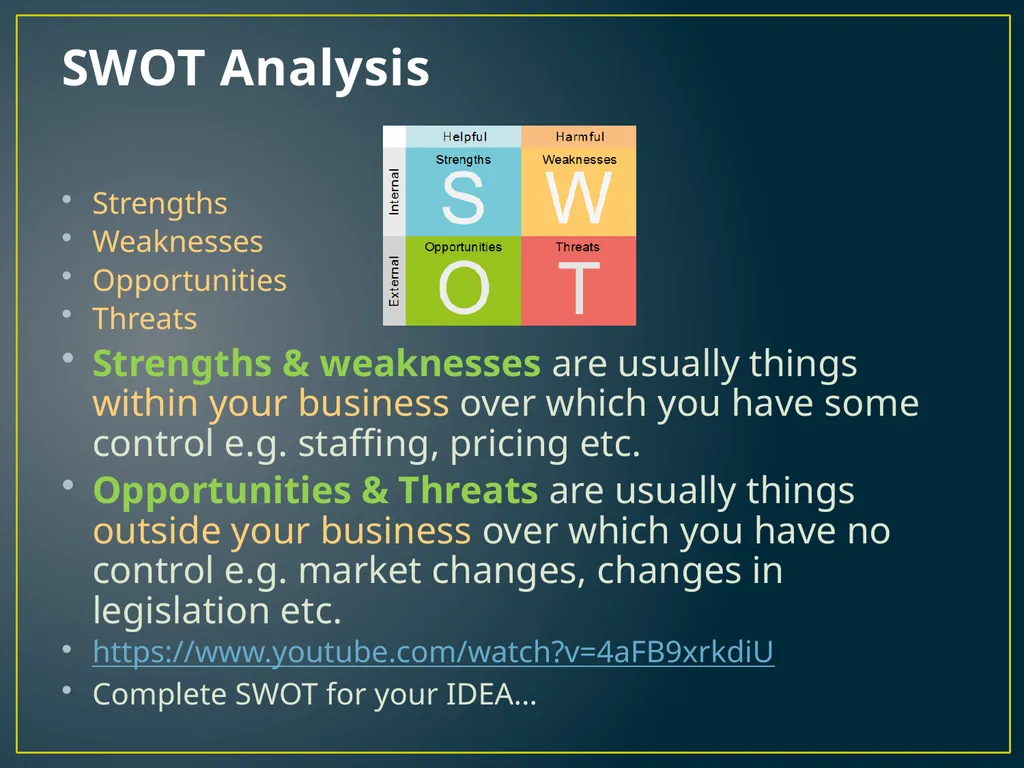
SWOT Analysis Strengths
Weaknesses
Opportunities
Threats
Strengths & weaknesses are usually things within your business over which you have some control e.g. staffing, pricing etc.
Opportunities & Threats are usually things outside your business over which you have no control e.g. market changes, changes in legislation etc.
https://www.youtube.com/watch?v=4aFB9xrkdiU
Complete SWOT for your IDEA…<br>
Weaknesses
Opportunities
Threats
Strengths & weaknesses are usually things within your business over which you have some control e.g. staffing, pricing etc.
Opportunities & Threats are usually things outside your business over which you have no control e.g. market changes, changes in legislation etc.
https://www.youtube.com/watch?v=4aFB9xrkdiU
Complete SWOT for your IDEA…<br>
16
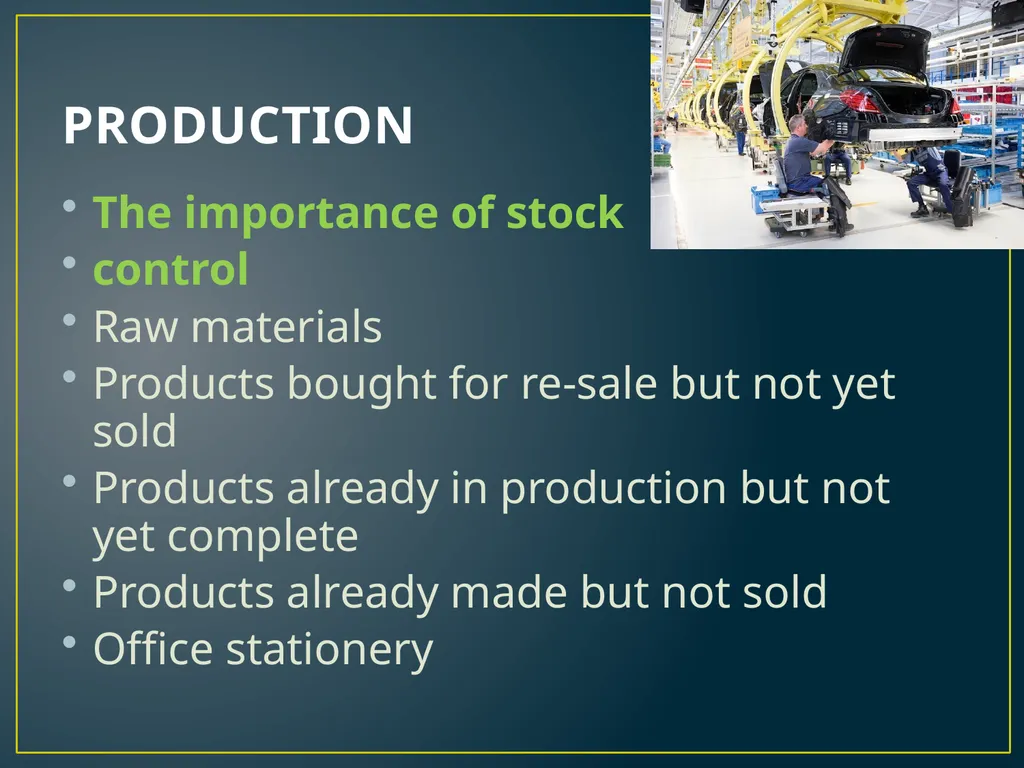
PRODUCTION The importance of stock
control
Raw materials
Products bought for re-sale but not yet sold
Products already in production but not yet complete
Products already made but not sold
Office stationery<br>
control
Raw materials
Products bought for re-sale but not yet sold
Products already in production but not yet complete
Products already made but not sold
Office stationery<br>
17
Stock Sins!
Running out of stock and not meeting their production deadlines as a result, or
Carrying too much stock. This can work out expensive if all the stock is not sold<br>
Running out of stock and not meeting their production deadlines as a result, or
Carrying too much stock. This can work out expensive if all the stock is not sold<br>
18
5 steps to production success Step 1: Ask yourselves the following questions
Where will I / we produce the product (s) / service?
Who will produce the product (s) / service?
How exactly will the product (s) / service be produced? What steps are involved?<br>
Where will I / we produce the product (s) / service?
Who will produce the product (s) / service?
How exactly will the product (s) / service be produced? What steps are involved?<br>
19
Step 2: Do your product / service research
e.g. any special equipment, materials etc. Find out how much the equipment and raw materials cost and if you can afford them.
Step 3: Give someone responsibility for production & quality control
Step 4: Talk to an experienced business person
Step 5: Work as a team<br>
e.g. any special equipment, materials etc. Find out how much the equipment and raw materials cost and if you can afford them.
Step 3: Give someone responsibility for production & quality control
Step 4: Talk to an experienced business person
Step 5: Work as a team<br>
20
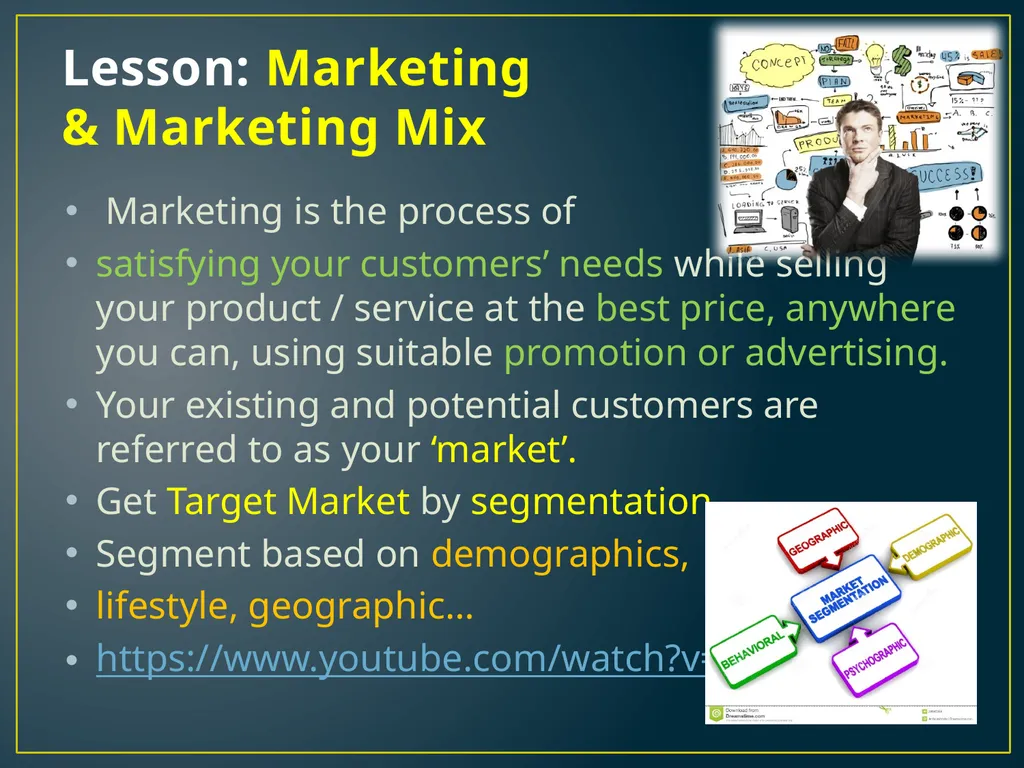
Lesson: Marketing
& Marketing Mix Marketing is the process of
satisfying your customers’ needs while selling your product / service at the best price, anywhere you can, using suitable promotion or advertising.
Your existing and potential customers are referred to as your ‘market’.
Get Target Market by segmentation.
Segment based on demographics,
lifestyle, geographic…
https://www.youtube.com/watch?v=i1xz5Kv-7VY<br>
satisfying your customers’ needs while selling your product / service at the best price, anywhere you can, using suitable promotion or advertising.
Your existing and potential customers are referred to as your ‘market’.
Get Target Market by segmentation.
Segment based on demographics,
lifestyle, geographic…
https://www.youtube.com/watch?v=i1xz5Kv-7VY<br>
21
What is the
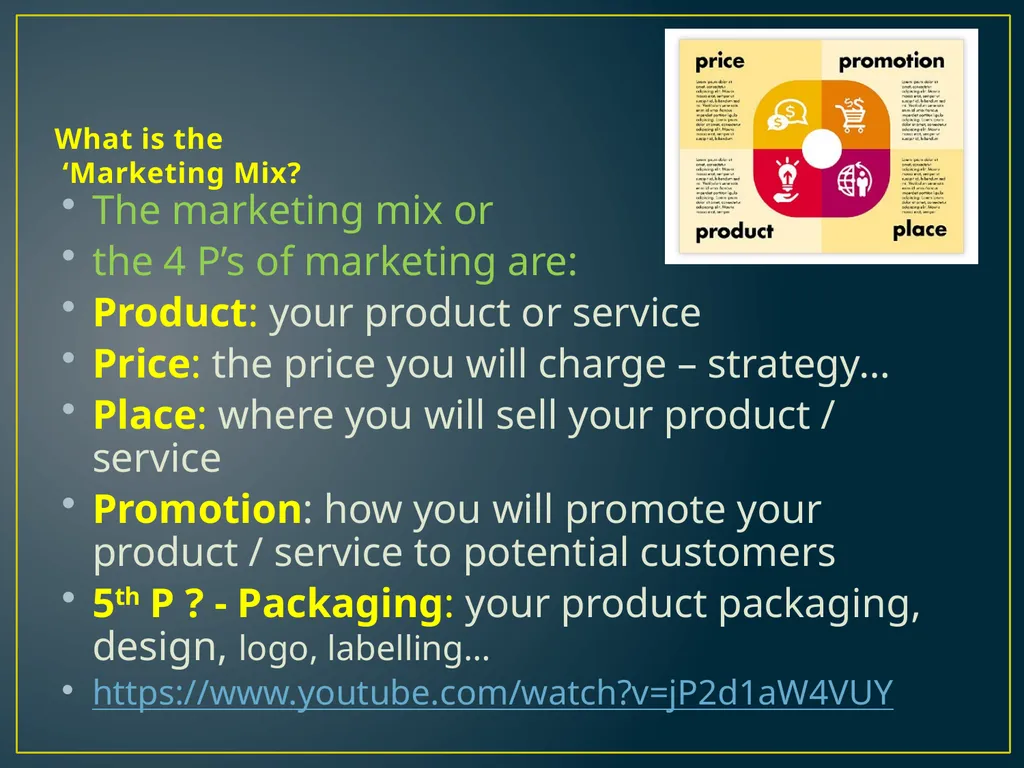
‘Marketing Mix? The marketing mix or
the 4 P’s of marketing are:
Product: your product or service
Price: the price you will charge – strategy…
Place: where you will sell your product / service
Promotion: how you will promote your product / service to potential customers
5th P ? - Packaging: your product packaging, design, logo, labelling…
https://www.youtube.com/watch?v=jP2d1aW4VUY<br>
the 4 P’s of marketing are:
Product: your product or service
Price: the price you will charge – strategy…
Place: where you will sell your product / service
Promotion: how you will promote your product / service to potential customers
5th P ? - Packaging: your product packaging, design, logo, labelling…
https://www.youtube.com/watch?v=jP2d1aW4VUY<br>
22
Tips – promotion… Social Media - Facebook page & Twitter
Website
T-shirts
Business Cards
PR, PS, SP, Advertising..
Focus on your USP
Catchy name that relates to Product/service Idea
Design a logo
https://www.youtube.com/watch?v=9_XWp5fnXKc<br>
Website
T-shirts
Business Cards
PR, PS, SP, Advertising..
Focus on your USP
Catchy name that relates to Product/service Idea
Design a logo
https://www.youtube.com/watch?v=9_XWp5fnXKc<br>
23
Entrepreneur Is a person who provides the initiative and takes the risks establishing a business.
An entrepreneur is innovative and uses society’s needs to create business opportunities in the hope of making a profit.
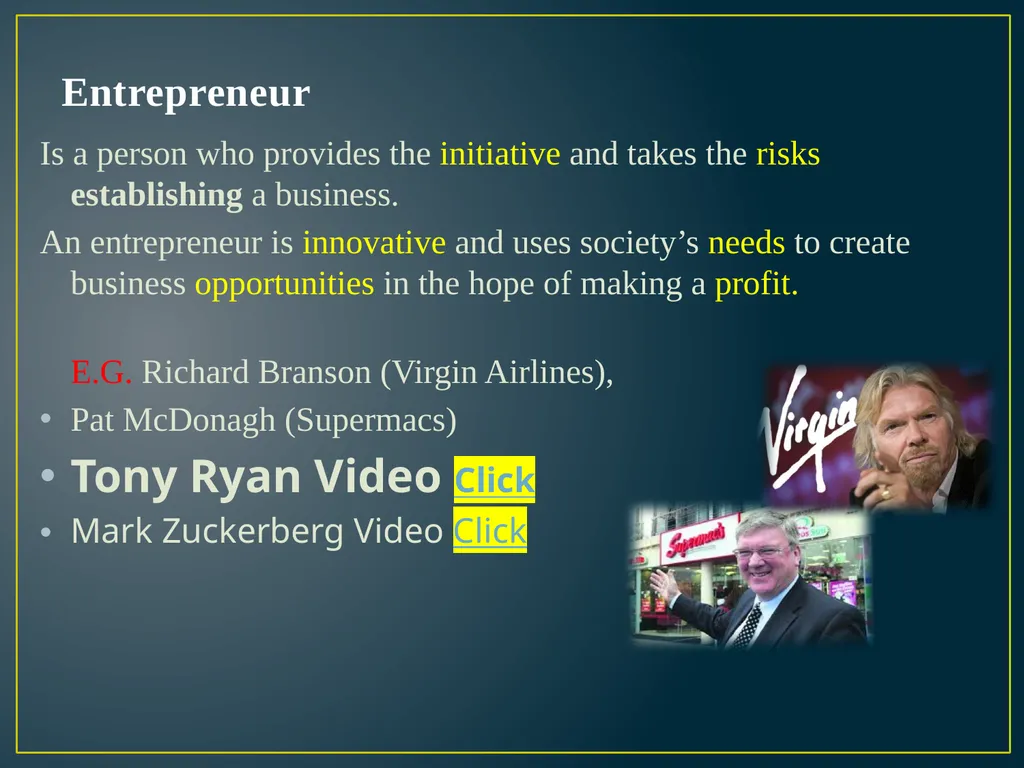
E.G. Richard Branson (Virgin Airlines),
Pat McDonagh (Supermacs)
Tony Ryan Video Click
Mark Zuckerberg Video Click<br>
An entrepreneur is innovative and uses society’s needs to create business opportunities in the hope of making a profit.
E.G. Richard Branson (Virgin Airlines),
Pat McDonagh (Supermacs)
Tony Ryan Video Click
Mark Zuckerberg Video Click<br>
24
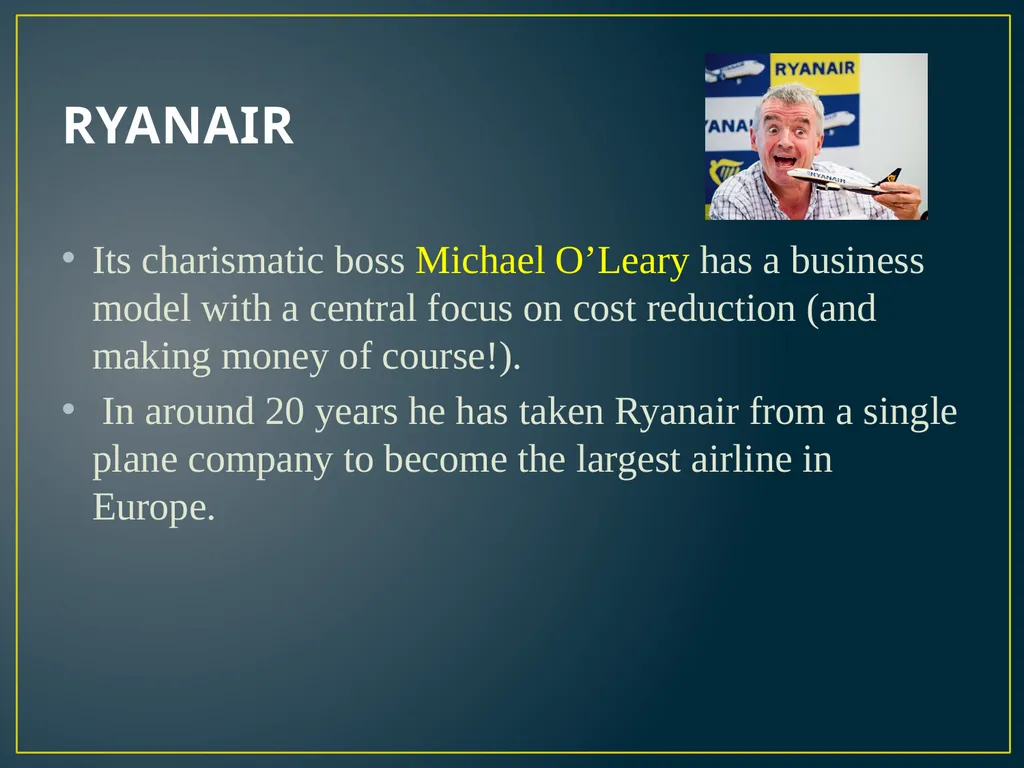
RYANAIR Its charismatic boss Michael O’Leary has a business model with a central focus on cost reduction (and making money of course!).
In around 20 years he has taken Ryanair from a single plane company to become the largest airline in Europe.<br>
In around 20 years he has taken Ryanair from a single plane company to become the largest airline in Europe.<br>
25
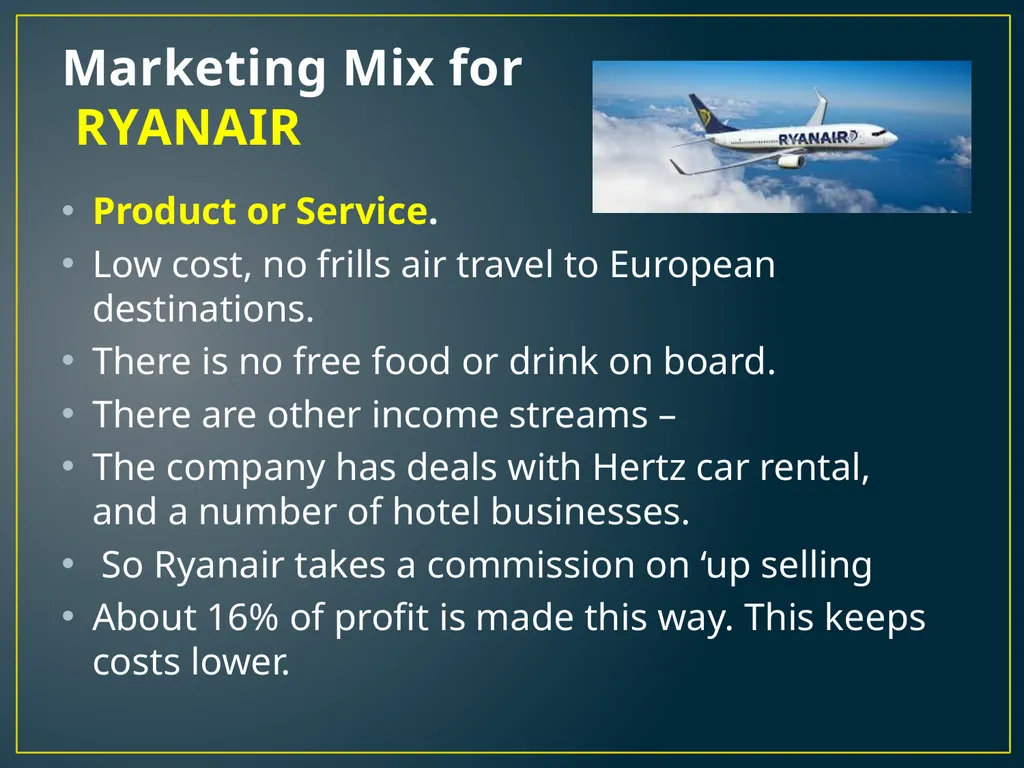
Marketing Mix for
RYANAIR Product or Service.
Low cost, no frills air travel to European destinations.
There is no free food or drink on board.
There are other income streams –
The company has deals with Hertz car rental, and a number of hotel businesses.
So Ryanair takes a commission on ‘up selling
About 16% of profit is made this way. This keeps costs lower.<br>
Low cost, no frills air travel to European destinations.
There is no free food or drink on board.
There are other income streams –
The company has deals with Hertz car rental, and a number of hotel businesses.
So Ryanair takes a commission on ‘up selling
About 16% of profit is made this way. This keeps costs lower.<br>
26
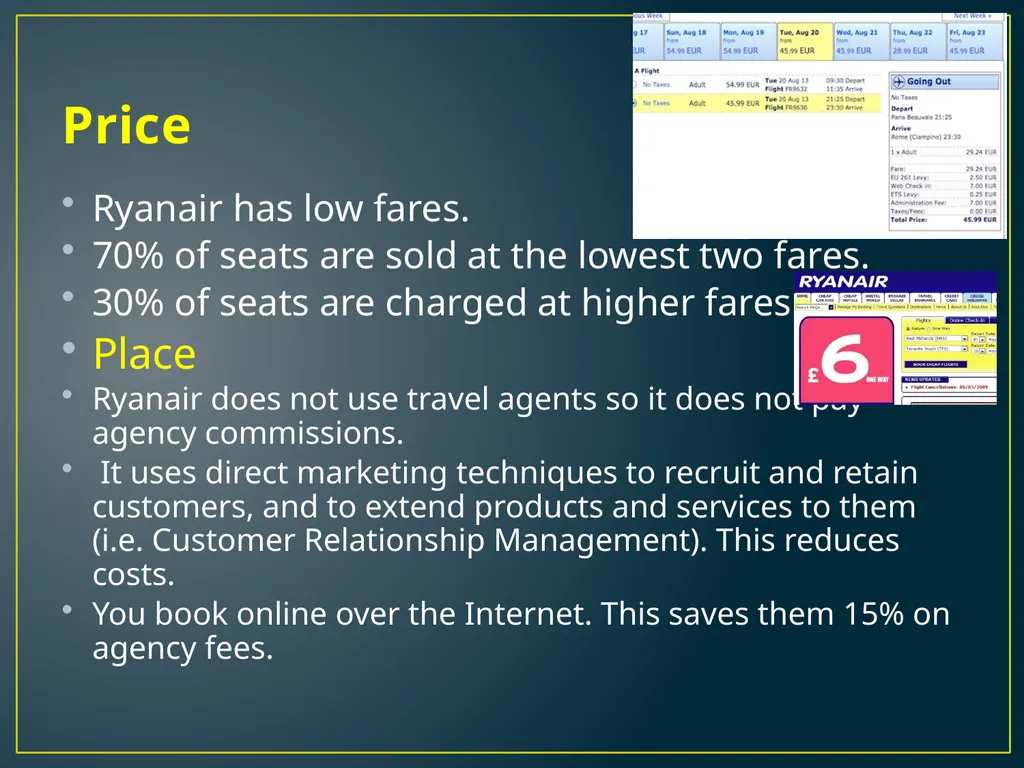
Price Ryanair has low fares.
70% of seats are sold at the lowest two fares.
30% of seats are charged at higher fares.
Place
Ryanair does not use travel agents so it does not pay agency commissions.
It uses direct marketing techniques to recruit and retain customers, and to extend products and services to them (i.e. Customer Relationship Management). This reduces costs.
You book online over the Internet. This saves them 15% on agency fees.<br>
70% of seats are sold at the lowest two fares.
30% of seats are charged at higher fares.
Place
Ryanair does not use travel agents so it does not pay agency commissions.
It uses direct marketing techniques to recruit and retain customers, and to extend products and services to them (i.e. Customer Relationship Management). This reduces costs.
You book online over the Internet. This saves them 15% on agency fees.<br>
27
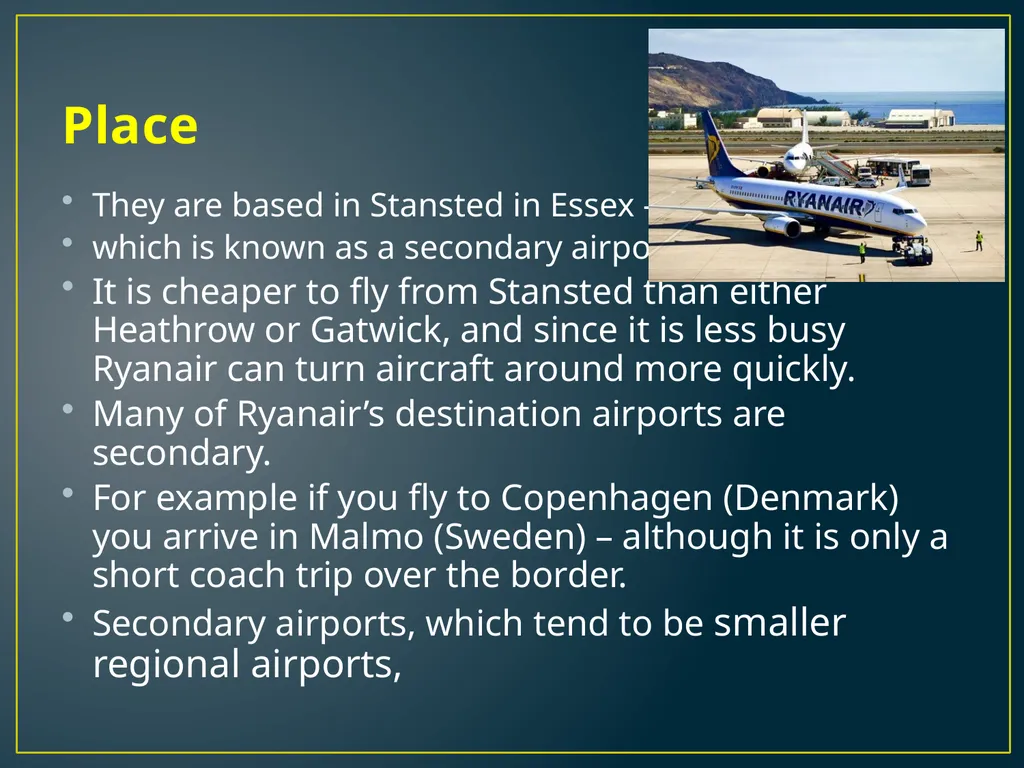
Place They are based in Stansted in Essex –
which is known as a secondary airport.
It is cheaper to fly from Stansted than either Heathrow or Gatwick, and since it is less busy Ryanair can turn aircraft around more quickly.
Many of Ryanair’s destination airports are secondary.
For example if you fly to Copenhagen (Denmark) you arrive in Malmo (Sweden) – although it is only a short coach trip over the border.
Secondary airports, which tend to be smaller regional airports,<br>
which is known as a secondary airport.
It is cheaper to fly from Stansted than either Heathrow or Gatwick, and since it is less busy Ryanair can turn aircraft around more quickly.
Many of Ryanair’s destination airports are secondary.
For example if you fly to Copenhagen (Denmark) you arrive in Malmo (Sweden) – although it is only a short coach trip over the border.
Secondary airports, which tend to be smaller regional airports,<br>
28
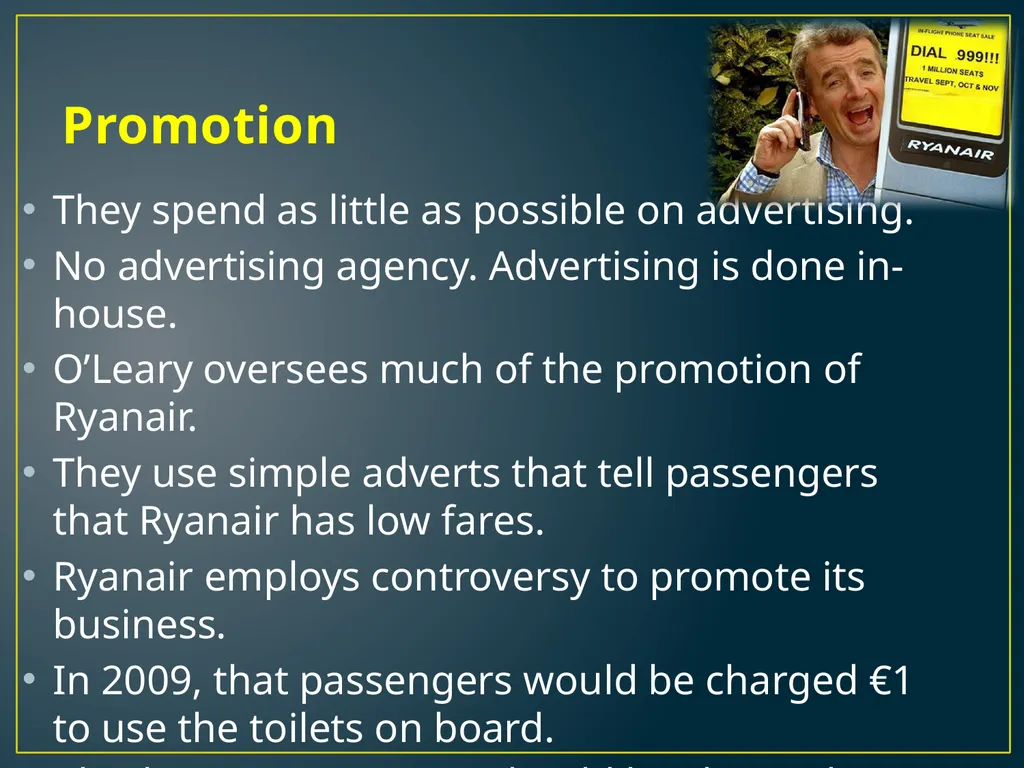
Promotion They spend as little as possible on advertising.
No advertising agency. Advertising is done in-house.
O’Leary oversees much of the promotion of Ryanair.
They use simple adverts that tell passengers that Ryanair has low fares.
Ryanair employs controversy to promote its business.
In 2009, that passengers would be charged €1 to use the toilets on board.
Also larger passengers should be charged more since they took up more room –<br>
No advertising agency. Advertising is done in-house.
O’Leary oversees much of the promotion of Ryanair.
They use simple adverts that tell passengers that Ryanair has low fares.
Ryanair employs controversy to promote its business.
In 2009, that passengers would be charged €1 to use the toilets on board.
Also larger passengers should be charged more since they took up more room –<br>
29
Costing & Pricing Step 1: Work out your ‘Fixed Costs’
remain the same regardless of how many units you are making.
Rental of your business premises
Your insurance<br>
remain the same regardless of how many units you are making.
Rental of your business premises
Your insurance<br>
30
PROMOTIONAL COSTS: getting business cards or posters etc. printed.
TRAVEL COSTS: travel time and cost to pick up materials, drop off orders etc.
OTHER COSTS: costs of telephone calls etc.<br>
TRAVEL COSTS: travel time and cost to pick up materials, drop off orders etc.
OTHER COSTS: costs of telephone calls etc.<br>
31
Your ‘Variable Costs’ are costs that change depending on how many products you produce.
Labour costs – estimate the time you are going to work on producing the product and put a cost against this
Packaging
PER UNIT (DIVIDE BY HOW MANY PRODUCTS)
TOTAL COSTS
FIXED COST PER UNIT + VARIABLE COST PER UNIT = TOTAL COST PER UNIT<br>
Labour costs – estimate the time you are going to work on producing the product and put a cost against this
Packaging
PER UNIT (DIVIDE BY HOW MANY PRODUCTS)
TOTAL COSTS
FIXED COST PER UNIT + VARIABLE COST PER UNIT = TOTAL COST PER UNIT<br>
32
PRICING Cost Plus Pricing/Mark -up
Adding a % to your unit price to give yourself a profit. E.g. adding 10% to a unit cost of 5 euro = 5.50 euro Competitive Pricing
Loss Leaders - You set your selling price at either the same as your total cost per unit or slightly below.
Penetration Pricing - Setting your price over your total cost per unit but under your competitor’s price.<br>
Adding a % to your unit price to give yourself a profit. E.g. adding 10% to a unit cost of 5 euro = 5.50 euro Competitive Pricing
Loss Leaders - You set your selling price at either the same as your total cost per unit or slightly below.
Penetration Pricing - Setting your price over your total cost per unit but under your competitor’s price.<br>
33
Premium Pricing - Making your price high on purpose because your product is unique and is considered a luxury.
Price Discrimination - Charging different prices to different customers.
Finally…Now that you know what it is going to cost you to make each unit, go back and look at your market research.<br>
Price Discrimination - Charging different prices to different customers.
Finally…Now that you know what it is going to cost you to make each unit, go back and look at your market research.<br>
34
Finance & Book Keeping Setting your budget
Managing your books
Preparing your accounts
Am I making a profit?
How much am I selling?
What are my costs?
Do I have enough cash?<br>
Managing your books
Preparing your accounts
Am I making a profit?
How much am I selling?
What are my costs?
Do I have enough cash?<br>
35
What is a Cash Book?
What is a budget?
What is a Profit & Loss Account?<br>
What is a budget?
What is a Profit & Loss Account?<br>