04
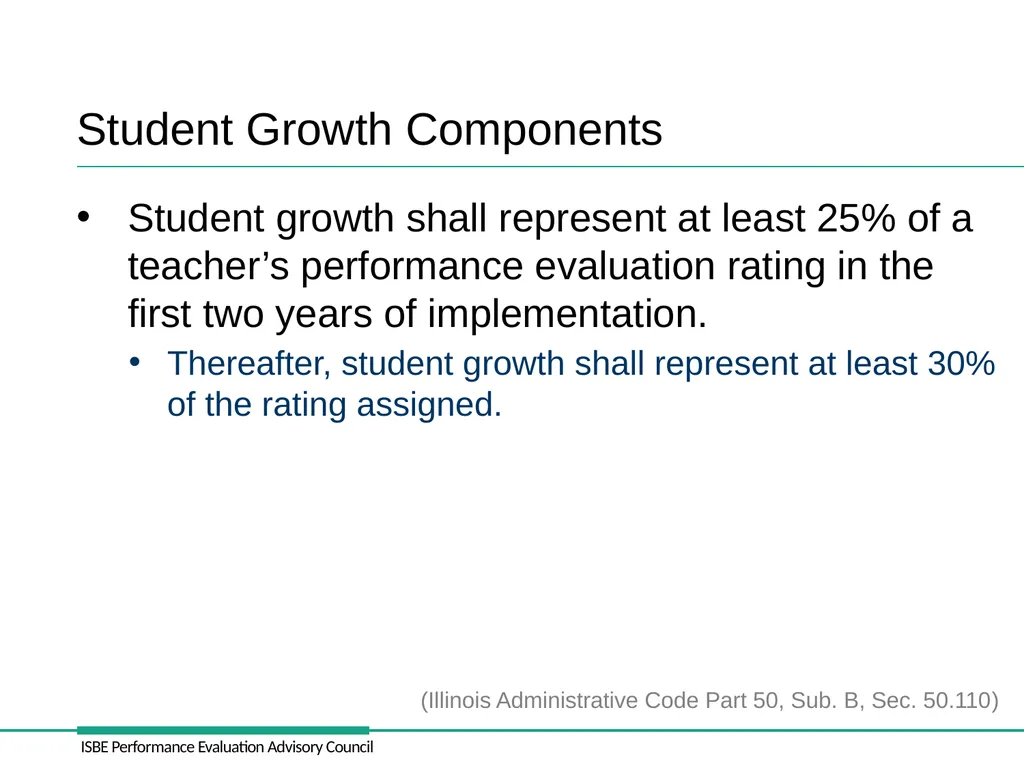
Student growth shall represent at least 25% of a teacher’s performance evaluation rating in the first two years of implementation.
Thereafter, student growth shall represent at least 30% of the rating assigned. Student Growth Components (Illinois Administrative Code Part 50, Sub. B, Sec. 50.110)<br>
05
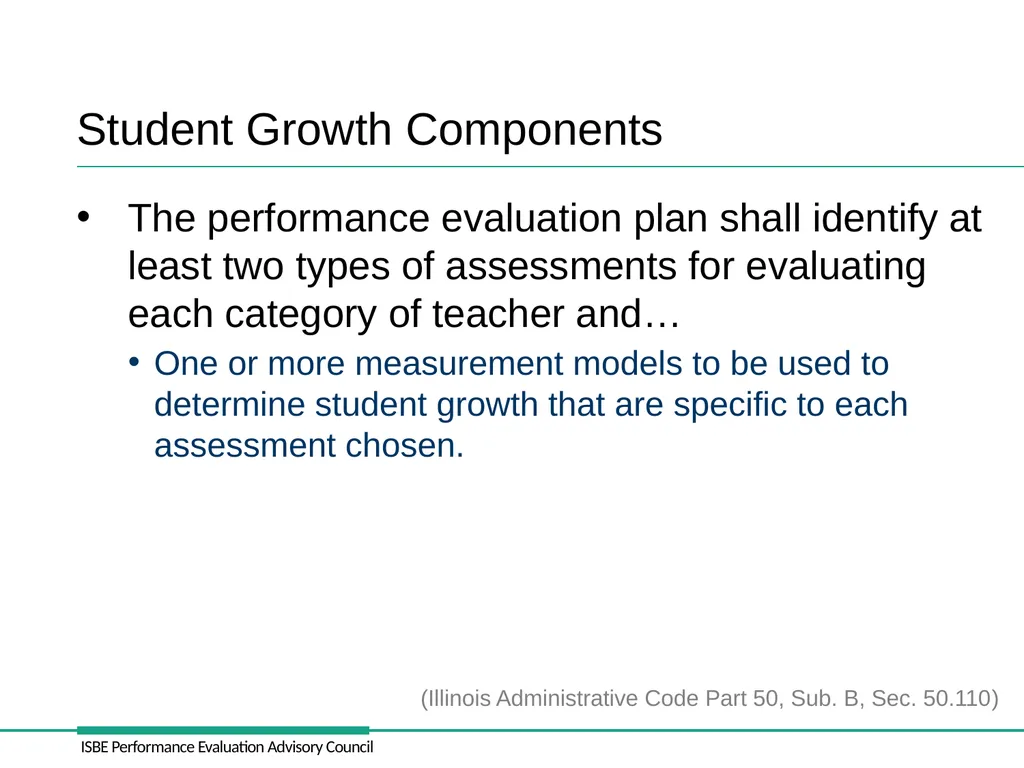
The performance evaluation plan shall identify at least two types of assessments for evaluating each category of teacher and…
One or more measurement models to be used to determine student growth that are specific to each assessment chosen. Student Growth Components (Illinois Administrative Code Part 50, Sub. B, Sec. 50.110)<br>
06
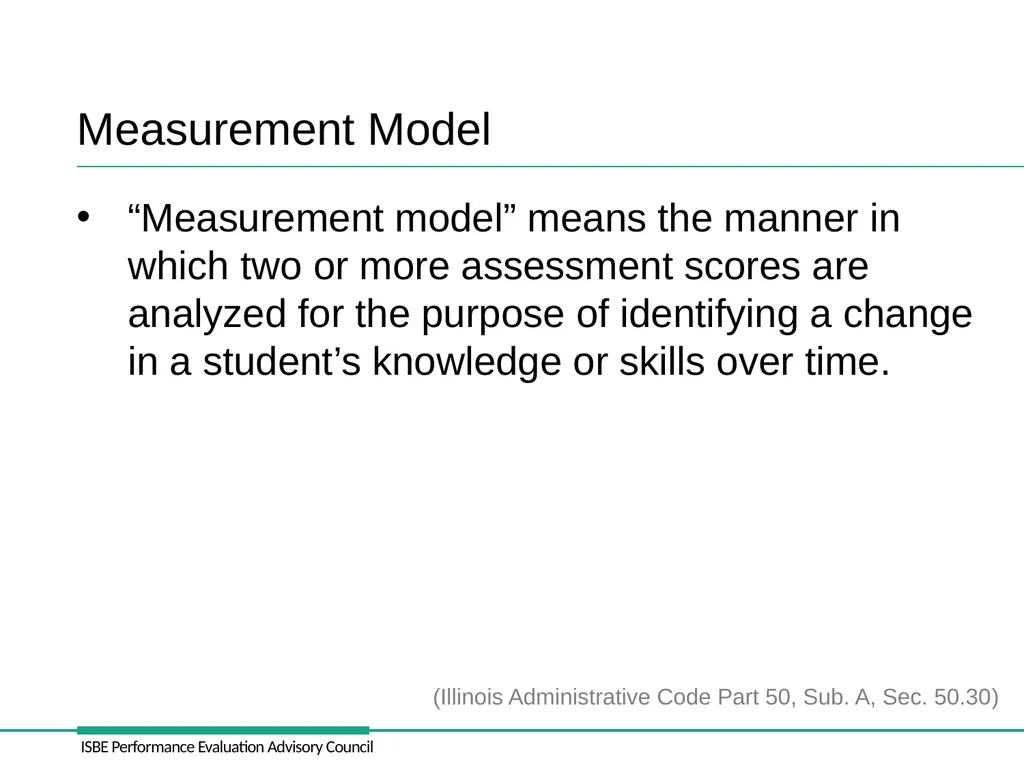
“Measurement model” means the manner in which two or more assessment scores are analyzed for the purpose of identifying a change in a student’s knowledge or skills over time. Measurement Model (Illinois Administrative Code Part 50, Sub. A, Sec. 50.30)<br>
07
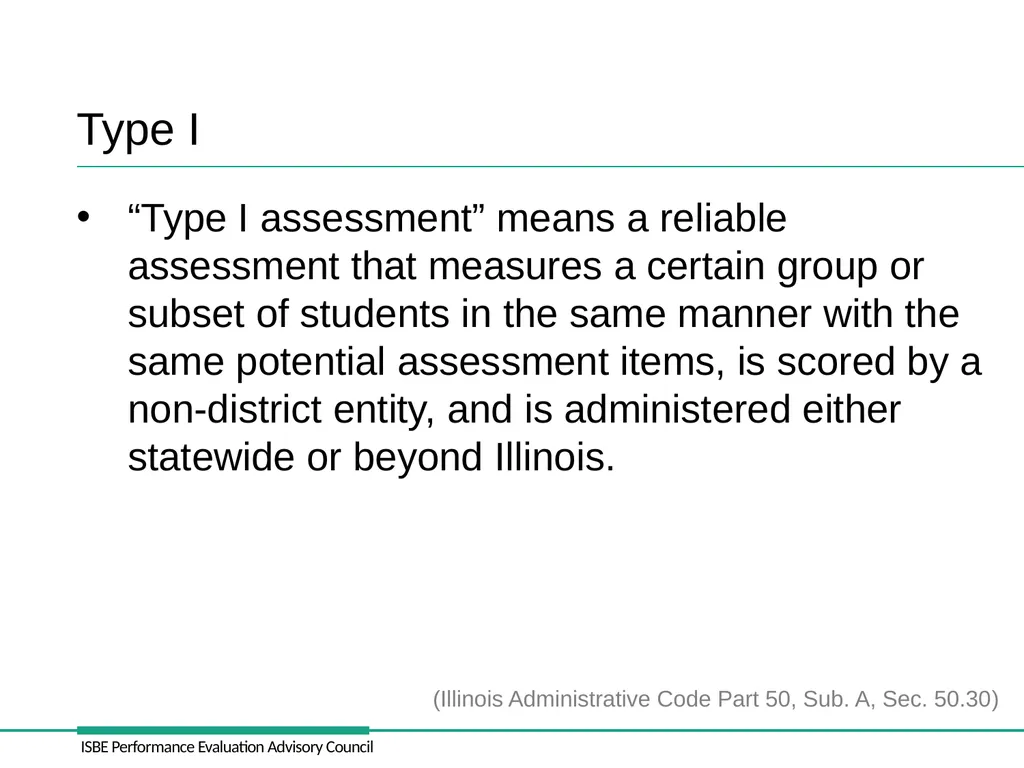
“Type I assessment” means a reliable assessment that measures a certain group or subset of students in the same manner with the same potential assessment items, is scored by a non-district entity, and is administered either statewide or beyond Illinois. Type I (Illinois Administrative Code Part 50, Sub. A, Sec. 50.30)<br>
08
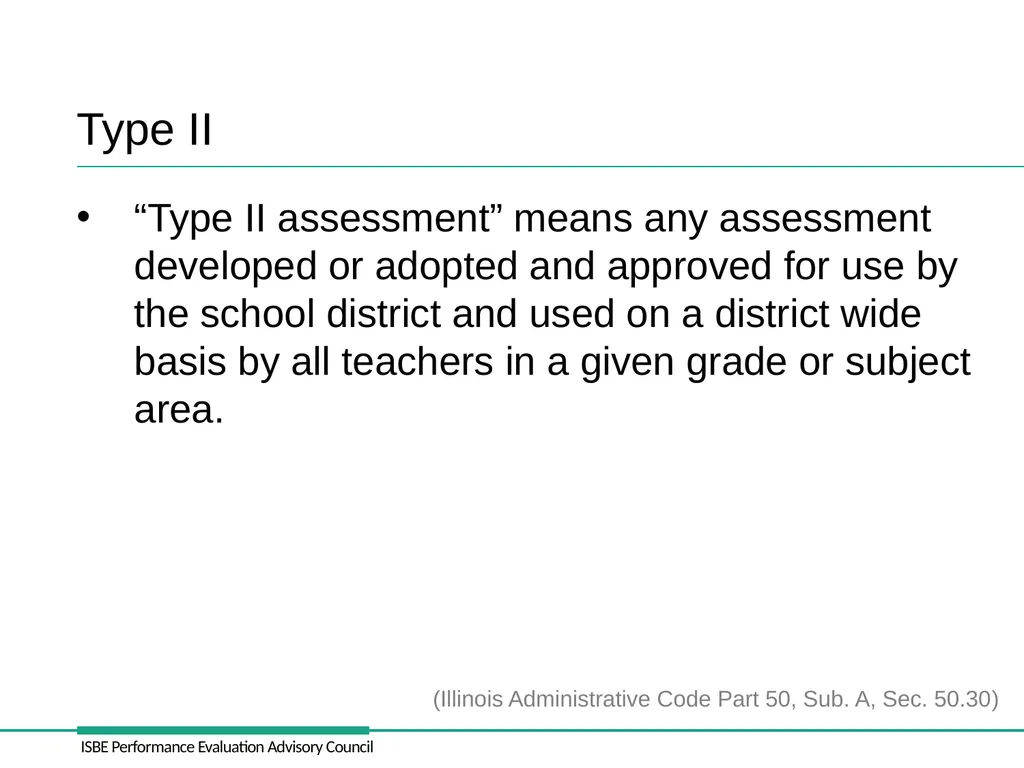
“Type II assessment” means any assessment developed or adopted and approved for use by the school district and used on a district wide basis by all teachers in a given grade or subject area. Type II (Illinois Administrative Code Part 50, Sub. A, Sec. 50.30)<br>
09
“Type III assessment” means any assessment that is rigorous, that is aligned to the course’s curriculum, and that the qualified evaluator and teacher determine measures student learning in that course. Type III (Illinois Administrative Code Part 50, Sub. A, Sec. 50.30)<br>
10
A Type I or Type II assessment may qualify as a Type III assessment if it aligns to the curriculum being taught and measures student learning in that subject area. Assessment Types (Illinois Administrative Code Part 50, Sub. A, Sec. 50.30)<br>
11
The evaluation plan shall include the use of at least one Type I or Type II assessment and at least one Type III assessment.
If neither a Type I nor a Type II assessment can be identified, then the evaluation plan shall require that at least two Type III assessments be used. Student Growth Components (Illinois Administrative Code Part 50, Sub. B, Sec. 50.110)<br>
12
Assessments used for each data point in a measurement model may be different provided that they address the same instructional content. Student Growth Components (Illinois Administrative Code Part 50, Sub. B, Sec. 50.110)<br>
13
Option 1: Type I and Type III
Option 2: Type II and Type III
Option 3: Two Type III’s Student Growth Components<br>
14
Each plan shall identify the uniform process (to occur at the midpoint of the evaluation cycle) by which the teacher will collect data specific to student learning. Midpoint Check-In (Illinois Administrative Code Part 50, Sub. B, Sec. 50.110)<br>
15
A Student Learning Objective (SLO) is a detailed process used to organize evidence of student growth over a specified period of time. The SLO Process<br>
16
The SLO template includes questions and statements that guide educators through the process of measuring student growth for the purpose of performance evaluation. SLO Template<br>
17
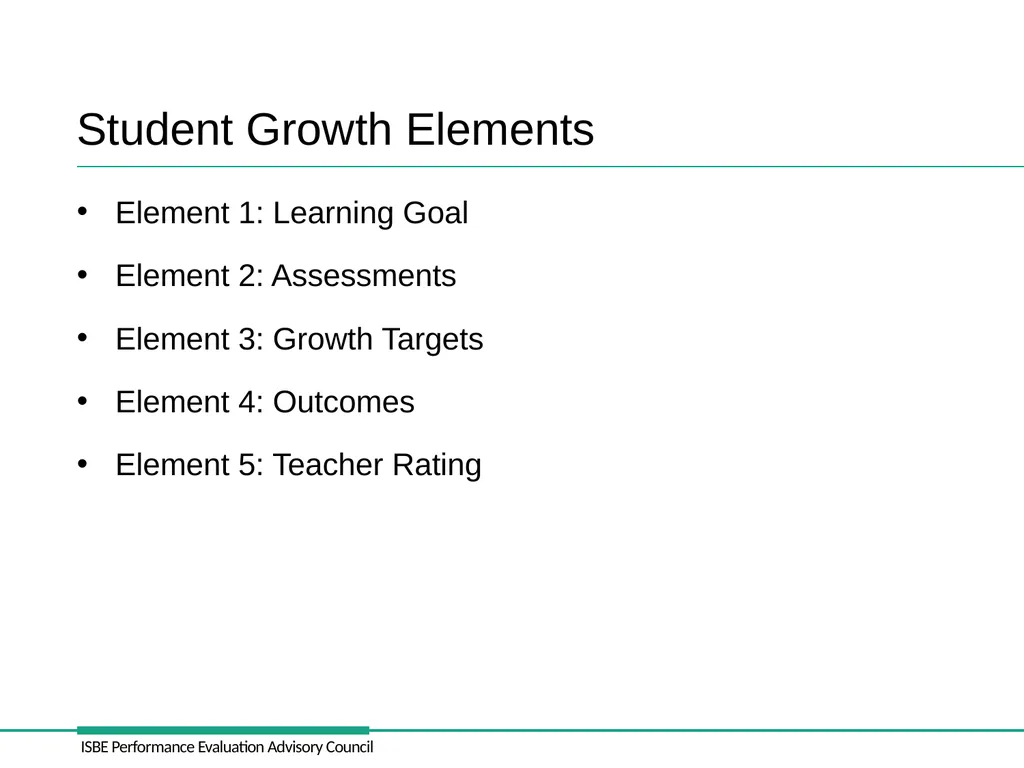
Element 1: Learning Goal
Element 2: Assessments
Element 3: Growth Targets
Element 4: Outcomes
Element 5: Teacher Rating Student Growth Elements<br>
18
A learning goal is a description of what students will be able to do at the end of a specified period of time aligned to appropriate learning standards.
The development of a learning goal provides a foundation for meaningful, goal directed instruction and assessment. Learning Goal<br>
19
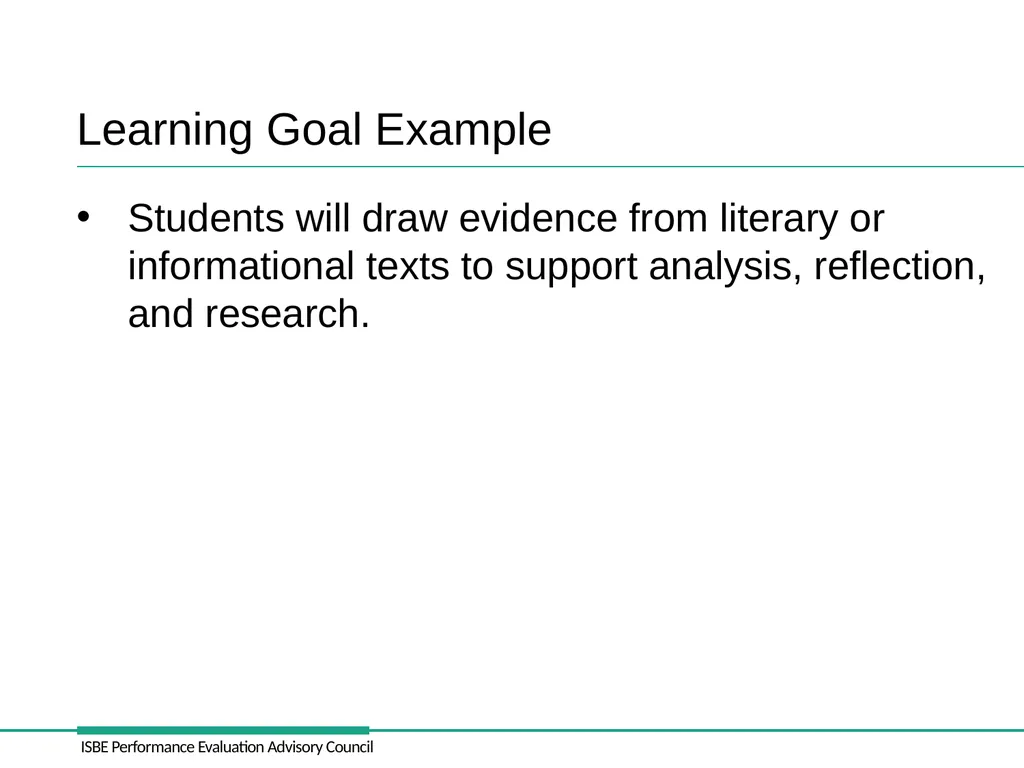
Students will draw evidence from literary or informational texts to support analysis, reflection, and research. Learning Goal Example<br>
20
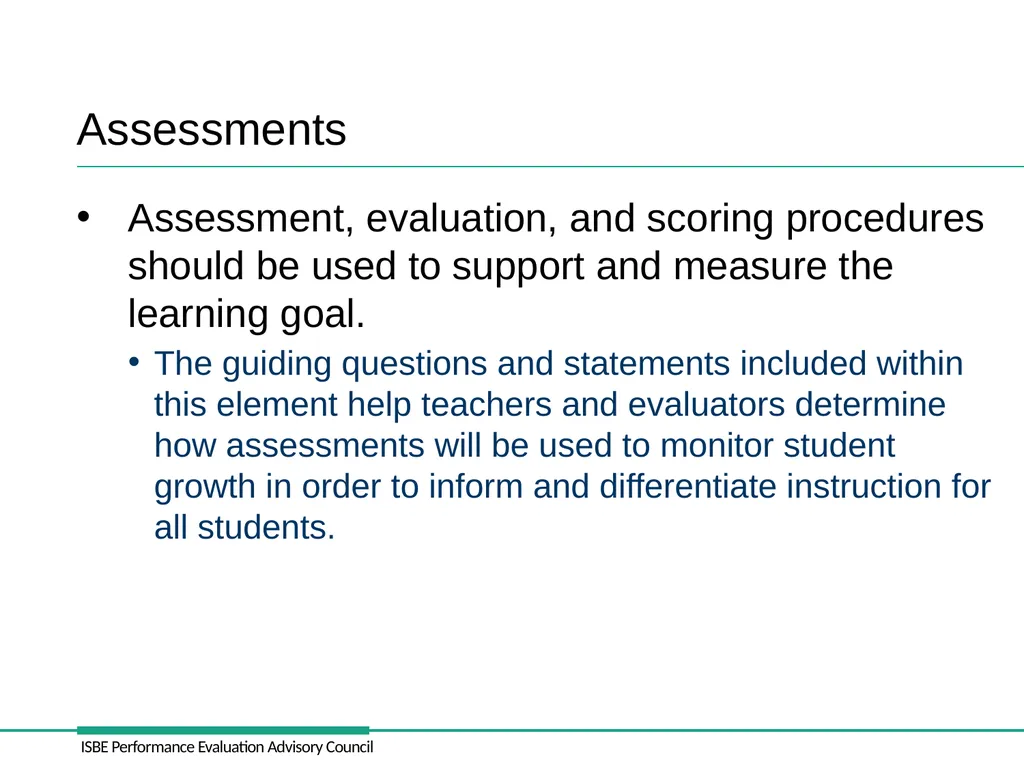
Assessment, evaluation, and scoring procedures should be used to support and measure the learning goal.
The guiding questions and statements included within this element help teachers and evaluators determine how assessments will be used to monitor student growth in order to inform and differentiate instruction for all students. Assessments<br>
21
Weekly Essays (Type II or III)
Students practice writing formal essays on a weekly topic that includes opportunities for self- or peer-assessment and revision.
All essays are evaluated using a common rubric that allows for substantive feedback. Students may also use this rubric to evaluate their own work when engaging in self- or peer-assessment. Assessment Example<br>
22
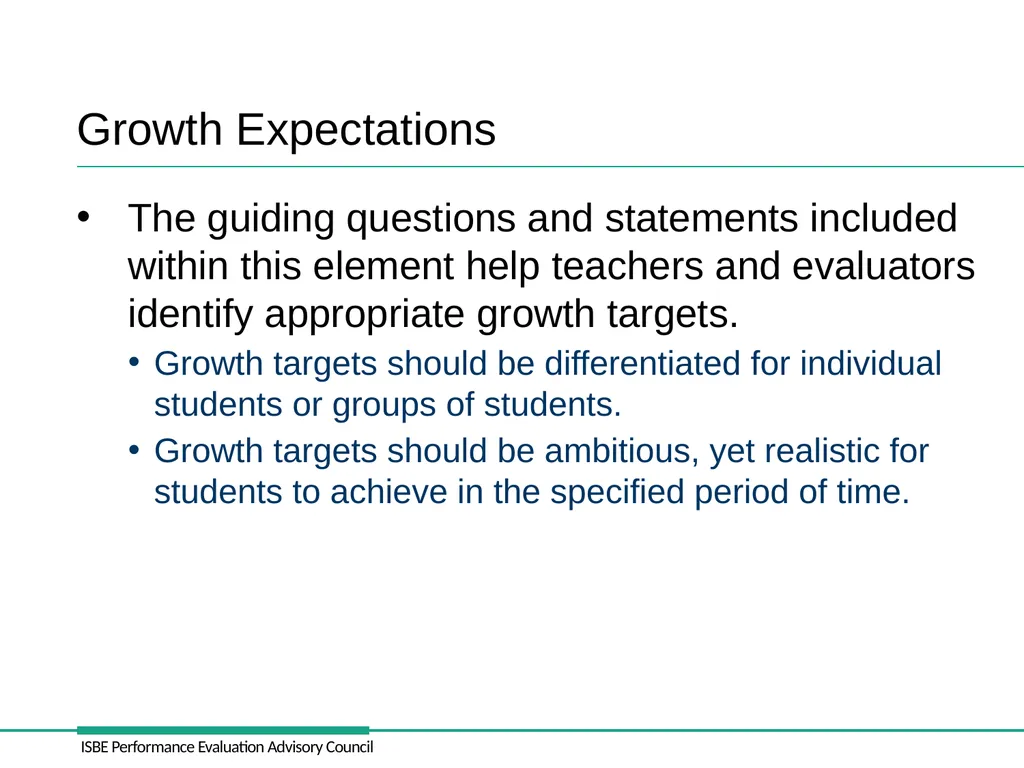
The guiding questions and statements included within this element help teachers and evaluators identify appropriate growth targets.
Growth targets should be differentiated for individual students or groups of students.
Growth targets should be ambitious, yet realistic for students to achieve in the specified period of time. Growth Expectations<br>
23
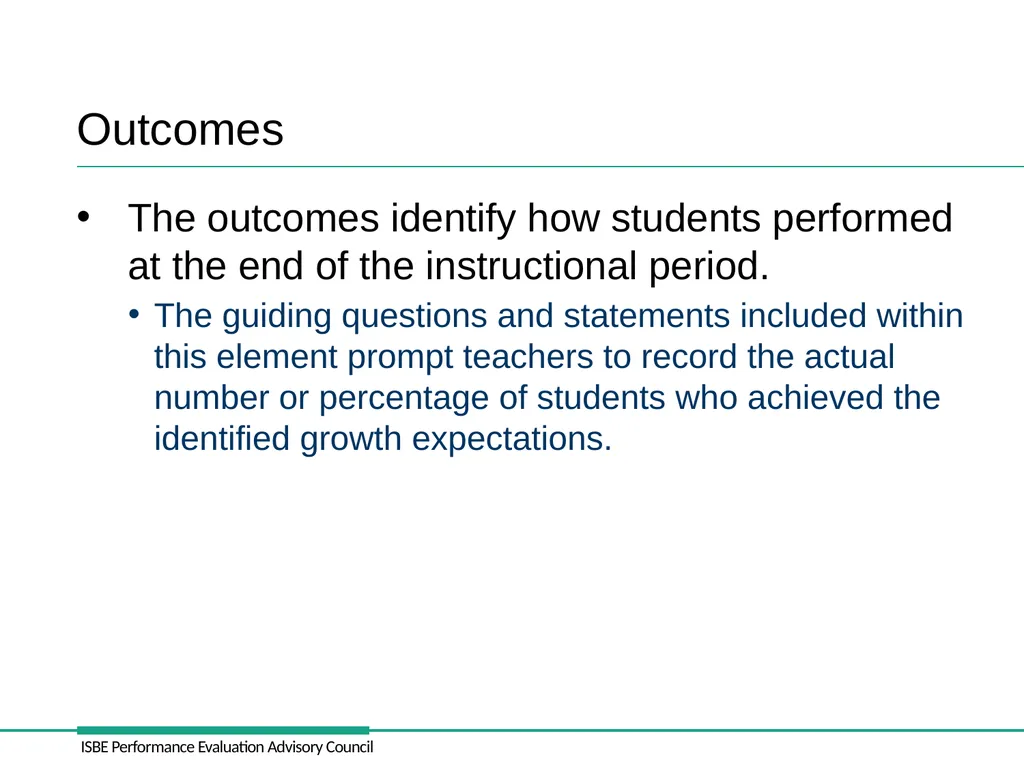
The outcomes identify how students performed at the end of the instructional period.
The guiding questions and statements included within this element prompt teachers to record the actual number or percentage of students who achieved the identified growth expectations. Outcomes<br>
24
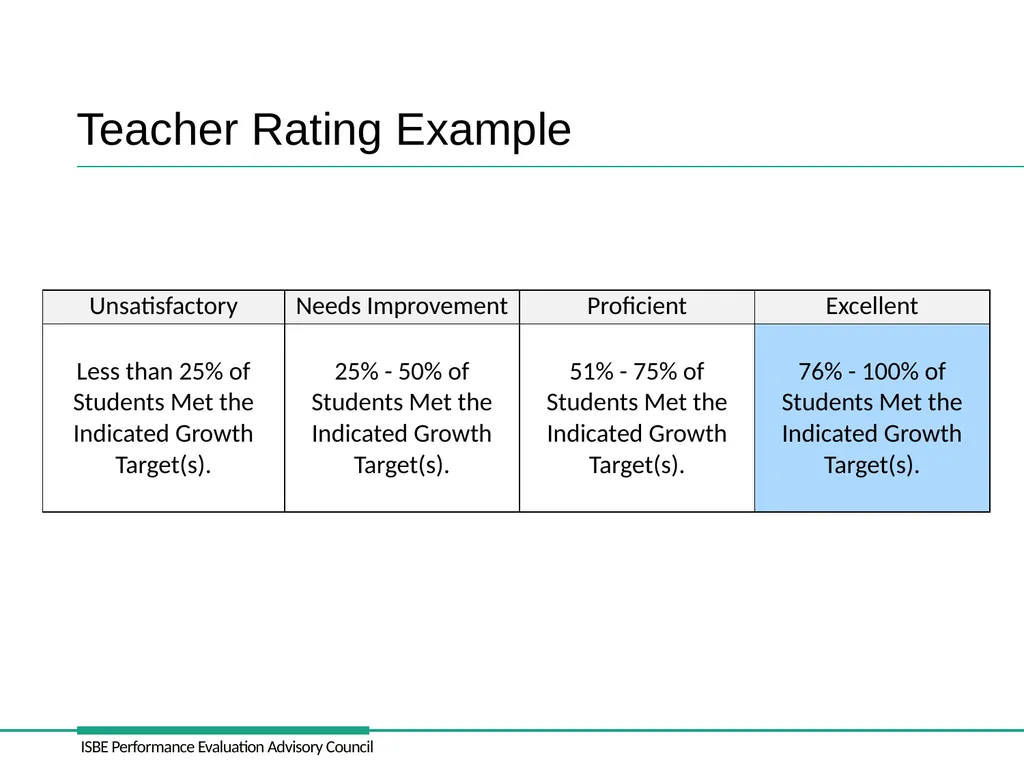
The method for determining a teacher rating for each SLO must be determined by the PERA joint committee.
A teacher rating process is outlined in the State Performance Evaluation Model. Teacher Rating<br>
25
Step 1: Collect Baseline Data
Teachers collect baseline data at the beginning of the school year or interval of instruction.
Baseline data provides measures of student understanding and ability to apply content knowledge. Measurement Model<br>
26
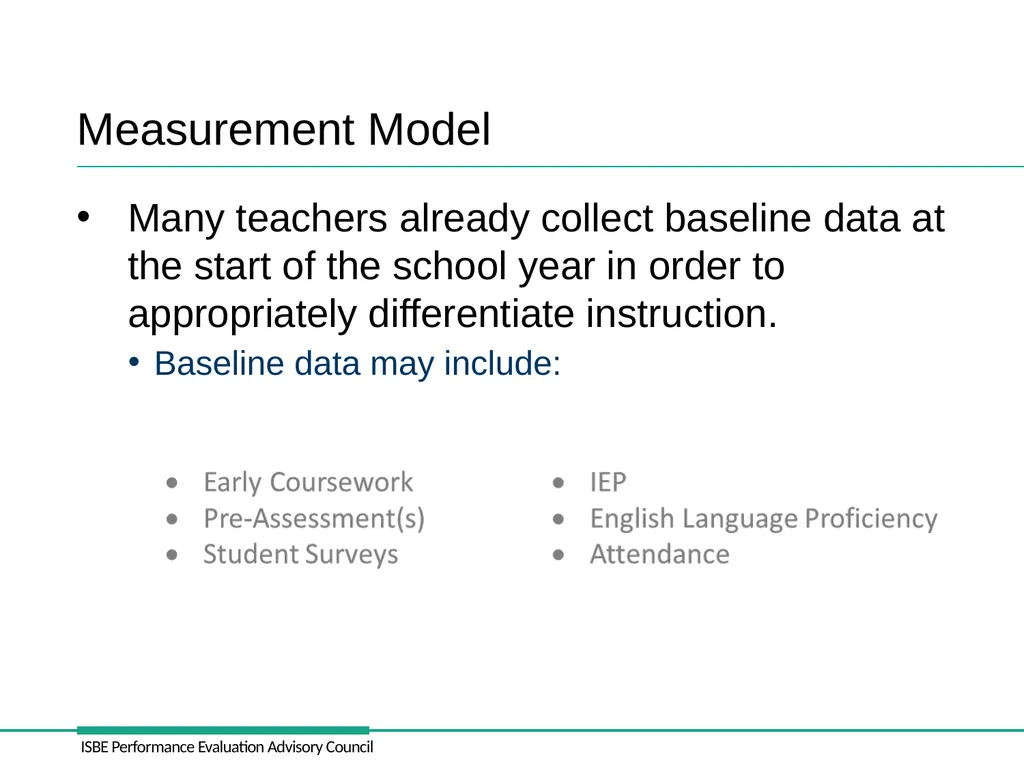
Many teachers already collect baseline data at the start of the school year in order to appropriately differentiate instruction.
Baseline data may include: Measurement Model<br>
27
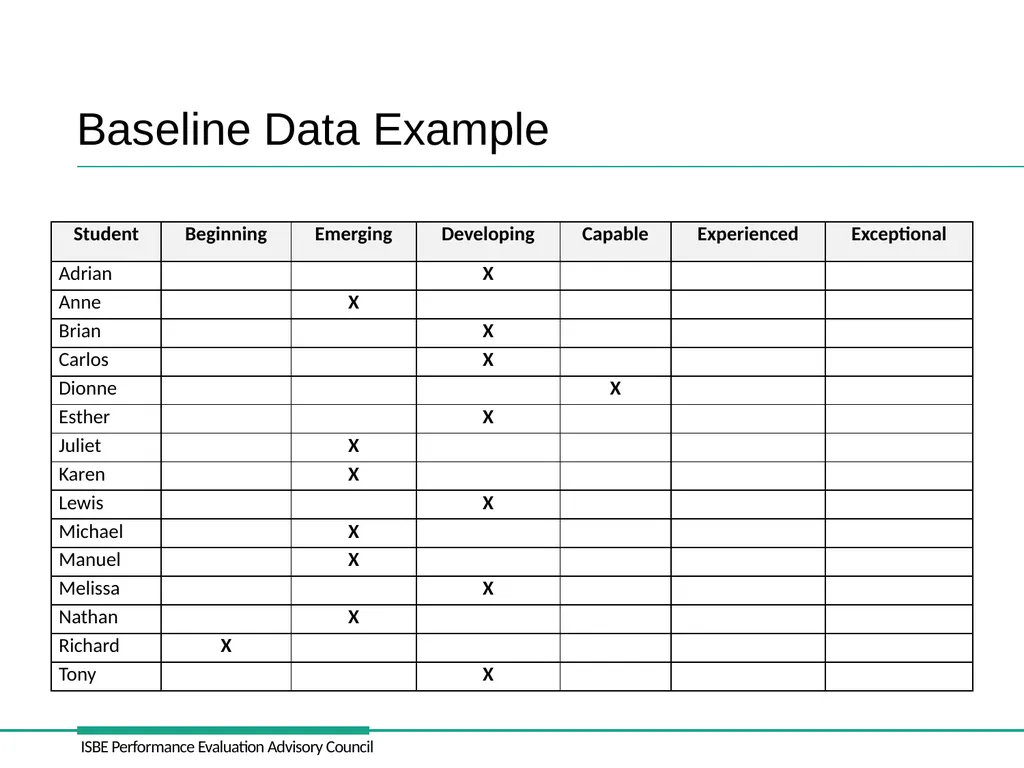
Baseline Data Example<br>
28
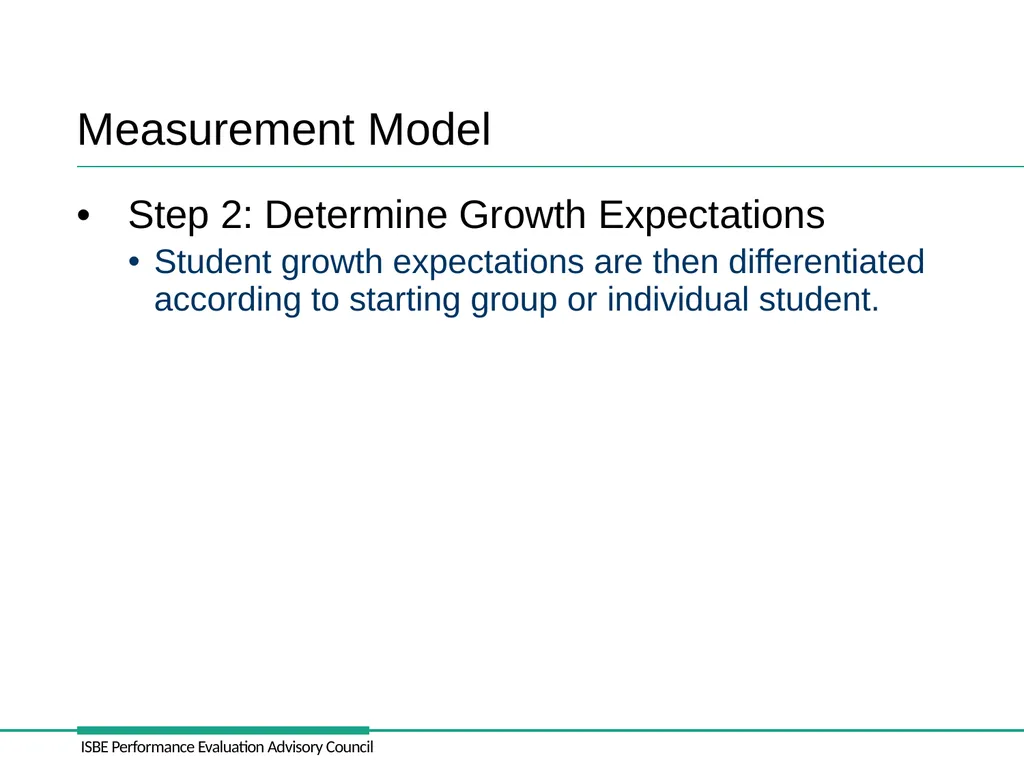
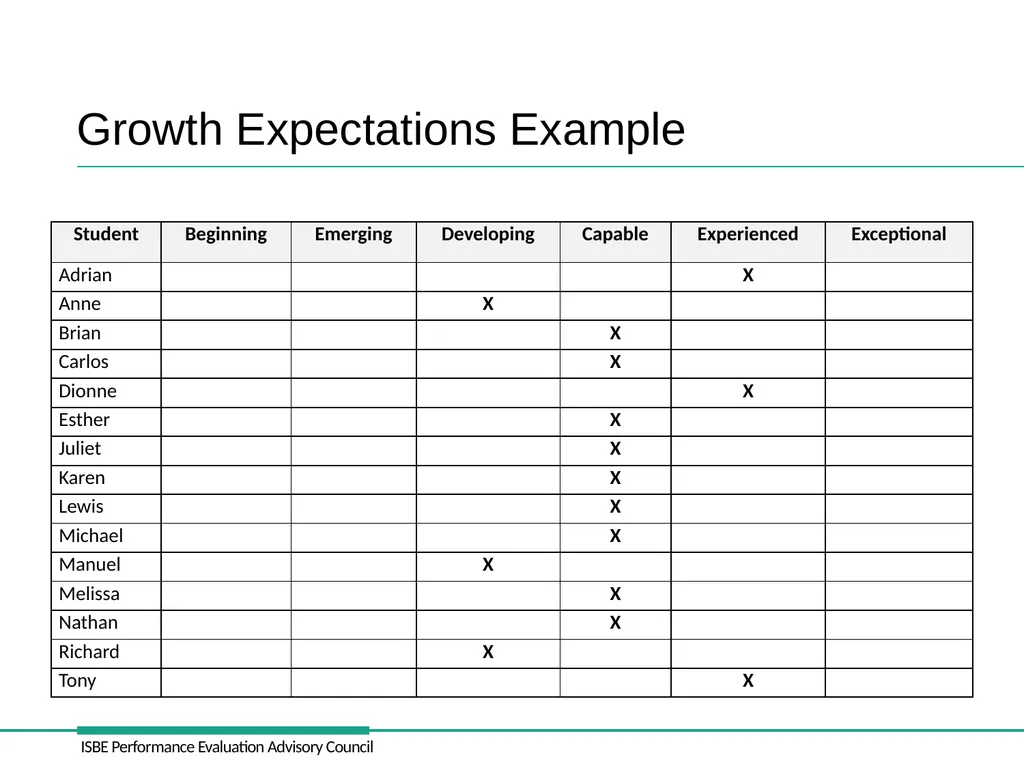
Step 2: Determine Growth Expectations
Student growth expectations are then differentiated according to starting group or individual student. Measurement Model<br>
29
Growth Expectations Example<br>
30
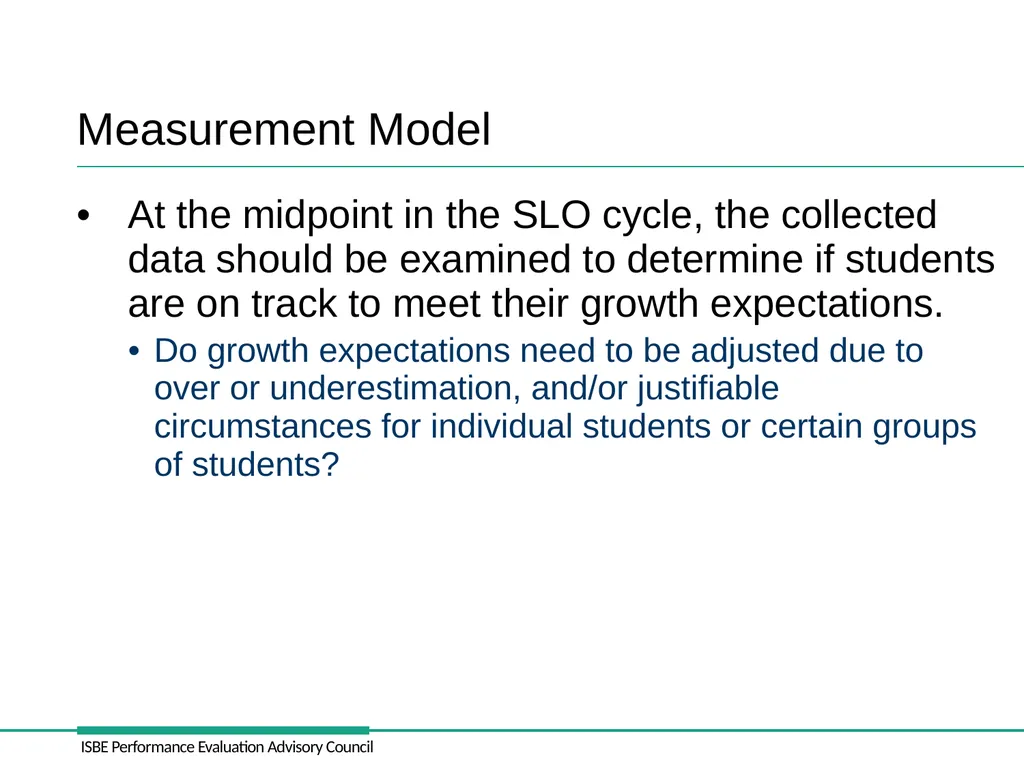
At the midpoint in the SLO cycle, the collected data should be examined to determine if students are on track to meet their growth expectations.
Do growth expectations need to be adjusted due to over or underestimation, and/or justifiable circumstances for individual students or certain groups of students? Measurement Model<br>
31
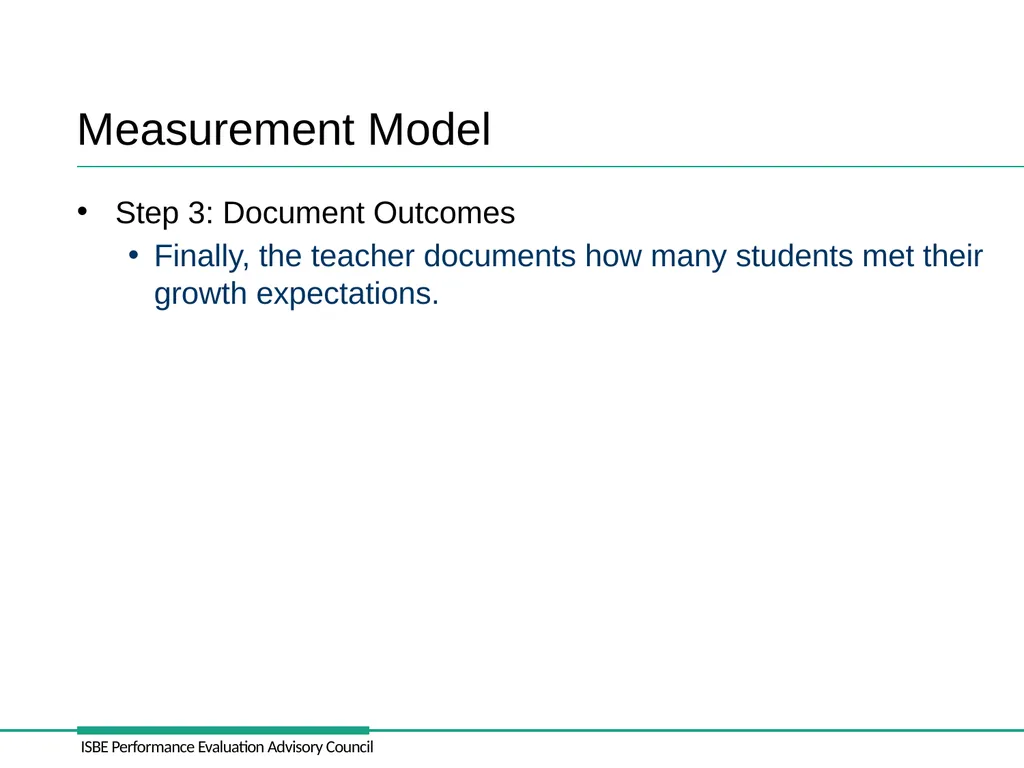
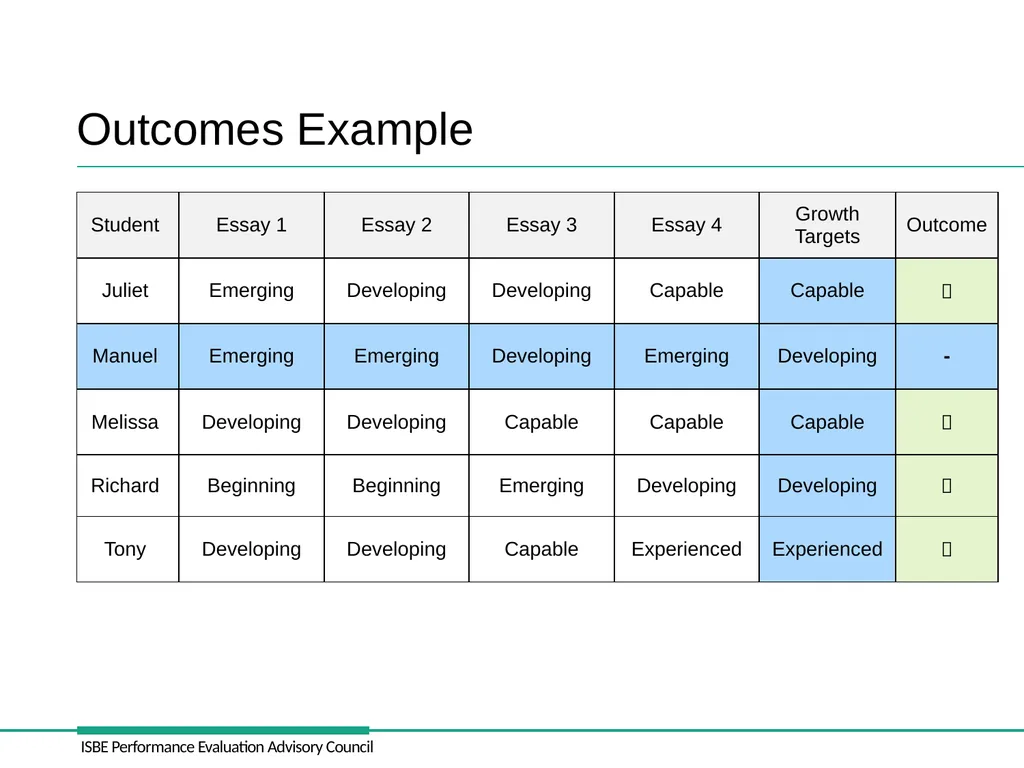
Step 3: Document Outcomes
Finally, the teacher documents how many students met their growth expectations. Measurement Model<br>
33
Teacher Rating Example<br>
34
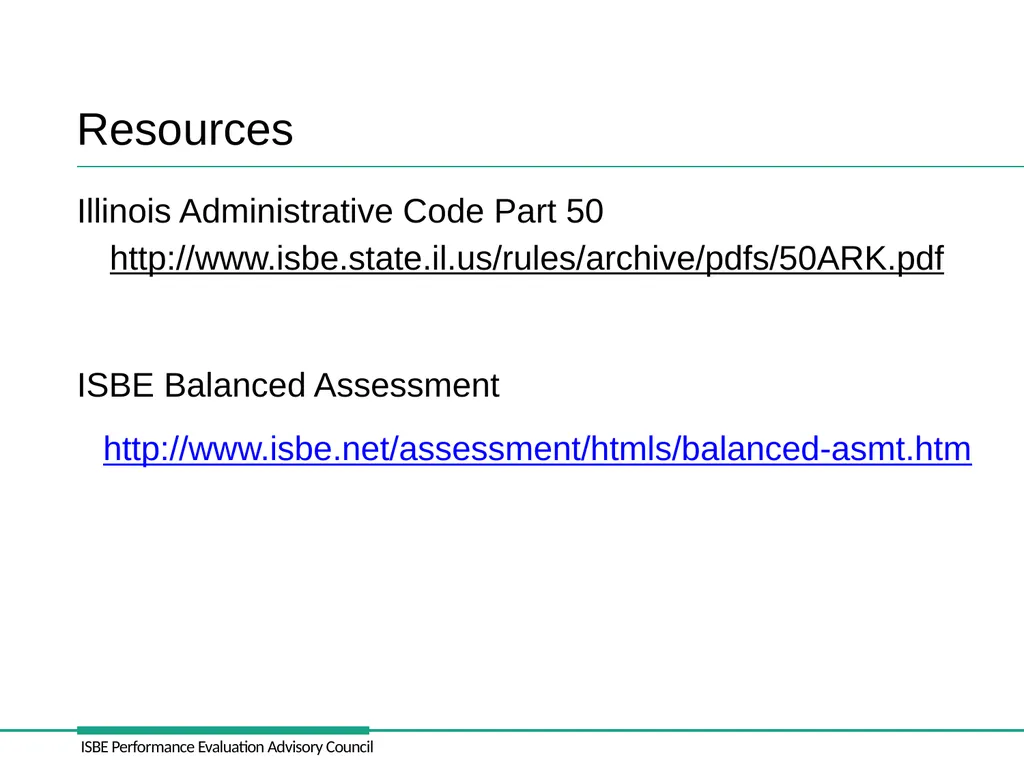
Illinois Administrative Code Part 50
http://www.isbe.state.il.us/rules/archive/pdfs/50ARK.pdf
ISBE Balanced Assessment
http://www.isbe.net/assessment/htmls/balanced-asmt.htm Resources<br>