
STUDENT-LED SCHOOL WATCHING & HAZARD MAPPING (DO #



Description: STUDENT-LED SCHOOL WATCHING HAZARD MAPPING (DO 23 s. 2015) Disaster Risk Reduction and Management Division of Negros Oriental Student-Led School Watching and Hazard Mapping aims to instruct all public elementary and secondary schools in
Related Topics
Download Presentation
"STUDENT-LED SCHOOL WATCHING & HAZARD MAPPING (DO #" is the property of its rightful owner. Permission is granted to download and print the materials on this website for personal, non-commercial use only, and to display it on your personal computer provided you do not modify the materials and that you retain all copyright notices contained in the materials. By downloading content from our website, you accept the terms of this agreement.
Presentation Transcript
slide1. STUDENT-LED SCHOOL WATCHING
& HAZARD MAPPING
(DO # 23 s. 2015)
Disaster Risk Reduction and Management Division of Negros Oriental<br>
slide2. Student-Led School Watching and Hazard Mapping
aims to instruct all public elementary and secondary schools in the specific engagement of learners in identifying and addressing hazards and risks. 2<br>
slide3. The said Guidelines support DepEd Order No. 50, s. 2011 entitled Creation of DRRM Office and DepEd Order No. 55, s. 2007 entitled Prioritizing the Mainstreaming of Disaster Risk Reduction and Management in the School System and Implementation of Programs and Projects Relative Therefore, which seek to mainstream the implementation of DRRM in the systems and processes of the Department at all levels. 3<br>
slide4. G U I D E L I N E S Rationale:
Strengthening disaster prevention, mitigation and preparedness is one of the key strategies to address the vulnerabilities of children inside and outside the school. With the increasing effects of climate change, it is important to raise the awareness and capacities of children to prepare for and manage possible disaster and/or emergencies. This is also intended to influence family preparedness as the learners could share and apply their lessons at home. 4<br>
slide5. G U I D E L I N E S Children, who are commonly identified as one of the vulnerable groups, should be equipped with the capacity to know, understand and apply safety and protection mechanism to build the foundation of their resilience. To initiate this strategy, it is imperative to increase the awareness of learners on the hazards and possible risk inside the school. 5<br>
slide6. G U I D E L I N E S The student-led school watching and hazard mapping are initial steps in engaging learners in disaster preparedness and management. This activity will raise awareness and equip learners with information and skills necessary for addressing the impact of hazards. Through this activity, the Department of Education creates an opportunity for learners to understand their role in disaster risk reduction and management (DRRM). 6<br>
slide7. O B J E C T I V E S Improve students’ level of awareness on the potential hazards and risk within and around schools;
Increase the participation of children in addressing potential disaster by reducing vulnerabilities; and
Inculcate a culture of safety in the day-to-day experience of children in school 7<br>
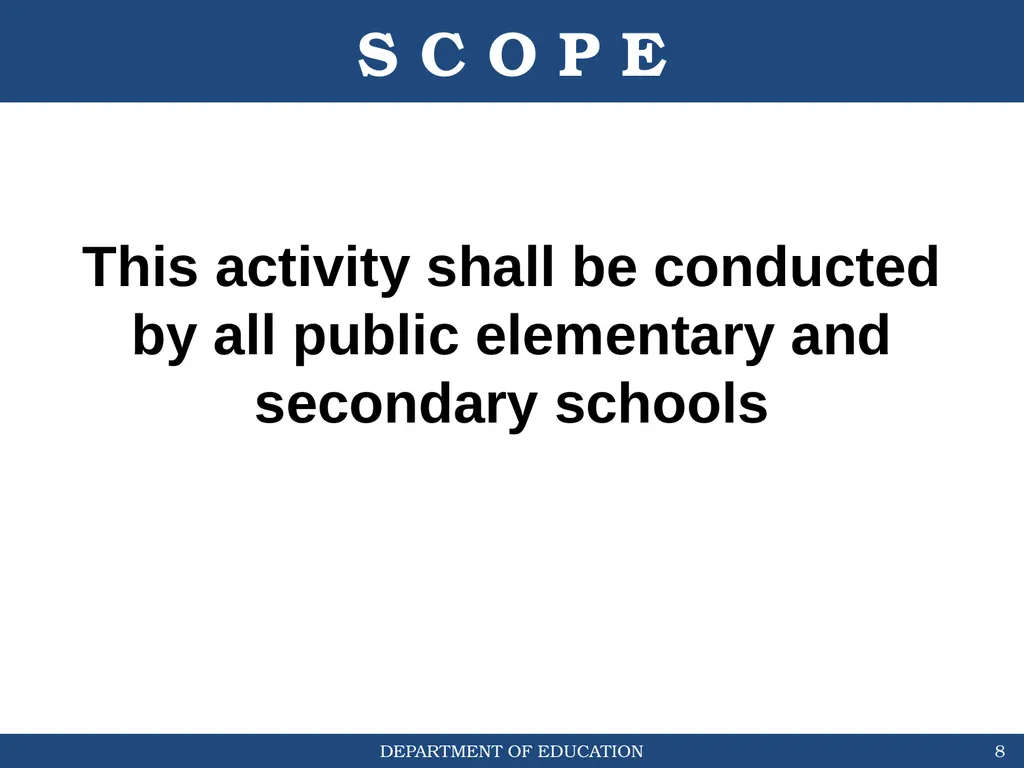
slide8. S C O P E This activity shall be conducted by all public elementary and secondary schools 8<br>
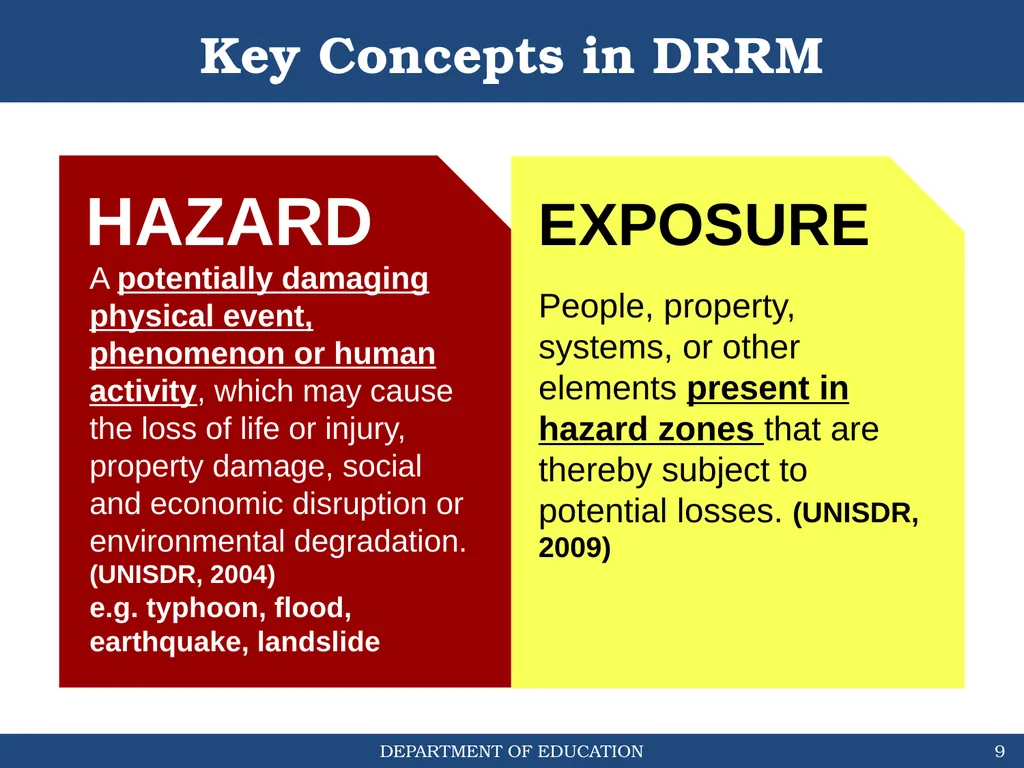
slide9. Key Concepts in DRRM 9<br>
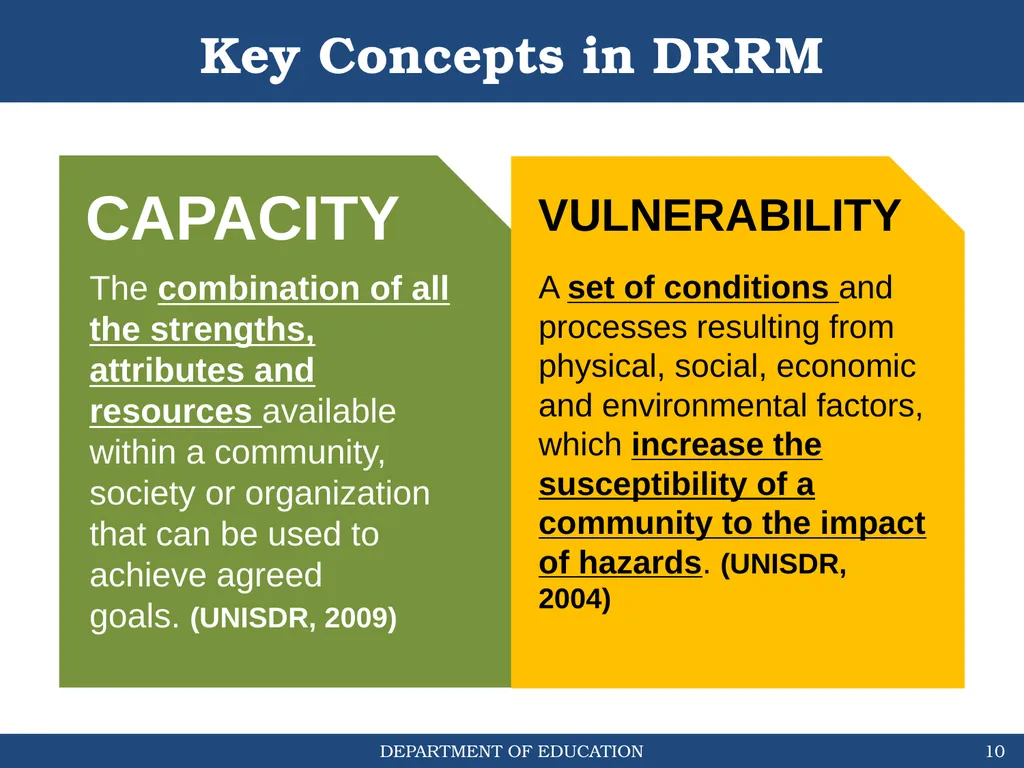
slide10. Key Concepts in DRRM 10<br>
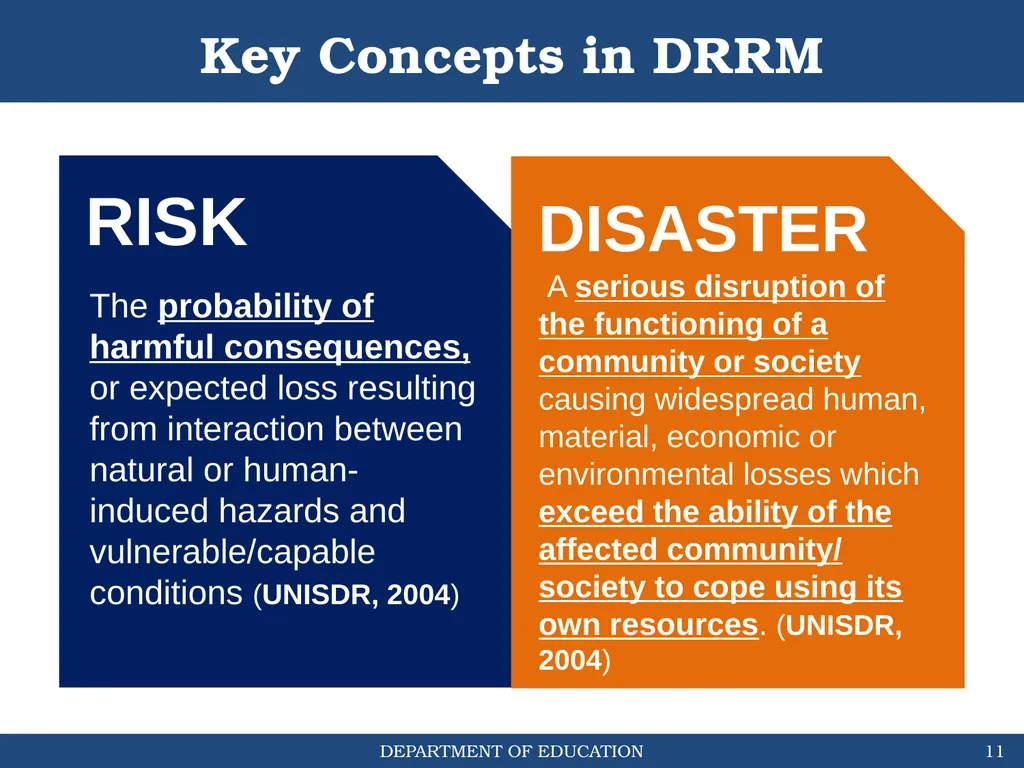
slide11. Key Concepts in DRRM 11<br>
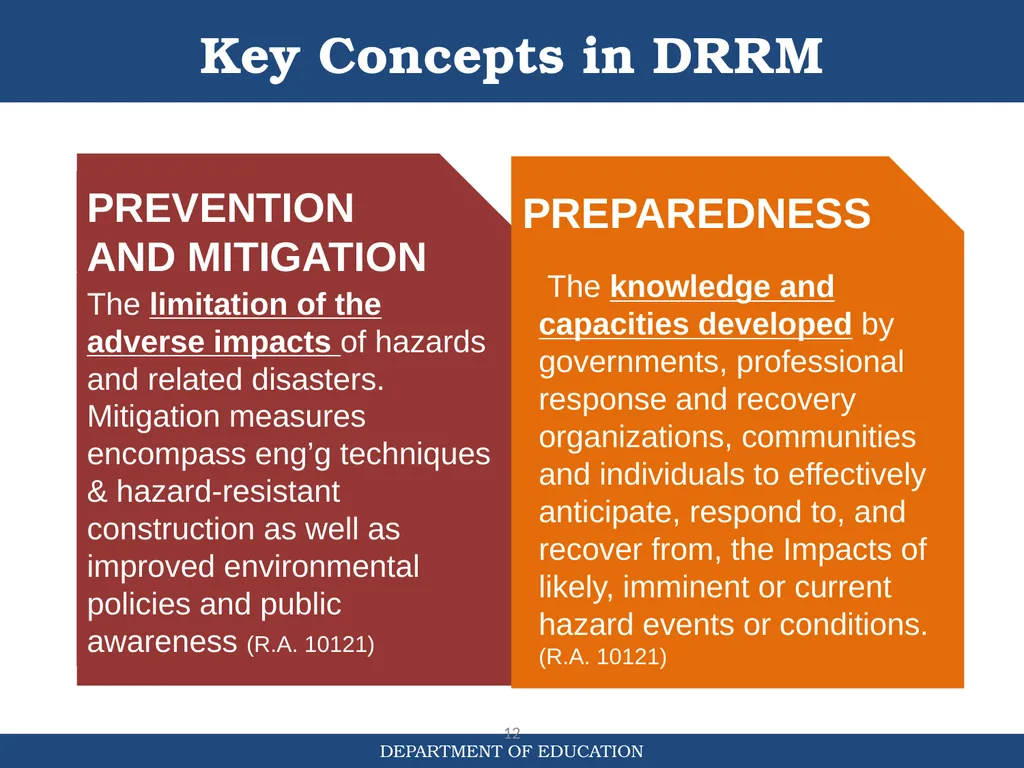
slide12. Key Concepts in DRRM 12<br>
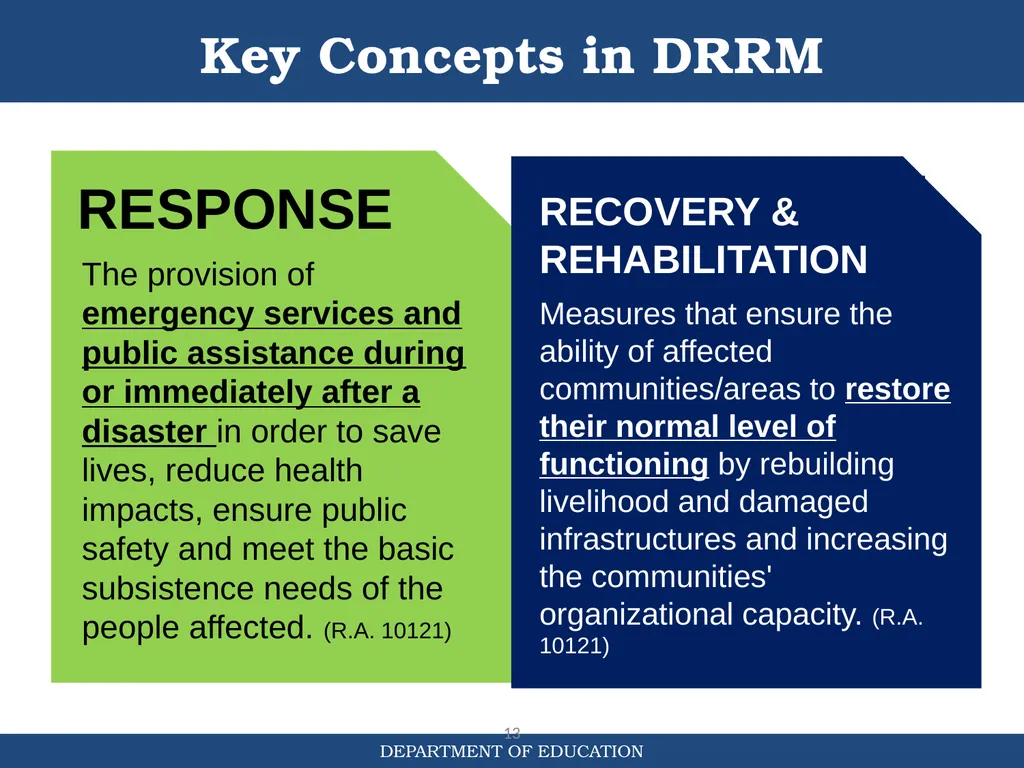
slide13. Key Concepts in DRRM 13<br>
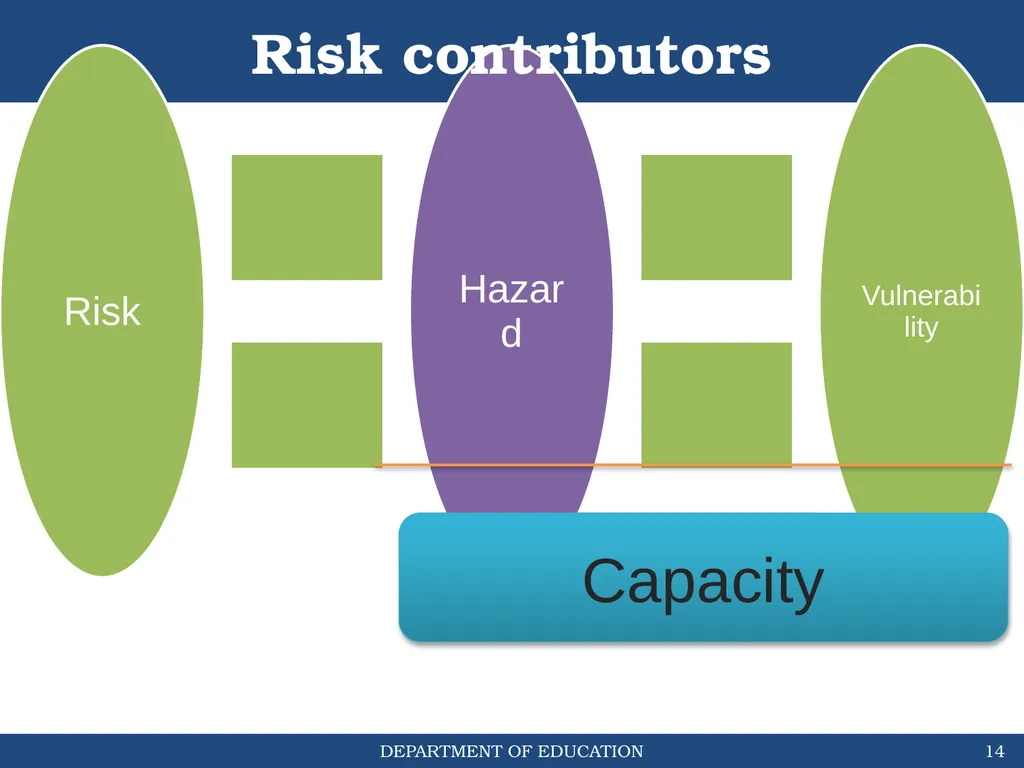
slide14. Capacity Risk contributors 14<br>
slide15. P O L I C Y S T A T E M E N T This policy shall require all public and secondary schools to organize a student-led school watching and hazard mapping activity every first month of the school year 15<br>
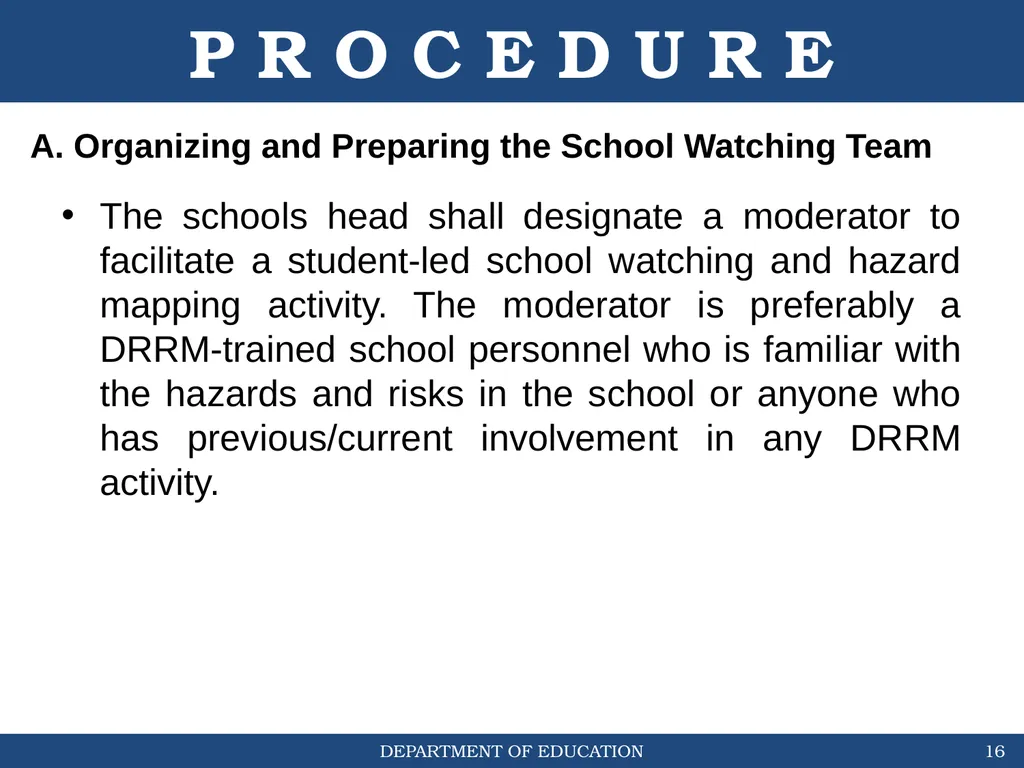
slide16. P R O C E D U R E The schools head shall designate a moderator to facilitate a student-led school watching and hazard mapping activity. The moderator is preferably a DRRM-trained school personnel who is familiar with the hazards and risks in the school or anyone who has previous/current involvement in any DRRM activity. 16 A. Organizing and Preparing the School Watching Team<br>
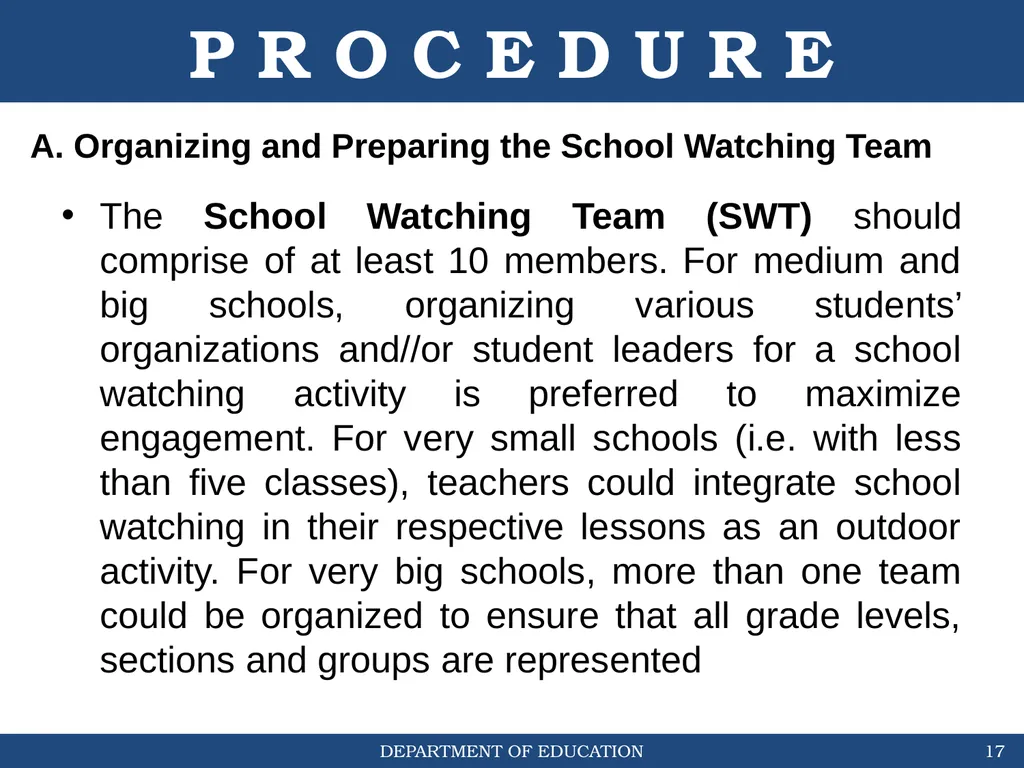
slide17. P R O C E D U R E The School Watching Team (SWT) should comprise of at least 10 members. For medium and big schools, organizing various students’ organizations and//or student leaders for a school watching activity is preferred to maximize engagement. For very small schools (i.e. with less than five classes), teachers could integrate school watching in their respective lessons as an outdoor activity. For very big schools, more than one team could be organized to ensure that all grade levels, sections and groups are represented 17 A. Organizing and Preparing the School Watching Team<br>
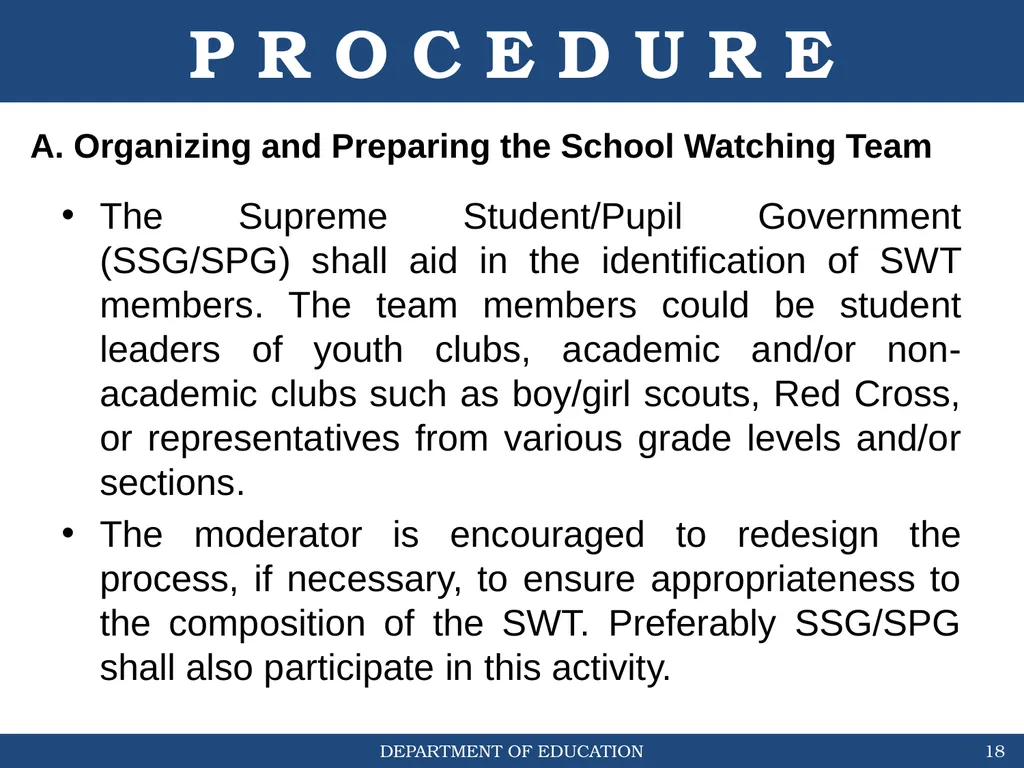
slide18. P R O C E D U R E The Supreme Student/Pupil Government (SSG/SPG) shall aid in the identification of SWT members. The team members could be student leaders of youth clubs, academic and/or non-academic clubs such as boy/girl scouts, Red Cross, or representatives from various grade levels and/or sections.
The moderator is encouraged to redesign the process, if necessary, to ensure appropriateness to the composition of the SWT. Preferably SSG/SPG shall also participate in this activity. 18 A. Organizing and Preparing the School Watching Team<br>
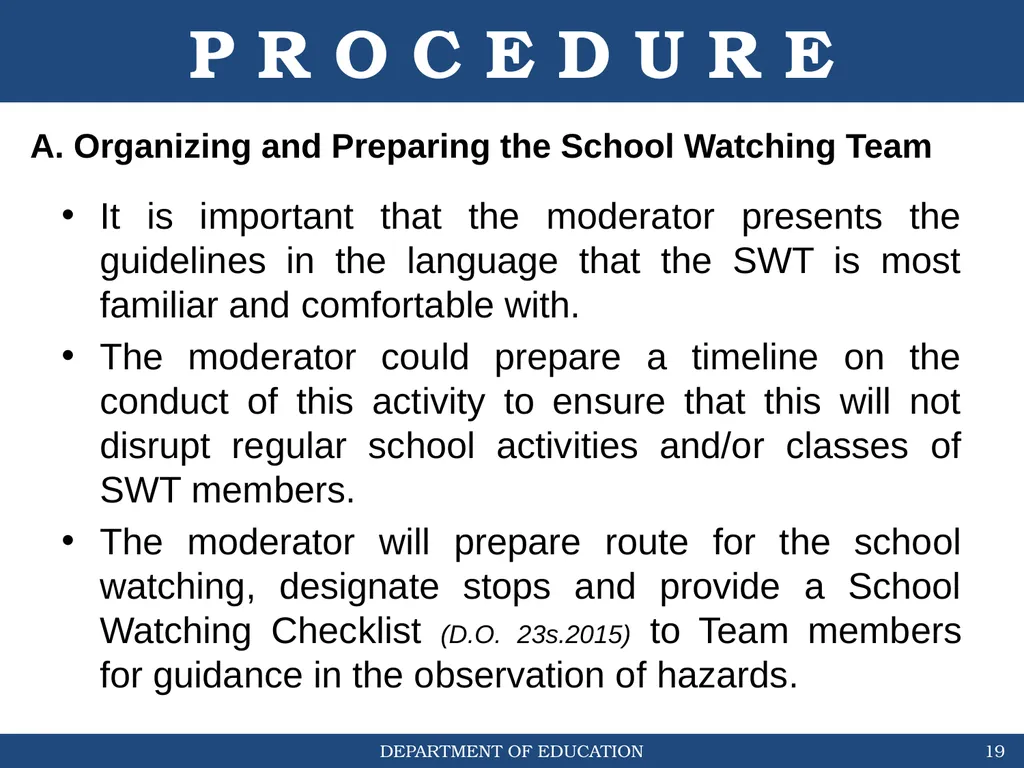
slide19. P R O C E D U R E It is important that the moderator presents the guidelines in the language that the SWT is most familiar and comfortable with.
The moderator could prepare a timeline on the conduct of this activity to ensure that this will not disrupt regular school activities and/or classes of SWT members.
The moderator will prepare route for the school watching, designate stops and provide a School Watching Checklist (D.O. 23s.2015) to Team members for guidance in the observation of hazards. 19 A. Organizing and Preparing the School Watching Team<br>
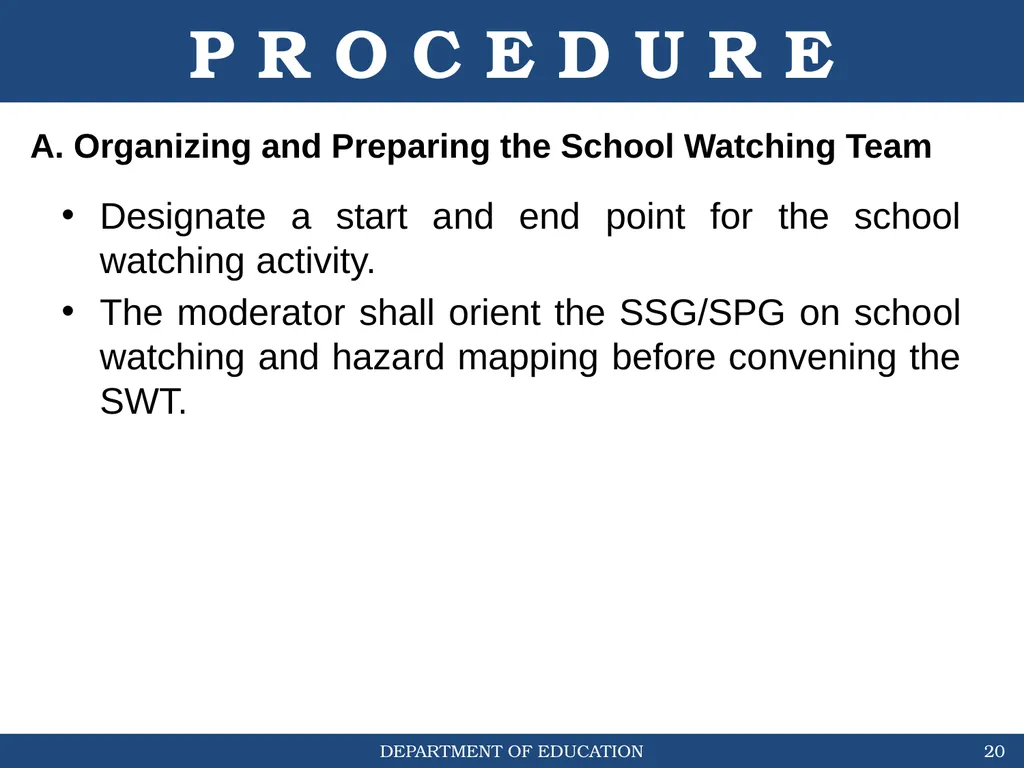
slide20. P R O C E D U R E Designate a start and end point for the school watching activity.
The moderator shall orient the SSG/SPG on school watching and hazard mapping before convening the SWT. 20 A. Organizing and Preparing the School Watching Team<br>
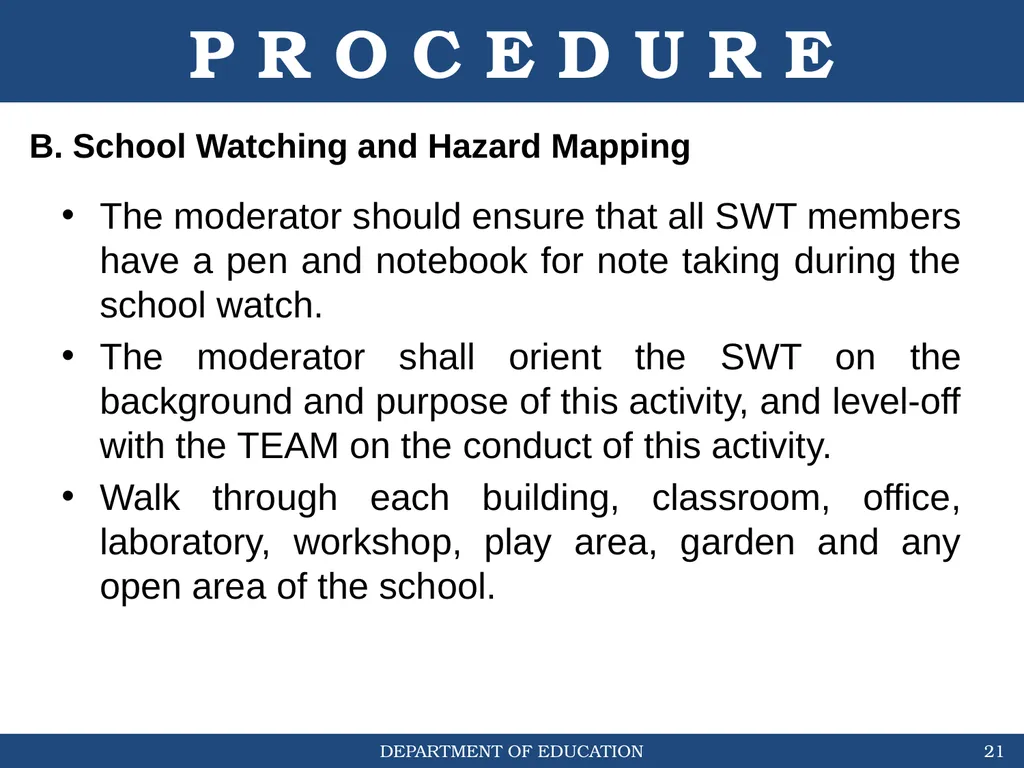
slide21. P R O C E D U R E The moderator should ensure that all SWT members have a pen and notebook for note taking during the school watch.
The moderator shall orient the SWT on the background and purpose of this activity, and level-off with the TEAM on the conduct of this activity.
Walk through each building, classroom, office, laboratory, workshop, play area, garden and any open area of the school. 21 B. School Watching and Hazard Mapping<br>
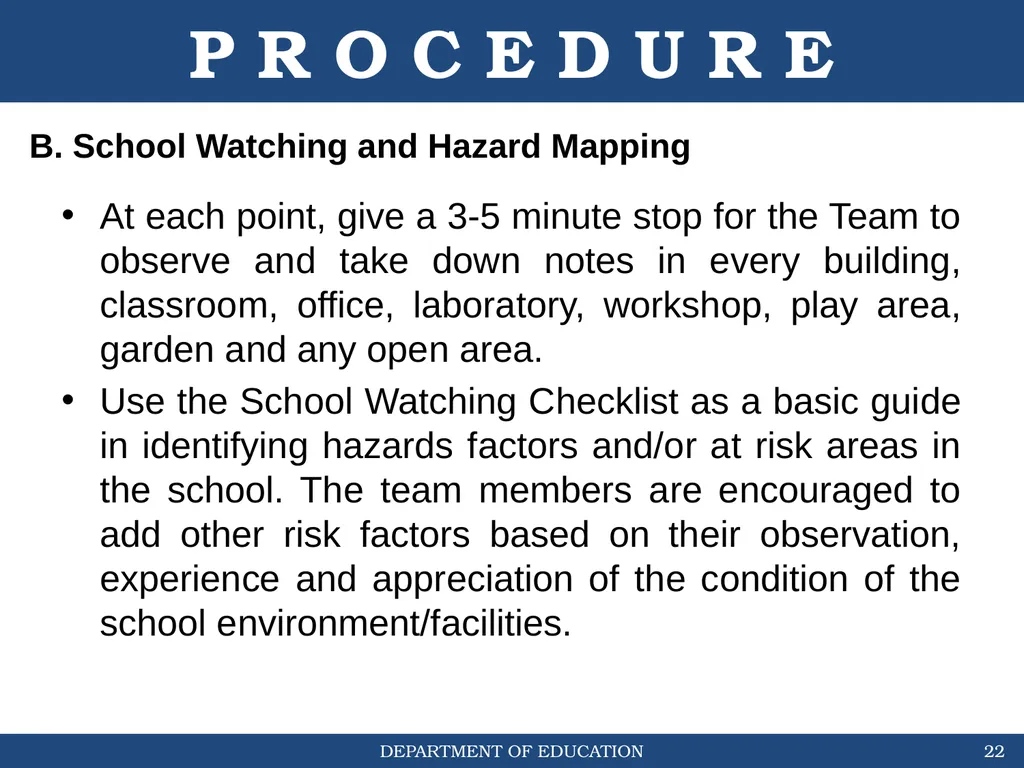
slide22. P R O C E D U R E At each point, give a 3-5 minute stop for the Team to observe and take down notes in every building, classroom, office, laboratory, workshop, play area, garden and any open area.
Use the School Watching Checklist as a basic guide in identifying hazards factors and/or at risk areas in the school. The team members are encouraged to add other risk factors based on their observation, experience and appreciation of the condition of the school environment/facilities. 22 B. School Watching and Hazard Mapping<br>
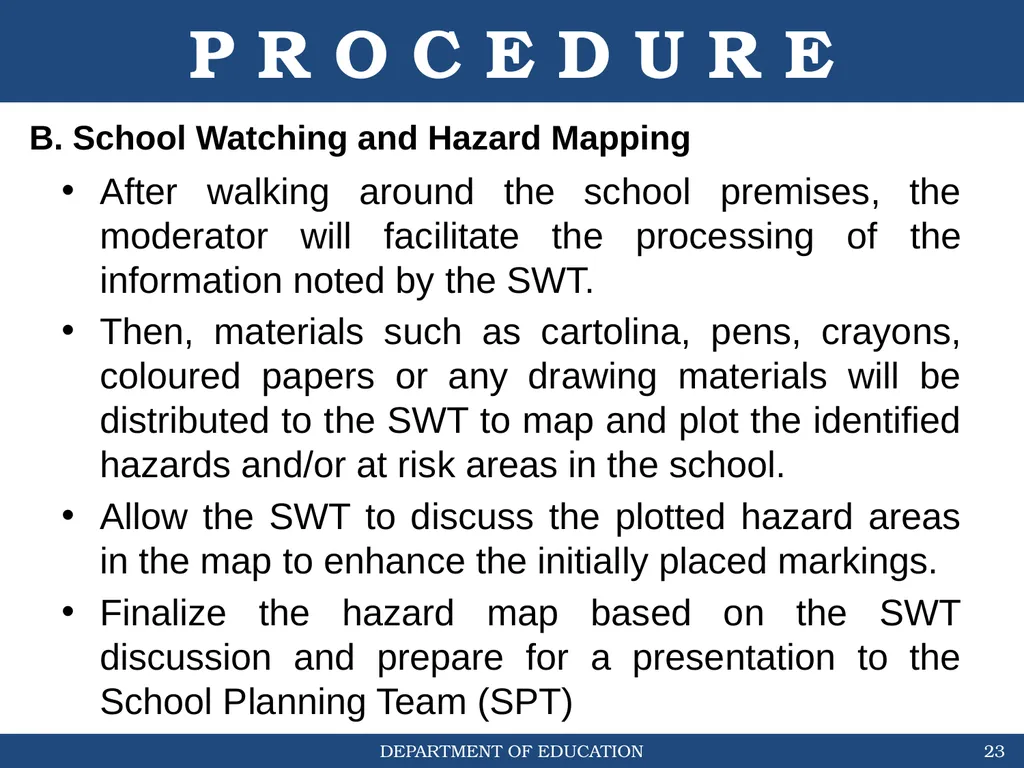
slide23. P R O C E D U R E After walking around the school premises, the moderator will facilitate the processing of the information noted by the SWT.
Then, materials such as cartolina, pens, crayons, coloured papers or any drawing materials will be distributed to the SWT to map and plot the identified hazards and/or at risk areas in the school.
Allow the SWT to discuss the plotted hazard areas in the map to enhance the initially placed markings.
Finalize the hazard map based on the SWT discussion and prepare for a presentation to the School Planning Team (SPT) 23 B. School Watching and Hazard Mapping<br>
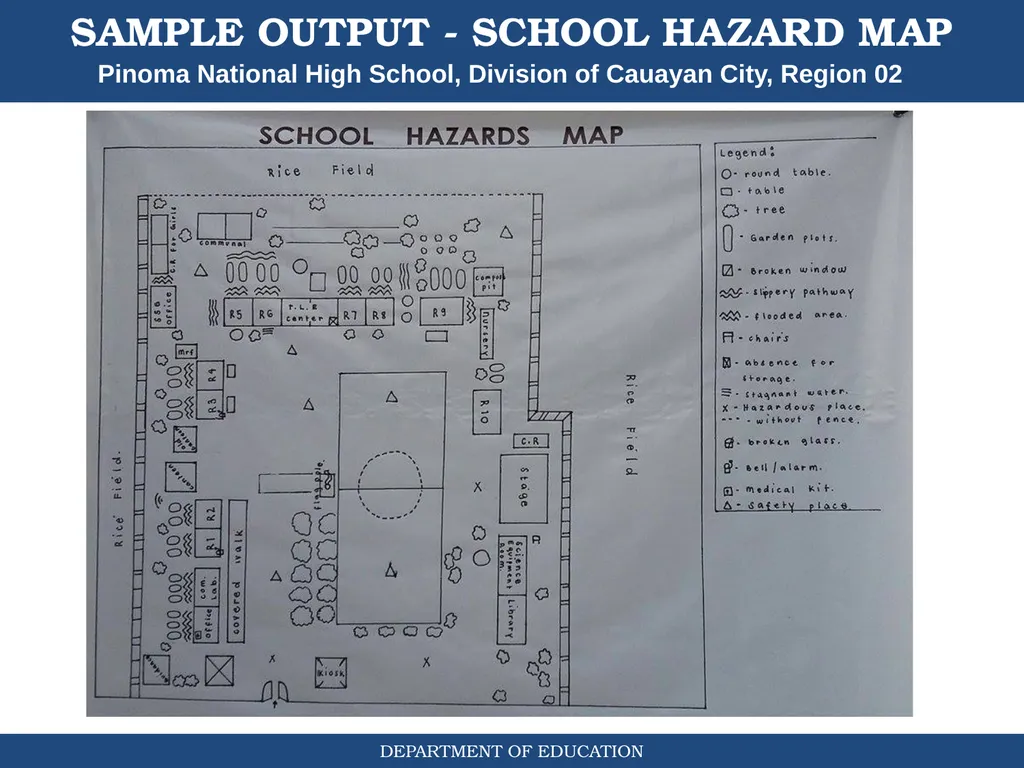
slide24. SAMPLE OUTPUT - SCHOOL HAZARD MAP Pinoma National High School, Division of Cauayan City, Region 02<br>
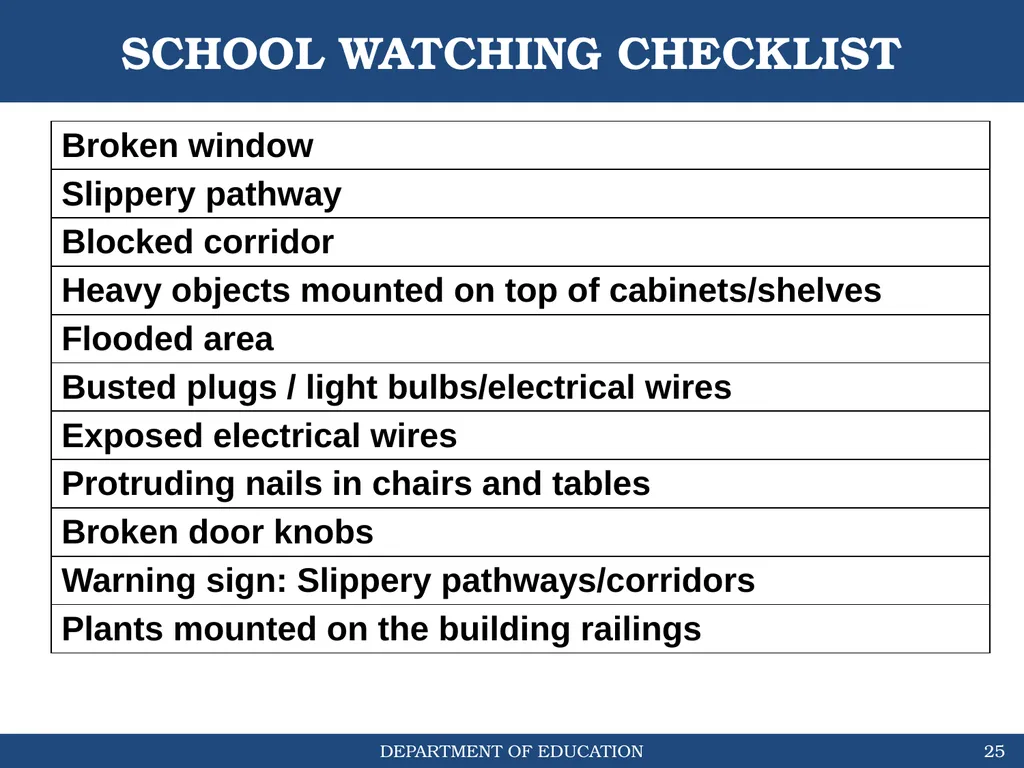
slide25. SCHOOL WATCHING CHECKLIST 25<br>
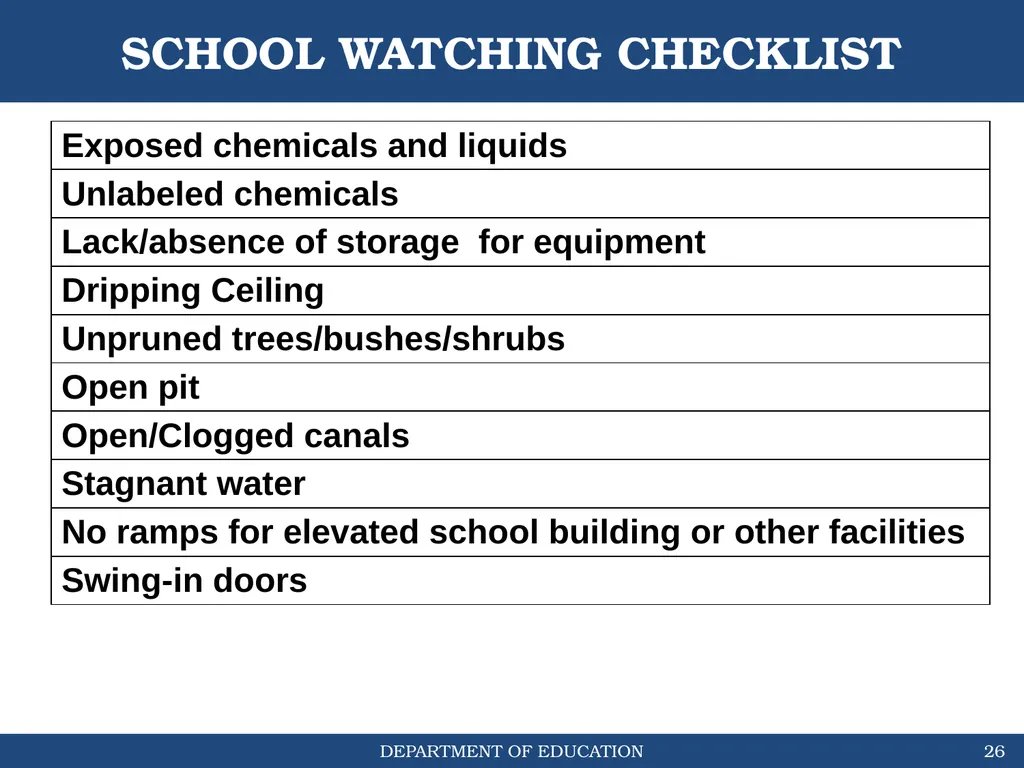
slide26. SCHOOL WATCHING CHECKLIST 26<br>
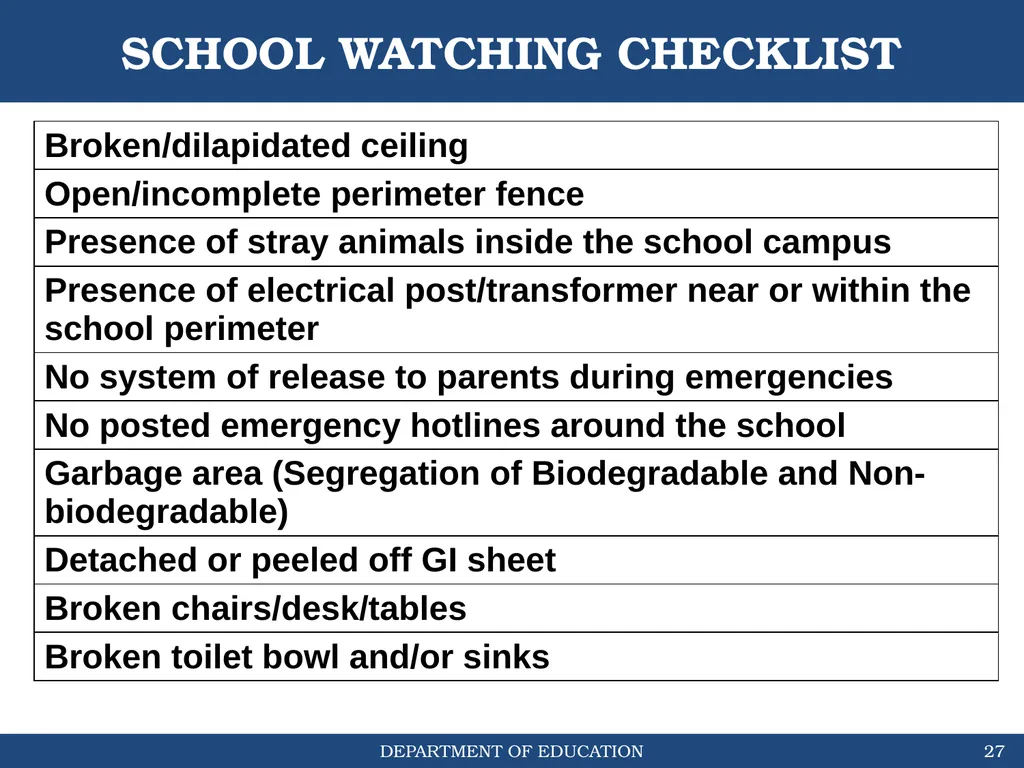
slide27. SCHOOL WATCHING CHECKLIST 27<br>
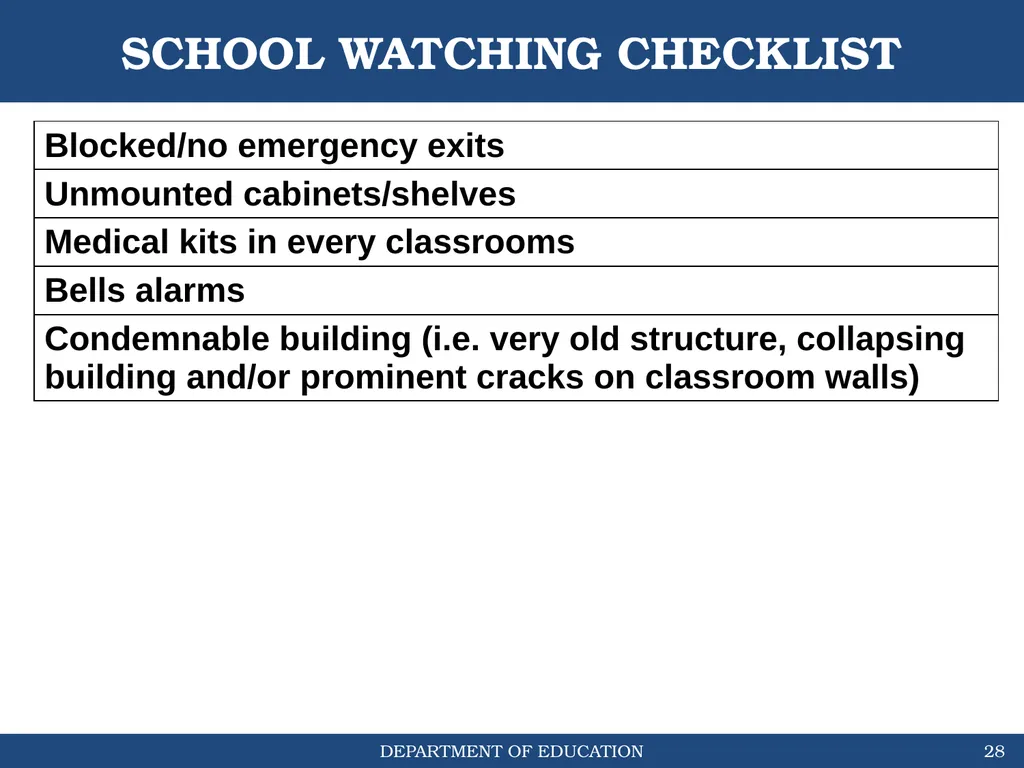
slide28. SCHOOL WATCHING CHECKLIST 28<br>
slide29. MONITORING & EVALUATION 29 All Division DRRM Coordinators shall conduct ocular visits to observe and document the conduct of school watching and hazard mapping. Specifically, the Coordinator shall note the implementation issues and submit reports to the DRRMO. This well serve as input to succeeding policy development initiatives.<br>
slide30. Thank you! Division of Negros Oriental
22 August 2015<br>
slide2. Student-Led School Watching and Hazard Mapping
aims to instruct all public elementary and secondary schools in the specific engagement of learners in identifying and addressing hazards and risks. 2<br>
slide3. The said Guidelines support DepEd Order No. 50, s. 2011 entitled Creation of DRRM Office and DepEd Order No. 55, s. 2007 entitled Prioritizing the Mainstreaming of Disaster Risk Reduction and Management in the School System and Implementation of Programs and Projects Relative Therefore, which seek to mainstream the implementation of DRRM in the systems and processes of the Department at all levels. 3<br>
slide4. G U I D E L I N E S Rationale:
Strengthening disaster prevention, mitigation and preparedness is one of the key strategies to address the vulnerabilities of children inside and outside the school. With the increasing effects of climate change, it is important to raise the awareness and capacities of children to prepare for and manage possible disaster and/or emergencies. This is also intended to influence family preparedness as the learners could share and apply their lessons at home. 4<br>
slide5. G U I D E L I N E S Children, who are commonly identified as one of the vulnerable groups, should be equipped with the capacity to know, understand and apply safety and protection mechanism to build the foundation of their resilience. To initiate this strategy, it is imperative to increase the awareness of learners on the hazards and possible risk inside the school. 5<br>
slide6. G U I D E L I N E S The student-led school watching and hazard mapping are initial steps in engaging learners in disaster preparedness and management. This activity will raise awareness and equip learners with information and skills necessary for addressing the impact of hazards. Through this activity, the Department of Education creates an opportunity for learners to understand their role in disaster risk reduction and management (DRRM). 6<br>
slide7. O B J E C T I V E S Improve students’ level of awareness on the potential hazards and risk within and around schools;
Increase the participation of children in addressing potential disaster by reducing vulnerabilities; and
Inculcate a culture of safety in the day-to-day experience of children in school 7<br>
slide8. S C O P E This activity shall be conducted by all public elementary and secondary schools 8<br>
slide9. Key Concepts in DRRM 9<br>
slide10. Key Concepts in DRRM 10<br>
slide11. Key Concepts in DRRM 11<br>
slide12. Key Concepts in DRRM 12<br>
slide13. Key Concepts in DRRM 13<br>
slide14. Capacity Risk contributors 14<br>
slide15. P O L I C Y S T A T E M E N T This policy shall require all public and secondary schools to organize a student-led school watching and hazard mapping activity every first month of the school year 15<br>
slide16. P R O C E D U R E The schools head shall designate a moderator to facilitate a student-led school watching and hazard mapping activity. The moderator is preferably a DRRM-trained school personnel who is familiar with the hazards and risks in the school or anyone who has previous/current involvement in any DRRM activity. 16 A. Organizing and Preparing the School Watching Team<br>
slide17. P R O C E D U R E The School Watching Team (SWT) should comprise of at least 10 members. For medium and big schools, organizing various students’ organizations and//or student leaders for a school watching activity is preferred to maximize engagement. For very small schools (i.e. with less than five classes), teachers could integrate school watching in their respective lessons as an outdoor activity. For very big schools, more than one team could be organized to ensure that all grade levels, sections and groups are represented 17 A. Organizing and Preparing the School Watching Team<br>
slide18. P R O C E D U R E The Supreme Student/Pupil Government (SSG/SPG) shall aid in the identification of SWT members. The team members could be student leaders of youth clubs, academic and/or non-academic clubs such as boy/girl scouts, Red Cross, or representatives from various grade levels and/or sections.
The moderator is encouraged to redesign the process, if necessary, to ensure appropriateness to the composition of the SWT. Preferably SSG/SPG shall also participate in this activity. 18 A. Organizing and Preparing the School Watching Team<br>
slide19. P R O C E D U R E It is important that the moderator presents the guidelines in the language that the SWT is most familiar and comfortable with.
The moderator could prepare a timeline on the conduct of this activity to ensure that this will not disrupt regular school activities and/or classes of SWT members.
The moderator will prepare route for the school watching, designate stops and provide a School Watching Checklist (D.O. 23s.2015) to Team members for guidance in the observation of hazards. 19 A. Organizing and Preparing the School Watching Team<br>
slide20. P R O C E D U R E Designate a start and end point for the school watching activity.
The moderator shall orient the SSG/SPG on school watching and hazard mapping before convening the SWT. 20 A. Organizing and Preparing the School Watching Team<br>
slide21. P R O C E D U R E The moderator should ensure that all SWT members have a pen and notebook for note taking during the school watch.
The moderator shall orient the SWT on the background and purpose of this activity, and level-off with the TEAM on the conduct of this activity.
Walk through each building, classroom, office, laboratory, workshop, play area, garden and any open area of the school. 21 B. School Watching and Hazard Mapping<br>
slide22. P R O C E D U R E At each point, give a 3-5 minute stop for the Team to observe and take down notes in every building, classroom, office, laboratory, workshop, play area, garden and any open area.
Use the School Watching Checklist as a basic guide in identifying hazards factors and/or at risk areas in the school. The team members are encouraged to add other risk factors based on their observation, experience and appreciation of the condition of the school environment/facilities. 22 B. School Watching and Hazard Mapping<br>
slide23. P R O C E D U R E After walking around the school premises, the moderator will facilitate the processing of the information noted by the SWT.
Then, materials such as cartolina, pens, crayons, coloured papers or any drawing materials will be distributed to the SWT to map and plot the identified hazards and/or at risk areas in the school.
Allow the SWT to discuss the plotted hazard areas in the map to enhance the initially placed markings.
Finalize the hazard map based on the SWT discussion and prepare for a presentation to the School Planning Team (SPT) 23 B. School Watching and Hazard Mapping<br>
slide24. SAMPLE OUTPUT - SCHOOL HAZARD MAP Pinoma National High School, Division of Cauayan City, Region 02<br>
slide25. SCHOOL WATCHING CHECKLIST 25<br>
slide26. SCHOOL WATCHING CHECKLIST 26<br>
slide27. SCHOOL WATCHING CHECKLIST 27<br>
slide28. SCHOOL WATCHING CHECKLIST 28<br>
slide29. MONITORING & EVALUATION 29 All Division DRRM Coordinators shall conduct ocular visits to observe and document the conduct of school watching and hazard mapping. Specifically, the Coordinator shall note the implementation issues and submit reports to the DRRMO. This well serve as input to succeeding policy development initiatives.<br>
slide30. Thank you! Division of Negros Oriental
22 August 2015<br>