
Subject: Philosophy Class: B.A.-I Prof. Suresh


Description: Subject: Philosophy Class: B.A.-I Prof. Suresh Chander Logic is the systematic study of the forms of inference, the relations that lead to the acceptance of one proposition, the conclusion, on the basis of a set of other propositions, the
Related Topics
Download Presentation
"Subject: Philosophy Class: B.A.-I Prof. Suresh" is the property of its rightful owner. Permission is granted to download and print the materials on this website for personal, non-commercial use only, and to display it on your personal computer provided you do not modify the materials and that you retain all copyright notices contained in the materials. By downloading content from our website, you accept the terms of this agreement.
Presentation Transcript
slide1. Subject: Philosophy Class: B.A.-I
Prof. Suresh Chander<br>
slide2. Logic is the systematic study of the forms of inference, the relations that lead to the acceptance of one proposition, the conclusion, on the basis of a set of other propositions, the premises. Definition of logic<br>
slide3. The subject of logic can be divided into three broad areas:
Theory of inference that is all about arguments that are used to justify one statement on the basis of others. Many of these arguments fall into standard argument-patterns,
Theory of definition, which tells about use of words or symbols to identify or characterize things; the things can be concrete or abstract. Again, there are some standard forms that depend on the kind of thing being characterized, and
Applied logic, in which theory of inference and theory of definition are applied as tools for analysing or solving practical problems. The Scope and Limits of Logic<br>
slide4. Logic is important because it influences every decision we make in our lives. Logical thinking allows us to learn and make decisions that will affect our lifestyle. If no one thought logically, we would all be running around like chickens with our heads cut off, and nothing would make any sense. Utility of Logic<br>
slide5. term is a word or group of words that has a special meaning, in proposition TERM<br>
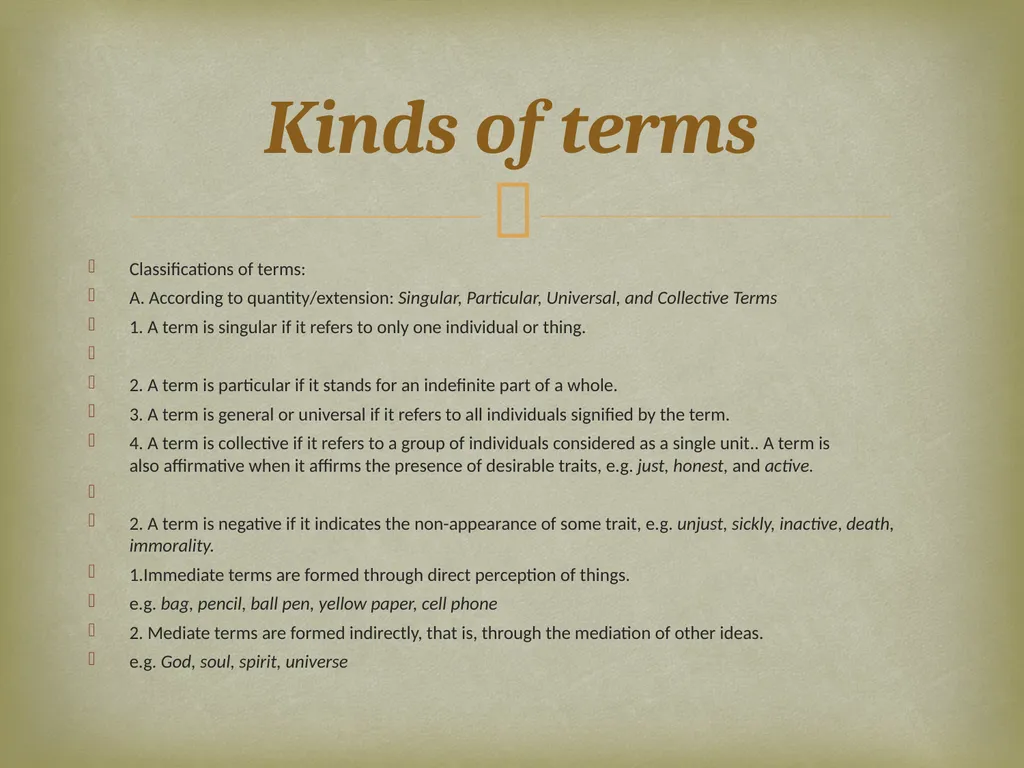
slide6. Classifications of terms:
A. According to quantity/extension: Singular, Particular, Universal, and Collective Terms
1. A term is singular if it refers to only one individual or thing.
2. A term is particular if it stands for an indefinite part of a whole.
3. A term is general or universal if it refers to all individuals signified by the term.
4. A term is collective if it refers to a group of individuals considered as a single unit.. A term is also affirmative when it affirms the presence of desirable traits, e.g. just, honest, and active.
2. A term is negative if it indicates the non-appearance of some trait, e.g. unjust, sickly, inactive, death, immorality.
1.Immediate terms are formed through direct perception of things.
e.g. bag, pencil, ball pen, yellow paper, cell phone
2. Mediate terms are formed indirectly, that is, through the mediation of other ideas.
e.g. God, soul, spirit, universe Kinds of terms<br>
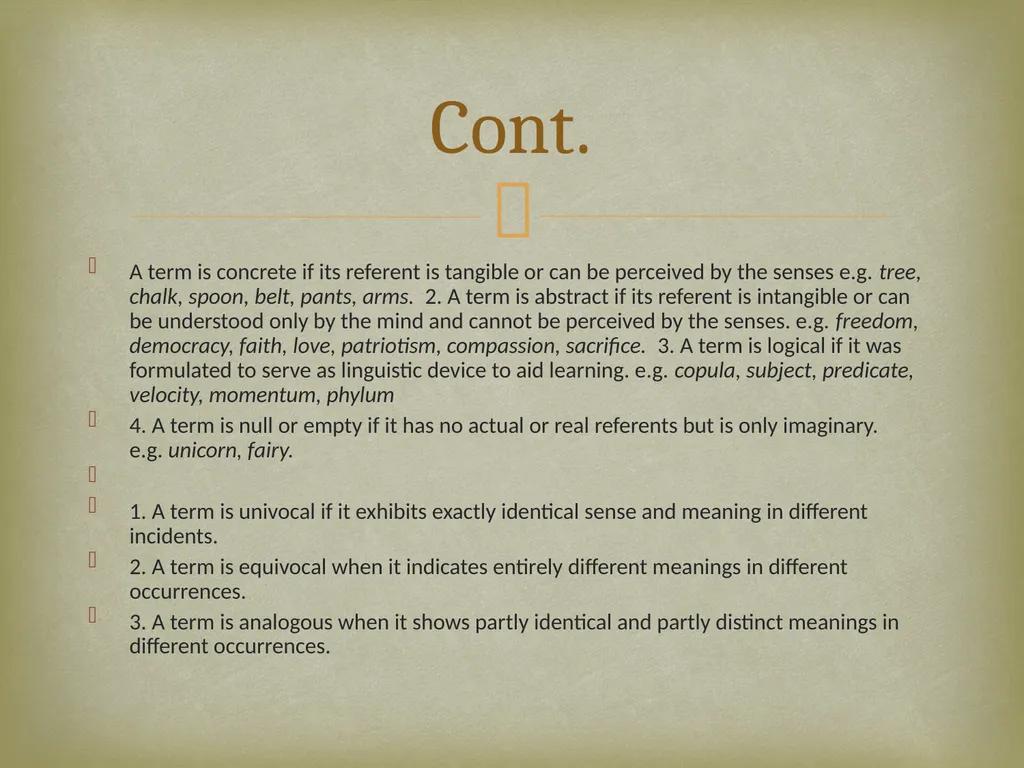
slide7. A term is concrete if its referent is tangible or can be perceived by the senses e.g. tree, chalk, spoon, belt, pants, arms. 2. A term is abstract if its referent is intangible or can be understood only by the mind and cannot be perceived by the senses. e.g. freedom, democracy, faith, love, patriotism, compassion, sacrifice. 3. A term is logical if it was formulated to serve as linguistic device to aid learning. e.g. copula, subject, predicate, velocity, momentum, phylum
4. A term is null or empty if it has no actual or real referents but is only imaginary. e.g. unicorn, fairy.
1. A term is univocal if it exhibits exactly identical sense and meaning in different incidents.
2. A term is equivocal when it indicates entirely different meanings in different occurrences.
3. A term is analogous when it shows partly identical and partly distinct meanings in different occurrences. Cont.<br>
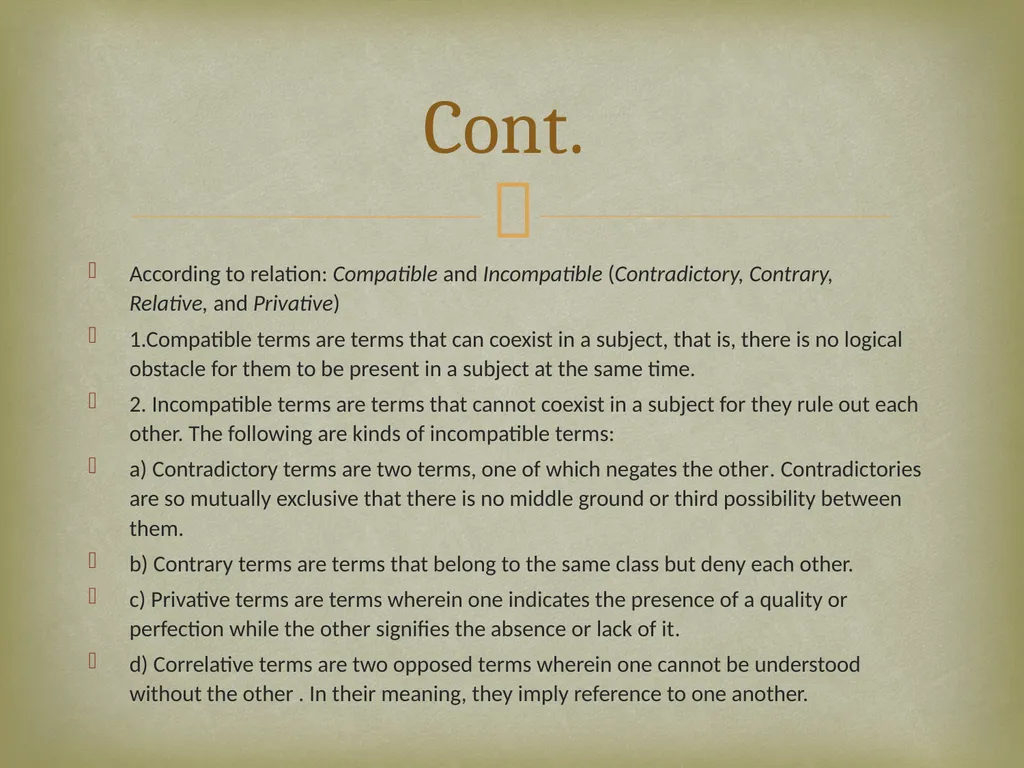
slide8. According to relation: Compatible and Incompatible (Contradictory, Contrary, Relative, and Privative)
1.Compatible terms are terms that can coexist in a subject, that is, there is no logical obstacle for them to be present in a subject at the same time.
2. Incompatible terms are terms that cannot coexist in a subject for they rule out each other. The following are kinds of incompatible terms:
a) Contradictory terms are two terms, one of which negates the other. Contradictories are so mutually exclusive that there is no middle ground or third possibility between them.
b) Contrary terms are terms that belong to the same class but deny each other.
c) Privative terms are terms wherein one indicates the presence of a quality or perfection while the other signifies the absence or lack of it.
d) Correlative terms are two opposed terms wherein one cannot be understood without the other . In their meaning, they imply reference to one another. Cont.<br>
slide9. The denotation of a word or phrase is its explicit or direct meaning. Another way to think of it is as the associations that a word usually elicits for most speakers of a language, as distinguished from those elicited for any individual speaker because of personal experience.
The connotation of a word or phrase is the associated or secondary meaning; it can be something suggested or implied by a word or thing, rather than being explicitly named or described. Denotation & Connotation<br>
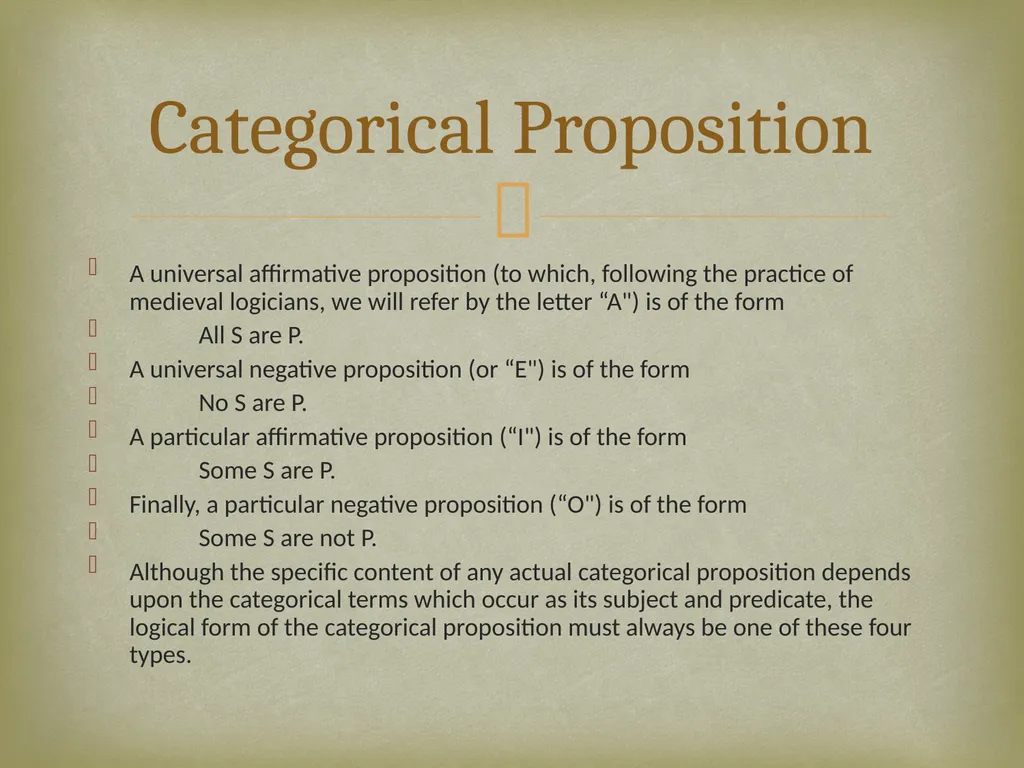
slide10. A universal affirmative proposition (to which, following the practice of medieval logicians, we will refer by the letter “A") is of the form
All S are P.
A universal negative proposition (or “E") is of the form
No S are P.
A particular affirmative proposition (“I") is of the form
Some S are P.
Finally, a particular negative proposition (“O") is of the form
Some S are not P.
Although the specific content of any actual categorical proposition depends upon the categorical terms which occur as its subject and predicate, the logical form of the categorical proposition must always be one of these four types. Categorical Proposition<br>
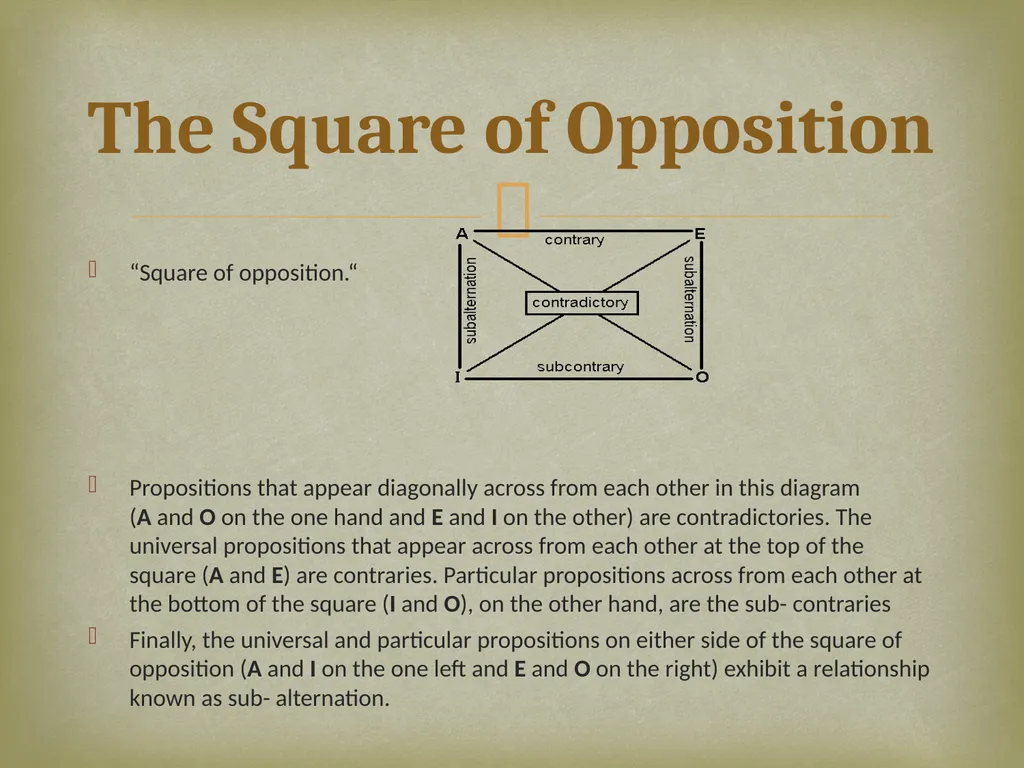
slide11. “Square of opposition.“
Propositions that appear diagonally across from each other in this diagram (A and O on the one hand and E and I on the other) are contradictories. The universal propositions that appear across from each other at the top of the square (A and E) are contraries. Particular propositions across from each other at the bottom of the square (I and O), on the other hand, are the sub- contraries
Finally, the universal and particular propositions on either side of the square of opposition (A and I on the one left and E and O on the right) exhibit a relationship known as sub- alternation. The Square of Opposition<br>
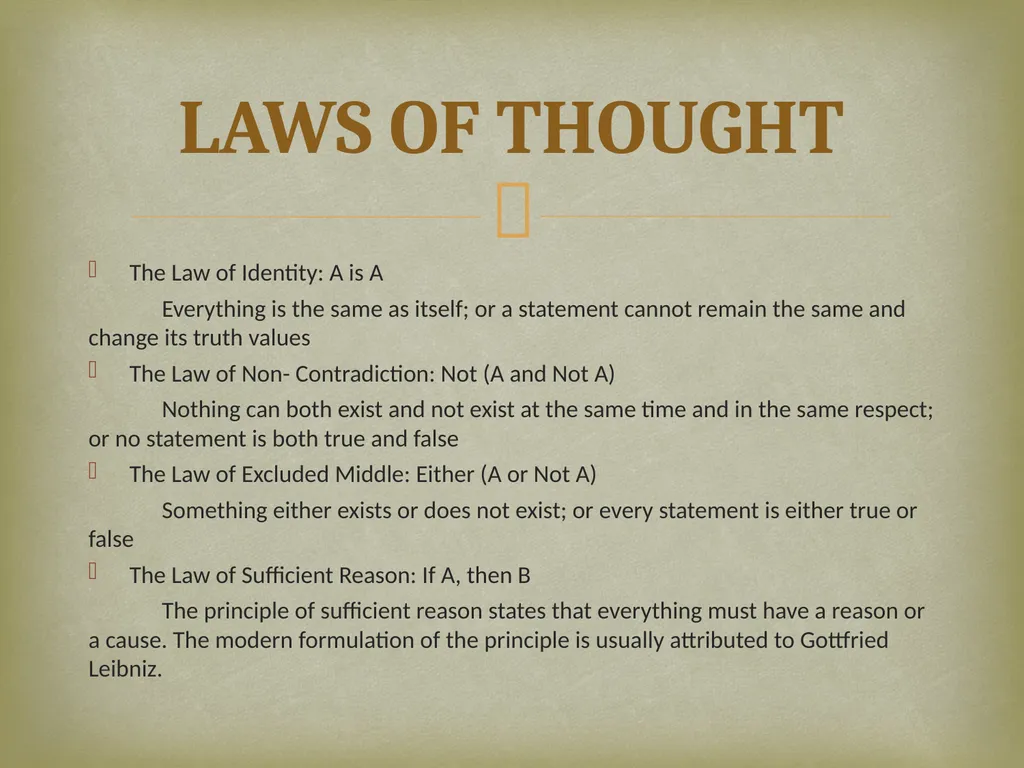
slide12. The Law of Identity: A is A
Everything is the same as itself; or a statement cannot remain the same and change its truth values
The Law of Non- Contradiction: Not (A and Not A)
Nothing can both exist and not exist at the same time and in the same respect; or no statement is both true and false
The Law of Excluded Middle: Either (A or Not A)
Something either exists or does not exist; or every statement is either true or false
The Law of Sufficient Reason: If A, then B
The principle of sufficient reason states that everything must have a reason or a cause. The modern formulation of the principle is usually attributed to Gottfried Leibniz. LAWS OF THOUGHT<br>
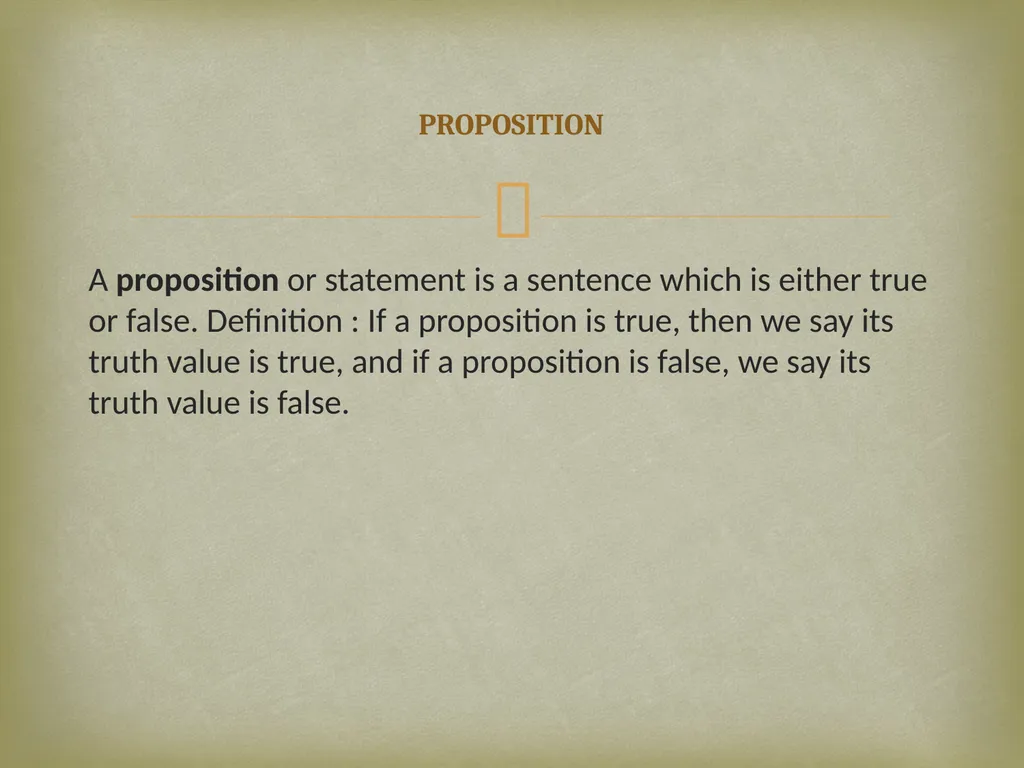
slide13. A proposition or statement is a sentence which is either true or false. Definition : If a proposition is true, then we say its truth value is true, and if a proposition is false, we say its truth value is false. PROPOSITION<br>
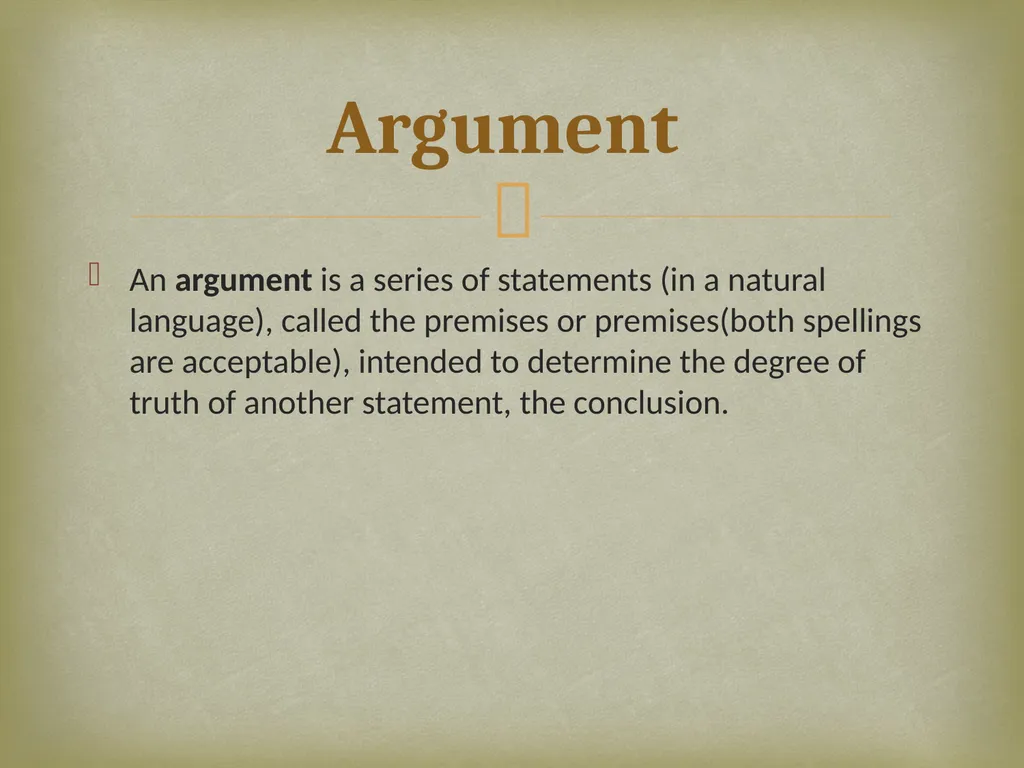
slide14. An argument is a series of statements (in a natural language), called the premises or premises(both spellings are acceptable), intended to determine the degree of truth of another statement, the conclusion. Argument<br>
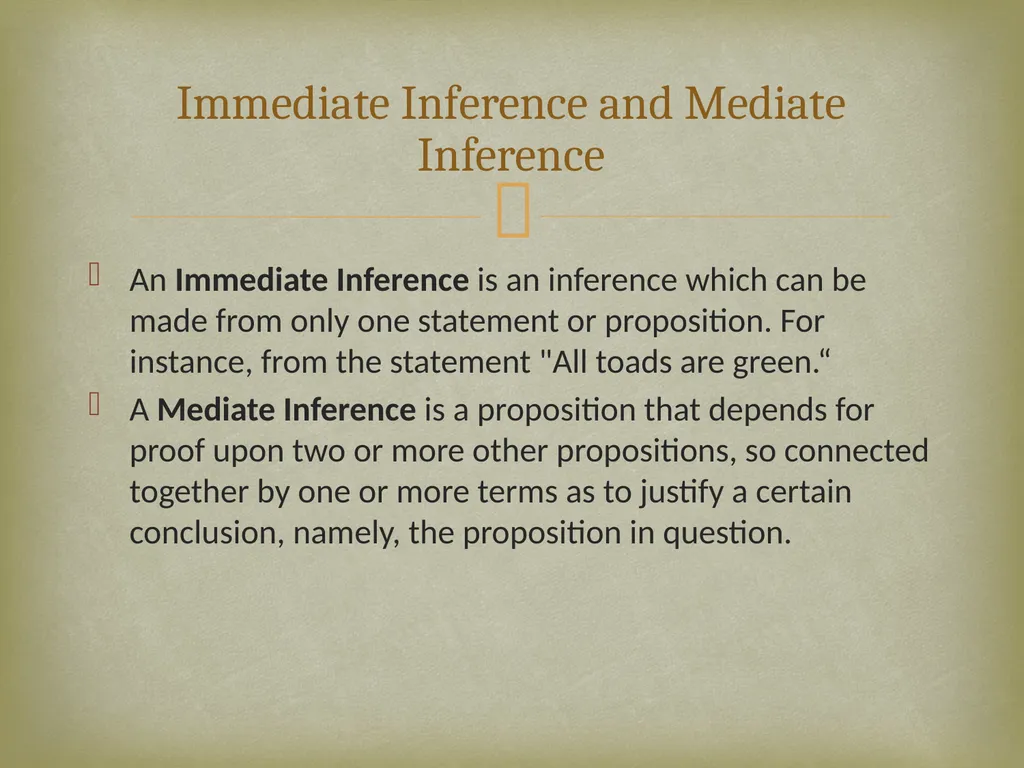
slide15. An Immediate Inference is an inference which can be made from only one statement or proposition. For instance, from the statement "All toads are green.“
A Mediate Inference is a proposition that depends for proof upon two or more other propositions, so connected together by one or more terms as to justify a certain conclusion, namely, the proposition in question. Immediate Inference and Mediate Inference<br>
slide16. Conversion is the inference in which the subject and predicate are interchanged. In modern logic it is only valid for the E and I propositions.
Obvers ion is the inference in which the quality of the proposition is changed and the predicate is interchanged with its complement
Contraposition is the inference in which the subject is interchanged with the complement of the predicate and the predicate is interchanged with the complement of the subject. In modern logic it is only valid for the A and O propositions.
Inverse is a type of conditional sentence which is an immediate inference made from another conditional sentence. More specifically, given a conditional sentence of the form , the inverse refers to the sentence. Conversion, Obvers ion Contraposition & Inverse<br>
slide17. A categorical syllogism is an argument consisting of exactly three categorical propositions (two premises and a conclusion) in which there appear a total of exactly three categorical terms, each of which is used exactly twice. Categorical Syllogism<br>
slide18. Four rules apply to all valid categorical syllogisms:
Rule 1: In a valid categorical syllogism, the middle term must be distributed in at least one premise.
Rule 2: In a valid categorical syllogism, any term that is distributed in the conclusion must be distributed in the premises.
Rule 3: In a valid categorical syllogism, the number of negative premises must be equal to the number of negative conclusions.
Rule 4: In a valid categorical syllogism a particular conclusion cannot be drawn from exclusively universal premises unless one assumes existential import. We do not assume existential import, and we will refer to arguments that would be valid if we did as traditionally valid. Rules of Categorical Syllogism:<br>
slide19. Now that we know the correct FORM of categorical syllogisms, we can learn some tools that will help us to determine when such syllogisms are valid or invalid. All categorical syllogisms have what is called a “mood” and a “figure.”
Mood: The mood of a categorical syllogism is a series of three letters corresponding to the type of proposition the major premise, the minor premise, and the conclusion are (A, E, I, or O).
When determining the mood of a categorical syllogism, you need to figure out which of the four forms of categorical proposition each line of the argument is (A, E, I, or O). For instance, in the argument above about dogs, ALL THREE statements are “A” propositions (of the form “All S are P”), so the mood of that argument would be “AAA”. Here is a syllogism that has a little more diversity:
1. No states with coastlines are states that are landlocked.
2. Some U.S. states are states that are landlocked.
3. Therefore, some U.S. states are not states with coastlines.
Let’s figure out the FORM of the premises and the conclusion:
1. No S are P (E)
2. Some S are P (I)
3. Some S are not P (O) Mood and Figure<br>
slide20. Figure 1: The middle term is on the left in P1, and on the right in P2.
Figure 2: The middle term is on the right in both premises.
Figure 3: The middle term is on the left in both premises.
Figure 4: The middle term is on the right in P1, and on the left in P2.
Let’s look at the other argument from earlier:
1. No states with coastlines are states that are landlocked.
2. Some U.S. states are states that are landlocked.
3. Therefore, some U.S. states are not states with coastlines. Cont.<br>
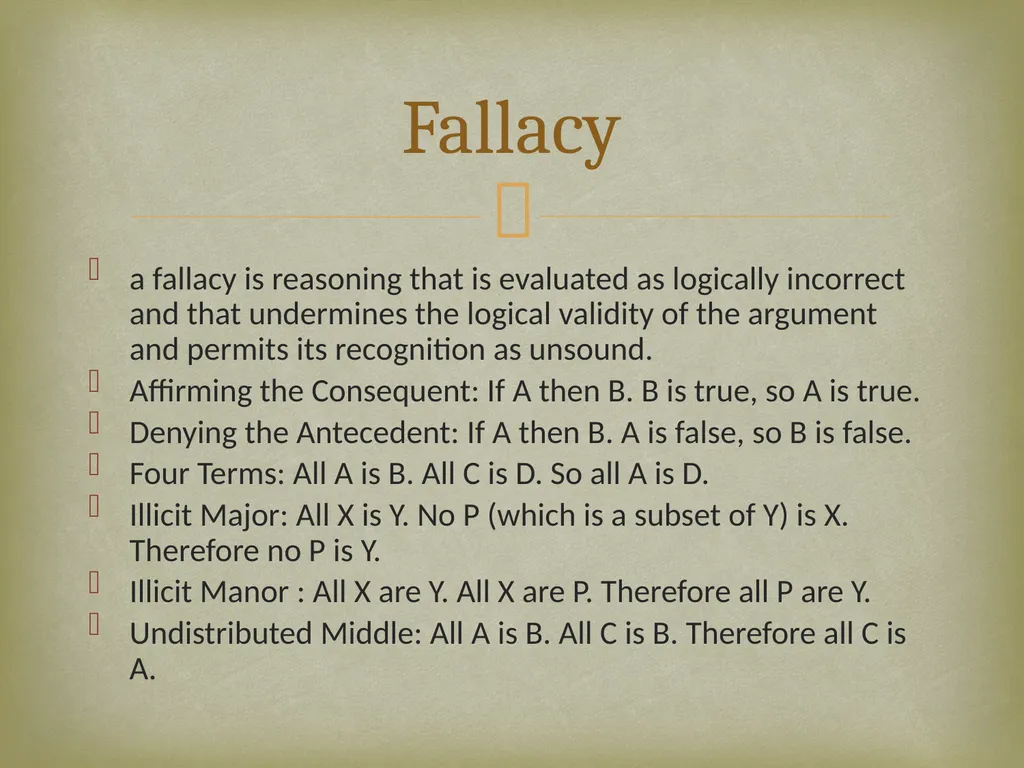
slide21. a fallacy is reasoning that is evaluated as logically incorrect and that undermines the logical validity of the argument and permits its recognition as unsound.
Affirming the Consequent: If A then B. B is true, so A is true.
Denying the Antecedent: If A then B. A is false, so B is false.
Four Terms: All A is B. All C is D. So all A is D.
Illicit Major: All X is Y. No P (which is a subset of Y) is X. Therefore no P is Y.
Illicit Manor : All X are Y. All X are P. Therefore all P are Y.
Undistributed Middle: All A is B. All C is B. Therefore all C is A. Fallacy<br>
slide22. A truth table is a visual tool, in the form of a diagram with rows & columns, that shows the truth or falsity of a compound premise. It’s a way of organizing information to list out all possible scenarios from the provided premises. Truth Table<br>
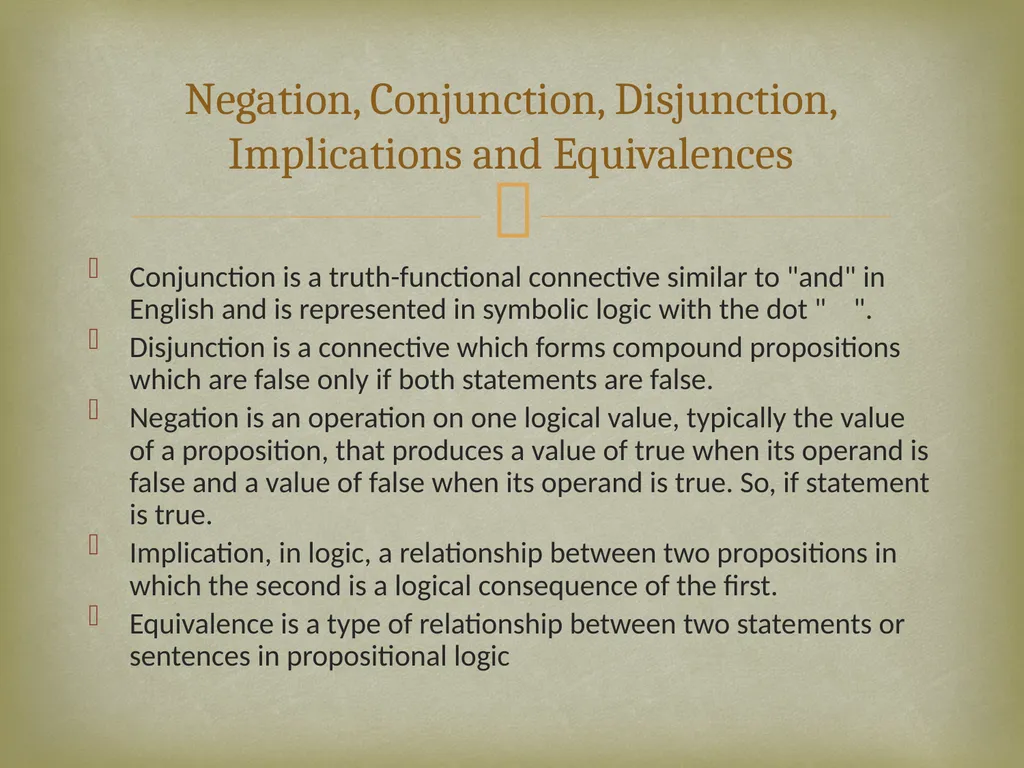
slide23. Conjunction is a truth-functional connective similar to "and" in English and is represented in symbolic logic with the dot " ".
Disjunction is a connective which forms compound propositions which are false only if both statements are false.
Negation is an operation on one logical value, typically the value of a proposition, that produces a value of true when its operand is false and a value of false when its operand is true. So, if statement is true.
Implication, in logic, a relationship between two propositions in which the second is a logical consequence of the first.
Equivalence is a type of relationship between two statements or sentences in propositional logic Negation, Conjunction, Disjunction, Implications and Equivalences<br>
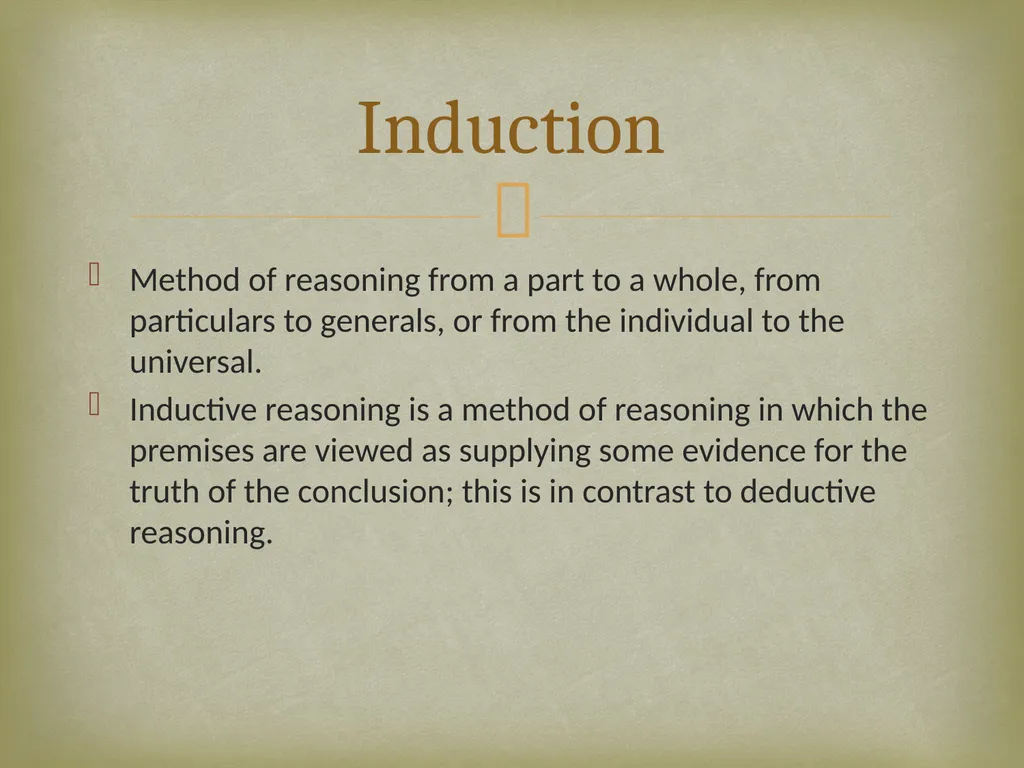
slide24. Method of reasoning from a part to a whole, from particulars to generals, or from the individual to the universal.
Inductive reasoning is a method of reasoning in which the premises are viewed as supplying some evidence for the truth of the conclusion; this is in contrast to deductive reasoning. Induction<br>
slide25. Deduction is a form of logic that achieves a specific conclusion from the general, drawing necessary conclusions from the premises. Deduction<br>
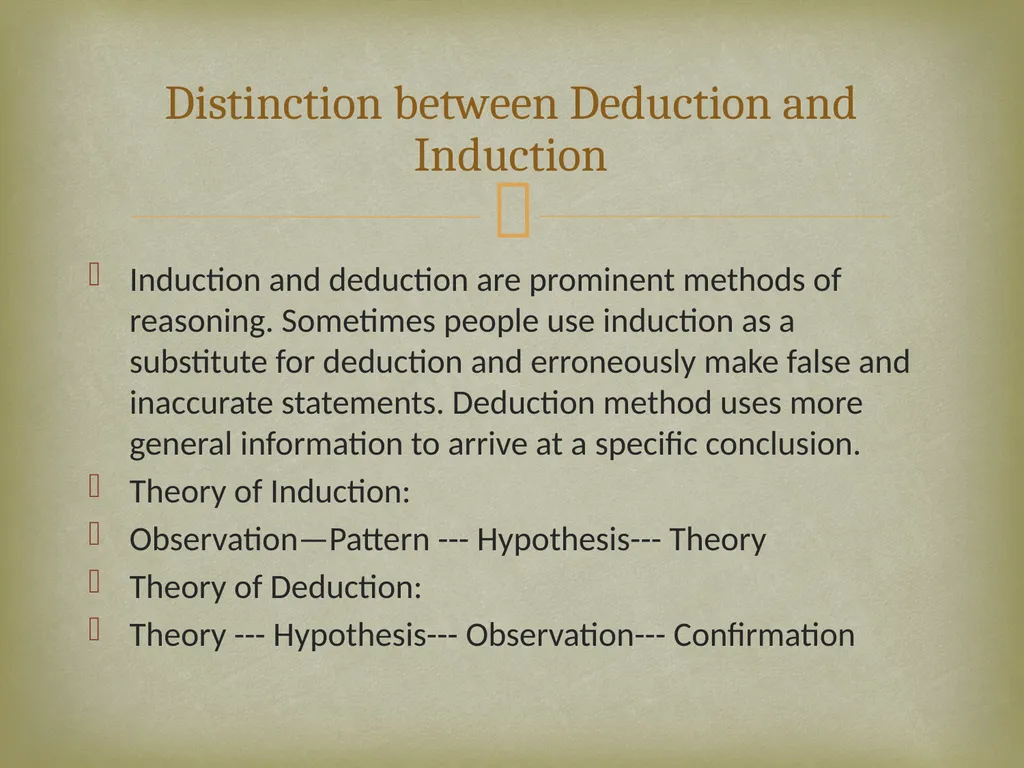
slide26. Induction and deduction are prominent methods of reasoning. Sometimes people use induction as a substitute for deduction and erroneously make false and inaccurate statements. Deduction method uses more general information to arrive at a specific conclusion.
Theory of Induction:
Observation—Pattern --- Hypothesis--- Theory
Theory of Deduction:
Theory --- Hypothesis--- Observation--- Confirmation Distinction between Deduction and Induction<br>
slide27. Causation, Relation that holds between two temporally simultaneous or successive events when the first event (the cause) brings about the other (the effect). Causation<br>
slide28. Plurality of causes is a common sense opinion for it means that a given effect or phenomenon may have been the result of alternative causes. In other words it states that one and the same effect can be produced by different causes on different occasions. Plurality of cause<br>
slide29. Thanks<br>
Prof. Suresh Chander<br>
slide2. Logic is the systematic study of the forms of inference, the relations that lead to the acceptance of one proposition, the conclusion, on the basis of a set of other propositions, the premises. Definition of logic<br>
slide3. The subject of logic can be divided into three broad areas:
Theory of inference that is all about arguments that are used to justify one statement on the basis of others. Many of these arguments fall into standard argument-patterns,
Theory of definition, which tells about use of words or symbols to identify or characterize things; the things can be concrete or abstract. Again, there are some standard forms that depend on the kind of thing being characterized, and
Applied logic, in which theory of inference and theory of definition are applied as tools for analysing or solving practical problems. The Scope and Limits of Logic<br>
slide4. Logic is important because it influences every decision we make in our lives. Logical thinking allows us to learn and make decisions that will affect our lifestyle. If no one thought logically, we would all be running around like chickens with our heads cut off, and nothing would make any sense. Utility of Logic<br>
slide5. term is a word or group of words that has a special meaning, in proposition TERM<br>
slide6. Classifications of terms:
A. According to quantity/extension: Singular, Particular, Universal, and Collective Terms
1. A term is singular if it refers to only one individual or thing.
2. A term is particular if it stands for an indefinite part of a whole.
3. A term is general or universal if it refers to all individuals signified by the term.
4. A term is collective if it refers to a group of individuals considered as a single unit.. A term is also affirmative when it affirms the presence of desirable traits, e.g. just, honest, and active.
2. A term is negative if it indicates the non-appearance of some trait, e.g. unjust, sickly, inactive, death, immorality.
1.Immediate terms are formed through direct perception of things.
e.g. bag, pencil, ball pen, yellow paper, cell phone
2. Mediate terms are formed indirectly, that is, through the mediation of other ideas.
e.g. God, soul, spirit, universe Kinds of terms<br>
slide7. A term is concrete if its referent is tangible or can be perceived by the senses e.g. tree, chalk, spoon, belt, pants, arms. 2. A term is abstract if its referent is intangible or can be understood only by the mind and cannot be perceived by the senses. e.g. freedom, democracy, faith, love, patriotism, compassion, sacrifice. 3. A term is logical if it was formulated to serve as linguistic device to aid learning. e.g. copula, subject, predicate, velocity, momentum, phylum
4. A term is null or empty if it has no actual or real referents but is only imaginary. e.g. unicorn, fairy.
1. A term is univocal if it exhibits exactly identical sense and meaning in different incidents.
2. A term is equivocal when it indicates entirely different meanings in different occurrences.
3. A term is analogous when it shows partly identical and partly distinct meanings in different occurrences. Cont.<br>
slide8. According to relation: Compatible and Incompatible (Contradictory, Contrary, Relative, and Privative)
1.Compatible terms are terms that can coexist in a subject, that is, there is no logical obstacle for them to be present in a subject at the same time.
2. Incompatible terms are terms that cannot coexist in a subject for they rule out each other. The following are kinds of incompatible terms:
a) Contradictory terms are two terms, one of which negates the other. Contradictories are so mutually exclusive that there is no middle ground or third possibility between them.
b) Contrary terms are terms that belong to the same class but deny each other.
c) Privative terms are terms wherein one indicates the presence of a quality or perfection while the other signifies the absence or lack of it.
d) Correlative terms are two opposed terms wherein one cannot be understood without the other . In their meaning, they imply reference to one another. Cont.<br>
slide9. The denotation of a word or phrase is its explicit or direct meaning. Another way to think of it is as the associations that a word usually elicits for most speakers of a language, as distinguished from those elicited for any individual speaker because of personal experience.
The connotation of a word or phrase is the associated or secondary meaning; it can be something suggested or implied by a word or thing, rather than being explicitly named or described. Denotation & Connotation<br>
slide10. A universal affirmative proposition (to which, following the practice of medieval logicians, we will refer by the letter “A") is of the form
All S are P.
A universal negative proposition (or “E") is of the form
No S are P.
A particular affirmative proposition (“I") is of the form
Some S are P.
Finally, a particular negative proposition (“O") is of the form
Some S are not P.
Although the specific content of any actual categorical proposition depends upon the categorical terms which occur as its subject and predicate, the logical form of the categorical proposition must always be one of these four types. Categorical Proposition<br>
slide11. “Square of opposition.“
Propositions that appear diagonally across from each other in this diagram (A and O on the one hand and E and I on the other) are contradictories. The universal propositions that appear across from each other at the top of the square (A and E) are contraries. Particular propositions across from each other at the bottom of the square (I and O), on the other hand, are the sub- contraries
Finally, the universal and particular propositions on either side of the square of opposition (A and I on the one left and E and O on the right) exhibit a relationship known as sub- alternation. The Square of Opposition<br>
slide12. The Law of Identity: A is A
Everything is the same as itself; or a statement cannot remain the same and change its truth values
The Law of Non- Contradiction: Not (A and Not A)
Nothing can both exist and not exist at the same time and in the same respect; or no statement is both true and false
The Law of Excluded Middle: Either (A or Not A)
Something either exists or does not exist; or every statement is either true or false
The Law of Sufficient Reason: If A, then B
The principle of sufficient reason states that everything must have a reason or a cause. The modern formulation of the principle is usually attributed to Gottfried Leibniz. LAWS OF THOUGHT<br>
slide13. A proposition or statement is a sentence which is either true or false. Definition : If a proposition is true, then we say its truth value is true, and if a proposition is false, we say its truth value is false. PROPOSITION<br>
slide14. An argument is a series of statements (in a natural language), called the premises or premises(both spellings are acceptable), intended to determine the degree of truth of another statement, the conclusion. Argument<br>
slide15. An Immediate Inference is an inference which can be made from only one statement or proposition. For instance, from the statement "All toads are green.“
A Mediate Inference is a proposition that depends for proof upon two or more other propositions, so connected together by one or more terms as to justify a certain conclusion, namely, the proposition in question. Immediate Inference and Mediate Inference<br>
slide16. Conversion is the inference in which the subject and predicate are interchanged. In modern logic it is only valid for the E and I propositions.
Obvers ion is the inference in which the quality of the proposition is changed and the predicate is interchanged with its complement
Contraposition is the inference in which the subject is interchanged with the complement of the predicate and the predicate is interchanged with the complement of the subject. In modern logic it is only valid for the A and O propositions.
Inverse is a type of conditional sentence which is an immediate inference made from another conditional sentence. More specifically, given a conditional sentence of the form , the inverse refers to the sentence. Conversion, Obvers ion Contraposition & Inverse<br>
slide17. A categorical syllogism is an argument consisting of exactly three categorical propositions (two premises and a conclusion) in which there appear a total of exactly three categorical terms, each of which is used exactly twice. Categorical Syllogism<br>
slide18. Four rules apply to all valid categorical syllogisms:
Rule 1: In a valid categorical syllogism, the middle term must be distributed in at least one premise.
Rule 2: In a valid categorical syllogism, any term that is distributed in the conclusion must be distributed in the premises.
Rule 3: In a valid categorical syllogism, the number of negative premises must be equal to the number of negative conclusions.
Rule 4: In a valid categorical syllogism a particular conclusion cannot be drawn from exclusively universal premises unless one assumes existential import. We do not assume existential import, and we will refer to arguments that would be valid if we did as traditionally valid. Rules of Categorical Syllogism:<br>
slide19. Now that we know the correct FORM of categorical syllogisms, we can learn some tools that will help us to determine when such syllogisms are valid or invalid. All categorical syllogisms have what is called a “mood” and a “figure.”
Mood: The mood of a categorical syllogism is a series of three letters corresponding to the type of proposition the major premise, the minor premise, and the conclusion are (A, E, I, or O).
When determining the mood of a categorical syllogism, you need to figure out which of the four forms of categorical proposition each line of the argument is (A, E, I, or O). For instance, in the argument above about dogs, ALL THREE statements are “A” propositions (of the form “All S are P”), so the mood of that argument would be “AAA”. Here is a syllogism that has a little more diversity:
1. No states with coastlines are states that are landlocked.
2. Some U.S. states are states that are landlocked.
3. Therefore, some U.S. states are not states with coastlines.
Let’s figure out the FORM of the premises and the conclusion:
1. No S are P (E)
2. Some S are P (I)
3. Some S are not P (O) Mood and Figure<br>
slide20. Figure 1: The middle term is on the left in P1, and on the right in P2.
Figure 2: The middle term is on the right in both premises.
Figure 3: The middle term is on the left in both premises.
Figure 4: The middle term is on the right in P1, and on the left in P2.
Let’s look at the other argument from earlier:
1. No states with coastlines are states that are landlocked.
2. Some U.S. states are states that are landlocked.
3. Therefore, some U.S. states are not states with coastlines. Cont.<br>
slide21. a fallacy is reasoning that is evaluated as logically incorrect and that undermines the logical validity of the argument and permits its recognition as unsound.
Affirming the Consequent: If A then B. B is true, so A is true.
Denying the Antecedent: If A then B. A is false, so B is false.
Four Terms: All A is B. All C is D. So all A is D.
Illicit Major: All X is Y. No P (which is a subset of Y) is X. Therefore no P is Y.
Illicit Manor : All X are Y. All X are P. Therefore all P are Y.
Undistributed Middle: All A is B. All C is B. Therefore all C is A. Fallacy<br>
slide22. A truth table is a visual tool, in the form of a diagram with rows & columns, that shows the truth or falsity of a compound premise. It’s a way of organizing information to list out all possible scenarios from the provided premises. Truth Table<br>
slide23. Conjunction is a truth-functional connective similar to "and" in English and is represented in symbolic logic with the dot " ".
Disjunction is a connective which forms compound propositions which are false only if both statements are false.
Negation is an operation on one logical value, typically the value of a proposition, that produces a value of true when its operand is false and a value of false when its operand is true. So, if statement is true.
Implication, in logic, a relationship between two propositions in which the second is a logical consequence of the first.
Equivalence is a type of relationship between two statements or sentences in propositional logic Negation, Conjunction, Disjunction, Implications and Equivalences<br>
slide24. Method of reasoning from a part to a whole, from particulars to generals, or from the individual to the universal.
Inductive reasoning is a method of reasoning in which the premises are viewed as supplying some evidence for the truth of the conclusion; this is in contrast to deductive reasoning. Induction<br>
slide25. Deduction is a form of logic that achieves a specific conclusion from the general, drawing necessary conclusions from the premises. Deduction<br>
slide26. Induction and deduction are prominent methods of reasoning. Sometimes people use induction as a substitute for deduction and erroneously make false and inaccurate statements. Deduction method uses more general information to arrive at a specific conclusion.
Theory of Induction:
Observation—Pattern --- Hypothesis--- Theory
Theory of Deduction:
Theory --- Hypothesis--- Observation--- Confirmation Distinction between Deduction and Induction<br>
slide27. Causation, Relation that holds between two temporally simultaneous or successive events when the first event (the cause) brings about the other (the effect). Causation<br>
slide28. Plurality of causes is a common sense opinion for it means that a given effect or phenomenon may have been the result of alternative causes. In other words it states that one and the same effect can be produced by different causes on different occasions. Plurality of cause<br>
slide29. Thanks<br>