
SUN PROTECTION AND SUNSCREEN PRODUCTS Department
TA
Published · 18 slides · 0 views

1 / 1
Description
SUN PROTECTION AND SUNSCREEN PRODUCTS Department of Pharmaceutical Analysis Sun protection Every skin type needs sun protection To prevent photoaging and wrinkles To prevent skin cancer To prevent hyperpigmentation and brown spots UV Rays
Related Topics
Share
Embed code
Download this presentation From Below
"SUN PROTECTION AND SUNSCREEN PRODUCTS Department" is the property of its rightful owner. Permission is granted to download and print the materials on this website for personal, non-commercial use only, and to display it on your personal computer provided you do not modify the materials and that you retain all copyright notices contained in the materials. By downloading content from our website, you accept the terms of this agreement.
Presentation Transcript
01
SUN PROTECTION
AND
SUNSCREEN PRODUCTS Department of Pharmaceutical Analysis<br>
02
Sun protection
Every skin type needs sun protection
To prevent photoaging and wrinkles
To prevent skin cancer
To prevent hyperpigmentation and brown spots
UV Rays (particularly wavelength below 320mµ) are responsible for most of the therapeutic as well as noxious effects that we attribute to sun-light.
The UV Spectrum is broken into three parts:
Very High Energy (UVC)
High Energy (UVB)
Low Energy (UVA) Department of Pharmaceutical Analysis Sun protection and Sunscreen products<br>
Every skin type needs sun protection
To prevent photoaging and wrinkles
To prevent skin cancer
To prevent hyperpigmentation and brown spots
UV Rays (particularly wavelength below 320mµ) are responsible for most of the therapeutic as well as noxious effects that we attribute to sun-light.
The UV Spectrum is broken into three parts:
Very High Energy (UVC)
High Energy (UVB)
Low Energy (UVA) Department of Pharmaceutical Analysis Sun protection and Sunscreen products<br>
03
UVA
Not blocked by window glass.
Penetrates light clothing.
Penetrates deeper into the skin.
Has more long-term effects than UVB
UVB
“B” for burn.
Cloud cover provides some protection.
Intensity varies on Time of day, Season, Weather.
UVC
Most rays are absorbed by the earth’s atmosphere (blocked by the ozone layer.)
More dangerous than UVA and UVB.
Causes serious damage to DNA Department of Pharmaceutical Analysis Sun protection and Sunscreen products<br>
Not blocked by window glass.
Penetrates light clothing.
Penetrates deeper into the skin.
Has more long-term effects than UVB
UVB
“B” for burn.
Cloud cover provides some protection.
Intensity varies on Time of day, Season, Weather.
UVC
Most rays are absorbed by the earth’s atmosphere (blocked by the ozone layer.)
More dangerous than UVA and UVB.
Causes serious damage to DNA Department of Pharmaceutical Analysis Sun protection and Sunscreen products<br>
04
It has long been known that UVB is the major cause of acute sunburn and tanning . Therefore, sunscreen efficacy is predominantly directed against UVB radiations. In addition, exposure to UVB radiation is immunosuppressive, mutagenic, and carcinogenic.
Effects of UVA manifest usually after a long duration of exposure, even if doses are low. UVA up regulates the formation of matrix metalloproteinase (MMPs), enzymes that degrade the matrix protein’s elastin and collagen, which, if not prevented, can result in marked reduction in skin elasticity and increased wrinkling.
UVA radiation damages skin by penetrating into the layers of skin and producing reactive oxygen resulting in acute and chronic changes. Studies have shown that UVA impairs the antigen presenting cell (APC) activity of the epidermal cells and thereby causes immune suppression, thus contributing to the growth of skin cancer.
The amount of exposure to UVA usually remains constant, whereas UVB exposure occurs more in the summer. Department of Pharmaceutical Analysis Sun protection and Sunscreen products<br>
Effects of UVA manifest usually after a long duration of exposure, even if doses are low. UVA up regulates the formation of matrix metalloproteinase (MMPs), enzymes that degrade the matrix protein’s elastin and collagen, which, if not prevented, can result in marked reduction in skin elasticity and increased wrinkling.
UVA radiation damages skin by penetrating into the layers of skin and producing reactive oxygen resulting in acute and chronic changes. Studies have shown that UVA impairs the antigen presenting cell (APC) activity of the epidermal cells and thereby causes immune suppression, thus contributing to the growth of skin cancer.
The amount of exposure to UVA usually remains constant, whereas UVB exposure occurs more in the summer. Department of Pharmaceutical Analysis Sun protection and Sunscreen products<br>
05
ULTRAVIOLET RADIATION AFFECTING THE SKIN:
Sunburns: the most common and acute response.
Photoaging: the leading cause of skin aging; damage begins as early as in one’s 20’s.
Cancer: ultraviolet radiation is a known carcinogen.
The effect is cumulative; the more time spent unprotected in the sun over lifetime, the greater the risks.
Sunscreen, also known as sunblock or suntan preparations are lotion, spray, gel or other topical products that absorb or reflects the sun's ultraviolet (UV) radiation and protects the skin. Department of Pharmaceutical Analysis Sun protection and Sunscreen products<br>
Sunburns: the most common and acute response.
Photoaging: the leading cause of skin aging; damage begins as early as in one’s 20’s.
Cancer: ultraviolet radiation is a known carcinogen.
The effect is cumulative; the more time spent unprotected in the sun over lifetime, the greater the risks.
Sunscreen, also known as sunblock or suntan preparations are lotion, spray, gel or other topical products that absorb or reflects the sun's ultraviolet (UV) radiation and protects the skin. Department of Pharmaceutical Analysis Sun protection and Sunscreen products<br>
06
PRINCIPLE OF EFFECTIVENESS OF SUN-SCREENS
A protective layer can be provided to the skin that prevents the UV-rays to reach the skin either by absorbing or by reflecting them.
Zinc oxide and titanium dioxide both have such tendency.
Preparations reflecting UV-rays are very effective and used widely.
2) To incorporate substances in preparations to filter the sun-rays by absorbing medium range UV-rays (280 mµ-320mµ) but allowing rays of higher wavelengths to pass. All modern sun-tan preparations are based on this principle and contain such substances. Example like oxybenzone, Tinosorb M Department of Pharmaceutical Analysis Sun protection and Sunscreen products<br>
A protective layer can be provided to the skin that prevents the UV-rays to reach the skin either by absorbing or by reflecting them.
Zinc oxide and titanium dioxide both have such tendency.
Preparations reflecting UV-rays are very effective and used widely.
2) To incorporate substances in preparations to filter the sun-rays by absorbing medium range UV-rays (280 mµ-320mµ) but allowing rays of higher wavelengths to pass. All modern sun-tan preparations are based on this principle and contain such substances. Example like oxybenzone, Tinosorb M Department of Pharmaceutical Analysis Sun protection and Sunscreen products<br>
07
3) Biologically effective substances can be used effectively to prevent symptoms of inflammation with-out reduction of tanning.
Damage of cells by sunburn liberates histamine in the tissues. So use of antihistaminic substances can avoid inflammation. Example like hydrocarbons and fluorocarbons may be useful in treating sunburn.
4) Substances that cause or accelerate tanning of the skin can be applied.
Dioxyacetone causes tanning by forming a brown complex with the keratin of the corneal layer.
8-methoxypsoralene when taken 10-20 mg internally 2 hours before exposure to the sun, accelerates tanning and avoids sunburn. Department of Pharmaceutical Analysis Sun protection and Sunscreen products<br>
Damage of cells by sunburn liberates histamine in the tissues. So use of antihistaminic substances can avoid inflammation. Example like hydrocarbons and fluorocarbons may be useful in treating sunburn.
4) Substances that cause or accelerate tanning of the skin can be applied.
Dioxyacetone causes tanning by forming a brown complex with the keratin of the corneal layer.
8-methoxypsoralene when taken 10-20 mg internally 2 hours before exposure to the sun, accelerates tanning and avoids sunburn. Department of Pharmaceutical Analysis Sun protection and Sunscreen products<br>
08
IDEAL SUN-SCREEN CHARACTERS:
Absorb light preferentially over the range of 280 - 320mµ.
Resistance to water
Be stable to heat, light and perspiration.
Preferably odorless, if mild odor: accepted by user.
Be non-toxic, non-irritant, non- sensitizing
Capable of retaining sunscreening property for several hours.
Stable under condition of use.
Non- stain
Not be rapidly absorbed.
Be neutral.
Be rapidly soluble in suitable vehicles. Department of Pharmaceutical Analysis Sun protection and Sunscreen products<br>
Absorb light preferentially over the range of 280 - 320mµ.
Resistance to water
Be stable to heat, light and perspiration.
Preferably odorless, if mild odor: accepted by user.
Be non-toxic, non-irritant, non- sensitizing
Capable of retaining sunscreening property for several hours.
Stable under condition of use.
Non- stain
Not be rapidly absorbed.
Be neutral.
Be rapidly soluble in suitable vehicles. Department of Pharmaceutical Analysis Sun protection and Sunscreen products<br>
09
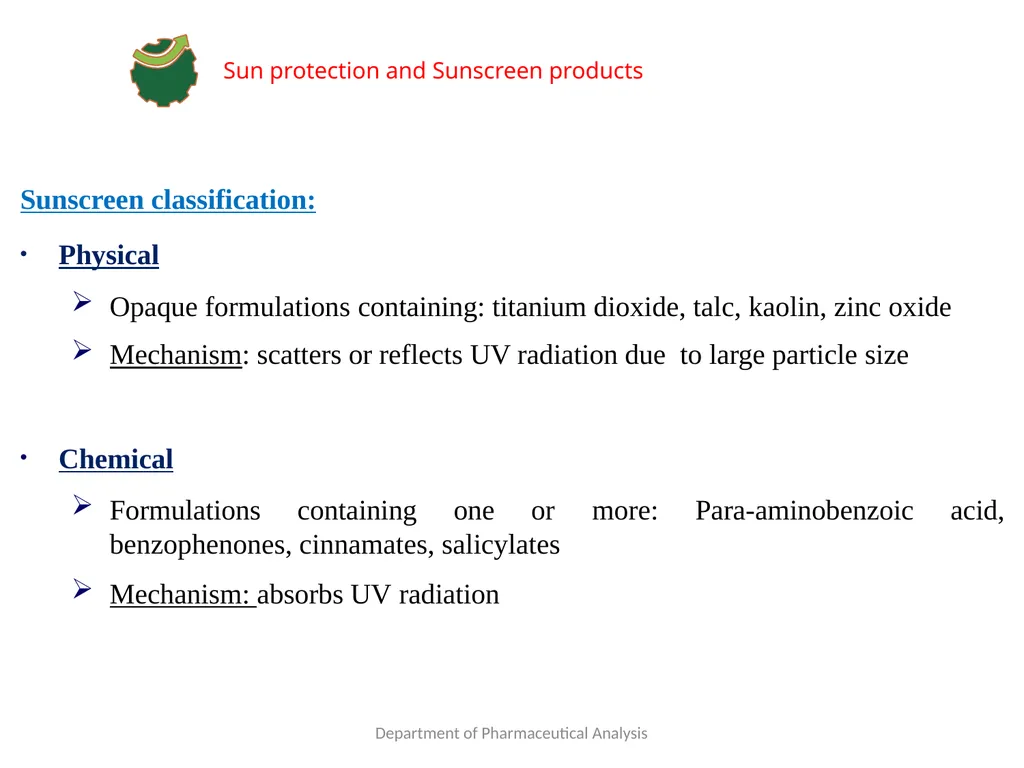
Sunscreen classification:
Physical
Opaque formulations containing: titanium dioxide, talc, kaolin, zinc oxide
Mechanism: scatters or reflects UV radiation due to large particle size
Chemical
Formulations containing one or more: Para-aminobenzoic acid, benzophenones, cinnamates, salicylates
Mechanism: absorbs UV radiation Department of Pharmaceutical Analysis Sun protection and Sunscreen products<br>
Physical
Opaque formulations containing: titanium dioxide, talc, kaolin, zinc oxide
Mechanism: scatters or reflects UV radiation due to large particle size
Chemical
Formulations containing one or more: Para-aminobenzoic acid, benzophenones, cinnamates, salicylates
Mechanism: absorbs UV radiation Department of Pharmaceutical Analysis Sun protection and Sunscreen products<br>
10
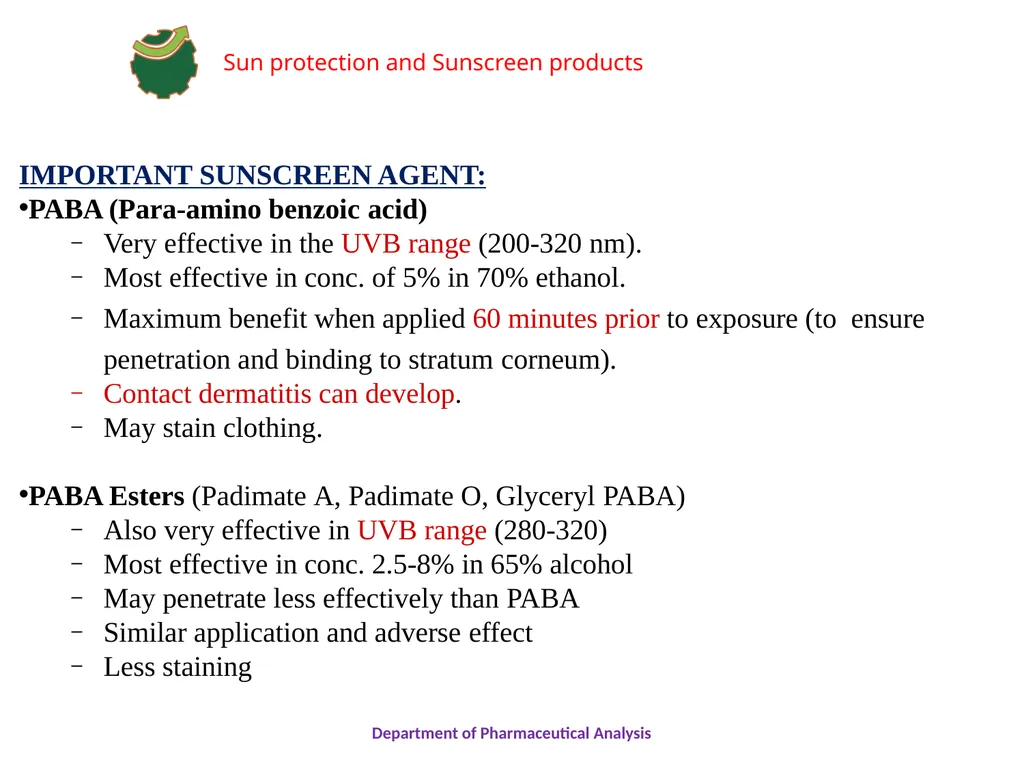
IMPORTANT SUNSCREEN AGENT:
PABA (Para-amino benzoic acid)
Very effective in the UVB range (200-320 nm).
Most effective in conc. of 5% in 70% ethanol.
Maximum benefit when applied 60 minutes prior to exposure (to ensure penetration and binding to stratum corneum).
Contact dermatitis can develop.
May stain clothing.
PABA Esters (Padimate A, Padimate O, Glyceryl PABA)
Also very effective in UVB range (280-320)
Most effective in conc. 2.5-8% in 65% alcohol
May penetrate less effectively than PABA
Similar application and adverse effect
Less staining Department of Pharmaceutical Analysis Sun protection and Sunscreen products<br>
PABA (Para-amino benzoic acid)
Very effective in the UVB range (200-320 nm).
Most effective in conc. of 5% in 70% ethanol.
Maximum benefit when applied 60 minutes prior to exposure (to ensure penetration and binding to stratum corneum).
Contact dermatitis can develop.
May stain clothing.
PABA Esters (Padimate A, Padimate O, Glyceryl PABA)
Also very effective in UVB range (280-320)
Most effective in conc. 2.5-8% in 65% alcohol
May penetrate less effectively than PABA
Similar application and adverse effect
Less staining Department of Pharmaceutical Analysis Sun protection and Sunscreen products<br>
11
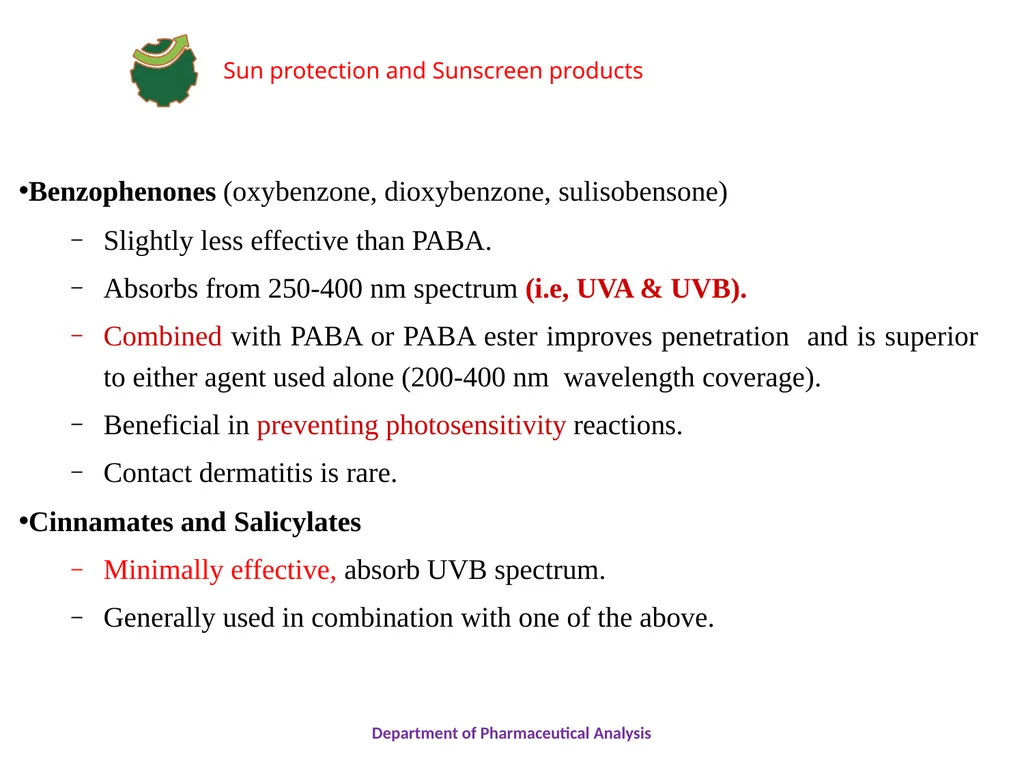
Benzophenones (oxybenzone, dioxybenzone, sulisobensone)
Slightly less effective than PABA.
Absorbs from 250-400 nm spectrum (i.e, UVA & UVB).
Combined with PABA or PABA ester improves penetration and is superior to either agent used alone (200-400 nm wavelength coverage).
Beneficial in preventing photosensitivity reactions.
Contact dermatitis is rare.
Cinnamates and Salicylates
Minimally effective, absorb UVB spectrum.
Generally used in combination with one of the above. Department of Pharmaceutical Analysis Sun protection and Sunscreen products<br>
Slightly less effective than PABA.
Absorbs from 250-400 nm spectrum (i.e, UVA & UVB).
Combined with PABA or PABA ester improves penetration and is superior to either agent used alone (200-400 nm wavelength coverage).
Beneficial in preventing photosensitivity reactions.
Contact dermatitis is rare.
Cinnamates and Salicylates
Minimally effective, absorb UVB spectrum.
Generally used in combination with one of the above. Department of Pharmaceutical Analysis Sun protection and Sunscreen products<br>
12
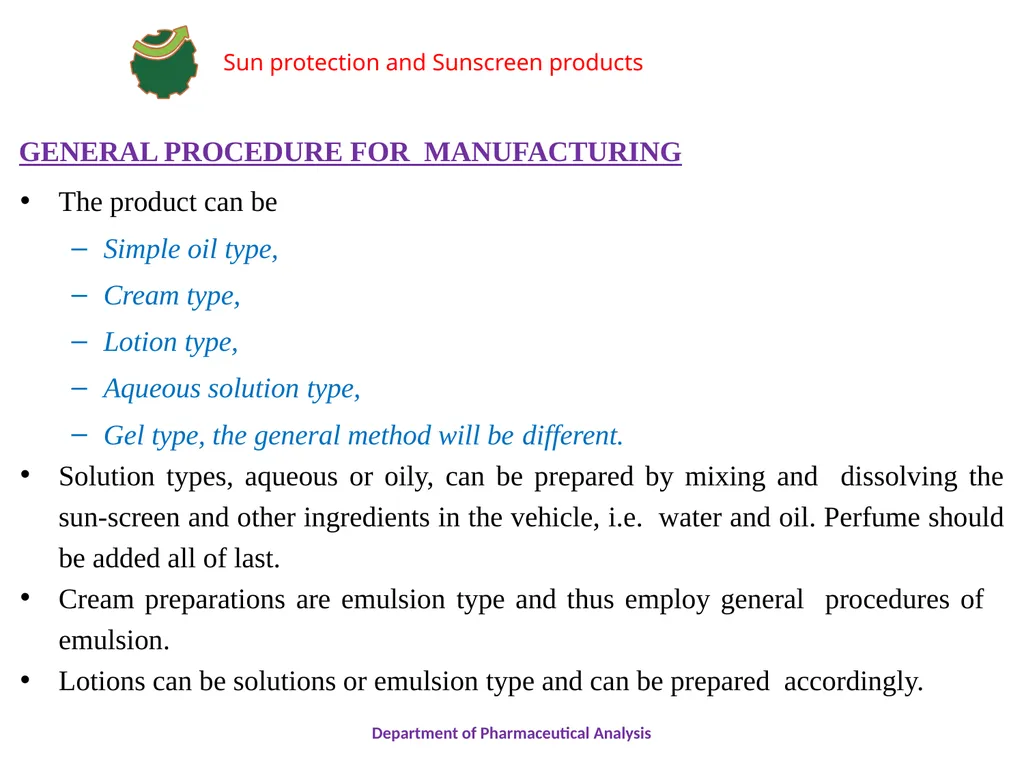
GENERAL PROCEDURE FOR MANUFACTURING
The product can be
Simple oil type,
Cream type,
Lotion type,
Aqueous solution type,
Gel type, the general method will be different.
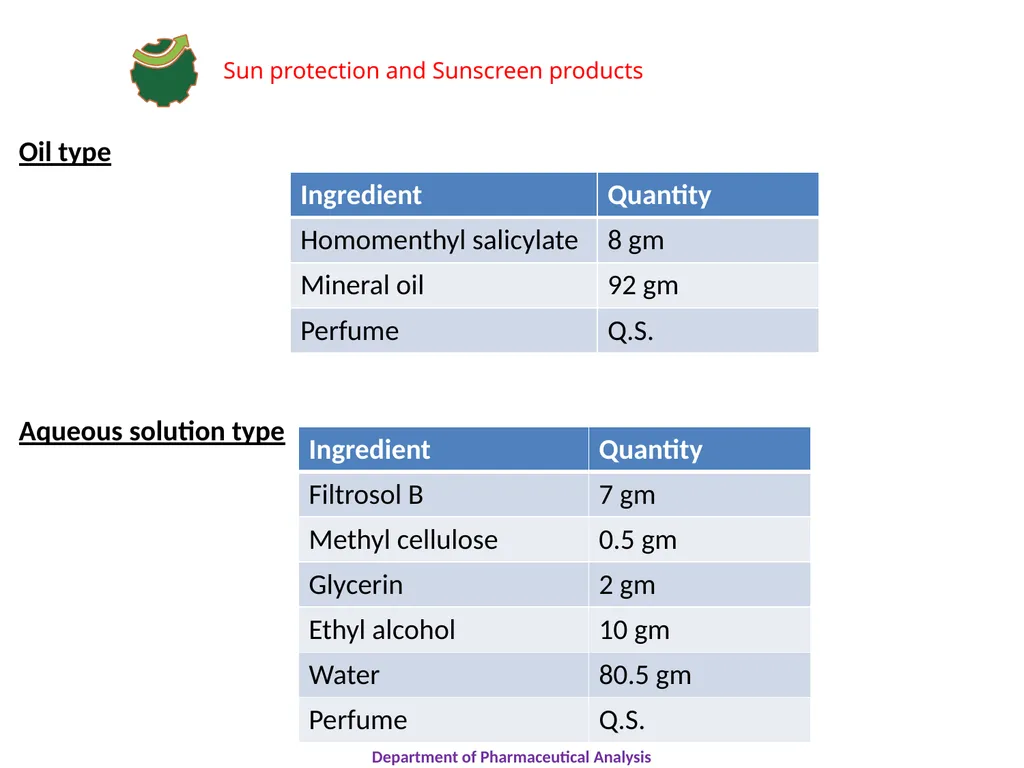
Solution types, aqueous or oily, can be prepared by mixing and dissolving the sun-screen and other ingredients in the vehicle, i.e. water and oil. Perfume should be added all of last.
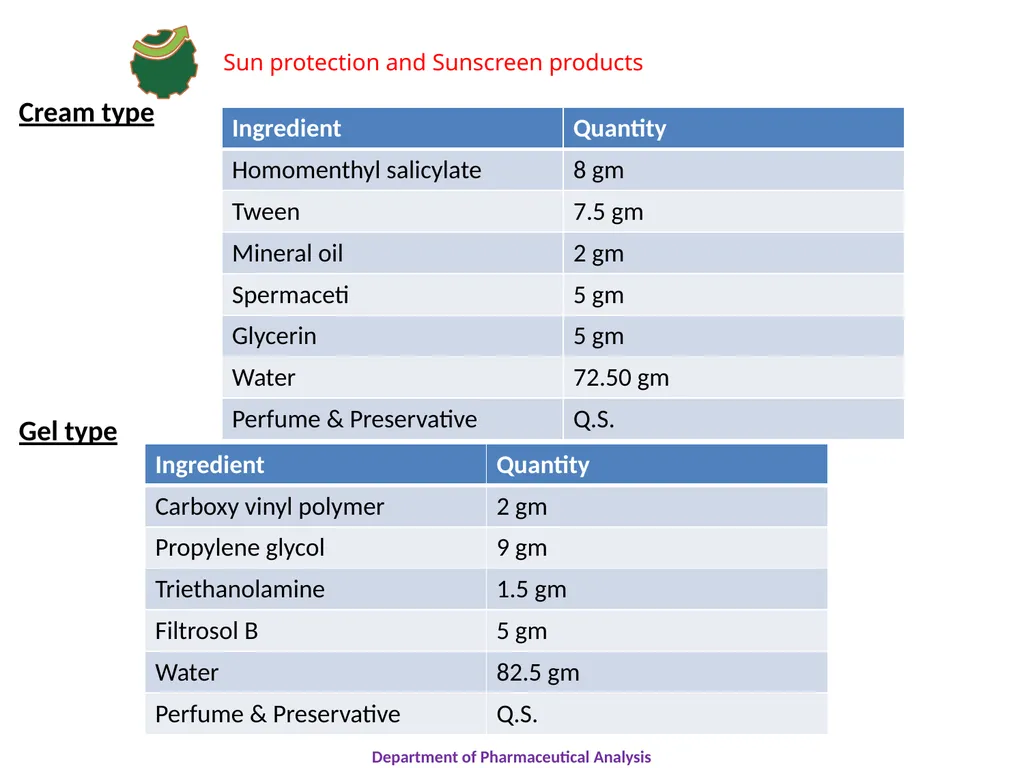
Cream preparations are emulsion type and thus employ general procedures of emulsion.
Lotions can be solutions or emulsion type and can be prepared accordingly. Department of Pharmaceutical Analysis Sun protection and Sunscreen products<br>
The product can be
Simple oil type,
Cream type,
Lotion type,
Aqueous solution type,
Gel type, the general method will be different.
Solution types, aqueous or oily, can be prepared by mixing and dissolving the sun-screen and other ingredients in the vehicle, i.e. water and oil. Perfume should be added all of last.
Cream preparations are emulsion type and thus employ general procedures of emulsion.
Lotions can be solutions or emulsion type and can be prepared accordingly. Department of Pharmaceutical Analysis Sun protection and Sunscreen products<br>
13
Oil type
Aqueous solution type Department of Pharmaceutical Analysis Sun protection and Sunscreen products<br>
Aqueous solution type Department of Pharmaceutical Analysis Sun protection and Sunscreen products<br>
14
Cream type
Gel type Department of Pharmaceutical Analysis Sun protection and Sunscreen products<br>
Gel type Department of Pharmaceutical Analysis Sun protection and Sunscreen products<br>
15
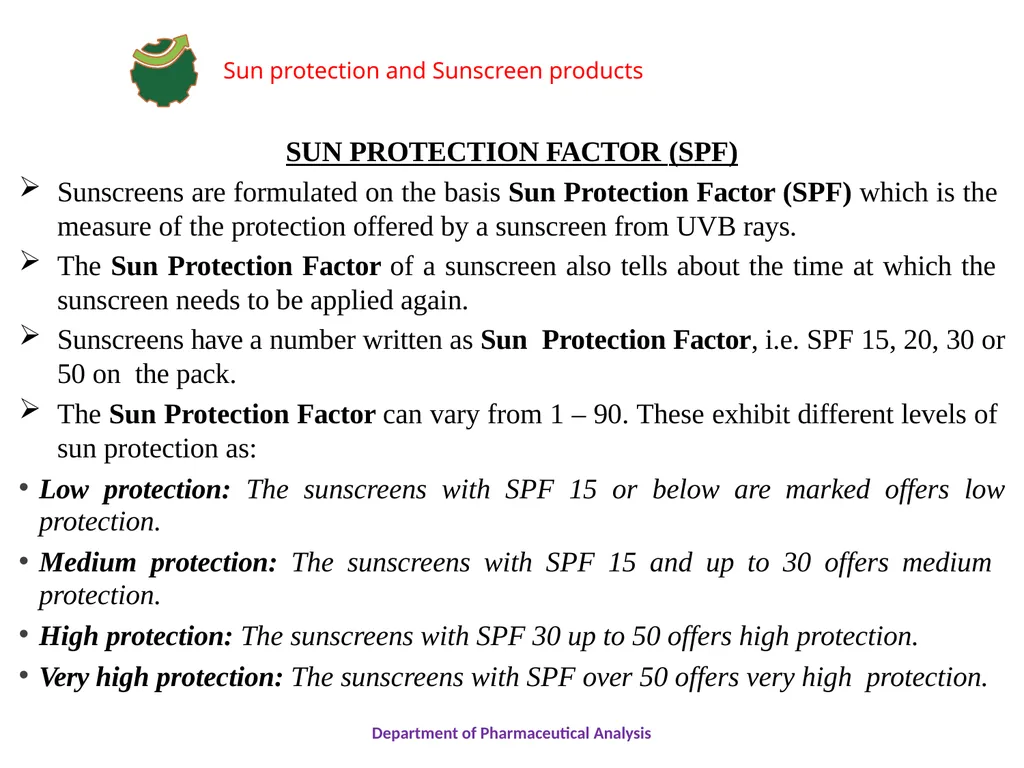
SUN PROTECTION FACTOR (SPF)
Sunscreens are formulated on the basis Sun Protection Factor (SPF) which is the measure of the protection offered by a sunscreen from UVB rays.
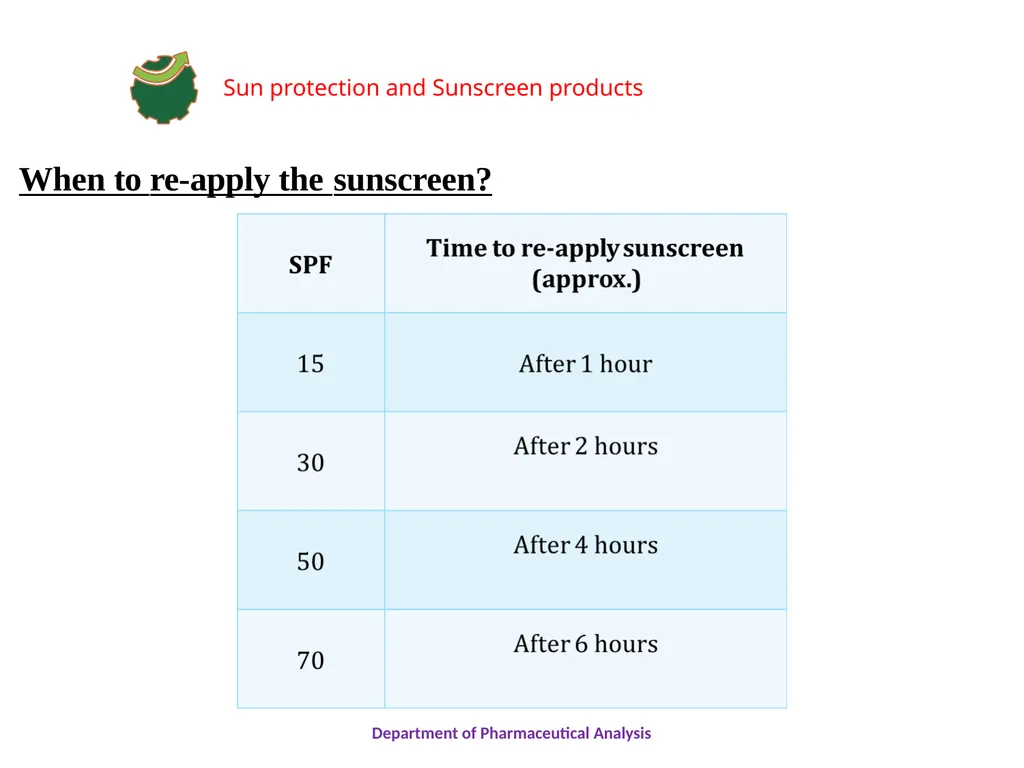
The Sun Protection Factor of a sunscreen also tells about the time at which the sunscreen needs to be applied again.
Sunscreens have a number written as Sun Protection Factor, i.e. SPF 15, 20, 30 or 50 on the pack.
The Sun Protection Factor can vary from 1 – 90. These exhibit different levels of sun protection as:
Low protection: The sunscreens with SPF 15 or below are marked offers low protection.
Medium protection: The sunscreens with SPF 15 and up to 30 offers medium protection.
High protection: The sunscreens with SPF 30 up to 50 offers high protection.
Very high protection: The sunscreens with SPF over 50 offers very high protection. Department of Pharmaceutical Analysis Sun protection and Sunscreen products<br>
Sunscreens are formulated on the basis Sun Protection Factor (SPF) which is the measure of the protection offered by a sunscreen from UVB rays.
The Sun Protection Factor of a sunscreen also tells about the time at which the sunscreen needs to be applied again.
Sunscreens have a number written as Sun Protection Factor, i.e. SPF 15, 20, 30 or 50 on the pack.
The Sun Protection Factor can vary from 1 – 90. These exhibit different levels of sun protection as:
Low protection: The sunscreens with SPF 15 or below are marked offers low protection.
Medium protection: The sunscreens with SPF 15 and up to 30 offers medium protection.
High protection: The sunscreens with SPF 30 up to 50 offers high protection.
Very high protection: The sunscreens with SPF over 50 offers very high protection. Department of Pharmaceutical Analysis Sun protection and Sunscreen products<br>
16
When to re-apply the sunscreen? Department of Pharmaceutical Analysis Sun protection and Sunscreen products<br>
17
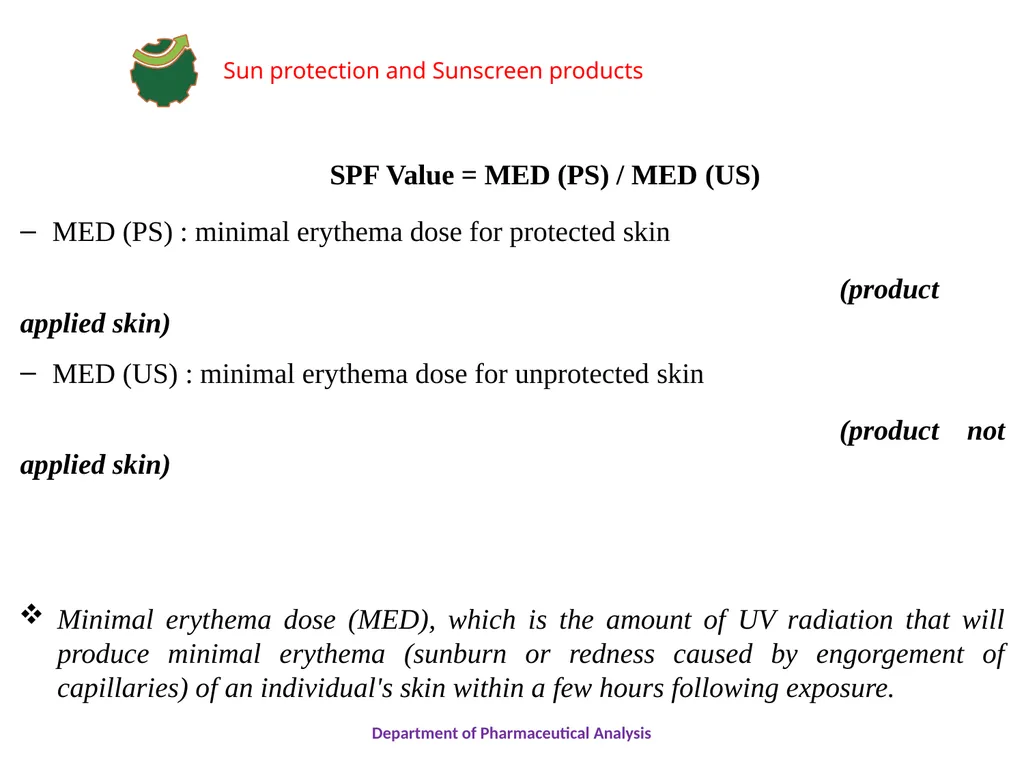
SPF Value = MED (PS) / MED (US)
MED (PS) : minimal erythema dose for protected skin
(product applied skin)
MED (US) : minimal erythema dose for unprotected skin
(product not applied skin)
Minimal erythema dose (MED), which is the amount of UV radiation that will produce minimal erythema (sunburn or redness caused by engorgement of capillaries) of an individual's skin within a few hours following exposure. Department of Pharmaceutical Analysis Sun protection and Sunscreen products<br>
MED (PS) : minimal erythema dose for protected skin
(product applied skin)
MED (US) : minimal erythema dose for unprotected skin
(product not applied skin)
Minimal erythema dose (MED), which is the amount of UV radiation that will produce minimal erythema (sunburn or redness caused by engorgement of capillaries) of an individual's skin within a few hours following exposure. Department of Pharmaceutical Analysis Sun protection and Sunscreen products<br>
18
No doubt a high Sun Protection Factor can protect the skin from sunburn-causing UVB rays, but our skin also needs UVA protection.
The protection grade of UVA rays is denoted by PA in the sunscreen. PA is levelled by PA+, PA++, PA+++; the more the plus signs, the more is the protection from UVA rays.
These days not only the UV rays but IR rays and Urban Pollution have become the concern for the skin. So, a sunscreen should offer protection against all of these harmful environmental factors.
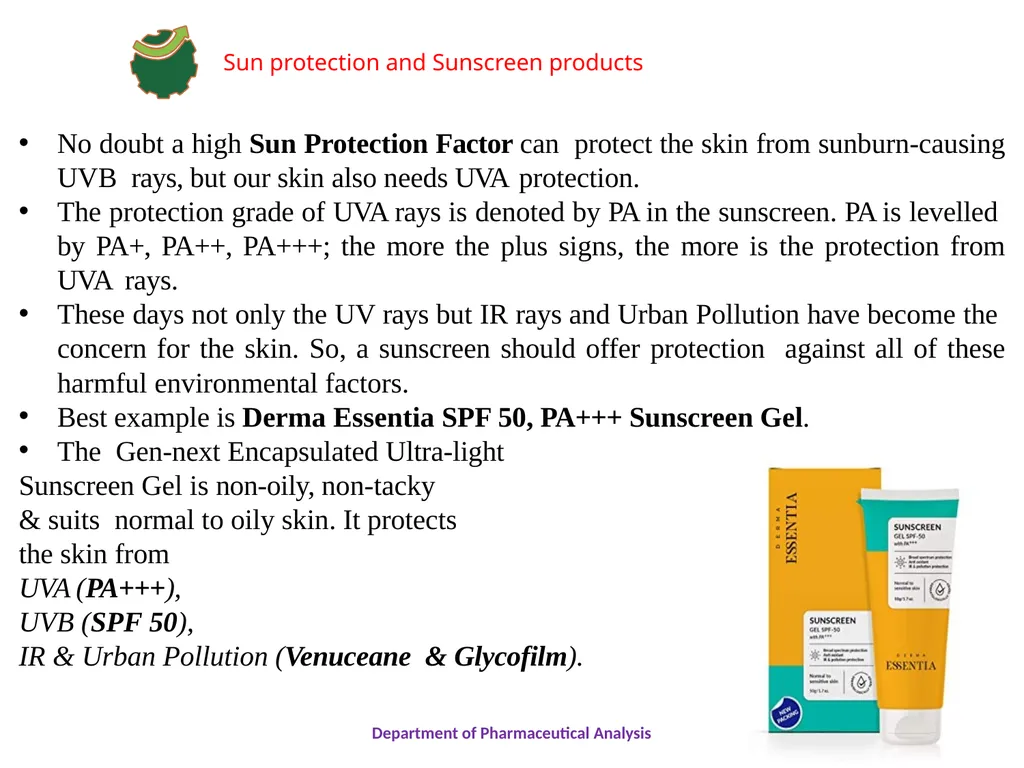
Best example is Derma Essentia SPF 50, PA+++ Sunscreen Gel.
The Gen-next Encapsulated Ultra-light
Sunscreen Gel is non-oily, non-tacky
& suits normal to oily skin. It protects
the skin from
UVA (PA+++),
UVB (SPF 50),
IR & Urban Pollution (Venuceane & Glycofilm). Department of Pharmaceutical Analysis Sun protection and Sunscreen products<br>
The protection grade of UVA rays is denoted by PA in the sunscreen. PA is levelled by PA+, PA++, PA+++; the more the plus signs, the more is the protection from UVA rays.
These days not only the UV rays but IR rays and Urban Pollution have become the concern for the skin. So, a sunscreen should offer protection against all of these harmful environmental factors.
Best example is Derma Essentia SPF 50, PA+++ Sunscreen Gel.
The Gen-next Encapsulated Ultra-light
Sunscreen Gel is non-oily, non-tacky
& suits normal to oily skin. It protects
the skin from
UVA (PA+++),
UVB (SPF 50),
IR & Urban Pollution (Venuceane & Glycofilm). Department of Pharmaceutical Analysis Sun protection and Sunscreen products<br>