
Surviving your final essay Part 1: Improving Essay
Description: Surviving your final essay Part 1: Improving Essay Content and structure Introductions Body paragraphs Conclusions 3 steps to a great INTRODUCTION Opening SentenceHook: Usually the first sentence, get our attention, peak the readers
Related Topics
Download Presentation
"Surviving your final essay Part 1: Improving Essay" is the property of its rightful owner. Permission is granted to download and print the materials on this website for personal, non-commercial use only, and to display it on your personal computer provided you do not modify the materials and that you retain all copyright notices contained in the materials. By downloading content from our website, you accept the terms of this agreement.
Presentation Transcript
slide1. Surviving your final essay<br>
slide2. Part 1: Improving Essay Content and structure Introductions
Body paragraphs
Conclusions<br>
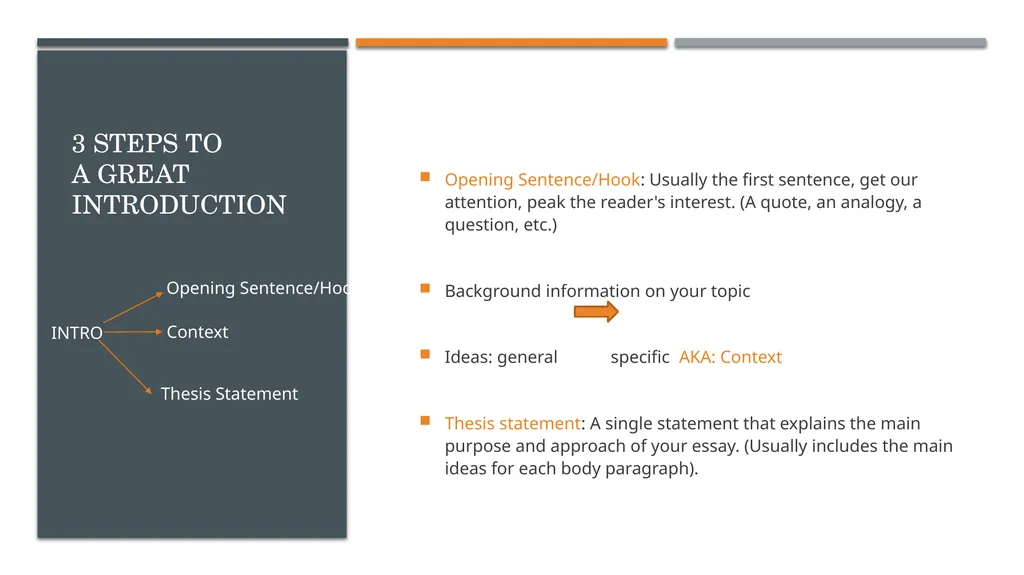
slide3. 3 steps to a great INTRODUCTION Opening Sentence/Hook: Usually the first sentence, get our attention, peak the reader's interest. (A quote, an analogy, a question, etc.)
Background information on your topic
Ideas: general specific AKA: Context
Thesis statement: A single statement that explains the main purpose and approach of your essay. (Usually includes the main ideas for each body paragraph). INTRO Opening Sentence/Hook Context Thesis Statement<br>
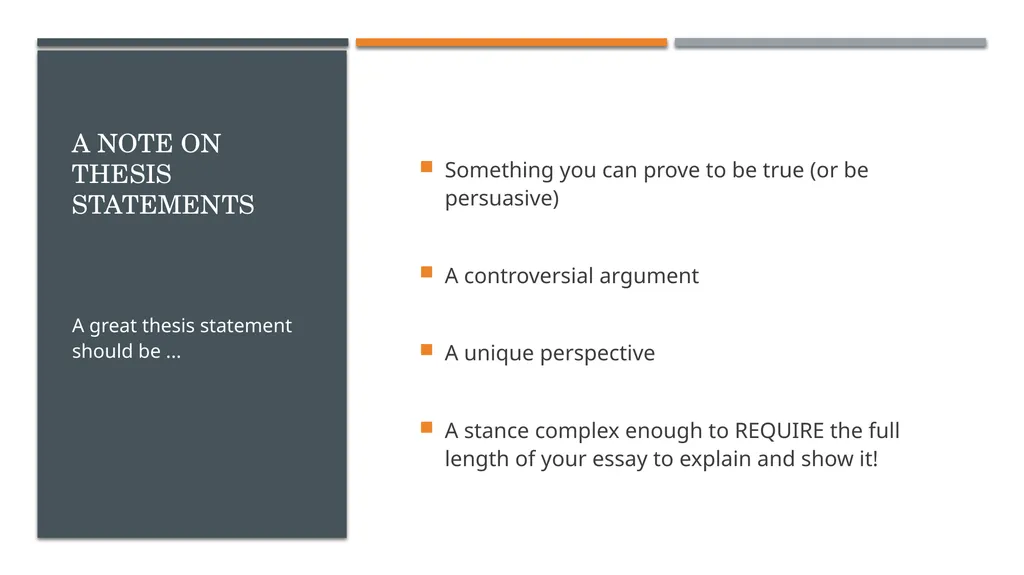
slide4. A note on Thesis statements Something you can prove to be true (or be persuasive)
A controversial argument
A unique perspective
A stance complex enough to REQUIRE the full length of your essay to explain and show it! A great thesis statement should be ...<br>
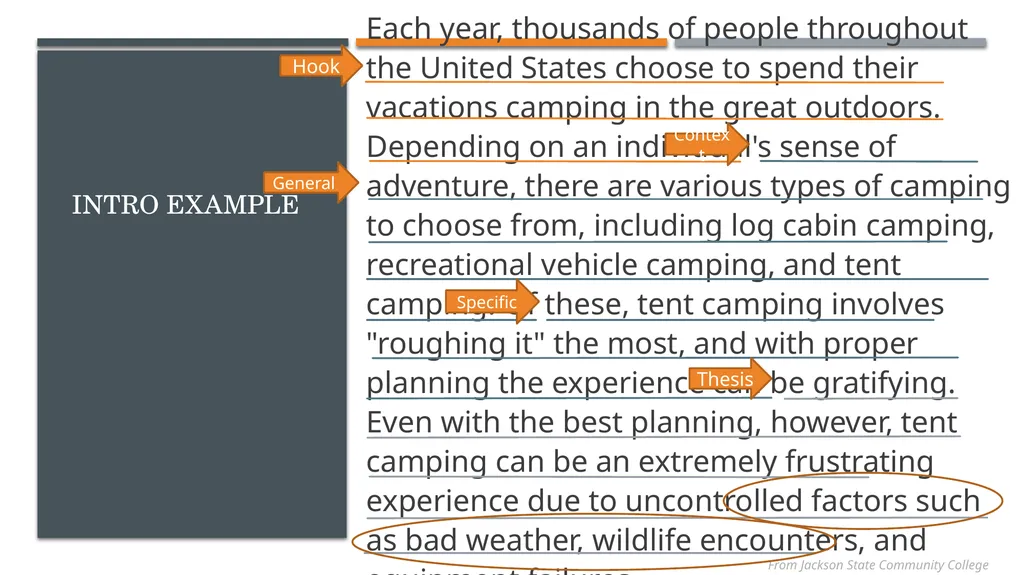
slide5. Intro Example Each year, thousands of people throughout the United States choose to spend their vacations camping in the great outdoors. Depending on an individual's sense of adventure, there are various types of camping to choose from, including log cabin camping, recreational vehicle camping, and tent camping. Of these, tent camping involves "roughing it" the most, and with proper planning the experience can be gratifying. Even with the best planning, however, tent camping can be an extremely frustrating experience due to uncontrolled factors such as bad weather, wildlife encounters, and equipment failures. From Jackson State Community College Hook Context General Specific Thesis<br>
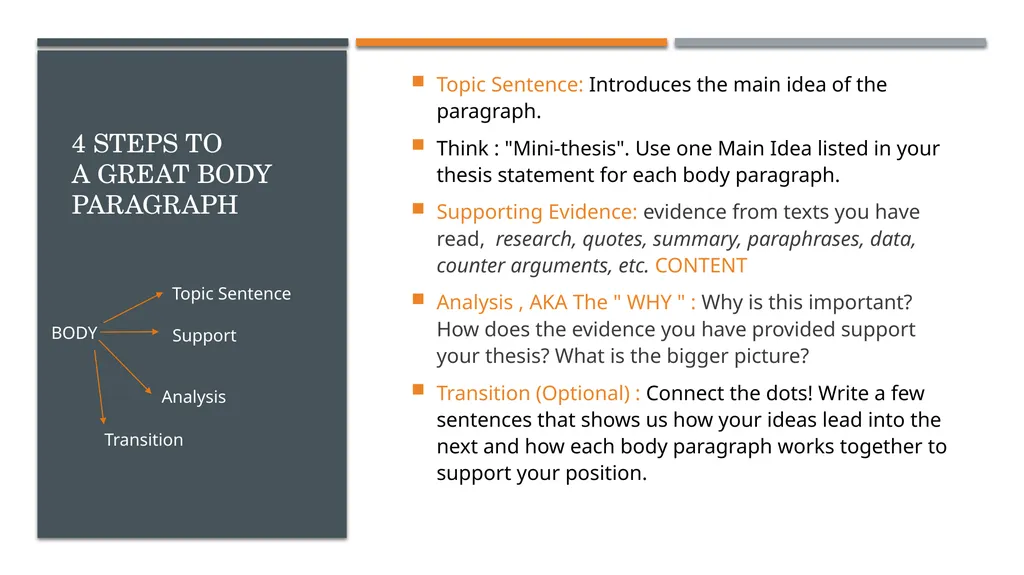
slide6. 4 steps to a great Body Paragraph Topic Sentence: Introduces the main idea of the paragraph.
Think : "Mini-thesis". Use one Main Idea listed in your thesis statement for each body paragraph.
Supporting Evidence: evidence from texts you have read, research, quotes, summary, paraphrases, data, counter arguments, etc. CONTENT
Analysis , AKA The " WHY " : Why is this important? How does the evidence you have provided support your thesis? What is the bigger picture?
Transition (Optional) : Connect the dots! Write a few sentences that shows us how your ideas lead into the next and how each body paragraph works together to support your position. BODY Topic Sentence Support Analysis Transition<br>
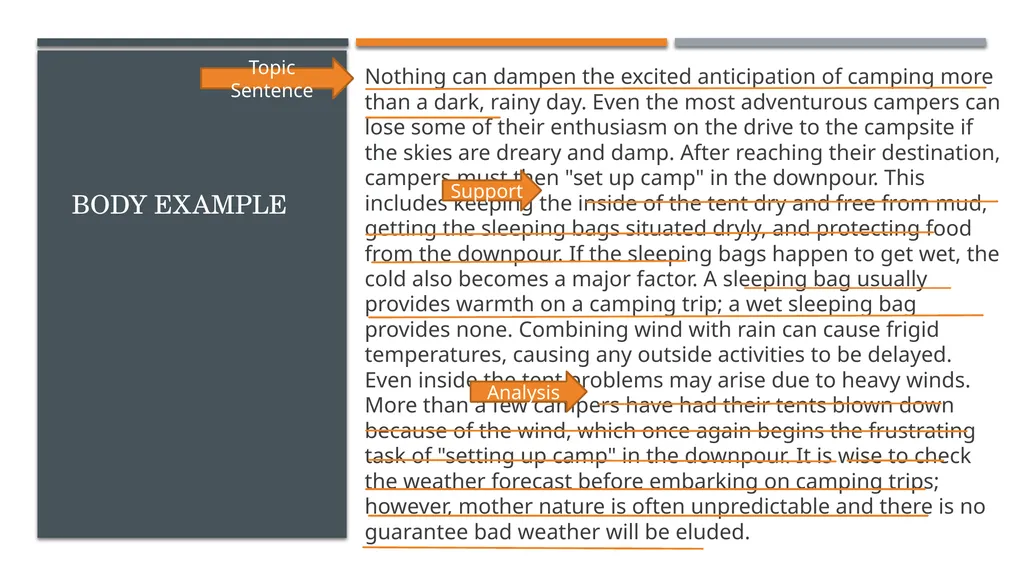
slide7. Body Example Nothing can dampen the excited anticipation of camping more than a dark, rainy day. Even the most adventurous campers can lose some of their enthusiasm on the drive to the campsite if the skies are dreary and damp. After reaching their destination, campers must then "set up camp" in the downpour. This includes keeping the inside of the tent dry and free from mud, getting the sleeping bags situated dryly, and protecting food from the downpour. If the sleeping bags happen to get wet, the cold also becomes a major factor. A sleeping bag usually provides warmth on a camping trip; a wet sleeping bag provides none. Combining wind with rain can cause frigid temperatures, causing any outside activities to be delayed. Even inside the tent problems may arise due to heavy winds. More than a few campers have had their tents blown down because of the wind, which once again begins the frustrating task of "setting up camp" in the downpour. It is wise to check the weather forecast before embarking on camping trips; however, mother nature is often unpredictable and there is no guarantee bad weather will be eluded. Topic Sentence Support Analysis<br>
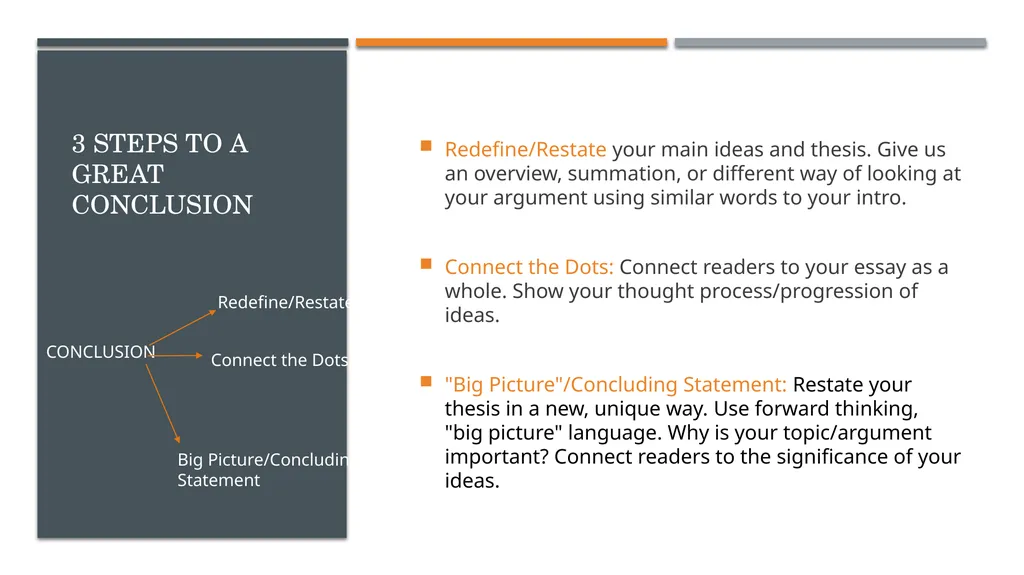
slide8. 3 Steps to a great Conclusion Redefine/Restate your main ideas and thesis. Give us an overview, summation, or different way of looking at your argument using similar words to your intro.
Connect the Dots: Connect readers to your essay as a whole. Show your thought process/progression of ideas.
"Big Picture"/Concluding Statement: Restate your thesis in a new, unique way. Use forward thinking, "big picture" language. Why is your topic/argument important? Connect readers to the significance of your ideas. CONCLUSION Connect the Dots Redefine/Restate Big Picture/Concluding Statement<br>
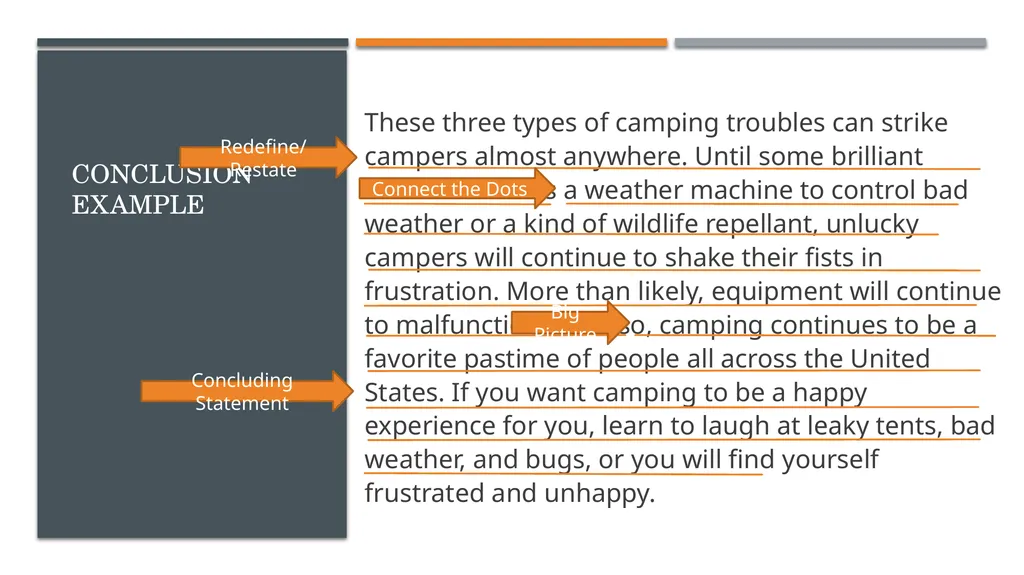
slide9. Conclusion example These three types of camping troubles can strike campers almost anywhere. Until some brilliant scientist invents a weather machine to control bad weather or a kind of wildlife repellant, unlucky campers will continue to shake their fists in frustration. More than likely, equipment will continue to malfunction. Even so, camping continues to be a favorite pastime of people all across the United States. If you want camping to be a happy experience for you, learn to laugh at leaky tents, bad weather, and bugs, or you will find yourself frustrated and unhappy. Redefine/Restate Connect the Dots Big Picture Concluding Statement<br>
slide10. Tips Reverse engineer your introduction and thesis
Write your body paragraphs first<br>
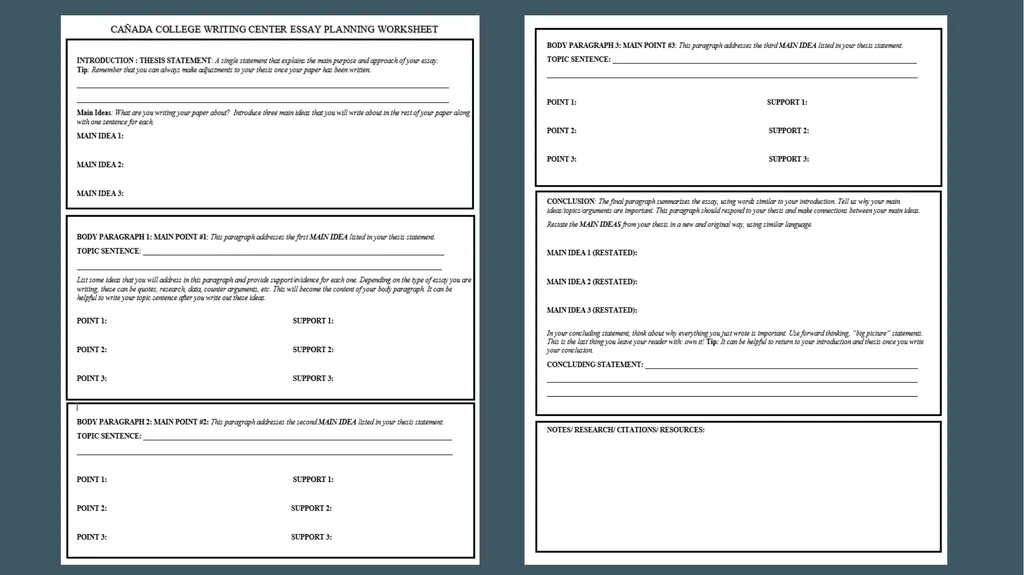
slide11. Part 2: Outlining How to use an outline to write your paper and organize your thoughts<br>
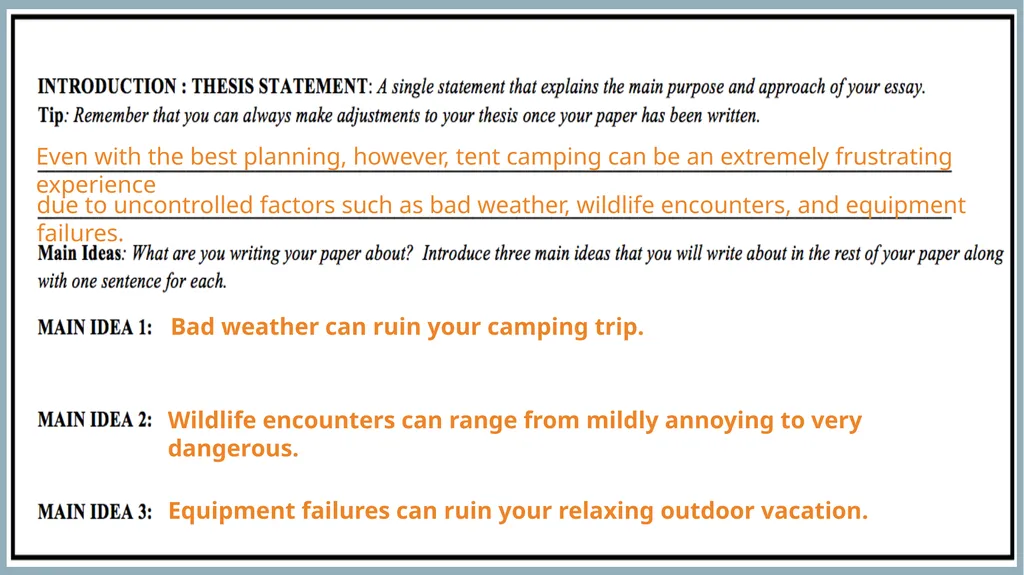
slide13. Even with the best planning, however, tent camping can be an extremely frustrating experience due to uncontrolled factors such as bad weather, wildlife encounters, and equipment failures. Bad weather can ruin your camping trip. Wildlife encounters can range from mildly annoying to very dangerous. Equipment failures can ruin your relaxing outdoor vacation.<br>
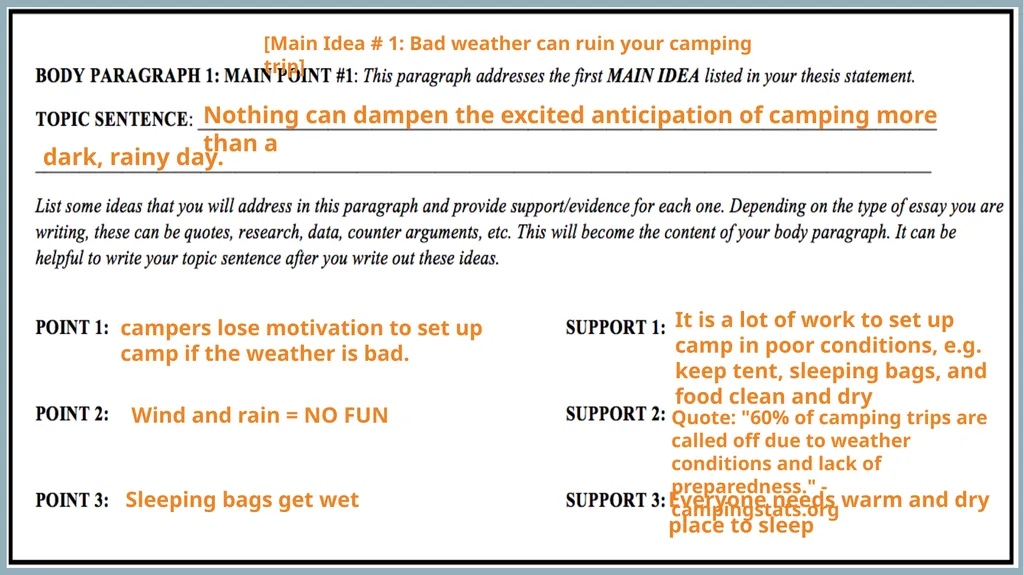
slide14. [Main Idea # 1: Bad weather can ruin your camping trip] Nothing can dampen the excited anticipation of camping more than a dark, rainy day. campers lose motivation to set up camp if the weather is bad. It is a lot of work to set up camp in poor conditions, e.g. keep tent, sleeping bags, and food clean and dry Wind and rain = NO FUN Quote: "60% of camping trips are called off due to weather conditions and lack of preparedness." - campingstats.org Sleeping bags get wet Everyone needs warm and dry place to sleep<br>
slide15. Try it! Take out your essay prompt and let's try to fill out some of your outline worksheet<br>
slide16. Part 3: Quoting and citing In text-citations
Using MLA
APA/Chicago resources<br>
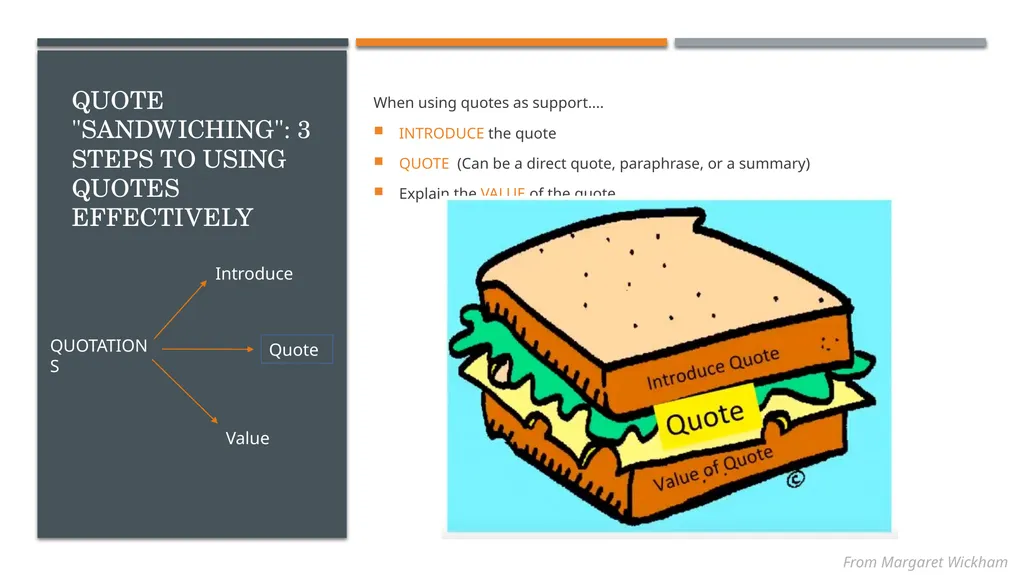
slide17. Quote "Sandwiching": 3 steps to using quotes effectively When using quotes as support....
INTRODUCE the quote
QUOTE (Can be a direct quote, paraphrase, or a summary)
Explain the VALUE of the quote Introduce QUOTATIONS Quote Value From Margaret Wickham<br>
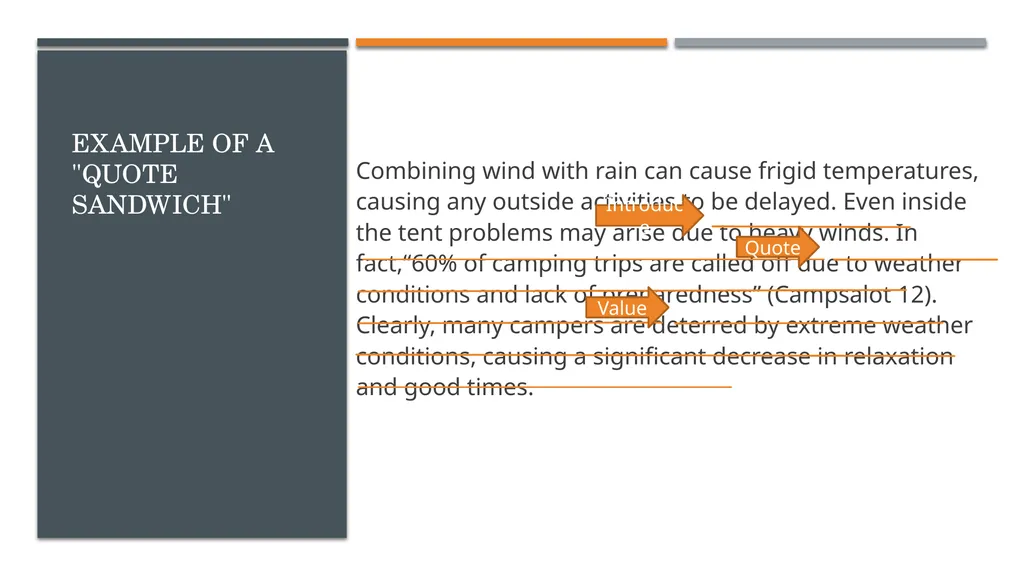
slide18. Example of A "quote Sandwich" Combining wind with rain can cause frigid temperatures, causing any outside activities to be delayed. Even inside the tent problems may arise due to heavy winds. In fact,“60% of camping trips are called off due to weather conditions and lack of preparedness” (Campsalot 12). Clearly, many campers are deterred by extreme weather conditions, causing a significant decrease in relaxation and good times. Introduce Quote Value<br>
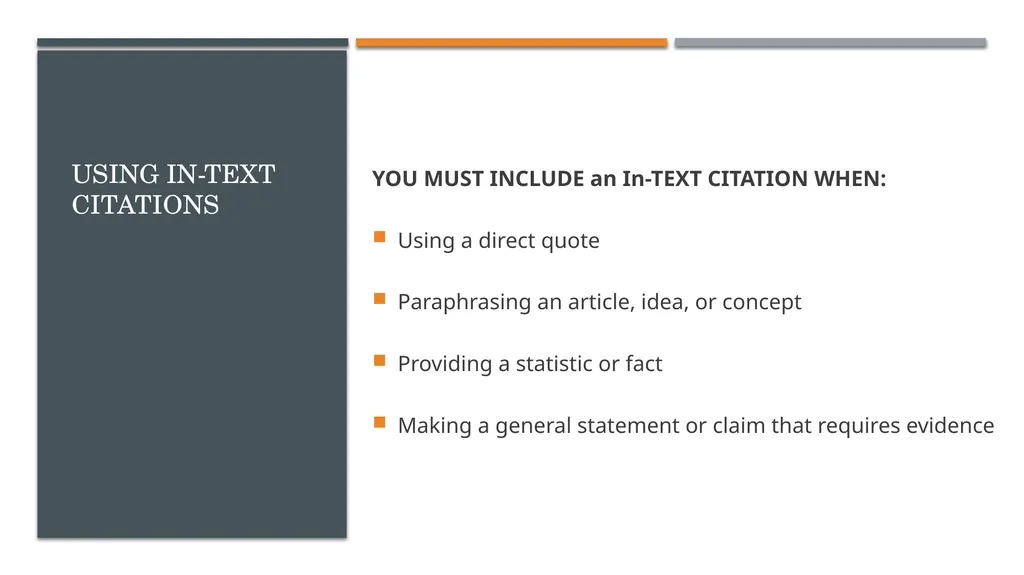
slide19. Using In-text citations YOU MUST INCLUDE an In-TEXT CITATION WHEN:
Using a direct quote
Paraphrasing an article, idea, or concept
Providing a statistic or fact
Making a general statement or claim that requires evidence<br>
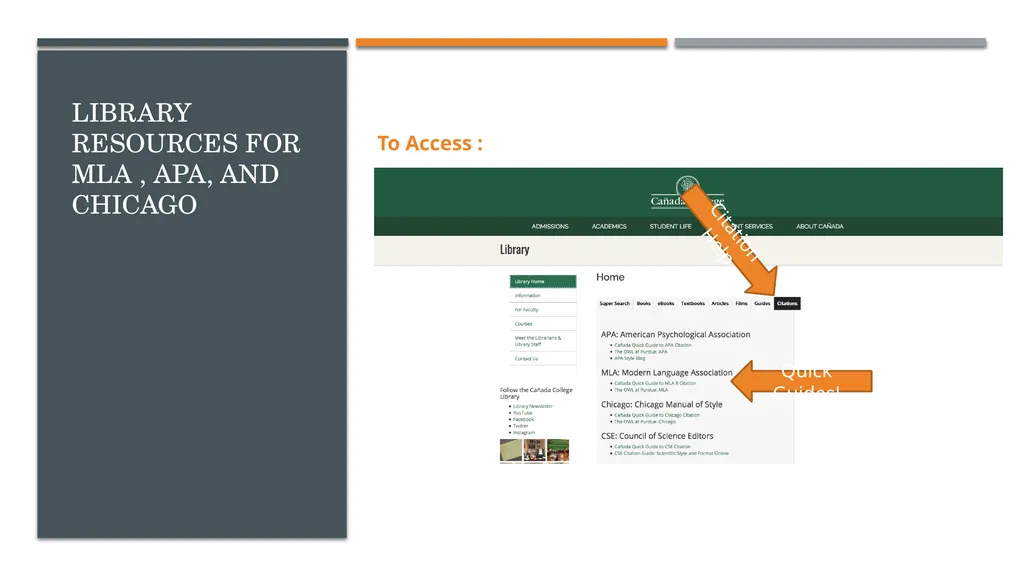
slide20. Library resources for MLA , APA, and chicago To Access :
https://canadacollege.edu/library/index.php Citation Help Quick Guides!<br>
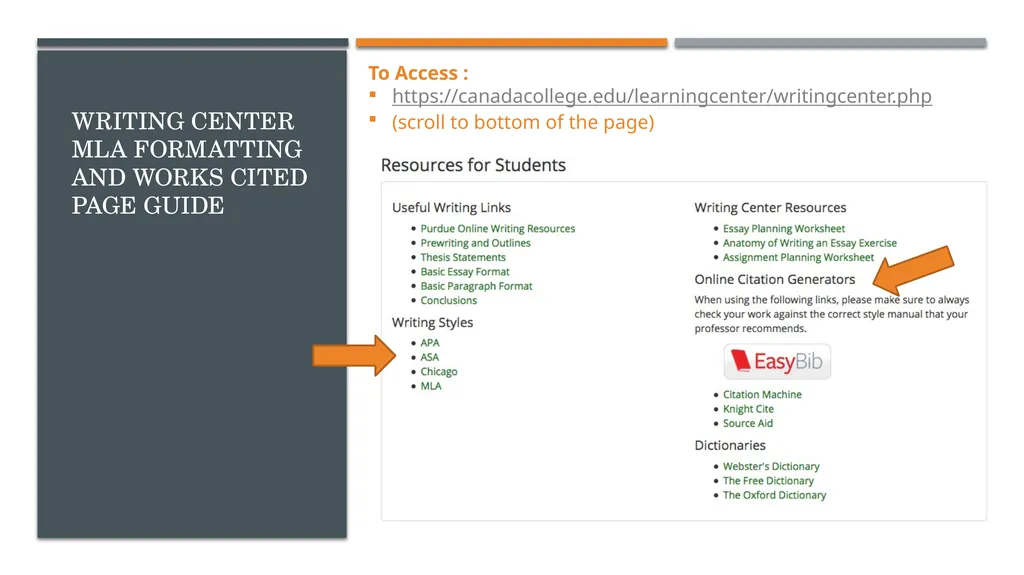
slide21. Writing center MLA Formatting and works cited page guide To Access :
https://canadacollege.edu/learningcenter/writingcenter.php
(scroll to bottom of the page)<br>
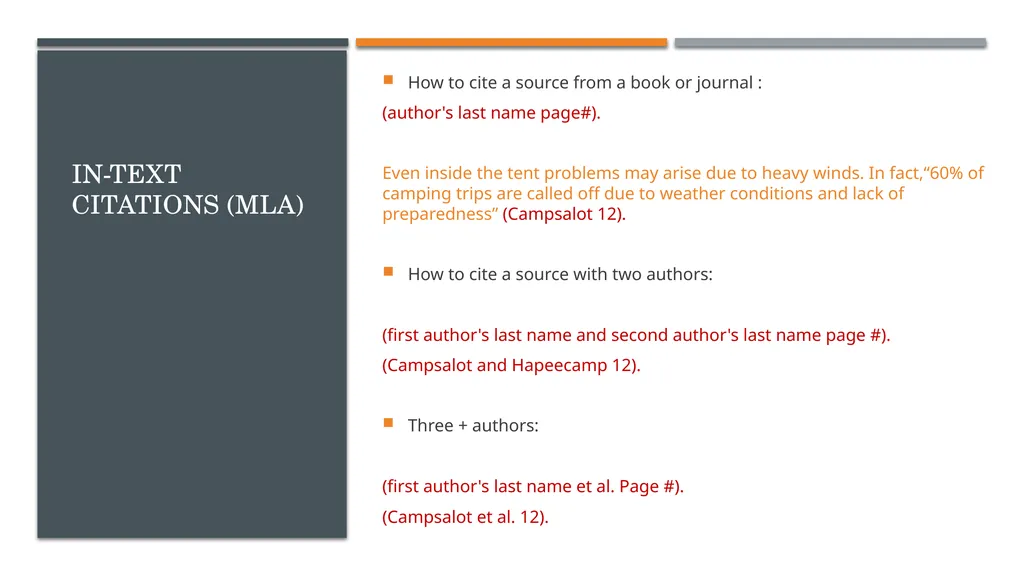
slide22. In-text citations (MLA) How to cite a source from a book or journal :
(author's last name page#).
Even inside the tent problems may arise due to heavy winds. In fact,“60% of camping trips are called off due to weather conditions and lack of preparedness” (Campsalot 12).
How to cite a source with two authors:
(first author's last name and second author's last name page #).
(Campsalot and Hapeecamp 12).
Three + authors:
(first author's last name et al. Page #).
(Campsalot et al. 12).<br>
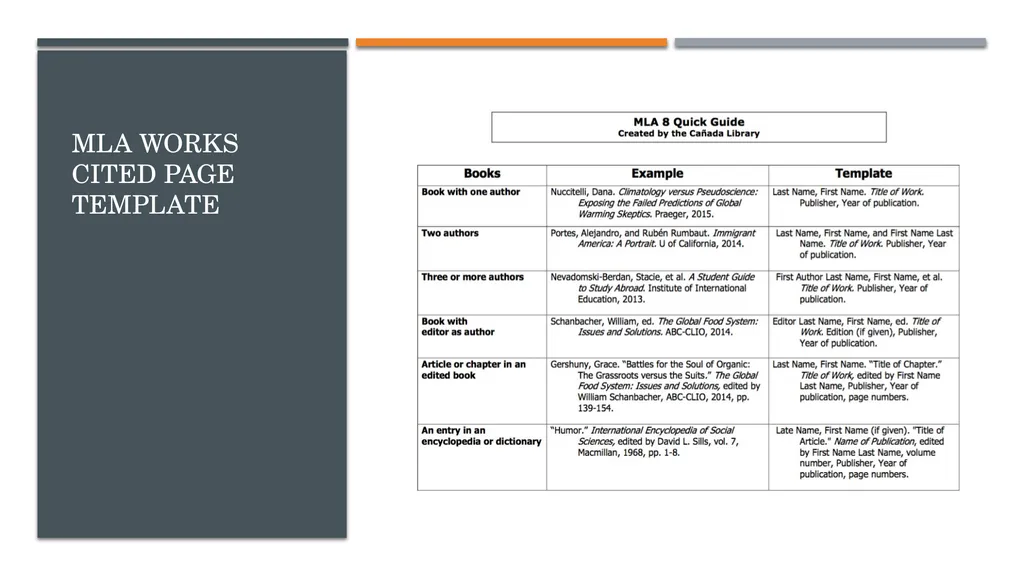
slide23. MLA Works Cited page template<br>
slide24. Cite it! Book :
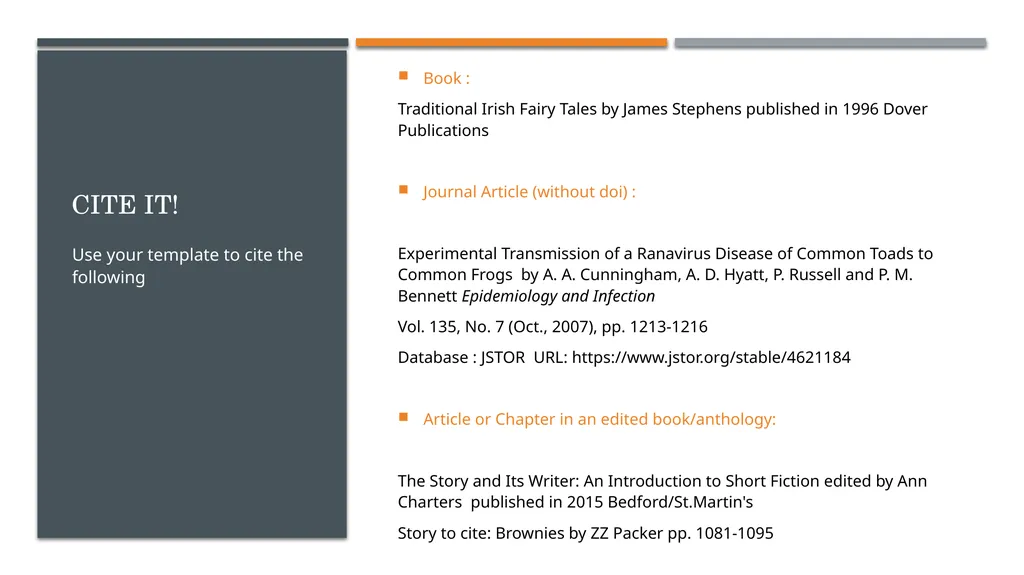
Traditional Irish Fairy Tales by James Stephens published in 1996 Dover Publications
Journal Article (without doi) :
Experimental Transmission of a Ranavirus Disease of Common Toads to Common Frogs by A. A. Cunningham, A. D. Hyatt, P. Russell and P. M. Bennett Epidemiology and Infection
Vol. 135, No. 7 (Oct., 2007), pp. 1213-1216
Database : JSTOR URL: https://www.jstor.org/stable/4621184
Article or Chapter in an edited book/anthology:
The Story and Its Writer: An Introduction to Short Fiction edited by Ann Charters published in 2015 Bedford/St.Martin's
Story to cite: Brownies by ZZ Packer pp. 1081-1095 Use your template to cite the following<br>
slide25. HOw Did you do? Book :
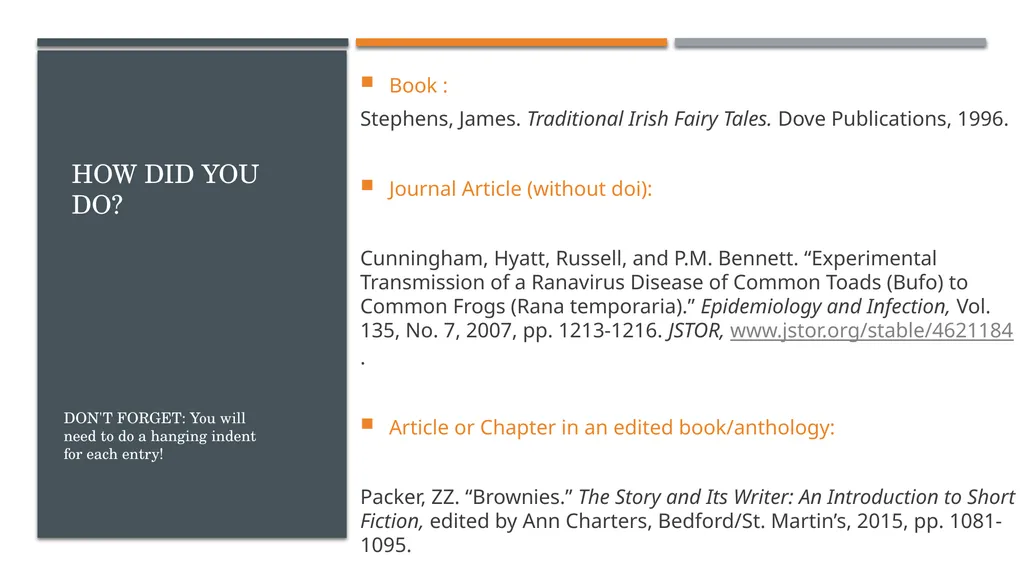
Stephens, James. Traditional Irish Fairy Tales. Dove Publications, 1996.
Journal Article (without doi):
Cunningham, Hyatt, Russell, and P.M. Bennett. “Experimental Transmission of a Ranavirus Disease of Common Toads (Bufo) to Common Frogs (Rana temporaria).” Epidemiology and Infection, Vol. 135, No. 7, 2007, pp. 1213-1216. JSTOR, www.jstor.org/stable/4621184.
Article or Chapter in an edited book/anthology:
Packer, ZZ. “Brownies.” The Story and Its Writer: An Introduction to Short Fiction, edited by Ann Charters, Bedford/St. Martin’s, 2015, pp. 1081-1095. DON'T FORGET: You will need to do a hanging indent for each entry!<br>
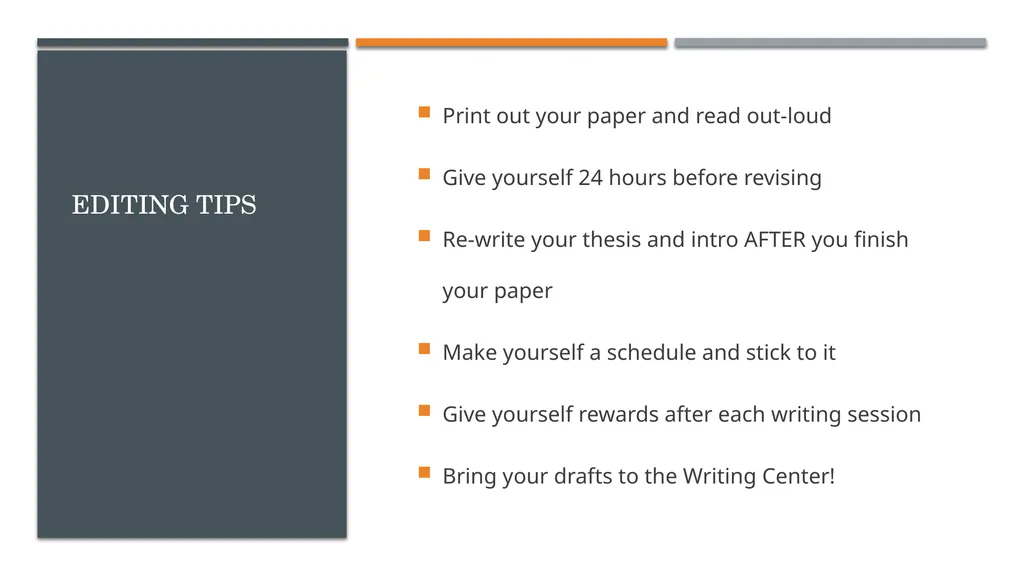
slide26. Editing tips Print out your paper and read out-loud
Give yourself 24 hours before revising
Re-write your thesis and intro AFTER you finish your paper
Make yourself a schedule and stick to it
Give yourself rewards after each writing session
Bring your drafts to the Writing Center!<br>
slide2. Part 1: Improving Essay Content and structure Introductions
Body paragraphs
Conclusions<br>
slide3. 3 steps to a great INTRODUCTION Opening Sentence/Hook: Usually the first sentence, get our attention, peak the reader's interest. (A quote, an analogy, a question, etc.)
Background information on your topic
Ideas: general specific AKA: Context
Thesis statement: A single statement that explains the main purpose and approach of your essay. (Usually includes the main ideas for each body paragraph). INTRO Opening Sentence/Hook Context Thesis Statement<br>
slide4. A note on Thesis statements Something you can prove to be true (or be persuasive)
A controversial argument
A unique perspective
A stance complex enough to REQUIRE the full length of your essay to explain and show it! A great thesis statement should be ...<br>
slide5. Intro Example Each year, thousands of people throughout the United States choose to spend their vacations camping in the great outdoors. Depending on an individual's sense of adventure, there are various types of camping to choose from, including log cabin camping, recreational vehicle camping, and tent camping. Of these, tent camping involves "roughing it" the most, and with proper planning the experience can be gratifying. Even with the best planning, however, tent camping can be an extremely frustrating experience due to uncontrolled factors such as bad weather, wildlife encounters, and equipment failures. From Jackson State Community College Hook Context General Specific Thesis<br>
slide6. 4 steps to a great Body Paragraph Topic Sentence: Introduces the main idea of the paragraph.
Think : "Mini-thesis". Use one Main Idea listed in your thesis statement for each body paragraph.
Supporting Evidence: evidence from texts you have read, research, quotes, summary, paraphrases, data, counter arguments, etc. CONTENT
Analysis , AKA The " WHY " : Why is this important? How does the evidence you have provided support your thesis? What is the bigger picture?
Transition (Optional) : Connect the dots! Write a few sentences that shows us how your ideas lead into the next and how each body paragraph works together to support your position. BODY Topic Sentence Support Analysis Transition<br>
slide7. Body Example Nothing can dampen the excited anticipation of camping more than a dark, rainy day. Even the most adventurous campers can lose some of their enthusiasm on the drive to the campsite if the skies are dreary and damp. After reaching their destination, campers must then "set up camp" in the downpour. This includes keeping the inside of the tent dry and free from mud, getting the sleeping bags situated dryly, and protecting food from the downpour. If the sleeping bags happen to get wet, the cold also becomes a major factor. A sleeping bag usually provides warmth on a camping trip; a wet sleeping bag provides none. Combining wind with rain can cause frigid temperatures, causing any outside activities to be delayed. Even inside the tent problems may arise due to heavy winds. More than a few campers have had their tents blown down because of the wind, which once again begins the frustrating task of "setting up camp" in the downpour. It is wise to check the weather forecast before embarking on camping trips; however, mother nature is often unpredictable and there is no guarantee bad weather will be eluded. Topic Sentence Support Analysis<br>
slide8. 3 Steps to a great Conclusion Redefine/Restate your main ideas and thesis. Give us an overview, summation, or different way of looking at your argument using similar words to your intro.
Connect the Dots: Connect readers to your essay as a whole. Show your thought process/progression of ideas.
"Big Picture"/Concluding Statement: Restate your thesis in a new, unique way. Use forward thinking, "big picture" language. Why is your topic/argument important? Connect readers to the significance of your ideas. CONCLUSION Connect the Dots Redefine/Restate Big Picture/Concluding Statement<br>
slide9. Conclusion example These three types of camping troubles can strike campers almost anywhere. Until some brilliant scientist invents a weather machine to control bad weather or a kind of wildlife repellant, unlucky campers will continue to shake their fists in frustration. More than likely, equipment will continue to malfunction. Even so, camping continues to be a favorite pastime of people all across the United States. If you want camping to be a happy experience for you, learn to laugh at leaky tents, bad weather, and bugs, or you will find yourself frustrated and unhappy. Redefine/Restate Connect the Dots Big Picture Concluding Statement<br>
slide10. Tips Reverse engineer your introduction and thesis
Write your body paragraphs first<br>
slide11. Part 2: Outlining How to use an outline to write your paper and organize your thoughts<br>
slide13. Even with the best planning, however, tent camping can be an extremely frustrating experience due to uncontrolled factors such as bad weather, wildlife encounters, and equipment failures. Bad weather can ruin your camping trip. Wildlife encounters can range from mildly annoying to very dangerous. Equipment failures can ruin your relaxing outdoor vacation.<br>
slide14. [Main Idea # 1: Bad weather can ruin your camping trip] Nothing can dampen the excited anticipation of camping more than a dark, rainy day. campers lose motivation to set up camp if the weather is bad. It is a lot of work to set up camp in poor conditions, e.g. keep tent, sleeping bags, and food clean and dry Wind and rain = NO FUN Quote: "60% of camping trips are called off due to weather conditions and lack of preparedness." - campingstats.org Sleeping bags get wet Everyone needs warm and dry place to sleep<br>
slide15. Try it! Take out your essay prompt and let's try to fill out some of your outline worksheet<br>
slide16. Part 3: Quoting and citing In text-citations
Using MLA
APA/Chicago resources<br>
slide17. Quote "Sandwiching": 3 steps to using quotes effectively When using quotes as support....
INTRODUCE the quote
QUOTE (Can be a direct quote, paraphrase, or a summary)
Explain the VALUE of the quote Introduce QUOTATIONS Quote Value From Margaret Wickham<br>
slide18. Example of A "quote Sandwich" Combining wind with rain can cause frigid temperatures, causing any outside activities to be delayed. Even inside the tent problems may arise due to heavy winds. In fact,“60% of camping trips are called off due to weather conditions and lack of preparedness” (Campsalot 12). Clearly, many campers are deterred by extreme weather conditions, causing a significant decrease in relaxation and good times. Introduce Quote Value<br>
slide19. Using In-text citations YOU MUST INCLUDE an In-TEXT CITATION WHEN:
Using a direct quote
Paraphrasing an article, idea, or concept
Providing a statistic or fact
Making a general statement or claim that requires evidence<br>
slide20. Library resources for MLA , APA, and chicago To Access :
https://canadacollege.edu/library/index.php Citation Help Quick Guides!<br>
slide21. Writing center MLA Formatting and works cited page guide To Access :
https://canadacollege.edu/learningcenter/writingcenter.php
(scroll to bottom of the page)<br>
slide22. In-text citations (MLA) How to cite a source from a book or journal :
(author's last name page#).
Even inside the tent problems may arise due to heavy winds. In fact,“60% of camping trips are called off due to weather conditions and lack of preparedness” (Campsalot 12).
How to cite a source with two authors:
(first author's last name and second author's last name page #).
(Campsalot and Hapeecamp 12).
Three + authors:
(first author's last name et al. Page #).
(Campsalot et al. 12).<br>
slide23. MLA Works Cited page template<br>
slide24. Cite it! Book :
Traditional Irish Fairy Tales by James Stephens published in 1996 Dover Publications
Journal Article (without doi) :
Experimental Transmission of a Ranavirus Disease of Common Toads to Common Frogs by A. A. Cunningham, A. D. Hyatt, P. Russell and P. M. Bennett Epidemiology and Infection
Vol. 135, No. 7 (Oct., 2007), pp. 1213-1216
Database : JSTOR URL: https://www.jstor.org/stable/4621184
Article or Chapter in an edited book/anthology:
The Story and Its Writer: An Introduction to Short Fiction edited by Ann Charters published in 2015 Bedford/St.Martin's
Story to cite: Brownies by ZZ Packer pp. 1081-1095 Use your template to cite the following<br>
slide25. HOw Did you do? Book :
Stephens, James. Traditional Irish Fairy Tales. Dove Publications, 1996.
Journal Article (without doi):
Cunningham, Hyatt, Russell, and P.M. Bennett. “Experimental Transmission of a Ranavirus Disease of Common Toads (Bufo) to Common Frogs (Rana temporaria).” Epidemiology and Infection, Vol. 135, No. 7, 2007, pp. 1213-1216. JSTOR, www.jstor.org/stable/4621184.
Article or Chapter in an edited book/anthology:
Packer, ZZ. “Brownies.” The Story and Its Writer: An Introduction to Short Fiction, edited by Ann Charters, Bedford/St. Martin’s, 2015, pp. 1081-1095. DON'T FORGET: You will need to do a hanging indent for each entry!<br>
slide26. Editing tips Print out your paper and read out-loud
Give yourself 24 hours before revising
Re-write your thesis and intro AFTER you finish your paper
Make yourself a schedule and stick to it
Give yourself rewards after each writing session
Bring your drafts to the Writing Center!<br>