Susan Cartwright Our Evolving Universe 1 Introduction: The Night Sky What do we see in the night sky? the Moon moving planets occasional comets and meteors against a background of randomly scattered fixed stars and the band of the Milky
"Susan Cartwright Our Evolving Universe 1" is the property of its rightful owner. Permission is granted to
download and print the materials on this website for personal, non-commercial use only, and to display it
on your personal computer provided you do not modify the materials and that you retain all copyright
notices contained in the materials. By downloading content from our website, you accept the terms of this
agreement.
Presentation Transcript
01
Susan Cartwright Our Evolving Universe 1 Introduction: The Night Sky What do we see in the night sky?
the Moon
moving planets
occasional comets and meteors
against a background of randomly scattered “fixed” stars and the band of the Milky Way What do we see here on Earth?
a rocky planet with oceans and an atmosphere
life that has evolved for more than 3 billion years
What has this to do with the stars and the Milky Way?<br>
02
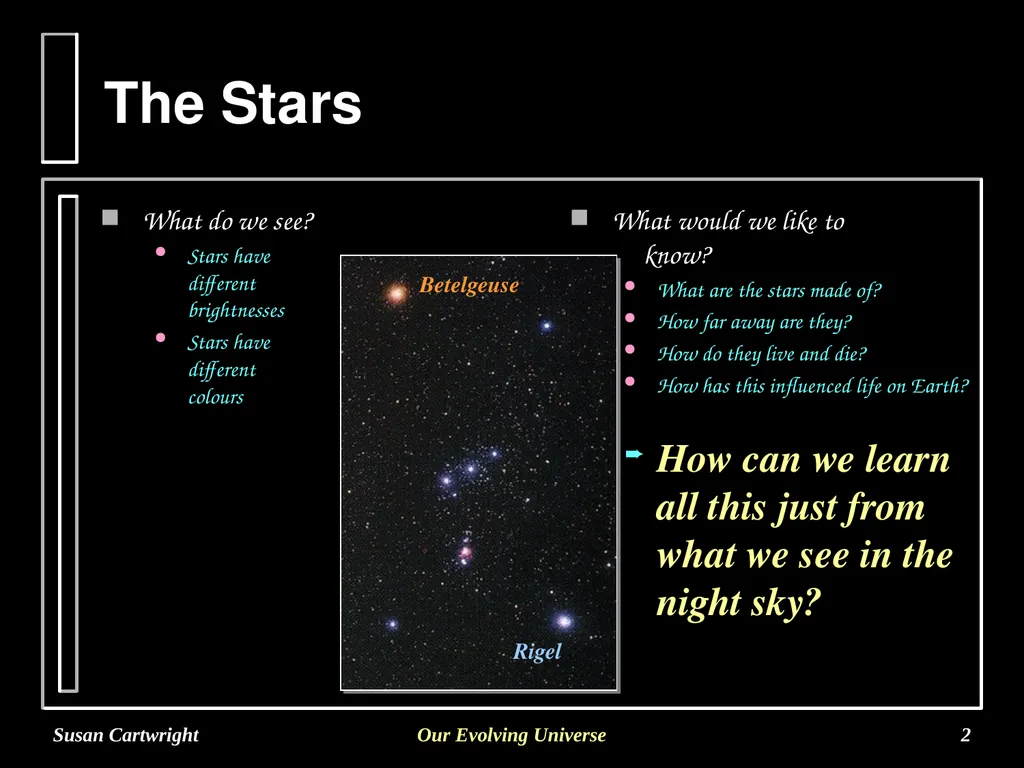
Susan Cartwright Our Evolving Universe 2 The Stars What do we see?
Stars have different brightnesses
Stars have different colours What would we like to know?
What are the stars made of?
How far away are they?
How do they live and die?
How has this influenced life on Earth?
How can we learn all this just from what we see in the night sky? Betelgeuse Rigel<br>
03
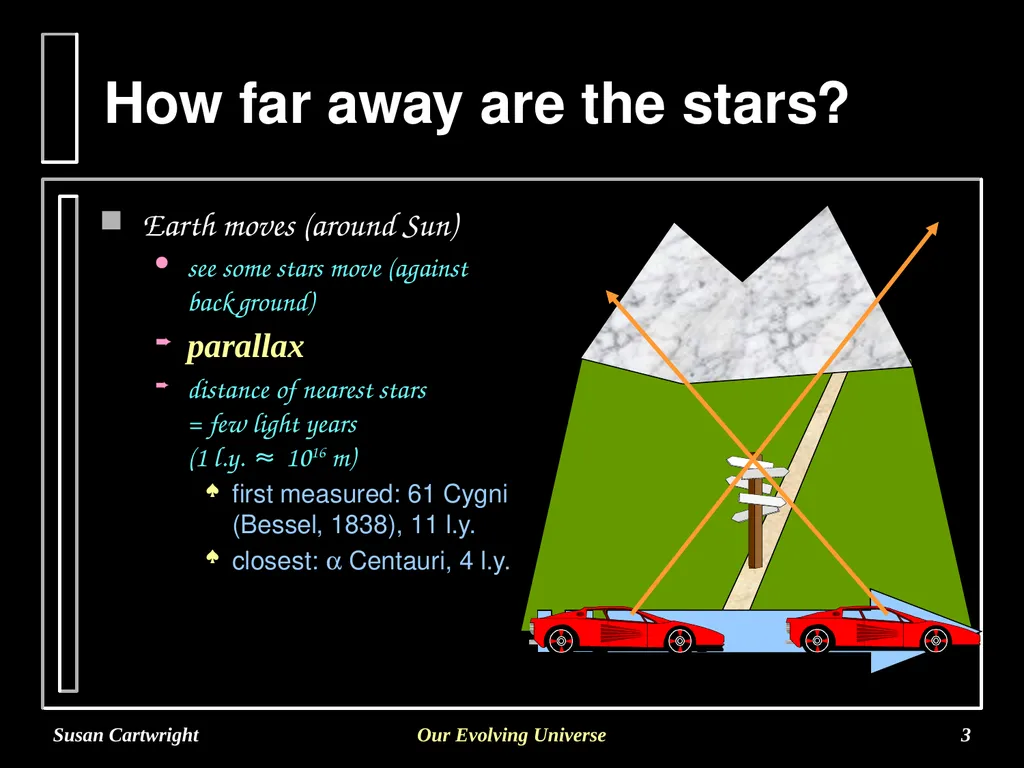
Susan Cartwright Our Evolving Universe 3 How far away are the stars? Earth moves (around Sun)
see some stars move (against background)
parallax
distance of nearest stars = few light years (1 l.y. ≈ 1016 m)
first measured: 61 Cygni (Bessel, 1838), 11 l.y.
closest: a Centauri, 4 l.y.<br>
04
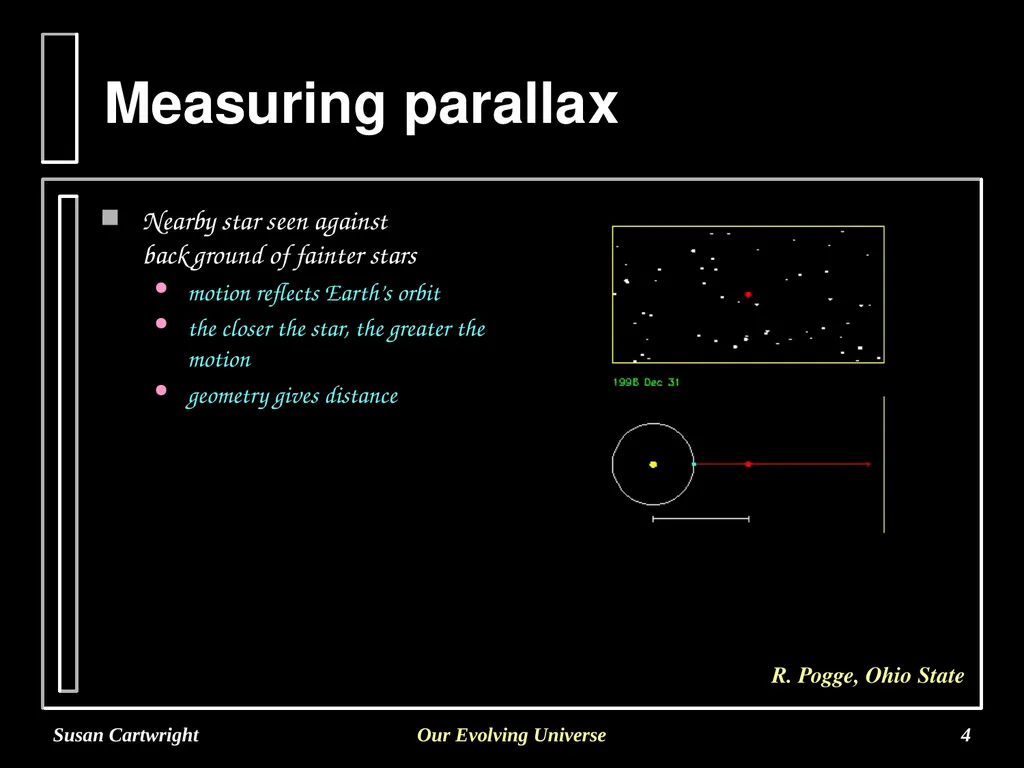
Susan Cartwright Our Evolving Universe 4 Measuring parallax Nearby star seen against background of fainter stars
motion reflects Earth’s orbit
the closer the star, the greater the motion
geometry gives distance R. Pogge, Ohio State<br>
05
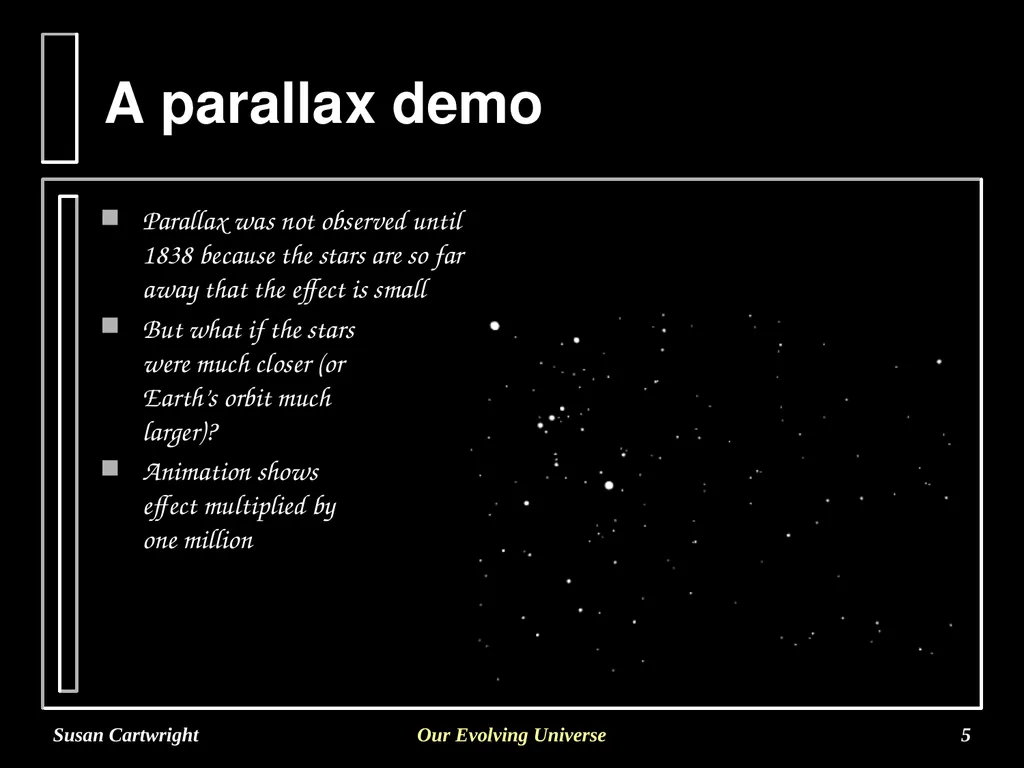
Susan Cartwright Our Evolving Universe 5 A parallax demo Parallax was not observed until 1838 because the stars are so far away that the effect is small
But what if the stars were much closer (or Earth’s orbit much larger)?
Animation shows effect multiplied by one million<br>
06
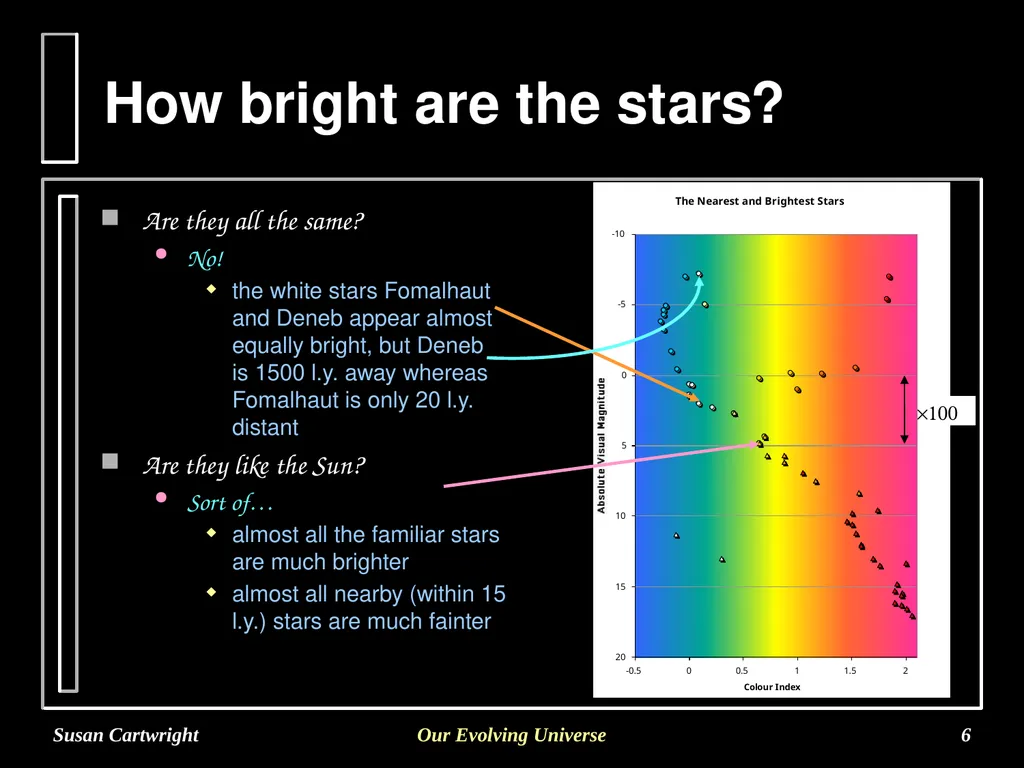
Susan Cartwright Our Evolving Universe 6 How bright are the stars? Are they all the same?
No!
the white stars Fomalhaut and Deneb appear almost equally bright, but Deneb is 1500 l.y. away whereas Fomalhaut is only 20 l.y. distant
Are they like the Sun?
Sort of…
almost all the familiar stars are much brighter
almost all nearby (within 15 l.y.) stars are much fainter ´100<br>
07
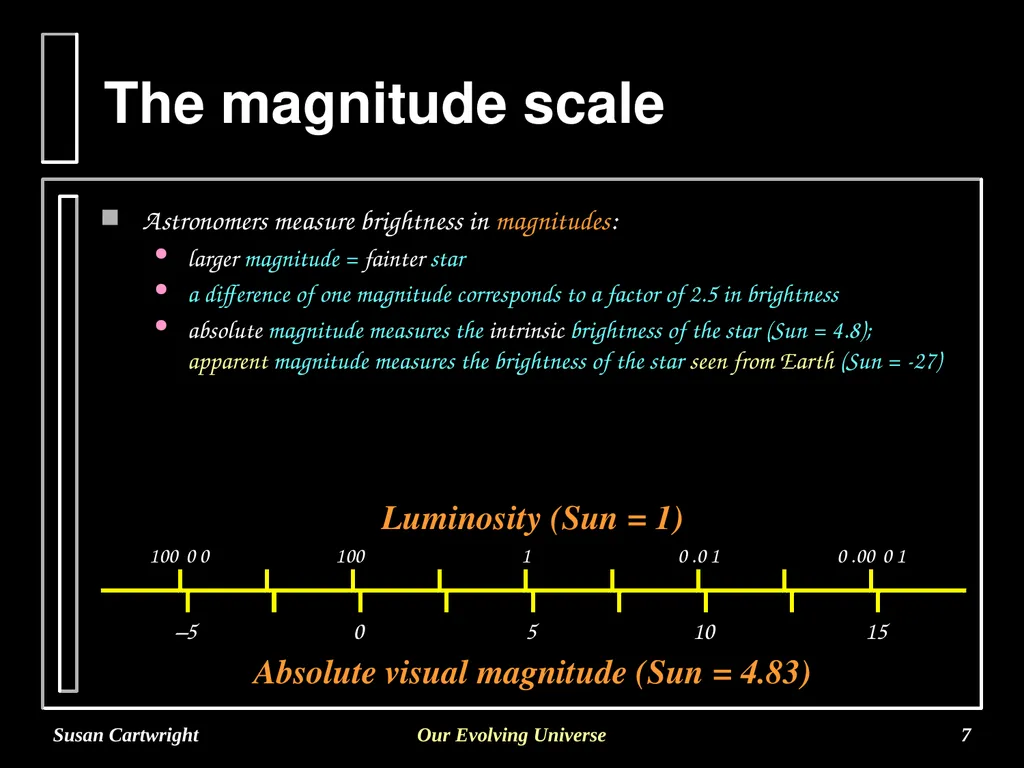
Susan Cartwright Our Evolving Universe 7 The magnitude scale Astronomers measure brightness in magnitudes:
larger magnitude = fainter star
a difference of one magnitude corresponds to a factor of 2.5 in brightness
absolute magnitude measures the intrinsic brightness of the star (Sun = 4.8); apparent magnitude measures the brightness of the star seen from Earth (Sun = -27) Luminosity (Sun = 1) Absolute visual magnitude (Sun = 4.83)<br>
08
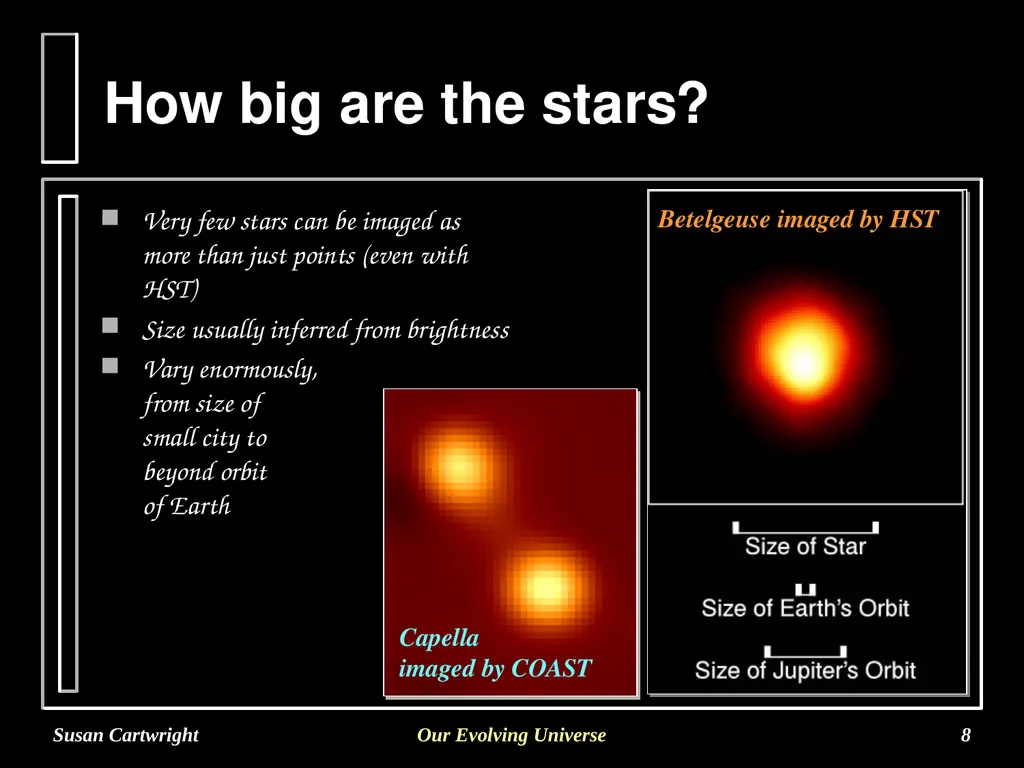
Susan Cartwright Our Evolving Universe 8 How big are the stars? Very few stars can be imaged as more than just points (even with HST)
Size usually inferred from brightness
Vary enormously, from size of small city to beyond orbit of Earth Betelgeuse imaged by HST Capella imaged by COAST<br>
09
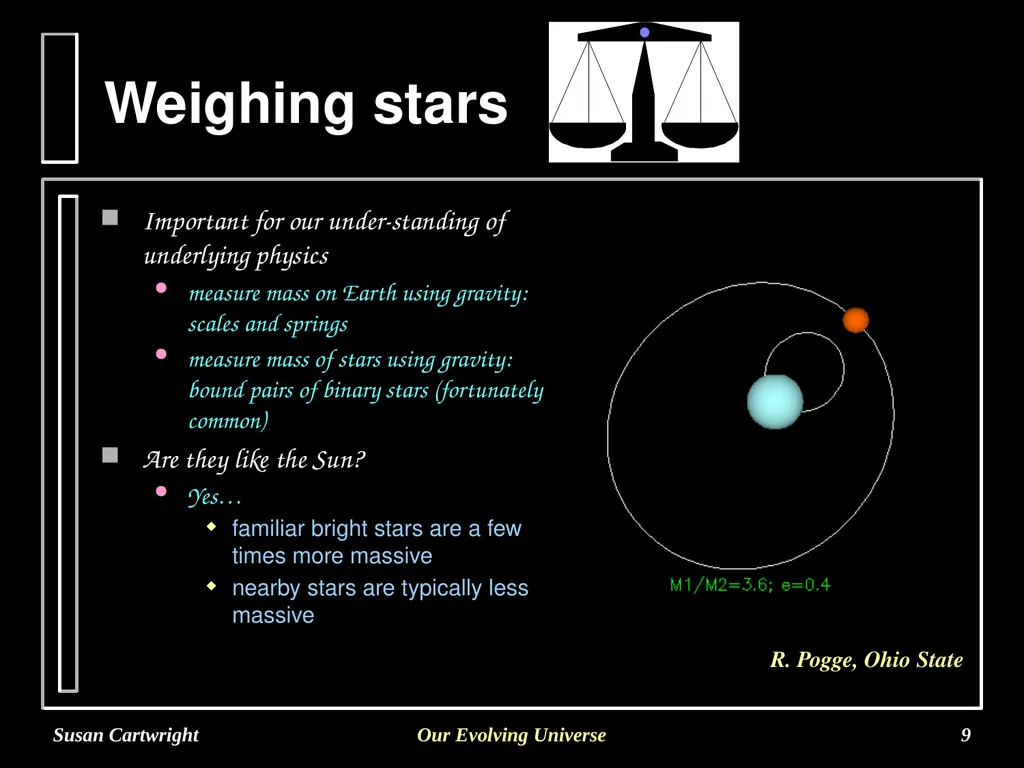
Susan Cartwright Our Evolving Universe 9 Weighing stars Important for our under-standing of underlying physics
measure mass on Earth using gravity: scales and springs
measure mass of stars using gravity: bound pairs of binary stars (fortunately common)
Are they like the Sun?
Yes…
familiar bright stars are a few times more massive
nearby stars are typically less massive R. Pogge, Ohio State<br>
10
Susan Cartwright Our Evolving Universe 10 What have we learned? From the motion of stars in the sky we can find:
their distances (if they are close)
their masses (if they are binaries)
And from studying their images we get:
their luminosities (if we know distance)
their sizes (if they are large and close) How does the Sun compare?
the stars we see in the sky are much brighter and somewhat more massive
typical stars near us are much fainter and somewhat less massive
the Sun is much better than average, but not a champion!<br>
11
Susan Cartwright Our Evolving Universe 11 What have we still to find out? “…never, by any means, will we be able to study [the stars’] chemical composition … I am of the opinion that every notion of the true mean temperature of the stars will necessarily always be concealed from us.”
Auguste Comte, French philosopher, 1835
He was proved wrong only 25 years later by the development of spectroscopy…
…next lecture!<br>