
SUTURE – MATERIALS & METHODS Dr. Rudra Pratap
T
Published · 45 slides · 0 views
1 / 1




Description
SUTURE MATERIALS METHODS Dr. Rudra Pratap Pandey Defined to be a device or contrivance to keep the wound edges together to facilitate healing by first intension. History Definitions Historically Ants held over the wound and when the
Related Topics
Share
Embed code
Download this presentation From Below
"SUTURE – MATERIALS & METHODS Dr. Rudra Pratap" is the property of its rightful owner. Permission is granted to download and print the materials on this website for personal, non-commercial use only, and to display it on your personal computer provided you do not modify the materials and that you retain all copyright notices contained in the materials. By downloading content from our website, you accept the terms of this agreement.
Presentation Transcript
01
SUTURE – MATERIALS & METHODS Dr. Rudra Pratap Pandey<br>
02
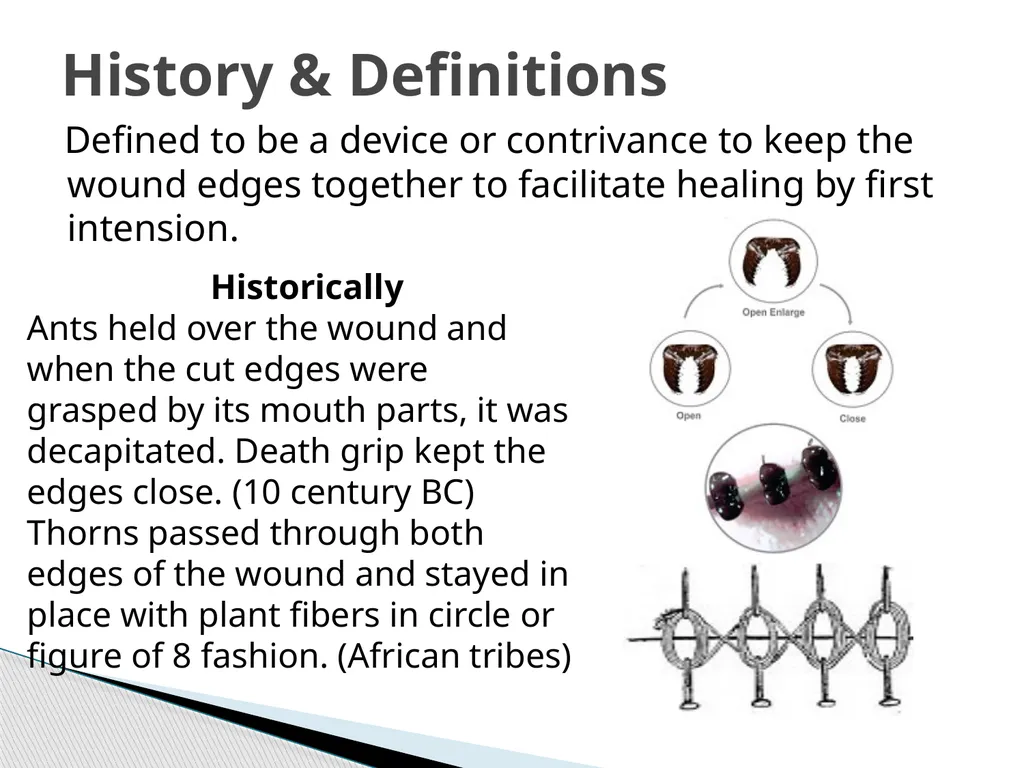
Defined to be a device or contrivance to keep the wound edges together to facilitate healing by first intension. History & Definitions Historically
Ants held over the wound and when the cut edges were grasped by its mouth parts, it was decapitated. Death grip kept the edges close. (10 century BC)
Thorns passed through both edges of the wound and stayed in place with plant fibers in circle or figure of 8 fashion. (African tribes)<br>
Ants held over the wound and when the cut edges were grasped by its mouth parts, it was decapitated. Death grip kept the edges close. (10 century BC)
Thorns passed through both edges of the wound and stayed in place with plant fibers in circle or figure of 8 fashion. (African tribes)<br>
03
Easy to handle
Predictable behavior in tissues
Predictable tensile strength
Sterile…easily sterilizable
Glides through tissues easily….smooth
Secure knotting ability
Inexpensive and easily avialble
Minimal tissue reaction
Non-capillary
Non-allergenic
Non-carcinogenic
Non-electrolytic
Non-shrinkage
The ideal suture should allow the healing tissue to recover sufficiently to keep the wound closed together once they are removed or absorbed. Suture materials – ideal properties<br>
Predictable behavior in tissues
Predictable tensile strength
Sterile…easily sterilizable
Glides through tissues easily….smooth
Secure knotting ability
Inexpensive and easily avialble
Minimal tissue reaction
Non-capillary
Non-allergenic
Non-carcinogenic
Non-electrolytic
Non-shrinkage
The ideal suture should allow the healing tissue to recover sufficiently to keep the wound closed together once they are removed or absorbed. Suture materials – ideal properties<br>
04
To appose the wound edges
To effect hemostasis
To retain and prosthesis in place
As material…a tie or ligature
Contraindications are infection, gross tissue loss, redness, edema, puncture wounds, bite wounds, virulent wounds, wounds involving tendon or vessels and wounds older than 6 hours (?) Indications…contraindications<br>
To effect hemostasis
To retain and prosthesis in place
As material…a tie or ligature
Contraindications are infection, gross tissue loss, redness, edema, puncture wounds, bite wounds, virulent wounds, wounds involving tendon or vessels and wounds older than 6 hours (?) Indications…contraindications<br>
05
Days: Muscle, subcutaneous tissue or skin
Weeks to Months: Fascia or tendon
Months to Never: Vascular prosthesis Time….when tissue no longer requires suture support<br>
Weeks to Months: Fascia or tendon
Months to Never: Vascular prosthesis Time….when tissue no longer requires suture support<br>
06
Suture needles
Needle holder
Rat tooth or thumb forceps Instruments for suturing<br>
Needle holder
Rat tooth or thumb forceps Instruments for suturing<br>
07
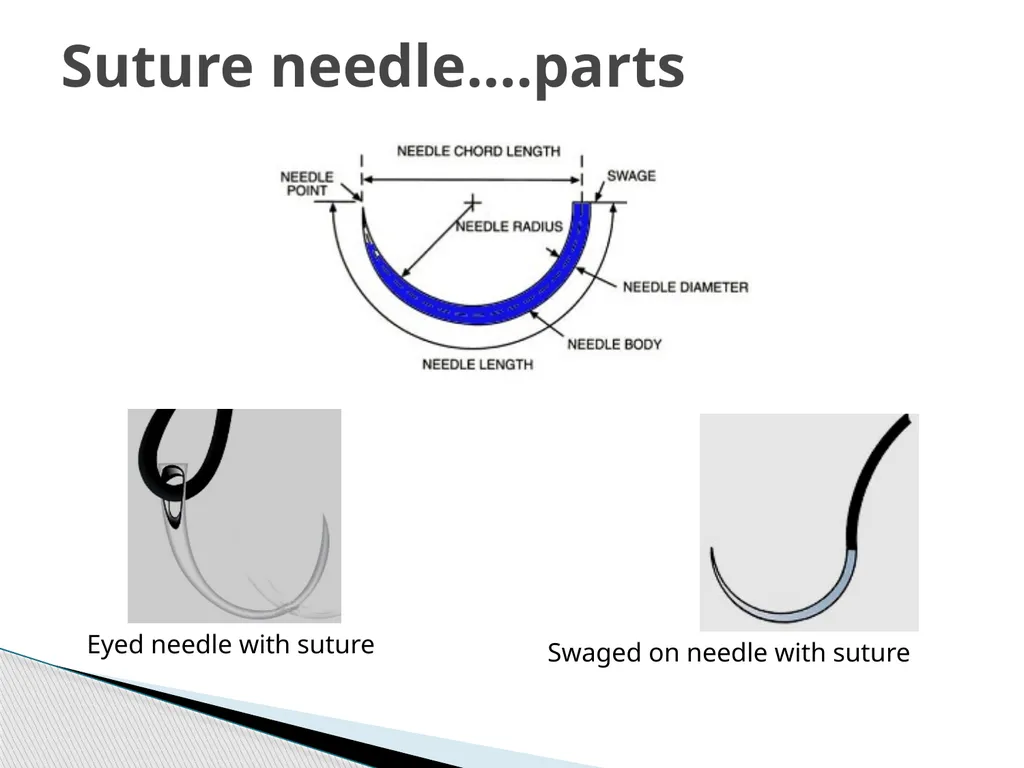
Suture needle….parts Eyed needle with suture Swaged on needle with suture<br>
08
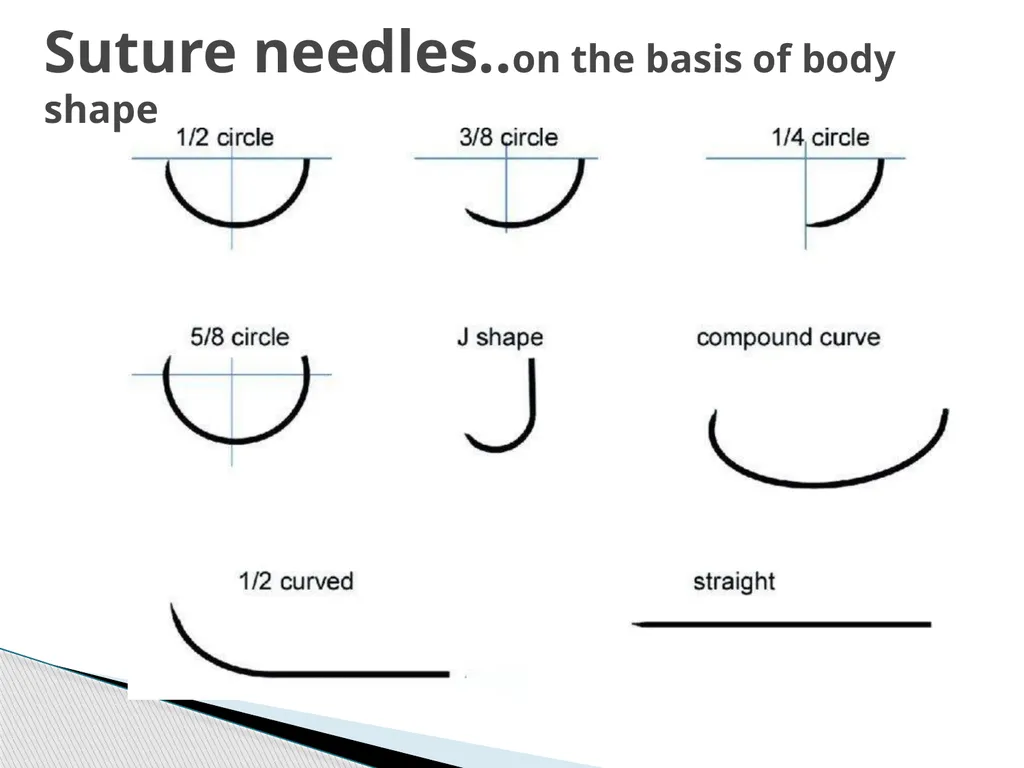
Suture needles..on the basis of body shape<br>
09
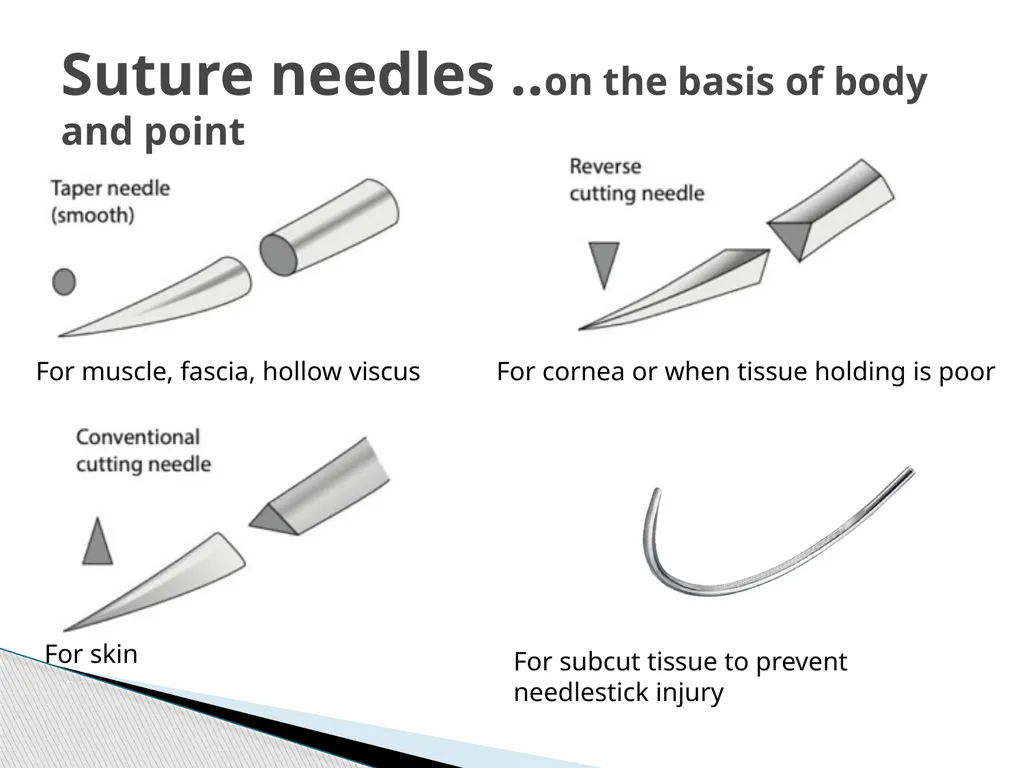
Suture needles ..on the basis of body and point For muscle, fascia, hollow viscus For skin For cornea or when tissue holding is poor For subcut tissue to prevent needlestick injury<br>
10
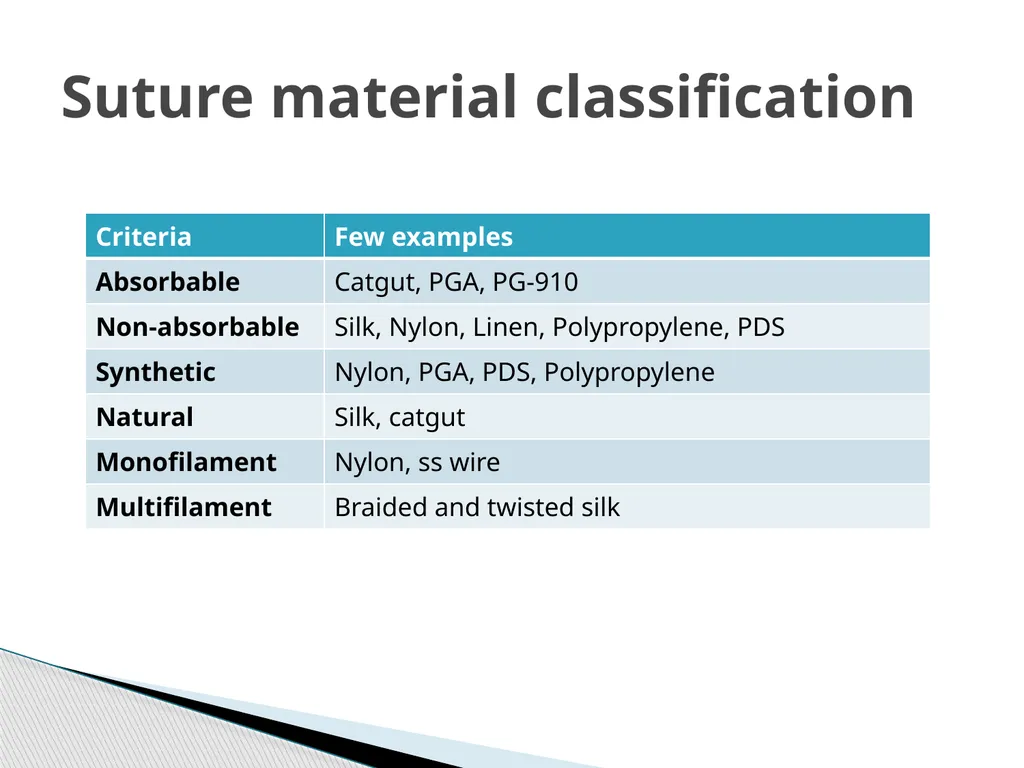
Suture material classification<br>
11
Absorbable
and slowly absorbable<br>
12
derived from sheep intestinal submucosa and bovine intestinal serosa. Avaialble as multifilament.
treated with formaldehyde to reduce its antigenicity and with chromic acid and pot. Dichromate to cause slow loss of tensile strength and decreases tissue reaction.
absorbed by phagocytosis
rapidly absorbable (unpredictable loss of strength)
loses tensile strength (33% in 7 days, 67% in 28 days)
complete removal from tissue may be prolonged (may become encapsulated and found years later)
rapid premature loss of strength in infected wounds, after exposure to digestive enzymes, in highly vascular tissue, and protein-depleted patients (not good for abdomen wall!)
good handling property when wet, good knot security (3 throws but ends need to be left long as tend to untie when wet)
is economical but largely replaced by synthetic materials due to demerits. Catgut<br>
treated with formaldehyde to reduce its antigenicity and with chromic acid and pot. Dichromate to cause slow loss of tensile strength and decreases tissue reaction.
absorbed by phagocytosis
rapidly absorbable (unpredictable loss of strength)
loses tensile strength (33% in 7 days, 67% in 28 days)
complete removal from tissue may be prolonged (may become encapsulated and found years later)
rapid premature loss of strength in infected wounds, after exposure to digestive enzymes, in highly vascular tissue, and protein-depleted patients (not good for abdomen wall!)
good handling property when wet, good knot security (3 throws but ends need to be left long as tend to untie when wet)
is economical but largely replaced by synthetic materials due to demerits. Catgut<br>
13
Obtained from tail of young kangaroo, is absorbable by phagocytosis
is very strong, good handling properties, better knot security than catgut
non boilable, heat labile, sterilized by soaking in alcohol or carbolic acid, preserved in boiled linseed oil.
has been used in joint capsule, ligament, tendon and hernia repair.
Obsolete, expensive Kangaroo tendon suture<br>
is very strong, good handling properties, better knot security than catgut
non boilable, heat labile, sterilized by soaking in alcohol or carbolic acid, preserved in boiled linseed oil.
has been used in joint capsule, ligament, tendon and hernia repair.
Obsolete, expensive Kangaroo tendon suture<br>
14
obtained from bovine cecum to cover surface with peritoneal erosion to prevent adhesions…not a true suture
incites tissue reaction in plain and chromic form, unpredictably absorbed
obsolete method
replaced by autologous peritoneum or omental grafts
Cargile membrane is an allograft and not a suture Cargile membrane<br>
incites tissue reaction in plain and chromic form, unpredictably absorbed
obsolete method
replaced by autologous peritoneum or omental grafts
Cargile membrane is an allograft and not a suture Cargile membrane<br>
15
is obtained from bovine fascia lata in the form of strips in glass vial
fresh strips as auto or allo grafts have also been used
has been used in correction of ptosis, hernia repair mainly perineal hernia when internal obturator is found too week
not a popular method Fascia lata sutures<br>
fresh strips as auto or allo grafts have also been used
has been used in correction of ptosis, hernia repair mainly perineal hernia when internal obturator is found too week
not a popular method Fascia lata sutures<br>
16
made of a glycolic acid polymer
absorbed by hydrolysis
rapidly absorbable
most of the tensile strength lost within 2 weeks of implantation
removed from the body within 3-4 months
more rapid absorption in alkaline environment (eg. urinary bladder)
significant tissue drag, may cut delicate tissues
available with coating as coating decreases drag
poorer knot security (need extra throws)
Stronger than chromic gut with more predictable strength loss and less tissue reactive
can be used to close clean tissue layers that regain sufficient strength within 7-10 days Polyglycolic acid (Dexon)<br>
absorbed by hydrolysis
rapidly absorbable
most of the tensile strength lost within 2 weeks of implantation
removed from the body within 3-4 months
more rapid absorption in alkaline environment (eg. urinary bladder)
significant tissue drag, may cut delicate tissues
available with coating as coating decreases drag
poorer knot security (need extra throws)
Stronger than chromic gut with more predictable strength loss and less tissue reactive
can be used to close clean tissue layers that regain sufficient strength within 7-10 days Polyglycolic acid (Dexon)<br>
17
composed of copolymer of glycolide and epsilon-caprolactone
rapidly absorbable by hydrolysis
loses tensile strength quickly (50 % within 7 days)
completely removed from body within 4 months
initially very strong (strongest of absorbable)
initial strength allows selection of 1-2 sizes smaller than would normally
minimal tissue reaction
soft, pliable material with excellent handling, minimal tissue drag
good knot security
4 throws for a secure knot
5 throws at the start and 6-7 at end of continuous pattern
used for soft tissue suturing when prolonged wound support is not necessary (subcutaneous and intradermal layers)
Braided multifilament Polyglactin 910 (Vicryl)<br>
rapidly absorbable by hydrolysis
loses tensile strength quickly (50 % within 7 days)
completely removed from body within 4 months
initially very strong (strongest of absorbable)
initial strength allows selection of 1-2 sizes smaller than would normally
minimal tissue reaction
soft, pliable material with excellent handling, minimal tissue drag
good knot security
4 throws for a secure knot
5 throws at the start and 6-7 at end of continuous pattern
used for soft tissue suturing when prolonged wound support is not necessary (subcutaneous and intradermal layers)
Braided multifilament Polyglactin 910 (Vicryl)<br>
18
composed of copolymer of glycolide and epsilon-caprolactone
rapidly absorbable by hydrolysis
loses tensile strength quickly (50 % within 7 days)
completely removed from body within 4 months
initially very strong (strongest of absorbable)
initial strength allows selection of 1-2 sizes smaller than would normally minimal tissue reaction
soft, pliable material with excellent handling property, minimal tissue drag, good knot security
used for soft tissue suturing when prolonged wound support is not necessary (eg. subcutaneous and intradermal layers)
monofilamentous Poliglecaprone 25 (Monocryl)<br>
rapidly absorbable by hydrolysis
loses tensile strength quickly (50 % within 7 days)
completely removed from body within 4 months
initially very strong (strongest of absorbable)
initial strength allows selection of 1-2 sizes smaller than would normally minimal tissue reaction
soft, pliable material with excellent handling property, minimal tissue drag, good knot security
used for soft tissue suturing when prolonged wound support is not necessary (eg. subcutaneous and intradermal layers)
monofilamentous Poliglecaprone 25 (Monocryl)<br>
19
composed of paradioxanone polymers
absorbed by hydrolysis
slowly absorbable, over 50% strength remains after 6 weeks
complete removal from the body up to 6 months
strength maintained in alkaline environment (suitable to close urinary bladder)
minimal tissue reaction
acceptable handling qualities but larger sizes are stiff, minimal tissue drag, reasonable knot security
4 throws for secure knot
5 throws at start and 6-7 at end of continuous pattern
popular choice for general soft tissue suturing
rcommended when prolonged tissue support desired
Monofilament and strong with very good tensile strength Polydioxanone (PDS II)<br>
absorbed by hydrolysis
slowly absorbable, over 50% strength remains after 6 weeks
complete removal from the body up to 6 months
strength maintained in alkaline environment (suitable to close urinary bladder)
minimal tissue reaction
acceptable handling qualities but larger sizes are stiff, minimal tissue drag, reasonable knot security
4 throws for secure knot
5 throws at start and 6-7 at end of continuous pattern
popular choice for general soft tissue suturing
rcommended when prolonged tissue support desired
Monofilament and strong with very good tensile strength Polydioxanone (PDS II)<br>
20
composed of glycolic acid and trimethylene carbonate
absorbed by hydrolysis
slowly absorbable, 50% tensile strength lost by 3 weeks, complete absorption takes 6-7 months
retains strength in alkaline environment (can use for urinary bladder closure)
strength similar to polydioxanone, minimal tissue drag,
Stiff, tends to conform tissues to suture rather than conforming to tissues
4 throws for secure knot 5 throws at start and 6-7 at end of continuous pattern
more economical than PDS
handling characteristics have limited use in small animals but could be selected for most soft tissue suturing
Monofilament, slowly absorbable, very strong Polyglyconate (Maxon)<br>
absorbed by hydrolysis
slowly absorbable, 50% tensile strength lost by 3 weeks, complete absorption takes 6-7 months
retains strength in alkaline environment (can use for urinary bladder closure)
strength similar to polydioxanone, minimal tissue drag,
Stiff, tends to conform tissues to suture rather than conforming to tissues
4 throws for secure knot 5 throws at start and 6-7 at end of continuous pattern
more economical than PDS
handling characteristics have limited use in small animals but could be selected for most soft tissue suturing
Monofilament, slowly absorbable, very strong Polyglyconate (Maxon)<br>
21
Non absorbable<br>
22
cotton thread is an excellent suture material when used in clean wounds.
the lack of springiness or stretching quality causes many ligatures to be broken at first, but this same quality prevents the tying of tissues too tightly.
No. 60, 50, and 30 thread is used as ligatures and sutures, the finer size for most ligatures, the larger size for sutures.
good handling properties and knot security.
gains strength when wet
has capillary property….never used in contamination
In suturing layers of tissue as the peritoneum and fascia of the abdominal wall.
never on ruminant GIT or hollow viscus
Cotton may be used to approximate skin edges of a clean wound but must be protected with sterile dressing.
can be sterilized by autoclaving but not a material of choice except in emergency.
multifilament twisted Cotton<br>
the lack of springiness or stretching quality causes many ligatures to be broken at first, but this same quality prevents the tying of tissues too tightly.
No. 60, 50, and 30 thread is used as ligatures and sutures, the finer size for most ligatures, the larger size for sutures.
good handling properties and knot security.
gains strength when wet
has capillary property….never used in contamination
In suturing layers of tissue as the peritoneum and fascia of the abdominal wall.
never on ruminant GIT or hollow viscus
Cotton may be used to approximate skin edges of a clean wound but must be protected with sterile dressing.
can be sterilized by autoclaving but not a material of choice except in emergency.
multifilament twisted Cotton<br>
23
obsolete, was used in 19th century before microbes were known
brittle, poor handling properties and knot security, tissue drag
poor strength, low tensile strength
in an experimental study in 2013 it was found to be good for external application after boiling sterilization and thus may have a role in cosmetic surgery
monofilament Horse tail hair<br>
brittle, poor handling properties and knot security, tissue drag
poor strength, low tensile strength
in an experimental study in 2013 it was found to be good for external application after boiling sterilization and thus may have a role in cosmetic surgery
monofilament Horse tail hair<br>
24
derived from silkworm cocoon
technically nonabsorbable, slowly loses tensile strength over 6 months. May be completely absorbed after 2 years
not recommended if prolonged strength or persistence is desired (e.g. securing a prosthetic device)
induces significant tissue reaction
excellent handling characteristics
good knot security
economical
should NOT use in infected or contaminated areas
potentiates infection (less bacteria required to induce infection)
harbor bacteria within braid leading to persistent infection
uncommonly used
use largely replaced by synthetic monofilament materials
Multifilament twisted or braided Silk<br>
technically nonabsorbable, slowly loses tensile strength over 6 months. May be completely absorbed after 2 years
not recommended if prolonged strength or persistence is desired (e.g. securing a prosthetic device)
induces significant tissue reaction
excellent handling characteristics
good knot security
economical
should NOT use in infected or contaminated areas
potentiates infection (less bacteria required to induce infection)
harbor bacteria within braid leading to persistent infection
uncommonly used
use largely replaced by synthetic monofilament materials
Multifilament twisted or braided Silk<br>
25
composed of synthetic twisted multifilament polyamide encased in a smooth sheath
very strong
somewhat stiff to handle
reactive when used in skin (increased if casing breaks)
should NOT be buried because of high rate of draining tract formation
economical
primarily used as a skin suture in food animals
Multifilament in a casing Polymerized caprolactum (supramid/vetafil)<br>
very strong
somewhat stiff to handle
reactive when used in skin (increased if casing breaks)
should NOT be buried because of high rate of draining tract formation
economical
primarily used as a skin suture in food animals
Multifilament in a casing Polymerized caprolactum (supramid/vetafil)<br>
26
composed of synthetic multifilament polyester
very strong, retains tensile strength when implanted
significant tissue drag
coating improves but decreases knot security
moderate tissue reaction when implanted
contraindicated in infected or contaminated wounds
potentiates infection
bacteria reside within braid leading to persistence of infection and chronic draining tracts
primarily used for tendon and ligament repairs because of excellent strength (extracapsular cruciate repairs)
results in significant incidence of chronic draining tracts
use gradually being replaced by monofilament options
Multifilament, non absorbable, braided Polyesters (Mersilene, Ethibond)<br>
very strong, retains tensile strength when implanted
significant tissue drag
coating improves but decreases knot security
moderate tissue reaction when implanted
contraindicated in infected or contaminated wounds
potentiates infection
bacteria reside within braid leading to persistence of infection and chronic draining tracts
primarily used for tendon and ligament repairs because of excellent strength (extracapsular cruciate repairs)
results in significant incidence of chronic draining tracts
use gradually being replaced by monofilament options
Multifilament, non absorbable, braided Polyesters (Mersilene, Ethibond)<br>
27
available as both monofilament or multifilament
composed of a polyamine
monofilament form is inert with minimal tissue reaction
nonabsorbable by definition but loses 30% of strength within 2 years of implantation
multifilament form is uncommonly used, stiff and looses strength after 6 months
significant memory (retains shape), especially in larger sizes
knot security is relatively poor so care necessary to ensure secure knots
4 throws required for a secure square knot
additional throws necessary for continuous patterns (5 on beginning knot and 6 on ending knot)
suture ends may be sharp …may cause trauma
mainly used as a skin suture, but can be buried if necessary
Monofilament is popular skin suture, economic Nylon (Dermalon or Ethilon)<br>
composed of a polyamine
monofilament form is inert with minimal tissue reaction
nonabsorbable by definition but loses 30% of strength within 2 years of implantation
multifilament form is uncommonly used, stiff and looses strength after 6 months
significant memory (retains shape), especially in larger sizes
knot security is relatively poor so care necessary to ensure secure knots
4 throws required for a secure square knot
additional throws necessary for continuous patterns (5 on beginning knot and 6 on ending knot)
suture ends may be sharp …may cause trauma
mainly used as a skin suture, but can be buried if necessary
Monofilament is popular skin suture, economic Nylon (Dermalon or Ethilon)<br>
28
composed of a copolymer of polyglycol and polybutylene terephthalates
good tensile strength, strength maintained when implanted
slippery to handle, more flexible and elastic than polypropylene or nylon
minimal tissue reaction
reasonable knot security but need to ensure throws adequately tightened
nice handling qualities once experience gained with knots
mainly used as a skin suture, but can be buried if necessary
monofilament Polybutester (Novafil)<br>
good tensile strength, strength maintained when implanted
slippery to handle, more flexible and elastic than polypropylene or nylon
minimal tissue reaction
reasonable knot security but need to ensure throws adequately tightened
nice handling qualities once experience gained with knots
mainly used as a skin suture, but can be buried if necessary
monofilament Polybutester (Novafil)<br>
29
composed of a propylene polymer derived from propane gas
not as strong as nylon
retains initial strength when implanted
minimal tissue reaction
minimal tissue drag, best knot security of synthetic monofilaments, very nice handling qualities
least likely of the monofilament nonabsorbable sutures to potentiate infection or induce thrombi
used as skin suture and if need to permanently implant suture (prosthetic device)
Monofilament, least reactive, costly Polypropylene (Prolene)<br>
not as strong as nylon
retains initial strength when implanted
minimal tissue reaction
minimal tissue drag, best knot security of synthetic monofilaments, very nice handling qualities
least likely of the monofilament nonabsorbable sutures to potentiate infection or induce thrombi
used as skin suture and if need to permanently implant suture (prosthetic device)
Monofilament, least reactive, costly Polypropylene (Prolene)<br>
30
Misc. methods<br>
31
SS, tantalum (a rare metal), silver, copper, aluminium, vitellium (cobalt, chromium & molybdenum alloy) wire have been used as suture. Others have historic importance only.
SS and tantalum are still in use.
Tantalum is for neuro or vascular anastomosis. SS has many uses.
Surgical stainless steel suture is a nonabsorabable 316L stainless steel
available as on needle sterile or roll
roll can be autoclaved
indicated for use in abdominal wound closure (monoblock closure in infection), hernia repair, sternal closure and orthopaedic procedures including cerclage and tendon repair
all metal suture have metal fatigue property (may break due to continuous movement)
metal sutures are monofilament Metal sutures<br>
SS and tantalum are still in use.
Tantalum is for neuro or vascular anastomosis. SS has many uses.
Surgical stainless steel suture is a nonabsorabable 316L stainless steel
available as on needle sterile or roll
roll can be autoclaved
indicated for use in abdominal wound closure (monoblock closure in infection), hernia repair, sternal closure and orthopaedic procedures including cerclage and tendon repair
all metal suture have metal fatigue property (may break due to continuous movement)
metal sutures are monofilament Metal sutures<br>
32
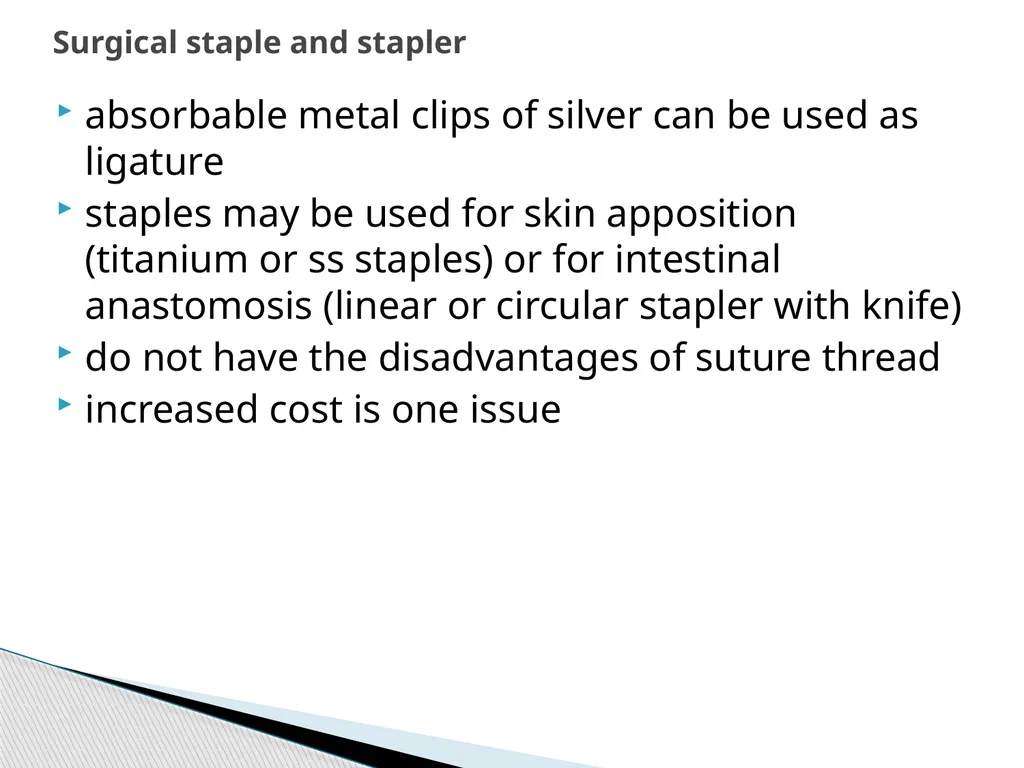
absorbable metal clips of silver can be used as ligature
staples may be used for skin apposition (titanium or ss staples) or for intestinal anastomosis (linear or circular stapler with knife)
do not have the disadvantages of suture thread
increased cost is one issue Surgical staple and stapler<br>
staples may be used for skin apposition (titanium or ss staples) or for intestinal anastomosis (linear or circular stapler with knife)
do not have the disadvantages of suture thread
increased cost is one issue Surgical staple and stapler<br>
33
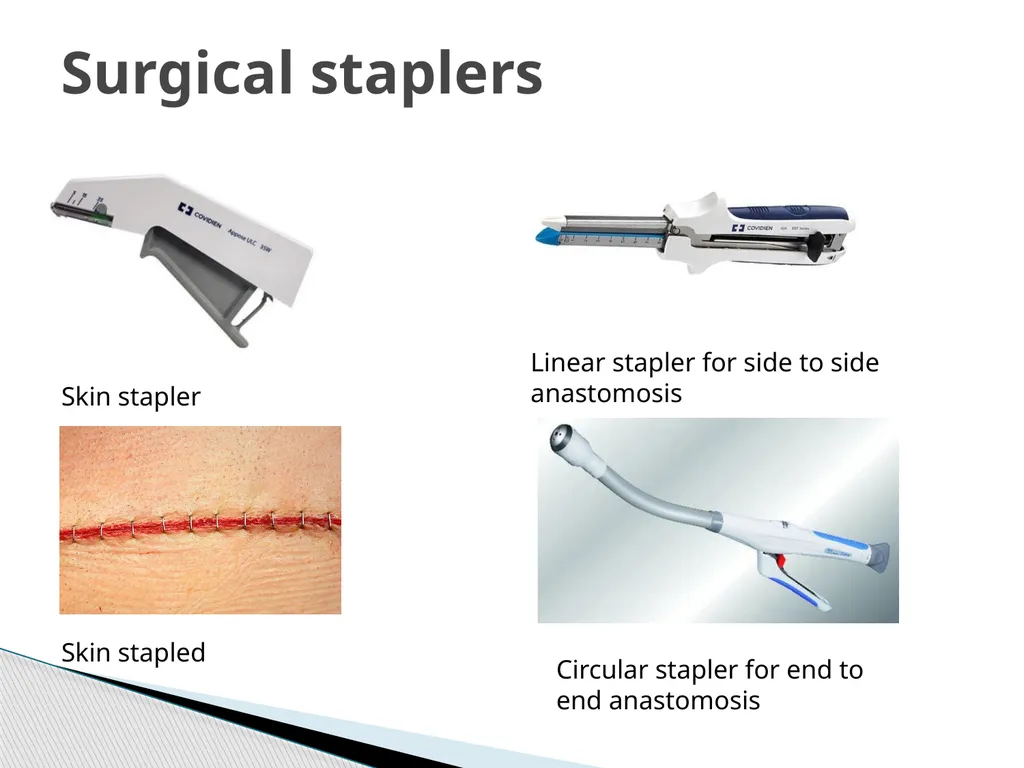
Surgical staplers Skin stapled Circular stapler for end to end anastomosis Linear stapler for side to side anastomosis Skin stapler<br>
34
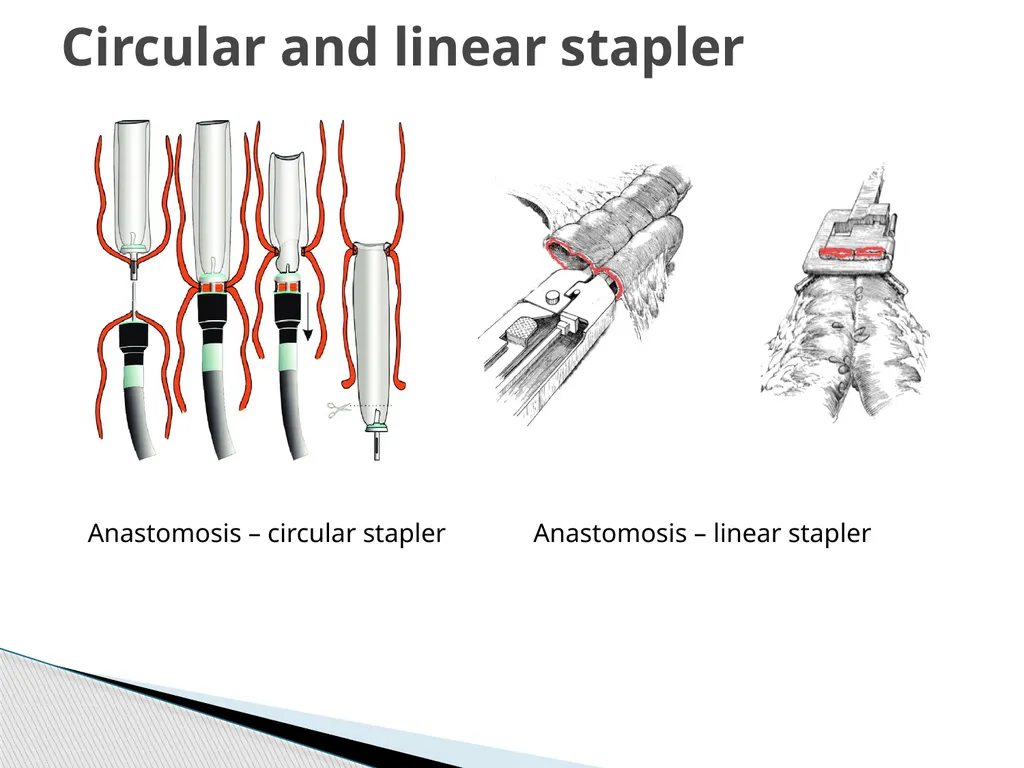
Circular and linear stapler Anastomosis – circular stapler Anastomosis – linear stapler<br>
35
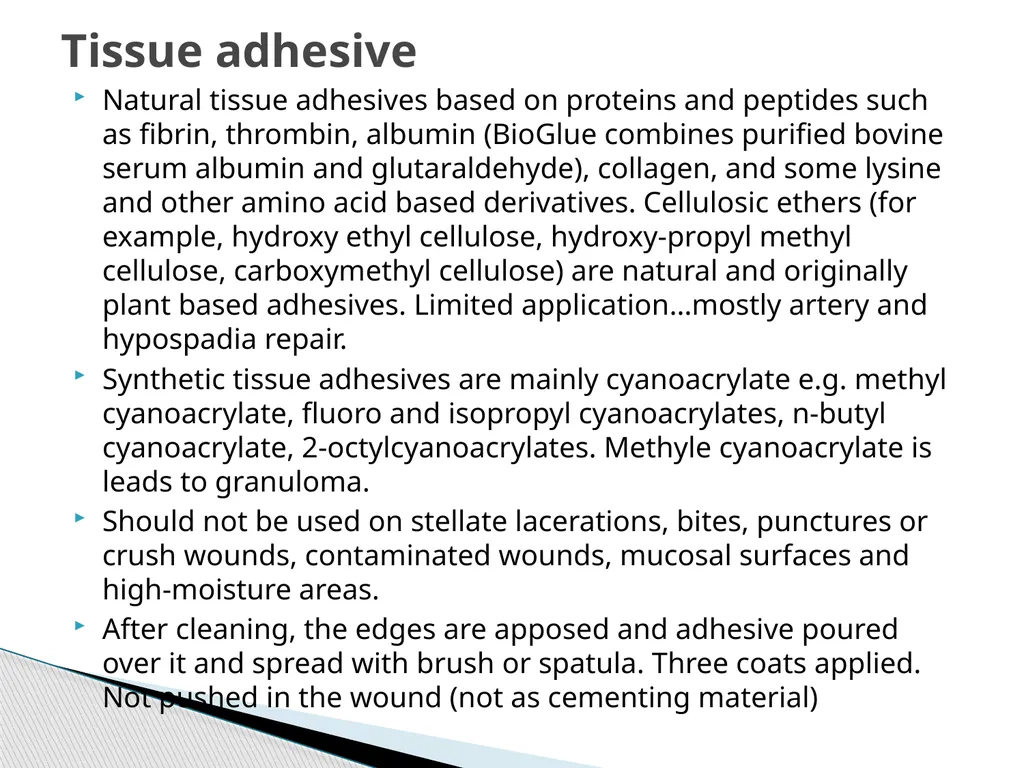
Natural tissue adhesives based on proteins and peptides such as fibrin, thrombin, albumin (BioGlue combines purified bovine serum albumin and glutaraldehyde), collagen, and some lysine and other amino acid based derivatives. Cellulosic ethers (for example, hydroxy ethyl cellulose, hydroxy-propyl methyl cellulose, carboxymethyl cellulose) are natural and originally plant based adhesives. Limited application…mostly artery and hypospadia repair.
Synthetic tissue adhesives are mainly cyanoacrylate e.g. methyl cyanoacrylate, fluoro and isopropyl cyanoacrylates, n-butyl cyanoacrylate, 2-octylcyanoacrylates. Methyle cyanoacrylate is leads to granuloma.
Should not be used on stellate lacerations, bites, punctures or crush wounds, contaminated wounds, mucosal surfaces and high-moisture areas.
After cleaning, the edges are apposed and adhesive poured over it and spread with brush or spatula. Three coats applied. Not pushed in the wound (not as cementing material) Tissue adhesive<br>
Synthetic tissue adhesives are mainly cyanoacrylate e.g. methyl cyanoacrylate, fluoro and isopropyl cyanoacrylates, n-butyl cyanoacrylate, 2-octylcyanoacrylates. Methyle cyanoacrylate is leads to granuloma.
Should not be used on stellate lacerations, bites, punctures or crush wounds, contaminated wounds, mucosal surfaces and high-moisture areas.
After cleaning, the edges are apposed and adhesive poured over it and spread with brush or spatula. Three coats applied. Not pushed in the wound (not as cementing material) Tissue adhesive<br>
36
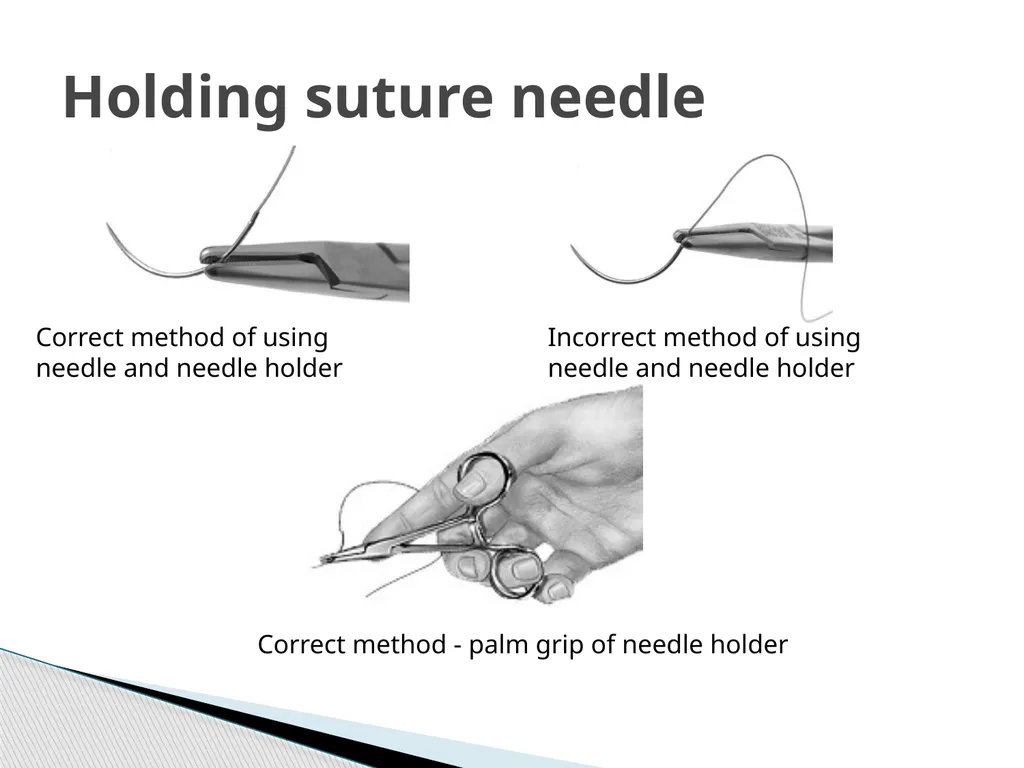
Holding suture needle Correct method of using needle and needle holder Incorrect method of using needle and needle holder Correct method - palm grip of needle holder<br>
37
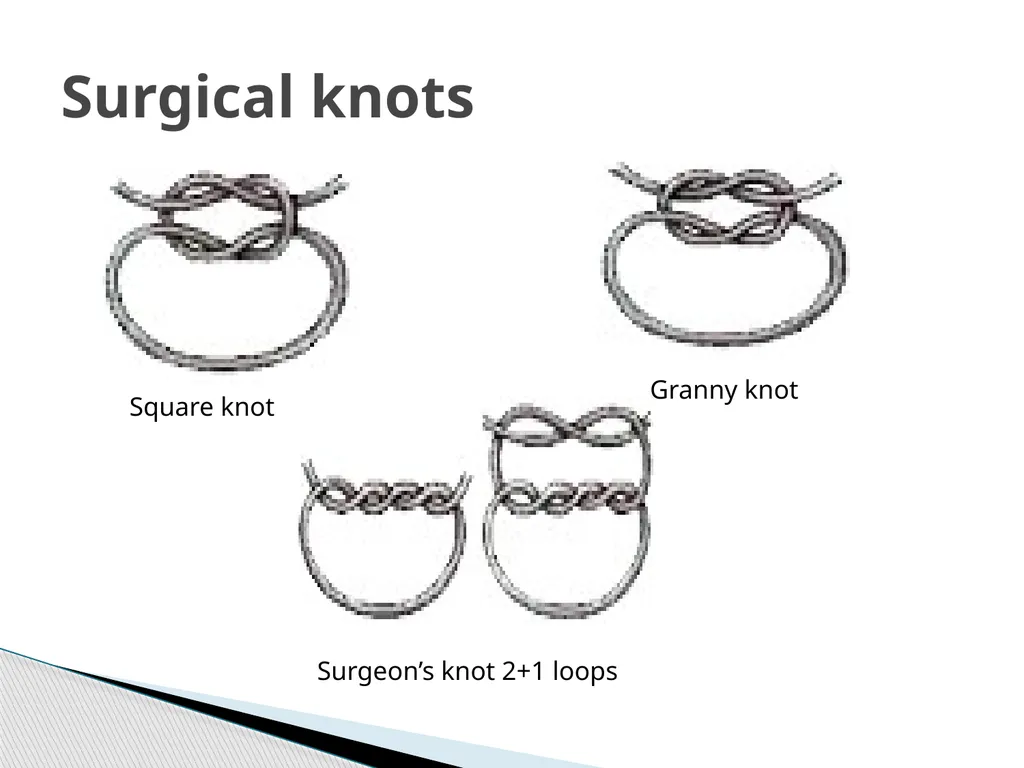
Surgical knots Surgeon’s knot 2+1 loops Granny knot Square knot<br>
38
Suture patterns<br>
39
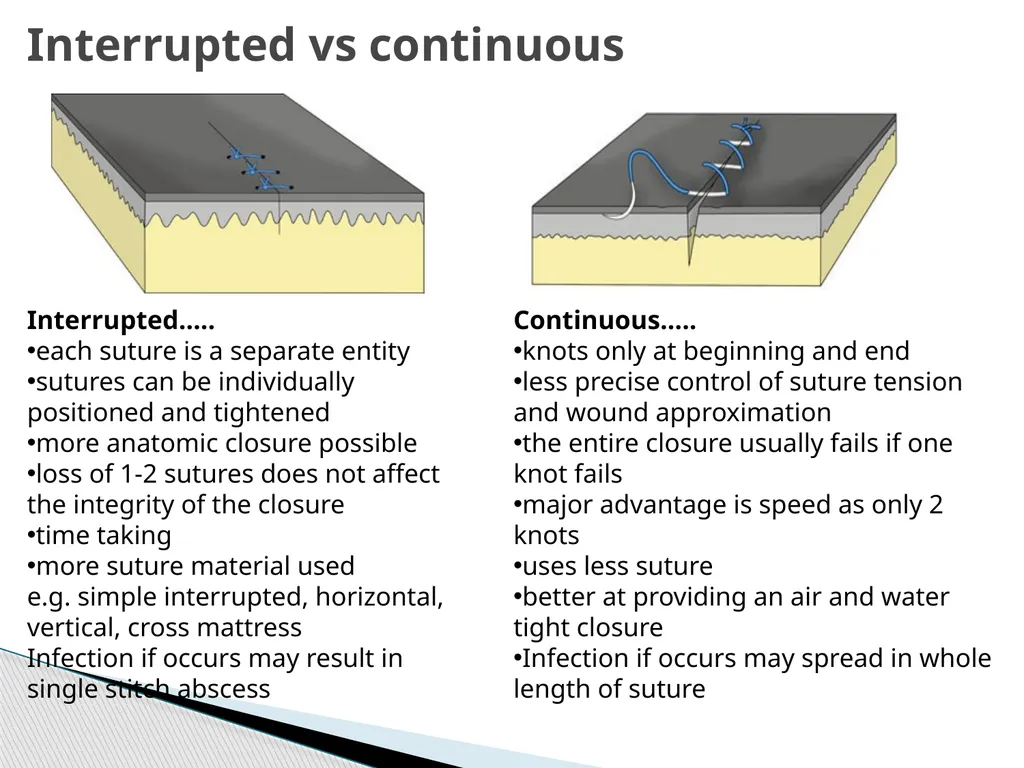
Interrupted vs continuous Interrupted…..
each suture is a separate entity
sutures can be individually positioned and tightened
more anatomic closure possible
loss of 1-2 sutures does not affect the integrity of the closure
time taking
more suture material used
e.g. simple interrupted, horizontal, vertical, cross mattress
Infection if occurs may result in single stitch abscess Continuous…..
knots only at beginning and end
less precise control of suture tension and wound approximation
the entire closure usually fails if one knot fails
major advantage is speed as only 2 knots
uses less suture
better at providing an air and water tight closure
Infection if occurs may spread in whole length of suture<br>
each suture is a separate entity
sutures can be individually positioned and tightened
more anatomic closure possible
loss of 1-2 sutures does not affect the integrity of the closure
time taking
more suture material used
e.g. simple interrupted, horizontal, vertical, cross mattress
Infection if occurs may result in single stitch abscess Continuous…..
knots only at beginning and end
less precise control of suture tension and wound approximation
the entire closure usually fails if one knot fails
major advantage is speed as only 2 knots
uses less suture
better at providing an air and water tight closure
Infection if occurs may spread in whole length of suture<br>
40
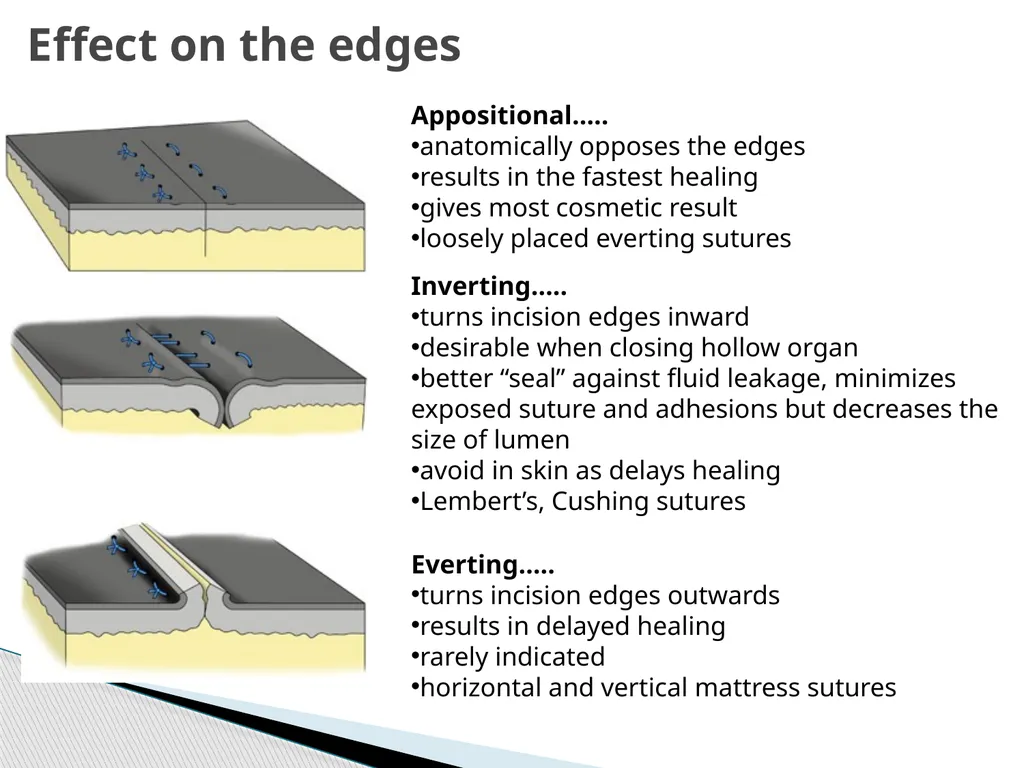
Effect on the edges Appositional…..
anatomically opposes the edges
results in the fastest healing
gives most cosmetic result
loosely placed everting sutures Inverting…..
turns incision edges inward
desirable when closing hollow organ
better “seal” against fluid leakage, minimizes exposed suture and adhesions but decreases the size of lumen
avoid in skin as delays healing
Lembert’s, Cushing sutures Everting…..
turns incision edges outwards
results in delayed healing
rarely indicated
horizontal and vertical mattress sutures<br>
anatomically opposes the edges
results in the fastest healing
gives most cosmetic result
loosely placed everting sutures Inverting…..
turns incision edges inward
desirable when closing hollow organ
better “seal” against fluid leakage, minimizes exposed suture and adhesions but decreases the size of lumen
avoid in skin as delays healing
Lembert’s, Cushing sutures Everting…..
turns incision edges outwards
results in delayed healing
rarely indicated
horizontal and vertical mattress sutures<br>
41
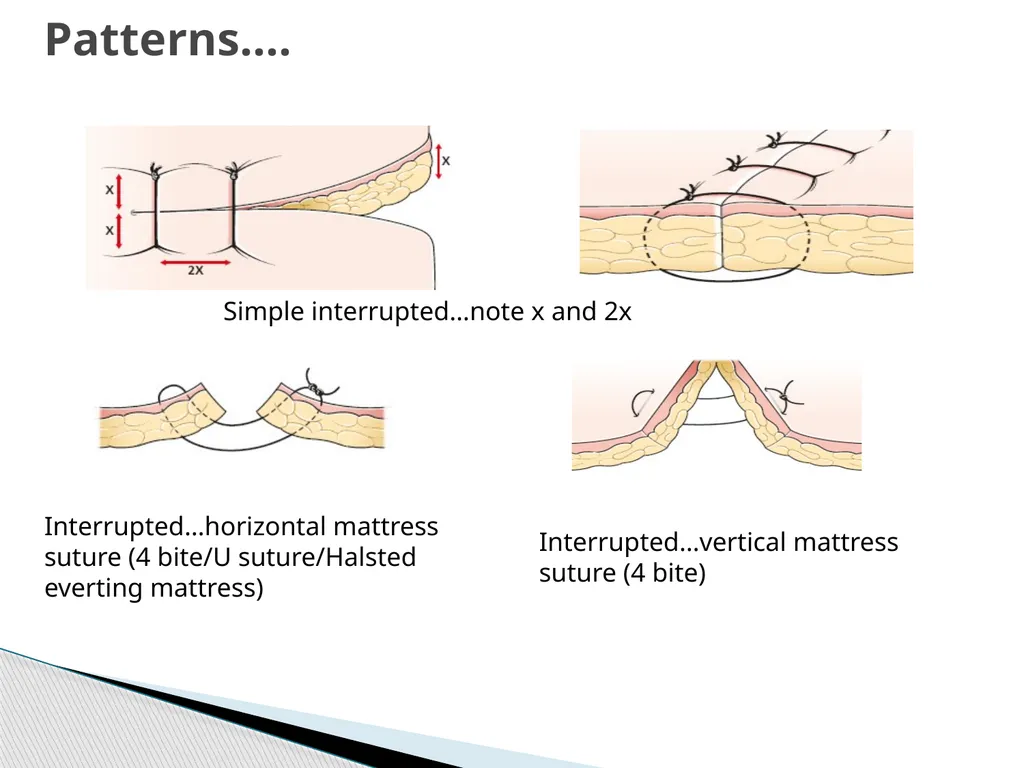
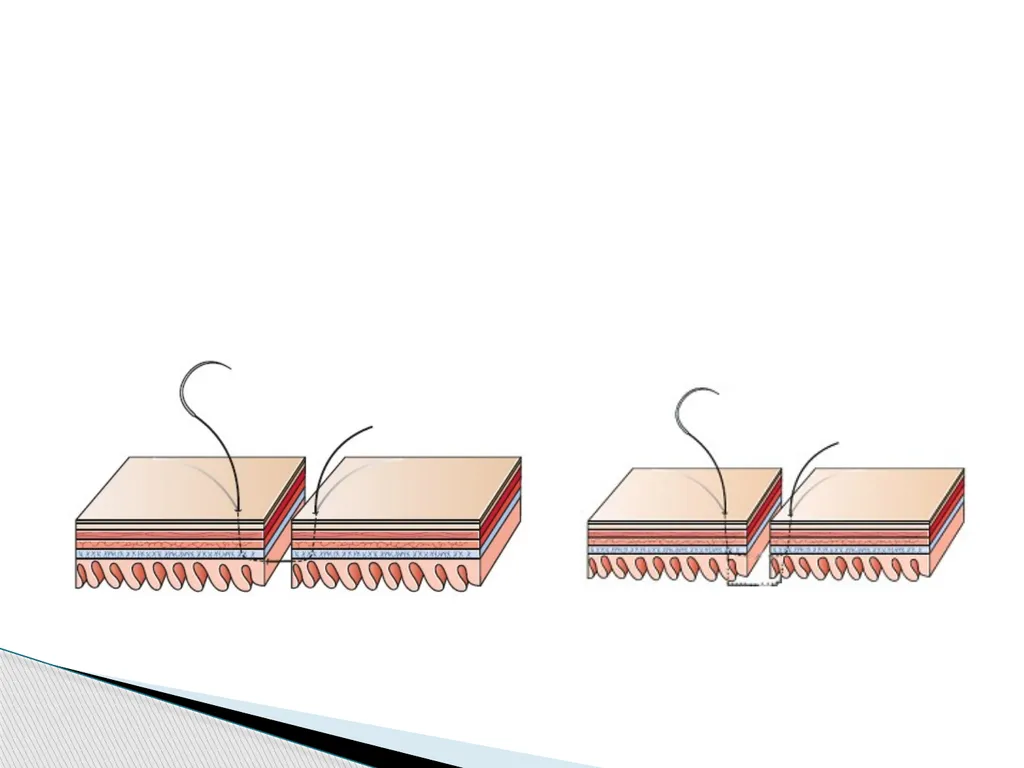
Patterns…. Simple interrupted…note x and 2x Interrupted…horizontal mattress suture (4 bite/U suture/Halsted everting mattress) Interrupted…vertical mattress suture (4 bite)<br>
42
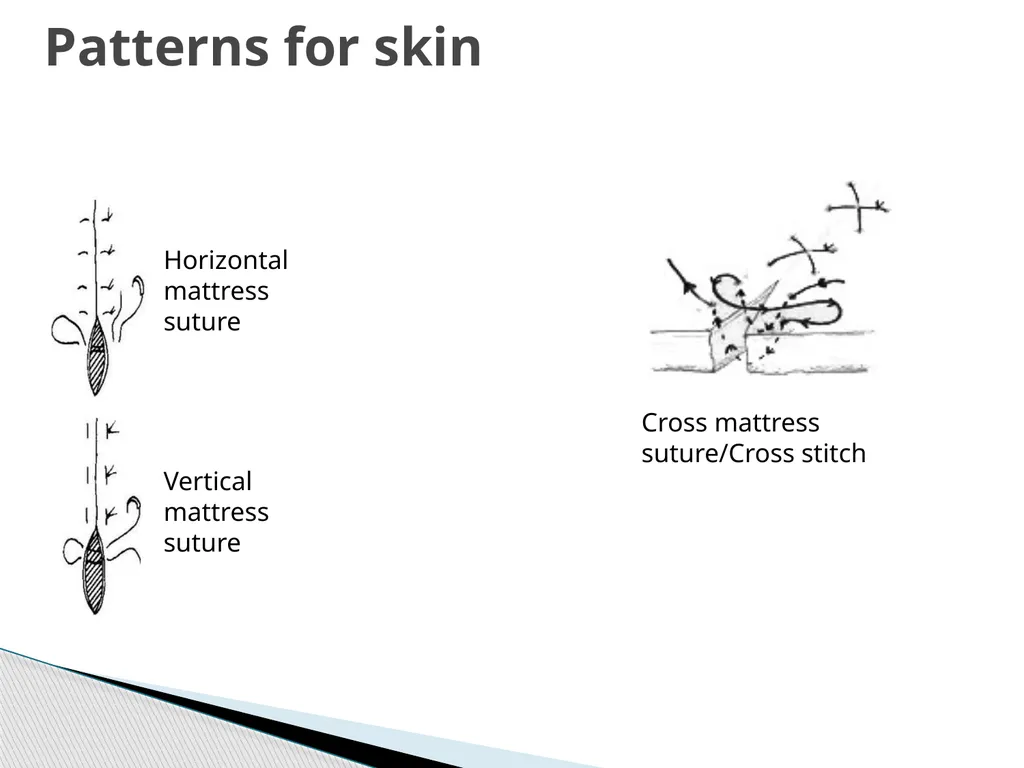
Patterns for skin Horizontal mattress suture Vertical mattress suture Cross mattress suture/Cross stitch<br>
43
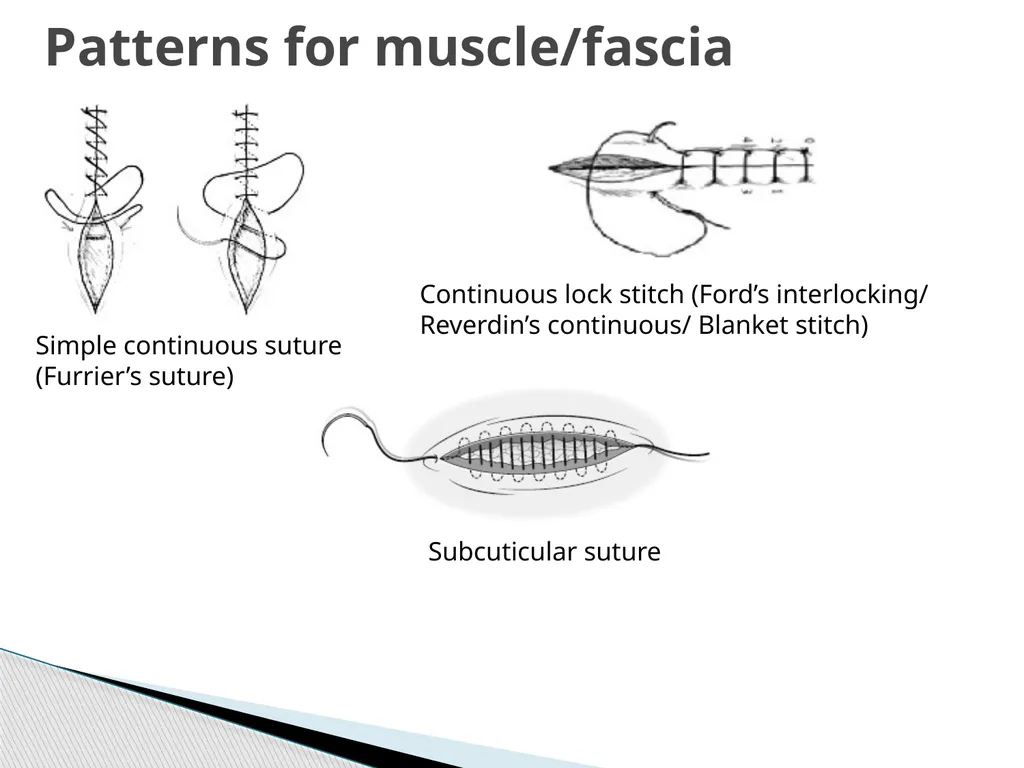
Patterns for muscle/fascia Simple continuous suture (Furrier’s suture) Continuous lock stitch (Ford’s interlocking/ Reverdin’s continuous/ Blanket stitch) Subcuticular suture<br>