
SWOT ANALYSIS AND ITS IMPORTANCE. BACHELOR OF
YM
Published · 34 slides · 0 views

1 / 1

Description
SWOT ANALYSIS AND ITS IMPORTANCE. BACHELOR OF OFFICE AND INFORMATION MANAGEMENT YEAR TWO, SEMESTER TWO, 2024 SWOT ANALYSIS Each letter in SWOT analysis stand for its specific meaning.The letter represent the following meaning. Strength
Related Topics
Share
Embed code
Download this presentation From Below
"SWOT ANALYSIS AND ITS IMPORTANCE. BACHELOR OF" is the property of its rightful owner. Permission is granted to download and print the materials on this website for personal, non-commercial use only, and to display it on your personal computer provided you do not modify the materials and that you retain all copyright notices contained in the materials. By downloading content from our website, you accept the terms of this agreement.
Presentation Transcript
01
SWOT ANALYSIS AND ITS IMPORTANCE. BACHELOR OF OFFICE AND INFORMATION MANAGEMENT
YEAR TWO, SEMESTER TWO, 2024<br>
YEAR TWO, SEMESTER TWO, 2024<br>
02
SWOT ANALYSIS Each letter in SWOT analysis stand for its specific meaning.The letter represent the following meaning.
Strength
Weakness
Opportunity
Threats
A SWOT analysis is that tool that identifies Strengths, Weakness, Opportunity and Threats that an organization face.<br>
Strength
Weakness
Opportunity
Threats
A SWOT analysis is that tool that identifies Strengths, Weakness, Opportunity and Threats that an organization face.<br>
03
SWOT Analysis is also sometimes known as SWOC Analysis where “S” stands for Strength ”W” Weakness ”O” Opportunity ”C” as Constraints which actually same as threats.
SWOT Analysis provide information that is helpful in matching firms resources and capabilities to the competitive environment that a firm operates.
The strengths and weaknesses come from within the firm while threats and opportunities arise on the external environment that a firm serves.<br>
SWOT Analysis provide information that is helpful in matching firms resources and capabilities to the competitive environment that a firm operates.
The strengths and weaknesses come from within the firm while threats and opportunities arise on the external environment that a firm serves.<br>
04
STRENGTH These are the characteristics of the business that gives it an advantage over others.
They are the qualities that enable a firm to accomplish its mission. These are the basis on which continued success can be made and continued/sustained.
A firm need to ask its self the following questions;
i. What advantage does the firm have that others donot have?
Ii. What do they do better than any one else?
Iii. What personnel resources do they have access to?<br>
They are the qualities that enable a firm to accomplish its mission. These are the basis on which continued success can be made and continued/sustained.
A firm need to ask its self the following questions;
i. What advantage does the firm have that others donot have?
Ii. What do they do better than any one else?
Iii. What personnel resources do they have access to?<br>
05
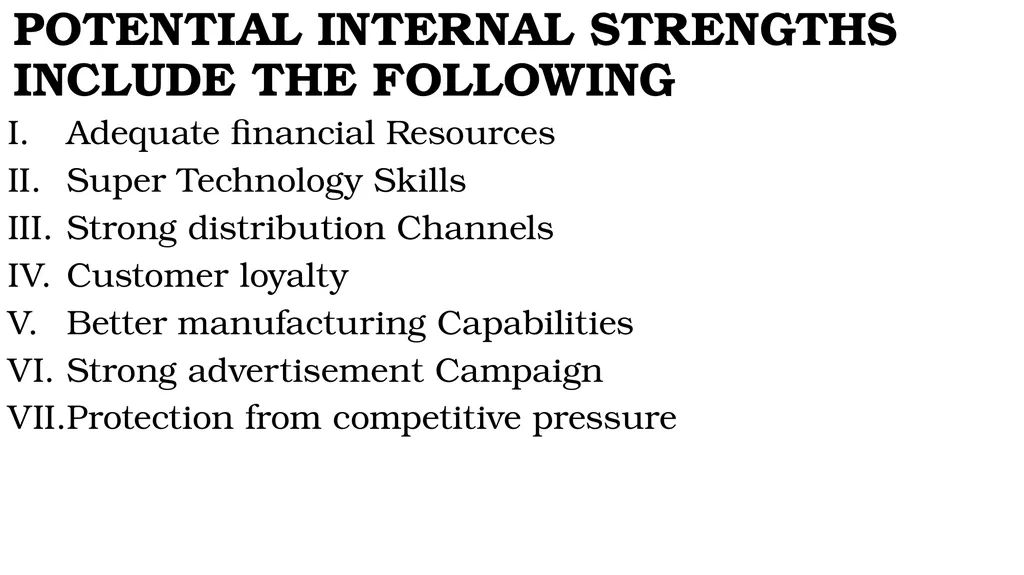
POTENTIAL INTERNAL STRENGTHS INCLUDE THE FOLLOWING Adequate financial Resources
Super Technology Skills
Strong distribution Channels
Customer loyalty
Better manufacturing Capabilities
Strong advertisement Campaign
Protection from competitive pressure<br>
Super Technology Skills
Strong distribution Channels
Customer loyalty
Better manufacturing Capabilities
Strong advertisement Campaign
Protection from competitive pressure<br>
06
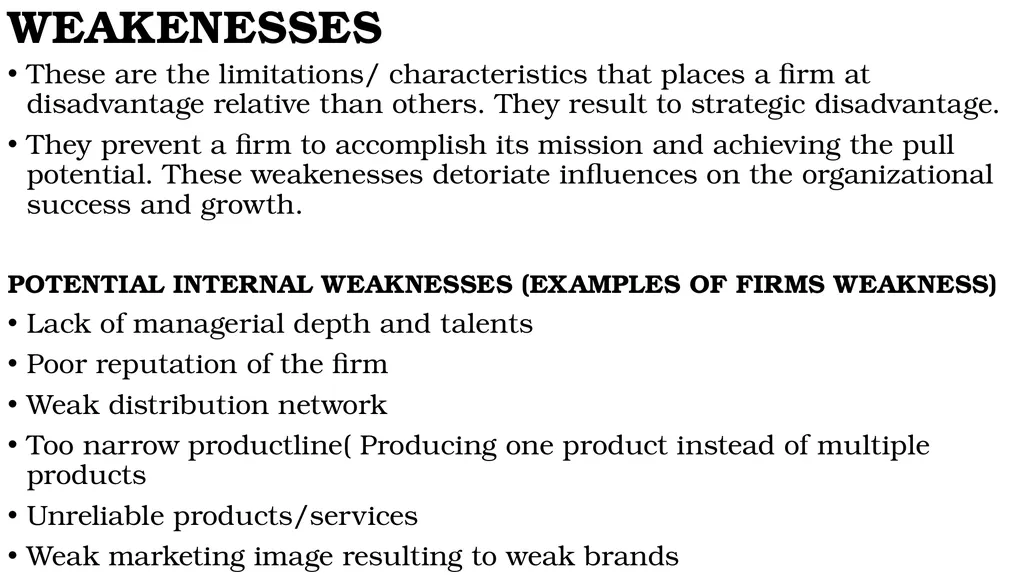
WEAKENESSES These are the limitations/ characteristics that places a firm at disadvantage relative than others. They result to strategic disadvantage.
They prevent a firm to accomplish its mission and achieving the pull potential. These weakenesses detoriate influences on the organizational success and growth.
POTENTIAL INTERNAL WEAKNESSES (EXAMPLES OF FIRMS WEAKNESS)
Lack of managerial depth and talents
Poor reputation of the firm
Weak distribution network
Too narrow productline( Producing one product instead of multiple products
Unreliable products/services
Weak marketing image resulting to weak brands<br>
They prevent a firm to accomplish its mission and achieving the pull potential. These weakenesses detoriate influences on the organizational success and growth.
POTENTIAL INTERNAL WEAKNESSES (EXAMPLES OF FIRMS WEAKNESS)
Lack of managerial depth and talents
Poor reputation of the firm
Weak distribution network
Too narrow productline( Producing one product instead of multiple products
Unreliable products/services
Weak marketing image resulting to weak brands<br>
07
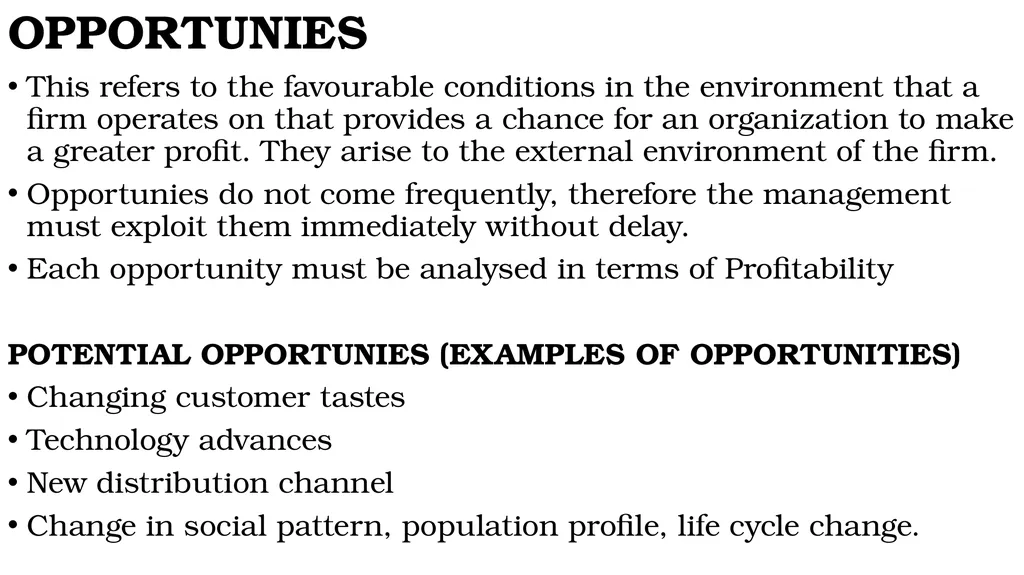
OPPORTUNIES This refers to the favourable conditions in the environment that a firm operates on that provides a chance for an organization to make a greater profit. They arise to the external environment of the firm.
Opportunies do not come frequently, therefore the management must exploit them immediately without delay.
Each opportunity must be analysed in terms of Profitability
POTENTIAL OPPORTUNIES (EXAMPLES OF OPPORTUNITIES)
Changing customer tastes
Technology advances
New distribution channel
Change in social pattern, population profile, life cycle change.<br>
Opportunies do not come frequently, therefore the management must exploit them immediately without delay.
Each opportunity must be analysed in terms of Profitability
POTENTIAL OPPORTUNIES (EXAMPLES OF OPPORTUNITIES)
Changing customer tastes
Technology advances
New distribution channel
Change in social pattern, population profile, life cycle change.<br>
08
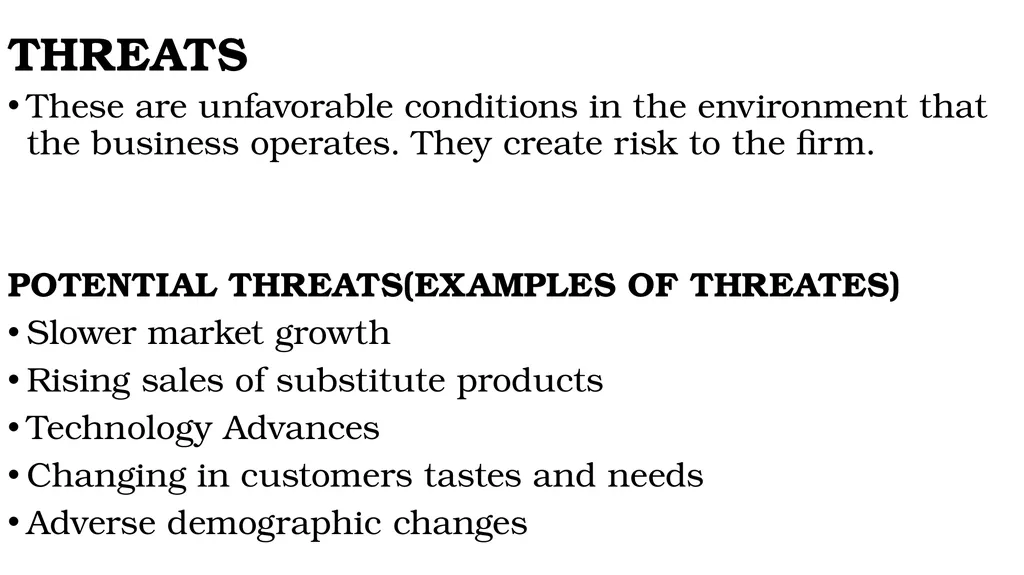
THREATS These are unfavorable conditions in the environment that the business operates. They create risk to the firm.
POTENTIAL THREATS(EXAMPLES OF THREATES)
Slower market growth
Rising sales of substitute products
Technology Advances
Changing in customers tastes and needs
Adverse demographic changes<br>
POTENTIAL THREATS(EXAMPLES OF THREATES)
Slower market growth
Rising sales of substitute products
Technology Advances
Changing in customers tastes and needs
Adverse demographic changes<br>
09
IMPORTANCE OF SWOT ANALYSIS It is the source of information for strategy planning
It builds an organisational strength
It reverse organizational weaknesses
It maximizes firms response to opportunity
It identify the core competencies of the firm
It helps in setting to objectives or strategic plan
It helps to know the past, present and the future.<br>
It builds an organisational strength
It reverse organizational weaknesses
It maximizes firms response to opportunity
It identify the core competencies of the firm
It helps in setting to objectives or strategic plan
It helps to know the past, present and the future.<br>
10
LIMITATION OF SWOT ANALYSIS A SWOT Analysis may be limited because;
It doesn’t priotize issues
It doesn't provide solutions or offer alternative decisions
It can generate too many ideas but doesnot help in choosing which one is the best.
It can produce a lot of information, but not all of it is usefull.<br>
It doesn’t priotize issues
It doesn't provide solutions or offer alternative decisions
It can generate too many ideas but doesnot help in choosing which one is the best.
It can produce a lot of information, but not all of it is usefull.<br>
11
ADVANTAGES OF SWOT ANALSYSIS It facilitates an understanding of the strengths and weaknesses of the organisation.
It encourages the development of strategic thinking.
It enables senior managers to focus on strengths and build opportunities.<br>
It encourages the development of strategic thinking.
It enables senior managers to focus on strengths and build opportunities.<br>
12
Achieving Competitive advantage by using IS/IT. Achieving Competitive Advantage with IT • Off-line (store) Retail • Online Retail • Automotive • Online music • Music players • Web search • Personal computers • Software Competitive Advantage
Competitiveness How effectively an organization meets the wants and needs of customers relative to others that offer similar goods or services.
is an outsourcing solutions design firm with an extensive offering of world-class logistics, fulfillment, customer care and technology infrastructure that can be leveraged to create unique, client-specific business solutions.
Outputs Productivity = Inputs Productivity Measures how well an organization is utilizing its resources.
Porter’s Competitive Advantage Model New Entrants Buyer Power Supplier Power Rivalry Among Competitors Suppliers Customers Substitutes<br>
Competitiveness How effectively an organization meets the wants and needs of customers relative to others that offer similar goods or services.
is an outsourcing solutions design firm with an extensive offering of world-class logistics, fulfillment, customer care and technology infrastructure that can be leveraged to create unique, client-specific business solutions.
Outputs Productivity = Inputs Productivity Measures how well an organization is utilizing its resources.
Porter’s Competitive Advantage Model New Entrants Buyer Power Supplier Power Rivalry Among Competitors Suppliers Customers Substitutes<br>
13
Achieving Competitive Advantage with Information Systems Porter’s Competitive Forces Model
Essentials of Management Information Systems Achieving Competitive Advantage with Information Systems
Using Information Systems to Achieve Competitive Advantage Porter’s Competitive Forces Model One way to understand competitive advantage
Five competitive forces shape fate of firmTraditional competitors Competitors in market space continuously devise new products, new efficiencies, switching costs.
New market entrantsSome industries have low barriers to entry:E.g., food industry versus microchip industryNewer companies may have advantages:Newer equipment, younger workforce, and so on.<br>
Using Information Systems to Achieve Competitive Advantage Porter’s Competitive Forces Model One way to understand competitive advantage
Five competitive forces shape fate of firmTraditional competitors Competitors in market space continuously devise new products, new efficiencies, switching costs.
New market entrantsSome industries have low barriers to entry:E.g., food industry versus microchip industryNewer companies may have advantages:Newer equipment, younger workforce, and so on.<br>
14
Porter’s Competitive Forces Model
Essentials of Management Information Systems
Achieving Competitive Advantage with Information SystemsUsing Information Systems to Achieve Competitive AdvantagePorter’s Competitive Forces Model Substitute products and services Substitutes
customers can purchase if your prices too high.E.g., Internet music service versus CDs.Customers Can customers easily switch to competitor’s products?
Can customers force firm and competitors to compete on price alone (transparent marketplace).
SuppliersThe more suppliers a firm has, the greater control it can exercise over suppliers.<br>
Achieving Competitive Advantage with Information SystemsUsing Information Systems to Achieve Competitive AdvantagePorter’s Competitive Forces Model Substitute products and services Substitutes
customers can purchase if your prices too high.E.g., Internet music service versus CDs.Customers Can customers easily switch to competitor’s products?
Can customers force firm and competitors to compete on price alone (transparent marketplace).
SuppliersThe more suppliers a firm has, the greater control it can exercise over suppliers.<br>
15
Porter’s Competitive Forces Model
Essentials of Management Information Systems
Achieving Competitive Advantage with Information SystemsUsing Information Systems to Achieve Competitive AdvantagePorter’s Competitive
Forces Model In Porter’s competitive forces model, the strategic position of the firm and its strategies are determined not only by competition with its traditional direct competitors but also by four forces in the industry’s environment:
new market entrants,
substitute products,
customers, and suppliers.<br>
Achieving Competitive Advantage with Information SystemsUsing Information Systems to Achieve Competitive AdvantagePorter’s Competitive
Forces Model In Porter’s competitive forces model, the strategic position of the firm and its strategies are determined not only by competition with its traditional direct competitors but also by four forces in the industry’s environment:
new market entrants,
substitute products,
customers, and suppliers.<br>
16
Information System Strategies for Dealing with Competitive Forces
Essentials of Management Information Systems
Achieving Competitive Advantage with Information Systems
Using Information Systems to Achieve Competitive Advantage Information System Strategies for Dealing with Competitive Forces Basic strategy:
Align IT with business objectives75 percent of businesses fail to align their IT with their business objectives, leading to lower profitability.
To align IT: Identify business goals and strategies.
Break strategic goals into concrete activities and processes.
Identify metrics for measuring progress.
Determine how IT can help achieve business goals.
Measure actual performance.<br>
Achieving Competitive Advantage with Information Systems
Using Information Systems to Achieve Competitive Advantage Information System Strategies for Dealing with Competitive Forces Basic strategy:
Align IT with business objectives75 percent of businesses fail to align their IT with their business objectives, leading to lower profitability.
To align IT: Identify business goals and strategies.
Break strategic goals into concrete activities and processes.
Identify metrics for measuring progress.
Determine how IT can help achieve business goals.
Measure actual performance.<br>
17
Information System Strategies for Dealing with Competitive Forces
Essentials of Management Information Systems
Achieving Competitive Advantage with Information Systems
Using Information Systems to Achieve Competitive AdvantageInformation System Strategies for Dealing with Competitive Forces
Low-cost leadership
Use information systems to achieve the lowest operational costs and the lowest prices.E.g. Wal-Mart Inventory replenishment system sends orders to suppliers when purchase recorded at cash register.
Minimizes inventory at warehouses, operating costs.
Efficient customer response system.<br>
Achieving Competitive Advantage with Information Systems
Using Information Systems to Achieve Competitive AdvantageInformation System Strategies for Dealing with Competitive Forces
Low-cost leadership
Use information systems to achieve the lowest operational costs and the lowest prices.E.g. Wal-Mart Inventory replenishment system sends orders to suppliers when purchase recorded at cash register.
Minimizes inventory at warehouses, operating costs.
Efficient customer response system.<br>
18
Essentials of Management Information Systems
Achieving Competitive Advantage with Information Systems
Using Information Systems to Achieve Competitive Advantage
Supermarkets and large retail stores such as Wal-Mart use sales data captured at the checkout counter to determine which items have sold and need to be reordered.
Wal-Mart’s continuous replenishment system transmits orders to restock directly to its suppliers.
The system enables Wal-Mart to keep costs low while fine-tuning its merchandise to meet customer demands.<br>
Using Information Systems to Achieve Competitive Advantage
Supermarkets and large retail stores such as Wal-Mart use sales data captured at the checkout counter to determine which items have sold and need to be reordered.
Wal-Mart’s continuous replenishment system transmits orders to restock directly to its suppliers.
The system enables Wal-Mart to keep costs low while fine-tuning its merchandise to meet customer demands.<br>
19
Information System Strategies for Dealing with Competitive Forces
Essentials of Management Information Systems
Achieving Competitive Advantage with Information Systems
Using Information Systems to Achieve Competitive Advantage
Information System Strategies for Dealing with Competitive Forces Product differentiation
Use information systems to enable new products and services, or greatly change the customer convenience in using your existing products and services.E.g., Google’s continuous innovations, Apple’s iPhone.
Use information systems to customize, personalize products to fit specifications of individual consumers.
DellMass customization at Lands’ End<br>
Achieving Competitive Advantage with Information Systems
Using Information Systems to Achieve Competitive Advantage
Information System Strategies for Dealing with Competitive Forces Product differentiation
Use information systems to enable new products and services, or greatly change the customer convenience in using your existing products and services.E.g., Google’s continuous innovations, Apple’s iPhone.
Use information systems to customize, personalize products to fit specifications of individual consumers.
DellMass customization at Lands’ End<br>
20
Information System Strategies for Dealing with Competitive Forces
Essentials of Management Information Systems
Achieving Competitive Advantage with Information Systems
Using Information Systems to Achieve Competitive Advantage
Information System Strategies for Dealing with Competitive Forces
Focus on market niche.
Use information systems to enable specific market focus, and serve narrow target market better than competitors.
Analyzes customer buying habits, preferencesAdvertising pitches to smaller and smaller target marketsE.g., Hilton Hotel’s OnQ SystemAnalyzes data collected on guests to determine preferences and guest’s profitability<br>
Achieving Competitive Advantage with Information Systems
Using Information Systems to Achieve Competitive Advantage
Information System Strategies for Dealing with Competitive Forces
Focus on market niche.
Use information systems to enable specific market focus, and serve narrow target market better than competitors.
Analyzes customer buying habits, preferencesAdvertising pitches to smaller and smaller target marketsE.g., Hilton Hotel’s OnQ SystemAnalyzes data collected on guests to determine preferences and guest’s profitability<br>
21
Information System Strategies for Dealing with Competitive Forces
Essentials of Management Information Systems
Achieving Competitive Advantage with Information Systems
Using Information Systems to Achieve Competitive AdvantageInformation System Strategies for Dealing with Competitive Forces
Strengthen customer and supplier intimacy.
Strong linkages to customers and suppliers increase switching costs and loyalty
Toyota: uses IS to facilitate direct access from suppliers to production schedules
Permits suppliers to decide how and when to ship suppliers to Chrysler factories, allowing more lead time in producing goods.
Amazon: keeps track of user preferences for purchases, and recommends titles purchased by others<br>
Achieving Competitive Advantage with Information Systems
Using Information Systems to Achieve Competitive AdvantageInformation System Strategies for Dealing with Competitive Forces
Strengthen customer and supplier intimacy.
Strong linkages to customers and suppliers increase switching costs and loyalty
Toyota: uses IS to facilitate direct access from suppliers to production schedules
Permits suppliers to decide how and when to ship suppliers to Chrysler factories, allowing more lead time in producing goods.
Amazon: keeps track of user preferences for purchases, and recommends titles purchased by others<br>
22
Some companies pursue several strategies at same time.
Essentials of Management Information Systems
Achieving Competitive Advantage with Information Systems
Using Information Systems to Achieve Competitive Advantage
Information System Strategies for Dealing with Competitive Forces
Some companies pursue several strategies at same time.
Dell emphasizes low cost plus customization of products.
Successfully using IS to achieve competitive advantage requires precise coordination of technology, organizations, and people.<br>
Achieving Competitive Advantage with Information Systems
Using Information Systems to Achieve Competitive Advantage
Information System Strategies for Dealing with Competitive Forces
Some companies pursue several strategies at same time.
Dell emphasizes low cost plus customization of products.
Successfully using IS to achieve competitive advantage requires precise coordination of technology, organizations, and people.<br>
23
The Internet’s Impact on Competitive Advantage
Essentials of Management Information Systems
Achieving Competitive Advantage with Information Systems
Using Information Systems to Achieve Competitive Advantage
The Internet’s Impact on Competitive Advantage
Enables new products and services
Transforms industries Increases bargaining power of customers and suppliers Intensifies competitive rivalry
Creates new opportunities for building brands and large customer bases<br>
Achieving Competitive Advantage with Information Systems
Using Information Systems to Achieve Competitive Advantage
The Internet’s Impact on Competitive Advantage
Enables new products and services
Transforms industries Increases bargaining power of customers and suppliers Intensifies competitive rivalry
Creates new opportunities for building brands and large customer bases<br>
24
The Business Value Chain Model
Essentials of Management Information System
Achieving Competitive Advantage with Information Systems
Using Information Systems to Achieve Competitive Advantage
The Business Value Chain ModelHighlights specific activities in a business where competitive strategies can best be applied and where information systems are likely to have a strategic impact.
Primary activities Support activities Benchmarking Best practices<br>
Achieving Competitive Advantage with Information Systems
Using Information Systems to Achieve Competitive Advantage
The Business Value Chain ModelHighlights specific activities in a business where competitive strategies can best be applied and where information systems are likely to have a strategic impact.
Primary activities Support activities Benchmarking Best practices<br>
25
The Value Chain Model Essentials of Management Information Systems
Achieving Competitive Advantage with Information Systems
Using Information Systems to Achieve Competitive Advantage
The Value Chain Model
This figure provides examples of systems for both primary and support activities of a firm and of its value partners that would add a margin of value to a firm’s products or services.<br>
Using Information Systems to Achieve Competitive Advantage
The Value Chain Model
This figure provides examples of systems for both primary and support activities of a firm and of its value partners that would add a margin of value to a firm’s products or services.<br>
26
The Internet and Globalization
Essentials of Management Information Systems
Achieving Competitive Advantage with Information Systems
Competing on a Global Scale
The Internet and GlobalizationPrior to the Internet, competing globally was only an option for huge firms able to afford factories, warehouses, and distribution centers abroad.
The Internet drastically reduces costs of operating globally.
Globalization benefits:Scale economies and resource cost reduction
Higher utilization rates, fixed capital costs, and lower cost per unit of productionSpeeding time to market<br>
Achieving Competitive Advantage with Information Systems
Competing on a Global Scale
The Internet and GlobalizationPrior to the Internet, competing globally was only an option for huge firms able to afford factories, warehouses, and distribution centers abroad.
The Internet drastically reduces costs of operating globally.
Globalization benefits:Scale economies and resource cost reduction
Higher utilization rates, fixed capital costs, and lower cost per unit of productionSpeeding time to market<br>
27
Global Business and System Strategies
Essentials of Management Information Systems
Achieving Competitive Advantage with Information Systems Competing on a Global ScaleGlobal Business and System Strategies
Domestic exporters Heavy centralization of corporate activities in home country
MultinationalsConcentrates financial management at central home base while decentralizing production, sales, and marketing to other countries
Franchisers Product created, designed, financed, and initially produced in home country but rely on foreign units for further production, marketing, and human resources
TransnationalsRegional (not national) headquarters and perhaps world headquarters; optimizing resources as needed<br>
Achieving Competitive Advantage with Information Systems Competing on a Global ScaleGlobal Business and System Strategies
Domestic exporters Heavy centralization of corporate activities in home country
MultinationalsConcentrates financial management at central home base while decentralizing production, sales, and marketing to other countries
Franchisers Product created, designed, financed, and initially produced in home country but rely on foreign units for further production, marketing, and human resources
TransnationalsRegional (not national) headquarters and perhaps world headquarters; optimizing resources as needed<br>
28
Global System Configurations
Essentials of Management Information Systems
Achieving Competitive Advantage with Information Systems Competing on a Global Scale Global System
Configurations Centralized systems:All development and operation at domestic home baseDuplicated systems:Development at home base but operations managed by autonomous units in foreign locations
Decentralized systems:Each foreign unit designs own solutions and systemsNetworked systems:Development and operations occur in integrated and coordinated fashion across all units<br>
Achieving Competitive Advantage with Information Systems Competing on a Global Scale Global System
Configurations Centralized systems:All development and operation at domestic home baseDuplicated systems:Development at home base but operations managed by autonomous units in foreign locations
Decentralized systems:Each foreign unit designs own solutions and systemsNetworked systems:Development and operations occur in integrated and coordinated fashion across all units<br>
29
Global Business Organization Systems Configurations
Essentials of Management Information Systems
Achieving Competitive Advantage with Information Systems Competing on a Global Scale Global Business Organization Systems Configurations
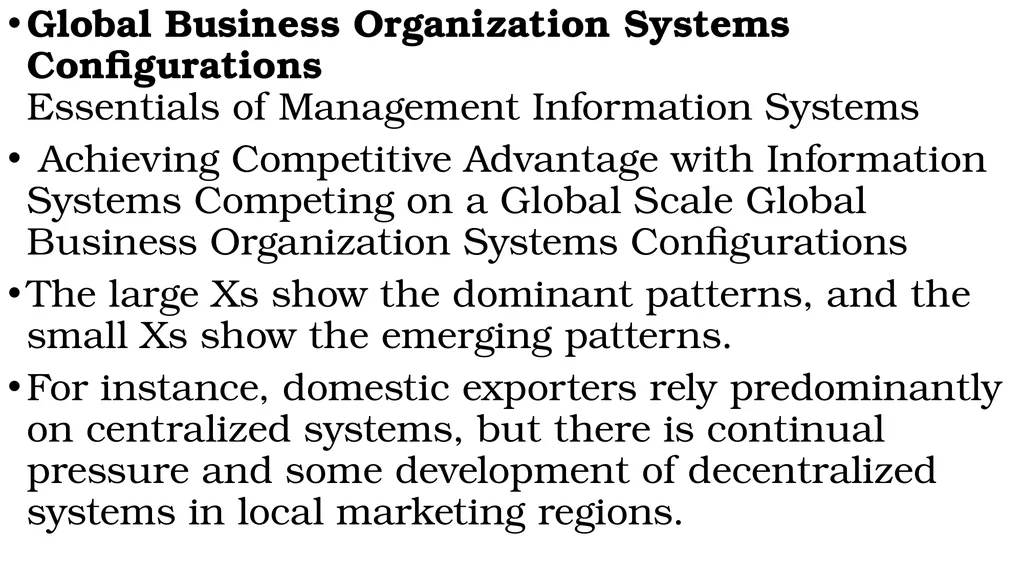
The large Xs show the dominant patterns, and the small Xs show the emerging patterns.
For instance, domestic exporters rely predominantly on centralized systems, but there is continual pressure and some development of decentralized systems in local marketing regions.<br>
Achieving Competitive Advantage with Information Systems Competing on a Global Scale Global Business Organization Systems Configurations
The large Xs show the dominant patterns, and the small Xs show the emerging patterns.
For instance, domestic exporters rely predominantly on centralized systems, but there is continual pressure and some development of decentralized systems in local marketing regions.<br>
30
Producer perspective:
Essentials of Management Information Systems
Achieving Competitive Advantage with Information Systems
Competing on Quality and Is Quality?
Producer perspective:Conformance to specifications and absence of variation from specs Customer perspective:
Physical quality (reliability), quality of service, psychological quality
Total quality management (TQM):Quality control is end in itselfAll people, functions responsible for qualitySix sigma:
Measure of quality: 3.4 defects/million opportunities<br>
Achieving Competitive Advantage with Information Systems
Competing on Quality and Is Quality?
Producer perspective:Conformance to specifications and absence of variation from specs Customer perspective:
Physical quality (reliability), quality of service, psychological quality
Total quality management (TQM):Quality control is end in itselfAll people, functions responsible for qualitySix sigma:
Measure of quality: 3.4 defects/million opportunities<br>
31
How Information Systems Improve Quality
Essentials of Management Information Systems
Achieving Competitive Advantage with Information Systems
Competing on Quality and Design
How Information Systems Improve Quality
Reduce cycle time and simplify production process.
BenchmarkingUse customer demands to improve products and services.
Improve design quality and precision.
Computer-aided design (CAD) systemsImprove production precision and tighten production tolerances.<br>
Achieving Competitive Advantage with Information Systems
Competing on Quality and Design
How Information Systems Improve Quality
Reduce cycle time and simplify production process.
BenchmarkingUse customer demands to improve products and services.
Improve design quality and precision.
Computer-aided design (CAD) systemsImprove production precision and tighten production tolerances.<br>
32
Essentials of Management Information Systems
Achieving Competitive Advantage with Information SystemsCompeting on Quality and DesignComputer-aided design (CAD) systems improve the quality and precision of product design by performing much of the design and testing work on the computer.
Competing on Business Processes Essentials of Management Information Systems
Achieving Competitive Advantage with Information Systems
Businesses are collections of business processes— ways of working and getting things done. See Chapter 1.Some times they are written in manuals, but in many cases business processes are informal.
In order to use information systems effectively, you need to change business processes.
Before you can change processes, you need to change people’s attitudes and behaviors, and even the organization itself.<br>
Competing on Business Processes Essentials of Management Information Systems
Achieving Competitive Advantage with Information Systems
Businesses are collections of business processes— ways of working and getting things done. See Chapter 1.Some times they are written in manuals, but in many cases business processes are informal.
In order to use information systems effectively, you need to change business processes.
Before you can change processes, you need to change people’s attitudes and behaviors, and even the organization itself.<br>
33
Business process management = continuous improvement
Essentials of Management Information Systems
Achieving Competitive Advantage with Information Systems
Competing on Business ProcessesBusiness process management = continuous improvementIdentify processes for change.
Analyze existing processes.Design new process.
Implement new process.Measure new process.
Competing on Business Processes Essentials of Management Information Systems
Achieving Competitive Advantage with Information Systems<br>
Achieving Competitive Advantage with Information Systems
Competing on Business ProcessesBusiness process management = continuous improvementIdentify processes for change.
Analyze existing processes.Design new process.
Implement new process.Measure new process.
Competing on Business Processes Essentials of Management Information Systems
Achieving Competitive Advantage with Information Systems<br>
34
Essentials of Management Information Systems
Achieving Competitive Advantage with Information Systems Competing on Business Processes
Business Process Reengineering Essentials of Management Information Systems
Achieving Competitive Advantage with Information Systems Competing on Business Processes
Business Process Reengineering A radical form of fast change Not continuous improvement, but elimination of old processes, replacement with new processes, in a brief time period
Can produce dramatic gains in productivity, but increases organizational resistance to change<br>
Achieving Competitive Advantage with Information Systems Competing on Business Processes
Business Process Reengineering Essentials of Management Information Systems
Achieving Competitive Advantage with Information Systems Competing on Business Processes
Business Process Reengineering A radical form of fast change Not continuous improvement, but elimination of old processes, replacement with new processes, in a brief time period
Can produce dramatic gains in productivity, but increases organizational resistance to change<br>