Synergistic Natural Gas Biomass Co-processing to Produce Hydrogen Rich Syngas Amoolya D. Lalsarea Jianli Hua Ali C. Sivrib Cosmin E. Dumitrescub a: Chemical and Biomedical Engineering b: Mechanical and Aerospace Engineering West Virginia
"Synergistic Natural Gas – Biomass Co-processing to" is the property of its rightful owner. Permission is granted to
download and print the materials on this website for personal, non-commercial use only, and to display it
on your personal computer provided you do not modify the materials and that you retain all copyright
notices contained in the materials. By downloading content from our website, you accept the terms of this
agreement.
Presentation Transcript
01
Synergistic Natural Gas – Biomass Co-processing to Produce Hydrogen Rich Syngas
Amoolya D. Lalsarea
Jianli Hua
Ali C. Sivrib
Cosmin E. Dumitrescub
a: Chemical and Biomedical Engineering
b: Mechanical and Aerospace Engineering
West Virginia University<br>
02
2 Outline Motivation
Gasifier reactor configuration
Natural gas-biomass
co-processing
Design of experiments
Results and discussion
Proposed reaction pathway
Process Scale-up and Path to Commercial Application
Conclusions
Future Work<br>
03
Motivation Lab scale scale-up of gasification reactor to bench scale fluidized bed reactor
Complexity of fluidization hydrodynamics
Complex reaction engineering of biomass / coal gasification
Gasification process development to improve efficiency
Process intensification 3<br>
04
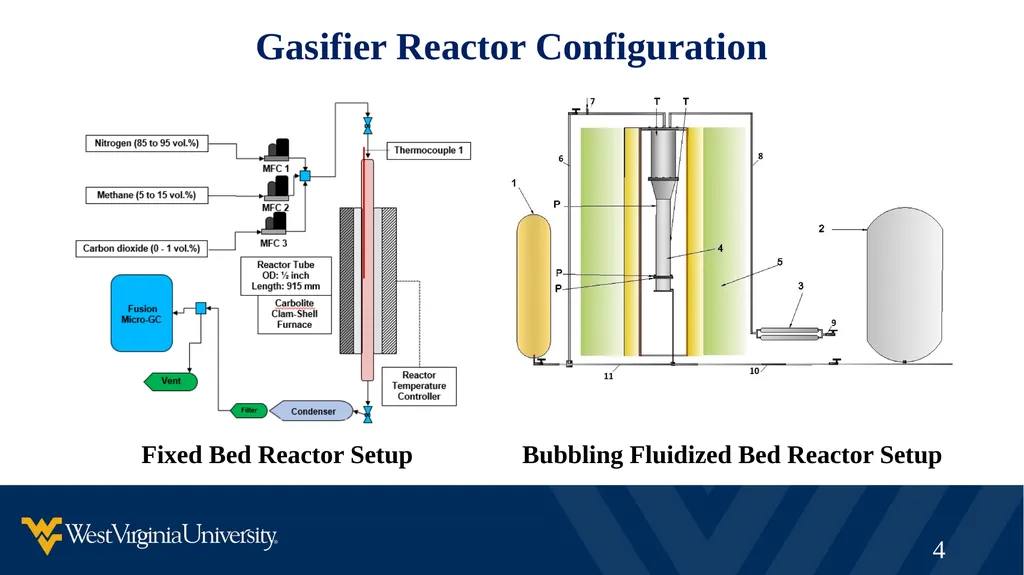
Gasifier Reactor Configuration Fixed Bed Reactor Setup Bubbling Fluidized Bed Reactor Setup 4<br>
05
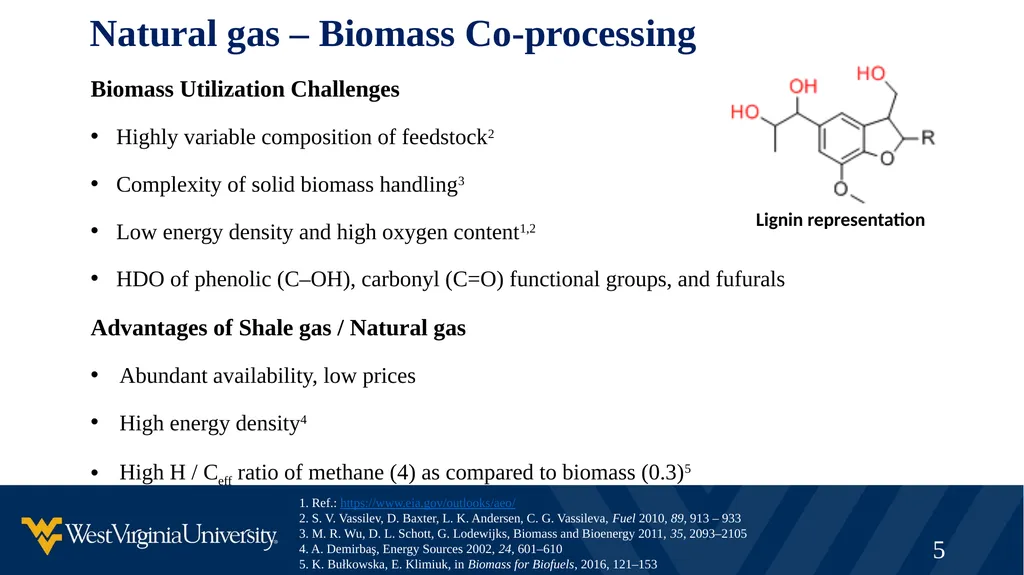
Natural gas – Biomass Co-processing Biomass Utilization Challenges
Highly variable composition of feedstock2
Complexity of solid biomass handling3
Low energy density and high oxygen content1,2
HDO of phenolic (C–OH), carbonyl (C=O) functional groups, and fufurals
Advantages of Shale gas / Natural gas
Abundant availability, low prices
High energy density4
High H / Ceff ratio of methane (4) as compared to biomass (0.3)5 1. Ref.: https://www.eia.gov/outlooks/aeo/
2. S. V. Vassilev, D. Baxter, L. K. Andersen, C. G. Vassileva, Fuel 2010, 89, 913 – 933
3. M. R. Wu, D. L. Schott, G. Lodewijks, Biomass and Bioenergy 2011, 35, 2093–2105
4. A. Demirbaş, Energy Sources 2002, 24, 601–610
5. K. Bułkowska, E. Klimiuk, in Biomass for Biofuels, 2016, 121–153 5 Lignin representation<br>
06
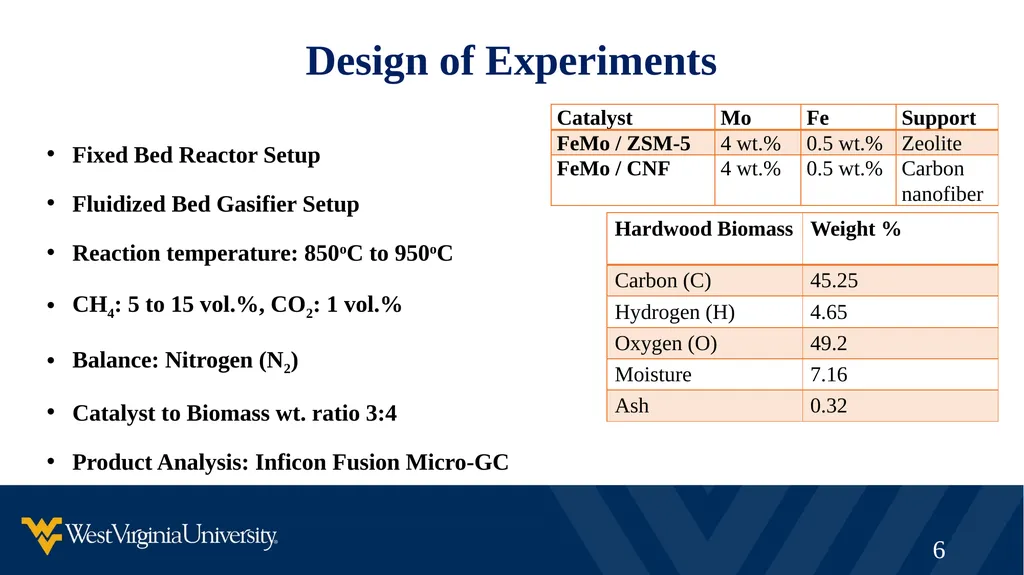
Design of Experiments Fixed Bed Reactor Setup
Fluidized Bed Gasifier Setup
Reaction temperature: 850oC to 950oC
CH4: 5 to 15 vol.%, CO2: 1 vol.%
Balance: Nitrogen (N2)
Catalyst to Biomass wt. ratio 3:4
Product Analysis: Inficon Fusion Micro-GC 6<br>
07
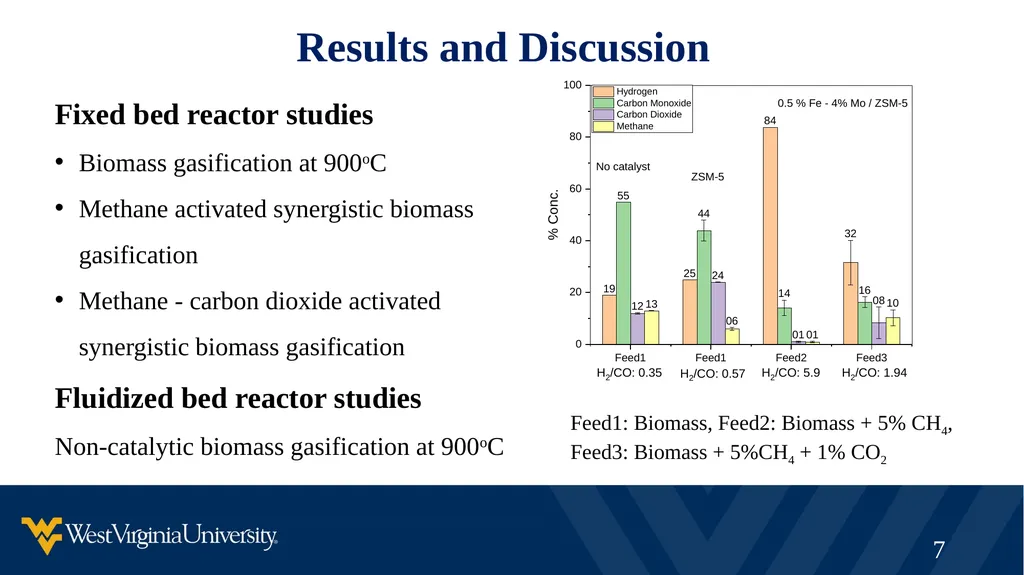
Results and Discussion Fixed bed reactor studies
Biomass gasification at 900oC
Methane activated synergistic biomass gasification
Methane - carbon dioxide activated synergistic biomass gasification
Fluidized bed reactor studies
Non-catalytic biomass gasification at 900oC Feed1: Biomass, Feed2: Biomass + 5% CH4,
Feed3: Biomass + 5%CH4 + 1% CO2 7<br>
08
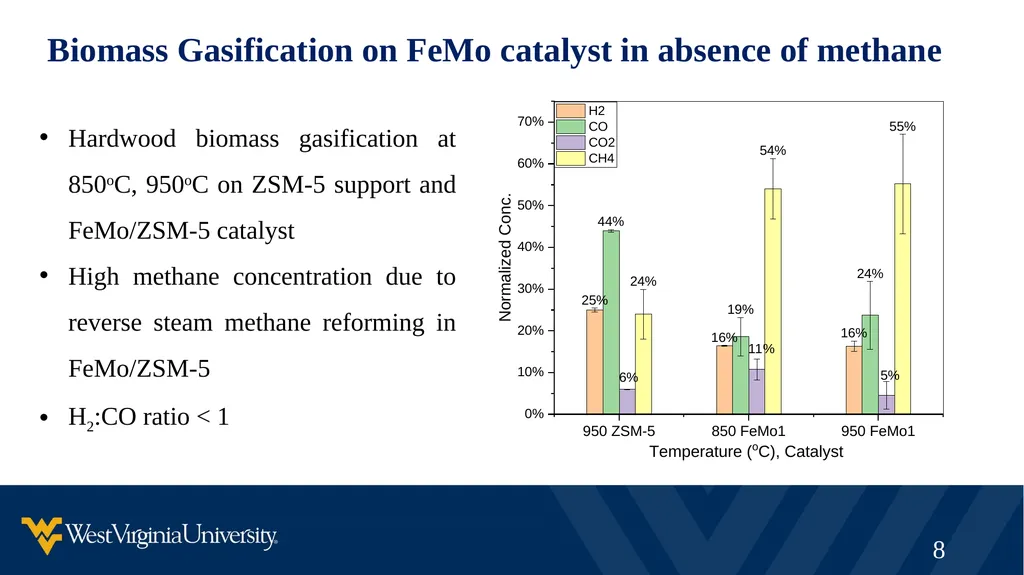
Biomass Gasification on FeMo catalyst in absence of methane Hardwood biomass gasification at 850oC, 950oC on ZSM-5 support and FeMo/ZSM-5 catalyst
High methane concentration due to reverse steam methane reforming in FeMo/ZSM-5
H2:CO ratio < 1 8<br>
09
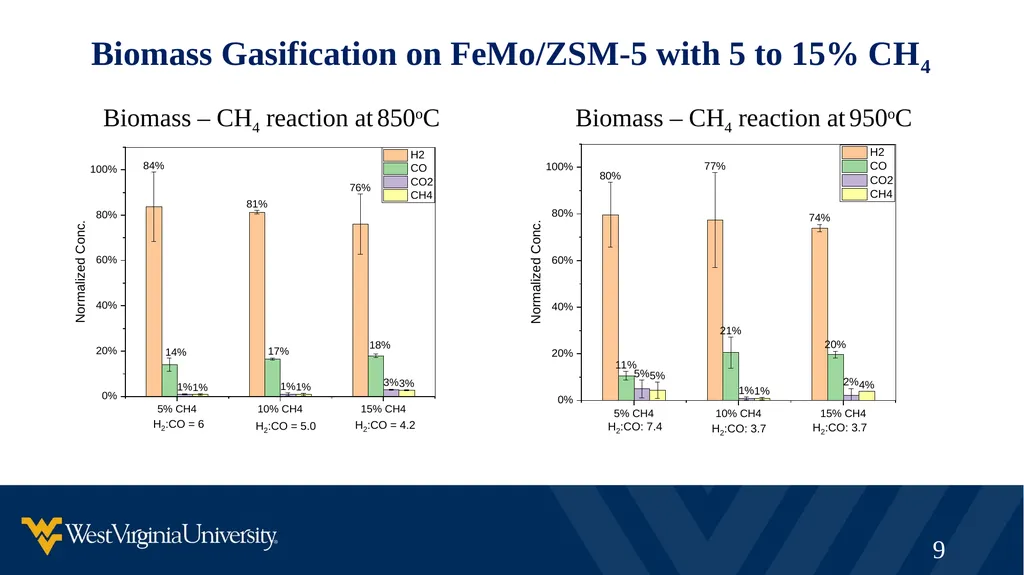
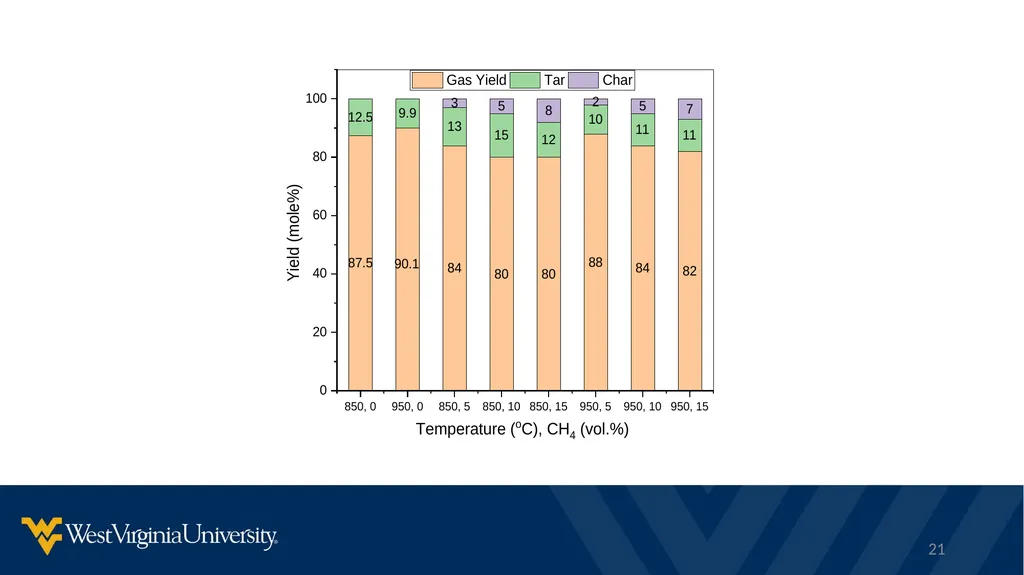
Biomass Gasification on FeMo/ZSM-5 with 5 to 15% CH4 Biomass – CH4 reaction at 850oC Biomass – CH4 reaction at 950oC 9<br>
10
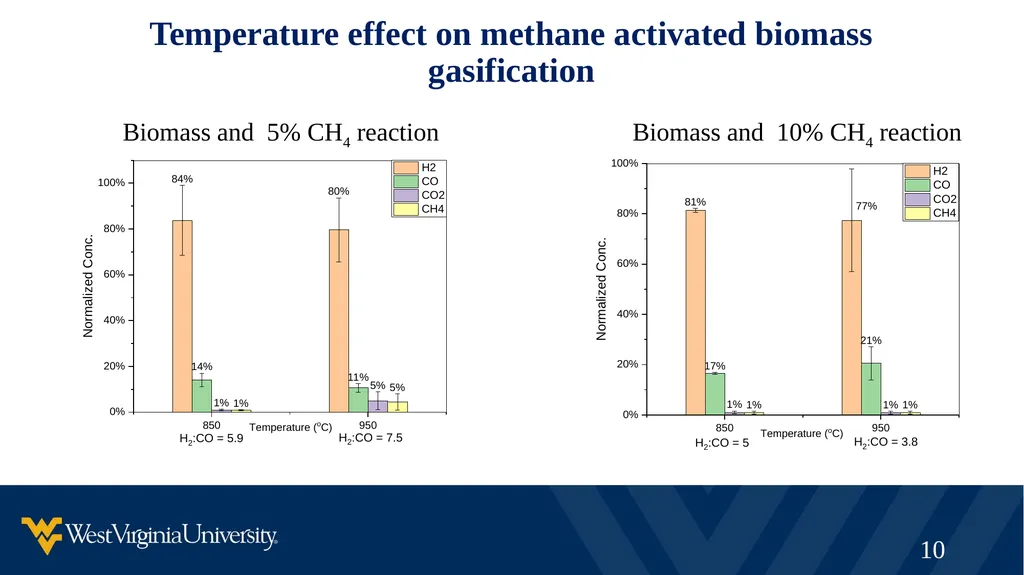
Temperature effect on methane activated biomass gasification Biomass and 5% CH4 reaction Biomass and 10% CH4 reaction 10<br>
11
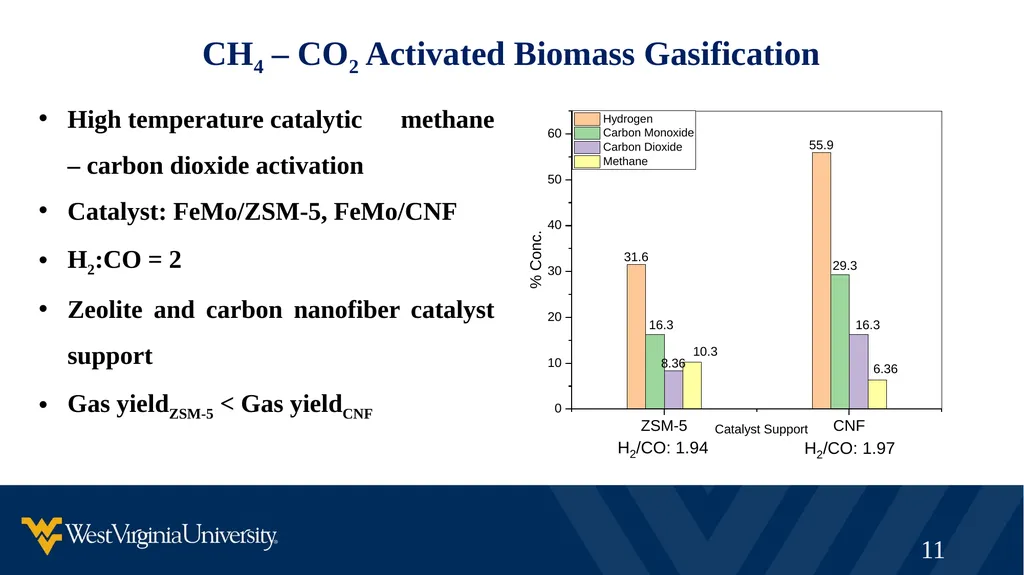
CH4 – CO2 Activated Biomass Gasification High temperature catalytic methane – carbon dioxide activation
Catalyst: FeMo/ZSM-5, FeMo/CNF
H2:CO = 2
Zeolite and carbon nanofiber catalyst support
Gas yieldZSM-5 < Gas yieldCNF 11<br>
12
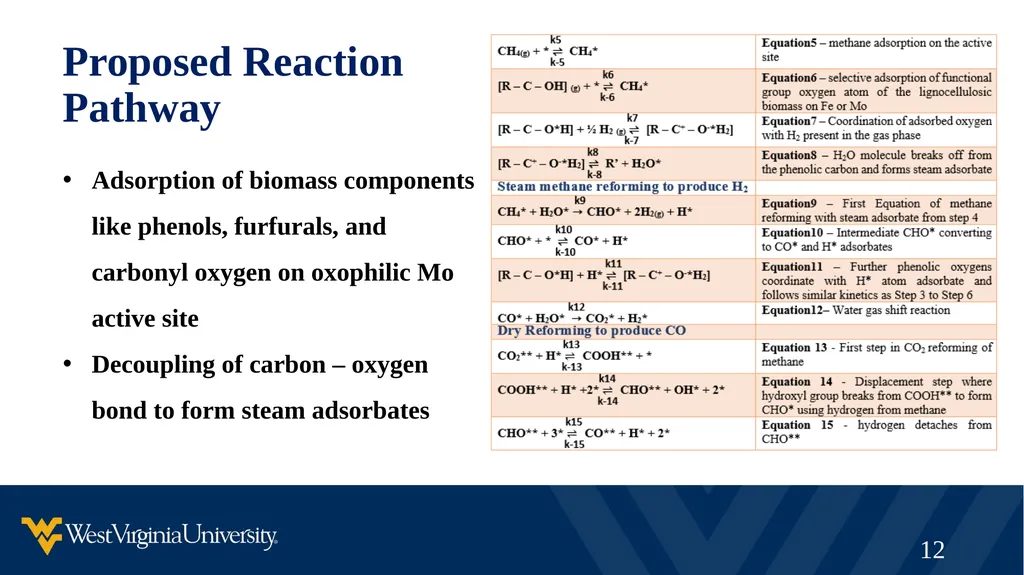
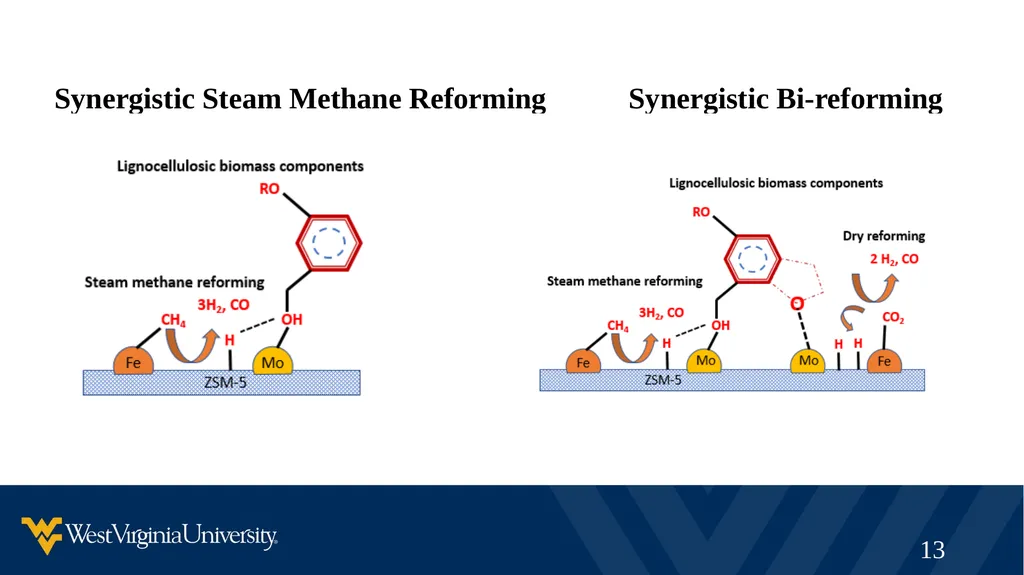
Proposed Reaction Pathway Adsorption of biomass components like phenols, furfurals, and carbonyl oxygen on oxophilic Mo active site
Decoupling of carbon – oxygen bond to form steam adsorbates 12<br>
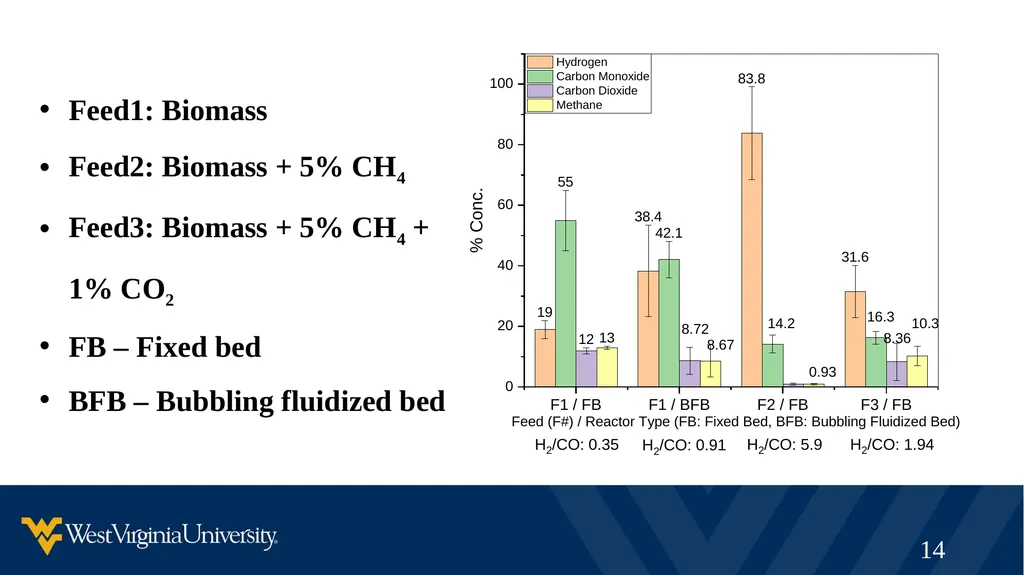
Feed1: Biomass
Feed2: Biomass + 5% CH4
Feed3: Biomass + 5% CH4 + 1% CO2
FB – Fixed bed
BFB – Bubbling fluidized bed 14<br>
15
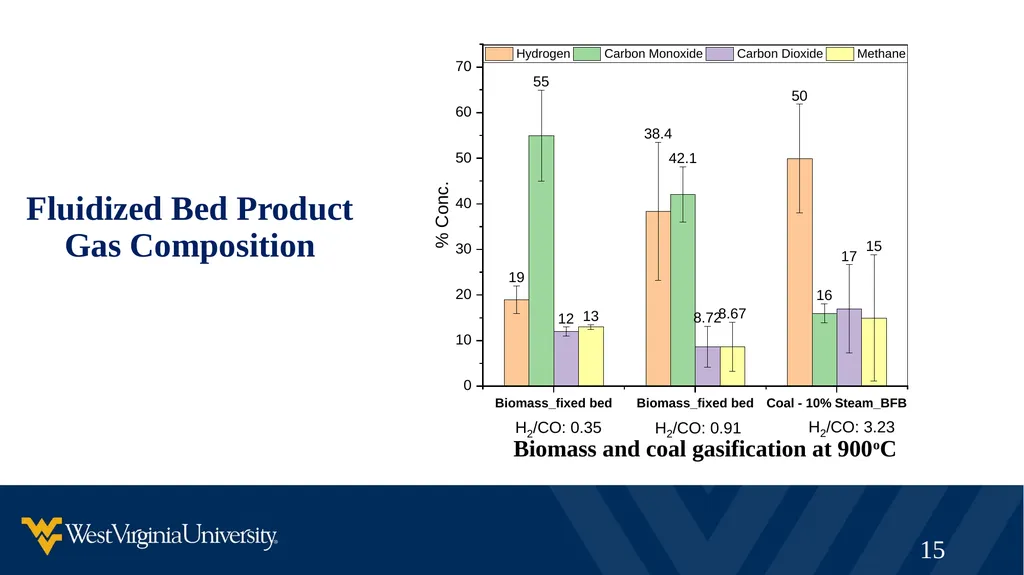
Fluidized Bed Product Gas Composition Biomass and coal gasification at 900oC 15<br>
16
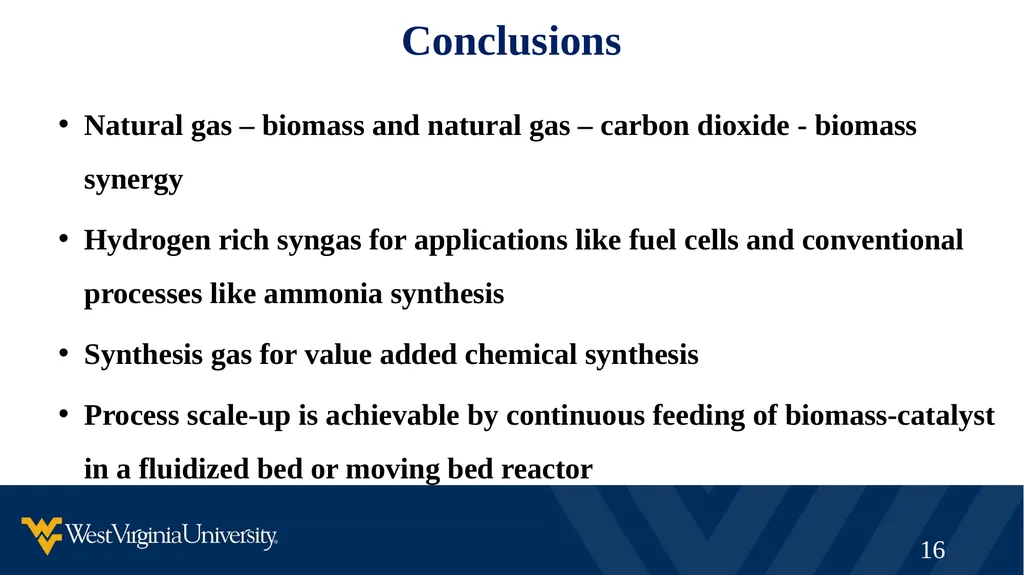
Conclusions Natural gas – biomass and natural gas – carbon dioxide - biomass synergy
Hydrogen rich syngas for applications like fuel cells and conventional processes like ammonia synthesis
Synthesis gas for value added chemical synthesis
Process scale-up is achievable by continuous feeding of biomass-catalyst in a fluidized bed or moving bed reactor 16<br>
17
Future Work Replicating all the fixed bed experimental conditions on bubbling fluidized bed setup
Achieve continuous streamlined feeding of coal / biomass
Extended continuous operation of fluidized bed reactor 17<br>
18
Hydrogen Rich Syngas Production through Synergistic Methane Activated Catalytic Biomass Gasification; Amoolya Lalsare, Yuxin Wang, Qingyuan Li, Ali C. Sivri, Cosmin E. Dumitrescu, Jianli Hu (under review at ACS Sustain Chem Eng)
Syngas (H2:CO = 2) production through methane – carbon dioxide activated synergistic bi-reforming in catalytic biomass gasification; Amoolya Lalsare, Ali C. Sivri, Ryan Egan, Roman J. Vukmanovich, Cosmin E. Dumitrescu, Jianli (submitted to ChemSusChem) Publications 18<br>
19
Acknowledgements Authors are pleased to acknowledge U.S Department of Energy and National Energy Technology Laboratory, Morgantown along with Leidos Research Support Team for the continuous support and cooperation for the specific work and broadly for the NETL Gasifier Support Stand Project 19<br>