
Synergy Audit Online Education Learning, teaching
NS
Published · 146 slides · 0 views

1 / 1











Description
Synergy Audit Online Education Learning, teaching and training education within the ERASMUS KA2 project Synergy Audit What does this presentation involves and how can I use it? This presentation is prepared as a possibility for a
Related Topics
Share
Embed code
Download this presentation From Below
"Synergy Audit Online Education Learning, teaching" is the property of its rightful owner. Permission is granted to download and print the materials on this website for personal, non-commercial use only, and to display it on your personal computer provided you do not modify the materials and that you retain all copyright notices contained in the materials. By downloading content from our website, you accept the terms of this agreement.
Presentation Transcript
01
Synergy Audit Online Education Learning, teaching and training education within the ERASMUS+ KA2 project Synergy Audit<br>
02
What does this presentation involves
and how can I use it? This presentation is prepared as a possibility for a multidisciplinary set of organisations to take usage from when learning about and teaching forward knowledge about environmental management and environmental audits from an interdisciplinary perspective, toward the organisation.
The knowledge in the presentation have been elaborated by partner organisations in the Synergy Audit project and is based on previous knowledge and experience from each of the partner organisations, together with knowledge input from data gathering and State of the art assessment in the ERASMUS+ Synergy Audit project (2019-2022).
The presentation is adviced to use as a sort of encyclopedia which point out certain relevant areas of knowledge within environmental science, environmental management, energy audits, contemporary history, teaching pedagogics and more as a help to grasp a holistic understanding about reasons for working with environmental management and its internal environmental audits.
It is our wish that this presentation will create curiosity for one or more areas of knowledge in the presentation and thereby inspire for further knowledge intake within specific areas.
Also, it is our main wish that this presentation will inspire you and your organisation to start up, and carry out environmental management and internal environmental audits in your organisation, for the chance to decrease environmental and climatic negative impact from activities performed by the organisation.
In this we all have a role to play, and we wish you all the best of luck on your journey forward with this mission.
The project partners of Synergy Audit<br>
03
Partner Collaborator<br>
04
Day 1<br>
05
Introduction to the Synergy Audit
Online Course Elaborated by the project partners of the Synergy Audit ERASMUS+ Project (2019-2022)
This learning, teaching and training education have been performed as a pilot and now as a finalized online training in the project.
The course involve lectures, seminars and workshops together with “real” environmental audit training toward organisations.
Course Aim: to make sure that you get more knowledge about environmental audits by an interdisciplinary perspective to make sure that you will be ready to perform internal environmental audits in your home organisation after the course ending.
Help to improve the chance for your home organisation to be environmentally certified.<br>
This learning, teaching and training education have been performed as a pilot and now as a finalized online training in the project.
The course involve lectures, seminars and workshops together with “real” environmental audit training toward organisations.
Course Aim: to make sure that you get more knowledge about environmental audits by an interdisciplinary perspective to make sure that you will be ready to perform internal environmental audits in your home organisation after the course ending.
Help to improve the chance for your home organisation to be environmentally certified.<br>
06
Lecture 1<br>
07
Climate change Why do we perform audits?<br>
08
Effects Of Global Climate Change? Temperatures Will Continue To Rise
The melting of polar ice caps.
Rising sea levels
The increasing frequency and intensity of extreme weather events
The extinction of animal and plant species
More frequent heat waves
The emergence of climate refugees
Agriculture and livestock issues that could exacerbate hunger around the world
The degradation of economic resource<br>
The melting of polar ice caps.
Rising sea levels
The increasing frequency and intensity of extreme weather events
The extinction of animal and plant species
More frequent heat waves
The emergence of climate refugees
Agriculture and livestock issues that could exacerbate hunger around the world
The degradation of economic resource<br>
09
Consequences of a changing climate Temperatures Will Continue to Rise
Frost-free Season (and Growing Season) will Lengthen
Changes in Precipitation Patterns
More Droughts and Heat Waves
Hurricanes Will Become Stronger and More Intense
Sea Level Will Rise 1-8 feet by 2100
Arctic Likely to Become Ice-Free<br>
Frost-free Season (and Growing Season) will Lengthen
Changes in Precipitation Patterns
More Droughts and Heat Waves
Hurricanes Will Become Stronger and More Intense
Sea Level Will Rise 1-8 feet by 2100
Arctic Likely to Become Ice-Free<br>
10
Most emissions come from just a few countries<br>
11
Global warming tipping points will push us over climate cliff<br>
12
Tipping points effects and domino effects Amazon rainforest
Arctic sea ice
Atlantic circulation
Boreal forest
Coral reefs
And more, and more ….<br>
Arctic sea ice
Atlantic circulation
Boreal forest
Coral reefs
And more, and more ….<br>
13
Meeting Climate Change Adaptation
Mitigation
Resilience
Transformatin<br>
Mitigation
Resilience
Transformatin<br>
14
EU Adaptation Strategy Extreme weather threat makes climate change adaptation a top priority
Smarter adaptation
Faster adaption
More systemic adaptation
Stepping up international action for climate resilience<br>
Smarter adaptation
Faster adaption
More systemic adaptation
Stepping up international action for climate resilience<br>
15
Water<br>
16
Water is not a commercial product like any other but,
rather, a heritage which must be protected, defended
and treated as such.
Directive 2000/60/EG preambel<br>
17
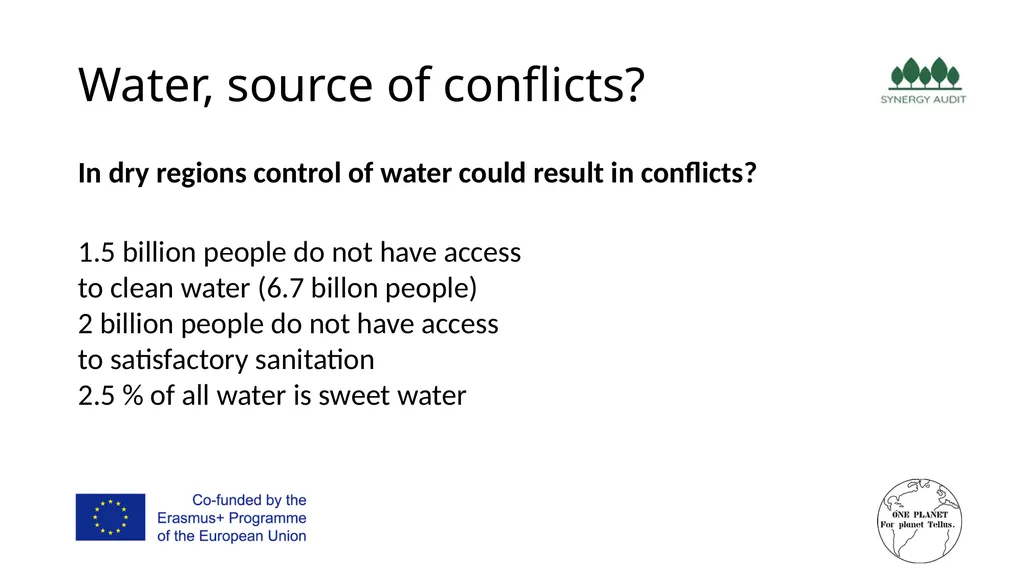
Water, source of conflicts? In dry regions control of water could result in conflicts?
1.5 billion people do not have access
to clean water (6.7 billon people)
2 billion people do not have access
to satisfactory sanitation
2.5 % of all water is sweet water<br>
1.5 billion people do not have access
to clean water (6.7 billon people)
2 billion people do not have access
to satisfactory sanitation
2.5 % of all water is sweet water<br>
18
More than 97% of all water is salty, of which 1% is
brackish water.
Only 0.25% of the world's water is sweet. About two-thirds of the sweet water.
It is available in frozen form. The rest is surface water and groundwater.
In arid regions, the availability of water is a power factor<br>
Only 0.25% of the world's water is sweet. About two-thirds of the sweet water.
It is available in frozen form. The rest is surface water and groundwater.
In arid regions, the availability of water is a power factor<br>
19
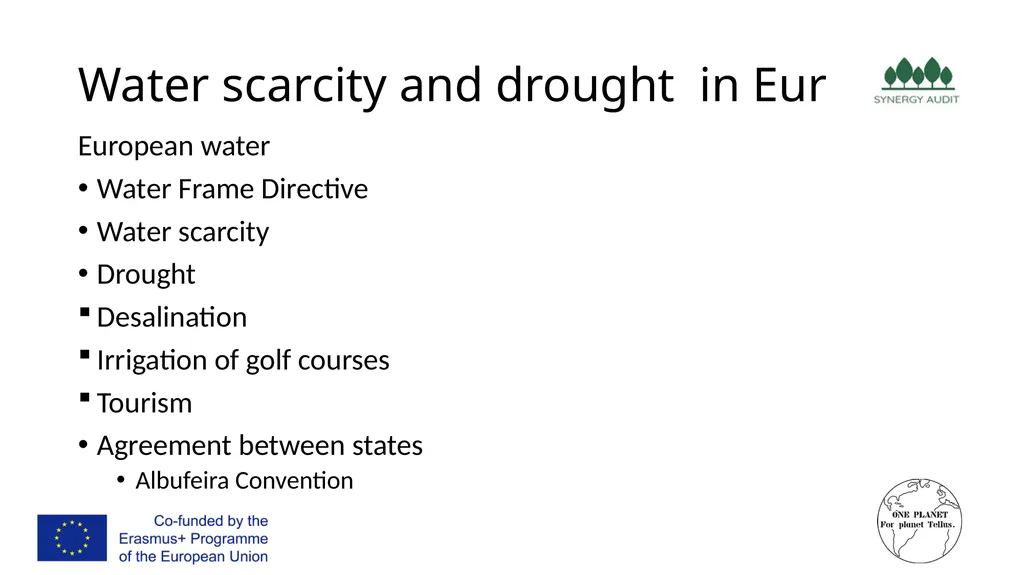
Water scarcity and drought in Europe European water
Water Frame Directive
Water scarcity
Drought
Desalination
Irrigation of golf courses
Tourism
Agreement between states
Albufeira Convention<br>
Water Frame Directive
Water scarcity
Drought
Desalination
Irrigation of golf courses
Tourism
Agreement between states
Albufeira Convention<br>
20
The threats Eutrophication
Environmental pollutants
Alien species
Physical disturbance
Exploitation
Shredding
Flash drought<br>
Environmental pollutants
Alien species
Physical disturbance
Exploitation
Shredding
Flash drought<br>
21
Aral lake syndrome one of the worst mistakes in modern history<br>
22
Climate change: the silent threat that could cause 50% of the world's species to disappear by the year 2100<br>
23
Climate and biodiversity are interdependent<br>
24
What is biodiversity and how does climate change affect it?<br>
25
What is an ecosystem?<br>
26
What are ecosystem services and
why are they needed? What are ecosystem services?
The impact of climate on ecosystems
Land use is central to both climate and biodiversity<br>
The impact of climate on ecosystems
Land use is central to both climate and biodiversity<br>
27
EU Biodiversity Strategy for 2030
Give nature a greater place in our lives The MISSION
“Take effective and urgent action to halt the loss of biodiversity in order to ensure that by 2020 ecosystems are resilient and continue to provide essential services, thereby securing the planet’s variety of life, and contributing to human well-being, and poverty eradication.”<br>
“Take effective and urgent action to halt the loss of biodiversity in order to ensure that by 2020 ecosystems are resilient and continue to provide essential services, thereby securing the planet’s variety of life, and contributing to human well-being, and poverty eradication.”<br>
28
The VISION
Living in harmony with nature “By 2050, biodiversity is valued, conserved, restored and wisely used, maintaining ecosystem services, sustaining a healthy planet and delivering benefits essential for all people.”<br>
29
Can nature get it right? Earth, our common home in the universe, also has rights
Nature has legal rights?
The Rights of Mother Earth
Panama gives nature rights
Large river in Canada has been granted legal rights
Whanganui river in New Zeeland<br>
Nature has legal rights?
The Rights of Mother Earth
Panama gives nature rights
Large river in Canada has been granted legal rights
Whanganui river in New Zeeland<br>
30
Lecture 2<br>
31
From environmental consciousness to enviromental law Why history matters?<br>
32
From environmental conscious
Mankind and nature: Premodern timesromental law A moral universe
Anthropocentrism
metaphors<br>
Anthropocentrism
metaphors<br>
33
Mankind and nature: modern times Carthesian Truth
From Linneus to Darwin
Romanticism
Utopian socialism
Ecocentric ethics: 1930s & 1940s<br>
From Linneus to Darwin
Romanticism
Utopian socialism
Ecocentric ethics: 1930s & 1940s<br>
34
Environmental consciouness: 1962-1968 Literature, not action.
Science, deep but confined to libraries.
Silent Spring (1962) and its impact.<br>
Science, deep but confined to libraries.
Silent Spring (1962) and its impact.<br>
35
Environmental consciousness: 1969-1973<br>
36
Environmental consciousness: 1974-1980s A moment of specialization in enviromental activism
Turning points: Three Miles Island (1979) and Chernobyl (1986)<br>
Turning points: Three Miles Island (1979) and Chernobyl (1986)<br>
37
International Environmental Law:
From the UN to Stockholm 1972 Pre-UN treaties’ impace: none.
Stockholm Conference on the Human Environment: it sets the enviroment on the global agenda.
The story continues…<br>
Stockholm Conference on the Human Environment: it sets the enviroment on the global agenda.
The story continues…<br>
38
International Environmental Law: From Stockholm to Paris Direct and indirect impact of Stockholm conference
Non-binding principles…
Brundtland Report 1987 (UN)
Rio de Janeiro (1992)
Kyoto (1997)
Paris (2015)<br>
Non-binding principles…
Brundtland Report 1987 (UN)
Rio de Janeiro (1992)
Kyoto (1997)
Paris (2015)<br>
39
Environmental Impact Assessment Born in the USA
Stockholm 1972
UNEP (1978)
World Charter for Nature (1982), UNCLOS (1982), Agenda 21
EC (1988) => EU (2001)<br>
Stockholm 1972
UNEP (1978)
World Charter for Nature (1982), UNCLOS (1982), Agenda 21
EC (1988) => EU (2001)<br>
40
Reflect on: Human-nature relationship viewed in historical perspective
Environmental consciouness and international law of the present times from a historical perspective<br>
Environmental consciouness and international law of the present times from a historical perspective<br>
41
Day 2<br>
42
Lecture 3<br>
43
Introduction of work groups and discussion about the outcome of LTTA 1 for each partner organisation<br>
44
Lecture 4<br>
45
Introduction to environmental audits A multidisciplinary zoom out and zoom in perspective<br>
46
Introduction to environmental audits –
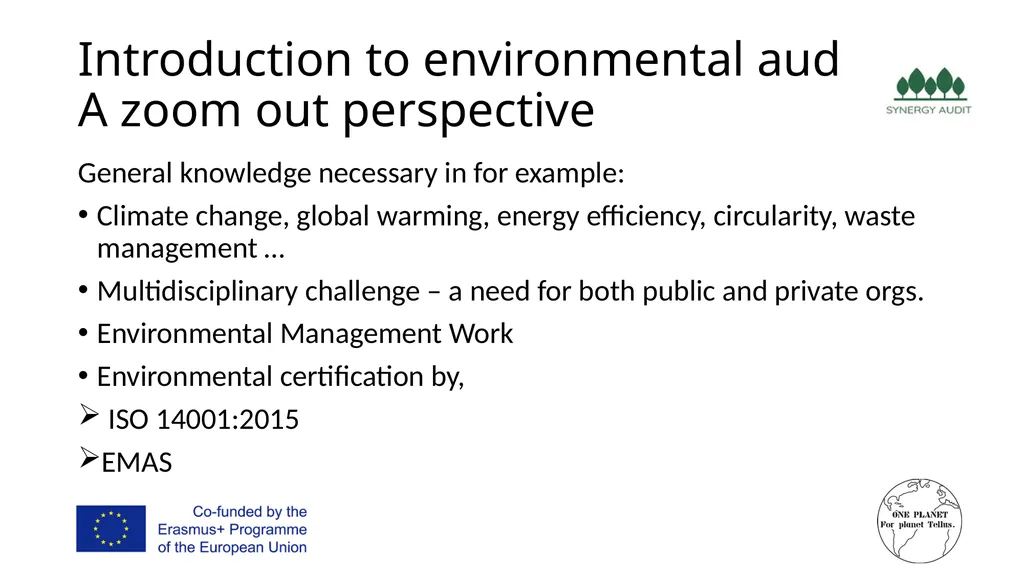
A zoom out perspective General knowledge necessary in for example:
Climate change, global warming, energy efficiency, circularity, waste management …
Multidisciplinary challenge – a need for both public and private orgs.
Environmental Management Work
Environmental certification by,
ISO 14001:2015
EMAS<br>
Climate change, global warming, energy efficiency, circularity, waste management …
Multidisciplinary challenge – a need for both public and private orgs.
Environmental Management Work
Environmental certification by,
ISO 14001:2015
EMAS<br>
47
The EMS in brief – a zoom out perspective 1. Leadership decision about integration of EMS into the organisation.
2. Planning of an EMS organisation in which responsibility is clarified within each activity area.
3. Knowledge gain about the reason for EMS work and the tool as such.
4. Communication plan for the EMS work.
5. Environmental investigation which consist of a review of all environmental aspects that the organisation creates with an assessment of environmental impact from the activities toward the organisation and the surrounding society. The assessment shall be performed in a quantitative and qualitative manner (usually updated every 5th year in accordance with obligations from ISO and EMAS Standards).<br>
48
The EMS in brief – a zoom out perspective 6. Elaboration of an environmental policy for the organisation for communication internally in the organisations and toward the surrounding society, for example stakeholder and interests.
7. Planning of an Environmental Goals and Action Plan (usually updated every 3rd year in accordance with obligations from ISO and EMAS Standards).
8. Planning and management of EMS documentation.
9. Planning and management of routines in support of the EMS.
10. Communication support of the EMS work to each person in the organisation.<br>
49
The EMS in brief – a zoom out perspective 11. Educative support of the EMS work toward each person in the organisation.
12. Follow-up on the EMS work in the organisation.
13. Organisation- and management of environmental audits.
14. Organisation – and management of a yearly management review.
15. Analysis of the EMS work with a management review for development of the EMS and therefore continuous improvement.
16. Budget organisation and management at yearly occasions.<br>
50
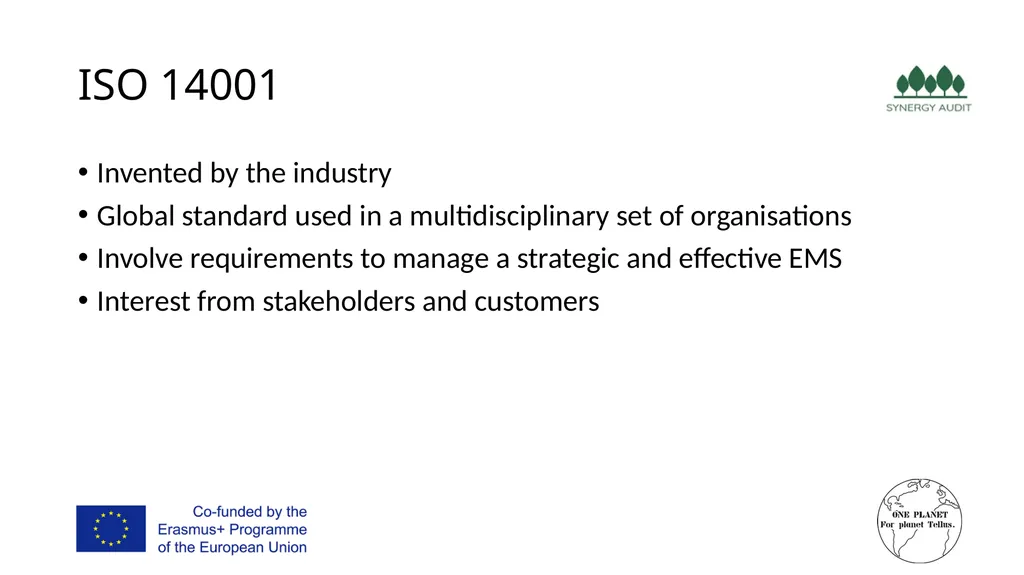
ISO 14001 Invented by the industry
Global standard used in a multidisciplinary set of organisations
Involve requirements to manage a strategic and effective EMS
Interest from stakeholders and customers<br>
Global standard used in a multidisciplinary set of organisations
Involve requirements to manage a strategic and effective EMS
Interest from stakeholders and customers<br>
51
EMAS Implemented by the EU in 2009
Very similar to the ISO 14001 standard
Global usage
Differentiates with the ISO standard by for example need of:
Full legal compliance
Full transparency externally of the EMS<br>
Very similar to the ISO 14001 standard
Global usage
Differentiates with the ISO standard by for example need of:
Full legal compliance
Full transparency externally of the EMS<br>
52
Environmental management system – A zoom in perspective Plan
1. Leadership decision about integration of EMS into the organisation (IEA check the documents)
2. Planning of an EMS organisation in which responsibility is clarified within each activity area. (IEA check the documents)
3. Knowledge gain about the reason for EMS work and the tool as such (IEA check the activities)
4. Communication plan for the EMS work (IEA check whether this work)<br>
53
Environmental management system – A zoom in perspective Do
5. Environmental investigation which consists of a review of all environmental aspects that the organisation creates with an assessment of environmental impact from the activities toward the organisation and the surrounding society. The assessment shall be performed in a quantitative and qualitative manner (usually updated every 5th year in accordance with obligations from ISO and EMAS Standards).
6. Elaboration of an environmental policy for the organisation for communication internally in the organisations and toward the surrounding society, for example stakeholder and interests. (IEA check the document, update every 3rd year)
7. Planning of an Environmental Goals and Action Plan (usually updated every 3rd year in accordance with obligations from ISO and EMAS Standards).
8. Planning and management of EMS documentation. (IEA check e.g., the law list and so on…)
9. Planning and management of routines in support of the EMS (IEA check the possible routine documents).
10. Communication support of the EMS work to each person in the organisation. (IEA check the usability)
11. Educative support of the EMS work toward each person in the organisation (IEA check the usability).
12. Follow-up on the EMS work in the organisation (IEA check the usability related to the requirements).<br>
54
Environmental management system – A zoom in perspective Check
13. Organisation- and management of environmental audits, yearly and every 3rd year.
(IEA check above)<br>
55
Environmental management system – A zoom in perspective Act
14. Organisation – and management of a yearly management review (IEA check of national requirements).
15. Analysis of the EMS work with a management review for development of the EMS and therefore continuous improvement (IEA check, deviation management)
16. Budget organisation and management at yearly occasions (IEA check).<br>
56
How to get ready for an EMS standard – a SYAT
(Synergy Audit) multidisciplinary perspective Gain from building from the EMS and P-D-C-A perspective
Read up on the ISO and/or EMAS standard in the EMS Construction
Monitoring of legislative compliance
EMS is an overall improvement help for organisations
Increased chance to find possible errors in processes
Reach out to and get inspired by certified organisations
Set off time and resources for preparation…<br>
Read up on the ISO and/or EMAS standard in the EMS Construction
Monitoring of legislative compliance
EMS is an overall improvement help for organisations
Increased chance to find possible errors in processes
Reach out to and get inspired by certified organisations
Set off time and resources for preparation…<br>
57
Lecture 5<br>
58
Environmental audits A multidisciplinary zoom in perspective<br>
59
Why do we perform IEA in organisations? Check phase tool in the P-D-C-A for controlling requirements
Focus on change-work for organisational improvement
IEA is obliged on national level in some countries and in ISO and EMAS standards:
Minimum once yearly and covering the full organisation within a 3-years period.<br>
Focus on change-work for organisational improvement
IEA is obliged on national level in some countries and in ISO and EMAS standards:
Minimum once yearly and covering the full organisation within a 3-years period.<br>
60
Concepts of importance in the IEA work Circular economy - involve the possibility to increase the usage time of resources, materials and products (Gregson et al., 2015). Tools for reaching a circular economy involve recycling, reduction, reusage and recovering of resources, materials and products (Kristensen and Mosgaard, 2020).
Continuous Improvement - a principle which states that the EMS from implementation toward on-going state is upheld by a process thinking in which the idea of systematic capacity for improvement of the EMS is a red thread within each section of the EMS work.
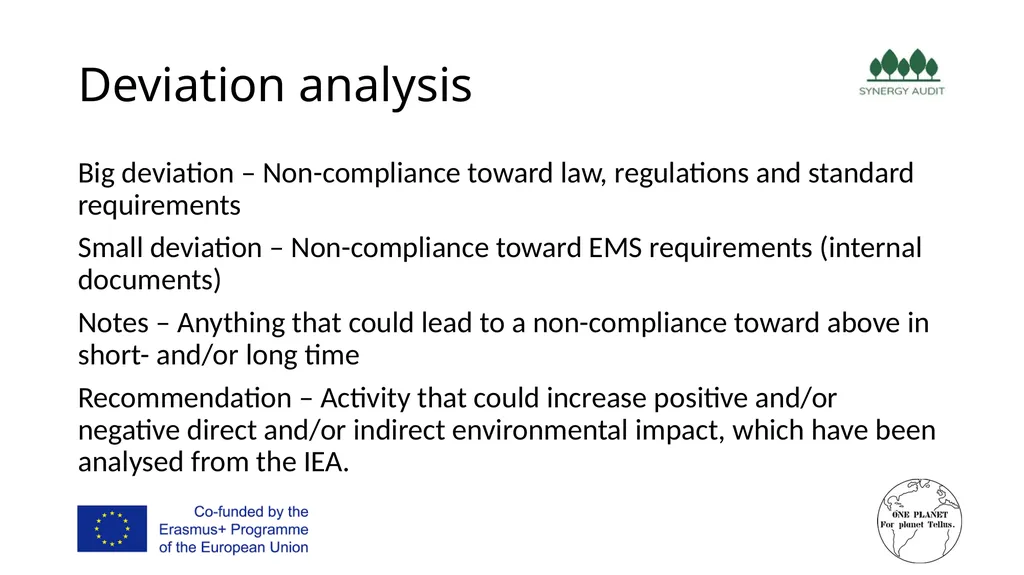
Deviation - is in the context of IEA referred to as something that have caused a situation where requirements have not been met during an IEA. There are three types of deviations used in the IEA and that is “Big deviation”, “Small deviation” and “notice/regard”. The deviations are reported as part of the IEA Report. Big deviation is a type of deviation where a legal requirement has been offended while small deviation is a type of deviation where a requirement on e.g., local organisational level has been offended e.g., a requirement in the Environmental Goal- and Action Plan. Finally, notice/regard is something that does not offend a legal or internal requirement but instead could be something that, in case it continues, can lead to a small or big deviation.<br>
Continuous Improvement - a principle which states that the EMS from implementation toward on-going state is upheld by a process thinking in which the idea of systematic capacity for improvement of the EMS is a red thread within each section of the EMS work.
Deviation - is in the context of IEA referred to as something that have caused a situation where requirements have not been met during an IEA. There are three types of deviations used in the IEA and that is “Big deviation”, “Small deviation” and “notice/regard”. The deviations are reported as part of the IEA Report. Big deviation is a type of deviation where a legal requirement has been offended while small deviation is a type of deviation where a requirement on e.g., local organisational level has been offended e.g., a requirement in the Environmental Goal- and Action Plan. Finally, notice/regard is something that does not offend a legal or internal requirement but instead could be something that, in case it continues, can lead to a small or big deviation.<br>
61
Concepts of importance in the IEA work Energy Audit - is a systematic procedure with the purpose of obtaining adequate knowledge concerning the energy consumption profile of a building or group of buildings, an industrial or commercial operation or installation, or a private or public service, identifying and quantifying cost-effective energy saving opportunities, and reporting the findings.
Energy Efficiency - according to the definition used in the frame of the EU Energy Efficiency Directive, is described as “the ratio of output of performance, service, goods or energy, to input of energy”.
Environmental Aspect - anything that an organisation does that can have an impact on the environment e.g., land, water, air, vegetation and the interchange between human beings and nature. These aspects are gathered and measured by the environmental investigation where the environmental impact of the organisation is equal to all the aspects.<br>
Energy Efficiency - according to the definition used in the frame of the EU Energy Efficiency Directive, is described as “the ratio of output of performance, service, goods or energy, to input of energy”.
Environmental Aspect - anything that an organisation does that can have an impact on the environment e.g., land, water, air, vegetation and the interchange between human beings and nature. These aspects are gathered and measured by the environmental investigation where the environmental impact of the organisation is equal to all the aspects.<br>
62
Concepts of importance in the IEA work Environmental controller - the person in an organisation who caretake for the work with implementing the environmental management system and within the task plan, coordinate and make the necessary follow-up in the EMS process.
Environmental Goal and Action Plan - the document where the goals elaborated from the previously made environmental policy (see below) are established for the coming 3 years in the organisation.
Environmental impact - the impact of an organisation which create change in the environment. It can be a positive or a negative impact and it is related to organisational activity, the possible production and final product and/or any kind of services provided by the organisation. There are indirect and direct impacts.
Environmental investigation - is the report which covers and present the environmental impact assessment (see above). The environmental investigation must for an organisation who are environmentally certified by e.g., an ISO 14001 and/or EMAS standard be updated at minimum every 5th year.<br>
Environmental Goal and Action Plan - the document where the goals elaborated from the previously made environmental policy (see below) are established for the coming 3 years in the organisation.
Environmental impact - the impact of an organisation which create change in the environment. It can be a positive or a negative impact and it is related to organisational activity, the possible production and final product and/or any kind of services provided by the organisation. There are indirect and direct impacts.
Environmental investigation - is the report which covers and present the environmental impact assessment (see above). The environmental investigation must for an organisation who are environmentally certified by e.g., an ISO 14001 and/or EMAS standard be updated at minimum every 5th year.<br>
63
Concepts of importance in the IEA work Environmental Policy - document that in short lines shall communicate the developmental plan for the organisation within the EMS work for the coming 3 years in a visionary way toward both internal and external groups.
Internal Environmental Audit (IEA) - procedure to control whether the organisation is fulfilling the legal and internal requirements (see below) within the environmental management work. The audit is performed by staff at the organisation and needs to be unbiased. If an organisation is ISO 14001 and/or EMAS certified internal environmental audits must take place every year within the organisation and all areas of the organisation need to have been audited within a 3-years period.
Internal Environmental Audit Report - the report which present the result of the IEA for the CEO and other areas of the organisation.
Internal Environmental Auditor - the person in the organisation who perform the IEA.<br>
Internal Environmental Audit (IEA) - procedure to control whether the organisation is fulfilling the legal and internal requirements (see below) within the environmental management work. The audit is performed by staff at the organisation and needs to be unbiased. If an organisation is ISO 14001 and/or EMAS certified internal environmental audits must take place every year within the organisation and all areas of the organisation need to have been audited within a 3-years period.
Internal Environmental Audit Report - the report which present the result of the IEA for the CEO and other areas of the organisation.
Internal Environmental Auditor - the person in the organisation who perform the IEA.<br>
64
Concepts of importance in the IEA work Legal Requirements - requirement which is based on a law, directive or any other sort of ruling legal document and it must be followed by any organisation no matter if it is environmentally certified or not. The EMS works for law fulfilment and is therefore a support for the organisation in following legal requirements and thereby consequentially trying to avoid legal violations and the consequences of it.
Life Cycle Perspective - a perspective which is based on a life cycle assessment method in which environmental impact from a products, service or process lifetime. A cradle-to-grave or cradle-to-cradle analysis can be made to assess the environmental impact for the processes in which the product appears during its lifetime. A product lifetime would for example assess the environmental impact from the extraction all the way toward its waste management and all necessary transportation in between its life. The life cycle perspective is used in ISO 14001 and EMAS standards and a certified organisation would need to use it as a tool to assess environmental aspects.
Recommendations - a part of the audit report (see above) in which the IEA team and/or staff involved in the department/area of the auditee have space to communicate recommended actions inspired by the audit of the report. The recommendations should be communicated short and clear and are not obliged to take into consideration by the leadership if the organisation, whom are the outermost responsible for the EMS which is audited and communicated in the report.<br>
Life Cycle Perspective - a perspective which is based on a life cycle assessment method in which environmental impact from a products, service or process lifetime. A cradle-to-grave or cradle-to-cradle analysis can be made to assess the environmental impact for the processes in which the product appears during its lifetime. A product lifetime would for example assess the environmental impact from the extraction all the way toward its waste management and all necessary transportation in between its life. The life cycle perspective is used in ISO 14001 and EMAS standards and a certified organisation would need to use it as a tool to assess environmental aspects.
Recommendations - a part of the audit report (see above) in which the IEA team and/or staff involved in the department/area of the auditee have space to communicate recommended actions inspired by the audit of the report. The recommendations should be communicated short and clear and are not obliged to take into consideration by the leadership if the organisation, whom are the outermost responsible for the EMS which is audited and communicated in the report.<br>
65
The work process Pre-Audit State
The Team!
3-years audit plan
Communication to auditee approximately 2 months before audit
Reading-in on the auditee
Elaboration on a checklist for the audit day
Elaboration of day schedule for the audit day<br>
The Team!
3-years audit plan
Communication to auditee approximately 2 months before audit
Reading-in on the auditee
Elaboration on a checklist for the audit day
Elaboration of day schedule for the audit day<br>
66
The work process On-site Audit State
Interviews and tours in the area
Taking notes by help of computer, pen and paper or dictaphone
Ending talk with the leader of the auditee area/department<br>
Interviews and tours in the area
Taking notes by help of computer, pen and paper or dictaphone
Ending talk with the leader of the auditee area/department<br>
67
The work process Post-Audit/Finalization Phase
Elaboration of IEA Report
Finalized report signed by audit team leader, archived and sent to the leadership/CEO of the organisation
Deviation management
If EMAS Certified the organisation needs to publish the full IEA Report externally on for example the web page of the organisation
Now the IEA is officially completed<br>
Elaboration of IEA Report
Finalized report signed by audit team leader, archived and sent to the leadership/CEO of the organisation
Deviation management
If EMAS Certified the organisation needs to publish the full IEA Report externally on for example the web page of the organisation
Now the IEA is officially completed<br>
68
Continuous tasks in the IEA work Continuous education of new auditors to keep the work force
Budgeted money for the work, yearly budget talks
Planning of conferences for the IEA Team for planning
Participation in conferences, workshops, courses for knowledge gain
Knowledge exchange and exchange of favors between organisations
Joining IEA networks
Having an interdisciplinary IEA Team with several knowledge areas<br>
Budgeted money for the work, yearly budget talks
Planning of conferences for the IEA Team for planning
Participation in conferences, workshops, courses for knowledge gain
Knowledge exchange and exchange of favors between organisations
Joining IEA networks
Having an interdisciplinary IEA Team with several knowledge areas<br>
69
Positive effects of performing IEA – a SYAT multidisciplinary perspective Possibility to overview resources in budget and time in the organisation.
Increased knowledge and therefore, individual and organisational development.
Helps improving EMS work and thereby, the general objectives.
Important tool in disseminating best practises.
Finding mistakes before they become a serious risk/danger.
Helpful tool in collecting and managing data, and more …<br>
Increased knowledge and therefore, individual and organisational development.
Helps improving EMS work and thereby, the general objectives.
Important tool in disseminating best practises.
Finding mistakes before they become a serious risk/danger.
Helpful tool in collecting and managing data, and more …<br>
70
(Lecture & Workshop 5)<br>
71
(Environmental audits) A multidisciplinary zoom in perspective<br>
72
The IEA Checklist A document for gathering necessary information on a coming IEA
Involve:
Physical areas to audit
Deep interview with Key-persons in the staff
Sample interviews for check-up on the workability of the EMS<br>
Involve:
Physical areas to audit
Deep interview with Key-persons in the staff
Sample interviews for check-up on the workability of the EMS<br>
73
The IEA Checklist Need to think from law and regulation when elaboration on the question
Need to ensure that law and regulation fulfillment is tested during the audit
There are law and regulation on several levels:
Municipal
National
EU
Global
Environmental Standards<br>
Need to ensure that law and regulation fulfillment is tested during the audit
There are law and regulation on several levels:
Municipal
National
EU
Global
Environmental Standards<br>
74
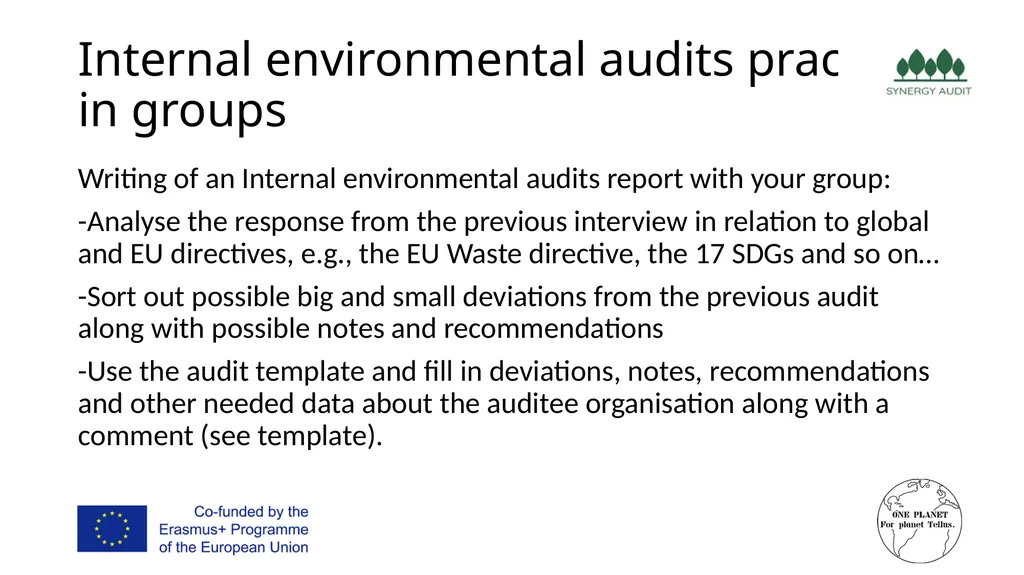
IEA training practices – Elaboration of checklist Group work in break-out rooms
Use prepared data about the organisation for your coming IEA (internal environmental audit) in the following session.
Practice on creating 5 questions for a coming IEA interview toward your organisation.
Work in groups and if needed, look at how checklist example questions can look like.
The team leader have the responsibility for assuring that the team will reach its goal within time.
Use up to 2 hours for this training.
Good Luck! <br>
Use prepared data about the organisation for your coming IEA (internal environmental audit) in the following session.
Practice on creating 5 questions for a coming IEA interview toward your organisation.
Work in groups and if needed, look at how checklist example questions can look like.
The team leader have the responsibility for assuring that the team will reach its goal within time.
Use up to 2 hours for this training.
Good Luck! <br>
75
Day 3<br>
76
Lecture & Workshop 6<br>
77
Teacher training Pedagogical principles for teaching sustainability<br>
78
The importance of motivation Participants there of own accord
Aware of goals, feel an incentive
Active participation
Reflection
Adequate orientation and input<br>
Aware of goals, feel an incentive
Active participation
Reflection
Adequate orientation and input<br>
79
START of the course
Participants’ own views and experiences
EXERCISE<br>
Participants’ own views and experiences
EXERCISE<br>
80
Input Check knowledge base
FACTUAL – scientific, technical, societal
DISCURSIVE<br>
FACTUAL – scientific, technical, societal
DISCURSIVE<br>
81
Conceptions of environment Environment as
Nature
Resource
Problem
Place to live
Biosphere
Community project
Which lies closest to you? Which have been apparent so far during the course? Which do you think will be apparent later?<br>
Nature
Resource
Problem
Place to live
Biosphere
Community project
Which lies closest to you? Which have been apparent so far during the course? Which do you think will be apparent later?<br>
82
Activities Focus on authentic problems
Direct environment learning resource
Concentrate on cause, rather than finding for symptoms<br>
Direct environment learning resource
Concentrate on cause, rather than finding for symptoms<br>
83
Reflection
Focus not only on action
Systematic perspective
Put insights in a larger perspective<br>
Focus not only on action
Systematic perspective
Put insights in a larger perspective<br>
84
Importance of social aspects
Strengthening the group
Social sustainability<br>
Strengthening the group
Social sustainability<br>
85
COnCLusion of lesson Share insights and findings
Give feedback<br>
Give feedback<br>
86
Lecture 7<br>
87
Circular economy<br>
88
What is a circular economy? Circular economy means that the value of products, materials and resources is maintained in the economy for as long as possible and the generation of waste is minimized.
It is a new way of thinking that waste is resource and raw-material, and the old linear concept of ‘take, make, use and dispose’ must be transformed.
It is an economic model which does not focus on producing more goods, but the consumption is based on using services, sharing, renting and recycling, instead of owning.
The circular economy will
-enable a healthier planet and reduce pollution
-reduce pressure on natural resources such as water and land use
-reduce emissions
-create new business opportunities and local quality jobs
-enable more resilient value chains<br>
It is a new way of thinking that waste is resource and raw-material, and the old linear concept of ‘take, make, use and dispose’ must be transformed.
It is an economic model which does not focus on producing more goods, but the consumption is based on using services, sharing, renting and recycling, instead of owning.
The circular economy will
-enable a healthier planet and reduce pollution
-reduce pressure on natural resources such as water and land use
-reduce emissions
-create new business opportunities and local quality jobs
-enable more resilient value chains<br>
89
Circular economy in EU Green Deal
Circular economy action plan
EU taxonomy for sustainable activities
Special policies include
-plastics,
-waste and recycling
-circular economy at the global level
-critical raw materials<br>
Circular economy action plan
EU taxonomy for sustainable activities
Special policies include
-plastics,
-waste and recycling
-circular economy at the global level
-critical raw materials<br>
90
Circular economy in EU Tools and instruments
EU Ecolabel
European Circular Economy Stakeholder Platform
Sustainable buildings – Levels
EU Environmental Technology Verification
Eco-Management and audit scheme
Green public procurement
Raw materials initiative
Eco-innovation action plan
Circular economy monitoring framework
European Innovation Partnership on Raw Materials
Environmental footprint methods<br>
EU Ecolabel
European Circular Economy Stakeholder Platform
Sustainable buildings – Levels
EU Environmental Technology Verification
Eco-Management and audit scheme
Green public procurement
Raw materials initiative
Eco-innovation action plan
Circular economy monitoring framework
European Innovation Partnership on Raw Materials
Environmental footprint methods<br>
91
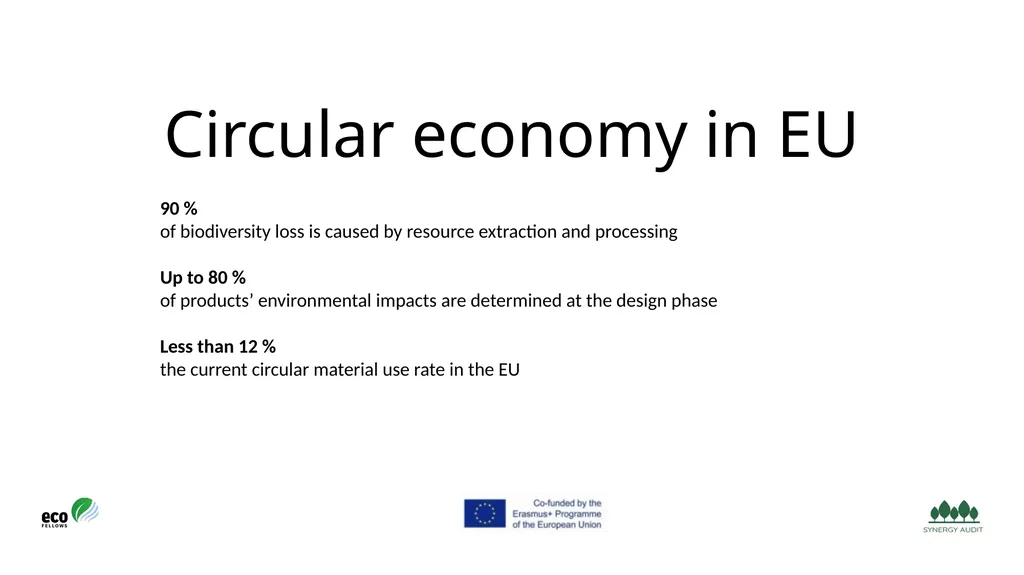
Circular economy in EU 90 %
of biodiversity loss is caused by resource extraction and processing
Up to 80 %
of products’ environmental impacts are determined at the design phase
Less than 12 %
the current circular material use rate in the EU<br>
of biodiversity loss is caused by resource extraction and processing
Up to 80 %
of products’ environmental impacts are determined at the design phase
Less than 12 %
the current circular material use rate in the EU<br>
92
Circular economy business models Sharing economy concepts, sharing platform
Using sharing platforms in usage, access an ownership, collaboration among product users
Product as a service
The customer shifts from owning materials or products towards using, sharing, borrowing and renting them.
Product-life extension
Extending the life-cycle of the product though anticipatory maintenance, resale and remanufacture.
Recovery and recycling
Recovery and reuse of products and raw materials that have reached the end of their useful life.
Circular supply chain
Use of recyclable materials and renewable energy and solutions based on resource-efficient cycles.<br>
Using sharing platforms in usage, access an ownership, collaboration among product users
Product as a service
The customer shifts from owning materials or products towards using, sharing, borrowing and renting them.
Product-life extension
Extending the life-cycle of the product though anticipatory maintenance, resale and remanufacture.
Recovery and recycling
Recovery and reuse of products and raw materials that have reached the end of their useful life.
Circular supply chain
Use of recyclable materials and renewable energy and solutions based on resource-efficient cycles.<br>
93
The role of municipals in the circular economy Roles
Planner, buyer, customer, property developer and licensing authorities
Enabler, accelerator, activator
Public procurement, piloting
Creating and designing circular economy business models, creating new jobs
operating models
long-term partnership
platforms, testbeds
joint value
Tools
Circular policies, long-term targets
Regulatory, economic and soft instruments
Collaboration, networking and information sharing
Projects and piloting<br>
Planner, buyer, customer, property developer and licensing authorities
Enabler, accelerator, activator
Public procurement, piloting
Creating and designing circular economy business models, creating new jobs
operating models
long-term partnership
platforms, testbeds
joint value
Tools
Circular policies, long-term targets
Regulatory, economic and soft instruments
Collaboration, networking and information sharing
Projects and piloting<br>
94
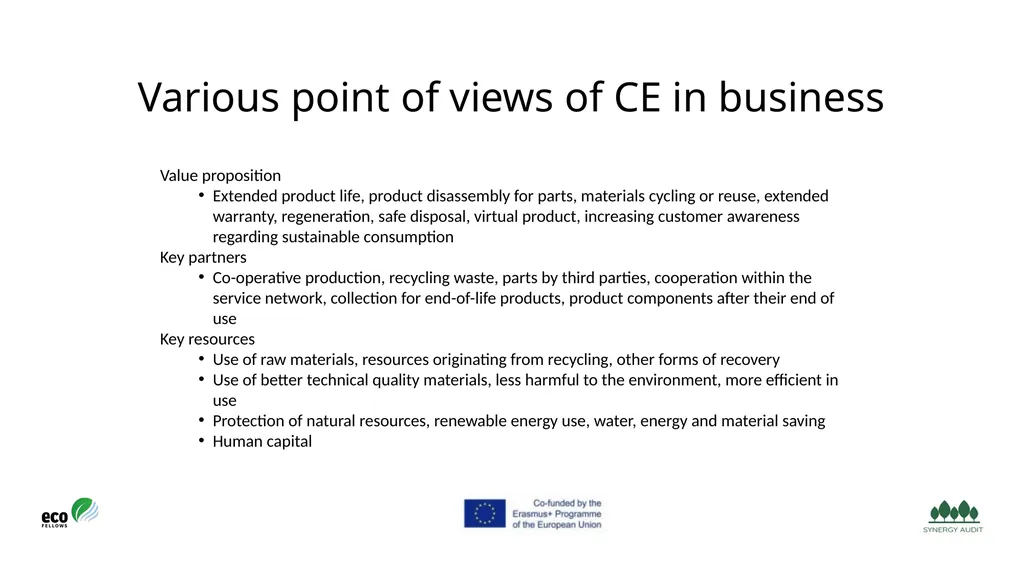
Various point of views of CE in business Value proposition
Extended product life, product disassembly for parts, materials cycling or reuse, extended warranty, regeneration, safe disposal, virtual product, increasing customer awareness regarding sustainable consumption
Key partners
Co-operative production, recycling waste, parts by third parties, cooperation within the service network, collection for end-of-life products, product components after their end of use
Key resources
Use of raw materials, resources originating from recycling, other forms of recovery
Use of better technical quality materials, less harmful to the environment, more efficient in use
Protection of natural resources, renewable energy use, water, energy and material saving
Human capital<br>
Extended product life, product disassembly for parts, materials cycling or reuse, extended warranty, regeneration, safe disposal, virtual product, increasing customer awareness regarding sustainable consumption
Key partners
Co-operative production, recycling waste, parts by third parties, cooperation within the service network, collection for end-of-life products, product components after their end of use
Key resources
Use of raw materials, resources originating from recycling, other forms of recovery
Use of better technical quality materials, less harmful to the environment, more efficient in use
Protection of natural resources, renewable energy use, water, energy and material saving
Human capital<br>
95
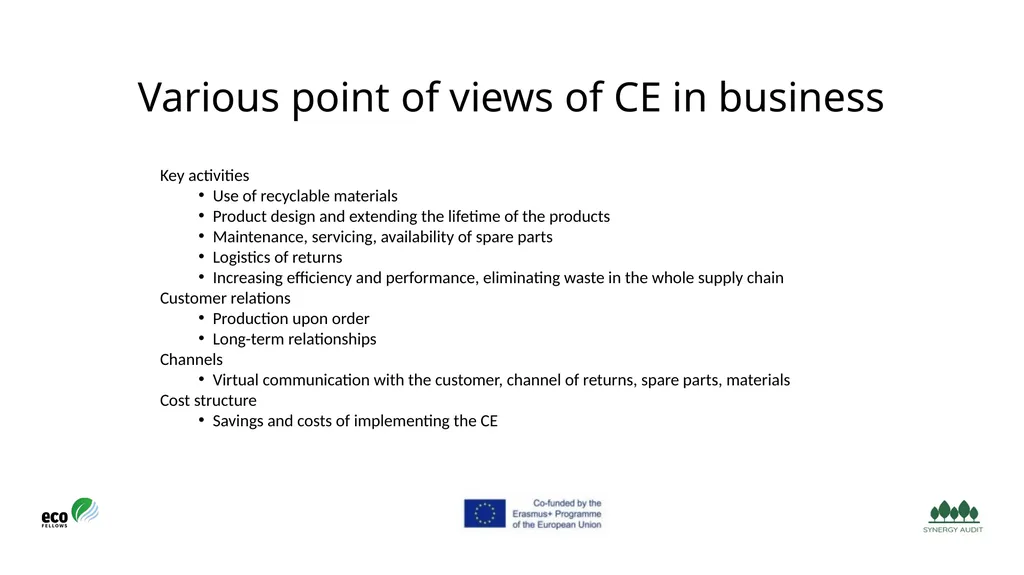
Various point of views of CE in business Key activities
Use of recyclable materials
Product design and extending the lifetime of the products
Maintenance, servicing, availability of spare parts
Logistics of returns
Increasing efficiency and performance, eliminating waste in the whole supply chain
Customer relations
Production upon order
Long-term relationships
Channels
Virtual communication with the customer, channel of returns, spare parts, materials
Cost structure
Savings and costs of implementing the CE<br>
Use of recyclable materials
Product design and extending the lifetime of the products
Maintenance, servicing, availability of spare parts
Logistics of returns
Increasing efficiency and performance, eliminating waste in the whole supply chain
Customer relations
Production upon order
Long-term relationships
Channels
Virtual communication with the customer, channel of returns, spare parts, materials
Cost structure
Savings and costs of implementing the CE<br>
96
Various point of views of CE in business Key activities
Use of recyclable materials
Product design and extending the lifetime of the products
Maintenance, servicing, availability of spare parts
Logistics of returns
Increasing efficiency and performance, eliminating waste in the whole supply chain
Customer relations
Production upon order
Long-term relationships
Channels
Virtual communication with the customer, channel of returns, spare parts, materials
Cost structure
Savings and costs of implementing the CE<br>
Use of recyclable materials
Product design and extending the lifetime of the products
Maintenance, servicing, availability of spare parts
Logistics of returns
Increasing efficiency and performance, eliminating waste in the whole supply chain
Customer relations
Production upon order
Long-term relationships
Channels
Virtual communication with the customer, channel of returns, spare parts, materials
Cost structure
Savings and costs of implementing the CE<br>
97
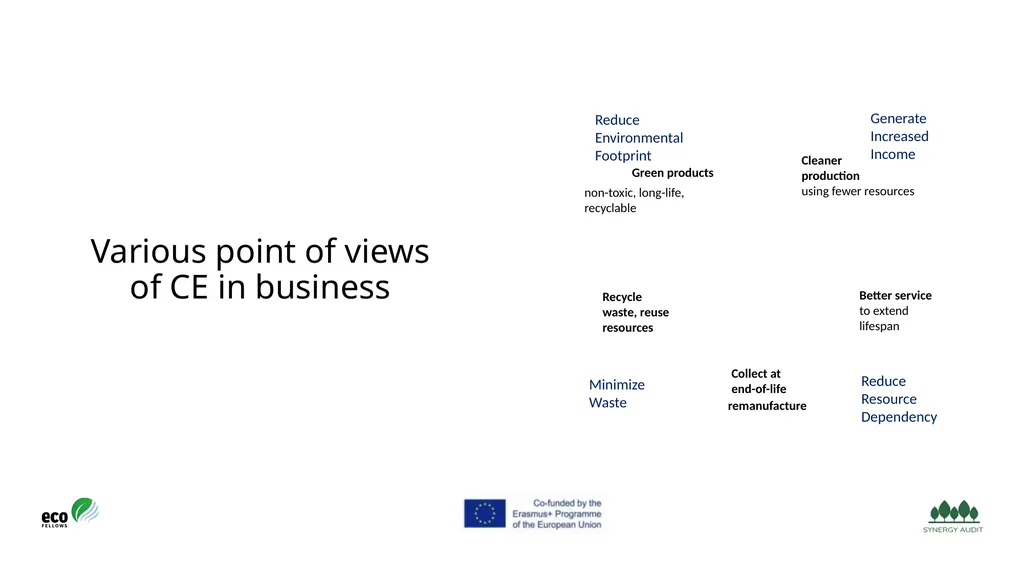
Various point of views of CE in business Cleaner
production
using fewer resources Better service
to extend
lifespan Collect at
end-of-life remanufacture Recycle
waste, reuse
resources Green products non-toxic, long-life,
recyclable Generate
Increased
Income Reduce
Resource
Dependency Minimize
Waste Reduce
Environmental
Footprint<br>
production
using fewer resources Better service
to extend
lifespan Collect at
end-of-life remanufacture Recycle
waste, reuse
resources Green products non-toxic, long-life,
recyclable Generate
Increased
Income Reduce
Resource
Dependency Minimize
Waste Reduce
Environmental
Footprint<br>
98
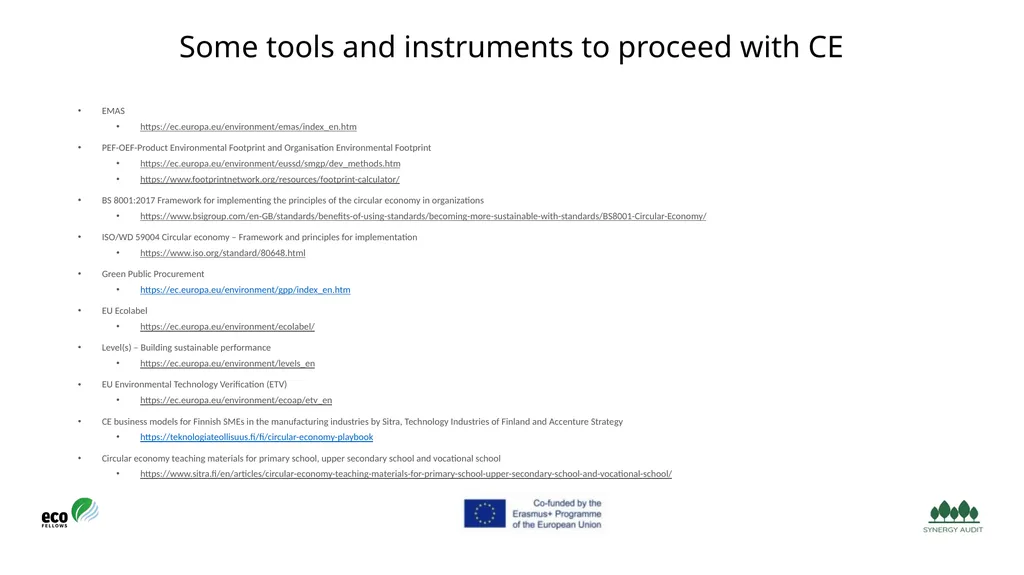
Some tools and instruments to proceed with CE EMAS
https://ec.europa.eu/environment/emas/index_en.htm
PEF-OEF-Product Environmental Footprint and Organisation Environmental Footprint
https://ec.europa.eu/environment/eussd/smgp/dev_methods.htm
https://www.footprintnetwork.org/resources/footprint-calculator/
BS 8001:2017 Framework for implementing the principles of the circular economy in organizations
https://www.bsigroup.com/en-GB/standards/benefits-of-using-standards/becoming-more-sustainable-with-standards/BS8001-Circular-Economy/
ISO/WD 59004 Circular economy – Framework and principles for implementation
https://www.iso.org/standard/80648.html
Green Public Procurement
https://ec.europa.eu/environment/gpp/index_en.htm
EU Ecolabel
https://ec.europa.eu/environment/ecolabel/
Level(s) – Building sustainable performance
https://ec.europa.eu/environment/levels_en
EU Environmental Technology Verification (ETV)
https://ec.europa.eu/environment/ecoap/etv_en
CE business models for Finnish SMEs in the manufacturing industries by Sitra, Technology Industries of Finland and Accenture Strategy
https://teknologiateollisuus.fi/fi/circular-economy-playbook
Circular economy teaching materials for primary school, upper secondary school and vocational school
https://www.sitra.fi/en/articles/circular-economy-teaching-materials-for-primary-school-upper-secondary-school-and-vocational-school/<br>
https://ec.europa.eu/environment/emas/index_en.htm
PEF-OEF-Product Environmental Footprint and Organisation Environmental Footprint
https://ec.europa.eu/environment/eussd/smgp/dev_methods.htm
https://www.footprintnetwork.org/resources/footprint-calculator/
BS 8001:2017 Framework for implementing the principles of the circular economy in organizations
https://www.bsigroup.com/en-GB/standards/benefits-of-using-standards/becoming-more-sustainable-with-standards/BS8001-Circular-Economy/
ISO/WD 59004 Circular economy – Framework and principles for implementation
https://www.iso.org/standard/80648.html
Green Public Procurement
https://ec.europa.eu/environment/gpp/index_en.htm
EU Ecolabel
https://ec.europa.eu/environment/ecolabel/
Level(s) – Building sustainable performance
https://ec.europa.eu/environment/levels_en
EU Environmental Technology Verification (ETV)
https://ec.europa.eu/environment/ecoap/etv_en
CE business models for Finnish SMEs in the manufacturing industries by Sitra, Technology Industries of Finland and Accenture Strategy
https://teknologiateollisuus.fi/fi/circular-economy-playbook
Circular economy teaching materials for primary school, upper secondary school and vocational school
https://www.sitra.fi/en/articles/circular-economy-teaching-materials-for-primary-school-upper-secondary-school-and-vocational-school/<br>
99
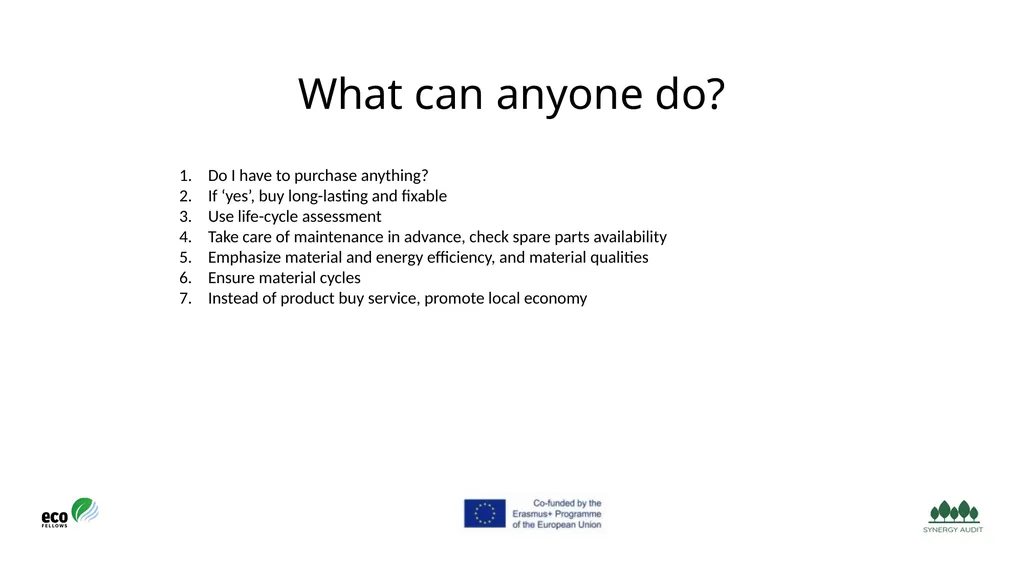
What can anyone do? Do I have to purchase anything?
If ‘yes’, buy long-lasting and fixable
Use life-cycle assessment
Take care of maintenance in advance, check spare parts availability
Emphasize material and energy efficiency, and material qualities
Ensure material cycles
Instead of product buy service, promote local economy<br>
If ‘yes’, buy long-lasting and fixable
Use life-cycle assessment
Take care of maintenance in advance, check spare parts availability
Emphasize material and energy efficiency, and material qualities
Ensure material cycles
Instead of product buy service, promote local economy<br>
100
Lecture & Workshop 8<br>
101
EU and Global directives in audits<br>
102
The Paris Agreement and IEA Maximum of 1,5 C temperature increase
Attention on matters of the agreement by for example public access to information, training and education.
In IEA climate impact activity could be assessed by usage of possible previous carbon dioxide equivalent assessment from the environmental investigation.
Carbon Audit could be a tool of usage.<br>
Attention on matters of the agreement by for example public access to information, training and education.
In IEA climate impact activity could be assessed by usage of possible previous carbon dioxide equivalent assessment from the environmental investigation.
Carbon Audit could be a tool of usage.<br>
103
Energy Roadmap 2050 Aim at open for thinking about how to make the energy sector of the EU to contain mostly renewable energy in 2050
Morepart of the greenhouse gas comes from the energy sector globally, solution is non GHG sources which effects all parts of the energy system
SYAT signals extra necessity to audit toward energy usage in organisations
Energy Audits<br>
Morepart of the greenhouse gas comes from the energy sector globally, solution is non GHG sources which effects all parts of the energy system
SYAT signals extra necessity to audit toward energy usage in organisations
Energy Audits<br>
104
Cloosing the loop – An EU action plan for the circular economy Plan for focus on transition toward a circular economy in the EU
Prolonged value of products and waste reduction is crucial topics
Focus on product design, production processes, consumption, waste management and reusage of necessity.
SYAT and circular economy in the IEA<br>
Prolonged value of products and waste reduction is crucial topics
Focus on product design, production processes, consumption, waste management and reusage of necessity.
SYAT and circular economy in the IEA<br>
105
Transforming our world: The 2030 agenda for sustainable development Plan/universal agenda for global operationality which point at 17 focus areas and their 169 targets.
Aim to sustain a healthy living for beings on the planet and global peace.
Ambition to be approached toward as of an international law
SYAT training in how to assess the 17 SDGs in IEA.<br>
Aim to sustain a healthy living for beings on the planet and global peace.
Ambition to be approached toward as of an international law
SYAT training in how to assess the 17 SDGs in IEA.<br>
106
IEA training practices – IEA toward the 17 SDG Map out relevant SDG(s) for your organisation to work goal-oriented toward.
Choose the mapped out SDG(s) for the organisation and elaborate on goals for them within the coming three years together with activities for managing the goals.
Elaborate on 1-2 IEA questions to ask the organisation for the coming IEA interview for assessing possible goal fulfillment of the chosen Sustainable development goal(s) in the organisation.
Use approximately 15 minutes to do the above task.
Good Luck! <br>
Choose the mapped out SDG(s) for the organisation and elaborate on goals for them within the coming three years together with activities for managing the goals.
Elaborate on 1-2 IEA questions to ask the organisation for the coming IEA interview for assessing possible goal fulfillment of the chosen Sustainable development goal(s) in the organisation.
Use approximately 15 minutes to do the above task.
Good Luck! <br>
107
The EU Waste Framework Directive Set of principles on waste management in the EU
Guiding reduction of damage toward environment, human health and areas of specific interest together with rural areas.
Increased re-usage and recycling of material
”From the cradle to the grave” assessment and monitoring of hazardous waste
Environmental damage from by-products
End-of-waste critiera
SYAT method for IEA toward the Waste Hierarchy<br>
Guiding reduction of damage toward environment, human health and areas of specific interest together with rural areas.
Increased re-usage and recycling of material
”From the cradle to the grave” assessment and monitoring of hazardous waste
Environmental damage from by-products
End-of-waste critiera
SYAT method for IEA toward the Waste Hierarchy<br>
108
The EU toxic-free hierarchy Chemicals can be of harm to human health, the health of the Earth by pollution, increase planetary crisis like climate change and, decrease of ecosystems and lessened biodiversity.
Chemical production – ”one of the most polluting, energy and resource-intensive sectors” (EEA, 2020).
A chemical management system that makes chemicals coexist with a healthy humanity and planetary boundary – with protection from hazardous chemicals.
A new hierarchy in chemical management with a zero pollution (2050) ambition – toward the EU green transition.
First priority – non-usage and final priority - protection<br>
Chemical production – ”one of the most polluting, energy and resource-intensive sectors” (EEA, 2020).
A chemical management system that makes chemicals coexist with a healthy humanity and planetary boundary – with protection from hazardous chemicals.
A new hierarchy in chemical management with a zero pollution (2050) ambition – toward the EU green transition.
First priority – non-usage and final priority - protection<br>
109
IEA training practices – the Waste Hierarchy Group work in break-out rooms
1. Assess materials in your organisation that contribute to most negative environmental impact.
2. Choose the material(s) that have been assessed as contributing to most negative environmental impact in the organisation for preparation for a coming IEA interview in the organisation.
3. Assess the outcome today for the chosen material from information from the organisation: Could the chosen material take a step up on the Waste Hierarchy list?
4. Create 1-2 question(s) about the usage and waste management of the chosen material for a coming IEA interview.
Use approximately 15 minutes for this exercise.
Good Luck! <br>
1. Assess materials in your organisation that contribute to most negative environmental impact.
2. Choose the material(s) that have been assessed as contributing to most negative environmental impact in the organisation for preparation for a coming IEA interview in the organisation.
3. Assess the outcome today for the chosen material from information from the organisation: Could the chosen material take a step up on the Waste Hierarchy list?
4. Create 1-2 question(s) about the usage and waste management of the chosen material for a coming IEA interview.
Use approximately 15 minutes for this exercise.
Good Luck! <br>
110
Testing of E-learning tool<br>
111
Day 4<br>
112
Lecture 9<br>
113
Energy Audits Georgia Veziryianni
CRES Training Department,
gvezir@cres.gr<br>
CRES Training Department,
gvezir@cres.gr<br>
114
identify the greatest opportunities for energy savings. They offer the opportunity to reduce the energy costs of an organization. This improves profitability and enhances competitiveness;
identify potential for improvement in business/production processes ; contribute to improved productivity;
help organizations reduce the environmental impact of their activities;
help some organizations fulfil obligations under their national with respect to emissions to air and pollution control;
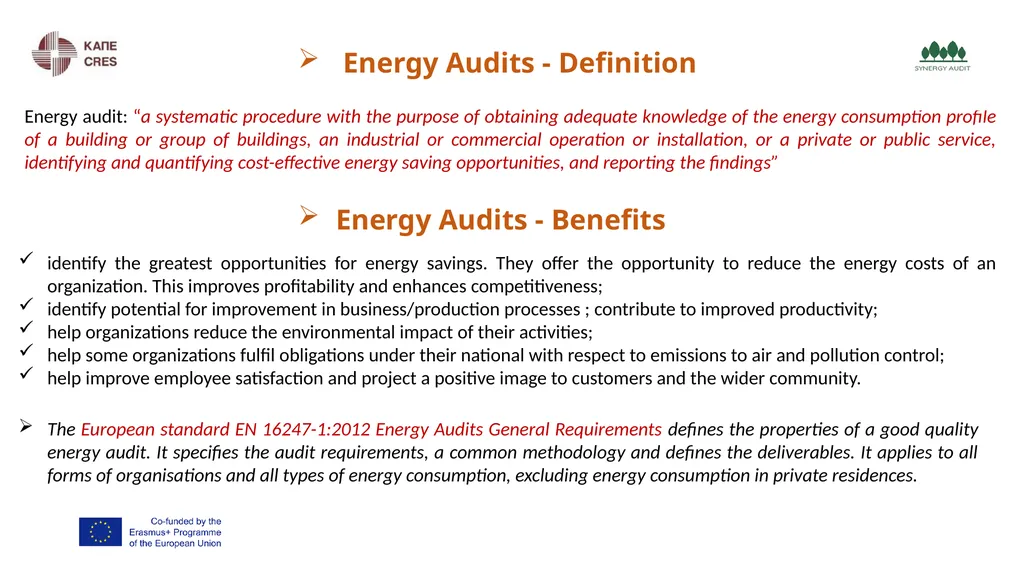
help improve employee satisfaction and project a positive image to customers and the wider community. Energy audit: “a systematic procedure with the purpose of obtaining adequate knowledge of the energy consumption profile of a building or group of buildings, an industrial or commercial operation or installation, or a private or public service, identifying and quantifying cost-effective energy saving opportunities, and reporting the findings” Energy Audits - Definition Energy Audits - Benefits The European standard EN 16247-1:2012 Energy Audits General Requirements defines the properties of a good quality energy audit. It specifies the audit requirements, a common methodology and defines the deliverables. It applies to all forms of organisations and all types of energy consumption, excluding energy consumption in private residences.<br>
identify potential for improvement in business/production processes ; contribute to improved productivity;
help organizations reduce the environmental impact of their activities;
help some organizations fulfil obligations under their national with respect to emissions to air and pollution control;
help improve employee satisfaction and project a positive image to customers and the wider community. Energy audit: “a systematic procedure with the purpose of obtaining adequate knowledge of the energy consumption profile of a building or group of buildings, an industrial or commercial operation or installation, or a private or public service, identifying and quantifying cost-effective energy saving opportunities, and reporting the findings” Energy Audits - Definition Energy Audits - Benefits The European standard EN 16247-1:2012 Energy Audits General Requirements defines the properties of a good quality energy audit. It specifies the audit requirements, a common methodology and defines the deliverables. It applies to all forms of organisations and all types of energy consumption, excluding energy consumption in private residences.<br>
115
What is an energy audit An inspection, survey and analysis of the energy flows for the identification of energy savings opportunities in a building, process or system, aiming at reducing the amount of energy input into the system, without negatively affecting the output(s). Why? Improve energy performance and minimize the environmental impacts of the organization's operations.
Identify behavioral change opportunities by evaluating current operations and maintenance practices.
Identify technical opportunities by evaluating significant process energy-using components or utilities including boilers, refrigeration plant, ventilation systems, building performance and fleet efficiency.
Provide clear financial information regarding energy savings opportunities in order to prioritize these items for the organization's decision-making process.
Gain a greater understanding of a part or all of the organization's energy usage patterns.
Identify potential for using renewable energy supply technologies.
Achieve compliance with legal requirements such as the Energy Efficiency Directive, Industrial Emissions Directive or the Environmental Protection Agency’s waste license requirements. To comply with corporate social responsibility goals.
Meet customer and shareholder expectations.
Inform a strategic plan aimed at minimizing the organization's carbon footprint.
Contribute to the process for certification to a formal energy management system, as set out in ISO 50001.<br>
Identify behavioral change opportunities by evaluating current operations and maintenance practices.
Identify technical opportunities by evaluating significant process energy-using components or utilities including boilers, refrigeration plant, ventilation systems, building performance and fleet efficiency.
Provide clear financial information regarding energy savings opportunities in order to prioritize these items for the organization's decision-making process.
Gain a greater understanding of a part or all of the organization's energy usage patterns.
Identify potential for using renewable energy supply technologies.
Achieve compliance with legal requirements such as the Energy Efficiency Directive, Industrial Emissions Directive or the Environmental Protection Agency’s waste license requirements. To comply with corporate social responsibility goals.
Meet customer and shareholder expectations.
Inform a strategic plan aimed at minimizing the organization's carbon footprint.
Contribute to the process for certification to a formal energy management system, as set out in ISO 50001.<br>
116
Main steps of an Energy Audits<br>
117
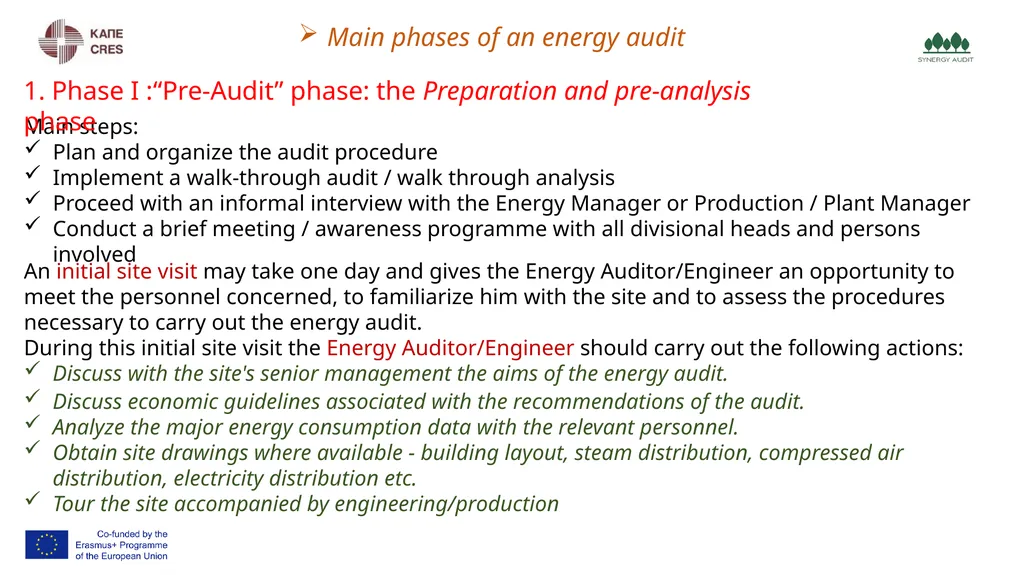
Main steps:
Plan and organize the audit procedure
Implement a walk-through audit / walk through analysis
Proceed with an informal interview with the Energy Manager or Production / Plant Manager
Conduct a brief meeting / awareness programme with all divisional heads and persons involved Main phases of an energy audit An initial site visit may take one day and gives the Energy Auditor/Engineer an opportunity to meet the personnel concerned, to familiarize him with the site and to assess the procedures necessary to carry out the energy audit.
During this initial site visit the Energy Auditor/Engineer should carry out the following actions:
Discuss with the site's senior management the aims of the energy audit.
Discuss economic guidelines associated with the recommendations of the audit.
Analyze the major energy consumption data with the relevant personnel.
Obtain site drawings where available - building layout, steam distribution, compressed air distribution, electricity distribution etc.
Tour the site accompanied by engineering/production 1. Phase I :“Pre-Audit” phase: the Preparation and pre-analysis phase<br>
Plan and organize the audit procedure
Implement a walk-through audit / walk through analysis
Proceed with an informal interview with the Energy Manager or Production / Plant Manager
Conduct a brief meeting / awareness programme with all divisional heads and persons involved Main phases of an energy audit An initial site visit may take one day and gives the Energy Auditor/Engineer an opportunity to meet the personnel concerned, to familiarize him with the site and to assess the procedures necessary to carry out the energy audit.
During this initial site visit the Energy Auditor/Engineer should carry out the following actions:
Discuss with the site's senior management the aims of the energy audit.
Discuss economic guidelines associated with the recommendations of the audit.
Analyze the major energy consumption data with the relevant personnel.
Obtain site drawings where available - building layout, steam distribution, compressed air distribution, electricity distribution etc.
Tour the site accompanied by engineering/production 1. Phase I :“Pre-Audit” phase: the Preparation and pre-analysis phase<br>
118
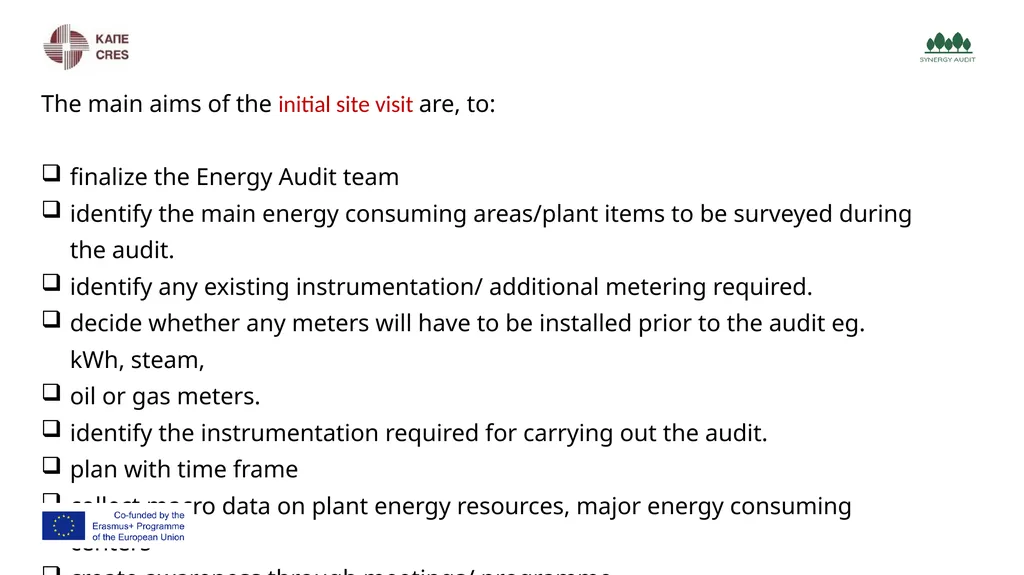
The main aims of the initial site visit are, to:
finalize the Energy Audit team
identify the main energy consuming areas/plant items to be surveyed during the audit.
identify any existing instrumentation/ additional metering required.
decide whether any meters will have to be installed prior to the audit eg. kWh, steam,
oil or gas meters.
identify the instrumentation required for carrying out the audit.
plan with time frame
collect macro data on plant energy resources, major energy consuming centers
create awareness through meetings/ programme<br>
finalize the Energy Audit team
identify the main energy consuming areas/plant items to be surveyed during the audit.
identify any existing instrumentation/ additional metering required.
decide whether any meters will have to be installed prior to the audit eg. kWh, steam,
oil or gas meters.
identify the instrumentation required for carrying out the audit.
plan with time frame
collect macro data on plant energy resources, major energy consuming centers
create awareness through meetings/ programme<br>
119
Depending on the nature and complexity of the site, a comprehensive audit can take from several weeks to several months to complete.
Detailed studies to establish, and investigate, energy and material balances for specific plant departments or items of process equipment are carried out.
Whenever possible, checks of plant operations are carried out over extended periods of time, at nights and at weekends as well as during normal daytime working hours, to ensure that nothing is overlooked.
The audit report will include a description of energy inputs and product outputs by major department or by major processing function and will evaluate the efficiency of each step of the manufacturing process.
Means of improving these efficiencies will be listed, and at least a preliminary assessment of the cost of the improvements will be made to indicate the expected pay-back on any capital investment needed.
The audit report should conclude with specific recommendations for detailed engineering studies and feasibility analyses, which must then be performed to justify the implementation of those conservation measures that require investments.<br>
Detailed studies to establish, and investigate, energy and material balances for specific plant departments or items of process equipment are carried out.
Whenever possible, checks of plant operations are carried out over extended periods of time, at nights and at weekends as well as during normal daytime working hours, to ensure that nothing is overlooked.
The audit report will include a description of energy inputs and product outputs by major department or by major processing function and will evaluate the efficiency of each step of the manufacturing process.
Means of improving these efficiencies will be listed, and at least a preliminary assessment of the cost of the improvements will be made to indicate the expected pay-back on any capital investment needed.
The audit report should conclude with specific recommendations for detailed engineering studies and feasibility analyses, which must then be performed to justify the implementation of those conservation measures that require investments.<br>
120
Information to be collected during the detailed audit:
Energy consumption by type of energy, by department, by major items of process equipment, by end-use
Material balance data (raw materials, intermediate and final products, recycled materials, use of scrap or waste products, production of by-products for re-use in other industries, etc.)
Energy cost and tariff data
Process and material flow diagrams
Generation and distribution of site services (e.g., compressed air, steam).
Sources of energy supply (e.g., electricity from the grid or self-generation)
Potential for fuel substitution, process modifications, and the use of co-generation systems (combined heat and power generation).<br>
Energy consumption by type of energy, by department, by major items of process equipment, by end-use
Material balance data (raw materials, intermediate and final products, recycled materials, use of scrap or waste products, production of by-products for re-use in other industries, etc.)
Energy cost and tariff data
Process and material flow diagrams
Generation and distribution of site services (e.g., compressed air, steam).
Sources of energy supply (e.g., electricity from the grid or self-generation)
Potential for fuel substitution, process modifications, and the use of co-generation systems (combined heat and power generation).<br>
121
60% of the inspected plants: numerous surfaces not properly insulated. INSUFFICIENT INSULATION Uninsulated steam boiler (backend) Uninsulated collector and valves Uninsulated tanks 40% of the inspected plants had numerous steam leaks, not sealed steam boiler, steam piping and steam collectors LEAKS<br>
122
The implementation and follow-up take place. The purpose is:
to assist and implement the energy conservation recommendation measures
to monitor the performance 3. Phase III: Post – Audit phase<br>
to assist and implement the energy conservation recommendation measures
to monitor the performance 3. Phase III: Post – Audit phase<br>
123
A key step in the audit process, concerning energy efficiency improvements. The level of financial analysis depends on the type of opportunity, the size of the investment and the level of risk associated with the various opportunities.
Choice of financial analysis tool (small investments, larger investments, additional considerations)
Validated calculations
Financial Analysis Method (simple payback, net present value, internal rate of return, life cycle costing) Financial analysis of opportunities:<br>
Choice of financial analysis tool (small investments, larger investments, additional considerations)
Validated calculations
Financial Analysis Method (simple payback, net present value, internal rate of return, life cycle costing) Financial analysis of opportunities:<br>
124
2. Phase II: Audit Phase (Detailed Energy Audit Activities) Main steps :
Primary data gathering, Process Flow Diagram and Energy utility Diagram
Conduction of survey and monitoring
Conduction of detailed trials / experiments for selected energy guzzlers
Analysis of energy use
Identification and development of Energy Conservation (ENCON) Opportunities
Cost Benefit Analysis
Reporting and Presentation to the top Management<br>
Primary data gathering, Process Flow Diagram and Energy utility Diagram
Conduction of survey and monitoring
Conduction of detailed trials / experiments for selected energy guzzlers
Analysis of energy use
Identification and development of Energy Conservation (ENCON) Opportunities
Cost Benefit Analysis
Reporting and Presentation to the top Management<br>
125
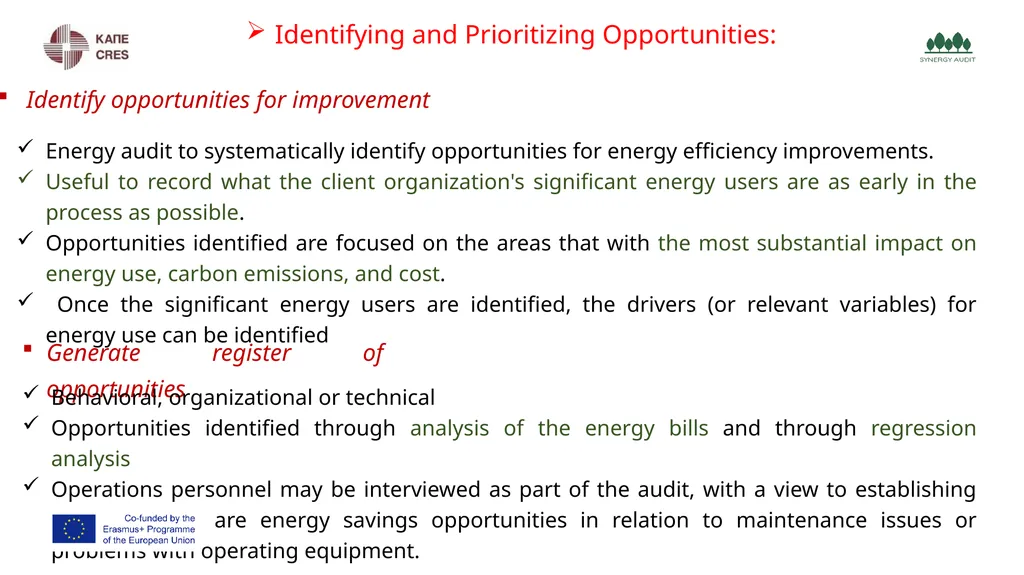
Energy audit to systematically identify opportunities for energy efficiency improvements.
Useful to record what the client organization's significant energy users are as early in the process as possible.
Opportunities identified are focused on the areas that with the most substantial impact on energy use, carbon emissions, and cost.
Once the significant energy users are identified, the drivers (or relevant variables) for energy use can be identified Identifying and Prioritizing Opportunities: Generate register of opportunities Behavioral, organizational or technical
Opportunities identified through analysis of the energy bills and through regression analysis
Operations personnel may be interviewed as part of the audit, with a view to establishing whether there are energy savings opportunities in relation to maintenance issues or problems with operating equipment. Identify opportunities for improvement<br>
Useful to record what the client organization's significant energy users are as early in the process as possible.
Opportunities identified are focused on the areas that with the most substantial impact on energy use, carbon emissions, and cost.
Once the significant energy users are identified, the drivers (or relevant variables) for energy use can be identified Identifying and Prioritizing Opportunities: Generate register of opportunities Behavioral, organizational or technical
Opportunities identified through analysis of the energy bills and through regression analysis
Operations personnel may be interviewed as part of the audit, with a view to establishing whether there are energy savings opportunities in relation to maintenance issues or problems with operating equipment. Identify opportunities for improvement<br>
126
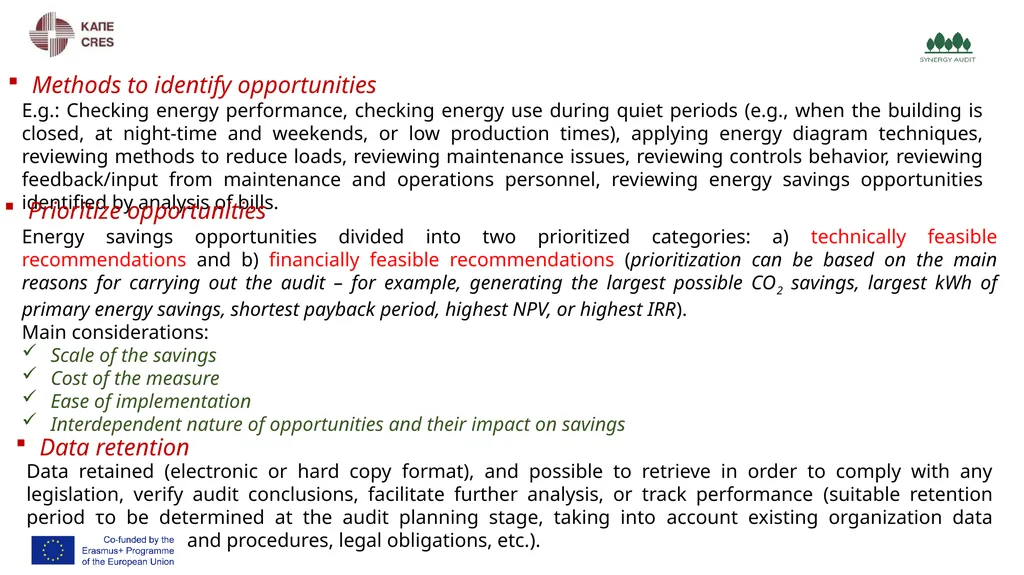
Data retention Methods to identify opportunities E.g.: Checking energy performance, checking energy use during quiet periods (e.g., when the building is closed, at night-time and weekends, or low production times), applying energy diagram techniques, reviewing methods to reduce loads, reviewing maintenance issues, reviewing controls behavior, reviewing feedback/input from maintenance and operations personnel, reviewing energy savings opportunities identified by analysis of bills. Prioritize opportunities Energy savings opportunities divided into two prioritized categories: a) technically feasible recommendations and b) financially feasible recommendations (prioritization can be based on the main reasons for carrying out the audit – for example, generating the largest possible CO2 savings, largest kWh of primary energy savings, shortest payback period, highest NPV, or highest IRR).
Main considerations:
Scale of the savings
Cost of the measure
Ease of implementation
Interdependent nature of opportunities and their impact on savings Data retained (electronic or hard copy format), and possible to retrieve in order to comply with any legislation, verify audit conclusions, facilitate further analysis, or track performance (suitable retention period το be determined at the audit planning stage, taking into account existing organization data retention policies and procedures, legal obligations, etc.).<br>
Main considerations:
Scale of the savings
Cost of the measure
Ease of implementation
Interdependent nature of opportunities and their impact on savings Data retained (electronic or hard copy format), and possible to retrieve in order to comply with any legislation, verify audit conclusions, facilitate further analysis, or track performance (suitable retention period το be determined at the audit planning stage, taking into account existing organization data retention policies and procedures, legal obligations, etc.).<br>
127
Thank you for your attention!
Georgia Veziryianni - gvezir@cres.gr
www.cres.gr<br>
Georgia Veziryianni - gvezir@cres.gr
www.cres.gr<br>
128
Lecture & Workshop 10<br>
129
Interview technique and audits ethics<br>
130
Interview technique Tools of usage
Deep interview
Group interview
Random sample interview
Successful and less successful interview environments
Simplifying facts<br>
Deep interview
Group interview
Random sample interview
Successful and less successful interview environments
Simplifying facts<br>
131
Interview technique The shy auditee
The talkative auditee
Most important – Your attitude as an auditor!<br>
The talkative auditee
Most important – Your attitude as an auditor!<br>
132
IEA Ethics Effective communication with all groups of an organisation
Building trust during a tough audit
Necessity to gain right data
Clear communication of reasons for IEA and deviations
Create an understanding<br>
Building trust during a tough audit
Necessity to gain right data
Clear communication of reasons for IEA and deviations
Create an understanding<br>
133
IEA Ethics Communication of responsibility
Full transparency toward the auditee
Unbiased
Full silence in communcation – professional discretion
Kind, professional, openminded and non-judgmental approach = possibility for great collaboration toward constant improvement<br>
Full transparency toward the auditee
Unbiased
Full silence in communcation – professional discretion
Kind, professional, openminded and non-judgmental approach = possibility for great collaboration toward constant improvement<br>
134
IEA training practise – Interview technique Group work in break-out rooms
Choose 1-2 auditors, 1 note-manager and 1 auditee within the group.
Choose 5-10 questions from the checklist in the previous workshop elaboration.
Use 10 minutes for the training interview.
Good Luck! <br>
Choose 1-2 auditors, 1 note-manager and 1 auditee within the group.
Choose 5-10 questions from the checklist in the previous workshop elaboration.
Use 10 minutes for the training interview.
Good Luck! <br>
135
IEA training practise – Interview technique Evaluation of interview
Answer the following questions within each group:
Did you as an interviewer have the chance to collect response to all five questions within time?
Did you as an auditee have the chance to understand all the questions within time?
Did you as a note-manager have the time to gather the necessary notes for possibility to understand later on?
If any of the above answers are NO, please take a moment and redo the practise before the real-time audit in your organisation.
Good Luck! <br>
Did you as an interviewer have the chance to collect response to all five questions within time?
Did you as an auditee have the chance to understand all the questions within time?
Did you as a note-manager have the time to gather the necessary notes for possibility to understand later on?
If any of the above answers are NO, please take a moment and redo the practise before the real-time audit in your organisation.
Good Luck! <br>
136
Workshop Practice 11<br>
137
Internal environmental audits practise in groups Performance of an interview with the organisation that your group is working in:
1. Arrange a meeting with key person(s) in the organisation for performance of a practice internal environmental audit (IEA) interview.
2. Choose person(s) within the IEA team who will ask questions on the approximately 30 minutes interview.
3. Choose person(s) in the IEA team who will take notes along the interview.
4. Perform the interview. Good Luck! <br>
1. Arrange a meeting with key person(s) in the organisation for performance of a practice internal environmental audit (IEA) interview.
2. Choose person(s) within the IEA team who will ask questions on the approximately 30 minutes interview.
3. Choose person(s) in the IEA team who will take notes along the interview.
4. Perform the interview. Good Luck! <br>
138
Performance of an Internal environmental audit Performance of an interview with the organisation that your group is working toward:
-Remember to take notes at the practise interview!
-Gather in the IEA team after the audit have finnished and look at the following:
Can you already now see possible deviations, notes and recommendations from the response? If yes, write down notes about it for memory to use in the coming audit report writing practise.<br>
-Remember to take notes at the practise interview!
-Gather in the IEA team after the audit have finnished and look at the following:
Can you already now see possible deviations, notes and recommendations from the response? If yes, write down notes about it for memory to use in the coming audit report writing practise.<br>
139
Day 5<br>
140
Lecture and Workshop 12<br>
141
Deviation analysis Big deviation – Non-compliance toward law, regulations and standard requirements
Small deviation – Non-compliance toward EMS requirements (internal documents)
Notes – Anything that could lead to a non-compliance toward above in short- and/or long time
Recommendation – Activity that could increase positive and/or negative direct and/or indirect environmental impact, which have been analysed from the IEA.<br>
Small deviation – Non-compliance toward EMS requirements (internal documents)
Notes – Anything that could lead to a non-compliance toward above in short- and/or long time
Recommendation – Activity that could increase positive and/or negative direct and/or indirect environmental impact, which have been analysed from the IEA.<br>
142
Internal environmental audits practise in groups Writing of an Internal environmental audits report with your group:
-Analyse the response from the previous interview in relation to global and EU directives, e.g., the EU Waste directive, the 17 SDGs and so on…
-Sort out possible big and small deviations from the previous audit along with possible notes and recommendations
-Use the audit template and fill in deviations, notes, recommendations and other needed data about the auditee organisation along with a comment (see template).<br>
-Analyse the response from the previous interview in relation to global and EU directives, e.g., the EU Waste directive, the 17 SDGs and so on…
-Sort out possible big and small deviations from the previous audit along with possible notes and recommendations
-Use the audit template and fill in deviations, notes, recommendations and other needed data about the auditee organisation along with a comment (see template).<br>
143
Online exam<br>
144
Online survey<br>
145
Ending of the presentation… and New Beginnings Welcome to join the Synergy Audit Network!
The Synergy Audit Network is a global network of internal environmental auditors, sustainability managers, stakeholders and interests to help for all kinds of organisations from a small NGO to a bigger industry.
The network shall be a support tool in your EMS and audit work where you with the help of other organisations in the network can share ideas, exchange knowledge and thereby also increase the chance for collaboration within sustainability with organisations.
If you would like to join the network please contact us at: forplanettellus@gmail.com
Contact information:
One Planet email address: forplanettellus@gmail.com
Network web address: www.one-planet.se<br>
The Synergy Audit Network is a global network of internal environmental auditors, sustainability managers, stakeholders and interests to help for all kinds of organisations from a small NGO to a bigger industry.
The network shall be a support tool in your EMS and audit work where you with the help of other organisations in the network can share ideas, exchange knowledge and thereby also increase the chance for collaboration within sustainability with organisations.
If you would like to join the network please contact us at: forplanettellus@gmail.com
Contact information:
One Planet email address: forplanettellus@gmail.com
Network web address: www.one-planet.se<br>
146
Good Luck Forward!<br>