Systematic review: feeding practices for LBW infants in LMICs Abimbola Akindolire Background Survival of small and very small babies have improved over the last 20 years. A large majority of preterms at term gestational age are growth
Related Topics
Share
Embed code
Download this presentation From Below
"Systematic review: feeding practices for LBW" is the property of its rightful owner. Permission is granted to
download and print the materials on this website for personal, non-commercial use only, and to display it
on your personal computer provided you do not modify the materials and that you retain all copyright
notices contained in the materials. By downloading content from our website, you accept the terms of this
agreement.
Presentation Transcript
01
Systematic review: feeding practices for LBW infants in LMICs Abimbola Akindolire<br>
02
Background Survival of small and very small babies have improved over the last 20 years.
A large majority of preterms at term gestational age are growth restricted
The main consequence of this growth restriction is reduced brain growth leading to cognitive delays.
To prevent this, adequate nutrition must be started as early as possible.
New research into best feeding practices in order to how to achieve the same intrauterine growth rates
Most available research/reviews are from the HICs and current guidelines are based on these information<br>
03
Literature search A literature search was conducted to see what evidence is available from LMICs to base current feeding practices on
The questions we were asking at this time were
What to feed
How to feed
When to start feeding
How to advance<br>
04
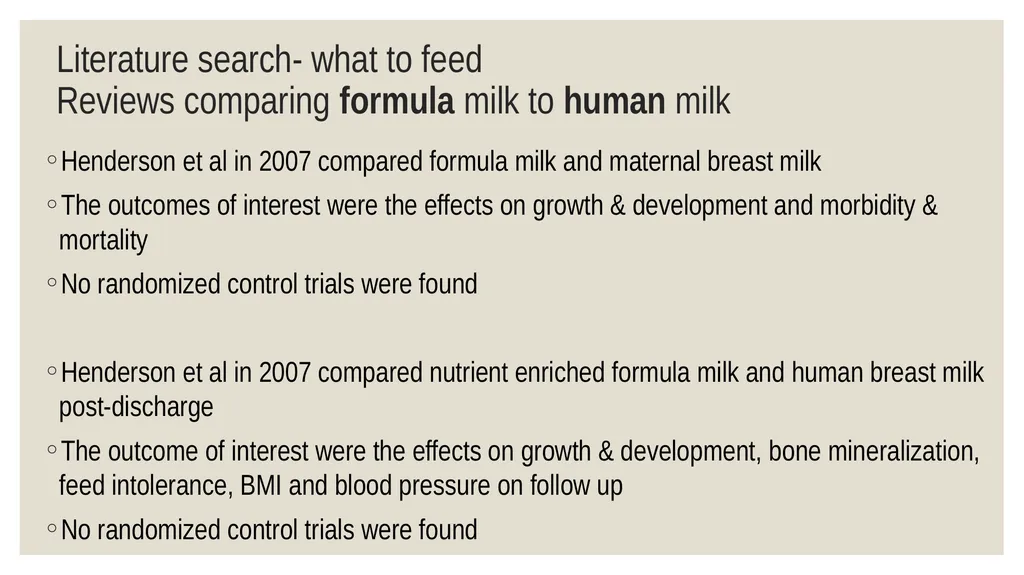
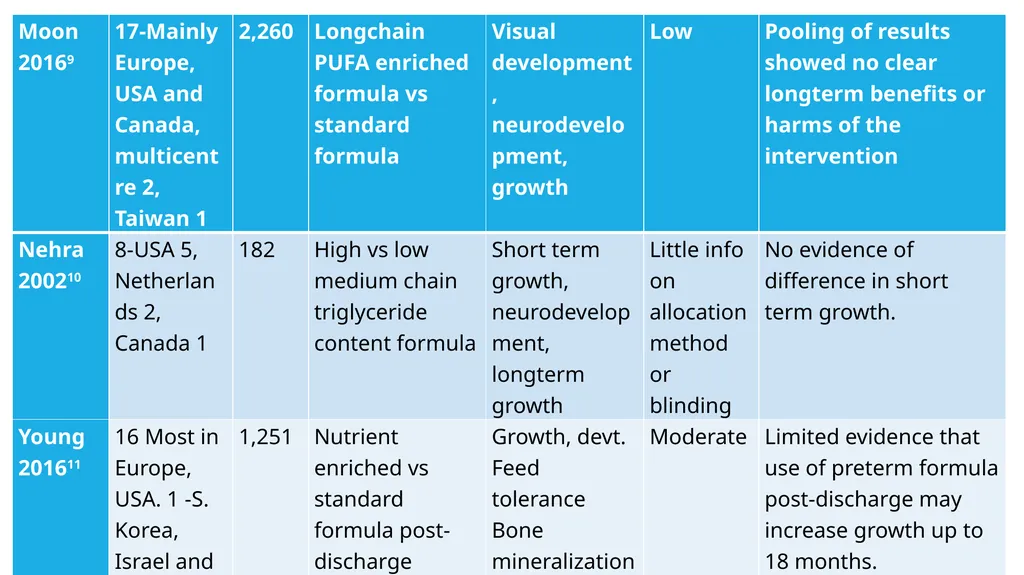
Literature search- what to feed Reviews comparing formula milk to human milk Henderson et al in 2007 compared formula milk and maternal breast milk
The outcomes of interest were the effects on growth & development and morbidity & mortality
No randomized control trials were found
Henderson et al in 2007 compared nutrient enriched formula milk and human breast milk post-discharge
The outcome of interest were the effects on growth & development, bone mineralization, feed intolerance, BMI and blood pressure on follow up
No randomized control trials were found<br>
05
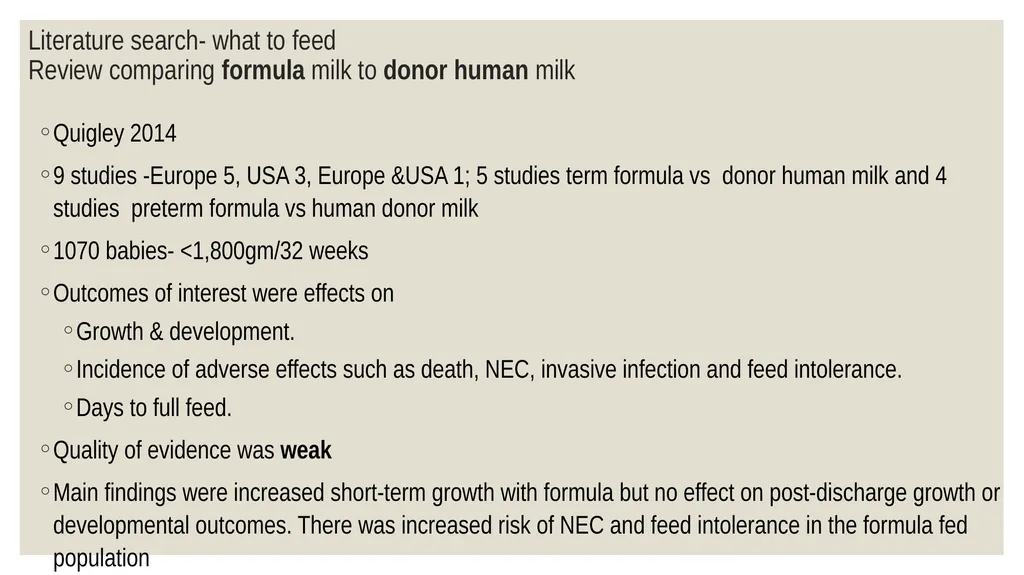
Literature search- what to feed Review comparing formula milk to donor human milk Quigley 2014
9 studies -Europe 5, USA 3, Europe &USA 1; 5 studies term formula vs donor human milk and 4 studies preterm formula vs human donor milk
1070 babies- <1,800gm/32 weeks
Outcomes of interest were effects on
Growth & development.
Incidence of adverse effects such as death, NEC, invasive infection and feed intolerance.
Days to full feed.
Quality of evidence was weak
Main findings were increased short-term growth with formula but no effect on post-discharge growth or developmental outcomes. There was increased risk of NEC and feed intolerance in the formula fed population<br>
06
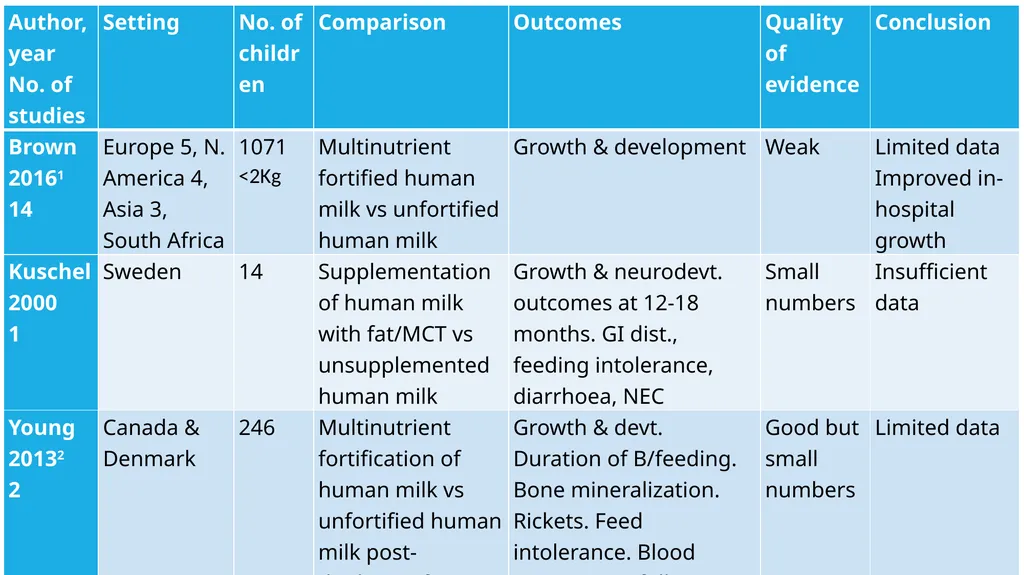
Literature search Reviews on breast milk fortification Many reviews in HICs
Most show evidence of improvement in weight gain with fortification<br>
07
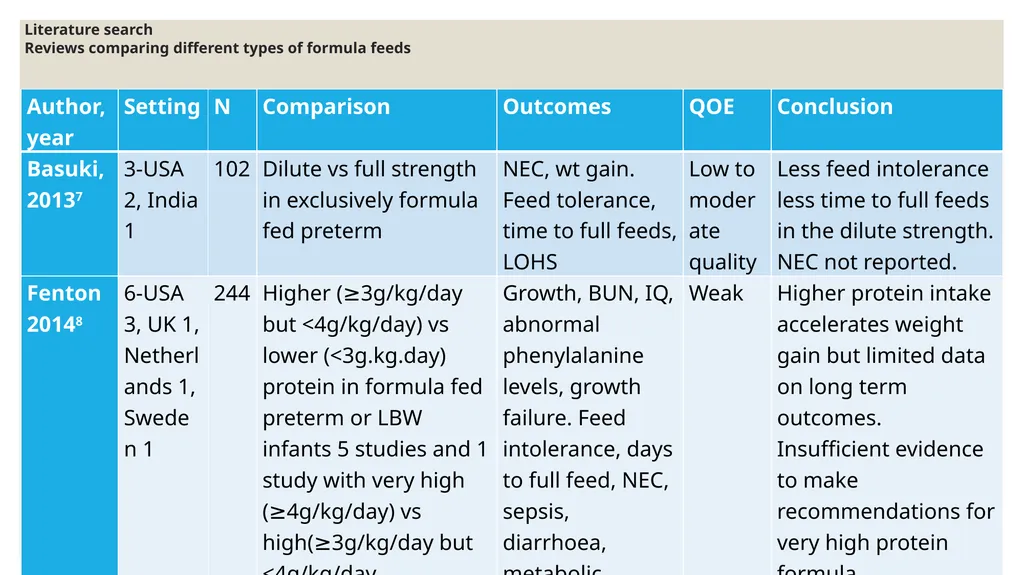
Literature search Reviews comparing different types of formula feeds<br>
08
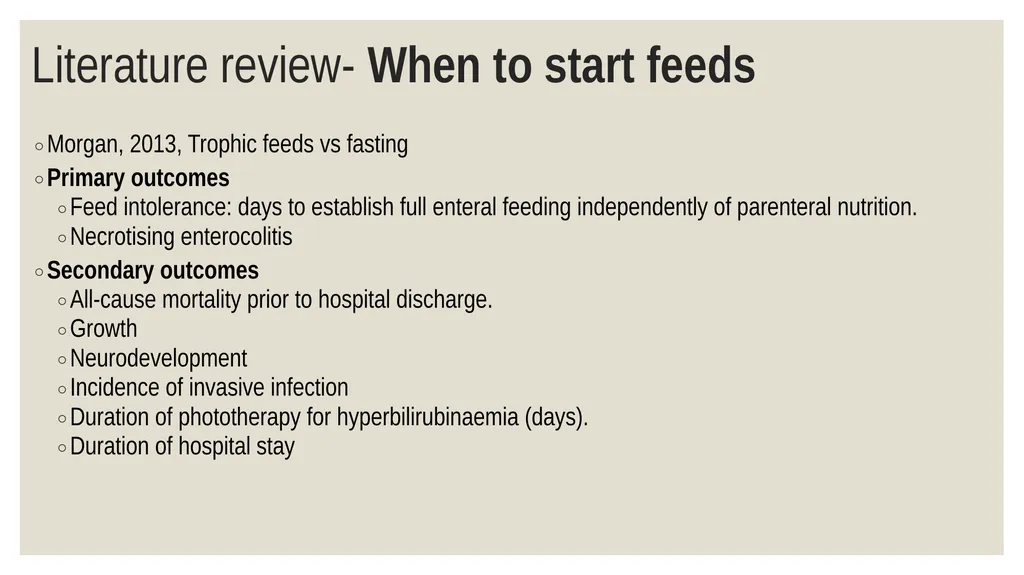
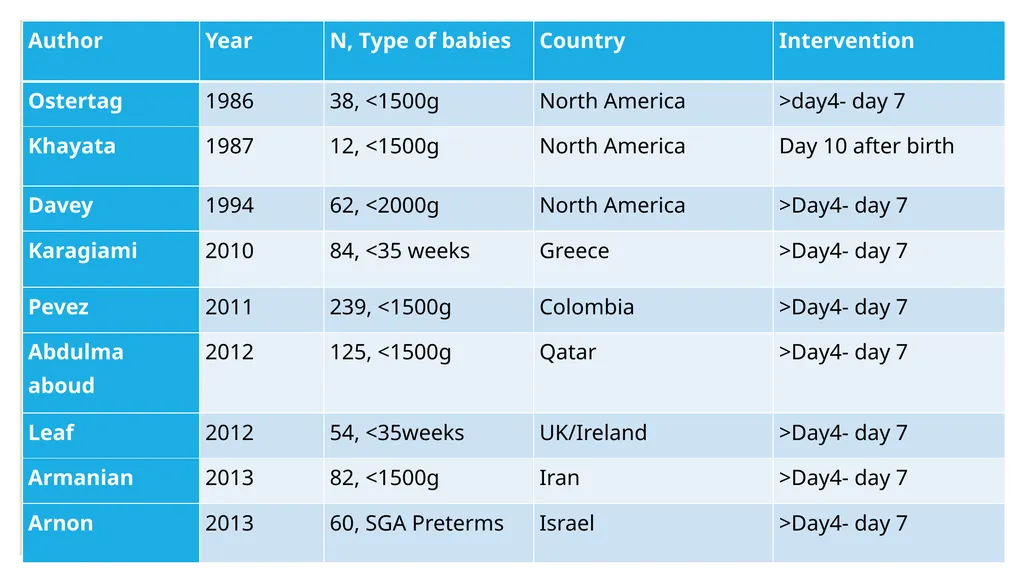
Literature review- When to start feeds Morgan, 2013, Trophic feeds vs fasting
Primary outcomes
Feed intolerance: days to establish full enteral feeding independently of parenteral nutrition.
Necrotising enterocolitis
Secondary outcomes
All-cause mortality prior to hospital discharge.
Growth
Neurodevelopment
Incidence of invasive infection
Duration of phototherapy for hyperbilirubinaemia (days).
Duration of hospital stay<br>
09
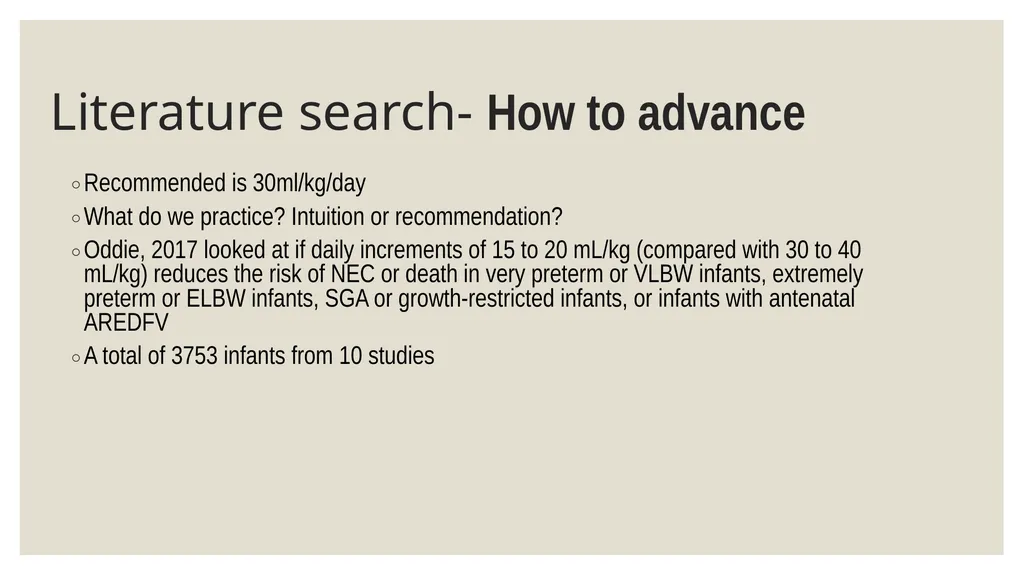
Literature search- How to advance Recommended is 30ml/kg/day
What do we practice? Intuition or recommendation?
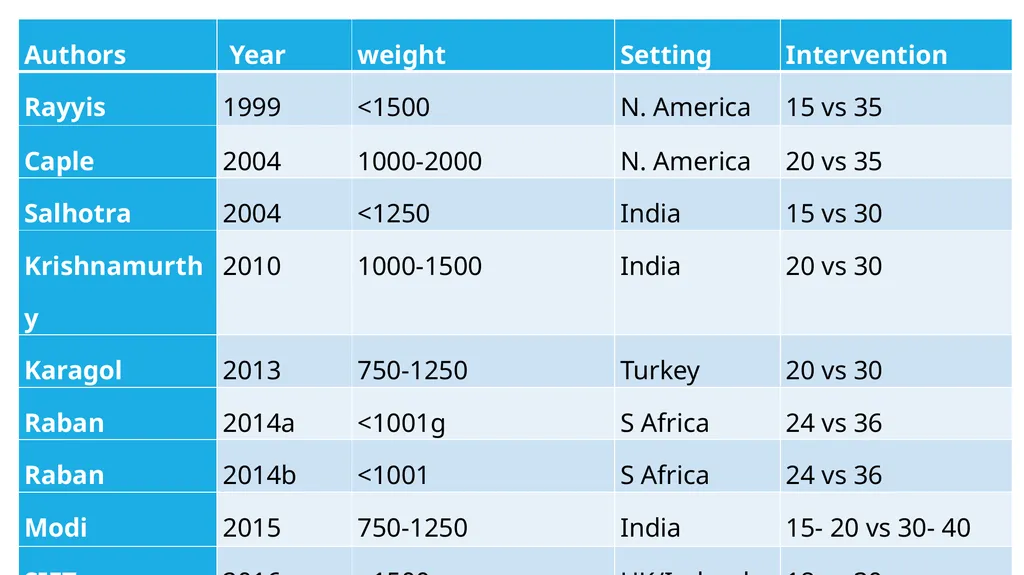
Oddie, 2017 looked at if daily increments of 15 to 20 mL/kg (compared with 30 to 40 mL/kg) reduces the risk of NEC or death in very preterm or VLBW infants, extremely preterm or ELBW infants, SGA or growth-restricted infants, or infants with antenatal AREDFV
A total of 3753 infants from 10 studies<br>
10
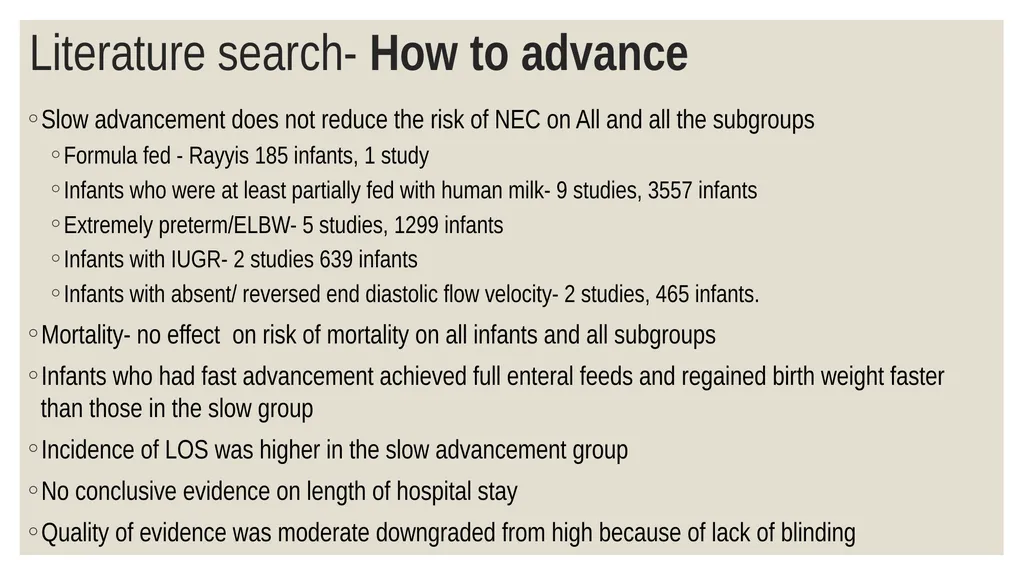
Literature search- How to advance Slow advancement does not reduce the risk of NEC on All and all the subgroups
Formula fed - Rayyis 185 infants, 1 study
Infants who were at least partially fed with human milk- 9 studies, 3557 infants
Extremely preterm/ELBW- 5 studies, 1299 infants
Infants with IUGR- 2 studies 639 infants
Infants with absent/ reversed end diastolic flow velocity- 2 studies, 465 infants.
Mortality- no effect on risk of mortality on all infants and all subgroups
Infants who had fast advancement achieved full enteral feeds and regained birth weight faster than those in the slow group
Incidence of LOS was higher in the slow advancement group
No conclusive evidence on length of hospital stay
Quality of evidence was moderate downgraded from high because of lack of blinding<br>
11
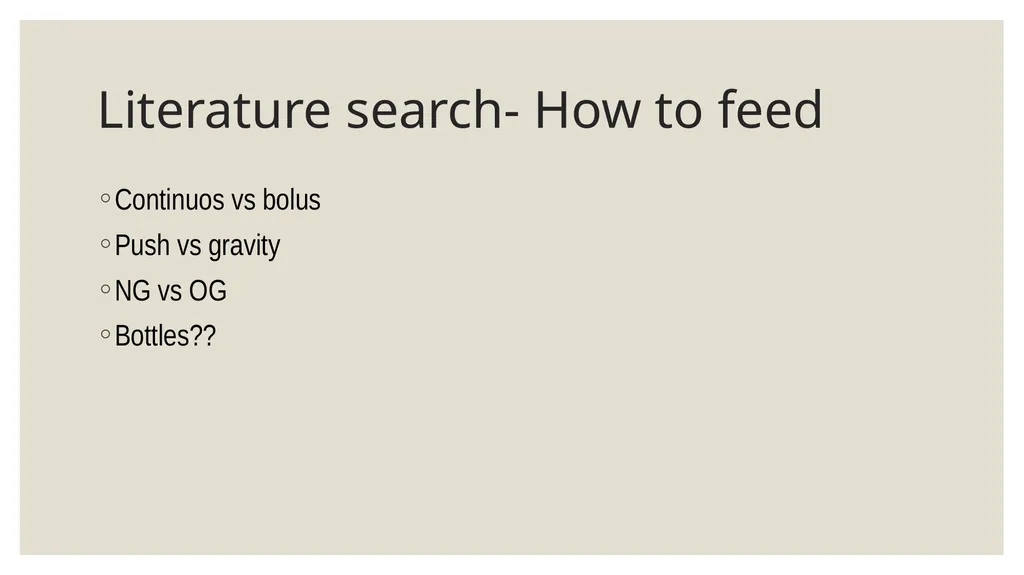
Literature search- How to feed Continuos vs bolus
Push vs gravity
NG vs OG
Bottles??<br>
12
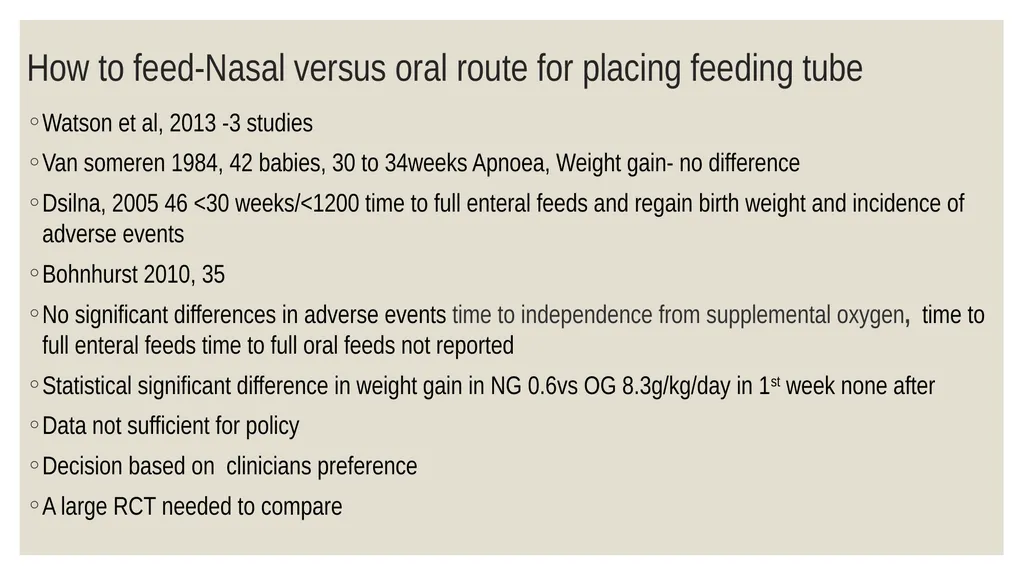
How to feed-Nasal versus oral route for placing feeding tube Watson et al, 2013 -3 studies
Van someren 1984, 42 babies, 30 to 34weeks Apnoea, Weight gain- no difference
Dsilna, 2005 46 <30 weeks/<1200 time to full enteral feeds and regain birth weight and incidence of adverse events
Bohnhurst 2010, 35
No significant differences in adverse events time to independence from supplemental oxygen, time to full enteral feeds time to full oral feeds not reported
Statistical significant difference in weight gain in NG 0.6vs OG 8.3g/kg/day in 1st week none after
Data not sufficient for policy
Decision based on clinicians preference
A large RCT needed to compare<br>
13
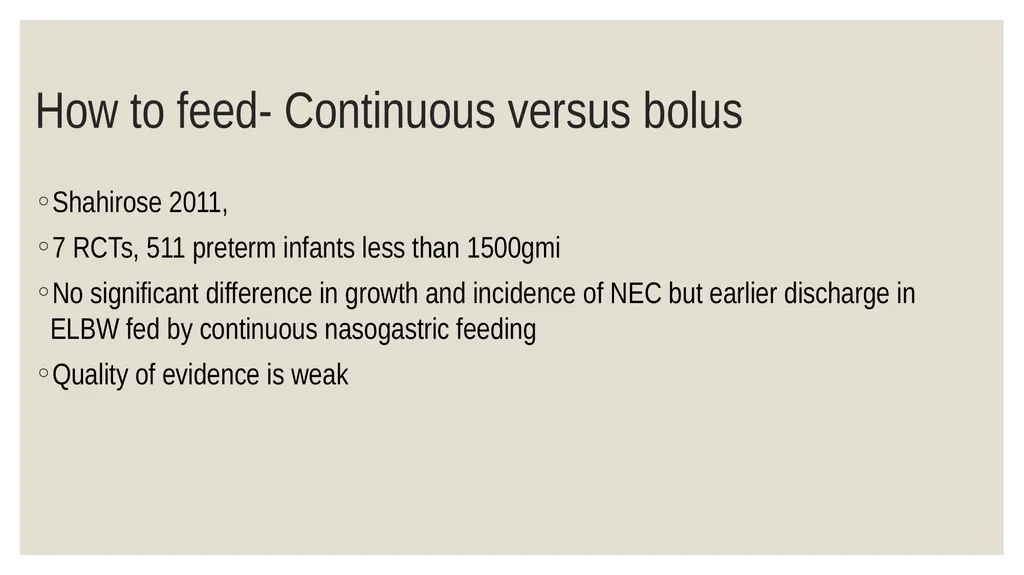
How to feed- Continuous versus bolus Shahirose 2011,
7 RCTs, 511 preterm infants less than 1500gmi
No significant difference in growth and incidence of NEC but earlier discharge in ELBW fed by continuous nasogastric feeding
Quality of evidence is weak<br>
14
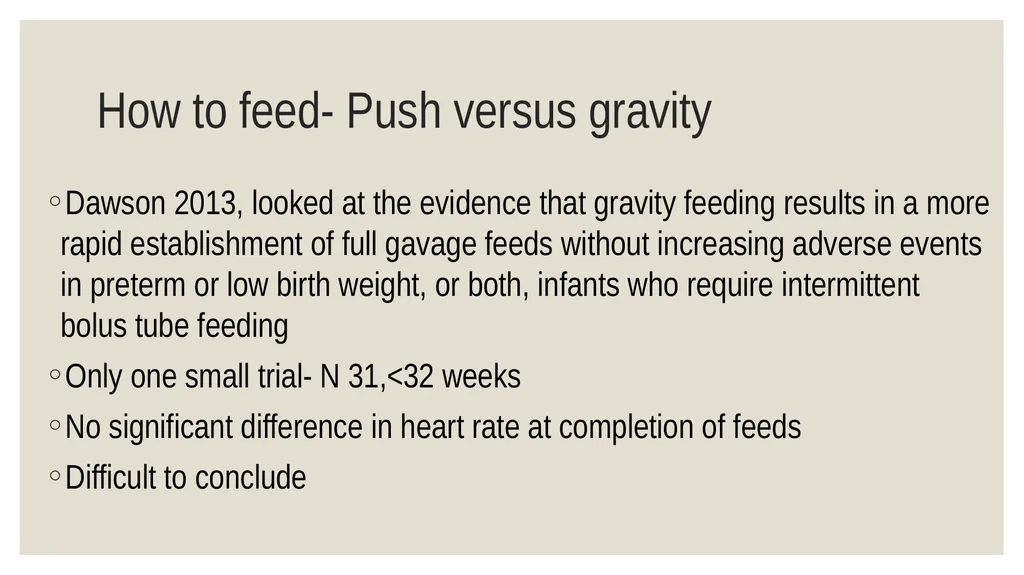
How to feed- Push versus gravity Dawson 2013, looked at the evidence that gravity feeding results in a more rapid establishment of full gavage feeds without increasing adverse events in preterm or low birth weight, or both, infants who require intermittent bolus tube feeding
Only one small trial- N 31,<32 weeks
No significant difference in heart rate at completion of feeds
Difficult to conclude<br>
15
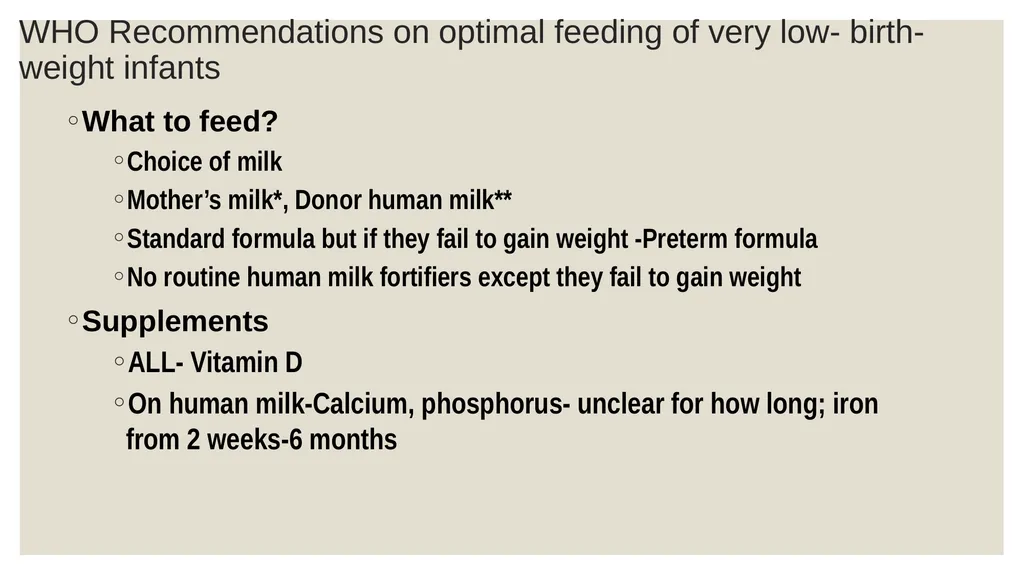
WHO Recommendations on optimal feeding of very low- birth- weight infants What to feed?
Choice of milk
Mother’s milk*, Donor human milk**
Standard formula but if they fail to gain weight -Preterm formula
No routine human milk fortifiers except they fail to gain weight
Supplements
ALL- Vitamin D
On human milk-Calcium, phosphorus- unclear for how long; iron from 2 weeks-6 months<br>
16
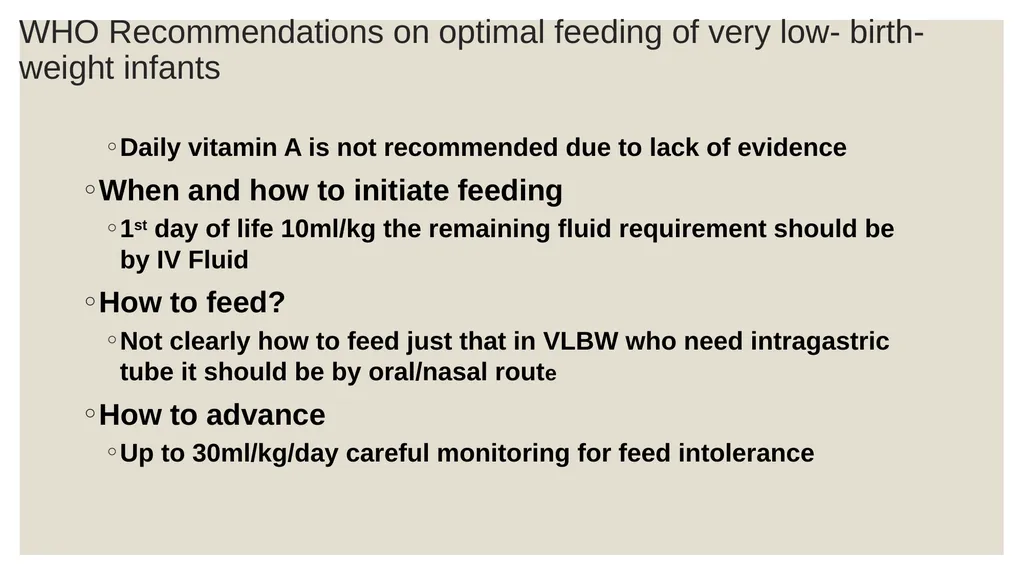
WHO Recommendations on optimal feeding of very low- birth- weight infants Daily vitamin A is not recommended due to lack of evidence
When and how to initiate feeding
1st day of life 10ml/kg the remaining fluid requirement should be by IV Fluid
How to feed?
Not clearly how to feed just that in VLBW who need intragastric tube it should be by oral/nasal route
How to advance
Up to 30ml/kg/day careful monitoring for feed intolerance<br>