
T2 - Teaching the Professional Role CanMEDS
T
Published · 29 slides · 0 views
1 / 1
Description
T2 - Teaching the Professional Role CanMEDS Professional T2 - Teaching the Professional Role The unmodified content below was created for the CanMEDS Teaching and Assessment Tools Guide by S Glover Takahashi and is owned by the Royal
Related Topics
Share
Embed code
Download this presentation From Below
"T2 - Teaching the Professional Role CanMEDS" is the property of its rightful owner. Permission is granted to download and print the materials on this website for personal, non-commercial use only, and to display it on your personal computer provided you do not modify the materials and that you retain all copyright notices contained in the materials. By downloading content from our website, you accept the terms of this agreement.
Presentation Transcript
01
T2 - Teaching the
Professional Role CanMEDS Professional<br>
02
T2 - Teaching the Professional Role The unmodified content below was created for the CanMEDS Teaching and Assessment Tools Guide by S Glover Takahashi and is owned by the Royal College of Physicians and Surgeons of Canada. You may use, reproduce and modify the content for your own non-commercial purposes provided that your modifications are clearly indicated and you provide attribution to the Royal College. The Royal College may revoke this permission at any time by providing written notice.
NOTICE: The content below may have been modified from its original form and may not represent the opinion or views of the Royal College. 2<br>
NOTICE: The content below may have been modified from its original form and may not represent the opinion or views of the Royal College. 2<br>
03
Objectives and Agenda Recognize the process and content of Professional Role
Apply professionalism skills to examples from everyday practice
Develop a personal professionalism resource for everyday practice T2 - Teaching the Professional Role 3<br>
Apply professionalism skills to examples from everyday practice
Develop a personal professionalism resource for everyday practice T2 - Teaching the Professional Role 3<br>
04
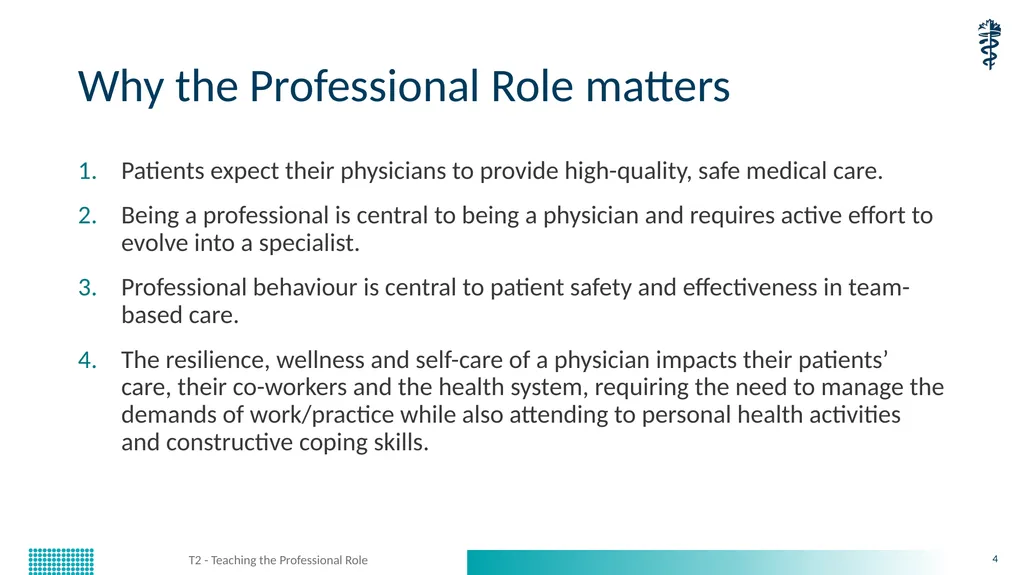
Why the Professional Role matters Patients expect their physicians to provide high-quality, safe medical care.
Being a professional is central to being a physician and requires active effort to evolve into a specialist.
Professional behaviour is central to patient safety and effectiveness in team-based care.
The resilience, wellness and self-care of a physician impacts their patients’ care, their co-workers and the health system, requiring the need to manage the demands of work/practice while also attending to personal health activities and constructive coping skills. T2 - Teaching the Professional Role 4<br>
05
The details: What is the Professional Role As Professionals, physicians are committed to the health and well-being of individual patients and society through ethical practice, high personal standards of behaviour, accountability to the profession and society, physician-led regulation, and maintenance of personal health. T2 - Teaching the Professional Role 5<br>
06
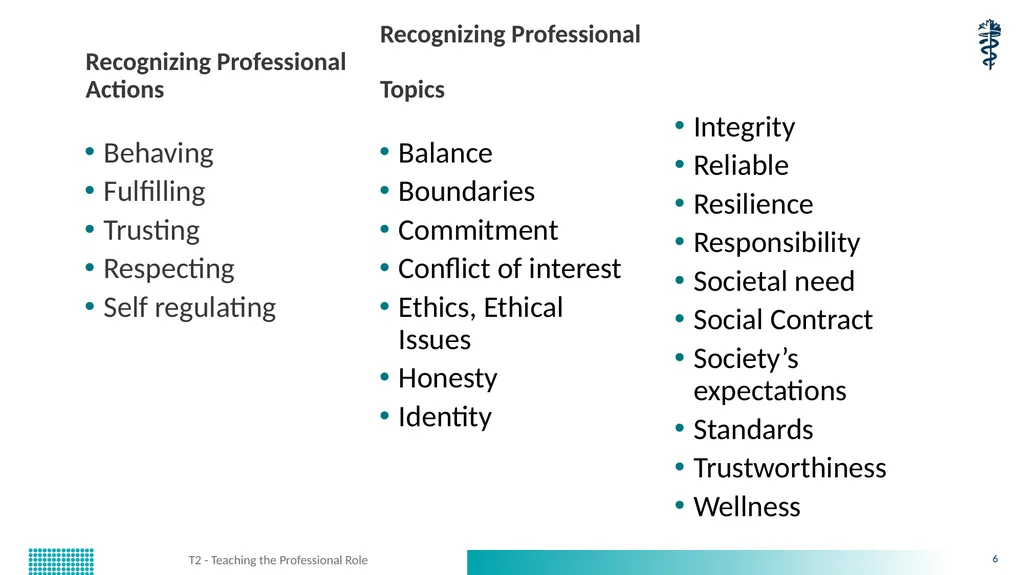
Recognizing Professional Actions Behaving
Fulfilling
Trusting
Respecting
Self regulating Recognizing Professional Topics Integrity
Reliable
Resilience
Responsibility
Societal need
Social Contract
Society’s expectations
Standards
Trustworthiness
Wellness T2 - Teaching the Professional Role 6 Balance
Boundaries
Commitment
Conflict of interest
Ethics, Ethical Issues
Honesty
Identity<br>
07
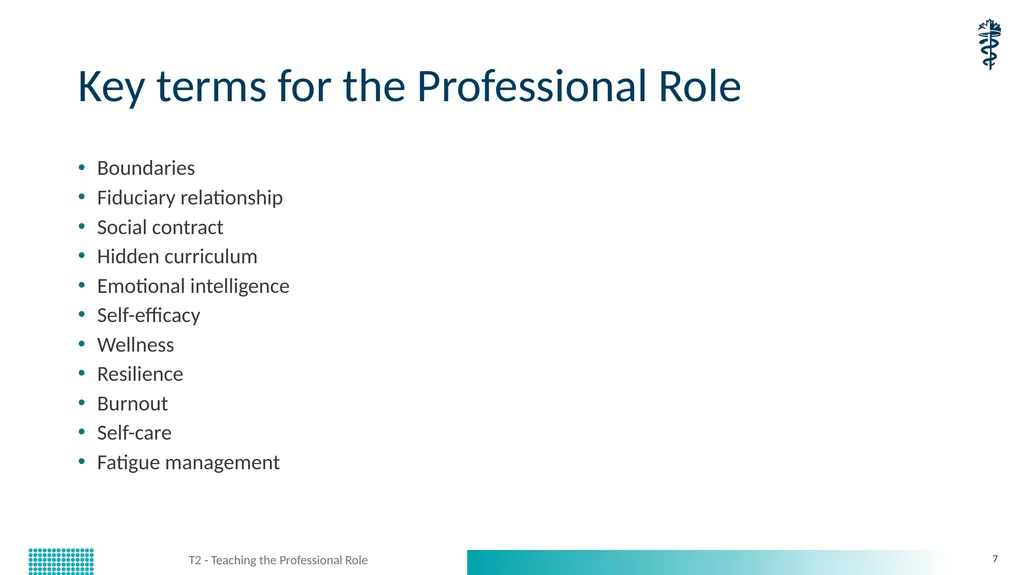
Key terms for the Professional Role Boundaries
Fiduciary relationship
Social contract
Hidden curriculum
Emotional intelligence
Self-efficacy
Wellness
Resilience
Burnout
Self-care
Fatigue management T2 - Teaching the Professional Role 7<br>
Fiduciary relationship
Social contract
Hidden curriculum
Emotional intelligence
Self-efficacy
Wellness
Resilience
Burnout
Self-care
Fatigue management T2 - Teaching the Professional Role 7<br>
08
Professional means showing commitment to: patients
society
profession
self T2 - Teaching the Professional Role 8<br>
society
profession
self T2 - Teaching the Professional Role 8<br>
09
Important to know about professionalism Professionalism has multiple factors that can be taught:
individual factors (i.e. behaviour and cognitive processes);
interpersonal factors (i.e. process or effect of providing patient care with others); and
context factors (i.e. variations and expectations in interactions within or across individuals, institutions, specialties, cultures, countries).
Focus on actively demonstrating positive professional behaviours.
Physicians need to demonstrate the importance of their own personal health, wellness, and resilience. T2 - Teaching the Professional Role 9<br>
10
Skills for residents to master in developing their identity as a physician in your specialty are: Learning the language
Learning to live with ambiguity
Learning to play the role
Learning the hierarchy and power relationships T2 - Teaching the Professional Role 10<br>
Learning to live with ambiguity
Learning to play the role
Learning the hierarchy and power relationships T2 - Teaching the Professional Role 10<br>
11
Label the BEHAVIOUR Avoid judging the person T2 - Teaching the Professional Role 11<br>
12
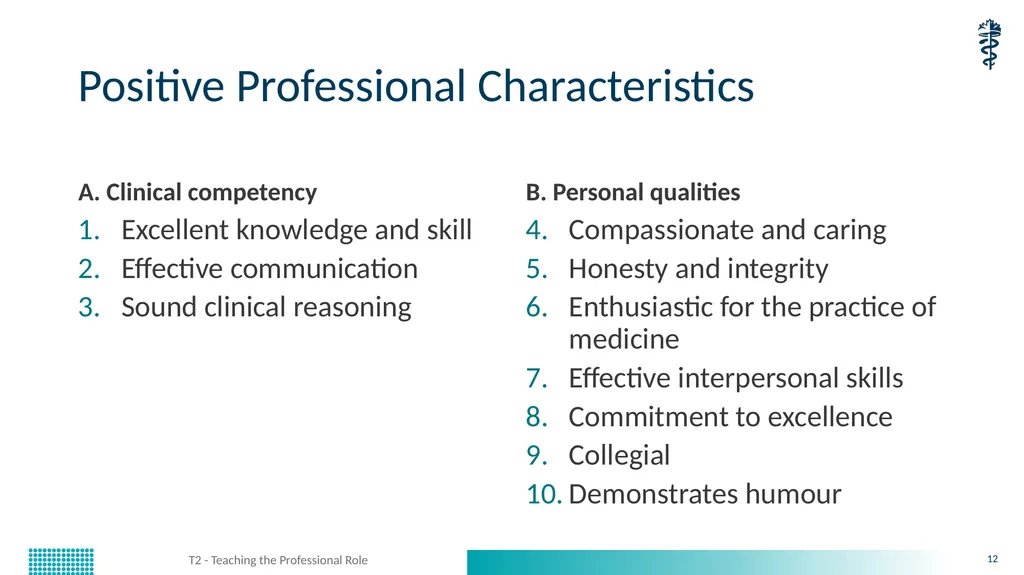
Positive Professional Characteristics A. Clinical competency Excellent knowledge and skill
Effective communication
Sound clinical reasoning B. Personal qualities Compassionate and caring
Honesty and integrity
Enthusiastic for the practice of medicine
Effective interpersonal skills
Commitment to excellence
Collegial
Demonstrates humour T2 - Teaching the Professional Role 12<br>
Effective communication
Sound clinical reasoning B. Personal qualities Compassionate and caring
Honesty and integrity
Enthusiastic for the practice of medicine
Effective interpersonal skills
Commitment to excellence
Collegial
Demonstrates humour T2 - Teaching the Professional Role 12<br>
13
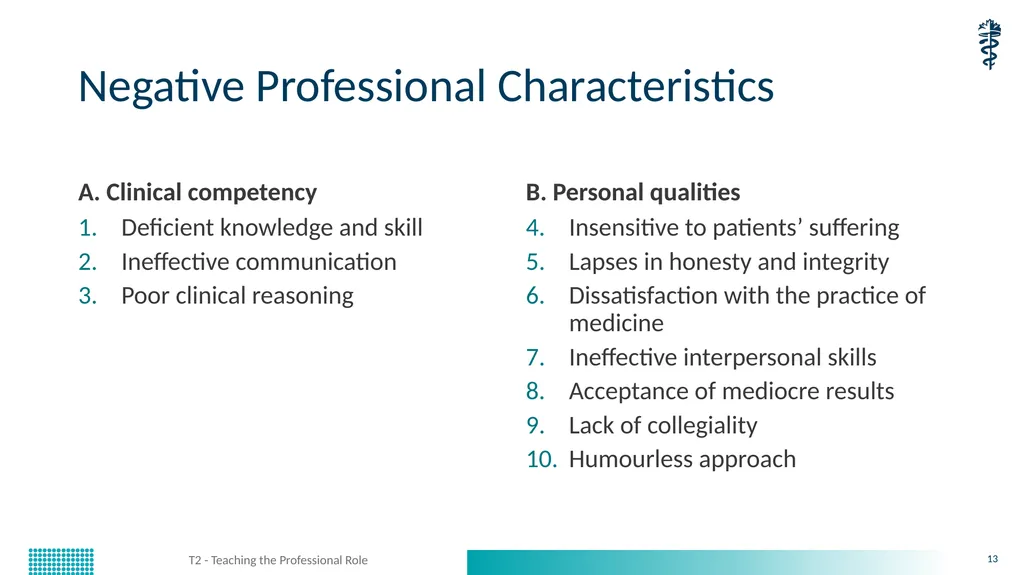
Negative Professional Characteristics A. Clinical competency Deficient knowledge and skill
Ineffective communication
Poor clinical reasoning B. Personal qualities Insensitive to patients’ suffering
Lapses in honesty and integrity
Dissatisfaction with the practice of medicine
Ineffective interpersonal skills
Acceptance of mediocre results
Lack of collegiality
Humourless approach T2 - Teaching the Professional Role 13<br>
14
Worksheet T3 Professionalism Scenarios and Case Discussion T2 - Teaching the Professional Role 14<br>
15
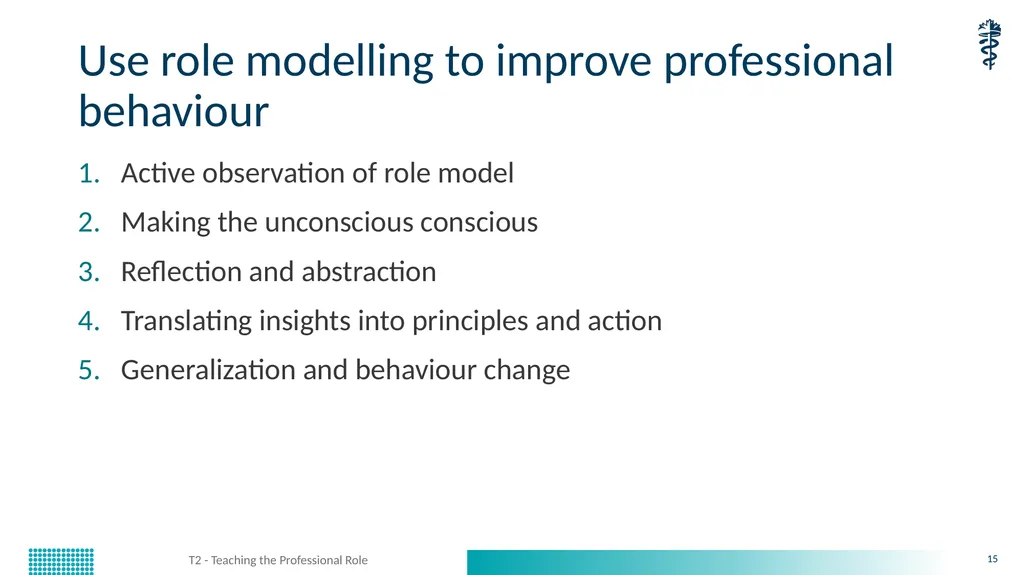
Use role modelling to improve professional behaviour Active observation of role model
Making the unconscious conscious
Reflection and abstraction
Translating insights into principles and action
Generalization and behaviour change T2 - Teaching the Professional Role 15<br>
Making the unconscious conscious
Reflection and abstraction
Translating insights into principles and action
Generalization and behaviour change T2 - Teaching the Professional Role 15<br>
16
Constructive coping skills Constructive coping skills include:
Positive reframing
Finding meaning in work
Focusing on what is important in life
Maintaining a positive outlook and attitude towards work
Embracing an approach that stresses work-life balance T2 - Teaching the Professional Role 16<br>
Positive reframing
Finding meaning in work
Focusing on what is important in life
Maintaining a positive outlook and attitude towards work
Embracing an approach that stresses work-life balance T2 - Teaching the Professional Role 16<br>
17
Wellness responsibilities Only care for patients when well enough to do so
Be aware of their own health, including recognizing when not well enough to provide competent care
Obtain help in order to ensure their own wellness
Adjust their practice to ensure that patients can and do receive appropriate care
Recognizing limits imposed by fatigue, stress or illness and taking care to ensure a healthy work-life balance
Avoid self-treatment T2 - Teaching the Professional Role 17<br>
18
Personal health activities Personal health activities are associated with lower rates of burnout and improved quality of life
Weekly aerobic and weight training to recommended levels
Annual visits to primary care provider (i.e. family physician)
Routine required health screening practices T2 - Teaching the Professional Role 18<br>
Weekly aerobic and weight training to recommended levels
Annual visits to primary care provider (i.e. family physician)
Routine required health screening practices T2 - Teaching the Professional Role 18<br>
19
Resilience, wellness and self- care Have a family doctor
Sleep right
Eat well
Exercise regularly
Stay connected T2 - Teaching the Professional Role 19<br>
Sleep right
Eat well
Exercise regularly
Stay connected T2 - Teaching the Professional Role 19<br>
20
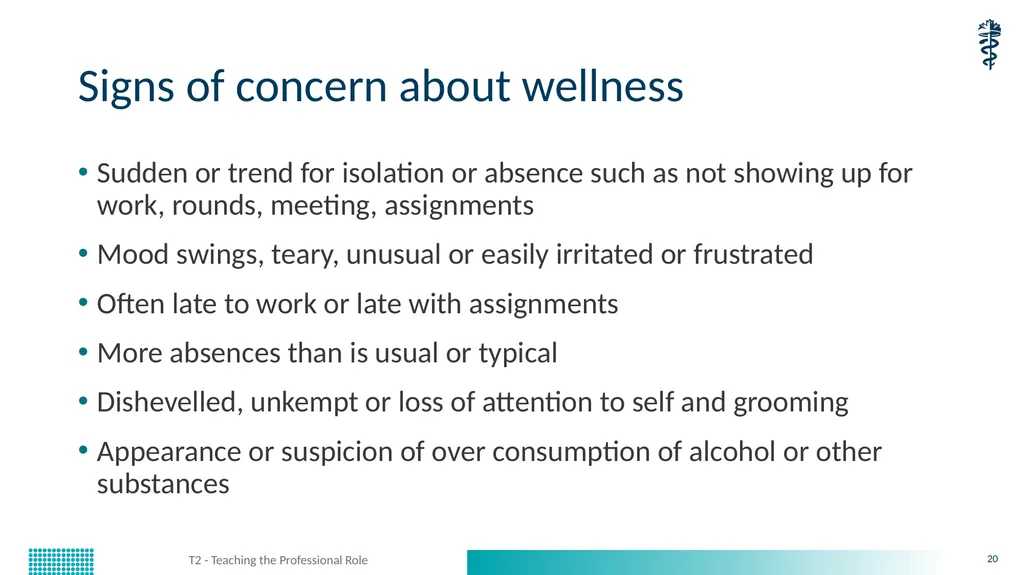
Signs of concern about wellness Sudden or trend for isolation or absence such as not showing up for work, rounds, meeting, assignments
Mood swings, teary, unusual or easily irritated or frustrated
Often late to work or late with assignments
More absences than is usual or typical
Dishevelled, unkempt or loss of attention to self and grooming
Appearance or suspicion of over consumption of alcohol or other substances T2 - Teaching the Professional Role 20<br>
21
Objectives Recognize the process and content of Professional Role
Apply professionalism skills to examples from everyday practice
Develop a personal professionalism resource for everyday practice T2 - Teaching the Professional Role 21<br>
Apply professionalism skills to examples from everyday practice
Develop a personal professionalism resource for everyday practice T2 - Teaching the Professional Role 21<br>
22
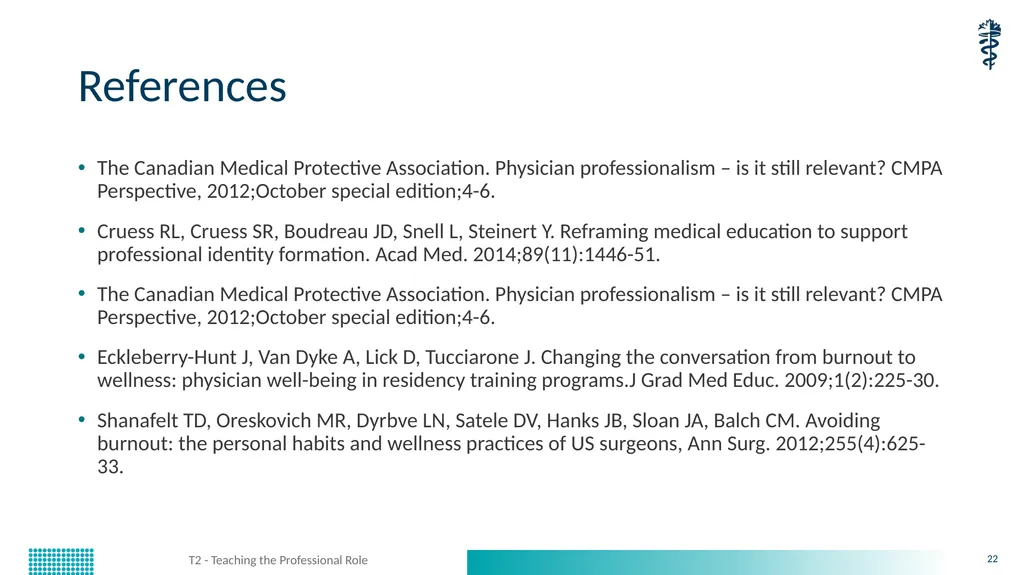
References The Canadian Medical Protective Association. Physician professionalism – is it still relevant? CMPA Perspective, 2012;October special edition;4-6.
Cruess RL, Cruess SR, Boudreau JD, Snell L, Steinert Y. Reframing medical education to support professional identity formation. Acad Med. 2014;89(11):1446-51.
The Canadian Medical Protective Association. Physician professionalism – is it still relevant? CMPA Perspective, 2012;October special edition;4-6.
Eckleberry-Hunt J, Van Dyke A, Lick D, Tucciarone J. Changing the conversation from burnout to wellness: physician well-being in residency training programs.J Grad Med Educ. 2009;1(2):225-30.
Shanafelt TD, Oreskovich MR, Dyrbve LN, Satele DV, Hanks JB, Sloan JA, Balch CM. Avoiding burnout: the personal habits and wellness practices of US surgeons, Ann Surg. 2012;255(4):625-33. T2 - Teaching the Professional Role 22<br>
23
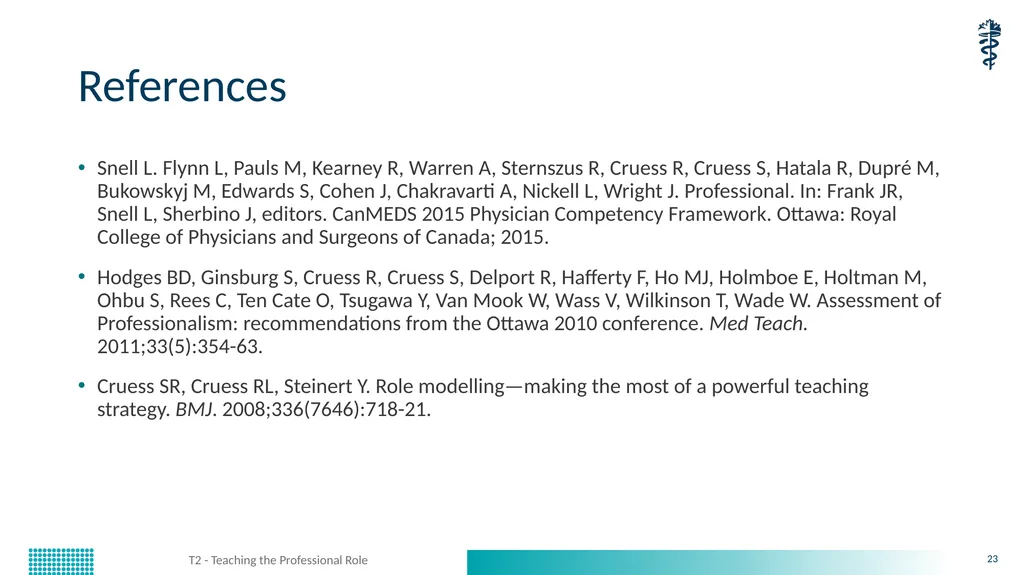
References Snell L. Flynn L, Pauls M, Kearney R, Warren A, Sternszus R, Cruess R, Cruess S, Hatala R, Dupré M, Bukowskyj M, Edwards S, Cohen J, Chakravarti A, Nickell L, Wright J. Professional. In: Frank JR, Snell L, Sherbino J, editors. CanMEDS 2015 Physician Competency Framework. Ottawa: Royal College of Physicians and Surgeons of Canada; 2015.
Hodges BD, Ginsburg S, Cruess R, Cruess S, Delport R, Hafferty F, Ho MJ, Holmboe E, Holtman M, Ohbu S, Rees C, Ten Cate O, Tsugawa Y, Van Mook W, Wass V, Wilkinson T, Wade W. Assessment of Professionalism: recommendations from the Ottawa 2010 conference. Med Teach. 2011;33(5):354-63.
Cruess SR, Cruess RL, Steinert Y. Role modelling—making the most of a powerful teaching strategy. BMJ. 2008;336(7646):718-21. T2 - Teaching the Professional Role 23<br>
24
Other Slides T2 - Teaching the Professional Role 24<br>
25
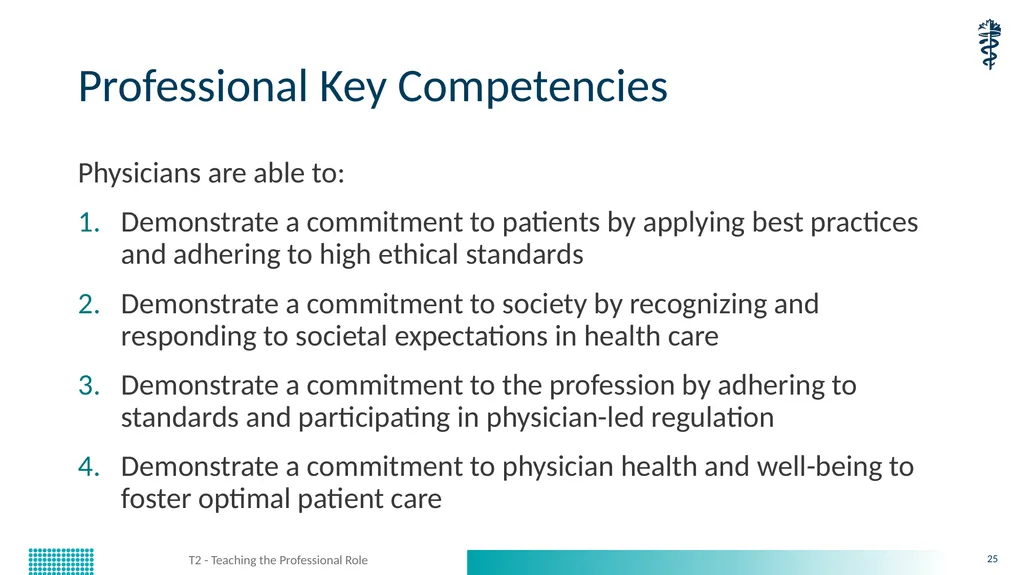
Professional Key Competencies Physicians are able to:
Demonstrate a commitment to patients by applying best practices and adhering to high ethical standards
Demonstrate a commitment to society by recognizing and responding to societal expectations in health care
Demonstrate a commitment to the profession by adhering to standards and participating in physician-led regulation
Demonstrate a commitment to physician health and well-being to foster optimal patient care T2 - Teaching the Professional Role 25<br>
26
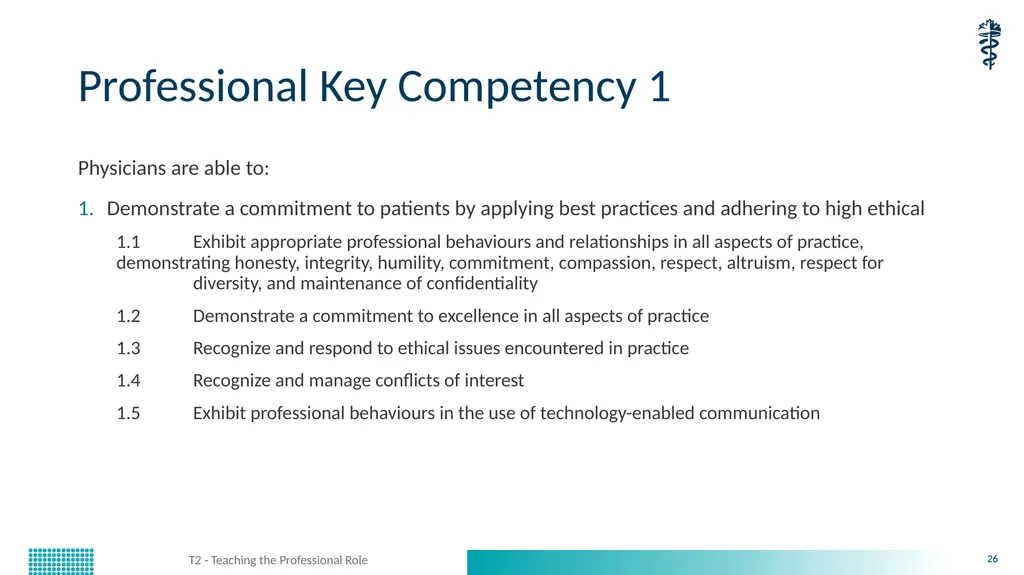
Professional Key Competency 1 Physicians are able to:
Demonstrate a commitment to patients by applying best practices and adhering to high ethical
1.1 Exhibit appropriate professional behaviours and relationships in all aspects of practice, demonstrating honesty, integrity, humility, commitment, compassion, respect, altruism, respect for diversity, and maintenance of confidentiality
1.2 Demonstrate a commitment to excellence in all aspects of practice
1.3 Recognize and respond to ethical issues encountered in practice
1.4 Recognize and manage conflicts of interest
1.5 Exhibit professional behaviours in the use of technology-enabled communication T2 - Teaching the Professional Role 26<br>
27
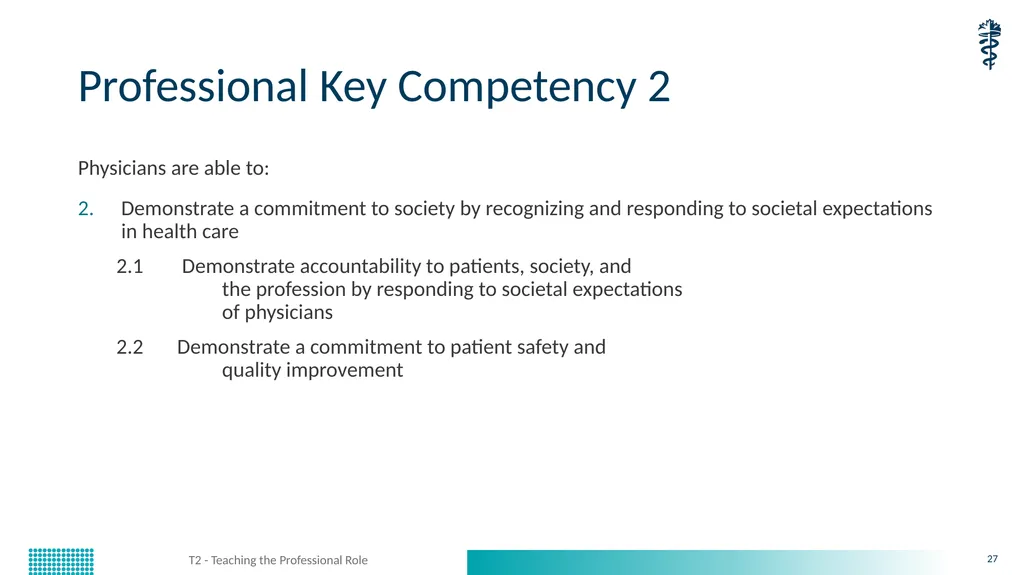
Professional Key Competency 2 Physicians are able to:
Demonstrate a commitment to society by recognizing and responding to societal expectations in health care
2.1 Demonstrate accountability to patients, society, and the profession by responding to societal expectations of physicians
2.2 Demonstrate a commitment to patient safety and quality improvement T2 - Teaching the Professional Role 27<br>
28
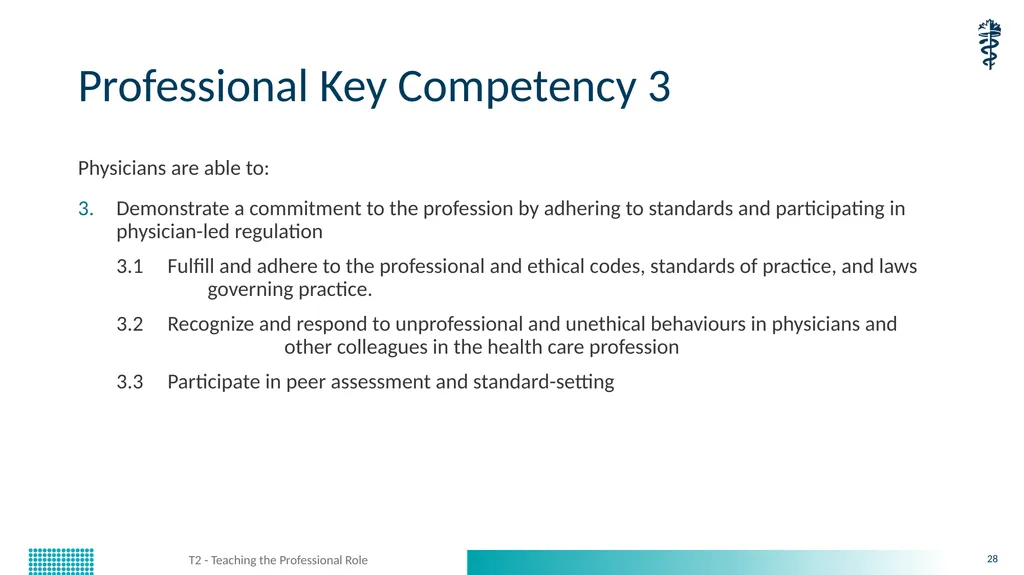
Professional Key Competency 3 Physicians are able to:
Demonstrate a commitment to the profession by adhering to standards and participating in physician-led regulation
3.1 Fulfill and adhere to the professional and ethical codes, standards of practice, and laws governing practice.
3.2 Recognize and respond to unprofessional and unethical behaviours in physicians and other colleagues in the health care profession
3.3 Participate in peer assessment and standard-setting T2 - Teaching the Professional Role 28<br>
29
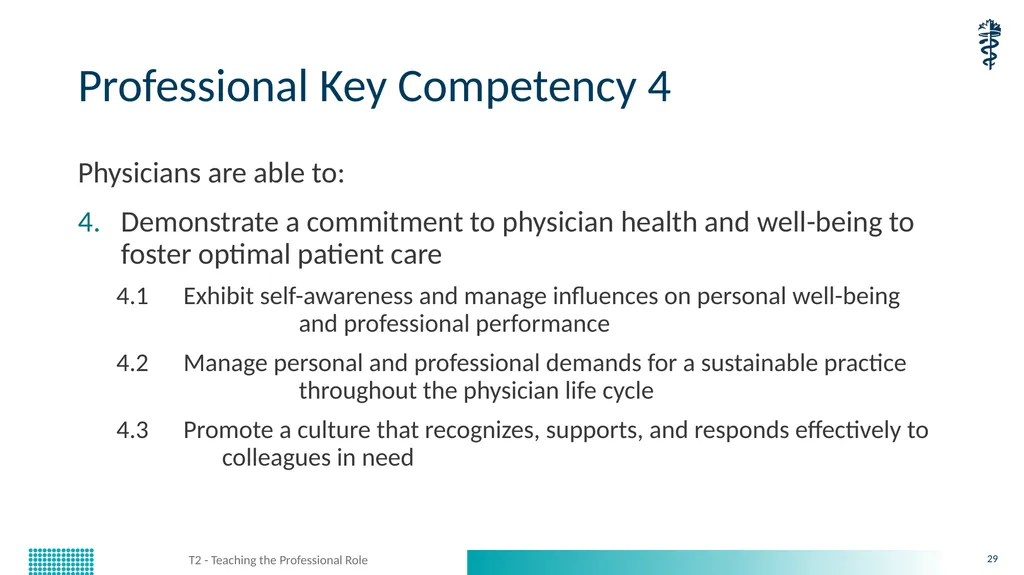
Professional Key Competency 4 Physicians are able to:
Demonstrate a commitment to physician health and well-being to foster optimal patient care
4.1 Exhibit self-awareness and manage influences on personal well-being and professional performance
4.2 Manage personal and professional demands for a sustainable practice throughout the physician life cycle
4.3 Promote a culture that recognizes, supports, and responds effectively to colleagues in need T2 - Teaching the Professional Role 29<br>