T4 Religious Language- Read Chapter A: Inherent Problems of religious language Limitations of language for traditional conceptions of God such as infinite and timeless Communication is based on language , experience, physical world we live
"T4 Religious Language- Read Chapter A: Inherent" is the property of its rightful owner. Permission is granted to
download and print the materials on this website for personal, non-commercial use only, and to display it
on your personal computer provided you do not modify the materials and that you retain all copyright
notices contained in the materials. By downloading content from our website, you accept the terms of this
agreement.
Presentation Transcript
01
T4 Religious Language- Read Chapter A: Inherent Problems of religious language<br>
02
Limitations of language for traditional conceptions of God such as infinite and timeless Communication is based on language , experience, physical world we live
Language about emotions , ideas, expressions, of artistic preferences , ethical discussions and language about religion, these concepts are meta-physical.
Metaphysical language is often dismissed not considered the same as physical level, does it have value in the empirical world? (Logical Positivists). Our languages is based on our experience and our experience is based on the empirical/physical world not the supernatural world. If we describe Divine God it is hard to understand, religious language described the divinities that are worshipped in traditions. How is it communicated? If a non-believer went in a Pentecostal Church , what should they do?<br>
03
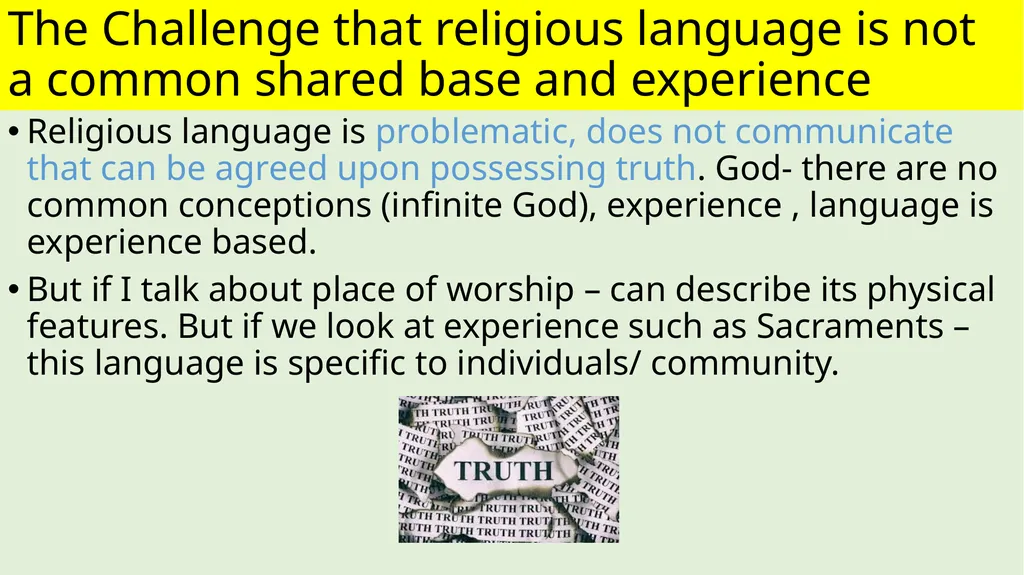
The Challenge that religious language is not a common shared base and experience Religious language is problematic, does not communicate that can be agreed upon possessing truth. God- there are no common conceptions (infinite God), experience , language is experience based.
But if I talk about place of worship – can describe its physical features. But if we look at experience such as Sacraments – this language is specific to individuals/ community.<br>
04
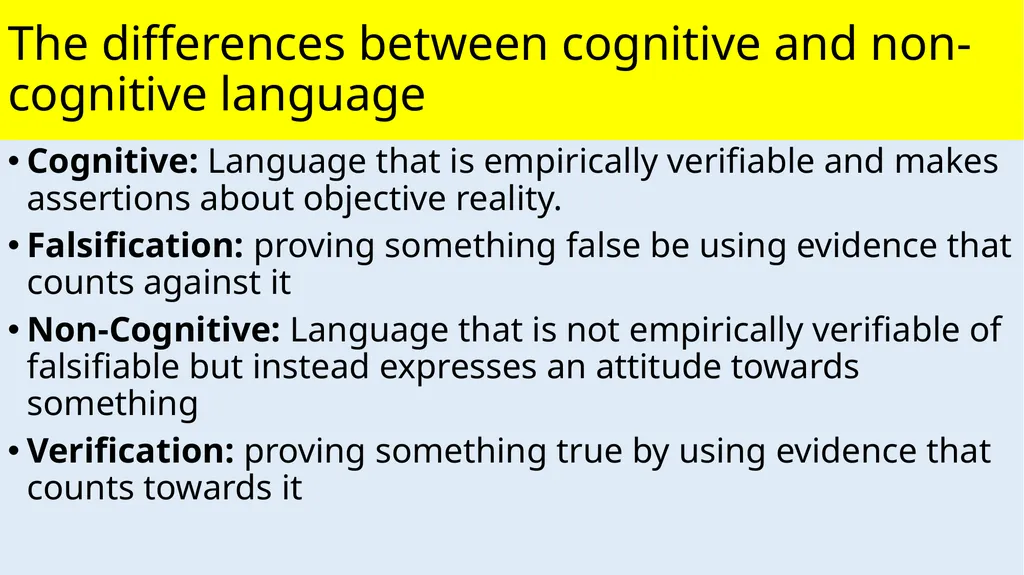
The differences between cognitive and non-cognitive language Cognitive: Language that is empirically verifiable and makes assertions about objective reality.
Falsification: proving something false be using evidence that counts against it
Non-Cognitive: Language that is not empirically verifiable of falsifiable but instead expresses an attitude towards something
Verification: proving something true by using evidence that counts towards it<br>
05
Match the word to the definition<br>
06
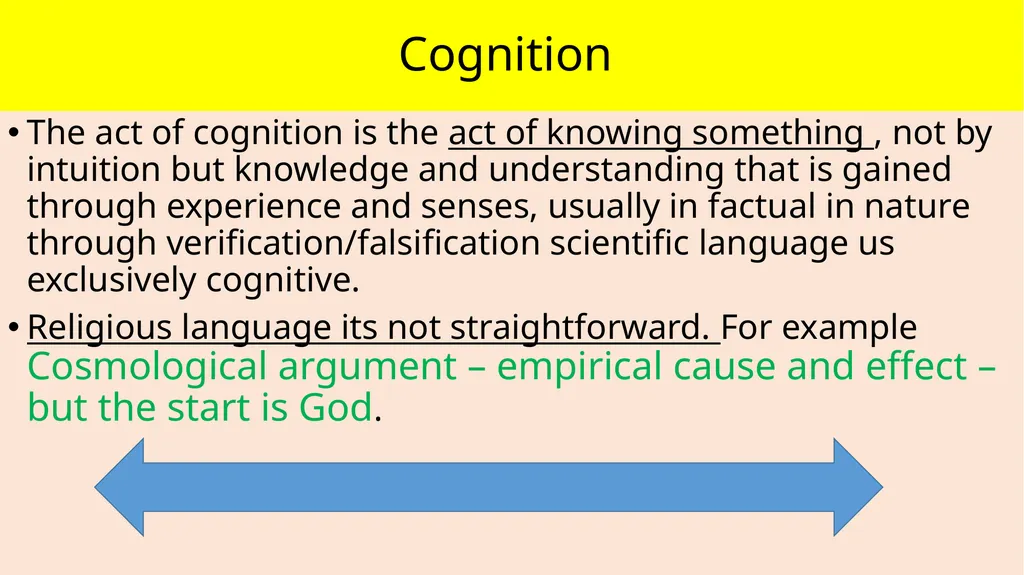
Cognition The act of cognition is the act of knowing something , not by intuition but knowledge and understanding that is gained through experience and senses, usually in factual in nature through verification/falsification scientific language us exclusively cognitive.
Religious language its not straightforward. For example Cosmological argument – empirical cause and effect – but the start is God.<br>
07
Non-Cognitive It expresses opinions , attitudes, feelings/emotions. A non-cognitive view of the world has a reality that is true for you, makes claim on a believer’s attitude.<br>
08
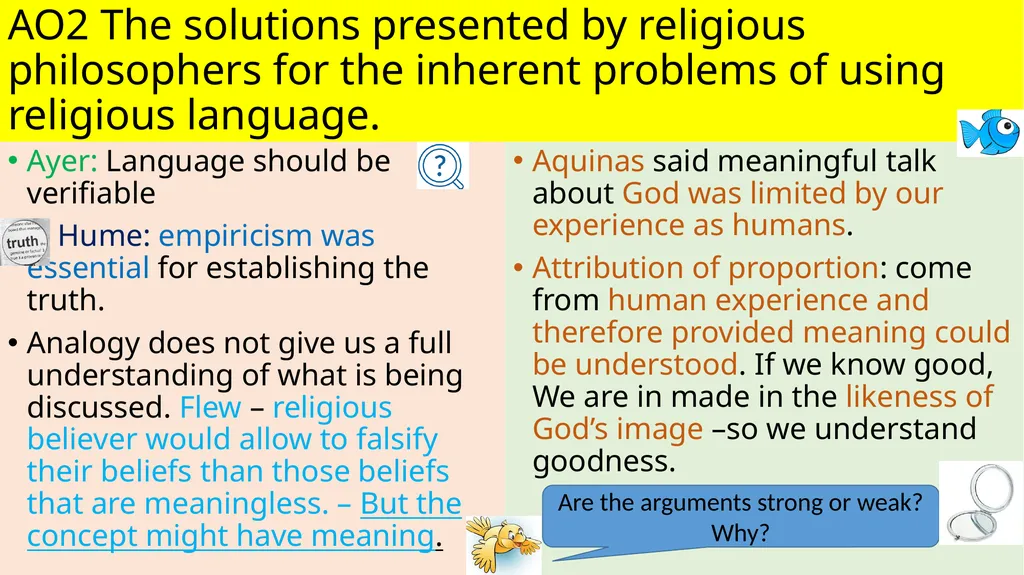
AO2 The solutions presented by religious philosophers for the inherent problems of using religious language. Ayer: Language should be verifiable
Hume: empiricism was essential for establishing the truth.
Analogy does not give us a full understanding of what is being discussed. Flew – religious believer would allow to falsify their beliefs than those beliefs that are meaningless. – But the concept might have meaning. Aquinas said meaningful talk about God was limited by our experience as humans.
Attribution of proportion: come from human experience and therefore provided meaning could be understood. If we know good, We are in made in the likeness of God’s image –so we understand goodness. Are the arguments strong or weak? Why?<br>
09
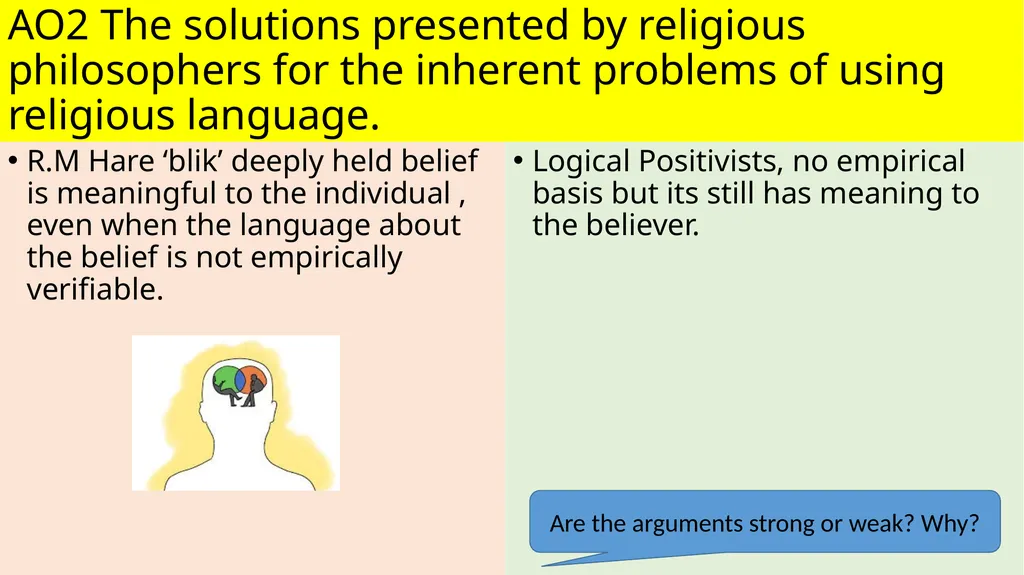
AO2 The solutions presented by religious philosophers for the inherent problems of using religious language. R.M Hare ‘blik’ deeply held belief is meaningful to the individual , even when the language about the belief is not empirically verifiable. Logical Positivists, no empirical basis but its still has meaning to the believer. Are the arguments strong or weak? Why?<br>
10
AO2: The exclusive context of religious belief for an understanding of religious language ‘Allah is one’ are phrases religious tradition, there is no objectivity but a universal accepted belief. Does it have meaning universally or is it exclusive?
D.Z Phillips, community that uses them, same value as any other language.
Braithwaite religious language is meaningful to those outside the religion to express an opinion/belief. Wittgenstein language games suggested unless you know the rues of the game then you would not be able to access the meaning of language.
Swinburne: Beliefs are not just some community agreed beliefs that do not extend beyond the community. Are the arguments strong or weak? Why?<br>
11
AO2: The exclusive context of religious belief for an understanding of religious language It is sensible the use of religious language can be intelligible outside the religion. For example Catholics would understand transubstantiation , or two Muslims discuss ummah. They provide a context, purpose so its not important for a non-religious to understand, How do they understand? Does it become exclusive? But there is debate- the exclusivity untrue? Are the arguments strong or weak? Why?<br>