04
Priming occurs when some element of the environment, including the media environment, activates related cognitions, including thoughts, beliefs, or expectations, making those cognitions more likely to be used in subsequent decision-making.
GRE: gender role expectations<br>
05
Type of female protagonist—aggressive and attractive, aggressive but less attractive, attractive but not aggressive, or neither attractive nor aggressive—and comparing the gender role expectations for women endorsed by those who watched different types of female protagonists.<br>
06
In order to control for degree of attractiveness within aggression, two clips, one featuring a high degree of aggression the other featuring no aggression on the part of the protagonist, were selected for each of two actresses, one of whom was stereotypically attractive (Angelina Jolie), the other of whom was less so (Kathy Bates)<br>
07
In the violence clips (from Tomb Raider and Primary Colors, respectively), the protagonist engaged in physical violence, exerted mastery in a difficult situation, used a firearm, and was successful in obtaining a goal. In the scene from Tomb Raider, the Jolie character is interrupted in her attempt to steal what appears to be an archaeological treasure by a homicidal android. She shoots it, kicks it, topples an obelisk onto it, and tears out its wiring until it stops functioning
https://www.youtube.com/watch?v=8oCOrFe1VTs primary colours 1.2 min
https://www.youtube.com/watch?v=nByAshpybOo&index=4&list=PLKyQZoCGOj9K99HlaLoIvGsxDAKDxc0b1<br>
08
https://www.youtube.com/watch?v=5BCjdQGnCtk 2001 tomb raider 2min
https://www.youtube.com/watch?v=h1-T9LYq1hI 3min escaping the temple
https://www.youtube.com/watch?v=lx0z9FjxP-Y&index=9&list=PLKyQZoCGOj9K99HlaLoIvGsxDAKDxc0b1 fried green tom 2.3 min<br>
09
In the clip from Primary Colors, the Bates character confronts a lawyer who may have committed fraud as part of a political attack on her employer; in the face of his denial, she physically assaults him and menaces him with a large handgun until he capitulates, confessing to his deceit.<br>
10
Although both violent characters are ostensibly ‘good guys,’ their aggression is not unambiguously virtuous or necessarily justified. One initiates the violence against an individual who may be innocent; the other acts in self-defense but precipitates the attack by apparently committing a crime. The violent protagonists are, however, unambiguously successful; aggression brings about success.<br>
11
In the non-violent clips (from Changeling and Fried Green Tomatoes, respectively), the protagonist was passive and submissive. In Changeling, the Jolie character attempts to confront a police officer who has tried to pass off a strange boy as her kidnapped child. When the officer insists that she is mistaken, she becomes upset and raises her voice, but her anger quickly turns to tears and an apologetic, submissive tone; she leaves without his admitting the mistake.<br>
12
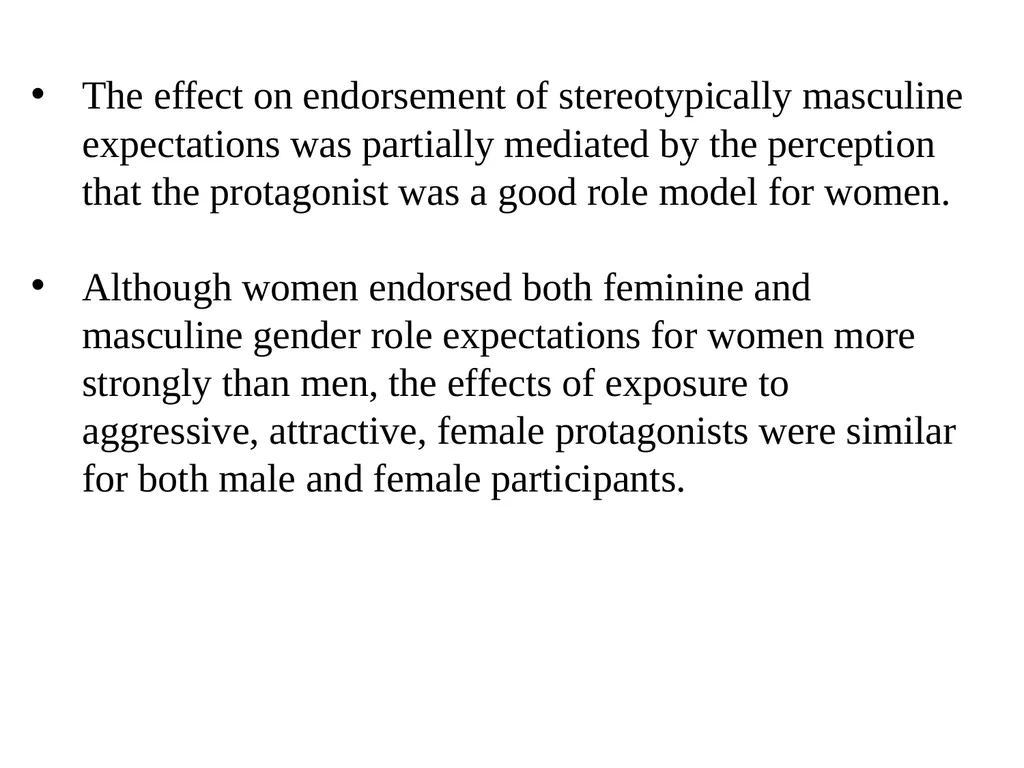
Watching a female protagonist behave aggressively was
found to activate stereotypically masculine gender role
expectations for women, but only when the protagonist was stereotypically physically attractive
Attractiveness played a key role in predicting
whether a protagonist was considered an appropriate
role model for women. This is consistent with the
notion that physical beauty signals a host of desirable
traits or characteristics<br>
13
In Fried Green Tomatoes, the Bates character is rudely cut off and insulted as she exits a grocery store; when, all annoyed, she attempts to point out the ill manners of one of her belittlers, he is rudely dismissive, and she ends up appearing forlorn, helplessly grasping at her spilled groceries.<br>
14
Aggressive protagonists were also considered better role models than less aggressive role models. This was true regardless of the physical attractiveness of the characters, and is therefore not merely a case of interpreting questionable moral behavior in a positive light due to a halo effect.
This effect of protagonist aggression on the perception of that protagonist’s worth as a role model seems to run counter to past findings indicating disapproval of aggression in general, particularly when undertaken by women<br>
15
Assertiveness and confidence accompanied the
aggression in the clips employed in the present study; it
may also be one of these traits, rather than aggression
itself, that led to a greater tendency to perceive
aggressive protagonists as appropriate role models. It
should also be noted that justified aggression is perceived
as less severe or problematic than unjustified
aggression<br>
16
Exposure to an attractive protagonist was expected to produce increased endorsement of stereotypically feminine gender role expectations for women, particularly in comparison to exposure to a less attractive, aggressive protagonist, who would be perceived as not embodying any stereotypically feminine traits.
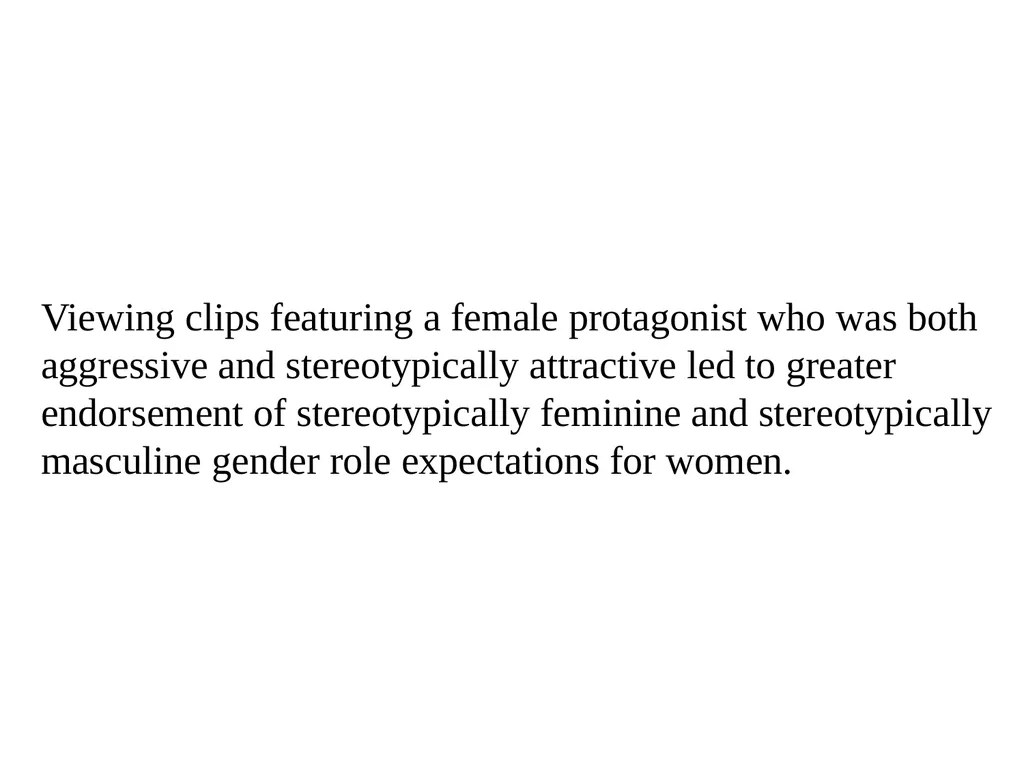
This research at least strongly suggests that exposure to depictions of attractive, aggressive, female protagonists can affect gender role expectations for women among viewers. Furthermore, this effect seems to include both stereotypically feminine and masculine expectations, indicating higher overall expectations for women. Viewing these depictions can change the way both men and women think about who women ought to be.<br>
17
Although there was no difference in attractiveness
between the two characters portrayed by Jolie, the aggressive character may have been seen as more provocatively attired (midriff-baring tank top, shorts, and boots) than the non-aggressive character (loose-fitting, tea-length, short-sleeved dress). Interpretations of the aggressive character’s mode of dress as sexualized may have contributed to activation of stereotypically feminine gender role expectations for women.<br>
18
Although Jolie’s character acted in self-defense and Bates’s character instigated the aggression, both acts of aggression are depicted as essentially moral rather than cruel or arbitrary<br>