
Teaching about caring friendships Part of:








Description: Teaching about caring friendships Part of: Relationships education (primary) ADAPT THIS FOR YOUR OWN PRESENTATION Training module YOUR NAME, YOUR SCHOOL Primary September 2020 Contents 2 3 About this training module 5 Teaching the new
Related Topics
Download Presentation
"Teaching about caring friendships Part of:" is the property of its rightful owner. Permission is granted to download and print the materials on this website for personal, non-commercial use only, and to display it on your personal computer provided you do not modify the materials and that you retain all copyright notices contained in the materials. By downloading content from our website, you accept the terms of this agreement.
Presentation Transcript
slide1. Teaching about caring friendships Part of: Relationships education (primary) ADAPT THIS FOR YOUR OWN PRESENTATION Training module [YOUR NAME, YOUR SCHOOL] Primary September 2020<br>
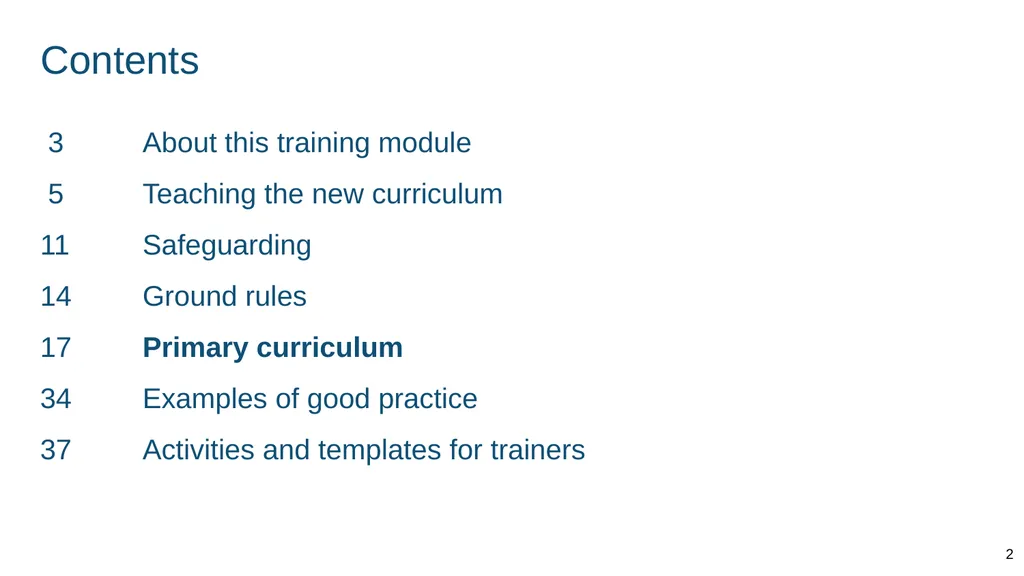
slide2. Contents 2 3 About this training module
5 Teaching the new curriculum
11 Safeguarding
14 Ground rules
17 Primary curriculum
34 Examples of good practice
37 Activities and templates for trainers<br>
slide3. About this training module Subject leads can use the adaptable slides and ‘activities and templates for trainers’ section at the end of this module to help shape training sessions for teachers.
This non-statutory training module supplements the statutory guidance on teaching about caring friendships, which schools should read in full.
Schools can choose whether and how to follow or adapt this training module and should refer to the Early Career Framework for pedagogical guidance. 3<br>
slide4. What you get out of today By the end of this training you should:
know what is included in the statutory guidance
know some key knowledge and facts to cover as part of this topic
have strategies to deal with questions that come up in class
feel more confident teaching about caring friendships 4<br>
slide5. Teaching the new curriculum 5<br>
slide6. Related topics Caring friendships is closely related to the following topics:
respectful relationships
intimate relationships and sexual health (secondary only)
Therefore, you should:
consider thematic links across key topics and the whole school when planning and delivering lessons
find ways to link knowledge and vocabulary across topics 6<br>
slide7. Related guidance Schools may also want to refer to the guidance for schools on preventing and responding to bullying (including cyberbullying)
when planning to teach this subject. 7<br>
slide8. Friendships support at [school name] Our leads
[Names, contact details of friendships support]
Our policies
[Add details - e.g. school policy on bullying]
Specialist support [Add details - e.g. providers school already works with]
Other information
[Add resources] 8<br>
slide9. Teaching about caring friendships at [school name] Ways in which we already teach about caring friendships at our school:
[add details]
[add details]
[add details] 9<br>
slide10. Pupils with SEND You will need to plan lessons to allow all pupils to access and practise the core knowledge, using your expertise as you normally would.
You might want to link lesson outcomes with statutory ‘preparing for adulthood’ outcomes for those with an education, health and care (EHC) plan. (See SEND code of practice, section 8.) STATUTORY GUIDANCE
In special schools and for some SEND pupils in mainstream schools there may be a need to tailor content and teaching to meet the specific needs of pupils at different developmental stages. As with all teaching for these subjects, schools should ensure that their teaching is sensitive, age-appropriate, developmentally appropriate and delivered with reference to the law. (p15) 10<br>
slide11. Safeguarding 11<br>
slide12. Safeguarding (1) Pupils may be affected by issues discussed in lessons.
Let your designated safeguarding lead or deputy and any other relevant staff, such as pastoral leads, know what you are teaching. This will enable them to identify and speak to relevant pupils, especially those who they know may have been directly impacted by issues covered in the lessons and those with adverse childhood experiences.
Teachers may need to deal with disclosures or concerns (e.g. of abuse or offending behaviour) in a way that safeguards pupils in line with school policies, especially the child protection policy. 12<br>
slide13. Trusted adults Within this module we have used the term trusted adult.
A trusted adult will generally be someone who children feel comfortable to turn to for help. Obvious examples include family members, teachers and doctors.
It will be important when teaching this topic, and any other relevant topics, that teachers explore this concept. Pupils should be comfortable and capable of identifying who their trusted adults could be both within their families and wider circles. 13<br>
slide14. Ground rules 14<br>
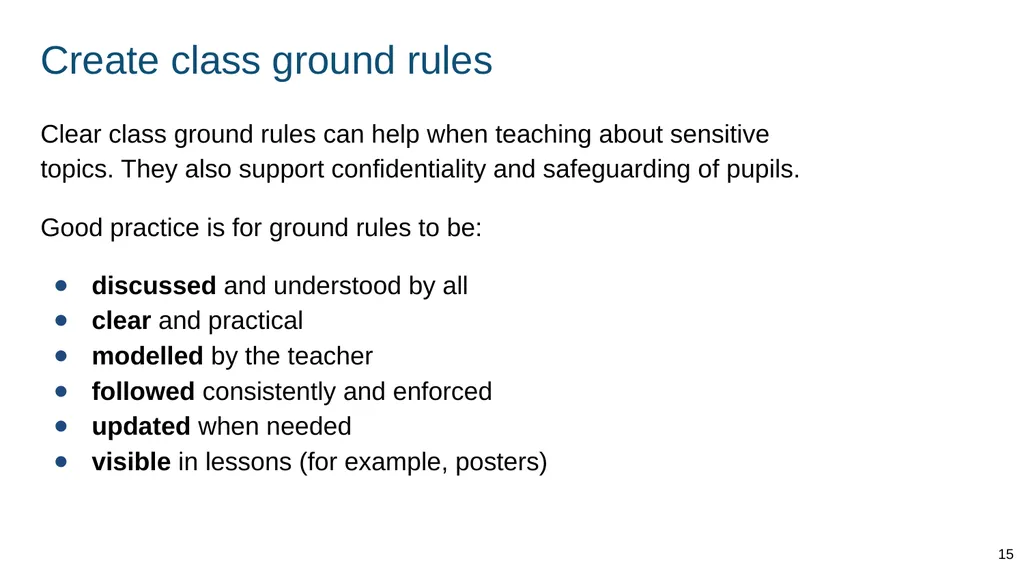
slide15. Create class ground rules Clear class ground rules can help when teaching about sensitive topics. They also support confidentiality and safeguarding of pupils.
Good practice is for ground rules to be:
discussed and understood by all
clear and practical
modelled by the teacher
followed consistently and enforced
updated when needed
visible in lessons (for example, posters) 15<br>
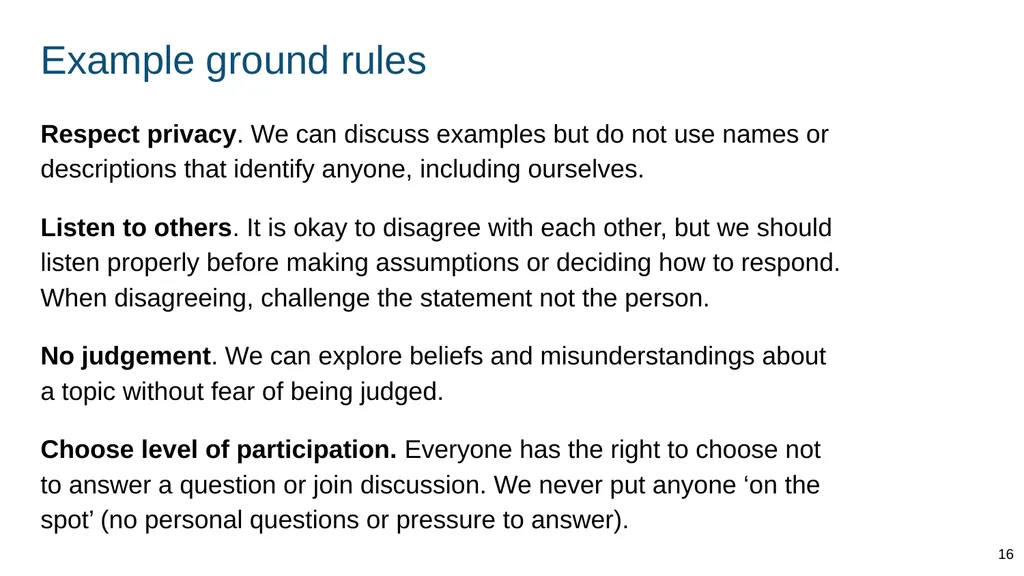
slide16. Example ground rules Respect privacy. We can discuss examples but do not use names or descriptions that identify anyone, including ourselves.
Listen to others. It is okay to disagree with each other, but we should listen properly before making assumptions or deciding how to respond. When disagreeing, challenge the statement not the person.
No judgement. We can explore beliefs and misunderstandings about a topic without fear of being judged.
Choose level of participation. Everyone has the right to choose not to answer a question or join discussion. We never put anyone ‘on the spot’ (no personal questions or pressure to answer). 16<br>
slide17. Primary curriculum 17<br>
slide18. Happy and secure friendships (1) Primary Explain that friendship is a relationship between two or more people who care about each other and choose to have a relationship together.
Teach pupils that friendship of all ages is usually based on something which binds people together, for example:
liking to play with each other
enjoying each other’s company
having similar interests and hobbies
enjoying the same activities
having shared experiences, e.g. becoming friends after a trip STATUTORY GUIDANCE Know how important friendships are in making us feel happy and secure, and how people choose and make friends. 18<br>
slide19. Happy and secure friendships (2) Primary Teach pupils that friendships make us feel happy and secure by giving us:
people to enjoy time with and share experiences
company so that we are not alone
a feeling of belonging
support when we need it
someone to look out for us
someone to share our problems with
Explain that friendship is something that is freely given. People who ask us to do things in return for their friendship may not be real friends. STATUTORY GUIDANCE Know how important friendships are in making us feel happy and secure, and how people choose and make friends. 19<br>
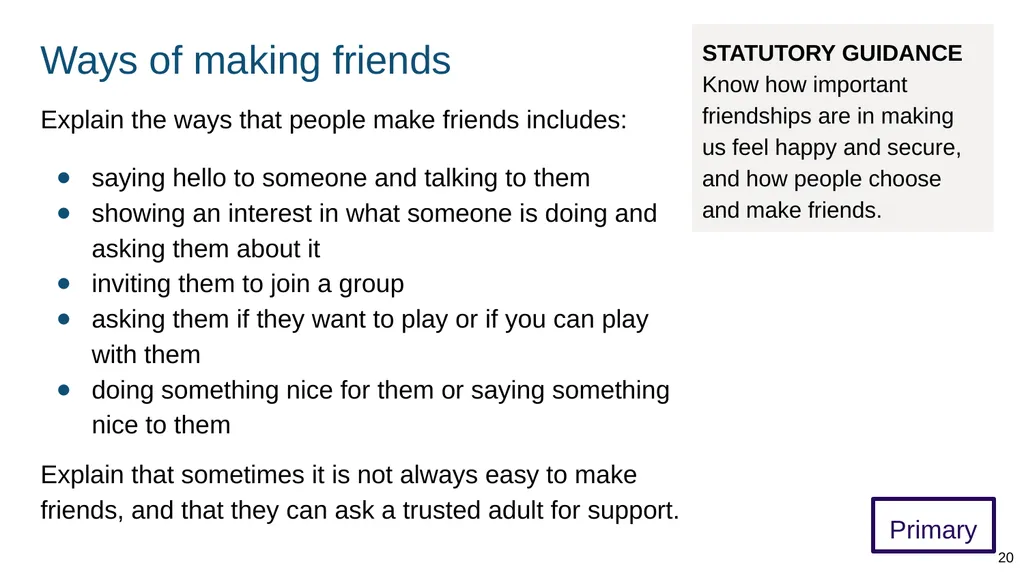
slide20. Ways of making friends Primary Explain the ways that people make friends includes:
saying hello to someone and talking to them
showing an interest in what someone is doing and asking them about it
inviting them to join a group
asking them if they want to play or if you can play with them
doing something nice for them or saying something nice to them
Explain that sometimes it is not always easy to make friends, and that they can ask a trusted adult for support. STATUTORY GUIDANCE Know how important friendships are in making us feel happy and secure, and how people choose and make friends. 20<br>
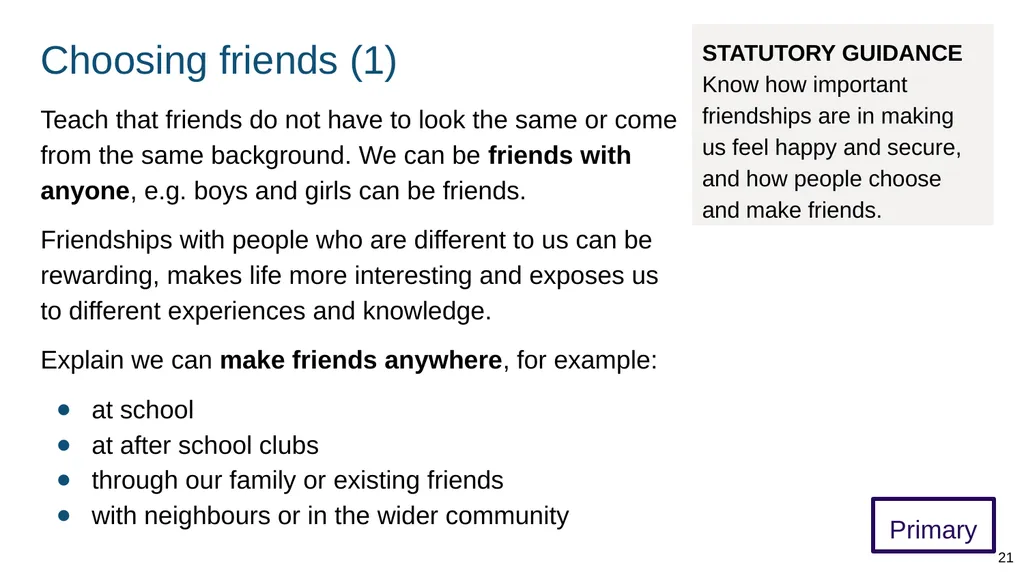
slide21. Choosing friends (1) Primary Teach that friends do not have to look the same or come from the same background. We can be friends with anyone, e.g. boys and girls can be friends.
Friendships with people who are different to us can be rewarding, makes life more interesting and exposes us to different experiences and knowledge.
Explain we can make friends anywhere, for example:
at school
at after school clubs
through our family or existing friends
with neighbours or in the wider community STATUTORY GUIDANCE Know how important friendships are in making us feel happy and secure, and how people choose and make friends. 21<br>
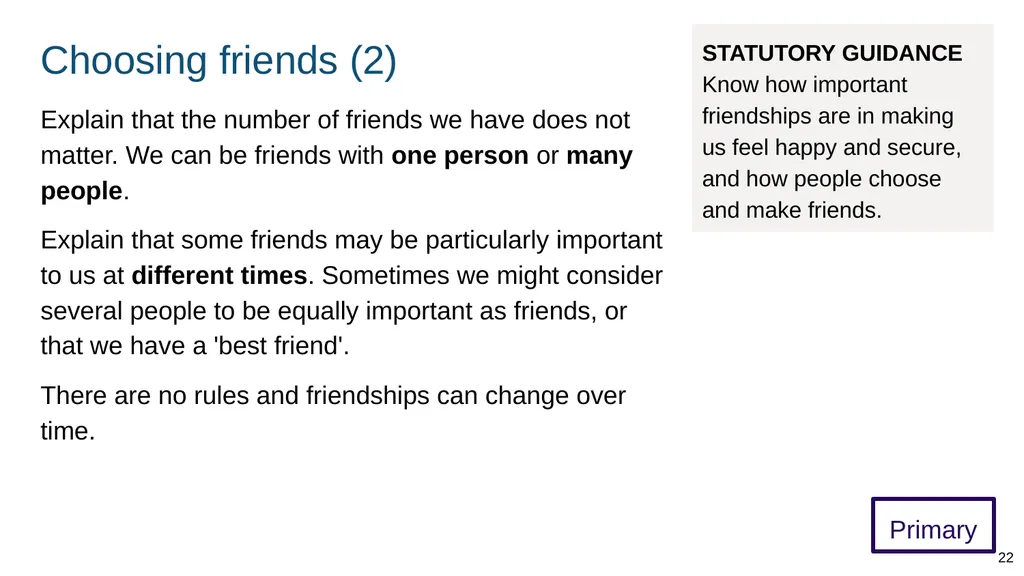
slide22. Choosing friends (2) Primary Explain that the number of friends we have does not matter. We can be friends with one person or many people.
Explain that some friends may be particularly important to us at different times. Sometimes we might consider several people to be equally important as friends, or that we have a 'best friend'.
There are no rules and friendships can change over time. STATUTORY GUIDANCE Know how important friendships are in making us feel happy and secure, and how people choose and make friends. 22<br>
slide23. Online friendships Primary Explain that the internet can give us the opportunity to be friends with people all over the world.
Explain that friendships are not the same as contacts (the amount of people we know) or ‘likes’ or ‘shares’ online. Real friendships are reciprocal, built on getting to know a person, spending time with them, sharing experiences with them and caring for them.
Teach that online friendships should have the same characteristics as friendships in real life.
Explain that being safe is paramount in any online relationship. See the online relationships module for more information. STATUTORY GUIDANCE Know how important friendships are in making us feel happy and secure, and how people choose and make friends. 23<br>
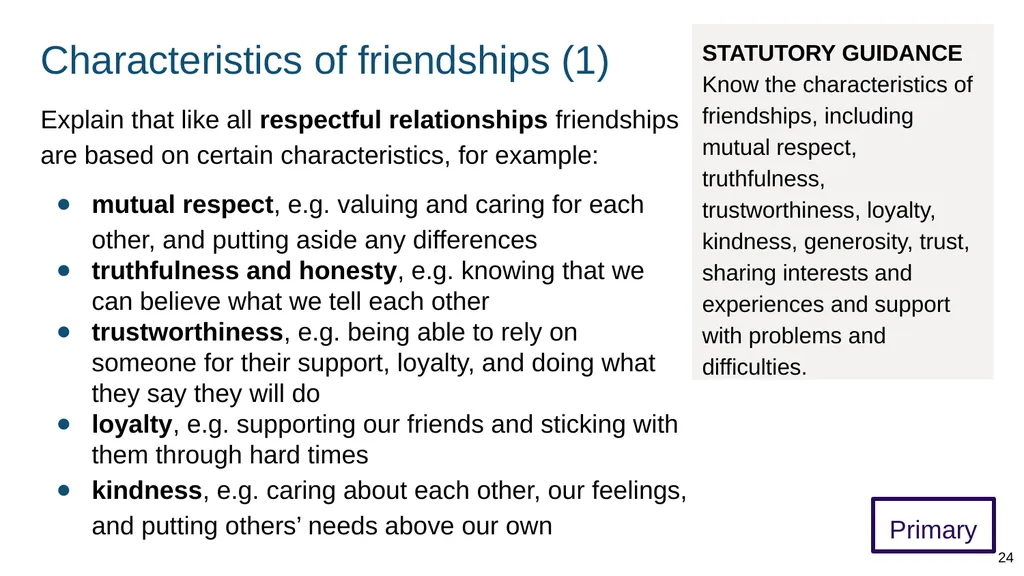
slide24. Characteristics of friendships (1) Explain that like all respectful relationships friendships are based on certain characteristics, for example:
mutual respect, e.g. valuing and caring for each other, and putting aside any differences
truthfulness and honesty, e.g. knowing that we can believe what we tell each other
trustworthiness, e.g. being able to rely on someone for their support, loyalty, and doing what they say they will do
loyalty, e.g. supporting our friends and sticking with them through hard times
kindness, e.g. caring about each other, our feelings, and putting others’ needs above our own STATUTORY GUIDANCE Know the characteristics of friendships, including mutual respect, truthfulness, trustworthiness, loyalty, kindness, generosity, trust, sharing interests and experiences and support with problems and difficulties. Primary 24<br>
slide25. Characteristics of friendships (2) Primary generosity, letting someone play with a toy or go first in a game
sharing interests and experiences, and that doing so makes them better and more satisfying, e.g. hobbies, games or clubs at school
supporting our friends when they have problems or difficulties, e.g. when they are upset STATUTORY GUIDANCE Know the characteristics of friendships, including mutual respect, truthfulness, trustworthiness, loyalty, kindness, generosity, trust, sharing interests and experiences and support with problems and difficulties. 25<br>
slide26. Welcoming friendships (1) Primary Explain that friendship is for sharing. Sharing the enjoyment friends experience when they spend time together is a way to build friendships and make new friends.
Trying to keep other people away from a friendship, for example out of jealousy, is more likely to make the friendship break down. People can end up feeling trapped or restricted and want to break away in this kind of friendship.
Teach pupils that being unwelcoming to others (e.g. ignoring them, or not involving them in a group or game) can make them feel lonely and excluded. STATUTORY GUIDANCE Know that healthy friendships are positive and welcoming towards others, and do not make others feel lonely or excluded. 26<br>
slide27. Welcoming friendships (2) Primary Explain that regularly excluding others to hurt them is a form of bullying. Teach that:
it is better to be kind to each other
life is more fun when we let other people’s personalities and ideas into our groups
Explain that while we should be friendly and welcoming to everyone, we do not have to be close friends with everyone. We are all allowed to decide how close a relationship we form with different people.
See the respectful relationships module for more information. STATUTORY GUIDANCE Know that healthy friendships are positive and welcoming towards others, and do not make others feel lonely or excluded. 27<br>
slide28. When an offer of friendship is rejected Primary Explain that not everyone we meet will want to be our friend. Sometimes we want to be friends with someone, but they do not feel the same way.
If this happens, we should not feel like we have done something wrong or do not deserve friendship.
Teach that we can still have a good relationship with that person and treat them with respect.
Explain to pupils that they can speak to a trusted adult for support. STATUTORY GUIDANCE Know that healthy friendships are positive and welcoming towards others, and do not make others feel lonely or excluded. 28<br>
slide29. Working through problems (1) Primary Explain that most friendships have their ups and downs. When there is conflict in a friendship it can help to:
apologise if we are in the wrong
recognise the emotions we each felt
discuss the problem on both sides honestly to resolve issues
listen and acknowledge each other’s viewpoints
clarify views and opinions
accept the consequences of our actions
Explain that a successfully resolved conflict can strengthen a friendship as the parties understand more about the other person and themselves as a result. STATUTORY GUIDANCE Know that most friendships have ups and downs, and that these can often be worked through so that the friendship is repaired or even strengthened, and that resorting to violence is never right. 29<br>
slide30. Working through problems (2) Primary Teach that communicating with someone is the only way to solve an issue in a friendship. Violence does not solve problems, it usually makes them worse and can permanently end a friendship.
Violence or fighting at school is very serious and will not be accepted under any circumstances.
Teach that there are always consequences for hurting, threatening to hurt or trying to hurt someone else.
Explain that pupils should speak to a trusted adult if they have witnessed any threats of violence against them or people they know. STATUTORY GUIDANCE Know that most friendships have ups and downs, and that these can often be worked through so that the friendship is repaired or even strengthened, and that resorting to violence is never right. 30<br>
slide31. Trust and friendship (1) Primary Teach that an important part of a friendship is trust and being able to rely on friends.
Explain that trust is built over time, and people learn to trust us by their experience of our behaviour towards them, and how they see us behaving towards others.
For example, trust develops when people:
share and take turns
keep promises
listen without judgment
respect people’s wishes, e.g. about boundaries
are honest about their feelings STATUTORY GUIDANCE Know how to recognise who to trust and who not to trust, how to judge when a friendship is making them feel unhappy or uncomfortable, managing conflict, how to manage these situations and how to seek help or advice from others, if needed. 31<br>
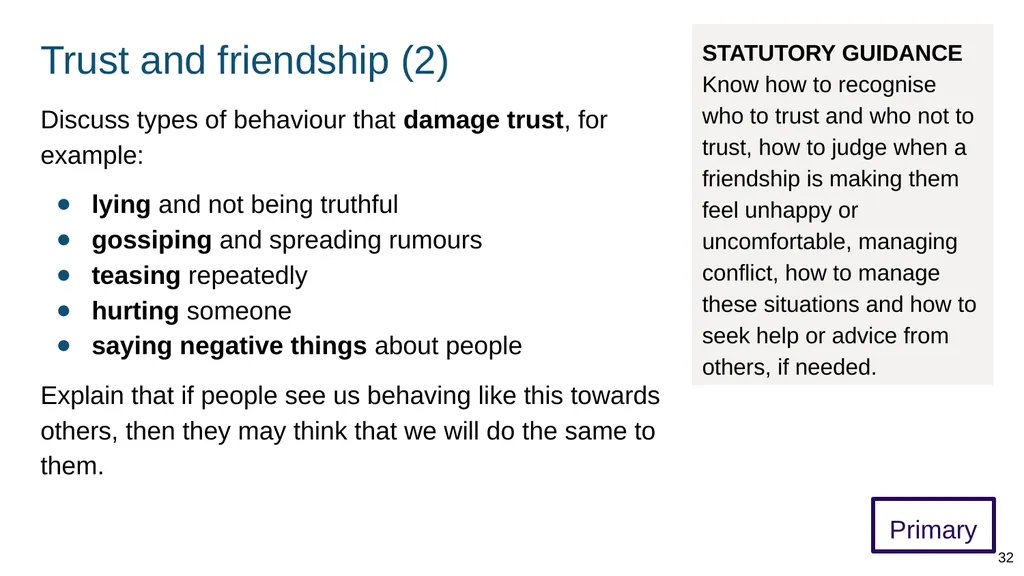
slide32. Trust and friendship (2) Primary Discuss types of behaviour that damage trust, for example:
lying and not being truthful
gossiping and spreading rumours
teasing repeatedly
hurting someone
saying negative things about people
Explain that if people see us behaving like this towards others, then they may think that we will do the same to them. STATUTORY GUIDANCE Know how to recognise who to trust and who not to trust, how to judge when a friendship is making them feel unhappy or uncomfortable, managing conflict, how to manage these situations and how to seek help or advice from others, if needed. 32<br>
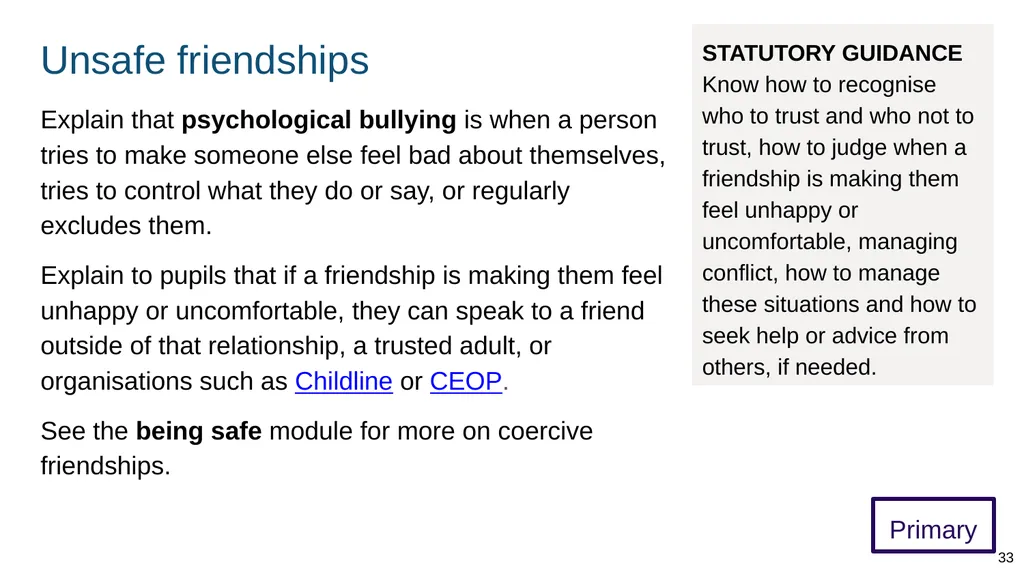
slide33. Unsafe friendships Primary Explain that psychological bullying is when a person tries to make someone else feel bad about themselves, tries to control what they do or say, or regularly excludes them.
Explain to pupils that if a friendship is making them feel unhappy or uncomfortable, they can speak to a friend outside of that relationship, a trusted adult, or organisations such as Childline or CEOP.
See the being safe module for more on coercive friendships. STATUTORY GUIDANCE Know how to recognise who to trust and who not to trust, how to judge when a friendship is making them feel unhappy or uncomfortable, managing conflict, how to manage these situations and how to seek help or advice from others, if needed. 33<br>
slide34. Examples of good practice 34<br>
slide35. Good practice The following are just some of the approaches you might consider when preparing to teach about caring friendships. Good practice 35<br>
slide36. Good practice approaches When teaching about how friendships develop, be aware that:
children recognise friendship qualities appropriate for their age or development
younger children will base friendships on play and time spent together, however by the end of primary school they will be selecting friends based on interests, personality, and shared values
it is important that these discussions are inclusive, for example, there should be no stigma attached to friendships with the opposite sex or people from different cultures or backgrounds
if using stories/examples, avoid reinforcing stereotypes, e.g. girls play with dolls and boys play with cars Good practice 36<br>
slide37. Activities and templates for trainers 37<br>
slide38. About these activities and templates Subject leads can use the following templates and training activities to plan training on teaching the new curriculum topics.
You can:
move slides - e.g. ‘rate your confidence (before training)’ - to the point in the presentation where you want to carry out that activity
delete slides if you are not covering those curriculum elements at this time 38<br>
slide39. Training activity:
Rate your confidence 39<br>
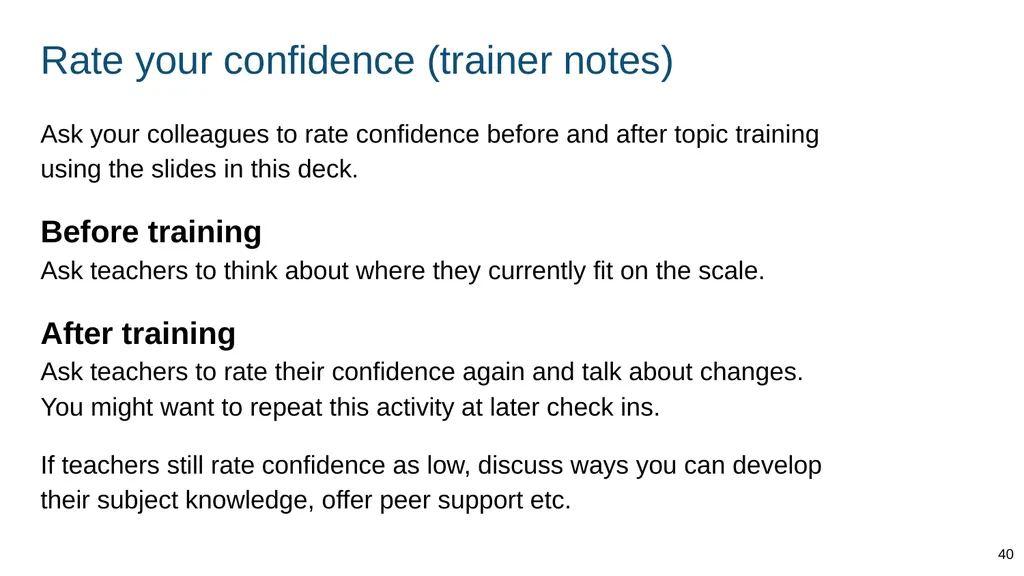
slide40. Rate your confidence (trainer notes) Ask your colleagues to rate confidence before and after topic training using the slides in this deck.
Before training Ask teachers to think about where they currently fit on the scale.
After training Ask teachers to rate their confidence again and talk about changes. You might want to repeat this activity at later check ins.
If teachers still rate confidence as low, discuss ways you can develop their subject knowledge, offer peer support etc. 40<br>
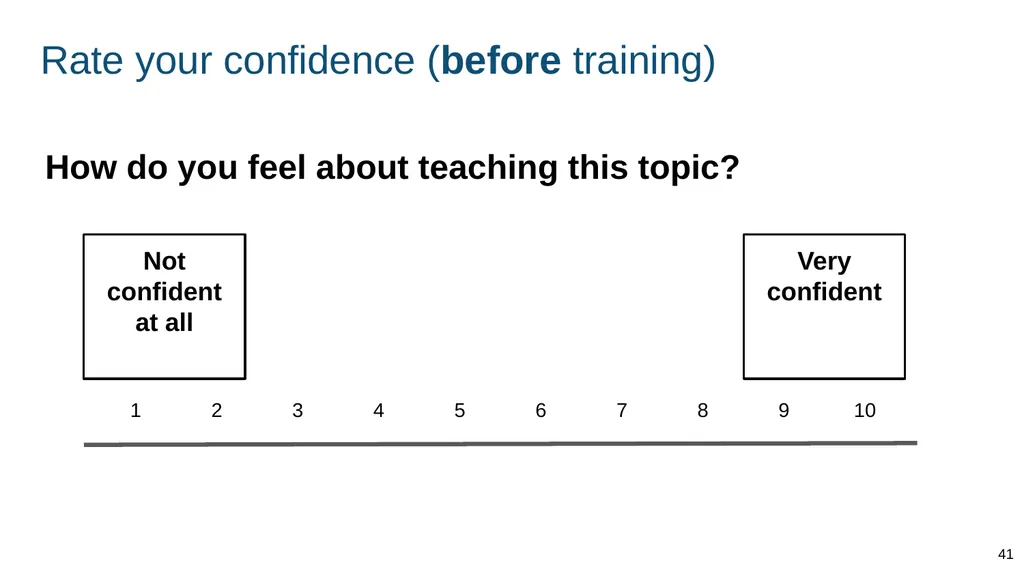
slide41. Rate your confidence (before training) How do you feel about teaching this topic? Not confident at all Very confident 41<br>
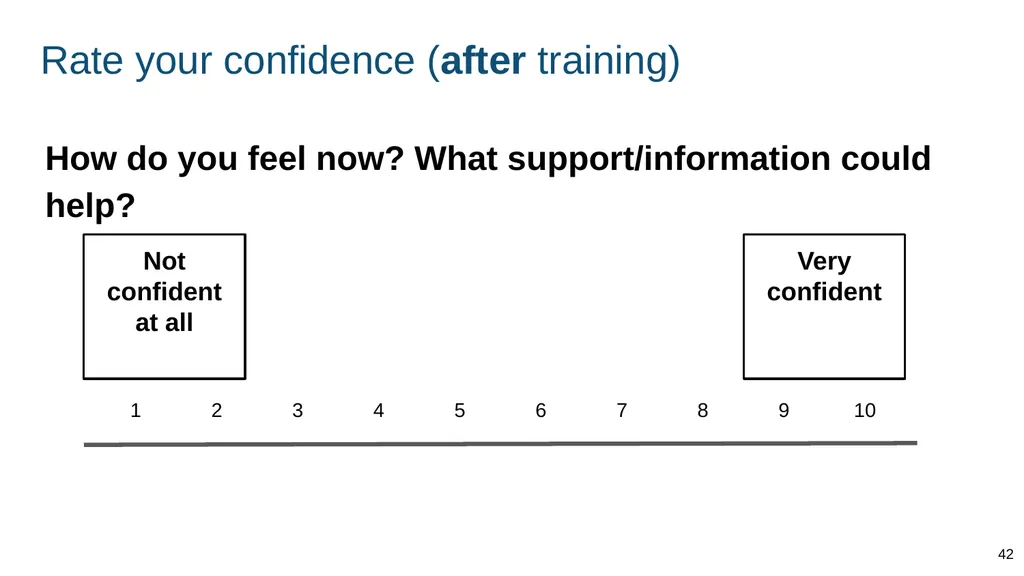
slide42. Rate your confidence (after training) How do you feel now? What support/information could help? Not confident at all Very confident 42<br>
slide43. Training activity:
Dealing with difficult questions 43<br>
slide44. Dealing with difficult questions (trainer notes) Use the following slides in your training to help teachers:
share concerns about questions they could be asked by pupils
strategise ways to respond to such questions 44<br>
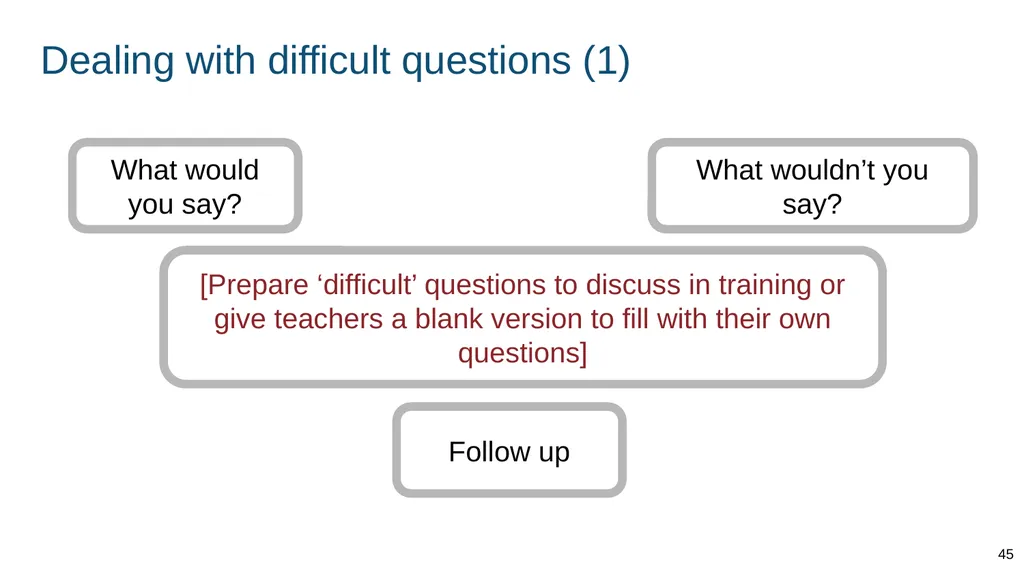
slide45. Dealing with difficult questions (1) [Prepare ‘difficult’ questions to discuss in training or give teachers a blank version to fill with their own questions] What would you say? What wouldn’t you say? Follow up 45<br>
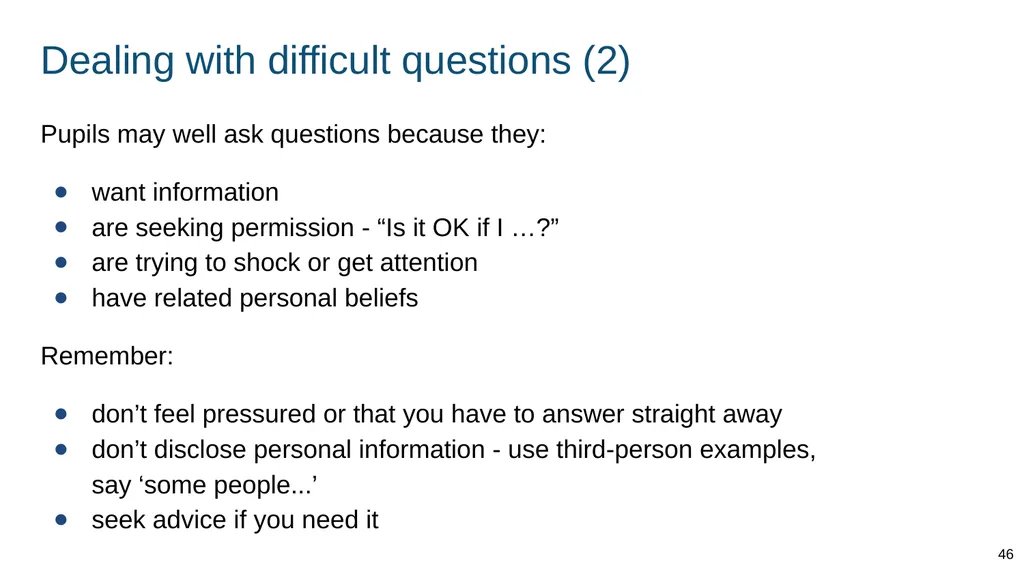
slide46. Dealing with difficult questions (2) Pupils may well ask questions because they:
want information
are seeking permission - “Is it OK if I …?”
are trying to shock or get attention
have related personal beliefs
Remember:
don’t feel pressured or that you have to answer straight away
don’t disclose personal information - use third-person examples, say ‘some people...’
seek advice if you need it 46<br>
slide47. Training activity:
How will I teach this? 47<br>
slide48. How will I teach this? (trainer notes) Use the following slides in your training to help teachers:
begin to plan and resource their lessons
discuss and address any issues they anticipate in the delivery of lessons 48<br>
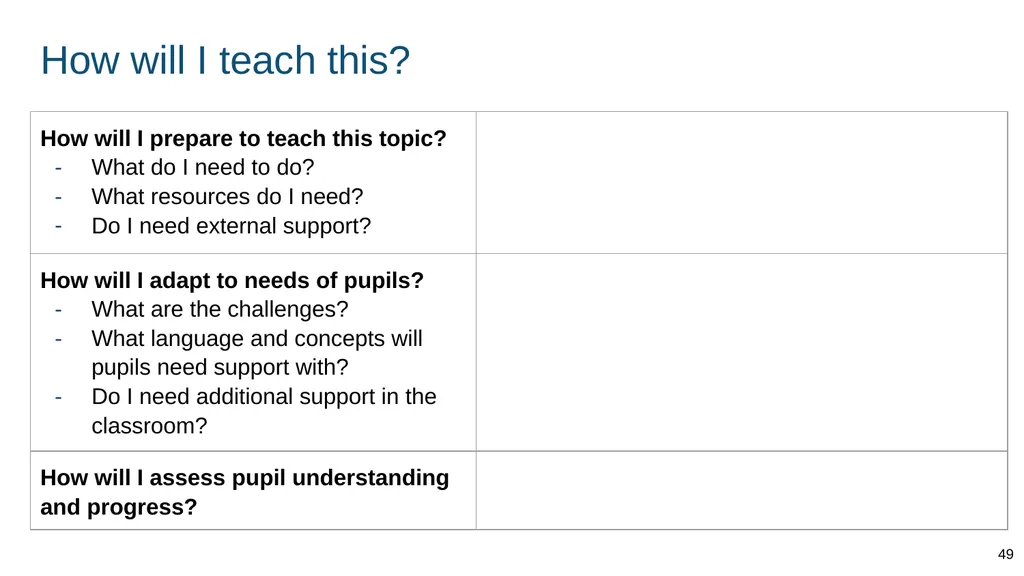
slide49. How will I teach this? 49<br>
slide50. Additional slides for structuring training 50<br>
slide51. Any concerns? ADAPT THIS FOR YOUR OWN PRESENTATION Any questions? What support do you need? 51<br>
slide52. XX% ADAPT THIS FOR YOUR OWN PRESENTATION [Use this format to present your own key facts and statistics - e.g. from your local authority or own monitoring. Include the source.] 52<br>
slide2. Contents 2 3 About this training module
5 Teaching the new curriculum
11 Safeguarding
14 Ground rules
17 Primary curriculum
34 Examples of good practice
37 Activities and templates for trainers<br>
slide3. About this training module Subject leads can use the adaptable slides and ‘activities and templates for trainers’ section at the end of this module to help shape training sessions for teachers.
This non-statutory training module supplements the statutory guidance on teaching about caring friendships, which schools should read in full.
Schools can choose whether and how to follow or adapt this training module and should refer to the Early Career Framework for pedagogical guidance. 3<br>
slide4. What you get out of today By the end of this training you should:
know what is included in the statutory guidance
know some key knowledge and facts to cover as part of this topic
have strategies to deal with questions that come up in class
feel more confident teaching about caring friendships 4<br>
slide5. Teaching the new curriculum 5<br>
slide6. Related topics Caring friendships is closely related to the following topics:
respectful relationships
intimate relationships and sexual health (secondary only)
Therefore, you should:
consider thematic links across key topics and the whole school when planning and delivering lessons
find ways to link knowledge and vocabulary across topics 6<br>
slide7. Related guidance Schools may also want to refer to the guidance for schools on preventing and responding to bullying (including cyberbullying)
when planning to teach this subject. 7<br>
slide8. Friendships support at [school name] Our leads
[Names, contact details of friendships support]
Our policies
[Add details - e.g. school policy on bullying]
Specialist support [Add details - e.g. providers school already works with]
Other information
[Add resources] 8<br>
slide9. Teaching about caring friendships at [school name] Ways in which we already teach about caring friendships at our school:
[add details]
[add details]
[add details] 9<br>
slide10. Pupils with SEND You will need to plan lessons to allow all pupils to access and practise the core knowledge, using your expertise as you normally would.
You might want to link lesson outcomes with statutory ‘preparing for adulthood’ outcomes for those with an education, health and care (EHC) plan. (See SEND code of practice, section 8.) STATUTORY GUIDANCE
In special schools and for some SEND pupils in mainstream schools there may be a need to tailor content and teaching to meet the specific needs of pupils at different developmental stages. As with all teaching for these subjects, schools should ensure that their teaching is sensitive, age-appropriate, developmentally appropriate and delivered with reference to the law. (p15) 10<br>
slide11. Safeguarding 11<br>
slide12. Safeguarding (1) Pupils may be affected by issues discussed in lessons.
Let your designated safeguarding lead or deputy and any other relevant staff, such as pastoral leads, know what you are teaching. This will enable them to identify and speak to relevant pupils, especially those who they know may have been directly impacted by issues covered in the lessons and those with adverse childhood experiences.
Teachers may need to deal with disclosures or concerns (e.g. of abuse or offending behaviour) in a way that safeguards pupils in line with school policies, especially the child protection policy. 12<br>
slide13. Trusted adults Within this module we have used the term trusted adult.
A trusted adult will generally be someone who children feel comfortable to turn to for help. Obvious examples include family members, teachers and doctors.
It will be important when teaching this topic, and any other relevant topics, that teachers explore this concept. Pupils should be comfortable and capable of identifying who their trusted adults could be both within their families and wider circles. 13<br>
slide14. Ground rules 14<br>
slide15. Create class ground rules Clear class ground rules can help when teaching about sensitive topics. They also support confidentiality and safeguarding of pupils.
Good practice is for ground rules to be:
discussed and understood by all
clear and practical
modelled by the teacher
followed consistently and enforced
updated when needed
visible in lessons (for example, posters) 15<br>
slide16. Example ground rules Respect privacy. We can discuss examples but do not use names or descriptions that identify anyone, including ourselves.
Listen to others. It is okay to disagree with each other, but we should listen properly before making assumptions or deciding how to respond. When disagreeing, challenge the statement not the person.
No judgement. We can explore beliefs and misunderstandings about a topic without fear of being judged.
Choose level of participation. Everyone has the right to choose not to answer a question or join discussion. We never put anyone ‘on the spot’ (no personal questions or pressure to answer). 16<br>
slide17. Primary curriculum 17<br>
slide18. Happy and secure friendships (1) Primary Explain that friendship is a relationship between two or more people who care about each other and choose to have a relationship together.
Teach pupils that friendship of all ages is usually based on something which binds people together, for example:
liking to play with each other
enjoying each other’s company
having similar interests and hobbies
enjoying the same activities
having shared experiences, e.g. becoming friends after a trip STATUTORY GUIDANCE Know how important friendships are in making us feel happy and secure, and how people choose and make friends. 18<br>
slide19. Happy and secure friendships (2) Primary Teach pupils that friendships make us feel happy and secure by giving us:
people to enjoy time with and share experiences
company so that we are not alone
a feeling of belonging
support when we need it
someone to look out for us
someone to share our problems with
Explain that friendship is something that is freely given. People who ask us to do things in return for their friendship may not be real friends. STATUTORY GUIDANCE Know how important friendships are in making us feel happy and secure, and how people choose and make friends. 19<br>
slide20. Ways of making friends Primary Explain the ways that people make friends includes:
saying hello to someone and talking to them
showing an interest in what someone is doing and asking them about it
inviting them to join a group
asking them if they want to play or if you can play with them
doing something nice for them or saying something nice to them
Explain that sometimes it is not always easy to make friends, and that they can ask a trusted adult for support. STATUTORY GUIDANCE Know how important friendships are in making us feel happy and secure, and how people choose and make friends. 20<br>
slide21. Choosing friends (1) Primary Teach that friends do not have to look the same or come from the same background. We can be friends with anyone, e.g. boys and girls can be friends.
Friendships with people who are different to us can be rewarding, makes life more interesting and exposes us to different experiences and knowledge.
Explain we can make friends anywhere, for example:
at school
at after school clubs
through our family or existing friends
with neighbours or in the wider community STATUTORY GUIDANCE Know how important friendships are in making us feel happy and secure, and how people choose and make friends. 21<br>
slide22. Choosing friends (2) Primary Explain that the number of friends we have does not matter. We can be friends with one person or many people.
Explain that some friends may be particularly important to us at different times. Sometimes we might consider several people to be equally important as friends, or that we have a 'best friend'.
There are no rules and friendships can change over time. STATUTORY GUIDANCE Know how important friendships are in making us feel happy and secure, and how people choose and make friends. 22<br>
slide23. Online friendships Primary Explain that the internet can give us the opportunity to be friends with people all over the world.
Explain that friendships are not the same as contacts (the amount of people we know) or ‘likes’ or ‘shares’ online. Real friendships are reciprocal, built on getting to know a person, spending time with them, sharing experiences with them and caring for them.
Teach that online friendships should have the same characteristics as friendships in real life.
Explain that being safe is paramount in any online relationship. See the online relationships module for more information. STATUTORY GUIDANCE Know how important friendships are in making us feel happy and secure, and how people choose and make friends. 23<br>
slide24. Characteristics of friendships (1) Explain that like all respectful relationships friendships are based on certain characteristics, for example:
mutual respect, e.g. valuing and caring for each other, and putting aside any differences
truthfulness and honesty, e.g. knowing that we can believe what we tell each other
trustworthiness, e.g. being able to rely on someone for their support, loyalty, and doing what they say they will do
loyalty, e.g. supporting our friends and sticking with them through hard times
kindness, e.g. caring about each other, our feelings, and putting others’ needs above our own STATUTORY GUIDANCE Know the characteristics of friendships, including mutual respect, truthfulness, trustworthiness, loyalty, kindness, generosity, trust, sharing interests and experiences and support with problems and difficulties. Primary 24<br>
slide25. Characteristics of friendships (2) Primary generosity, letting someone play with a toy or go first in a game
sharing interests and experiences, and that doing so makes them better and more satisfying, e.g. hobbies, games or clubs at school
supporting our friends when they have problems or difficulties, e.g. when they are upset STATUTORY GUIDANCE Know the characteristics of friendships, including mutual respect, truthfulness, trustworthiness, loyalty, kindness, generosity, trust, sharing interests and experiences and support with problems and difficulties. 25<br>
slide26. Welcoming friendships (1) Primary Explain that friendship is for sharing. Sharing the enjoyment friends experience when they spend time together is a way to build friendships and make new friends.
Trying to keep other people away from a friendship, for example out of jealousy, is more likely to make the friendship break down. People can end up feeling trapped or restricted and want to break away in this kind of friendship.
Teach pupils that being unwelcoming to others (e.g. ignoring them, or not involving them in a group or game) can make them feel lonely and excluded. STATUTORY GUIDANCE Know that healthy friendships are positive and welcoming towards others, and do not make others feel lonely or excluded. 26<br>
slide27. Welcoming friendships (2) Primary Explain that regularly excluding others to hurt them is a form of bullying. Teach that:
it is better to be kind to each other
life is more fun when we let other people’s personalities and ideas into our groups
Explain that while we should be friendly and welcoming to everyone, we do not have to be close friends with everyone. We are all allowed to decide how close a relationship we form with different people.
See the respectful relationships module for more information. STATUTORY GUIDANCE Know that healthy friendships are positive and welcoming towards others, and do not make others feel lonely or excluded. 27<br>
slide28. When an offer of friendship is rejected Primary Explain that not everyone we meet will want to be our friend. Sometimes we want to be friends with someone, but they do not feel the same way.
If this happens, we should not feel like we have done something wrong or do not deserve friendship.
Teach that we can still have a good relationship with that person and treat them with respect.
Explain to pupils that they can speak to a trusted adult for support. STATUTORY GUIDANCE Know that healthy friendships are positive and welcoming towards others, and do not make others feel lonely or excluded. 28<br>
slide29. Working through problems (1) Primary Explain that most friendships have their ups and downs. When there is conflict in a friendship it can help to:
apologise if we are in the wrong
recognise the emotions we each felt
discuss the problem on both sides honestly to resolve issues
listen and acknowledge each other’s viewpoints
clarify views and opinions
accept the consequences of our actions
Explain that a successfully resolved conflict can strengthen a friendship as the parties understand more about the other person and themselves as a result. STATUTORY GUIDANCE Know that most friendships have ups and downs, and that these can often be worked through so that the friendship is repaired or even strengthened, and that resorting to violence is never right. 29<br>
slide30. Working through problems (2) Primary Teach that communicating with someone is the only way to solve an issue in a friendship. Violence does not solve problems, it usually makes them worse and can permanently end a friendship.
Violence or fighting at school is very serious and will not be accepted under any circumstances.
Teach that there are always consequences for hurting, threatening to hurt or trying to hurt someone else.
Explain that pupils should speak to a trusted adult if they have witnessed any threats of violence against them or people they know. STATUTORY GUIDANCE Know that most friendships have ups and downs, and that these can often be worked through so that the friendship is repaired or even strengthened, and that resorting to violence is never right. 30<br>
slide31. Trust and friendship (1) Primary Teach that an important part of a friendship is trust and being able to rely on friends.
Explain that trust is built over time, and people learn to trust us by their experience of our behaviour towards them, and how they see us behaving towards others.
For example, trust develops when people:
share and take turns
keep promises
listen without judgment
respect people’s wishes, e.g. about boundaries
are honest about their feelings STATUTORY GUIDANCE Know how to recognise who to trust and who not to trust, how to judge when a friendship is making them feel unhappy or uncomfortable, managing conflict, how to manage these situations and how to seek help or advice from others, if needed. 31<br>
slide32. Trust and friendship (2) Primary Discuss types of behaviour that damage trust, for example:
lying and not being truthful
gossiping and spreading rumours
teasing repeatedly
hurting someone
saying negative things about people
Explain that if people see us behaving like this towards others, then they may think that we will do the same to them. STATUTORY GUIDANCE Know how to recognise who to trust and who not to trust, how to judge when a friendship is making them feel unhappy or uncomfortable, managing conflict, how to manage these situations and how to seek help or advice from others, if needed. 32<br>
slide33. Unsafe friendships Primary Explain that psychological bullying is when a person tries to make someone else feel bad about themselves, tries to control what they do or say, or regularly excludes them.
Explain to pupils that if a friendship is making them feel unhappy or uncomfortable, they can speak to a friend outside of that relationship, a trusted adult, or organisations such as Childline or CEOP.
See the being safe module for more on coercive friendships. STATUTORY GUIDANCE Know how to recognise who to trust and who not to trust, how to judge when a friendship is making them feel unhappy or uncomfortable, managing conflict, how to manage these situations and how to seek help or advice from others, if needed. 33<br>
slide34. Examples of good practice 34<br>
slide35. Good practice The following are just some of the approaches you might consider when preparing to teach about caring friendships. Good practice 35<br>
slide36. Good practice approaches When teaching about how friendships develop, be aware that:
children recognise friendship qualities appropriate for their age or development
younger children will base friendships on play and time spent together, however by the end of primary school they will be selecting friends based on interests, personality, and shared values
it is important that these discussions are inclusive, for example, there should be no stigma attached to friendships with the opposite sex or people from different cultures or backgrounds
if using stories/examples, avoid reinforcing stereotypes, e.g. girls play with dolls and boys play with cars Good practice 36<br>
slide37. Activities and templates for trainers 37<br>
slide38. About these activities and templates Subject leads can use the following templates and training activities to plan training on teaching the new curriculum topics.
You can:
move slides - e.g. ‘rate your confidence (before training)’ - to the point in the presentation where you want to carry out that activity
delete slides if you are not covering those curriculum elements at this time 38<br>
slide39. Training activity:
Rate your confidence 39<br>
slide40. Rate your confidence (trainer notes) Ask your colleagues to rate confidence before and after topic training using the slides in this deck.
Before training Ask teachers to think about where they currently fit on the scale.
After training Ask teachers to rate their confidence again and talk about changes. You might want to repeat this activity at later check ins.
If teachers still rate confidence as low, discuss ways you can develop their subject knowledge, offer peer support etc. 40<br>
slide41. Rate your confidence (before training) How do you feel about teaching this topic? Not confident at all Very confident 41<br>
slide42. Rate your confidence (after training) How do you feel now? What support/information could help? Not confident at all Very confident 42<br>
slide43. Training activity:
Dealing with difficult questions 43<br>
slide44. Dealing with difficult questions (trainer notes) Use the following slides in your training to help teachers:
share concerns about questions they could be asked by pupils
strategise ways to respond to such questions 44<br>
slide45. Dealing with difficult questions (1) [Prepare ‘difficult’ questions to discuss in training or give teachers a blank version to fill with their own questions] What would you say? What wouldn’t you say? Follow up 45<br>
slide46. Dealing with difficult questions (2) Pupils may well ask questions because they:
want information
are seeking permission - “Is it OK if I …?”
are trying to shock or get attention
have related personal beliefs
Remember:
don’t feel pressured or that you have to answer straight away
don’t disclose personal information - use third-person examples, say ‘some people...’
seek advice if you need it 46<br>
slide47. Training activity:
How will I teach this? 47<br>
slide48. How will I teach this? (trainer notes) Use the following slides in your training to help teachers:
begin to plan and resource their lessons
discuss and address any issues they anticipate in the delivery of lessons 48<br>
slide49. How will I teach this? 49<br>
slide50. Additional slides for structuring training 50<br>
slide51. Any concerns? ADAPT THIS FOR YOUR OWN PRESENTATION Any questions? What support do you need? 51<br>
slide52. XX% ADAPT THIS FOR YOUR OWN PRESENTATION [Use this format to present your own key facts and statistics - e.g. from your local authority or own monitoring. Include the source.] 52<br>