
Technical and Vocational Education and Training

Description: Technical and Vocational Education and Training Colleges Partnerships for Skills- A call to Action 1 The role of TVET Colleges in addressing skills shortages and advancing economic growth in South Africa 2 Programme 2: TVET and the rest of
Related Topics
Download Presentation
"Technical and Vocational Education and Training" is the property of its rightful owner. Permission is granted to download and print the materials on this website for personal, non-commercial use only, and to display it on your personal computer provided you do not modify the materials and that you retain all copyright notices contained in the materials. By downloading content from our website, you accept the terms of this agreement.
Presentation Transcript
slide1. Technical and Vocational Education and Training Colleges
Partnerships for Skills- A call to Action 1 The role of TVET Colleges in addressing skills shortages and advancing economic growth in South Africa<br>
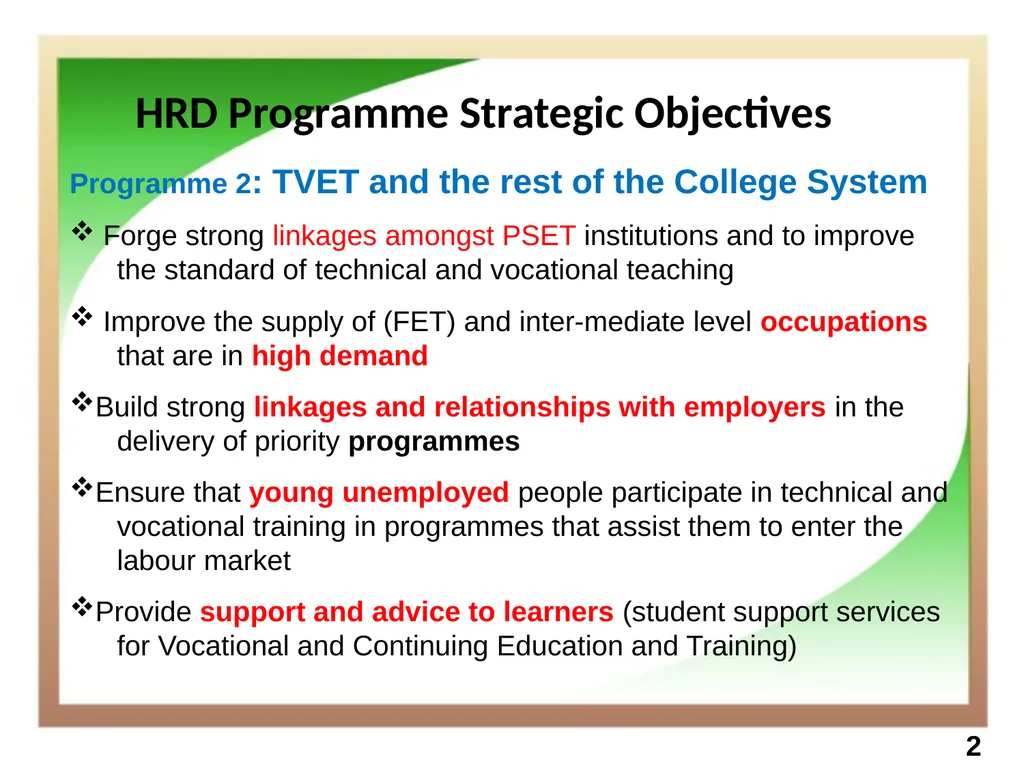
slide2. 2 Programme 2: TVET and the rest of the College System
Forge strong linkages amongst PSET institutions and to improve
the standard of technical and vocational teaching
Improve the supply of (FET) and inter-mediate level occupations
that are in high demand
Build strong linkages and relationships with employers in the
delivery of priority programmes
Ensure that young unemployed people participate in technical and
vocational training in programmes that assist them to enter the
labour market
Provide support and advice to learners (student support services
for Vocational and Continuing Education and Training) HRD Programme Strategic Objectives<br>
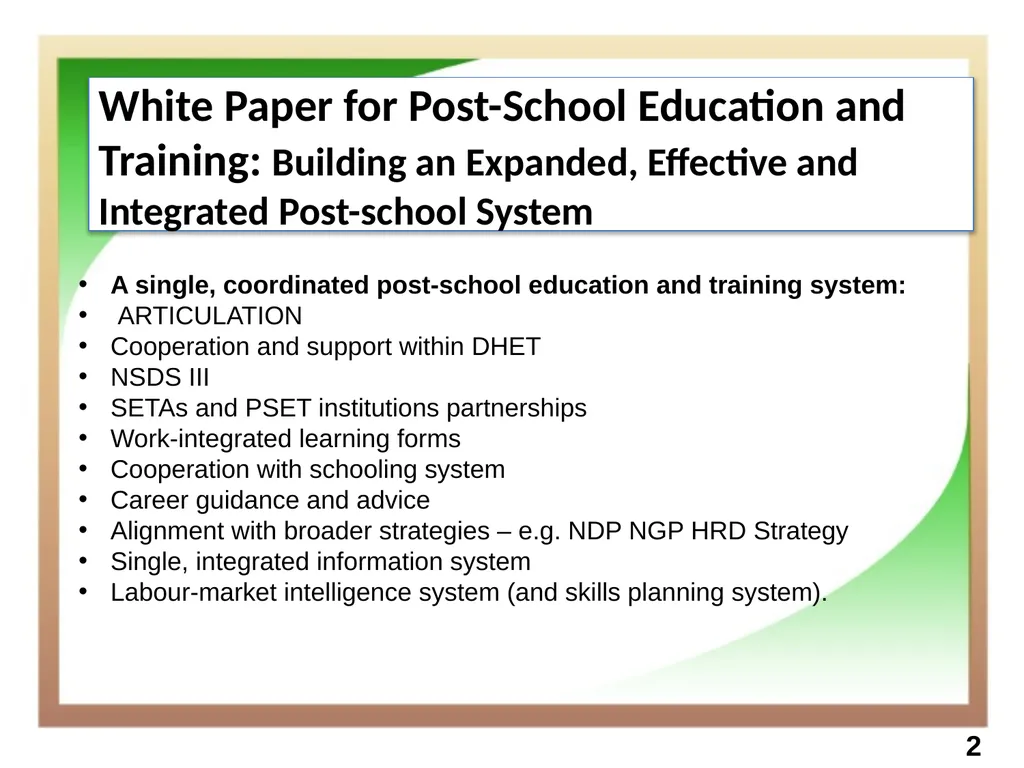
slide3. 2 White Paper for Post-School Education and Training: Building an Expanded, Effective and Integrated Post-school System A single, coordinated post-school education and training system:
ARTICULATION
Cooperation and support within DHET
NSDS III
SETAs and PSET institutions partnerships
Work-integrated learning forms
Cooperation with schooling system
Career guidance and advice
Alignment with broader strategies – e.g. NDP NGP HRD Strategy
Single, integrated information system
Labour-market intelligence system (and skills planning system).<br>
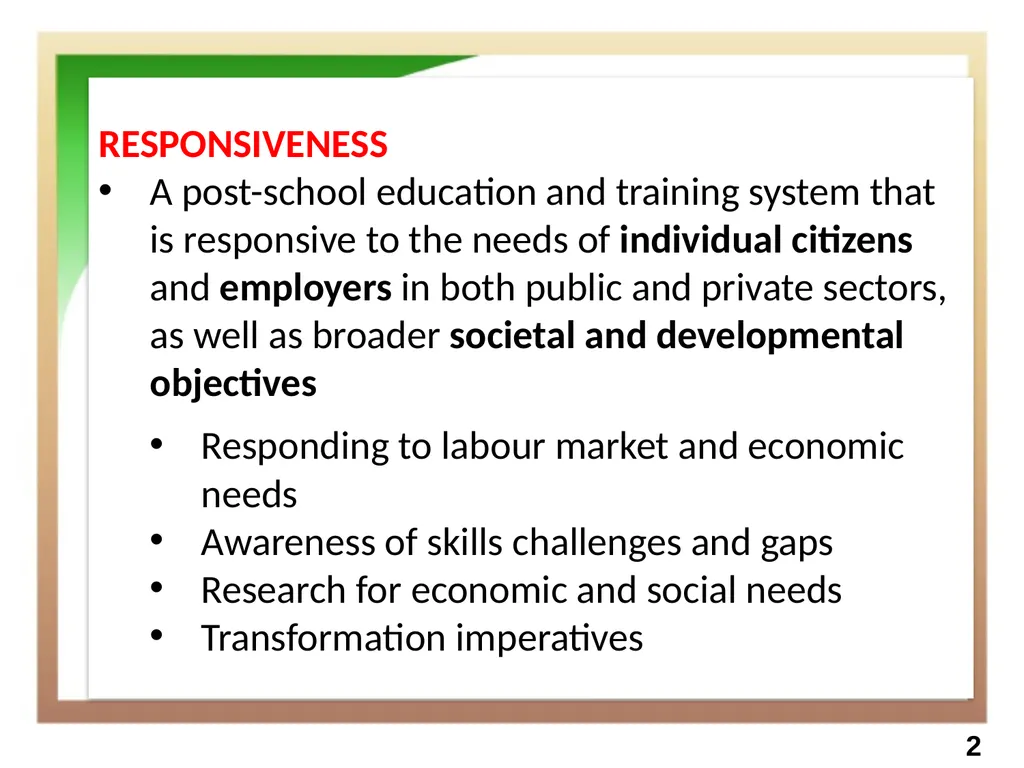
slide4. 2 RESPONSIVENESS
A post-school education and training system that is responsive to the needs of individual citizens and employers in both public and private sectors, as well as broader societal and developmental objectives
Responding to labour market and economic needs
Awareness of skills challenges and gaps
Research for economic and social needs
Transformation imperatives<br>
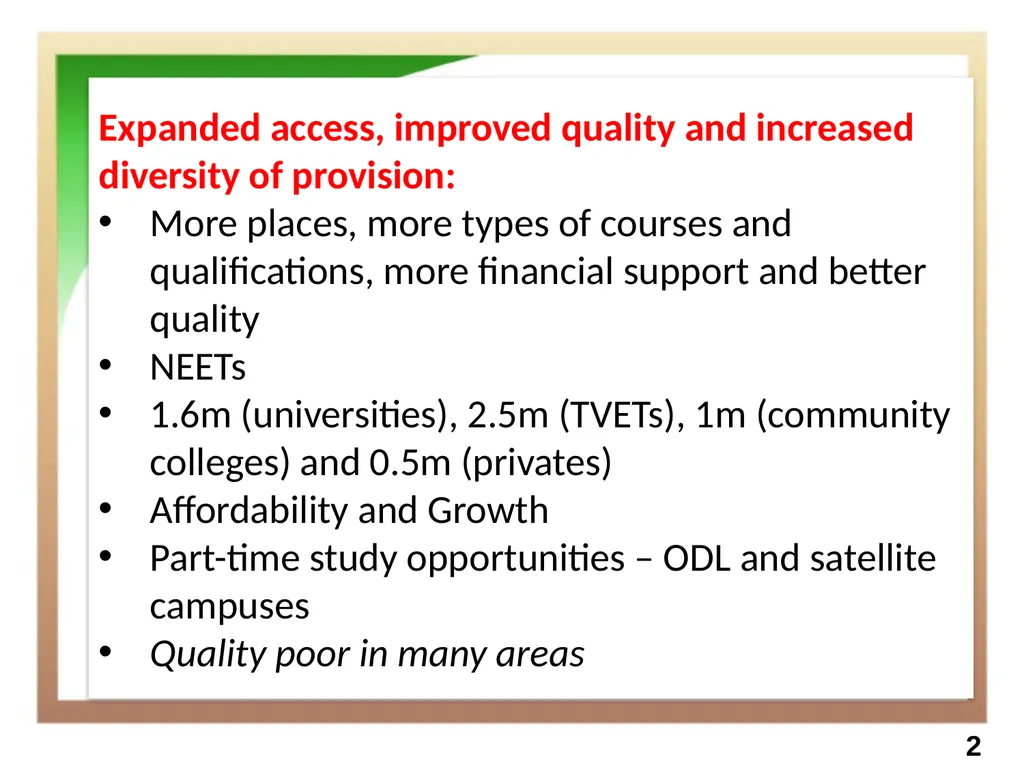
slide5. 2 Expanded access, improved quality and increased diversity of provision:
More places, more types of courses and qualifications, more financial support and better quality
NEETs
1.6m (universities), 2.5m (TVETs), 1m (community colleges) and 0.5m (privates)
Affordability and Growth
Part-time study opportunities – ODL and satellite campuses
Quality poor in many areas<br>
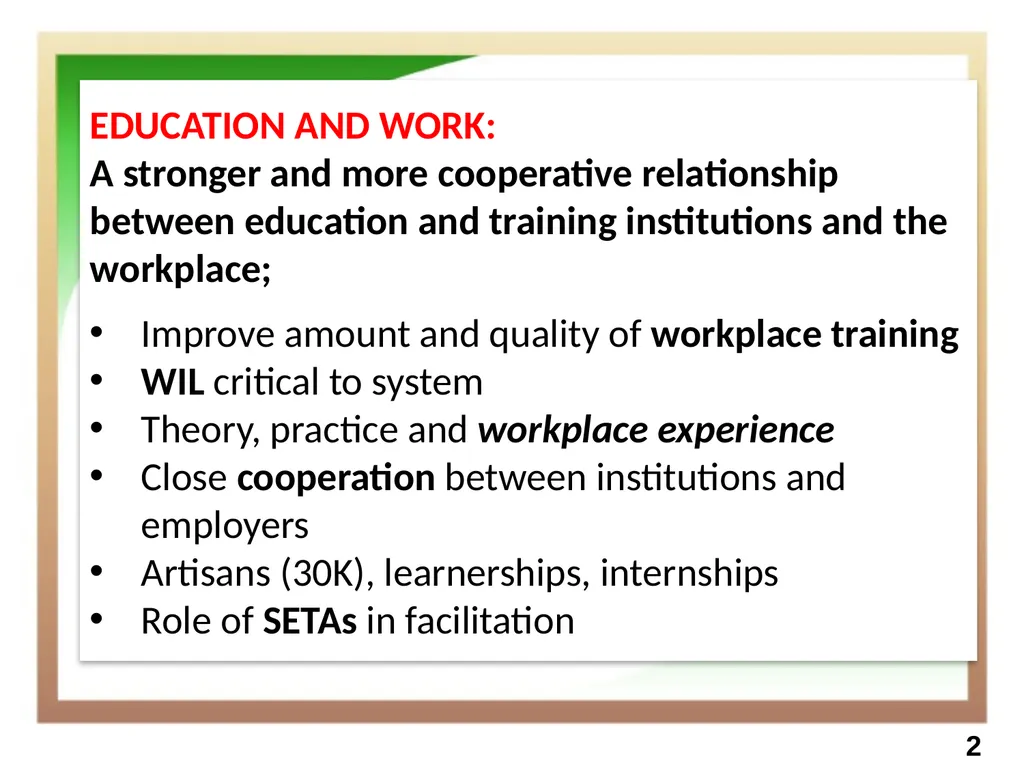
slide6. 2 EDUCATION AND WORK:
A stronger and more cooperative relationship between education and training institutions and the workplace;
Improve amount and quality of workplace training
WIL critical to system
Theory, practice and workplace experience
Close cooperation between institutions and employers
Artisans (30K), learnerships, internships
Role of SETAs in facilitation<br>
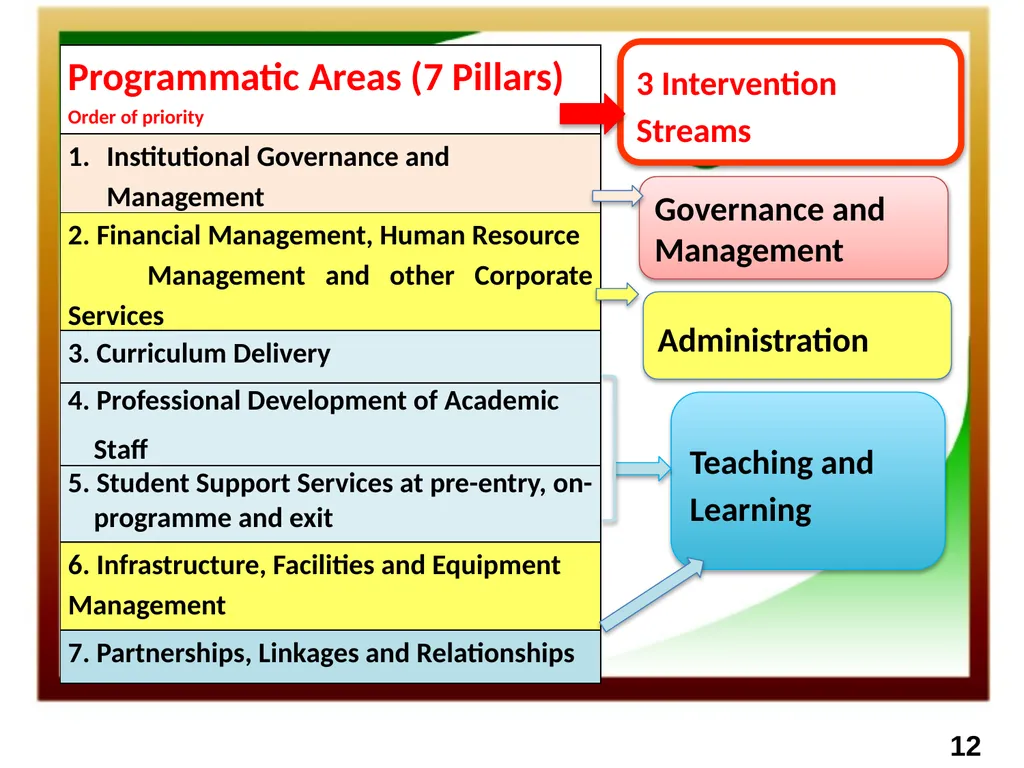
slide7. 12 Governance and Management Administration Teaching and Learning 3 Intervention Streams<br>
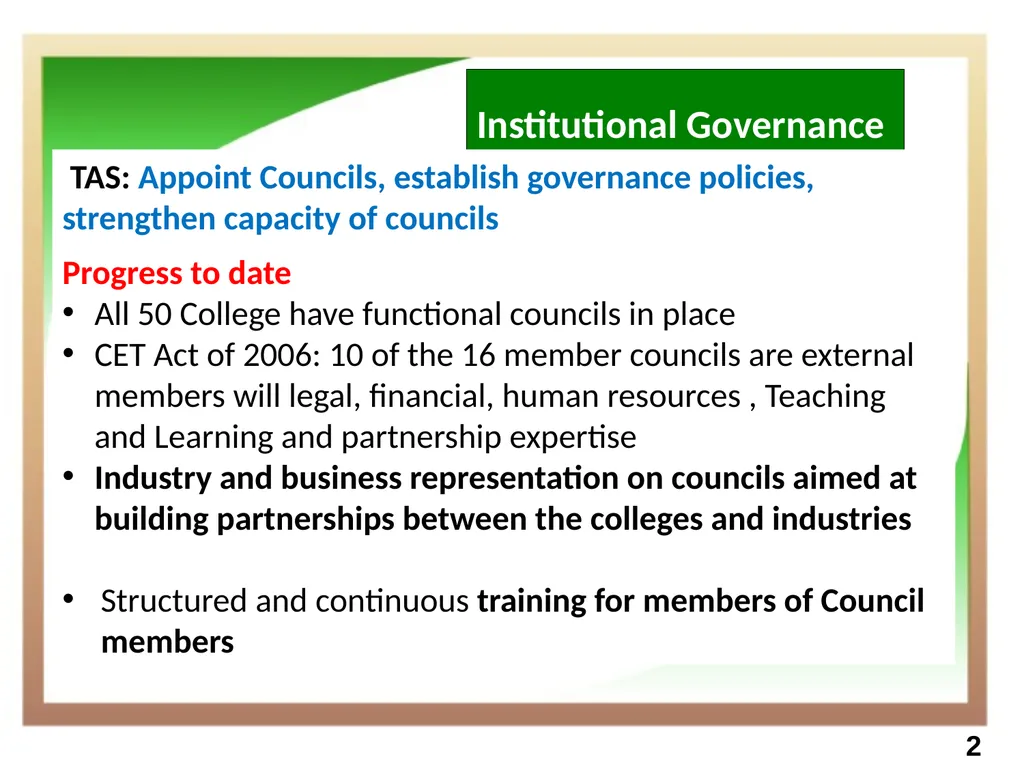
slide8. 2 Institutional Governance TAS: Appoint Councils, establish governance policies, strengthen capacity of councils
Progress to date
All 50 College have functional councils in place
CET Act of 2006: 10 of the 16 member councils are external members will legal, financial, human resources , Teaching and Learning and partnership expertise
Industry and business representation on councils aimed at building partnerships between the colleges and industries
Structured and continuous training for members of Council members<br>
slide9. 2 Institutional Governance Structured and continuous training for members of Council White Paper: vision of the Department.
Legislation and policy.
Financial policies and processes.
Teaching and Learning and the role of the Academic Board.
Linkages and Partnerships.
Strategic and operational planning Management vacancies Principals and DPs
Capacity building and support:
Strategic and operational planning (approved by the Minister).
Operational Plans: Partnerships
Accountable: College T+L Plans (accountable)
Training: Campus Managers<br>
slide10. 2 Section 7: Work placement (student and lecturer)
agement Employability is a key success indicator of TVET output.
prepare students for the world of the work
lecturers familiar with the demands of the workplace to prepare students
WIL guidelines - student and lecturer work placement
College Work Place Based Learning/Work based experience policy in place
Process in place to identify industry partners and/or employers
Partnerships with institutions and/employers established and on record
At least 50% of students at qualification/ programme exit level placed in WPBL/WBE
At least 10 % of students at pre-exit level placed in WPBL/WBE across qualifications and programmes
10% of lecturers placed in WPBL/WBE (NB: target of 30% annually by 2019)
Monitoring of students in WPBL/WBE placements
Recording of students who completed WPBL/WBE
Recording of lecturers who completed WPBL/WBE
Process in place to ensure integration of WPBL/WBE experience into pedagogical practices by lecturers<br>
slide11. Dual System Projects Introduction of the Dual system:
Swiss/SSACI and DHET Project used Nated and NCV
Limited/Partial success but many lessons learnt
2. Pilot Project (2016-2018)
- German (GIZ/DHET) project using new occupational (plumber +electrical)(methodology)
- 2 Gauteng Colleges (EEC+EWC) and
2 Eastern Cape Colleges (EMC +PE) 11<br>
slide12. Curriculum Reform NCV
NCV Review complete.
Umalusi developing new policy
Nated 1-3
Umalusi quality assure
Increased enrolments on N1 – N3 observed
Replaced by a foundational programme (proposed)
N4 – N6
QCTO quality assure
Reform of Business studies subjects underway
Implementation is problematic and not yet tested
Position paper required
On-going work until DBE to rationalise the FET Band
Number of colleges positioned to deliver higher certificates 12<br>
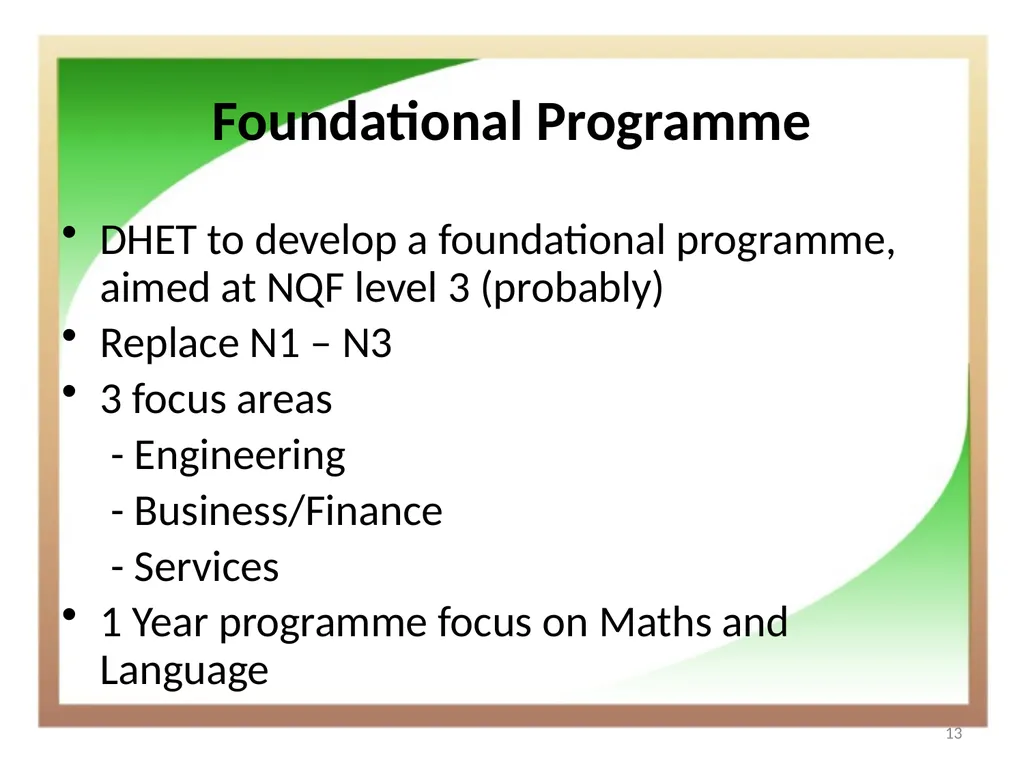
slide13. Foundational Programme 13 DHET to develop a foundational programme, aimed at NQF level 3 (probably)
Replace N1 – N3
3 focus areas
- Engineering
- Business/Finance
- Services
1 Year programme focus on Maths and Language<br>
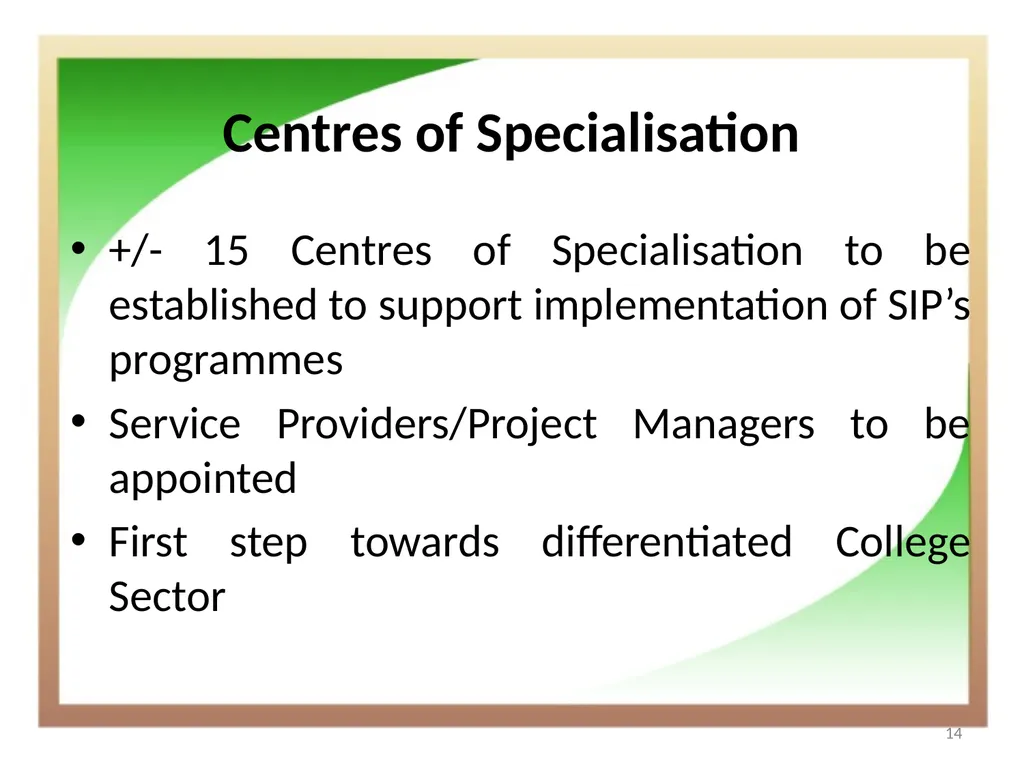
slide14. Centres of Specialisation +/- 15 Centres of Specialisation to be established to support implementation of SIP’s programmes
Service Providers/Project Managers to be appointed
First step towards differentiated College Sector 14<br>
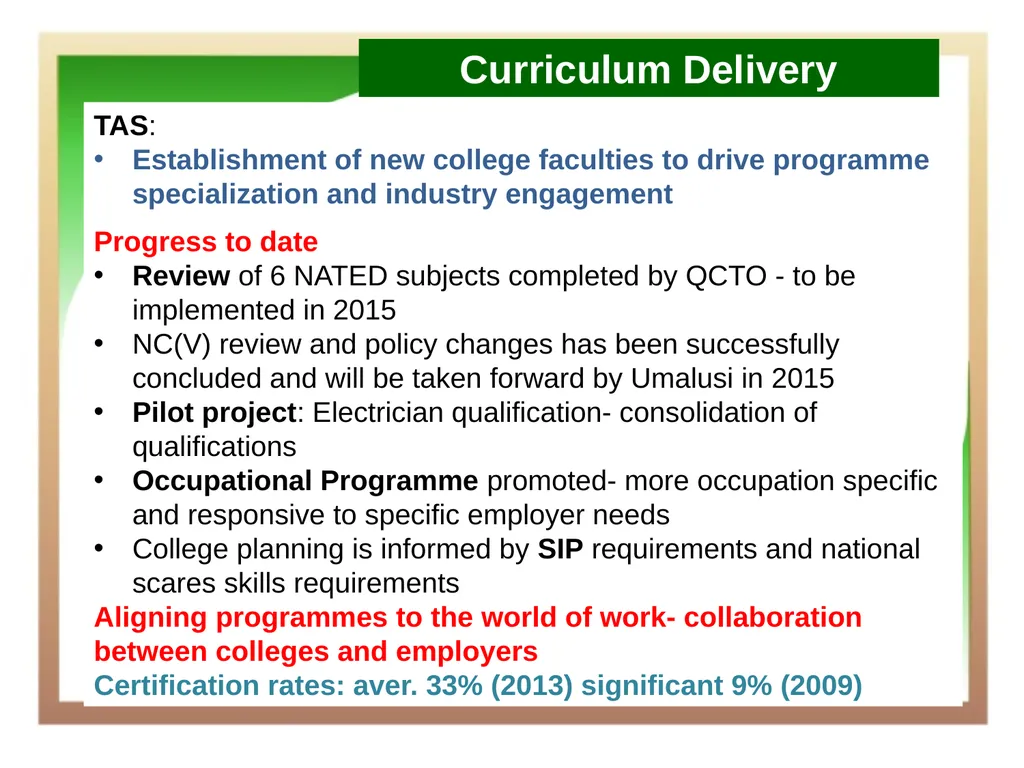
slide15. Curriculum Delivery TAS:
Establishment of new college faculties to drive programme specialization and industry engagement
Progress to date
Review of 6 NATED subjects completed by QCTO - to be implemented in 2015
NC(V) review and policy changes has been successfully concluded and will be taken forward by Umalusi in 2015
Pilot project: Electrician qualification- consolidation of qualifications
Occupational Programme promoted- more occupation specific and responsive to specific employer needs
College planning is informed by SIP requirements and national scares skills requirements
Aligning programmes to the world of work- collaboration between colleges and employers
Certification rates: aver. 33% (2013) significant 9% (2009)<br>
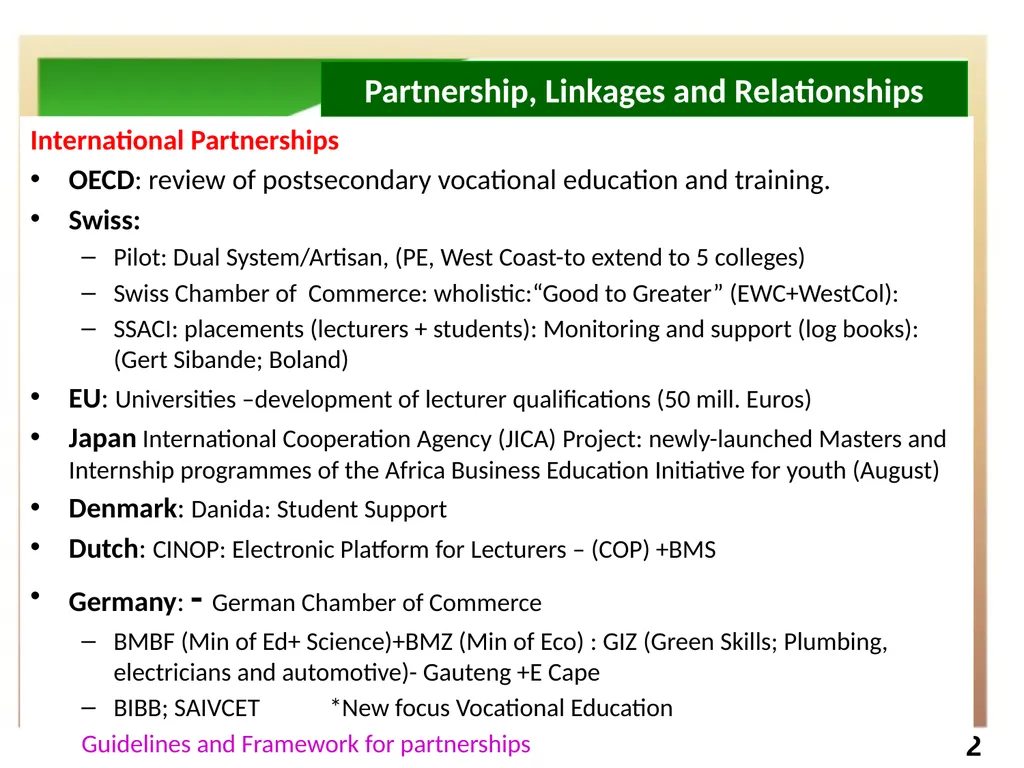
slide16. 2 International Partnerships
OECD: review of postsecondary vocational education and training.
Swiss:
Pilot: Dual System/Artisan, (PE, West Coast-to extend to 5 colleges)
Swiss Chamber of Commerce: wholistic:“Good to Greater” (EWC+WestCol):
SSACI: placements (lecturers + students): Monitoring and support (log books): (Gert Sibande; Boland)
EU: Universities –development of lecturer qualifications (50 mill. Euros)
Japan International Cooperation Agency (JICA) Project: newly-launched Masters and Internship programmes of the Africa Business Education Initiative for youth (August)
Denmark: Danida: Student Support
Dutch: CINOP: Electronic Platform for Lecturers – (COP) +BMS
Germany: - German Chamber of Commerce
BMBF (Min of Ed+ Science)+BMZ (Min of Eco) : GIZ (Green Skills; Plumbing, electricians and automotive)- Gauteng +E Cape
BIBB; SAIVCET *New focus Vocational Education
Guidelines and Framework for partnerships Partnership, Linkages and Relationships<br>
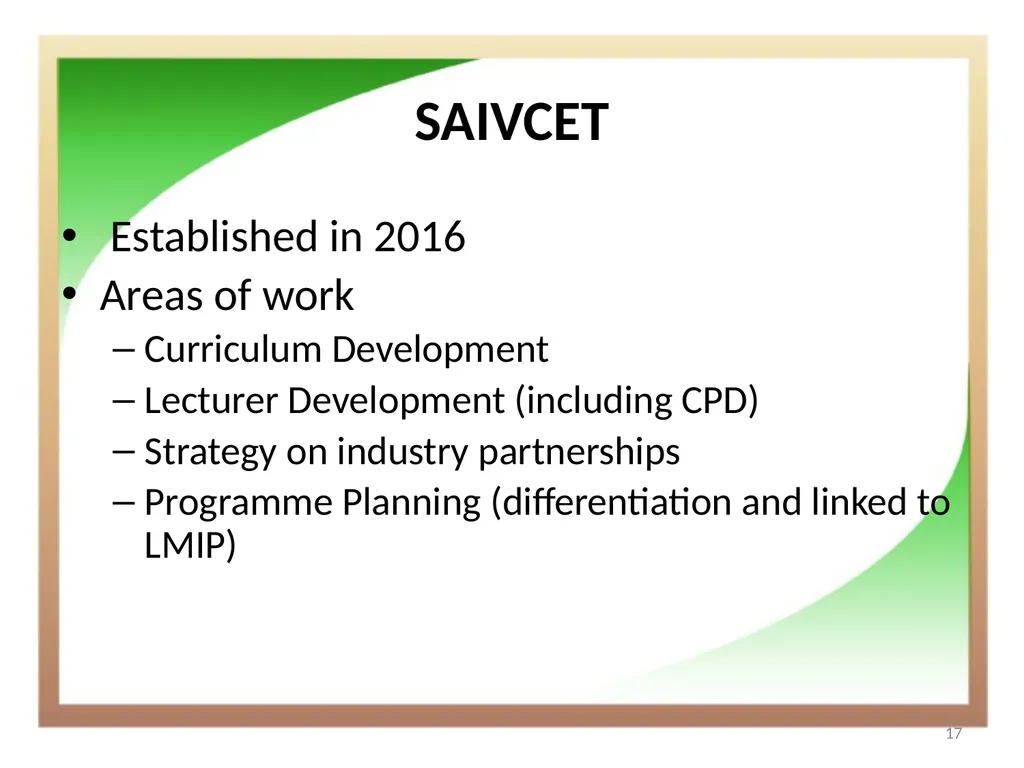
slide17. SAIVCET Established in 2016
Areas of work
Curriculum Development
Lecturer Development (including CPD)
Strategy on industry partnerships
Programme Planning (differentiation and linked to LMIP) 17<br>
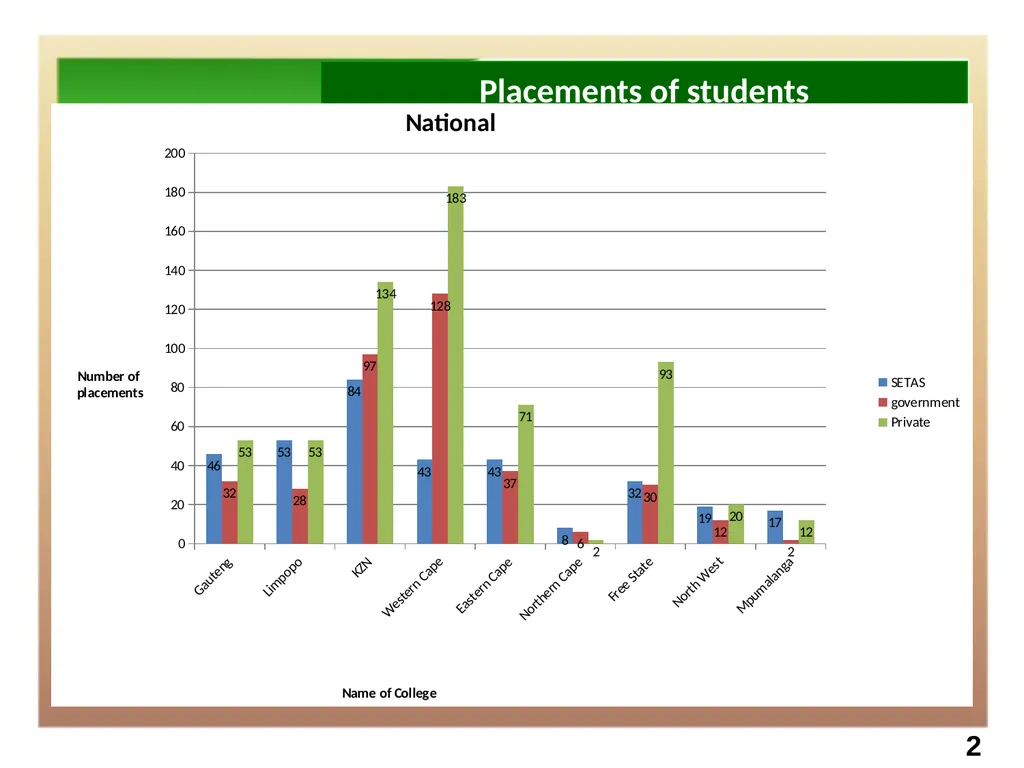
slide18. 2 Placements of students<br>
slide2. 2 Programme 2: TVET and the rest of the College System
Forge strong linkages amongst PSET institutions and to improve
the standard of technical and vocational teaching
Improve the supply of (FET) and inter-mediate level occupations
that are in high demand
Build strong linkages and relationships with employers in the
delivery of priority programmes
Ensure that young unemployed people participate in technical and
vocational training in programmes that assist them to enter the
labour market
Provide support and advice to learners (student support services
for Vocational and Continuing Education and Training) HRD Programme Strategic Objectives<br>
slide3. 2 White Paper for Post-School Education and Training: Building an Expanded, Effective and Integrated Post-school System A single, coordinated post-school education and training system:
ARTICULATION
Cooperation and support within DHET
NSDS III
SETAs and PSET institutions partnerships
Work-integrated learning forms
Cooperation with schooling system
Career guidance and advice
Alignment with broader strategies – e.g. NDP NGP HRD Strategy
Single, integrated information system
Labour-market intelligence system (and skills planning system).<br>
slide4. 2 RESPONSIVENESS
A post-school education and training system that is responsive to the needs of individual citizens and employers in both public and private sectors, as well as broader societal and developmental objectives
Responding to labour market and economic needs
Awareness of skills challenges and gaps
Research for economic and social needs
Transformation imperatives<br>
slide5. 2 Expanded access, improved quality and increased diversity of provision:
More places, more types of courses and qualifications, more financial support and better quality
NEETs
1.6m (universities), 2.5m (TVETs), 1m (community colleges) and 0.5m (privates)
Affordability and Growth
Part-time study opportunities – ODL and satellite campuses
Quality poor in many areas<br>
slide6. 2 EDUCATION AND WORK:
A stronger and more cooperative relationship between education and training institutions and the workplace;
Improve amount and quality of workplace training
WIL critical to system
Theory, practice and workplace experience
Close cooperation between institutions and employers
Artisans (30K), learnerships, internships
Role of SETAs in facilitation<br>
slide7. 12 Governance and Management Administration Teaching and Learning 3 Intervention Streams<br>
slide8. 2 Institutional Governance TAS: Appoint Councils, establish governance policies, strengthen capacity of councils
Progress to date
All 50 College have functional councils in place
CET Act of 2006: 10 of the 16 member councils are external members will legal, financial, human resources , Teaching and Learning and partnership expertise
Industry and business representation on councils aimed at building partnerships between the colleges and industries
Structured and continuous training for members of Council members<br>
slide9. 2 Institutional Governance Structured and continuous training for members of Council White Paper: vision of the Department.
Legislation and policy.
Financial policies and processes.
Teaching and Learning and the role of the Academic Board.
Linkages and Partnerships.
Strategic and operational planning Management vacancies Principals and DPs
Capacity building and support:
Strategic and operational planning (approved by the Minister).
Operational Plans: Partnerships
Accountable: College T+L Plans (accountable)
Training: Campus Managers<br>
slide10. 2 Section 7: Work placement (student and lecturer)
agement Employability is a key success indicator of TVET output.
prepare students for the world of the work
lecturers familiar with the demands of the workplace to prepare students
WIL guidelines - student and lecturer work placement
College Work Place Based Learning/Work based experience policy in place
Process in place to identify industry partners and/or employers
Partnerships with institutions and/employers established and on record
At least 50% of students at qualification/ programme exit level placed in WPBL/WBE
At least 10 % of students at pre-exit level placed in WPBL/WBE across qualifications and programmes
10% of lecturers placed in WPBL/WBE (NB: target of 30% annually by 2019)
Monitoring of students in WPBL/WBE placements
Recording of students who completed WPBL/WBE
Recording of lecturers who completed WPBL/WBE
Process in place to ensure integration of WPBL/WBE experience into pedagogical practices by lecturers<br>
slide11. Dual System Projects Introduction of the Dual system:
Swiss/SSACI and DHET Project used Nated and NCV
Limited/Partial success but many lessons learnt
2. Pilot Project (2016-2018)
- German (GIZ/DHET) project using new occupational (plumber +electrical)(methodology)
- 2 Gauteng Colleges (EEC+EWC) and
2 Eastern Cape Colleges (EMC +PE) 11<br>
slide12. Curriculum Reform NCV
NCV Review complete.
Umalusi developing new policy
Nated 1-3
Umalusi quality assure
Increased enrolments on N1 – N3 observed
Replaced by a foundational programme (proposed)
N4 – N6
QCTO quality assure
Reform of Business studies subjects underway
Implementation is problematic and not yet tested
Position paper required
On-going work until DBE to rationalise the FET Band
Number of colleges positioned to deliver higher certificates 12<br>
slide13. Foundational Programme 13 DHET to develop a foundational programme, aimed at NQF level 3 (probably)
Replace N1 – N3
3 focus areas
- Engineering
- Business/Finance
- Services
1 Year programme focus on Maths and Language<br>
slide14. Centres of Specialisation +/- 15 Centres of Specialisation to be established to support implementation of SIP’s programmes
Service Providers/Project Managers to be appointed
First step towards differentiated College Sector 14<br>
slide15. Curriculum Delivery TAS:
Establishment of new college faculties to drive programme specialization and industry engagement
Progress to date
Review of 6 NATED subjects completed by QCTO - to be implemented in 2015
NC(V) review and policy changes has been successfully concluded and will be taken forward by Umalusi in 2015
Pilot project: Electrician qualification- consolidation of qualifications
Occupational Programme promoted- more occupation specific and responsive to specific employer needs
College planning is informed by SIP requirements and national scares skills requirements
Aligning programmes to the world of work- collaboration between colleges and employers
Certification rates: aver. 33% (2013) significant 9% (2009)<br>
slide16. 2 International Partnerships
OECD: review of postsecondary vocational education and training.
Swiss:
Pilot: Dual System/Artisan, (PE, West Coast-to extend to 5 colleges)
Swiss Chamber of Commerce: wholistic:“Good to Greater” (EWC+WestCol):
SSACI: placements (lecturers + students): Monitoring and support (log books): (Gert Sibande; Boland)
EU: Universities –development of lecturer qualifications (50 mill. Euros)
Japan International Cooperation Agency (JICA) Project: newly-launched Masters and Internship programmes of the Africa Business Education Initiative for youth (August)
Denmark: Danida: Student Support
Dutch: CINOP: Electronic Platform for Lecturers – (COP) +BMS
Germany: - German Chamber of Commerce
BMBF (Min of Ed+ Science)+BMZ (Min of Eco) : GIZ (Green Skills; Plumbing, electricians and automotive)- Gauteng +E Cape
BIBB; SAIVCET *New focus Vocational Education
Guidelines and Framework for partnerships Partnership, Linkages and Relationships<br>
slide17. SAIVCET Established in 2016
Areas of work
Curriculum Development
Lecturer Development (including CPD)
Strategy on industry partnerships
Programme Planning (differentiation and linked to LMIP) 17<br>
slide18. 2 Placements of students<br>