
Technical Safety Engineering Grounding Session
GB
Published · 28 slides · 0 views
1 / 1
Description
Technical Safety Engineering Grounding Session Michael Banner PEng MSc Disclaimer Background 22 Years as a Technical Safety Professional BSc. Chemical Engineering, MSc Safety, Risk Reliability Engineering Consultancies (4y), EPC (7y),
Related Topics
Share
Embed code
Download this presentation From Below
"Technical Safety Engineering Grounding Session" is the property of its rightful owner. Permission is granted to download and print the materials on this website for personal, non-commercial use only, and to display it on your personal computer provided you do not modify the materials and that you retain all copyright notices contained in the materials. By downloading content from our website, you accept the terms of this agreement.
Presentation Transcript
01
Technical Safety Engineering
Grounding Session Michael Banner
PEng MSc<br>
02
Disclaimer<br>
03
Background 22 Years as a Technical Safety Professional
BSc. Chemical Engineering, MSc Safety, Risk & Reliability Engineering
Consultancies (4y), EPC (7y), Operators (11y), Insurance Risk Engineering
Lead Technical Safety Eng on Multi $Billion Projects both onshore & offshore
Exxon, Chevon, BP, TOTAL,
Oil and Gas, LNG, Petrochemical Projects
Technical Authority for Mid-sized Operators
Conducted dozens of internal/external audits
8 years international overseas
Russia, Norway, France, UK, Middle East
Half Career on Projects outside of Canada<br>
04
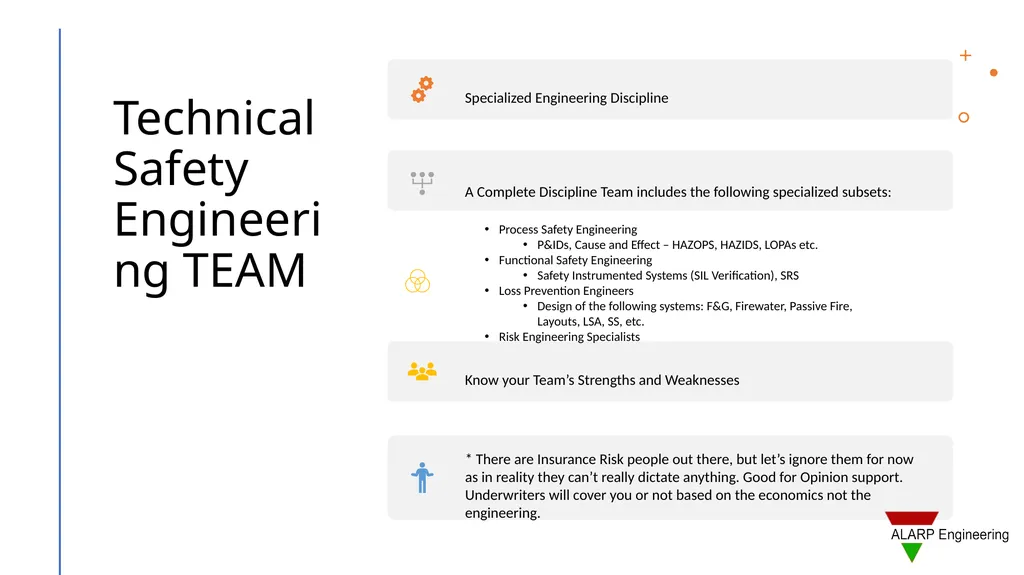
Technical Safety Engineering TEAM Process Safety Engineering
P&IDs, Cause and Effect – HAZOPS, HAZIDS, LOPAs etc.
Functional Safety Engineering
Safety Instrumented Systems (SIL Verification), SRS
Loss Prevention Engineers
Design of the following systems: F&G, Firewater, Passive Fire, Layouts, LSA, SS, etc.
Risk Engineering Specialists<br>
P&IDs, Cause and Effect – HAZOPS, HAZIDS, LOPAs etc.
Functional Safety Engineering
Safety Instrumented Systems (SIL Verification), SRS
Loss Prevention Engineers
Design of the following systems: F&G, Firewater, Passive Fire, Layouts, LSA, SS, etc.
Risk Engineering Specialists<br>
05
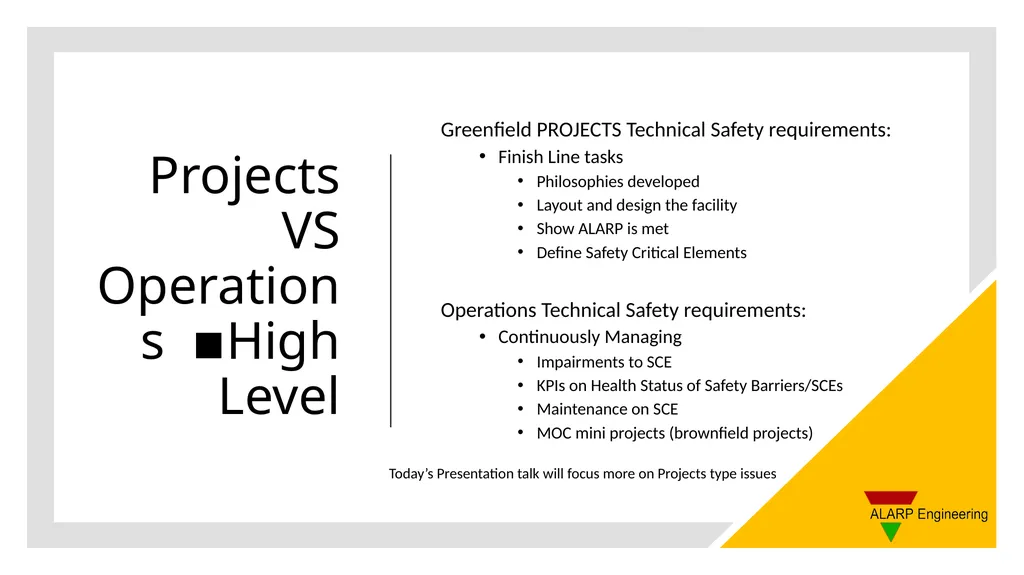
Projects VS Operations ▪High Level Greenfield PROJECTS Technical Safety requirements:
Finish Line tasks
Philosophies developed
Layout and design the facility
Show ALARP is met
Define Safety Critical Elements
Operations Technical Safety requirements:
Continuously Managing
Impairments to SCE
KPIs on Health Status of Safety Barriers/SCEs
Maintenance on SCE
MOC mini projects (brownfield projects) Today’s Presentation talk will focus more on Projects type issues<br>
06
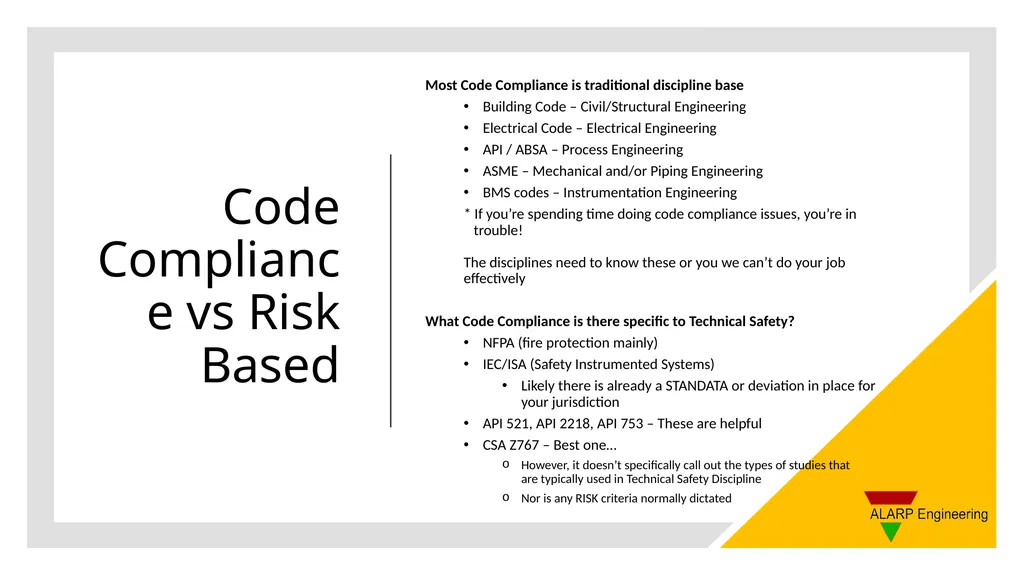
Code Compliance vs Risk Based Most Code Compliance is traditional discipline base
Building Code – Civil/Structural Engineering
Electrical Code – Electrical Engineering
API / ABSA – Process Engineering
ASME – Mechanical and/or Piping Engineering
BMS codes – Instrumentation Engineering
* If you’re spending time doing code compliance issues, you’re in trouble! The disciplines need to know these or you we can’t do your job effectively
What Code Compliance is there specific to Technical Safety?
NFPA (fire protection mainly)
IEC/ISA (Safety Instrumented Systems)
Likely there is already a STANDATA or deviation in place for your jurisdiction
API 521, API 2218, API 753 – These are helpful
CSA Z767 – Best one…
However, it doesn’t specifically call out the types of studies that are typically used in Technical Safety Discipline
Nor is any RISK criteria normally dictated<br>
07
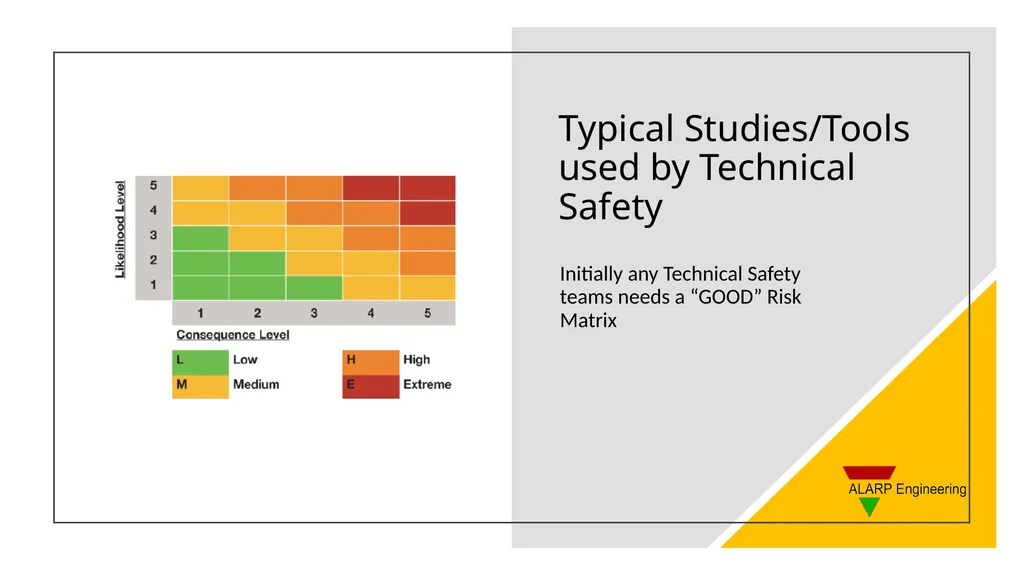
Typical Studies/Tools used by Technical Safety Initially any Technical Safety teams needs a “GOOD” Risk Matrix<br>
08
What is a “GOOD” Risk Matrix Many Companies in Alberta STILL don’t have a “good” Risk Matrix
Key Points
Likelihood levels should be “Logarithmic” >1, >0.1, >0.01, >0.001, >1E-4
It facilitates a clear understanding of what safety credits are applied and their effect
Segregate the difference between Single Fatality and Multiple Fatalities
Ideally, we need to be able to focus on Process Safety Events with the potential for Multiple Fatalities and be able to steer clear of slip/trips/falls hazards that are within an HSE scope
Help prioritize safety critical components as opposed to the potential for a “wet floor sign” being safety critical
Any Fatality Consequences does NOT have a “Green/Acceptable” rating on the Matrix
As a course filter on Risk Management the ALARP demonstration should be another layer past Risk Matrix when it comes to a fatality
These should be “Yellow/Medium/ALARP” only<br>
09
Major Accident HAZID Process Hazard Analysis (PHA) tools:
HAZOP
WHAT-IF
LOPA
However, any facility should have a Major Accident HAZID to:
Identify all your Major Accident Hazards
Fire/Explosion Single Fatality
Single Event causing Multiple Fatalities
Loss of Containment causing catastrophic Environmental Damage<br>
HAZOP
WHAT-IF
LOPA
However, any facility should have a Major Accident HAZID to:
Identify all your Major Accident Hazards
Fire/Explosion Single Fatality
Single Event causing Multiple Fatalities
Loss of Containment causing catastrophic Environmental Damage<br>
10
Major Accident HAZID Outcome of a Major Accident HAZID:
List of ALL the Major Accidents
List of all the Safety Critical “Systems”
List of Actions for a Risk Register
Example – Consequence Analysis/QRA
With these you can produce:
Rudimentary Bow-Tie (if you wish)
Define Performance Standards for SCEs
Scope of Work for Technical Safety Consultants to bid
Example: list Major Accidents to do any Consequence Analysis on<br>
11
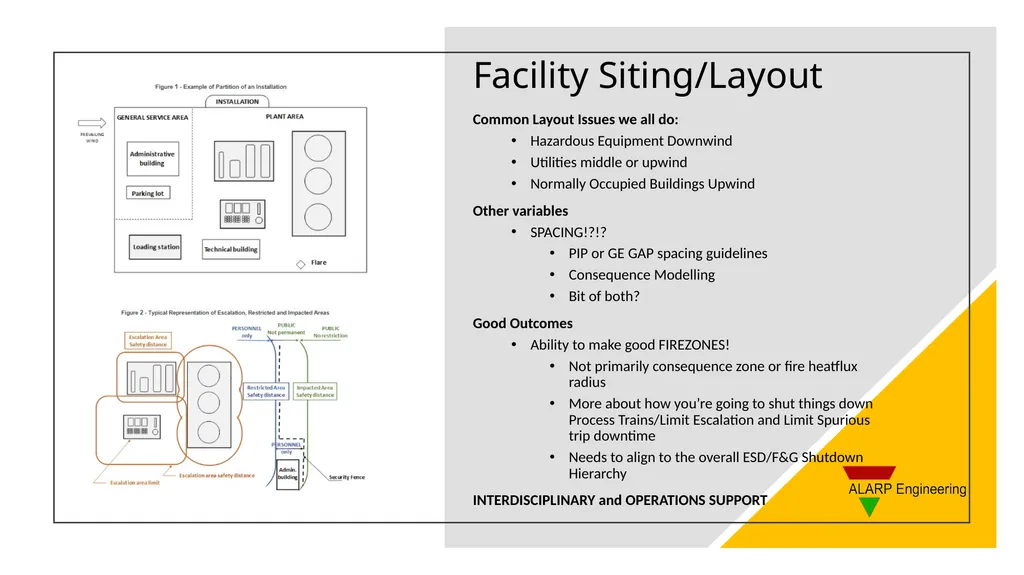
Facility Siting/Layout Common Layout Issues we all do:
Hazardous Equipment Downwind
Utilities middle or upwind
Normally Occupied Buildings Upwind
Other variables
SPACING!?!?
PIP or GE GAP spacing guidelines
Consequence Modelling
Bit of both?
Good Outcomes
Ability to make good FIREZONES!
Not primarily consequence zone or fire heatflux radius
More about how you’re going to shut things down Process Trains/Limit Escalation and Limit Spurious trip downtime
Needs to align to the overall ESD/F&G Shutdown Hierarchy
INTERDISCIPLINARY and OPERATIONS SUPPORT<br>
12
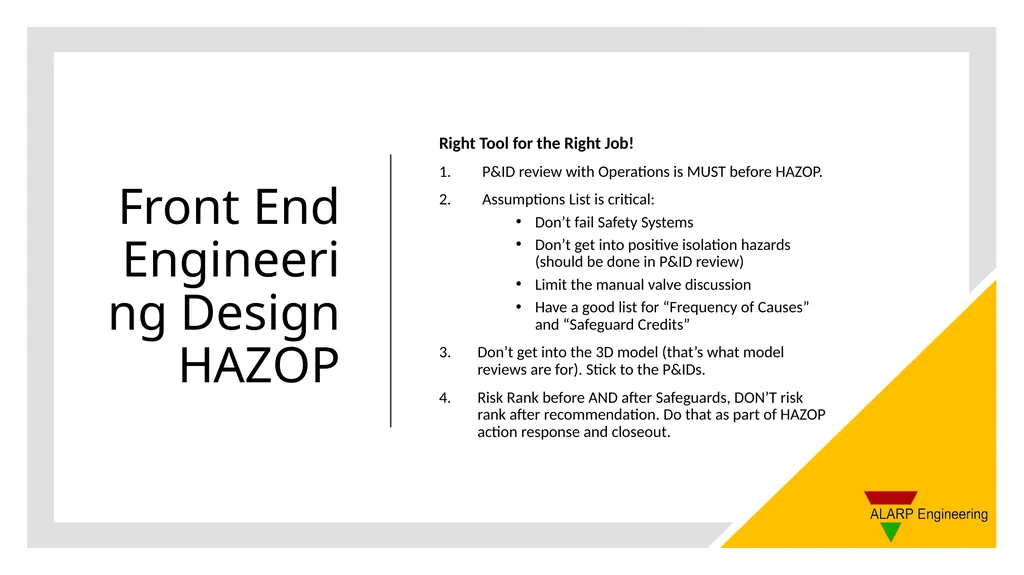
Front End Engineering Design HAZOP Right Tool for the Right Job!
P&ID review with Operations is MUST before HAZOP.
Assumptions List is critical:
Don’t fail Safety Systems
Don’t get into positive isolation hazards (should be done in P&ID review)
Limit the manual valve discussion
Have a good list for “Frequency of Causes” and “Safeguard Credits”
Don’t get into the 3D model (that’s what model reviews are for). Stick to the P&IDs.
Risk Rank before AND after Safeguards, DON’T risk rank after recommendation. Do that as part of HAZOP action response and closeout.<br>
13
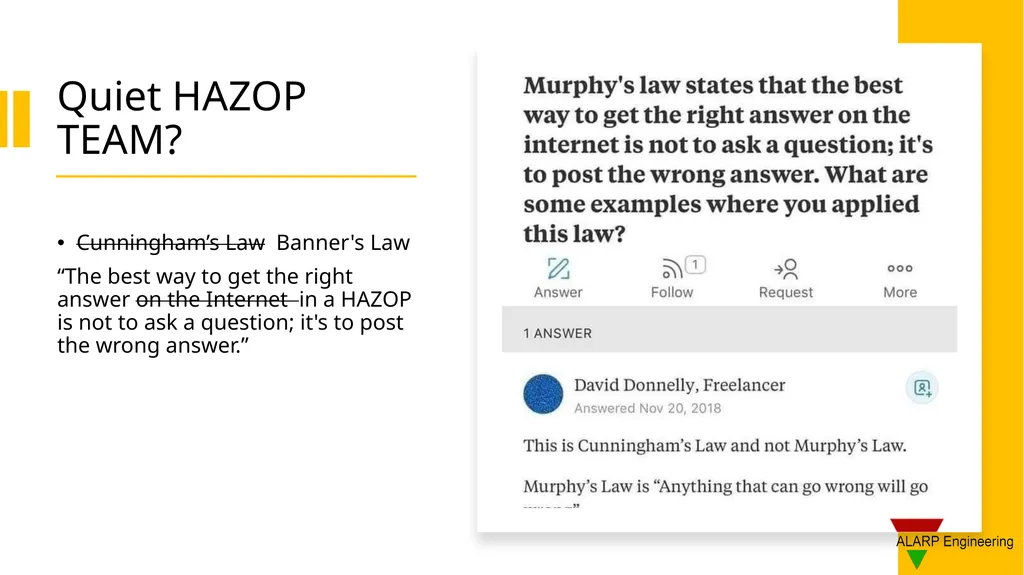
Quiet HAZOP TEAM? Cunningham’s Law Banner's Law
“The best way to get the right answer on the Internet in a HAZOP is not to ask a question; it's to post the wrong answer.”<br>
“The best way to get the right answer on the Internet in a HAZOP is not to ask a question; it's to post the wrong answer.”<br>
14
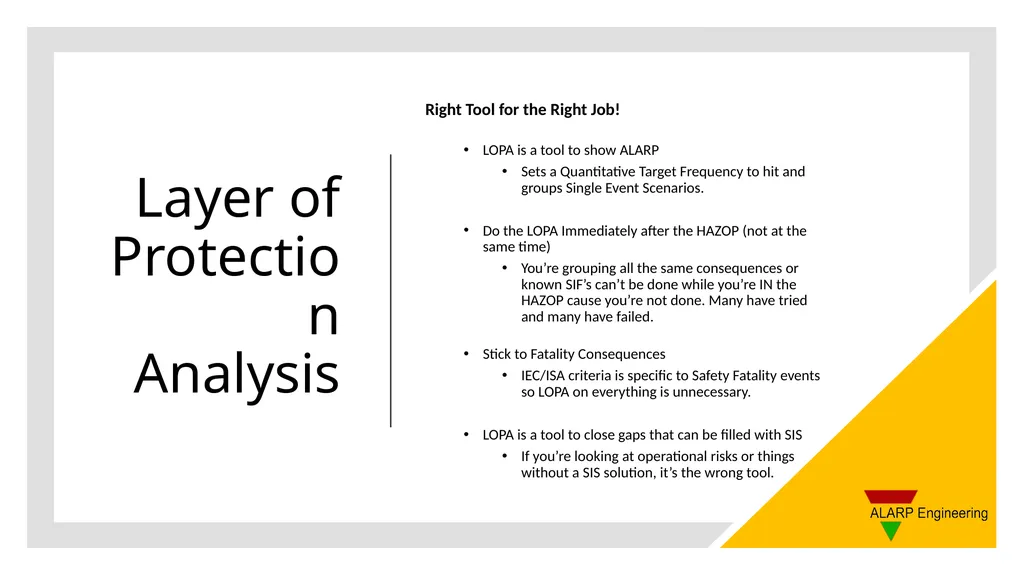
Layer of Protection Analysis Right Tool for the Right Job!
LOPA is a tool to show ALARP
Sets a Quantitative Target Frequency to hit and groups Single Event Scenarios.
Do the LOPA Immediately after the HAZOP (not at the same time)
You’re grouping all the same consequences or known SIF’s can’t be done while you’re IN the HAZOP cause you’re not done. Many have tried and many have failed.
Stick to Fatality Consequences
IEC/ISA criteria is specific to Safety Fatality events so LOPA on everything is unnecessary.
LOPA is a tool to close gaps that can be filled with SIS
If you’re looking at operational risks or things without a SIS solution, it’s the wrong tool.<br>
15
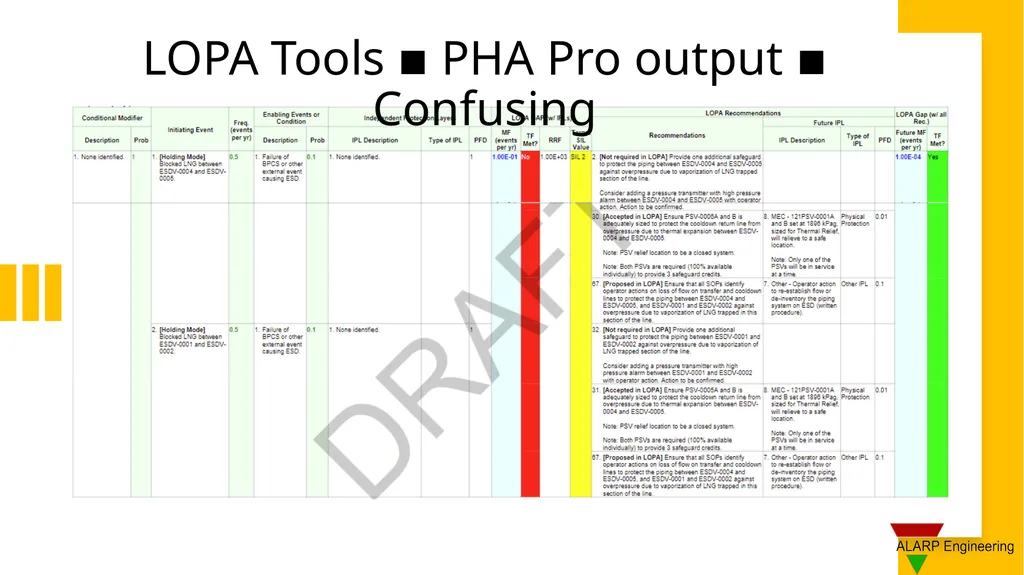
LOPA Tools ▪ PHA Pro output ▪ Confusing<br>
16
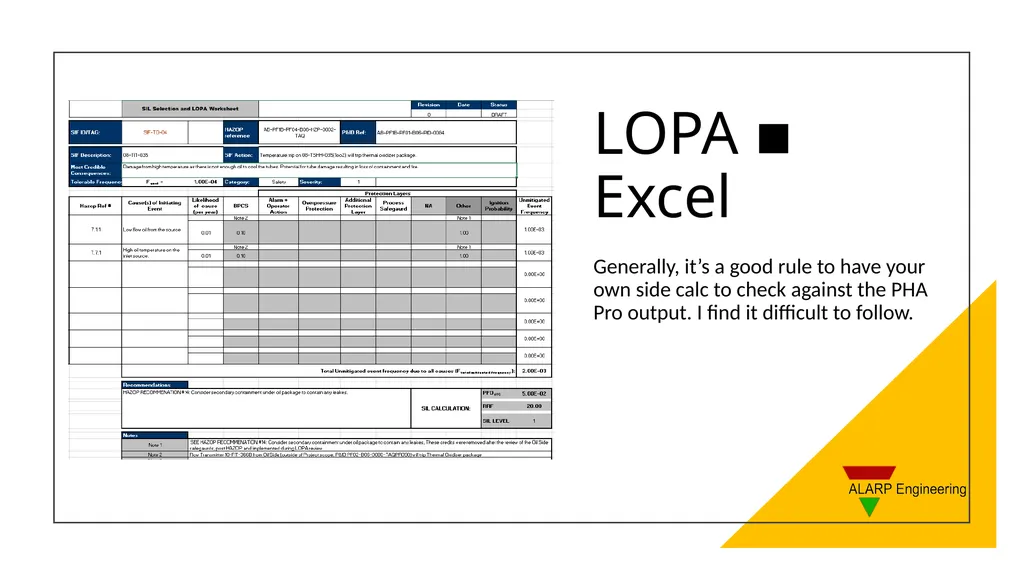
LOPA ▪ Excel Generally, it’s a good rule to have your own side calc to check against the PHA Pro output. I find it difficult to follow.<br>
17
SIL Verification Functional Safety Specialist area
Here is where I admit, I am weak…
I find that Training Courses are weak at producing people who can hit the ground running these
If you have a good consultant that can do these, hang onto them
Internationally there is different software that exists, they have different variables (MCI, beta factor, MTTR etc.)
Multiple international contractors – they expect different outputs
Operators should consider their own license and ability to lend out<br>
18
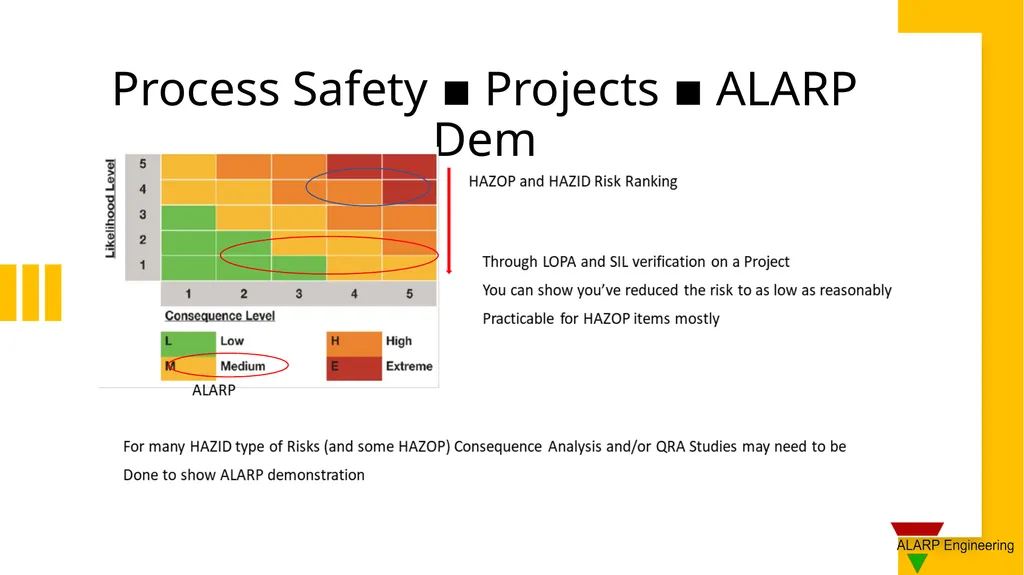
Process Safety ▪ Projects ▪ ALARP Dem<br>
19
Quantitative Risk Assessment (QRA) The QRA is a powerful tool that can put to rest many perceived risks to your facility. It’s a verification tool not a good design tool.
Again, right tool, right job QRA CAN DO
Provide Individual Risk to worker groups
Location Specific Risk to adjacent points of interest
Societal Risk fN curve criteria
Validate Layout & Manning
Provide Safe Design for Normally Occupied Buildings
SIMOP risks
Identify Largest Risk Contributors to show ALARP QRA CAN’T DO
Specific Process Controls (historical release)
Specific Detection and Isolation changes
Specific Flange vs Welding connections
Pipeline ESD locations/Timings<br>
20
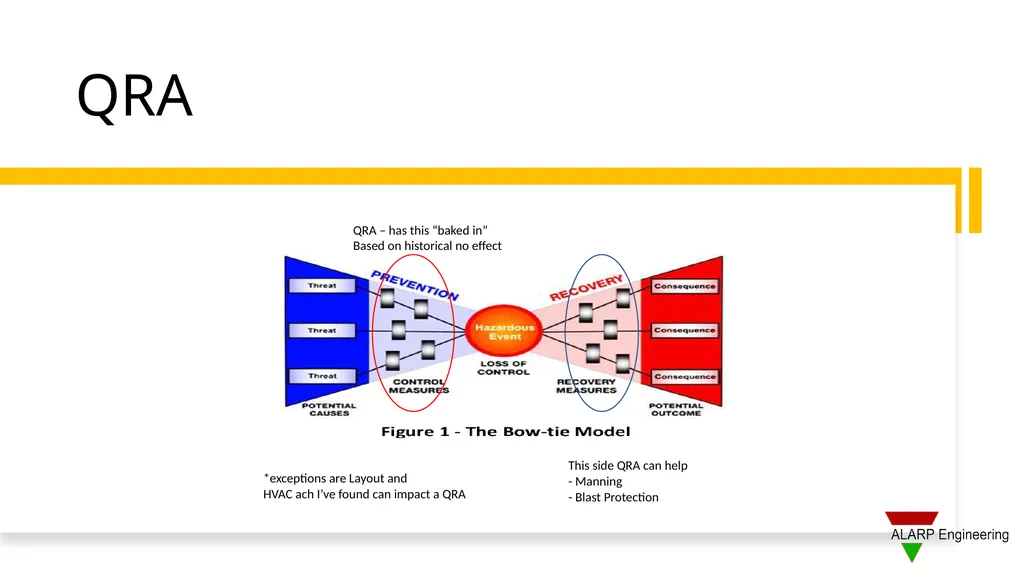
QRA QRA – has this “baked in”
Based on historical no effect This side QRA can help
- Manning
- Blast Protection *exceptions are Layout and
HVAC ach I’ve found can impact a QRA<br>
21
QRA ▪ Rule Sets The Devil is in the Details
Review the Rule Sets (ask for them)
Fatality Probit equations – Pool Fires are often over estimated
Escape Impairment – Often overlooked
Ignition Probabilities
Pooling Rates: Example – Propylene stored at elevation
Get the EVENT TREE
Don’t just read the report, ask for the event tree to follow the events to largest fatalities, make sure it makes sense<br>
22
Loss Prevention ▪ Firewater Systems Good ideas to be aware of when designing or reviewing a Firewater Systems
Fire rated division between Firewater Pumps – Firewater Pumps catch on fire, more often than you think.
Foam? Depends on if your firefighting or cooling. Monitors just cooling? – Top of a tank – Yes. Deluge maybe yes/no. Options.
Freezing in stagnant above ground sections (glycol works, heat tracing unreliable but ok solution).
TESTING LINE on Firewater Pump for Pressure and Flow (Cold Hydrant testing sucks).
Deluge Skid – Spend the money on Pressure Balancing Deluge Valve.
Total Firewater Demand: Firewater Hydraulics should be run both ways (explained on next page).<br>
23
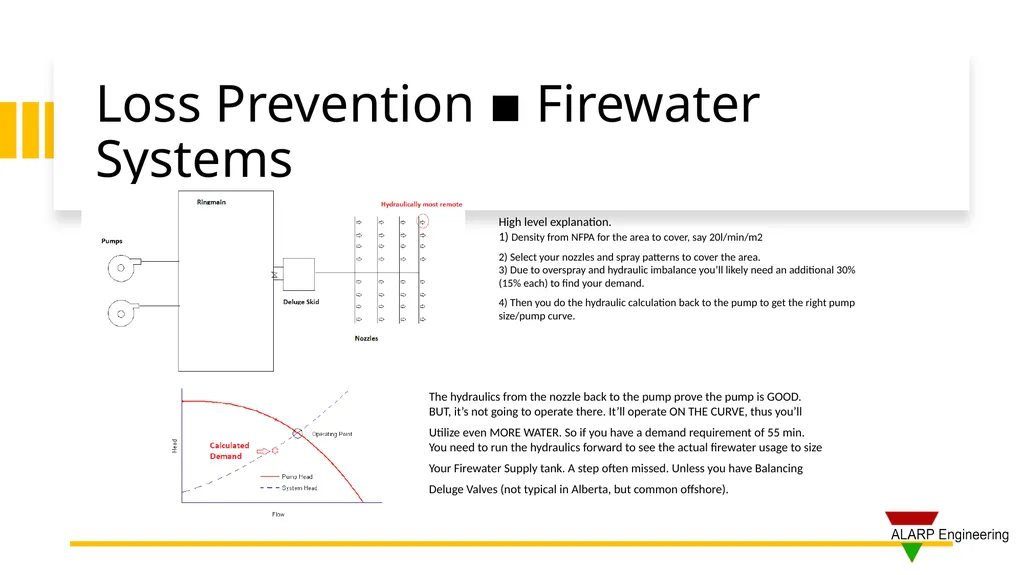
Loss Prevention ▪ Firewater Systems High level explanation.
1) Density from NFPA for the area to cover, say 20l/min/m2
2) Select your nozzles and spray patterns to cover the area. 3) Due to overspray and hydraulic imbalance you’ll likely need an additional 30% (15% each) to find your demand.
4) Then you do the hydraulic calculation back to the pump to get the right pump size/pump curve. The hydraulics from the nozzle back to the pump prove the pump is GOOD. BUT, it’s not going to operate there. It’ll operate ON THE CURVE, thus you’ll
Utilize even MORE WATER. So if you have a demand requirement of 55 min. You need to run the hydraulics forward to see the actual firewater usage to size
Your Firewater Supply tank. A step often missed. Unless you have Balancing
Deluge Valves (not typical in Alberta, but common offshore).<br>
24
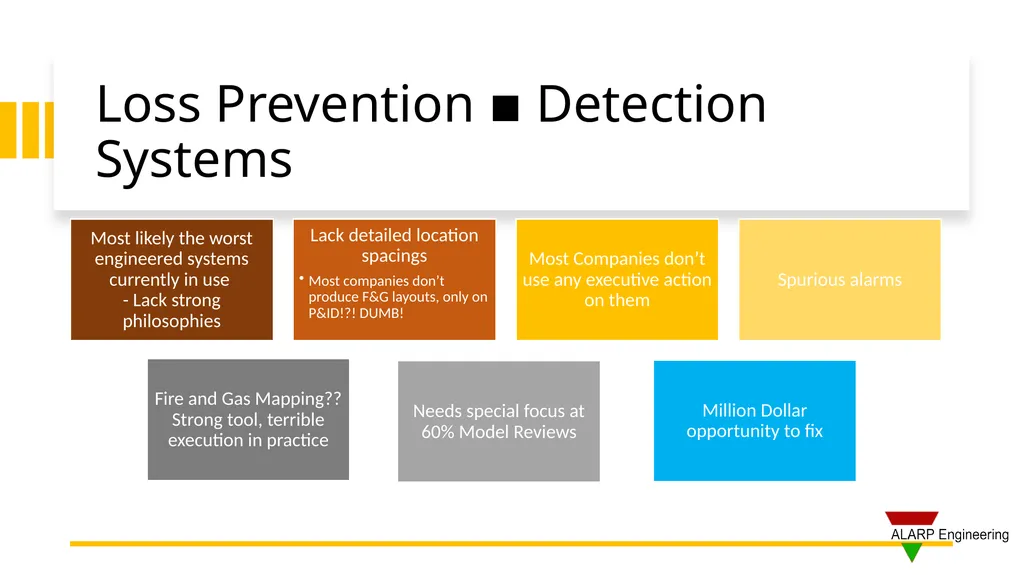
Loss Prevention ▪ Detection Systems<br>
25
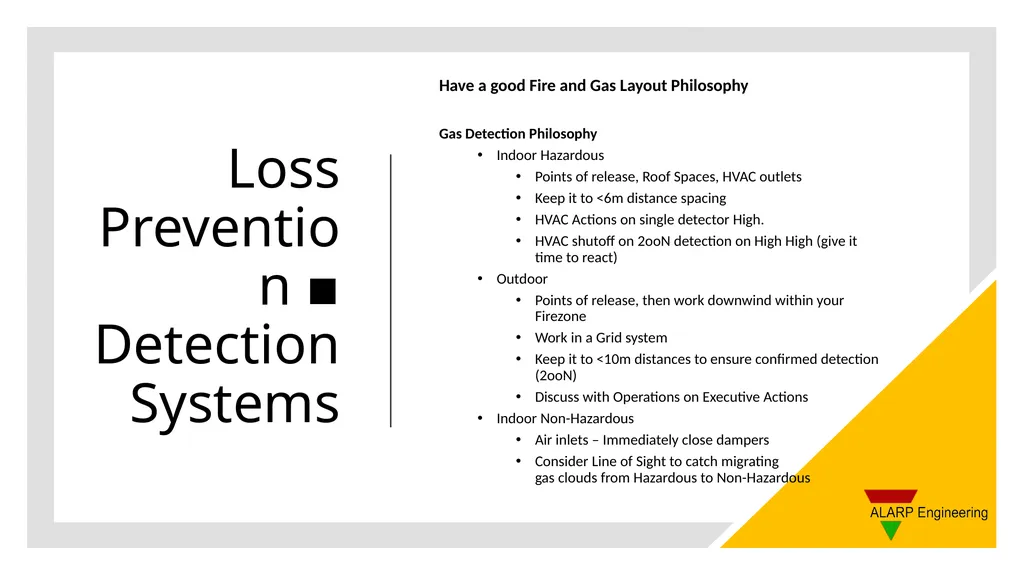
Loss Prevention ▪ Detection Systems Have a good Fire and Gas Layout Philosophy
Gas Detection Philosophy
Indoor Hazardous
Points of release, Roof Spaces, HVAC outlets
Keep it to <6m distance spacing
HVAC Actions on single detector High.
HVAC shutoff on 2ooN detection on High High (give it time to react)
Outdoor
Points of release, then work downwind within your Firezone
Work in a Grid system
Keep it to <10m distances to ensure confirmed detection (2ooN)
Discuss with Operations on Executive Actions
Indoor Non-Hazardous
Air inlets – Immediately close dampers
Consider Line of Sight to catch migrating gas clouds from Hazardous to Non-Hazardous<br>
26
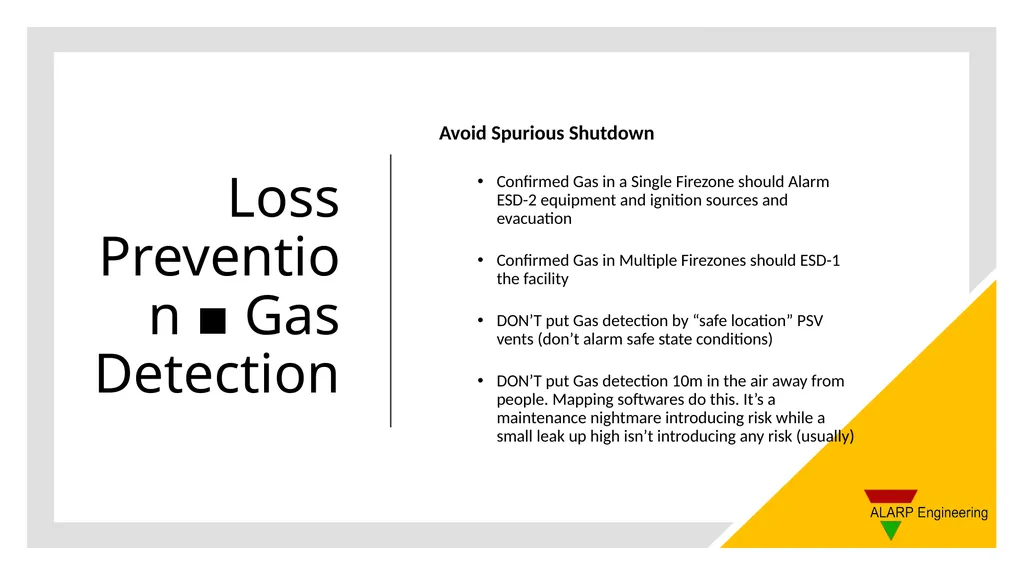
Loss Prevention ▪ Gas Detection Avoid Spurious Shutdown
Confirmed Gas in a Single Firezone should Alarm ESD-2 equipment and ignition sources and evacuation
Confirmed Gas in Multiple Firezones should ESD-1 the facility
DON’T put Gas detection by “safe location” PSV vents (don’t alarm safe state conditions)
DON’T put Gas detection 10m in the air away from people. Mapping softwares do this. It’s a maintenance nightmare introducing risk while a small leak up high isn’t introducing any risk (usually)<br>
27
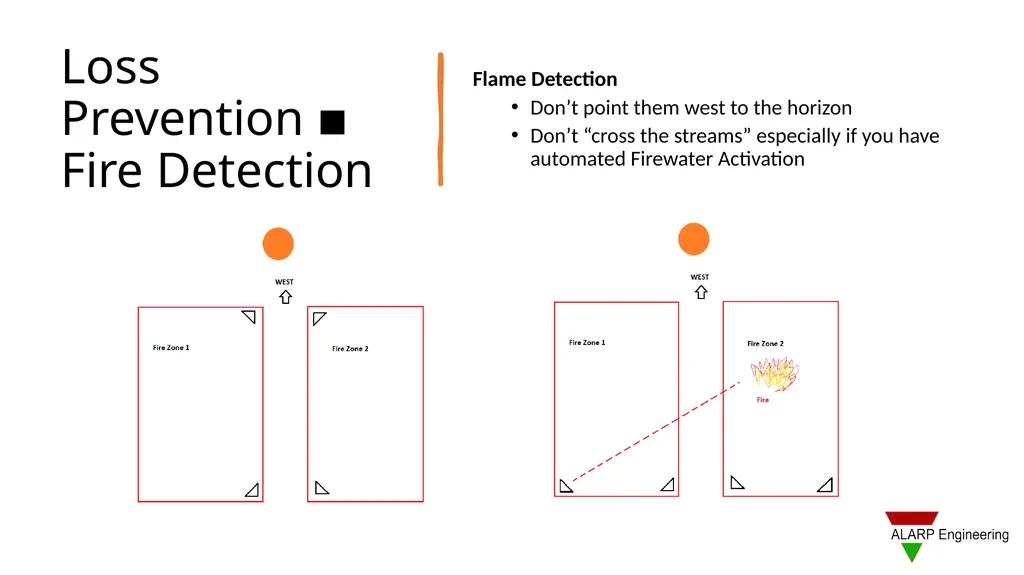
Loss Prevention ▪ Fire Detection Flame Detection
Don’t point them west to the horizon
Don’t “cross the streams” especially if you have automated Firewater Activation<br>
Don’t point them west to the horizon
Don’t “cross the streams” especially if you have automated Firewater Activation<br>
28
Questions?<br>