
Technology and Skills in the Digital Industries
BR
Published · 23 slides · 0 views

1 / 1



Description
Technology and Skills in the Digital Industries Introduction The UK Commission is working to transform the UKs approach to investing in the skills of its people as an intrinsic part of securing jobs and growth. Key to our ambition is the
Related Topics
Share
Embed code
Download this presentation From Below
"Technology and Skills in the Digital Industries" is the property of its rightful owner. Permission is granted to download and print the materials on this website for personal, non-commercial use only, and to display it on your personal computer provided you do not modify the materials and that you retain all copyright notices contained in the materials. By downloading content from our website, you accept the terms of this agreement.
Presentation Transcript
01
Technology and Skills in the Digital Industries<br>
02
Introduction The UK Commission is working to transform the UK’s approach to investing in the skills of it’s people as an intrinsic part of securing jobs and growth. Key to our ambition is the need to encourage greater employer ownership of skills, working to secure long term sustainable partnerships.
This slide pack and accompanying evidence report present the case for more employers to invest in developing higher level skills in the Digital Sector. It does so by drawing on a range data sources, and qualitative findings in four emerging technologies; Cyber Security, Mobile Technologies, Green IT and Cloud Computing.
Slide packs and reports are also available for a number of other sectors from: www.ukces.org.uk Each of the sectors are important to the economy in terms of driving up higher level skills through technological advancements.
For information about this slide pack and accompanying report please contact:
Rachel Pinto (Rachel.pinto@ukces.org.uk)
Source information can be found in the notes section of each slide.<br>
This slide pack and accompanying evidence report present the case for more employers to invest in developing higher level skills in the Digital Sector. It does so by drawing on a range data sources, and qualitative findings in four emerging technologies; Cyber Security, Mobile Technologies, Green IT and Cloud Computing.
Slide packs and reports are also available for a number of other sectors from: www.ukces.org.uk Each of the sectors are important to the economy in terms of driving up higher level skills through technological advancements.
For information about this slide pack and accompanying report please contact:
Rachel Pinto (Rachel.pinto@ukces.org.uk)
Source information can be found in the notes section of each slide.<br>
03
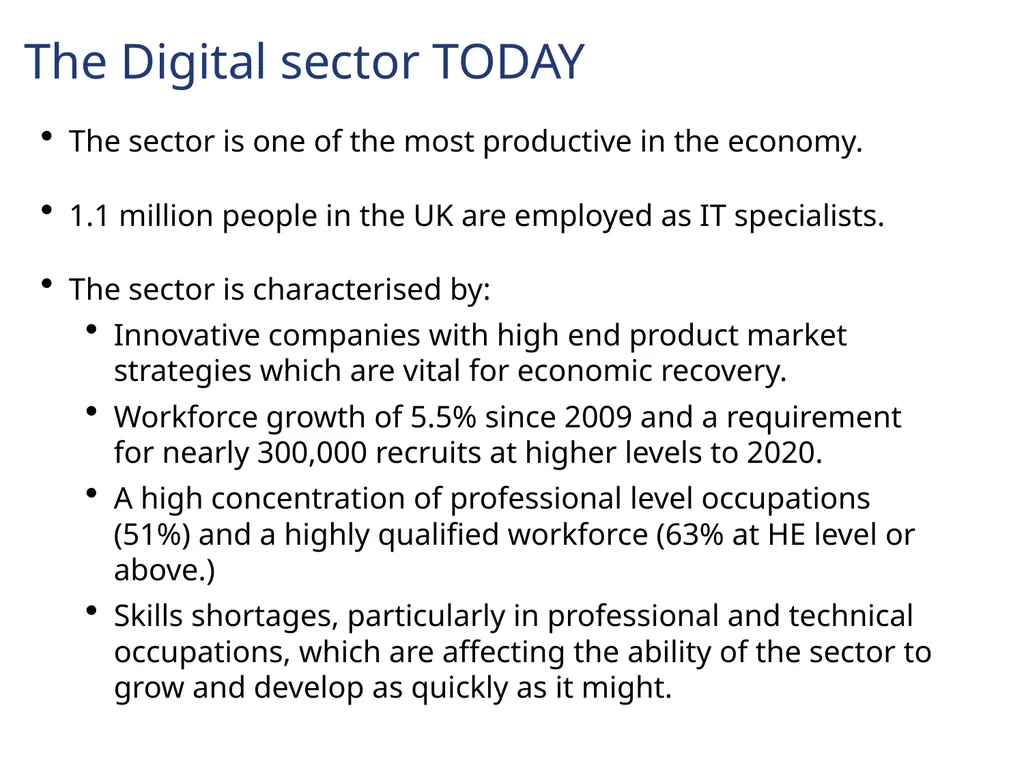
The Digital sector TODAY The sector is one of the most productive in the economy.
1.1 million people in the UK are employed as IT specialists.
The sector is characterised by:
Innovative companies with high end product market strategies which are vital for economic recovery.
Workforce growth of 5.5% since 2009 and a requirement for nearly 300,000 recruits at higher levels to 2020.
A high concentration of professional level occupations (51%) and a highly qualified workforce (63% at HE level or above.)
Skills shortages, particularly in professional and technical occupations, which are affecting the ability of the sector to grow and develop as quickly as it might.<br>
1.1 million people in the UK are employed as IT specialists.
The sector is characterised by:
Innovative companies with high end product market strategies which are vital for economic recovery.
Workforce growth of 5.5% since 2009 and a requirement for nearly 300,000 recruits at higher levels to 2020.
A high concentration of professional level occupations (51%) and a highly qualified workforce (63% at HE level or above.)
Skills shortages, particularly in professional and technical occupations, which are affecting the ability of the sector to grow and develop as quickly as it might.<br>
04
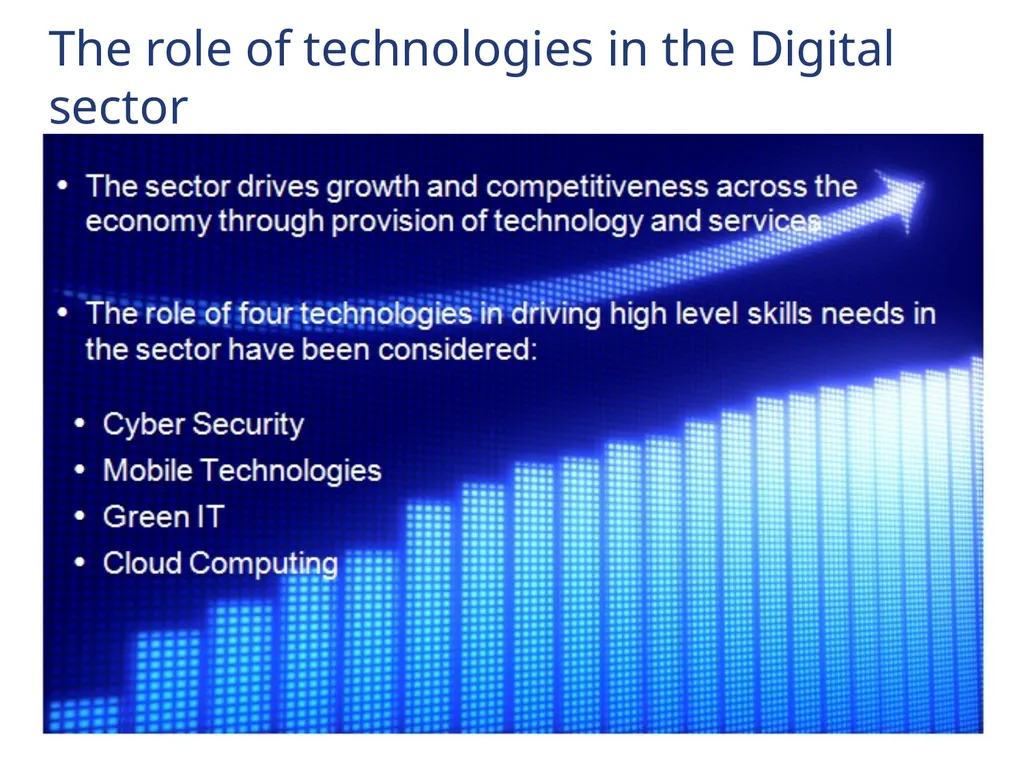
The role of technologies in the Digital sector<br>
05
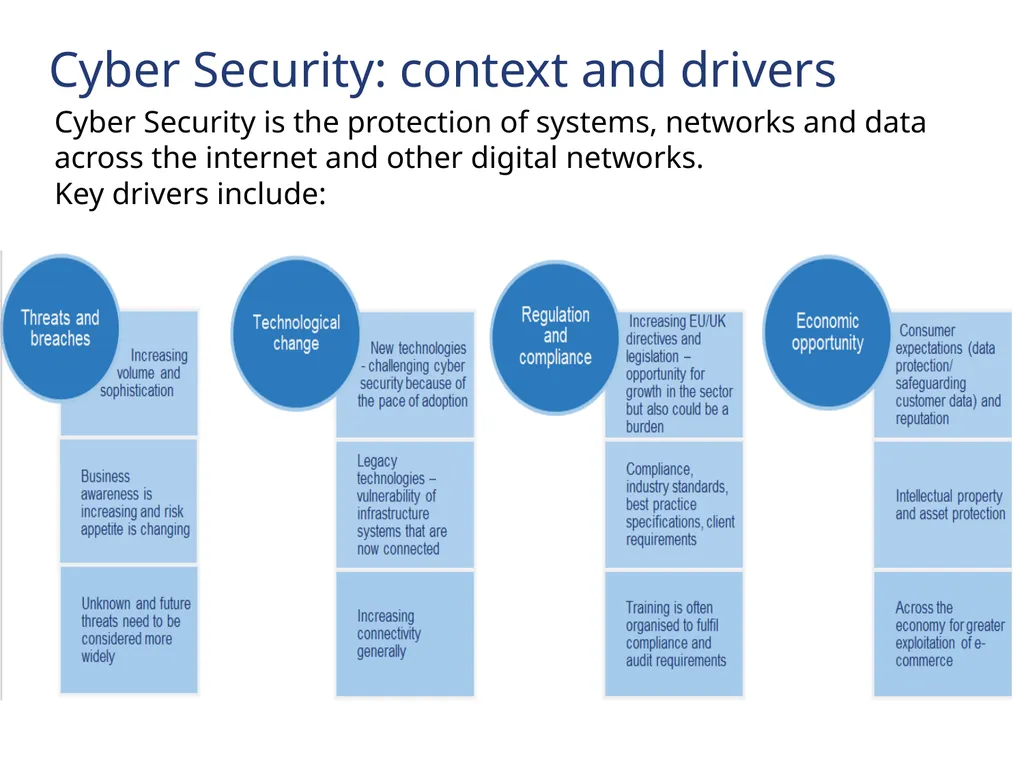
Cyber Security: context and drivers Cyber Security is the protection of systems, networks and data
across the internet and other digital networks.
Key drivers include:<br>
across the internet and other digital networks.
Key drivers include:<br>
06
Cyber Security: roles and recruitment The most common higher level roles include:
Information (IT) Security Manager
Information Security Consultant
Chief Information Security Officer (CISO)
Security Architect
Security Designer
Security Analyst Increasing demand is widely reported and employers face significant challenges in recruiting senior staff, retention and skills issues: “Interviews ...confirmed that the UK lacks technical skills and that the current pipeline of graduates and practitioners would not meet demand.” (NAO, 2013)<br>
Information (IT) Security Manager
Information Security Consultant
Chief Information Security Officer (CISO)
Security Architect
Security Designer
Security Analyst Increasing demand is widely reported and employers face significant challenges in recruiting senior staff, retention and skills issues: “Interviews ...confirmed that the UK lacks technical skills and that the current pipeline of graduates and practitioners would not meet demand.” (NAO, 2013)<br>
07
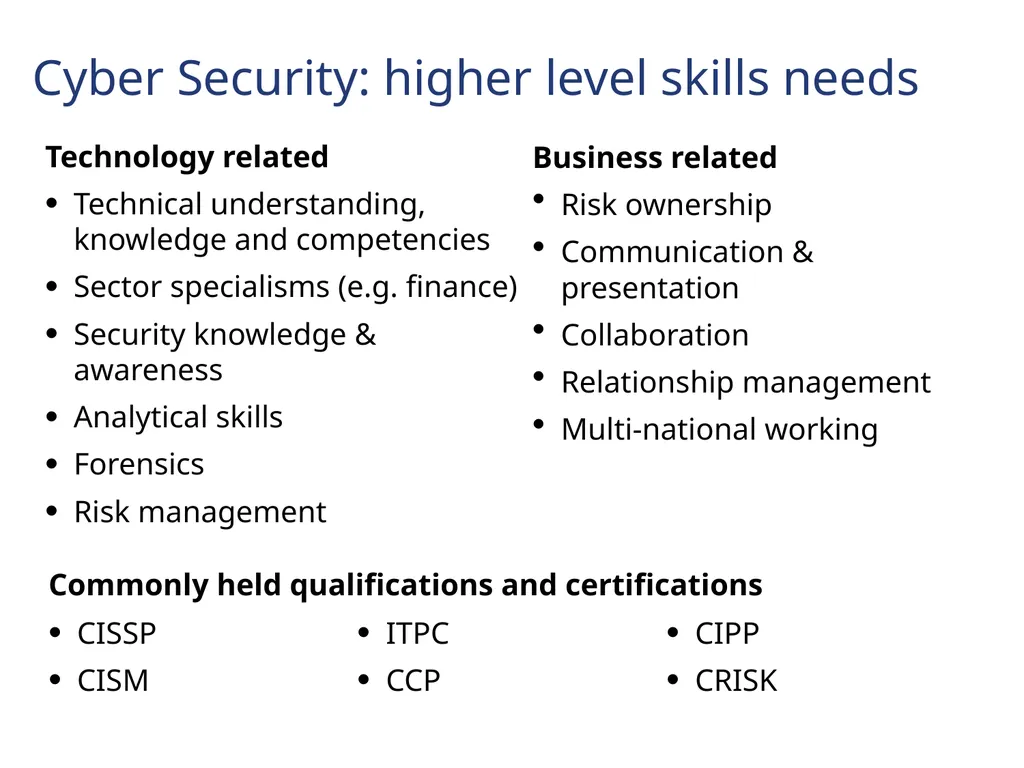
Cyber Security: higher level skills needs Business related
Risk ownership
Communication & presentation
Collaboration
Relationship management
Multi-national working Technology related
Technical understanding, knowledge and competencies
Sector specialisms (e.g. finance)
Security knowledge & awareness
Analytical skills
Forensics
Risk management CISSP
CISM
ITPC
CCP
CIPP
CRISK Commonly held qualifications and certifications<br>
Risk ownership
Communication & presentation
Collaboration
Relationship management
Multi-national working Technology related
Technical understanding, knowledge and competencies
Sector specialisms (e.g. finance)
Security knowledge & awareness
Analytical skills
Forensics
Risk management CISSP
CISM
ITPC
CCP
CIPP
CRISK Commonly held qualifications and certifications<br>
08
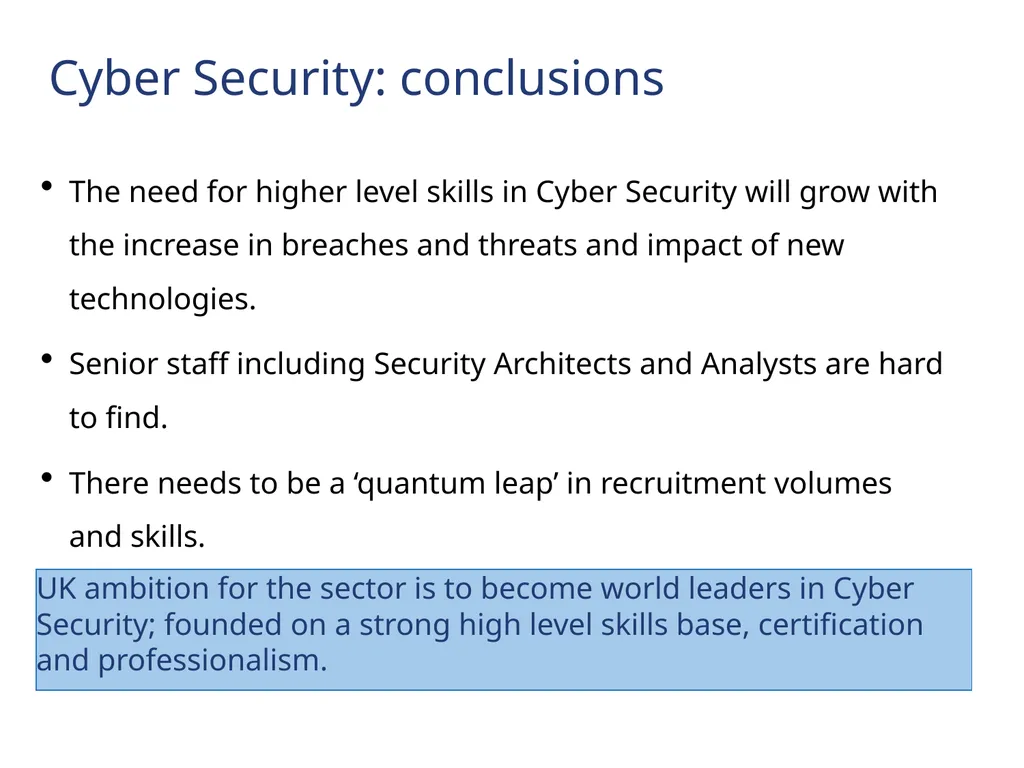
Cyber Security: conclusions The need for higher level skills in Cyber Security will grow with the increase in breaches and threats and impact of new technologies.
Senior staff including Security Architects and Analysts are hard to find.
There needs to be a ‘quantum leap’ in recruitment volumes and skills. UK ambition for the sector is to become world leaders in Cyber Security; founded on a strong high level skills base, certification and professionalism.<br>
Senior staff including Security Architects and Analysts are hard to find.
There needs to be a ‘quantum leap’ in recruitment volumes and skills. UK ambition for the sector is to become world leaders in Cyber Security; founded on a strong high level skills base, certification and professionalism.<br>
09
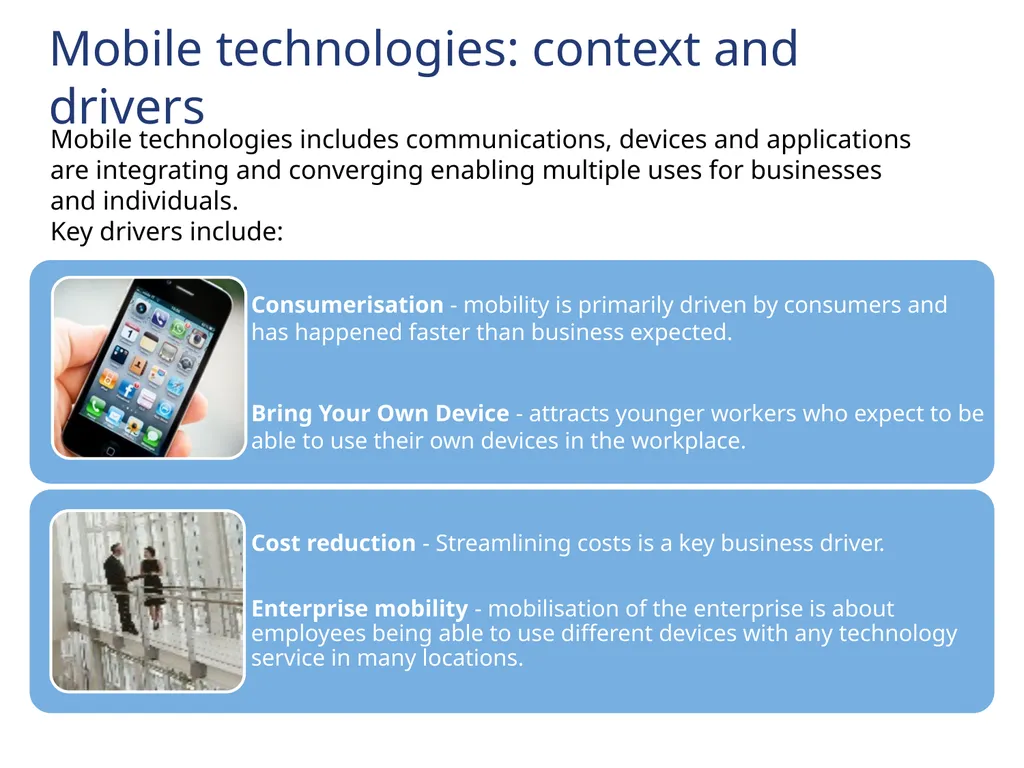
Mobile technologies: context and drivers Mobile technologies includes communications, devices and applications are integrating and converging enabling multiple uses for businesses and individuals.
Key drivers include:<br>
Key drivers include:<br>
10
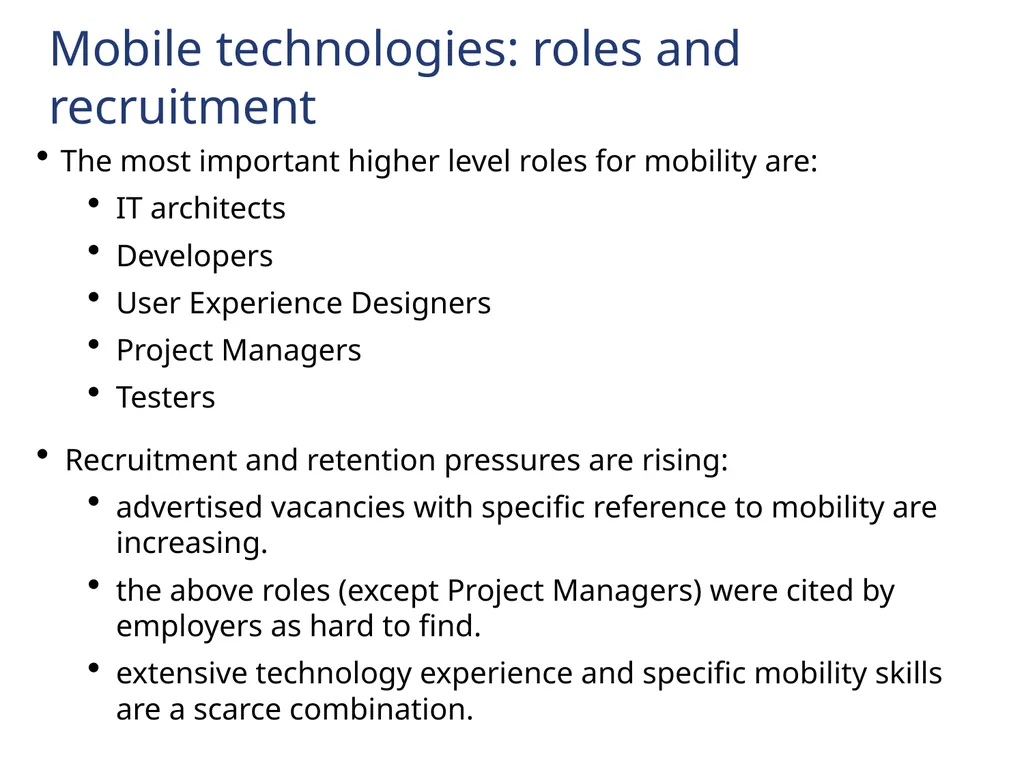
Mobile technologies: roles and recruitment The most important higher level roles for mobility are:
IT architects
Developers
User Experience Designers
Project Managers
Testers
Recruitment and retention pressures are rising:
advertised vacancies with specific reference to mobility are increasing.
the above roles (except Project Managers) were cited by employers as hard to find.
extensive technology experience and specific mobility skills are a scarce combination.<br>
IT architects
Developers
User Experience Designers
Project Managers
Testers
Recruitment and retention pressures are rising:
advertised vacancies with specific reference to mobility are increasing.
the above roles (except Project Managers) were cited by employers as hard to find.
extensive technology experience and specific mobility skills are a scarce combination.<br>
11
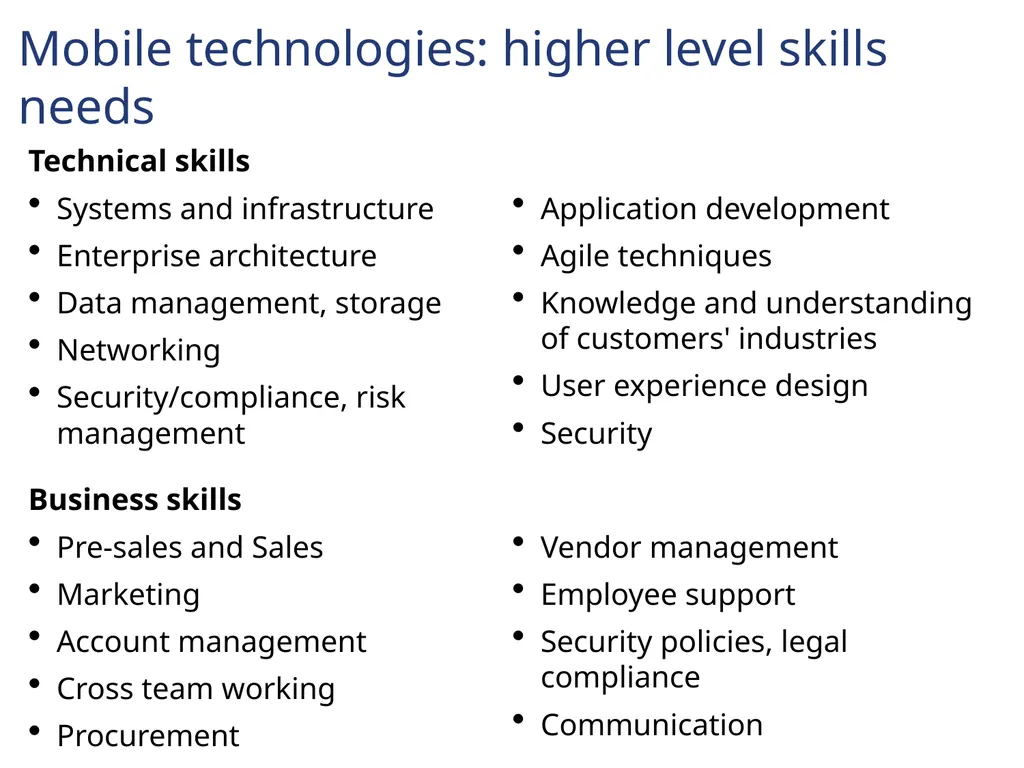
Mobile technologies: higher level skills needs Technical skills
Systems and infrastructure
Enterprise architecture
Data management, storage
Networking
Security/compliance, risk management
Application development
Agile techniques
Knowledge and understanding of customers' industries
User experience design
Security Business skills
Pre-sales and Sales
Marketing
Account management
Cross team working
Procurement
Vendor management
Employee support
Security policies, legal compliance
Communication<br>
Systems and infrastructure
Enterprise architecture
Data management, storage
Networking
Security/compliance, risk management
Application development
Agile techniques
Knowledge and understanding of customers' industries
User experience design
Security Business skills
Pre-sales and Sales
Marketing
Account management
Cross team working
Procurement
Vendor management
Employee support
Security policies, legal compliance
Communication<br>
12
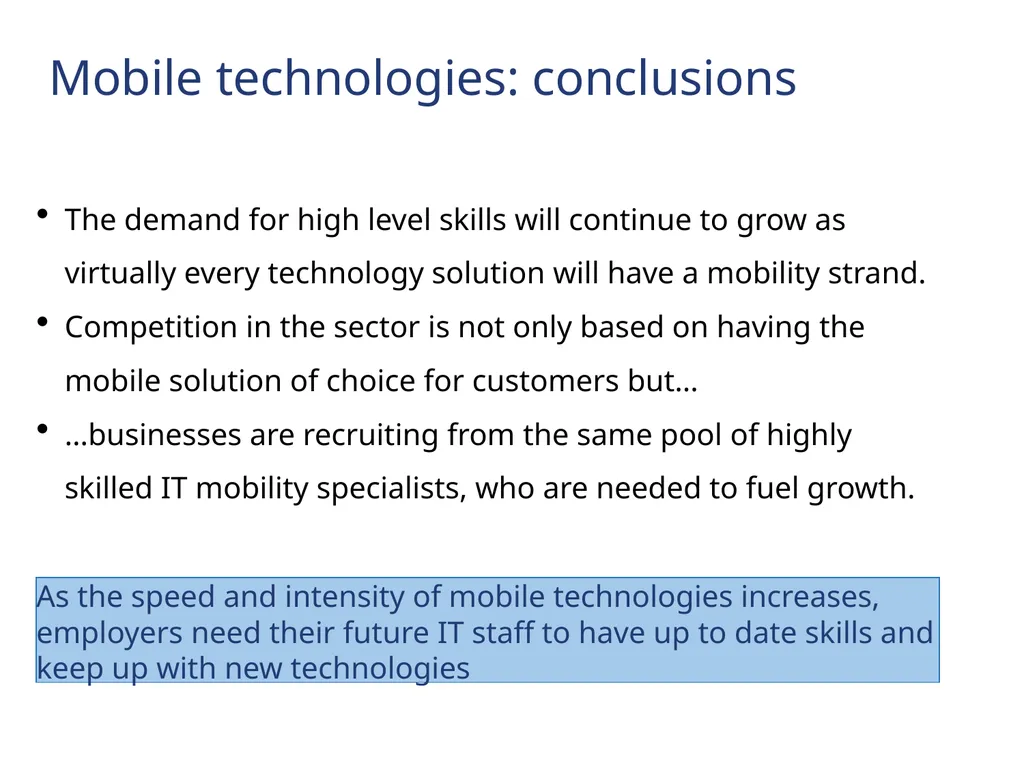
Mobile technologies: conclusions The demand for high level skills will continue to grow as virtually every technology solution will have a mobility strand.
Competition in the sector is not only based on having the mobile solution of choice for customers but…
…businesses are recruiting from the same pool of highly skilled IT mobility specialists, who are needed to fuel growth. As the speed and intensity of mobile technologies increases, employers need their future IT staff to have up to date skills and keep up with new technologies<br>
Competition in the sector is not only based on having the mobile solution of choice for customers but…
…businesses are recruiting from the same pool of highly skilled IT mobility specialists, who are needed to fuel growth. As the speed and intensity of mobile technologies increases, employers need their future IT staff to have up to date skills and keep up with new technologies<br>
13
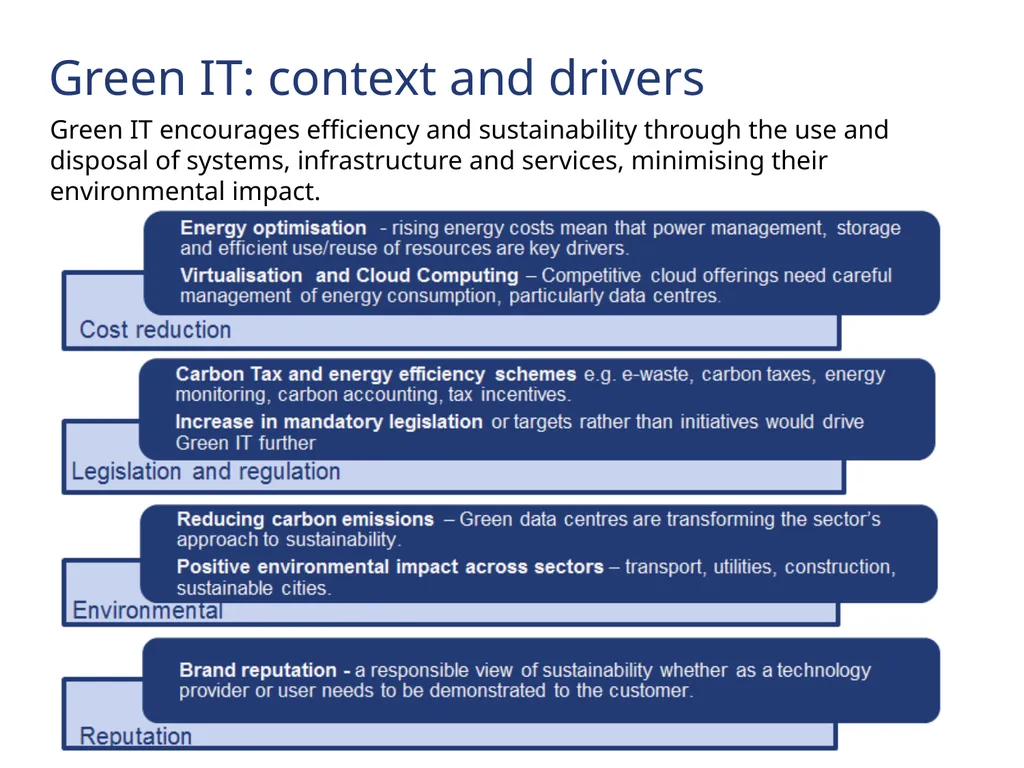
Green IT: context and drivers Green IT encourages efficiency and sustainability through the use and disposal of systems, infrastructure and services, minimising their environmental impact.
Key drivers include:<br>
Key drivers include:<br>
14
Green IT: roles and recruitment The most important higher level roles
IT – Business Strategists
IT Architects
Big Data Specialists
Solution Designers
System Designers and System Managers
Network Specialists
Research and Development<br>
IT – Business Strategists
IT Architects
Big Data Specialists
Solution Designers
System Designers and System Managers
Network Specialists
Research and Development<br>
15
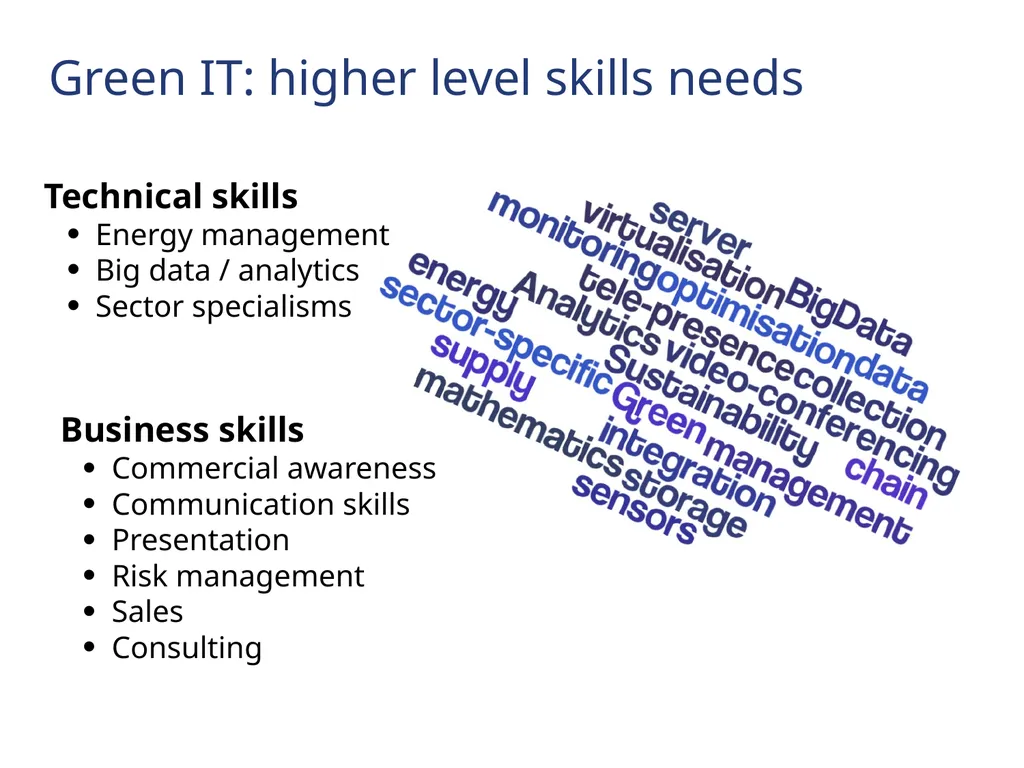
Green IT: higher level skills needs Technical skills
Energy management
Big data / analytics
Sector specialisms Business skills
Commercial awareness
Communication skills
Presentation
Risk management
Sales
Consulting<br>
Energy management
Big data / analytics
Sector specialisms Business skills
Commercial awareness
Communication skills
Presentation
Risk management
Sales
Consulting<br>
16
Green IT: conclusions Green IT offers the opportunities for the Digital sector to provide more products and services as sustainability eventually pervades all parts of the customers business.
Evangelists of sustainability will drive Green IT across the business.
Technical IT skills with sector specialisms will deliver the sustainability agenda in many sectors including utilities, construction, logistics and the public sector. Increasing volumes of specialists with strategic high level skills, (founded on deep technology, fundamental STEM principles, mathematics and R&D) will be needed to develop ongoing and future Green IT solutions.<br>
Evangelists of sustainability will drive Green IT across the business.
Technical IT skills with sector specialisms will deliver the sustainability agenda in many sectors including utilities, construction, logistics and the public sector. Increasing volumes of specialists with strategic high level skills, (founded on deep technology, fundamental STEM principles, mathematics and R&D) will be needed to develop ongoing and future Green IT solutions.<br>
17
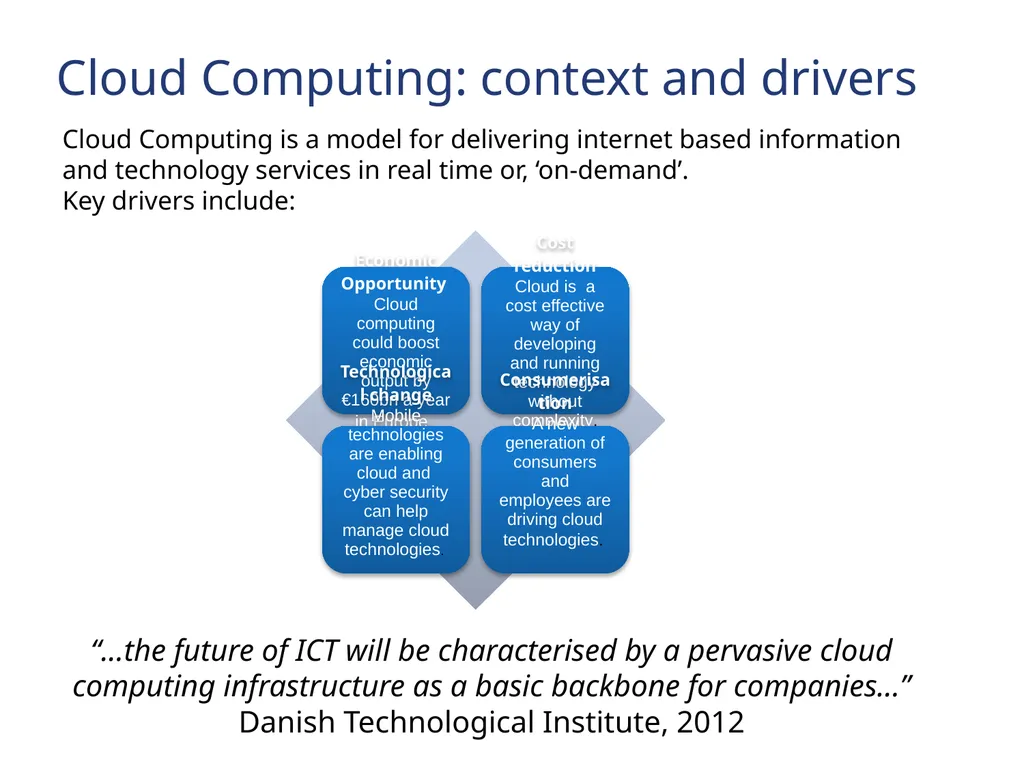
Cloud Computing: context and drivers “...the future of ICT will be characterised by a pervasive cloud computing infrastructure as a basic backbone for companies...” Danish Technological Institute, 2012 Cloud Computing is a model for delivering internet based information and technology services in real time or, ‘on-demand’.
Key drivers include:<br>
Key drivers include:<br>
18
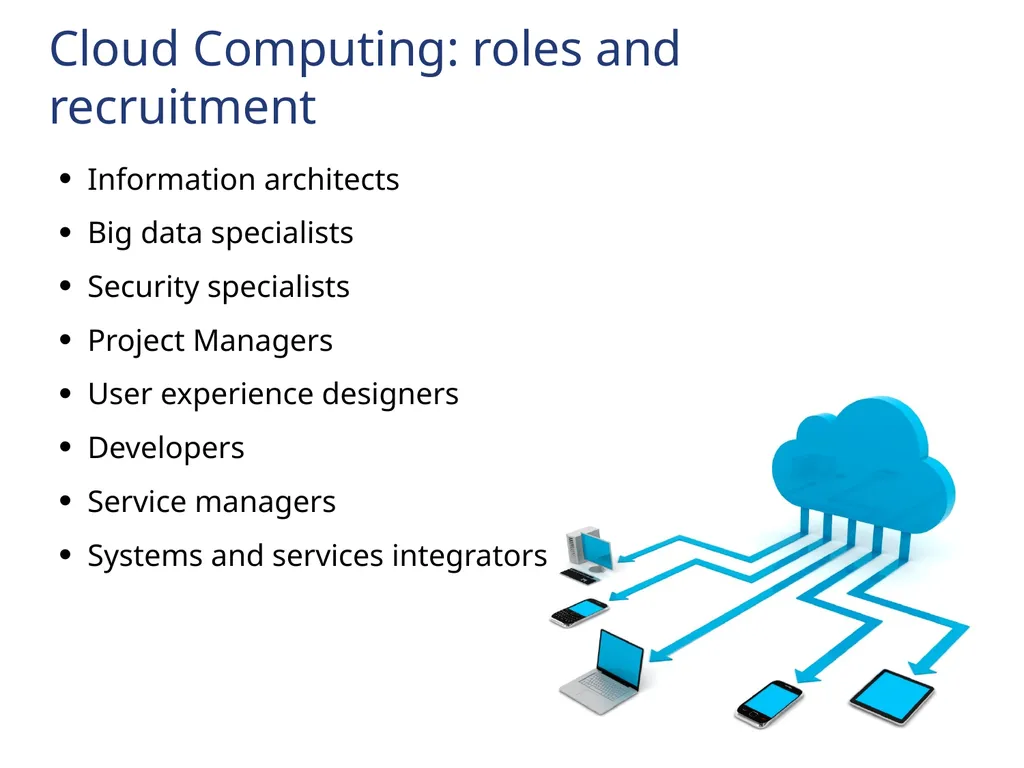
Cloud Computing: roles and recruitment Information architects
Big data specialists
Security specialists
Project Managers
User experience designers
Developers
Service managers
Systems and services integrators<br>
Big data specialists
Security specialists
Project Managers
User experience designers
Developers
Service managers
Systems and services integrators<br>
19
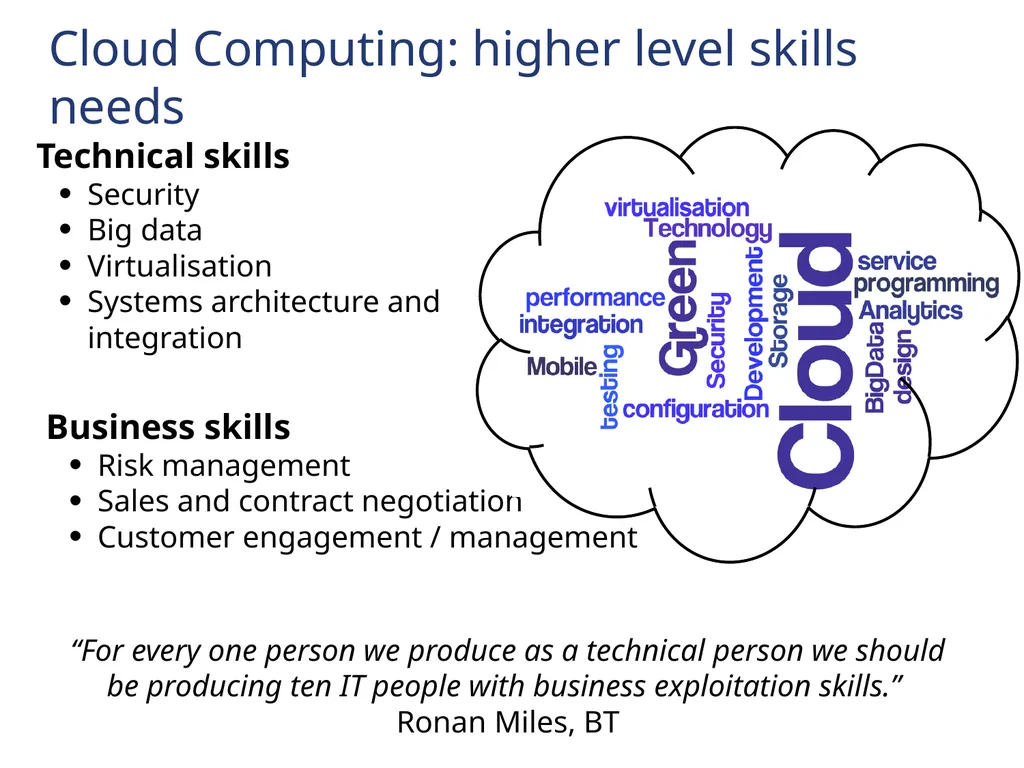
Cloud Computing: higher level skills needs “For every one person we produce as a technical person we should be producing ten IT people with business exploitation skills.”
Ronan Miles, BT Technical skills
Security
Big data
Virtualisation
Systems architecture and integration Business skills
Risk management
Sales and contract negotiation
Customer engagement / management<br>
Ronan Miles, BT Technical skills
Security
Big data
Virtualisation
Systems architecture and integration Business skills
Risk management
Sales and contract negotiation
Customer engagement / management<br>
20
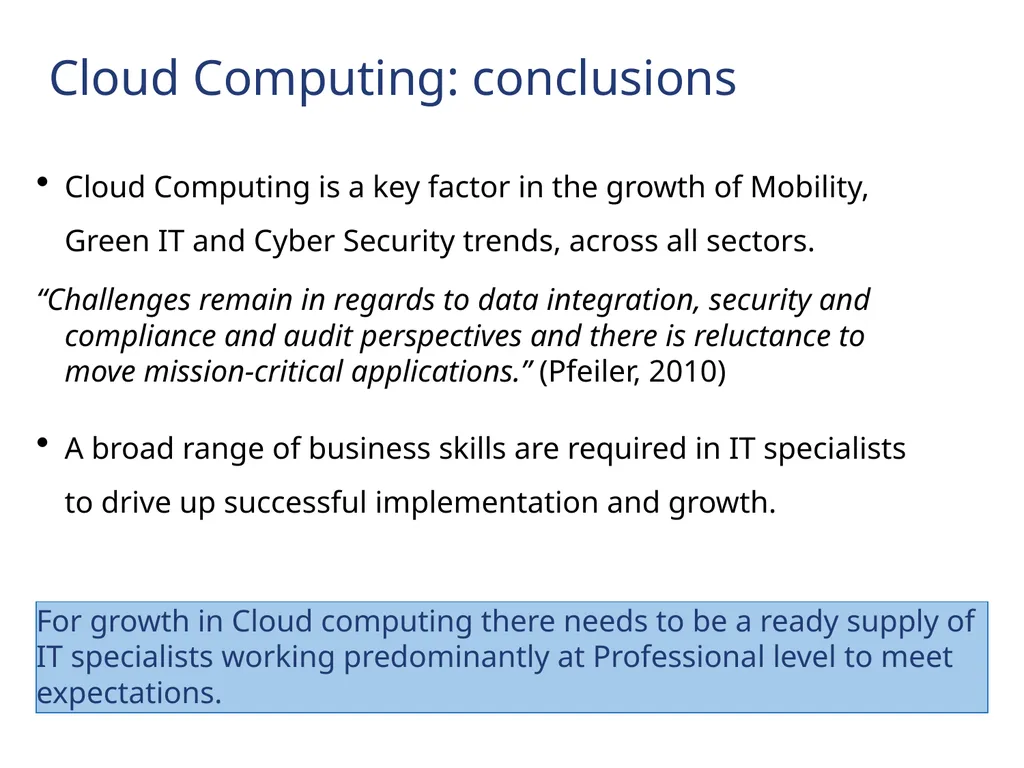
Cloud Computing: conclusions Cloud Computing is a key factor in the growth of Mobility, Green IT and Cyber Security trends, across all sectors.
“Challenges remain in regards to data integration, security and compliance and audit perspectives and there is reluctance to move mission-critical applications.” (Pfeiler, 2010)
A broad range of business skills are required in IT specialists to drive up successful implementation and growth. For growth in Cloud computing there needs to be a ready supply of IT specialists working predominantly at Professional level to meet expectations.<br>
“Challenges remain in regards to data integration, security and compliance and audit perspectives and there is reluctance to move mission-critical applications.” (Pfeiler, 2010)
A broad range of business skills are required in IT specialists to drive up successful implementation and growth. For growth in Cloud computing there needs to be a ready supply of IT specialists working predominantly at Professional level to meet expectations.<br>
21
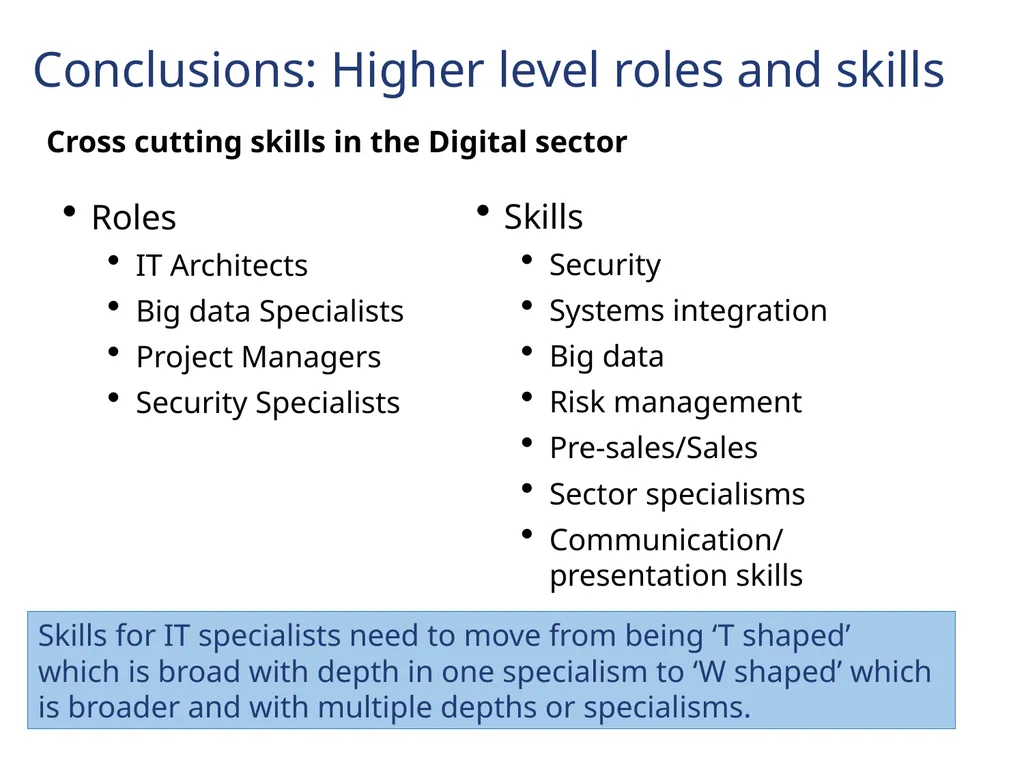
Conclusions: Higher level roles and skills Skills
Security
Systems integration
Big data
Risk management
Pre-sales/Sales
Sector specialisms
Communication/ presentation skills Cross cutting skills in the Digital sector Skills for IT specialists need to move from being ‘T shaped’ which is broad with depth in one specialism to ‘W shaped’ which is broader and with multiple depths or specialisms. Roles
IT Architects
Big data Specialists
Project Managers
Security Specialists<br>
Security
Systems integration
Big data
Risk management
Pre-sales/Sales
Sector specialisms
Communication/ presentation skills Cross cutting skills in the Digital sector Skills for IT specialists need to move from being ‘T shaped’ which is broad with depth in one specialism to ‘W shaped’ which is broader and with multiple depths or specialisms. Roles
IT Architects
Big data Specialists
Project Managers
Security Specialists<br>
22
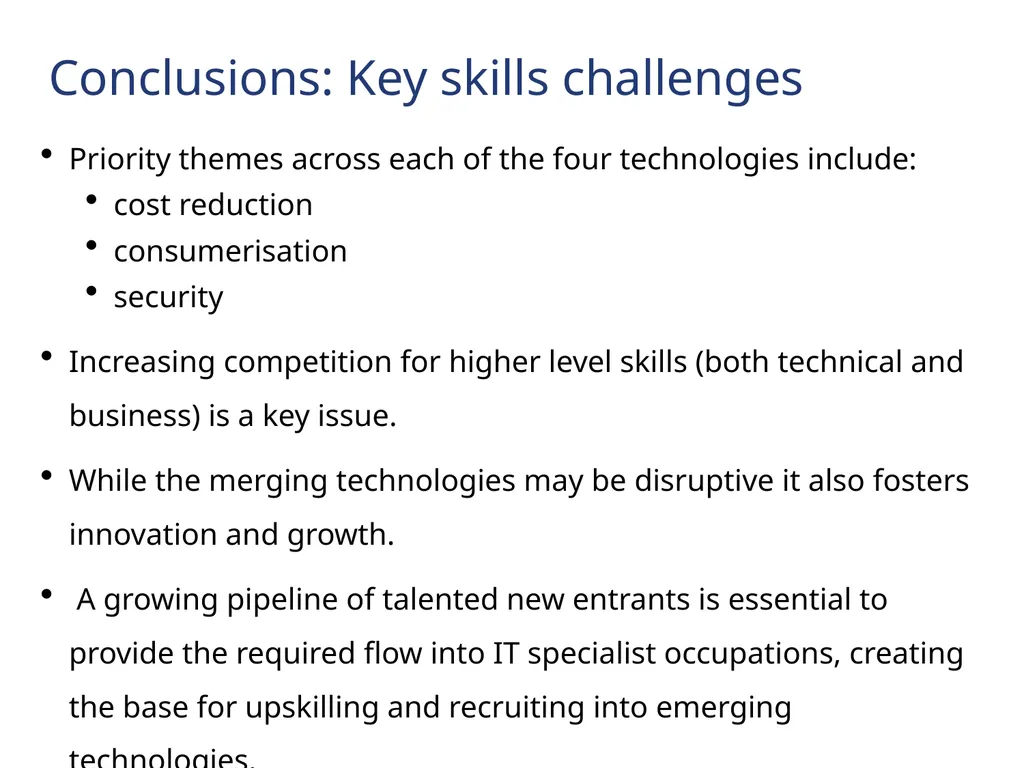
Conclusions: Key skills challenges Priority themes across each of the four technologies include:
cost reduction
consumerisation
security
Increasing competition for higher level skills (both technical and business) is a key issue.
While the merging technologies may be disruptive it also fosters innovation and growth.
A growing pipeline of talented new entrants is essential to provide the required flow into IT specialist occupations, creating the base for upskilling and recruiting into emerging technologies.<br>
cost reduction
consumerisation
security
Increasing competition for higher level skills (both technical and business) is a key issue.
While the merging technologies may be disruptive it also fosters innovation and growth.
A growing pipeline of talented new entrants is essential to provide the required flow into IT specialist occupations, creating the base for upskilling and recruiting into emerging technologies.<br>
23
Contacts and Social Media 01709 774800 Rachel.pinto@ukces.org.uk # hightechskills<br>