
TEMPLATE DIGITAL MARKETING STRATEGY Your Company
AS
Published · 36 slides · 0 views

1 / 1





Description
TEMPLATE DIGITAL MARKETING STRATEGY Your Company Name One linerMission Statement TABLE OF CONTENT Step 1: Understand Your Industry Step 2: Understand Your Competition Step 3: Understand Your Buyers Step 4: Understand the Digital Channels
Related Topics
Share
Embed code
Download this presentation From Below
"TEMPLATE DIGITAL MARKETING STRATEGY Your Company" is the property of its rightful owner. Permission is granted to download and print the materials on this website for personal, non-commercial use only, and to display it on your personal computer provided you do not modify the materials and that you retain all copyright notices contained in the materials. By downloading content from our website, you accept the terms of this agreement.
Presentation Transcript
01
TEMPLATE DIGITAL MARKETING STRATEGY<br>
02
Your Company Name One liner/Mission Statement<br>
03
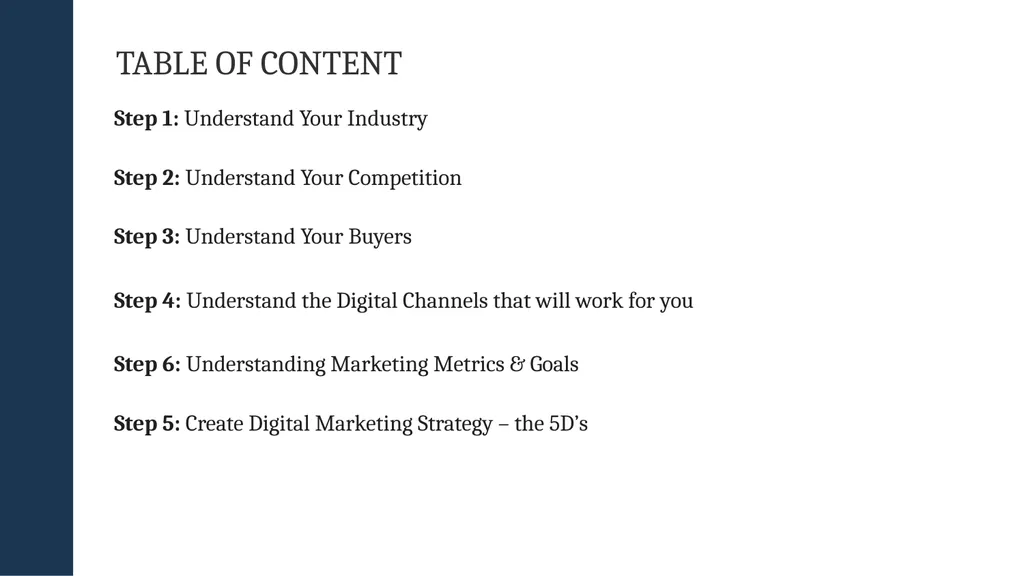
TABLE OF CONTENT Step 1: Understand Your Industry
Step 2: Understand Your Competition
Step 3: Understand Your Buyers
Step 4: Understand the Digital Channels that will work for you
Step 6: Understanding Marketing Metrics & Goals
Step 5: Create Digital Marketing Strategy – the 5D’s<br>
Step 2: Understand Your Competition
Step 3: Understand Your Buyers
Step 4: Understand the Digital Channels that will work for you
Step 6: Understanding Marketing Metrics & Goals
Step 5: Create Digital Marketing Strategy – the 5D’s<br>
04
UNDERSTAND YOUR INDUSTRY PART ONE<br>
05
Purpose of Our Research It’s worthwhile to analyze the state of your industry – whether as a prospective new entrant or as an existing player in the game. One way to do this is with Porter’s Five Forces Analysis.
This method of studying an industry considers – as the name suggests – five different criteria and how high the power, threat, or rivalry in each area is.
Below are the five forces in the analysis:<br>
This method of studying an industry considers – as the name suggests – five different criteria and how high the power, threat, or rivalry in each area is.
Below are the five forces in the analysis:<br>
06
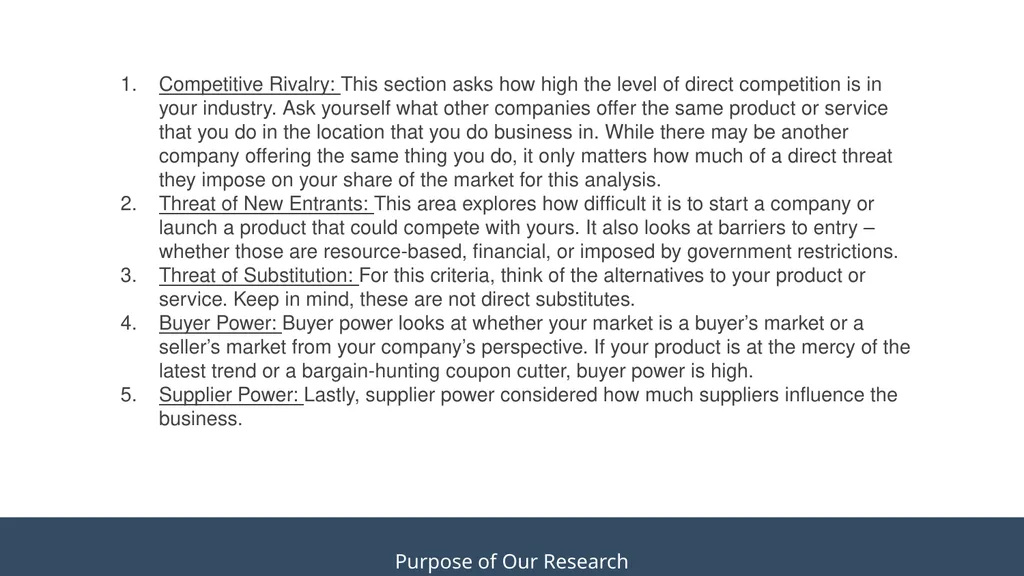
Purpose of Our Research Competitive Rivalry: This section asks how high the level of direct competition is in your industry. Ask yourself what other companies offer the same product or service that you do in the location that you do business in. While there may be another company offering the same thing you do, it only matters how much of a direct threat they impose on your share of the market for this analysis.
Threat of New Entrants: This area explores how difficult it is to start a company or launch a product that could compete with yours. It also looks at barriers to entry – whether those are resource-based, financial, or imposed by government restrictions.
Threat of Substitution: For this criteria, think of the alternatives to your product or service. Keep in mind, these are not direct substitutes.
Buyer Power: Buyer power looks at whether your market is a buyer’s market or a seller’s market from your company’s perspective. If your product is at the mercy of the latest trend or a bargain-hunting coupon cutter, buyer power is high.
Supplier Power: Lastly, supplier power considered how much suppliers influence the business.<br>
Threat of New Entrants: This area explores how difficult it is to start a company or launch a product that could compete with yours. It also looks at barriers to entry – whether those are resource-based, financial, or imposed by government restrictions.
Threat of Substitution: For this criteria, think of the alternatives to your product or service. Keep in mind, these are not direct substitutes.
Buyer Power: Buyer power looks at whether your market is a buyer’s market or a seller’s market from your company’s perspective. If your product is at the mercy of the latest trend or a bargain-hunting coupon cutter, buyer power is high.
Supplier Power: Lastly, supplier power considered how much suppliers influence the business.<br>
07
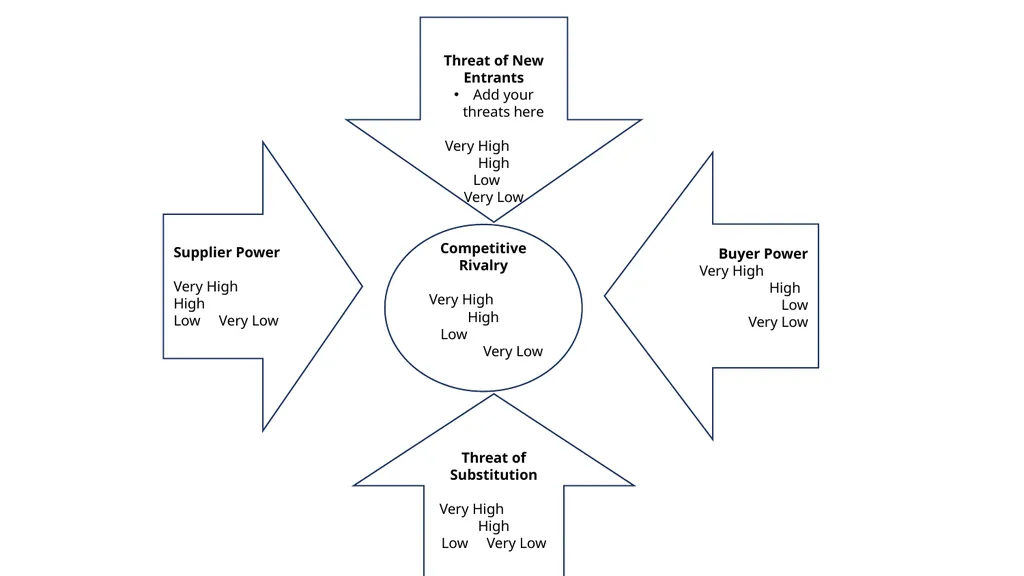
Threat of Substitution
Very High High
Low Very Low Threat of New Entrants
Add your threats here
Very High High
Low Very Low Buyer Power
Very High High
Low Very Low Supplier Power
Very High High
Low Very Low Competitive Rivalry
Very High High
Low
Very Low<br>
Very High High
Low Very Low Threat of New Entrants
Add your threats here
Very High High
Low Very Low Buyer Power
Very High High
Low Very Low Supplier Power
Very High High
Low Very Low Competitive Rivalry
Very High High
Low
Very Low<br>
08
Analyzing Your Results Analyzing Your Results
After you complete your analysis, take note of how often categories are marked as “high” or “low.” If there are more lows than highs, this is good!
You have an opportunity to make an enormous impact in your market. If your highs outweigh your lows, consider what concrete actions you will have to take to overcome these potential threats and obstacles.
Whether you’re incumbent or a new business, these forces can change at any time, so staying on top of industry trends and getting a high-level look at your market is essential for long-term success.<br>
After you complete your analysis, take note of how often categories are marked as “high” or “low.” If there are more lows than highs, this is good!
You have an opportunity to make an enormous impact in your market. If your highs outweigh your lows, consider what concrete actions you will have to take to overcome these potential threats and obstacles.
Whether you’re incumbent or a new business, these forces can change at any time, so staying on top of industry trends and getting a high-level look at your market is essential for long-term success.<br>
09
UNDERSTAND YOUR COMPETITION PART TWO<br>
10
Competition Research Once you understand your industry as a whole, dive into where you fit into that industry with a SWOT analysis.
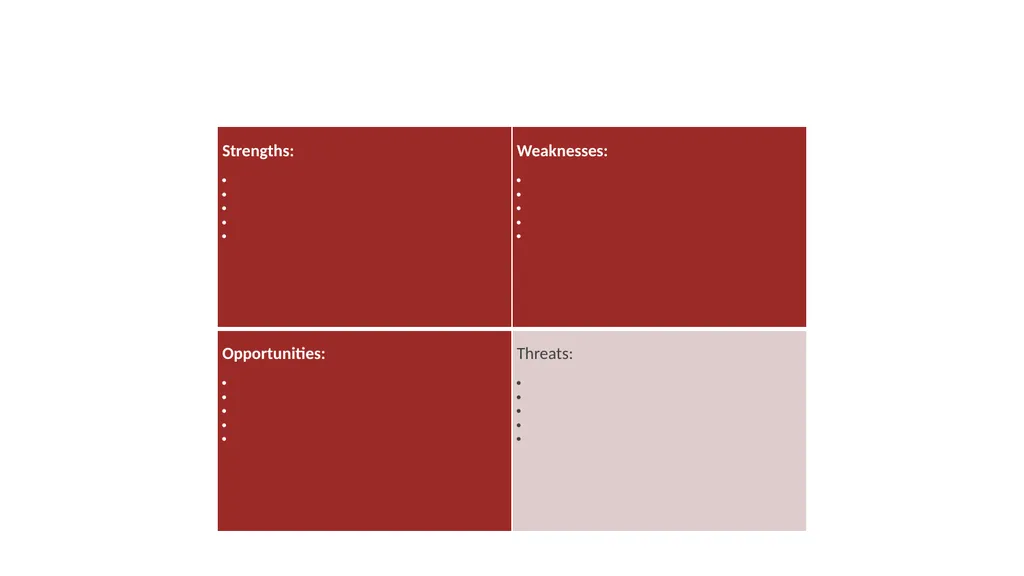
A SWOT analysis looks at a company’s internal strengths and weaknesses and the external opportunities and threats within the market.
Competing this analysis will highlight the direct areas of opportunity your company can start building on or working to overcome.<br>
A SWOT analysis looks at a company’s internal strengths and weaknesses and the external opportunities and threats within the market.
Competing this analysis will highlight the direct areas of opportunity your company can start building on or working to overcome.<br>
11
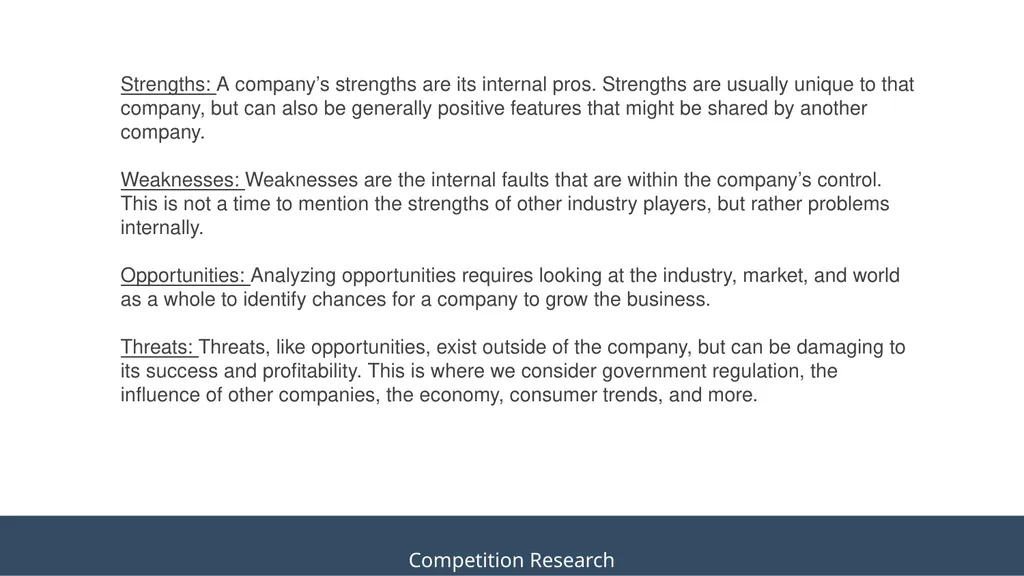
Competition Research Strengths: A company’s strengths are its internal pros. Strengths are usually unique to that company, but can also be generally positive features that might be shared by another company.
Weaknesses: Weaknesses are the internal faults that are within the company’s control. This is not a time to mention the strengths of other industry players, but rather problems internally.
Opportunities: Analyzing opportunities requires looking at the industry, market, and world as a whole to identify chances for a company to grow the business.
Threats: Threats, like opportunities, exist outside of the company, but can be damaging to its success and profitability. This is where we consider government regulation, the influence of other companies, the economy, consumer trends, and more.<br>
Weaknesses: Weaknesses are the internal faults that are within the company’s control. This is not a time to mention the strengths of other industry players, but rather problems internally.
Opportunities: Analyzing opportunities requires looking at the industry, market, and world as a whole to identify chances for a company to grow the business.
Threats: Threats, like opportunities, exist outside of the company, but can be damaging to its success and profitability. This is where we consider government regulation, the influence of other companies, the economy, consumer trends, and more.<br>
12
Analyzing Your SWOT Analysis Use this analysis as a snapshot for your company’s performance or potential performance. Don’t just compare the amount of strengths and opportunities with the amount of weaknesses and threats – weigh their importance to determine if you’re currently in a good place or if you could be doing better.<br>
13
UNDERSTAND YOUR BUYER PART THREE<br>
14
Buyer Persona While you need to know where you stand in your industry, it’s ultimately worth knowing where you stand in the eyes of your customer and potential customers.
Taking the time and effort to learn how your company or product will be perceived in the market is a vital action all businesses must routinely take.
You will better understand:
Facts about your target market.
What matters to someone who would purchase from you.
The demand for your product.
The potential price points.
Perception on competition
Impressions of your branding.<br>
Taking the time and effort to learn how your company or product will be perceived in the market is a vital action all businesses must routinely take.
You will better understand:
Facts about your target market.
What matters to someone who would purchase from you.
The demand for your product.
The potential price points.
Perception on competition
Impressions of your branding.<br>
15
Buyer Persona Buyer Personas
Before you get to surveying your buyers, it’s helpful to define them with buyer personas – semi-fictional generalizations of who your target customers are.
Understanding your buyer personas guides your survey construction to be more tailored to your intended audience. If you haven’t established your buyer personas yet, use this free tool to get started.<br>
Before you get to surveying your buyers, it’s helpful to define them with buyer personas – semi-fictional generalizations of who your target customers are.
Understanding your buyer personas guides your survey construction to be more tailored to your intended audience. If you haven’t established your buyer personas yet, use this free tool to get started.<br>
16
Write up a brief synopsis of this buyer persona and why they may be a good fit to be a customer.
If you’re making a buyer persona from scratch, visit https://www.hubspot.com/make-my-persona and insert a screenshot of your persona. Their Name
Their Occupation/Title
Their Age or Location Buyer Persona<br>
If you’re making a buyer persona from scratch, visit https://www.hubspot.com/make-my-persona and insert a screenshot of your persona. Their Name
Their Occupation/Title
Their Age or Location Buyer Persona<br>
17
UNDERSTAND YOUR DIGITAL CHANNELS PART FOUR<br>
18
We set out to find out…(take it from here!) Your Company Goal<br>
19
Digital Marketing Channels Types of Digital Marketing Channels:
Content Marketing: Blog, Quora, Lead Magnets, Guest Posts
Search engine optimization (SEO): On-page & Off-page
Social Media Marketing: Facebook, Instagram, Twitter, Pintrest, Linkedin
Paid Social: Ads on Social Media Platforms
Display Advertising: Banners ads on high DA websites
Cold Email Outreach Marketing
Influencer Marketing & PR
Inbound Marketing: Marketing Automation & Funnel Optumization
Most businesses need a combination of these channels to build your effective growth strategy. We like to break it down to Organic & Paid Channels for further clarity on showing effectiveness of these campaigns.<br>
Content Marketing: Blog, Quora, Lead Magnets, Guest Posts
Search engine optimization (SEO): On-page & Off-page
Social Media Marketing: Facebook, Instagram, Twitter, Pintrest, Linkedin
Paid Social: Ads on Social Media Platforms
Display Advertising: Banners ads on high DA websites
Cold Email Outreach Marketing
Influencer Marketing & PR
Inbound Marketing: Marketing Automation & Funnel Optumization
Most businesses need a combination of these channels to build your effective growth strategy. We like to break it down to Organic & Paid Channels for further clarity on showing effectiveness of these campaigns.<br>
20
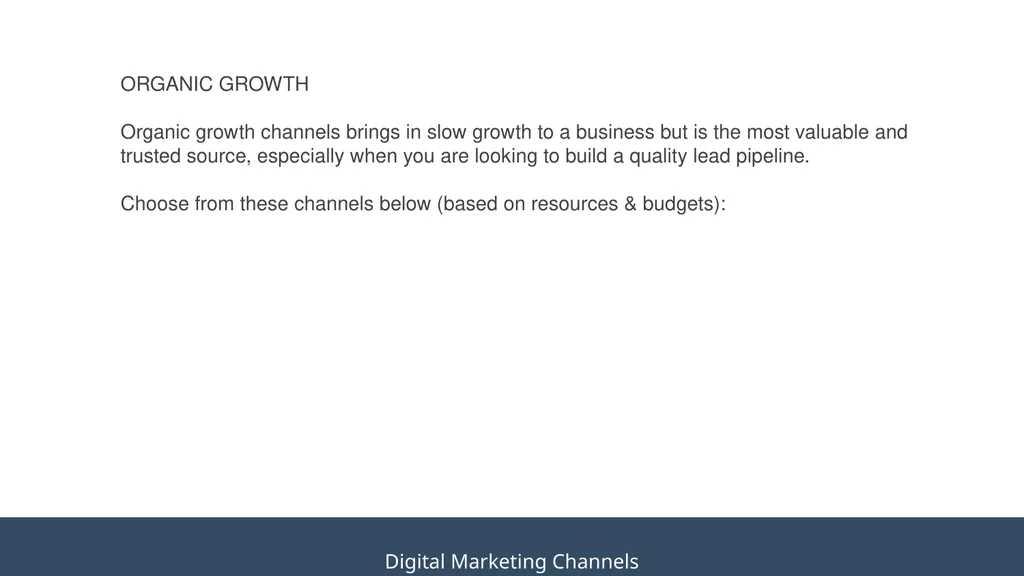
Digital Marketing Channels ORGANIC GROWTH
Organic growth channels brings in slow growth to a business but is the most valuable and trusted source, especially when you are looking to build a quality lead pipeline.
Choose from these channels below (based on resources & budgets):<br>
Organic growth channels brings in slow growth to a business but is the most valuable and trusted source, especially when you are looking to build a quality lead pipeline.
Choose from these channels below (based on resources & budgets):<br>
21
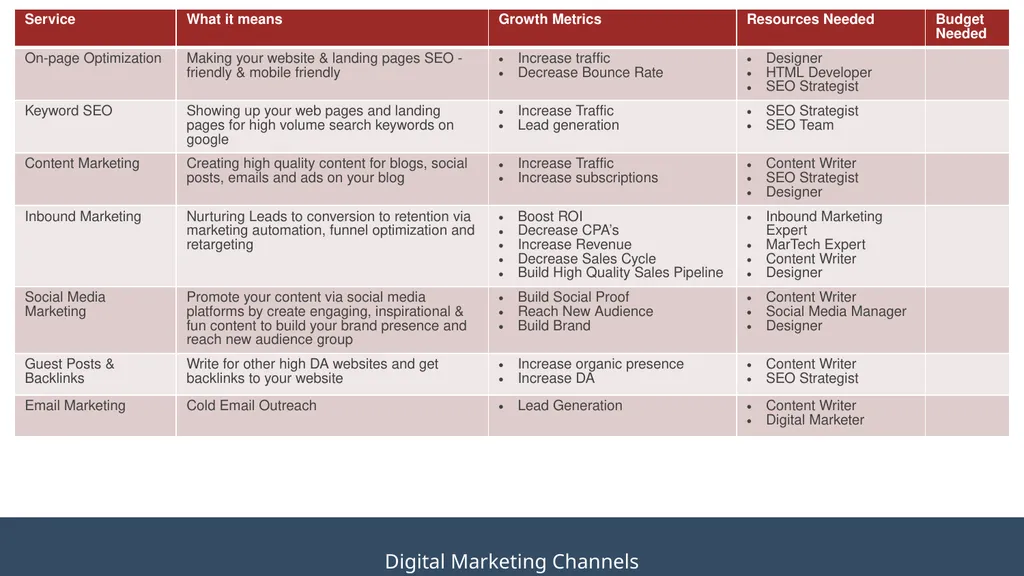
Digital Marketing Channels<br>
22
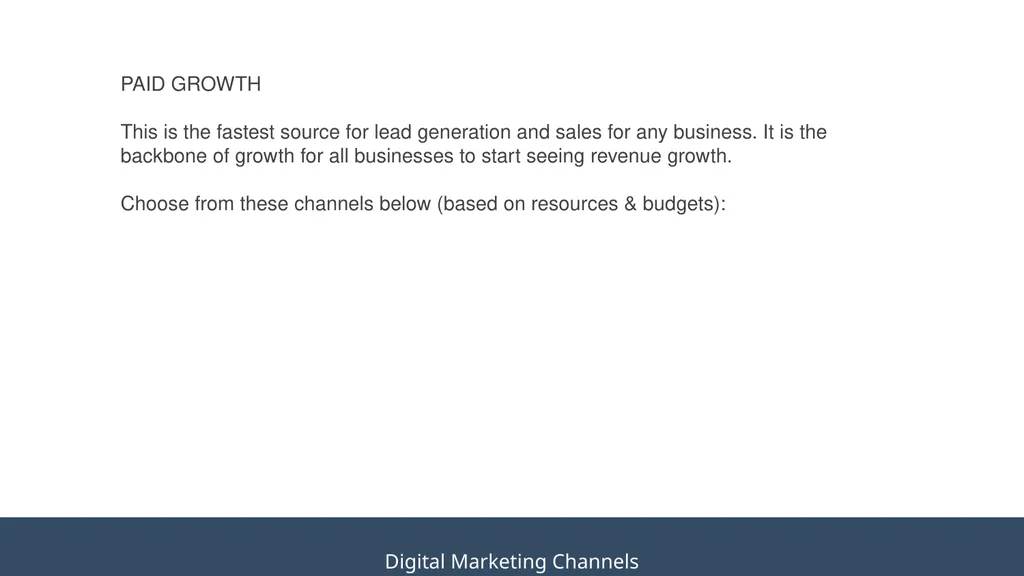
Digital Marketing Channels PAID GROWTH
This is the fastest source for lead generation and sales for any business. It is the backbone of growth for all businesses to start seeing revenue growth.
Choose from these channels below (based on resources & budgets):<br>
This is the fastest source for lead generation and sales for any business. It is the backbone of growth for all businesses to start seeing revenue growth.
Choose from these channels below (based on resources & budgets):<br>
23
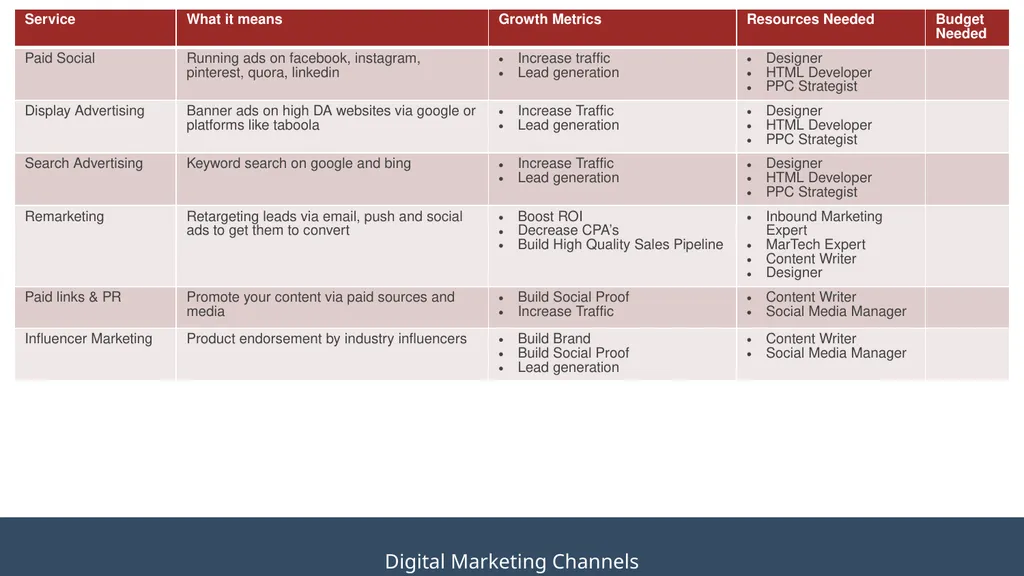
Digital Marketing Channels<br>
24
UNDERSTAND YOUR MARKETING METRIC & GOALS PART FIVE<br>
25
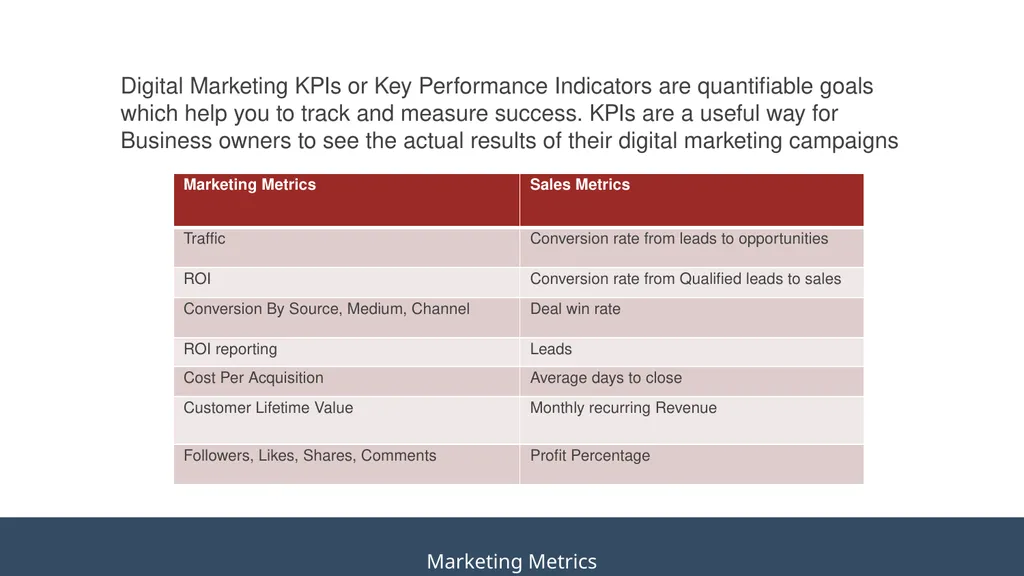
Marketing Metrics Digital Marketing KPIs or Key Performance Indicators are quantifiable goals which help you to track and measure success. KPIs are a useful way for Business owners to see the actual results of their digital marketing campaigns<br>
26
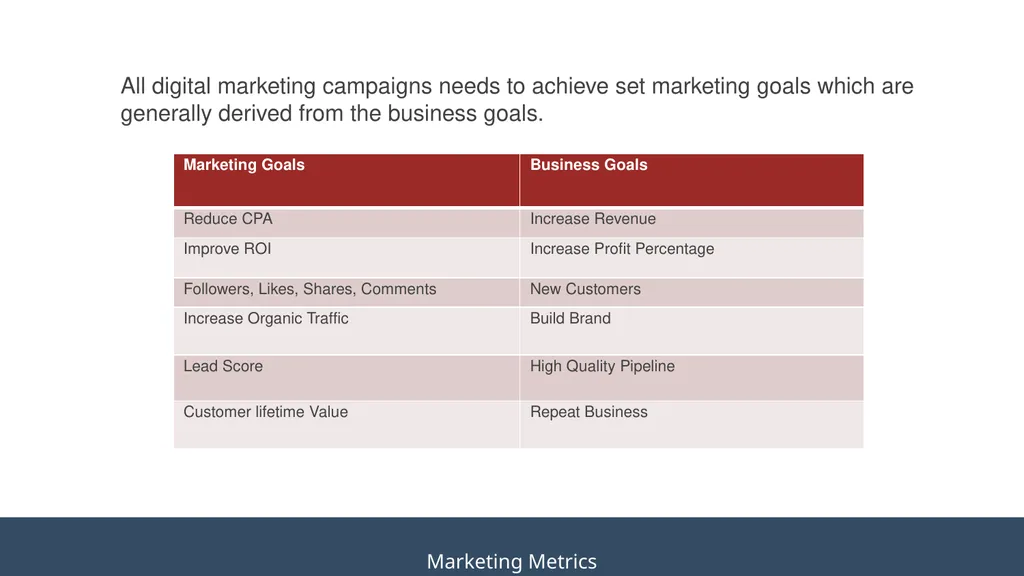
Marketing Metrics All digital marketing campaigns needs to achieve set marketing goals which are generally derived from the business goals.<br>
27
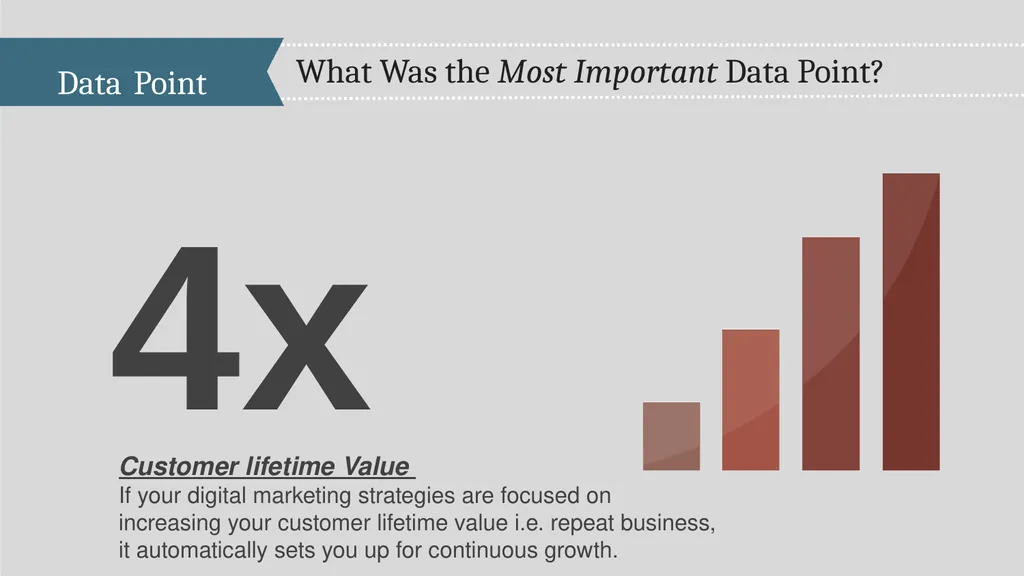
Data Point What Was the Most Important Data Point? 4x Customer lifetime Value
If your digital marketing strategies are focused on
increasing your customer lifetime value i.e. repeat business,
it automatically sets you up for continuous growth.<br>
If your digital marketing strategies are focused on
increasing your customer lifetime value i.e. repeat business,
it automatically sets you up for continuous growth.<br>
28
CREATING YOUR DIGITAL MARKETING STRATEGY PART SIX<br>
29
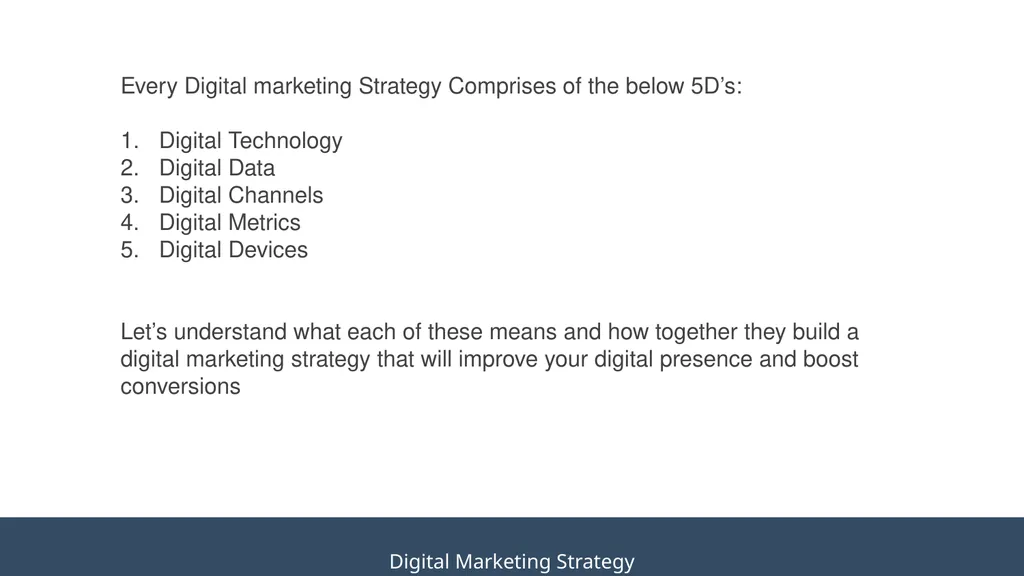
Digital Marketing Strategy Every Digital marketing Strategy Comprises of the below 5D’s:
Digital Technology
Digital Data
Digital Channels
Digital Metrics
Digital Devices
Let’s understand what each of these means and how together they build a digital marketing strategy that will improve your digital presence and boost conversions<br>
Digital Technology
Digital Data
Digital Channels
Digital Metrics
Digital Devices
Let’s understand what each of these means and how together they build a digital marketing strategy that will improve your digital presence and boost conversions<br>
30
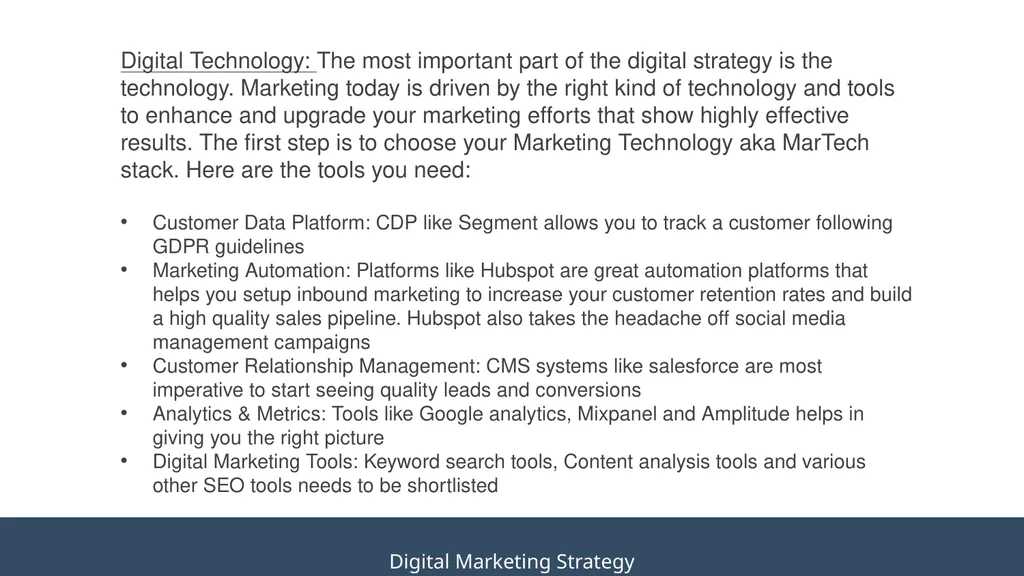
Digital Marketing Strategy Digital Technology: The most important part of the digital strategy is the technology. Marketing today is driven by the right kind of technology and tools to enhance and upgrade your marketing efforts that show highly effective results. The first step is to choose your Marketing Technology aka MarTech stack. Here are the tools you need:
Customer Data Platform: CDP like Segment allows you to track a customer following GDPR guidelines
Marketing Automation: Platforms like Hubspot are great automation platforms that helps you setup inbound marketing to increase your customer retention rates and build a high quality sales pipeline. Hubspot also takes the headache off social media management campaigns
Customer Relationship Management: CMS systems like salesforce are most imperative to start seeing quality leads and conversions
Analytics & Metrics: Tools like Google analytics, Mixpanel and Amplitude helps in giving you the right picture
Digital Marketing Tools: Keyword search tools, Content analysis tools and various other SEO tools needs to be shortlisted<br>
Customer Data Platform: CDP like Segment allows you to track a customer following GDPR guidelines
Marketing Automation: Platforms like Hubspot are great automation platforms that helps you setup inbound marketing to increase your customer retention rates and build a high quality sales pipeline. Hubspot also takes the headache off social media management campaigns
Customer Relationship Management: CMS systems like salesforce are most imperative to start seeing quality leads and conversions
Analytics & Metrics: Tools like Google analytics, Mixpanel and Amplitude helps in giving you the right picture
Digital Marketing Tools: Keyword search tools, Content analysis tools and various other SEO tools needs to be shortlisted<br>
31
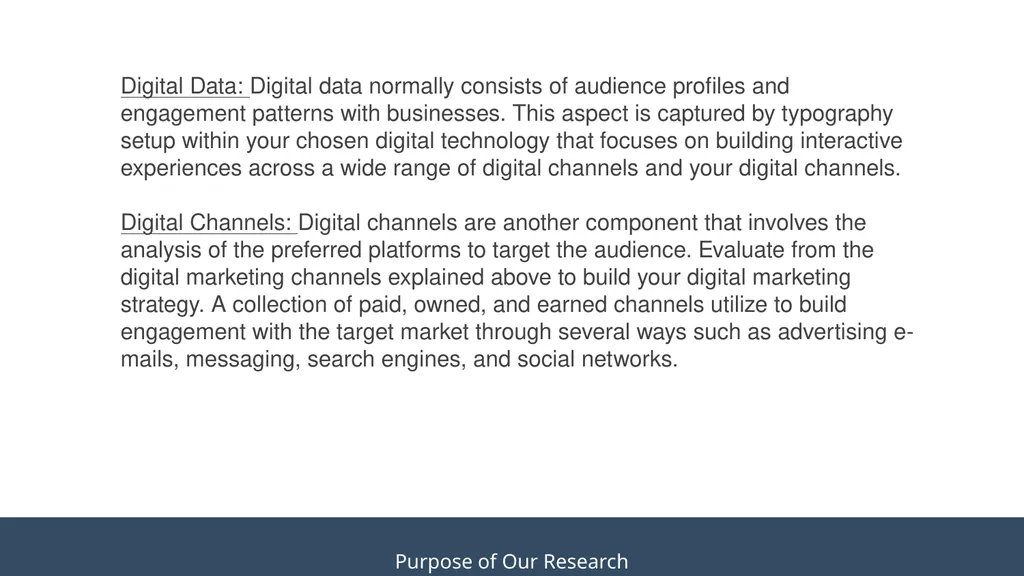
Purpose of Our Research Digital Data: Digital data normally consists of audience profiles and engagement patterns with businesses. This aspect is captured by typography setup within your chosen digital technology that focuses on building interactive experiences across a wide range of digital channels and your digital channels.
Digital Channels: Digital channels are another component that involves the analysis of the preferred platforms to target the audience. Evaluate from the digital marketing channels explained above to build your digital marketing strategy. A collection of paid, owned, and earned channels utilize to build engagement with the target market through several ways such as advertising e-mails, messaging, search engines, and social networks.<br>
Digital Channels: Digital channels are another component that involves the analysis of the preferred platforms to target the audience. Evaluate from the digital marketing channels explained above to build your digital marketing strategy. A collection of paid, owned, and earned channels utilize to build engagement with the target market through several ways such as advertising e-mails, messaging, search engines, and social networks.<br>
32
Purpose of Our Research Digital Metrics: identifying business goals and setting up marketing metrics to fulfill your goals is the honest way to see how your campaigns perform.
Digital Devices: It mainly focuses on the target audience’s interaction and engagement on websites and mobile applications using a combination of connected devices. These devices may include smartphones, tablets, desktop computers, TVs, and gaming devices. Hence its most important to make your websites and landing pages seo-friendly and mobile friendly<br>
Digital Devices: It mainly focuses on the target audience’s interaction and engagement on websites and mobile applications using a combination of connected devices. These devices may include smartphones, tablets, desktop computers, TVs, and gaming devices. Hence its most important to make your websites and landing pages seo-friendly and mobile friendly<br>
33
How To Start? – A Summary PART SEVEN<br>
34
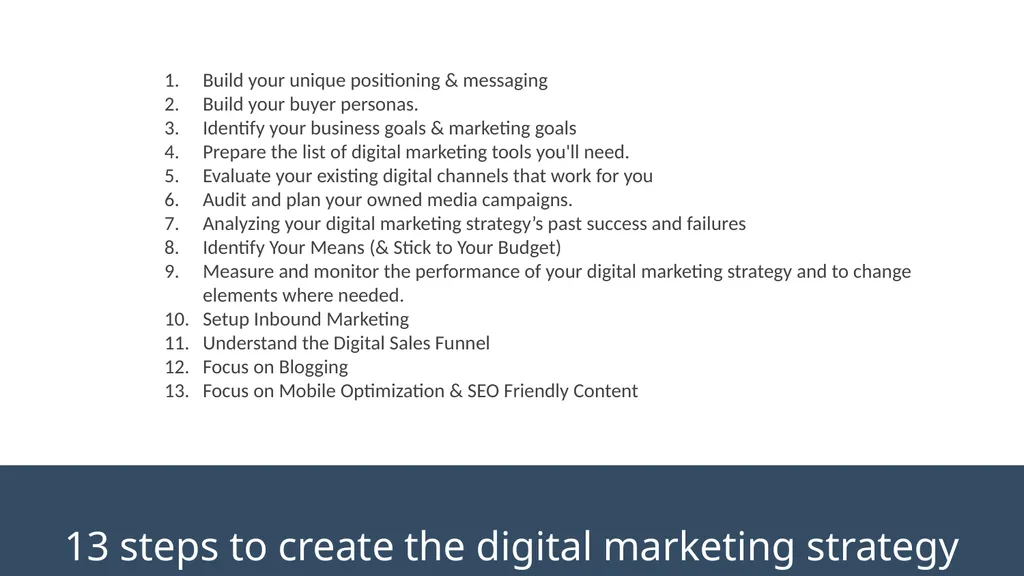
13 steps to create the digital marketing strategy Build your unique positioning & messaging
Build your buyer personas.
Identify your business goals & marketing goals
Prepare the list of digital marketing tools you'll need.
Evaluate your existing digital channels that work for you
Audit and plan your owned media campaigns.
Analyzing your digital marketing strategy’s past success and failures
Identify Your Means (& Stick to Your Budget)
Measure and monitor the performance of your digital marketing strategy and to change elements where needed.
Setup Inbound Marketing
Understand the Digital Sales Funnel
Focus on Blogging
Focus on Mobile Optimization & SEO Friendly Content<br>
Build your buyer personas.
Identify your business goals & marketing goals
Prepare the list of digital marketing tools you'll need.
Evaluate your existing digital channels that work for you
Audit and plan your owned media campaigns.
Analyzing your digital marketing strategy’s past success and failures
Identify Your Means (& Stick to Your Budget)
Measure and monitor the performance of your digital marketing strategy and to change elements where needed.
Setup Inbound Marketing
Understand the Digital Sales Funnel
Focus on Blogging
Focus on Mobile Optimization & SEO Friendly Content<br>
35
THANK YOU!<br>