04
TCHOUKBALL (Switzerland)
Equipment: Handball, two rebounding frames
Setup: Court with frames at each end
How to Play: Pass ball among team (max 3 passes).Throw ball at rebound frame(can be either end).Points scored if opponents can't catch rebound No physical contact or interception allowed<br>
05
TCHOUKBALL (Switzerland)
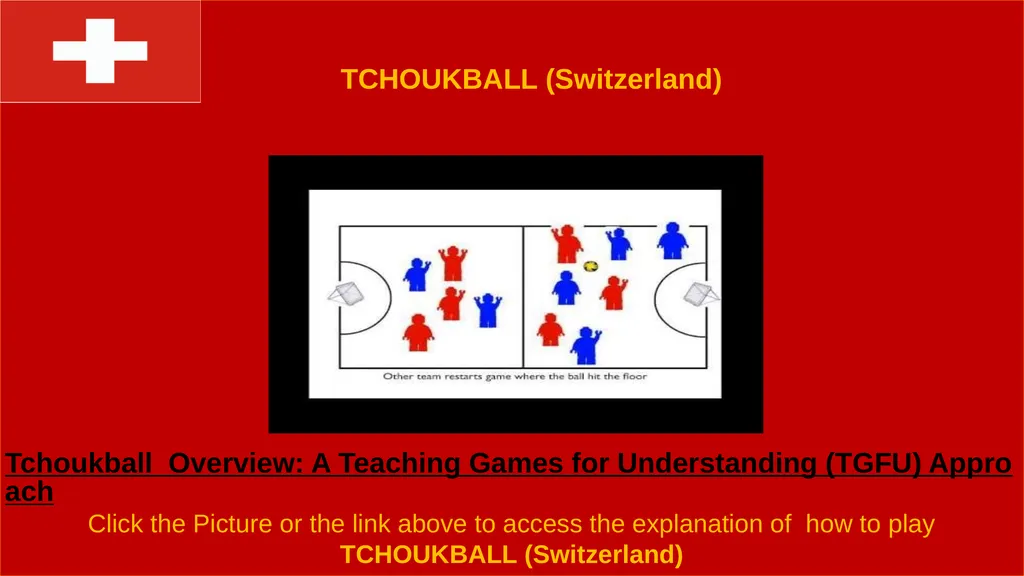
Tchoukball Overview: A Teaching Games for Understanding (TGFU) Approach
Click the Picture or the link above to access the explanation of how to play TCHOUKBALL (Switzerland)<br>
06
BATU SEREMBAN (Malaysia)
Equipment: fine stones or small pyramid shaped beanbags
SETUP: Use five small stones or beanbags.
How to Play: Complete different levels by tossing, picking up, and catching the stones in specific sequences. Players take turns. If a player fails a level, they restart from that level on their next turn. The first player to complete all eight levels wins.
Levels of Play
Level One – Toss one stone in the air, pick up one stone from the ground, and catch the tossed stone before it lands. Repeat until all stones are collected.
Level Two – Toss one stone in the air and pick up two stones at a time before catching the tossed stone.
Level Three – Toss one stone, pick up three stones first, then the last stone separately.
Level Four – Toss one stone and pick up all four remaining stones in one move.
Level Five – Toss one stone, place the remaining four on the ground, then catch the tossed stone.
Level Six – Swap ground stones while tossing and catching one stone.
Level Seven – Toss and catch multiple stones in a sequence, alternating hands.
Level Eight – A selected stone must be picked up without disturbing others before completing Level One again.<br>
07
BATU SEREMBAN (Malyasia)
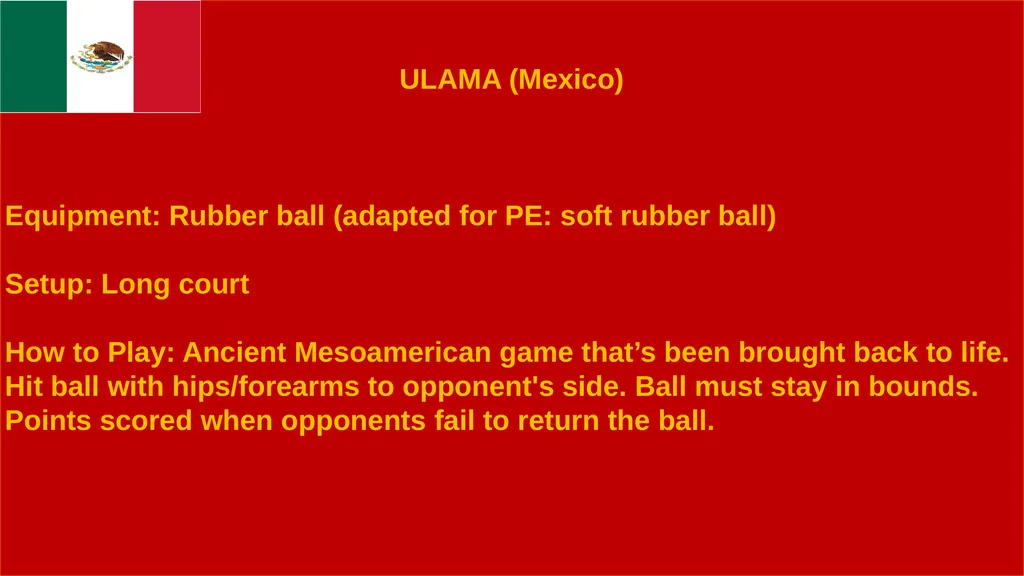
Batu Seremban: A Traditional Game in Malaysia | GROUP 2 STEM-EULER
Double Click the Picture or the link above to access the explanation of how to play BATU SEREMBAN (Malyasia)<br>
08
ULAMA (Mexico)
Equipment: Rubber ball (adapted for PE: soft rubber ball)
Setup: Long court
How to Play: Ancient Mesoamerican game that’s been brought back to life. Hit ball with hips/forearms to opponent's side. Ball must stay in bounds. Points scored when opponents fail to return the ball.
INDIVIDUAL TEAM
Click the Picture or the link above to access the explanation of how to play JIANZI (China)<br>
09
ULAMA (Mexico)
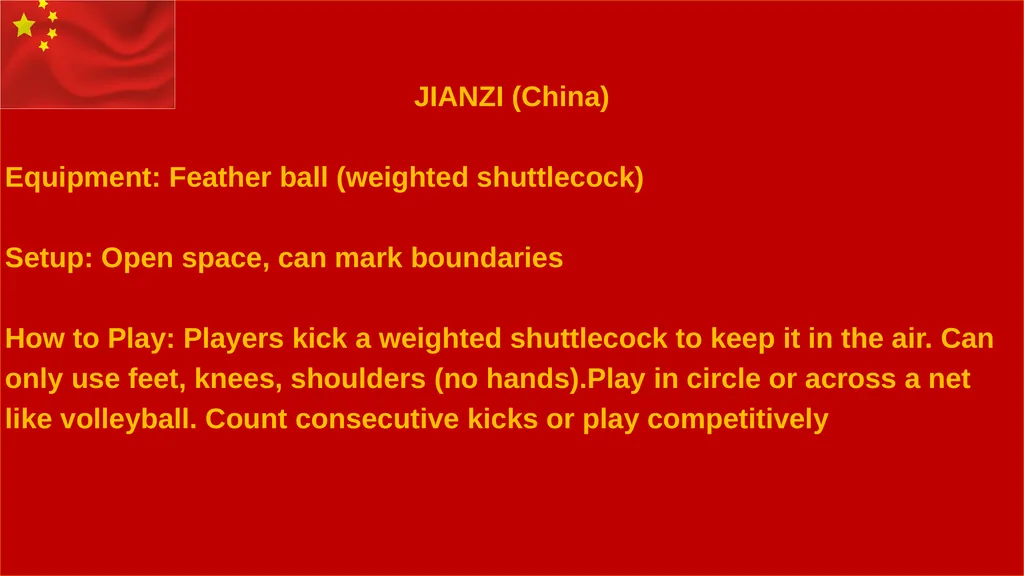
ULAMA
Double Click the Picture or the link above to access the explanation of how to play ULAMA (Mexico)<br>
10
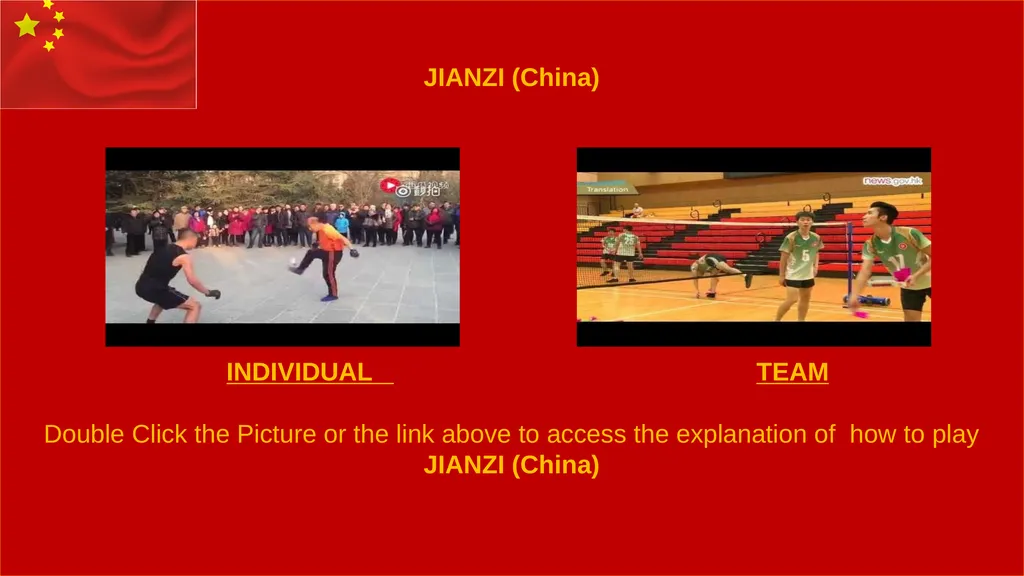
JIANZI (China)
Equipment: Feather ball (weighted shuttlecock)
Setup: Open space, can mark boundaries
How to Play: Players kick a weighted shuttlecock to keep it in the air. Can only use feet, knees, shoulders (no hands).Play in circle or across a net like volleyball. Count consecutive kicks or play competitively<br>
11
JIANZI (China)
INDIVIDUAL TEAM
Double Click the Picture or the link above to access the explanation of how to play JIANZI (China)<br>
12
KORFBALL (Netherlands)
Equipment: Ball similar to soccer ball, two posts with baskets
Setup: Court divided into two zones
How to Play: Mixed gender teams (4 males, 4 females).Players score by shooting ball into basket. You Cannot run with ball or solo play. No physical contact allowed<br>
13
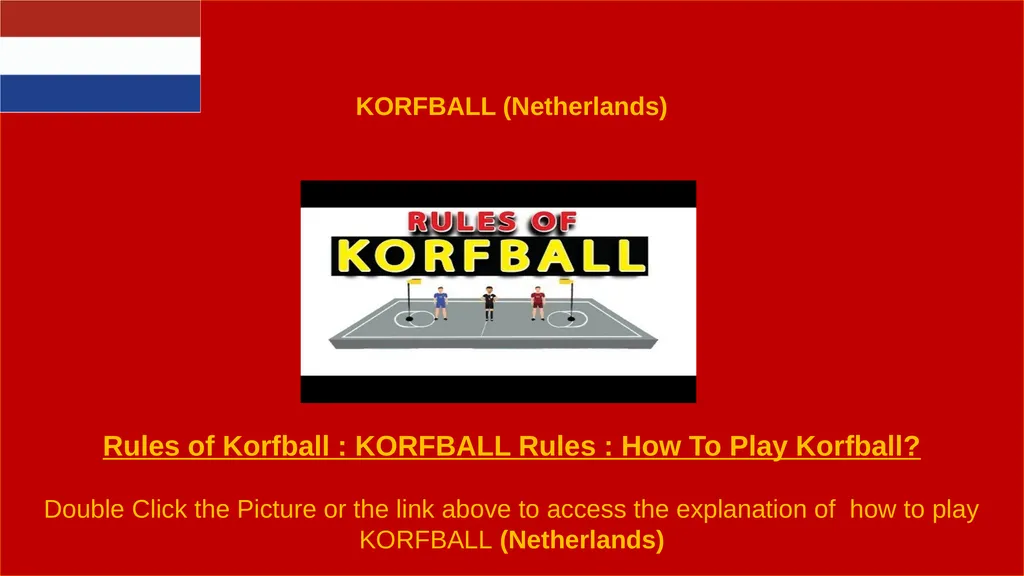
KORFBALL (Netherlands)
Rules of Korfball : KORFBALL Rules : How To Play Korfball?
Double Click the Picture or the link above to access the explanation of how to play KORFBALL (Netherlands)<br>
14
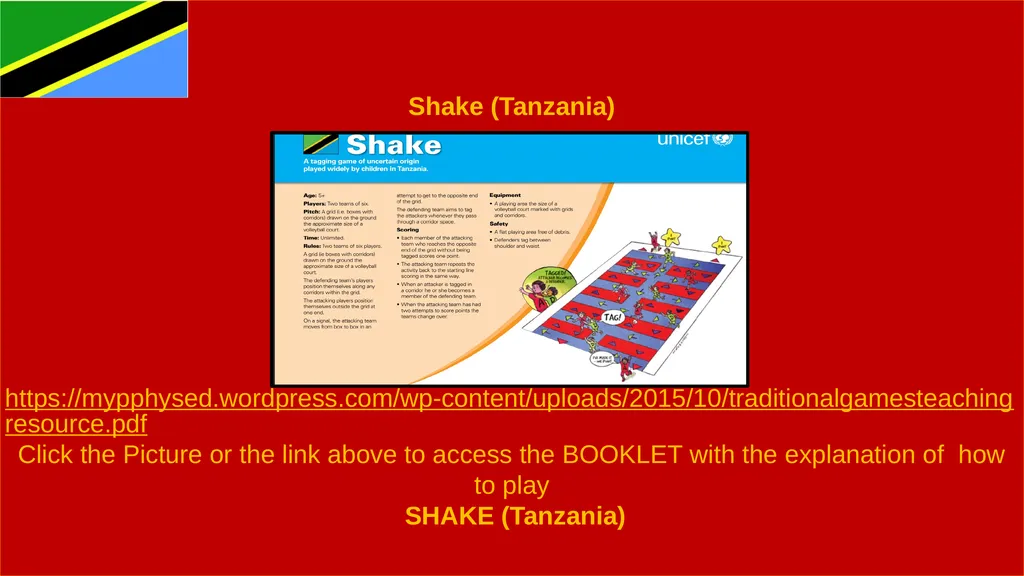
SHAKE (Tanzania)
Equipment: A playing area the size of a volleyball court marked with grids and corridors.
Setup: Players: Two teams of six. Pitch: A grid (i.e. boxes with corridors) drawn on the ground the approximate size of a volleyball court.
How to Play: Two teams of six players play on a grid the size of a volleyball court, with corridors drawn within it. The defending team positions themselves along the corridors, while the attacking team starts outside the grid at one end. On a signal, the attacking team moves through the grid, aiming to reach the opposite end without being tagged by the defenders. Each attacking player who reaches the end without being tagged scores a point, and if tagged, they switch to the defending team; after two attempts, the teams switch roles.<br>
15
Shake (Tanzania)
https://mypphysed.wordpress.com/wp-content/uploads/2015/10/traditionalgamesteachingresource.pdf
Click the Picture or the link above to access the BOOKLET with the explanation of how to play
SHAKE (Tanzania)<br>
16
PÉTANQUE (France)
Equipment: Metal balls (boules), small wooden target ball (jack)
Setup: Open area with smooth ground
How to Play: Players throw metal balls (boules) toward a small wooden target ball (jack). The goal is to get your boules closer to the target than your opponent’s. Players can also knock away opponents' boules to gain an advantage. Can be played individually or in teams.<br>
17
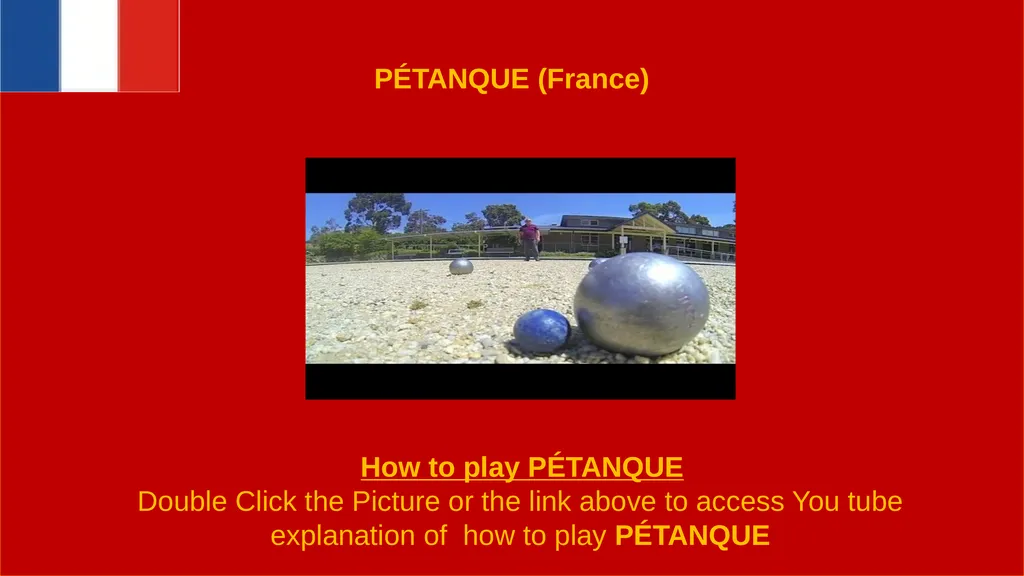
PÉTANQUE (France) How to play PÉTANQUE
Double Click the Picture or the link above to access You tube explanation of how to play PÉTANQUE<br>
18
KHO KHO(India)
Equipment: None
Setup: Rectangular field with two wooden poles
How to Play: Two teams of 12 players (9 active per side). One team sits in a row (chasers), facing alternate directions, while the other team runs (runners). One chaser is active and pursues runners. If tired, they can tap a sitting teammate's back saying "Kho" to switch roles. Points are earned when chasers tag all runners. Teams switch roles after each round.<br>
19
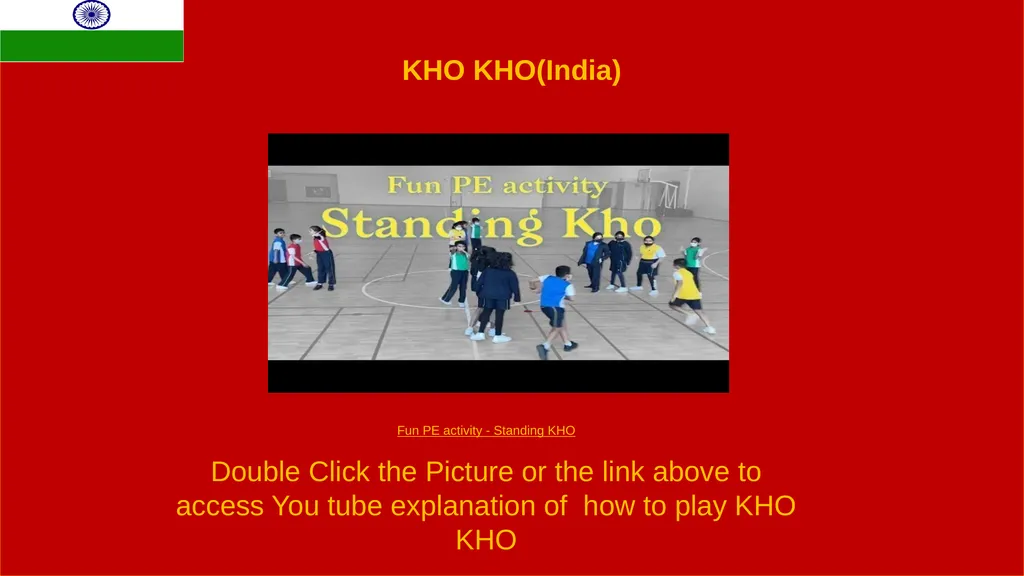
KHO KHO(India) Fun PE activity - Standing KHO
Double Click the Picture or the link above to access You tube explanation of how to play KHO KHO<br>
20
SEPAK TAKRAW (Thailand)
Equipment: Rattan ball, volleyball-style net
Setup: Court similar to badminton, net height 1.52m (5ft)
How to Play: Teams of 3 players on each side. Players use feet, knees, chest and head (no hands).Each team gets 3 touches before returning the ball. Points scored when ball touches ground in opponent's court<br>
21
SEPAK TAKRAW (Thailand) How to Play Sepak Takraw? also known as Sepak raga and Takraw is a modified variant of volleyball
Double Click the Picture or the link above to access You tube explanation of how to play SEPAK TAKRAW<br>
22
KI-O-RAHI (New Zealand)
Equipment: Round ball, seven boundary markers
Setup: Circular field with inner and outer zones
How to Play: Played on a circular field with inner and outer zones. Two teams: Kioma (offense) tries to score points by touching pillars, while Taniwha (defense) protects the central "tupu" (target). Teams switch roles during the game. Emphasizes strategy, teamwork, passing, running, and tagging.<br>
23
KI-O-RAHI (New Zealand)
KI-O-RAHI-Simplified Version explained
Double Click the Picture or the link above to access You tube explanation of how to play
KI-0-RAHI<br>