
Tentative agreement Sectoral table General
KL
Published · 136 slides · 0 views

1 / 1






Description
Tentative agreement Sectoral table General assemblies January and February 2024 1 Content of the tentative agreement Content of the tentative agreement Training and knowledge transfer Diversion Self-scheduling Work-time arrangements
Related Topics
Share
Embed code
Download this presentation From Below
"Tentative agreement Sectoral table General" is the property of its rightful owner. Permission is granted to download and print the materials on this website for personal, non-commercial use only, and to display it on your personal computer provided you do not modify the materials and that you retain all copyright notices contained in the materials. By downloading content from our website, you accept the terms of this agreement.
Presentation Transcript
01
Tentative agreement
Sectoral table
General assemblies
January and February 2024 1<br>
Sectoral table
General assemblies
January and February 2024 1<br>
02
Content of the tentative agreement Content of the tentative agreement
Training and knowledge transfer
Diversion
Self-scheduling
Work-time arrangements
Displacement
Overtime
Premiums
Seniority
Independent labour
Regional measures
Definition of service
National inter-round working committees
Other measures specific to personnel classes 2<br>
Training and knowledge transfer
Diversion
Self-scheduling
Work-time arrangements
Displacement
Overtime
Premiums
Seniority
Independent labour
Regional measures
Definition of service
National inter-round working committees
Other measures specific to personnel classes 2<br>
03
HR development plan and knowledge transfer Increase the human resources development budget for Class 3 personnel
New annual training and coaching budget for employees with less than 2 years of practice (classes 1, 2 and 4) 3<br>
New annual training and coaching budget for employees with less than 2 years of practice (classes 1, 2 and 4) 3<br>
04
HR development plan and knowledge transfer Increased training and skills development budget for Class 3 personnel
The human resources development budget provided for in paragraph 13.01 of the Class 3 collective agreement for office personnel and administrative technicians and professionals will be 0.55% of payroll 4<br>
The human resources development budget provided for in paragraph 13.01 of the Class 3 collective agreement for office personnel and administrative technicians and professionals will be 0.55% of payroll 4<br>
05
HR development plan and knowledge transfer New annual training and coaching budget for employees with less than 2 years of practice
Annual local budget for the duration of the collective agreement dedicated to training and coaching for employees with less than 2 years of experience in their job who are assigned to the rehabilitation, care and supervision of users:
0.19%* for Class 1
0.10%* for Class 2
0.19%* for Class 4
If the entire amount stipulated is not spent by the employer in the course of a given year, the remaining balance is added to the amount earmarked for such activities in the following year.
The parties must agree in local arrangements on how this budget is to be used.
* Percentage of the payroll of personnel in this class who are assigned to the rehabilitation, care or supervision of users. 5<br>
Annual local budget for the duration of the collective agreement dedicated to training and coaching for employees with less than 2 years of experience in their job who are assigned to the rehabilitation, care and supervision of users:
0.19%* for Class 1
0.10%* for Class 2
0.19%* for Class 4
If the entire amount stipulated is not spent by the employer in the course of a given year, the remaining balance is added to the amount earmarked for such activities in the following year.
The parties must agree in local arrangements on how this budget is to be used.
* Percentage of the payroll of personnel in this class who are assigned to the rehabilitation, care or supervision of users. 5<br>
06
Diversion Introduction of mediation / arbitration
Letter of agreement on the diversion of labour relations away from the courts
Letter of agreement on the health and social services system's new HR information system
Information provided to unions
Expansion of list of grievances handled through preparatory conferences
Harmonization of the time limit for filing a psychological harassment complaint with the Act respecting labour standards
National working committee on disputes and grievances related to the health crisis 6<br>
Letter of agreement on the diversion of labour relations away from the courts
Letter of agreement on the health and social services system's new HR information system
Information provided to unions
Expansion of list of grievances handled through preparatory conferences
Harmonization of the time limit for filing a psychological harassment complaint with the Act respecting labour standards
National working committee on disputes and grievances related to the health crisis 6<br>
07
Diversion Introduction of mediation / arbitration in article 11 of the collective agreement
The process is voluntary
List of mediators / arbitrators or chosen by local parties
If mediation / arbitration does not result in an agreement, the parties recognize that the mediator / arbitrator will be validly seized of the grievance(s) and have the authority to rule on the merits
Costs shared equally between the parties 7<br>
The process is voluntary
List of mediators / arbitrators or chosen by local parties
If mediation / arbitration does not result in an agreement, the parties recognize that the mediator / arbitrator will be validly seized of the grievance(s) and have the authority to rule on the merits
Costs shared equally between the parties 7<br>
08
Diversion Letter of agreement on the diversion of labour relations away from the courts
Local working committee
The national parties suggest that local parties establish a working committee to undertake an intensive process to settle disputes and grievances arising from the national provisions of the collective agreement and the locally negotiated and agreed stipulations in force prior to (date of coming into force of the new national provisions of the collective agreement).
Mediation / arbitration
The national parties encourage local parties to use the mediation / arbitration procedure provided for in article 11 of the national provisions of the collective agreement or any other alternative dispute resolution method. 8<br>
Local working committee
The national parties suggest that local parties establish a working committee to undertake an intensive process to settle disputes and grievances arising from the national provisions of the collective agreement and the locally negotiated and agreed stipulations in force prior to (date of coming into force of the new national provisions of the collective agreement).
Mediation / arbitration
The national parties encourage local parties to use the mediation / arbitration procedure provided for in article 11 of the national provisions of the collective agreement or any other alternative dispute resolution method. 8<br>
09
Diversion (cont'd)
National follow-up
The national parties agree to submit the following matters to the permanent national negotiating committee:
Analyze the effects of the new provisions in the collective agreement concerning diversion
Agree on indicators
Make recommendations to the national negotiating parties 9<br>
National follow-up
The national parties agree to submit the following matters to the permanent national negotiating committee:
Analyze the effects of the new provisions in the collective agreement concerning diversion
Agree on indicators
Make recommendations to the national negotiating parties 9<br>
10
Diversion Letter of agreement on the health and social services system's new HR information system
A transitional period has already been provided for the acquisition and implementation of a human resources information system
During this period, the CPNSSS will keep the FSSS-CSN informed of progress on the acquisition and implementation of the system
During this period, the national parties recommend that, technology or the information system permitting, institutions where local unions currently have no access to the employer's HR information system facilitate union access to the schedule module at no cost to the Employer, subject to the Employer's obligations under Act to modernize legislative provisions as regards the protection of personal information. 10<br>
A transitional period has already been provided for the acquisition and implementation of a human resources information system
During this period, the CPNSSS will keep the FSSS-CSN informed of progress on the acquisition and implementation of the system
During this period, the national parties recommend that, technology or the information system permitting, institutions where local unions currently have no access to the employer's HR information system facilitate union access to the schedule module at no cost to the Employer, subject to the Employer's obligations under Act to modernize legislative provisions as regards the protection of personal information. 10<br>
11
Diversion Information provided to unions
Amend paragraph 6.07 as follows:
6.07 Once a month, the employer provides the union with two copies of a list of new employees, indicating the following information: hiring date, address, email address when available, job title, service, rate of pay, employee number, social insurance number and status; as well as a list indicating departure dates The list of departures must indicate the service in which the employee worked.
Expand the list of grievances handled through a preparatory conference
Amend paragraph 11.16 of the national provisions of the collective agreement concerning preparatory conferences to cover all grievances 11<br>
Amend paragraph 6.07 as follows:
6.07 Once a month, the employer provides the union with two copies of a list of new employees, indicating the following information: hiring date, address, email address when available, job title, service, rate of pay, employee number, social insurance number and status; as well as a list indicating departure dates The list of departures must indicate the service in which the employee worked.
Expand the list of grievances handled through a preparatory conference
Amend paragraph 11.16 of the national provisions of the collective agreement concerning preparatory conferences to cover all grievances 11<br>
12
Diversion Harmonization of the time limit for filing a psychological harassment complaint with the Act respecting labour standards
Change the 90-day limit in paragraphs 3.09 and 10.01 of the collective agreement to 2 years
National working committee on disputes and grievances related to the health crisis
Create a joint national working committee on the settlement of disputes and grievances related to the health crisis 12<br>
Change the 90-day limit in paragraphs 3.09 and 10.01 of the collective agreement to 2 years
National working committee on disputes and grievances related to the health crisis
Create a joint national working committee on the settlement of disputes and grievances related to the health crisis 12<br>
13
Self-scheduling Add a Letter of Agreement on self-management of work schedules
The purpose of this Letter of Agreement is to encourage employee involvement in drawing up and managing their schedules in order to improve the predictability and stability of their schedules and the continuity of care and services, while improving work-life-study balance.
This is a voluntary, flexible and proactive form of shared schedule management based on the participation and empowerment of employees in planning their work schedules.
This approach involves measures that allow employees to participate in drawing up and changing their schedules, while taking into account the needs of other team members, of the service and of the units of care.
Team composition
The process of self-management of work schedules (hereafter "self-scheduling") includes employees holding positions with the same job title. This process also includes employees with the job title who are part of the float team and part-time casual employees when they are assigned to the self-managed service or unit of care for the duration of the schedule period. 13<br>
The purpose of this Letter of Agreement is to encourage employee involvement in drawing up and managing their schedules in order to improve the predictability and stability of their schedules and the continuity of care and services, while improving work-life-study balance.
This is a voluntary, flexible and proactive form of shared schedule management based on the participation and empowerment of employees in planning their work schedules.
This approach involves measures that allow employees to participate in drawing up and changing their schedules, while taking into account the needs of other team members, of the service and of the units of care.
Team composition
The process of self-management of work schedules (hereafter "self-scheduling") includes employees holding positions with the same job title. This process also includes employees with the job title who are part of the float team and part-time casual employees when they are assigned to the self-managed service or unit of care for the duration of the schedule period. 13<br>
14
Self-scheduling Before self-scheduling is introduced for a job title in a service or unit of care, the employer notifies the local union that self-scheduling is being adopted. The local union can ensure that the self-scheduling team voluntarily subscribes to this model.
The main steps in self-scheduling include:
Identification and communication of guidelines by the manager regarding needs of the activity centre and number of staff required;
Establishment of the schedule, including the following steps:
Step 1: Indicate preferences for hours associated with each position, leave, addition of availability and non-availability, scheduling of on-call duty times, open shifts, at regular time;
Step 2: Add overtime shifts on a voluntary basis;
Step 3: Fill remaining needs in accordance with the local provisions of the collective agreement;
Posting of schedules according to the terms and conditions set by the team. 14<br>
The main steps in self-scheduling include:
Identification and communication of guidelines by the manager regarding needs of the activity centre and number of staff required;
Establishment of the schedule, including the following steps:
Step 1: Indicate preferences for hours associated with each position, leave, addition of availability and non-availability, scheduling of on-call duty times, open shifts, at regular time;
Step 2: Add overtime shifts on a voluntary basis;
Step 3: Fill remaining needs in accordance with the local provisions of the collective agreement;
Posting of schedules according to the terms and conditions set by the team. 14<br>
15
Self-scheduling In each of the above steps, the manager and the team balance the work schedule based on the guidelines and identified needs.
Notwithstanding the foregoing, if this process does not work out, the self-scheduling team can return to a model whereby preferences are indicated in accordance with the local provisions of the collective agreement until the next scheduling period.
The self-scheduling team and the manager must ensure that employees who arrive mid-schedule are added to the schedule. 15<br>
Notwithstanding the foregoing, if this process does not work out, the self-scheduling team can return to a model whereby preferences are indicated in accordance with the local provisions of the collective agreement until the next scheduling period.
The self-scheduling team and the manager must ensure that employees who arrive mid-schedule are added to the schedule. 15<br>
16
Self-scheduling A self-scheduling team can determine the following, among other things:
Method of decision-making
Scheduling period (minimum 4 weeks to maximum 26 weeks)
Time frames and terms for planning, establishment and modification of schedules
Procedure for adding assignments
Method of granting overtime on a voluntary basis
Terms for arranging work hours or the regular work week
Communication tools to be used to facilitate self-scheduling
The terms and conditions determined by the self-scheduling team are recorded in writing.
They must be submitted to the manager and the local union.
Any terms and conditions not covered by an agreement are governed by the local provisions of the collective agreement. 16<br>
Method of decision-making
Scheduling period (minimum 4 weeks to maximum 26 weeks)
Time frames and terms for planning, establishment and modification of schedules
Procedure for adding assignments
Method of granting overtime on a voluntary basis
Terms for arranging work hours or the regular work week
Communication tools to be used to facilitate self-scheduling
The terms and conditions determined by the self-scheduling team are recorded in writing.
They must be submitted to the manager and the local union.
Any terms and conditions not covered by an agreement are governed by the local provisions of the collective agreement. 16<br>
17
Self-scheduling Self-scheduling employees can voluntarily arrange their own work schedule, including the following options:
Choose to have a regular work day of more than 8 hours
Choose a schedule that does not have the minimum 16-hour interval between 2 shifts during a shift change
Exchange shifts within the current schedule
Work more than one weekend out of two
Choose another arrangement of hours or regular work week
Work more than 5 consecutive days 17<br>
Choose to have a regular work day of more than 8 hours
Choose a schedule that does not have the minimum 16-hour interval between 2 shifts during a shift change
Exchange shifts within the current schedule
Work more than one weekend out of two
Choose another arrangement of hours or regular work week
Work more than 5 consecutive days 17<br>
18
Self-scheduling Notwithstanding the voluntary nature of self-scheduling, this model cannot result in a change in the constituent elements of the position for a member of the self-scheduling team or reduce the number of hours for that position.
Given the voluntary nature of the self-scheduling model, the team can terminate the process after confirming that it no longer subscribes to this management model.
When a position is posted, the local parties agree to indicate that the position is currently in a service or unit of care that is using the self-scheduling model. 18<br>
Given the voluntary nature of the self-scheduling model, the team can terminate the process after confirming that it no longer subscribes to this management model.
When a position is posted, the local parties agree to indicate that the position is currently in a service or unit of care that is using the self-scheduling model. 18<br>
19
Self-scheduling The labour relations committee is mandated to implement this Letter of Agreement and to monitor its application.
The national parties agree to mandate the permanent national negotiating committee to discuss issues encountered by the parties. 19<br>
The national parties agree to mandate the permanent national negotiating committee to discuss issues encountered by the parties. 19<br>
20
Self-scheduling Letter of Agreement on self-scheduling to recognize work attendance
Employees in the 4 personnel classes working in self-scheduling services and job titles that provide 24/7 service
Lump-sum payment of up to $300 per month
The employee receives a lump sum of $100 when they work the equivalent of a full-time schedule in an initial 2-week period
The employee receives a lump sum of $200 when they work the equivalent of a full-time schedule in a second consecutive 2-week period
At the end of the period of 4 consecutive weeks, an employee who maintains the conditions of eligibility may again receive the above-mentioned lump sums, in the same sequence
The lump-sum payment is prorated to regular hours worked during the reference period
This measure will expire on March 30, 2028 20<br>
Employees in the 4 personnel classes working in self-scheduling services and job titles that provide 24/7 service
Lump-sum payment of up to $300 per month
The employee receives a lump sum of $100 when they work the equivalent of a full-time schedule in an initial 2-week period
The employee receives a lump sum of $200 when they work the equivalent of a full-time schedule in a second consecutive 2-week period
At the end of the period of 4 consecutive weeks, an employee who maintains the conditions of eligibility may again receive the above-mentioned lump sums, in the same sequence
The lump-sum payment is prorated to regular hours worked during the reference period
This measure will expire on March 30, 2028 20<br>
21
Work-time arrangements 4-day schedule (Appendix P)
Atypical schedules (Appendix Y)
9/14 evening schedule for Class 1 (Letter of Agreement #35)
Day, evening, night and shift rotation schedule (Letter of Agreement #36)
New work-time arrangements for self-scheduling teams
Addition of a new weekend schedule with an increased premium
An added mandate for the Labour Relations Committee 21<br>
Atypical schedules (Appendix Y)
9/14 evening schedule for Class 1 (Letter of Agreement #35)
Day, evening, night and shift rotation schedule (Letter of Agreement #36)
New work-time arrangements for self-scheduling teams
Addition of a new weekend schedule with an increased premium
An added mandate for the Labour Relations Committee 21<br>
22
Work-time arrangements 4-day schedule (Appendix P)
Allow voluntary access to the arrangement after agreement between an employee and the employer
Delete the reference to field of implementation
Indicate that when it is not possible to grant a 4-day schedule to all employees who desire it, the employer will take seniority into account 22<br>
Allow voluntary access to the arrangement after agreement between an employee and the employer
Delete the reference to field of implementation
Indicate that when it is not possible to grant a 4-day schedule to all employees who desire it, the employer will take seniority into account 22<br>
23
Work-time arrangements Atypical schedules (Appendix Y)
Allow voluntary access to the arrangement after agreement between an employee and the employer
Stipulate that such an agreement must be for a minimum of one year and is renewable
Provide that the employer or the employee may terminate the arrangement with 60 days notice; however, the employer and the employee may terminate the arrangement at any time by mutual agreement
Allow shifts of up to 16 hours; however, the employer must inform the union of any agreement that provides for a shift of more than 12 hours
Indicate that when it is not possible to grant this arrangement to all employees who desire it, the employer will take seniority into account 23<br>
Allow voluntary access to the arrangement after agreement between an employee and the employer
Stipulate that such an agreement must be for a minimum of one year and is renewable
Provide that the employer or the employee may terminate the arrangement with 60 days notice; however, the employer and the employee may terminate the arrangement at any time by mutual agreement
Allow shifts of up to 16 hours; however, the employer must inform the union of any agreement that provides for a shift of more than 12 hours
Indicate that when it is not possible to grant this arrangement to all employees who desire it, the employer will take seniority into account 23<br>
24
Work-time arrangements Day, evening, night and shift rotation schedule (Letter of Agreement #36)
Allow voluntary access to the arrangement after agreement between an employee and the employer
Indicate that when it is not possible to grant this arrangement to all employees who desire it, the employer will take seniority into account 24<br>
Allow voluntary access to the arrangement after agreement between an employee and the employer
Indicate that when it is not possible to grant this arrangement to all employees who desire it, the employer will take seniority into account 24<br>
25
Work-time arrangements 9/14 evening schedule for Class 1 (Letter of Agreement #35)
Allow voluntary access to the arrangement after agreement between an employee and the employer
Indicate that when it is not possible to grant this arrangement to all employees who desire it, the employer will take seniority into account 25<br>
Allow voluntary access to the arrangement after agreement between an employee and the employer
Indicate that when it is not possible to grant this arrangement to all employees who desire it, the employer will take seniority into account 25<br>
26
Work-time arrangements Work-time arrangements for self-scheduling teams in 24/7 services (Class 1)
To work the equivalent of a 9/14 evening schedule, it is possible to convert up to 8.5% of the evening premium and use a minimum of 7 statutory holidays
The employer automatically allows 25% of employees who hold a full-time position and work the evening shift, for the entire service, to work the equivalent of a 9/14 evening schedule, upon request. This arrangement is granted in exchange for the employee's commitment to work an additional 4 hours on weekends in their activity centre, up to 17 times per year, at the overtime rate. 26<br>
To work the equivalent of a 9/14 evening schedule, it is possible to convert up to 8.5% of the evening premium and use a minimum of 7 statutory holidays
The employer automatically allows 25% of employees who hold a full-time position and work the evening shift, for the entire service, to work the equivalent of a 9/14 evening schedule, upon request. This arrangement is granted in exchange for the employee's commitment to work an additional 4 hours on weekends in their activity centre, up to 17 times per year, at the overtime rate. 26<br>
27
Work-time arrangements (cont'd)
To work the equivalent of an 8/14 night schedule, it is possible to convert up to 18% of the night premium, up to 3 sick days, and to use a minimum of 11 statutory holidays
The employer automatically allows 25% of employees who hold a full-time position and work the night shift, for the activity centre, to work the equivalent of an 8/14 schedule, upon request. This arrangement is granted in exchange for the employee's commitment to work an additional 4 hours on weekends in their service, up to 10 times per year, at the overtime rate.
In all the above cases, if the members of the team are unable to meet needs when the employee with the work-time arrangement has time off, the employer may terminate the arrangement with at least 4 weeks notice to the employee concerned. 27<br>
To work the equivalent of an 8/14 night schedule, it is possible to convert up to 18% of the night premium, up to 3 sick days, and to use a minimum of 11 statutory holidays
The employer automatically allows 25% of employees who hold a full-time position and work the night shift, for the activity centre, to work the equivalent of an 8/14 schedule, upon request. This arrangement is granted in exchange for the employee's commitment to work an additional 4 hours on weekends in their service, up to 10 times per year, at the overtime rate.
In all the above cases, if the members of the team are unable to meet needs when the employee with the work-time arrangement has time off, the employer may terminate the arrangement with at least 4 weeks notice to the employee concerned. 27<br>
28
Work-time arrangements Addition of a new weekend arrangement with an increased premium (classes 1 and 2)
The national parties have agreed to add a new appendix to the collective agreement allowing for a weekend work-time arrangement with an increased premium. It is available to Class 1 employees who desire it and Class 2 assistance care job titles working in 24/7 services. When it is not possible to grant this arrangement to all employees who desire it, the institution will take seniority into account.
This new condensed weekend work-time arrangement consists of five 12-hour shifts per 14-day period, all on the weekend, with rotating shifts.
Employees who choose this schedule receive a premium of 16% of salary for working weekends, in addition to the premiums currently provided for in the collective agreements. Conversion of part of the inconvenience premiums and the additional premium is possible, in addition to using 10 days of split annual leave, 12 statutory holidays and 3 sick days for personal reasons, to enable the employee to have full-time status. 28<br>
The national parties have agreed to add a new appendix to the collective agreement allowing for a weekend work-time arrangement with an increased premium. It is available to Class 1 employees who desire it and Class 2 assistance care job titles working in 24/7 services. When it is not possible to grant this arrangement to all employees who desire it, the institution will take seniority into account.
This new condensed weekend work-time arrangement consists of five 12-hour shifts per 14-day period, all on the weekend, with rotating shifts.
Employees who choose this schedule receive a premium of 16% of salary for working weekends, in addition to the premiums currently provided for in the collective agreements. Conversion of part of the inconvenience premiums and the additional premium is possible, in addition to using 10 days of split annual leave, 12 statutory holidays and 3 sick days for personal reasons, to enable the employee to have full-time status. 28<br>
29
Work-time arrangements An added mandate for the Labour Relations Committee
This Committee is mandated to monitor the implementation and application of the work-time arrangements. 29<br>
This Committee is mandated to monitor the implementation and application of the work-time arrangements. 29<br>
30
Displacement Voluntary displacements
A new article in the collective agreement provides for lump sum payments to employees who volunteer for an intra- or inter-institutional displacement.
Voluntary temporary displacements of employees away from their home base are subject to the local and national provisions of the collective agreement of the employee's home institution.
Employees thus continue to receive all of their applicable working conditions and remuneration.
Employees affected by such displacements may not receive more than one lump sum payment provided for in this article per day.
Lump sum payments provided for in this article are not contributory amounts and are not eligible for pension plan purposes. 30<br>
A new article in the collective agreement provides for lump sum payments to employees who volunteer for an intra- or inter-institutional displacement.
Voluntary temporary displacements of employees away from their home base are subject to the local and national provisions of the collective agreement of the employee's home institution.
Employees thus continue to receive all of their applicable working conditions and remuneration.
Employees affected by such displacements may not receive more than one lump sum payment provided for in this article per day.
Lump sum payments provided for in this article are not contributory amounts and are not eligible for pension plan purposes. 30<br>
31
Displacement Intra-institutional displacement
Employees who agree to a temporary displacement to one of the employer's institutions located 20 to 100 kilometres from their home base are entitled to a lump sum payment of $50 per day, on top of the moving allowances provided for in the collective agreement.
If the institution is not accessible by vehicle, the lump sum payment in the above paragraph applies even if it is located less than 20 kilometres away.
If the facility is located 100 kilometres or more from the home base, the lump sum payment provided for in the above paragraphs is increased to $100. 31<br>
Employees who agree to a temporary displacement to one of the employer's institutions located 20 to 100 kilometres from their home base are entitled to a lump sum payment of $50 per day, on top of the moving allowances provided for in the collective agreement.
If the institution is not accessible by vehicle, the lump sum payment in the above paragraph applies even if it is located less than 20 kilometres away.
If the facility is located 100 kilometres or more from the home base, the lump sum payment provided for in the above paragraphs is increased to $100. 31<br>
32
Displacement Inter-institutional displacement
Employees who agree to a temporary displacement to a facility of another institution less than 100 kilometres from their home base are entitled to a lump sum payment of $50 per day, on top of the moving allowances provided for in the collective agreement.
If the facility is located 100 kilometres or more from the home base, the lump sum payment provided for in the above paragraphs is increased to $100. 32<br>
Employees who agree to a temporary displacement to a facility of another institution less than 100 kilometres from their home base are entitled to a lump sum payment of $50 per day, on top of the moving allowances provided for in the collective agreement.
If the facility is located 100 kilometres or more from the home base, the lump sum payment provided for in the above paragraphs is increased to $100. 32<br>
33
Overtime Rate for full overtime shifts worked on weekends increased to double time
Conversion of overtime on weekend shifts to paid time off
Available full-time employees get priority for voluntary overtime
The minimum interval between 2 shifts cannot be an obstacle to work-time arrangements and self-scheduling 33<br>
Conversion of overtime on weekend shifts to paid time off
Available full-time employees get priority for voluntary overtime
The minimum interval between 2 shifts cannot be an obstacle to work-time arrangements and self-scheduling 33<br>
34
Overtime Rate for full overtime shifts worked on weekends increased to double time
In 24/7 services
For full shifts on weekends and after the regular work week
For employees in all four personnel classes
Must keep to work schedule 7 days before and 7 days after the overtime shift
Absences for the following reasons will not be penalized:
scheduled annual leave
statutory holidays
union leave (internal and external)
conversion of premiums
floating days off
parental leave, including pregnancy-related medical appointments
scheduled time off under work-time arrangements or special agreements (e.g. 9/10 schedule, 4/32 schedule, etc.)
personal leave 34<br>
In 24/7 services
For full shifts on weekends and after the regular work week
For employees in all four personnel classes
Must keep to work schedule 7 days before and 7 days after the overtime shift
Absences for the following reasons will not be penalized:
scheduled annual leave
statutory holidays
union leave (internal and external)
conversion of premiums
floating days off
parental leave, including pregnancy-related medical appointments
scheduled time off under work-time arrangements or special agreements (e.g. 9/10 schedule, 4/32 schedule, etc.)
personal leave 34<br>
35
Overtime Overtime on weekend shifts converted to paid time off
After 15 full overtime shifts on weekends paid at double time, the employee may choose, starting with the 16th shift, to be paid at time-and-a-half and bank 0.5 days per shift, up to a maximum of 5 days per year. 35<br>
After 15 full overtime shifts on weekends paid at double time, the employee may choose, starting with the 16th shift, to be paid at time-and-a-half and bank 0.5 days per shift, up to a maximum of 5 days per year. 35<br>
36
Overtime Available full-time employees get priority for voluntary overtime
Notwithstanding any local provisions to the contrary, if overtime is necessary, the employer must offer it first to available full-time employees and to part-time employees who offer and respect full-time availability, on a rotating basis, so as to distribute overtime equitably among these employees who normally perform the work in the service.
Minimum interval between 2 shifts
Add the following subparagraph to paragraph 8.09 of the collective agreement:
The minimum interval between 2 shifts cannot be an obstacle to work-time arrangements and self-scheduling. 36<br>
Notwithstanding any local provisions to the contrary, if overtime is necessary, the employer must offer it first to available full-time employees and to part-time employees who offer and respect full-time availability, on a rotating basis, so as to distribute overtime equitably among these employees who normally perform the work in the service.
Minimum interval between 2 shifts
Add the following subparagraph to paragraph 8.09 of the collective agreement:
The minimum interval between 2 shifts cannot be an obstacle to work-time arrangements and self-scheduling. 36<br>
37
Workplace premiums 37 Critical care premium
Specific critical care premium
Youth centre premium
Premium for serious behavioural disorders
Psychiatry premium
Premium for Class 3 personnel working in emergency departments
Premium for continuous-assistance residences
CHSLD premium and lump sum
Special conditions for prison settings
Premium for sorting soiled linen
Updated lists of facilities in appendices A, R and T<br>
Specific critical care premium
Youth centre premium
Premium for serious behavioural disorders
Psychiatry premium
Premium for Class 3 personnel working in emergency departments
Premium for continuous-assistance residences
CHSLD premium and lump sum
Special conditions for prison settings
Premium for sorting soiled linen
Updated lists of facilities in appendices A, R and T<br>
38
Critical care premium 38<br>
39
Brachytherapy Specific critical care premium
Brachytherapy is added to the list of services covered by the specific critical care premium 39<br>
Brachytherapy is added to the list of services covered by the specific critical care premium 39<br>
40
Specific critical care premium 40<br>
41
Youth Centre premium (including DPJ) 41<br>
42
Premium for serious behavioural disorders 42<br>
43
Premium for serious behavioural disorders 43 Example:
For a health and social services assistant or a beneficiary attendant working with people with serious behavioural disorders (Class 2)
With the current lump sum payment: These employees receive the equivalent of $0.39 per hour (currently fixed over time)
With the new permanent premium (based on salary on April 1, 2023 at the single rate in ranking 9):
Level 1: $0.95 per hour
Level 2: $0.68 per hour
Level 3: $0.27 per hour<br>
For a health and social services assistant or a beneficiary attendant working with people with serious behavioural disorders (Class 2)
With the current lump sum payment: These employees receive the equivalent of $0.39 per hour (currently fixed over time)
With the new permanent premium (based on salary on April 1, 2023 at the single rate in ranking 9):
Level 1: $0.95 per hour
Level 2: $0.68 per hour
Level 3: $0.27 per hour<br>
44
Premium for serious behavioural disorders 44 Example:
For an educator working with people with serious behavioural disorders
(Class 4)
With the current lump sum payment: These employees receive the equivalent of $0.59 per hour (currently fixed over time)
With the new permanent premium (based on salary on April 1, 2023 at the last echelon in ranking 16):
Level 1: $1.32 per hour
Level 2: $0.95 per hour
Level 3: $0.37 per hour<br>
For an educator working with people with serious behavioural disorders
(Class 4)
With the current lump sum payment: These employees receive the equivalent of $0.59 per hour (currently fixed over time)
With the new permanent premium (based on salary on April 1, 2023 at the last echelon in ranking 16):
Level 1: $1.32 per hour
Level 2: $0.95 per hour
Level 3: $0.37 per hour<br>
45
Premium for serious behavioural disorders 45 Example:
For a social worker working with people with serious behavioural disorders
(Class 4)
With the current lump sum payment: These employees receive the equivalent of $0.72 per hour (currently fixed over time)
With the new permanent premium (based on salary on April 1, 2023 at the last echelon in ranking 22):
Level 1: $0.78 per hour
Level 2: $1.27 per hour
Level 3: $0.51 per hour<br>
For a social worker working with people with serious behavioural disorders
(Class 4)
With the current lump sum payment: These employees receive the equivalent of $0.72 per hour (currently fixed over time)
With the new permanent premium (based on salary on April 1, 2023 at the last echelon in ranking 22):
Level 1: $0.78 per hour
Level 2: $1.27 per hour
Level 3: $0.51 per hour<br>
46
Psychiatry premium 46<br>
47
Psychiatry premium 47 Example:
For a nurse (based on a 37.5-hour week)
(Class 1)
With the current fixed premium: These employees receive the equivalent of $0.57 per hour
With the new premium (based on salary on April 1, 2023 at the last echelon in ranking 19):
Level 1: $1.53 per hour
Level 2: $1.10 per hour
Level 3: $0.44 per hour<br>
For a nurse (based on a 37.5-hour week)
(Class 1)
With the current fixed premium: These employees receive the equivalent of $0.57 per hour
With the new premium (based on salary on April 1, 2023 at the last echelon in ranking 19):
Level 1: $1.53 per hour
Level 2: $1.10 per hour
Level 3: $0.44 per hour<br>
48
Psychiatry premium 48 Example:
For a Specialized Pacification and Security Worker (new job title replacing Psychiatric Intervention Officer) (based on a 37.5-hour week) (Class 2)
With the current fixed premium: These employees receive the equivalent of $0.57 per hour
With the new premium (based on salary on April 1, 2023 at the last echelon in ranking 10):
Level 1: $1.01 per hour
Level 2: $0.71 per hour
Level 3: $0.29 per hour<br>
For a Specialized Pacification and Security Worker (new job title replacing Psychiatric Intervention Officer) (based on a 37.5-hour week) (Class 2)
With the current fixed premium: These employees receive the equivalent of $0.57 per hour
With the new premium (based on salary on April 1, 2023 at the last echelon in ranking 10):
Level 1: $1.01 per hour
Level 2: $0.71 per hour
Level 3: $0.29 per hour<br>
49
Premium for Class 3 personnel in emergency rooms 49<br>
50
Premium for Class 3 personnel in emergency rooms 50 Example:
For an Administrative Officer, Class 3 (based on a 35-hour week)
With the current lump sum payment: These employees receive the equivalent of $0.49 per hour (currently fixed over time).
With the new premium (based on salary on April 1, 2023 at the last echelon in ranking 7):
Level 1: $0.64 per hour
Level 2: $0.26 per hour
Level 3: $0.13 per hour<br>
For an Administrative Officer, Class 3 (based on a 35-hour week)
With the current lump sum payment: These employees receive the equivalent of $0.49 per hour (currently fixed over time).
With the new premium (based on salary on April 1, 2023 at the last echelon in ranking 7):
Level 1: $0.64 per hour
Level 2: $0.26 per hour
Level 3: $0.13 per hour<br>
51
Premium for Class 3 personnel in emergency rooms 51 Example:
For an Administrative Officer, Class 2 (based on a 35-hour week)
With the current lump sum payment: These employees receive the equivalent of $0.49 per hour (currently fixed over time).
With the new premium (based on salary on April 1, 2023 + salary increase):
Level 1: $0.69 per hour
Level 2: $0.28 per hour
Level 3: $0.14 per hour<br>
For an Administrative Officer, Class 2 (based on a 35-hour week)
With the current lump sum payment: These employees receive the equivalent of $0.49 per hour (currently fixed over time).
With the new premium (based on salary on April 1, 2023 + salary increase):
Level 1: $0.69 per hour
Level 2: $0.28 per hour
Level 3: $0.14 per hour<br>
52
Premium for Class 3 personnel in emergency rooms 52 Example:
For an Administrative Officer, Class 1 (based on a 35-hour week)
With the current lump sum payment: These employees receive the equivalent of $0.49 per hour (currently fixed over time).
With the new premium (based on salary on April 1, 2023):
Level 1: $0.69 per hour
Level 2: $0.28 per hour
Level 3: $0.14 per hour<br>
For an Administrative Officer, Class 1 (based on a 35-hour week)
With the current lump sum payment: These employees receive the equivalent of $0.49 per hour (currently fixed over time).
With the new premium (based on salary on April 1, 2023):
Level 1: $0.69 per hour
Level 2: $0.28 per hour
Level 3: $0.14 per hour<br>
53
Premium for continuous-assistance residences 53<br>
54
Premium for continuous-assistance residences 54 Example:
For a health and social services assistant or a beneficiary attendant working in a continuous-assistance residence (Class 2)
With the current lump sum payment: These employees receive the equivalent of $0.39 per hour (currently fixed over time).
With the new permanent premium (based on salary on April 1, 2023 at the single rate in ranking 9):
Level 1: $1.36 per hour
Level 2: $0.82 per hour
Level 3: $0.27 per hour<br>
For a health and social services assistant or a beneficiary attendant working in a continuous-assistance residence (Class 2)
With the current lump sum payment: These employees receive the equivalent of $0.39 per hour (currently fixed over time).
With the new permanent premium (based on salary on April 1, 2023 at the single rate in ranking 9):
Level 1: $1.36 per hour
Level 2: $0.82 per hour
Level 3: $0.27 per hour<br>
55
Premium for continuous-assistance residences 55 Example:
For an educator working in a continuous-assistance residence
(Class 4)
With the current lump sum payment: These employees receive the equivalent of $0.59 per hour (currently fixed over time).
With the new permanent premium (based on salary on April 1, 2023 at the last echelon in ranking 16):
Level 1: $1.89 per hour
Level 2: $1.13 per hour
Level 3: $0.38 per hour<br>
For an educator working in a continuous-assistance residence
(Class 4)
With the current lump sum payment: These employees receive the equivalent of $0.59 per hour (currently fixed over time).
With the new permanent premium (based on salary on April 1, 2023 at the last echelon in ranking 16):
Level 1: $1.89 per hour
Level 2: $1.13 per hour
Level 3: $0.38 per hour<br>
56
Workplace premiums For all the previously described workplace premiums:
The premium is based on hours actually worked in a covered workplace, including overtime hours and hours of authorized paid absences
To determine eligibility for the various premium levels, only paid hours are taken into account, including authorized paid absences but excluding overtime, regardless of the workplaces and job titles in which the hours were worked 56<br>
The premium is based on hours actually worked in a covered workplace, including overtime hours and hours of authorized paid absences
To determine eligibility for the various premium levels, only paid hours are taken into account, including authorized paid absences but excluding overtime, regardless of the workplaces and job titles in which the hours were worked 56<br>
57
CHSLD-MDA-MA Premium and lump sum for CHSLDs, Maisons des aînés (MDAs) and Maisons alternatives (MAs)
Letter of Agreement #40 regarding Class 4 employees working with clients in CHSLDs, MDAs and MAs
Letter of Agreement #40 is renewed
The amount is increased from $180 to $215
List of activity centres and sub-centres removed from paragraph 2.
CHSLD / MDA / MA premium
The premium provided for in paragraph 9.19 of the collective agreement is also available to unit and pavilion attendants (3685). 57<br>
Letter of Agreement #40 regarding Class 4 employees working with clients in CHSLDs, MDAs and MAs
Letter of Agreement #40 is renewed
The amount is increased from $180 to $215
List of activity centres and sub-centres removed from paragraph 2.
CHSLD / MDA / MA premium
The premium provided for in paragraph 9.19 of the collective agreement is also available to unit and pavilion attendants (3685). 57<br>
58
Prisons Special conditions for prison settings
Class 1, 2, 3 and 4 employees working in prison settings get 5 floating days off if they hold a full-time position and compensation in the amount of 2.2% if they are part-time. 58<br>
Class 1, 2, 3 and 4 employees working in prison settings get 5 floating days off if they hold a full-time position and compensation in the amount of 2.2% if they are part-time. 58<br>
59
Soiled linen Premium for sorting soiled linen
The parties agree to amend paragraph 9.13 as follows:
"An employee in a laundry service who is assigned on a continuous basis to sorting or dispatching soiled linen to the washing area receives, in addition to their pay, a weekly premium of..."
* This means a gain of more than $60 per pay period 59<br>
The parties agree to amend paragraph 9.13 as follows:
"An employee in a laundry service who is assigned on a continuous basis to sorting or dispatching soiled linen to the washing area receives, in addition to their pay, a weekly premium of..."
* This means a gain of more than $60 per pay period 59<br>
60
Workplace premiums Update of appendices A, R and T in the collective agreement
The parties agree to set up a committee to update the lists in appendices A, R and T of the collective agreement, as of January 15, 2023. 60<br>
The parties agree to set up a committee to update the lists in appendices A, R and T of the collective agreement, as of January 15, 2023. 60<br>
61
Inconvenience premiums 61 Evening shift premium
Night shift premium
Weekend premium<br>
Night shift premium
Weekend premium<br>
62
Evening shift premium 62<br>
63
Evening shift premium 63 Example:
For a nurse
Ranking 19, last echelon
(Class 1)
The current enhanced evening premium comes to approximately $3.31 per hour.
With the new premium (based on salary on April 1, 2023):
Level 1: $4.39 per hour
Level 2: $3.07 per hour
Level 3: $1.94 per hour<br>
For a nurse
Ranking 19, last echelon
(Class 1)
The current enhanced evening premium comes to approximately $3.31 per hour.
With the new premium (based on salary on April 1, 2023):
Level 1: $4.39 per hour
Level 2: $3.07 per hour
Level 3: $1.94 per hour<br>
64
Evening shift premium 64 Example:
For a housekeeping attendant (heavy or light work)
Ranking 3
(Class 2)
The current enhanced evening premium comes to approximately $1.73 per hour.
With the new premium (based on salary on April 1, 2023):
Level 1: $2.29 per hour
Level 2: $1.94 per hour
Level 3: $1.94 per hour<br>
For a housekeeping attendant (heavy or light work)
Ranking 3
(Class 2)
The current enhanced evening premium comes to approximately $1.73 per hour.
With the new premium (based on salary on April 1, 2023):
Level 1: $2.29 per hour
Level 2: $1.94 per hour
Level 3: $1.94 per hour<br>
65
Evening shift premium 65 Example:
For a beneficiary attendant
Ranking 9, single rate
(Class 2)
The current enhanced evening premium comes to approximately $2.05 per hour.
With the new premium (based on salary on April 1, 2023):
Level 1: $2.72 per hour
Level 2: $1.94 per hour
Level 3: $1.94 per hour<br>
For a beneficiary attendant
Ranking 9, single rate
(Class 2)
The current enhanced evening premium comes to approximately $2.05 per hour.
With the new premium (based on salary on April 1, 2023):
Level 1: $2.72 per hour
Level 2: $1.94 per hour
Level 3: $1.94 per hour<br>
66
Evening shift premium 66 Example:
For an Administrative Officer, Class 2
Ranking 8 + enhancement
(Class 3)
The current enhanced evening premium comes to approximately $2.00 per hour.
With the new premium (based on salary on April 1, 2023):
Level 1: $2.74 per hour
Level 2: $1.94 per hour
Level 3: $1.94 per hour<br>
For an Administrative Officer, Class 2
Ranking 8 + enhancement
(Class 3)
The current enhanced evening premium comes to approximately $2.00 per hour.
With the new premium (based on salary on April 1, 2023):
Level 1: $2.74 per hour
Level 2: $1.94 per hour
Level 3: $1.94 per hour<br>
67
Night shift premium 67<br>
68
Night shift premium 68 Example:
For a nurse
Ranking 19
(Class 1)
The current enhanced night premium (10 years+) comes to approximately $6.62 per hour.
With the new premium (based on salary on April 1, 2023):
Level 1: $7.80 per hour
Level 2: $6.14 per hour
Level 3: $3.88 per hour<br>
For a nurse
Ranking 19
(Class 1)
The current enhanced night premium (10 years+) comes to approximately $6.62 per hour.
With the new premium (based on salary on April 1, 2023):
Level 1: $7.80 per hour
Level 2: $6.14 per hour
Level 3: $3.88 per hour<br>
69
Night shift premium 69 Example:
For a housekeeping attendant (heavy or light work)
Ranking 3
(Class 2)
The current enhanced night premium (10 years+) comes to approximately $3.45 per hour.
With the new premium (based on salary on April 1, 2023):
Level 1: $4.12 per hour
Level 2: $3.88 per hour
Level 3: $3.88 per hour<br>
For a housekeeping attendant (heavy or light work)
Ranking 3
(Class 2)
The current enhanced night premium (10 years+) comes to approximately $3.45 per hour.
With the new premium (based on salary on April 1, 2023):
Level 1: $4.12 per hour
Level 2: $3.88 per hour
Level 3: $3.88 per hour<br>
70
Night shift premium 70 Example:
For a beneficiary attendant
Ranking 9, single rate
(Class 2)
The current enhanced night premium (10 years+) comes to approximately $4.10 per hour.
With the new premium (based on salary on April 1, 2023):
Level 1: $4.89 per hour
Level 2: $3.88 per hour
Level 3: $3.88 per hour<br>
For a beneficiary attendant
Ranking 9, single rate
(Class 2)
The current enhanced night premium (10 years+) comes to approximately $4.10 per hour.
With the new premium (based on salary on April 1, 2023):
Level 1: $4.89 per hour
Level 2: $3.88 per hour
Level 3: $3.88 per hour<br>
71
Night shift premium 71 Example:
For an Administrative Officer, Class 2
Ranking 8 + enhancement
(Class 3)
The current enhanced night premium (10 years+) comes to approximately $4.00 per hour.
With the new premium (based on salary on April 1, 2023):
Level 1: $4.94 per hour
Level 2: $3.88 per hour
Level 3: $3.88 per hour<br>
For an Administrative Officer, Class 2
Ranking 8 + enhancement
(Class 3)
The current enhanced night premium (10 years+) comes to approximately $4.00 per hour.
With the new premium (based on salary on April 1, 2023):
Level 1: $4.94 per hour
Level 2: $3.88 per hour
Level 3: $3.88 per hour<br>
72
Night shift premium 72 Example:
For an educator
Ranking 16
(Class 4)
The current enhanced night premium (10 years+) comes to approximately $5.71 per hour.
With the new premium (based on salary on April 1, 2023):
Level 1: $6.81 per hour
Level 2: $5.29 per hour
Level 3: $3.88 per hour<br>
For an educator
Ranking 16
(Class 4)
The current enhanced night premium (10 years+) comes to approximately $5.71 per hour.
With the new premium (based on salary on April 1, 2023):
Level 1: $6.81 per hour
Level 2: $5.29 per hour
Level 3: $3.88 per hour<br>
73
Weekend premium 73<br>
74
Weekend premium 74 Example:
For a nurse
Ranking 19, last echelon
(Class 1)
The current enhanced weekend premium (24/7 service) comes to approximately $3.31 per hour.
With the new premium (based on salary on April 1, 2023):
Level 1: $3.95 per hour
Level 2: $1.39 per hour
Level 3: $2.19 per hour<br>
For a nurse
Ranking 19, last echelon
(Class 1)
The current enhanced weekend premium (24/7 service) comes to approximately $3.31 per hour.
With the new premium (based on salary on April 1, 2023):
Level 1: $3.95 per hour
Level 2: $1.39 per hour
Level 3: $2.19 per hour<br>
75
Weekend premium 75 Example:
For a housekeeping attendant (heavy or light work)
Ranking 3, last echelon
(Class 2)
The current weekend premium comes to approximately $0.86 per hour.
With the new premium (based on salary on April 1, 2023):
Level 1: $2.06 per hour
Level 2: $1.39 per hour
Level 3: $1.39 per hour<br>
For a housekeeping attendant (heavy or light work)
Ranking 3, last echelon
(Class 2)
The current weekend premium comes to approximately $0.86 per hour.
With the new premium (based on salary on April 1, 2023):
Level 1: $2.06 per hour
Level 2: $1.39 per hour
Level 3: $1.39 per hour<br>
76
Weekend premium 76 Example:
For a beneficiary attendant
Ranking 9, single rate
(Class 2)
The current weekend premium comes to approximately $1.03 per hour.
With the new premium (based on salary on April 1, 2023):
Level 1: $2.45 per hour
Level 2: $1.39 per hour
Level 3: $1.39 per hour<br>
For a beneficiary attendant
Ranking 9, single rate
(Class 2)
The current weekend premium comes to approximately $1.03 per hour.
With the new premium (based on salary on April 1, 2023):
Level 1: $2.45 per hour
Level 2: $1.39 per hour
Level 3: $1.39 per hour<br>
77
Weekend premium 77 Example:
For an educator
Ranking 16, last echelon
(Class 4)
The current weekend premium comes to approximately $1.43 per hour.
With the new premium (based on salary on April 1, 2023):
Level 1: $3.40 per hour
Level 2: $1.39 per hour
Level 3: $1.89 per hour<br>
For an educator
Ranking 16, last echelon
(Class 4)
The current weekend premium comes to approximately $1.43 per hour.
With the new premium (based on salary on April 1, 2023):
Level 1: $3.40 per hour
Level 2: $1.39 per hour
Level 3: $1.89 per hour<br>
78
Inconvenience premiums 78<br>
79
Inconvenience premiums 79 Inconvenience premiums are paid for hours actually worked under applicable conditions. They are considered or paid only when the inconvenience is experienced.
To determine eligibility for the various premium levels, only paid hours are taken into account, including authorized paid absences but excluding overtime, regardless of the shifts and job titles in which the hours were worked.<br>
To determine eligibility for the various premium levels, only paid hours are taken into account, including authorized paid absences but excluding overtime, regardless of the shifts and job titles in which the hours were worked.<br>
80
Seniority and personnel placement agencies Letter of Agreement outside the collective agreement regarding a special process for recognizing the seniority of employees from personnel placement agencies, temporary employees and employees currently employed by the health and social services system
Letter of Agreement regarding reduced use of personnel placement agencies and independent labour 80<br>
Letter of Agreement regarding reduced use of personnel placement agencies and independent labour 80<br>
81
Seniority and personnel placement agencies Letter of Agreement outside the collective agreement regarding a special process for recognizing the seniority of employees from personnel placement agencies, temporary employees and employees currently employed in the health and social services system
The parties adopt a special process for recognizing seniority 6 months after the creation of Agence Santé Québec. To do this, the parties agree to recognize "system" seniority pursuant to Article 12 of the national provisions of the collective agreement:
For newly hired employees from a placement agency, from the date the collective agreement enters into force until the seniority recognition process:
Starting March 13, 2020 until 6 months after the creation of Agence Santé Québec, for the period during which the employee worked in health and social services system institutions on behalf of a personnel placement agency 81<br>
The parties adopt a special process for recognizing seniority 6 months after the creation of Agence Santé Québec. To do this, the parties agree to recognize "system" seniority pursuant to Article 12 of the national provisions of the collective agreement:
For newly hired employees from a placement agency, from the date the collective agreement enters into force until the seniority recognition process:
Starting March 13, 2020 until 6 months after the creation of Agence Santé Québec, for the period during which the employee worked in health and social services system institutions on behalf of a personnel placement agency 81<br>
82
Seniority and personnel placement agencies (cont'd)
b) For other employees:
During the seniority recognition process, accumulated seniority from past employment relationships with all health and social services system employers, provided no more than 1 year elapsed between each of the employment relationships
c) For employees with temporary status
Employees who were hired as temporary employees and those who were hired as and are still temporary employees have all of their accumulated seniority since the start of their employment recognized in accordance with the rules set out in the collective agreement
Each union affiliated with the FSSS-CSN agrees to settle grievances with respect to recognition of these employees’ seniority, with no admission regarding recognition of temporary employee status. 82<br>
b) For other employees:
During the seniority recognition process, accumulated seniority from past employment relationships with all health and social services system employers, provided no more than 1 year elapsed between each of the employment relationships
c) For employees with temporary status
Employees who were hired as temporary employees and those who were hired as and are still temporary employees have all of their accumulated seniority since the start of their employment recognized in accordance with the rules set out in the collective agreement
Each union affiliated with the FSSS-CSN agrees to settle grievances with respect to recognition of these employees’ seniority, with no admission regarding recognition of temporary employee status. 82<br>
83
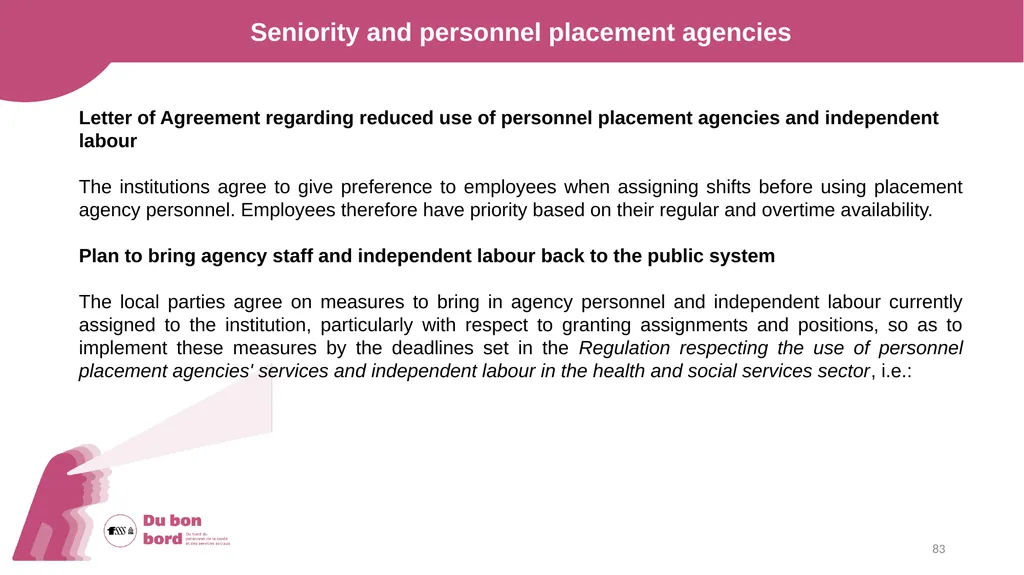
Seniority and personnel placement agencies Letter of Agreement regarding reduced use of personnel placement agencies and independent labour
The institutions agree to give preference to employees when assigning shifts before using placement agency personnel. Employees therefore have priority based on their regular and overtime availability.
Plan to bring agency staff and independent labour back to the public system
The local parties agree on measures to bring in agency personnel and independent labour currently assigned to the institution, particularly with respect to granting assignments and positions, so as to implement these measures by the deadlines set in the Regulation respecting the use of personnel placement agencies' services and independent labour in the health and social services sector, i.e.: 83<br>
The institutions agree to give preference to employees when assigning shifts before using placement agency personnel. Employees therefore have priority based on their regular and overtime availability.
Plan to bring agency staff and independent labour back to the public system
The local parties agree on measures to bring in agency personnel and independent labour currently assigned to the institution, particularly with respect to granting assignments and positions, so as to implement these measures by the deadlines set in the Regulation respecting the use of personnel placement agencies' services and independent labour in the health and social services sector, i.e.: 83<br>
84
Seniority and personnel placement agencies (cont'd)
October 20, 2024 for the Capitale-Nationale, Montréal, Chaudière-Appalaches, Laval and Montérégie health and social service regions
October 19, 2025 for the Saguenay–Lac-Saint-Jean, Mauricie and Centre-du-Québec, Estrie, Lanaudière and Laurentides health and social service regions
October 18, 2026 for the Bas-Saint-Laurent, Outaouais, Abitibi-Témiscamingue, Côte-Nord, Nord-du-Québec, Gaspésie–Iles-de-la-Madeleine and Nunavik health and social service regions
The national parties agree to mandate the permanent national negotiating committee to discuss progress on these plans and any other topic related to this Letter of Agreement. 84<br>
October 20, 2024 for the Capitale-Nationale, Montréal, Chaudière-Appalaches, Laval and Montérégie health and social service regions
October 19, 2025 for the Saguenay–Lac-Saint-Jean, Mauricie and Centre-du-Québec, Estrie, Lanaudière and Laurentides health and social service regions
October 18, 2026 for the Bas-Saint-Laurent, Outaouais, Abitibi-Témiscamingue, Côte-Nord, Nord-du-Québec, Gaspésie–Iles-de-la-Madeleine and Nunavik health and social service regions
The national parties agree to mandate the permanent national negotiating committee to discuss progress on these plans and any other topic related to this Letter of Agreement. 84<br>
85
Far North Letter of Agreement outside the collective agreement for Class 1 personnel
Improved access to leave without pay to work in a northern institution
Improvement and enhancement of Letter of Agreement #37 regarding employees working for an institution in the Far North (classes 2, 3 and 4). 85<br>
Improved access to leave without pay to work in a northern institution
Improvement and enhancement of Letter of Agreement #37 regarding employees working for an institution in the Far North (classes 2, 3 and 4). 85<br>
86
Far North Letter of agreement outside the collective agreement for Class 1 personnel
Letter of Agreement outside the collective agreement pertaining to the Nunavik health and social services region and covering Class 1 personnel for the duration of the forthcoming collective agreement.
The agreement stipulates, among other things, that personnel covered by the Letter of Agreement waive the additional allowance equal to 66% of food shipping costs (Appendix H, Art. 7.02).
The agreement takes effect upon signing. 86<br>
Letter of Agreement outside the collective agreement pertaining to the Nunavik health and social services region and covering Class 1 personnel for the duration of the forthcoming collective agreement.
The agreement stipulates, among other things, that personnel covered by the Letter of Agreement waive the additional allowance equal to 66% of food shipping costs (Appendix H, Art. 7.02).
The agreement takes effect upon signing. 86<br>
87
Far North (cont'd)
Improved attraction / retention premium for Class 1 personnel
Level 1: The premium increases from $14,000 to $20,447 (facilities in Kuujjuaq and Kuujjuarapik)
Level 2: The premium increases from $15,000 to $21,908 (facilities in Umiujaq, Tasiujaq, Kangiqsualujjuaq, Aupaluk, Quaqtaq and Kangirsuk)
Level 3: The premium increases from $17,000 to $24,829 (facilities in Inukjuak, Kangiqsujuaq, Puvirnituq, Ivujivik, Akulivik andSalluit)
The premiums are increased starting on the same date and according to the same general pay raise parameters as those provided for in the national provisions.
The amounts are adjusted on a pro-rated basis for the length of the assignment. Part-time employees receive the premium on a pro-rated basis for paid hours. 87<br>
Improved attraction / retention premium for Class 1 personnel
Level 1: The premium increases from $14,000 to $20,447 (facilities in Kuujjuaq and Kuujjuarapik)
Level 2: The premium increases from $15,000 to $21,908 (facilities in Umiujaq, Tasiujaq, Kangiqsualujjuaq, Aupaluk, Quaqtaq and Kangirsuk)
Level 3: The premium increases from $17,000 to $24,829 (facilities in Inukjuak, Kangiqsujuaq, Puvirnituq, Ivujivik, Akulivik andSalluit)
The premiums are increased starting on the same date and according to the same general pay raise parameters as those provided for in the national provisions.
The amounts are adjusted on a pro-rated basis for the length of the assignment. Part-time employees receive the premium on a pro-rated basis for paid hours. 87<br>
88
Far North (cont'd)
Shuttle project to provide additional trips out for Class 1 personnel
The Employer grants a work-time arrangement for a minimum of one year to employees whose home base is at a facility in region 17 and who request it
Notwithstanding the foregoing, in the event of an emergency or situation that puts the local population at risk, the employer may delay the start of the work-time arrangement until the situation normalizes
Employees with a work-time arrangement must work at least 26 weeks annually
The number of trips out for which the employer reimburses expenses may not exceed 6 per year, including those provided for in Appendix H (Regional Disparities)
Employees with a work-time arrangement are considered employees with no dependants for the purposes of applying the regional disparity provisions 88<br>
Shuttle project to provide additional trips out for Class 1 personnel
The Employer grants a work-time arrangement for a minimum of one year to employees whose home base is at a facility in region 17 and who request it
Notwithstanding the foregoing, in the event of an emergency or situation that puts the local population at risk, the employer may delay the start of the work-time arrangement until the situation normalizes
Employees with a work-time arrangement must work at least 26 weeks annually
The number of trips out for which the employer reimburses expenses may not exceed 6 per year, including those provided for in Appendix H (Regional Disparities)
Employees with a work-time arrangement are considered employees with no dependants for the purposes of applying the regional disparity provisions 88<br>
89
Far North (cont'd)
All leave for employees with a work-time arrangement, with the exception of weekly days off and sick leave, must be taken during trips out
Benefits provided for in the collective agreement and those outside the collective agreement, including accumulation of experience and seniority, are pro-rated to the employee's time worked 89<br>
All leave for employees with a work-time arrangement, with the exception of weekly days off and sick leave, must be taken during trips out
Benefits provided for in the collective agreement and those outside the collective agreement, including accumulation of experience and seniority, are pro-rated to the employee's time worked 89<br>
90
Far North Improved access to leave without pay to work in a northern institution
Amendment to paragraph 18.05 of the collective agreement:
"...an employee recruited to work in one of the following institutions:
Nunavik (17)
Ungava Tulattavik Health Centre
Inuulitsivik Health Centre
obtains, upon written request made forty-five (45) days in advance, leave without pay for a maximum of twelve (12) months.
At the employee's request, this leave without pay may be extended for one or more periods totalling a maximum of forty-eight (48) months.
Notwithstanding the foregoing, in the event of an emergency or a situation that puts the population of the territory served by the institution from which the employee came at risk, the employer and the employee shall agree on terms and conditions for the unpaid leave." 90<br>
Amendment to paragraph 18.05 of the collective agreement:
"...an employee recruited to work in one of the following institutions:
Nunavik (17)
Ungava Tulattavik Health Centre
Inuulitsivik Health Centre
obtains, upon written request made forty-five (45) days in advance, leave without pay for a maximum of twelve (12) months.
At the employee's request, this leave without pay may be extended for one or more periods totalling a maximum of forty-eight (48) months.
Notwithstanding the foregoing, in the event of an emergency or a situation that puts the population of the territory served by the institution from which the employee came at risk, the employer and the employee shall agree on terms and conditions for the unpaid leave." 90<br>
91
Far North Improvement and enhancement of Letter of Agreement #37 regarding employees working for an institution in the Far North
The Letter of Agreement is renewed until 6 months after the collective agreement expires
Adjustment of interim allowances for Class 3 and 4 technicians and professionals by 21%
Annual interim allowance for Class 2 personnel and for Class 3 personnel not covered by the Letter of Agreement: 25% of the allowance for technicians and professionals
Schefferville and Kawawachikamach added to Sector III. 91<br>
The Letter of Agreement is renewed until 6 months after the collective agreement expires
Adjustment of interim allowances for Class 3 and 4 technicians and professionals by 21%
Annual interim allowance for Class 2 personnel and for Class 3 personnel not covered by the Letter of Agreement: 25% of the allowance for technicians and professionals
Schefferville and Kawawachikamach added to Sector III. 91<br>
92
Far North 92 Class 3 and 4 technicians and professionals<br>
93
Far North 93 Class 2 and 3 personnel not receiving another allowance<br>
94
Other regions with labour shortage issues Regional budget envelopes to fund initiatives to increase workforce size and availability
$9 million for Outaouais
$2 million for Abitibi
$2.245 million for Côte-Nord
$0.205 million for Nord-du-Québec
$2.55 million for Gaspésie/Iles-de-la-Madeleine
Throughout the duration of the collective agreement, with the understanding that amounts will be distributed evenly across the years of application of the collective agreement. 94<br>
$9 million for Outaouais
$2 million for Abitibi
$2.245 million for Côte-Nord
$0.205 million for Nord-du-Québec
$2.55 million for Gaspésie/Iles-de-la-Madeleine
Throughout the duration of the collective agreement, with the understanding that amounts will be distributed evenly across the years of application of the collective agreement. 94<br>
95
Other regions with labour shortage issues (cont.)
All budgets are allocated to fund initiatives designed to increase the size and availability of the workforce in these regions.
Beginning April 1, 2023, budgets will be spread over a 5-year term.
If the entire budget allocated for a fiscal year is not committed, uncommitted amounts are rolled over to following fiscal year. No money may be rolled over past March 30, 2028. 95<br>
All budgets are allocated to fund initiatives designed to increase the size and availability of the workforce in these regions.
Beginning April 1, 2023, budgets will be spread over a 5-year term.
If the entire budget allocated for a fiscal year is not committed, uncommitted amounts are rolled over to following fiscal year. No money may be rolled over past March 30, 2028. 95<br>
96
Other regions with labour shortage issues (cont.)
These dedicated budgets must fund initiatives agreed upon locally and approved by the national parties for regions facing exceptional workforce issues.
Initiatives may include lump-sum payments for settling in, special premiums for border issues, enhanced premiums, attraction / retention premiums, or other initiatives designed to reduce the use of independent labour. Such measures cannot be considered as salary: they are not contributory or eligible for the pension plan.
Throughout the term of the collective agreement, measures may be modified by local parties, subject to the agreement of the national parties, to target initiatives better suited to their regional issues.
An assessment will be made with the national parties in the 90 days before the expiry of the collective agreement. 96<br>
These dedicated budgets must fund initiatives agreed upon locally and approved by the national parties for regions facing exceptional workforce issues.
Initiatives may include lump-sum payments for settling in, special premiums for border issues, enhanced premiums, attraction / retention premiums, or other initiatives designed to reduce the use of independent labour. Such measures cannot be considered as salary: they are not contributory or eligible for the pension plan.
Throughout the term of the collective agreement, measures may be modified by local parties, subject to the agreement of the national parties, to target initiatives better suited to their regional issues.
An assessment will be made with the national parties in the 90 days before the expiry of the collective agreement. 96<br>
97
Nursing candidates CEPI and CEPIA
Employees in any personnel class will receive the most advantageous salary if they obtain the job title of candidate to the nursing profession (CEPI) or candidate to the nursing assistant profession (CEPIA) 97<br>
Employees in any personnel class will receive the most advantageous salary if they obtain the job title of candidate to the nursing profession (CEPI) or candidate to the nursing assistant profession (CEPIA) 97<br>
98
SPECIFIC MEASURES
CLASS 1 98<br>
CLASS 1 98<br>
99
Neonatal transport Creation of a national working committee on neonatal transport at the Centre hospitalier universitaire Sainte-Justine (CHUSJ)
Mandates
Study and assess the working conditions of respiratory therapists and nurses assigned to neonatal transport at CHUSJ
Study the workload of employees assigned to neonatal transport
Assess specific needs and requirements associated with neonatal transport
Report findings on the specific circumstances associated with neonatal transport
Discuss any other matters concerning neonatal transport agreed upon by the parties
Produce a joint report on the work to present to the negotiating parties no more than 18 months before the collective agreement expires 99<br>
Mandates
Study and assess the working conditions of respiratory therapists and nurses assigned to neonatal transport at CHUSJ
Study the workload of employees assigned to neonatal transport
Assess specific needs and requirements associated with neonatal transport
Report findings on the specific circumstances associated with neonatal transport
Discuss any other matters concerning neonatal transport agreed upon by the parties
Produce a joint report on the work to present to the negotiating parties no more than 18 months before the collective agreement expires 99<br>
100
Specialty nurse practitioners Creation of a national working committee on specialized nurse practitioners (SNPs)
Mandates
Contribute to evaluating the effects of expanding reserved and non-reserved activities to other job titles with a view to optimizing their contribution to reserved and non-reserved activities and, where appropriate, recommend changes to promote implementation of the new work organization;
Study current tasks and work organization of SNPs and the impact of changes in their roles and responsibilities, and recommend changes where necessary. 100<br>
Mandates
Contribute to evaluating the effects of expanding reserved and non-reserved activities to other job titles with a view to optimizing their contribution to reserved and non-reserved activities and, where appropriate, recommend changes to promote implementation of the new work organization;
Study current tasks and work organization of SNPs and the impact of changes in their roles and responsibilities, and recommend changes where necessary. 100<br>
101
SPECIFIC MEASURES
CLASS 2 101<br>
CLASS 2 101<br>
102
Creation of ASSS team leader job title Health and Social Services Aide Team Leader job title created
(Class 2)
This job title will be assigned ranking 10, single rate 102<br>
(Class 2)
This job title will be assigned ranking 10, single rate 102<br>
103
Creation of specialized pacification and security worker job titles Specialized Pacification and Security Worker (ISPS) and ISPS Team Leader job titles created (Class 2)
The 6 Intervention Officer and Intervention Officer Team Leader job titles are merged into 2 job titles
The parties have agreed on ranking 10 for ISPS and ranking 11 for ISPS Team Leader
The FSSS-CSN undertakes not to file any complaints seeking the reevaluation of these two job titles following the 2025 and 2030 pay equity audits and will inform its affiliated unions of this commitment
If employees or unions do file complaints, the FSSS‑CSN agrees not to represent them before the Commission or any other body that makes a decision on the complaint.
* A change in ranking from 8 to 10 for all job titles in the intervention officer group 103<br>
The 6 Intervention Officer and Intervention Officer Team Leader job titles are merged into 2 job titles
The parties have agreed on ranking 10 for ISPS and ranking 11 for ISPS Team Leader
The FSSS-CSN undertakes not to file any complaints seeking the reevaluation of these two job titles following the 2025 and 2030 pay equity audits and will inform its affiliated unions of this commitment
If employees or unions do file complaints, the FSSS‑CSN agrees not to represent them before the Commission or any other body that makes a decision on the complaint.
* A change in ranking from 8 to 10 for all job titles in the intervention officer group 103<br>
104
SPECIFIC MEASURES
CLASS 3 104<br>
CLASS 3 104<br>
105
Recognition of an Attestation of College Studies (AEC) or Diploma of College Studies (DEC) combined with a university certificate for some Class 3 technician job titles A Diploma of College Studies (DEC) combined with a relevant undergraduate university certificate recognized for the following job titles:
Paralegal (2112)
Communications technician (2275)
Documentation technician (2356)
Building technician (2374)
Instrumentation and control technician (2379) 105<br>
Paralegal (2112)
Communications technician (2275)
Documentation technician (2356)
Building technician (2374)
Instrumentation and control technician (2379) 105<br>
106
Recognition of an Attestation of College Studies (AEC) or Diploma of College Studies (DEC) combined with a university certificate for some Class 3 technician job titles (cont'd)
A relevant Attestation of College Studies (AEC) of 800 hours or more combined with relevant experience in the field recognized for the following job titles:
Paralegal (2112)
Audiovisual technician (2258)
Communications technician (2275)
Documentation technician (2356)
Electro-mechanics technician (2371)
Building technician (2374)
Mechanical fabrication technician (2377)
Instrumentation and control technician (2379) 106<br>
A relevant Attestation of College Studies (AEC) of 800 hours or more combined with relevant experience in the field recognized for the following job titles:
Paralegal (2112)
Audiovisual technician (2258)
Communications technician (2275)
Documentation technician (2356)
Electro-mechanics technician (2371)
Building technician (2374)
Mechanical fabrication technician (2377)
Instrumentation and control technician (2379) 106<br>
107
Elimination of Administrative Officer, Class 4 job titles Elimination of Administrative Officer, Class 4 job titles (secretarial and administrative sectors) and reclassification of the affected employees to Administrative Officer, Class 3 job titles (secretarial and administrative sectors)
Employees covered by this measure will be automatically reclassified to one of two job titles: Administrative Officer, Secretarial Sector, Class 3 (5316) or Administrative Officer, Administrative Sector, Class 3 (5317), on the date the collective agreement comes into effect. 107<br>
Employees covered by this measure will be automatically reclassified to one of two job titles: Administrative Officer, Secretarial Sector, Class 3 (5316) or Administrative Officer, Administrative Sector, Class 3 (5317), on the date the collective agreement comes into effect. 107<br>
108
Letter of agreement on administrative officers
and medical secretaries Training and recognition of acquired competencies
The national parties agree that each institution, in partnership with a school recognized by the relevant ministry, will facilitate a process of recognition of acquired competencies for currently employed administrative officers and medical secretaries who wish to develop their knowledge and competencies. Further, institutions will facilitate access to qualifying training dispensed by a school recognized by the relevant ministry, specifically for the purpose of the testing required under staffing processes and the evaluation of qualifications
The national parties agree that each institution will promote the implementation of training and support projects to meet its administrative support needs
Costs associated with such projects will be funded from the human resources budget provided in Article 13 of the national provisions 108<br>
and medical secretaries Training and recognition of acquired competencies
The national parties agree that each institution, in partnership with a school recognized by the relevant ministry, will facilitate a process of recognition of acquired competencies for currently employed administrative officers and medical secretaries who wish to develop their knowledge and competencies. Further, institutions will facilitate access to qualifying training dispensed by a school recognized by the relevant ministry, specifically for the purpose of the testing required under staffing processes and the evaluation of qualifications
The national parties agree that each institution will promote the implementation of training and support projects to meet its administrative support needs
Costs associated with such projects will be funded from the human resources budget provided in Article 13 of the national provisions 108<br>
109
Letter of agreement on administrative officers
and medical secretaries (cont.)
Local monitoring of Letter of Agreement implementation
The labour relations committee provided for in Article 36 of the collective agreement is mandated to monitor the implementation of this Letter of Agreement.
Annually evaluate administrative support development needs within the institution, and agree on the share of the budget, provided for in paragraph 13.01(c) of the national provisions of the collective agreement, to be used to ensure the implementation of this Letter of Agreement;
Identify measures to promote and recognize the role of administrative officers and medical secretaries within the institution’s various work teams;
In collaboration with institution resource persons identified by the committee, support skills development for administrative officers and medical secretaries based on identified needs and the employees’ expressed preferences. 109<br>
and medical secretaries (cont.)
Local monitoring of Letter of Agreement implementation
The labour relations committee provided for in Article 36 of the collective agreement is mandated to monitor the implementation of this Letter of Agreement.
Annually evaluate administrative support development needs within the institution, and agree on the share of the budget, provided for in paragraph 13.01(c) of the national provisions of the collective agreement, to be used to ensure the implementation of this Letter of Agreement;
Identify measures to promote and recognize the role of administrative officers and medical secretaries within the institution’s various work teams;
In collaboration with institution resource persons identified by the committee, support skills development for administrative officers and medical secretaries based on identified needs and the employees’ expressed preferences. 109<br>
110
Letter of agreement regarding administrative officers
and medical secretaries (cont'd)
(d) Agree on measures to support and facilitate the process for employees who so wish; to this end, the committee supports favourable conditions such as modulation of work schedules to facilitate access to the process for recognition of acquired competencies, access to qualifying training, and training projects.
(e) Produce a yearly report based on the following indicators:
Number of employees who took advantage of the measures provided for in this Letter of Agreement and the job titles concerned;
Number of transfers and promotions resulting from the application of this Letter of Agreement;
Budget invested per institution;
Other indicators agreed on by the parties.
The local parties will send their yearly report to the negotiating parties.
At any time, make recommendations related to the application of this Letter of Agreement to the permanent national negotiating committee provided for in article 33 of the collective agreement. 110<br>
and medical secretaries (cont'd)
(d) Agree on measures to support and facilitate the process for employees who so wish; to this end, the committee supports favourable conditions such as modulation of work schedules to facilitate access to the process for recognition of acquired competencies, access to qualifying training, and training projects.
(e) Produce a yearly report based on the following indicators:
Number of employees who took advantage of the measures provided for in this Letter of Agreement and the job titles concerned;
Number of transfers and promotions resulting from the application of this Letter of Agreement;
Budget invested per institution;
Other indicators agreed on by the parties.
The local parties will send their yearly report to the negotiating parties.
At any time, make recommendations related to the application of this Letter of Agreement to the permanent national negotiating committee provided for in article 33 of the collective agreement. 110<br>
111
Letter of agreement regarding administrative officers
and medical secretaries (cont'd)
National follow-up
The permanent national negotiating committee is responsible for monitoring and evaluating the present Letter of Agreement based on the reports and recommendations received from the local parties.
The parties also agree to mandate the permanent national negotiating committee to discuss the contribution of administrative officers and medical secretaries to the health and social services system. 111<br>
and medical secretaries (cont'd)
National follow-up
The permanent national negotiating committee is responsible for monitoring and evaluating the present Letter of Agreement based on the reports and recommendations received from the local parties.
The parties also agree to mandate the permanent national negotiating committee to discuss the contribution of administrative officers and medical secretaries to the health and social services system. 111<br>
112
Information technology sector Introduction of a new temporary premium
National working committee on the information technology (IT) sector 112<br>
National working committee on the information technology (IT) sector 112<br>
113
Information technology sector Premium
A 7.5% premium on paid hours to recognize the performance of project coordination and monitoring duties by employees with the following job titles:
Computer analyst (1123)
Specialized computer analyst (1124)
Computer technician (2123)
Specialized computer technician (2124)
This new IT premium is non-recurring and expires on March 30, 2028. The premium is paid on the basis of paid hours per pay period. The budget for payment of this premium is $3.59 million per year. 113<br>
A 7.5% premium on paid hours to recognize the performance of project coordination and monitoring duties by employees with the following job titles:
Computer analyst (1123)
Specialized computer analyst (1124)
Computer technician (2123)
Specialized computer technician (2124)
This new IT premium is non-recurring and expires on March 30, 2028. The premium is paid on the basis of paid hours per pay period. The budget for payment of this premium is $3.59 million per year. 113<br>
114
Information technology (IT) sector Creation of a working committee
Assess the appropriateness of instituting a mechanism for recognizing skills acquired in the workplace along with qualifying training to support the advancement on the salary scale of covered office personnel and administrative professionals and technicians;
Evaluate measures that could be put in place to encourage flexible work schedules and access to telework;
Analyze the effects of the new premium and consider the possibility of extending its application. 114<br>
Assess the appropriateness of instituting a mechanism for recognizing skills acquired in the workplace along with qualifying training to support the advancement on the salary scale of covered office personnel and administrative professionals and technicians;
Evaluate measures that could be put in place to encourage flexible work schedules and access to telework;
Analyze the effects of the new premium and consider the possibility of extending its application. 114<br>
115
Professional orders Add a Letter of Agreement regarding reimbursement of professional order dues for Class 3 personnel
50% of applicable dues payable to a professional order, up to a maximum annual amount of $400, will be reimbursed, upon presentation of supporting documentation, by the employer to a Class 3 employee holding a full-time position with the number of hours listed for the job title, when membership in the professional order is a position requirement for the employee. 115<br>
50% of applicable dues payable to a professional order, up to a maximum annual amount of $400, will be reimbursed, upon presentation of supporting documentation, by the employer to a Class 3 employee holding a full-time position with the number of hours listed for the job title, when membership in the professional order is a position requirement for the employee. 115<br>
116
SPECIFIC MEASURES
CLASS 4 116<br>
CLASS 4 116<br>
117
Mental health Psychotherapy permit
Voluntary increase in number of hours per week
National inter-union committee on the provision of mental health services 117<br>
Voluntary increase in number of hours per week
National inter-union committee on the provision of mental health services 117<br>
118
Mental health Psychotherapy permit
Reimbursement of the cost of the psychotherapy permit and related training fees, when required by the employer, when the employee practices psychotherapy at mental health services within the health and social services network, for the following job titles:
• Human relations officer (1553)
• Guidance counsellor (1701)
• Criminologist (1544)
• Occupational therapist (1230)
• Psycho-educator (1652)
• Clinical sexologist (1573)
• Social worker (1550) 118<br>
Reimbursement of the cost of the psychotherapy permit and related training fees, when required by the employer, when the employee practices psychotherapy at mental health services within the health and social services network, for the following job titles:
• Human relations officer (1553)
• Guidance counsellor (1701)
• Criminologist (1544)
• Occupational therapist (1230)
• Psycho-educator (1652)
• Clinical sexologist (1573)
• Social worker (1550) 118<br>
119
Mental health Voluntary upgrading of work week
1.1 The employer and the employee who requests it may agree on an upgraded work schedule. This schedule may not exceed 37.5 hours per week and will be deemed to comply with, but not modify, the List of Job Titles;
1.2 Upon completion of the agreement in paragraph 1.1, the following terms and conditions apply to position postings:
1.2.1 When a position is newly created or becomes vacant, the Employer shall:
Post newly created positions on the basis of the number of hours per week provided for in the List of Job Titles, with the exception of 37.5 hours;
Post newly vacant positions on the basis of the number of hours per week provided for in the List of Job Titles, with the exception of 37.5 hours. However, if the position was previously at 37.5 hours, it can be posted as 37.5 hours. 119<br>
1.1 The employer and the employee who requests it may agree on an upgraded work schedule. This schedule may not exceed 37.5 hours per week and will be deemed to comply with, but not modify, the List of Job Titles;
1.2 Upon completion of the agreement in paragraph 1.1, the following terms and conditions apply to position postings:
1.2.1 When a position is newly created or becomes vacant, the Employer shall:
Post newly created positions on the basis of the number of hours per week provided for in the List of Job Titles, with the exception of 37.5 hours;
Post newly vacant positions on the basis of the number of hours per week provided for in the List of Job Titles, with the exception of 37.5 hours. However, if the position was previously at 37.5 hours, it can be posted as 37.5 hours. 119<br>
120
Mental health 120 (cont'd)
1.2.2 When the position obtained has a normal 35-hour or 36.25-hour week, the Employer may offer an employee who holds a full-time or part-time position the opportunity to permanently upgrade the normal work week for the position to 37.5 hours.
The upgrading terms and conditions apply only to employees working in mental health who hold one of the following job titles:
Guidance counsellor (1701)
Criminologist (1544)
Occupational therapist (1230)
Psycho-educator (1652)
Clinical sexologist (1573)
Social worker (1550)<br>
1.2.2 When the position obtained has a normal 35-hour or 36.25-hour week, the Employer may offer an employee who holds a full-time or part-time position the opportunity to permanently upgrade the normal work week for the position to 37.5 hours.
The upgrading terms and conditions apply only to employees working in mental health who hold one of the following job titles:
Guidance counsellor (1701)
Criminologist (1544)
Occupational therapist (1230)
Psycho-educator (1652)
Clinical sexologist (1573)
Social worker (1550)<br>
121
Mental health National inter-union committee on the provision of mental health services
Mandates
Analyze ways of involving users' family and friends in order to optimize the delivery of mental health services and follow-up
Analyze the effects of introducing holders of psychotherapy permits into work teams
Identify solutions to enable the following job titles to contribute to the front-line identification of signs and symptoms associated with the most common mental disorders:
Human relations officer (1553)
Guidance counsellor (1701)
Criminologist (1544)
Occupational therapist (1230)
Psycho-educator (1652)
Clinical sexologist (1573)
Social worker (1550)
And any other relevant job title 121<br>
Mandates
Analyze ways of involving users' family and friends in order to optimize the delivery of mental health services and follow-up
Analyze the effects of introducing holders of psychotherapy permits into work teams
Identify solutions to enable the following job titles to contribute to the front-line identification of signs and symptoms associated with the most common mental disorders:
Human relations officer (1553)
Guidance counsellor (1701)
Criminologist (1544)
Occupational therapist (1230)
Psycho-educator (1652)
Clinical sexologist (1573)
Social worker (1550)
And any other relevant job title 121<br>
122
Lawyers Working committee for employees with the job title of lawyer
Amend Letter of Agreement #26 regarding the remuneration of employees with the job title of lawyer 122<br>
Amend Letter of Agreement #26 regarding the remuneration of employees with the job title of lawyer 122<br>
123
Lawyers Interunion working committee for employees with the job title of lawyer
The working committee's mandate is to examine the following points:
(a) Total remuneration of employees with the job title of lawyer
(b) The attraction / retention situation for employees with the job title of lawyer, based on analysis of indicators, taking into account the workplace , and identifying the main characteristics
(c) The effects of the DPJ legal premium on the attraction and retention of employees with the job title of lawyer
(d) The appropriateness of extending the premium analyzed in paragraph (c) beyond its expiry date, or of eliminating or modifying it
(e) Any other subject agreed to by the parties. 123<br>
The working committee's mandate is to examine the following points:
(a) Total remuneration of employees with the job title of lawyer
(b) The attraction / retention situation for employees with the job title of lawyer, based on analysis of indicators, taking into account the workplace , and identifying the main characteristics
(c) The effects of the DPJ legal premium on the attraction and retention of employees with the job title of lawyer
(d) The appropriateness of extending the premium analyzed in paragraph (c) beyond its expiry date, or of eliminating or modifying it
(e) Any other subject agreed to by the parties. 123<br>
124
Lawyers Amendment to Letter of Agreement #26 regarding the remuneration of employees with the job title of lawyer
Amend Letter of Agreement #26 regarding the remuneration of employees with the job title of lawyer by adding the Youth Centre premium for employees with the job title of lawyer who hold a position in the legal department of the Direction de la protection de la jeunesse (DPJ)
This premium cannot be combined with the retention premium for lawyers. The more advantageous of the two premiums shall apply to an employee who meets the conditions required for payment of either premium.
This premium will take effect on the date on which the collective agreement comes into force, and expire on March 30, 2028. 124<br>
Amend Letter of Agreement #26 regarding the remuneration of employees with the job title of lawyer by adding the Youth Centre premium for employees with the job title of lawyer who hold a position in the legal department of the Direction de la protection de la jeunesse (DPJ)
This premium cannot be combined with the retention premium for lawyers. The more advantageous of the two premiums shall apply to an employee who meets the conditions required for payment of either premium.
This premium will take effect on the date on which the collective agreement comes into force, and expire on March 30, 2028. 124<br>
125
Professional orders Introduce a Letter of Agreement regarding reimbursement of professional order dues for Class 4 personnel
50% of applicable dues payable to a professional order, up to a maximum annual amount of $400, will be reimbursed, upon presentation of supporting documentation, by the employer to a Class 4 employee holding a full-time position with the number of hours listed for the job title, when membership in the professional order is a position requirement for the employee. 125<br>
50% of applicable dues payable to a professional order, up to a maximum annual amount of $400, will be reimbursed, upon presentation of supporting documentation, by the employer to a Class 4 employee holding a full-time position with the number of hours listed for the job title, when membership in the professional order is a position requirement for the employee. 125<br>
126
Class 4 administrative tasks Creation of a national working committee on administrative tasks for Class 4 job titles
Mandates
Identify and evaluate measures implemented in the institutions to reduce time spent on paperwork and other administrative tasks
List administrative and clinical/administrative tasks performed by the employees
Collaborate in the search for ways to improve practices related to administrative and clinical/administrative tasks 126<br>
Mandates
Identify and evaluate measures implemented in the institutions to reduce time spent on paperwork and other administrative tasks
List administrative and clinical/administrative tasks performed by the employees
Collaborate in the search for ways to improve practices related to administrative and clinical/administrative tasks 126<br>
127
Agreement on local provisions Definition of service (classes 1 to 3)
Article 2 in the local provisions of the collective agreements of unions affiliated with the FSSS-CSN is amended to include the following paragraph on the definition of a service:
“Set of specific, hierarchically organized activities constituting a distinct entity in terms of the
institution’s organizational structure, based on, among other things, the care or services provided to users, as determined by the employer.” 127<br>
Article 2 in the local provisions of the collective agreements of unions affiliated with the FSSS-CSN is amended to include the following paragraph on the definition of a service:
“Set of specific, hierarchically organized activities constituting a distinct entity in terms of the
institution’s organizational structure, based on, among other things, the care or services provided to users, as determined by the employer.” 127<br>
128
Agreement on local provisions (cont.)
Further, local provisions that do not allow a service to be distributed over more than one institution are amended to include the following paragraph:
“The employer may create services based in more than one institution if it promotes better organization of care and services or increases the accessibility of care and services, or when the specific nature of the care and services provided by a service justifies it.”
These amendments to the local provisions shall not have the effect of modifying or rendering inoperative the other items in Article 2 or any other local provisions of the collective agreement which do not concern the definition of a service, the number of institutions across which a service may be spread, or the territory covered by a service. 128<br>
Further, local provisions that do not allow a service to be distributed over more than one institution are amended to include the following paragraph:
“The employer may create services based in more than one institution if it promotes better organization of care and services or increases the accessibility of care and services, or when the specific nature of the care and services provided by a service justifies it.”
These amendments to the local provisions shall not have the effect of modifying or rendering inoperative the other items in Article 2 or any other local provisions of the collective agreement which do not concern the definition of a service, the number of institutions across which a service may be spread, or the territory covered by a service. 128<br>
129
Occupational health and safety Creation of a national inter-union committee to monitor the prevention and participation mechanisms provided for in the Act to modernize the occupational health and safety regime with respect to health and social service institutions;
Extension of the forum on employees’ general health with a new budget. 129<br>
Extension of the forum on employees’ general health with a new budget. 129<br>
130
Workplace health and safety Creation of a national inter-union committee to monitor prevention and participation mechanisms provided for in the Act to modernize the occupational health and safety regime (AMOHSR) with respect to health and social service institutions;
Mandates
Monitor the implementation of prevention and participation mechanisms (PPMs) under the transitional measures provided for in the AMOHSR and the Regulation respecting prevention programs;
Request a progress report from institutions on the implementation of PPMs and measures addressing psychosocial risks;
Assess progress reports received;
Identify PPM organizational structures that seem to show potential for enhanced efficiency and effectiveness;
Identify and publish best practices in prevention and participation mechanisms. 130<br>
Mandates
Monitor the implementation of prevention and participation mechanisms (PPMs) under the transitional measures provided for in the AMOHSR and the Regulation respecting prevention programs;
Request a progress report from institutions on the implementation of PPMs and measures addressing psychosocial risks;
Assess progress reports received;
Identify PPM organizational structures that seem to show potential for enhanced efficiency and effectiveness;
Identify and publish best practices in prevention and participation mechanisms. 130<br>
131
Workplace health and safety 131 Letter of Agreement #56 regarding the forum on employees’ general health
The employer has allocated a budget of $3.214 million, for the duration of the collective agreement, to be used for projects arising from Letter of Agreement #56 regarding the forum on employees’ general health.<br>
The employer has allocated a budget of $3.214 million, for the duration of the collective agreement, to be used for projects arising from Letter of Agreement #56 regarding the forum on employees’ general health.<br>
132
Degrees or diplomas obtained outside Quebec Amendment to the general provisions of the List of Job Titles concerning degrees or diplomas obtained outside Quebec
“Notwithstanding the preceding paragraph, the competent authority for the comparative evaluation of degrees or diplomas obtained outside Quebec is the Ministère de l'Immigration, de la Francisation et de l'Intégration (MIFI), subject to the requirements of certain professions, specifically competence certificates, permits or membership in a professional order.”
The MSSS must secure the agreement of the other union organizations covered by the List of Job Titles, job descriptions and salary rates and scales for the health and social services network. 132<br>
“Notwithstanding the preceding paragraph, the competent authority for the comparative evaluation of degrees or diplomas obtained outside Quebec is the Ministère de l'Immigration, de la Francisation et de l'Intégration (MIFI), subject to the requirements of certain professions, specifically competence certificates, permits or membership in a professional order.”
The MSSS must secure the agreement of the other union organizations covered by the List of Job Titles, job descriptions and salary rates and scales for the health and social services network. 132<br>
133
Student status Creation of a national working committee on the introduction of employees with student status
Agree on pilot projects for integrating students
Identify target job titles for pilot projects
Pursue discussions on terms and conditions applicable to student employees
Study the current presence and contribution of students in the network, and identify ways to maximize this contribution
Establish workforce indicators, including retention rate, number of projects implemented, years of education of student employees, satisfaction rate and retention rate
Analyse the effects of the pilot projects on the basis of indicators previously determined by the committee 133<br>
Agree on pilot projects for integrating students
Identify target job titles for pilot projects
Pursue discussions on terms and conditions applicable to student employees
Study the current presence and contribution of students in the network, and identify ways to maximize this contribution
Establish workforce indicators, including retention rate, number of projects implemented, years of education of student employees, satisfaction rate and retention rate
Analyse the effects of the pilot projects on the basis of indicators previously determined by the committee 133<br>
134
Integrating employees from Indigenous communities Creation of a national working committee on the integration of employees from Indigenous communities
Mandates
Cultural issues related to the integration of employees from Indigenous communities
Issues related to remuneration and access to certain job titles
Measures to attract and integrate employees from Indigenous communities 134<br>
Mandates
Cultural issues related to the integration of employees from Indigenous communities
Issues related to remuneration and access to certain job titles
Measures to attract and integrate employees from Indigenous communities 134<br>
135
Agence Santé Québec and adoption of Bill 15 Creation of a national working committee to update the national collective agreement in response to the creation of Agence Santé Québec and adoption of Bill 15
Update the collective agreement and make all necessary changes for consistency in response to the creation of Agence Santé Québec and the adoption of Bill 15, including with regard to the following subjects:
Seniority (Article 12), including the question of seniority for employees of institutions not merged into Santé Québec
Layoff procedure (Article 14)
Job security (Article 15)
Leave for union work (Article 7)
Regional disparities (Appendix H) 135<br>
Update the collective agreement and make all necessary changes for consistency in response to the creation of Agence Santé Québec and the adoption of Bill 15, including with regard to the following subjects:
Seniority (Article 12), including the question of seniority for employees of institutions not merged into Santé Québec
Layoff procedure (Article 14)
Job security (Article 15)
Leave for union work (Article 7)
Regional disparities (Appendix H) 135<br>
136
Tow clauses In the event that remuneration improvements are granted to other union organizations in the health and social services system, these same improvements will apply, for the same job titles and under the same conditions, provided that any concessions made in exchange are agreed to by the FSSS-CSN. 136<br>