04
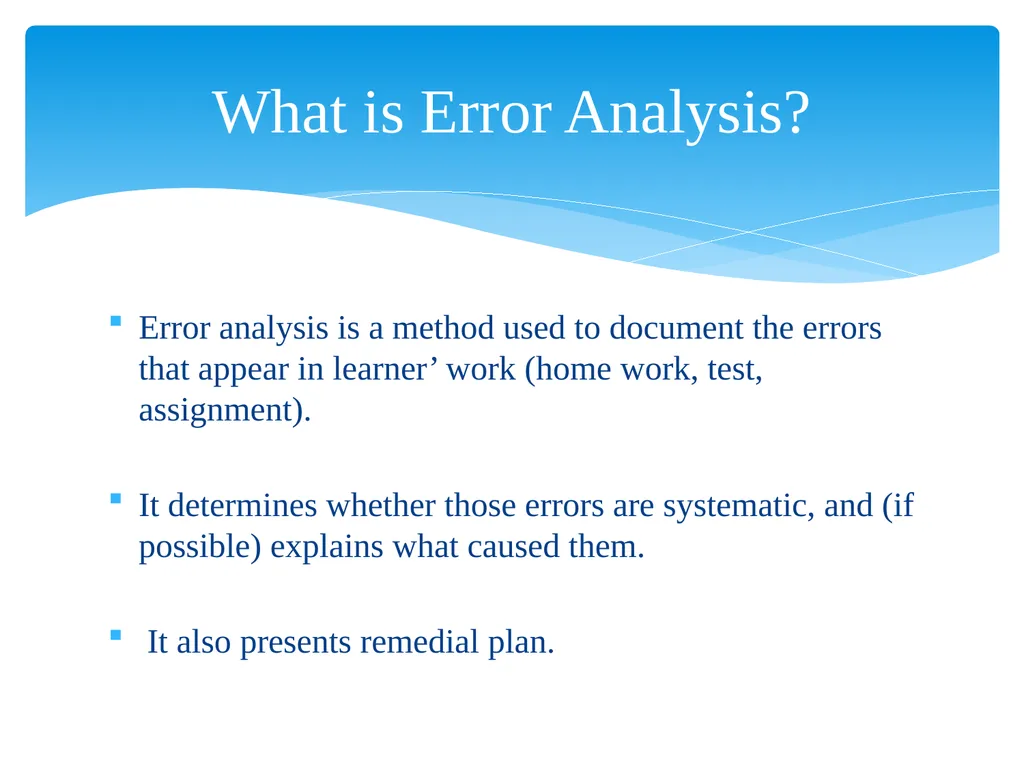
Error analysis is a method used to document the errors that appear in learner’ work (home work, test, assignment).
It determines whether those errors are systematic, and (if possible) explains what caused them.
It also presents remedial plan. What is Error Analysis?<br>
05
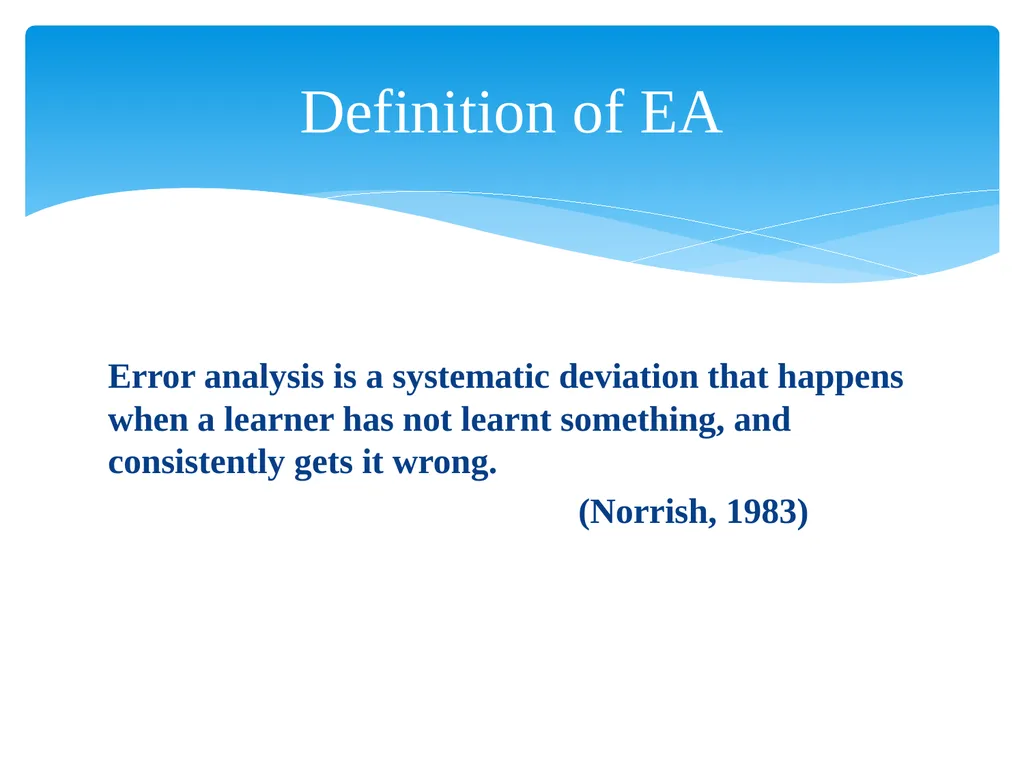
Error analysis is a systematic deviation that happens when a learner has not learnt something, and consistently gets it wrong.
(Norrish, 1983) Definition of EA<br>
06
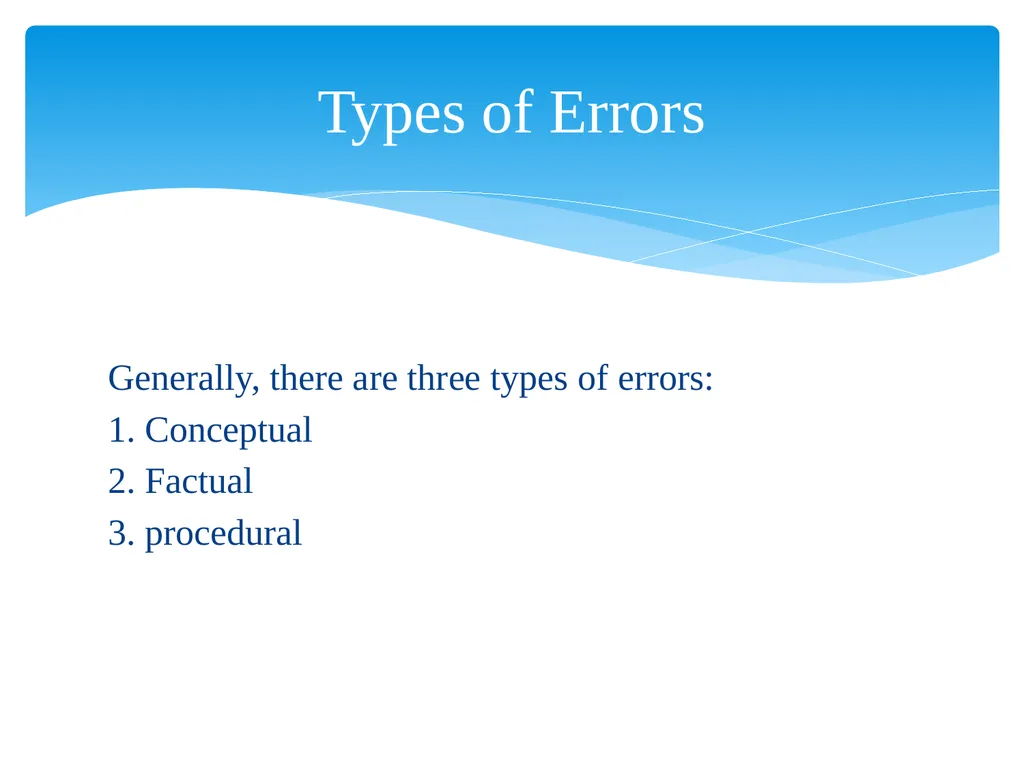
Generally, there are three types of errors:
1. Conceptual
2. Factual
3. procedural Types of Errors<br>
07
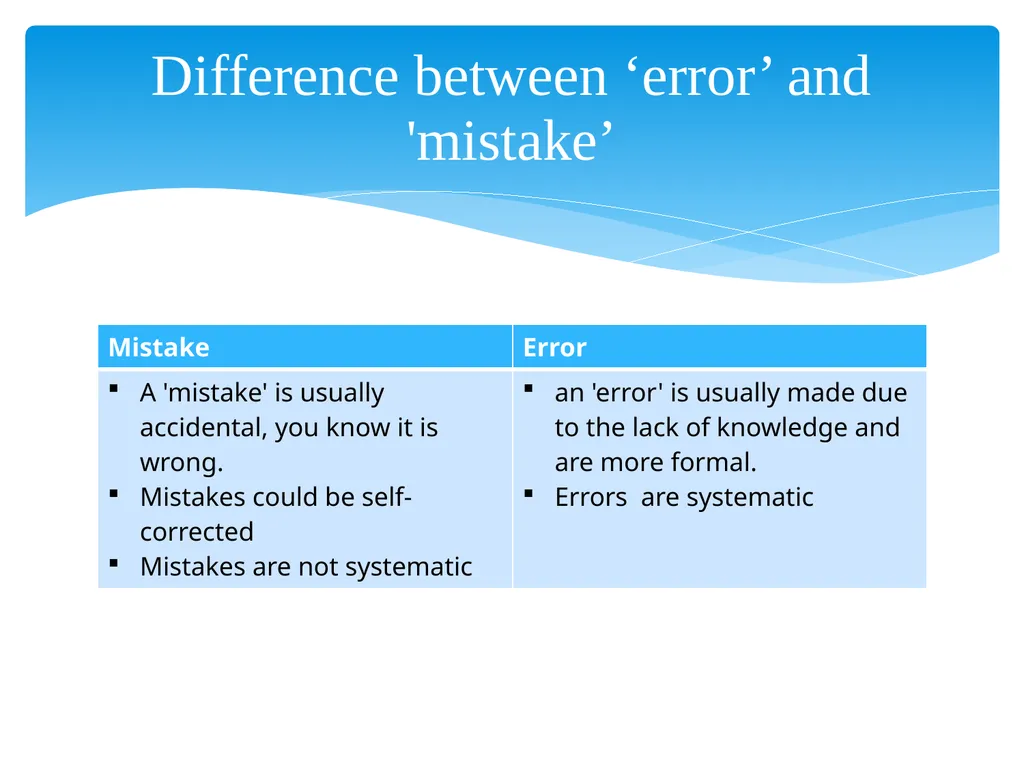
Difference between ‘error’ and 'mistake’<br>
08
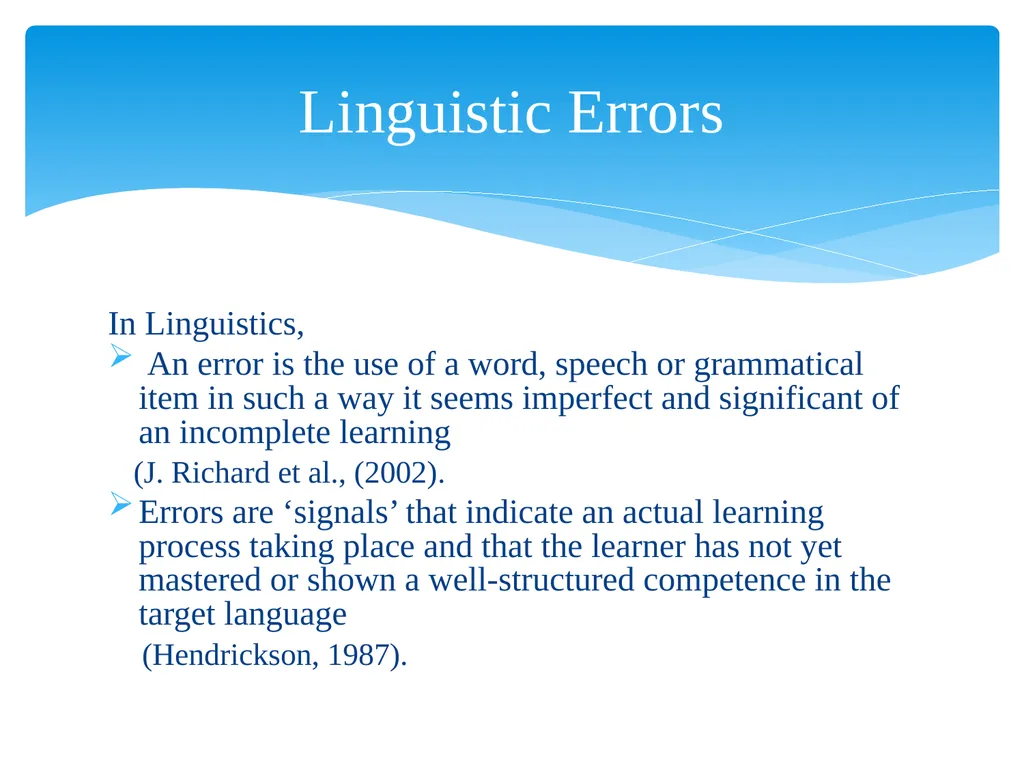
In Linguistics,
An error is the use of a word, speech or grammatical item in such a way it seems imperfect and significant of an incomplete learning
(J. Richard et al., (2002).
Errors are ‘signals’ that indicate an actual learning process taking place and that the learner has not yet mastered or shown a well-structured competence in the target language
(Hendrickson, 1987). Linguistic Errors<br>
09
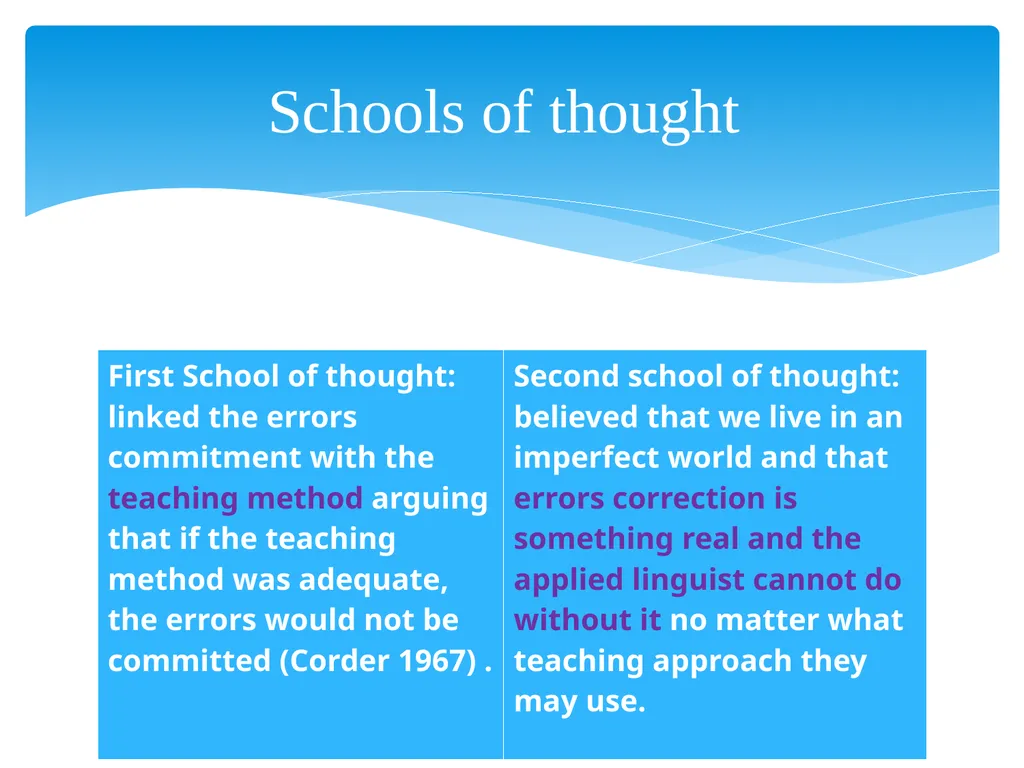
Schools of thought<br>
10
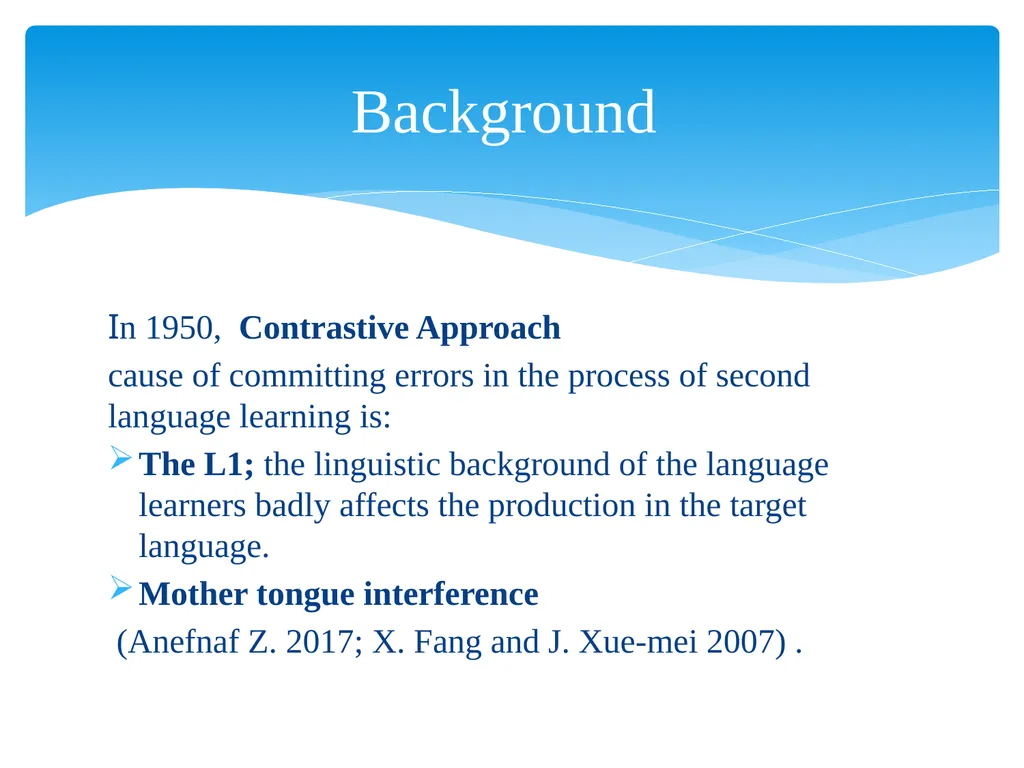
In 1950, Contrastive Approach
cause of committing errors in the process of second language learning is:
The L1; the linguistic background of the language learners badly affects the production in the target language.
Mother tongue interference
(Anefnaf Z. 2017; X. Fang and J. Xue-mei 2007) . Background<br>
11
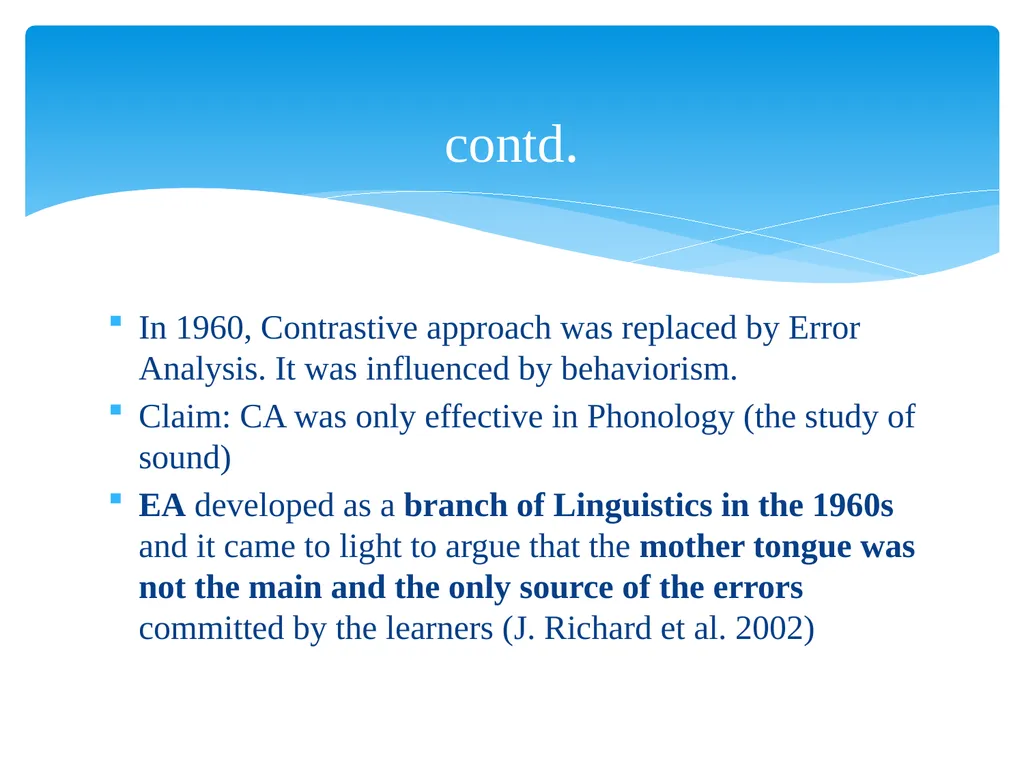
In 1960, Contrastive approach was replaced by Error Analysis. It was influenced by behaviorism.
Claim: CA was only effective in Phonology (the study of sound)
EA developed as a branch of Linguistics in the 1960s and it came to light to argue that the mother tongue was not the main and the only source of the errors committed by the learners (J. Richard et al. 2002) contd.<br>
12
Errors can be caused by the target language itself and by the applied communicative strategies as well as the type and quality of the second language instructions (Hashim,1999). Contd.<br>
13
To identify strategies which learners use in language learning, in terms of the approaches and strategies used in both of teaching and learning.
To identify the causes of learners’ errors, that is, investigating the motives behind committing such errors as the first attempt to eradicate them.
To obtain information on common difficulties in Language Learning, as an aid to teaching or in the preparation of the teaching materials (J. Richard et al. 2002). Aims of Error Analysis (Linguistics)<br>
14
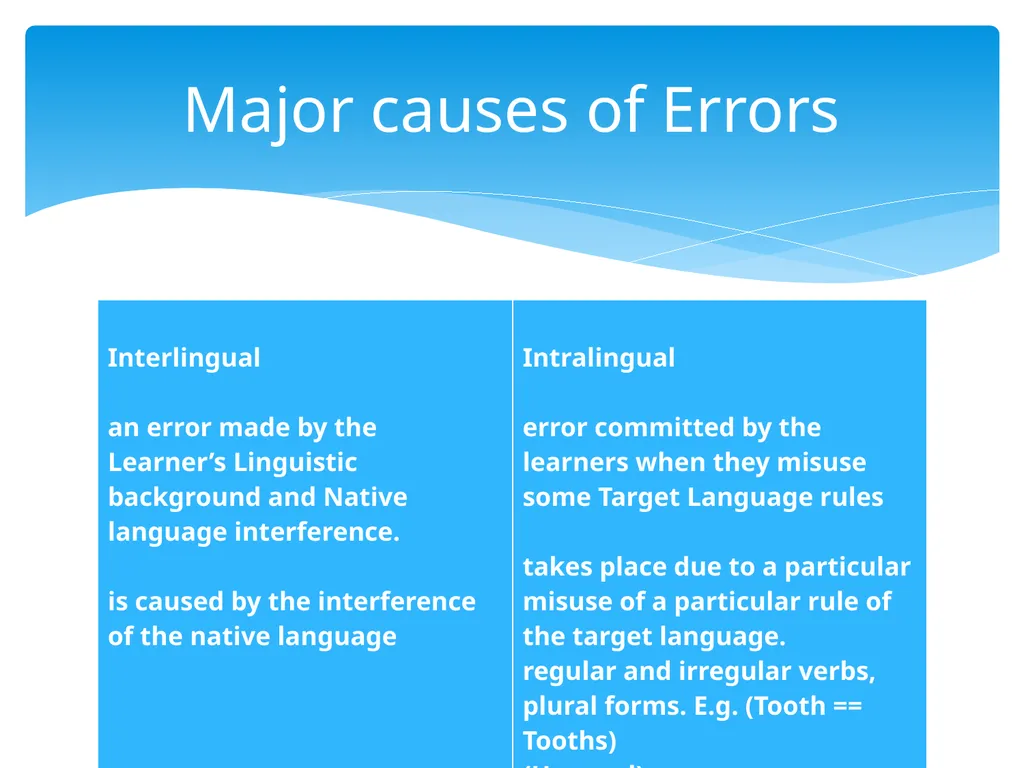
Major causes of Errors<br>
15
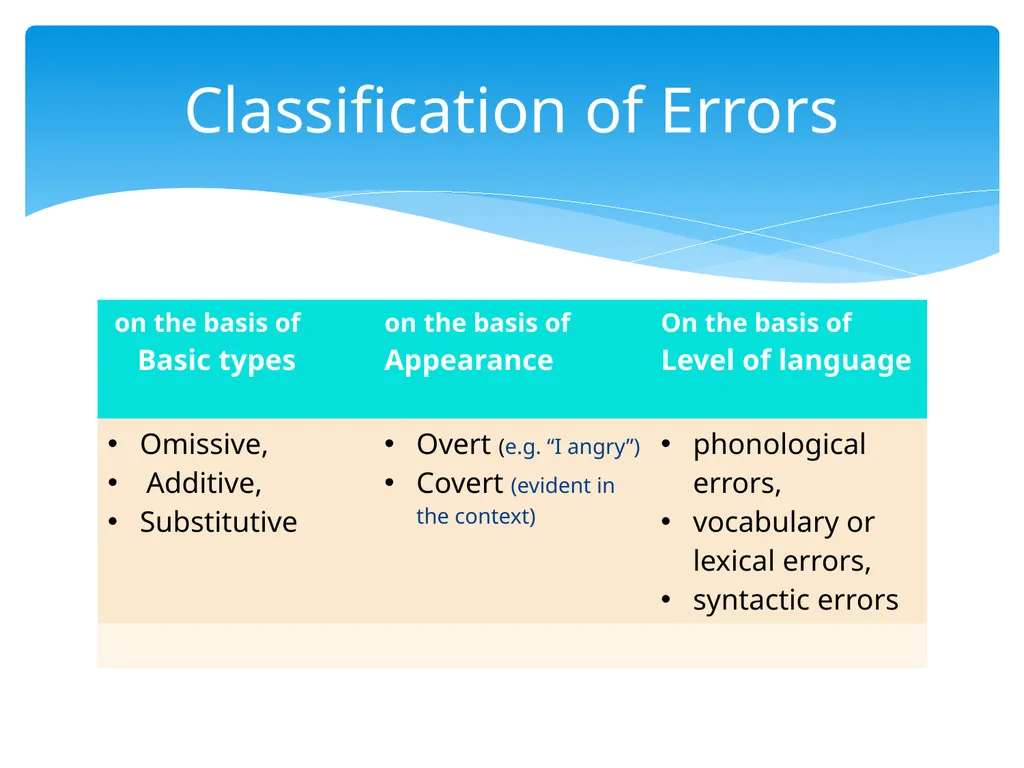
Classification of Errors<br>
16
Spelling: omission of silent letters:
no (know)
dout (doubt)
weit (weight)
Grammar: omission of
We wait the bus all the time Examples of omissive errors<br>
17
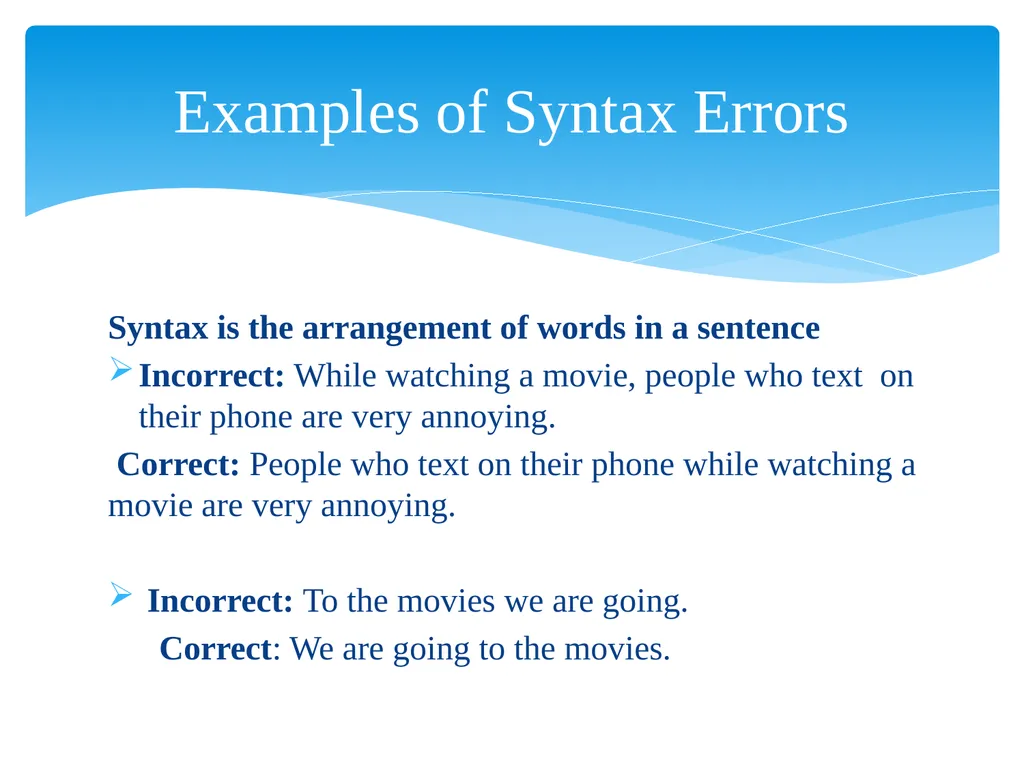
Syntax is the arrangement of words in a sentence
Incorrect: While watching a movie, people who text on their phone are very annoying.
Correct: People who text on their phone while watching a movie are very annoying.
Incorrect: To the movies we are going.
Correct: We are going to the movies. Examples of Syntax Errors<br>
18
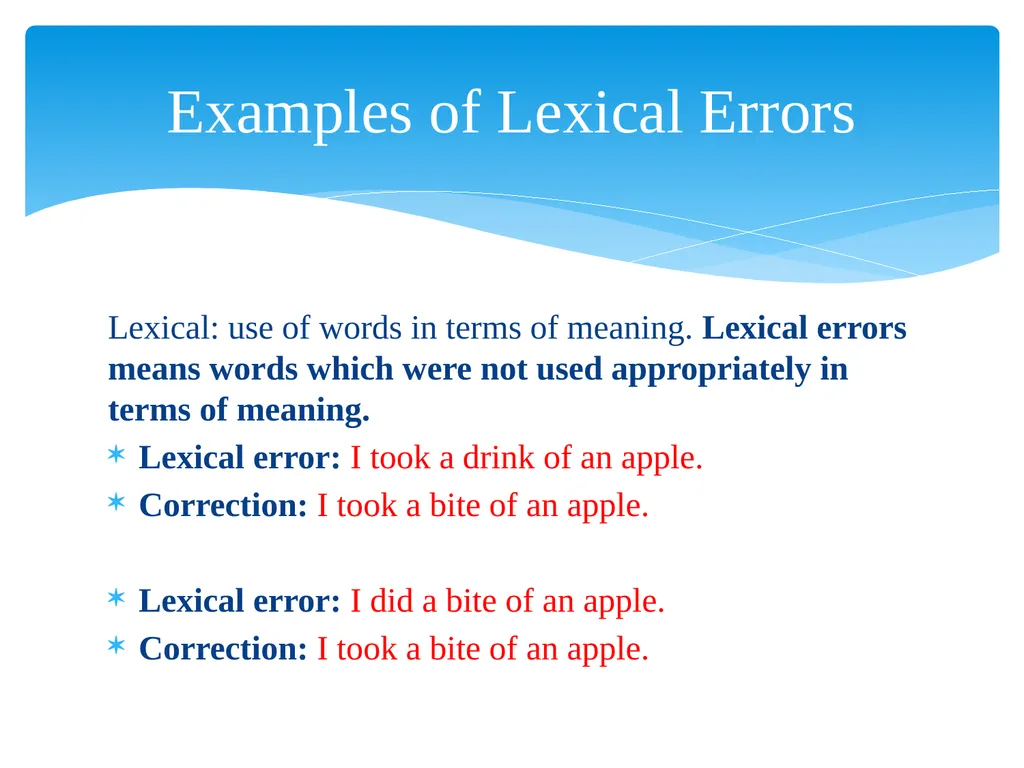
Lexical: use of words in terms of meaning. Lexical errors means words which were not used appropriately in terms of meaning.
Lexical error: I took a drink of an apple.
Correction: I took a bite of an apple.
Lexical error: I did a bite of an apple.
Correction: I took a bite of an apple. Examples of Lexical Errors<br>
19
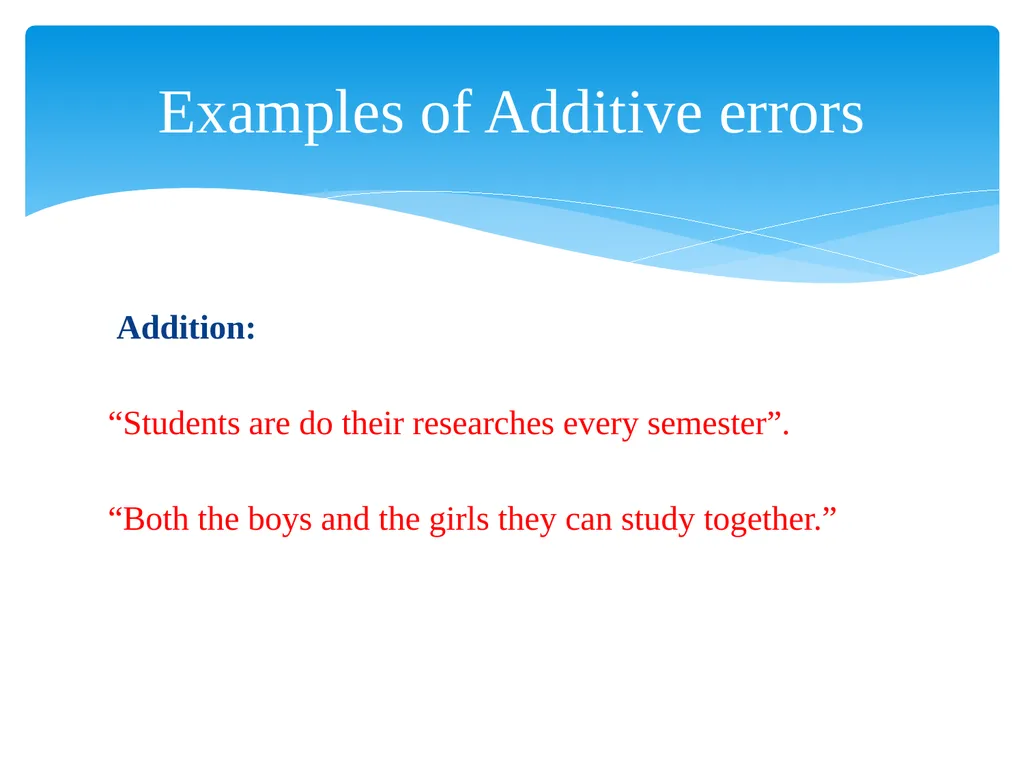
Addition:
“Students are do their researches every semester”.
“Both the boys and the girls they can study together.” Examples of Additive errors<br>
20
'thun' for 'sun.’
‘My tennis racket’, ‘my tennis bat’
‘Set the chair’, ‘set the table’ Examples of Substitutive Errors<br>
21
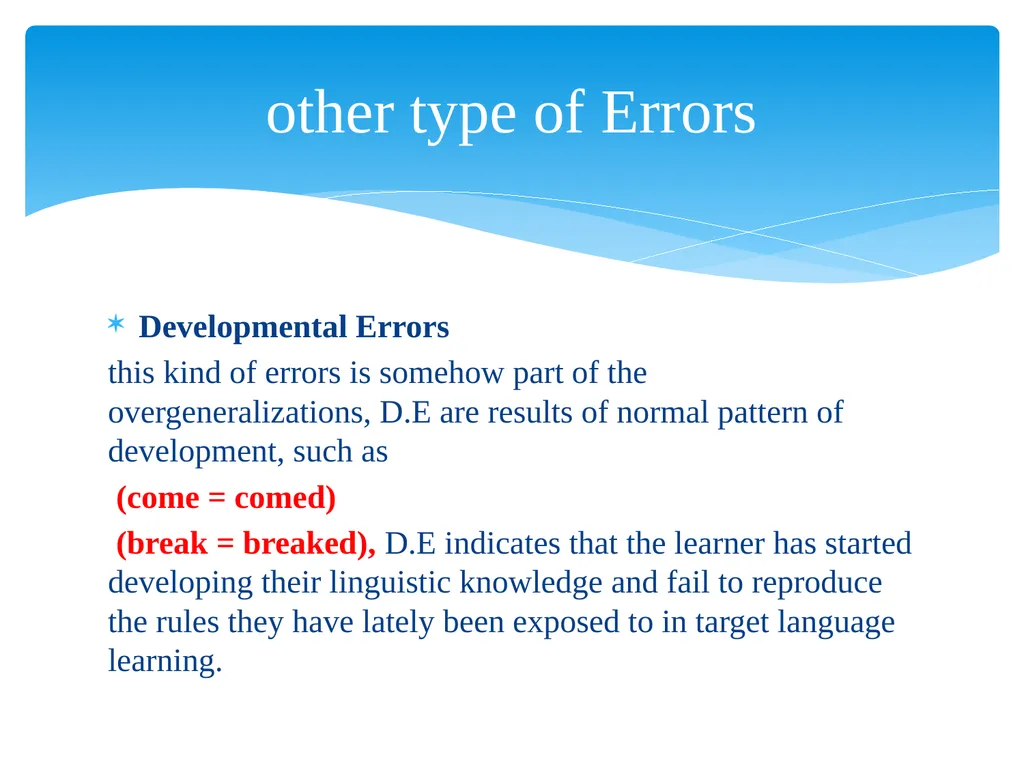
Developmental Errors
this kind of errors is somehow part of the overgeneralizations, D.E are results of normal pattern of development, such as
(come = comed)
(break = breaked), D.E indicates that the learner has started developing their linguistic knowledge and fail to reproduce the rules they have lately been exposed to in target language learning. other type of Errors<br>
22
Induced errors:
known as transfer of training, errors caused by misleading teaching examples, teachers, sometimes, unconditionally, explain a rule without highlighting the exceptions or the intended message they would want to convey (J. Richard et al. 2002). Contd.<br>
23
teaching prepositions particularly “at”
where the teacher may hold up a box and say “I am looking at the box”, the students may understand that “at” means “under” , they may later utter “the cat is at the table” instead of the cat is under the table.
(J. Richard et al. 2002) Example of Induced Error<br>
24
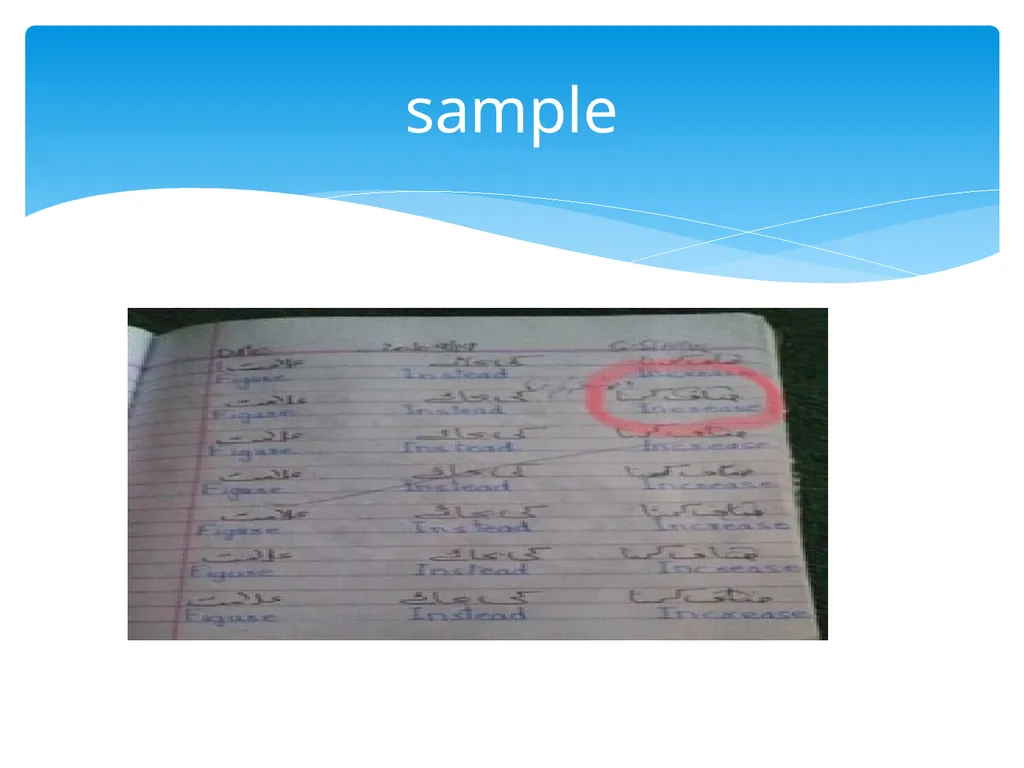
Errors of avoidance:
these errors occur when the learner fail to apply certain target language rules just because they are thought of to be too difficult. Contd.<br>
27
Errors are significant for
Teachers
Learners
How?� One point from each student Reflection Time<br>
28
Teaching is a highly reflective and moral responsibility.
Assessment has a significant role to make teaching and learning meaningful.
Students’ work is a source of getting knowledge about them that ultimately helps them improving their learning. Conclusion<br>