
Texas a&m university-commerce Commerce, texas A








Description: Texas am university-commerce Commerce, texas A Qualitative Analysis of Discussion Prompts and Student to Student Discussion Posts in an Online Graduate Gifted Education Course Joyce E. Kyle Miller, PhD Texas am university commerce
Related Topics
Download Presentation
"Texas a&m university-commerce Commerce, texas A" is the property of its rightful owner. Permission is granted to download and print the materials on this website for personal, non-commercial use only, and to display it on your personal computer provided you do not modify the materials and that you retain all copyright notices contained in the materials. By downloading content from our website, you accept the terms of this agreement.
Presentation Transcript
slide1. Texas a&m university-commerce
Commerce, texas A Qualitative Analysis of Discussion Prompts and Student to Student Discussion Posts in an Online Graduate Gifted Education Course
Joyce E. Kyle Miller, PhD<br>
slide2. Texas a&m university commerce<br>
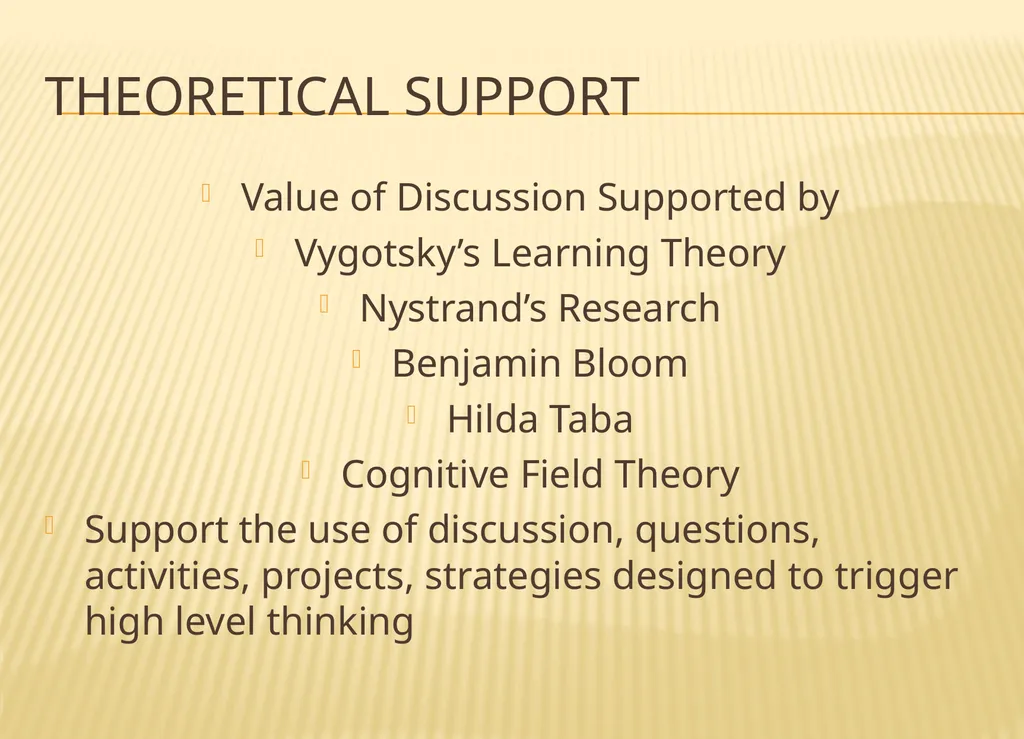
slide3. Theoretical support Value of Discussion Supported by
Vygotsky’s Learning Theory
Nystrand’s Research
Benjamin Bloom
Hilda Taba
Cognitive Field Theory
Support the use of discussion, questions, activities, projects, strategies designed to trigger high level thinking<br>
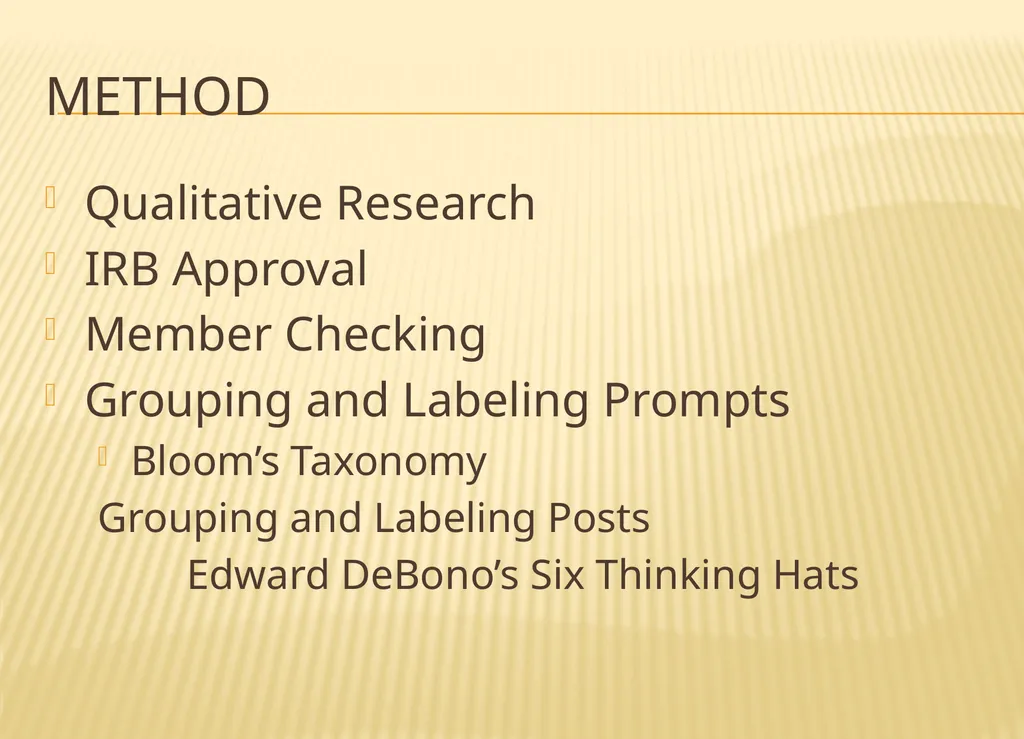
slide4. Method Qualitative Research
IRB Approval
Member Checking
Grouping and Labeling Prompts
Bloom’s Taxonomy
Grouping and Labeling Posts
Edward DeBono’s Six Thinking Hats<br>
slide5. EDCI 506 Nature and Needs of the Gifted Student
This course is a survey of the major facets of gifted education: characteristics of the gifted, identification of the gifted, curricular and instructional strategies appropriate in teaching the gifted, personnel for the gifted and evaluation<br>
slide6. Major Topics Addressed Historical development of gifted education
Characteristics, nature and needs of the gifted
Problems and Issues in the Identification of the Gifted
The Gifted Underachievement
Strategies for Teaching the Gifted
Curriculum for the Gifted
Social and Emotional Needs of the Gifted
The Texas State Plan for Gifted Education
Acceleration
Program Evaluation<br>
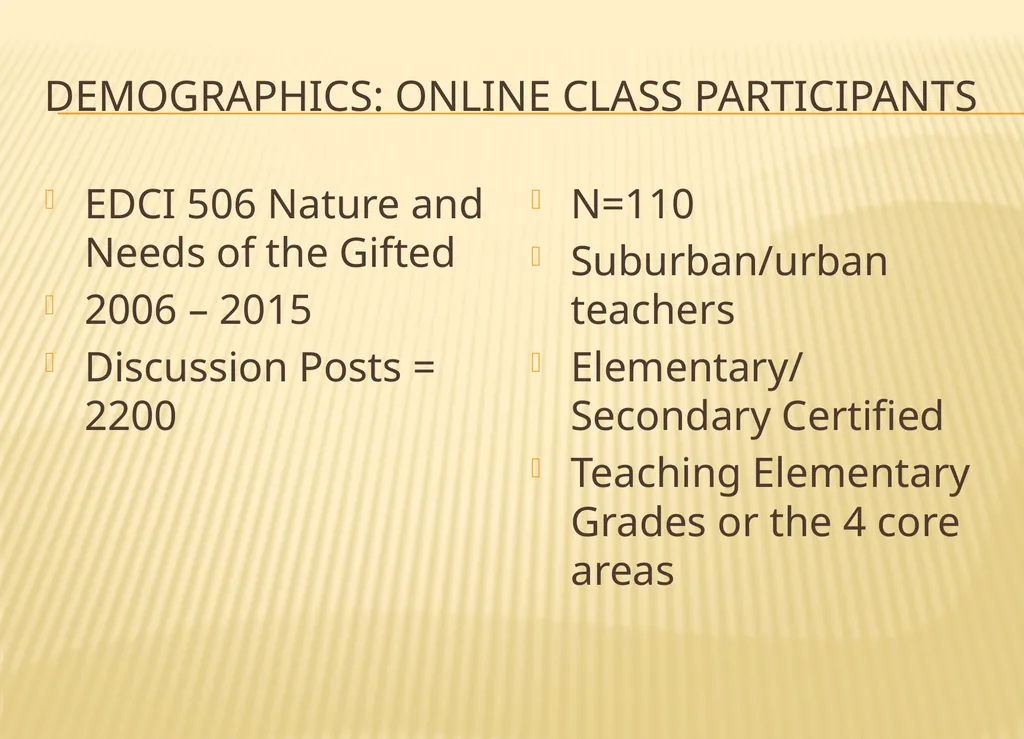
slide7. Demographics: Online Class Participants EDCI 506 Nature and Needs of the Gifted
2006 – 2015
Discussion Posts = 2200 N=110
Suburban/urban teachers
Elementary/Secondary Certified
Teaching Elementary Grades or the 4 core areas<br>
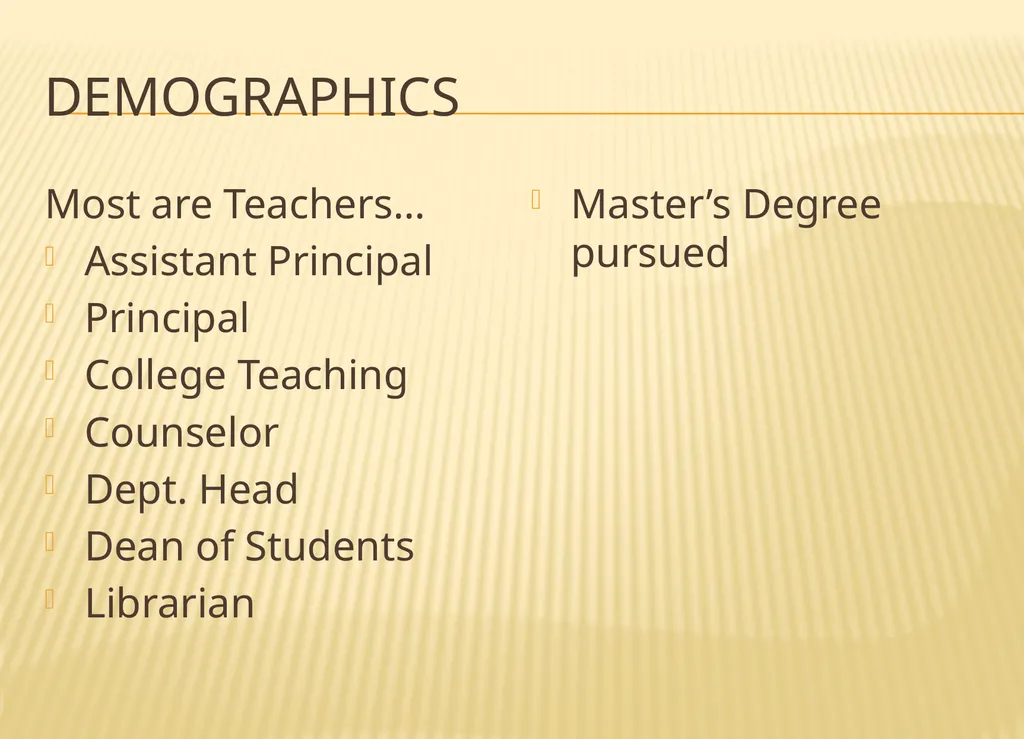
slide8. Demographics Most are Teachers…
Assistant Principal
Principal
College Teaching
Counselor
Dept. Head
Dean of Students
Librarian Master’s Degree pursued<br>
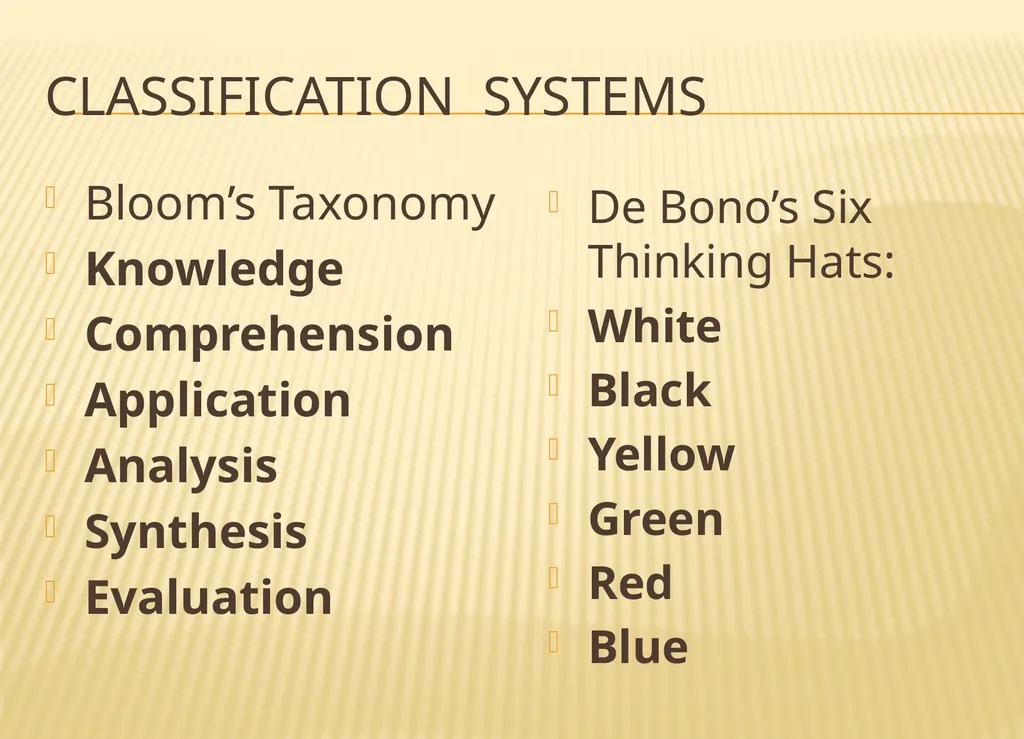
slide9. Classification systems Bloom’s Taxonomy
Knowledge
Comprehension
Application
Analysis
Synthesis
Evaluation De Bono’s Six Thinking Hats:
White
Black
Yellow
Green
Red
Blue<br>
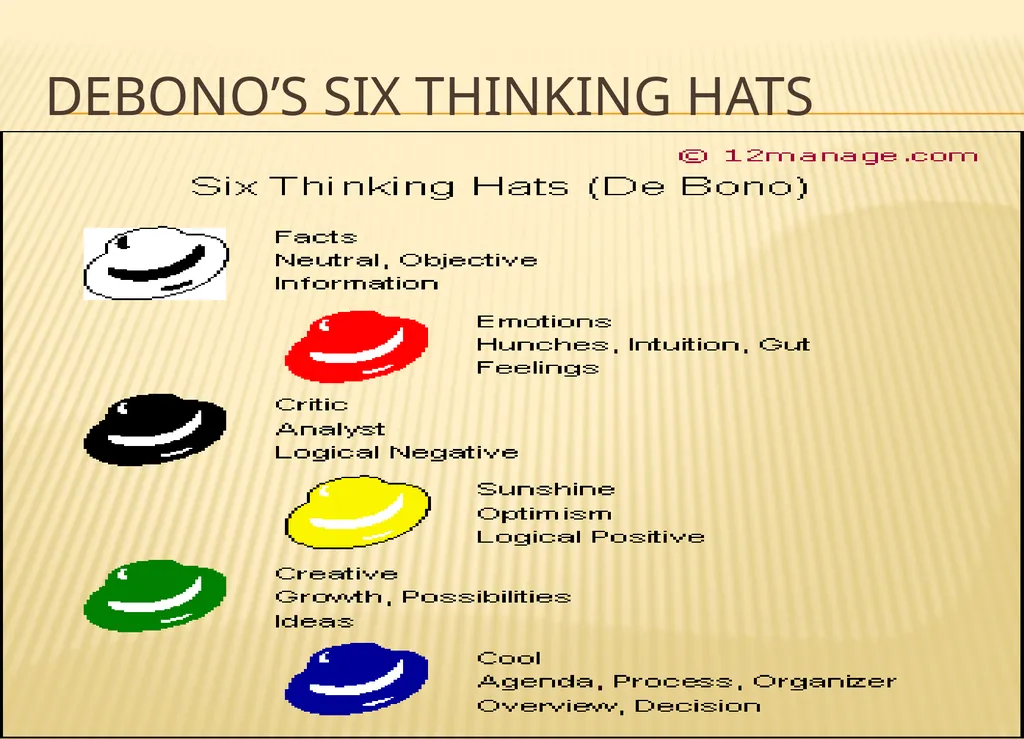
slide10. DeBono’s Six Thinking Hats<br>
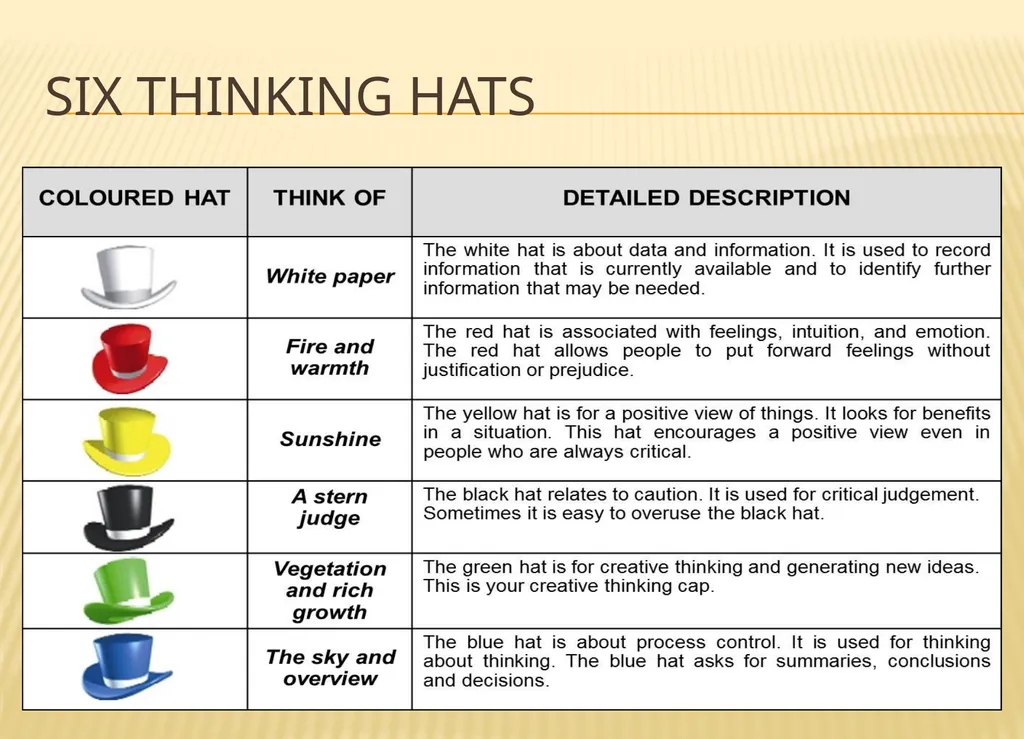
slide11. Six Thinking Hats<br>
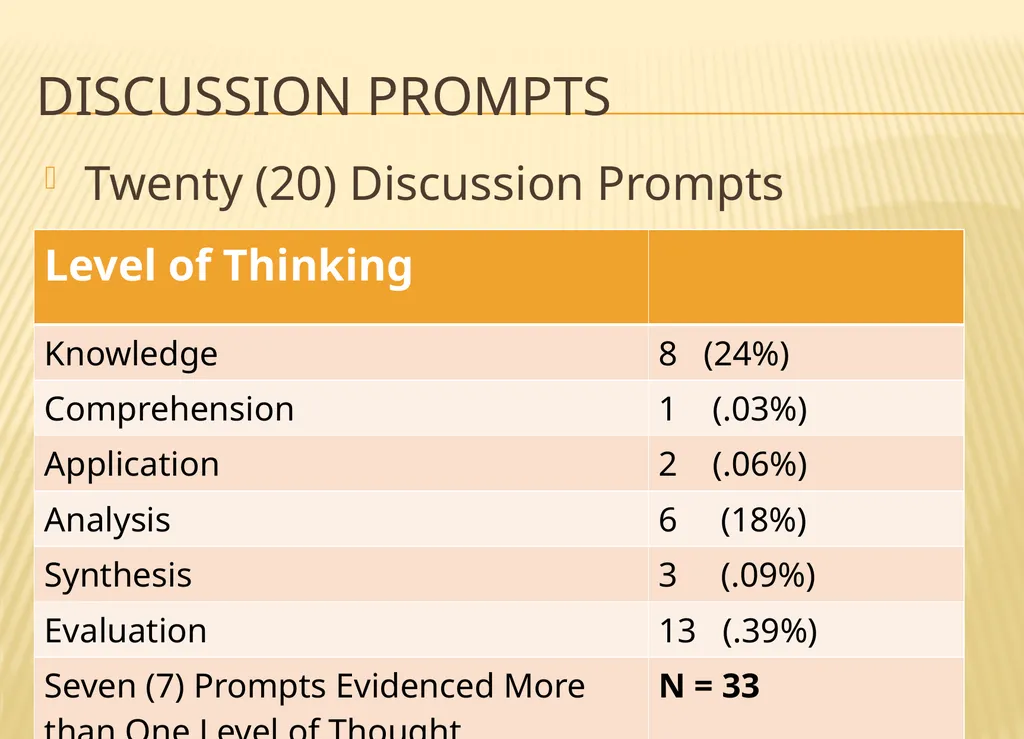
slide12. Discussion prompts Twenty (20) Discussion Prompts<br>
slide13. Question Addressed Which of DeBono’s Six Thinking Hats are reflected in
Student to Student Discussion Posts ?<br>
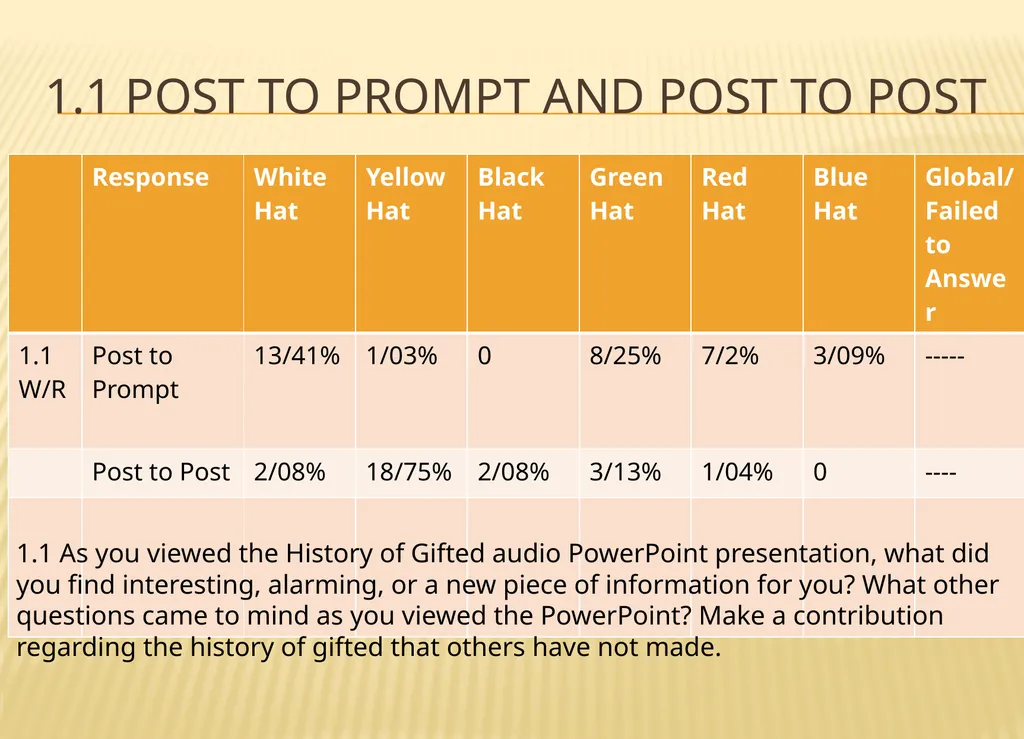
slide14. 1.1 Post to Prompt and Post to Post 1.1 As you viewed the History of Gifted audio PowerPoint presentation, what did you find interesting, alarming, or a new piece of information for you? What other questions came to mind as you viewed the PowerPoint? Make a contribution regarding the history of gifted that others have not made.<br>
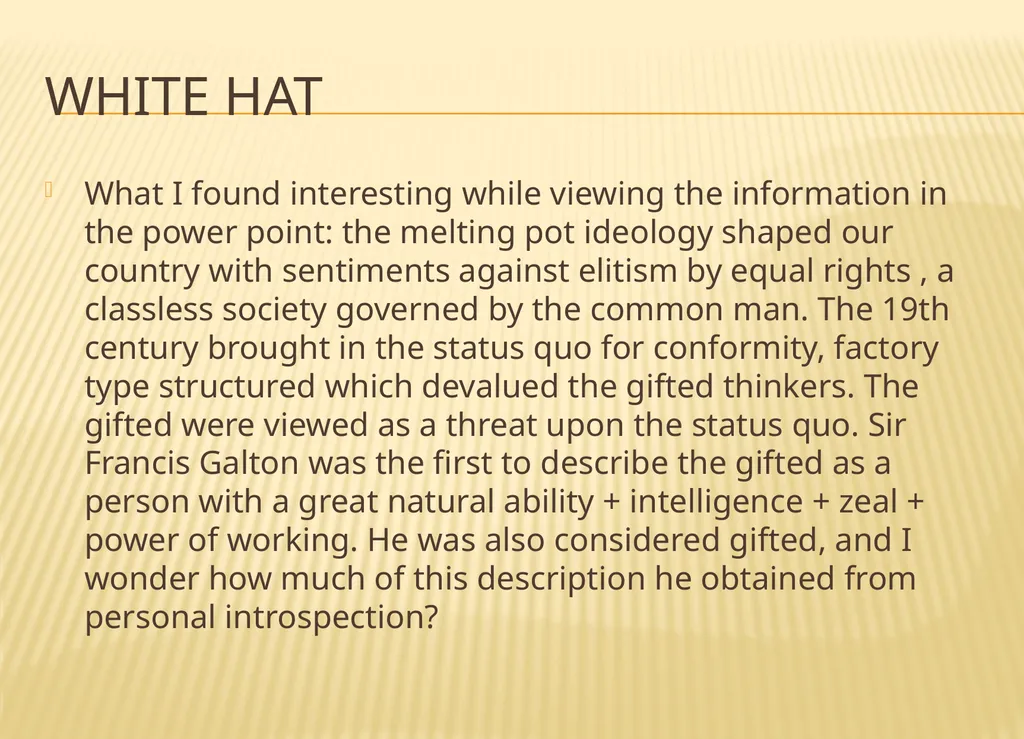
slide15. White Hat What I found interesting while viewing the information in the power point: the melting pot ideology shaped our country with sentiments against elitism by equal rights , a classless society governed by the common man. The 19th century brought in the status quo for conformity, factory type structured which devalued the gifted thinkers. The gifted were viewed as a threat upon the status quo. Sir Francis Galton was the first to describe the gifted as a person with a great natural ability + intelligence + zeal + power of working. He was also considered gifted, and I wonder how much of this description he obtained from personal introspection?<br>
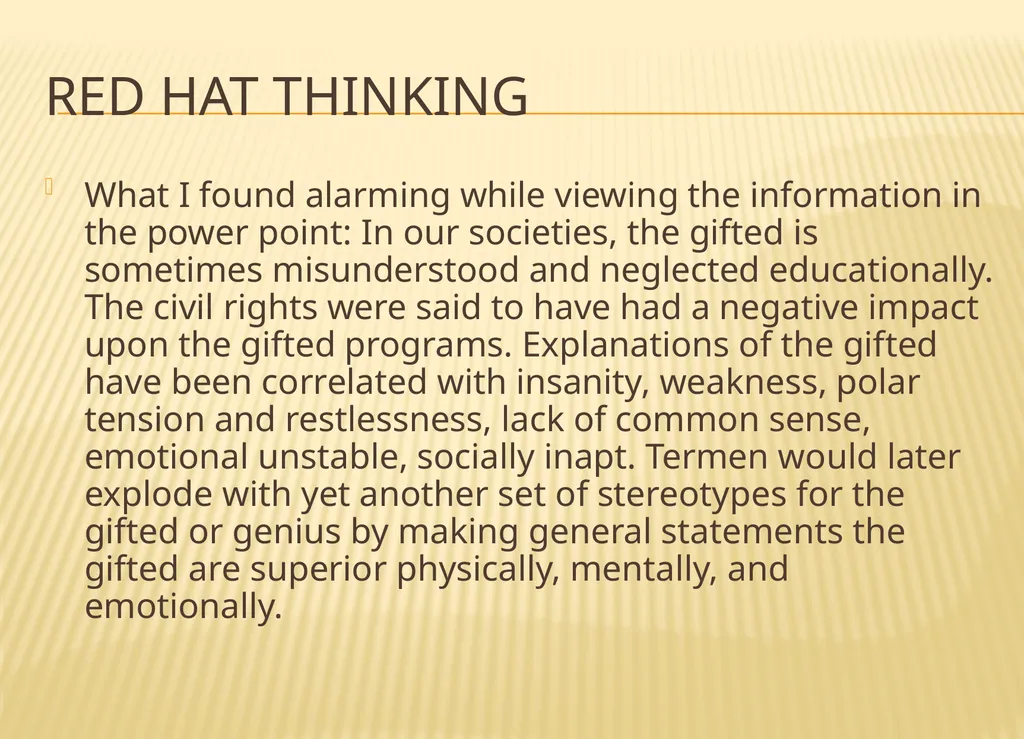
slide16. Red Hat Thinking What I found alarming while viewing the information in the power point: In our societies, the gifted is sometimes misunderstood and neglected educationally. The civil rights were said to have had a negative impact upon the gifted programs. Explanations of the gifted have been correlated with insanity, weakness, polar tension and restlessness, lack of common sense, emotional unstable, socially inapt. Termen would later explode with yet another set of stereotypes for the gifted or genius by making general statements the gifted are superior physically, mentally, and emotionally.<br>
slide17. White hat thinking What I found new while viewing the information in the power point: Thomas Jefferson advocated for rigorous testing to find the gifted and align them with leadership roles. The Sputnik Era in 1957 prized the gifted thinkers and sought them out. Women were not involved with identifying the gifted until the 60's. Women were found to focus more on the development of a gifted person. Strang would advocate looking at the individual gifted asking specific questions as to where the individual was in deed gifted.<br>
slide18. Green hat thinking I now look at the phrase "melting pot" with new eyes. I at one time perceived this to be in reference to constitutional rights not the devaluing of intellectual properties. I find it strange to see some of these terms I thought to be liberating as ways in which we maintained the status quo on a society and the individuals within that society.<br>
slide19. Student post to student post I also found it interesting that ideas I thought were positive have had a negative affect on educating the gifted. I have always valued the hard working student. By valuing that hard worker, have I been devaluing the naturally gifted learner? I hope that I have been able to look at individual students and find the positive in each of them.<br>
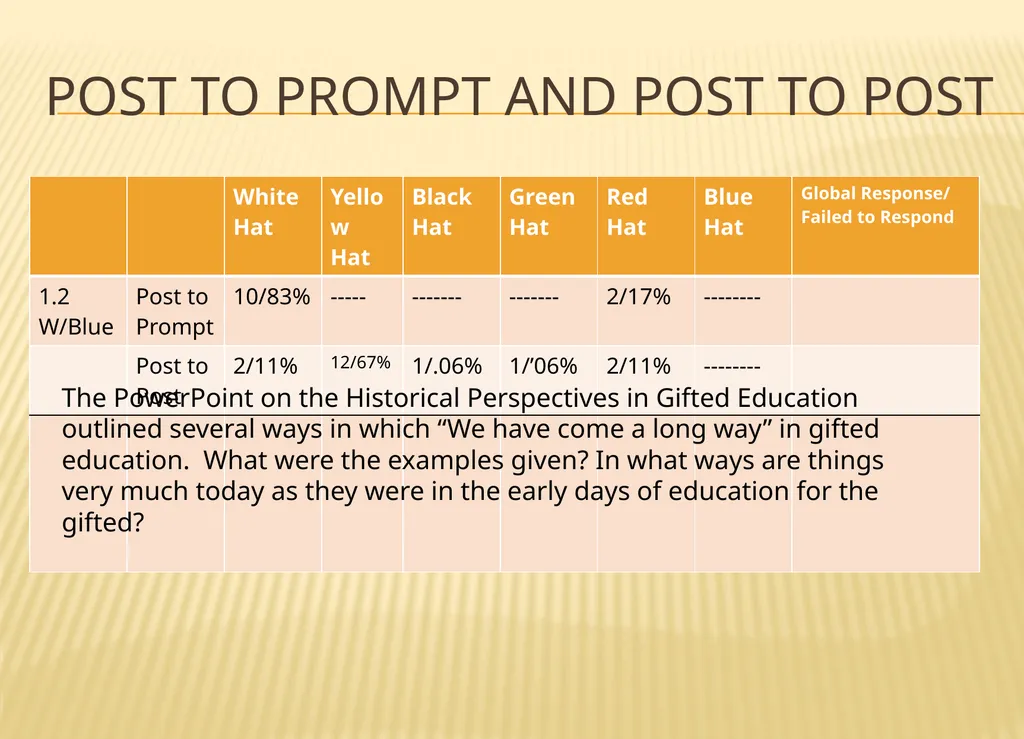
slide20. Post to Prompt and Post to Post The PowerPoint on the Historical Perspectives in Gifted Education outlined several ways in which “We have come a long way” in gifted education. What were the examples given? In what ways are things very much today as they were in the early days of education for the gifted?<br>
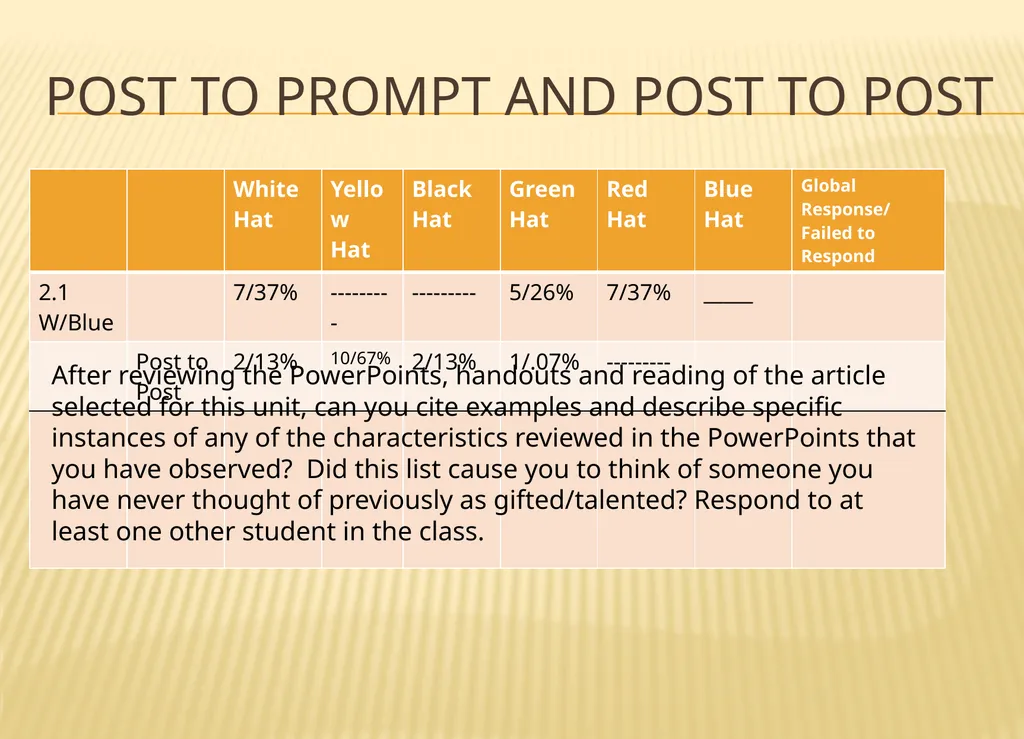
slide21. Post to Prompt and Post to Post After reviewing the PowerPoints, handouts and reading of the article selected for this unit, can you cite examples and describe specific instances of any of the characteristics reviewed in the PowerPoints that you have observed? Did this list cause you to think of someone you have never thought of previously as gifted/talented? Respond to at least one other student in the class.<br>
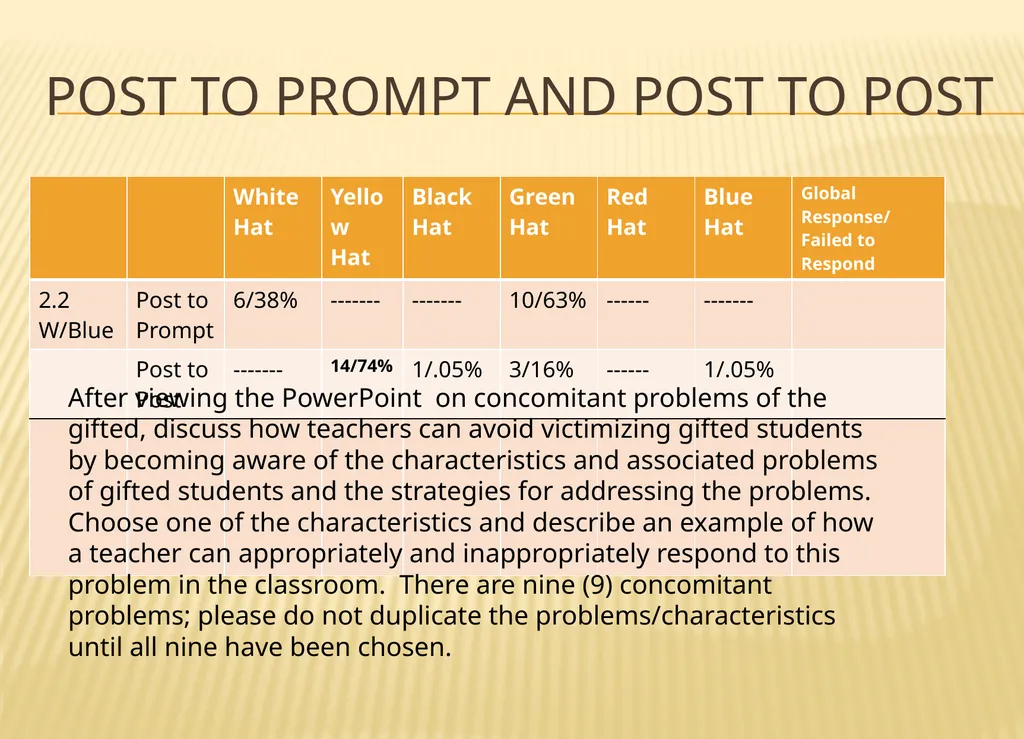
slide22. Post to Prompt and Post to Post After viewing the PowerPoint on concomitant problems of the gifted, discuss how teachers can avoid victimizing gifted students by becoming aware of the characteristics and associated problems of gifted students and the strategies for addressing the problems. Choose one of the characteristics and describe an example of how a teacher can appropriately and inappropriately respond to this problem in the classroom. There are nine (9) concomitant problems; please do not duplicate the problems/characteristics until all nine have been chosen.<br>
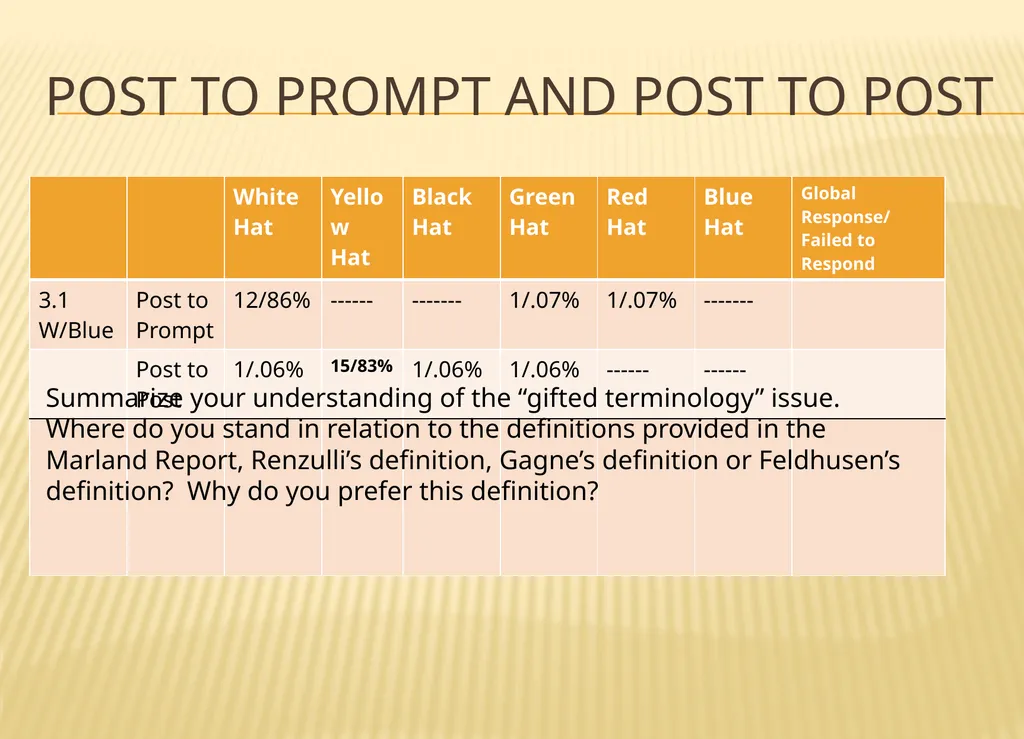
slide23. Post to Prompt and Post to Post Summarize your understanding of the “gifted terminology” issue. Where do you stand in relation to the definitions provided in the Marland Report, Renzulli’s definition, Gagne’s definition or Feldhusen’s definition? Why do you prefer this definition?<br>
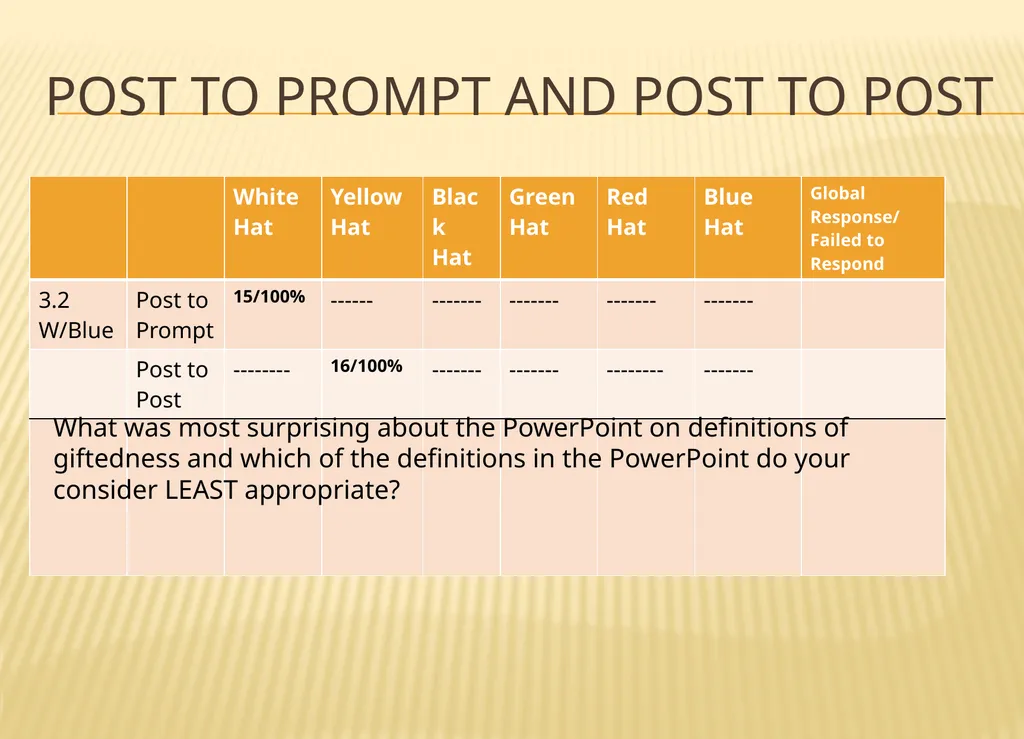
slide24. Post to Prompt and Post to Post What was most surprising about the PowerPoint on definitions of giftedness and which of the definitions in the PowerPoint do your consider LEAST appropriate?<br>
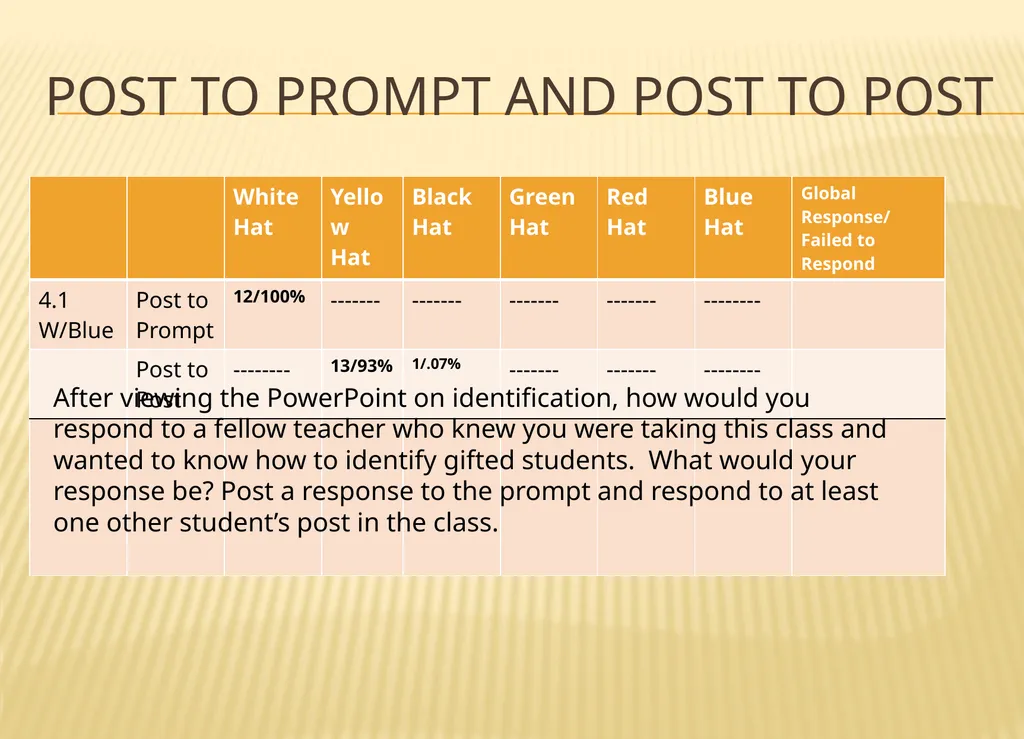
slide25. Post to Prompt and Post to Post After viewing the PowerPoint on identification, how would you respond to a fellow teacher who knew you were taking this class and wanted to know how to identify gifted students. What would your response be? Post a response to the prompt and respond to at least one other student’s post in the class.<br>
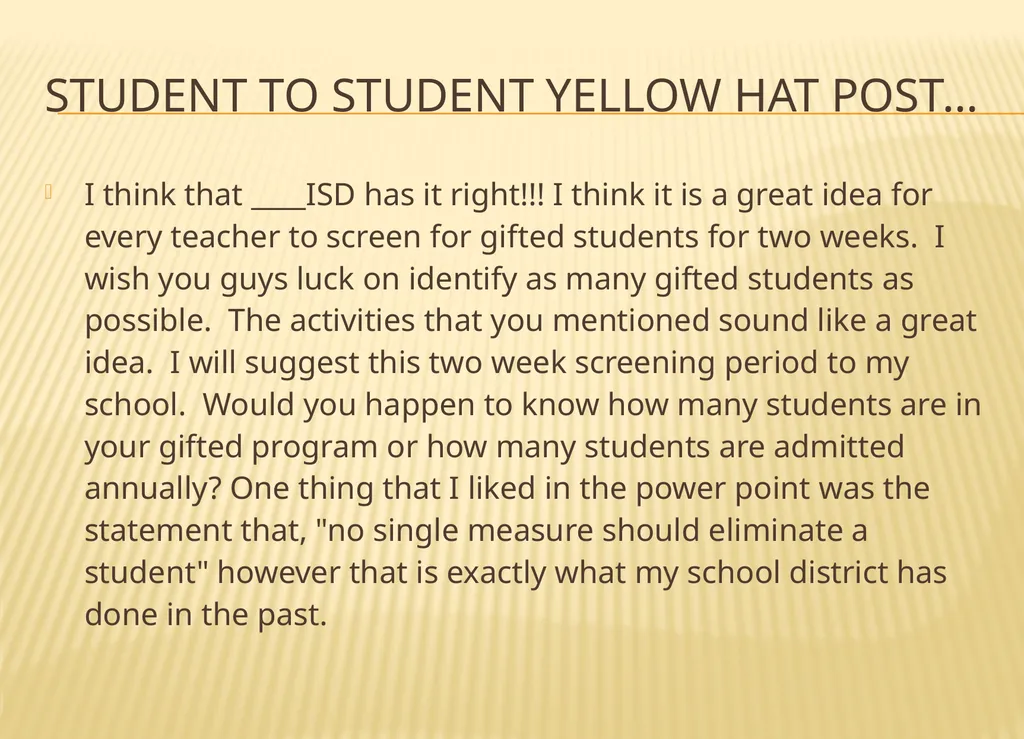
slide26. Student to student yellow hat post… I think that ____ISD has it right!!! I think it is a great idea for every teacher to screen for gifted students for two weeks. I wish you guys luck on identify as many gifted students as possible. The activities that you mentioned sound like a great idea. I will suggest this two week screening period to my school. Would you happen to know how many students are in your gifted program or how many students are admitted annually? One thing that I liked in the power point was the statement that, "no single measure should eliminate a student" however that is exactly what my school district has done in the past.<br>
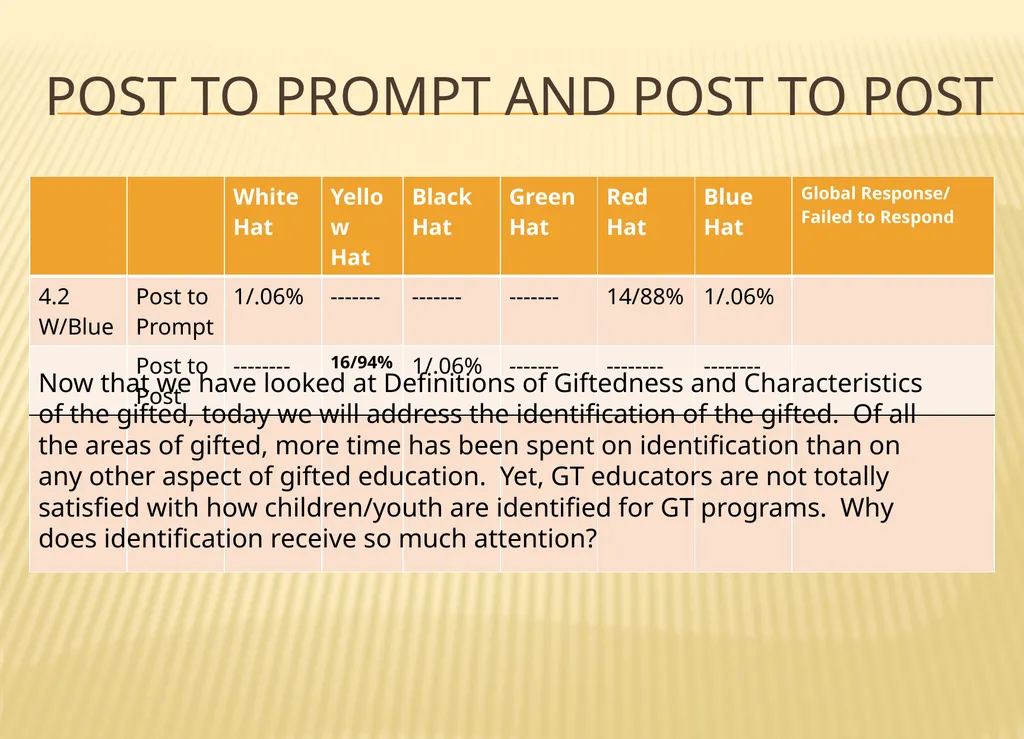
slide27. Post to Prompt and Post to Post Now that we have looked at Definitions of Giftedness and Characteristics of the gifted, today we will address the identification of the gifted. Of all the areas of gifted, more time has been spent on identification than on any other aspect of gifted education. Yet, GT educators are not totally satisfied with how children/youth are identified for GT programs. Why does identification receive so much attention?<br>
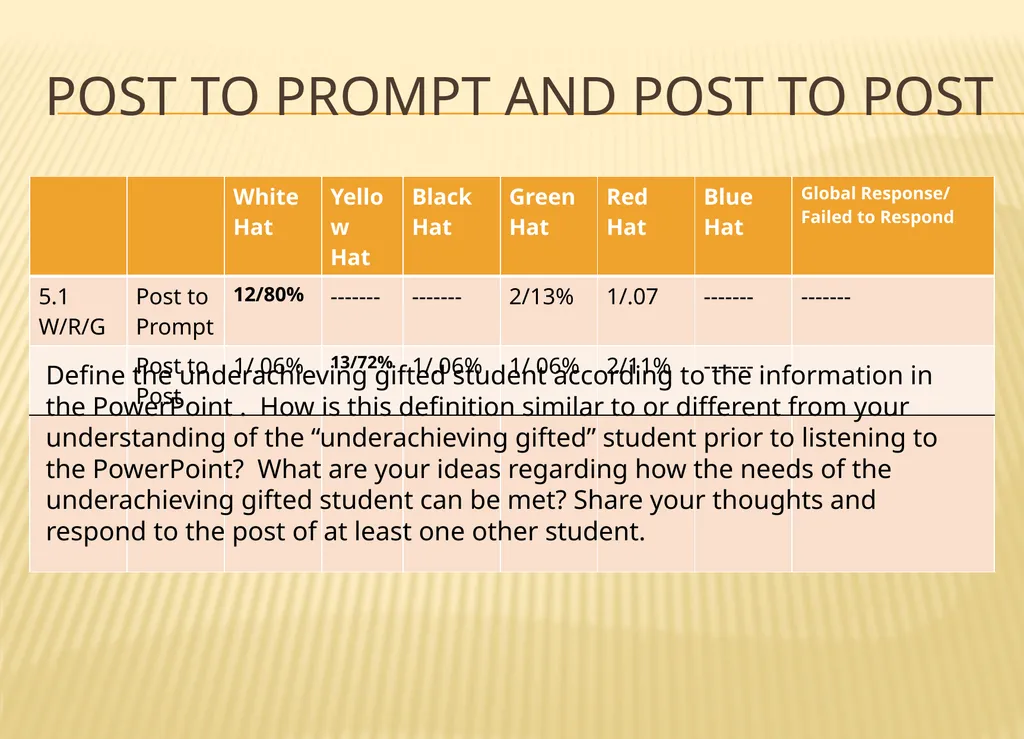
slide28. Post to Prompt and Post to Post Define the underachieving gifted student according to the information in the PowerPoint . How is this definition similar to or different from your understanding of the “underachieving gifted” student prior to listening to the PowerPoint? What are your ideas regarding how the needs of the underachieving gifted student can be met? Share your thoughts and respond to the post of at least one other student.<br>
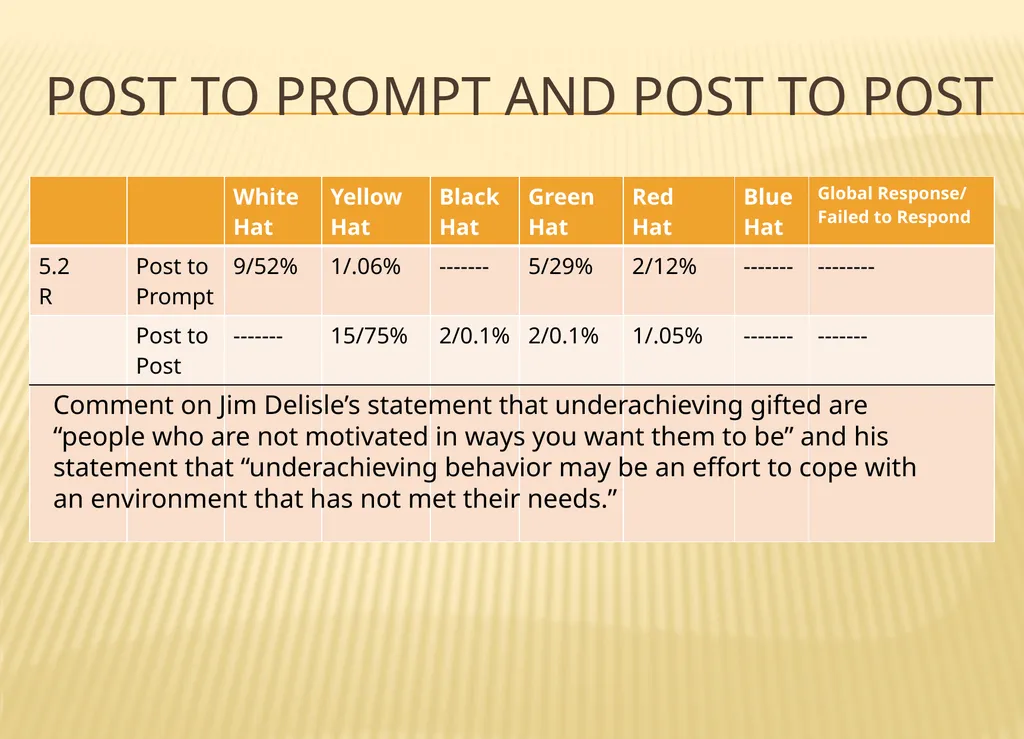
slide29. Post to Prompt and Post to Post Comment on Jim Delisle’s statement that underachieving gifted are “people who are not motivated in ways you want them to be” and his statement that “underachieving behavior may be an effort to cope with an environment that has not met their needs.”<br>
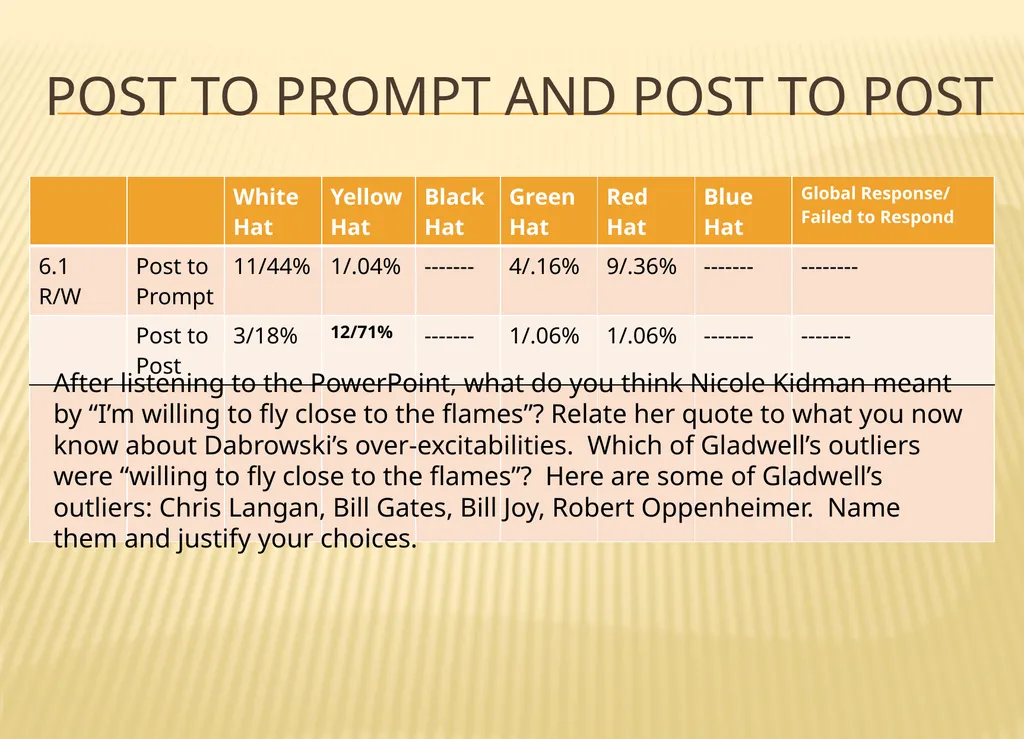
slide30. Post to Prompt and Post to Post After listening to the PowerPoint, what do you think Nicole Kidman meant by “I’m willing to fly close to the flames”? Relate her quote to what you now know about Dabrowski’s over-excitabilities. Which of Gladwell’s outliers were “willing to fly close to the flames”? Here are some of Gladwell’s outliers: Chris Langan, Bill Gates, Bill Joy, Robert Oppenheimer. Name them and justify your choices.<br>
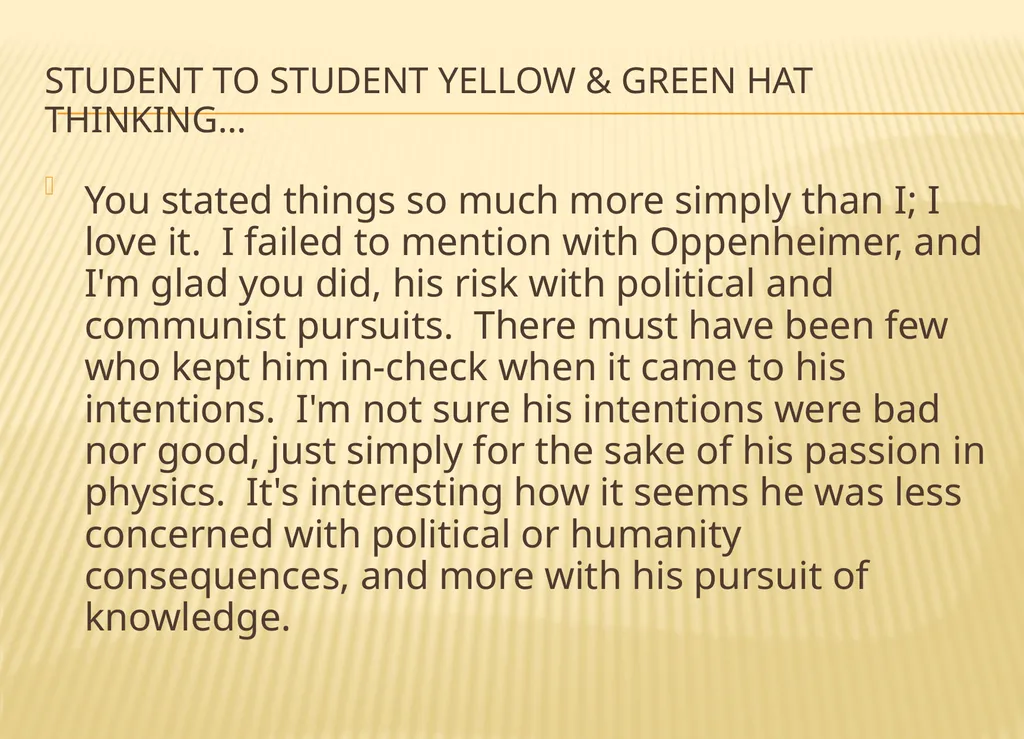
slide31. Student to student yellow & green hat thinking… You stated things so much more simply than I; I love it. I failed to mention with Oppenheimer, and I'm glad you did, his risk with political and communist pursuits. There must have been few who kept him in-check when it came to his intentions. I'm not sure his intentions were bad nor good, just simply for the sake of his passion in physics. It's interesting how it seems he was less concerned with political or humanity consequences, and more with his pursuit of knowledge.<br>
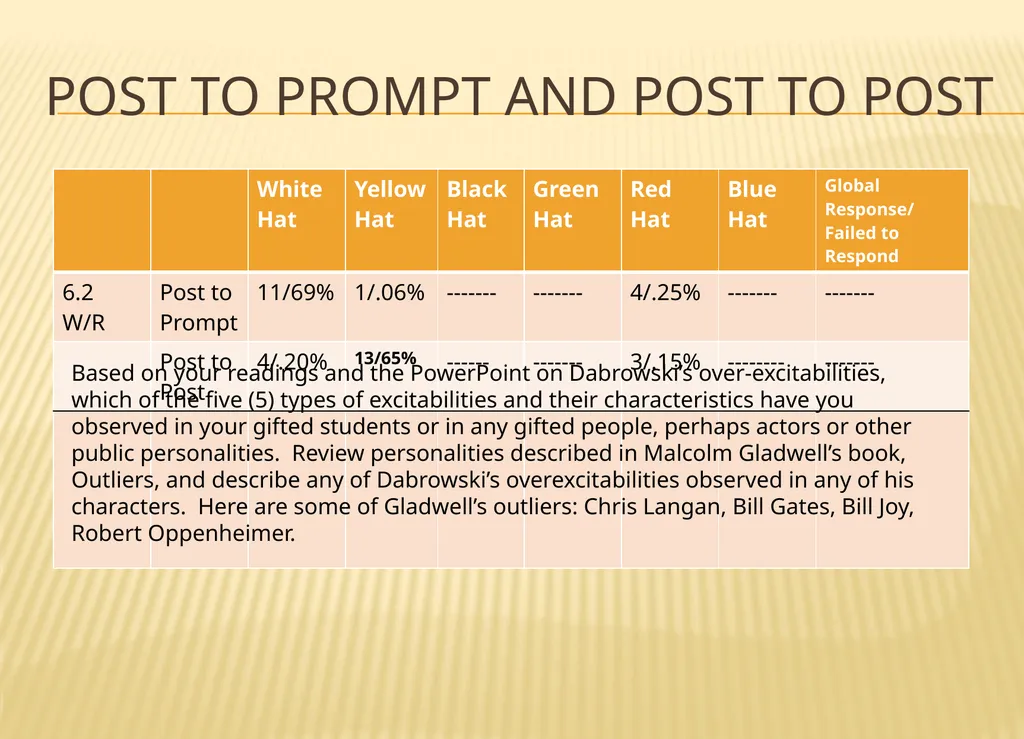
slide32. Post to Prompt and Post to Post Based on your readings and the PowerPoint on Dabrowski’s over-excitabilities, which of the five (5) types of excitabilities and their characteristics have you observed in your gifted students or in any gifted people, perhaps actors or other public personalities. Review personalities described in Malcolm Gladwell’s book, Outliers, and describe any of Dabrowski’s overexcitabilities observed in any of his characters. Here are some of Gladwell’s outliers: Chris Langan, Bill Gates, Bill Joy, Robert Oppenheimer.<br>
slide33. Student to student yellow, red Thank you so much for sharing about your boys. They sound like good kids. I can't say for sure but I think that I might have a sensual OE. I can remember just a few years back that my mama made me some fried pork chops and rice. I love it!! Well...when we sat down at the table to eat I took one bite of the pork chop and started to cry. I actually, had tears rolling down my cheeks. My mom asked me what was wrong I replied, "Nothing, they're just so good." This has happened to me on several occasions when eating. I just get too excited and start to cry. I might just be weird or crazy!!<br>
slide34. Post to Prompt and Post to Post After viewing the PowerPoint on the Texas State Plan: Part 1, describe the aspects of the State Plan that are realistic for all school districts in Texas. Which aspects are unrealistic? You may want to visit with a GT teacher or GT coordinator who has experience with and thoughts regarding the State Plan.<br>
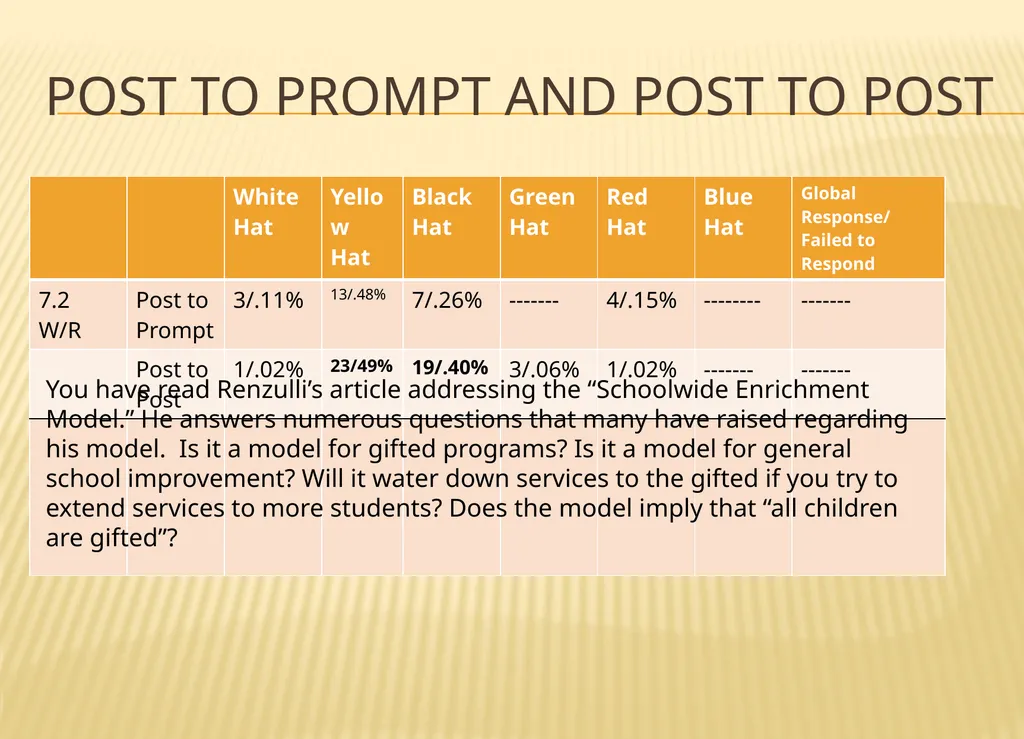
slide35. Post to Prompt and Post to Post You have read Renzulli’s article addressing the “Schoolwide Enrichment Model.” He answers numerous questions that many have raised regarding his model. Is it a model for gifted programs? Is it a model for general school improvement? Will it water down services to the gifted if you try to extend services to more students? Does the model imply that “all children are gifted”?<br>
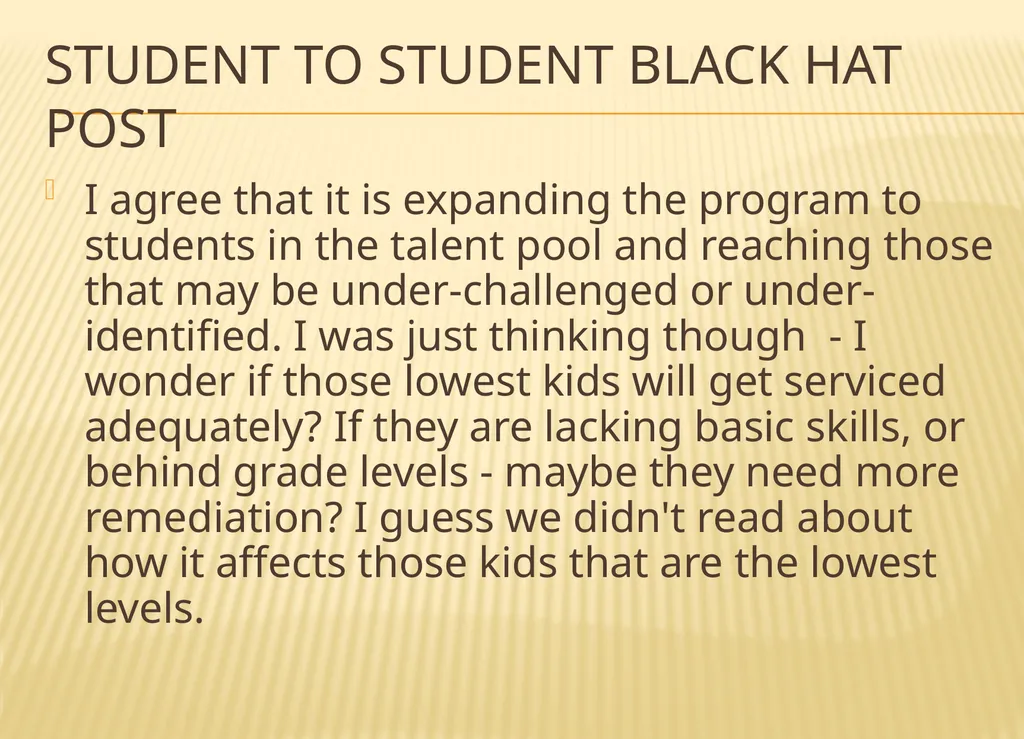
slide36. Student to Student Black Hat Post I agree that it is expanding the program to students in the talent pool and reaching those that may be under-challenged or under- identified. I was just thinking though - I wonder if those lowest kids will get serviced adequately? If they are lacking basic skills, or behind grade levels - maybe they need more remediation? I guess we didn't read about how it affects those kids that are the lowest levels.<br>
slide37. Student to Student Black Hat Post …I was just thinking though…I wonder if those lowest kids will get serviced adequately. If they are lacking basic skills, or behind grade levels—maybe they need more remediation? I guess we didn’t read about how it affects those kids that are the lowest level.<br>
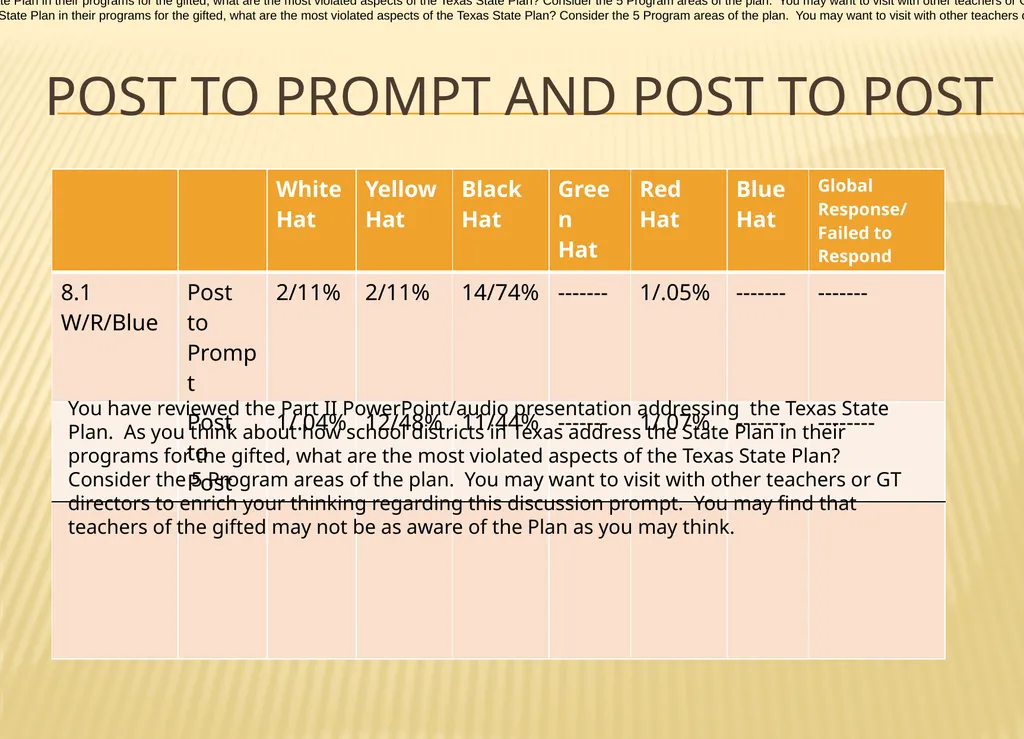
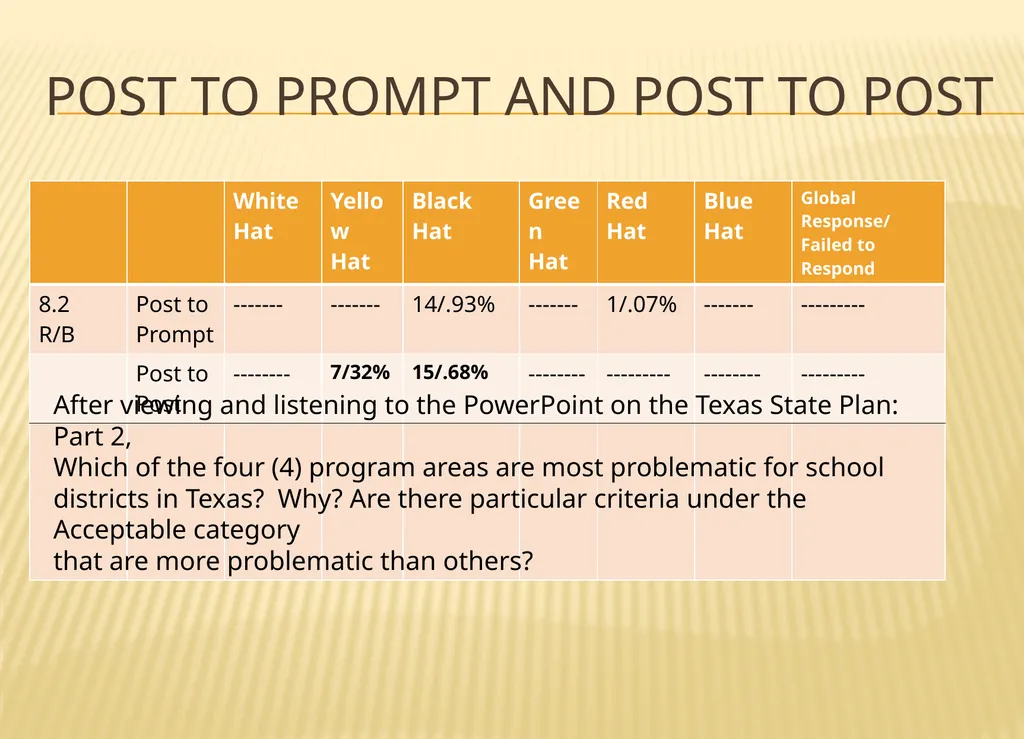
slide38. Post to Prompt and Post to Post You have reviewed the Part II PowerPoint/audio presentation addressing the Texas State Plan. As you think about how school districts in Texas address the State Plan in their programs for the gifted, what are the most violated aspects of the Texas State Plan? Consider the 5 Program areas of the plan. You may want to visit with other teachers or GT directors to enrich your thinking regarding this discussion prompt. You may find that teachers of the gifted may not be as aware of the Plan as you may think. You have reviewed the Part II PowerPoint/audio presentation addressing the Texas State Plan. As you think about how school districts in Texas address the State Plan in their programs for the gifted, what are the most violated aspects of the Texas State Plan? Consider the 5 Program areas of the plan. You may want to visit with other teachers or GT directors to enrich your thinking regarding this discussion prompt. You may find that teachers of the gifted may not be as aware of the Plan as you may think. You have reviewed the Part II PowerPoint/audio presentation addressing the Texas State Plan. As you think about how school districts in Texas address the State Plan in their programs for the gifted, what are the most violated aspects of the Texas State Plan? Consider the 5 Program areas of the plan. You may want to visit with other teachers or GT directors to enrich your thinking regarding this discussion prompt. You may find that teachers of the gifted may not be as aware of the Plan as you may think.<br>
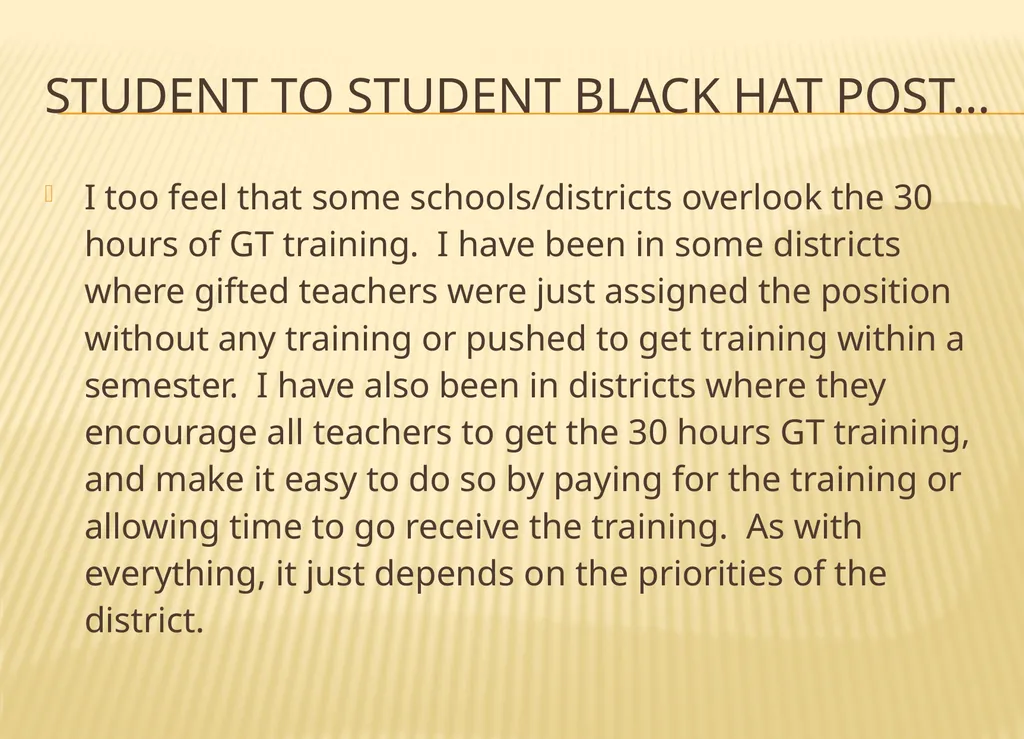
slide39. Student to Student Black Hat Post… I too feel that some schools/districts overlook the 30 hours of GT training. I have been in some districts where gifted teachers were just assigned the position without any training or pushed to get training within a semester. I have also been in districts where they encourage all teachers to get the 30 hours GT training, and make it easy to do so by paying for the training or allowing time to go receive the training. As with everything, it just depends on the priorities of the district.<br>
slide40. Post to Prompt and Post to Post After viewing and listening to the PowerPoint on the Texas State Plan: Part 2,
Which of the four (4) program areas are most problematic for school districts in Texas? Why? Are there particular criteria under the Acceptable category
that are more problematic than others?<br>
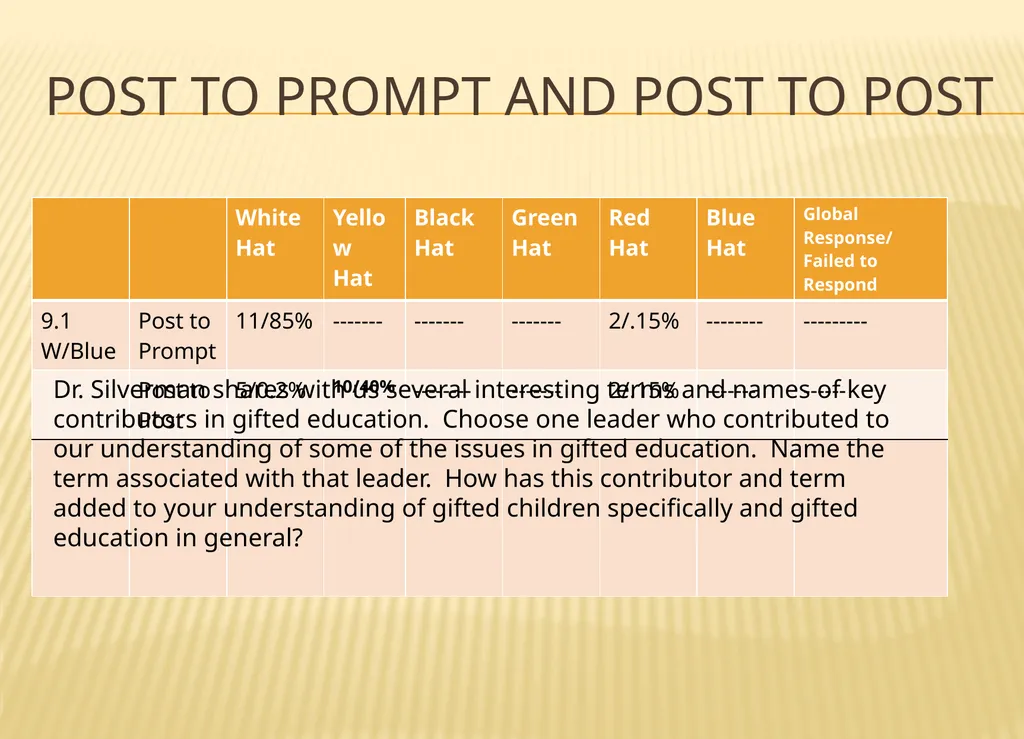
slide41. Post to Prompt and Post to Post Dr. Silverman shares with us several interesting terms and names of key contributors in gifted education. Choose one leader who contributed to our understanding of some of the issues in gifted education. Name the term associated with that leader. How has this contributor and term added to your understanding of gifted children specifically and gifted education in general?<br>
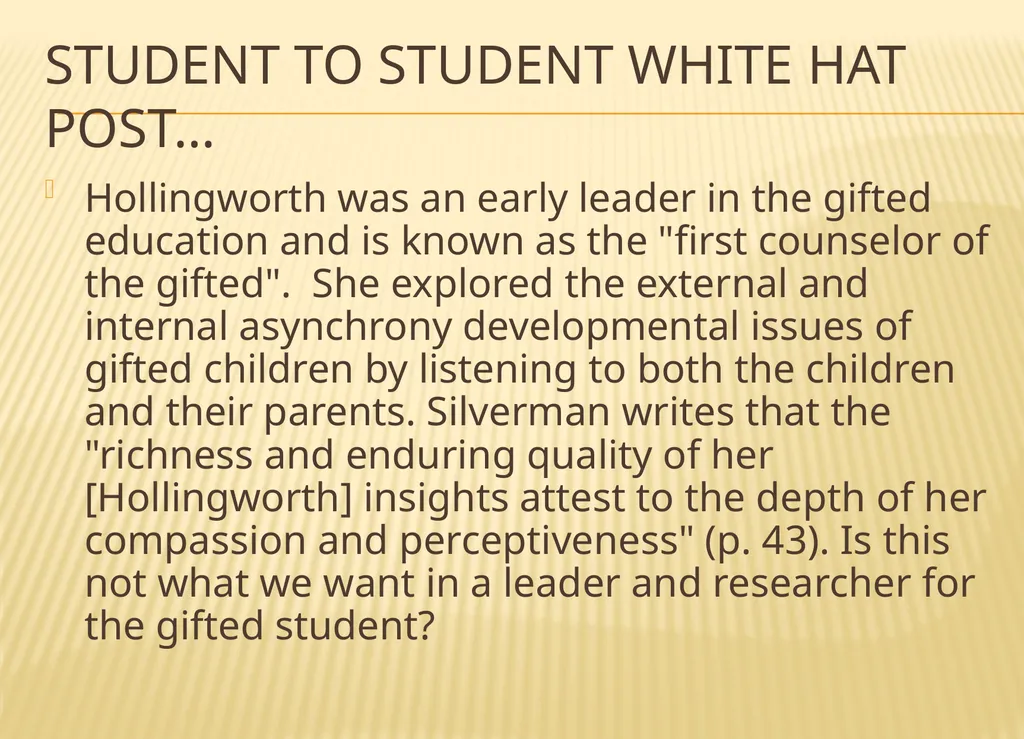
slide42. Student to student white hat post… Hollingworth was an early leader in the gifted education and is known as the "first counselor of the gifted". She explored the external and internal asynchrony developmental issues of gifted children by listening to both the children and their parents. Silverman writes that the "richness and enduring quality of her [Hollingworth] insights attest to the depth of her compassion and perceptiveness" (p. 43). Is this not what we want in a leader and researcher for the gifted student?<br>
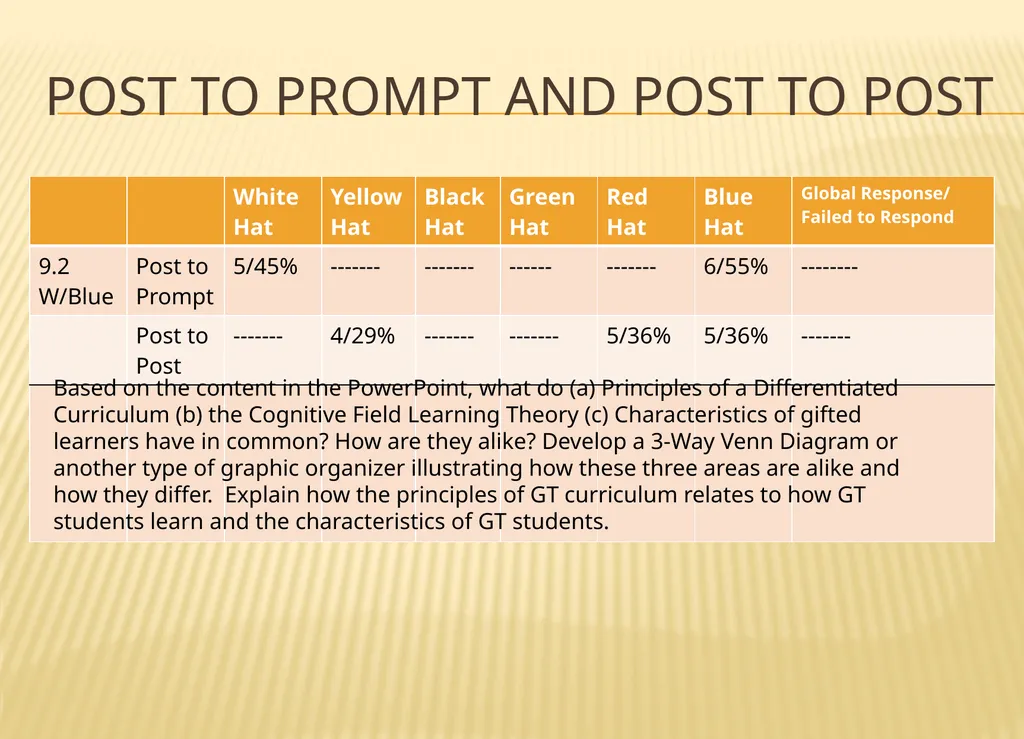
slide43. Post to Prompt and Post to Post Based on the content in the PowerPoint, what do (a) Principles of a Differentiated Curriculum (b) the Cognitive Field Learning Theory (c) Characteristics of gifted learners have in common? How are they alike? Develop a 3-Way Venn Diagram or another type of graphic organizer illustrating how these three areas are alike and how they differ. Explain how the principles of GT curriculum relates to how GT students learn and the characteristics of GT students.<br>
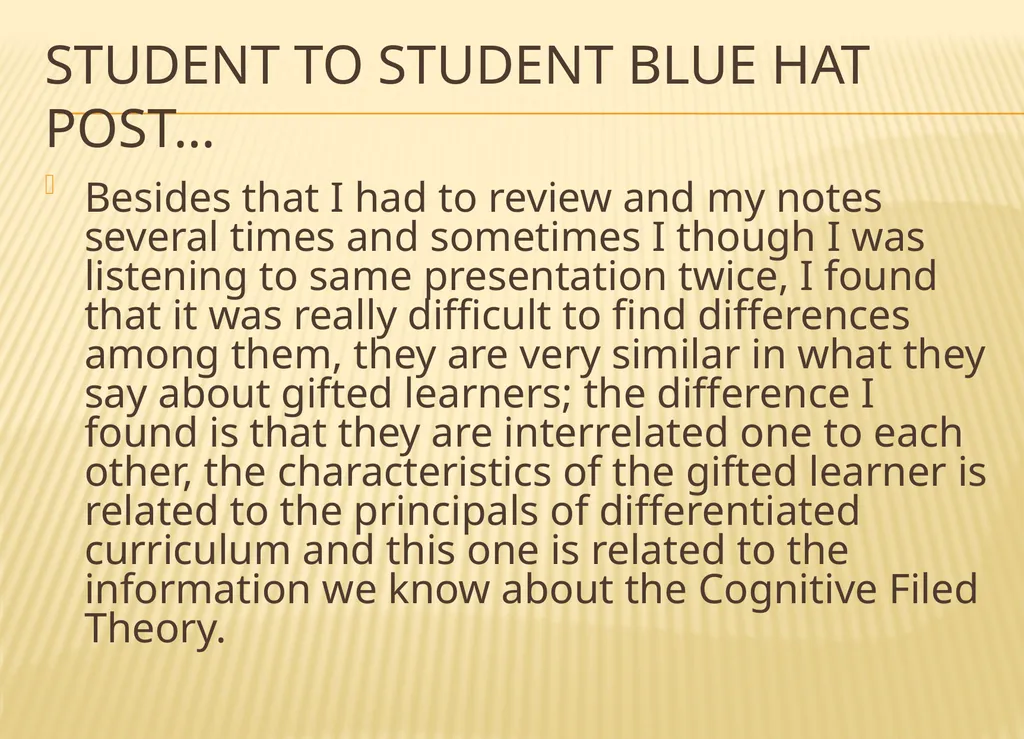
slide44. Student to student blue hat post… Besides that I had to review and my notes several times and sometimes I though I was listening to same presentation twice, I found that it was really difficult to find differences among them, they are very similar in what they say about gifted learners; the difference I found is that they are interrelated one to each other, the characteristics of the gifted learner is related to the principals of differentiated curriculum and this one is related to the information we know about the Cognitive Filed Theory.<br>
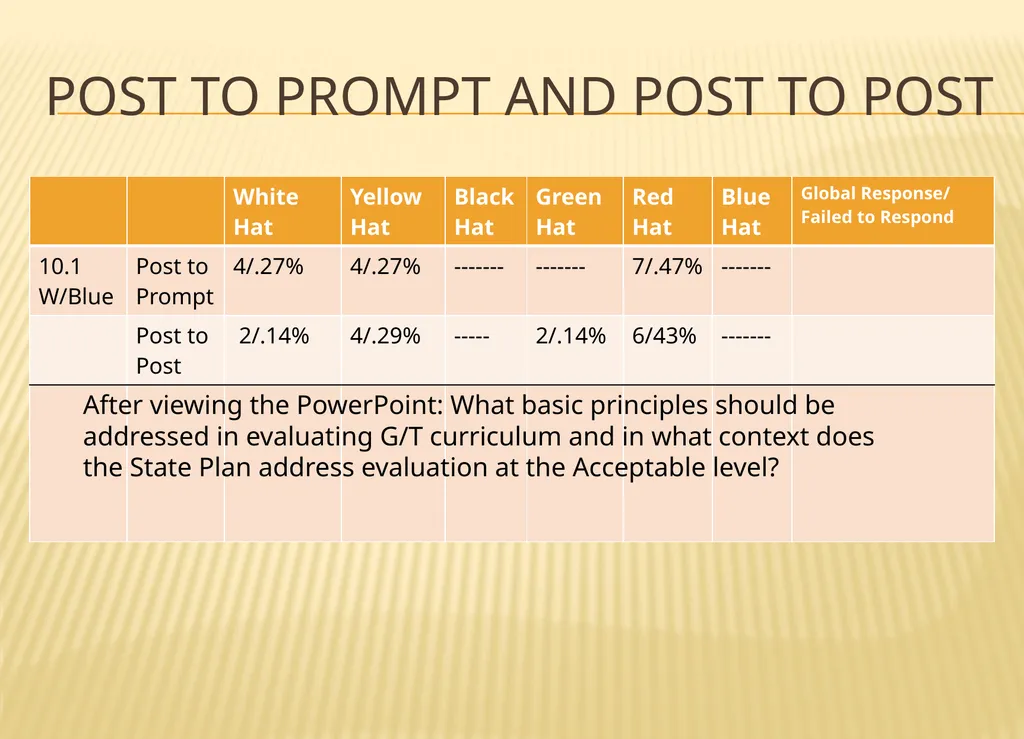
slide45. Post to Prompt and Post to Post After viewing the PowerPoint: What basic principles should be addressed in evaluating G/T curriculum and in what context does the State Plan address evaluation at the Acceptable level?<br>
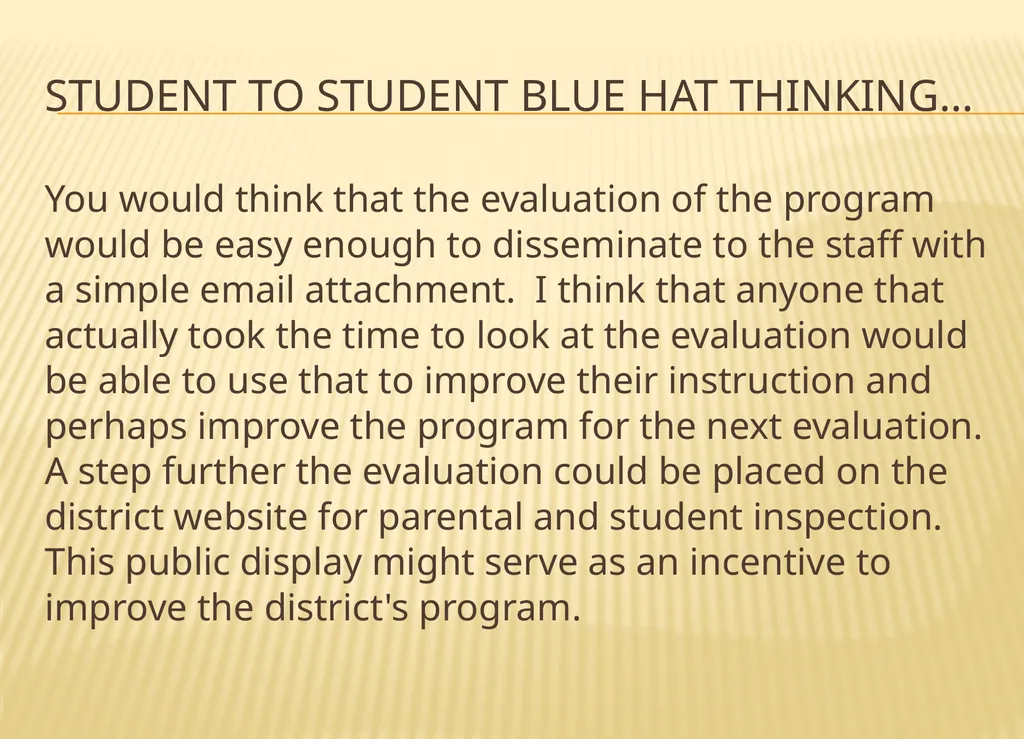
slide46. Student to student blue hat thinking… You would think that the evaluation of the program would be easy enough to disseminate to the staff with a simple email attachment. I think that anyone that actually took the time to look at the evaluation would be able to use that to improve their instruction and perhaps improve the program for the next evaluation. A step further the evaluation could be placed on the district website for parental and student inspection. This public display might serve as an incentive to improve the district's program.<br>
slide47. Student to student post…red hat In some ways it is a good thing that it is an ongoing process because that way if issues do show up or something just is not working right they will catch it quicker than if they waited until the end to see how it went. It is more work but, it almost ensures that at least on campus every one is up to date on what is going on and how it is going instead of someone struggling through something without getting help before it is too late.<br>
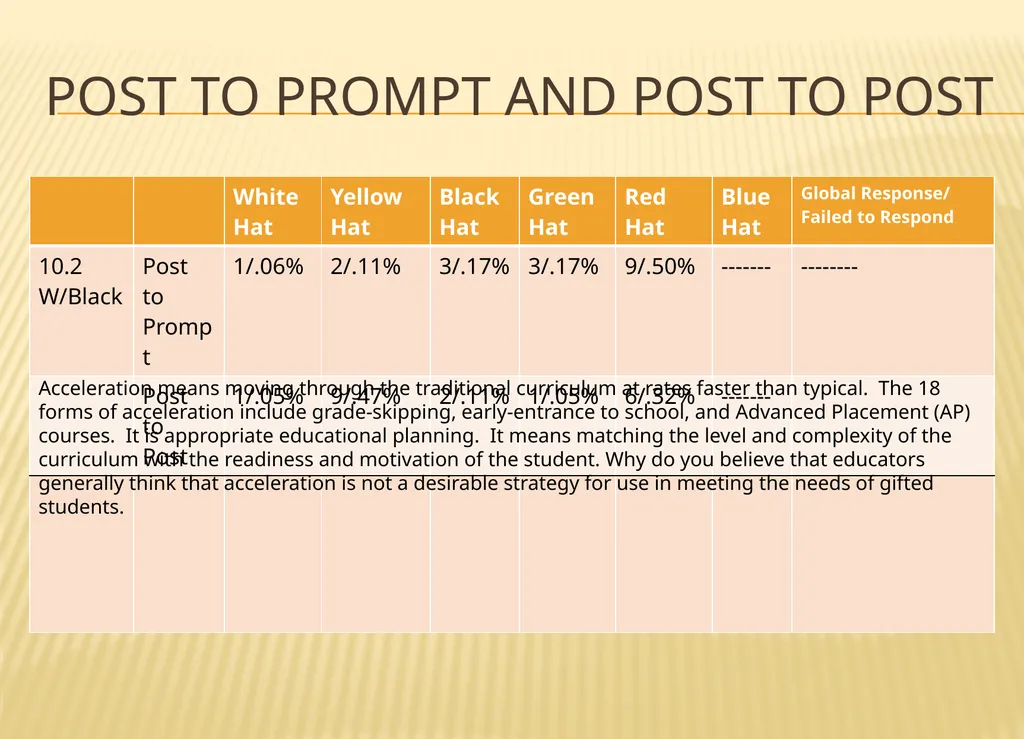
slide48. Post to Prompt and Post to Post Acceleration means moving through the traditional curriculum at rates faster than typical. The 18 forms of acceleration include grade-skipping, early-entrance to school, and Advanced Placement (AP) courses. It is appropriate educational planning. It means matching the level and complexity of the curriculum with the readiness and motivation of the student. Why do you believe that educators generally think that acceleration is not a desirable strategy for use in meeting the needs of gifted students.<br>
slide49. Student to student black hat post As an educator, I believe that acceleration isn't a desirable strategy to meet the needs of gifted students because they are still children. They may have the brain and academic level of a 16 year old, but they may only have the maturity level of a 12 year old. I think that there are some cases for acceleration, but in the end, they still need to have the overall school experience. Going through the school system they get to interact with children their own age, and get to experience the things all children need to experience. They need to be able to go through the feelings they are having and understand that they happen.<br>
slide50. Student to student black hat post They need to have some sort of normalcy in their life because people are going to consider them not normal when they find out how gifted they are. Being gifted can be just as bad as being mentally or physically handicapped. I believe that children, gifted or not, can't really handle the responsibility that goes along with moving forward into a different program. As parents, we want what's best for our children, and we want them to succeed, but I believe overall we just want our children to have a happy and normal life.<br>
slide51. Student to student posts… Reflect Yellow Hat Thinking
Reflect Black Hat Thinking when addressing Renzulli’s Schoolwide Enrichment Model (slide #33)
Reflect Black Hat Thinking when addressing the Texas State Plan (slide #34)
Reflect Black Hat Thinking when addressing Acceleration (slide #39)<br>
slide52. Implications for practice Careful attention should be given to the level of thinking which characterizes discussion prompts, activities, projects in an online class.
The desired level of thinking should be intentional and specifically included as a part of discussion prompts. (e.g. Put your Blue Hat on and…).<br>
slide53. References Balaji, M. S. & Chakrabarti, D. (2010). Student interactions in online discussion forum:
Empirical research from ‘Media Richness Theory’ perspective. Journal of Interactive Online Learning, 9(1), 1-22. http://www.ncolr.org/jiol/issues/pdf/9.1.1.pdf
Bloom, Benjamin S. Taxonomy of Educational Objectives (1956). Published by Allyn and Bacon, Boston, MA. Copyright (c) 1984 by Pearson Education.
DeBono, Edward, Six Thinking Hats
Hulkari, H., & Mahlamaki-Kultanen, S. (2008). Reflection through Web Discussions: Assessing Nursing Students' Work-Based Learning. Journal of Workplace Learning, 20(3), 157-164.
LaPointe, L., & Reisetter, M. (2008). Beloning Online: Students' Perceptions of the Value and Efficacy of an Online Learning Community. International Journal of E-Learning, 641-665.
Nystrand, M. (2006). Research on the role of classroom discourse as it affects reading comprehension. Research in the Teaching of English, 2006. 392-412.
Theus, R. (1968). Cognitive-Field Theory: A Positive Approach to Learning. The Clearning House, 42, 501-505.
VuMinh, C., KosKo, K., & Hebst, P. (2014). An Analysis of Evaluative Comments in Teachers’ Online Discussions of Representations of Practice. Journal of Teacher Education, 66, 35-50.
Vygotsky, Lev, (1978) Mind in Society: The Development of Higher Psychological Processes.
Xia, C., Fielder, J., & Siragusa, L. (2013). Achieving better peer interaction in online discussion. Issues in Educational Research, 23, 1-17.<br>
slide54. Thank You !! Dr. Joyce E. Kyle Miller
Texas A&M University-Commerce
2600 Motley Drive
Joyce.miller@tamuc.edu
Mesquite, Texas 75150
972-345-5386<br>
Joyce E. Kyle Miller, PhD<br>
slide2. Texas a&m university commerce<br>
slide3. Theoretical support Value of Discussion Supported by
Vygotsky’s Learning Theory
Nystrand’s Research
Benjamin Bloom
Hilda Taba
Cognitive Field Theory
Support the use of discussion, questions, activities, projects, strategies designed to trigger high level thinking<br>
slide4. Method Qualitative Research
IRB Approval
Member Checking
Grouping and Labeling Prompts
Bloom’s Taxonomy
Grouping and Labeling Posts
Edward DeBono’s Six Thinking Hats<br>
slide5. EDCI 506 Nature and Needs of the Gifted Student
This course is a survey of the major facets of gifted education: characteristics of the gifted, identification of the gifted, curricular and instructional strategies appropriate in teaching the gifted, personnel for the gifted and evaluation<br>
slide6. Major Topics Addressed Historical development of gifted education
Characteristics, nature and needs of the gifted
Problems and Issues in the Identification of the Gifted
The Gifted Underachievement
Strategies for Teaching the Gifted
Curriculum for the Gifted
Social and Emotional Needs of the Gifted
The Texas State Plan for Gifted Education
Acceleration
Program Evaluation<br>
slide7. Demographics: Online Class Participants EDCI 506 Nature and Needs of the Gifted
2006 – 2015
Discussion Posts = 2200 N=110
Suburban/urban teachers
Elementary/Secondary Certified
Teaching Elementary Grades or the 4 core areas<br>
slide8. Demographics Most are Teachers…
Assistant Principal
Principal
College Teaching
Counselor
Dept. Head
Dean of Students
Librarian Master’s Degree pursued<br>
slide9. Classification systems Bloom’s Taxonomy
Knowledge
Comprehension
Application
Analysis
Synthesis
Evaluation De Bono’s Six Thinking Hats:
White
Black
Yellow
Green
Red
Blue<br>
slide10. DeBono’s Six Thinking Hats<br>
slide11. Six Thinking Hats<br>
slide12. Discussion prompts Twenty (20) Discussion Prompts<br>
slide13. Question Addressed Which of DeBono’s Six Thinking Hats are reflected in
Student to Student Discussion Posts ?<br>
slide14. 1.1 Post to Prompt and Post to Post 1.1 As you viewed the History of Gifted audio PowerPoint presentation, what did you find interesting, alarming, or a new piece of information for you? What other questions came to mind as you viewed the PowerPoint? Make a contribution regarding the history of gifted that others have not made.<br>
slide15. White Hat What I found interesting while viewing the information in the power point: the melting pot ideology shaped our country with sentiments against elitism by equal rights , a classless society governed by the common man. The 19th century brought in the status quo for conformity, factory type structured which devalued the gifted thinkers. The gifted were viewed as a threat upon the status quo. Sir Francis Galton was the first to describe the gifted as a person with a great natural ability + intelligence + zeal + power of working. He was also considered gifted, and I wonder how much of this description he obtained from personal introspection?<br>
slide16. Red Hat Thinking What I found alarming while viewing the information in the power point: In our societies, the gifted is sometimes misunderstood and neglected educationally. The civil rights were said to have had a negative impact upon the gifted programs. Explanations of the gifted have been correlated with insanity, weakness, polar tension and restlessness, lack of common sense, emotional unstable, socially inapt. Termen would later explode with yet another set of stereotypes for the gifted or genius by making general statements the gifted are superior physically, mentally, and emotionally.<br>
slide17. White hat thinking What I found new while viewing the information in the power point: Thomas Jefferson advocated for rigorous testing to find the gifted and align them with leadership roles. The Sputnik Era in 1957 prized the gifted thinkers and sought them out. Women were not involved with identifying the gifted until the 60's. Women were found to focus more on the development of a gifted person. Strang would advocate looking at the individual gifted asking specific questions as to where the individual was in deed gifted.<br>
slide18. Green hat thinking I now look at the phrase "melting pot" with new eyes. I at one time perceived this to be in reference to constitutional rights not the devaluing of intellectual properties. I find it strange to see some of these terms I thought to be liberating as ways in which we maintained the status quo on a society and the individuals within that society.<br>
slide19. Student post to student post I also found it interesting that ideas I thought were positive have had a negative affect on educating the gifted. I have always valued the hard working student. By valuing that hard worker, have I been devaluing the naturally gifted learner? I hope that I have been able to look at individual students and find the positive in each of them.<br>
slide20. Post to Prompt and Post to Post The PowerPoint on the Historical Perspectives in Gifted Education outlined several ways in which “We have come a long way” in gifted education. What were the examples given? In what ways are things very much today as they were in the early days of education for the gifted?<br>
slide21. Post to Prompt and Post to Post After reviewing the PowerPoints, handouts and reading of the article selected for this unit, can you cite examples and describe specific instances of any of the characteristics reviewed in the PowerPoints that you have observed? Did this list cause you to think of someone you have never thought of previously as gifted/talented? Respond to at least one other student in the class.<br>
slide22. Post to Prompt and Post to Post After viewing the PowerPoint on concomitant problems of the gifted, discuss how teachers can avoid victimizing gifted students by becoming aware of the characteristics and associated problems of gifted students and the strategies for addressing the problems. Choose one of the characteristics and describe an example of how a teacher can appropriately and inappropriately respond to this problem in the classroom. There are nine (9) concomitant problems; please do not duplicate the problems/characteristics until all nine have been chosen.<br>
slide23. Post to Prompt and Post to Post Summarize your understanding of the “gifted terminology” issue. Where do you stand in relation to the definitions provided in the Marland Report, Renzulli’s definition, Gagne’s definition or Feldhusen’s definition? Why do you prefer this definition?<br>
slide24. Post to Prompt and Post to Post What was most surprising about the PowerPoint on definitions of giftedness and which of the definitions in the PowerPoint do your consider LEAST appropriate?<br>
slide25. Post to Prompt and Post to Post After viewing the PowerPoint on identification, how would you respond to a fellow teacher who knew you were taking this class and wanted to know how to identify gifted students. What would your response be? Post a response to the prompt and respond to at least one other student’s post in the class.<br>
slide26. Student to student yellow hat post… I think that ____ISD has it right!!! I think it is a great idea for every teacher to screen for gifted students for two weeks. I wish you guys luck on identify as many gifted students as possible. The activities that you mentioned sound like a great idea. I will suggest this two week screening period to my school. Would you happen to know how many students are in your gifted program or how many students are admitted annually? One thing that I liked in the power point was the statement that, "no single measure should eliminate a student" however that is exactly what my school district has done in the past.<br>
slide27. Post to Prompt and Post to Post Now that we have looked at Definitions of Giftedness and Characteristics of the gifted, today we will address the identification of the gifted. Of all the areas of gifted, more time has been spent on identification than on any other aspect of gifted education. Yet, GT educators are not totally satisfied with how children/youth are identified for GT programs. Why does identification receive so much attention?<br>
slide28. Post to Prompt and Post to Post Define the underachieving gifted student according to the information in the PowerPoint . How is this definition similar to or different from your understanding of the “underachieving gifted” student prior to listening to the PowerPoint? What are your ideas regarding how the needs of the underachieving gifted student can be met? Share your thoughts and respond to the post of at least one other student.<br>
slide29. Post to Prompt and Post to Post Comment on Jim Delisle’s statement that underachieving gifted are “people who are not motivated in ways you want them to be” and his statement that “underachieving behavior may be an effort to cope with an environment that has not met their needs.”<br>
slide30. Post to Prompt and Post to Post After listening to the PowerPoint, what do you think Nicole Kidman meant by “I’m willing to fly close to the flames”? Relate her quote to what you now know about Dabrowski’s over-excitabilities. Which of Gladwell’s outliers were “willing to fly close to the flames”? Here are some of Gladwell’s outliers: Chris Langan, Bill Gates, Bill Joy, Robert Oppenheimer. Name them and justify your choices.<br>
slide31. Student to student yellow & green hat thinking… You stated things so much more simply than I; I love it. I failed to mention with Oppenheimer, and I'm glad you did, his risk with political and communist pursuits. There must have been few who kept him in-check when it came to his intentions. I'm not sure his intentions were bad nor good, just simply for the sake of his passion in physics. It's interesting how it seems he was less concerned with political or humanity consequences, and more with his pursuit of knowledge.<br>
slide32. Post to Prompt and Post to Post Based on your readings and the PowerPoint on Dabrowski’s over-excitabilities, which of the five (5) types of excitabilities and their characteristics have you observed in your gifted students or in any gifted people, perhaps actors or other public personalities. Review personalities described in Malcolm Gladwell’s book, Outliers, and describe any of Dabrowski’s overexcitabilities observed in any of his characters. Here are some of Gladwell’s outliers: Chris Langan, Bill Gates, Bill Joy, Robert Oppenheimer.<br>
slide33. Student to student yellow, red Thank you so much for sharing about your boys. They sound like good kids. I can't say for sure but I think that I might have a sensual OE. I can remember just a few years back that my mama made me some fried pork chops and rice. I love it!! Well...when we sat down at the table to eat I took one bite of the pork chop and started to cry. I actually, had tears rolling down my cheeks. My mom asked me what was wrong I replied, "Nothing, they're just so good." This has happened to me on several occasions when eating. I just get too excited and start to cry. I might just be weird or crazy!!<br>
slide34. Post to Prompt and Post to Post After viewing the PowerPoint on the Texas State Plan: Part 1, describe the aspects of the State Plan that are realistic for all school districts in Texas. Which aspects are unrealistic? You may want to visit with a GT teacher or GT coordinator who has experience with and thoughts regarding the State Plan.<br>
slide35. Post to Prompt and Post to Post You have read Renzulli’s article addressing the “Schoolwide Enrichment Model.” He answers numerous questions that many have raised regarding his model. Is it a model for gifted programs? Is it a model for general school improvement? Will it water down services to the gifted if you try to extend services to more students? Does the model imply that “all children are gifted”?<br>
slide36. Student to Student Black Hat Post I agree that it is expanding the program to students in the talent pool and reaching those that may be under-challenged or under- identified. I was just thinking though - I wonder if those lowest kids will get serviced adequately? If they are lacking basic skills, or behind grade levels - maybe they need more remediation? I guess we didn't read about how it affects those kids that are the lowest levels.<br>
slide37. Student to Student Black Hat Post …I was just thinking though…I wonder if those lowest kids will get serviced adequately. If they are lacking basic skills, or behind grade levels—maybe they need more remediation? I guess we didn’t read about how it affects those kids that are the lowest level.<br>
slide38. Post to Prompt and Post to Post You have reviewed the Part II PowerPoint/audio presentation addressing the Texas State Plan. As you think about how school districts in Texas address the State Plan in their programs for the gifted, what are the most violated aspects of the Texas State Plan? Consider the 5 Program areas of the plan. You may want to visit with other teachers or GT directors to enrich your thinking regarding this discussion prompt. You may find that teachers of the gifted may not be as aware of the Plan as you may think. You have reviewed the Part II PowerPoint/audio presentation addressing the Texas State Plan. As you think about how school districts in Texas address the State Plan in their programs for the gifted, what are the most violated aspects of the Texas State Plan? Consider the 5 Program areas of the plan. You may want to visit with other teachers or GT directors to enrich your thinking regarding this discussion prompt. You may find that teachers of the gifted may not be as aware of the Plan as you may think. You have reviewed the Part II PowerPoint/audio presentation addressing the Texas State Plan. As you think about how school districts in Texas address the State Plan in their programs for the gifted, what are the most violated aspects of the Texas State Plan? Consider the 5 Program areas of the plan. You may want to visit with other teachers or GT directors to enrich your thinking regarding this discussion prompt. You may find that teachers of the gifted may not be as aware of the Plan as you may think.<br>
slide39. Student to Student Black Hat Post… I too feel that some schools/districts overlook the 30 hours of GT training. I have been in some districts where gifted teachers were just assigned the position without any training or pushed to get training within a semester. I have also been in districts where they encourage all teachers to get the 30 hours GT training, and make it easy to do so by paying for the training or allowing time to go receive the training. As with everything, it just depends on the priorities of the district.<br>
slide40. Post to Prompt and Post to Post After viewing and listening to the PowerPoint on the Texas State Plan: Part 2,
Which of the four (4) program areas are most problematic for school districts in Texas? Why? Are there particular criteria under the Acceptable category
that are more problematic than others?<br>
slide41. Post to Prompt and Post to Post Dr. Silverman shares with us several interesting terms and names of key contributors in gifted education. Choose one leader who contributed to our understanding of some of the issues in gifted education. Name the term associated with that leader. How has this contributor and term added to your understanding of gifted children specifically and gifted education in general?<br>
slide42. Student to student white hat post… Hollingworth was an early leader in the gifted education and is known as the "first counselor of the gifted". She explored the external and internal asynchrony developmental issues of gifted children by listening to both the children and their parents. Silverman writes that the "richness and enduring quality of her [Hollingworth] insights attest to the depth of her compassion and perceptiveness" (p. 43). Is this not what we want in a leader and researcher for the gifted student?<br>
slide43. Post to Prompt and Post to Post Based on the content in the PowerPoint, what do (a) Principles of a Differentiated Curriculum (b) the Cognitive Field Learning Theory (c) Characteristics of gifted learners have in common? How are they alike? Develop a 3-Way Venn Diagram or another type of graphic organizer illustrating how these three areas are alike and how they differ. Explain how the principles of GT curriculum relates to how GT students learn and the characteristics of GT students.<br>
slide44. Student to student blue hat post… Besides that I had to review and my notes several times and sometimes I though I was listening to same presentation twice, I found that it was really difficult to find differences among them, they are very similar in what they say about gifted learners; the difference I found is that they are interrelated one to each other, the characteristics of the gifted learner is related to the principals of differentiated curriculum and this one is related to the information we know about the Cognitive Filed Theory.<br>
slide45. Post to Prompt and Post to Post After viewing the PowerPoint: What basic principles should be addressed in evaluating G/T curriculum and in what context does the State Plan address evaluation at the Acceptable level?<br>
slide46. Student to student blue hat thinking… You would think that the evaluation of the program would be easy enough to disseminate to the staff with a simple email attachment. I think that anyone that actually took the time to look at the evaluation would be able to use that to improve their instruction and perhaps improve the program for the next evaluation. A step further the evaluation could be placed on the district website for parental and student inspection. This public display might serve as an incentive to improve the district's program.<br>
slide47. Student to student post…red hat In some ways it is a good thing that it is an ongoing process because that way if issues do show up or something just is not working right they will catch it quicker than if they waited until the end to see how it went. It is more work but, it almost ensures that at least on campus every one is up to date on what is going on and how it is going instead of someone struggling through something without getting help before it is too late.<br>
slide48. Post to Prompt and Post to Post Acceleration means moving through the traditional curriculum at rates faster than typical. The 18 forms of acceleration include grade-skipping, early-entrance to school, and Advanced Placement (AP) courses. It is appropriate educational planning. It means matching the level and complexity of the curriculum with the readiness and motivation of the student. Why do you believe that educators generally think that acceleration is not a desirable strategy for use in meeting the needs of gifted students.<br>
slide49. Student to student black hat post As an educator, I believe that acceleration isn't a desirable strategy to meet the needs of gifted students because they are still children. They may have the brain and academic level of a 16 year old, but they may only have the maturity level of a 12 year old. I think that there are some cases for acceleration, but in the end, they still need to have the overall school experience. Going through the school system they get to interact with children their own age, and get to experience the things all children need to experience. They need to be able to go through the feelings they are having and understand that they happen.<br>
slide50. Student to student black hat post They need to have some sort of normalcy in their life because people are going to consider them not normal when they find out how gifted they are. Being gifted can be just as bad as being mentally or physically handicapped. I believe that children, gifted or not, can't really handle the responsibility that goes along with moving forward into a different program. As parents, we want what's best for our children, and we want them to succeed, but I believe overall we just want our children to have a happy and normal life.<br>
slide51. Student to student posts… Reflect Yellow Hat Thinking
Reflect Black Hat Thinking when addressing Renzulli’s Schoolwide Enrichment Model (slide #33)
Reflect Black Hat Thinking when addressing the Texas State Plan (slide #34)
Reflect Black Hat Thinking when addressing Acceleration (slide #39)<br>
slide52. Implications for practice Careful attention should be given to the level of thinking which characterizes discussion prompts, activities, projects in an online class.
The desired level of thinking should be intentional and specifically included as a part of discussion prompts. (e.g. Put your Blue Hat on and…).<br>
slide53. References Balaji, M. S. & Chakrabarti, D. (2010). Student interactions in online discussion forum:
Empirical research from ‘Media Richness Theory’ perspective. Journal of Interactive Online Learning, 9(1), 1-22. http://www.ncolr.org/jiol/issues/pdf/9.1.1.pdf
Bloom, Benjamin S. Taxonomy of Educational Objectives (1956). Published by Allyn and Bacon, Boston, MA. Copyright (c) 1984 by Pearson Education.
DeBono, Edward, Six Thinking Hats
Hulkari, H., & Mahlamaki-Kultanen, S. (2008). Reflection through Web Discussions: Assessing Nursing Students' Work-Based Learning. Journal of Workplace Learning, 20(3), 157-164.
LaPointe, L., & Reisetter, M. (2008). Beloning Online: Students' Perceptions of the Value and Efficacy of an Online Learning Community. International Journal of E-Learning, 641-665.
Nystrand, M. (2006). Research on the role of classroom discourse as it affects reading comprehension. Research in the Teaching of English, 2006. 392-412.
Theus, R. (1968). Cognitive-Field Theory: A Positive Approach to Learning. The Clearning House, 42, 501-505.
VuMinh, C., KosKo, K., & Hebst, P. (2014). An Analysis of Evaluative Comments in Teachers’ Online Discussions of Representations of Practice. Journal of Teacher Education, 66, 35-50.
Vygotsky, Lev, (1978) Mind in Society: The Development of Higher Psychological Processes.
Xia, C., Fielder, J., & Siragusa, L. (2013). Achieving better peer interaction in online discussion. Issues in Educational Research, 23, 1-17.<br>
slide54. Thank You !! Dr. Joyce E. Kyle Miller
Texas A&M University-Commerce
2600 Motley Drive
Joyce.miller@tamuc.edu
Mesquite, Texas 75150
972-345-5386<br>