
Textiles & Clothing SBU Presentation to the
MT
Published · 14 slides · 0 views

1 / 1


Description
Textiles Clothing SBU Presentation to the Parliamentary Committee 5 June 2018 Shakeel Meer Dineo Skwambane Introduction The presentation will take the Committee through overall economic trends affecting the clothing, textiles, footwear
Related Topics
Share
Embed code
Download this presentation From Below
"Textiles & Clothing SBU Presentation to the" is the property of its rightful owner. Permission is granted to download and print the materials on this website for personal, non-commercial use only, and to display it on your personal computer provided you do not modify the materials and that you retain all copyright notices contained in the materials. By downloading content from our website, you accept the terms of this agreement.
Presentation Transcript
01
Textiles & Clothing SBU Presentation to the Parliamentary Committee 5 June 2018 Shakeel Meer
Dineo Skwambane<br>
Dineo Skwambane<br>
02
Introduction The presentation will take the Committee through overall economic trends affecting the clothing, textiles, footwear and leather (CTFL) industry
Highlights of actual funding activity
IDC funding case studies within the CTFL sector (textiles and clothing)
Overview of non-funding activities
CTCP approvals and relationship with SBU funding
The SBU works closely with the Clothing and Textiles Competitiveness Programme (CTCP) which is a grant scheme through the dti and managed by the IDC.
Sector Specific Challenges
Concluding remarks on way forward<br>
03
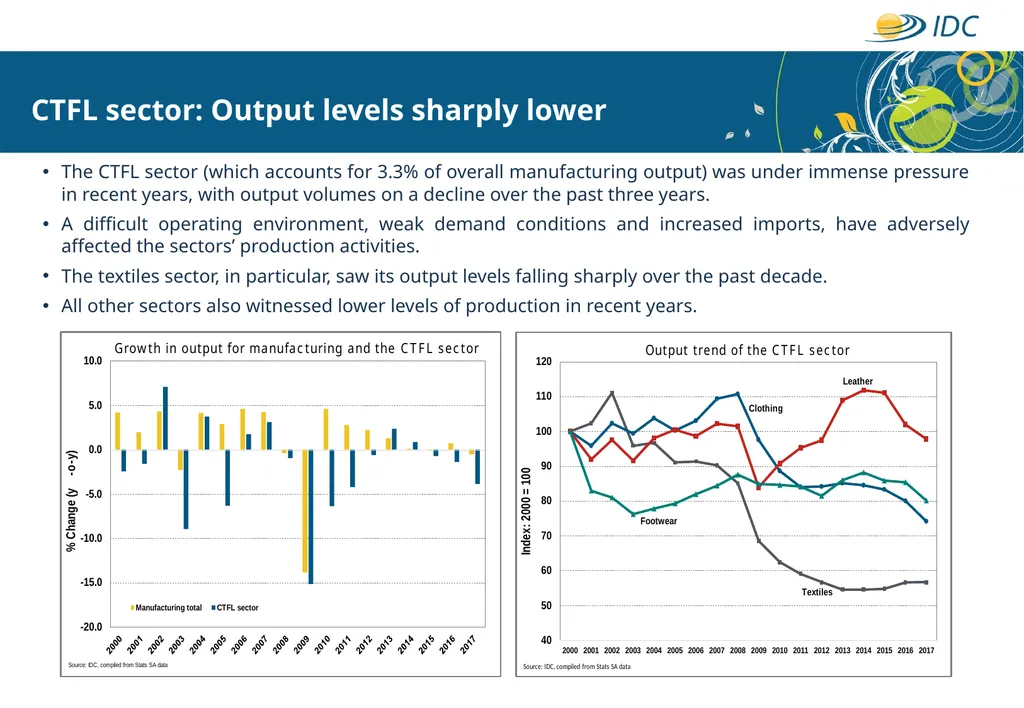
The CTFL sector (which accounts for 3.3% of overall manufacturing output) was under immense pressure in recent years, with output volumes on a decline over the past three years.
A difficult operating environment, weak demand conditions and increased imports, have adversely affected the sectors’ production activities.
The textiles sector, in particular, saw its output levels falling sharply over the past decade.
All other sectors also witnessed lower levels of production in recent years. CTFL sector: Output levels sharply lower<br>
04
Pressure on disposable income – low retail sales
Illegal Imports
Exchange rate volatility
Eroded equity base due to losses
Low appetite of commercial banks to fund industry – more especially clothing (jobs rich) because of low security
IDC only funder to provide support to distressed businesses
Ageing workforce (especially management)
Lack of financial skills (costing)
Retailer pressure on margins
Fragmented industry Sector Specific Challenges<br>
05
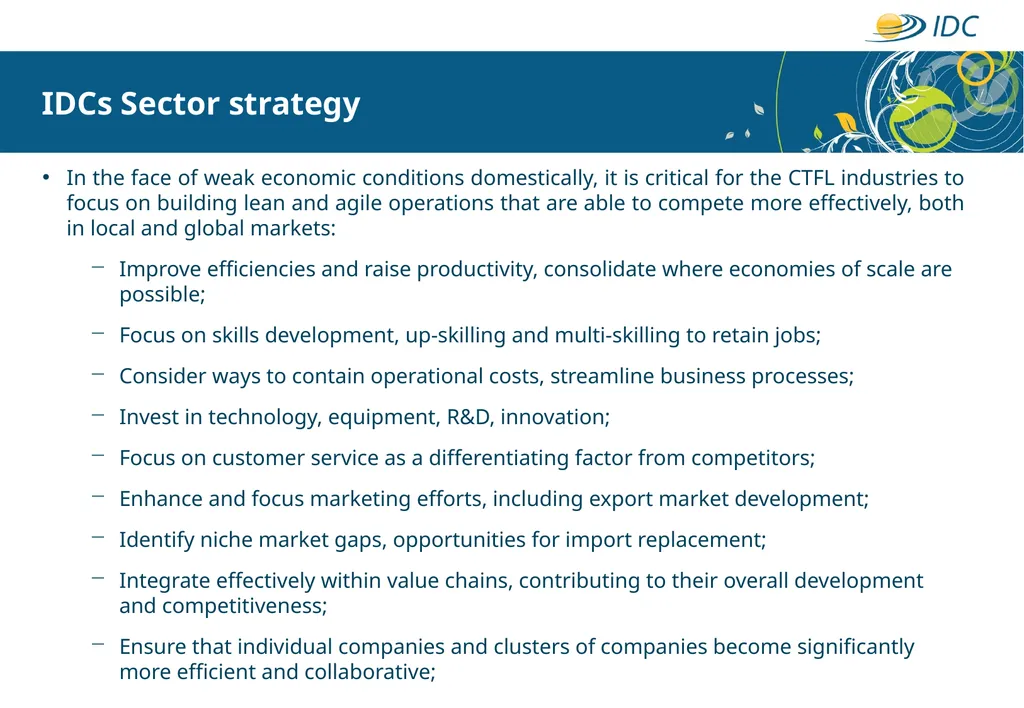
In the face of weak economic conditions domestically, it is critical for the CTFL industries to focus on building lean and agile operations that are able to compete more effectively, both in local and global markets:
Improve efficiencies and raise productivity, consolidate where economies of scale are possible;
Focus on skills development, up-skilling and multi-skilling to retain jobs;
Consider ways to contain operational costs, streamline business processes;
Invest in technology, equipment, R&D, innovation;
Focus on customer service as a differentiating factor from competitors;
Enhance and focus marketing efforts, including export market development;
Identify niche market gaps, opportunities for import replacement;
Integrate effectively within value chains, contributing to their overall development and competitiveness;
Ensure that individual companies and clusters of companies become significantly more efficient and collaborative; IDCs Sector strategy<br>
06
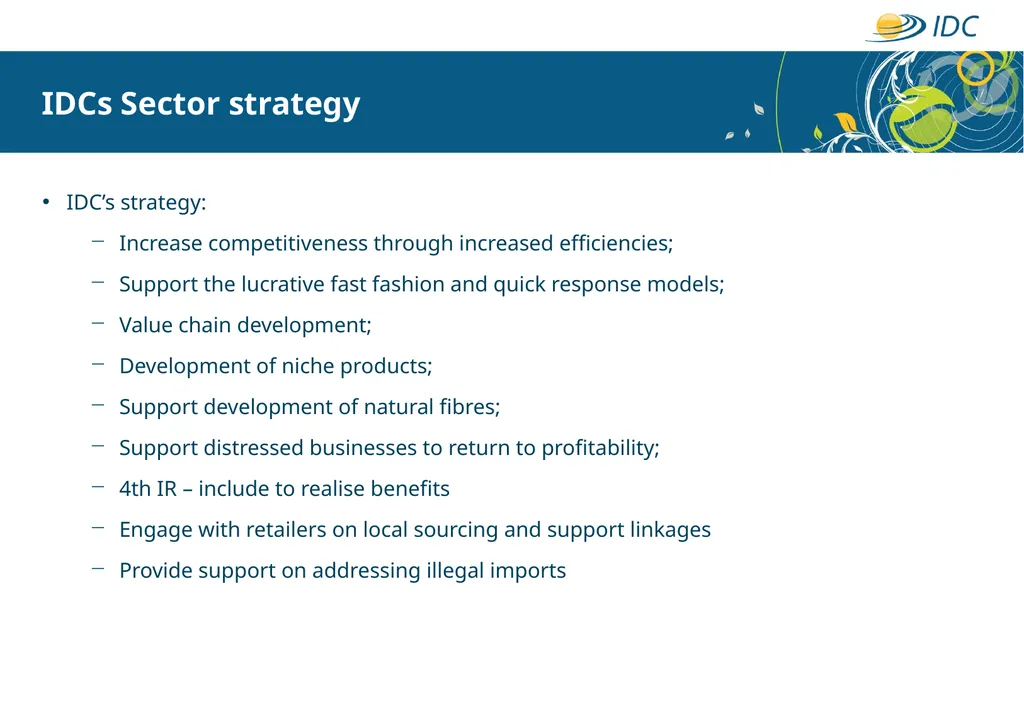
IDC’s strategy:
Increase competitiveness through increased efficiencies;
Support the lucrative fast fashion and quick response models;
Value chain development;
Development of niche products;
Support development of natural fibres;
Support distressed businesses to return to profitability;
4th IR – include to realise benefits
Engage with retailers on local sourcing and support linkages
Provide support on addressing illegal imports IDCs Sector strategy<br>
07
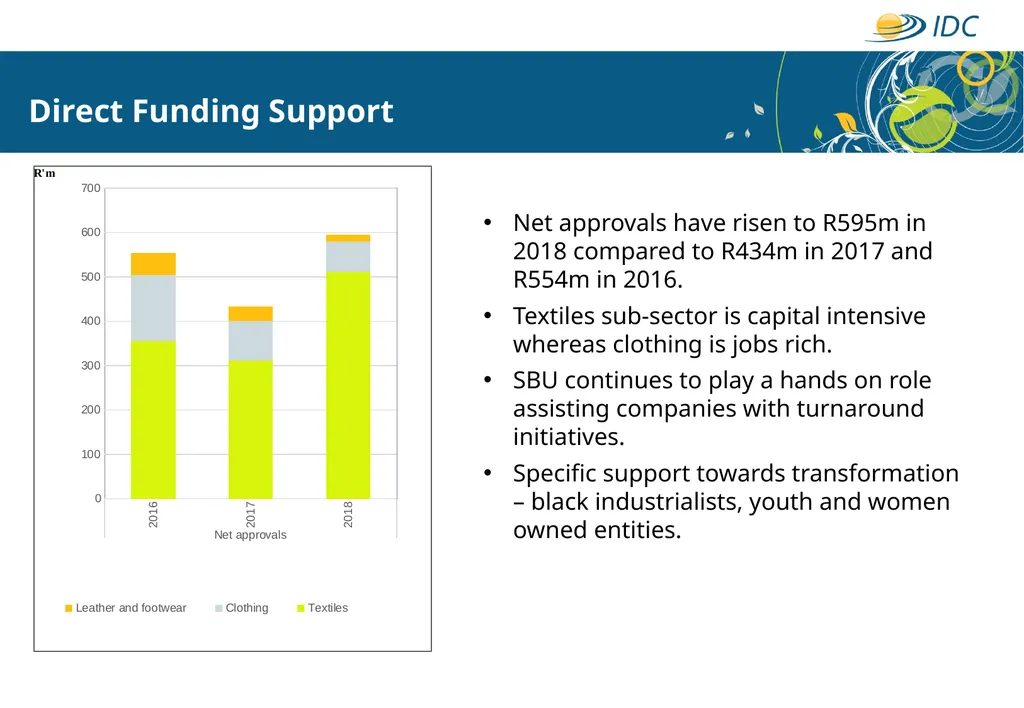
Direct Funding Support Net approvals have risen to R595m in 2018 compared to R434m in 2017 and R554m in 2016.
Textiles sub-sector is capital intensive whereas clothing is jobs rich.
SBU continues to play a hands on role assisting companies with turnaround initiatives.
Specific support towards transformation – black industrialists, youth and women owned entities.<br>
Textiles sub-sector is capital intensive whereas clothing is jobs rich.
SBU continues to play a hands on role assisting companies with turnaround initiatives.
Specific support towards transformation – black industrialists, youth and women owned entities.<br>
08
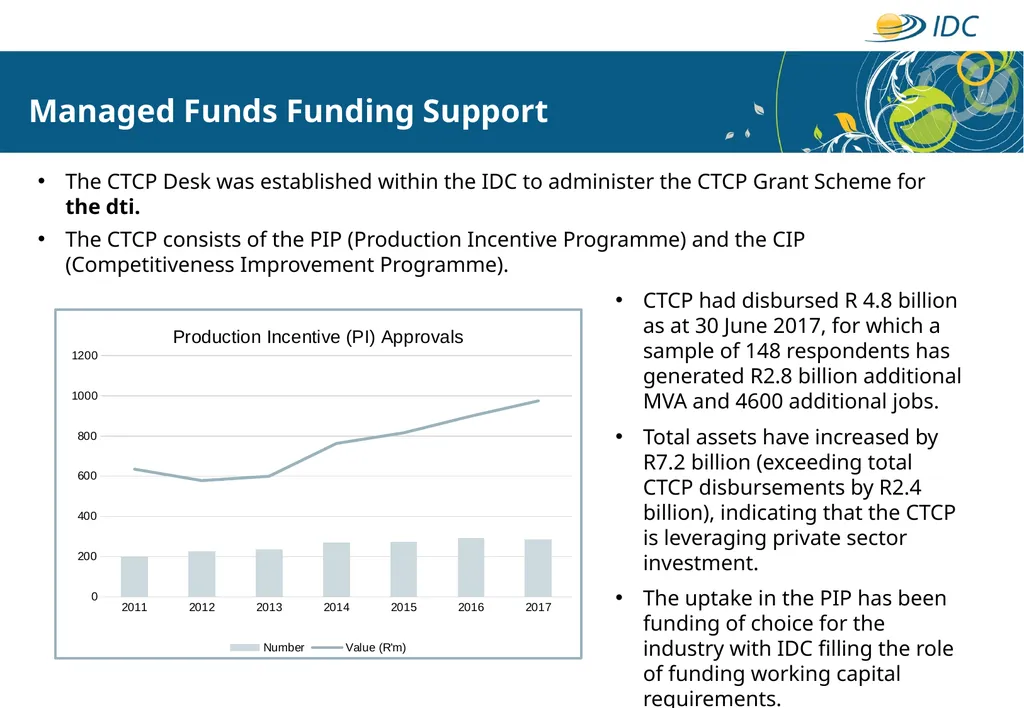
Managed Funds Funding Support The CTCP Desk was established within the IDC to administer the CTCP Grant Scheme for the dti.
The CTCP consists of the PIP (Production Incentive Programme) and the CIP (Competitiveness Improvement Programme). CTCP had disbursed R 4.8 billion as at 30 June 2017, for which a sample of 148 respondents has generated R2.8 billion additional MVA and 4600 additional jobs.
Total assets have increased by R7.2 billion (exceeding total CTCP disbursements by R2.4 billion), indicating that the CTCP is leveraging private sector investment.
The uptake in the PIP has been funding of choice for the industry with IDC filling the role of funding working capital requirements.<br>
09
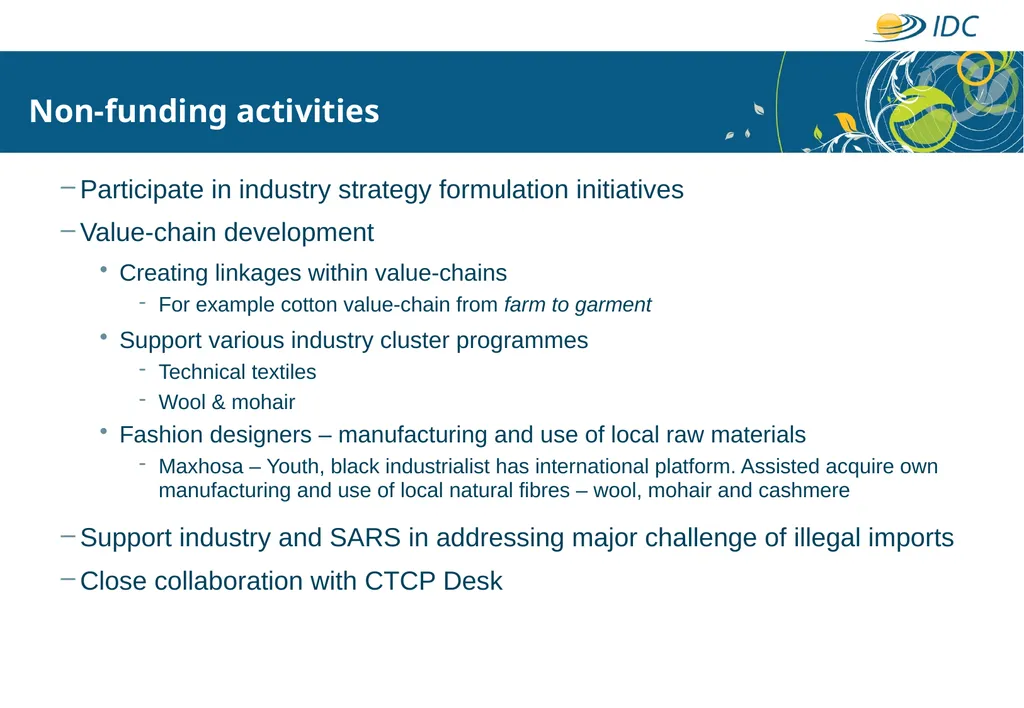
Non-funding activities Participate in industry strategy formulation initiatives
Value-chain development
Creating linkages within value-chains
For example cotton value-chain from farm to garment
Support various industry cluster programmes
Technical textiles
Wool & mohair
Fashion designers – manufacturing and use of local raw materials
Maxhosa – Youth, black industrialist has international platform. Assisted acquire own manufacturing and use of local natural fibres – wool, mohair and cashmere
Support industry and SARS in addressing major challenge of illegal imports
Close collaboration with CTCP Desk<br>
10
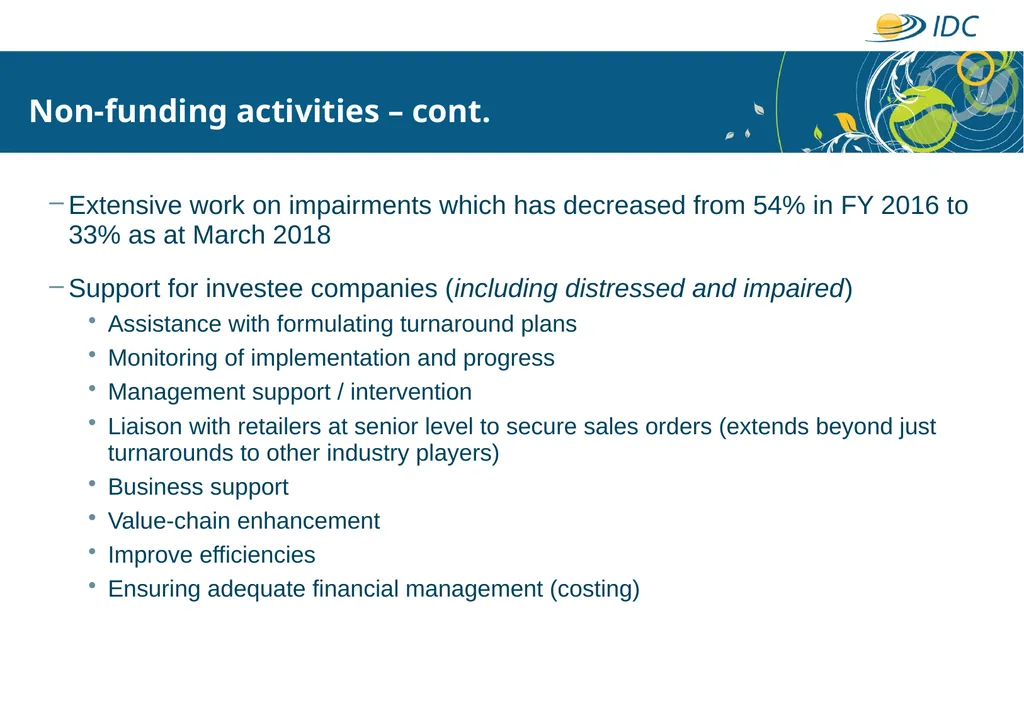
Non-funding activities – cont. Extensive work on impairments which has decreased from 54% in FY 2016 to 33% as at March 2018
Support for investee companies (including distressed and impaired)
Assistance with formulating turnaround plans
Monitoring of implementation and progress
Management support / intervention
Liaison with retailers at senior level to secure sales orders (extends beyond just turnarounds to other industry players)
Business support
Value-chain enhancement
Improve efficiencies
Ensuring adequate financial management (costing)<br>
11
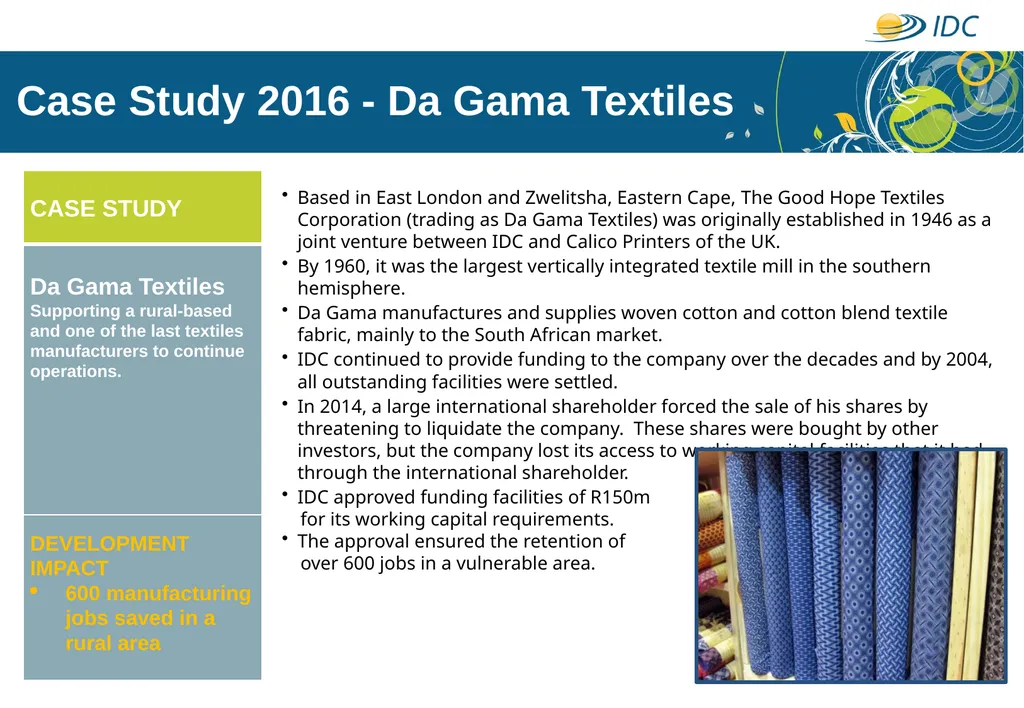
Case Study 2016 - Da Gama Textiles Based in East London and Zwelitsha, Eastern Cape, The Good Hope Textiles Corporation (trading as Da Gama Textiles) was originally established in 1946 as a joint venture between IDC and Calico Printers of the UK.
By 1960, it was the largest vertically integrated textile mill in the southern hemisphere.
Da Gama manufactures and supplies woven cotton and cotton blend textile fabric, mainly to the South African market.
IDC continued to provide funding to the company over the decades and by 2004, all outstanding facilities were settled.
In 2014, a large international shareholder forced the sale of his shares by threatening to liquidate the company. These shares were bought by other investors, but the company lost its access to working capital facilities that it had through the international shareholder.
IDC approved funding facilities of R150m
for its working capital requirements.
The approval ensured the retention of
over 600 jobs in a vulnerable area.<br>
12
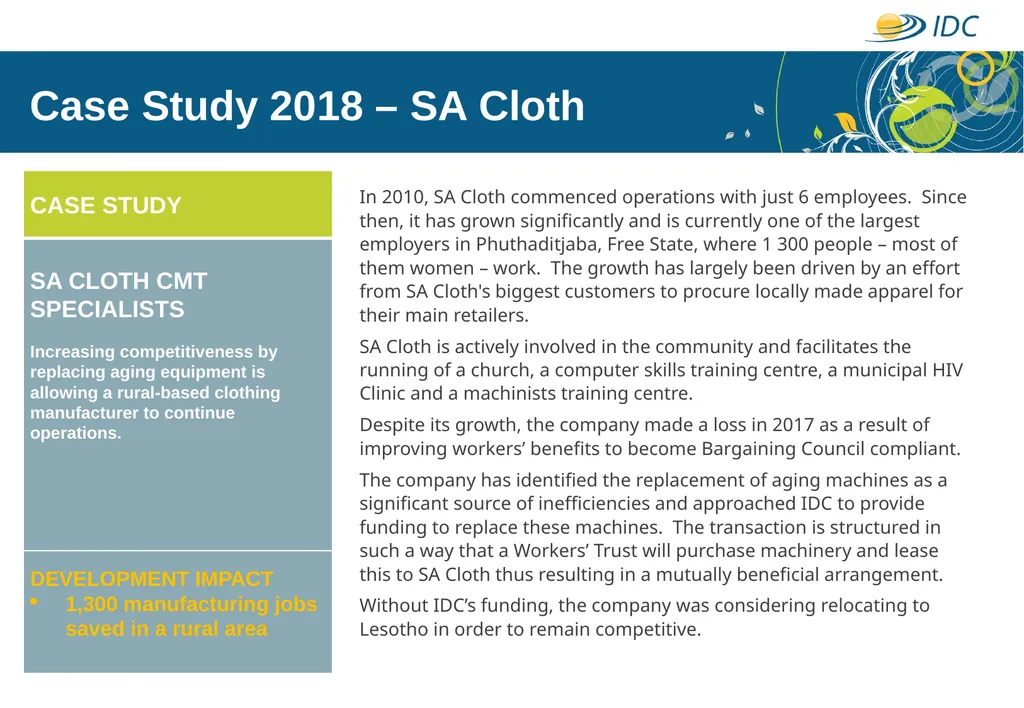
Case Study 2018 – SA Cloth In 2010, SA Cloth commenced operations with just 6 employees. Since then, it has grown significantly and is currently one of the largest employers in Phuthaditjaba, Free State, where 1 300 people – most of them women – work. The growth has largely been driven by an effort from SA Cloth's biggest customers to procure locally made apparel for their main retailers.
SA Cloth is actively involved in the community and facilitates the running of a church, a computer skills training centre, a municipal HIV Clinic and a machinists training centre.
Despite its growth, the company made a loss in 2017 as a result of improving workers’ benefits to become Bargaining Council compliant.
The company has identified the replacement of aging machines as a significant source of inefficiencies and approached IDC to provide funding to replace these machines. The transaction is structured in such a way that a Workers’ Trust will purchase machinery and lease this to SA Cloth thus resulting in a mutually beneficial arrangement.
Without IDC’s funding, the company was considering relocating to Lesotho in order to remain competitive.<br>
13
Concluding remarks Continued public sector support to CTFL industries is crucial, including:
Funding assistance aimed at improving the competitiveness and long-term sustainability of players, and to stabilise employment
Tightening control of imports, especially illegal imports, ensuring consistent and effective enforcement of customs regulations
Enforcing and monitoring localisation directives, especially product designations
Pursuing initiatives aimed at strengthening value-chains, all the way to their retail and export servicing segments
Building success stories
Attracting commercial funders and new investment
Attracting new entrants – managers and entrepreneurs<br>
14
Thank You The Industrial Development Corporation
19 Fredman Drive, Sandown
PO Box 784055, Sandton, 2146
South Africa
Telephone (011) 269 3000
Facsimile (011) 269 2116
E-mail callcentre@idc.co.za<br>
19 Fredman Drive, Sandown
PO Box 784055, Sandton, 2146
South Africa
Telephone (011) 269 3000
Facsimile (011) 269 2116
E-mail callcentre@idc.co.za<br>