
THE ACCOUNTING EQUATION AND DOUBLE-ENTRY
TA
Published · 50 slides · 0 views
1 / 1








Description
THE ACCOUNTING EQUATION AND DOUBLE-ENTRY BOOK-KEEPING Book-keeping Book-keeping is the process of recording financial transactions in the accounting records (the books) of an entity. Transactions are recorded in accounts, and there is a
Related Topics
Share
Embed code
Download this presentation From Below
"THE ACCOUNTING EQUATION AND DOUBLE-ENTRY" is the property of its rightful owner. Permission is granted to download and print the materials on this website for personal, non-commercial use only, and to display it on your personal computer provided you do not modify the materials and that you retain all copyright notices contained in the materials. By downloading content from our website, you accept the terms of this agreement.
Presentation Transcript
01
THE ACCOUNTING EQUATION AND DOUBLE-ENTRY BOOK-KEEPING<br>
02
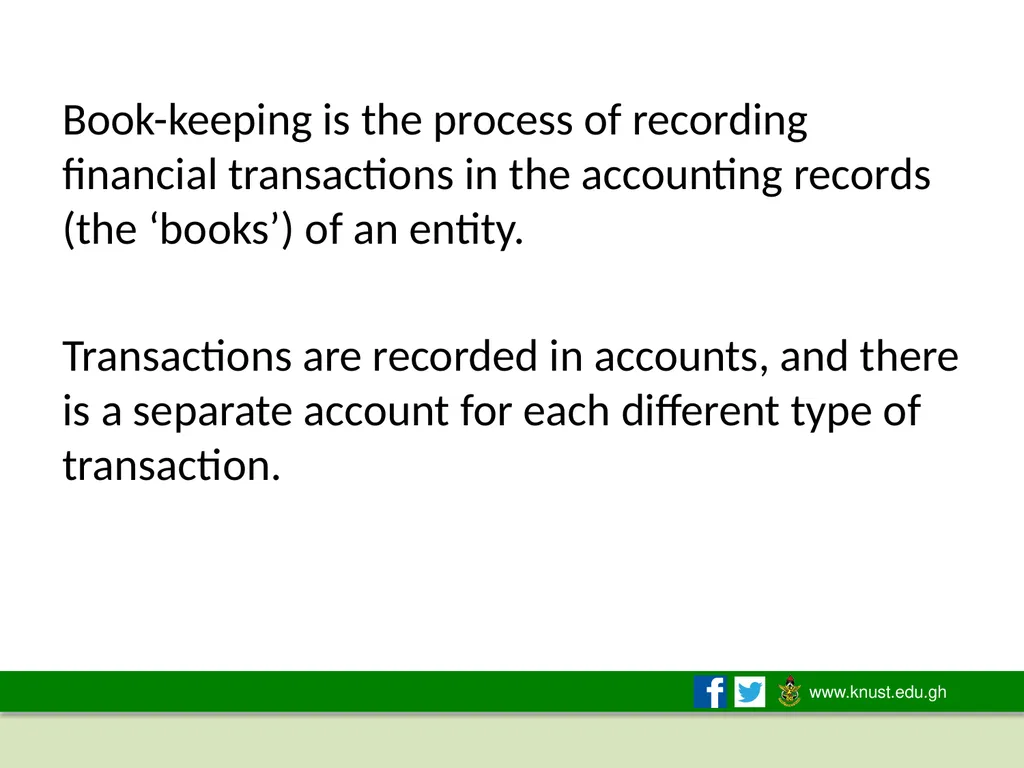
Book-keeping Book-keeping is the process of recording financial transactions in the accounting records (the ‘books’) of an entity.
Transactions are recorded in accounts, and there is a separate account for each different type of transaction.<br>
Transactions are recorded in accounts, and there is a separate account for each different type of transaction.<br>
03
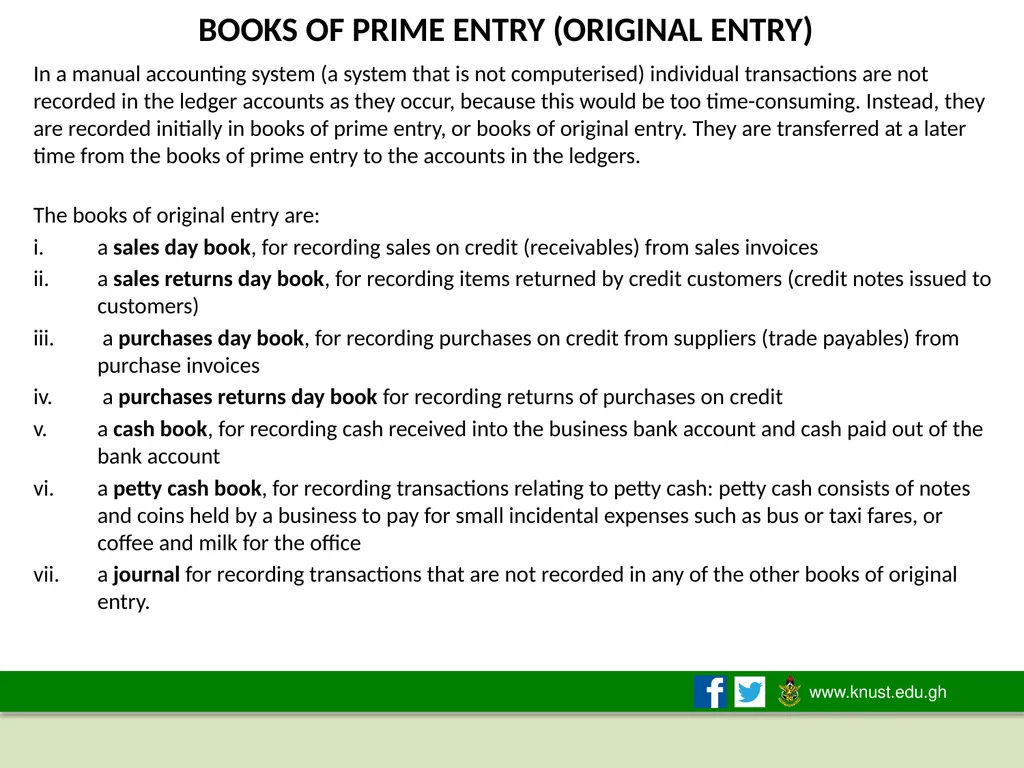
In a manual accounting system (a system that is not computerised) individual transactions are not recorded in the ledger accounts as they occur, because this would be too time-consuming. Instead, they are recorded initially in books of prime entry, or books of original entry. They are transferred at a later time from the books of prime entry to the accounts in the ledgers.
The books of original entry are:
a sales day book, for recording sales on credit (receivables) from sales invoices
a sales returns day book, for recording items returned by credit customers (credit notes issued to customers)
a purchases day book, for recording purchases on credit from suppliers (trade payables) from purchase invoices
a purchases returns day book for recording returns of purchases on credit
a cash book, for recording cash received into the business bank account and cash paid out of the bank account
a petty cash book, for recording transactions relating to petty cash: petty cash consists of notes and coins held by a business to pay for small incidental expenses such as bus or taxi fares, or coffee and milk for the office
a journal for recording transactions that are not recorded in any of the other books of original entry. BOOKS OF PRIME ENTRY (ORIGINAL ENTRY)<br>
The books of original entry are:
a sales day book, for recording sales on credit (receivables) from sales invoices
a sales returns day book, for recording items returned by credit customers (credit notes issued to customers)
a purchases day book, for recording purchases on credit from suppliers (trade payables) from purchase invoices
a purchases returns day book for recording returns of purchases on credit
a cash book, for recording cash received into the business bank account and cash paid out of the bank account
a petty cash book, for recording transactions relating to petty cash: petty cash consists of notes and coins held by a business to pay for small incidental expenses such as bus or taxi fares, or coffee and milk for the office
a journal for recording transactions that are not recorded in any of the other books of original entry. BOOKS OF PRIME ENTRY (ORIGINAL ENTRY)<br>
04
The sales day book is the book of prime entry for credit sales. The sales day book is used to keep a list of all invoices sent to customers each day. An extract from the sales day book might look like this.
SALES DAY BOOK
Date Invoice Customer Total Amount Invoiced
20X0 GHS
Jan 10 247 Asamoah & Co 105.00
248 Ofori Co 86.40
249 Koree & Co 31.80
250 Penton College 1,264.60
1,487.80 THE SALES DAY BOOK<br>
SALES DAY BOOK
Date Invoice Customer Total Amount Invoiced
20X0 GHS
Jan 10 247 Asamoah & Co 105.00
248 Ofori Co 86.40
249 Koree & Co 31.80
250 Penton College 1,264.60
1,487.80 THE SALES DAY BOOK<br>
05
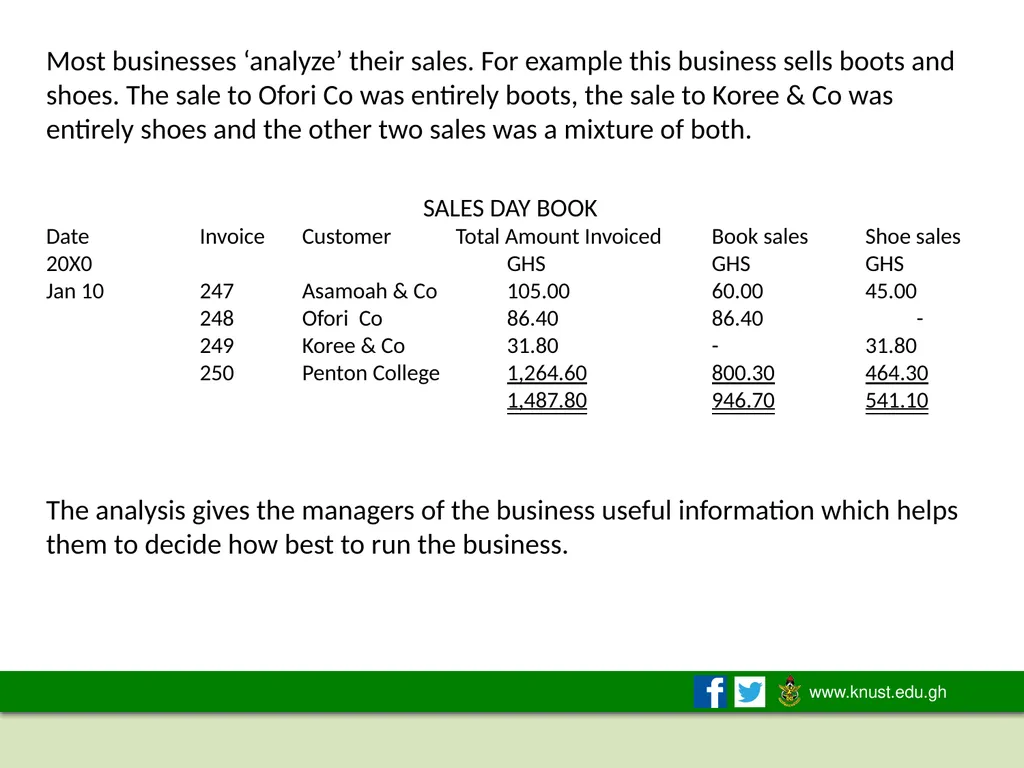
Most businesses ‘analyze’ their sales. For example this business sells boots and shoes. The sale to Ofori Co was entirely boots, the sale to Koree & Co was entirely shoes and the other two sales was a mixture of both.
SALES DAY BOOK
Date Invoice Customer Total Amount Invoiced Book sales Shoe sales
20X0 GHS GHS GHS
Jan 10 247 Asamoah & Co 105.00 60.00 45.00
248 Ofori Co 86.40 86.40 -
249 Koree & Co 31.80 - 31.80
250 Penton College 1,264.60 800.30 464.30
1,487.80 946.70 541.10
The analysis gives the managers of the business useful information which helps them to decide how best to run the business.<br>
SALES DAY BOOK
Date Invoice Customer Total Amount Invoiced Book sales Shoe sales
20X0 GHS GHS GHS
Jan 10 247 Asamoah & Co 105.00 60.00 45.00
248 Ofori Co 86.40 86.40 -
249 Koree & Co 31.80 - 31.80
250 Penton College 1,264.60 800.30 464.30
1,487.80 946.70 541.10
The analysis gives the managers of the business useful information which helps them to decide how best to run the business.<br>
06
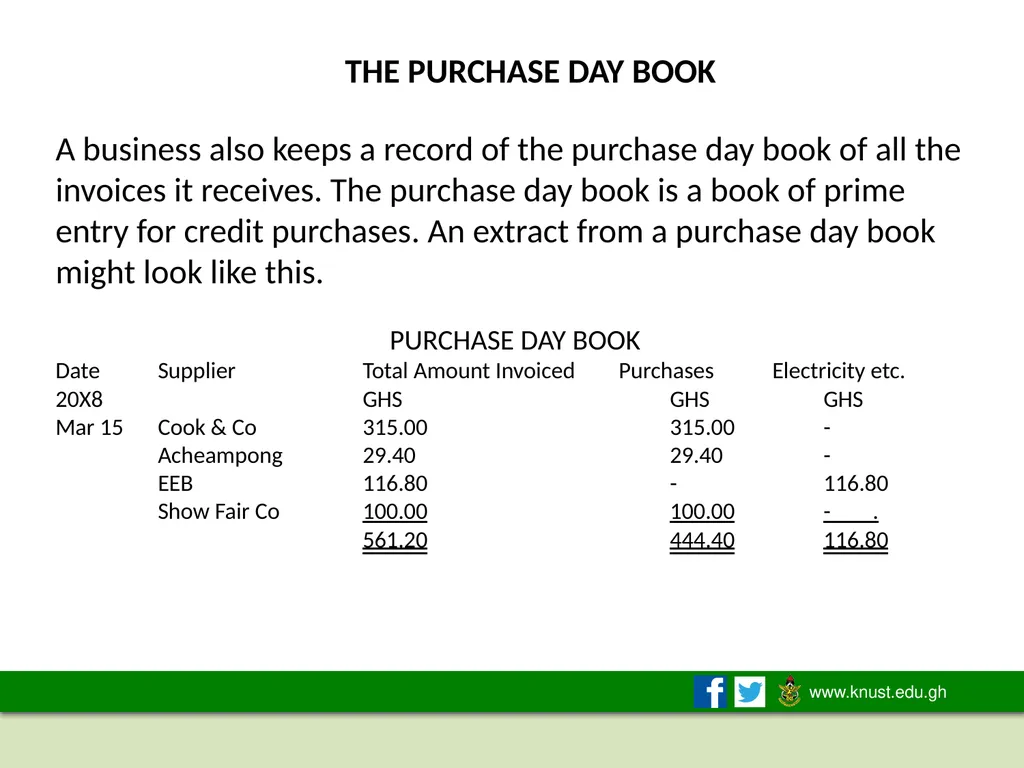
A business also keeps a record of the purchase day book of all the invoices it receives. The purchase day book is a book of prime entry for credit purchases. An extract from a purchase day book might look like this.
PURCHASE DAY BOOK
Date Supplier Total Amount Invoiced Purchases Electricity etc.
20X8 GHS GHS GHS
Mar 15 Cook & Co 315.00 315.00 -
Acheampong 29.40 29.40 -
EEB 116.80 - 116.80
Show Fair Co 100.00 100.00 - .
561.20 444.40 116.80 THE PURCHASE DAY BOOK<br>
PURCHASE DAY BOOK
Date Supplier Total Amount Invoiced Purchases Electricity etc.
20X8 GHS GHS GHS
Mar 15 Cook & Co 315.00 315.00 -
Acheampong 29.40 29.40 -
EEB 116.80 - 116.80
Show Fair Co 100.00 100.00 - .
561.20 444.40 116.80 THE PURCHASE DAY BOOK<br>
07
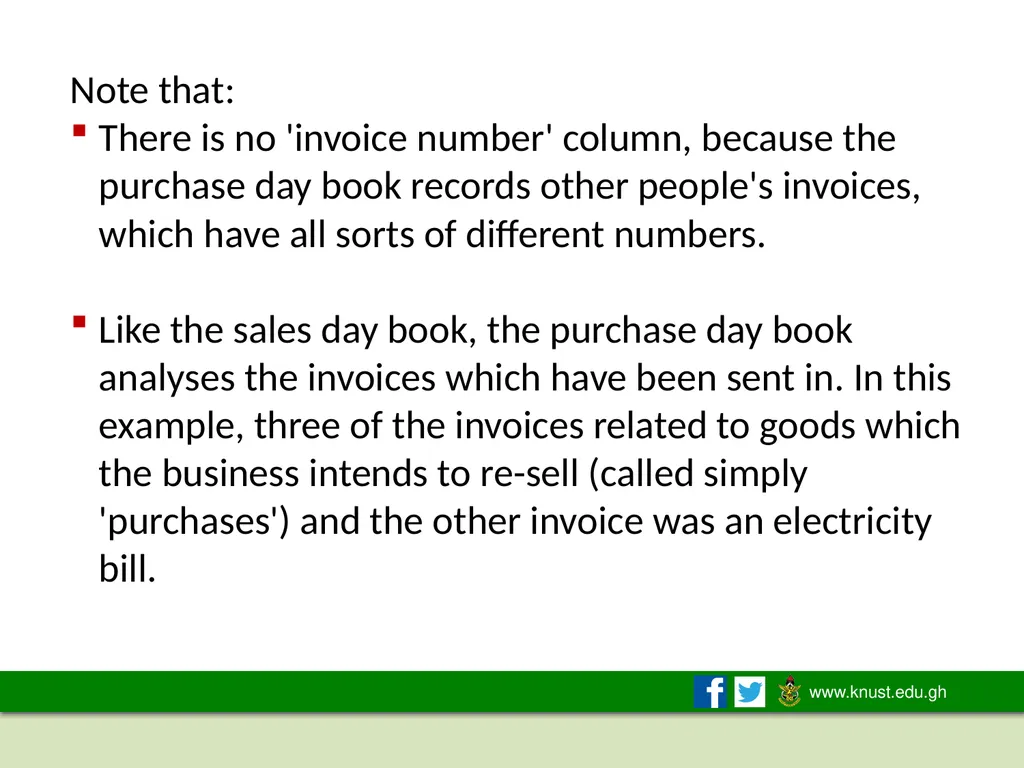
Note that:
There is no 'invoice number' column, because the purchase day book records other people's invoices, which have all sorts of different numbers.
Like the sales day book, the purchase day book analyses the invoices which have been sent in. In this example, three of the invoices related to goods which the business intends to re-sell (called simply 'purchases') and the other invoice was an electricity bill.<br>
There is no 'invoice number' column, because the purchase day book records other people's invoices, which have all sorts of different numbers.
Like the sales day book, the purchase day book analyses the invoices which have been sent in. In this example, three of the invoices related to goods which the business intends to re-sell (called simply 'purchases') and the other invoice was an electricity bill.<br>
08
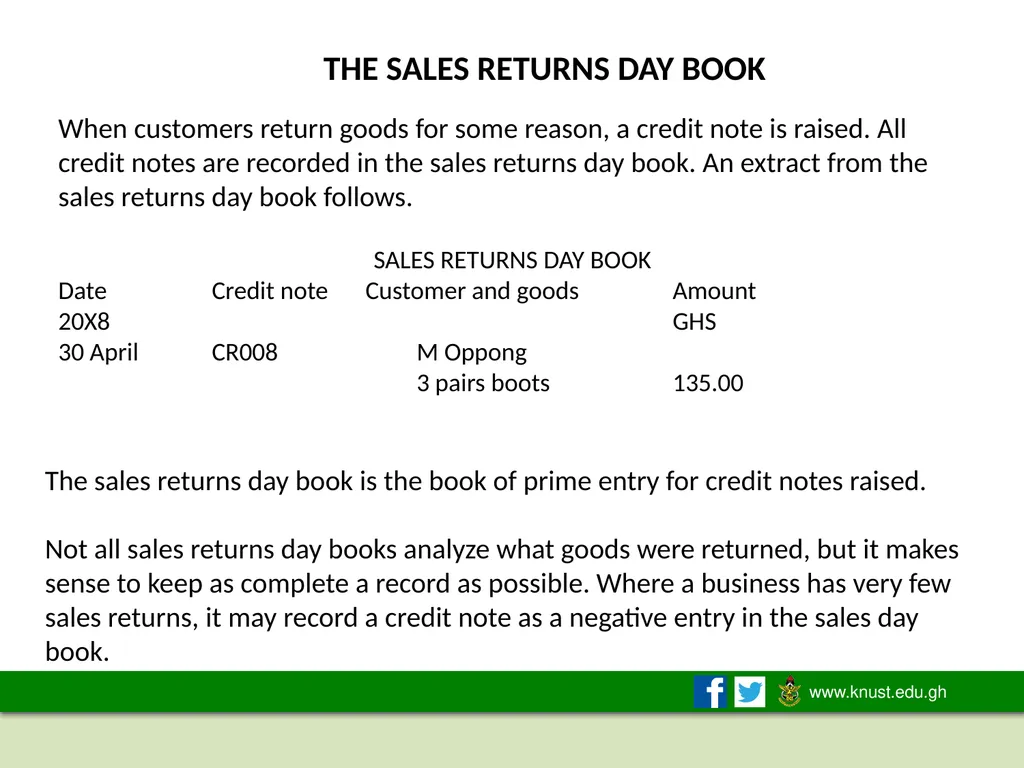
When customers return goods for some reason, a credit note is raised. All credit notes are recorded in the sales returns day book. An extract from the sales returns day book follows.
SALES RETURNS DAY BOOK
Date Credit note Customer and goods Amount
20X8 GHS
30 April CR008 M Oppong
3 pairs boots 135.00 THE SALES RETURNS DAY BOOK The sales returns day book is the book of prime entry for credit notes raised.
Not all sales returns day books analyze what goods were returned, but it makes sense to keep as complete a record as possible. Where a business has very few sales returns, it may record a credit note as a negative entry in the sales day book.<br>
SALES RETURNS DAY BOOK
Date Credit note Customer and goods Amount
20X8 GHS
30 April CR008 M Oppong
3 pairs boots 135.00 THE SALES RETURNS DAY BOOK The sales returns day book is the book of prime entry for credit notes raised.
Not all sales returns day books analyze what goods were returned, but it makes sense to keep as complete a record as possible. Where a business has very few sales returns, it may record a credit note as a negative entry in the sales day book.<br>
09
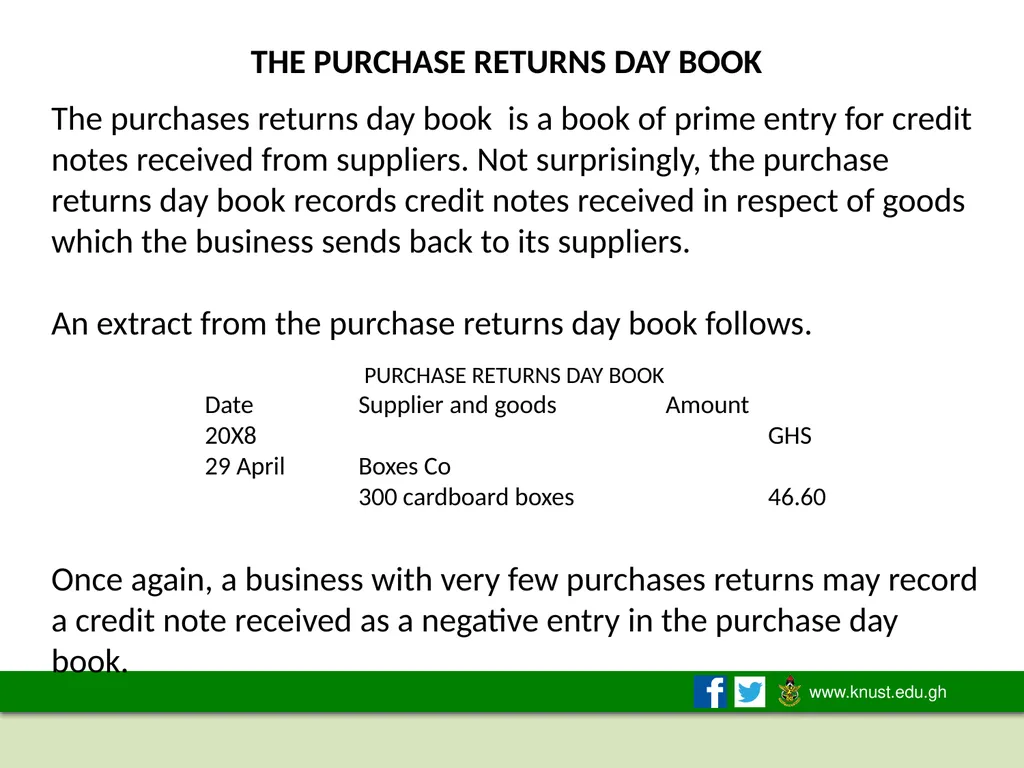
The purchases returns day book is a book of prime entry for credit notes received from suppliers. Not surprisingly, the purchase returns day book records credit notes received in respect of goods which the business sends back to its suppliers.
An extract from the purchase returns day book follows.
PURCHASE RETURNS DAY BOOK
Date Supplier and goods Amount
20X8 GHS
29 April Boxes Co
300 cardboard boxes 46.60
Once again, a business with very few purchases returns may record a credit note received as a negative entry in the purchase day book. THE PURCHASE RETURNS DAY BOOK<br>
An extract from the purchase returns day book follows.
PURCHASE RETURNS DAY BOOK
Date Supplier and goods Amount
20X8 GHS
29 April Boxes Co
300 cardboard boxes 46.60
Once again, a business with very few purchases returns may record a credit note received as a negative entry in the purchase day book. THE PURCHASE RETURNS DAY BOOK<br>
10
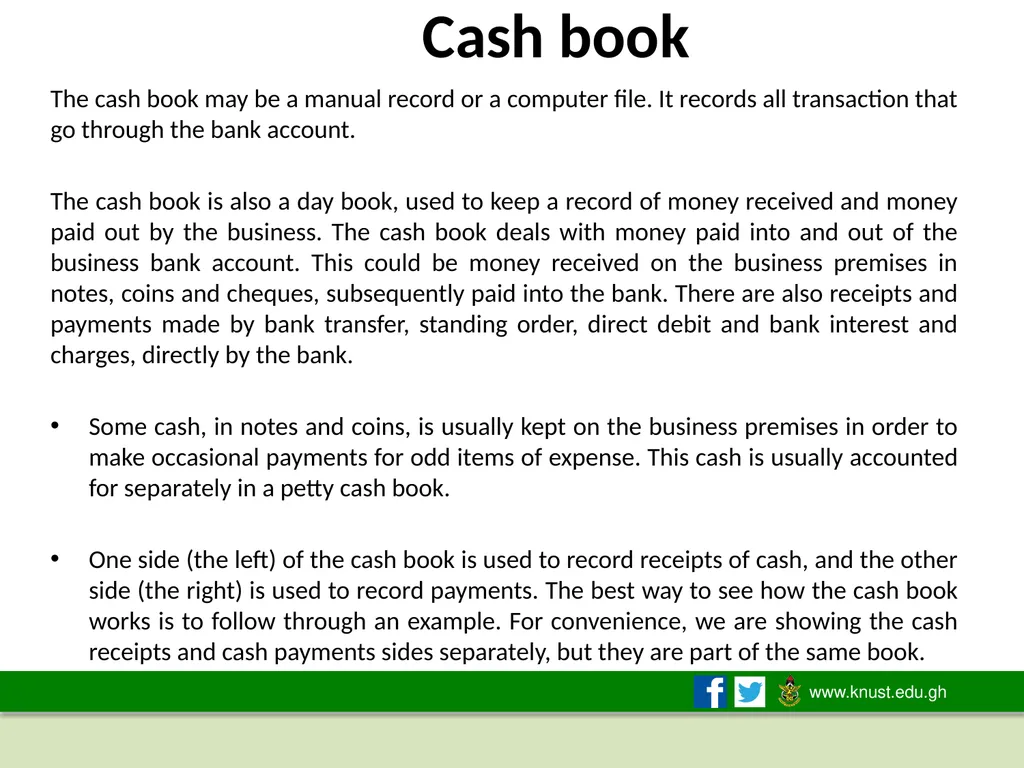
Cash book The cash book may be a manual record or a computer file. It records all transaction that go through the bank account.
The cash book is also a day book, used to keep a record of money received and money paid out by the business. The cash book deals with money paid into and out of the business bank account. This could be money received on the business premises in notes, coins and cheques, subsequently paid into the bank. There are also receipts and payments made by bank transfer, standing order, direct debit and bank interest and charges, directly by the bank.
Some cash, in notes and coins, is usually kept on the business premises in order to make occasional payments for odd items of expense. This cash is usually accounted for separately in a petty cash book.
One side (the left) of the cash book is used to record receipts of cash, and the other side (the right) is used to record payments. The best way to see how the cash book works is to follow through an example. For convenience, we are showing the cash receipts and cash payments sides separately, but they are part of the same book.<br>
The cash book is also a day book, used to keep a record of money received and money paid out by the business. The cash book deals with money paid into and out of the business bank account. This could be money received on the business premises in notes, coins and cheques, subsequently paid into the bank. There are also receipts and payments made by bank transfer, standing order, direct debit and bank interest and charges, directly by the bank.
Some cash, in notes and coins, is usually kept on the business premises in order to make occasional payments for odd items of expense. This cash is usually accounted for separately in a petty cash book.
One side (the left) of the cash book is used to record receipts of cash, and the other side (the right) is used to record payments. The best way to see how the cash book works is to follow through an example. For convenience, we are showing the cash receipts and cash payments sides separately, but they are part of the same book.<br>
11
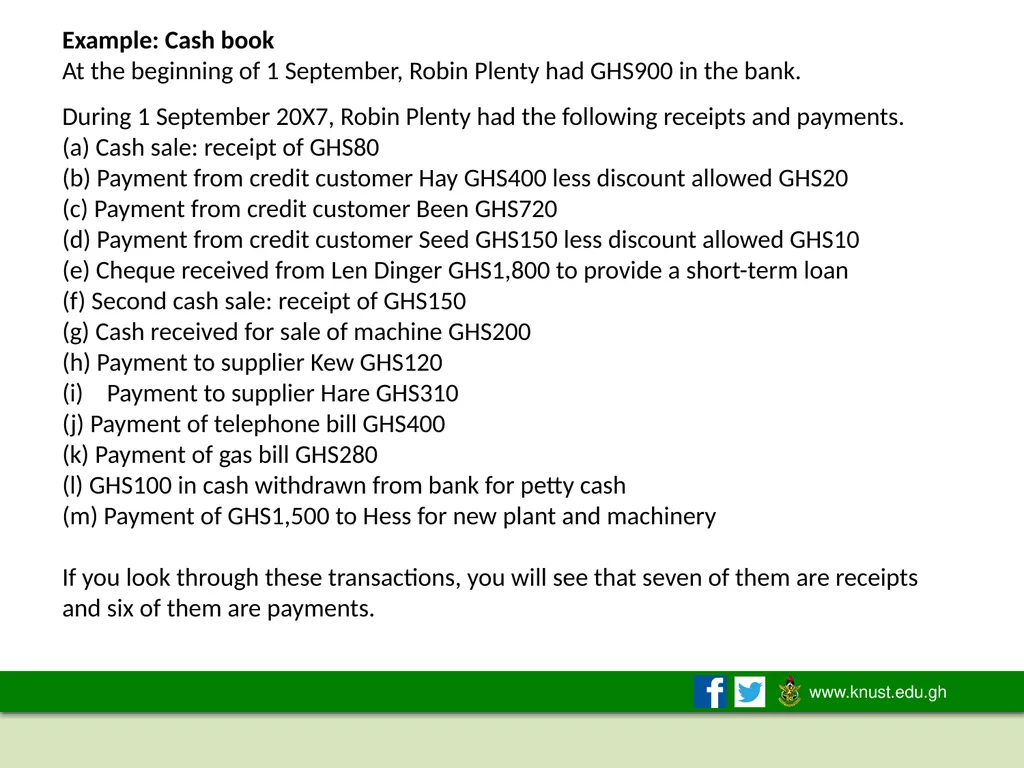
Example: Cash book
At the beginning of 1 September, Robin Plenty had GHS900 in the bank.
During 1 September 20X7, Robin Plenty had the following receipts and payments.
(a) Cash sale: receipt of GHS80
(b) Payment from credit customer Hay GHS400 less discount allowed GHS20
(c) Payment from credit customer Been GHS720
(d) Payment from credit customer Seed GHS150 less discount allowed GHS10
(e) Cheque received from Len Dinger GHS1,800 to provide a short-term loan
(f) Second cash sale: receipt of GHS150
(g) Cash received for sale of machine GHS200
(h) Payment to supplier Kew GHS120
Payment to supplier Hare GHS310
(j) Payment of telephone bill GHS400
(k) Payment of gas bill GHS280
(l) GHS100 in cash withdrawn from bank for petty cash
(m) Payment of GHS1,500 to Hess for new plant and machinery
If you look through these transactions, you will see that seven of them are receipts and six of them are payments.<br>
At the beginning of 1 September, Robin Plenty had GHS900 in the bank.
During 1 September 20X7, Robin Plenty had the following receipts and payments.
(a) Cash sale: receipt of GHS80
(b) Payment from credit customer Hay GHS400 less discount allowed GHS20
(c) Payment from credit customer Been GHS720
(d) Payment from credit customer Seed GHS150 less discount allowed GHS10
(e) Cheque received from Len Dinger GHS1,800 to provide a short-term loan
(f) Second cash sale: receipt of GHS150
(g) Cash received for sale of machine GHS200
(h) Payment to supplier Kew GHS120
Payment to supplier Hare GHS310
(j) Payment of telephone bill GHS400
(k) Payment of gas bill GHS280
(l) GHS100 in cash withdrawn from bank for petty cash
(m) Payment of GHS1,500 to Hess for new plant and machinery
If you look through these transactions, you will see that seven of them are receipts and six of them are payments.<br>
12
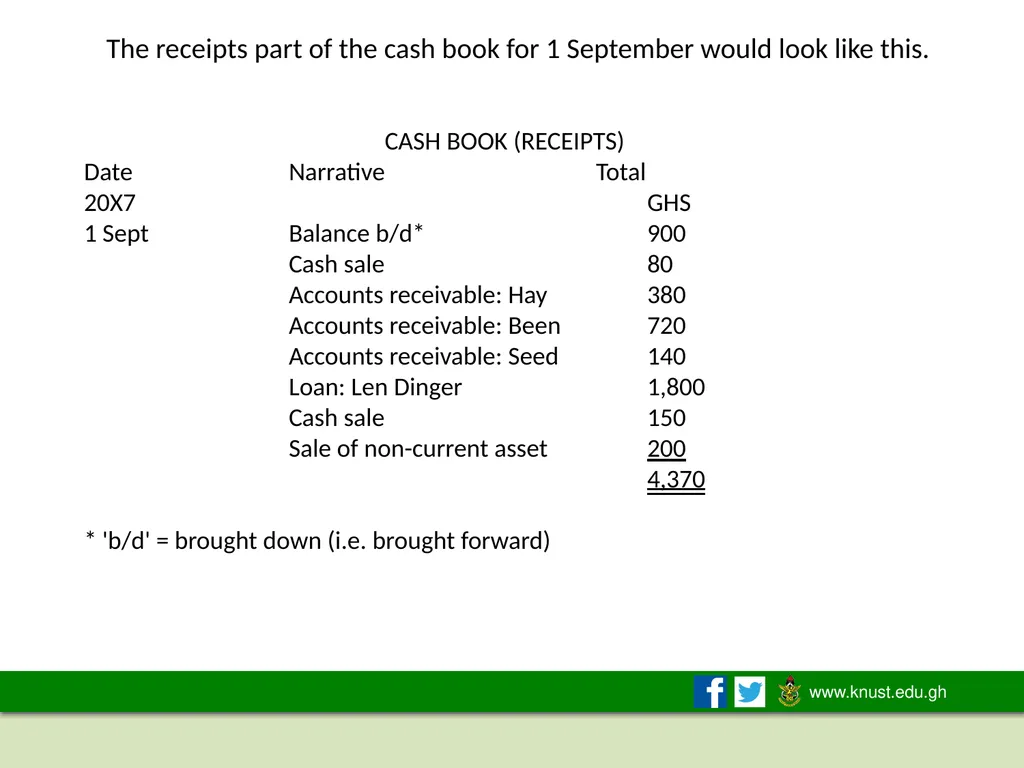
CASH BOOK (RECEIPTS)
Date Narrative Total
20X7 GHS
1 Sept Balance b/d* 900
Cash sale 80
Accounts receivable: Hay 380
Accounts receivable: Been 720
Accounts receivable: Seed 140
Loan: Len Dinger 1,800
Cash sale 150
Sale of non-current asset 200
4,370
* 'b/d' = brought down (i.e. brought forward) The receipts part of the cash book for 1 September would look like this.<br>
Date Narrative Total
20X7 GHS
1 Sept Balance b/d* 900
Cash sale 80
Accounts receivable: Hay 380
Accounts receivable: Been 720
Accounts receivable: Seed 140
Loan: Len Dinger 1,800
Cash sale 150
Sale of non-current asset 200
4,370
* 'b/d' = brought down (i.e. brought forward) The receipts part of the cash book for 1 September would look like this.<br>
13
There is space on the right hand side of the cash book so that the receipts can be analyzed under various headings – for example, 'cash from receivables', 'cash sales' and 'other receipts'.
The cash received in the day amounted to GHS3,470. Added to the GHS900 at the start of the day, this comes to GHS4,370. This is not the amount to be carried forward to the next day, because first we have to subtract all the payments made during 1 September.<br>
The cash received in the day amounted to GHS3,470. Added to the GHS900 at the start of the day, this comes to GHS4,370. This is not the amount to be carried forward to the next day, because first we have to subtract all the payments made during 1 September.<br>
14
The payments part of the cash book for 1 September would look like this.
CASH BOOK (PAYMENTS)
Date Narrative Total
20X7 GHS
1 Sept Accounts payable: Kew 120
Accounts payable: Hare 310
Telephone 400
Gas bill 280
Petty cash 100
Machinery purchase 1,500
Balance c/d (balancing figure) 1,660
4,370<br>
CASH BOOK (PAYMENTS)
Date Narrative Total
20X7 GHS
1 Sept Accounts payable: Kew 120
Accounts payable: Hare 310
Telephone 400
Gas bill 280
Petty cash 100
Machinery purchase 1,500
Balance c/d (balancing figure) 1,660
4,370<br>
15
As you can see, this is very similar to the receipts part of the cash book. The only points to note are as follows.
The analysis on the right would be under headings like 'payments to payables, 'payments into petty cash', 'wages' and 'other payments'.
Payments during 1 September totalled GHS2,710. We know that the total of receipts was GHS4,370. That means that there is a balance of GHS4,370 – GHS2,710 = GHS1,660 to be 'carried down' to the start of the next day. As you can see this 'balance carried down' is noted at the end of the payments column, so that the receipts and payments totals show the same figure of GHS4,370 at the end of 1 September.<br>
The analysis on the right would be under headings like 'payments to payables, 'payments into petty cash', 'wages' and 'other payments'.
Payments during 1 September totalled GHS2,710. We know that the total of receipts was GHS4,370. That means that there is a balance of GHS4,370 – GHS2,710 = GHS1,660 to be 'carried down' to the start of the next day. As you can see this 'balance carried down' is noted at the end of the payments column, so that the receipts and payments totals show the same figure of GHS4,370 at the end of 1 September.<br>
16
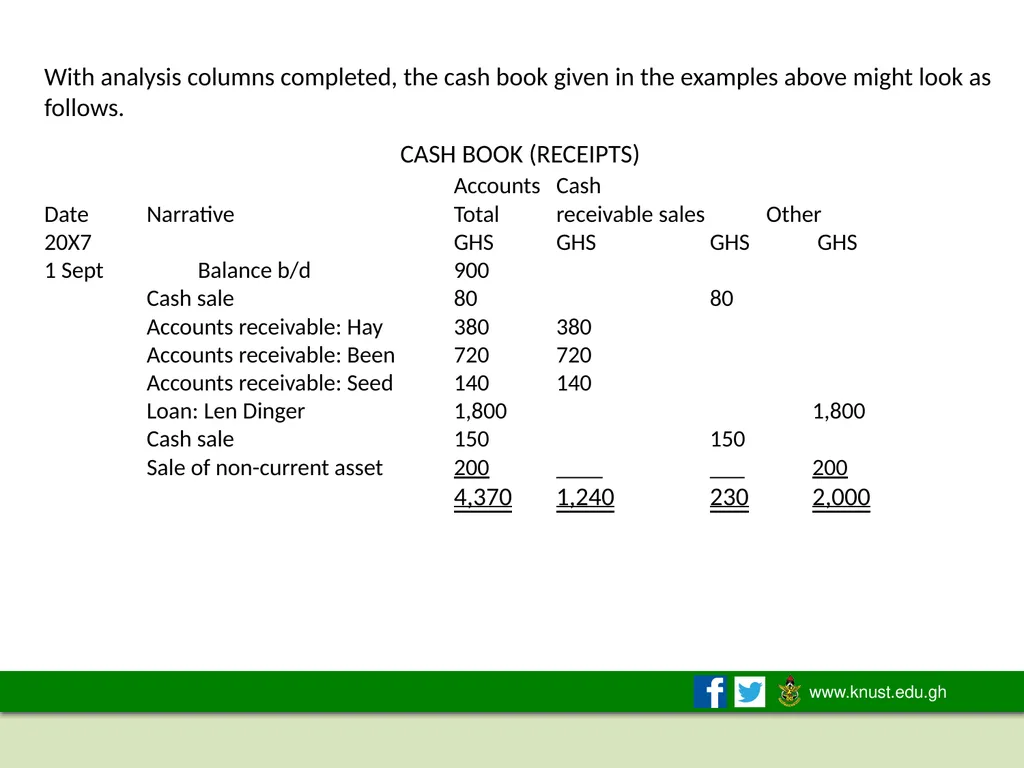
With analysis columns completed, the cash book given in the examples above might look as follows.
CASH BOOK (RECEIPTS)
Accounts Cash
Date Narrative Total receivable sales Other
20X7 GHS GHS GHS GHS
1 Sept Balance b/d 900
Cash sale 80 80
Accounts receivable: Hay 380 380
Accounts receivable: Been 720 720
Accounts receivable: Seed 140 140
Loan: Len Dinger 1,800 1,800
Cash sale 150 150
Sale of non-current asset 200 ____ ___ 200
4,370 1,240 230 2,000<br>
CASH BOOK (RECEIPTS)
Accounts Cash
Date Narrative Total receivable sales Other
20X7 GHS GHS GHS GHS
1 Sept Balance b/d 900
Cash sale 80 80
Accounts receivable: Hay 380 380
Accounts receivable: Been 720 720
Accounts receivable: Seed 140 140
Loan: Len Dinger 1,800 1,800
Cash sale 150 150
Sale of non-current asset 200 ____ ___ 200
4,370 1,240 230 2,000<br>
17
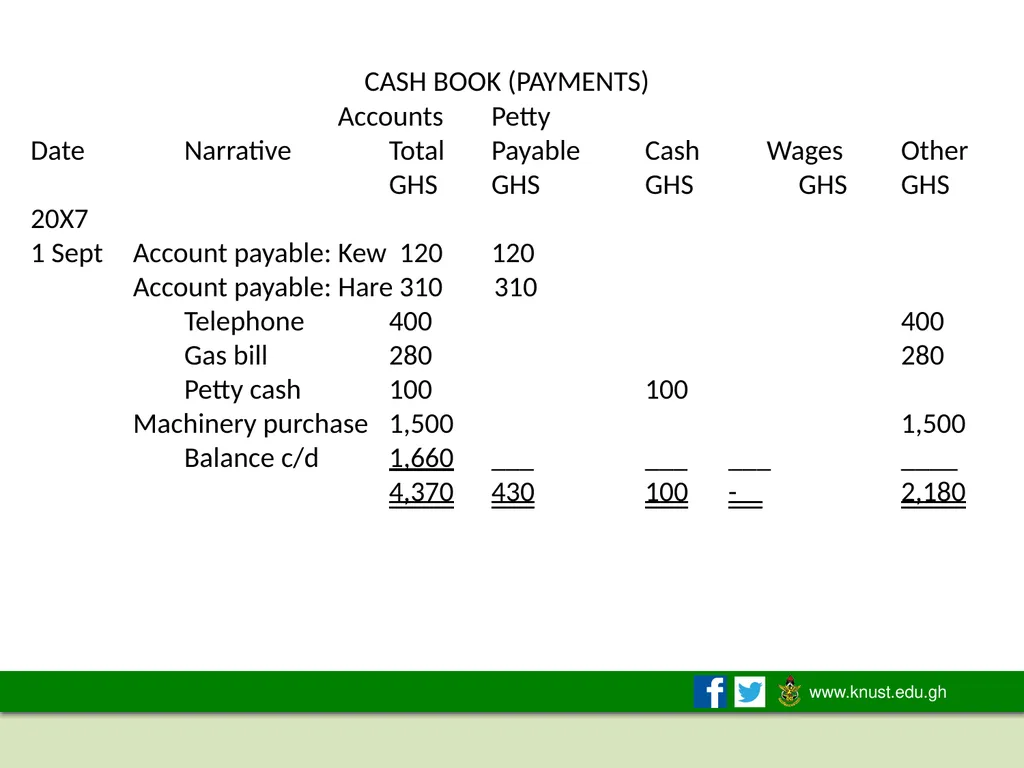
CASH BOOK (PAYMENTS)
Accounts Petty
Date Narrative Total Payable Cash Wages Other
GHS GHS GHS GHS GHS
20X7
1 Sept Account payable: Kew 120 120
Account payable: Hare 310 310
Telephone 400 400
Gas bill 280 280
Petty cash 100 100
Machinery purchase 1,500 1,500
Balance c/d 1,660 ___ ___ ___ ____
4,370 430 100 - 2,180<br>
Accounts Petty
Date Narrative Total Payable Cash Wages Other
GHS GHS GHS GHS GHS
20X7
1 Sept Account payable: Kew 120 120
Account payable: Hare 310 310
Telephone 400 400
Gas bill 280 280
Petty cash 100 100
Machinery purchase 1,500 1,500
Balance c/d 1,660 ___ ___ ___ ____
4,370 430 100 - 2,180<br>
18
Most businesses keep petty cash on the premises, which is topped up from the main bank account. Under the imprest system, the petty cash is kept at an agreed sum, so that each topping up is equal to the amount paid out in the period.
Most businesses keep a small amount of cash on the premises to make occasional small payments in cash, e.g. staff refreshments, postage stamps, to pay the office cleaner, taxi fares, etc. This is often called the cash float or petty cash account. The cash float can also be the resting place for occasional small receipts, e.g. cash paid by a visitor to make a phone call, etc. PETTY CASH<br>
Most businesses keep a small amount of cash on the premises to make occasional small payments in cash, e.g. staff refreshments, postage stamps, to pay the office cleaner, taxi fares, etc. This is often called the cash float or petty cash account. The cash float can also be the resting place for occasional small receipts, e.g. cash paid by a visitor to make a phone call, etc. PETTY CASH<br>
19
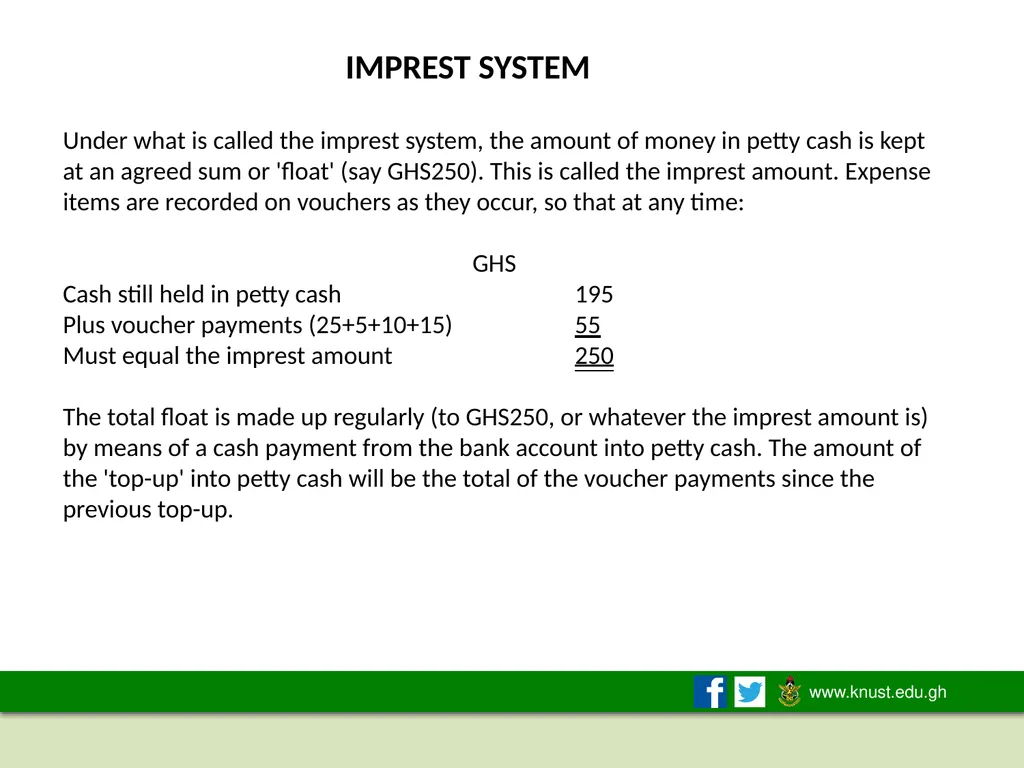
Under what is called the imprest system, the amount of money in petty cash is kept at an agreed sum or 'float' (say GHS250). This is called the imprest amount. Expense items are recorded on vouchers as they occur, so that at any time:
GHS
Cash still held in petty cash 195
Plus voucher payments (25+5+10+15) 55
Must equal the imprest amount 250
The total float is made up regularly (to GHS250, or whatever the imprest amount is) by means of a cash payment from the bank account into petty cash. The amount of the 'top-up' into petty cash will be the total of the voucher payments since the previous top-up. IMPREST SYSTEM<br>
GHS
Cash still held in petty cash 195
Plus voucher payments (25+5+10+15) 55
Must equal the imprest amount 250
The total float is made up regularly (to GHS250, or whatever the imprest amount is) by means of a cash payment from the bank account into petty cash. The amount of the 'top-up' into petty cash will be the total of the voucher payments since the previous top-up. IMPREST SYSTEM<br>
20
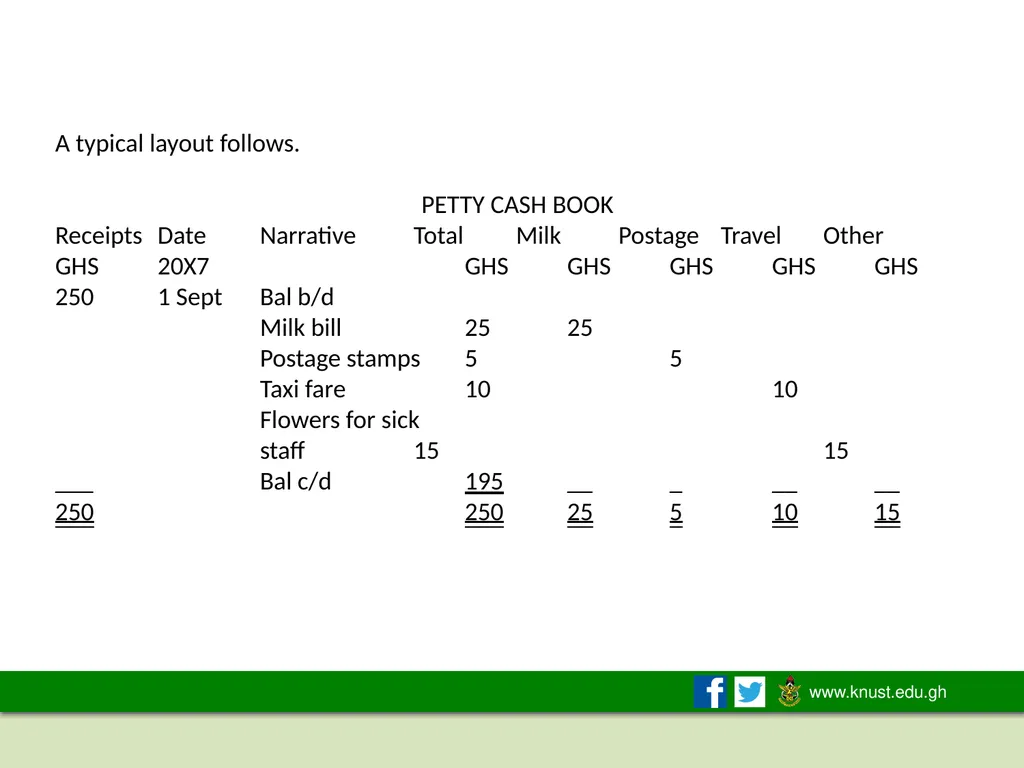
A typical layout follows.
PETTY CASH BOOK
Receipts Date Narrative Total Milk Postage Travel Other
GHS 20X7 GHS GHS GHS GHS GHS
250 1 Sept Bal b/d
Milk bill 25 25
Postage stamps 5 5
Taxi fare 10 10
Flowers for sick
staff 15 15
___ Bal c/d 195 __ _ __ __
250 250 25 5 10 15<br>
PETTY CASH BOOK
Receipts Date Narrative Total Milk Postage Travel Other
GHS 20X7 GHS GHS GHS GHS GHS
250 1 Sept Bal b/d
Milk bill 25 25
Postage stamps 5 5
Taxi fare 10 10
Flowers for sick
staff 15 15
___ Bal c/d 195 __ _ __ __
250 250 25 5 10 15<br>
21
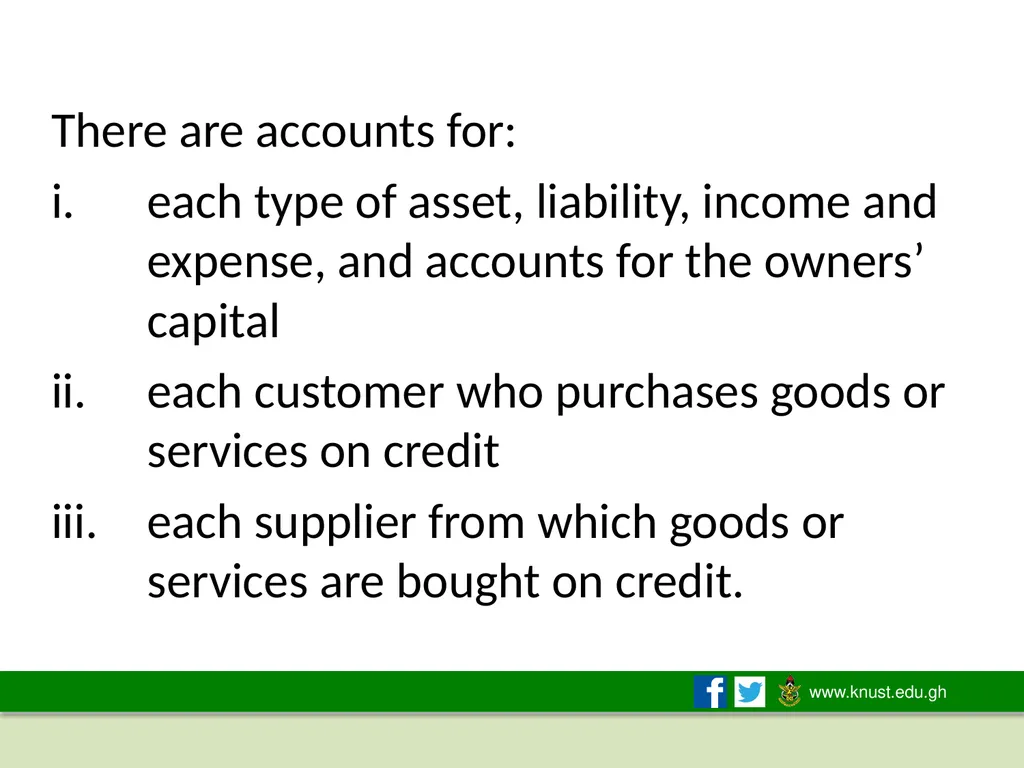
Accounts and ledgers There are accounts for:
each type of asset, liability, income and expense, and accounts for the owners’ capital
each customer who purchases goods or services on credit
each supplier from which goods or services are bought on credit.<br>
each type of asset, liability, income and expense, and accounts for the owners’ capital
each customer who purchases goods or services on credit
each supplier from which goods or services are bought on credit.<br>
22
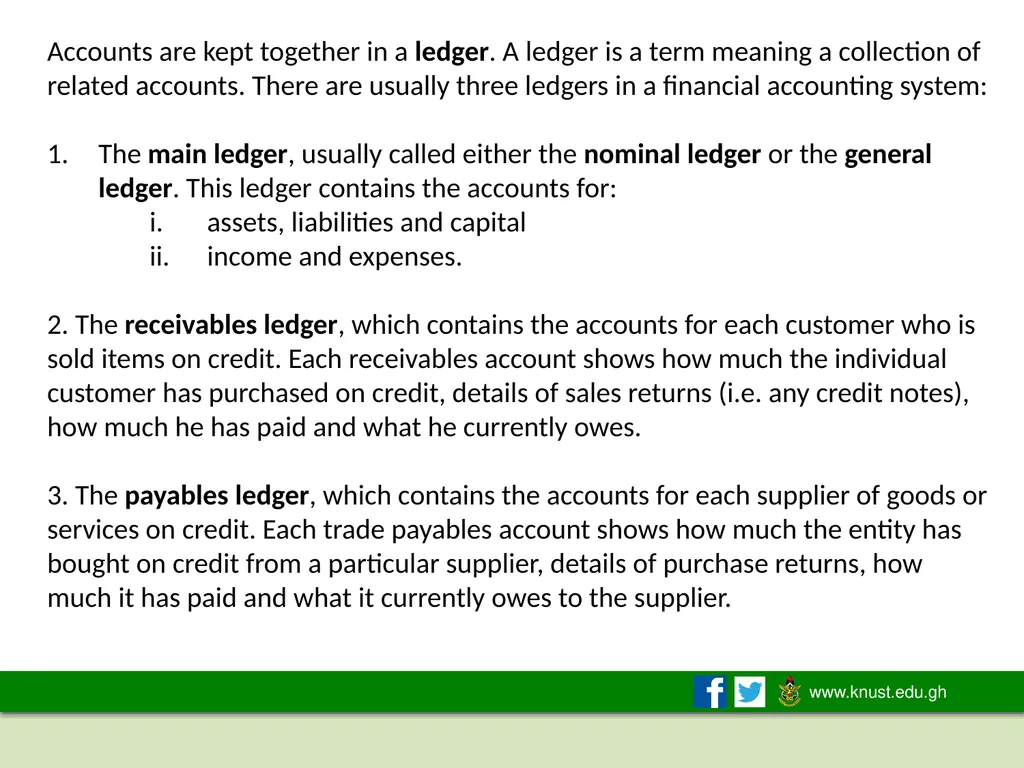
Accounts are kept together in a ledger. A ledger is a term meaning a collection of related accounts. There are usually three ledgers in a financial accounting system:
The main ledger, usually called either the nominal ledger or the general ledger. This ledger contains the accounts for:
assets, liabilities and capital
income and expenses.
2. The receivables ledger, which contains the accounts for each customer who is sold items on credit. Each receivables account shows how much the individual customer has purchased on credit, details of sales returns (i.e. any credit notes), how much he has paid and what he currently owes.
3. The payables ledger, which contains the accounts for each supplier of goods or services on credit. Each trade payables account shows how much the entity has bought on credit from a particular supplier, details of purchase returns, how much it has paid and what it currently owes to the supplier.<br>
The main ledger, usually called either the nominal ledger or the general ledger. This ledger contains the accounts for:
assets, liabilities and capital
income and expenses.
2. The receivables ledger, which contains the accounts for each customer who is sold items on credit. Each receivables account shows how much the individual customer has purchased on credit, details of sales returns (i.e. any credit notes), how much he has paid and what he currently owes.
3. The payables ledger, which contains the accounts for each supplier of goods or services on credit. Each trade payables account shows how much the entity has bought on credit from a particular supplier, details of purchase returns, how much it has paid and what it currently owes to the supplier.<br>
23
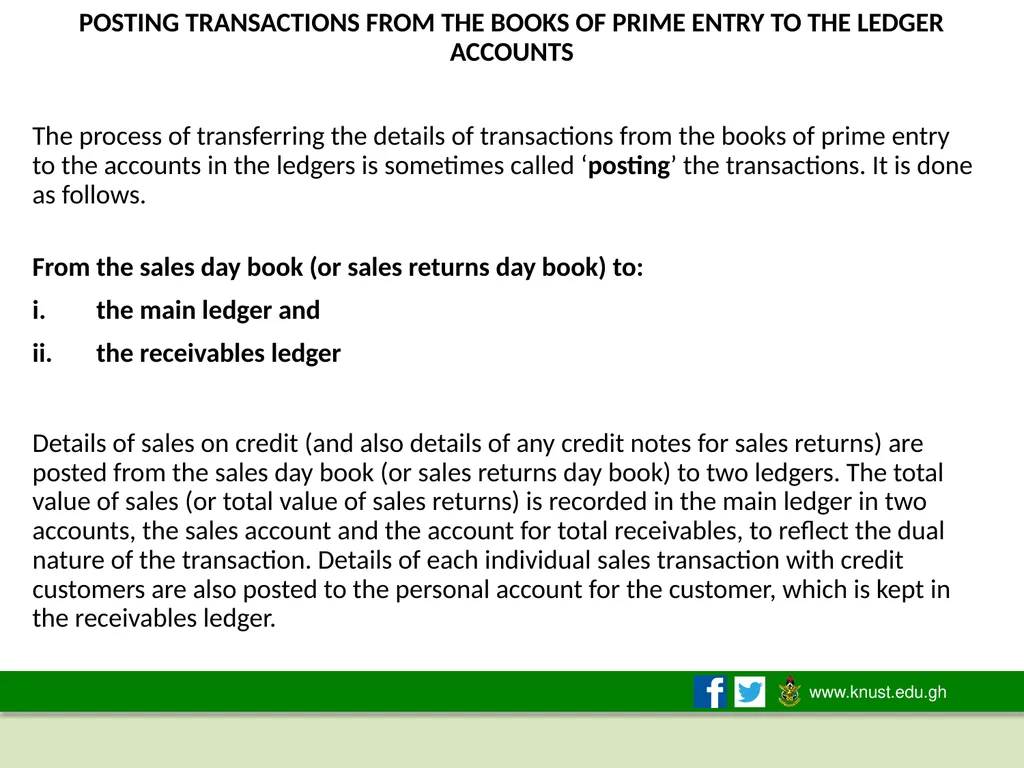
POSTING TRANSACTIONS FROM THE BOOKS OF PRIME ENTRY TO THE LEDGER ACCOUNTS The process of transferring the details of transactions from the books of prime entry to the accounts in the ledgers is sometimes called ‘posting’ the transactions. It is done as follows.
From the sales day book (or sales returns day book) to:
the main ledger and
the receivables ledger
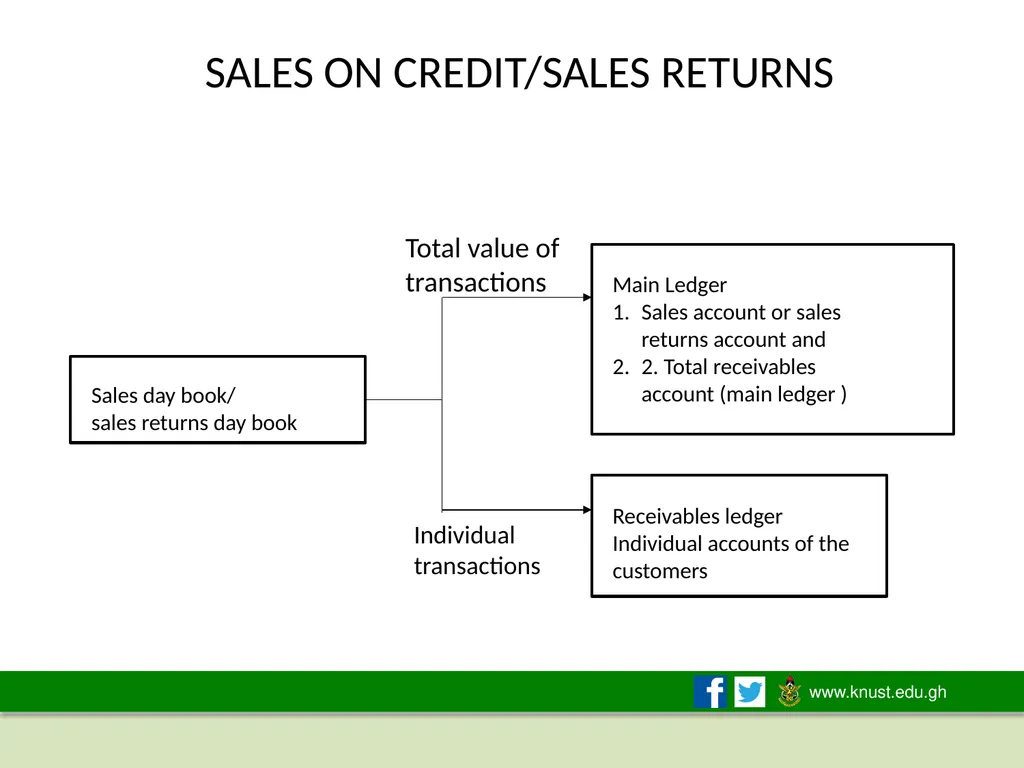
Details of sales on credit (and also details of any credit notes for sales returns) are posted from the sales day book (or sales returns day book) to two ledgers. The total value of sales (or total value of sales returns) is recorded in the main ledger in two accounts, the sales account and the account for total receivables, to reflect the dual nature of the transaction. Details of each individual sales transaction with credit customers are also posted to the personal account for the customer, which is kept in the receivables ledger.<br>
From the sales day book (or sales returns day book) to:
the main ledger and
the receivables ledger
Details of sales on credit (and also details of any credit notes for sales returns) are posted from the sales day book (or sales returns day book) to two ledgers. The total value of sales (or total value of sales returns) is recorded in the main ledger in two accounts, the sales account and the account for total receivables, to reflect the dual nature of the transaction. Details of each individual sales transaction with credit customers are also posted to the personal account for the customer, which is kept in the receivables ledger.<br>
24
Sales day book/
sales returns day book Main Ledger
Sales account or sales returns account and
2. Total receivables account (main ledger ) Receivables ledger
Individual accounts of the customers Total value of transactions Individual transactions SALES ON CREDIT/SALES RETURNS<br>
sales returns day book Main Ledger
Sales account or sales returns account and
2. Total receivables account (main ledger ) Receivables ledger
Individual accounts of the customers Total value of transactions Individual transactions SALES ON CREDIT/SALES RETURNS<br>
25
Suppose that a sales day book contains the following three transactions that have not yet been posted to the ledger accounts.
If these transactions are posted to the ledgers:
Sales of $750 will be recorded in the main ledger, both as $750 of sales and $750 of money now owed by customers (trade receivables).
In the receivables ledger, sales on credit of $250 will be recorded in the individual account for Entity Green, sales of $100 in the account for P Rose and sales of $400 in the account for Yellow Company. EXAMPLE<br>
If these transactions are posted to the ledgers:
Sales of $750 will be recorded in the main ledger, both as $750 of sales and $750 of money now owed by customers (trade receivables).
In the receivables ledger, sales on credit of $250 will be recorded in the individual account for Entity Green, sales of $100 in the account for P Rose and sales of $400 in the account for Yellow Company. EXAMPLE<br>
26
From the purchases day book (or purchase returns day book) to
the main ledger and
the payables ledger
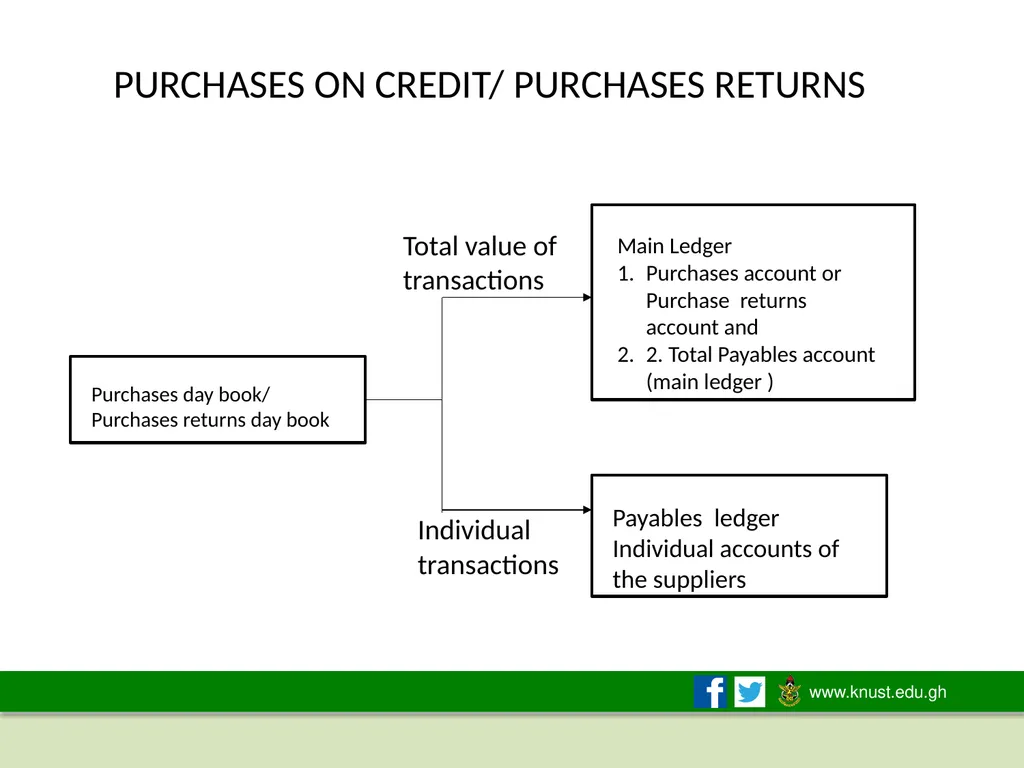
Details of purchases of goods on credit (and also details of any credit notes from suppliers for purchase returns) are posted from the purchases day book (or purchase returns day book) to two ledgers.
The total value of purchases (or total value of purchase returns) is recorded in the main ledger in two accounts, the purchases account and the account for total trade payables, to reflect the dual nature of the transaction.
Details of each individual purchase transaction with suppliers are also posted to the personal account for the supplier, which is kept in the payables ledger.<br>
the main ledger and
the payables ledger
Details of purchases of goods on credit (and also details of any credit notes from suppliers for purchase returns) are posted from the purchases day book (or purchase returns day book) to two ledgers.
The total value of purchases (or total value of purchase returns) is recorded in the main ledger in two accounts, the purchases account and the account for total trade payables, to reflect the dual nature of the transaction.
Details of each individual purchase transaction with suppliers are also posted to the personal account for the supplier, which is kept in the payables ledger.<br>
27
Purchases day book/
Purchases returns day book Main Ledger
Purchases account or Purchase returns account and
2. Total Payables account (main ledger ) Payables ledger
Individual accounts of the suppliers Total value of transactions Individual transactions PURCHASES ON CREDIT/ PURCHASES RETURNS<br>
Purchases returns day book Main Ledger
Purchases account or Purchase returns account and
2. Total Payables account (main ledger ) Payables ledger
Individual accounts of the suppliers Total value of transactions Individual transactions PURCHASES ON CREDIT/ PURCHASES RETURNS<br>
28
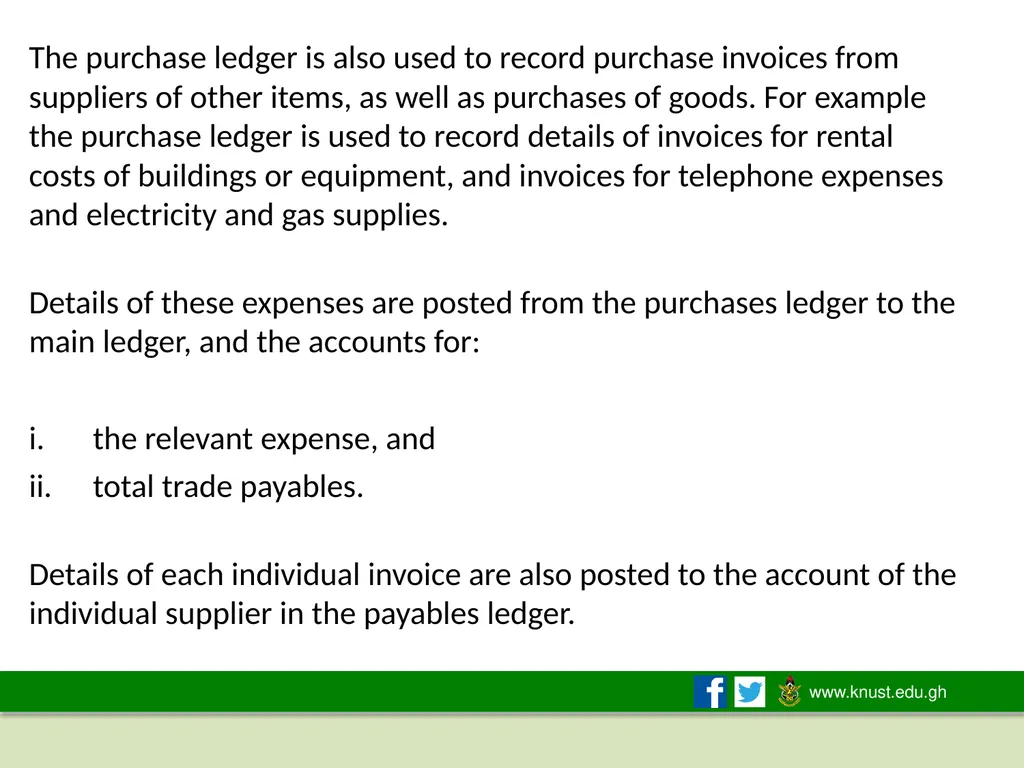
The purchase ledger is also used to record purchase invoices from suppliers of other items, as well as purchases of goods. For example the purchase ledger is used to record details of invoices for rental costs of buildings or equipment, and invoices for telephone expenses and electricity and gas supplies.
Details of these expenses are posted from the purchases ledger to the main ledger, and the accounts for:
the relevant expense, and
total trade payables.
Details of each individual invoice are also posted to the account of the individual supplier in the payables ledger.<br>
Details of these expenses are posted from the purchases ledger to the main ledger, and the accounts for:
the relevant expense, and
total trade payables.
Details of each individual invoice are also posted to the account of the individual supplier in the payables ledger.<br>
29
From the cash book to
the main ledger and
the receivables or payables ledger
The cash book in a manual accounting system is often used as both a book of prime entry and as an account in the main ledger. However it might be convenient to think of the cash book as a book of prime entry and a different account, the bank account, as an account in the main ledger.
The cash book has two sides, a side for receipts of money and a side for payments.
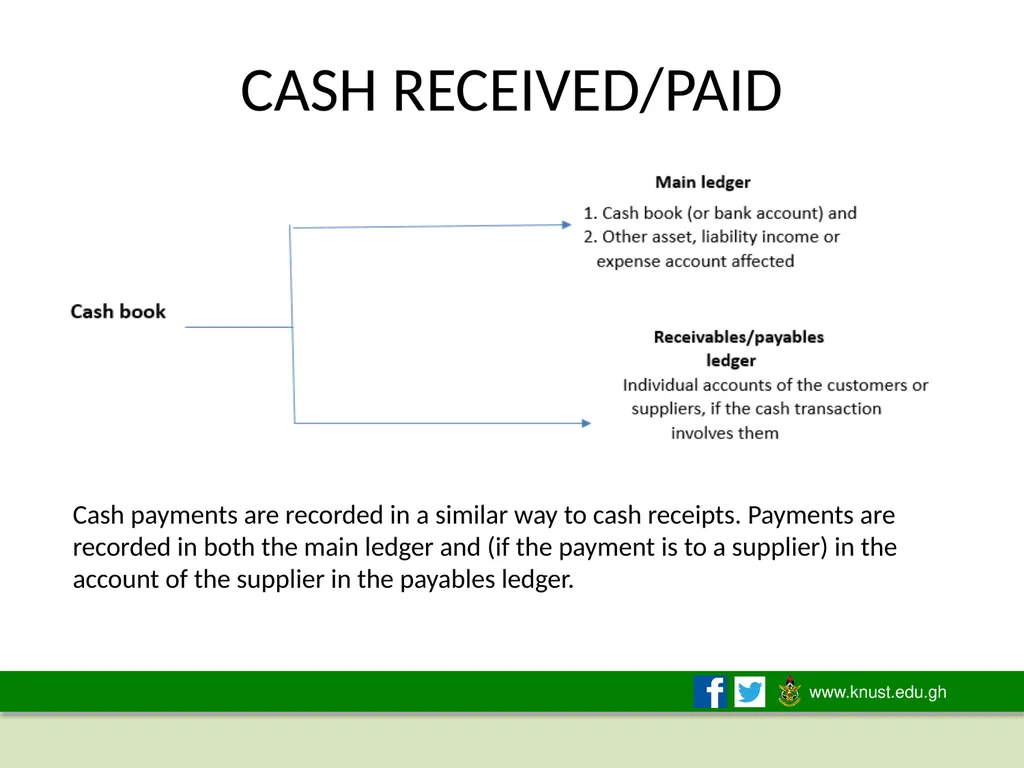
Details of cash received are posted to the main ledger, where the dual nature of the transaction is recorded. For example money received from a credit customer is recorded as an addition to money in the bank and a reduction in trade payables. Money received for a cash sale is recorded as an addition to money in the bank and an increase in total revenue from cash sales. If the cash is received from a credit customer, the details of the money received are also recorded in the customer’s personal account in the receivables ledger.<br>
the main ledger and
the receivables or payables ledger
The cash book in a manual accounting system is often used as both a book of prime entry and as an account in the main ledger. However it might be convenient to think of the cash book as a book of prime entry and a different account, the bank account, as an account in the main ledger.
The cash book has two sides, a side for receipts of money and a side for payments.
Details of cash received are posted to the main ledger, where the dual nature of the transaction is recorded. For example money received from a credit customer is recorded as an addition to money in the bank and a reduction in trade payables. Money received for a cash sale is recorded as an addition to money in the bank and an increase in total revenue from cash sales. If the cash is received from a credit customer, the details of the money received are also recorded in the customer’s personal account in the receivables ledger.<br>
30
CASH RECEIVED/PAID Cash payments are recorded in a similar way to cash receipts. Payments are
recorded in both the main ledger and (if the payment is to a supplier) in the account of the supplier in the payables ledger.<br>
31
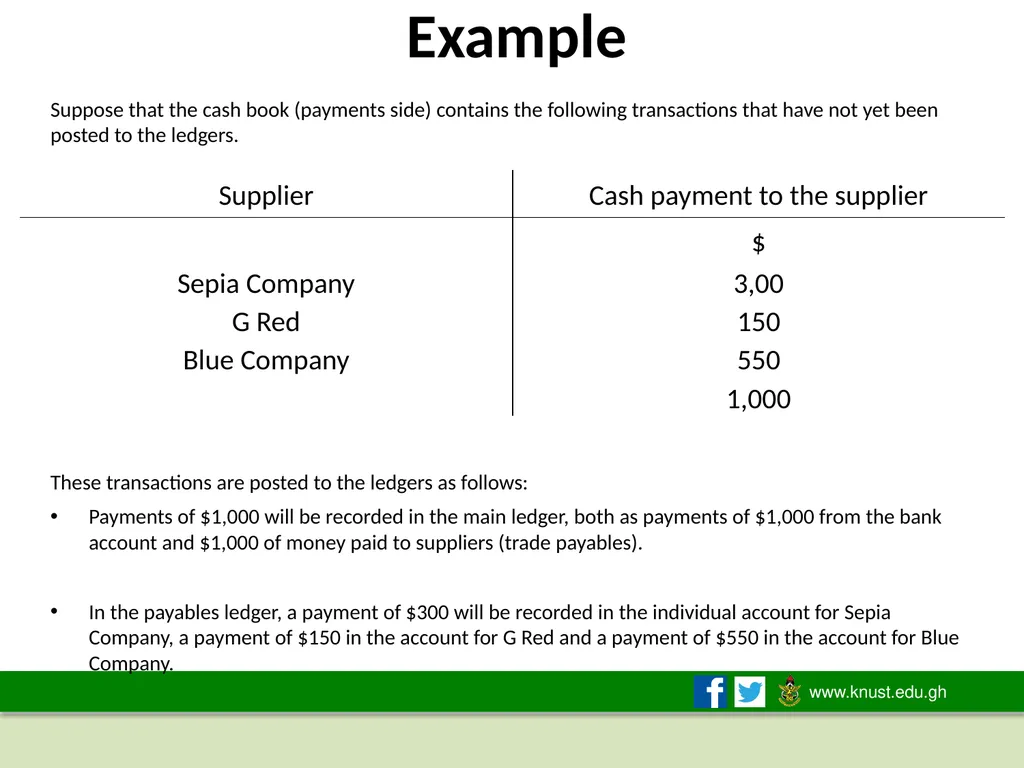
Example Suppose that the cash book (payments side) contains the following transactions that have not yet been posted to the ledgers.
These transactions are posted to the ledgers as follows:
Payments of $1,000 will be recorded in the main ledger, both as payments of $1,000 from the bank account and $1,000 of money paid to suppliers (trade payables).
In the payables ledger, a payment of $300 will be recorded in the individual account for Sepia Company, a payment of $150 in the account for G Red and a payment of $550 in the account for Blue Company.<br>
These transactions are posted to the ledgers as follows:
Payments of $1,000 will be recorded in the main ledger, both as payments of $1,000 from the bank account and $1,000 of money paid to suppliers (trade payables).
In the payables ledger, a payment of $300 will be recorded in the individual account for Sepia Company, a payment of $150 in the account for G Red and a payment of $550 in the account for Blue Company.<br>
32
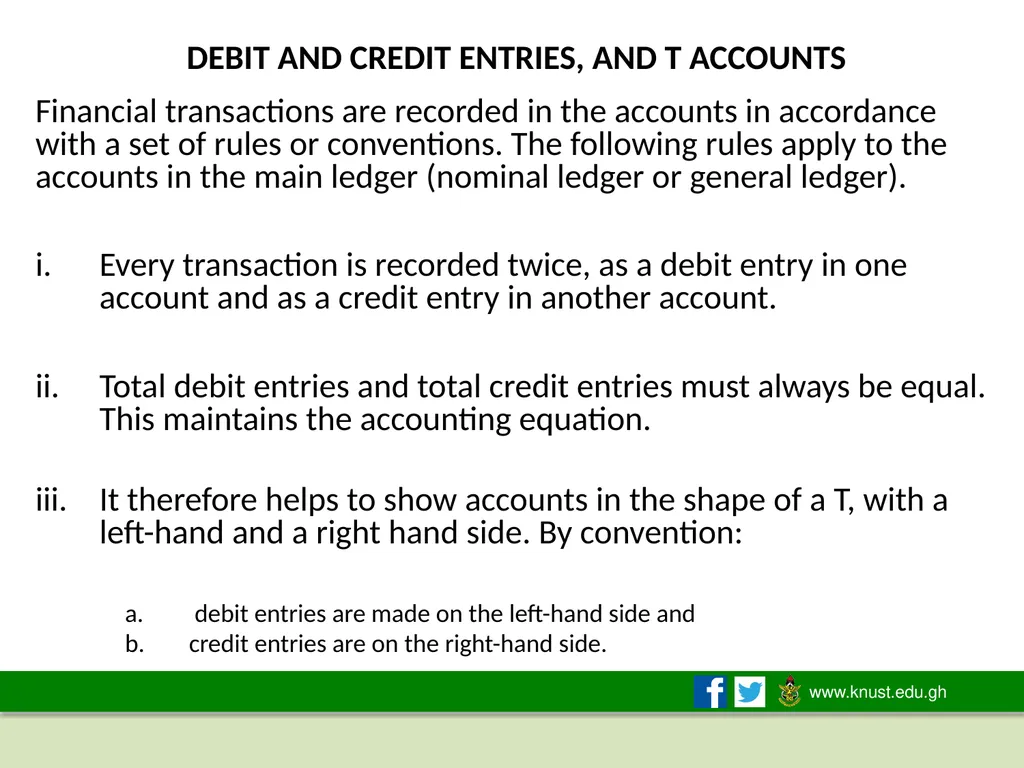
Financial transactions are recorded in the accounts in accordance with a set of rules or conventions. The following rules apply to the accounts in the main ledger (nominal ledger or general ledger).
Every transaction is recorded twice, as a debit entry in one account and as a credit entry in another account.
Total debit entries and total credit entries must always be equal. This maintains the accounting equation.
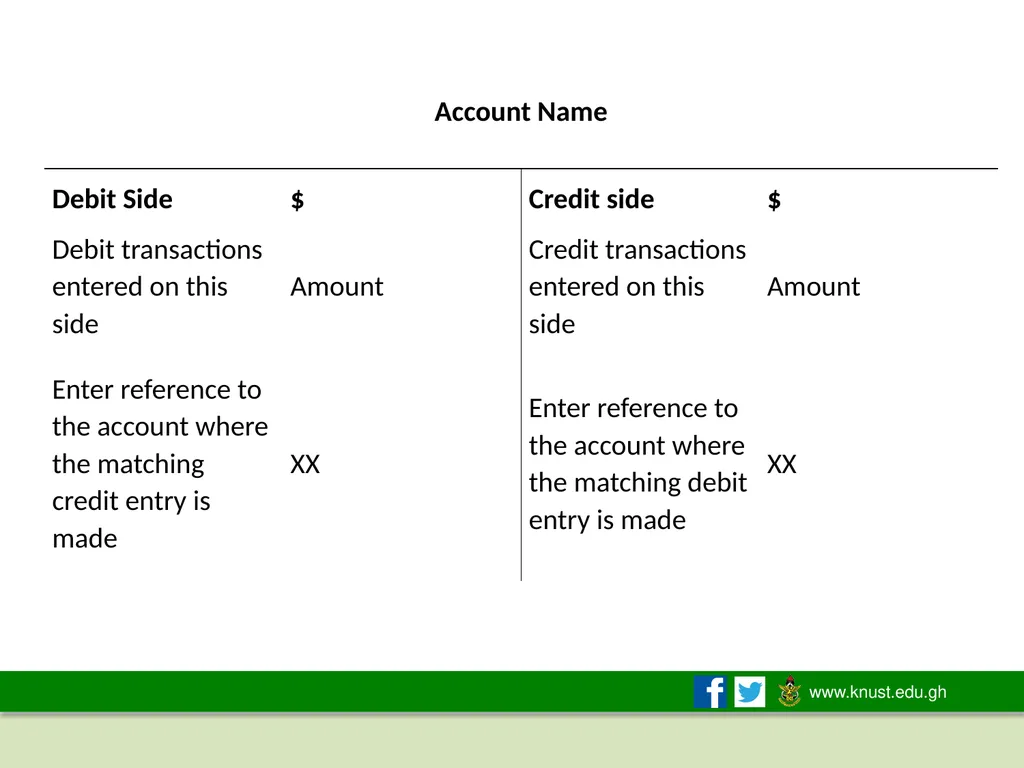
It therefore helps to show accounts in the shape of a T, with a left-hand and a right hand side. By convention:
debit entries are made on the left-hand side and
credit entries are on the right-hand side. DEBIT AND CREDIT ENTRIES, AND T ACCOUNTS<br>
Every transaction is recorded twice, as a debit entry in one account and as a credit entry in another account.
Total debit entries and total credit entries must always be equal. This maintains the accounting equation.
It therefore helps to show accounts in the shape of a T, with a left-hand and a right hand side. By convention:
debit entries are made on the left-hand side and
credit entries are on the right-hand side. DEBIT AND CREDIT ENTRIES, AND T ACCOUNTS<br>
33
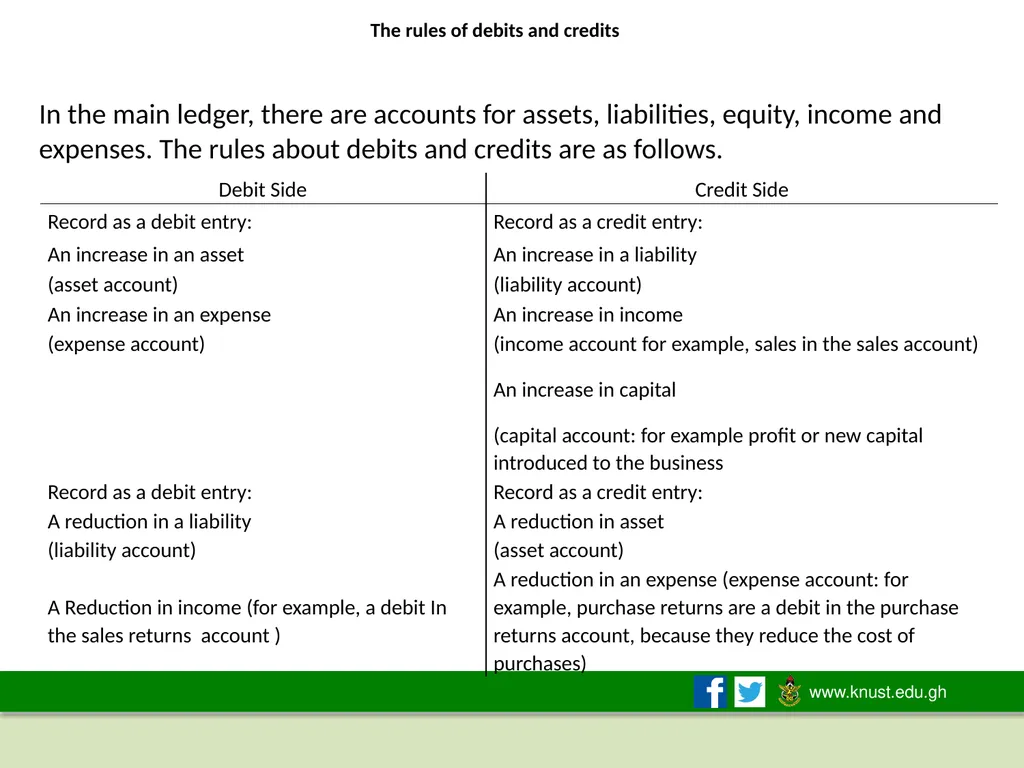
The rules of debits and credits In the main ledger, there are accounts for assets, liabilities, equity, income and
expenses. The rules about debits and credits are as follows.<br>
34
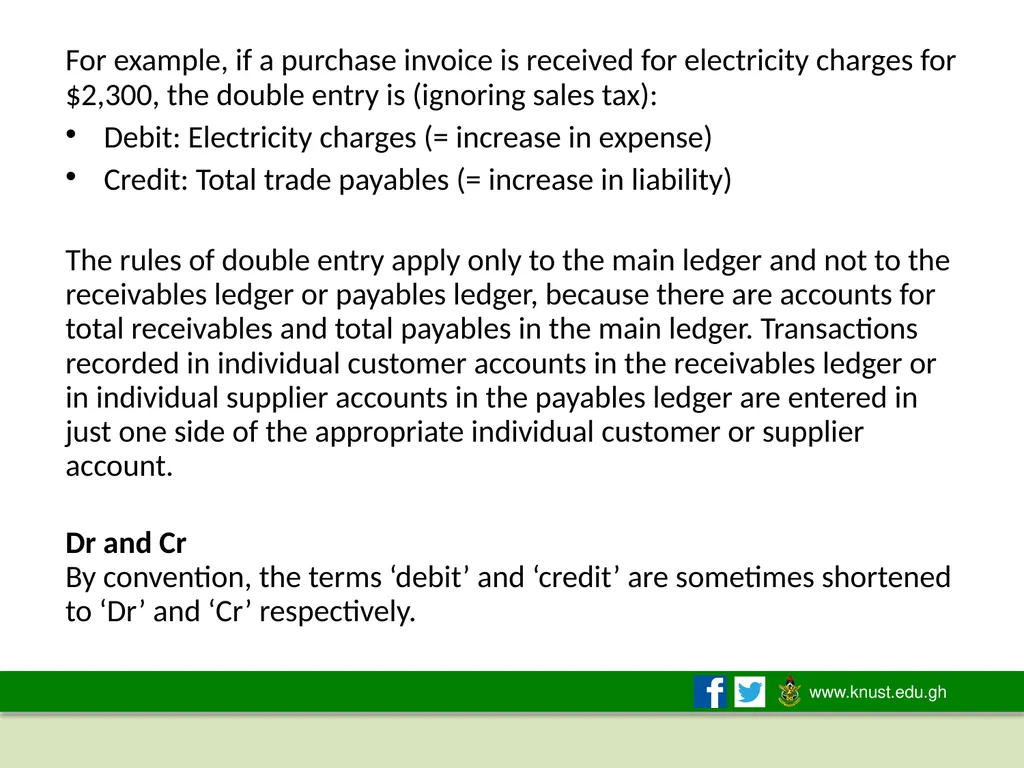
For example, if a purchase invoice is received for electricity charges for $2,300, the double entry is (ignoring sales tax):
Debit: Electricity charges (= increase in expense)
Credit: Total trade payables (= increase in liability)
The rules of double entry apply only to the main ledger and not to the receivables ledger or payables ledger, because there are accounts for total receivables and total payables in the main ledger. Transactions recorded in individual customer accounts in the receivables ledger or in individual supplier accounts in the payables ledger are entered in just one side of the appropriate individual customer or supplier account.
Dr and Cr By convention, the terms ‘debit’ and ‘credit’ are sometimes shortened to ‘Dr’ and ‘Cr’ respectively.<br>
Debit: Electricity charges (= increase in expense)
Credit: Total trade payables (= increase in liability)
The rules of double entry apply only to the main ledger and not to the receivables ledger or payables ledger, because there are accounts for total receivables and total payables in the main ledger. Transactions recorded in individual customer accounts in the receivables ledger or in individual supplier accounts in the payables ledger are entered in just one side of the appropriate individual customer or supplier account.
Dr and Cr By convention, the terms ‘debit’ and ‘credit’ are sometimes shortened to ‘Dr’ and ‘Cr’ respectively.<br>
35
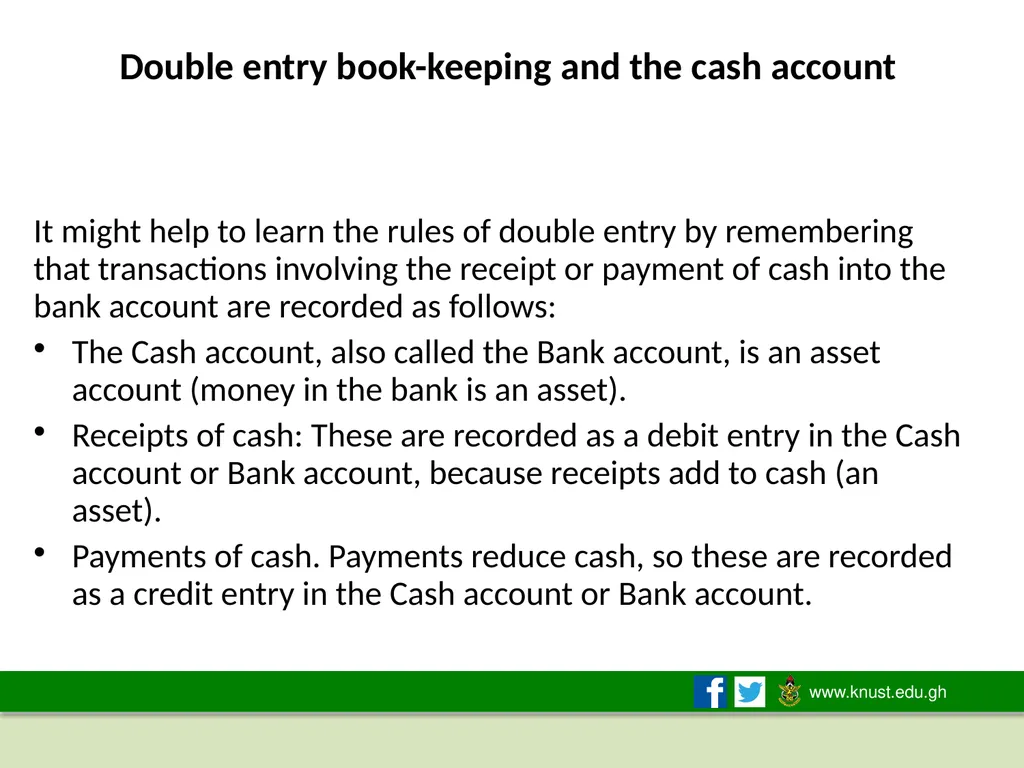
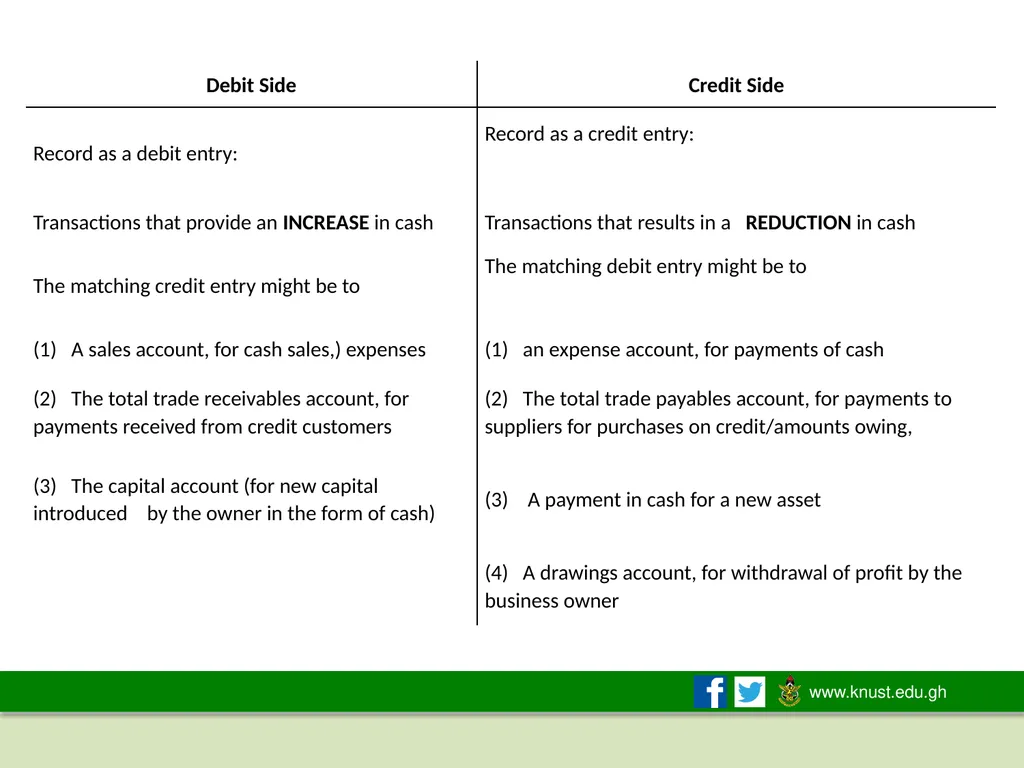
Double entry book-keeping and the cash account It might help to learn the rules of double entry by remembering that transactions involving the receipt or payment of cash into the bank account are recorded as follows:
The Cash account, also called the Bank account, is an asset account (money in the bank is an asset).
Receipts of cash: These are recorded as a debit entry in the Cash account or Bank account, because receipts add to cash (an asset).
Payments of cash. Payments reduce cash, so these are recorded as a credit entry in the Cash account or Bank account.<br>
The Cash account, also called the Bank account, is an asset account (money in the bank is an asset).
Receipts of cash: These are recorded as a debit entry in the Cash account or Bank account, because receipts add to cash (an asset).
Payments of cash. Payments reduce cash, so these are recorded as a credit entry in the Cash account or Bank account.<br>
36
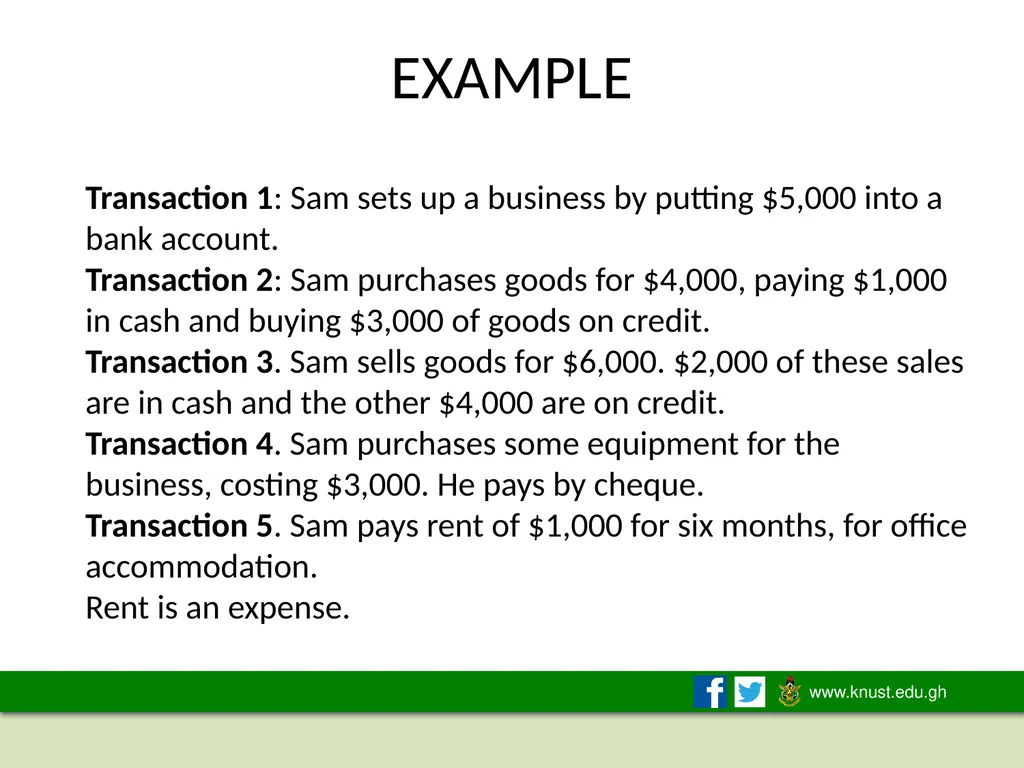
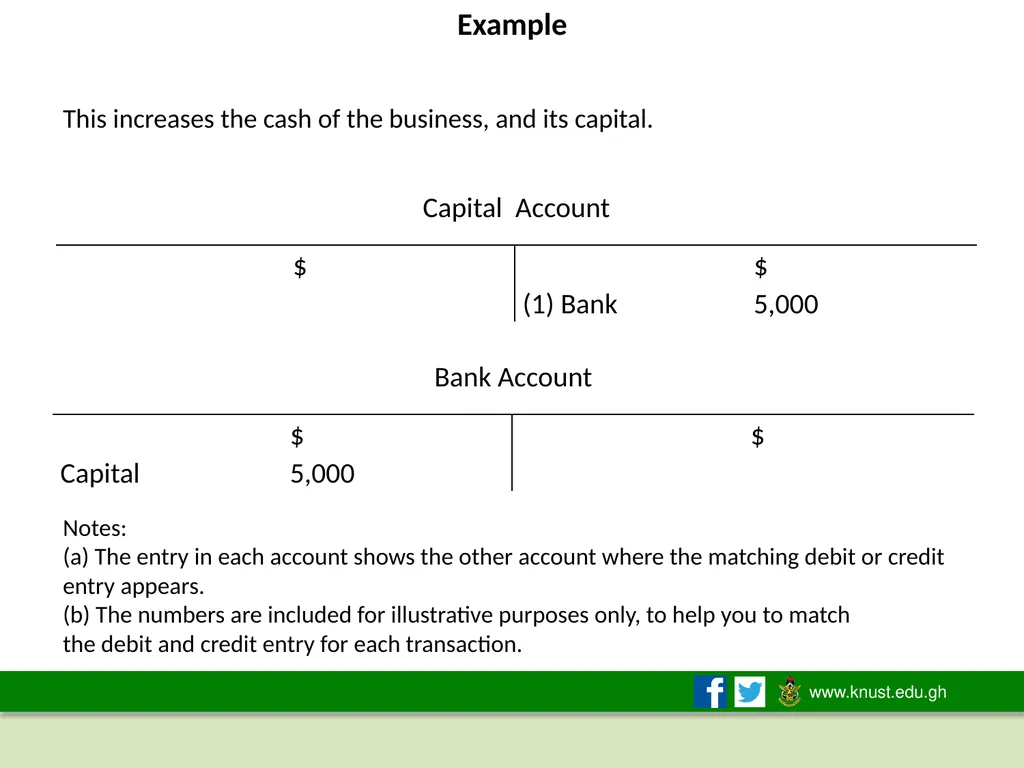
EXAMPLE Transaction 1: Sam sets up a business by putting $5,000 into a bank account.
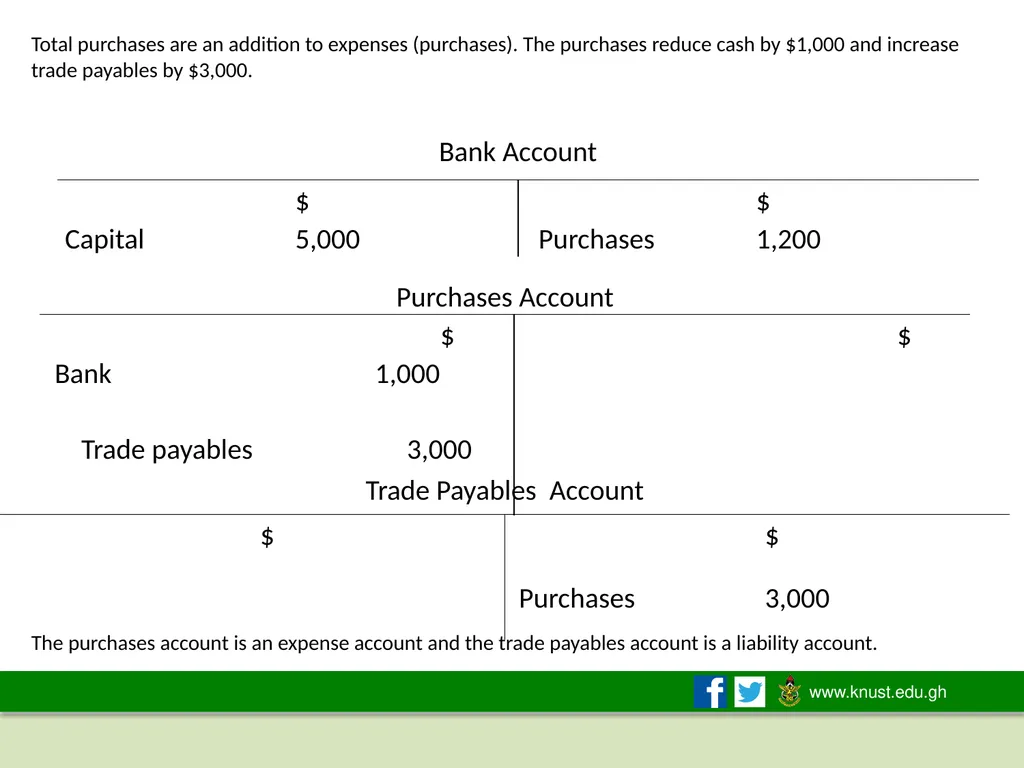
Transaction 2: Sam purchases goods for $4,000, paying $1,000 in cash and buying $3,000 of goods on credit.
Transaction 3. Sam sells goods for $6,000. $2,000 of these sales are in cash and the other $4,000 are on credit.
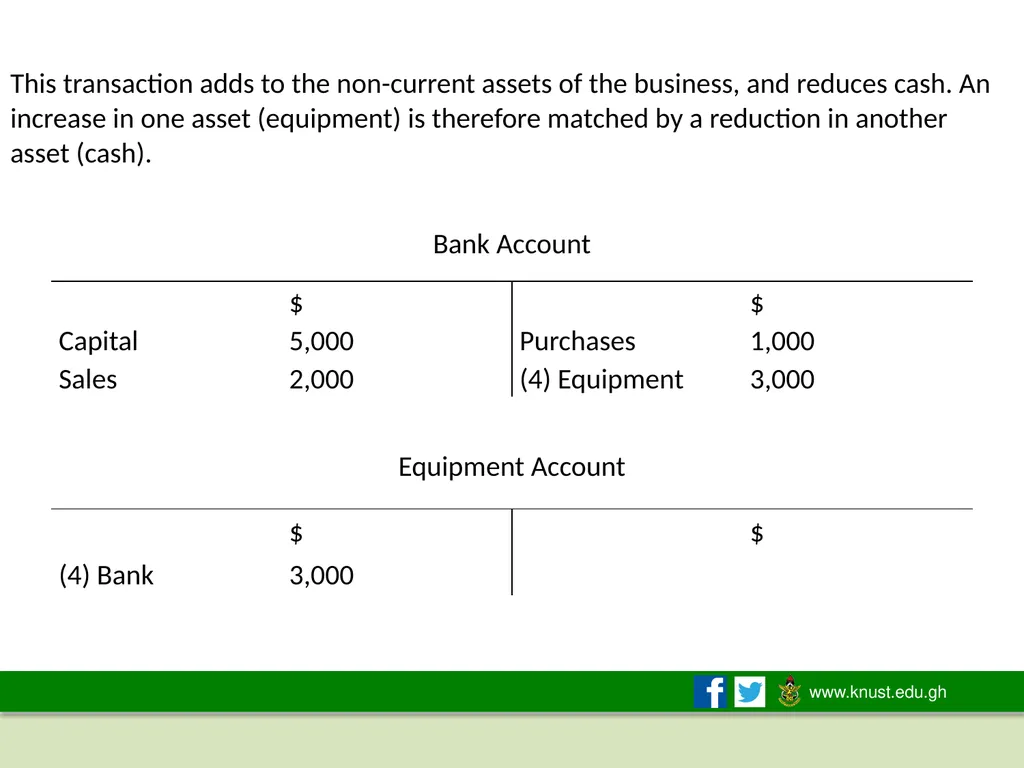
Transaction 4. Sam purchases some equipment for the business, costing $3,000. He pays by cheque.
Transaction 5. Sam pays rent of $1,000 for six months, for office accommodation. Rent is an expense.<br>
Transaction 3. Sam sells goods for $6,000. $2,000 of these sales are in cash and the other $4,000 are on credit.
Transaction 4. Sam purchases some equipment for the business, costing $3,000. He pays by cheque.
Transaction 5. Sam pays rent of $1,000 for six months, for office accommodation. Rent is an expense.<br>
37
Example This increases the cash of the business, and its capital.
Notes: (a) The entry in each account shows the other account where the matching debit or credit entry appears. (b) The numbers are included for illustrative purposes only, to help you to match the debit and credit entry for each transaction.<br>
Notes: (a) The entry in each account shows the other account where the matching debit or credit entry appears. (b) The numbers are included for illustrative purposes only, to help you to match the debit and credit entry for each transaction.<br>
38
Total purchases are an addition to expenses (purchases). The purchases reduce cash by $1,000 and increase trade payables by $3,000.
The purchases account is an expense account and the trade payables account is a liability account.<br>
The purchases account is an expense account and the trade payables account is a liability account.<br>
39
Total sales (income) are $6,000, and the sales result in an increase in total assets of $6,000, consisting of cash ($2,000) and trade receivables ($4,000).<br>
40
This transaction adds to the non-current assets of the business, and reduces cash. An increase in one asset (equipment) is therefore matched by a reduction in another asset (cash).<br>
41
The rental cost adds to expenses and reduces cash.<br>
42
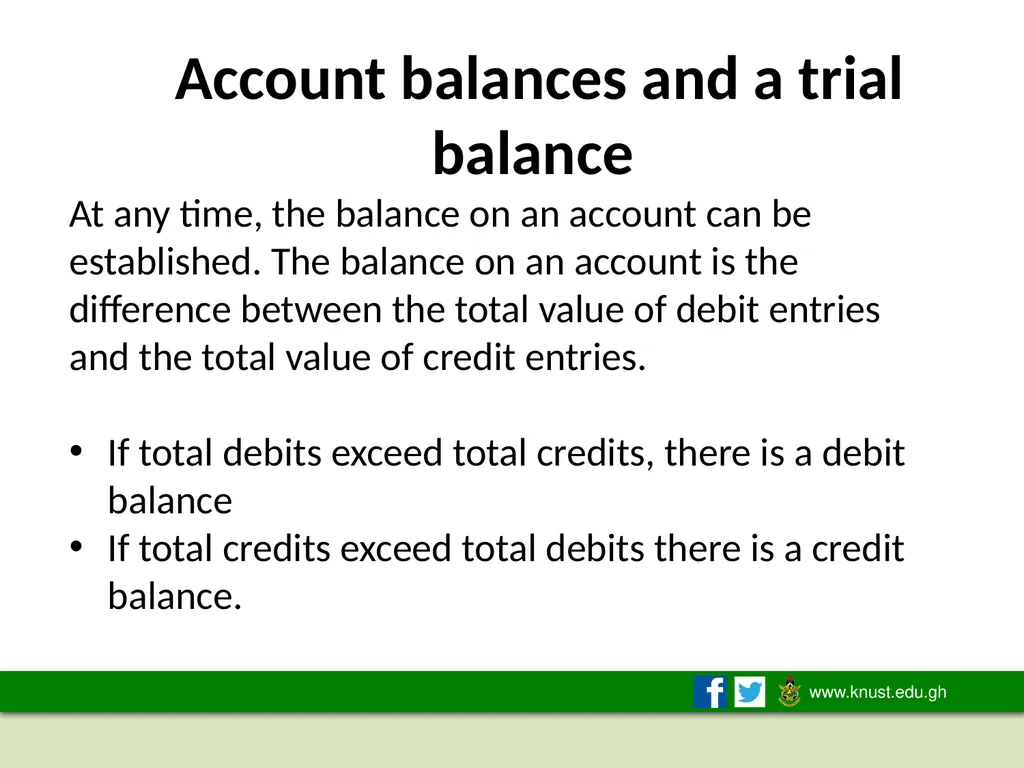
Account balances and a trial balance At any time, the balance on an account can be established. The balance on an account is the difference between the total value of debit entries and the total value of credit entries.
If total debits exceed total credits, there is a debit balance
If total credits exceed total debits there is a credit balance.<br>
If total debits exceed total credits, there is a debit balance
If total credits exceed total debits there is a credit balance.<br>
43
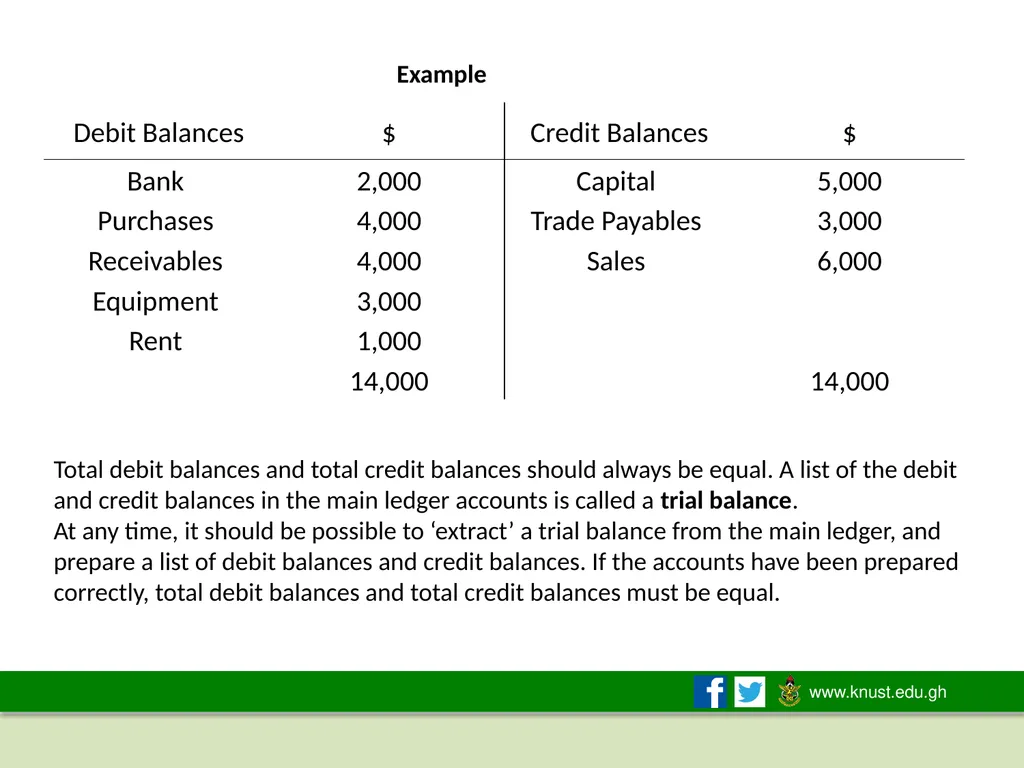
Example Total debit balances and total credit balances should always be equal. A list of the debit and credit balances in the main ledger accounts is called a trial balance.
At any time, it should be possible to ‘extract’ a trial balance from the main ledger, and prepare a list of debit balances and credit balances. If the accounts have been prepared correctly, total debit balances and total credit balances must be equal.<br>
At any time, it should be possible to ‘extract’ a trial balance from the main ledger, and prepare a list of debit balances and credit balances. If the accounts have been prepared correctly, total debit balances and total credit balances must be equal.<br>
44
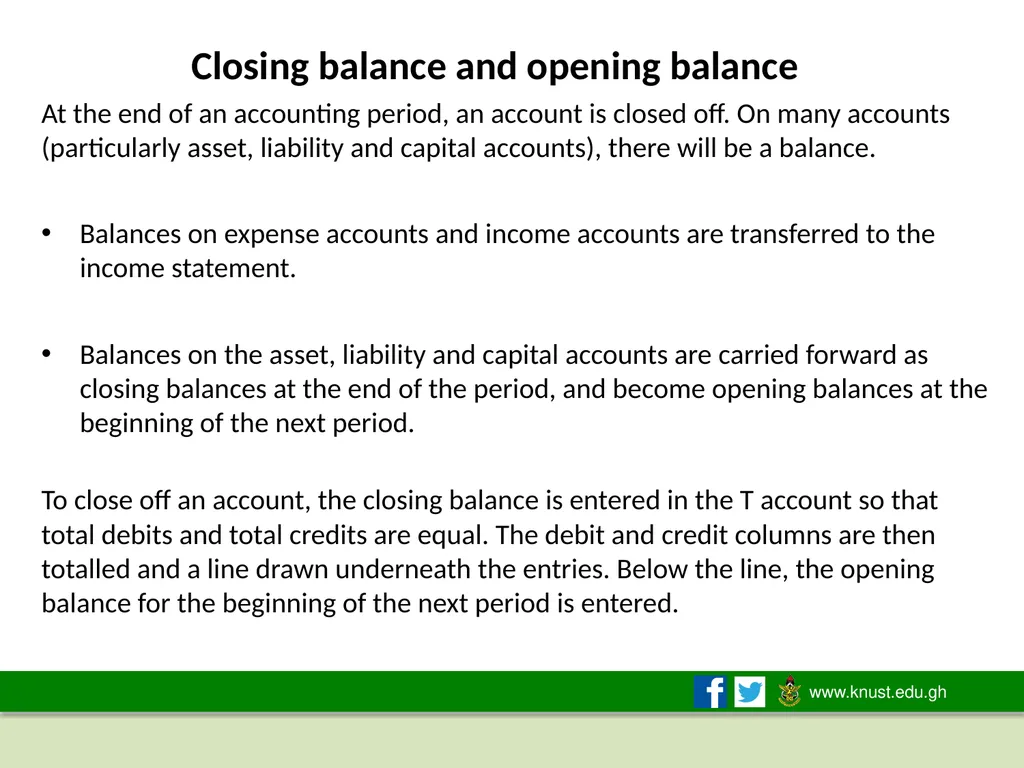
At the end of an accounting period, an account is closed off. On many accounts (particularly asset, liability and capital accounts), there will be a balance.
Balances on expense accounts and income accounts are transferred to the income statement.
Balances on the asset, liability and capital accounts are carried forward as closing balances at the end of the period, and become opening balances at the beginning of the next period.
To close off an account, the closing balance is entered in the T account so that total debits and total credits are equal. The debit and credit columns are then totalled and a line drawn underneath the entries. Below the line, the opening balance for the beginning of the next period is entered. Closing balance and opening balance<br>
Balances on expense accounts and income accounts are transferred to the income statement.
Balances on the asset, liability and capital accounts are carried forward as closing balances at the end of the period, and become opening balances at the beginning of the next period.
To close off an account, the closing balance is entered in the T account so that total debits and total credits are equal. The debit and credit columns are then totalled and a line drawn underneath the entries. Below the line, the opening balance for the beginning of the next period is entered. Closing balance and opening balance<br>
45
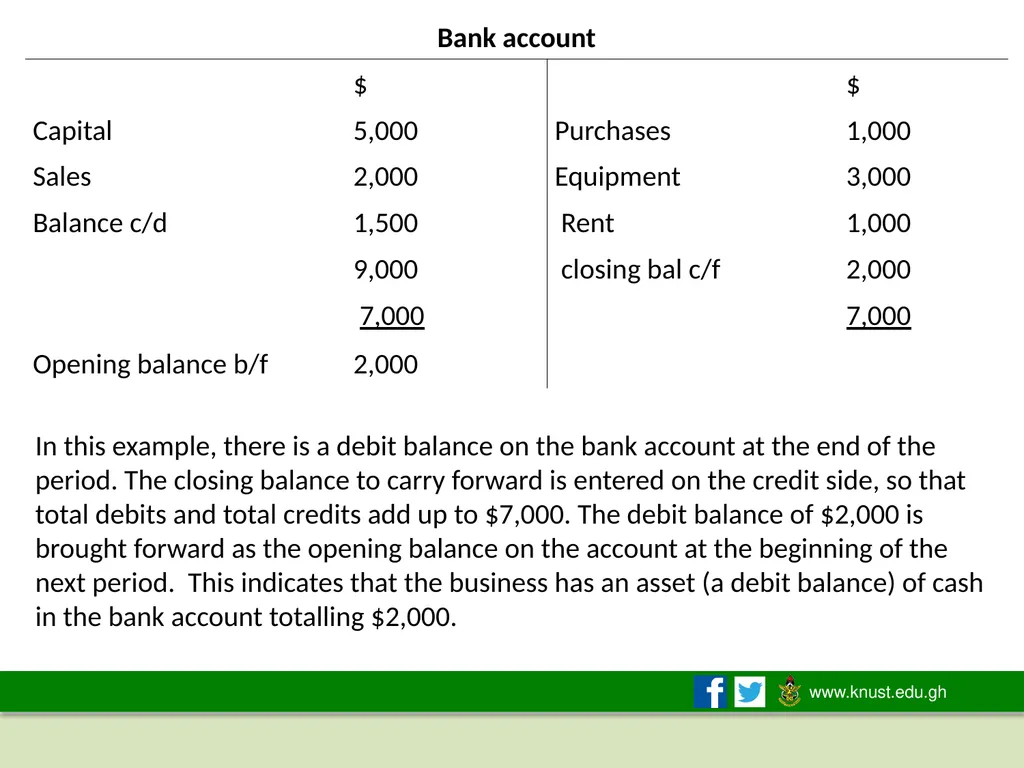
In this example, there is a debit balance on the bank account at the end of the period. The closing balance to carry forward is entered on the credit side, so that total debits and total credits add up to $7,000. The debit balance of $2,000 is brought forward as the opening balance on the account at the beginning of the next period. This indicates that the business has an asset (a debit balance) of cash in the bank account totalling $2,000.<br>
46
NOTE
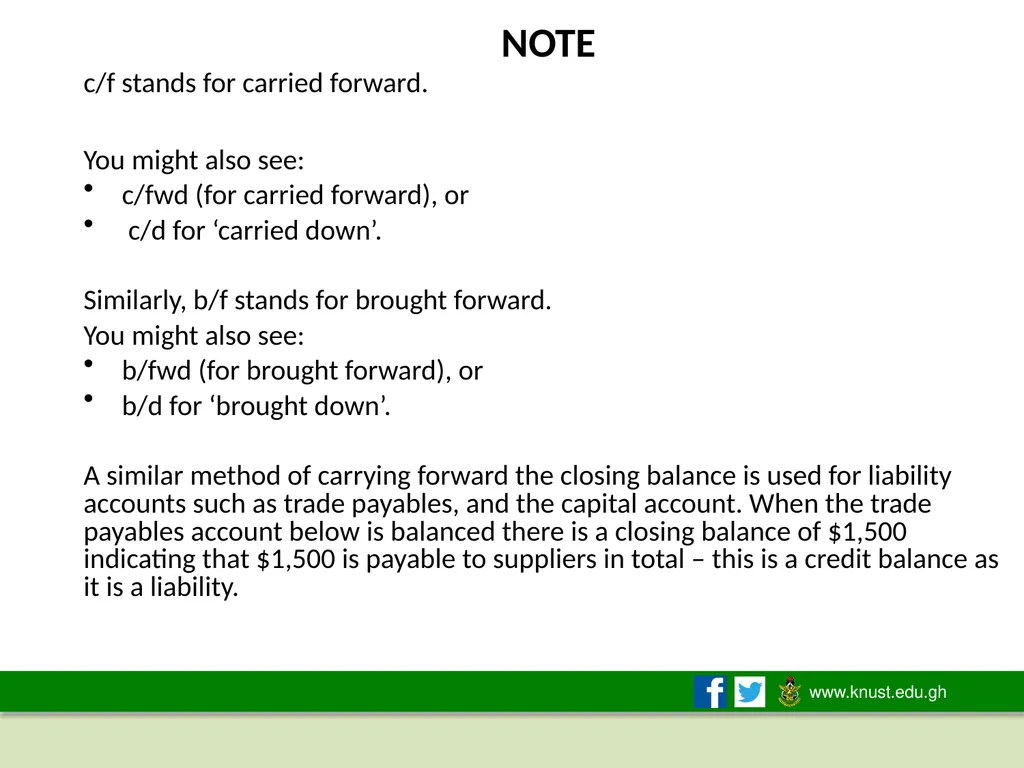
c/f stands for carried forward.
You might also see:
c/fwd (for carried forward), or
c/d for ‘carried down’.
Similarly, b/f stands for brought forward.
You might also see:
b/fwd (for brought forward), or
b/d for ‘brought down’.
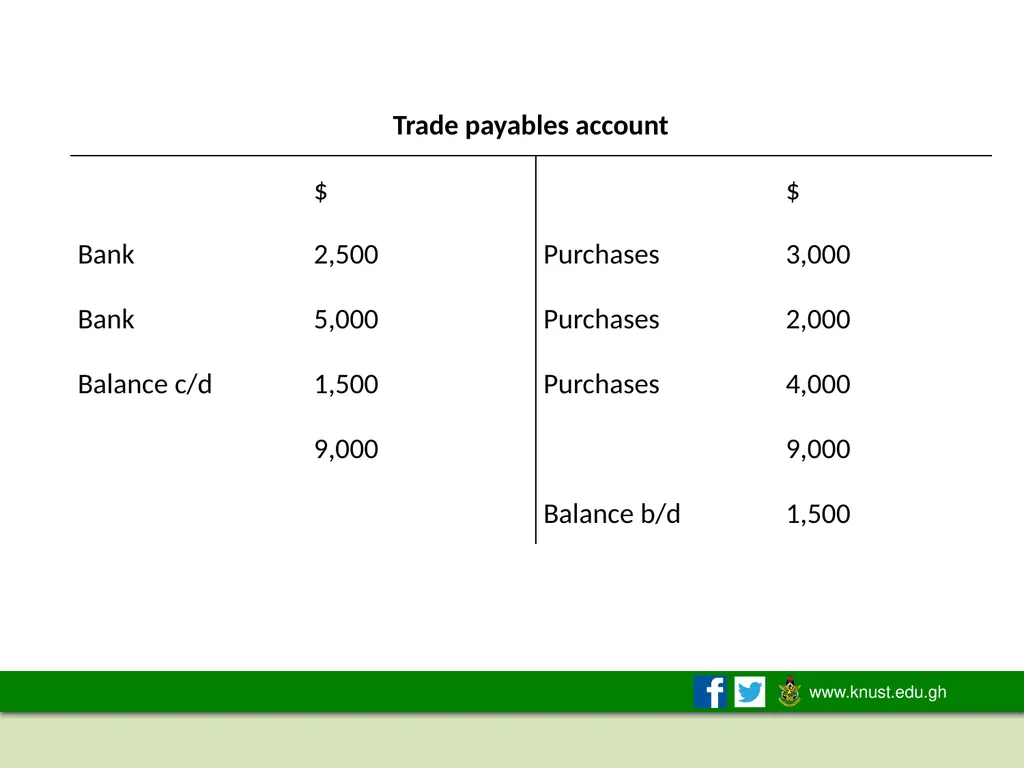
A similar method of carrying forward the closing balance is used for liability accounts such as trade payables, and the capital account. When the trade payables account below is balanced there is a closing balance of $1,500 indicating that $1,500 is payable to suppliers in total – this is a credit balance as it is a liability.<br>
c/f stands for carried forward.
You might also see:
c/fwd (for carried forward), or
c/d for ‘carried down’.
Similarly, b/f stands for brought forward.
You might also see:
b/fwd (for brought forward), or
b/d for ‘brought down’.
A similar method of carrying forward the closing balance is used for liability accounts such as trade payables, and the capital account. When the trade payables account below is balanced there is a closing balance of $1,500 indicating that $1,500 is payable to suppliers in total – this is a credit balance as it is a liability.<br>
47
END OF LECTURE
THANK YOU<br>