
The Adaptive Concept Map Jacob Moore CS 6604
LO
Published · 32 slides · 0 views
1 / 1

Description
The Adaptive Concept Map Jacob Moore CS 6604 42512 Motivation Textbooks are widely used in engineering education practice Textbooks are rarely studied in engineering education research (CS being an exception) With the rise of digital
Related Topics
Share
Embed code
Download this presentation From Below
"The Adaptive Concept Map Jacob Moore CS 6604" is the property of its rightful owner. Permission is granted to download and print the materials on this website for personal, non-commercial use only, and to display it on your personal computer provided you do not modify the materials and that you retain all copyright notices contained in the materials. By downloading content from our website, you accept the terms of this agreement.
Presentation Transcript
01
The Adaptive Concept Map Jacob Moore
CS 6604
4/25/12<br>
CS 6604
4/25/12<br>
02
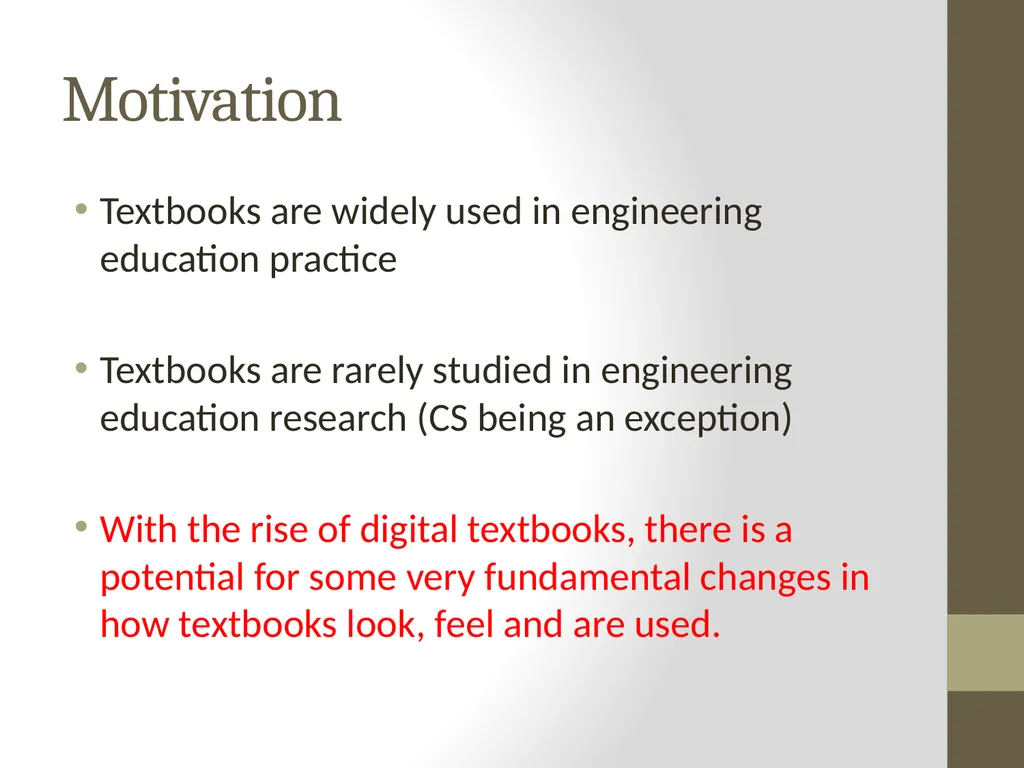
Motivation Textbooks are widely used in engineering education practice
Textbooks are rarely studied in engineering education research (CS being an exception)
With the rise of digital textbooks, there is a potential for some very fundamental changes in how textbooks look, feel and are used.<br>
Textbooks are rarely studied in engineering education research (CS being an exception)
With the rise of digital textbooks, there is a potential for some very fundamental changes in how textbooks look, feel and are used.<br>
03
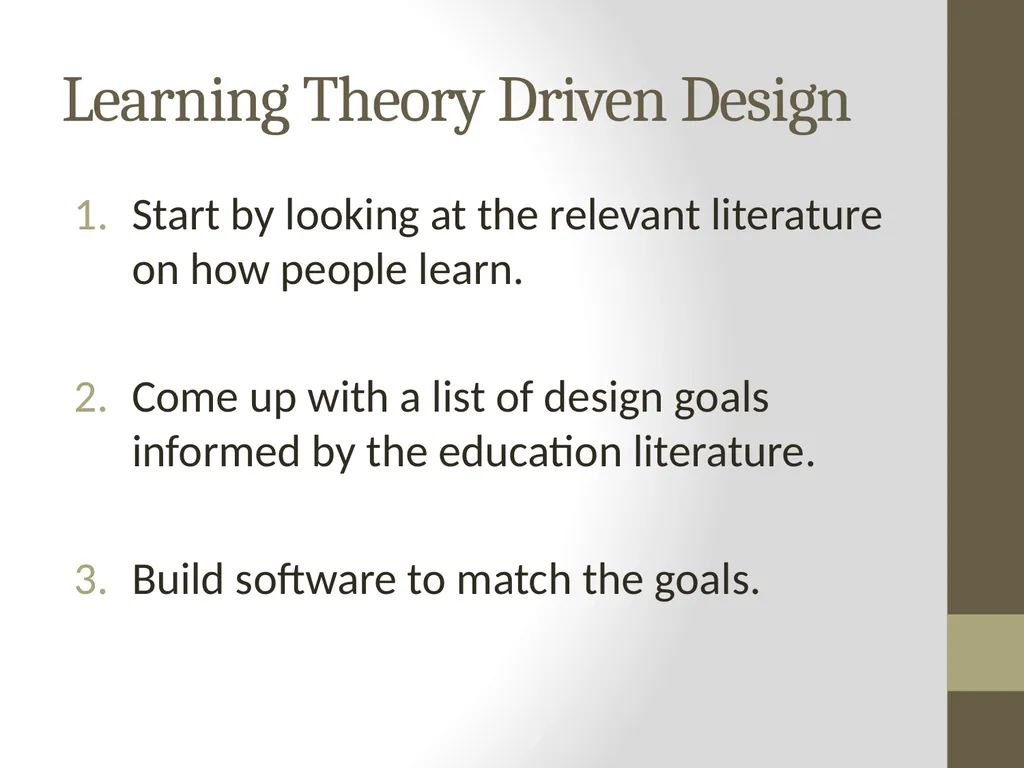
Learning Theory Driven Design Start by looking at the relevant literature on how people learn.
Come up with a list of design goals informed by the education literature.
Build software to match the goals.<br>
Come up with a list of design goals informed by the education literature.
Build software to match the goals.<br>
04
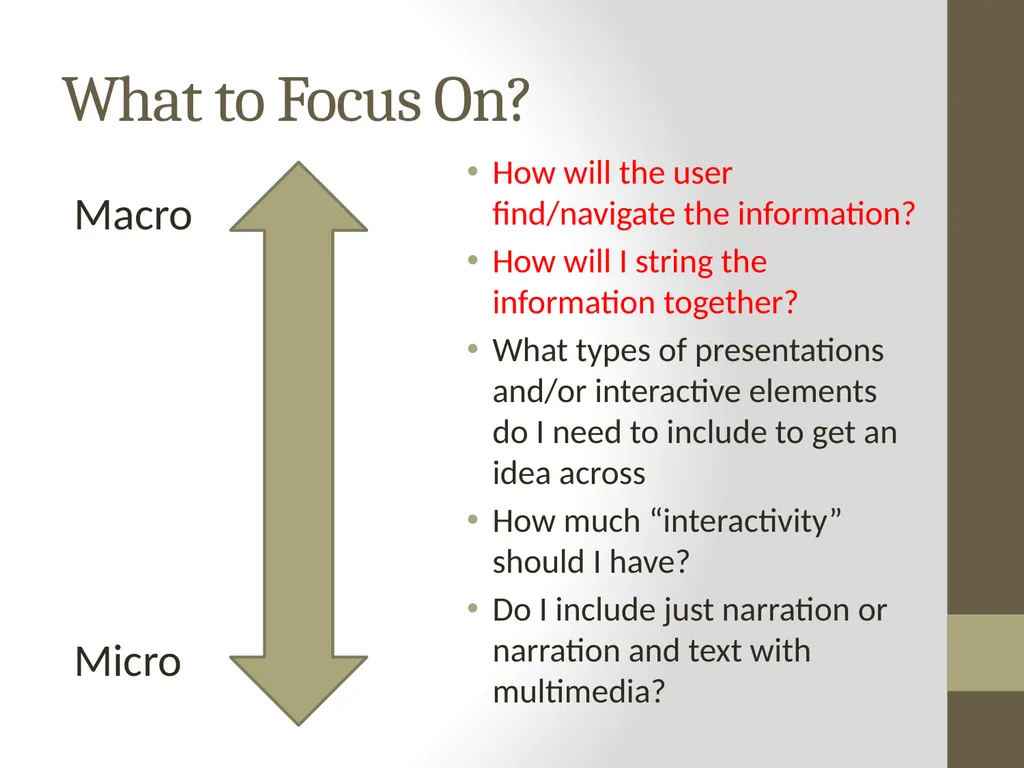
What to Focus On? Macro
Micro How will the user find/navigate the information?
How will I string the information together?
What types of presentations and/or interactive elements do I need to include to get an idea across
How much “interactivity” should I have?
Do I include just narration or narration and text with multimedia?<br>
Micro How will the user find/navigate the information?
How will I string the information together?
What types of presentations and/or interactive elements do I need to include to get an idea across
How much “interactivity” should I have?
Do I include just narration or narration and text with multimedia?<br>
05
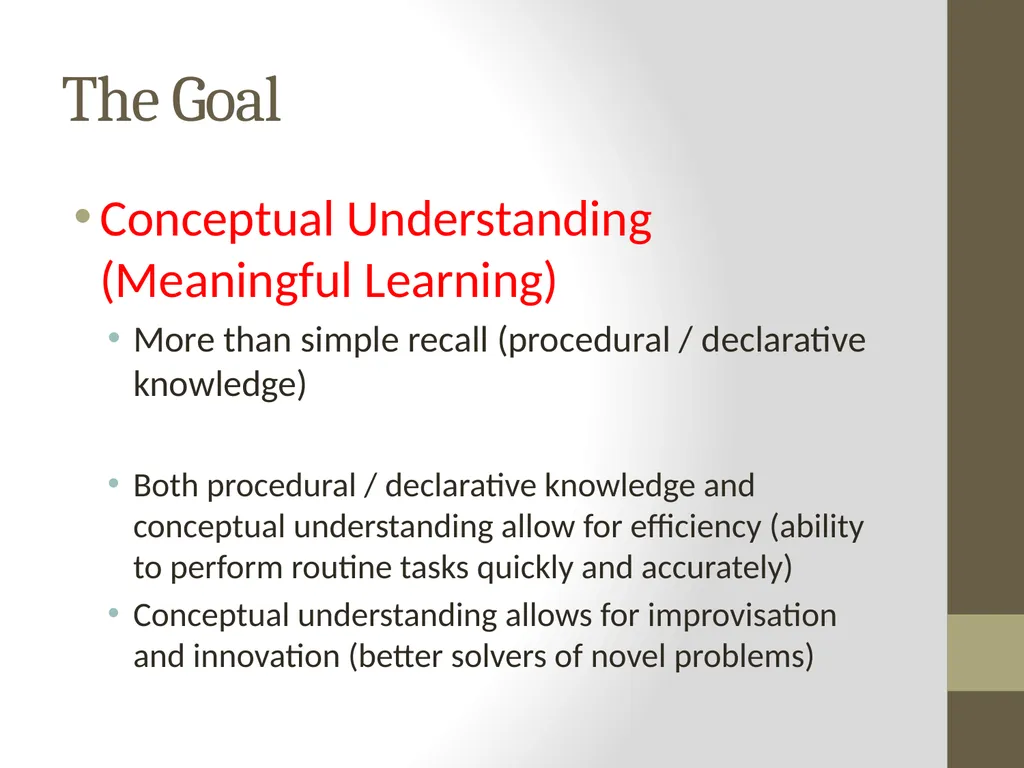
The Goal Conceptual Understanding (Meaningful Learning)
More than simple recall (procedural / declarative knowledge)
Both procedural / declarative knowledge and conceptual understanding allow for efficiency (ability to perform routine tasks quickly and accurately)
Conceptual understanding allows for improvisation and innovation (better solvers of novel problems)<br>
More than simple recall (procedural / declarative knowledge)
Both procedural / declarative knowledge and conceptual understanding allow for efficiency (ability to perform routine tasks quickly and accurately)
Conceptual understanding allows for improvisation and innovation (better solvers of novel problems)<br>
06
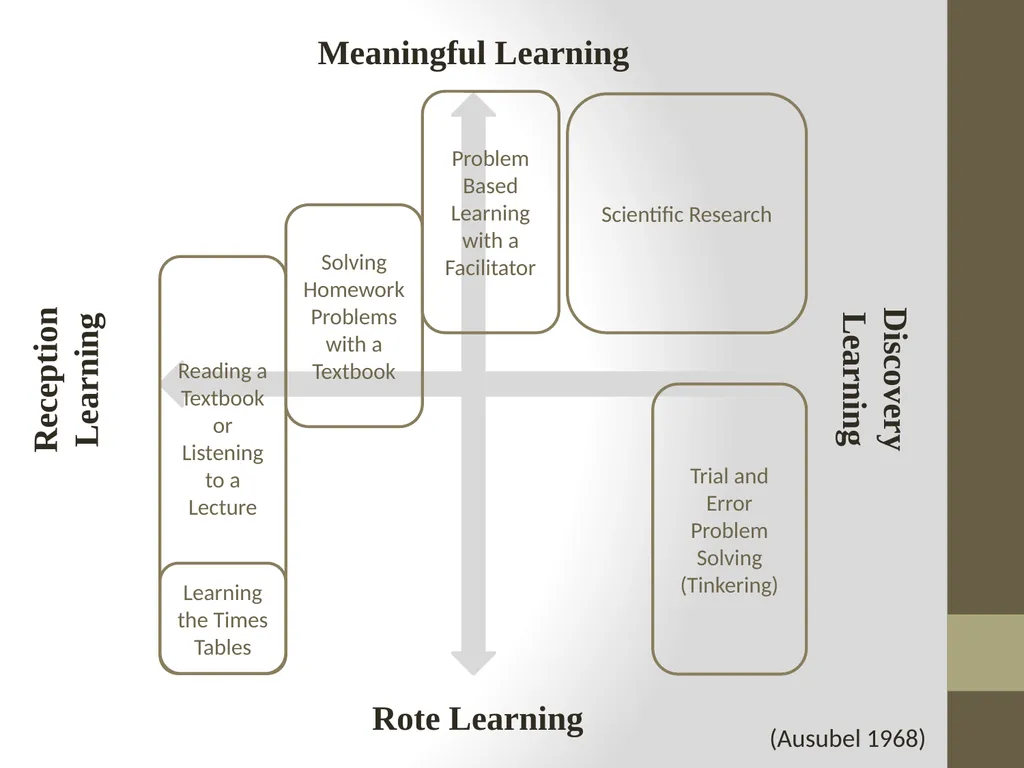
Reception Learning Discovery Learning Meaningful Learning Rote Learning Reading a Textbook or Listening to a Lecture Learning the Times Tables Solving Homework Problems with a Textbook Problem Based Learning with a Facilitator Trial and Error Problem Solving (Tinkering) Scientific Research (Ausubel 1968)<br>
07
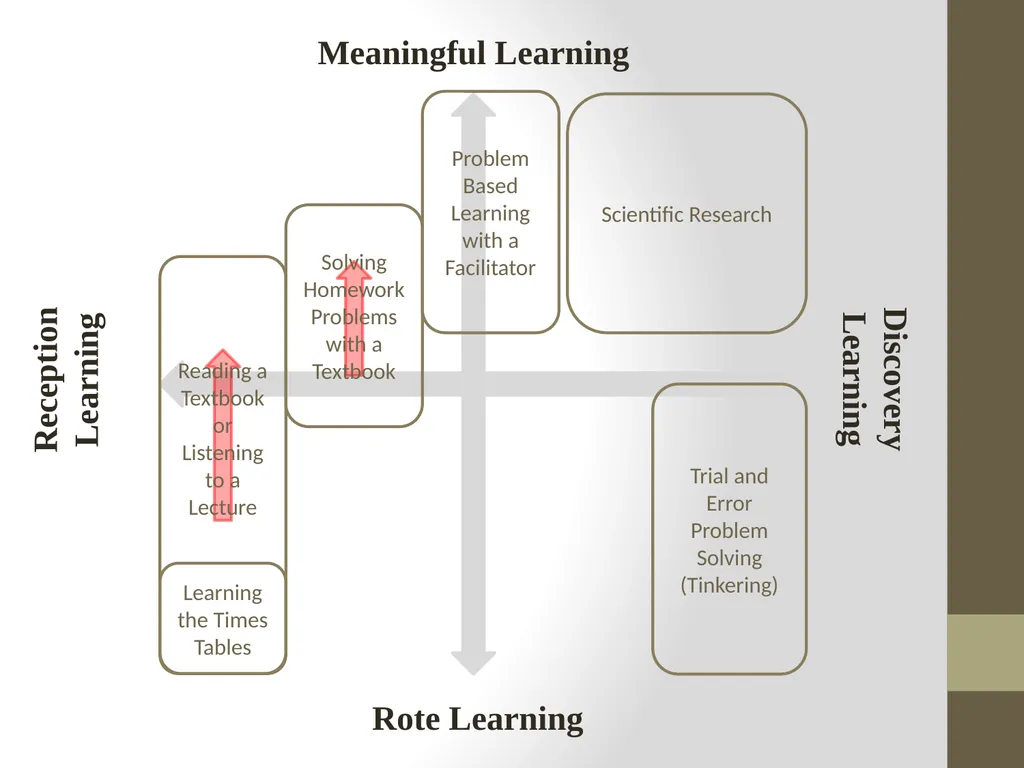
Reception Learning Discovery Learning Meaningful Learning Rote Learning Reading a Textbook or Listening to a Lecture Learning the Times Tables Solving Homework Problems with a Textbook Problem Based Learning with a Facilitator Trial and Error Problem Solving (Tinkering) Scientific Research<br>
08
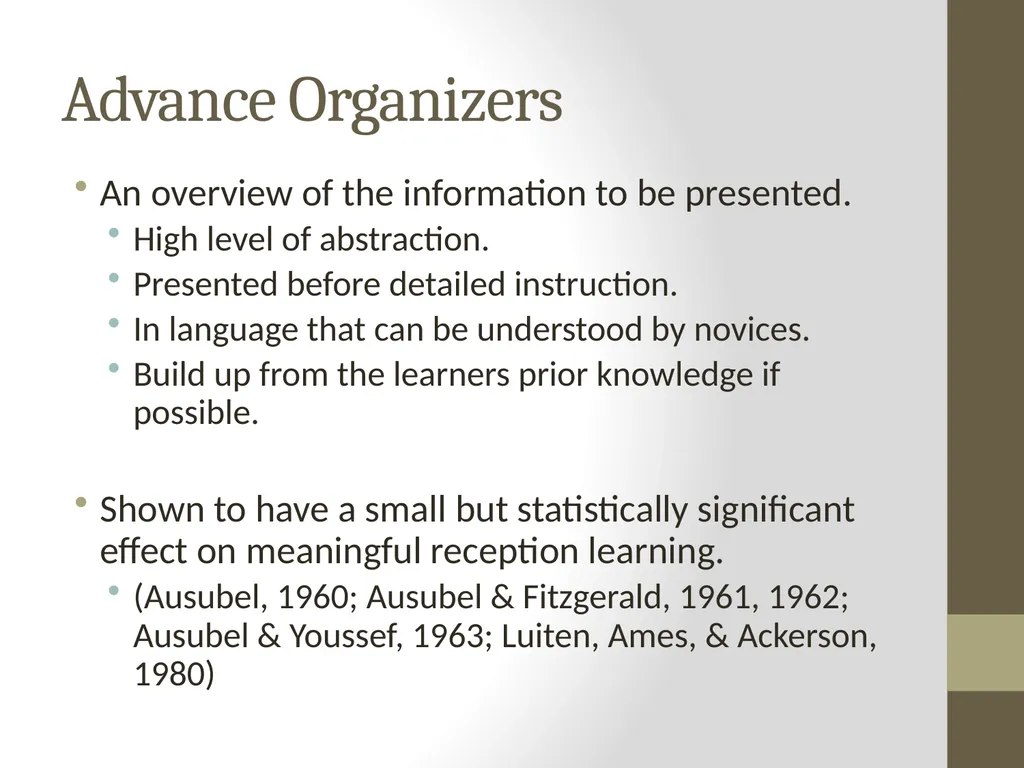
Advance Organizers An overview of the information to be presented.
High level of abstraction.
Presented before detailed instruction.
In language that can be understood by novices.
Build up from the learners prior knowledge if possible.
Shown to have a small but statistically significant effect on meaningful reception learning.
(Ausubel, 1960; Ausubel & Fitzgerald, 1961, 1962; Ausubel & Youssef, 1963; Luiten, Ames, & Ackerson, 1980)<br>
High level of abstraction.
Presented before detailed instruction.
In language that can be understood by novices.
Build up from the learners prior knowledge if possible.
Shown to have a small but statistically significant effect on meaningful reception learning.
(Ausubel, 1960; Ausubel & Fitzgerald, 1961, 1962; Ausubel & Youssef, 1963; Luiten, Ames, & Ackerson, 1980)<br>
09
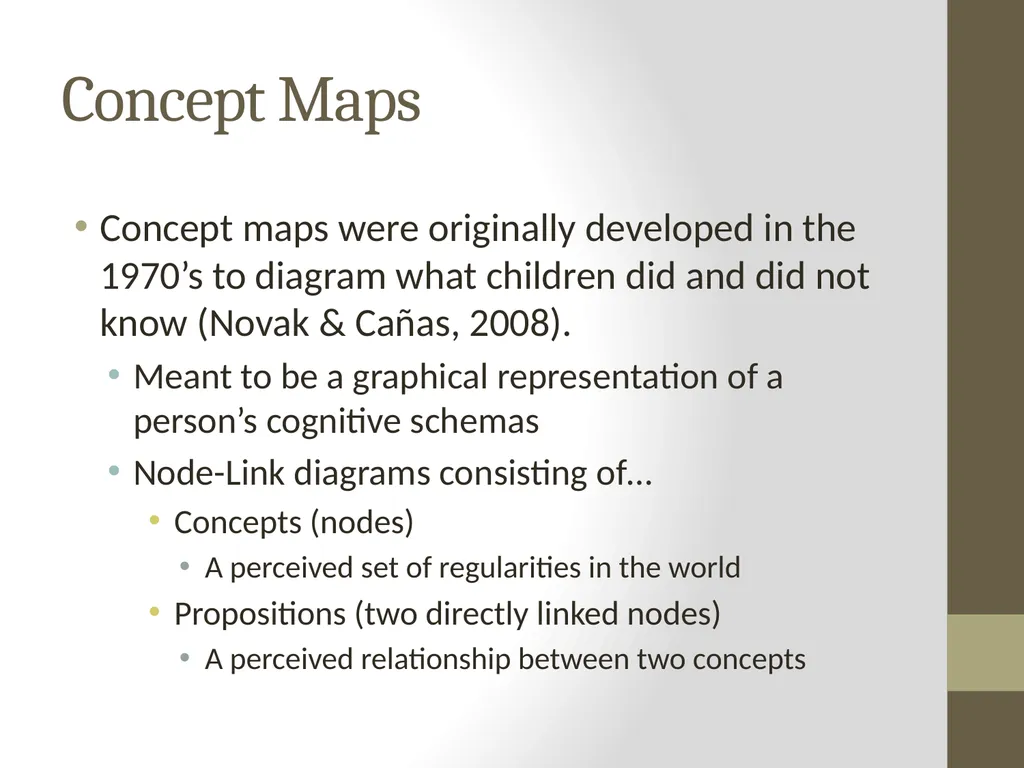
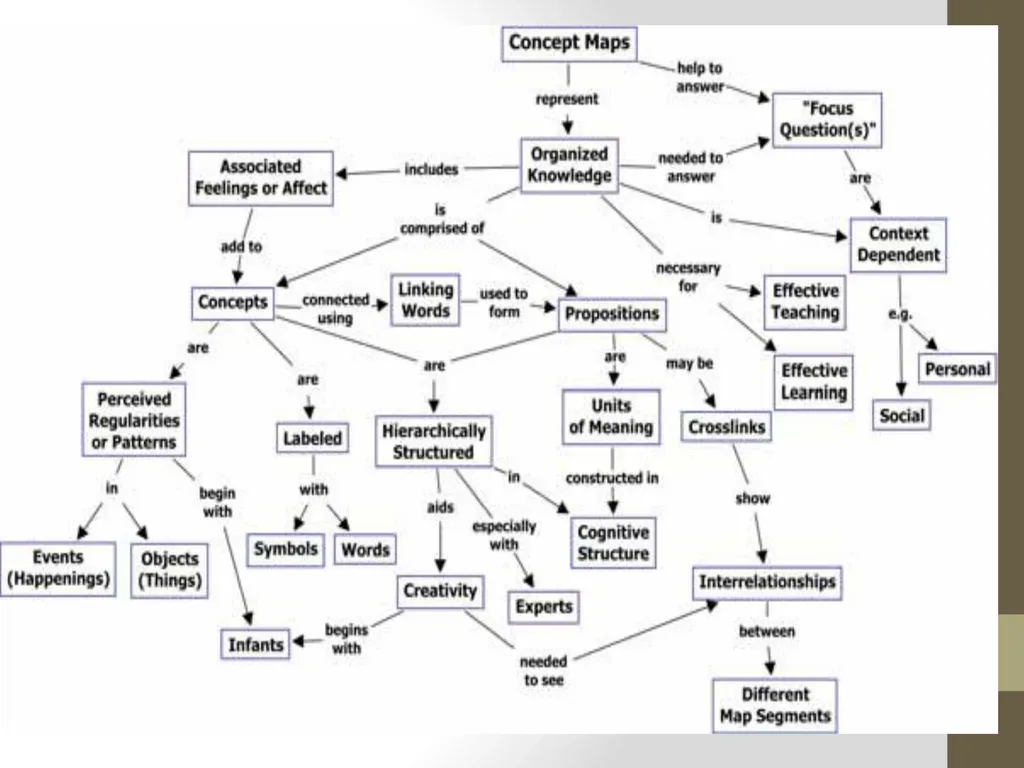
Concept Maps Concept maps were originally developed in the 1970’s to diagram what children did and did not know (Novak & Cañas, 2008).
Meant to be a graphical representation of a person’s cognitive schemas
Node-Link diagrams consisting of…
Concepts (nodes)
A perceived set of regularities in the world
Propositions (two directly linked nodes)
A perceived relationship between two concepts<br>
Meant to be a graphical representation of a person’s cognitive schemas
Node-Link diagrams consisting of…
Concepts (nodes)
A perceived set of regularities in the world
Propositions (two directly linked nodes)
A perceived relationship between two concepts<br>
10
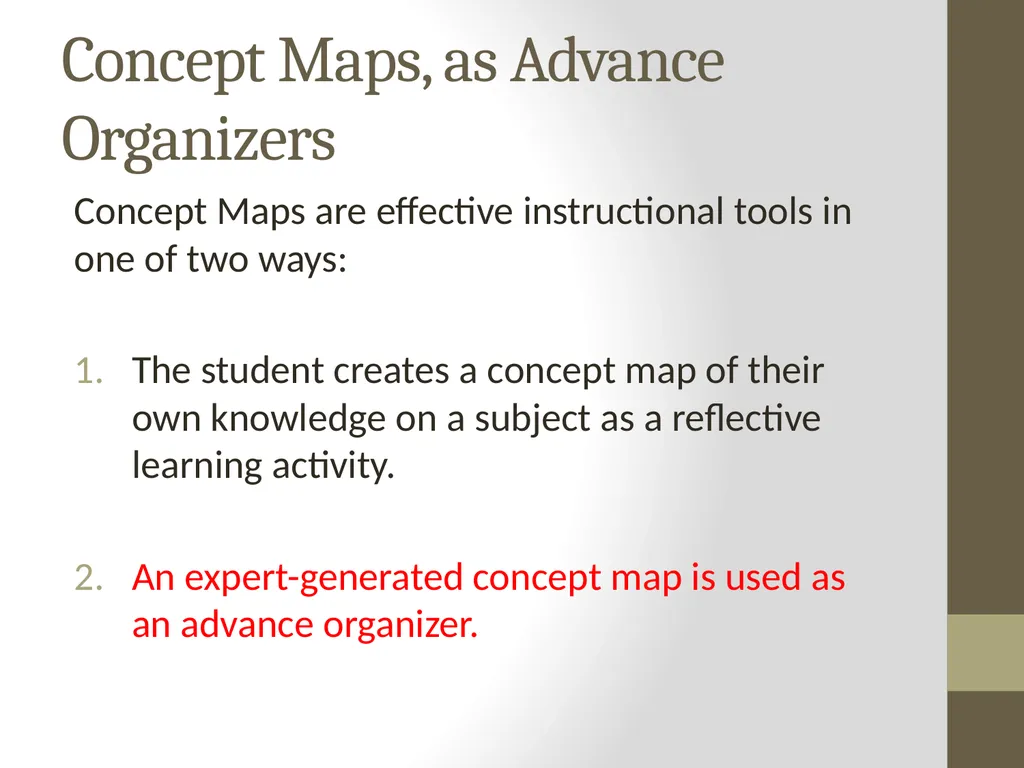
Concept Maps, as Advance Organizers Concept Maps are effective instructional tools in one of two ways:
The student creates a concept map of their own knowledge on a subject as a reflective learning activity.
An expert-generated concept map is used as an advance organizer.<br>
The student creates a concept map of their own knowledge on a subject as a reflective learning activity.
An expert-generated concept map is used as an advance organizer.<br>
11
Concept Maps, as Advance Organizers Concept maps can server as powerful advance organizers, particularly if there are anchor concepts (Novak, 2010).
Reasons
They match how information is stored in long term memory
People can more quickly scan the visual information for key details
Lower cognitive load than text<br>
Reasons
They match how information is stored in long term memory
People can more quickly scan the visual information for key details
Lower cognitive load than text<br>
12
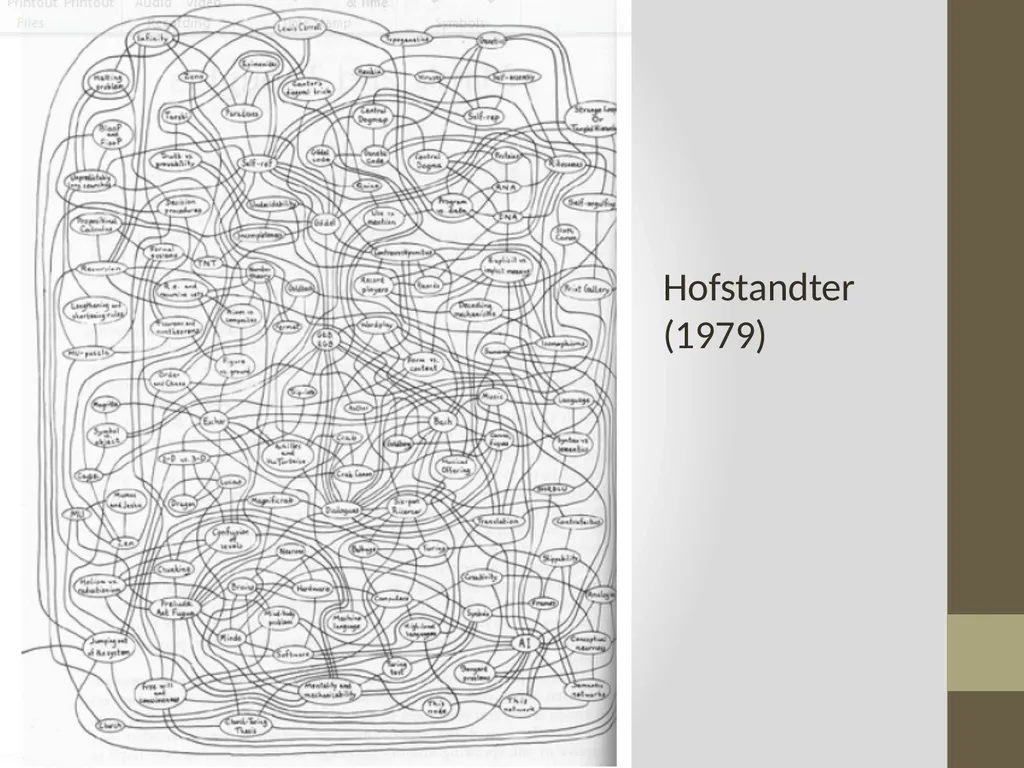
Map Shock Concept maps do not work as advance organizers beyond a certain level of complexity.
“Map shock” is a cognitive and affective reaction to large and complex concept maps that results in the incomplete processing of those maps (Blankenship & Dansereau, 2000).<br>
“Map shock” is a cognitive and affective reaction to large and complex concept maps that results in the incomplete processing of those maps (Blankenship & Dansereau, 2000).<br>
13
Hofstandter (1979)<br>
14
Current Solutions to Map Shock Animated maps
Maps are built up node by node and with accompanying narration
Imposes a linear format on the map, bad for a searching tool
Stacked Maps
Break the map down into several smaller maps
Can be disorienting
Hinders crosslinking
Ignores personal preferences<br>
Maps are built up node by node and with accompanying narration
Imposes a linear format on the map, bad for a searching tool
Stacked Maps
Break the map down into several smaller maps
Can be disorienting
Hinders crosslinking
Ignores personal preferences<br>
15
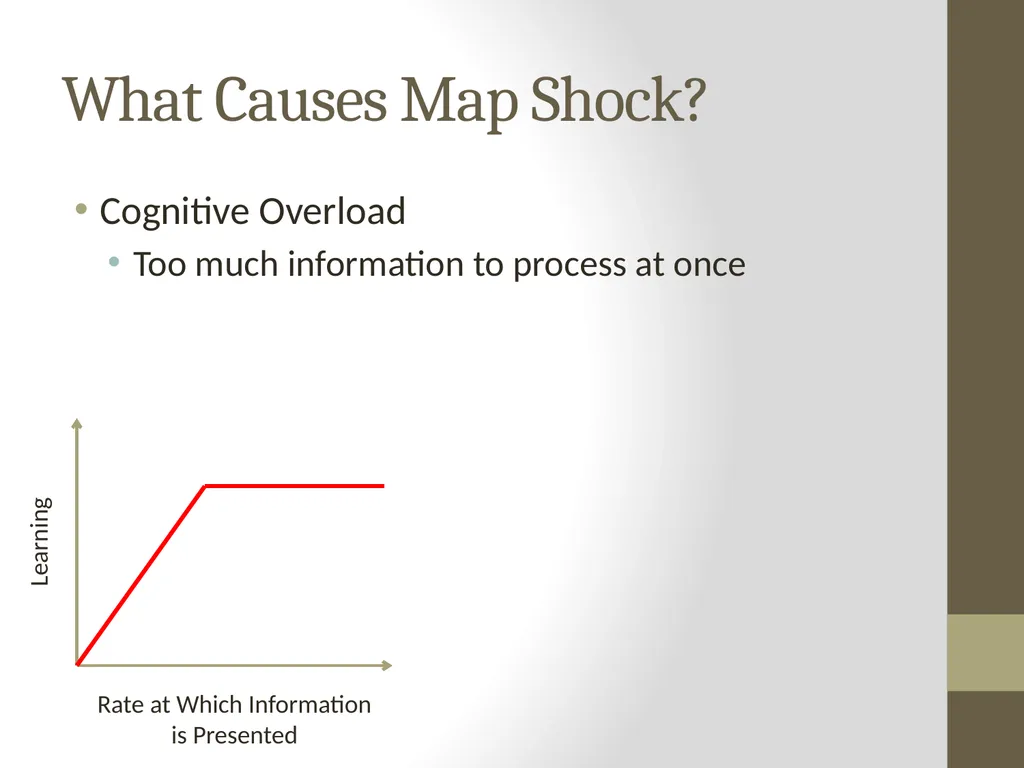
What Causes Map Shock? Cognitive Overload
Too much information to process at once Learning Rate at Which Information is Presented<br>
Too much information to process at once Learning Rate at Which Information is Presented<br>
16
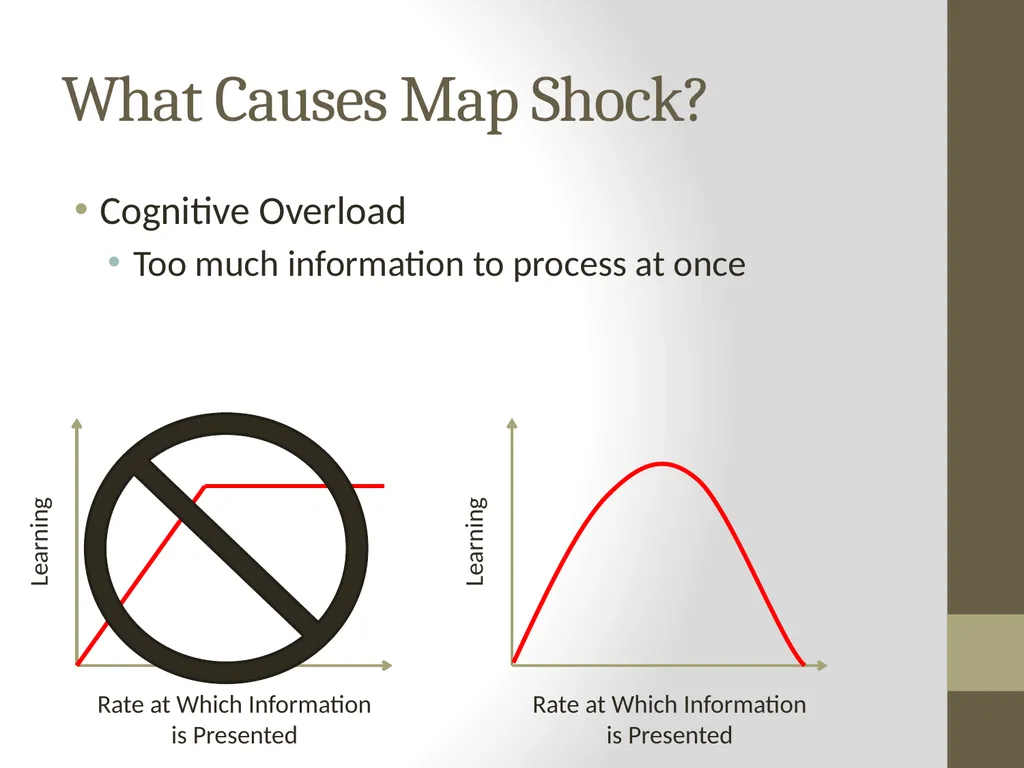
What Causes Map Shock? Cognitive Overload
Too much information to process at once Learning Rate at Which Information is Presented Learning Rate at Which Information is Presented<br>
Too much information to process at once Learning Rate at Which Information is Presented Learning Rate at Which Information is Presented<br>
17
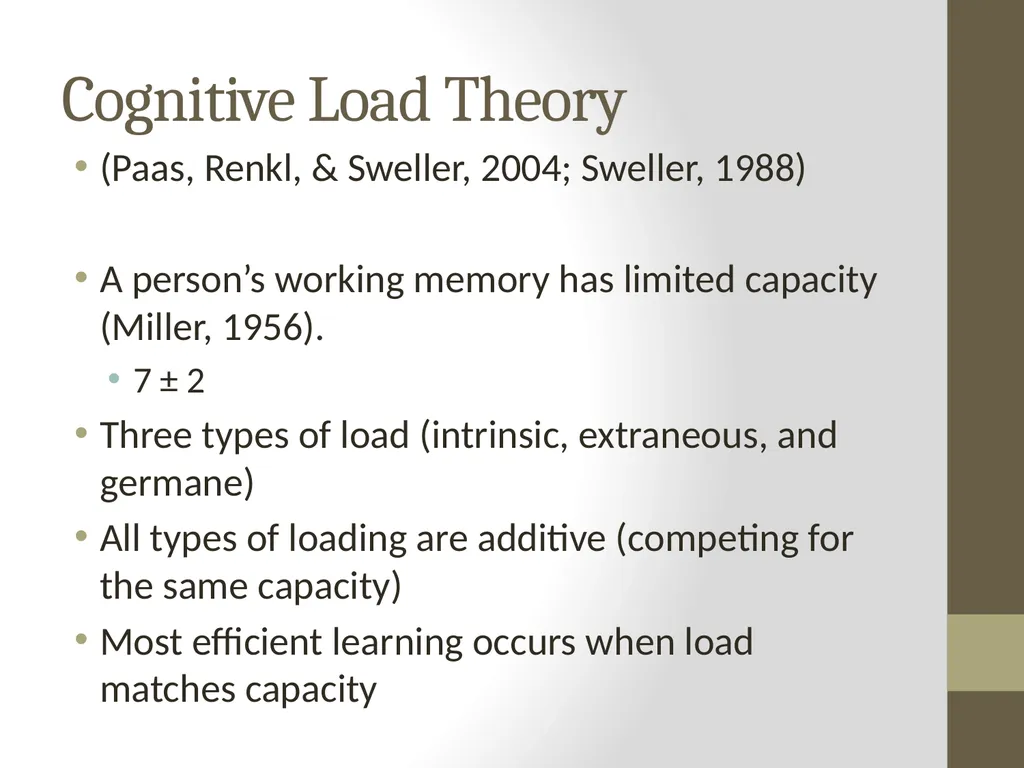
Cognitive Load Theory (Paas, Renkl, & Sweller, 2004; Sweller, 1988)
A person’s working memory has limited capacity (Miller, 1956).
7 ± 2
Three types of load (intrinsic, extraneous, and germane)
All types of loading are additive (competing for the same capacity)
Most efficient learning occurs when load matches capacity<br>
A person’s working memory has limited capacity (Miller, 1956).
7 ± 2
Three types of load (intrinsic, extraneous, and germane)
All types of loading are additive (competing for the same capacity)
Most efficient learning occurs when load matches capacity<br>
18
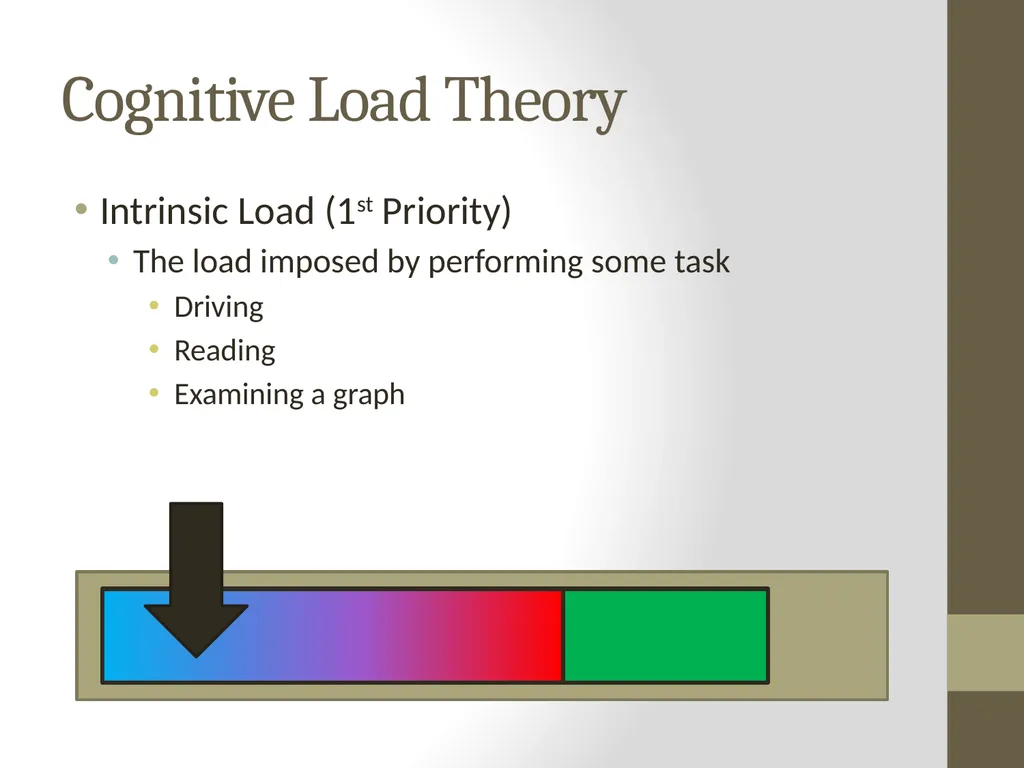
Cognitive Load Theory Intrinsic Load (1st Priority)
The load imposed by performing some task
Driving
Reading
Examining a graph<br>
The load imposed by performing some task
Driving
Reading
Examining a graph<br>
19
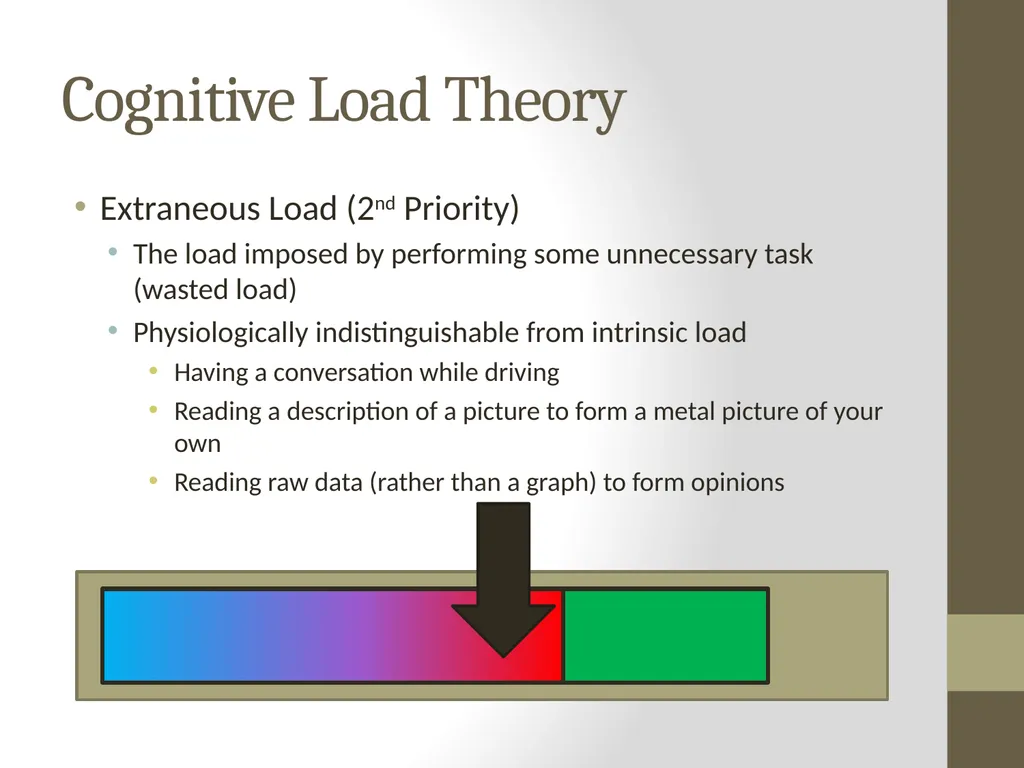
Cognitive Load Theory Extraneous Load (2nd Priority)
The load imposed by performing some unnecessary task (wasted load)
Physiologically indistinguishable from intrinsic load
Having a conversation while driving
Reading a description of a picture to form a metal picture of your own
Reading raw data (rather than a graph) to form opinions<br>
The load imposed by performing some unnecessary task (wasted load)
Physiologically indistinguishable from intrinsic load
Having a conversation while driving
Reading a description of a picture to form a metal picture of your own
Reading raw data (rather than a graph) to form opinions<br>
20
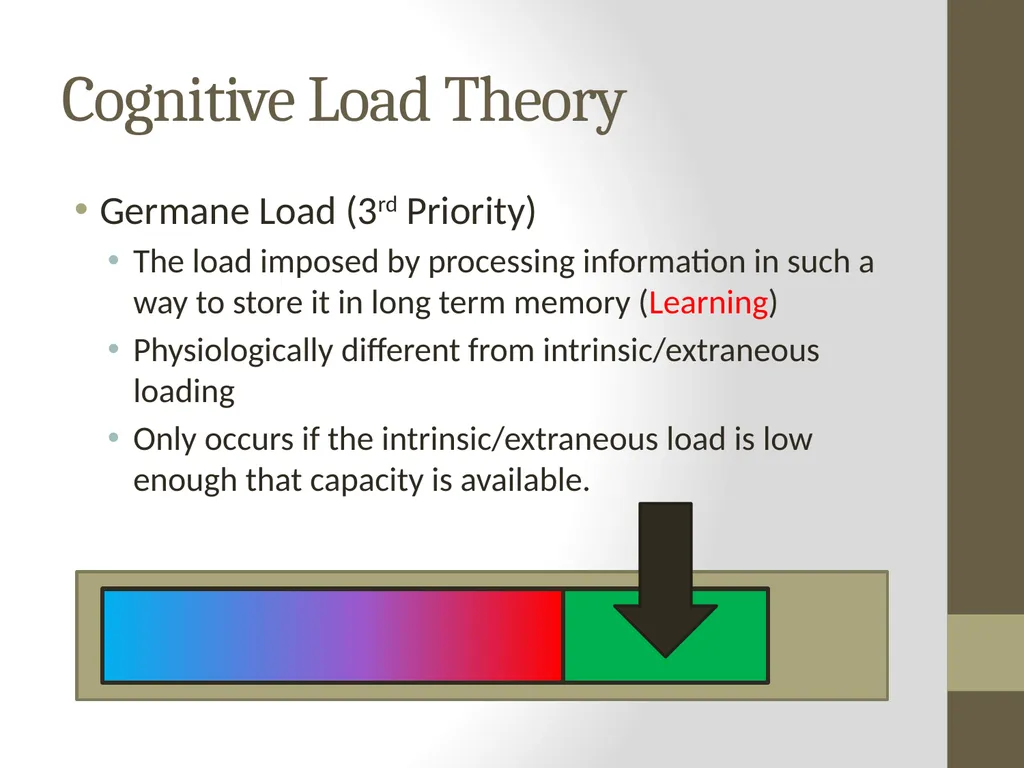
Cognitive Load Theory Germane Load (3rd Priority)
The load imposed by processing information in such a way to store it in long term memory (Learning)
Physiologically different from intrinsic/extraneous loading
Only occurs if the intrinsic/extraneous load is low enough that capacity is available.<br>
The load imposed by processing information in such a way to store it in long term memory (Learning)
Physiologically different from intrinsic/extraneous loading
Only occurs if the intrinsic/extraneous load is low enough that capacity is available.<br>
21
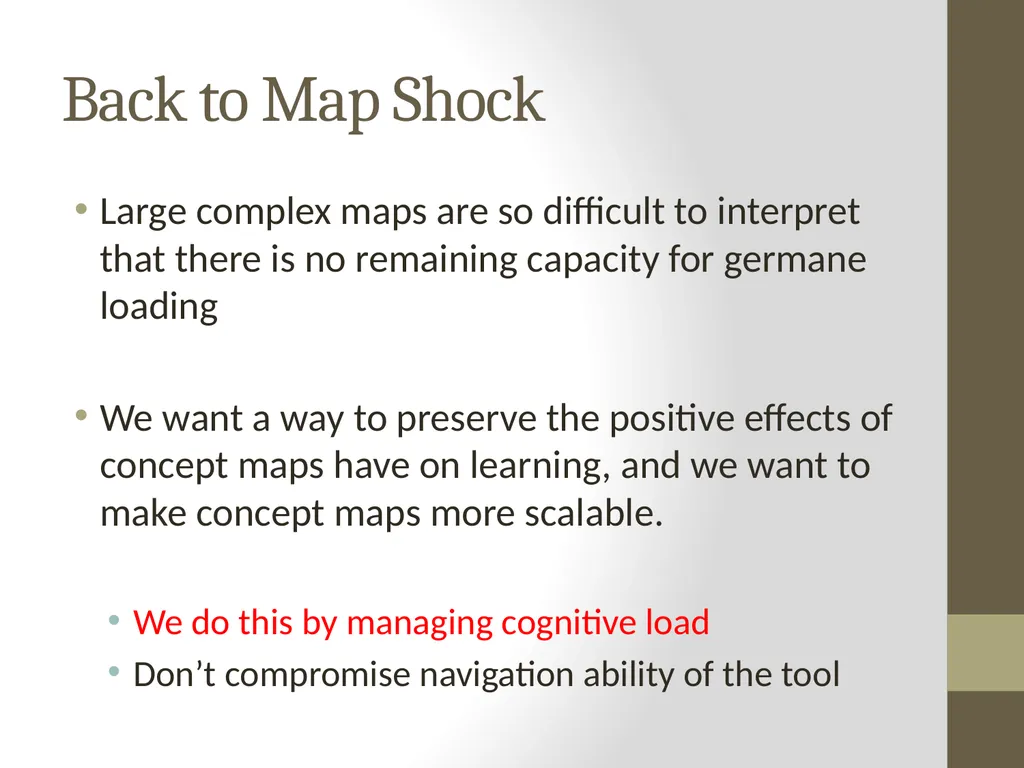
Back to Map Shock Large complex maps are so difficult to interpret that there is no remaining capacity for germane loading
We want a way to preserve the positive effects of concept maps have on learning, and we want to make concept maps more scalable.
We do this by managing cognitive load
Don’t compromise navigation ability of the tool<br>
We want a way to preserve the positive effects of concept maps have on learning, and we want to make concept maps more scalable.
We do this by managing cognitive load
Don’t compromise navigation ability of the tool<br>
22
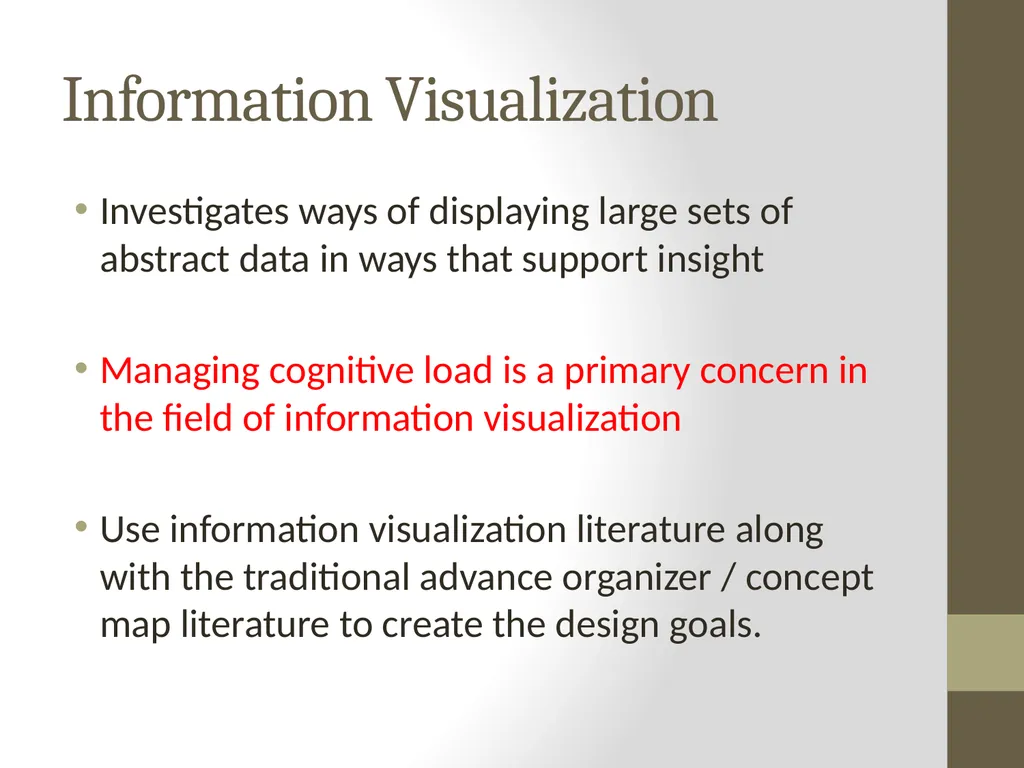
Information Visualization Investigates ways of displaying large sets of abstract data in ways that support insight
Managing cognitive load is a primary concern in the field of information visualization
Use information visualization literature along with the traditional advance organizer / concept map literature to create the design goals.<br>
Managing cognitive load is a primary concern in the field of information visualization
Use information visualization literature along with the traditional advance organizer / concept map literature to create the design goals.<br>
23
Adaptive Map Design Goals Tool will serve as a navigation system and advance organizer
Usability is a primary goal (never overwhelm the user)
Automatic concept map generation (ease of content creation)<br>
Usability is a primary goal (never overwhelm the user)
Automatic concept map generation (ease of content creation)<br>
24
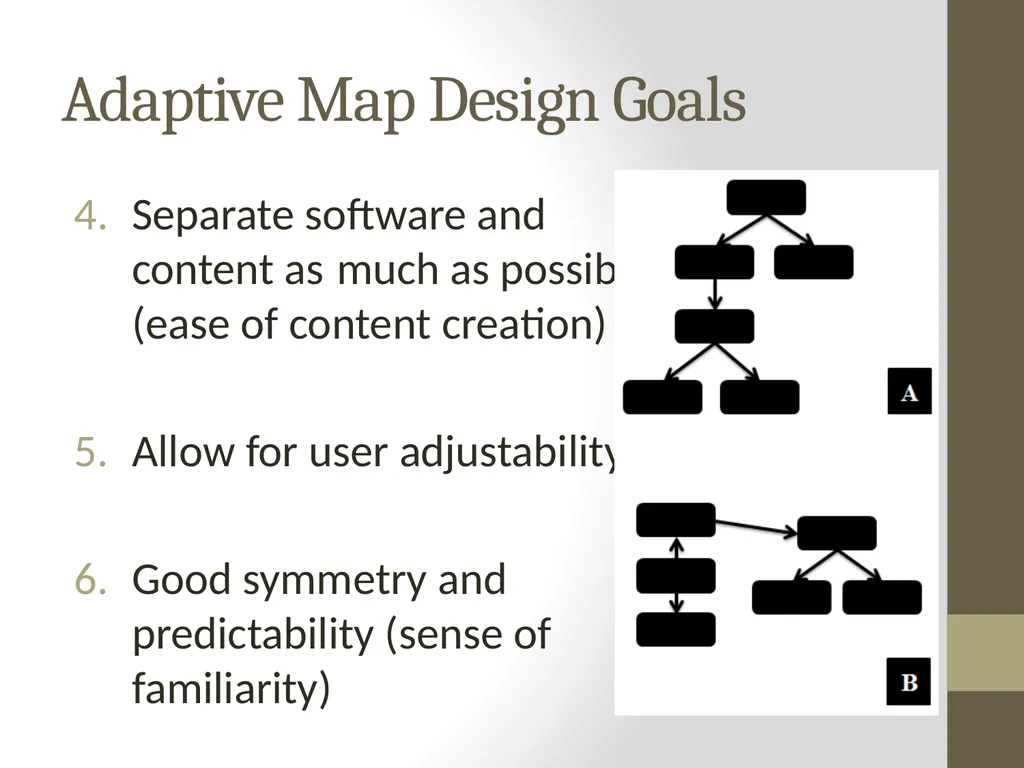
Adaptive Map Design Goals Separate software and content as much as possible (ease of content creation)
Allow for user adjustability
Good symmetry and predictability (sense of familiarity)<br>
Allow for user adjustability
Good symmetry and predictability (sense of familiarity)<br>
25
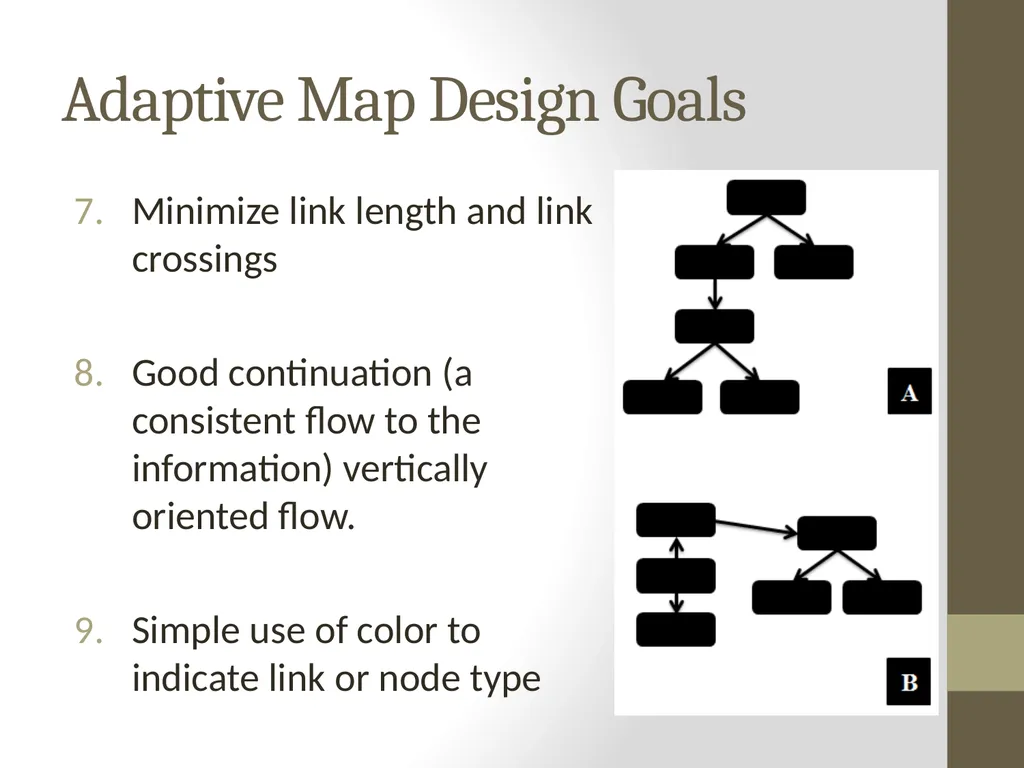
Adaptive Map Design Goals Minimize link length and link crossings
Good continuation (a consistent flow to the information) vertically oriented flow.
Simple use of color to indicate link or node type<br>
Good continuation (a consistent flow to the information) vertically oriented flow.
Simple use of color to indicate link or node type<br>
26
Adaptive Map Design Goals Help user maintain a sense of context while viewing details (either smooth zooming and panning or focus + context views)
Start with an overview (Overview first, zoom and filter, details on demand)<br>
Start with an overview (Overview first, zoom and filter, details on demand)<br>
27
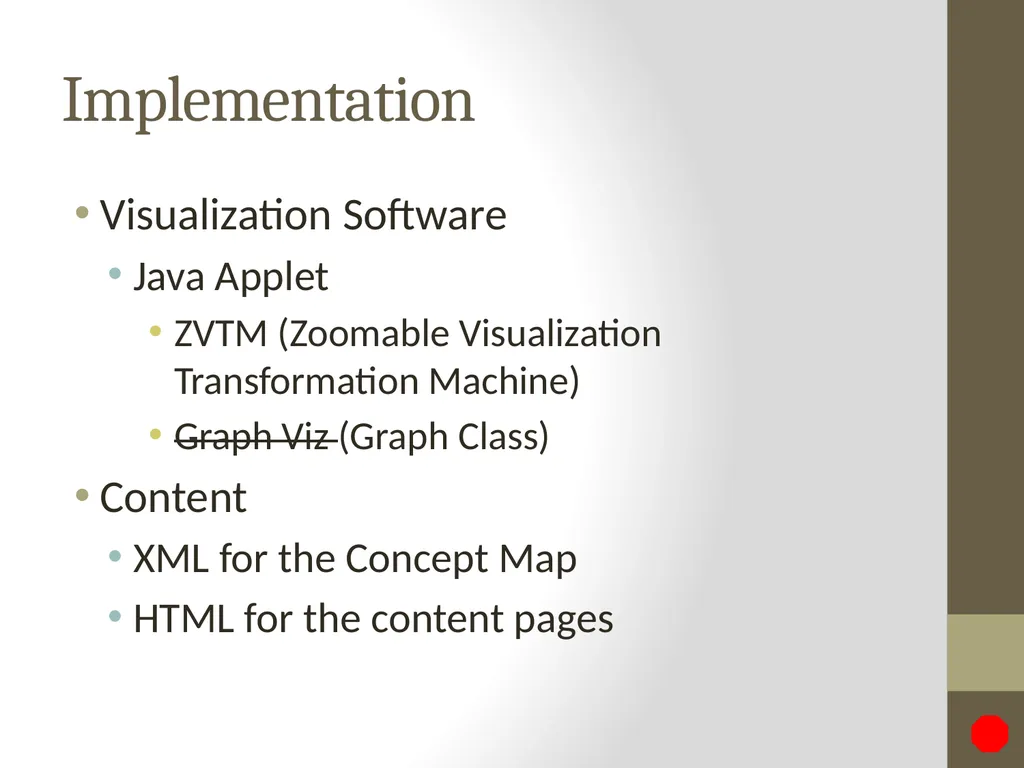
Implementation Visualization Software
Java Applet
ZVTM (Zoomable Visualization Transformation Machine)
Graph Viz (Graph Class)
Content
XML for the Concept Map
HTML for the content pages<br>
Java Applet
ZVTM (Zoomable Visualization Transformation Machine)
Graph Viz (Graph Class)
Content
XML for the Concept Map
HTML for the content pages<br>
28
Evaluation Pilot Testing and Debugging
Spring 2012, Summer 2012
Formal Evaluation
Fall 2012
Evaluate conceptual understanding
Evaluate student usage patterns
Evaluate student opinions<br>
Spring 2012, Summer 2012
Formal Evaluation
Fall 2012
Evaluate conceptual understanding
Evaluate student usage patterns
Evaluate student opinions<br>
29
Evaluation Evaluating Conceptual Understanding
Statics Concept Inventory (Steif & Dantzler, 2005)
Problem Sets and Observations<br>
Statics Concept Inventory (Steif & Dantzler, 2005)
Problem Sets and Observations<br>
30
Questions<br>
31
References Ausubel, D. P. (1960). The Use of Advance Organizers in the Learning and Retention of Meaningful Verbal Material. Journal of Educational Psychology, 51(5), 267–272.
Ausubel, D. P. (1968). Educational Psychology; a Cognitive View. New York, NY: Holt, Rinehart and Winston.
Ausubel, D. P., & Fitzgerald, D. (1961). The Role of Discriminability in Meaningful Learning and Retention. Journal of Educational Psychology, 52(5), 266–274.
Ausubel, D. P., & Fitzgerald, D. (1962). Organizer, General Background, and Antecedent Learning Variables in Sequential Verbal Learning. Journal of Educational Psychology, 53(6), 243–249.
Ausubel, D. P., & Youssef, M. (1963). Role of Discriminability in Meaningful Paralleled Learning. Journal of Educational Psychology, 54(6), 331–336.
Blankenship, J., & Dansereau, D. (2000). The Effect of Animated Node-Link Displays on Information Recall. The Journal of Experimental Education, 68(4), 293–308.
Luiten, J., Ames, W., & Ackerson, G. (1980). A Meta-analysis of the Effects of Advance Organizers on Learning and Retention. American Educational Research Journal, 17(2), 211 –218.
Miller, G. A. (1956). The Magical Number Seven, Plus or Minus Two: Some Limits On Our Capacity For Processing Information. Psychological Review, 63(2), 81–97.
Novak, J. D. (2010). Learning, Creating, and Using Knowledge: Concept Maps as Facilitative Tools in Schools and Corporations. New York, NY: Taylor & Francis.
Novak, J. D., & Cañas, A. J. (2008). The Theory Underlying Concept Maps and How to Construct and Use Them (Technical Report No. Cmap Tools 2006-01 Rev 01-2008).
Paas, F., Renkl, A., & Sweller, J. (2004). Cognitive Load Theory: Instructional Implications of the Interaction Between Information Structures and Cognitive Architecture. Instructional Science, 32(1/2), 1–8.
Steif, P. S., & Dantzler, J. A. (2005). A Statics Concept Inventory: Development and Psychometric Analysis. Journal of Engineering Education, 94(4), 363–372.
Sweller, J. (1988). Cognitive Load During Problem Solving: Effects on Learning. Cognitive Science, 12(2), 257–285.<br>
Ausubel, D. P. (1968). Educational Psychology; a Cognitive View. New York, NY: Holt, Rinehart and Winston.
Ausubel, D. P., & Fitzgerald, D. (1961). The Role of Discriminability in Meaningful Learning and Retention. Journal of Educational Psychology, 52(5), 266–274.
Ausubel, D. P., & Fitzgerald, D. (1962). Organizer, General Background, and Antecedent Learning Variables in Sequential Verbal Learning. Journal of Educational Psychology, 53(6), 243–249.
Ausubel, D. P., & Youssef, M. (1963). Role of Discriminability in Meaningful Paralleled Learning. Journal of Educational Psychology, 54(6), 331–336.
Blankenship, J., & Dansereau, D. (2000). The Effect of Animated Node-Link Displays on Information Recall. The Journal of Experimental Education, 68(4), 293–308.
Luiten, J., Ames, W., & Ackerson, G. (1980). A Meta-analysis of the Effects of Advance Organizers on Learning and Retention. American Educational Research Journal, 17(2), 211 –218.
Miller, G. A. (1956). The Magical Number Seven, Plus or Minus Two: Some Limits On Our Capacity For Processing Information. Psychological Review, 63(2), 81–97.
Novak, J. D. (2010). Learning, Creating, and Using Knowledge: Concept Maps as Facilitative Tools in Schools and Corporations. New York, NY: Taylor & Francis.
Novak, J. D., & Cañas, A. J. (2008). The Theory Underlying Concept Maps and How to Construct and Use Them (Technical Report No. Cmap Tools 2006-01 Rev 01-2008).
Paas, F., Renkl, A., & Sweller, J. (2004). Cognitive Load Theory: Instructional Implications of the Interaction Between Information Structures and Cognitive Architecture. Instructional Science, 32(1/2), 1–8.
Steif, P. S., & Dantzler, J. A. (2005). A Statics Concept Inventory: Development and Psychometric Analysis. Journal of Engineering Education, 94(4), 363–372.
Sweller, J. (1988). Cognitive Load During Problem Solving: Effects on Learning. Cognitive Science, 12(2), 257–285.<br>