The Art of Programming in a Technical Institute

Published  . 0 views
↓ Download
The Art of Programming in a Technical Institute
1 / 1
The Art of Programming in a Technical Institute - slide 1 of 16 The Art of Programming in a Technical Institute - slide 2 of 16 The Art of Programming in a Technical Institute - slide 3 of 16 The Art of Programming in a Technical Institute - slide 4 of 16 The Art of Programming in a Technical Institute - slide 5 of 16 The Art of Programming in a Technical Institute - slide 6 of 16 The Art of Programming in a Technical Institute - slide 7 of 16 The Art of Programming in a Technical Institute - slide 8 of 16 The Art of Programming in a Technical Institute - slide 9 of 16 The Art of Programming in a Technical Institute - slide 10 of 16 The Art of Programming in a Technical Institute - slide 11 of 16 The Art of Programming in a Technical Institute - slide 12 of 16 The Art of Programming in a Technical Institute - slide 13 of 16 The Art of Programming in a Technical Institute - slide 14 of 16 The Art of Programming in a Technical Institute - slide 15 of 16 The Art of Programming in a Technical Institute - slide 16 of 16
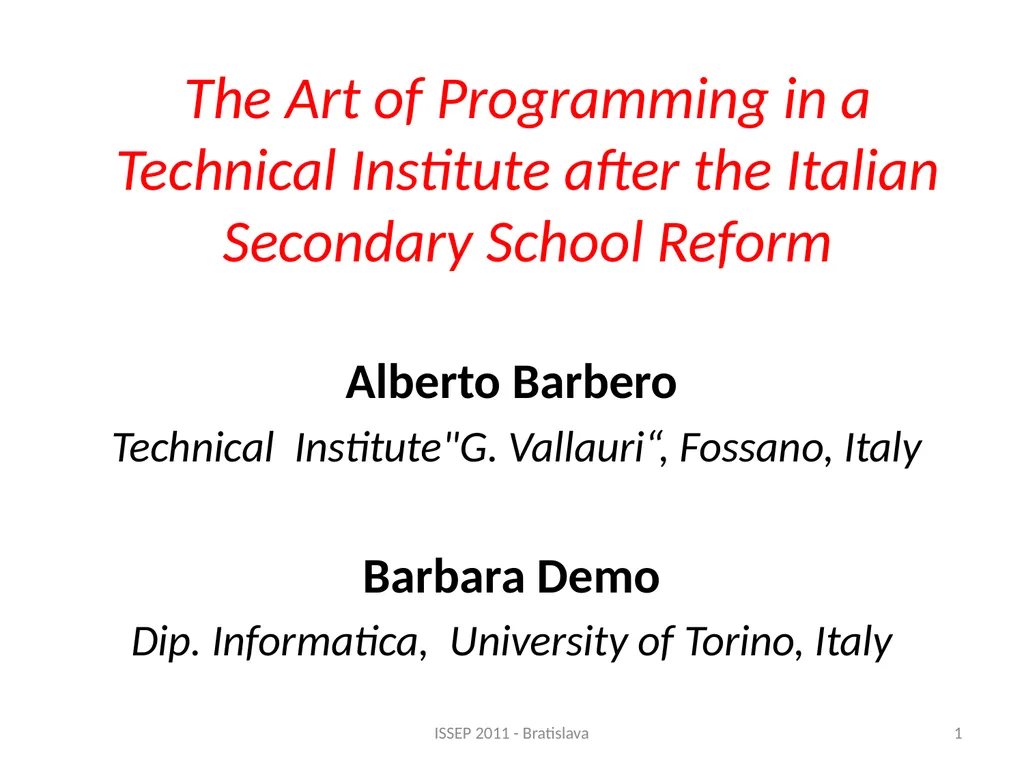
Description: The Art of Programming in a Technical Institute after the Italian Secondary School Reform Alberto Barbero Technical InstituteG. Vallauri, Fossano, Italy Barbara Demo Dip. Informatica, University of Torino, Italy 1 ISSEP 2011 - Bratislava

Related Topics

Download Presentation

"The Art of Programming in a Technical Institute" is the property of its rightful owner. Permission is granted to download and print the materials on this website for personal, non-commercial use only, and to display it on your personal computer provided you do not modify the materials and that you retain all copyright notices contained in the materials. By downloading content from our website, you accept the terms of this agreement.

Presentation Transcript

slide1. The Art of Programming in a Technical Institute after the Italian Secondary School Reform Alberto Barbero
Technical Institute"G. Vallauri“, Fossano, Italy

Barbara Demo
Dip. Informatica, University of Torino, Italy 1 ISSEP 2011 - Bratislava<br>
slide2. Summary What kind of CS in high schools
Manifesto for Informatics in schools
Informatics as a science
What do we teach?
High school Italian Reform: working with teachers is a must
first year technical secondary school students:  programming
Structured problem solving
A proposal using Scratch 2 ISSEP 2011 - Bratislava<br>
slide3. Manifesto of Informatics in schools Italian Secondary School Reform
What CS in high schools
Manifesto published in May 2010 by the main Computer Science academic associations in Italy
CINI, GII, GRIN
three basic perceptions of Informatics
Pragmatic : Hardware & software tools to solve everyday problems
Technological: knowing languages and systems in order to implement
Scientific: Informatics is also the science funding hw and sw developments of the middle of the XXiethcentury 3 ISSEP 2011 - Bratislava<br>
slide4. Reform of Italian high schools Opportunity to have voice in defining curricula
mandatory feeling involved in schools
Opportunity to work with teachers Spontaneous requests by teachers
Cooperation with Dschola an Association of schools many technical but not only
Other associations are interested , museums, … Activity here described: 4 ISSEP 2011 - Bratislava<br>
slide5. new curricula: from schools  bottom up
from academia  top down
it’s time for a large common action for shaping what shall be taught
to pupils of different age levels
in different types of school The point is exactly:
what do we have to teach? 5 ISSEP 2011 - Bratislava<br>
slide6. A proposal for the curriculum of the first year in Secondary School N. Wirth, Program development by stepwise refinement, CACM, April 1971 in the Reform of Italian Sec. School guidelines:
… Introduction to the concept of algorithm
not unknown to students
thus the introductive part can go quite quickly 6 ISSEP 2011 - Bratislava<br>
slide7. N. Wirth, Program development by stepwise refinement, CACM, April 1971 Scratch
Arduino and S4A “The creative activity of programming – to be distinguished from coding- … It is here considered as a sequence of design decisions concerning the decomposition of tasks into subtasks and of data into data structures. programming problem solving 7 ISSEP 2011 - Bratislava<br>
slide8. Some examples: think a number game Think a number
Add 1
Multiply by 3
……..
Tell me the number you finished with
Now I can tell you the number you thought at the beginning (x + 1) * 3 – x – 2 … = a
x = (a – 1) / 2 Work with maths teachers 8 ISSEP 2011 - Bratislava<br>
slide9. Think a number game 9 ISSEP 2011 - Bratislava<br>
slide10. Calculator 10 ISSEP 2011 - Bratislava<br>
slide11. High-low-guess-a-number Think a number between 1 and 999
I will guess your number with less questions than many humans Introducing time complexity
……..
…………
In general: introducing to properties of algorithms 11 ISSEP 2011 - Bratislava<br>
slide12. High-low-guess-a-number 12 ISSEP 2011 - Bratislava<br>
slide13. What Informatics in high schools? Programming and problem solving but not only from a technical point of view such as learn coding, also algorithms properties and systems organisation
Interactions with philosophy and history of science particularly in school types where these disciplines are present, for example in “Licei”, but also, in a softer form, in the other school types
Help from CS in proposing original ways for thinking to traditional concepts from other disciplines
Informatics to look at some mathematical concepts from a different perspective
Informatics and language 13 ISSEP 2011 - Bratislava<br>
slide14. Papers by the “group”: Also written with teachers
A Contribution to the Discussion on Informatics and Robotics in Secondary Schools, same authors & F. Vaschetto, Robotics in Education, IEEE Conf., Wien, September 2011

B. Demo & all., In and Out of the School Activities Implementing IBSE and Constructionist Learning Methodologies By Robotics, Chapter in “Robots in K-12 Education”, February, 2012

E. Giovannetti, What kind of CS in secondary schools, Conf. DIDAMATICA, Workshop “Informatics in Secondary Schools”, Torino, May 2011. 14 ISSEP 2011 - Bratislava<br>
slide15. Many thanks for your attention barbara@di.unito.it
barbero@vallauri.edu please write your comments to 15 ISSEP 2011 - Bratislava<br>
slide16. Teorema di Böhm-Jacopini: Qualsiasi algoritmo può essere trasformato in un algoritmo equivalente composto soltanto di combinazioni di sequenze, selezioni e iterazioni. Chiameremo ben strutturato un algoritmo composto di sole "strutture fondamentali". Sequenza: è la forma più semplice di procedura per strutturare un algoritmo e consiste in una serie di istruzioni una dietro l'altra che la macchina dovrà eseguire in fila. Selezione: struttura algoritmica, che inizia con la verifica di una condizione logica C, cioè di una affermazione che può essere soltanto vera o falsa, che continua con una sequenza di azioni A, se la condizione C è verificata, o altrimenti continua con la sequenza di azioni B, e in entrambi i casi si riconduce, poi, a una continuazione unica. Iterazione: programma in cui la procedura ripete il ciclo fin quando sussistono le condizioni per la ripetizione, mentre nel caso opposto si esce dalla struttura ripetitiva.
Fonti:Mauro La Torre; "Principi di informatica ", 1994, La Nuova Italia Editrice 16 ISSEP 2011 - Bratislava<br>