
The Blueprint + SU's Information for Student Reps
DP
Published · 76 slides · 0 views

1 / 1


Description
The Blueprint SUs Information for Student Reps Published: August 2026 Next Update: August 2027 How to use this PowerPoint: Treat it as a source of information not a single-session agenda. After going through the Introduction, select
Related Topics
Share
Embed code
Download this presentation From Below
"The Blueprint + SU's Information for Student Reps" is the property of its rightful owner. Permission is granted to download and print the materials on this website for personal, non-commercial use only, and to display it on your personal computer provided you do not modify the materials and that you retain all copyright notices contained in the materials. By downloading content from our website, you accept the terms of this agreement.
Presentation Transcript
01
The Blueprint + SU's Information for Student Reps Published: August 2026
Next Update: August 2027<br>
Next Update: August 2027<br>
02
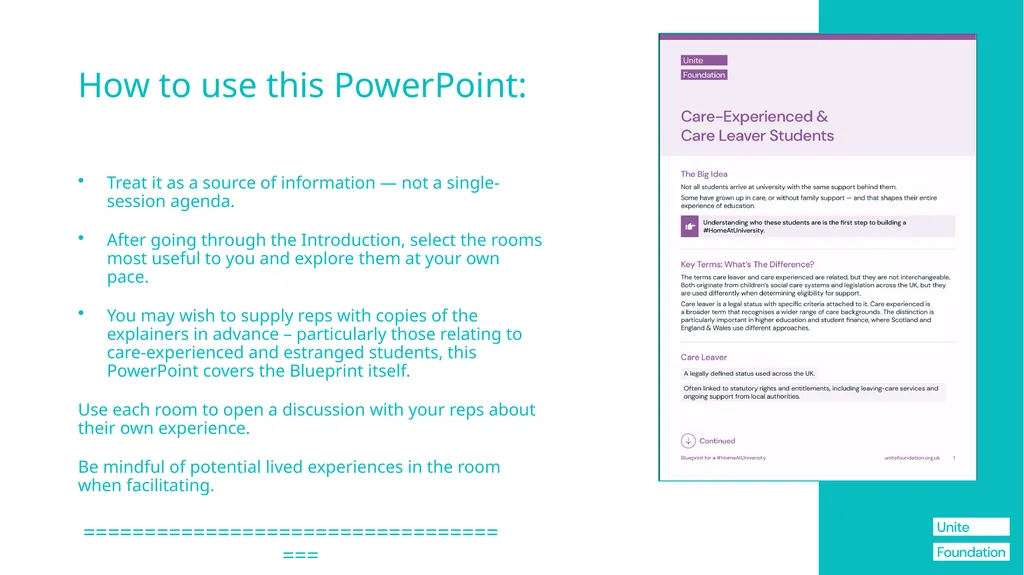
How to use this PowerPoint: Treat it as a source of information — not a single-session agenda.
After going through the Introduction, select the rooms most useful to you and explore them at your own pace.
You may wish to supply reps with copies of the explainers in advance – particularly those relating to care-experienced and estranged students, this PowerPoint covers the Blueprint itself.
Use each room to open a discussion with your reps about their own experience.
Be mindful of potential lived experiences in the room when facilitating. =====================================<br>
03
Introduction:
Building
the Foundations<br>
Building
the Foundations<br>
04
The Big Idea: What does it really mean to feel at home at university?
Not just having a room — but having stability, security, and somewhere you belong.
The big idea behind Blueprint is simple:
👉 Every student should have a safe and stable #HomeAtUniversity — so they can succeed. =====================================<br>
Not just having a room — but having stability, security, and somewhere you belong.
The big idea behind Blueprint is simple:
👉 Every student should have a safe and stable #HomeAtUniversity — so they can succeed. =====================================<br>
05
Why This Matters: University systems are often built on an assumption: that students have a safe home to return to between semesters.
For care-experienced and estranged students, that safety net often doesn’t exist.
That can mean:
Housing insecurity year round
Much greater financial pressure
Significant risk of dropping out
The stigma of feeling different and not belonging at university
👉 Without stability at home, success at university becomes much harder. =====================================<br>
06
About the Unite Foundation: Since 2012, the Unite Foundation has been working to change this.
Providing free, 3-year accommodation scholarships for almost 1000 students so far
Supporting a community of care experienced & estranged students: All of Us
Commissioning research to inform universities, policy makers and national governments
At the heart of this work is a simple belief: when students have a stable home, they can thrive. =====================================<br>
07
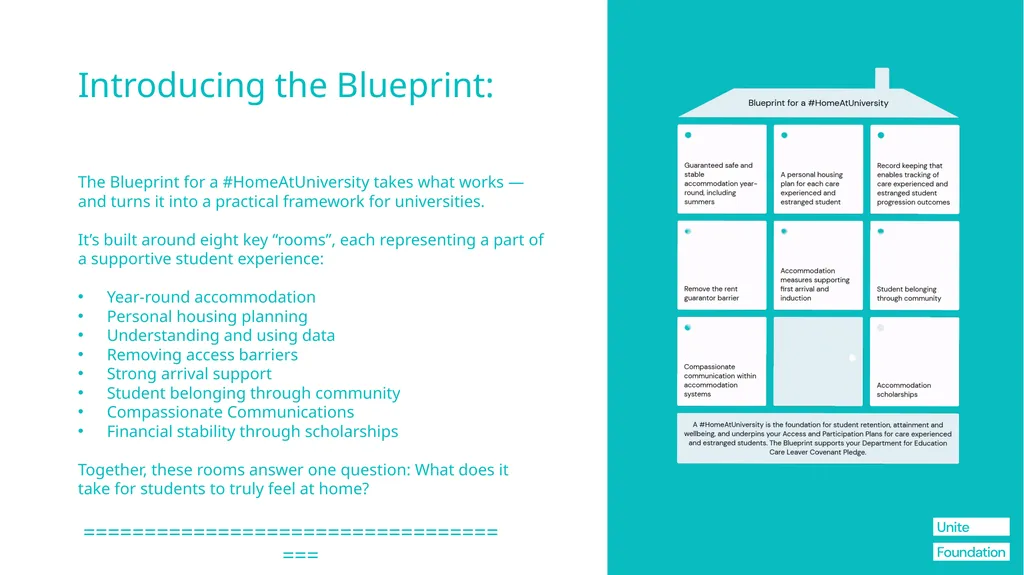
Introducing the Blueprint: The Blueprint for a #HomeAtUniversity takes what works — and turns it into a practical framework for universities.
It’s built around eight key “rooms”, each representing a part of a supportive student experience:
Year-round accommodation
Personal housing planning
Understanding and using data
Removing access barriers
Strong arrival support
Student belonging through community
Compassionate Communications
Financial stability through scholarships
Together, these rooms answer one question: What does it take for students to truly feel at home? =====================================<br>
08
What this is (and isn’t): The Blueprint isn’t a checklist.
It’s a way of:
• Spotting gaps in your current services
• Identifying what good looks
• Taking practical steps to improve
👉 You won’t be doing it alone. The Unite Foundation provides the tools to help your SU along the way. =====================================<br>
It’s a way of:
• Spotting gaps in your current services
• Identifying what good looks
• Taking practical steps to improve
👉 You won’t be doing it alone. The Unite Foundation provides the tools to help your SU along the way. =====================================<br>
09
Be part of the bigger picture: This work doesn’t stop at one university.
The Unite Foundation wants to hear from you:
• What’s working well?
• Where are the pinch points?
• What practice goes beyond the Blueprint?
👉 By sharing this, you help shape the future of support across the sector. =====================================<br>
The Unite Foundation wants to hear from you:
• What’s working well?
• Where are the pinch points?
• What practice goes beyond the Blueprint?
👉 By sharing this, you help shape the future of support across the sector. =====================================<br>
10
Group Discussion: What have your own experiences of life on campus be like?
What could improve life living on campus for students, including care-experienced and estranged students? =====================================<br>
What could improve life living on campus for students, including care-experienced and estranged students? =====================================<br>
11
Key takeaway: This isn’t just about accommodation.
It’s about:
• Fairness
• Belonging
• And whether all students have the chance to succeed
👉 A home at university shouldn’t be the exception — it should be the expectation. =====================================<br>
It’s about:
• Fairness
• Belonging
• And whether all students have the chance to succeed
👉 A home at university shouldn’t be the exception — it should be the expectation. =====================================<br>
12
Room 1: Guaranteed
Year-Round Accommodation<br>
Year-Round Accommodation<br>
13
The Big Idea: Imagine trying to succeed at university… without knowing where you’ll live for part of the year.
For many care-experienced and estranged students, this isn’t hypothetical — it’s reality.
Room 1 is simple:
👉 Students should have safe, stable accommodation all year round — including summer. =====================================<br>
For many care-experienced and estranged students, this isn’t hypothetical — it’s reality.
Room 1 is simple:
👉 Students should have safe, stable accommodation all year round — including summer. =====================================<br>
14
Why This Matters: University systems often assume students can “go home” outside term time. But for some students, there is no safe home to return to.
That creates real challenges:
Nowhere to stay during long breaks (especially summer)
Expensive short-term housing options
Constant moving between places
Increased risk of homelessness
👉 If a student doesn’t know where they’re living, everything else becomes harder. =====================================<br>
15
What good looks like : When this room is “built”, students experience certainty — not crisis.
Strong approaches include:
Guaranteed or priority access to halls during vacation periods
Proactive communication (students are told early and often)
Emergency accommodation options when things go wrong
Joined-up support (housing + finance + wellbeing working together)
👉 The key shift: From “support if things go wrong” to “stability built into the system.” =====================================<br>
16
In practice: University of Strathclyde At Strathclyde, this room is already taking shape:
Summer accommodation available for care-experienced and estranged students
Priority / guaranteed access to halls
Emergency housing for crisis situations
Information shared before arrival and throughout the student journey
Strong links between accommodation, support staff, and external partners
In one year, 16 students were supported over the summer.
👉 What stands out isn’t just the offer — it’s how proactive and joined-up it is. =====================================<br>
17
What to watch for Even strong systems can have gaps:
Not all students may be eligible for financial support (e.g. estranged students)
Some periods may not be covered
👉 This means housing support must connect with financial advice and wider policy. =====================================<br>
Not all students may be eligible for financial support (e.g. estranged students)
Some periods may not be covered
👉 This means housing support must connect with financial advice and wider policy. =====================================<br>
18
Group Discussion: What could the possible impacts be of housing instability?
What sort of questions should the SU ask the University about housing stability and year-round accommodation? =====================================<br>
What sort of questions should the SU ask the University about housing stability and year-round accommodation? =====================================<br>
19
Key Takeaway: This isn’t just about rooms or rent.
It’s about:
Stability
Fairness
And whether students can fully take part in university life
A home at university shouldn’t stop when term ends. =====================================<br>
It’s about:
Stability
Fairness
And whether students can fully take part in university life
A home at university shouldn’t stop when term ends. =====================================<br>
20
Room 2: Personal Housing Plan<br>
21
The Big Idea: Imagine trying to study, work, and plan your future… while constantly worrying about where you’ll live.
For care-experienced and estranged students, housing decisions aren’t just choices, they’re high stakes.
Room 2 is simple:
👉 Every student should have a clear, supported personal housing plan. =====================================<br>
For care-experienced and estranged students, housing decisions aren’t just choices, they’re high stakes.
Room 2 is simple:
👉 Every student should have a clear, supported personal housing plan. =====================================<br>
22
Why This Matters : All students think about housing — where, when, how much. But for some students, the consequences are much bigger.
Without support, this can mean:
Constant stress about future housing
Real risk of homelessness at transition points
Last-minute decisions with limited options
Not asking for help due to stigma or lack of trust
👉 If housing isn’t planned, it quickly becomes a crisis. =====================================<br>
23
What Good Looks Like : When this room is “built”, students are supported early — not just when things go wrong.
Strong approaches include:
Accommodation planning for the full university journey is at the heart of welcome and induction
Housing discussed routinely at check-in alongside finance, wellbeing, and study
A regular contact students can build trust with
👉 The key shift: From “students ask for help” to “support checks in with students.” =====================================<br>
24
In practice: University of Bath At Bath, this room is built into the student experience:
One-to-one meetings every semester, every year
Dedicated support for care-experienced, estranged students, carers, and others
A consistent structure — so students know what to expect
Housing always part of the conversation, alongside wellbeing and finances
These conversations aren’t siloed — they connect students to the right support without them having to repeat their story multiple times.
Around 260 students engage with this system each year. =====================================<br>
25
What to watch for: Even well-designed systems need careful delivery:
Housing planning needs to feel safe, consistent and non-judgemental
Students may hesitate to disclose relevant information if ‘student to university’ conversations are not holistic
Housing should be an explicit conversation component for all students not just care-experienced and estranged students
👉 Trust is what makes this room work — not just process. =====================================<br>
26
Key Takeaway: This isn’t about paperwork or forms.
It’s about:
Staying ahead of risk
Building trust
And making sure no student is navigating alone
👉 A #HomeAtUniversity isn’t just about where you live — it’s about knowing what comes next. =====================================<br>
It’s about:
Staying ahead of risk
Building trust
And making sure no student is navigating alone
👉 A #HomeAtUniversity isn’t just about where you live — it’s about knowing what comes next. =====================================<br>
27
Room 3: Record Keeping<br>
28
The Big Idea : Imagine trying to improve something without knowing what’s working.
That’s the challenge this room tackles.
Room 3 is simple:
👉 Universities should consistently identify, record input, and track student outcomes; using that insight to improve accommodation systems and support. =====================================<br>
That’s the challenge this room tackles.
Room 3 is simple:
👉 Universities should consistently identify, record input, and track student outcomes; using that insight to improve accommodation systems and support. =====================================<br>
29
Why this matters : Care-experienced and estranged students are often a small and under-identified group.
That means their experiences can easily be missed.
Without good data, universities can’t answer key questions:
Are students staying and succeeding?
Is housing support actually making a difference?
Who is still being missed?
👉 If it isn’t recorded, it’s much harder to improve. =====================================<br>
30
What good looks like When this room is “built”, data becomes a tool for insight — not just reporting.
Strong approaches include:
Consistent identification of relevant students to build a dynamic picture of the student population
Tracking participation in accommodation services uptake (e.g. guarantor schemes)
Following academic progress over time, not just at one moment
Using data actively to evaluate and improve retention
👉 The key shift: From “we think this works” to “we can see what works — and for who.” =====================================<br>
31
In practice: HEAT (Higher Education Access Tracker) HEAT shows how this room can work at scale:
Tracks students from outreach into university and beyond
Links data with national datasets (like HESA)
Captures participation in interventions over time
Enables comparison between different groups
It doesn’t just show who gets in, it helps universities understand individual student journeys and those of the wider student population. =====================================<br>
32
What to watch for Good record keeping isn’t just about systems:
Students may not always be identified or recorded consistently
Definitions (e.g. estranged vs care-experienced) can vary
Data may be collected but not meaningfully used
👉 The real value comes from turning data into action. =====================================<br>
Students may not always be identified or recorded consistently
Definitions (e.g. estranged vs care-experienced) can vary
Data may be collected but not meaningfully used
👉 The real value comes from turning data into action. =====================================<br>
33
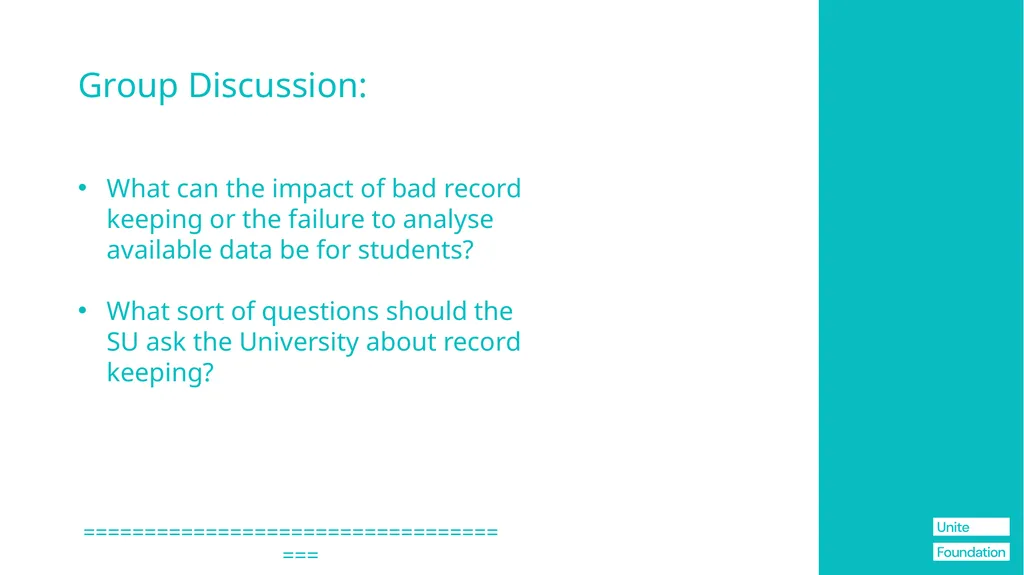
Group Discussion: What can the impact of bad record keeping or the failure to analyse available data be for students?
What sort of questions should the SU ask the University about record keeping? =====================================<br>
What sort of questions should the SU ask the University about record keeping? =====================================<br>
34
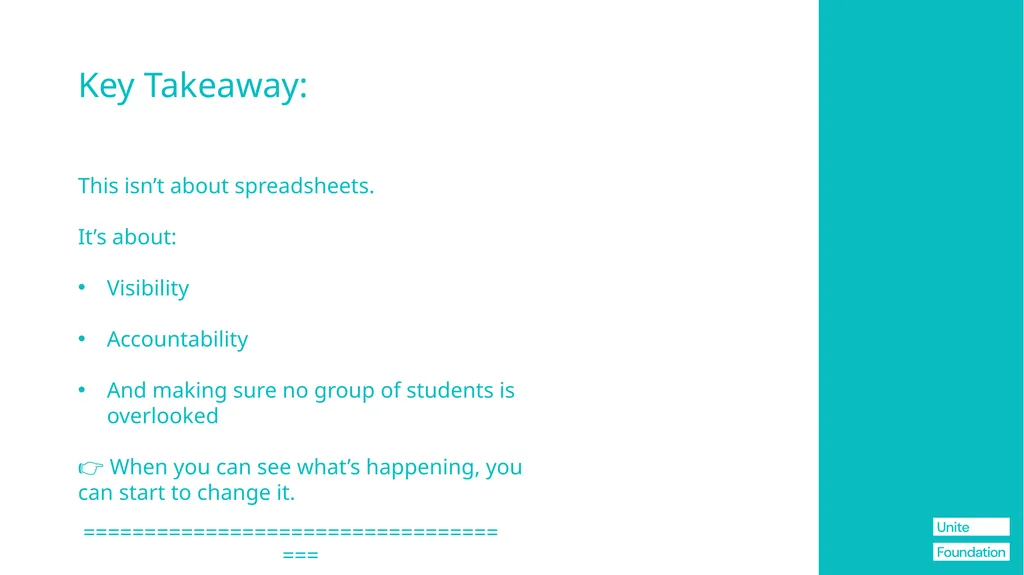
Key Takeaway: This isn’t about spreadsheets.
It’s about:
Visibility
Accountability
And making sure no group of students is overlooked
👉 When you can see what’s happening, you can start to change it. =====================================<br>
It’s about:
Visibility
Accountability
And making sure no group of students is overlooked
👉 When you can see what’s happening, you can start to change it. =====================================<br>
35
Room 4: Removing the Rent Guarantor Barrier<br>
36
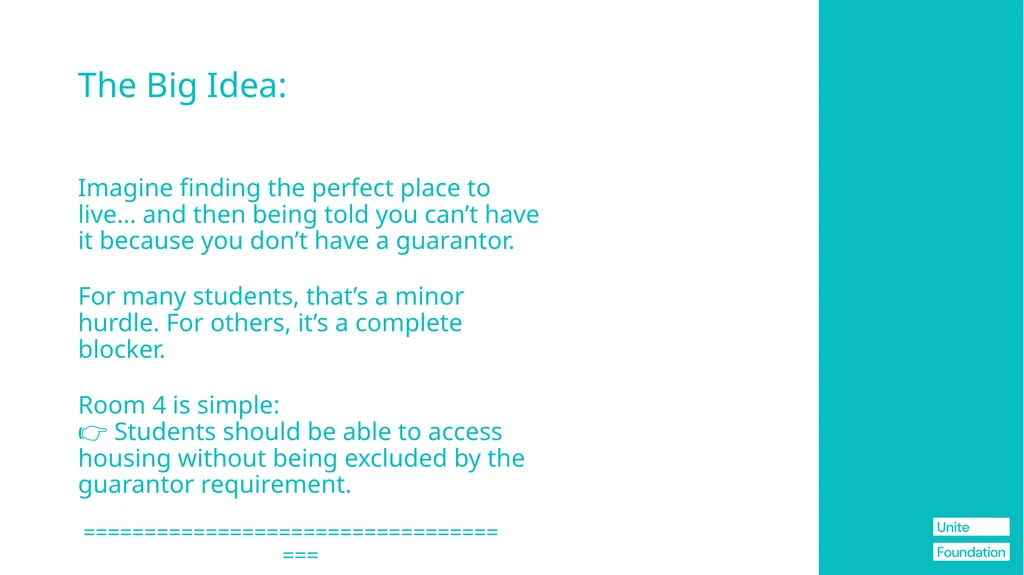
The Big Idea: Imagine finding the perfect place to live… and then being told you can’t have it because you don’t have a guarantor.
For many students, that’s a minor hurdle. For others, it’s a complete blocker.
Room 4 is simple:
👉 Students should be able to access housing without being excluded by the guarantor requirement. =====================================<br>
For many students, that’s a minor hurdle. For others, it’s a complete blocker.
Room 4 is simple:
👉 Students should be able to access housing without being excluded by the guarantor requirement. =====================================<br>
37
Why This Matters : Most landlords, PBSA providers, and some university residences require a guarantor — usually a parent or guardian who can cover unpaid rent or damages.
But for care-experienced and estranged students, that person often doesn’t exist.
This can lead to:
Being rejected from accommodation
Paying more for limited alternatives
Increased risk of unsafe or unstable housing
Barriers to moving into housing at all
👉 Housing access shouldn’t depend on who you can call for help. =====================================<br>
38
What Good Looks Like : When this room is “built”, students have real routes into housing — not dead ends.
Strong approaches include:
University-backed rent guarantor schemes
Partnerships with alternative rent guarantor providers
Clear, early information about what a rent guarantor is, and options
Support navigating the student rental market
👉 The key shift: From “you need a guarantor” to “we’ll make sure this isn’t a barrier.” =====================================<br>
39
In practice: What universities are doing Across the UK, universities are stepping in to remove this barrier:
Providing full and clear information about rent guarantors on their websites
Providing rent guarantor services for students who require them
Prioritising care-experienced and estranged students in fee-free arrangements with commercial rent guarantor providers
Removing the rent guarantor requirement in halls of residence they own or commission
👉 Schemes vary — but the principle is consistent: no student should be locked out of housing because of their circumstances. =====================================<br>
40
What to watch for Even when schemes exist, barriers can remain:
Criteria like not including 1st years, requiring a co-signer, or paying extra admin fees
Poor signposting and resulting low awareness among students at their point of need
A design and language that purely reflects a focus on international students with differing needs
👉 Removing the barrier means offering a solution and making it accessible, visible and inclusive. =====================================<br>
41
Group Discussion: What can the impact of a rent guarantor requirement be for students who cannot provide a guarantor?
What sort of questions should the SU ask the University about rent guarantors? =====================================<br>
What sort of questions should the SU ask the University about rent guarantors? =====================================<br>
42
Key Takeaway: This isn’t just about paperwork.
It’s about:
Access
Fairness
And whether students can fully participate in university life
👉 A home at university shouldn’t depend on having a guarantor. =====================================<br>
It’s about:
Access
Fairness
And whether students can fully participate in university life
👉 A home at university shouldn’t depend on having a guarantor. =====================================<br>
43
Room 5: Additional Support on Arrival<br>
44
The Big Idea: Starting university is a big moment.
Now imagine arriving… already worrying about housing, money, and whether everything will fall into place.
For some students, the transition isn’t just exciting — it’s fragile.
Room 5 is simple:
👉 Students should receive targeted, practical accommodation services early when they arrive and throughout arrival. =====================================<br>
45
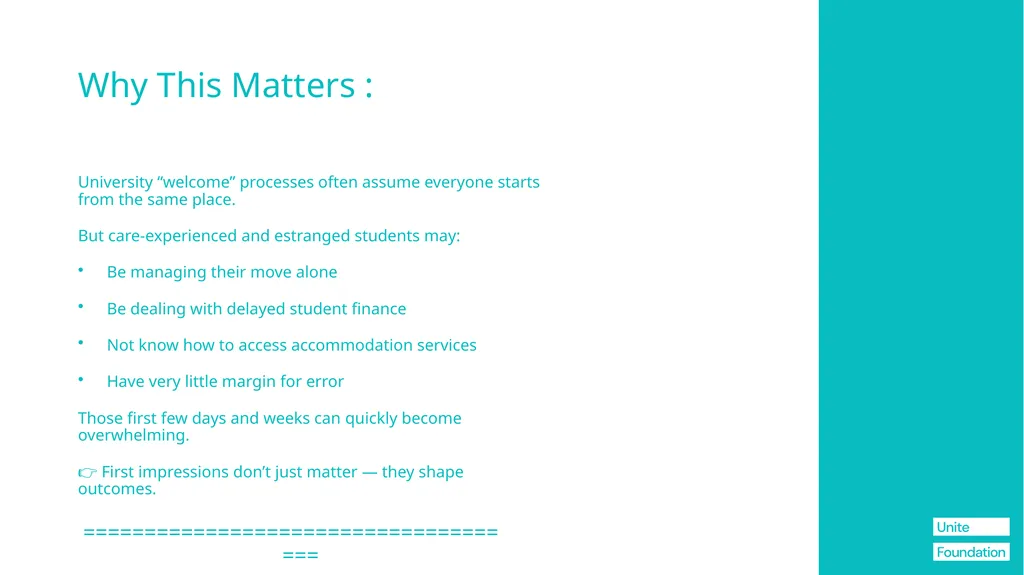
Why This Matters : University “welcome” processes often assume everyone starts from the same place.
But care-experienced and estranged students may:
Be managing their move alone
Be dealing with delayed student finance
Not know how to access accommodation services
Have very little margin for error
Those first few days and weeks can quickly become overwhelming.
👉 First impressions don’t just matter — they shape outcomes. =====================================<br>
46
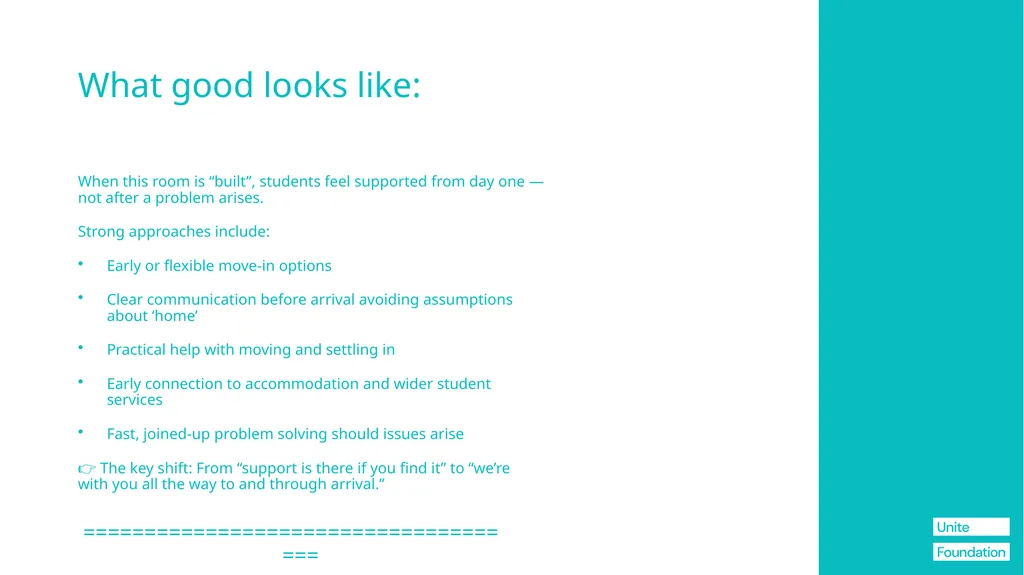
What good looks like: When this room is “built”, students feel supported from day one — not after a problem arises.
Strong approaches include:
Early or flexible move-in options
Clear communication before arrival avoiding assumptions about ‘home’
Practical help with moving and settling in
Early connection to accommodation and wider student services
Fast, joined-up problem solving should issues arise
👉 The key shift: From “support is there if you find it” to “we’re with you all the way to and through arrival.” =====================================<br>
47
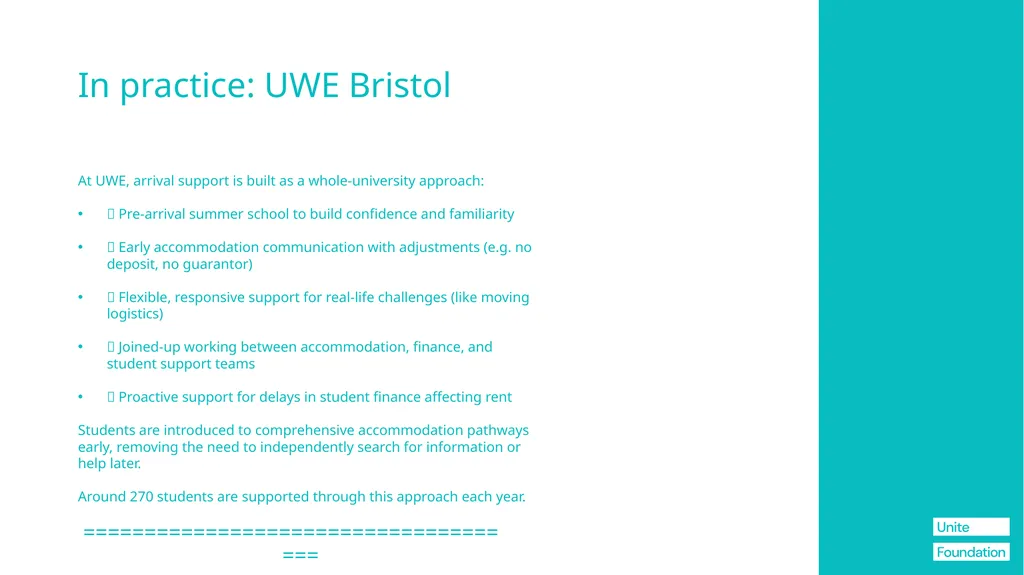
In practice: UWE Bristol At UWE, arrival support is built as a whole-university approach:
✅ Pre-arrival summer school to build confidence and familiarity
✅ Early accommodation communication with adjustments (e.g. no deposit, no guarantor)
✅ Flexible, responsive support for real-life challenges (like moving logistics)
✅ Joined-up working between accommodation, finance, and student support teams
✅ Proactive support for delays in student finance affecting rent
Students are introduced to comprehensive accommodation pathways early, removing the need to independently search for information or help later.
Around 270 students are supported through this approach each year. =====================================<br>
48
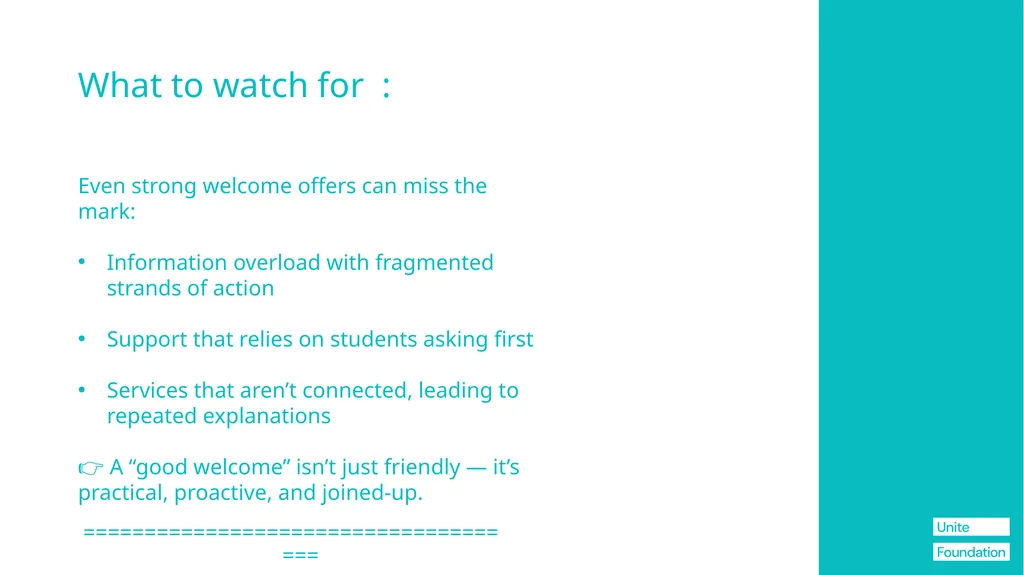
What to watch for : Even strong welcome offers can miss the mark:
Information overload with fragmented strands of action
Support that relies on students asking first
Services that aren’t connected, leading to repeated explanations
👉 A “good welcome” isn’t just friendly — it’s practical, proactive, and joined-up. =====================================<br>
Information overload with fragmented strands of action
Support that relies on students asking first
Services that aren’t connected, leading to repeated explanations
👉 A “good welcome” isn’t just friendly — it’s practical, proactive, and joined-up. =====================================<br>
49
Group Discussion: What impact can a lack of support on arrival have, for students who lack support elsewhere?
What sort of questions should the SU ask the University about support for students on arrival? =====================================<br>
What sort of questions should the SU ask the University about support for students on arrival? =====================================<br>
50
Key Takeaway: This isn’t just about welcome events.
It’s about:
Safety and stability
Confidence
Practical input that sets students up to succeed from the very start
👉 A #HomeAtUniversity should feel like a home — from before, through and after arrival. =====================================<br>
It’s about:
Safety and stability
Confidence
Practical input that sets students up to succeed from the very start
👉 A #HomeAtUniversity should feel like a home — from before, through and after arrival. =====================================<br>
51
Room 6:
Student Belonging Through Community<br>
Student Belonging Through Community<br>
52
The Big Idea: Imagine arriving at university and feeling like everyone else already has their people. A family to call. Friends from home. A place to go during the weekends, holidays, and quieter times of year.
For care-experienced and estranged students, those connections can be harder to find.
Room 6 is simple:
👉 Students should have opportunities to build meaningful connections, community, and a sense of belonging throughout their time at university. =====================================<br>
For care-experienced and estranged students, those connections can be harder to find.
Room 6 is simple:
👉 Students should have opportunities to build meaningful connections, community, and a sense of belonging throughout their time at university. =====================================<br>
53
Why This Matters: University success is about accommodation, finances, and academic experience. It’s also about belonging.
Care-experienced and estranged students may be more likely to experience:
The perception that they are different from other students, and a stigma of shame about their lived experience
Limited or not networks to turn to for emotional support and connection
Difficult experiences during holidays, celebratory periods and university closures
Challenges finding a commonality with others and their ‘place’ within university life.
👉 A student can have a room in halls and still feel isolated. A #HomeAtUniversity is about community connection as well as accommodation. =====================================<br>
54
What Good Looks Like: When this room is “built”, universities and Students’ Unions actively create opportunities for belonging through community.
Strong approaches include:
Care-experienced and estranged student societies, networks or liberation groups
Informal social opportunities throughout the year using halls and other university spaces as hosting resource
Activities in accommodation during holiday periods, inviting private residential students in too, to make campus a vibrant space full of social connection
Activity that focusses on social connection for its own sake as well as practical ‘need’, with wide opportunity for students to shape content and lead
Online communities that help students feel seen and stay connected locally, regionally and nationally
👉 The key shift: From “Students know support exists.” to “Students belong to a community. =====================================<br>
55
In Practice: University of Bristol At the University of Bristol, the university recognises that belonging and connection are essential components of student success. The university:
Supports a Care Leavers and Estranged Students Society which hosts informal social events throughout the year
Maintains contact during vacation periods and collaborates with accommodation team o organise events during quiet periods
Creates opportunities for peer connection in halls and faculties through signposting and trust building
Encourages students to shape activities and support opportunities
👉 The focus isn’t about organising events. It’s on enabling successive cohorts of students to find and continually build belonging through community. =====================================<br>
56
Community Beyond the Campus Community doesn’t have to stop at the university gates.
The Unite Foundation supports All of Us – a UK-wide community exclusively for care-experienced and estranged students.
All of Us provides routes – online and in real life – for care-experienced and estranged students to connect with one another. =====================================<br>
The Unite Foundation supports All of Us – a UK-wide community exclusively for care-experienced and estranged students.
All of Us provides routes – online and in real life – for care-experienced and estranged students to connect with one another. =====================================<br>
57
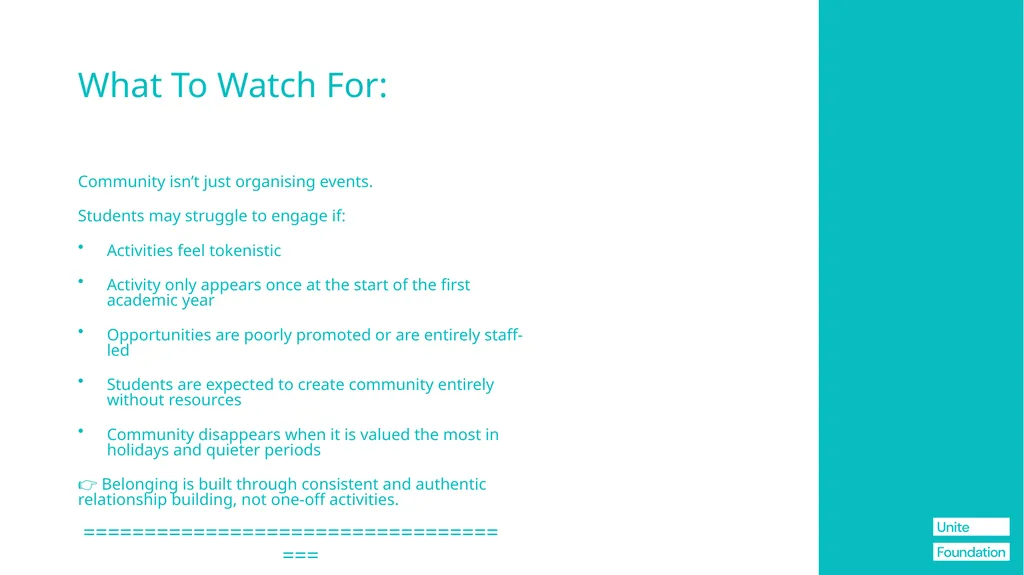
What To Watch For: Community isn’t just organising events.
Students may struggle to engage if:
Activities feel tokenistic
Activity only appears once at the start of the first academic year
Opportunities are poorly promoted or are entirely staff-led
Students are expected to create community entirely without resources
Community disappears when it is valued the most in holidays and quieter periods
👉 Belonging is built through consistent and authentic relationship building, not one-off activities. =====================================<br>
58
Group Discussion: What impact can a lack of a sense of community or belonging have on students?
What sort of questions should the SU ask the University about building a sense of community at university? =====================================<br>
What sort of questions should the SU ask the University about building a sense of community at university? =====================================<br>
59
Key Takeaway: This isn’t just about events.
It’s about:
Belonging
Friendship
Connection
And knowing that you’re not facing university alone
A safe and stable #HomeAtUniversity isn’t only a place to stay. It’s a community that stays with you. Everyone needs somewhere to belong.
👉 No student should feel like they’re navigating university on their own. =====================================<br>
60
Room 6:
Compassionate Communications<br>
Compassionate Communications<br>
61
The Big Idea: Imagine missing a rent payment. Now imagine receiving an email that focuses on penalties rather than understanding.
For many students, that’s stressful. For care-experienced and estranged students it can trigger anxiety, undermine mental health and; reinforce feelings of not belonging.
Room 7 is simple:
👉 Universities should communicate with care-experienced and estranged students in ways that are clear, compassionate, and recognise their housing circumstances. =====================================<br>
62
Why This Matters: Many university automated systems are designed to communicate risk. Escalate immediately, to prompt resolution by the student. They can also convey assumptions that everyone has family, and all ‘go home’ at some point.
While efficient, they are often impersonal, highly triggering and without consideration of the recipient.
Care-experienced and estranged students may be :
Living in halls all year round
In a crisis unrelated to housing and their anomalous compliance is a soft signal of welfare need
Managing risk of homelessness
Navigating the process without the support of a trusted adult
👉 The way we communicate can either build trust or create barriers. =====================================<br>
63
What Good Looks Like: When this room is “built”, communication is designed around understanding, not just compliance.
Strong approaches include:
Using empathetic and student-centred language without assumption on ‘home’ or ‘family’
Welfare first; assuming students may need help, not just enforcement
Detailing trusted support routes alongside problems
Routinely establishing constructive relationships in buildings before situations escalate
Reviewing template communications through a care-experienced and estranged student lens
👉 The key shift: From “You have failed and are in trouble.” to “We can help you sort this. =====================================<br>
64
In Practice: At universities that have implemented this room, care-experienced and estranged students are recognised as a group who may face additional barriers and stressors.
Before accommodation issues arise:
Template communications are reviewed for tone, accessibility, and inclusivity
Accommodation services or student support contracts, that are already familiar, are signposted alongside every request for action
An environment exists where students and accommodation teams have opportunity to communicate before situations can escalate
Accommodation teams knowledgeable across diversity, disability and communication barriers embed that expertise into systems design
👉 Accommodation inclusion can be emphasised rather than undermined by reviewing communication policy and templates. =====================================<br>
65
What To Watch For: Compassionate accommodation communication doesn’t mean avoiding difficult conversations.
Students still need:
Clear Expectations
Accurate information that is pertinent to their specific needs
Awareness of consequences in the event of issues
👉 Communications can be clear, inclusive and compassionate. =====================================<br>
Students still need:
Clear Expectations
Accurate information that is pertinent to their specific needs
Awareness of consequences in the event of issues
👉 Communications can be clear, inclusive and compassionate. =====================================<br>
66
Group Discussion: What can the impact be of an approach to communications that lacks compassion?
What sort of questions should the SU ask the University about how services communicate with students? =====================================<br>
What sort of questions should the SU ask the University about how services communicate with students? =====================================<br>
67
Key Takeaway: This isn’t just about emails.
It’s about:
Trust
Dignity
Belonging
Creating a culture where students feel seen and able to ask for help
The right message at the right time can stop a small problem becoming a crisis.
👉 A #HomeAtUniversity isn’t just built through accommodation and support. It’s built through the way institutions speak to care experienced and estranged students. =====================================<br>
68
Room 8: Accommodation Scholarships<br>
69
The Big Idea: Imagine going to university… without worrying about rent.
No juggling payments. No choosing between housing and everything else.
Room 8 is simple:
👉 Students with access to free or heavily subsidised accommodation bridge the outcomes gap. =====================================<br>
No juggling payments. No choosing between housing and everything else.
Room 8 is simple:
👉 Students with access to free or heavily subsidised accommodation bridge the outcomes gap. =====================================<br>
70
Why This Matters: For most students, accommodation is their biggest cost.
For care-experienced and estranged students, there’s often no financial safety net behind it.
That can mean:
Constant financial pressure
Use of unsafe or inappropriate housing ‘options’
More paid work with little time or energy for study
Feeling excluded from the “typical” student experience
Even when other support is in place, cost alone can still be the biggest barrier.
👉 If housing isn’t affordable, it isn’t accessible. =====================================<br>
71
What Good Looks Like: When this room is “built”, students have real financial breathing space.
Strong approaches include:
Free or subsidised accommodation scholarships
Year-round coverage (not just term time)
Clear, well promoted access for eligible students
Wraparound services alongside the accommodation offer
👉 The key shift: From “help with housing costs” → to “removing the cost completely.” =====================================<br>
72
In practice: What this looks like Across the sector, this approach is already happening:
Some universities partner with the Unite Foundation to offer 3-year scholarships for students or deliver free accommodation throughout study years themselves
Others offer a singe-year accommodation scholarship for all eligible students or discounted fees that reflect the summer period.
Others are introducing targeted schemes for care-experienced and estranged students.
Accommodation scholarships are often combined with wellbeing, transition, and community services
Partnerships with external providers or funders help scale up provision =====================================<br>
73
What to watch for Not all schemes are created equal:
Highly competitive, low value, models can reduce student incentive to apply
Short-term support may not provide full stability so whilst helpful, should be considered a full solution
Terminology around accommodation services should be described as measures of equity rather than addressing a ‘deficit’ in a student
Students may face unusual costs outside rent so continue to explore accommodation and finance holistically.
👉 The most effective schemes are predictable, accessible, and long-term. =====================================<br>
74
Group Discussion: What could the impact of an accommodation scholarship be for students?
What sort of questions should the SU ask about accommodation scholarships? =====================================<br>
What sort of questions should the SU ask about accommodation scholarships? =====================================<br>
75
Key Takeaway: This isn’t just about funding.
It’s about:
Stability
Equity
And giving students the freedom to focus on their future
👉 Removing housing costs can transform the entire student experience. =====================================<br>
It’s about:
Stability
Equity
And giving students the freedom to focus on their future
👉 Removing housing costs can transform the entire student experience. =====================================<br>
76
Thank you<br>