
THE COMMISSION FOR CONCILIATION,MEDIATION AND
DP
Published · 44 slides · 0 views
1 / 1
Description
THE COMMISSION FOR CONCILIATION,MEDIATION AND ARBITRATION 202021 ANNUAL REPORT COPYRIGHT 2 Unless otherwise indicated, copyright in this material vests in the Commission for Conciliation, Mediation and Arbitration (CCMA). No part of this
Related Topics
Share
Embed code
Download this presentation From Below
"THE COMMISSION FOR CONCILIATION,MEDIATION AND" is the property of its rightful owner. Permission is granted to download and print the materials on this website for personal, non-commercial use only, and to display it on your personal computer provided you do not modify the materials and that you retain all copyright notices contained in the materials. By downloading content from our website, you accept the terms of this agreement.
Presentation Transcript
01
THE COMMISSION FOR CONCILIATION,MEDIATION AND ARBITRATION
2020/21 ANNUAL REPORT<br>
2020/21 ANNUAL REPORT<br>
02
COPYRIGHT 2 © Unless otherwise indicated, copyright in this material vests in the Commission for Conciliation, Mediation and Arbitration (CCMA). No part of this material may be reproduced, modified or adapted in any form or by any means without the written permission of the Commission for Conciliation, Mediation and Arbitration.<br>
03
EXECUTIVE SUMMARY 3 The CCMA hereby presents 2020/21 Annual report in line with the requirements of Section 55(1)(d) of the Public Finance Management Act, 1999 (Act No.1 of 1999) (the PFMA).
The 2020/21 financial year marks the first year of the implementation of the CCMA’s 2020/21-2024/25 five year Imvuselelo- The Revival Strategy.
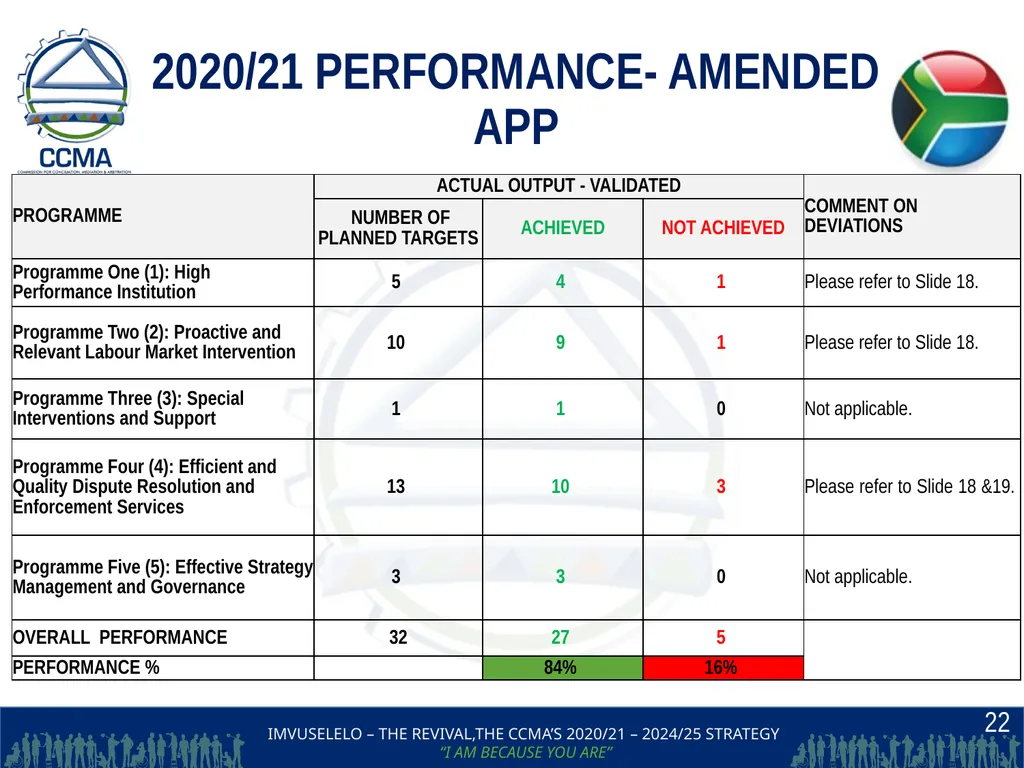
The CCMA revised its 2020/21 APP during the financial year, due to the deadly and debilitating effects of the Covid-19 pandemic and budget constraints by re-directing all efforts to core dispute resolution activities and minimising discretionary activities.
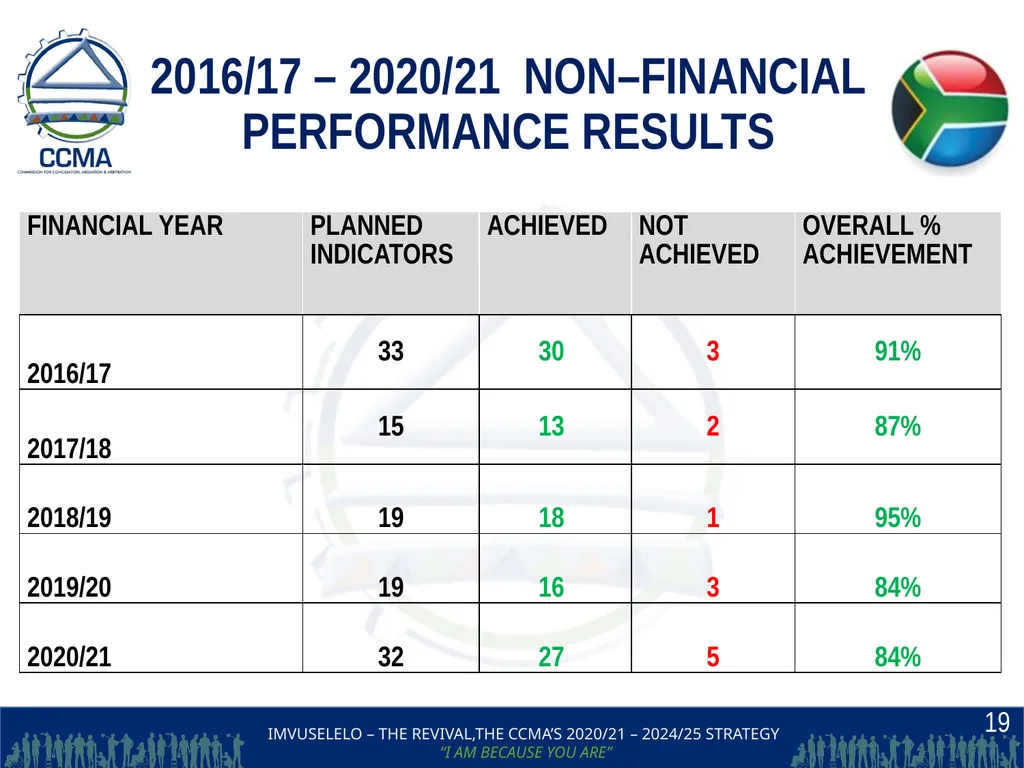
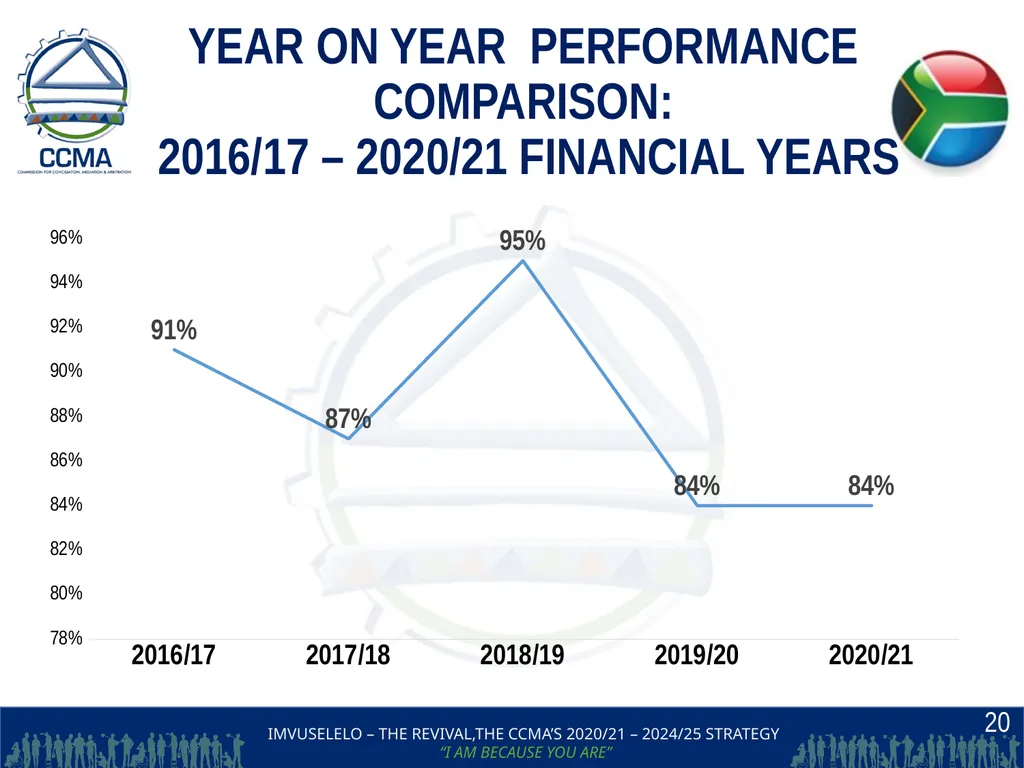
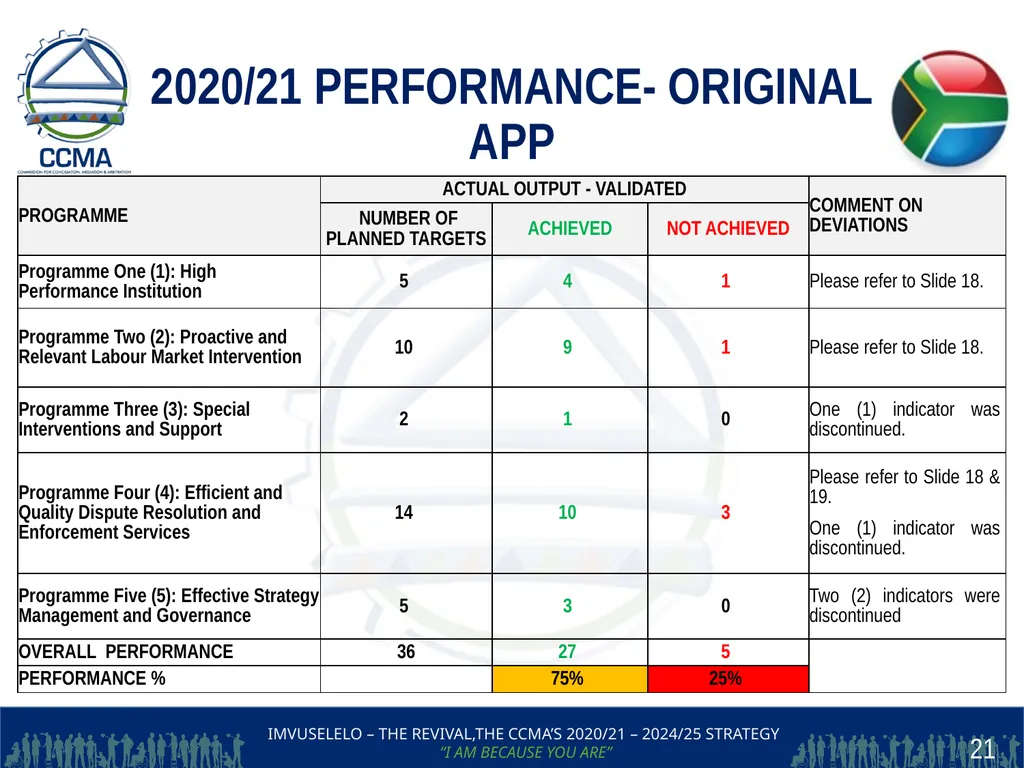
Despite the challenges, the CCMA continued to strive to make a meaningful contribution towards labour peace and equity as per strategic intent of the Imvuselelo Strategy with a total of 84% performance on the planned APP targets achieved.
The CCMA’s job saving efforts saw 58 165 jobs saved of those likely to be retrenched 138 816, with actual retrenchments recorded at 74 747. The total number of referrals as at the end of the 2020/21 financial year was recorded at 154 143, which is 67 404 less than the 2019/20 financial year.
Central to the work that was delivered in the year under review were the extensive planning processes aimed at re – positioning the CCMA appropriately to respond effectively to the CCMA’s legislated and discretionary mandate, the new policy imperatives of government, as well as the needs of the labour market.
Labour peace and equity is even more important more so now during the turbulent socio–economic conditions.<br>
The 2020/21 financial year marks the first year of the implementation of the CCMA’s 2020/21-2024/25 five year Imvuselelo- The Revival Strategy.
The CCMA revised its 2020/21 APP during the financial year, due to the deadly and debilitating effects of the Covid-19 pandemic and budget constraints by re-directing all efforts to core dispute resolution activities and minimising discretionary activities.
Despite the challenges, the CCMA continued to strive to make a meaningful contribution towards labour peace and equity as per strategic intent of the Imvuselelo Strategy with a total of 84% performance on the planned APP targets achieved.
The CCMA’s job saving efforts saw 58 165 jobs saved of those likely to be retrenched 138 816, with actual retrenchments recorded at 74 747. The total number of referrals as at the end of the 2020/21 financial year was recorded at 154 143, which is 67 404 less than the 2019/20 financial year.
Central to the work that was delivered in the year under review were the extensive planning processes aimed at re – positioning the CCMA appropriately to respond effectively to the CCMA’s legislated and discretionary mandate, the new policy imperatives of government, as well as the needs of the labour market.
Labour peace and equity is even more important more so now during the turbulent socio–economic conditions.<br>
04
4 CONSTITUTIONAL, LEGISLATIVE AND POLICY MANDATE<br>
05
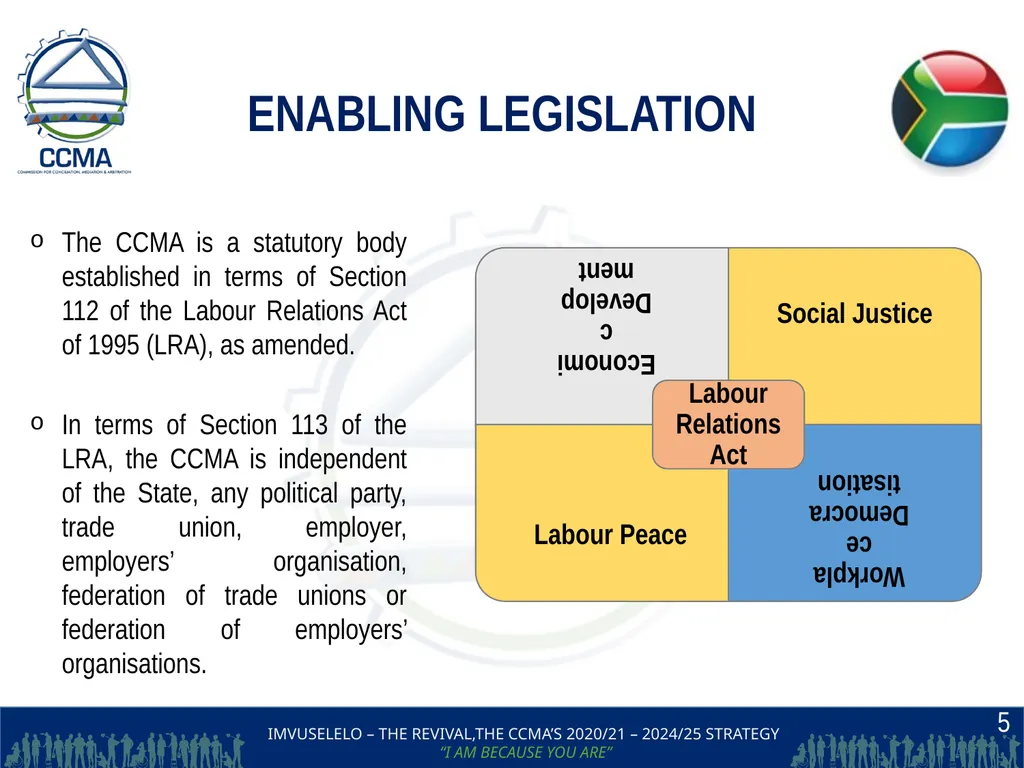
ENABLING LEGISLATION 5 The CCMA is a statutory body established in terms of Section 112 of the Labour Relations Act of 1995 (LRA), as amended.
In terms of Section 113 of the LRA, the CCMA is independent of the State, any political party, trade union, employer, employers’ organisation, federation of trade unions or federation of employers’ organisations.<br>
In terms of Section 113 of the LRA, the CCMA is independent of the State, any political party, trade union, employer, employers’ organisation, federation of trade unions or federation of employers’ organisations.<br>
06
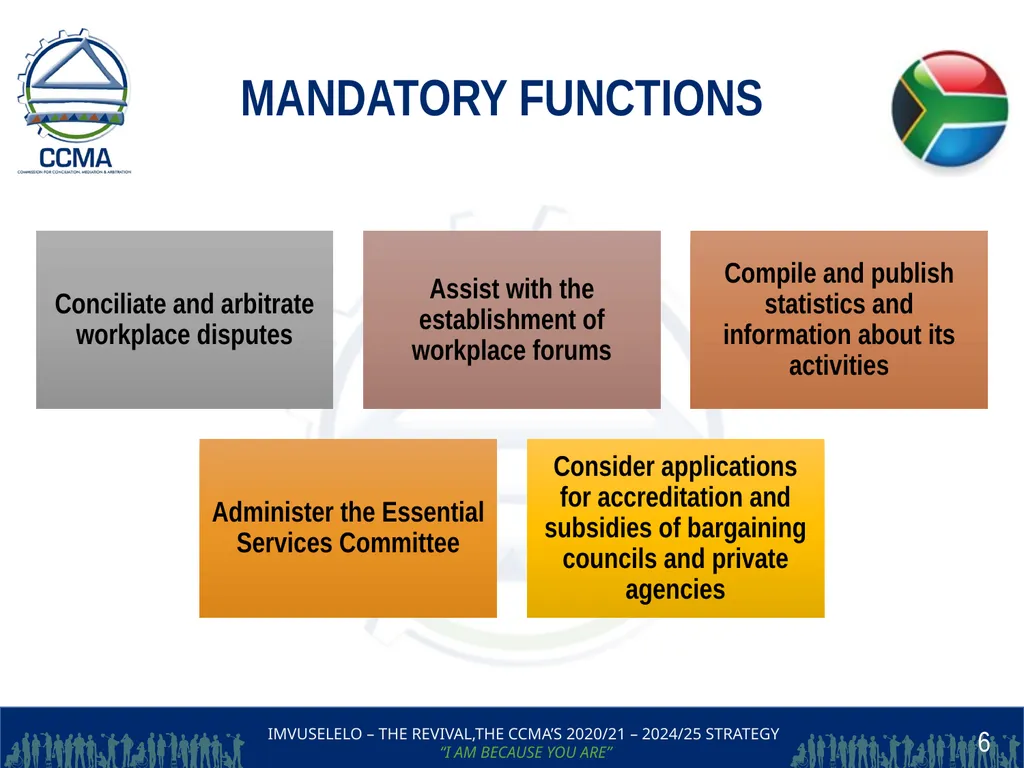
MANDATORY FUNCTIONS 6<br>
07
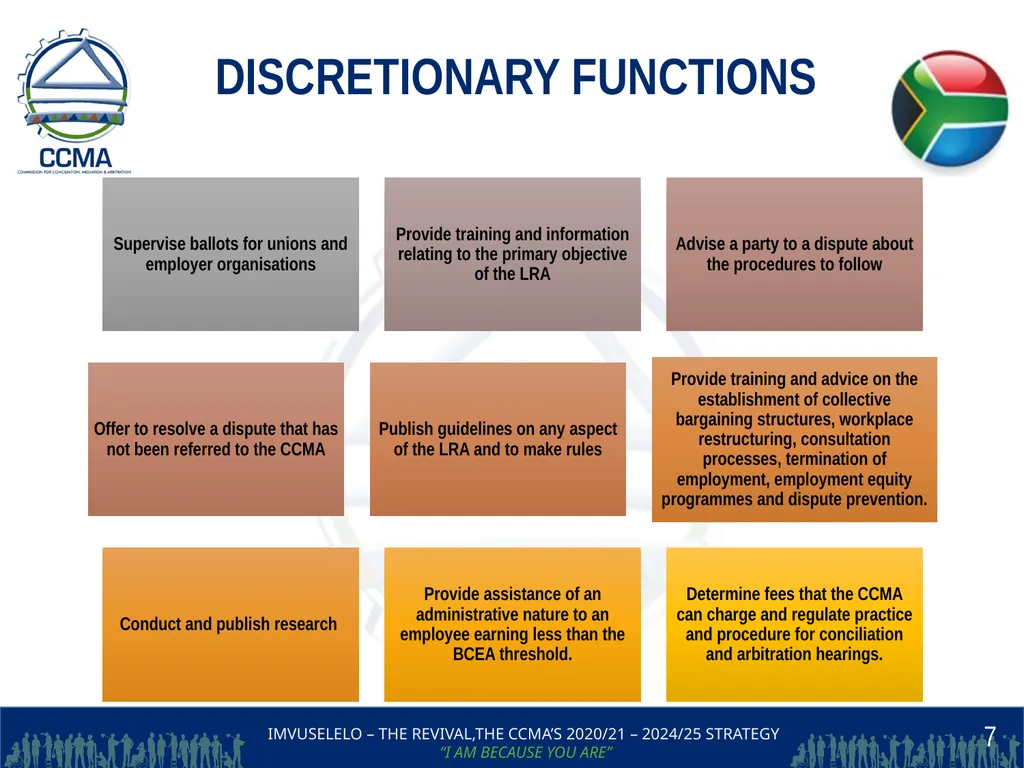
DISCRETIONARY FUNCTIONS 7<br>
08
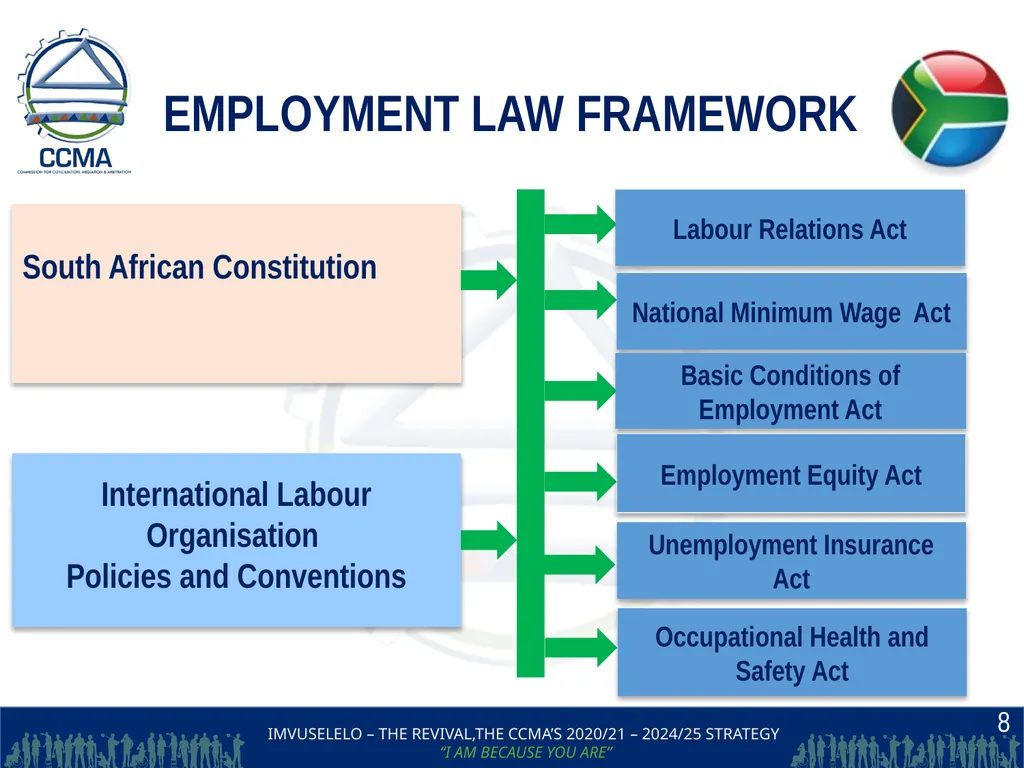
EMPLOYMENT LAW FRAMEWORK 8 South African Constitution International Labour Organisation
Policies and Conventions Labour Relations Act National Minimum Wage Act Basic Conditions of Employment Act Employment Equity Act Unemployment Insurance Act Occupational Health and Safety Act<br>
Policies and Conventions Labour Relations Act National Minimum Wage Act Basic Conditions of Employment Act Employment Equity Act Unemployment Insurance Act Occupational Health and Safety Act<br>
09
9 STRATEGIC OVERVIEW<br>
10
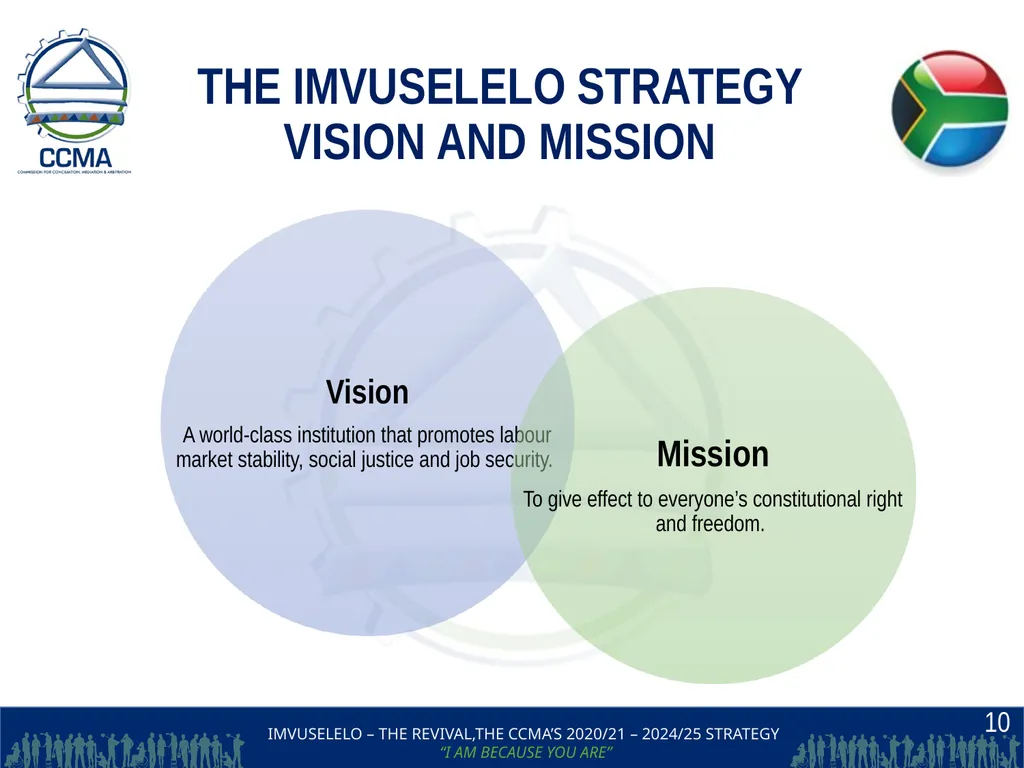
THE IMVUSELELO STRATEGY VISION AND MISSION 10<br>
11
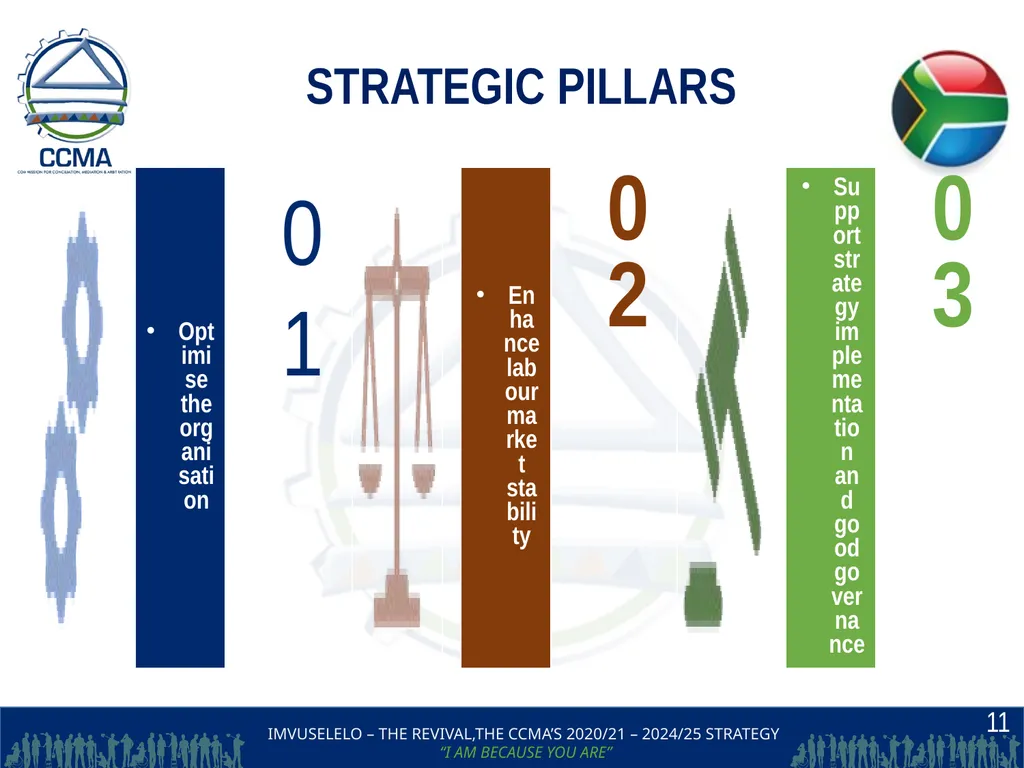
STRATEGIC PILLARS 11<br>
12
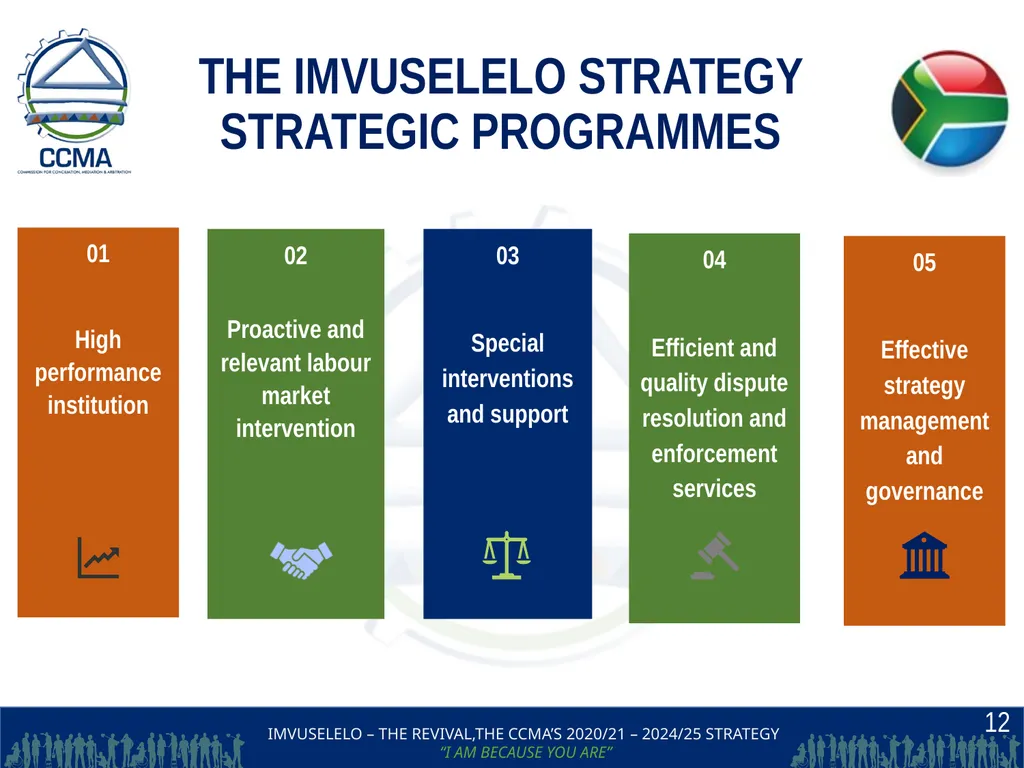
12 THE IMVUSELELO STRATEGY STRATEGIC PROGRAMMES<br>
13
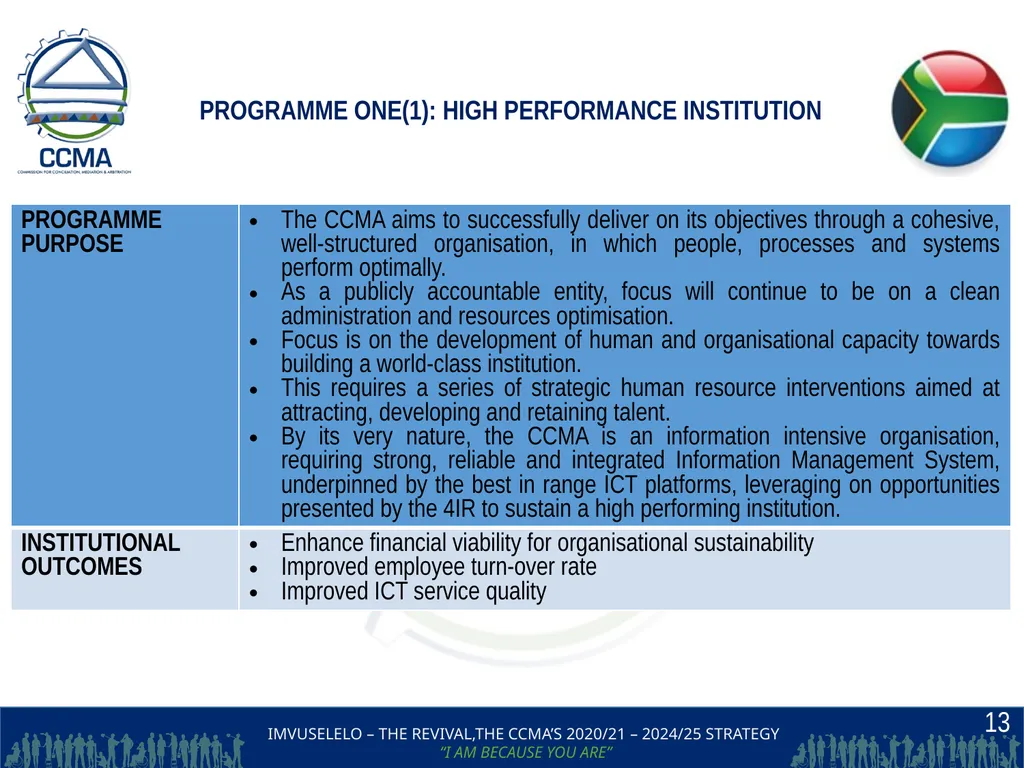
PROGRAMME ONE(1): HIGH PERFORMANCE INSTITUTION 13<br>
14
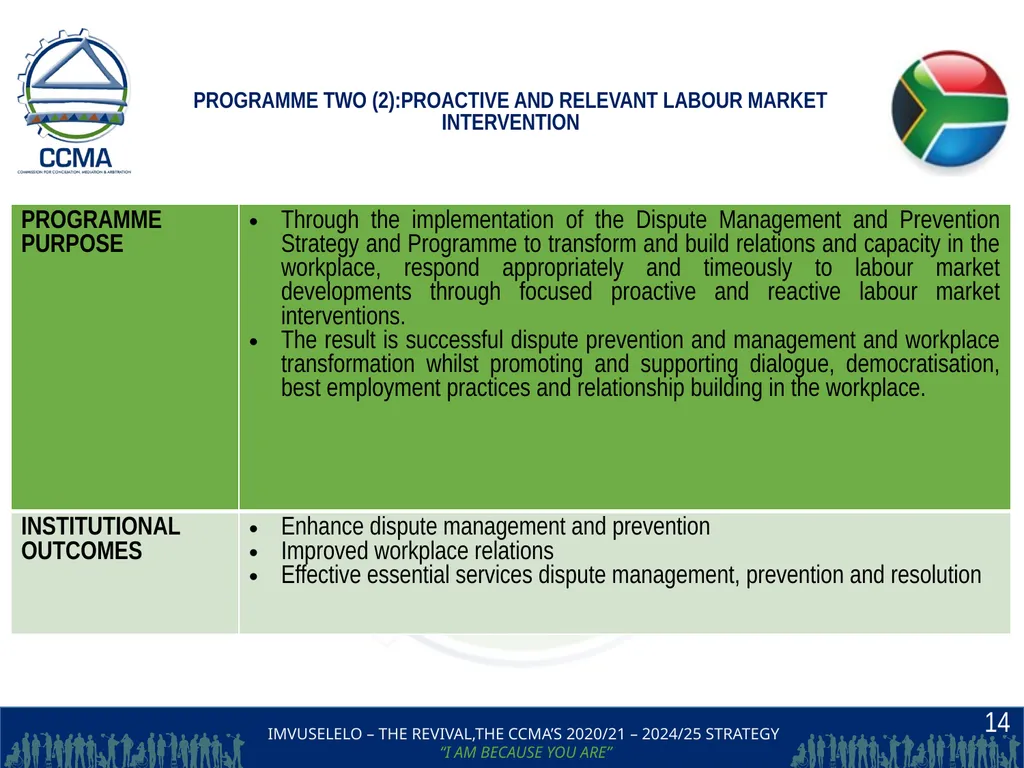
PROGRAMME TWO (2):PROACTIVE AND RELEVANT LABOUR MARKET INTERVENTION 14<br>
15
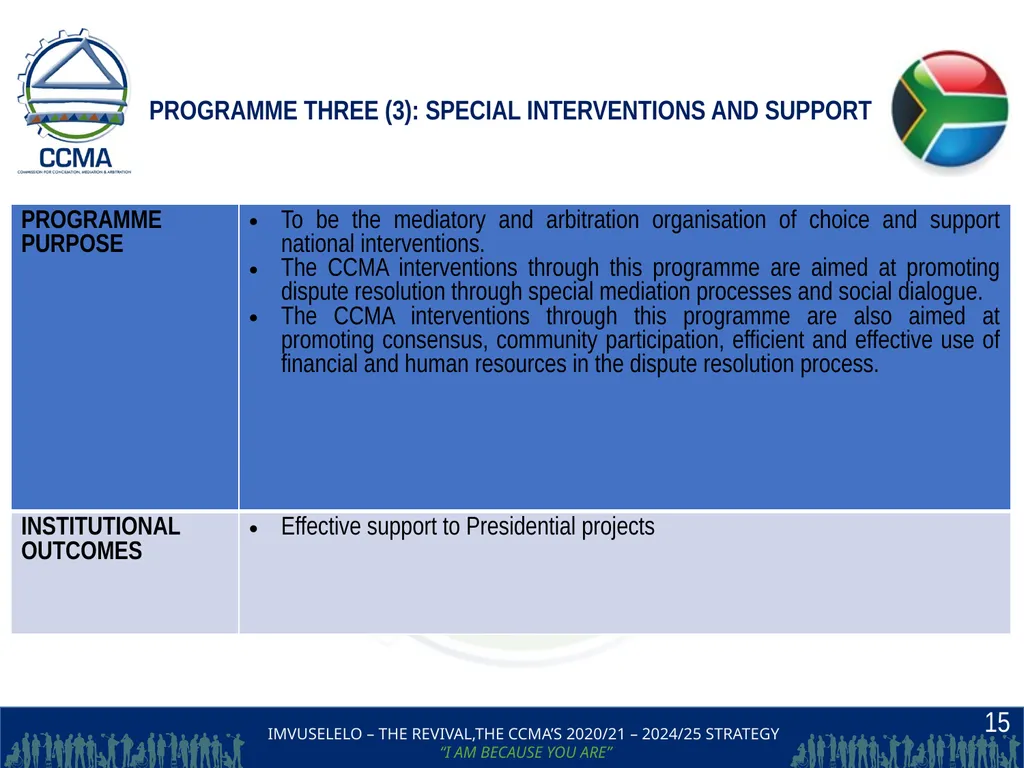
PROGRAMME THREE (3): SPECIAL INTERVENTIONS AND SUPPORT 15<br>
16
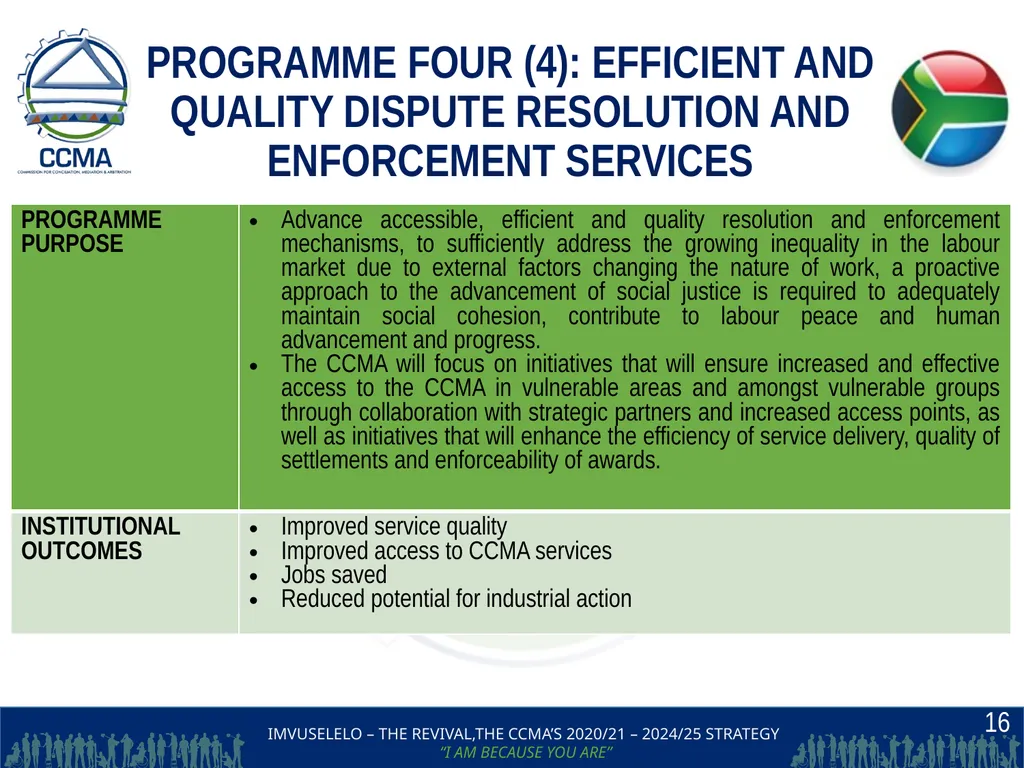
PROGRAMME FOUR (4): EFFICIENT AND QUALITY DISPUTE RESOLUTION AND ENFORCEMENT SERVICES 16<br>
17
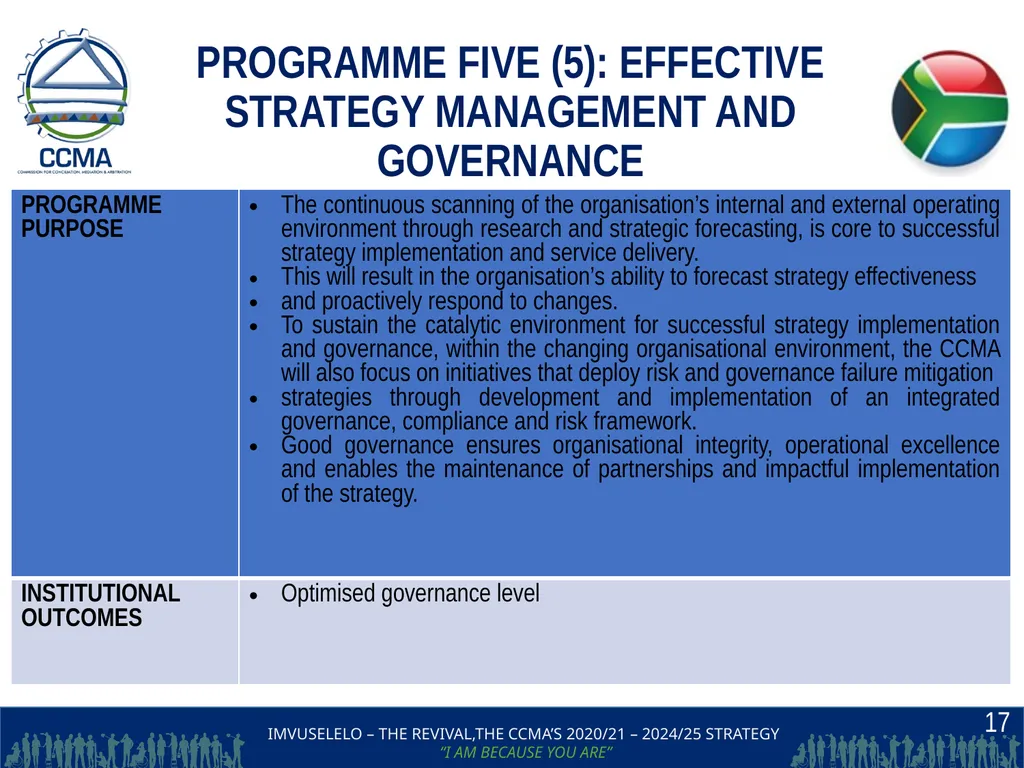
PROGRAMME FIVE (5): EFFECTIVE STRATEGY MANAGEMENT AND GOVERNANCE 17<br>
18
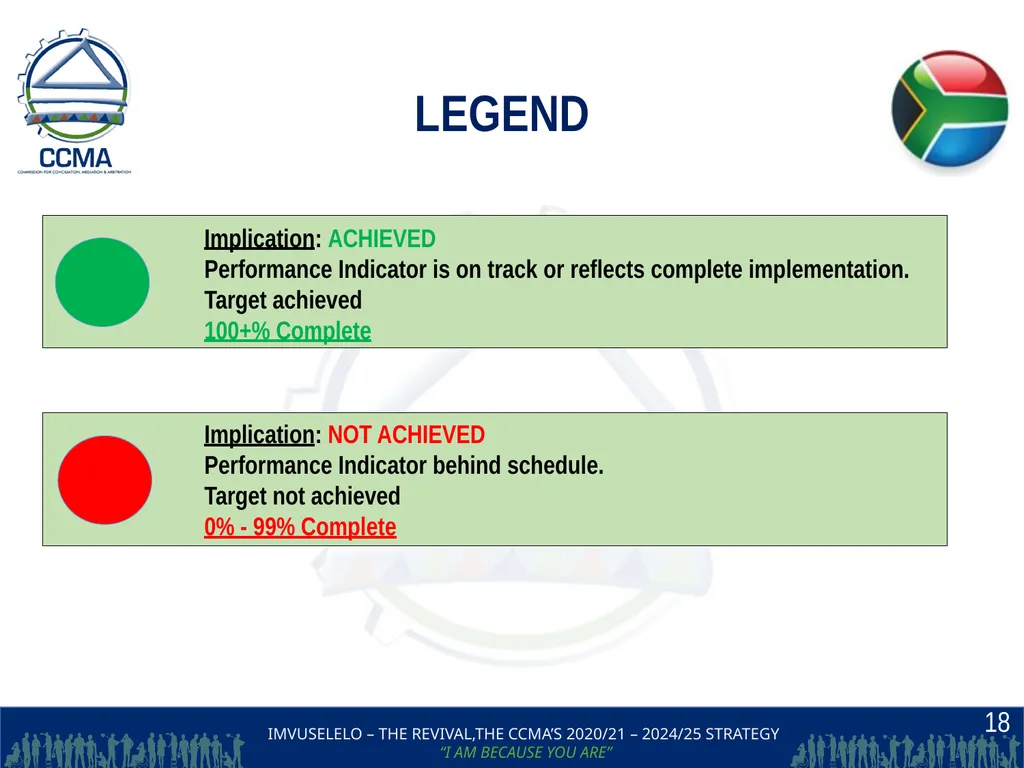
LEGEND 18 Implication: ACHIEVED
Performance Indicator is on track or reflects complete implementation. Target achieved
100+% Complete Implication: NOT ACHIEVED
Performance Indicator behind schedule.
Target not achieved
0% - 99% Complete<br>
Performance Indicator is on track or reflects complete implementation. Target achieved
100+% Complete Implication: NOT ACHIEVED
Performance Indicator behind schedule.
Target not achieved
0% - 99% Complete<br>
19
2016/17 – 2020/21 NON–FINANCIAL PERFORMANCE RESULTS 19<br>
20
YEAR ON YEAR PERFORMANCE COMPARISON:
2016/17 – 2020/21 FINANCIAL YEARS 20<br>
21
2020/21 PERFORMANCE- ORIGINAL APP 21<br>
22
2020/21 PERFORMANCE- AMENDED APP 22<br>
23
2020/21 UNDER – PERFORMING TARGETS 23<br>
24
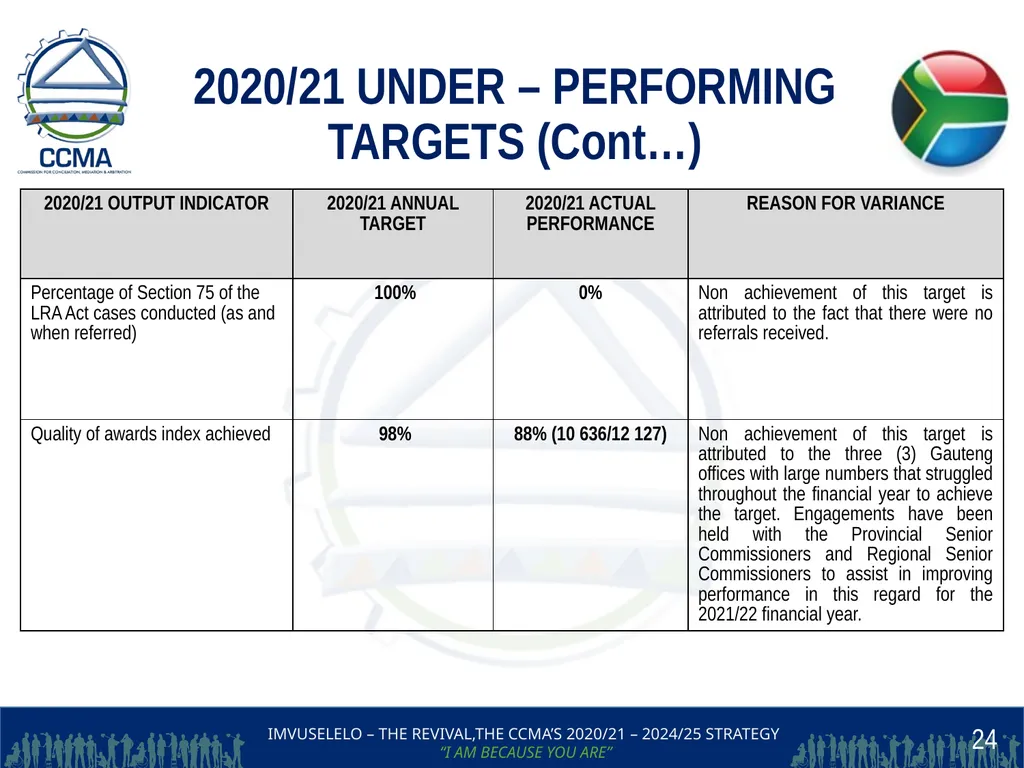
2020/21 UNDER – PERFORMING TARGETS (Cont…) 24<br>
25
EFFECTIVE AND QUALITY DISPUTE RESOLUTION 25 Priority 2 contributes towards Outcome 3: Economy and Employment
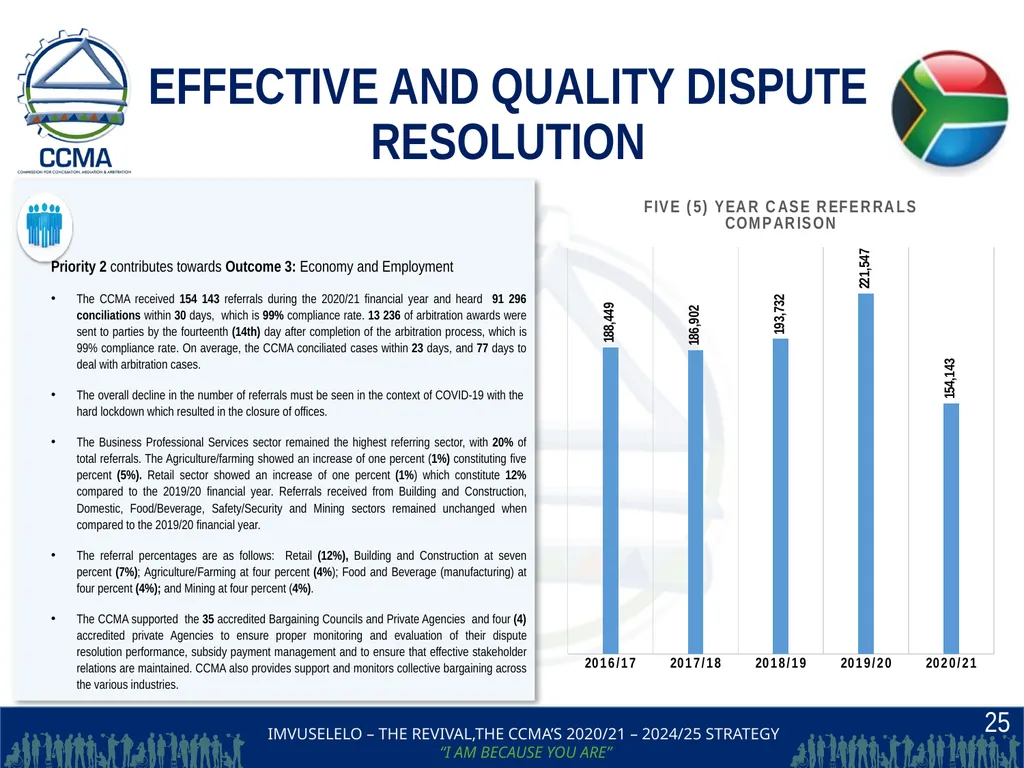
The CCMA received 154 143 referrals during the 2020/21 financial year and heard 91 296 conciliations within 30 days, which is 99% compliance rate. 13 236 of arbitration awards were sent to parties by the fourteenth (14th) day after completion of the arbitration process, which is 99% compliance rate. On average, the CCMA conciliated cases within 23 days, and 77 days to deal with arbitration cases.
The overall decline in the number of referrals must be seen in the context of COVID-19 with the hard lockdown which resulted in the closure of offices.
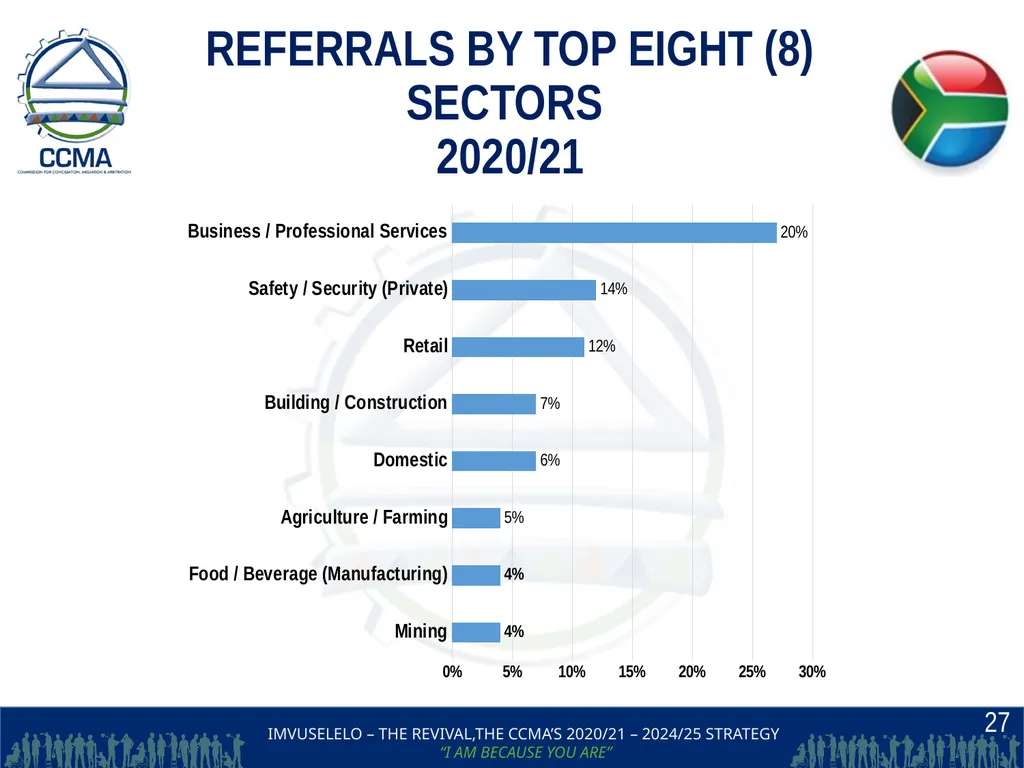
The Business Professional Services sector remained the highest referring sector, with 20% of total referrals. The Agriculture/farming showed an increase of one percent (1%) constituting five percent (5%). Retail sector showed an increase of one percent (1%) which constitute 12% compared to the 2019/20 financial year. Referrals received from Building and Construction, Domestic, Food/Beverage, Safety/Security and Mining sectors remained unchanged when compared to the 2019/20 financial year.
The referral percentages are as follows: Retail (12%), Building and Construction at seven percent (7%); Agriculture/Farming at four percent (4%); Food and Beverage (manufacturing) at four percent (4%); and Mining at four percent (4%).
The CCMA supported the 35 accredited Bargaining Councils and Private Agencies and four (4) accredited private Agencies to ensure proper monitoring and evaluation of their dispute resolution performance, subsidy payment management and to ensure that effective stakeholder relations are maintained. CCMA also provides support and monitors collective bargaining across the various industries.<br>
The CCMA received 154 143 referrals during the 2020/21 financial year and heard 91 296 conciliations within 30 days, which is 99% compliance rate. 13 236 of arbitration awards were sent to parties by the fourteenth (14th) day after completion of the arbitration process, which is 99% compliance rate. On average, the CCMA conciliated cases within 23 days, and 77 days to deal with arbitration cases.
The overall decline in the number of referrals must be seen in the context of COVID-19 with the hard lockdown which resulted in the closure of offices.
The Business Professional Services sector remained the highest referring sector, with 20% of total referrals. The Agriculture/farming showed an increase of one percent (1%) constituting five percent (5%). Retail sector showed an increase of one percent (1%) which constitute 12% compared to the 2019/20 financial year. Referrals received from Building and Construction, Domestic, Food/Beverage, Safety/Security and Mining sectors remained unchanged when compared to the 2019/20 financial year.
The referral percentages are as follows: Retail (12%), Building and Construction at seven percent (7%); Agriculture/Farming at four percent (4%); Food and Beverage (manufacturing) at four percent (4%); and Mining at four percent (4%).
The CCMA supported the 35 accredited Bargaining Councils and Private Agencies and four (4) accredited private Agencies to ensure proper monitoring and evaluation of their dispute resolution performance, subsidy payment management and to ensure that effective stakeholder relations are maintained. CCMA also provides support and monitors collective bargaining across the various industries.<br>
26
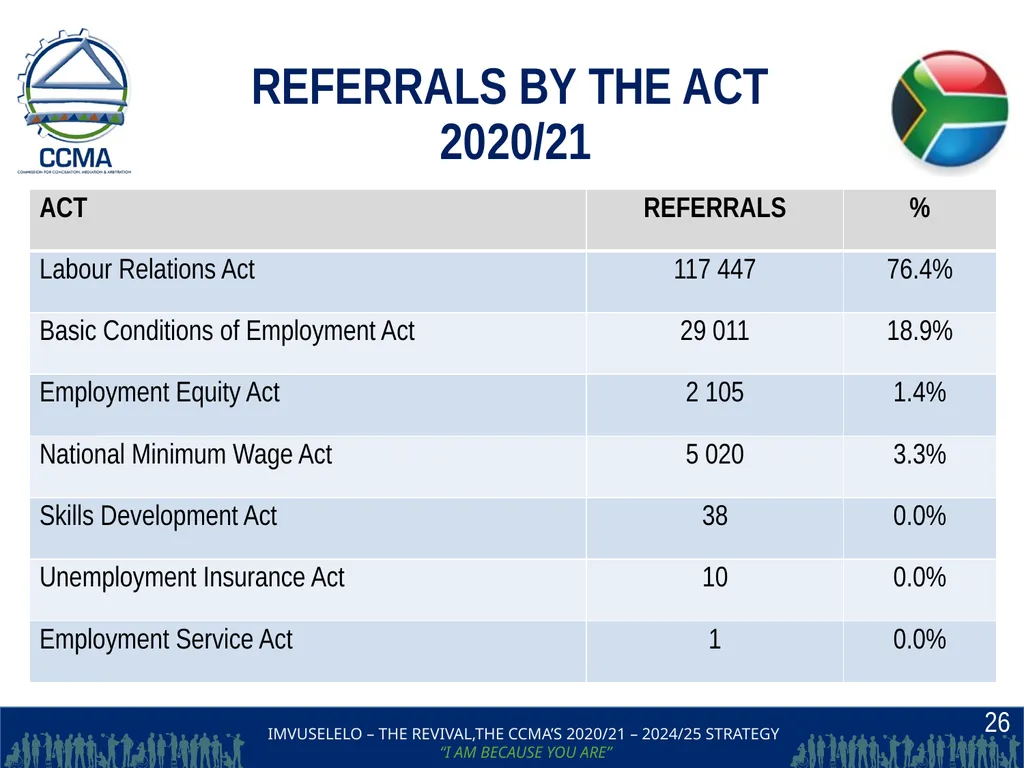
REFERRALS BY THE ACT
2020/21 26<br>
27
REFERRALS BY TOP EIGHT (8) SECTORS
2020/21 27<br>
28
2020/21 NEW JURISDICTION REFERRALS 28 THE NATIONAL MINUMUM WAGE AND EMPLOYMENT LAW AMENDMENTS
During 2020/21 financial year, the CCMA received 24 215 referrals relating to the BCEA and the NMWA. This constitutes 15.7% of the total referrals received. This represent a decline of 11 552 referrals when compared to 35 767 received in 2019/20 financial year.
The CCMA continued to strive to meet its legislative mandate, notwithstanding the soaring increase in referrals and fiscal constraints.<br>
During 2020/21 financial year, the CCMA received 24 215 referrals relating to the BCEA and the NMWA. This constitutes 15.7% of the total referrals received. This represent a decline of 11 552 referrals when compared to 35 767 received in 2019/20 financial year.
The CCMA continued to strive to meet its legislative mandate, notwithstanding the soaring increase in referrals and fiscal constraints.<br>
29
LEGISLATIVE IMPACT AND SOCIAL PROTECTION 29 Priority 3 & 6 contributes towards Outcome 6: Inclusive rural economy and Outcome 11: Social protection.
During the 2020/21 financial year, a total of 124 278 Users have accessed the CCMA services from identified sectors. These Users accessed CCMA services from identified users as follows: Agriculture (13 037), Domestic (19 218), Private Security (43 458), Retail (36 958) and Mining (11 607). In the 2020/21 financial year, the CCMA conducted 19 918 outreach services (inclusive of awareness raising activities, capacity building activities and social justice blockages activities, resulting in 44 891 954 intended beneficiaries being capacitated.
To increase effective access to the CCMA services in vulnerable sectors and vulnerable groups, a total of 296 awareness activities were delivered in support of the Advocacy Campaign Plan across eight (8) provincial offices. In addition, 13 vulnerable sector projects were delivered to targets workplaces to reduce high rate of dismissals in sectors, agriculture in particular.
The CCMA through the Essential Services Committee (ESC) engaged a total of 133 entities to ensure that there are minimums to be maintained during the industrial action in essential services. A total of 11 Essential Services Designations, Minimum Services Agreements (MSDs), Minimum Services Determinations (MSDs), and/or Maintenance Services Determinations were monitored for compliance.
Three (3) Collective Bargaining Pre-Bargaining Conferences conducted for strategically identified Users. A total of eight (8) Collective Bargaining Support Processes (CBSP) were undertaken across various sectors, which includes pre-during and post wage facilitations, balloting and verification exercises and facilitation of outstanding issues arising from wage negotiations.<br>
During the 2020/21 financial year, a total of 124 278 Users have accessed the CCMA services from identified sectors. These Users accessed CCMA services from identified users as follows: Agriculture (13 037), Domestic (19 218), Private Security (43 458), Retail (36 958) and Mining (11 607). In the 2020/21 financial year, the CCMA conducted 19 918 outreach services (inclusive of awareness raising activities, capacity building activities and social justice blockages activities, resulting in 44 891 954 intended beneficiaries being capacitated.
To increase effective access to the CCMA services in vulnerable sectors and vulnerable groups, a total of 296 awareness activities were delivered in support of the Advocacy Campaign Plan across eight (8) provincial offices. In addition, 13 vulnerable sector projects were delivered to targets workplaces to reduce high rate of dismissals in sectors, agriculture in particular.
The CCMA through the Essential Services Committee (ESC) engaged a total of 133 entities to ensure that there are minimums to be maintained during the industrial action in essential services. A total of 11 Essential Services Designations, Minimum Services Agreements (MSDs), Minimum Services Determinations (MSDs), and/or Maintenance Services Determinations were monitored for compliance.
Three (3) Collective Bargaining Pre-Bargaining Conferences conducted for strategically identified Users. A total of eight (8) Collective Bargaining Support Processes (CBSP) were undertaken across various sectors, which includes pre-during and post wage facilitations, balloting and verification exercises and facilitation of outstanding issues arising from wage negotiations.<br>
30
LABOUR MARKET STABILITY AND ECONOMIC DEVELOPMENT 30 Priority 3 of contributes towards Outcome 3: Economy and Employment, and Outcome 15: Nation-building and social cohesion
The CCMA dealt with 3 431 mutual interest disputes during this reporting period, which constitute a decrease of 1 325 compared to 4 756 dealt in the 2019/20 financial year. This has a direct bearing on labour market stability, economic growth and recovery owing to the nature and volatility of these disputes The settlement rate in these matters were recorded at 53%, which is five percent (5%) lower than the previous year.
Of the 121 public interest matters dealt with, the CCMA settled 112 public interest matters, resulting in 93% settlement rate. This is due to the CCMA’s ongoing proactive monitoring, support and guidance provided to labour market in respect of Collective Bargaining matters. The CCMA contributed in resolving various high profile disputes: NEHAWU v NHLS; Sugar Milling v FAWU, UASA& AMCU; NUMSA v Gautrain; Netcare Hospitals v HOSPERSA, among others.
The CCMA hosted a Bargaining Councils Labour Dialogue to address accreditation matters, strengthening and maintaining stakeholder relationships, identifying and addressing challenges faced by Bargaining Councils. Priority 2 contributes towards Outcome3: Economy and Employment
The CCMA’s dedicated focus to job-saving has consistently yielded commendable job-saving success. During the 2020/21 financial, a total of 58 165 jobs were saved against 138 816 employees likely to be retrenched, which resulted in 42%. Actual retrenchments recorded at 74 747, with highest recorded in Mining (15 293), Retail (8 156) and Metals (6 330) sectors.
The CCMA recorded its highest number in large-scale retrenchments (Section 189A) referrals at 1 124. The number of small-scale retrenchments recorded at 8 645 which is 37.9% increase compared to 6 267 recorded in the 2019/20 financial year.
The CCMA sustained its job-saving efforts by ensuring that partnerships with other institutions such as Productivity SA and Industrial Development Corporation have been maintained.<br>
The CCMA dealt with 3 431 mutual interest disputes during this reporting period, which constitute a decrease of 1 325 compared to 4 756 dealt in the 2019/20 financial year. This has a direct bearing on labour market stability, economic growth and recovery owing to the nature and volatility of these disputes The settlement rate in these matters were recorded at 53%, which is five percent (5%) lower than the previous year.
Of the 121 public interest matters dealt with, the CCMA settled 112 public interest matters, resulting in 93% settlement rate. This is due to the CCMA’s ongoing proactive monitoring, support and guidance provided to labour market in respect of Collective Bargaining matters. The CCMA contributed in resolving various high profile disputes: NEHAWU v NHLS; Sugar Milling v FAWU, UASA& AMCU; NUMSA v Gautrain; Netcare Hospitals v HOSPERSA, among others.
The CCMA hosted a Bargaining Councils Labour Dialogue to address accreditation matters, strengthening and maintaining stakeholder relationships, identifying and addressing challenges faced by Bargaining Councils. Priority 2 contributes towards Outcome3: Economy and Employment
The CCMA’s dedicated focus to job-saving has consistently yielded commendable job-saving success. During the 2020/21 financial, a total of 58 165 jobs were saved against 138 816 employees likely to be retrenched, which resulted in 42%. Actual retrenchments recorded at 74 747, with highest recorded in Mining (15 293), Retail (8 156) and Metals (6 330) sectors.
The CCMA recorded its highest number in large-scale retrenchments (Section 189A) referrals at 1 124. The number of small-scale retrenchments recorded at 8 645 which is 37.9% increase compared to 6 267 recorded in the 2019/20 financial year.
The CCMA sustained its job-saving efforts by ensuring that partnerships with other institutions such as Productivity SA and Industrial Development Corporation have been maintained.<br>
31
PRIORITY AND PRESIDENTIAL PROJECTS 31 Government's Youth Empowerment The Single Adjudication Committee (SAC) comprising of the CCMA, Productivity SA, DTIC and the UIF convened on weekly basis to consider TERS application.
During the 2020/21 financial year, the CCMA received a total of 121 TERS applications.
The SAC considered 88 TERS applications.
A total of 22 applications were recommended, 33 were defective or withdrawn, whilst 11 were still awaiting UIF declarations at the end of the financial year.
A total number of 3 531 employees were due to benefit from TERS.
The total funding allocated for the recommended applications is R166 134 088 as at the end of the 2020/21 financial year.
The joint BUSA-CCMA Web Tool has up-to-date information including the CCMA information sheets. The CCMA Youth in Labour Think tank was conceptualised in line with the Government’s Youth Development Policy which informed by the NDP 2030.
The platform provides youth in the labour market (Scholars/Researchers/Academics/Professionals) to share experiences and challenges.
This Think Tank forms part of Community Social Responsibility initiatives which the CCMA conduct on a regular basis.<br>
During the 2020/21 financial year, the CCMA received a total of 121 TERS applications.
The SAC considered 88 TERS applications.
A total of 22 applications were recommended, 33 were defective or withdrawn, whilst 11 were still awaiting UIF declarations at the end of the financial year.
A total number of 3 531 employees were due to benefit from TERS.
The total funding allocated for the recommended applications is R166 134 088 as at the end of the 2020/21 financial year.
The joint BUSA-CCMA Web Tool has up-to-date information including the CCMA information sheets. The CCMA Youth in Labour Think tank was conceptualised in line with the Government’s Youth Development Policy which informed by the NDP 2030.
The platform provides youth in the labour market (Scholars/Researchers/Academics/Professionals) to share experiences and challenges.
This Think Tank forms part of Community Social Responsibility initiatives which the CCMA conduct on a regular basis.<br>
32
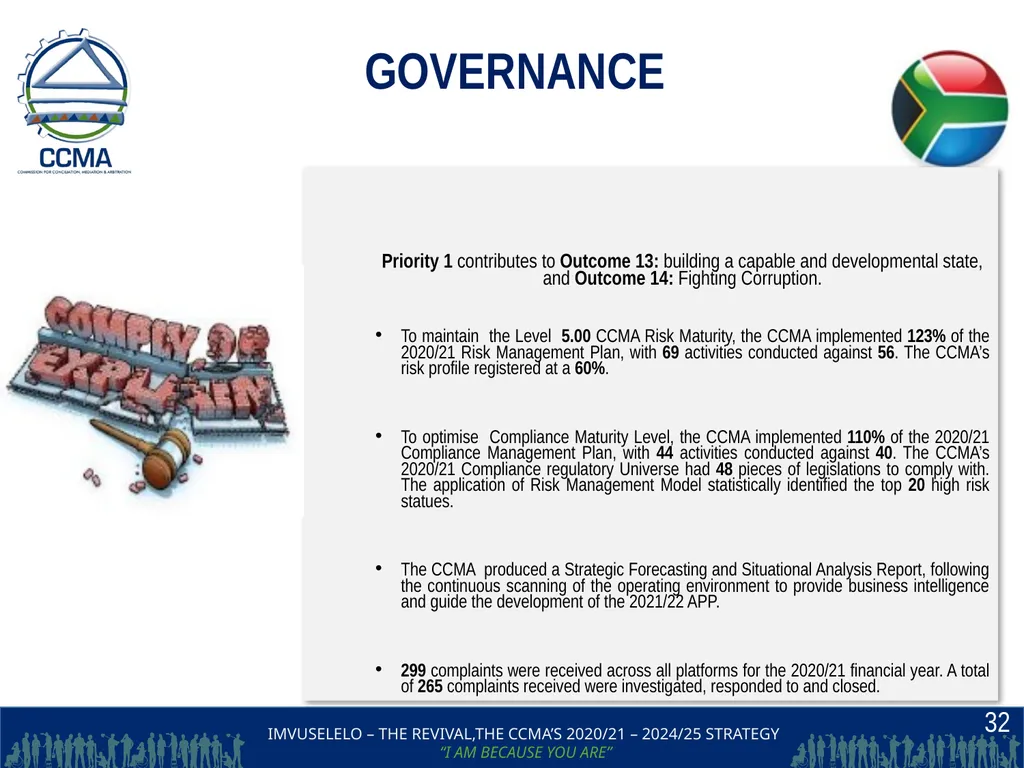
GOVERNANCE 32 Priority 1 contributes to Outcome 13: building a capable and developmental state, and Outcome 14: Fighting Corruption.
To maintain the Level 5.00 CCMA Risk Maturity, the CCMA implemented 123% of the 2020/21 Risk Management Plan, with 69 activities conducted against 56. The CCMA’s risk profile registered at a 60%.
To optimise Compliance Maturity Level, the CCMA implemented 110% of the 2020/21 Compliance Management Plan, with 44 activities conducted against 40. The CCMA’s 2020/21 Compliance regulatory Universe had 48 pieces of legislations to comply with. The application of Risk Management Model statistically identified the top 20 high risk statues.
The CCMA produced a Strategic Forecasting and Situational Analysis Report, following the continuous scanning of the operating environment to provide business intelligence and guide the development of the 2021/22 APP.
299 complaints were received across all platforms for the 2020/21 financial year. A total of 265 complaints received were investigated, responded to and closed.<br>
To maintain the Level 5.00 CCMA Risk Maturity, the CCMA implemented 123% of the 2020/21 Risk Management Plan, with 69 activities conducted against 56. The CCMA’s risk profile registered at a 60%.
To optimise Compliance Maturity Level, the CCMA implemented 110% of the 2020/21 Compliance Management Plan, with 44 activities conducted against 40. The CCMA’s 2020/21 Compliance regulatory Universe had 48 pieces of legislations to comply with. The application of Risk Management Model statistically identified the top 20 high risk statues.
The CCMA produced a Strategic Forecasting and Situational Analysis Report, following the continuous scanning of the operating environment to provide business intelligence and guide the development of the 2021/22 APP.
299 complaints were received across all platforms for the 2020/21 financial year. A total of 265 complaints received were investigated, responded to and closed.<br>
33
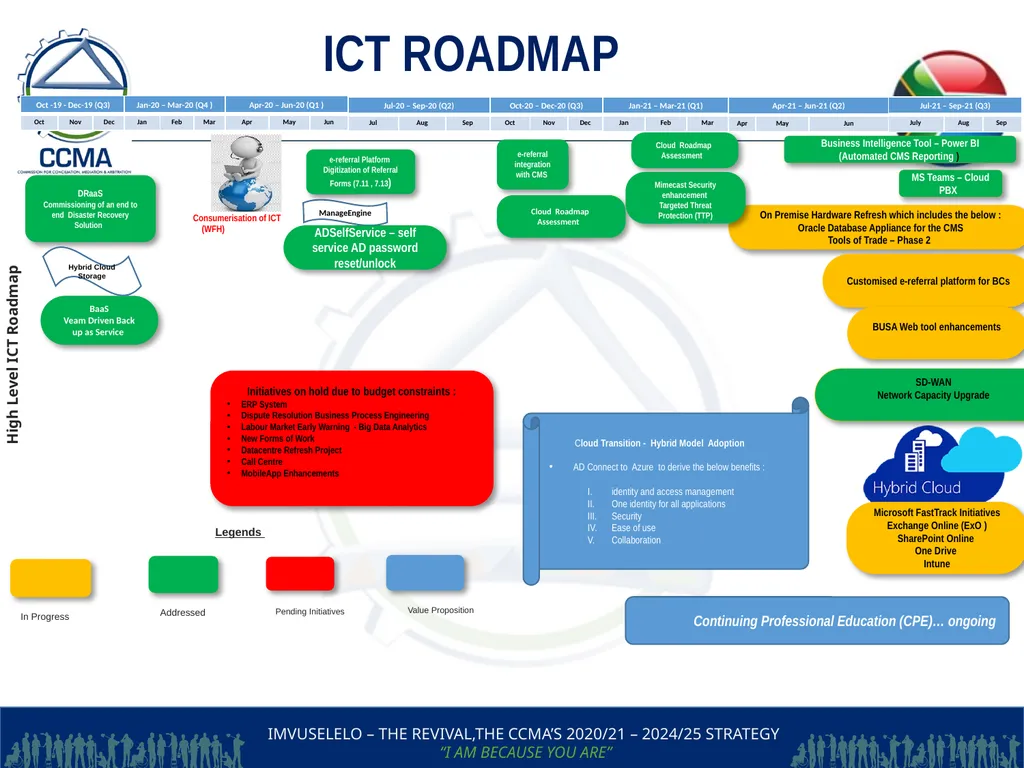
33 In Progress Addressed Legends High Level ICT Roadmap DRaaS
Commissioning of an end to end Disaster Recovery Solution BaaS
Veam Driven Back up as Service Business Intelligence Tool – Power BI
(Automated CMS Reporting ) Hybrid Cloud Storage Continuing Professional Education (CPE)… ongoing Cloud Transition - Hybrid Model Adoption
AD Connect to Azure to derive the below benefits :
identity and access management
One identity for all applications
Security
Ease of use
Collaboration ManageEngine ADSelfService – self service AD password reset/unlock e-referral Platform
Digitization of Referral Forms (7.11 , 7.13) e-referral integration with CMS Cloud Roadmap Assessment On Premise Hardware Refresh which includes the below :
Oracle Database Appliance for the CMS
Tools of Trade – Phase 2 Customised e-referral platform for BCs SD-WAN
Network Capacity Upgrade Initiatives on hold due to budget constraints :
ERP System
Dispute Resolution Business Process Engineering
Labour Market Early Warning - Big Data Analytics
New Forms of Work
Datacentre Refresh Project
Call Centre
MobileApp Enhancements MS Teams – Cloud PBX Microsoft FastTrack Initiatives
Exchange Online (ExO )
SharePoint Online
One Drive
Intune Cloud Roadmap Assessment Mimecast Security enhancement
Targeted Threat Protection (TTP) Value Proposition BUSA Web tool enhancements Pending Initiatives ICT ROADMAP<br>
Commissioning of an end to end Disaster Recovery Solution BaaS
Veam Driven Back up as Service Business Intelligence Tool – Power BI
(Automated CMS Reporting ) Hybrid Cloud Storage Continuing Professional Education (CPE)… ongoing Cloud Transition - Hybrid Model Adoption
AD Connect to Azure to derive the below benefits :
identity and access management
One identity for all applications
Security
Ease of use
Collaboration ManageEngine ADSelfService – self service AD password reset/unlock e-referral Platform
Digitization of Referral Forms (7.11 , 7.13) e-referral integration with CMS Cloud Roadmap Assessment On Premise Hardware Refresh which includes the below :
Oracle Database Appliance for the CMS
Tools of Trade – Phase 2 Customised e-referral platform for BCs SD-WAN
Network Capacity Upgrade Initiatives on hold due to budget constraints :
ERP System
Dispute Resolution Business Process Engineering
Labour Market Early Warning - Big Data Analytics
New Forms of Work
Datacentre Refresh Project
Call Centre
MobileApp Enhancements MS Teams – Cloud PBX Microsoft FastTrack Initiatives
Exchange Online (ExO )
SharePoint Online
One Drive
Intune Cloud Roadmap Assessment Mimecast Security enhancement
Targeted Threat Protection (TTP) Value Proposition BUSA Web tool enhancements Pending Initiatives ICT ROADMAP<br>
34
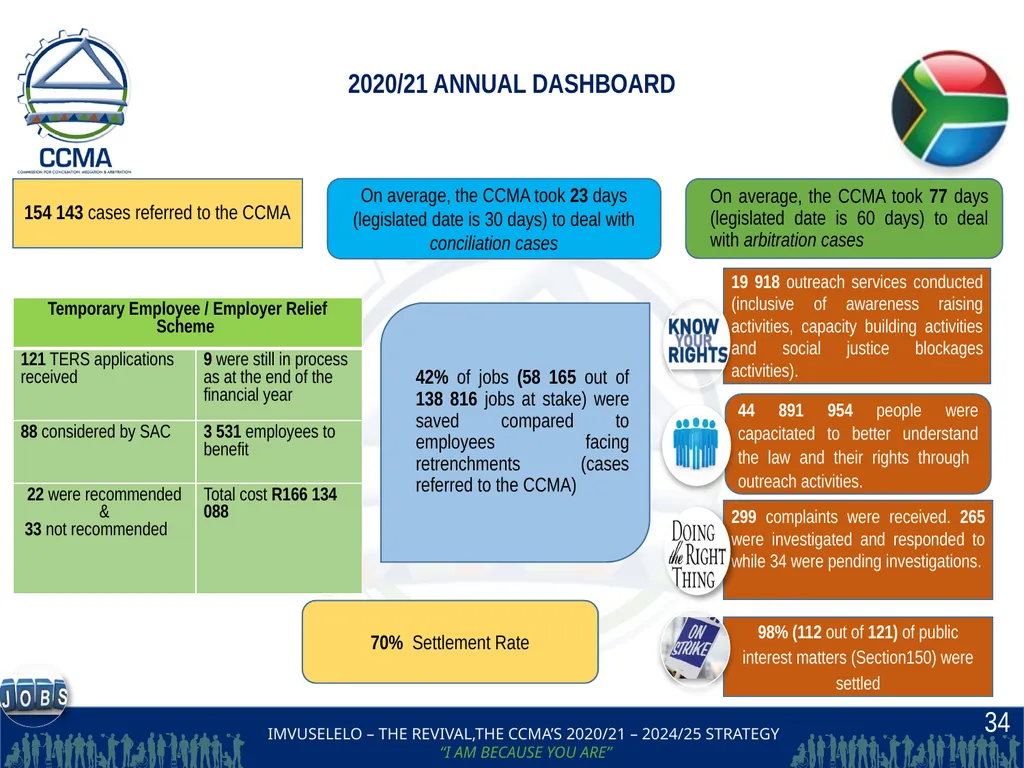
2020/21 ANNUAL DASHBOARD 34 154 143 cases referred to the CCMA 70% Settlement Rate 42% of jobs (58 165 out of 138 816 jobs at stake) were saved compared to employees facing retrenchments (cases referred to the CCMA) On average, the CCMA took 23 days (legislated date is 30 days) to deal with conciliation cases On average, the CCMA took 77 days (legislated date is 60 days) to deal with arbitration cases<br>
35
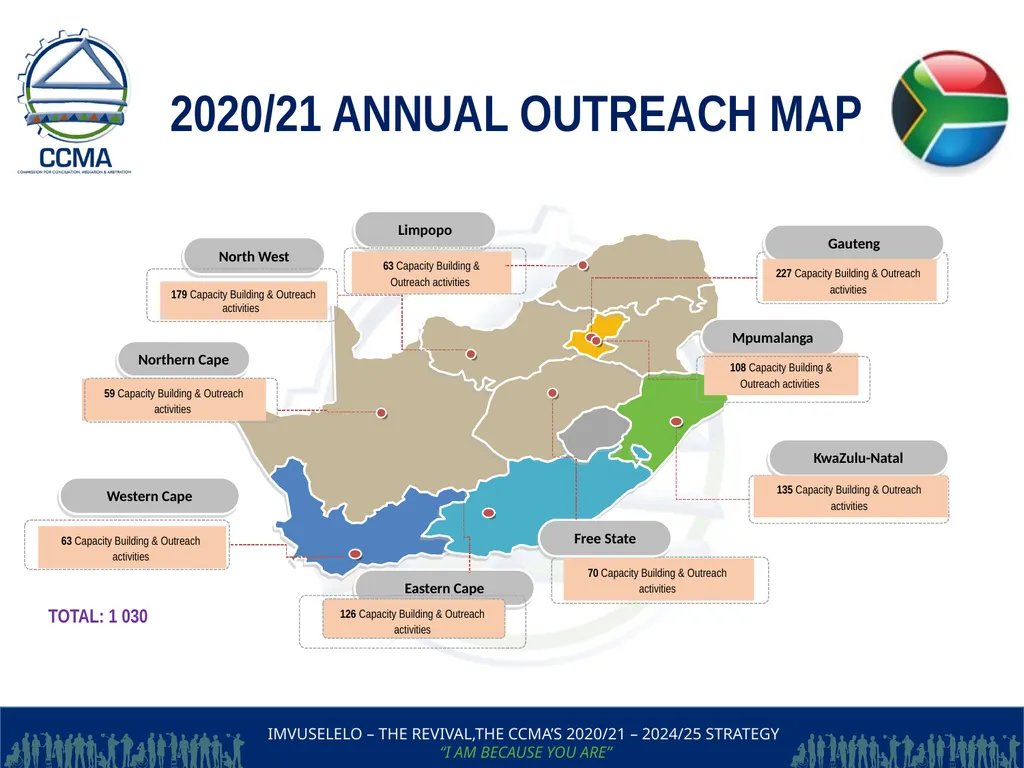
2020/21 ANNUAL OUTREACH MAP Northern Cape 59 Capacity Building & Outreach activities Free State 70 Capacity Building & Outreach
activities North West Limpopo 63 Capacity Building & Outreach activities 179 Capacity Building & Outreach activities 126 Capacity Building & Outreach
activities Mpumalanga 108 Capacity Building & Outreach activities TOTAL: 1 030<br>
activities North West Limpopo 63 Capacity Building & Outreach activities 179 Capacity Building & Outreach activities 126 Capacity Building & Outreach
activities Mpumalanga 108 Capacity Building & Outreach activities TOTAL: 1 030<br>
36
36 FINANCIAL PERFORMANCE RESULTS<br>
37
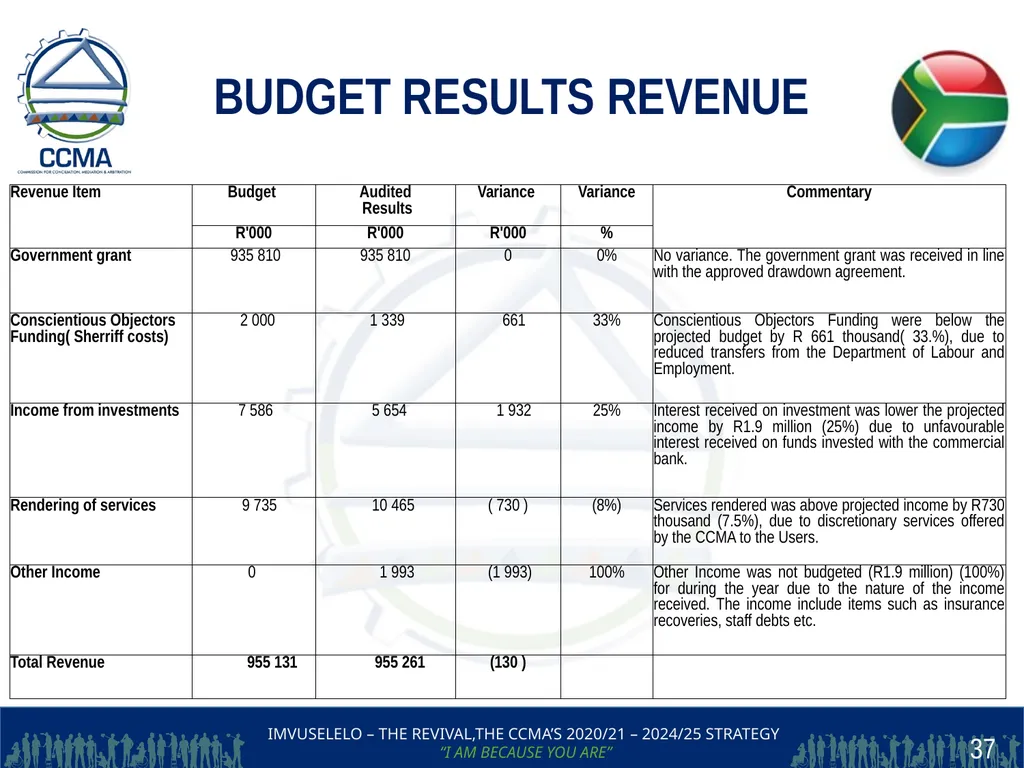
BUDGET RESULTS REVENUE 37<br>
38
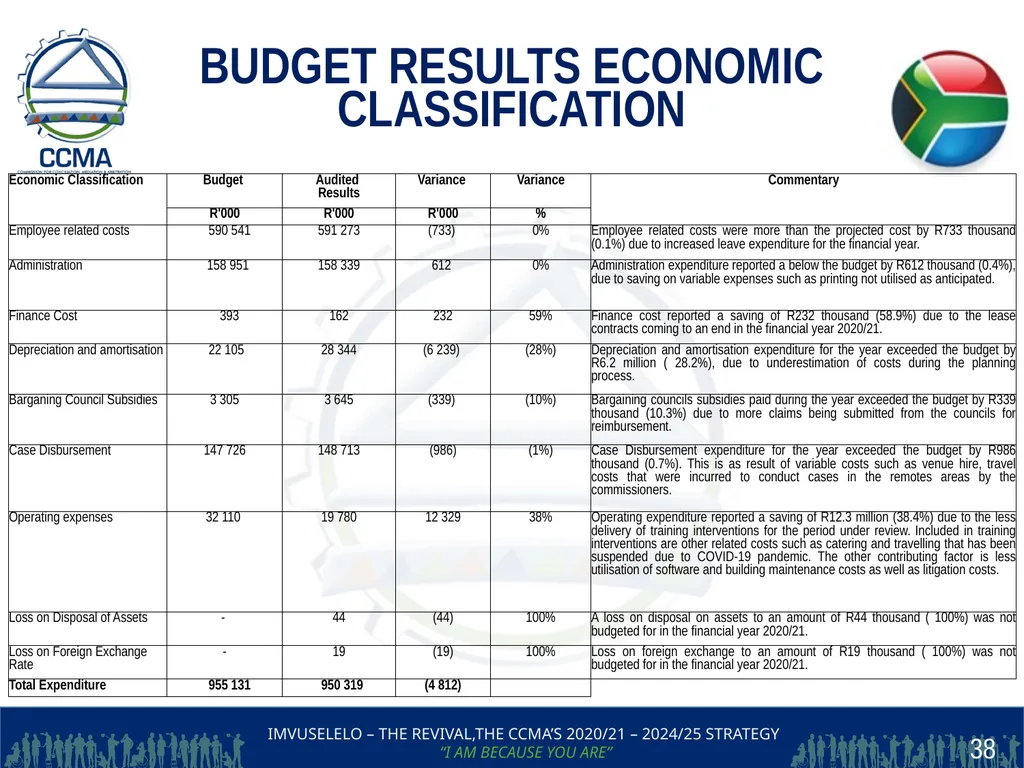
BUDGET RESULTS ECONOMIC CLASSIFICATION 38<br>
39
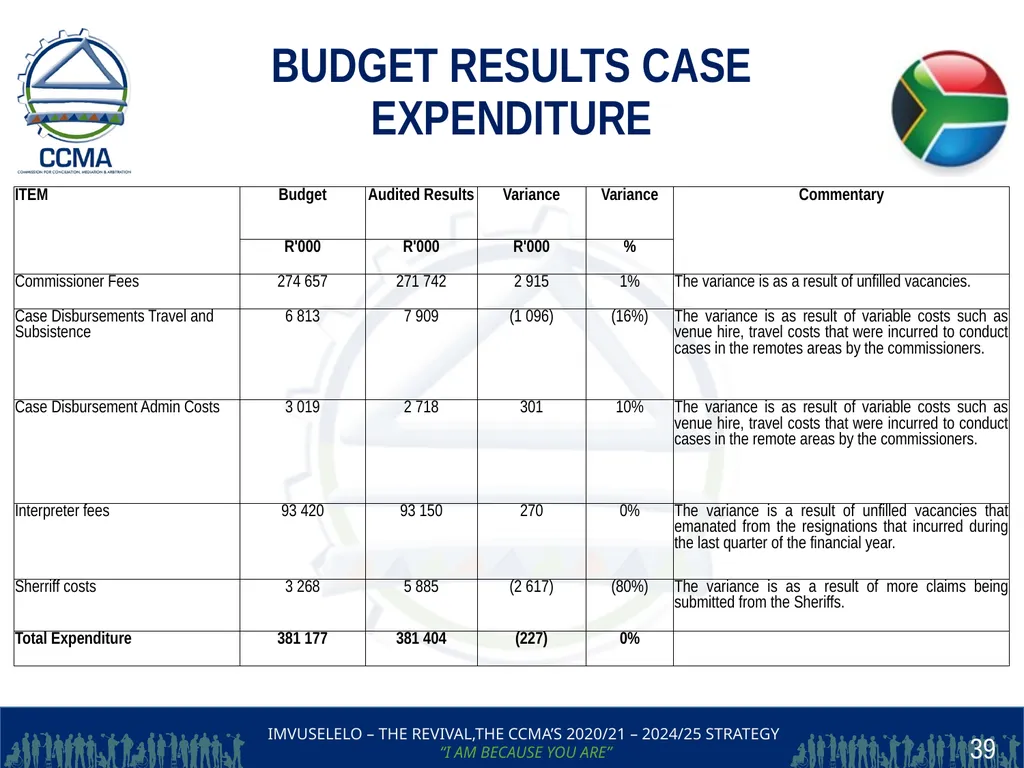
BUDGET RESULTS CASE EXPENDITURE 39<br>
40
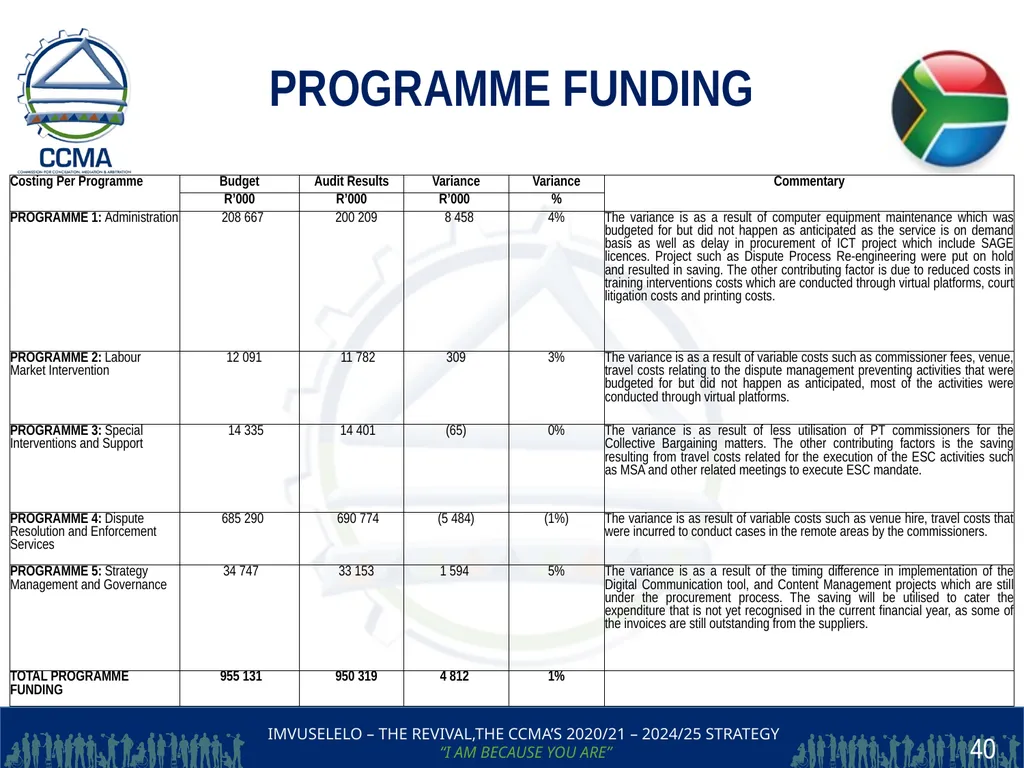
PROGRAMME FUNDING 40<br>
41
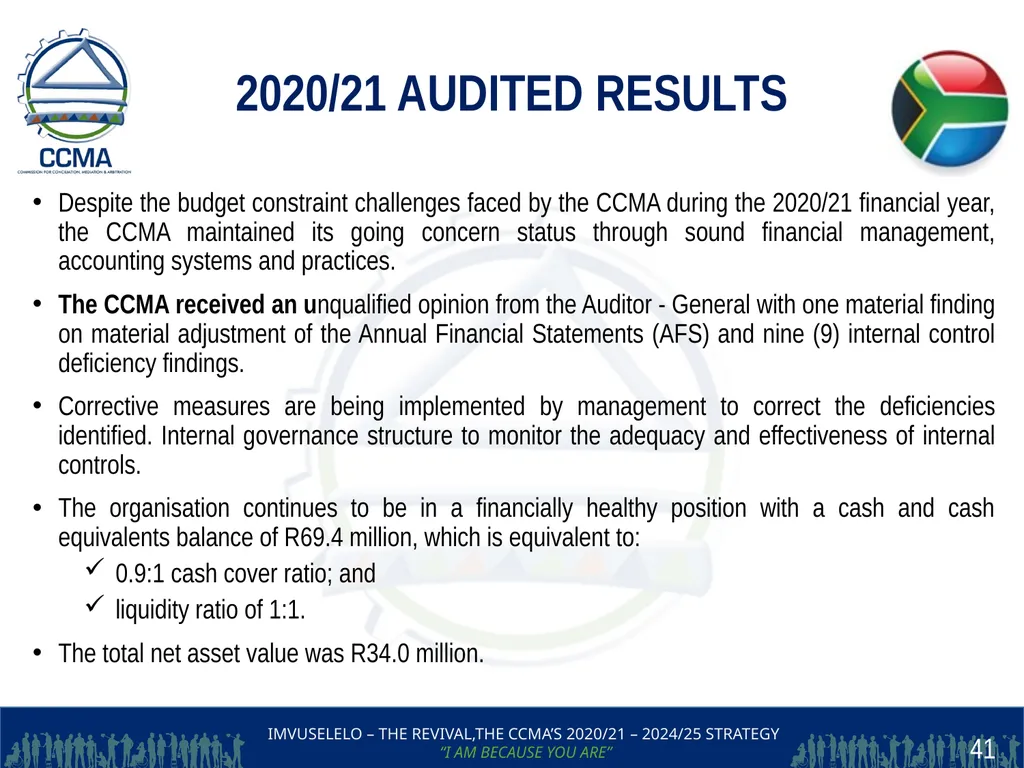
2020/21 AUDITED RESULTS 41 Despite the budget constraint challenges faced by the CCMA during the 2020/21 financial year, the CCMA maintained its going concern status through sound financial management, accounting systems and practices.
The CCMA received an unqualified opinion from the Auditor - General with one material finding on material adjustment of the Annual Financial Statements (AFS) and nine (9) internal control deficiency findings.
Corrective measures are being implemented by management to correct the deficiencies identified. Internal governance structure to monitor the adequacy and effectiveness of internal controls.
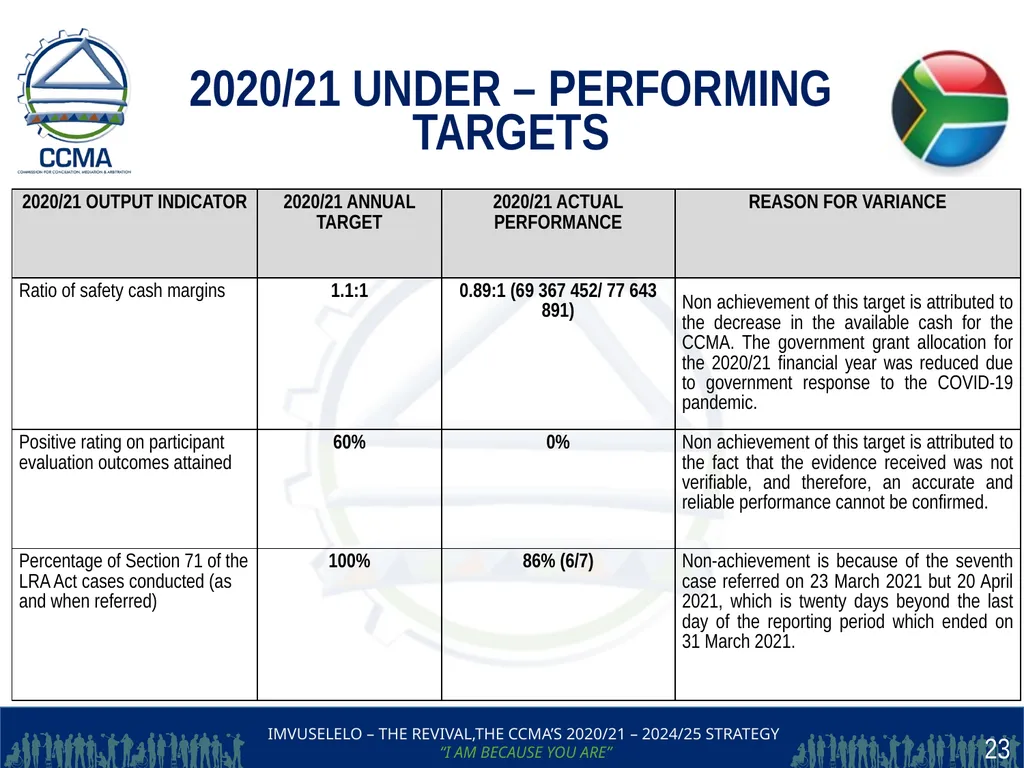
The organisation continues to be in a financially healthy position with a cash and cash equivalents balance of R69.4 million, which is equivalent to:
0.9:1 cash cover ratio; and
liquidity ratio of 1:1.
The total net asset value was R34.0 million.<br>
The CCMA received an unqualified opinion from the Auditor - General with one material finding on material adjustment of the Annual Financial Statements (AFS) and nine (9) internal control deficiency findings.
Corrective measures are being implemented by management to correct the deficiencies identified. Internal governance structure to monitor the adequacy and effectiveness of internal controls.
The organisation continues to be in a financially healthy position with a cash and cash equivalents balance of R69.4 million, which is equivalent to:
0.9:1 cash cover ratio; and
liquidity ratio of 1:1.
The total net asset value was R34.0 million.<br>
42
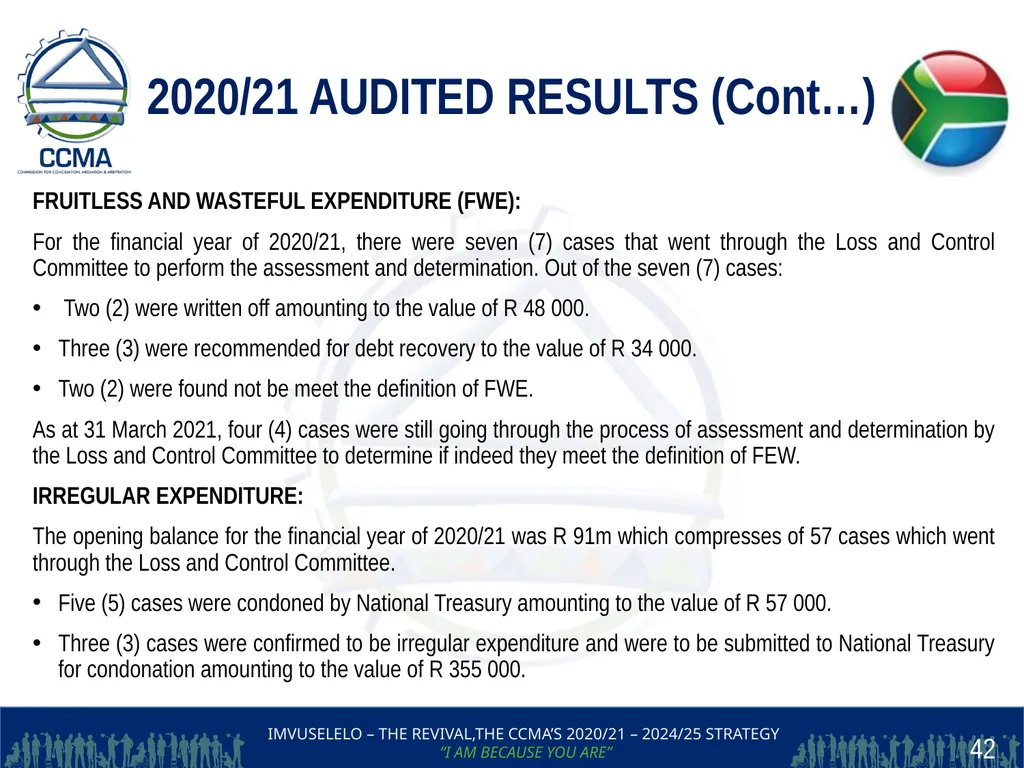
2020/21 AUDITED RESULTS (Cont…) 42 FRUITLESS AND WASTEFUL EXPENDITURE (FWE):
For the financial year of 2020/21, there were seven (7) cases that went through the Loss and Control Committee to perform the assessment and determination. Out of the seven (7) cases:
Two (2) were written off amounting to the value of R 48 000.
Three (3) were recommended for debt recovery to the value of R 34 000.
Two (2) were found not be meet the definition of FWE.
As at 31 March 2021, four (4) cases were still going through the process of assessment and determination by the Loss and Control Committee to determine if indeed they meet the definition of FEW.
IRREGULAR EXPENDITURE:
The opening balance for the financial year of 2020/21 was R 91m which compresses of 57 cases which went through the Loss and Control Committee.
Five (5) cases were condoned by National Treasury amounting to the value of R 57 000.
Three (3) cases were confirmed to be irregular expenditure and were to be submitted to National Treasury for condonation amounting to the value of R 355 000.<br>
For the financial year of 2020/21, there were seven (7) cases that went through the Loss and Control Committee to perform the assessment and determination. Out of the seven (7) cases:
Two (2) were written off amounting to the value of R 48 000.
Three (3) were recommended for debt recovery to the value of R 34 000.
Two (2) were found not be meet the definition of FWE.
As at 31 March 2021, four (4) cases were still going through the process of assessment and determination by the Loss and Control Committee to determine if indeed they meet the definition of FEW.
IRREGULAR EXPENDITURE:
The opening balance for the financial year of 2020/21 was R 91m which compresses of 57 cases which went through the Loss and Control Committee.
Five (5) cases were condoned by National Treasury amounting to the value of R 57 000.
Three (3) cases were confirmed to be irregular expenditure and were to be submitted to National Treasury for condonation amounting to the value of R 355 000.<br>
43
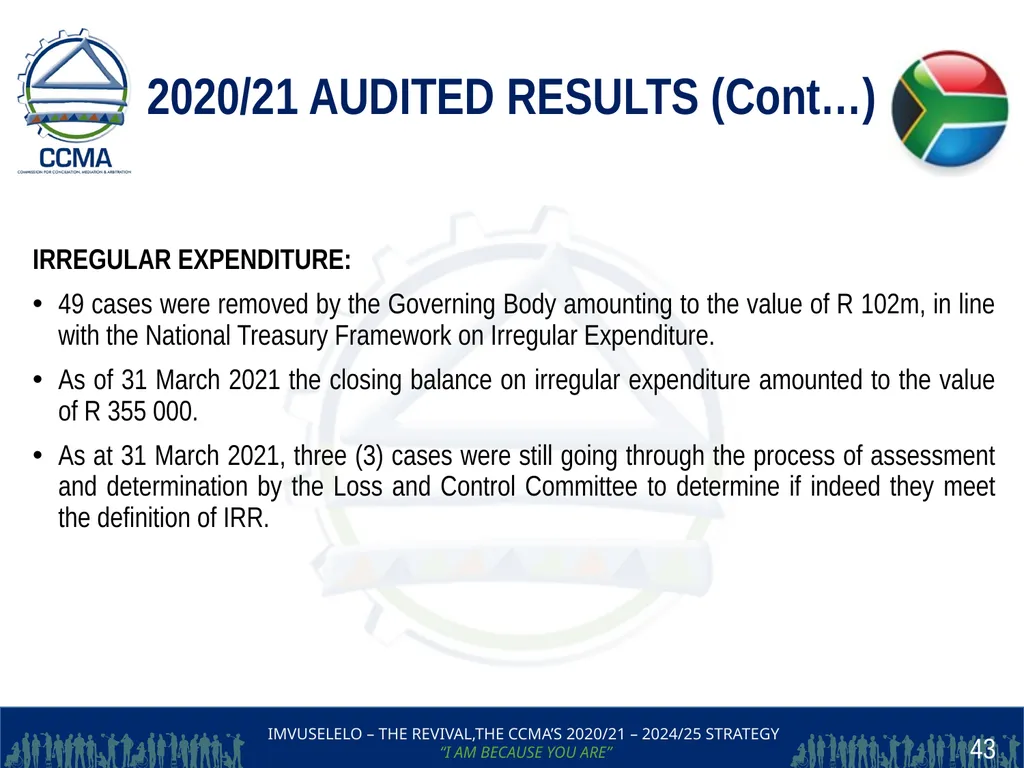
2020/21 AUDITED RESULTS (Cont…) 43 IRREGULAR EXPENDITURE:
49 cases were removed by the Governing Body amounting to the value of R 102m, in line with the National Treasury Framework on Irregular Expenditure.
As of 31 March 2021 the closing balance on irregular expenditure amounted to the value of R 355 000.
As at 31 March 2021, three (3) cases were still going through the process of assessment and determination by the Loss and Control Committee to determine if indeed they meet the definition of IRR.<br>
49 cases were removed by the Governing Body amounting to the value of R 102m, in line with the National Treasury Framework on Irregular Expenditure.
As of 31 March 2021 the closing balance on irregular expenditure amounted to the value of R 355 000.
As at 31 March 2021, three (3) cases were still going through the process of assessment and determination by the Loss and Control Committee to determine if indeed they meet the definition of IRR.<br>
44
THANK YOU<br>