
The conceptual metaphor theory Basic concepts and









Description: The conceptual metaphor theory Basic concepts and assumptions By the use of metaphors the ability to understand and to express in language the experience of the world unbelievably increases. . By the use of metaphors the ability to
Related Topics
Download Presentation
"The conceptual metaphor theory Basic concepts and" is the property of its rightful owner. Permission is granted to download and print the materials on this website for personal, non-commercial use only, and to display it on your personal computer provided you do not modify the materials and that you retain all copyright notices contained in the materials. By downloading content from our website, you accept the terms of this agreement.
Presentation Transcript
slide1. The conceptual metaphor theory Basic concepts and assumptions<br>
slide2. By the use of metaphors the ability to understand and to express in language the experience of the world unbelievably increases. .<br>
slide3. By the use of metaphors the ability to understand and to express in language the experience of the world unbelievably increases.
It allows people to go beyond the immediate experience and to extend the language in an unlimited way. .<br>
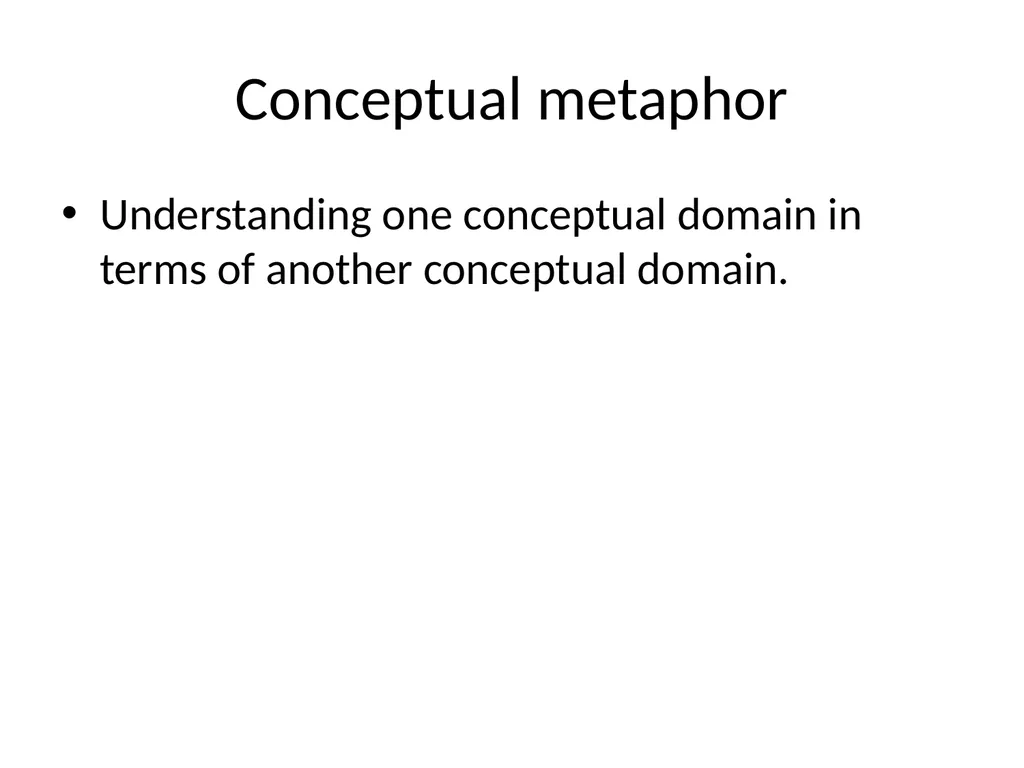
slide4. Conceptual metaphor Understanding one conceptual domain in terms of another conceptual domain.<br>
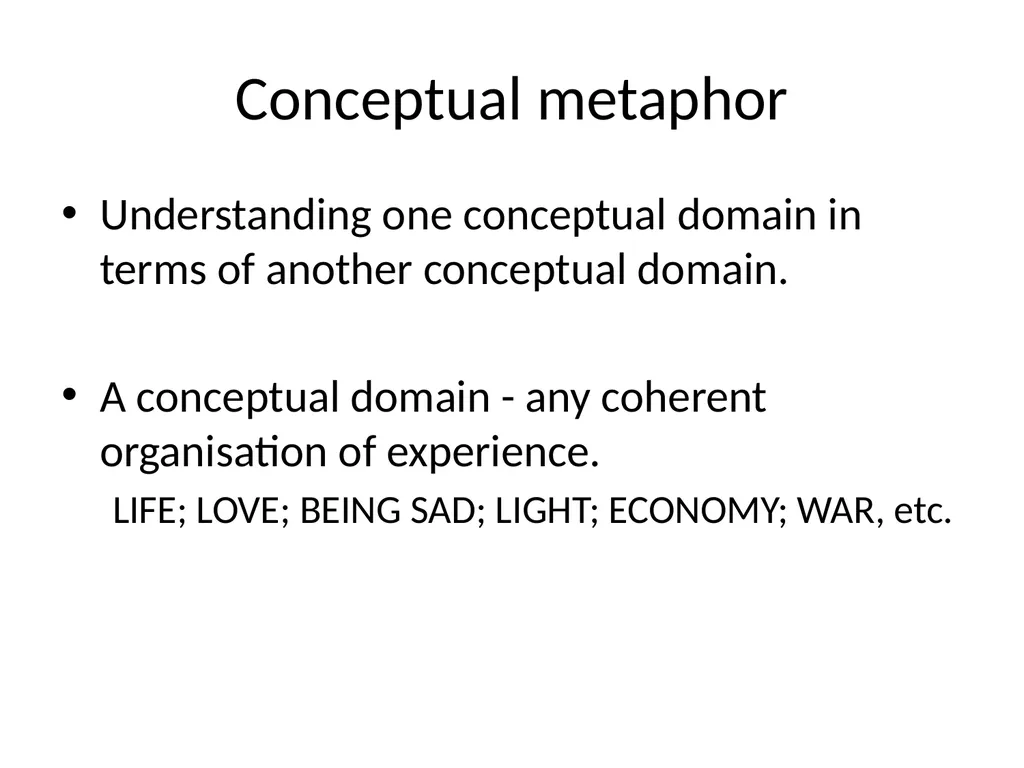
slide5. Conceptual metaphor Understanding one conceptual domain in terms of another conceptual domain.
A conceptual domain - any coherent organisation of experience.
LIFE; LOVE; BEING SAD; LIGHT; ECONOMY; WAR, etc.<br>
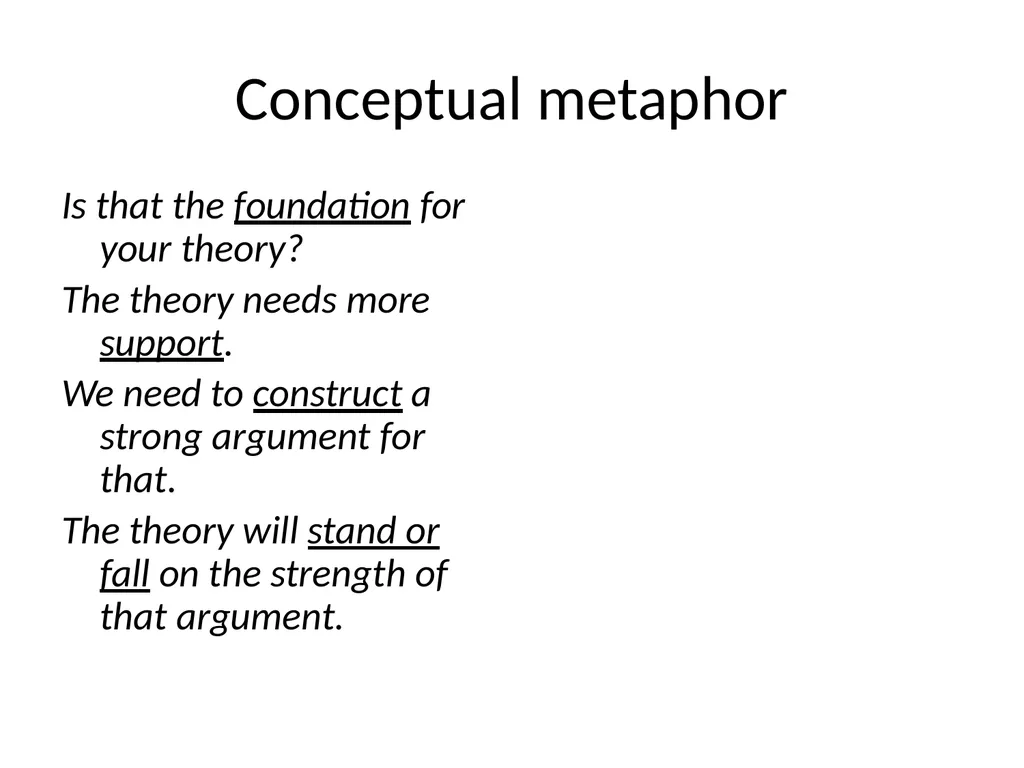
slide6. Conceptual metaphor Is that the foundation for your theory?
The theory needs more support.
We need to construct a strong argument for that.
The theory will stand or fall on the strength of that argument.<br>
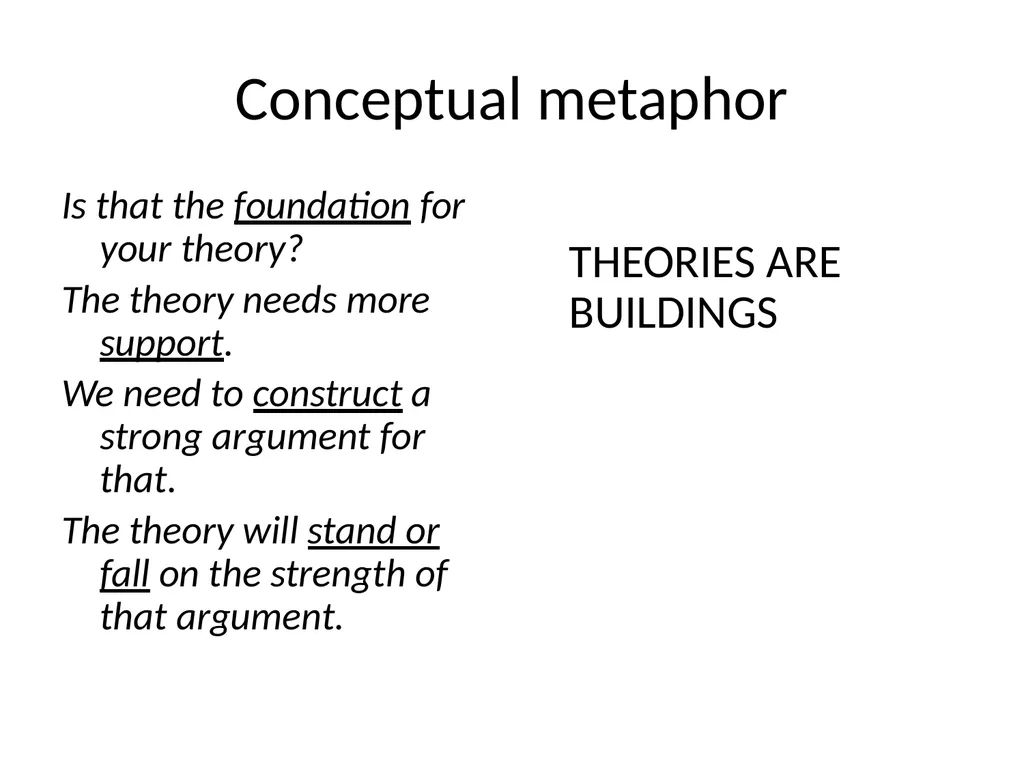
slide7. Conceptual metaphor Is that the foundation for your theory?
The theory needs more support.
We need to construct a strong argument for that.
The theory will stand or fall on the strength of that argument. THEORIES ARE BUILDINGS<br>
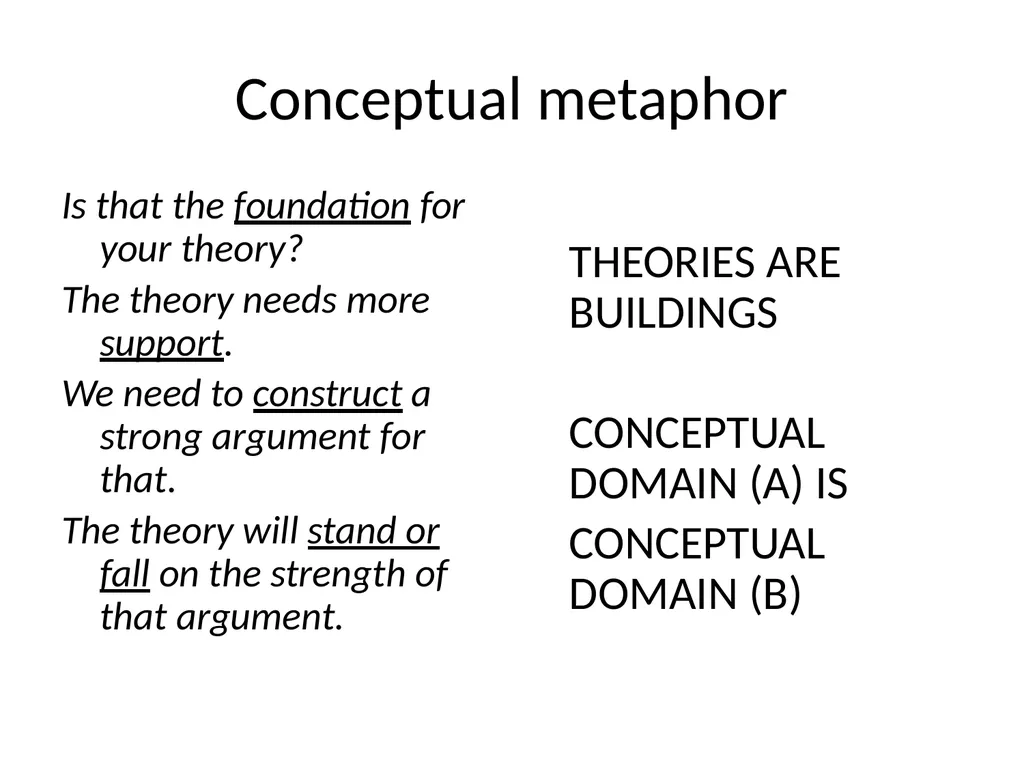
slide8. Conceptual metaphor Is that the foundation for your theory?
The theory needs more support.
We need to construct a strong argument for that.
The theory will stand or fall on the strength of that argument. THEORIES ARE BUILDINGS
CONCEPTUAL DOMAIN (A) IS
CONCEPTUAL DOMAIN (B)<br>
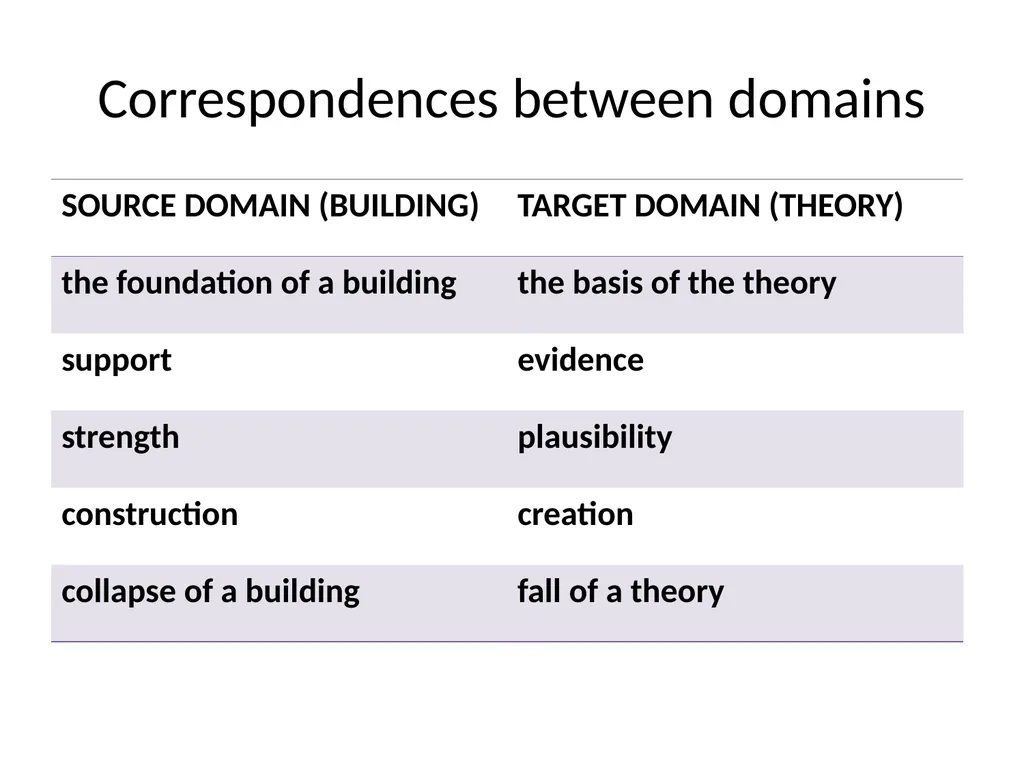
slide9. Correspondences between domains<br>
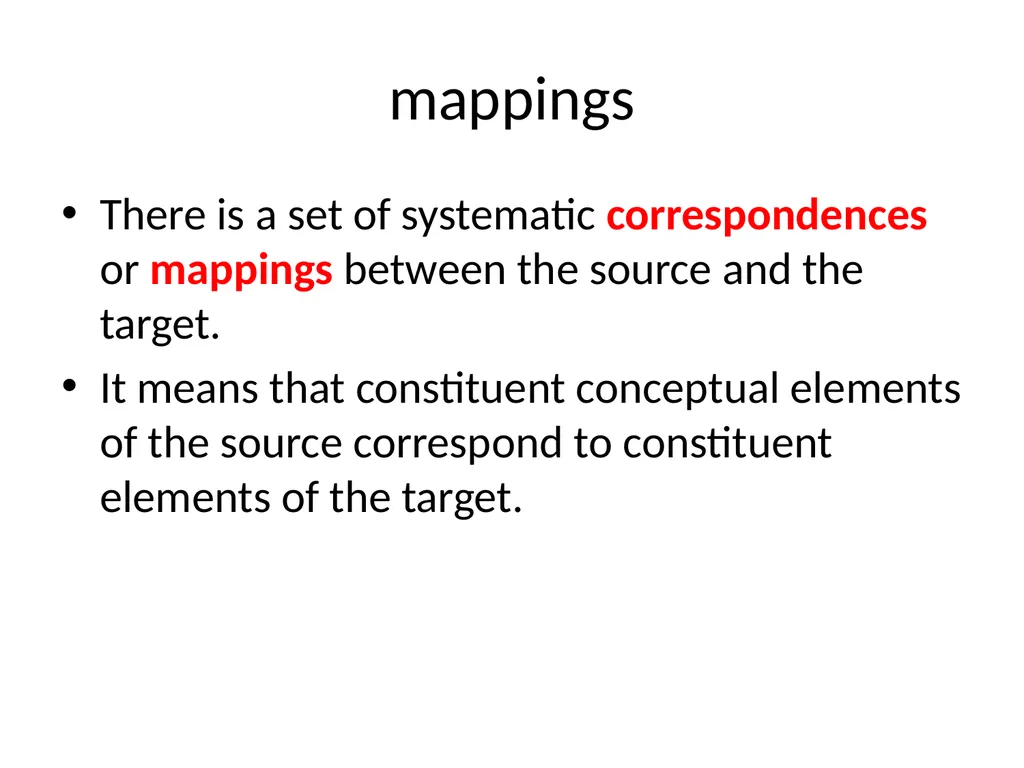
slide10. mappings There is a set of systematic correspondences or mappings between the source and the target.
It means that constituent conceptual elements of the source correspond to constituent elements of the target.<br>
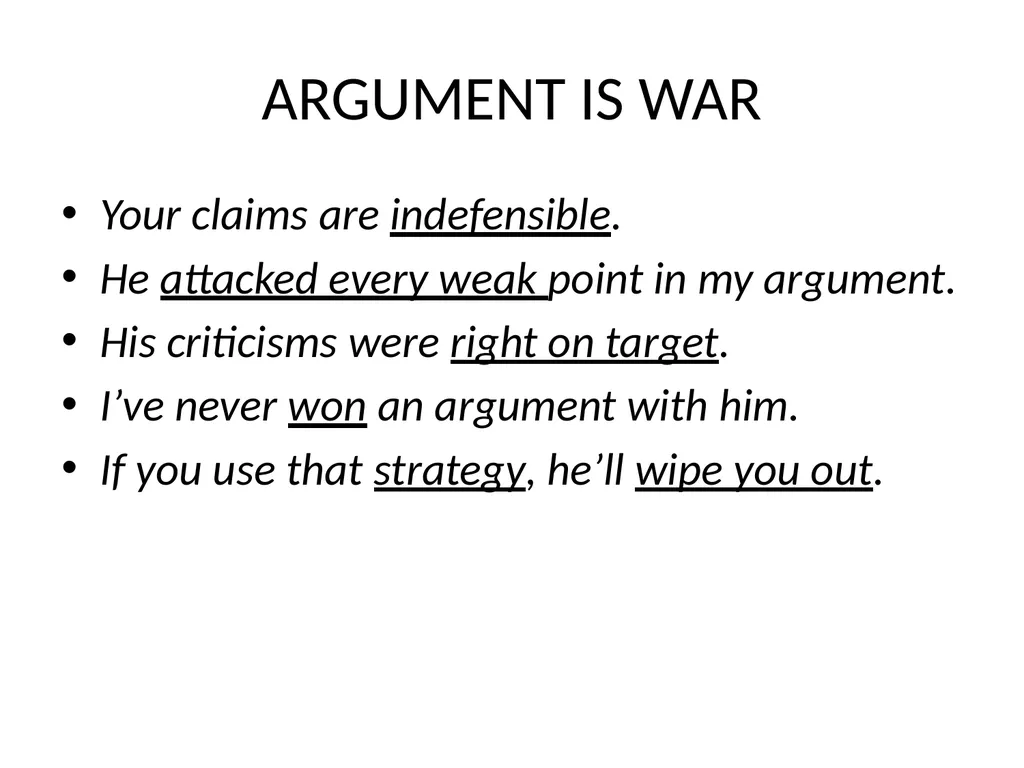
slide11. ARGUMENT IS WAR Your claims are indefensible.
He attacked every weak point in my argument.
His criticisms were right on target.
I’ve never won an argument with him.
If you use that strategy, he’ll wipe you out.<br>
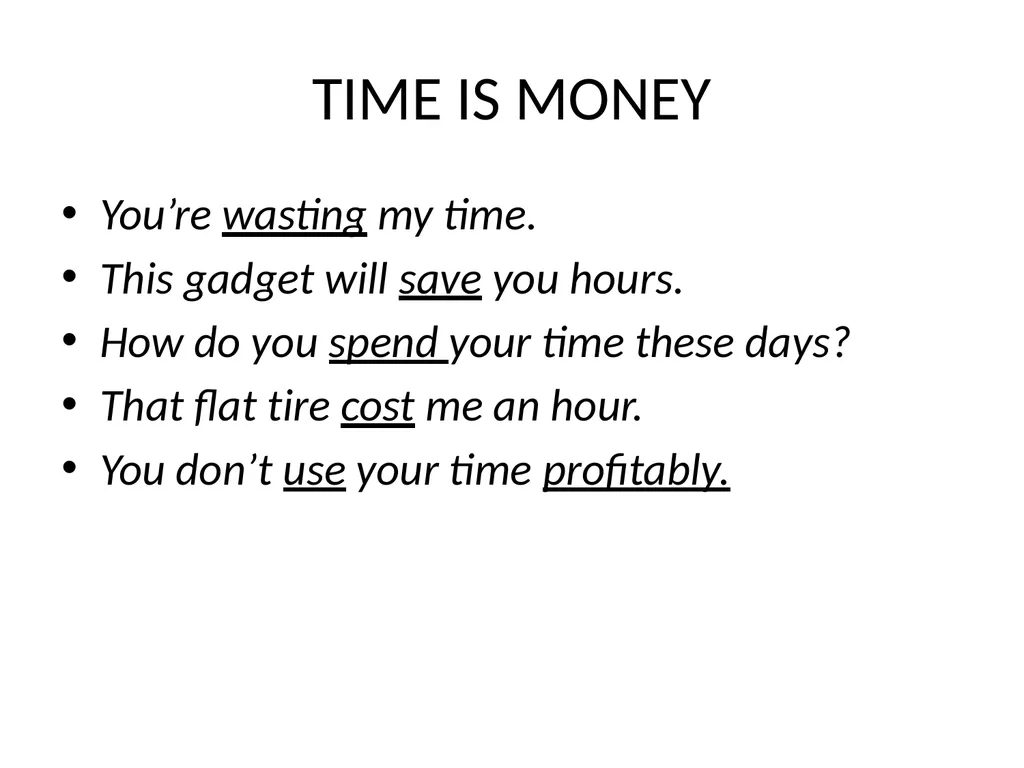
slide12. TIME IS MONEY You’re wasting my time.
This gadget will save you hours.
How do you spend your time these days?
That flat tire cost me an hour.
You don’t use your time profitably.<br>
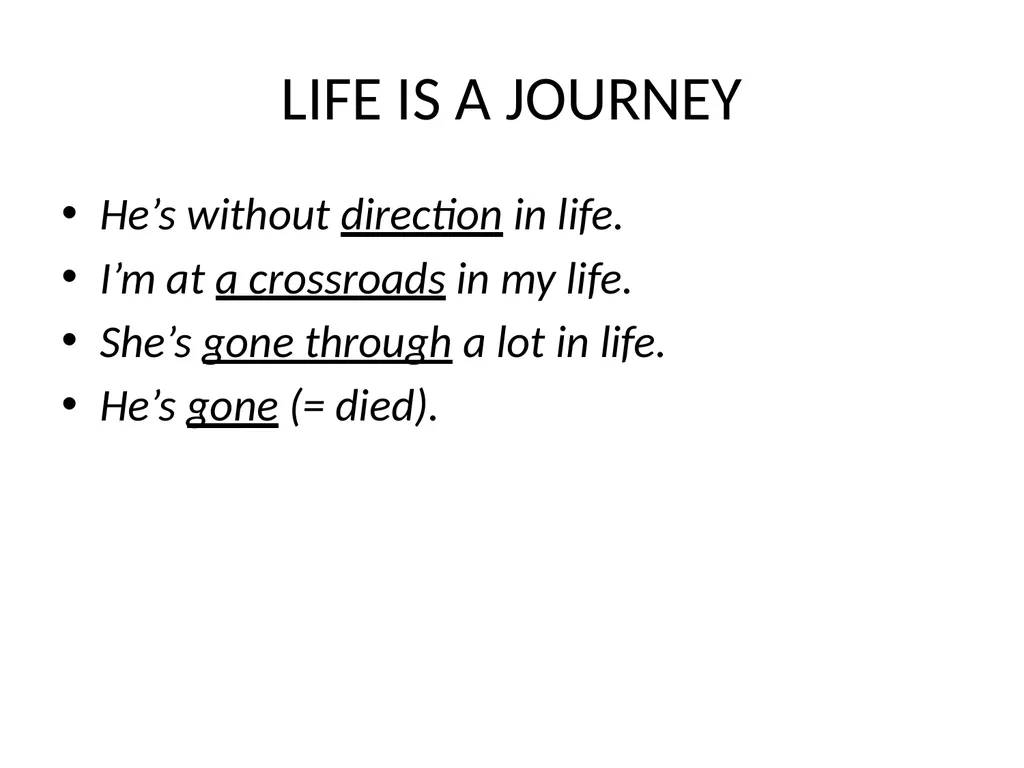
slide13. LIFE IS A JOURNEY He’s without direction in life.
I’m at a crossroads in my life.
She’s gone through a lot in life.
He’s gone (= died).<br>
slide14. metaphor vs. metaphorical linguistic expression<br>
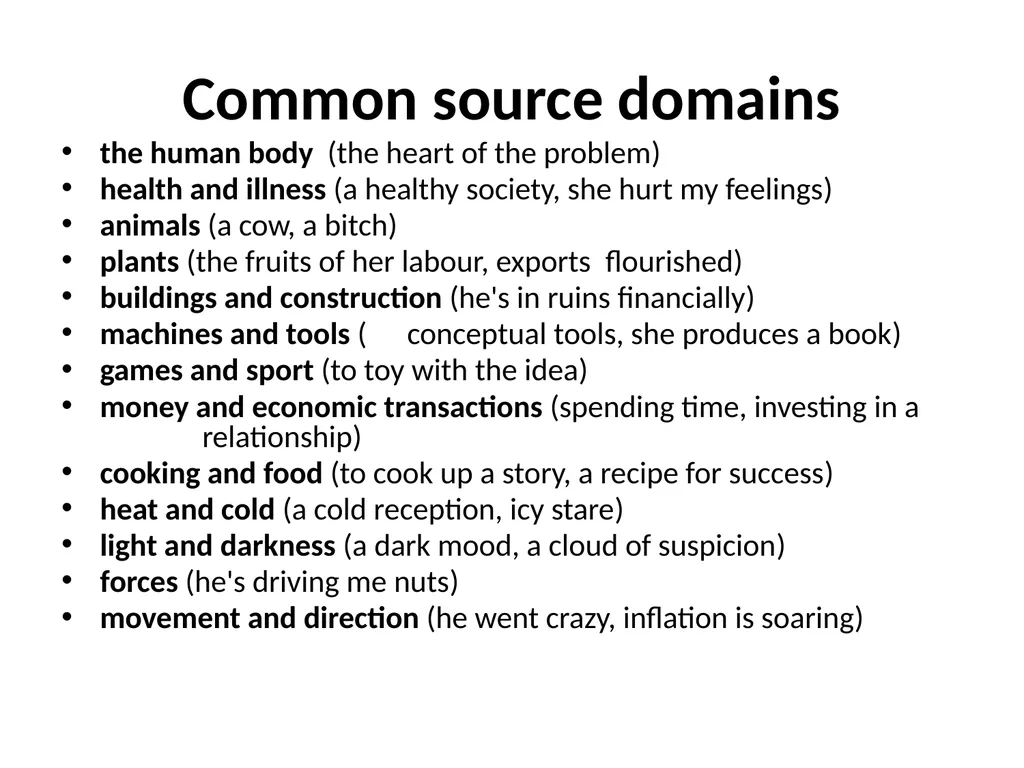
slide15. Common source domains the human body (the heart of the problem)
health and illness (a healthy society, she hurt my feelings)
animals (a cow, a bitch)
plants (the fruits of her labour, exports flourished)
buildings and construction (he's in ruins financially)
machines and tools ( conceptual tools, she produces a book)
games and sport (to toy with the idea)
money and economic transactions (spending time, investing in a relationship)
cooking and food (to cook up a story, a recipe for success)
heat and cold (a cold reception, icy stare)
light and darkness (a dark mood, a cloud of suspicion)
forces (he's driving me nuts)
movement and direction (he went crazy, inflation is soaring)<br>
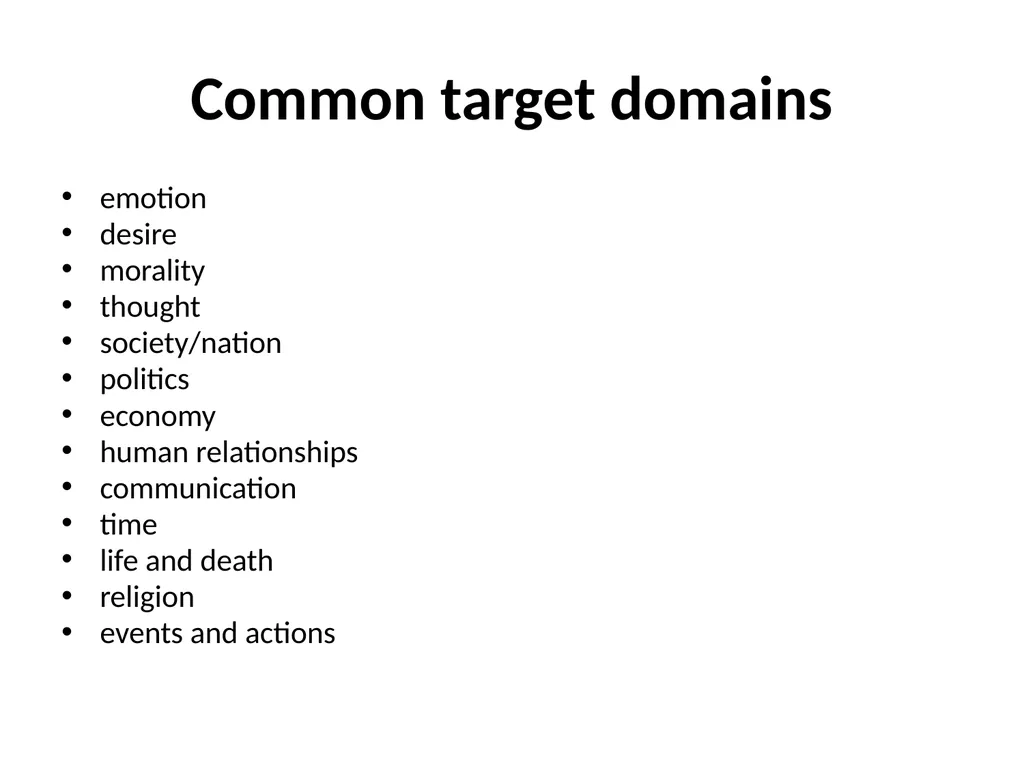
slide16. Common target domains emotion
desire
morality
thought
society/nation
politics
economy
human relationships
communication
time
life and death
religion
events and actions<br>
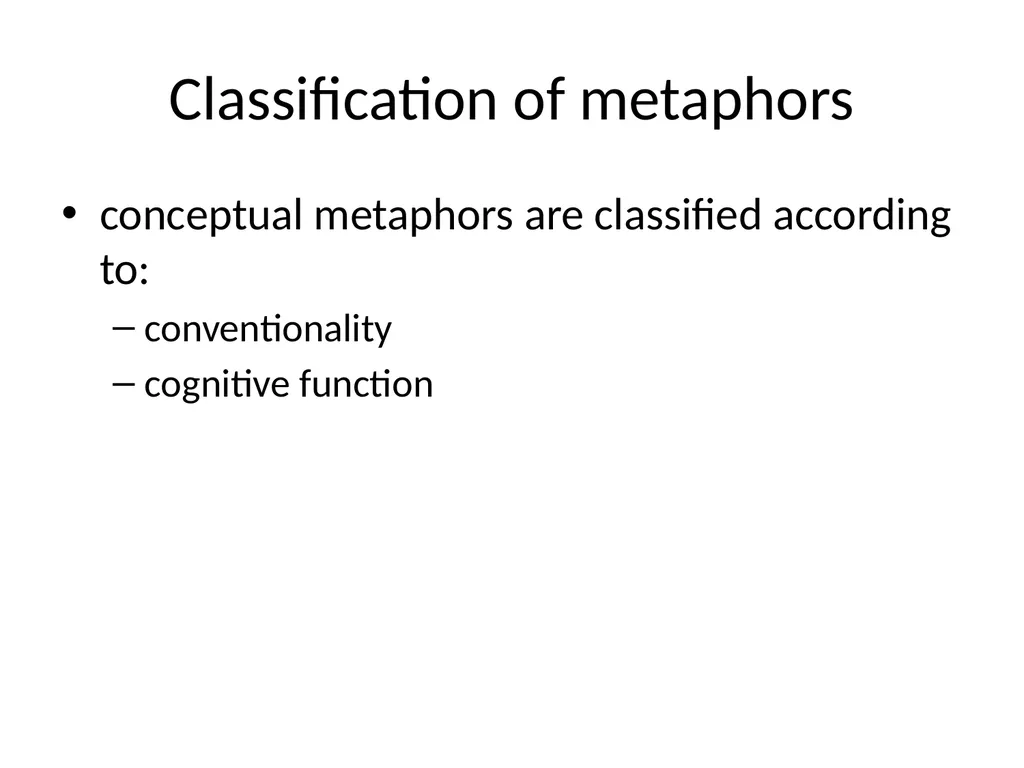
slide17. Classification of metaphors conceptual metaphors are classified according to:
conventionality
cognitive function<br>
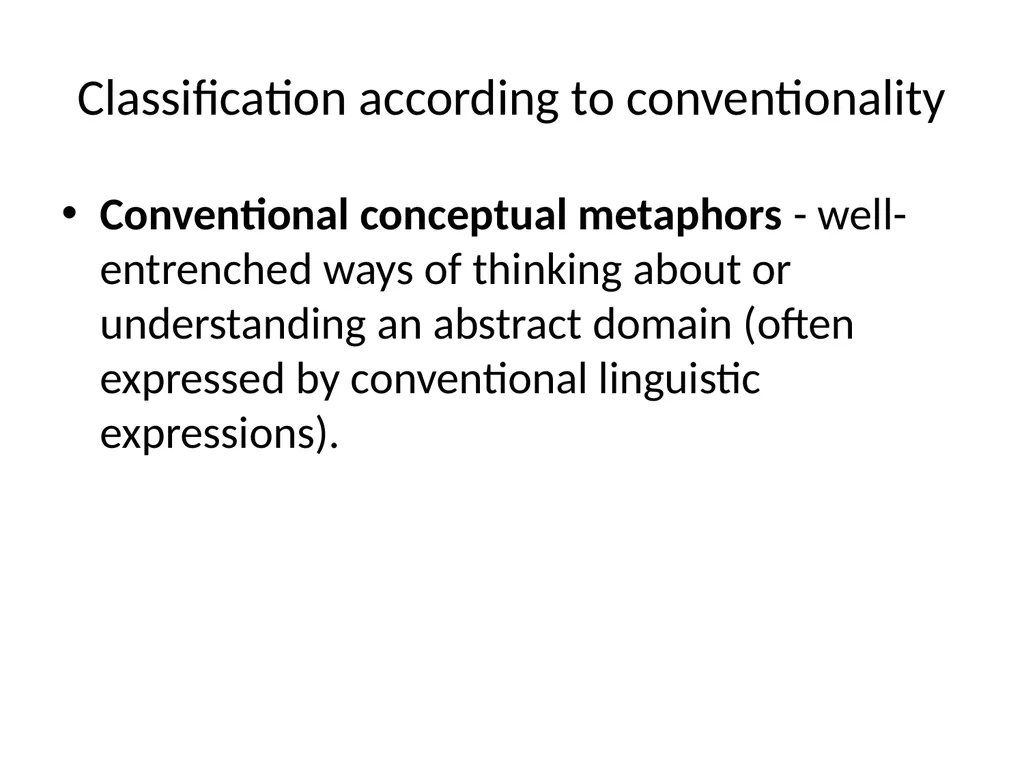
slide18. Classification according to conventionality Conventional conceptual metaphors - well-entrenched ways of thinking about or understanding an abstract domain (often expressed by conventional linguistic expressions).<br>
slide19. Classification according to conventionality Unconventional conceptual metaphors
unconventional linguistic expression
unconventional source-target connection<br>
slide20. The cognitive function of metaphors Ontological metaphors
Structural metaphors
Orientational metaphors<br>
slide21. The cognitive function of metaphors Ontological metaphors
They give ontological status to abstract or vague concepts (i.e. we think and talk of them as if they were THINGS).
They allow us to refer to, quantify, to identify more diffuse aspects of our experience.<br>
slide22. The cognitive function of metaphors Ontological metaphors – examples
Give me a call. (an event is a physical object)
my mind (a possessed physical object)
in love (an emotional state is a container)
Life has cheated me. (life is a person; personification)
Ontological metaphors can be elaborated into structural metaphors.<br>
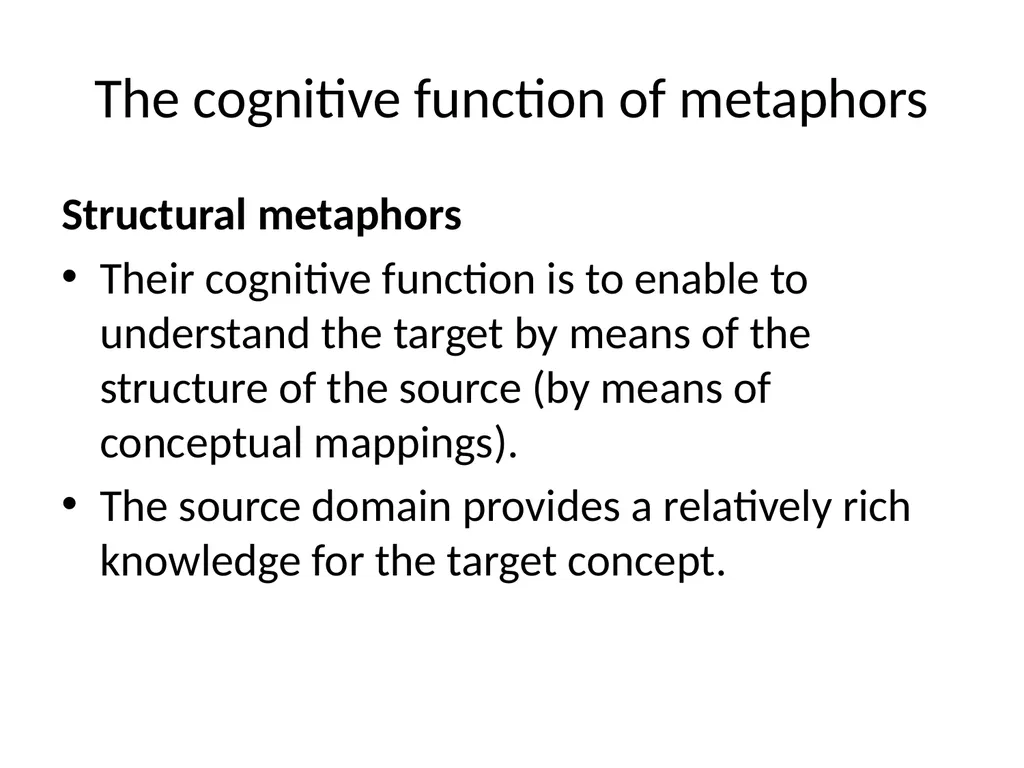
slide23. The cognitive function of metaphors Structural metaphors
Their cognitive function is to enable to understand the target by means of the structure of the source (by means of conceptual mappings).
The source domain provides a relatively rich knowledge for the target concept.<br>
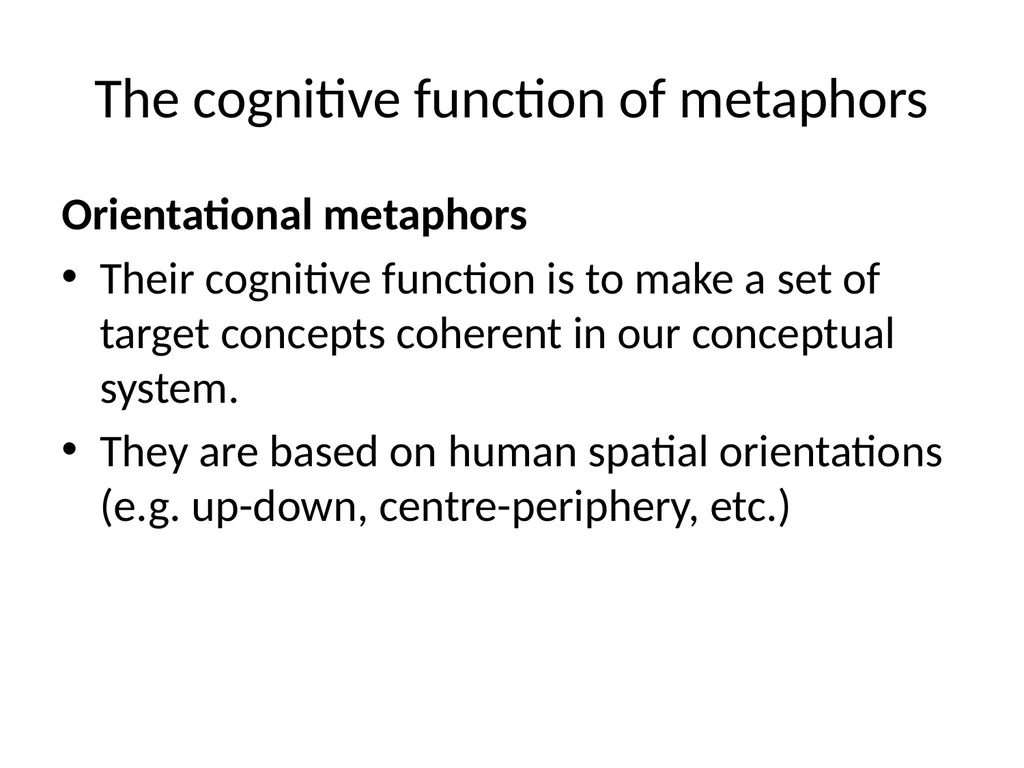
slide24. The cognitive function of metaphors Orientational metaphors
Their cognitive function is to make a set of target concepts coherent in our conceptual system.
They are based on human spatial orientations (e.g. up-down, centre-periphery, etc.)<br>
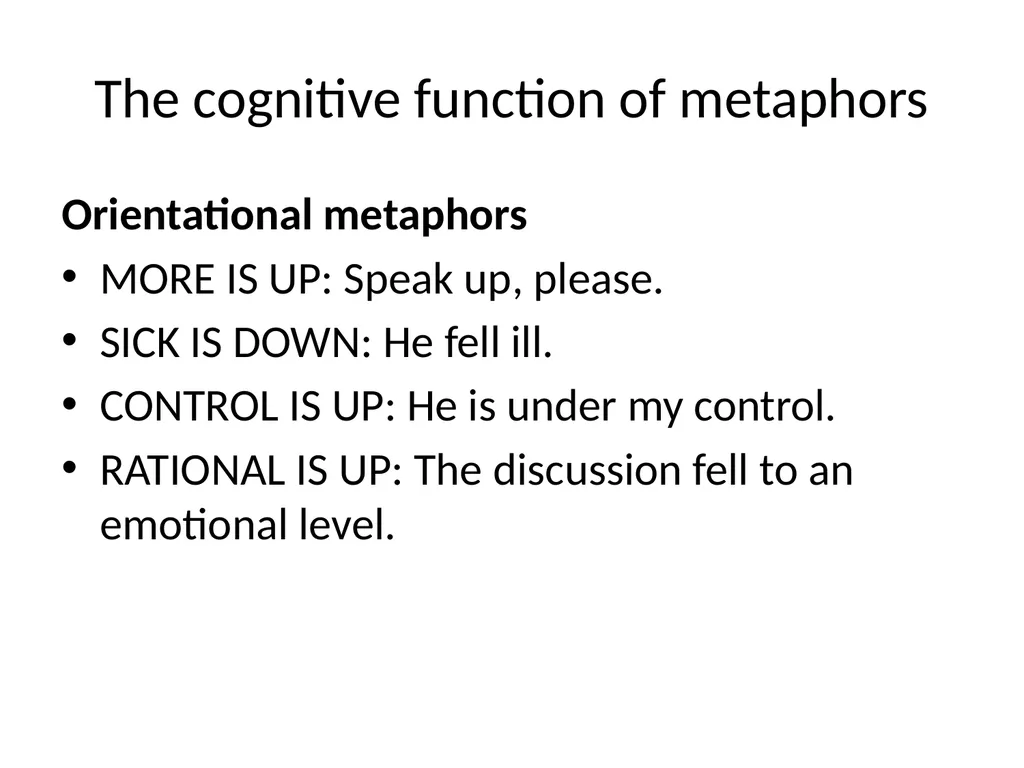
slide25. The cognitive function of metaphors Orientational metaphors
MORE IS UP: Speak up, please.
SICK IS DOWN: He fell ill.
CONTROL IS UP: He is under my control.
RATIONAL IS UP: The discussion fell to an emotional level.<br>
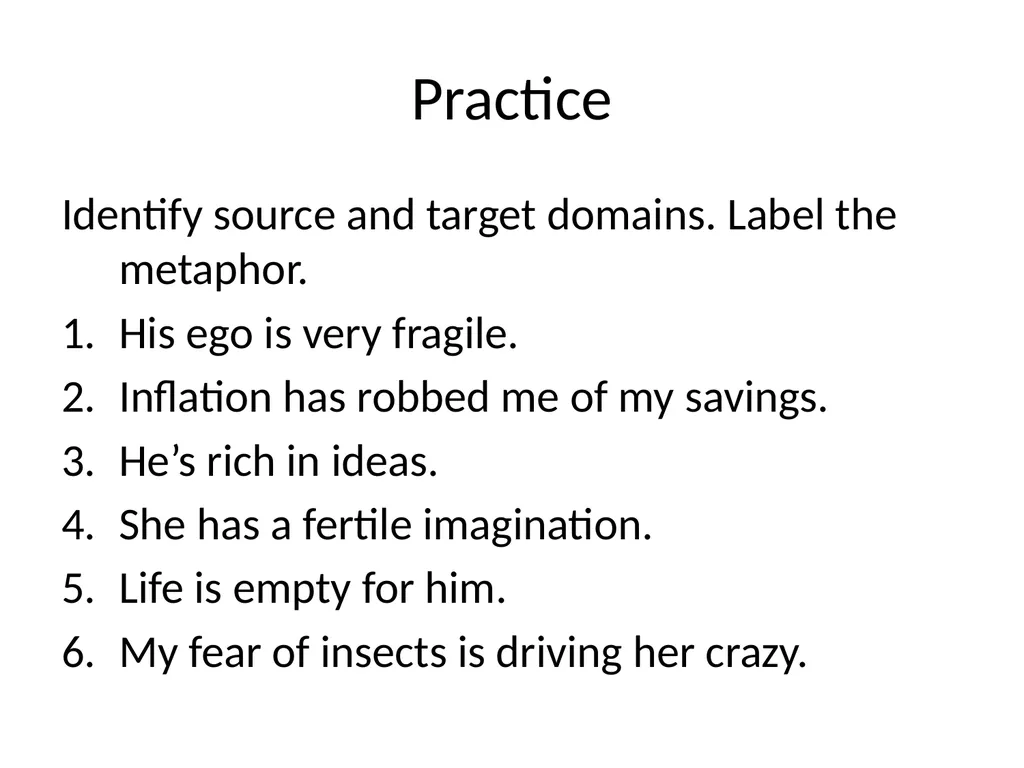
slide26. Practice Identify source and target domains. Label the metaphor.
His ego is very fragile.
Inflation has robbed me of my savings.
He’s rich in ideas.
She has a fertile imagination.
Life is empty for him.
My fear of insects is driving her crazy.<br>
slide27. His ego is very fragile.
THE MIND IS A BRITTLE OBJECT
Inflation has robbed me of my savings. INFLATION IS A PERSON
He’s rich in ideas.
IDEAS ARE MONEY
She has a fertile imagination.
IDEAS ARE PLANTS
Life is empty for him. LIFE IS A CONTAINER
My fear of insects is driving her crazy.
FEAR IS AN OBJECT. FEAR IS A FORCE.<br>
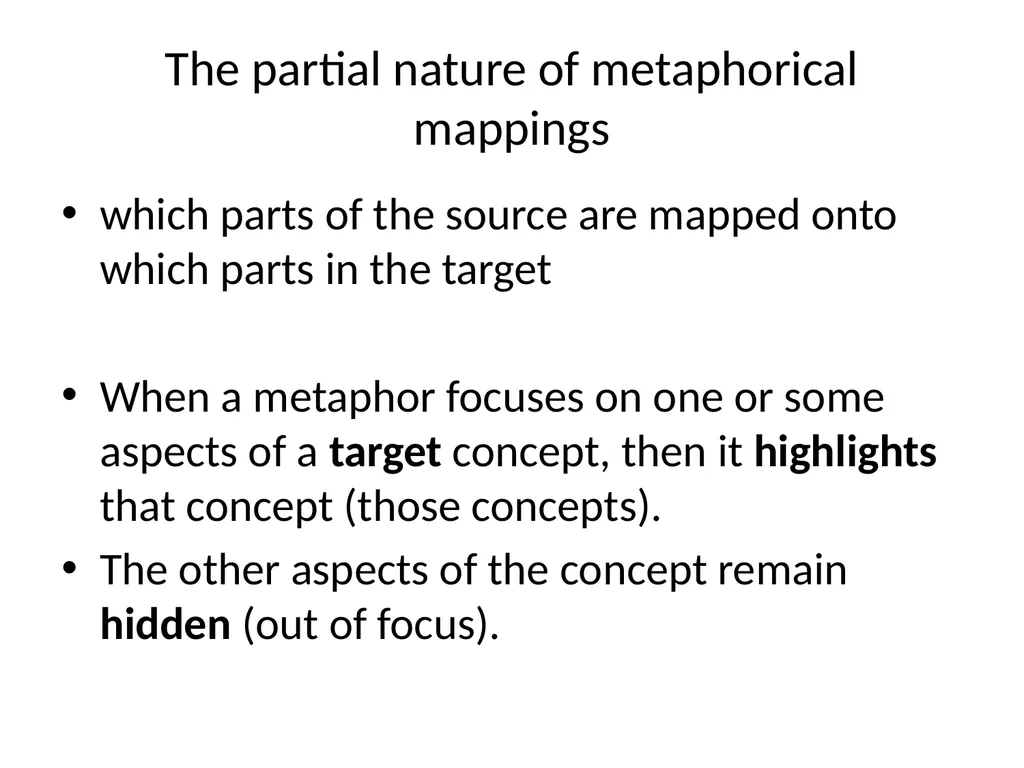
slide28. The partial nature of metaphorical mappings which parts of the source are mapped onto which parts in the target
When a metaphor focuses on one or some aspects of a target concept, then it highlights that concept (those concepts).
The other aspects of the concept remain hidden (out of focus).<br>
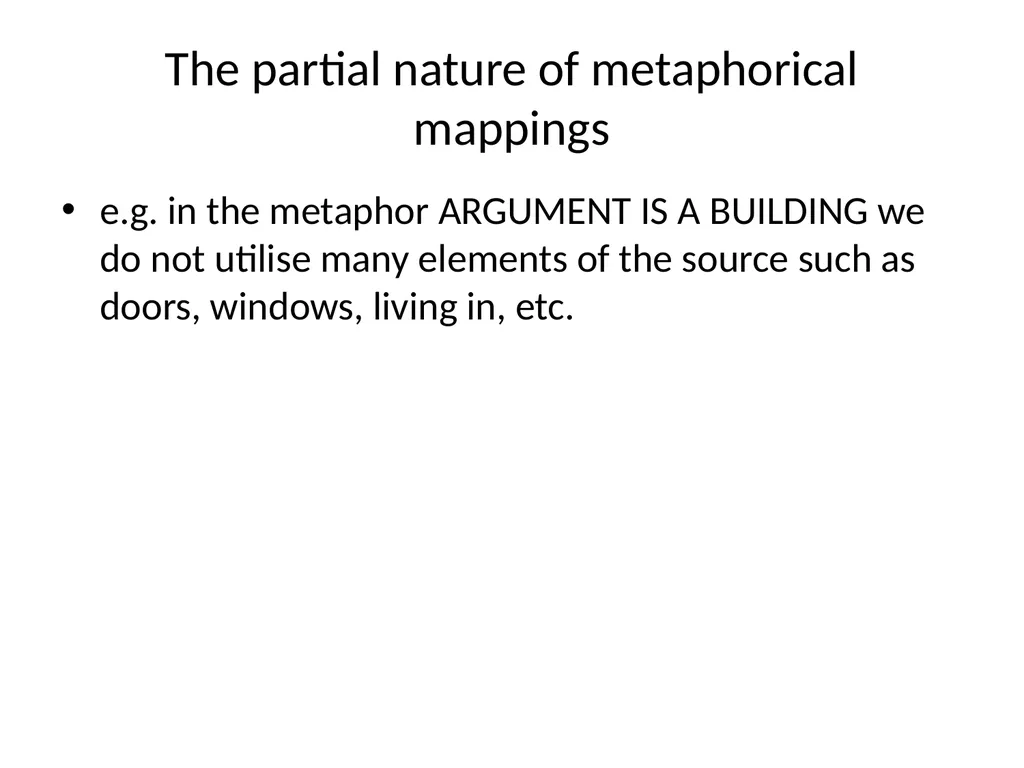
slide29. The partial nature of metaphorical mappings e.g. in the metaphor ARGUMENT IS A BUILDING we do not utilise many elements of the source such as doors, windows, living in, etc.<br>
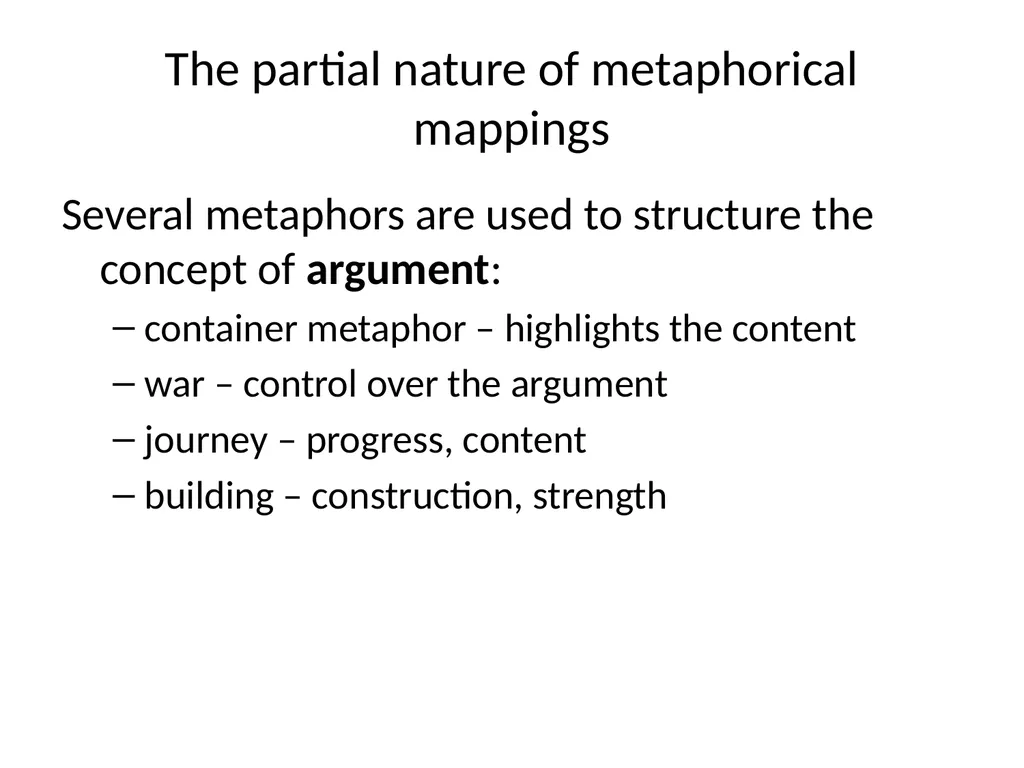
slide30. The partial nature of metaphorical mappings Several metaphors are used to structure the concept of argument:
container metaphor – highlights the content
war – control over the argument
journey – progress, content
building – construction, strength<br>
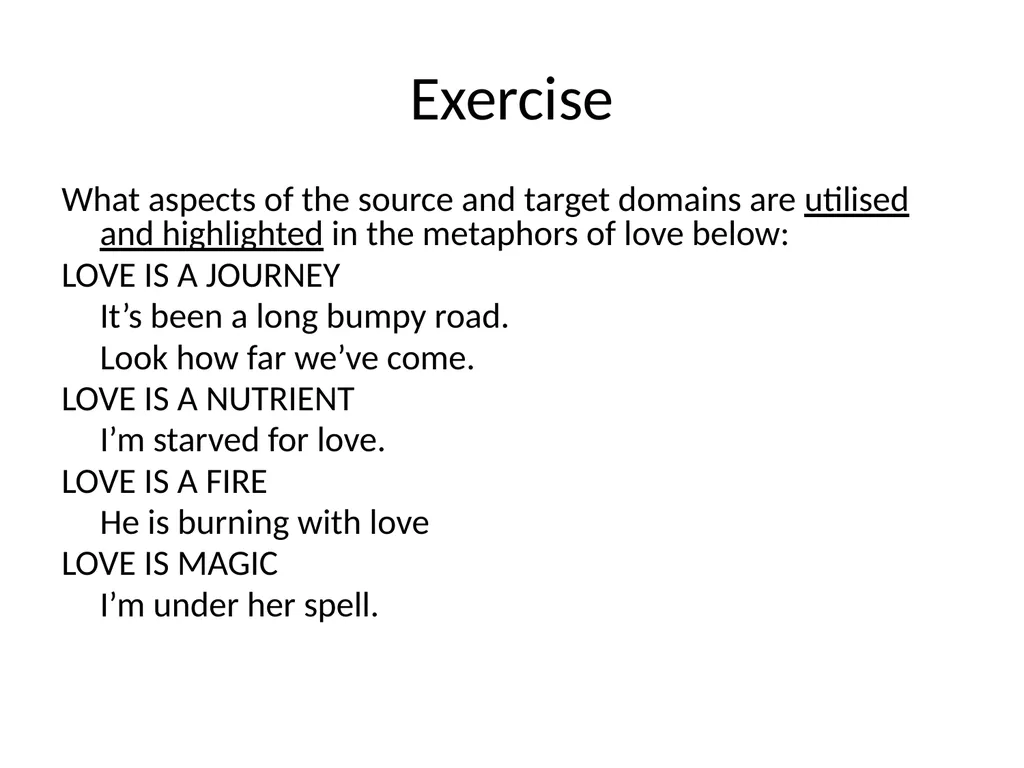
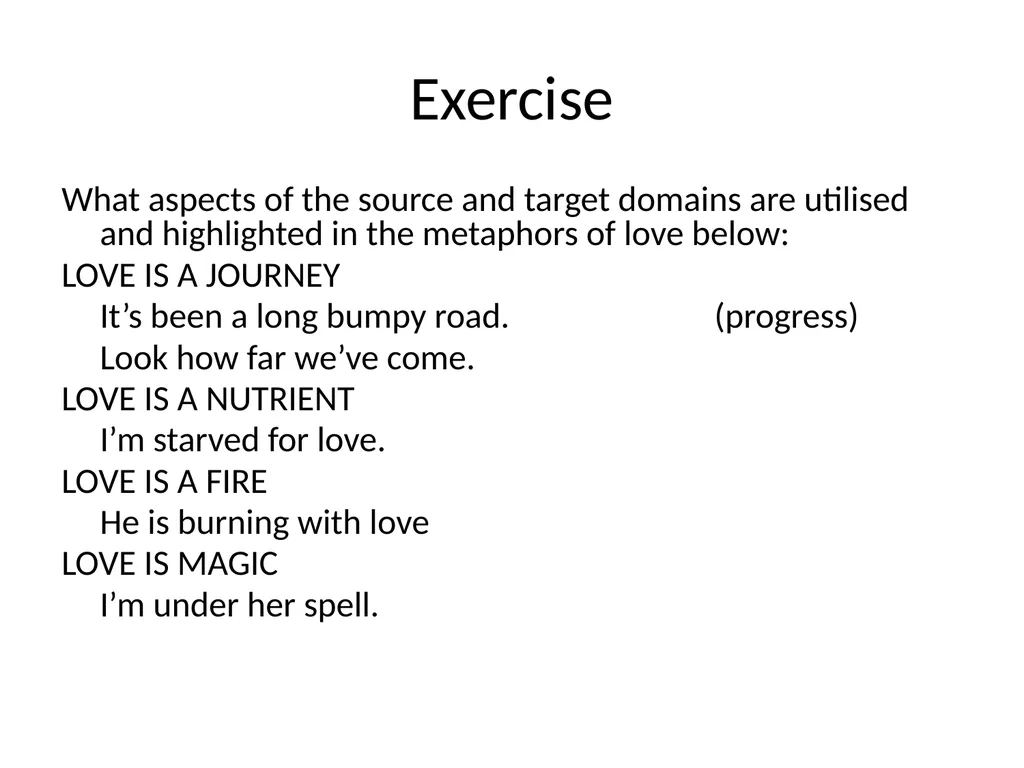
slide31. Exercise What aspects of the source and target domains are utilised and highlighted in the metaphors of love below:
LOVE IS A JOURNEY
It’s been a long bumpy road.
Look how far we’ve come.
LOVE IS A NUTRIENT
I’m starved for love.
LOVE IS A FIRE
He is burning with love
LOVE IS MAGIC
I’m under her spell.<br>
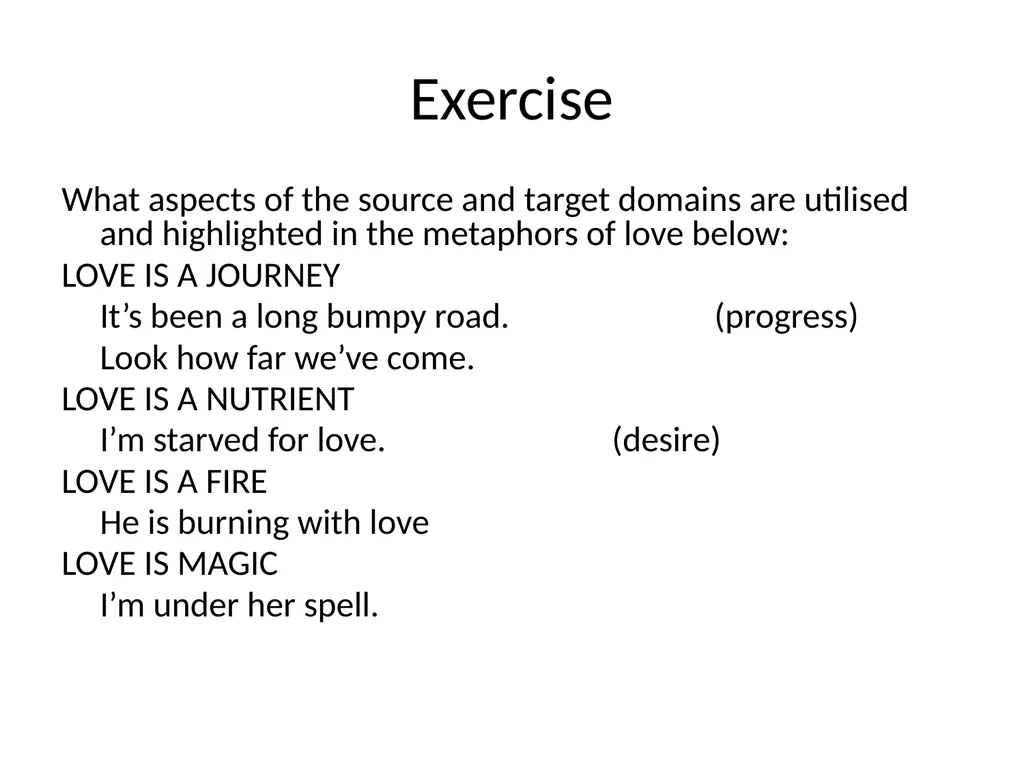
slide32. Exercise What aspects of the source and target domains are utilised and highlighted in the metaphors of love below:
LOVE IS A JOURNEY
It’s been a long bumpy road. (progress)
Look how far we’ve come.
LOVE IS A NUTRIENT
I’m starved for love.
LOVE IS A FIRE
He is burning with love
LOVE IS MAGIC
I’m under her spell.<br>
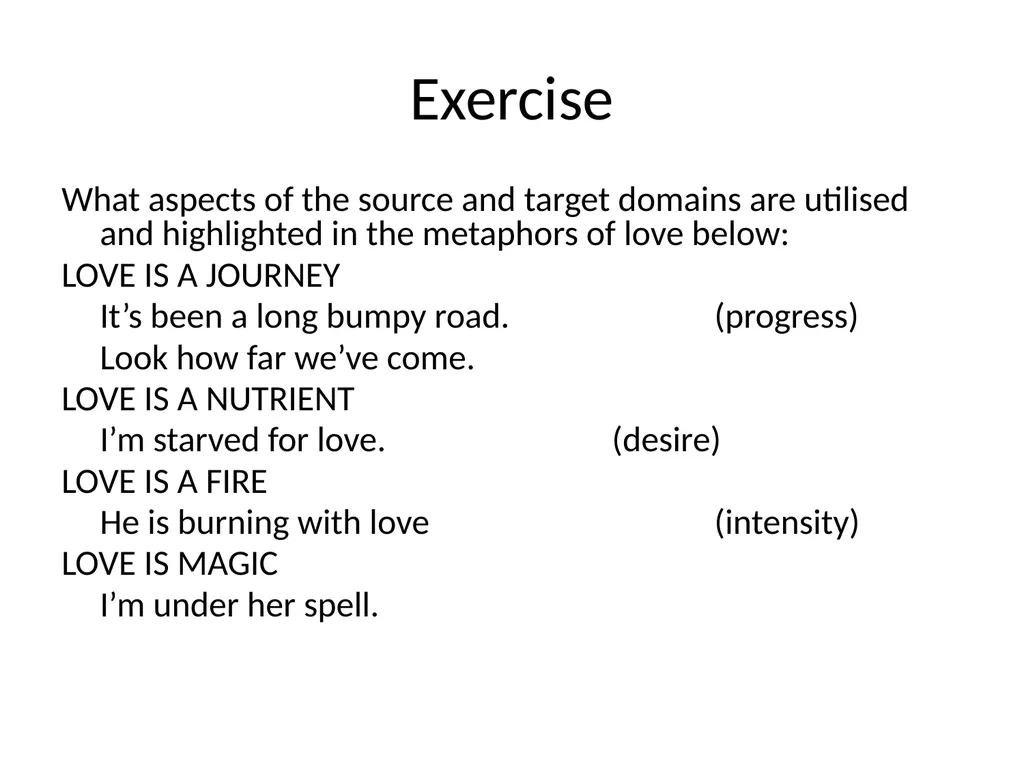
slide33. Exercise What aspects of the source and target domains are utilised and highlighted in the metaphors of love below:
LOVE IS A JOURNEY
It’s been a long bumpy road. (progress)
Look how far we’ve come.
LOVE IS A NUTRIENT
I’m starved for love. (desire)
LOVE IS A FIRE
He is burning with love
LOVE IS MAGIC
I’m under her spell.<br>
slide34. Exercise What aspects of the source and target domains are utilised and highlighted in the metaphors of love below:
LOVE IS A JOURNEY
It’s been a long bumpy road. (progress)
Look how far we’ve come.
LOVE IS A NUTRIENT
I’m starved for love. (desire)
LOVE IS A FIRE
He is burning with love (intensity)
LOVE IS MAGIC
I’m under her spell.<br>
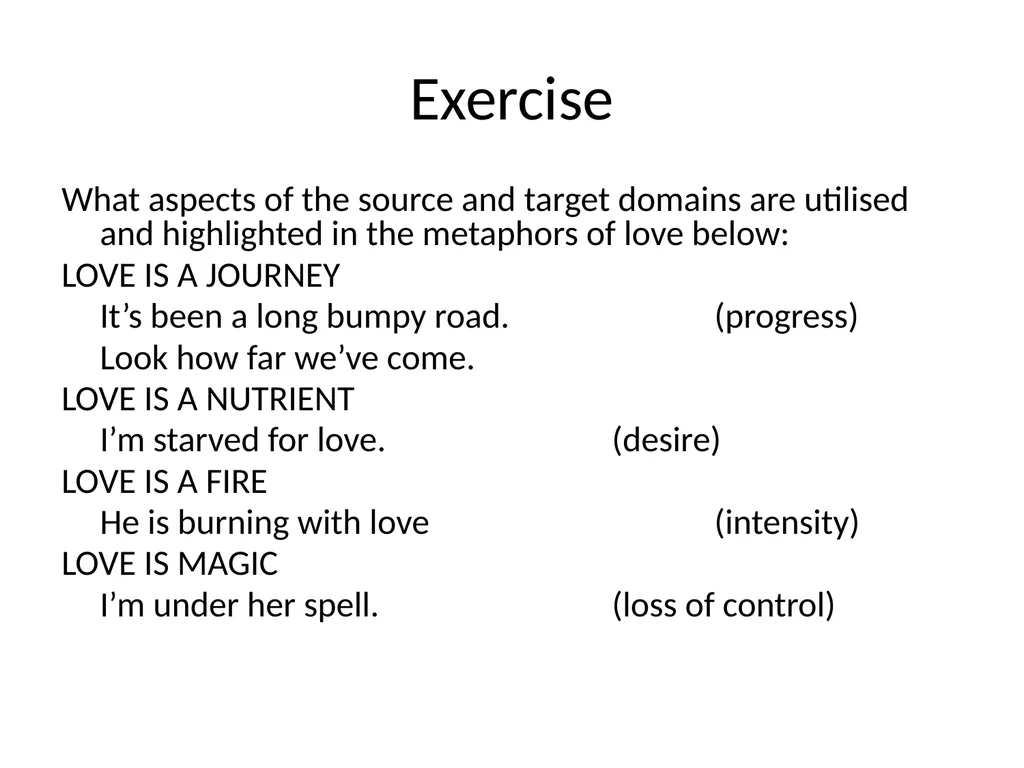
slide35. Exercise What aspects of the source and target domains are utilised and highlighted in the metaphors of love below:
LOVE IS A JOURNEY
It’s been a long bumpy road. (progress)
Look how far we’ve come.
LOVE IS A NUTRIENT
I’m starved for love. (desire)
LOVE IS A FIRE
He is burning with love (intensity)
LOVE IS MAGIC
I’m under her spell. (loss of control)<br>
slide36. The concept of sadness: an analysis Identify the conceptual metaphors manifested by these examples.
Which aspects of sadness are highlighted and which aspects are hidden?
Waves of depression came over him.
He brought me down with his remarks.
He is in a dark mood.
I am filled with sorrow.
That was a terrible blow.
Tim heals all sorrows.
He was insane with grief.
He drowned his sorrow in drink.
His feelings of misery got out of hand.
She was ruled by sorrow.<br>
slide37. Waves of depression came over him.
SADNESS IN A NATURAL FORCE
Highlighted: passivity, lack of control
Hidden: cause, attempt at control, behavioural responses (?)<br>
slide38. He brought me down with his remarks.
SAD IS DOWN
Highlighted: negative character
Hidden: cause, attempt at control<br>
slide39. He is in a dark mood.
SAD IS DARK
Highlighted: negative character
Hidden: cause, attempt t control<br>
slide40. I am filled with sorrow.
SADNESS IS A FLUID IN A CONTAINER
Highlighted: intensity, attempt at control, loss of control
Hidden: negative character<br>
slide41. That was a terrible blow.
SADNESS IS A PHYSICAL FORCE
Highlighted: passivity, sudden impact
Hidden: cause, attempt at control, behavioral responses<br>
slide42. Tim heals all sorrows.
SADNESS IS A DISEASE
Highlighted: negative character, passivity, behavioral responses
Hidden: attempt at control<br>
slide43. He was insane with grief.
SADNESS IS INSANITY
Highlighted: lack of control
Hidden: attempt at control<br>
slide44. He drowned his sorrow in drink.
SADNESS IS AN OPPONENT
Highlighted: attempt at control
Hidden: passivity<br>
slide45. His feelings of misery got out of hand.
SADNESS IS A CAPTIVE ANIMAL
Highlighted: loss of control
Hidden: passivity<br>
slide46. She was ruled by sorrow.
SADNESS IS A SOCIAL SUPERIOR
Highlighted: lack of control
Hidden: attempt at control<br>
slide2. By the use of metaphors the ability to understand and to express in language the experience of the world unbelievably increases. .<br>
slide3. By the use of metaphors the ability to understand and to express in language the experience of the world unbelievably increases.
It allows people to go beyond the immediate experience and to extend the language in an unlimited way. .<br>
slide4. Conceptual metaphor Understanding one conceptual domain in terms of another conceptual domain.<br>
slide5. Conceptual metaphor Understanding one conceptual domain in terms of another conceptual domain.
A conceptual domain - any coherent organisation of experience.
LIFE; LOVE; BEING SAD; LIGHT; ECONOMY; WAR, etc.<br>
slide6. Conceptual metaphor Is that the foundation for your theory?
The theory needs more support.
We need to construct a strong argument for that.
The theory will stand or fall on the strength of that argument.<br>
slide7. Conceptual metaphor Is that the foundation for your theory?
The theory needs more support.
We need to construct a strong argument for that.
The theory will stand or fall on the strength of that argument. THEORIES ARE BUILDINGS<br>
slide8. Conceptual metaphor Is that the foundation for your theory?
The theory needs more support.
We need to construct a strong argument for that.
The theory will stand or fall on the strength of that argument. THEORIES ARE BUILDINGS
CONCEPTUAL DOMAIN (A) IS
CONCEPTUAL DOMAIN (B)<br>
slide9. Correspondences between domains<br>
slide10. mappings There is a set of systematic correspondences or mappings between the source and the target.
It means that constituent conceptual elements of the source correspond to constituent elements of the target.<br>
slide11. ARGUMENT IS WAR Your claims are indefensible.
He attacked every weak point in my argument.
His criticisms were right on target.
I’ve never won an argument with him.
If you use that strategy, he’ll wipe you out.<br>
slide12. TIME IS MONEY You’re wasting my time.
This gadget will save you hours.
How do you spend your time these days?
That flat tire cost me an hour.
You don’t use your time profitably.<br>
slide13. LIFE IS A JOURNEY He’s without direction in life.
I’m at a crossroads in my life.
She’s gone through a lot in life.
He’s gone (= died).<br>
slide14. metaphor vs. metaphorical linguistic expression<br>
slide15. Common source domains the human body (the heart of the problem)
health and illness (a healthy society, she hurt my feelings)
animals (a cow, a bitch)
plants (the fruits of her labour, exports flourished)
buildings and construction (he's in ruins financially)
machines and tools ( conceptual tools, she produces a book)
games and sport (to toy with the idea)
money and economic transactions (spending time, investing in a relationship)
cooking and food (to cook up a story, a recipe for success)
heat and cold (a cold reception, icy stare)
light and darkness (a dark mood, a cloud of suspicion)
forces (he's driving me nuts)
movement and direction (he went crazy, inflation is soaring)<br>
slide16. Common target domains emotion
desire
morality
thought
society/nation
politics
economy
human relationships
communication
time
life and death
religion
events and actions<br>
slide17. Classification of metaphors conceptual metaphors are classified according to:
conventionality
cognitive function<br>
slide18. Classification according to conventionality Conventional conceptual metaphors - well-entrenched ways of thinking about or understanding an abstract domain (often expressed by conventional linguistic expressions).<br>
slide19. Classification according to conventionality Unconventional conceptual metaphors
unconventional linguistic expression
unconventional source-target connection<br>
slide20. The cognitive function of metaphors Ontological metaphors
Structural metaphors
Orientational metaphors<br>
slide21. The cognitive function of metaphors Ontological metaphors
They give ontological status to abstract or vague concepts (i.e. we think and talk of them as if they were THINGS).
They allow us to refer to, quantify, to identify more diffuse aspects of our experience.<br>
slide22. The cognitive function of metaphors Ontological metaphors – examples
Give me a call. (an event is a physical object)
my mind (a possessed physical object)
in love (an emotional state is a container)
Life has cheated me. (life is a person; personification)
Ontological metaphors can be elaborated into structural metaphors.<br>
slide23. The cognitive function of metaphors Structural metaphors
Their cognitive function is to enable to understand the target by means of the structure of the source (by means of conceptual mappings).
The source domain provides a relatively rich knowledge for the target concept.<br>
slide24. The cognitive function of metaphors Orientational metaphors
Their cognitive function is to make a set of target concepts coherent in our conceptual system.
They are based on human spatial orientations (e.g. up-down, centre-periphery, etc.)<br>
slide25. The cognitive function of metaphors Orientational metaphors
MORE IS UP: Speak up, please.
SICK IS DOWN: He fell ill.
CONTROL IS UP: He is under my control.
RATIONAL IS UP: The discussion fell to an emotional level.<br>
slide26. Practice Identify source and target domains. Label the metaphor.
His ego is very fragile.
Inflation has robbed me of my savings.
He’s rich in ideas.
She has a fertile imagination.
Life is empty for him.
My fear of insects is driving her crazy.<br>
slide27. His ego is very fragile.
THE MIND IS A BRITTLE OBJECT
Inflation has robbed me of my savings. INFLATION IS A PERSON
He’s rich in ideas.
IDEAS ARE MONEY
She has a fertile imagination.
IDEAS ARE PLANTS
Life is empty for him. LIFE IS A CONTAINER
My fear of insects is driving her crazy.
FEAR IS AN OBJECT. FEAR IS A FORCE.<br>
slide28. The partial nature of metaphorical mappings which parts of the source are mapped onto which parts in the target
When a metaphor focuses on one or some aspects of a target concept, then it highlights that concept (those concepts).
The other aspects of the concept remain hidden (out of focus).<br>
slide29. The partial nature of metaphorical mappings e.g. in the metaphor ARGUMENT IS A BUILDING we do not utilise many elements of the source such as doors, windows, living in, etc.<br>
slide30. The partial nature of metaphorical mappings Several metaphors are used to structure the concept of argument:
container metaphor – highlights the content
war – control over the argument
journey – progress, content
building – construction, strength<br>
slide31. Exercise What aspects of the source and target domains are utilised and highlighted in the metaphors of love below:
LOVE IS A JOURNEY
It’s been a long bumpy road.
Look how far we’ve come.
LOVE IS A NUTRIENT
I’m starved for love.
LOVE IS A FIRE
He is burning with love
LOVE IS MAGIC
I’m under her spell.<br>
slide32. Exercise What aspects of the source and target domains are utilised and highlighted in the metaphors of love below:
LOVE IS A JOURNEY
It’s been a long bumpy road. (progress)
Look how far we’ve come.
LOVE IS A NUTRIENT
I’m starved for love.
LOVE IS A FIRE
He is burning with love
LOVE IS MAGIC
I’m under her spell.<br>
slide33. Exercise What aspects of the source and target domains are utilised and highlighted in the metaphors of love below:
LOVE IS A JOURNEY
It’s been a long bumpy road. (progress)
Look how far we’ve come.
LOVE IS A NUTRIENT
I’m starved for love. (desire)
LOVE IS A FIRE
He is burning with love
LOVE IS MAGIC
I’m under her spell.<br>
slide34. Exercise What aspects of the source and target domains are utilised and highlighted in the metaphors of love below:
LOVE IS A JOURNEY
It’s been a long bumpy road. (progress)
Look how far we’ve come.
LOVE IS A NUTRIENT
I’m starved for love. (desire)
LOVE IS A FIRE
He is burning with love (intensity)
LOVE IS MAGIC
I’m under her spell.<br>
slide35. Exercise What aspects of the source and target domains are utilised and highlighted in the metaphors of love below:
LOVE IS A JOURNEY
It’s been a long bumpy road. (progress)
Look how far we’ve come.
LOVE IS A NUTRIENT
I’m starved for love. (desire)
LOVE IS A FIRE
He is burning with love (intensity)
LOVE IS MAGIC
I’m under her spell. (loss of control)<br>
slide36. The concept of sadness: an analysis Identify the conceptual metaphors manifested by these examples.
Which aspects of sadness are highlighted and which aspects are hidden?
Waves of depression came over him.
He brought me down with his remarks.
He is in a dark mood.
I am filled with sorrow.
That was a terrible blow.
Tim heals all sorrows.
He was insane with grief.
He drowned his sorrow in drink.
His feelings of misery got out of hand.
She was ruled by sorrow.<br>
slide37. Waves of depression came over him.
SADNESS IN A NATURAL FORCE
Highlighted: passivity, lack of control
Hidden: cause, attempt at control, behavioural responses (?)<br>
slide38. He brought me down with his remarks.
SAD IS DOWN
Highlighted: negative character
Hidden: cause, attempt at control<br>
slide39. He is in a dark mood.
SAD IS DARK
Highlighted: negative character
Hidden: cause, attempt t control<br>
slide40. I am filled with sorrow.
SADNESS IS A FLUID IN A CONTAINER
Highlighted: intensity, attempt at control, loss of control
Hidden: negative character<br>
slide41. That was a terrible blow.
SADNESS IS A PHYSICAL FORCE
Highlighted: passivity, sudden impact
Hidden: cause, attempt at control, behavioral responses<br>
slide42. Tim heals all sorrows.
SADNESS IS A DISEASE
Highlighted: negative character, passivity, behavioral responses
Hidden: attempt at control<br>
slide43. He was insane with grief.
SADNESS IS INSANITY
Highlighted: lack of control
Hidden: attempt at control<br>
slide44. He drowned his sorrow in drink.
SADNESS IS AN OPPONENT
Highlighted: attempt at control
Hidden: passivity<br>
slide45. His feelings of misery got out of hand.
SADNESS IS A CAPTIVE ANIMAL
Highlighted: loss of control
Hidden: passivity<br>
slide46. She was ruled by sorrow.
SADNESS IS A SOCIAL SUPERIOR
Highlighted: lack of control
Hidden: attempt at control<br>