The CYK Algorithm Implementation Wesam Fadheel Mohammed Hamdi CS 6800 Spring 2016, WMU Outline CYK Algorithm. The basics of CYK Algorithm. The Chomsky Normal Form CNF. CYK Algorithm steps. How does the CYK Algorithm start? Build the
Related Topics
Share
Embed code
Download this presentation From Below
"The CYK Algorithm Implementation Wesam Fadheel &" is the property of its rightful owner. Permission is granted to
download and print the materials on this website for personal, non-commercial use only, and to display it
on your personal computer provided you do not modify the materials and that you retain all copyright
notices contained in the materials. By downloading content from our website, you accept the terms of this
agreement.
Presentation Transcript
01
The CYK Algorithm Implementation Wesam Fadheel & Mohammed Hamdi
CS 6800
Spring 2016, WMU<br>
02
Outline CYK Algorithm.
The basics of CYK Algorithm.
The Chomsky Normal Form CNF.
CYK Algorithm steps.
How does the CYK Algorithm start?
Build the Triangular Table & example 1.
Build the Upper Diagonal Matrix Table & example 2.
Notes.
References.<br>
03
The CYK Algorithm It is called CYK or CKY Algorithm according to its inventors Cocke-Kasami-Younger.
It is a membership problem to determine weather the string (w) belongs to the grammar (G) or not.<br>
04
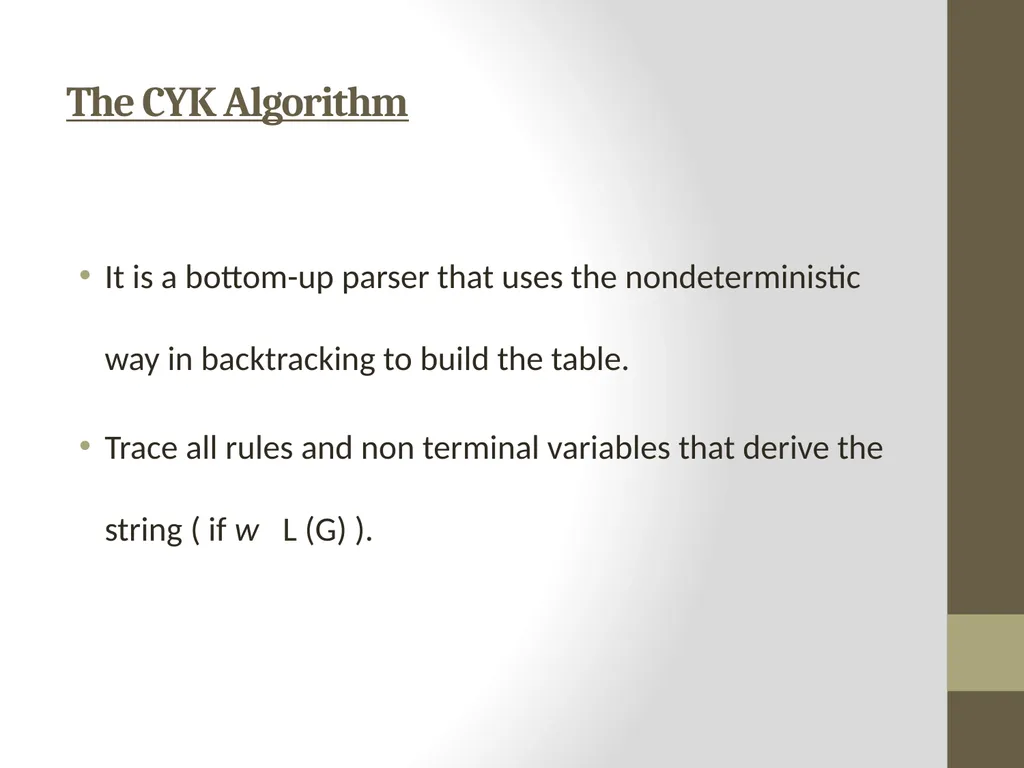
The CYK Algorithm It is a bottom-up parser that uses the nondeterministic way in backtracking to build the table.
Trace all rules and non terminal variables that derive the string ( if w L (G) ).<br>
05
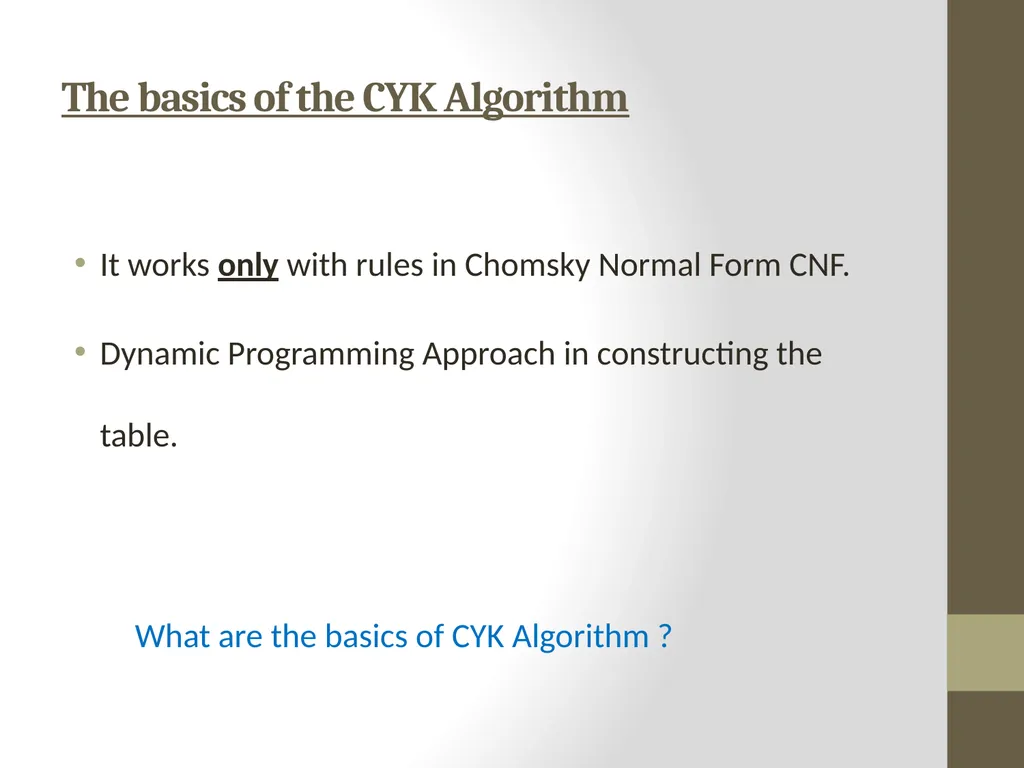
The basics of the CYK Algorithm It works only with rules in Chomsky Normal Form CNF.
Dynamic Programming Approach in constructing the table. What are the basics of CYK Algorithm ?<br>
06
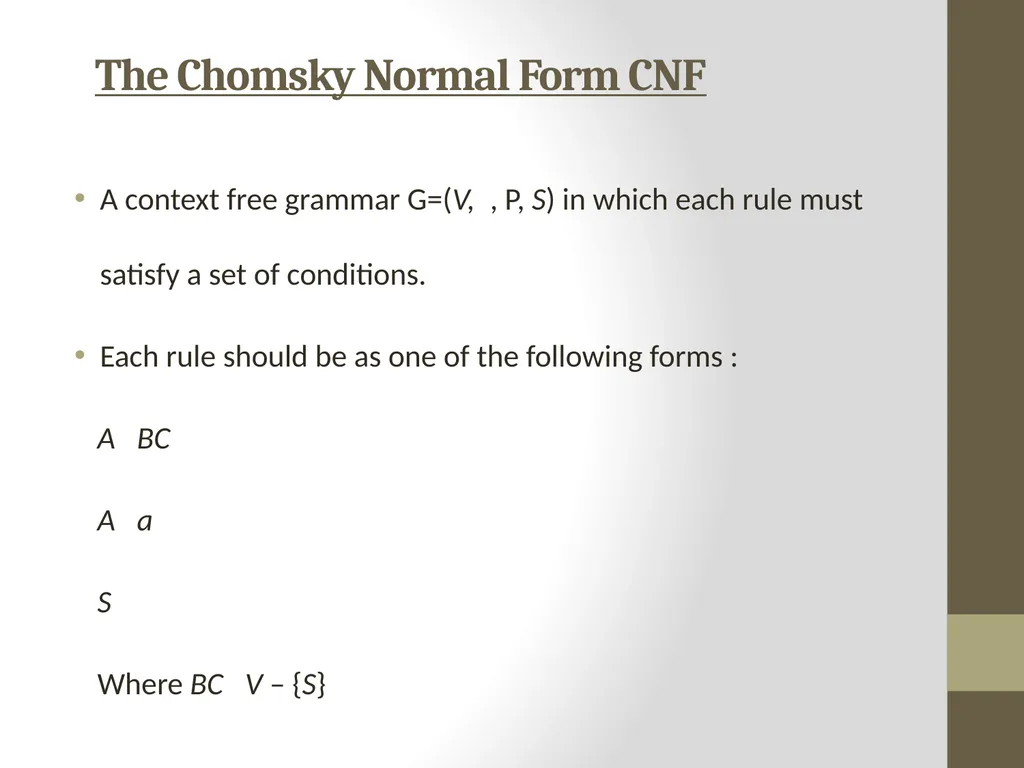
The Chomsky Normal Form CNF A context free grammar G=(V, , P, S) in which each rule must satisfy a set of conditions.
Each rule should be as one of the following forms :
A BC
A a
S
Where BC V – {S}<br>
07
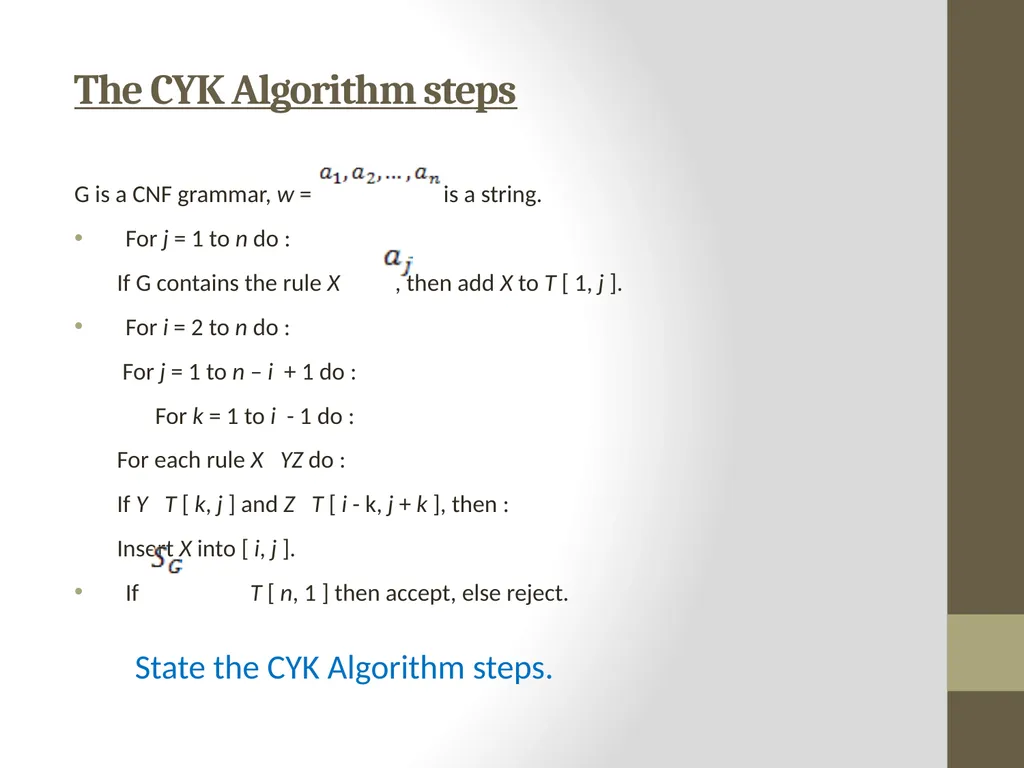
The CYK Algorithm steps
G is a CNF grammar, w = is a string.
For j = 1 to n do :
If G contains the rule X , then add X to T [ 1, j ].
For i = 2 to n do :
For j = 1 to n – i + 1 do :
For k = 1 to i - 1 do :
For each rule X YZ do :
If Y T [ k, j ] and Z T [ i - k, j + k ], then :
Insert X into [ i, j ].
If T [ n, 1 ] then accept, else reject. State the CYK Algorithm steps.<br>
08
How does the CYK Algorithm start?
Count the number of terminals in the given string to determine the dimension of the table.
Look for the terminals in the right side of the given CNF rules.
Start to build the table from the lower row.<br>
09
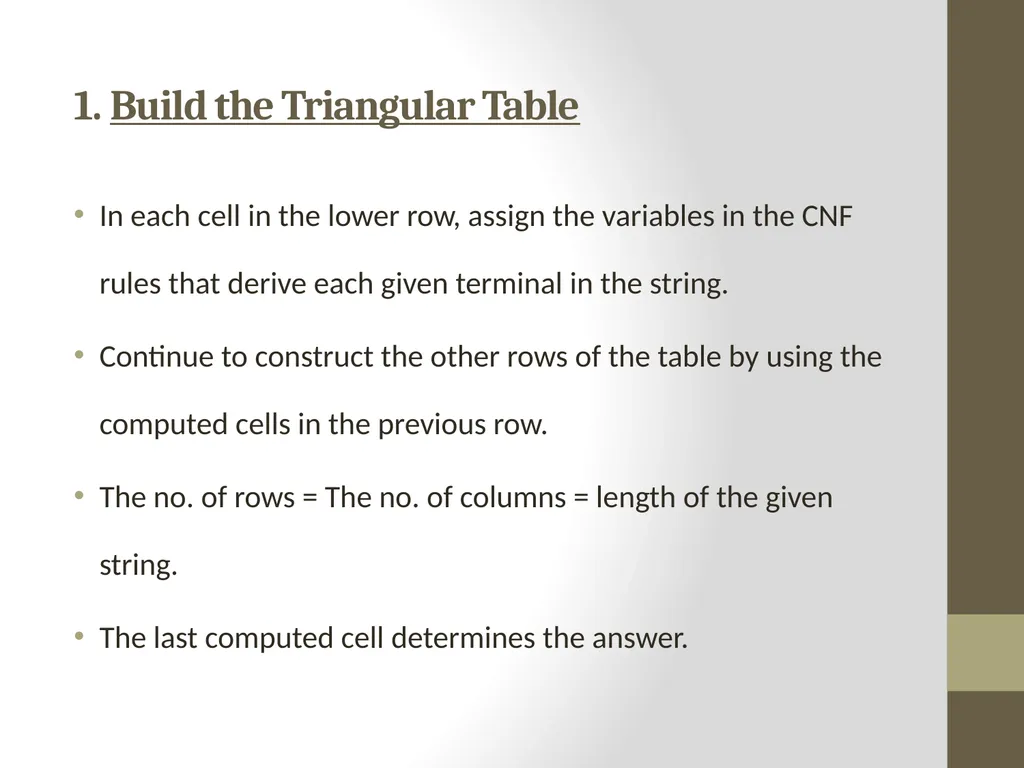
1. Build the Triangular Table In each cell in the lower row, assign the variables in the CNF rules that derive each given terminal in the string.
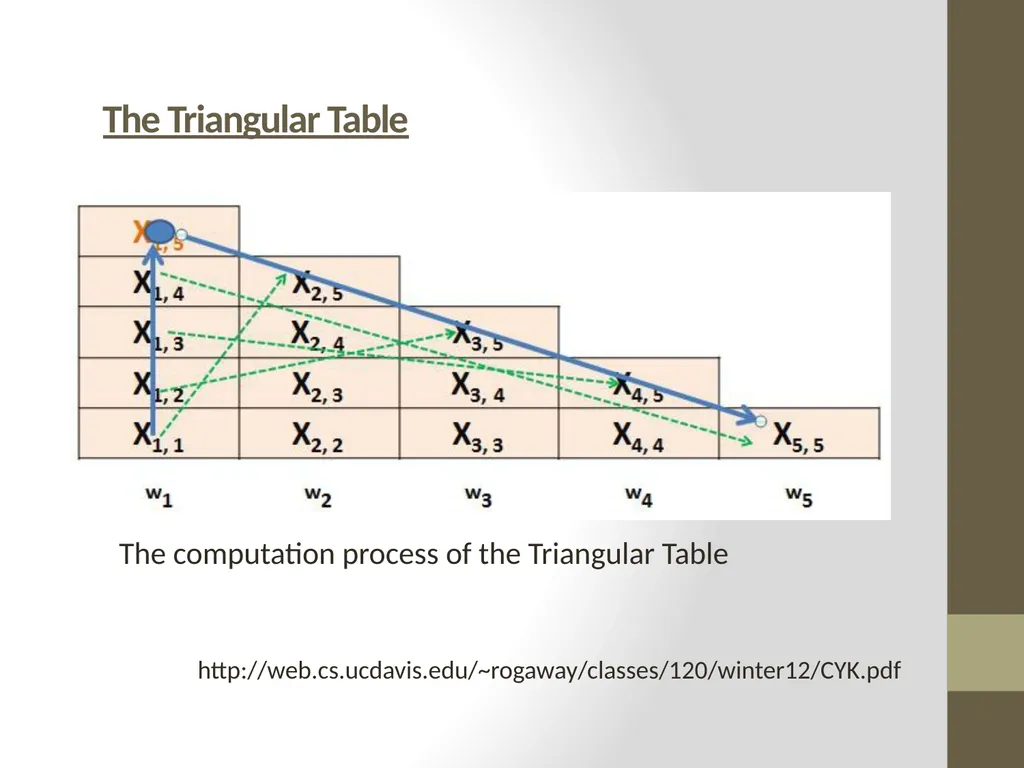
Continue to construct the other rows of the table by using the computed cells in the previous row.
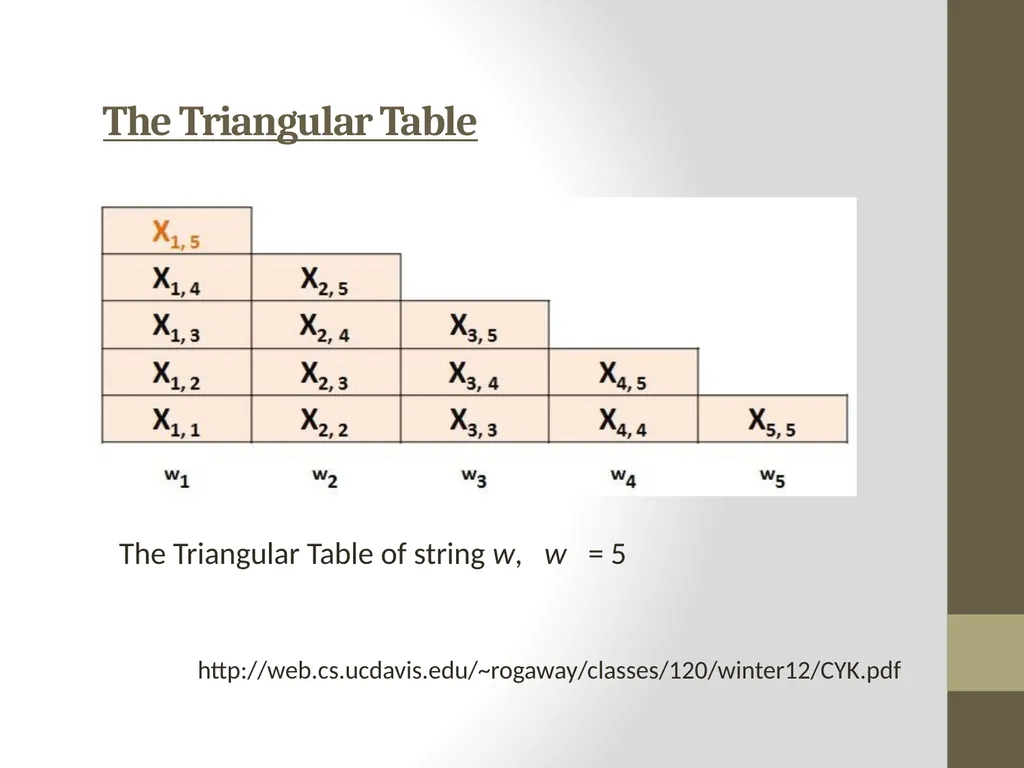
The no. of rows = The no. of columns = length of the given string.
The last computed cell determines the answer.<br>
10
The Triangular Table The Triangular Table of string w, w = 5 http://web.cs.ucdavis.edu/~rogaway/classes/120/winter12/CYK.pdf<br>
11
The Triangular Table The computation process of the Triangular Table http://web.cs.ucdavis.edu/~rogaway/classes/120/winter12/CYK.pdf<br>
12
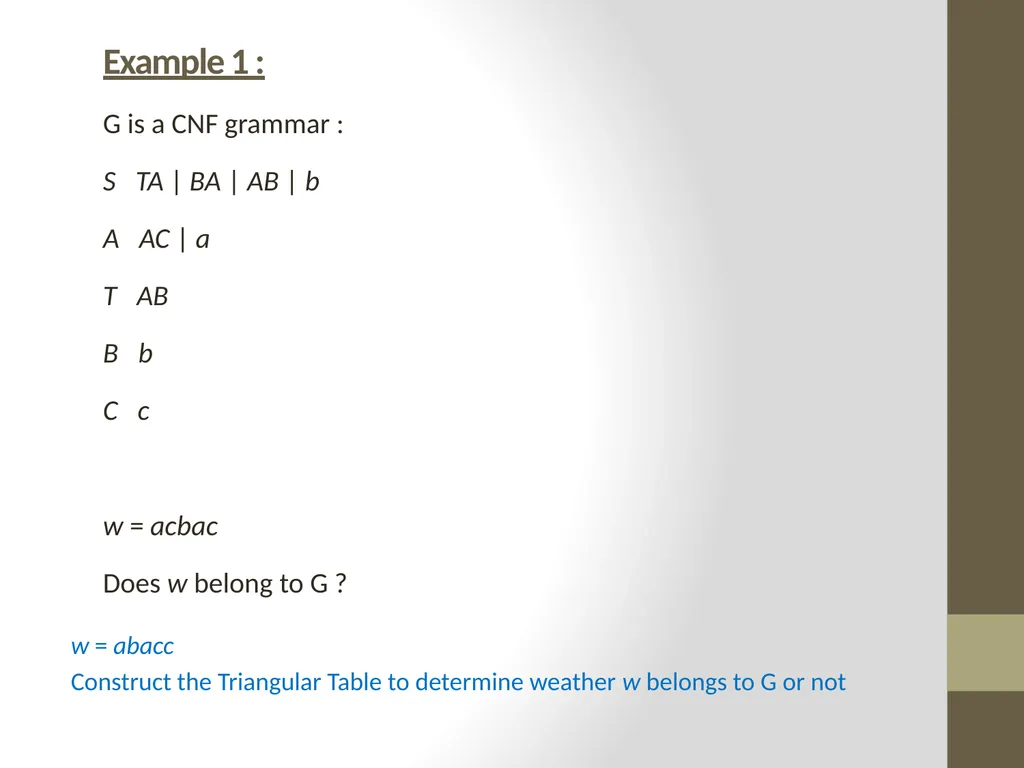
Example 1 :
G is a CNF grammar :
S TA | BA | AB | b
A AC | a
T AB
B b
C c
w = acbac
Does w belong to G ? w = abacc
Construct the Triangular Table to determine weather w belongs to G or not<br>
13
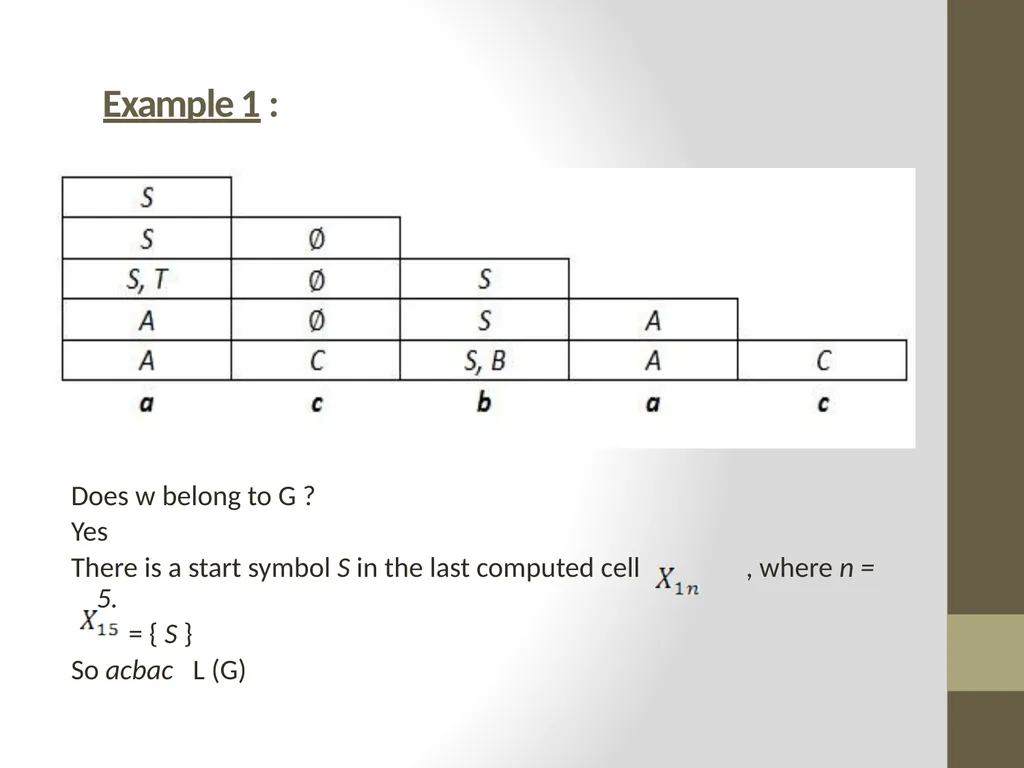
Example 1 : Does w belong to G ?
Yes
There is a start symbol S in the last computed cell , where n = 5.
= { S }
So acbac L (G)<br>
14
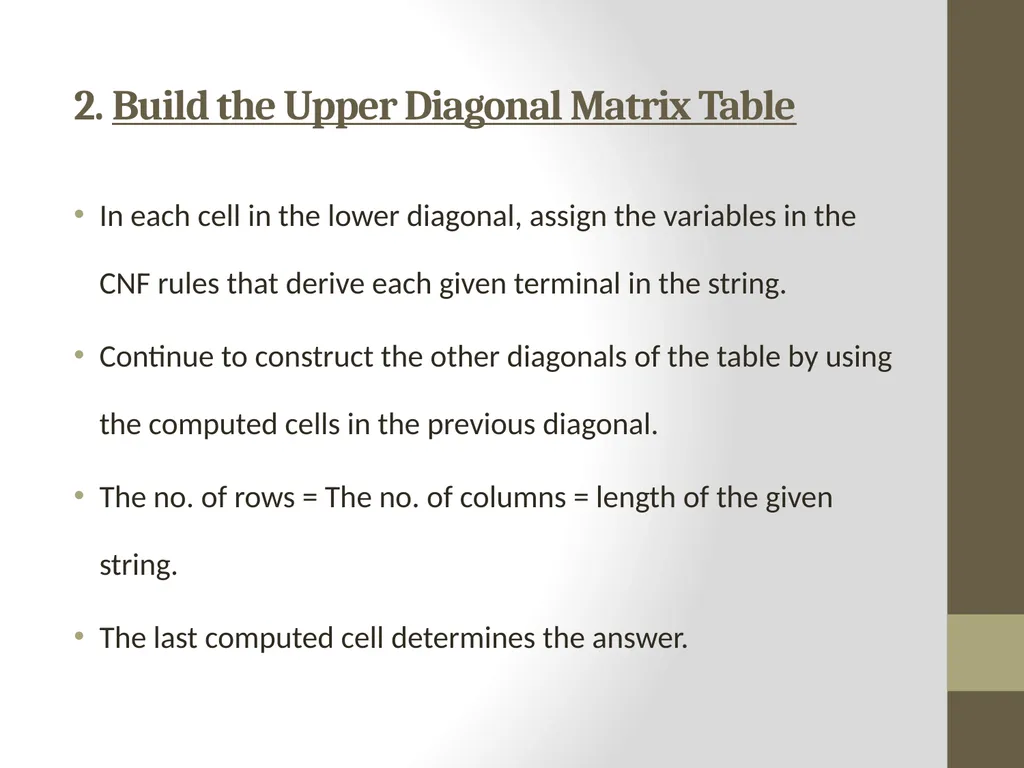
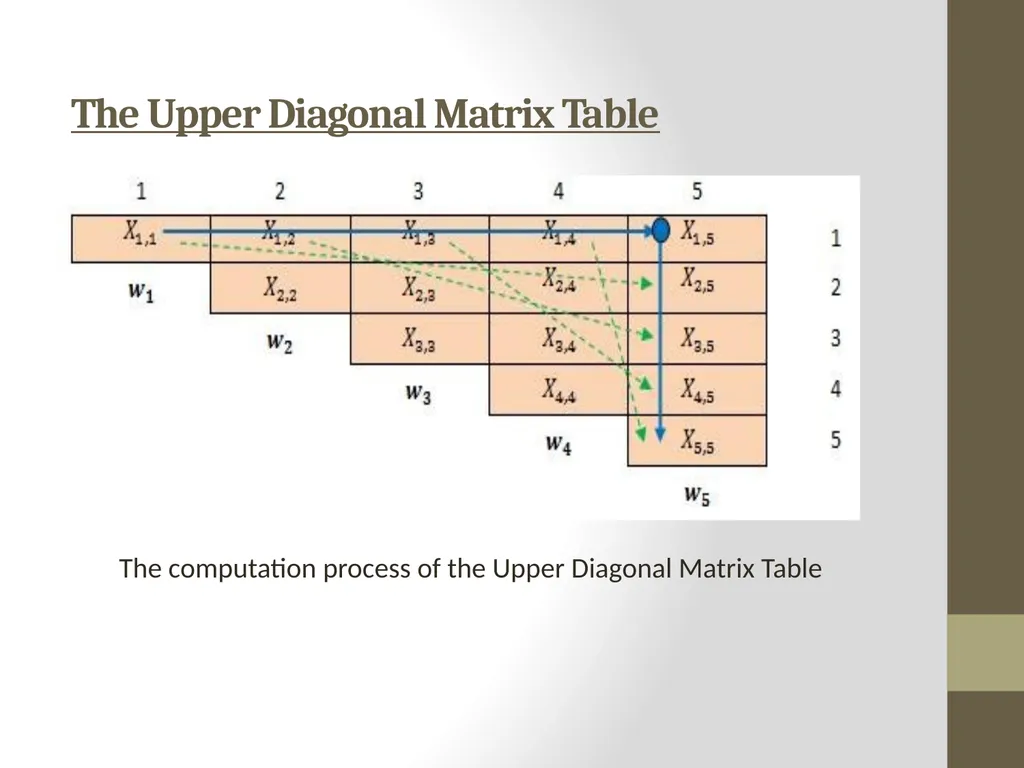
2. Build the Upper Diagonal Matrix Table In each cell in the lower diagonal, assign the variables in the CNF rules that derive each given terminal in the string.
Continue to construct the other diagonals of the table by using the computed cells in the previous diagonal.
The no. of rows = The no. of columns = length of the given string.
The last computed cell determines the answer.<br>
15
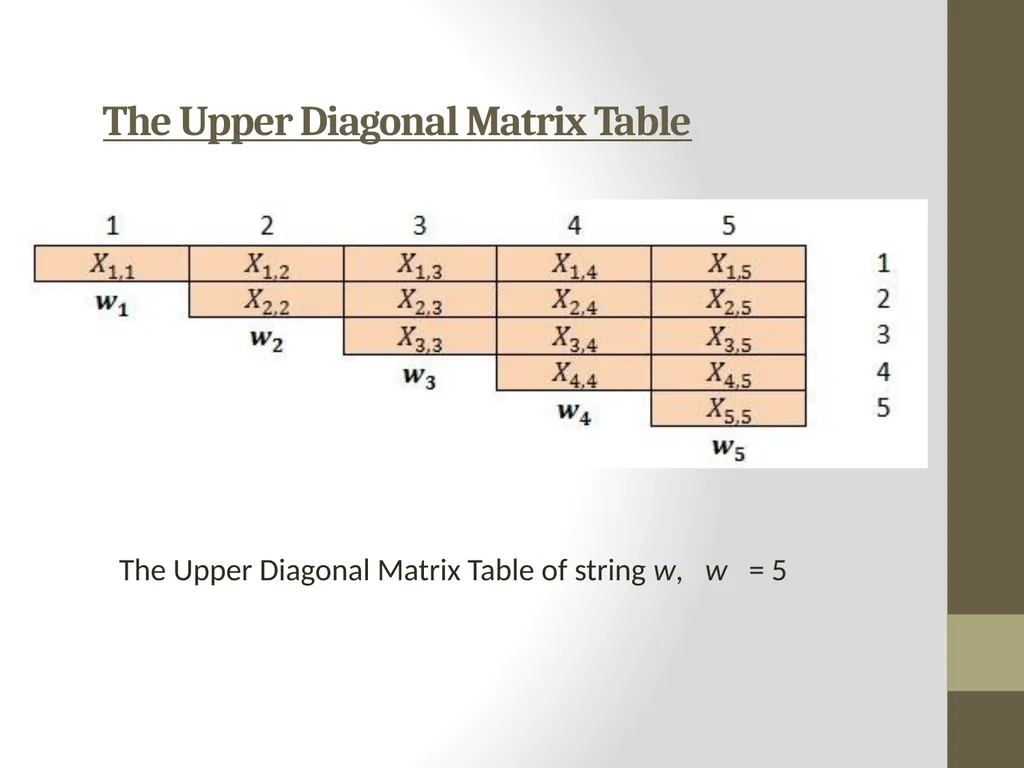
The Upper Diagonal Matrix Table The Upper Diagonal Matrix Table of string w, w = 5<br>
16
The Upper Diagonal Matrix Table The computation process of the Upper Diagonal Matrix Table<br>
17
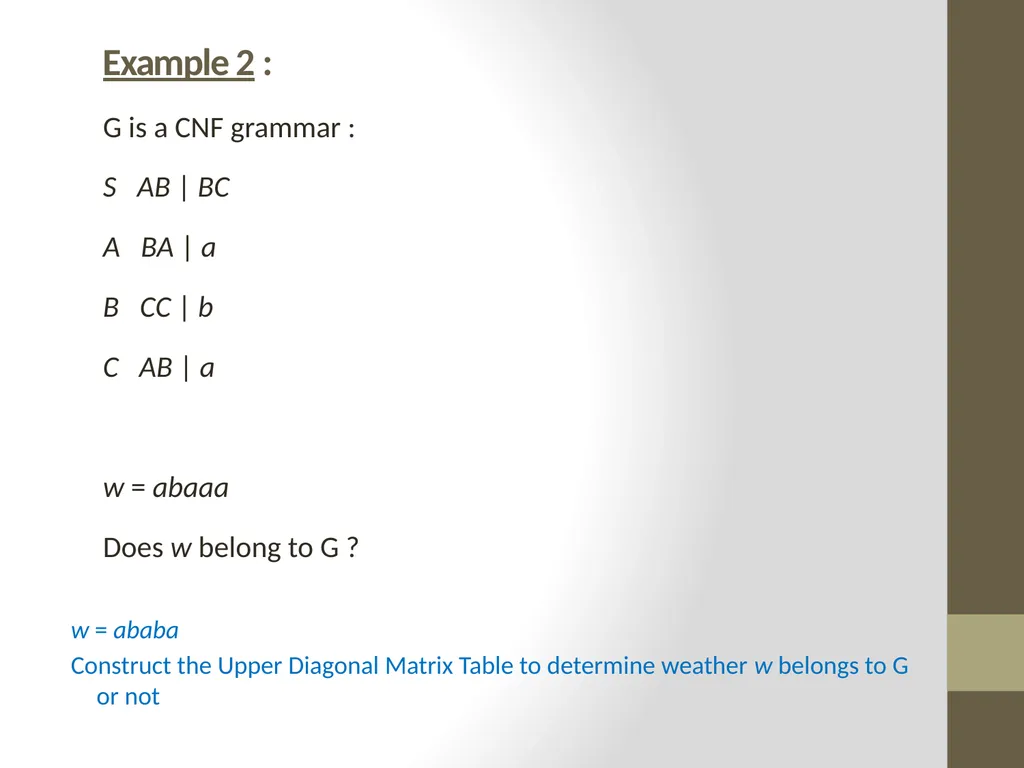
Example 2 :
G is a CNF grammar :
S AB | BC
A BA | a
B CC | b
C AB | a
w = abaaa
Does w belong to G ? w = ababa
Construct the Upper Diagonal Matrix Table to determine weather w belongs to G or not<br>
18
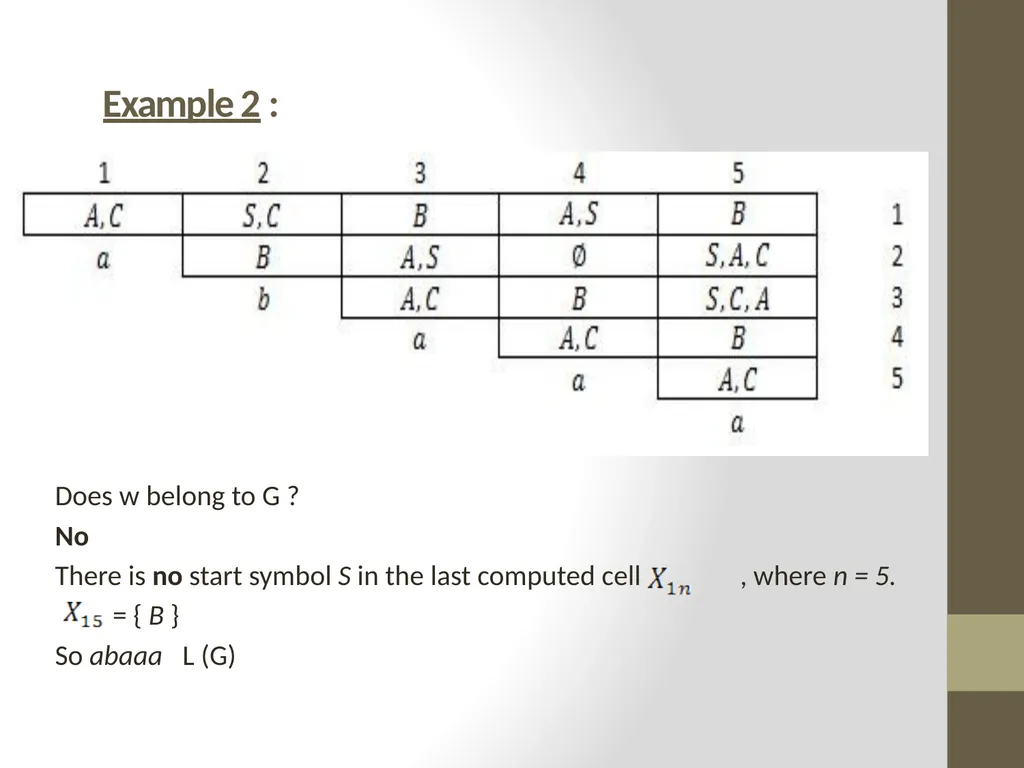
Example 2 : Does w belong to G ?
No
There is no start symbol S in the last computed cell , where n = 5.
= { B }
So abaaa L (G)<br>
19
Notes :
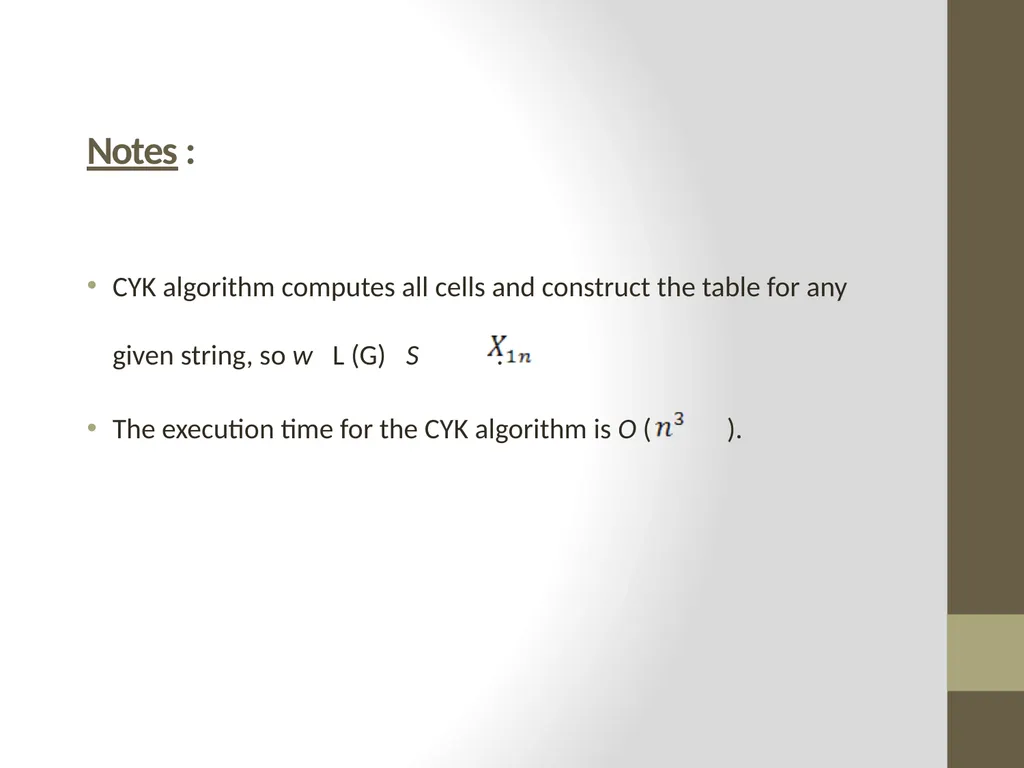
CYK algorithm computes all cells and construct the table for any given string, so w L (G) S .
The execution time for the CYK algorithm is O ( ).<br>
20
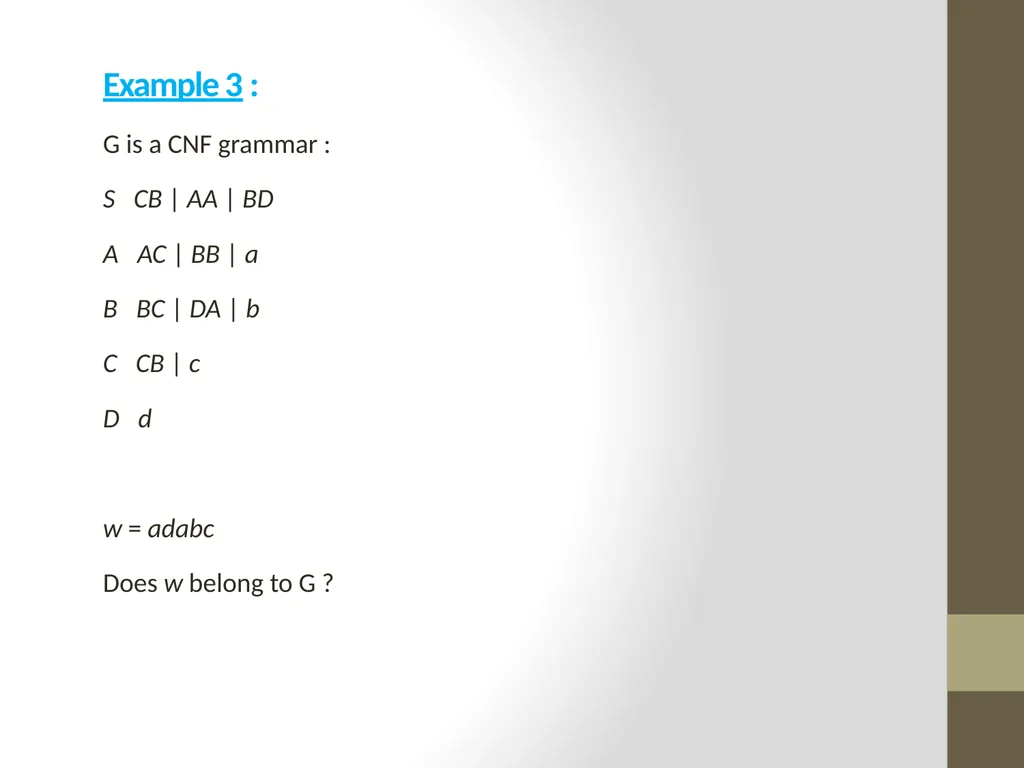
Example 3 :
G is a CNF grammar :
S CB | AA | BD
A AC | BB | a
B BC | DA | b
C CB | c
D d
w = adabc
Does w belong to G ?<br>
21
The References :
Rich E. . (2008). Automata, Computability & Complexity: Theory and Application.
Rodriguez D., Velazquez. (2009). The CYK Algorithm. Retrieved from : http://web.cs.ucdavis.edu/~rogaway/classes/120/winter12/CYK.pdf
Sudkamp T. . (1997). Languages and Machines: An Introduction to Theory of Computer Science. 2nd Edition.<br>