The Development of Geology Where the Hell do Rocks come From? Why do streams continually flow? The Ancient Greeks know about Lava and Volcanoes and Caves Aristotle Pondered the Hydrological Cycle Plato thought a giant cavern inside the
"The Development of Geology Where the Hell do Rocks" is the property of its rightful owner. Permission is granted to
download and print the materials on this website for personal, non-commercial use only, and to display it
on your personal computer provided you do not modify the materials and that you retain all copyright
notices contained in the materials. By downloading content from our website, you accept the terms of this
agreement.
Presentation Transcript
01
The Development of Geology Where the Hell do Rocks come From?
Why do streams continually flow?
The Ancient Greeks know about Lava and Volcanoes and Caves<br>
02
Aristotle Pondered the Hydrological Cycle Plato thought a giant cavern inside the Earth replenishes flowing water.
Aristotle rejects this If any one will picture to himself a reservoir adequate to the water that is continuously flowing day by day, and consider the amount of water, it is obvious that a receptacle that is to contain all the water that flows in the year would be larger than the earth. Note that neither the volume of the Earth or the volume of Earth’s water is known at this time.<br>
03
Bernard Palissy 1580 in Admirable Discourses publishes the correct (modern) version of the hydrological theory. - “if the fountains and rivers came from the sea their waters would be salty” –”if the springs of fountains come for the sea, how could they dry out in the summer?” When I had long and closely examined the source of the springs of natural fountains, and the place whence they could come, I finally understood that they could not come from or be produced by anything but rain Rain water that falls on mountains, lands, and all places that slope toward rivers or fountains, do not get to them so very quickly [so] all springs are fed from the end of one winter to the next. Nature has buffers snowpack, aquifers, ground water, that store the rain until it comes again.<br>
04
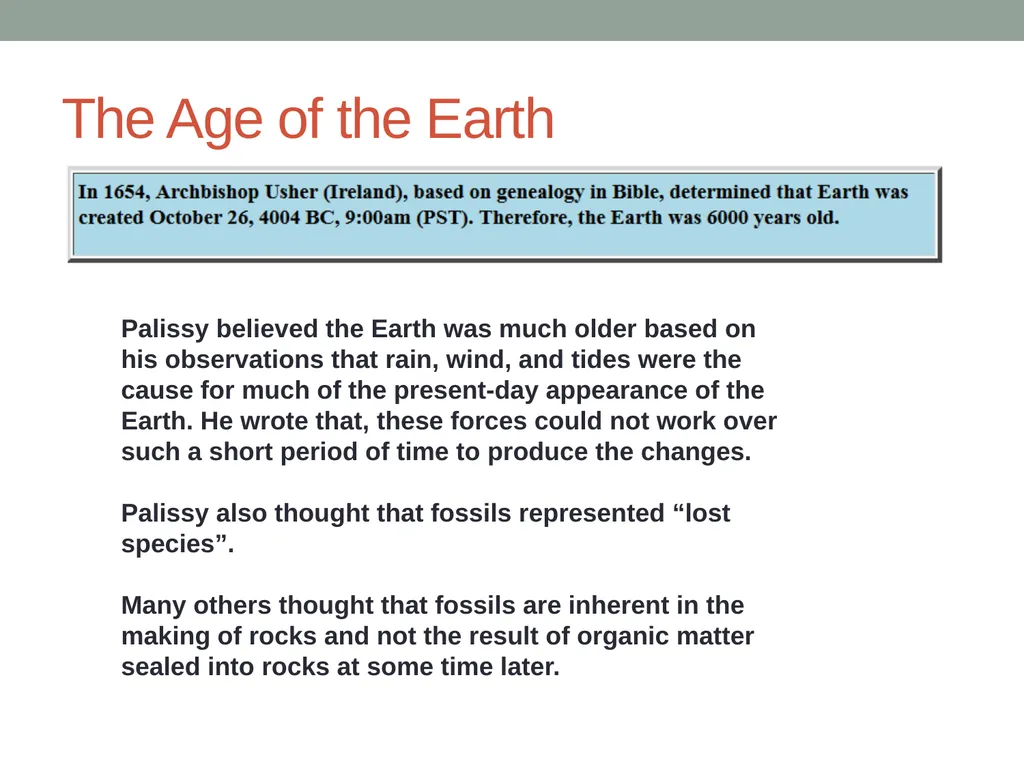
The Age of the Earth Palissy believed the Earth was much older based on his observations that rain, wind, and tides were the cause for much of the present-day appearance of the Earth. He wrote that, these forces could not work over such a short period of time to produce the changes.
Palissy also thought that fossils represented “lost species”.
Many others thought that fossils are inherent in the making of rocks and not the result of organic matter sealed into rocks at some time later.<br>
05
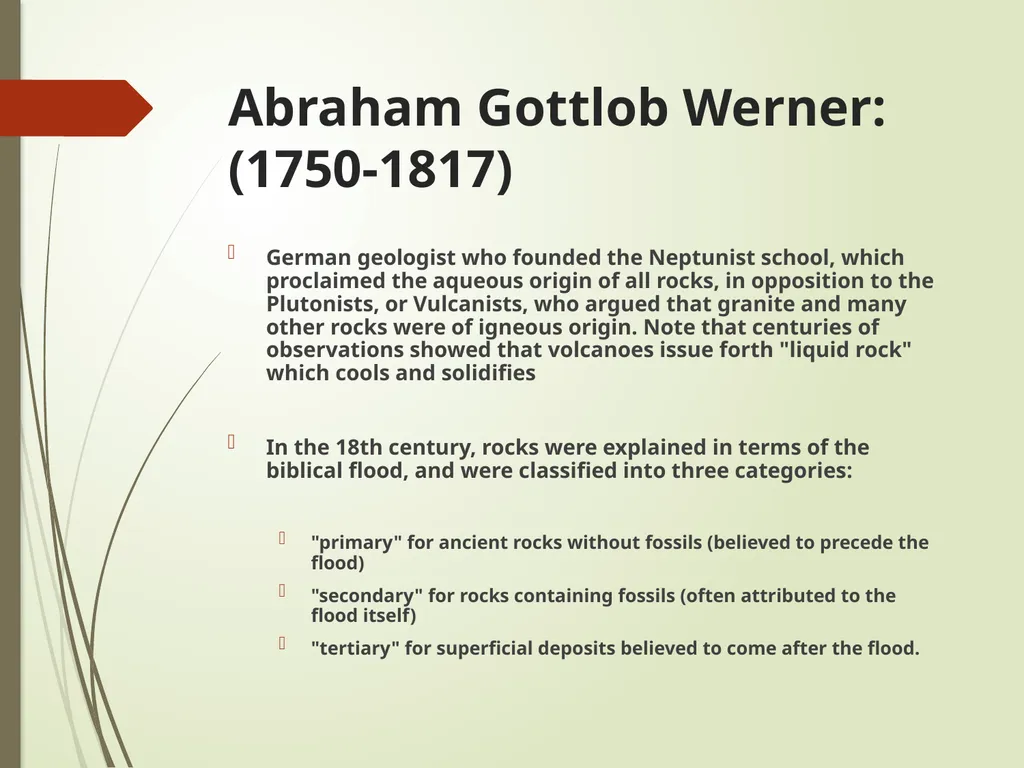
Abraham Gottlob Werner: (1750-1817) German geologist who founded the Neptunist school, which proclaimed the aqueous origin of all rocks, in opposition to the Plutonists, or Vulcanists, who argued that granite and many other rocks were of igneous origin. Note that centuries of observations showed that volcanoes issue forth "liquid rock" which cools and solidifies
In the 18th century, rocks were explained in terms of the biblical flood, and were classified into three categories:
"primary" for ancient rocks without fossils (believed to precede the flood)
"secondary" for rocks containing fossils (often attributed to the flood itself)
"tertiary" for superficial deposits believed to come after the flood.<br>
06
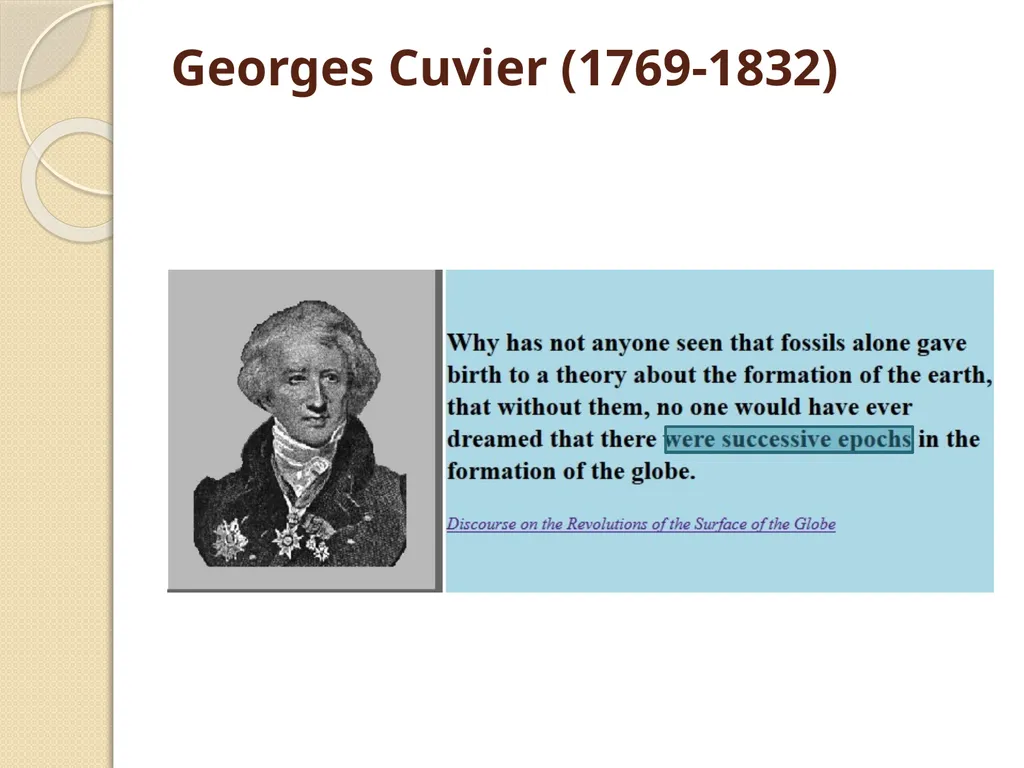
Georges Cuvier (1769-1832)<br>
07
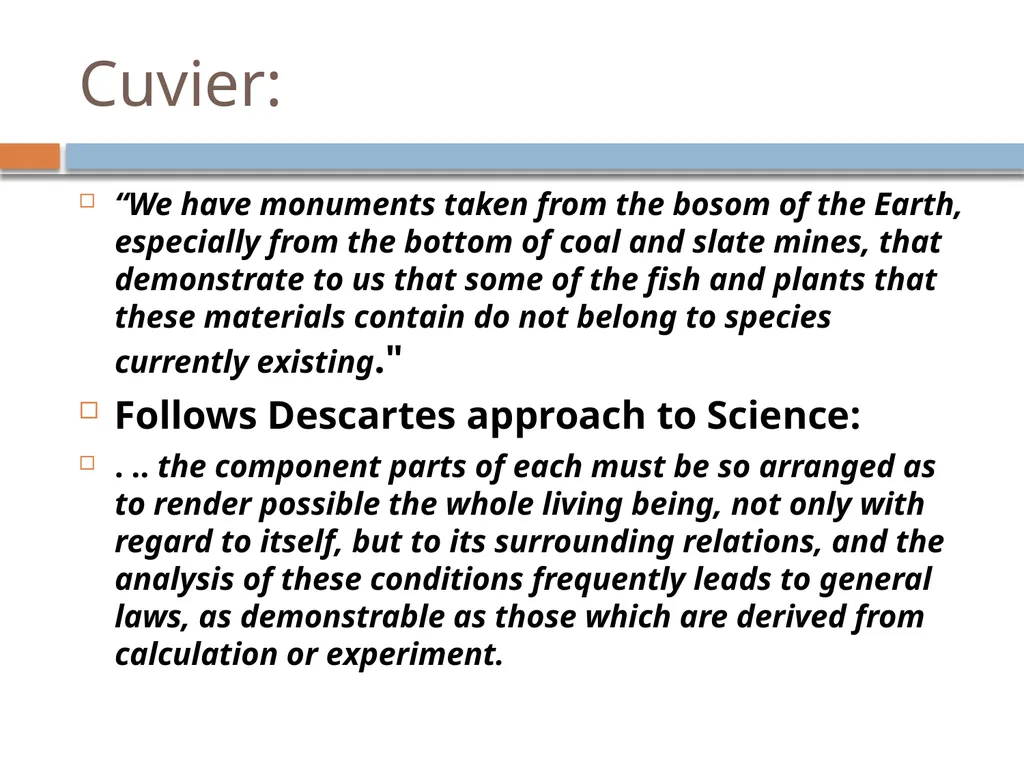
Cuvier: “We have monuments taken from the bosom of the Earth, especially from the bottom of coal and slate mines, that demonstrate to us that some of the fish and plants that these materials contain do not belong to species currently existing."
Follows Descartes approach to Science:
. .. the component parts of each must be so arranged as to render possible the whole living being, not only with regard to itself, but to its surrounding relations, and the analysis of these conditions frequently leads to general laws, as demonstrable as those which are derived from calculation or experiment.<br>
08
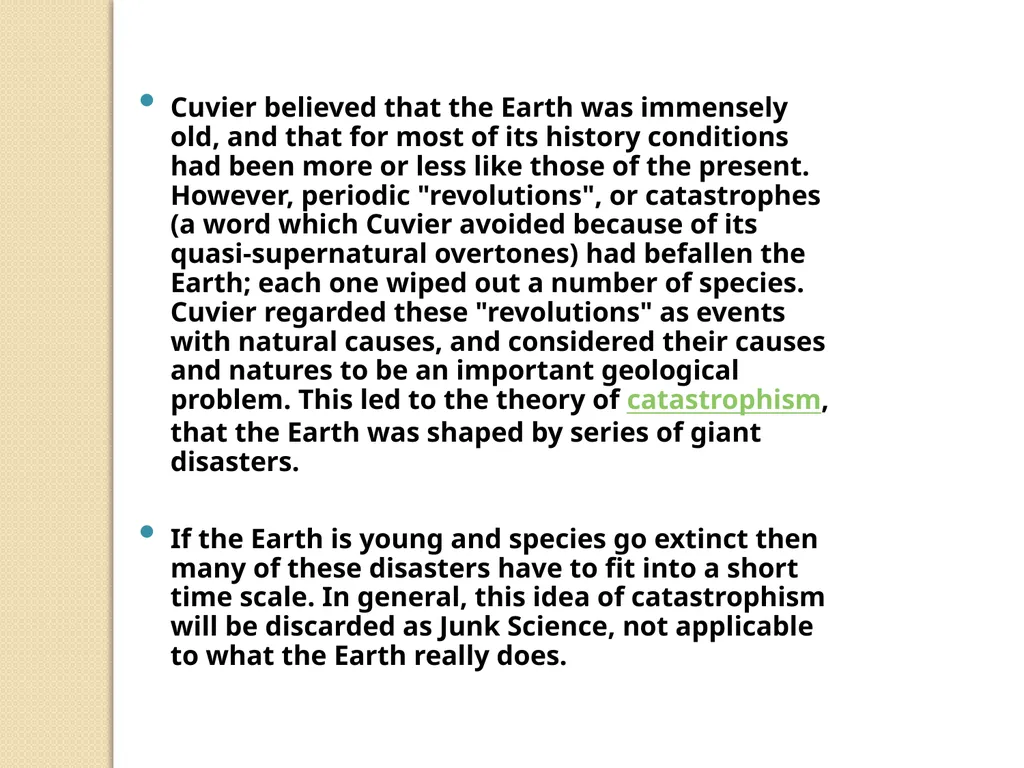
Cuvier believed that the Earth was immensely old, and that for most of its history conditions had been more or less like those of the present. However, periodic "revolutions", or catastrophes (a word which Cuvier avoided because of its quasi-supernatural overtones) had befallen the Earth; each one wiped out a number of species. Cuvier regarded these "revolutions" as events with natural causes, and considered their causes and natures to be an important geological problem. This led to the theory of catastrophism, that the Earth was shaped by series of giant disasters.
If the Earth is young and species go extinct then many of these disasters have to fit into a short time scale. In general, this idea of catastrophism will be discarded as Junk Science, not applicable to what the Earth really does.<br>
09
James Hutton, Father of Geology (Scotland, 1726-1797) published `Theory of the Earth' in 1785. -Demonstrated that Hadrian's Wall was built by Romans and that after 1500 years there was no change. Thus, he suspected that Earth was much older than 6000 years.
Also writes: “…the earth functions as a machine whose purpose is to sustain life” (have we seen this before?)
Hutton also explained that erratic boulders (big rocks in the middle of nowhere) resulted from the actions of glaciers in the Alps. In 1818 the first large scale theory of recurring glaciation was published (by Wahlenberg).<br>
10
Hutton’s theory of uniformitarianism -slow but steady uniform processes shape the landforms on the Earth. According to this theory, there were essentially three stages that form a complete cycle:
erosion of rocks produced sediment
sediment builds up until eventually its weight generated enough heat to liquefy the bottom layers
this molten rock forced its way back upwards, through the sediment, to reach the surface.
The process then started all over again, continuously regenerating the Earth's surface over countless ages, maintaining an environment capable of supporting living animals and plants
Is this original idea of continuous regeneration inconsistent with previous notions about the interaction between God and Nature? What about recurring Ice Ages? What is the problem here?<br>
11
In the mid 1800's, Scottish geologist Sir Charles Lyell expanded on uniformitarianism to develop gradualism, the view that all features of the Earth's surface are produced by various physical, chemical, and biological processes through long periods of geological time. These processes can change their impacts over time and do not operate at a uniform rate with time.
The Principles of Geology: Being an Attempt to Explain the Former Changes of the Earth's Surface, by Reference to Causes now in Operation (3 vols 1830-33). His system was based on two propositions:
the causes of geologic change operating include all the causes that have acted from the earliest time
and these causes have always operated at the same average levels of energy.
These two propositions add up to a "steady-state" theory of the Earth in which, at any time, the geological structure of the earth represents average conditions.<br>
12
Lyell's position suggested that the world had always been (roughly) similar to its current state. In particular, Lyell believed that the species composition of the world remained unchanged, with at least some members of all classes of organisms existing throughout the history of the earth.
Darwin read Lyell's Principles of Geology and came to accept Lyell's view that long-term geological processes were responsible for shaping the earth's surface in a gradual manner. How does this help fortify or motivate Darwin's position on the Origin of Species?<br>