The District of Columbia Rehabilitation Services

Published  . 0 views
↓ Download
The District of Columbia Rehabilitation Services
1 / 1
The District of Columbia Rehabilitation Services - slide 1 of 61 The District of Columbia Rehabilitation Services - slide 2 of 61 The District of Columbia Rehabilitation Services - slide 3 of 61 The District of Columbia Rehabilitation Services - slide 4 of 61 The District of Columbia Rehabilitation Services - slide 5 of 61 The District of Columbia Rehabilitation Services - slide 6 of 61 The District of Columbia Rehabilitation Services - slide 7 of 61 The District of Columbia Rehabilitation Services - slide 8 of 61 The District of Columbia Rehabilitation Services - slide 9 of 61 The District of Columbia Rehabilitation Services - slide 10 of 61 The District of Columbia Rehabilitation Services - slide 11 of 61 The District of Columbia Rehabilitation Services - slide 12 of 61 The District of Columbia Rehabilitation Services - slide 13 of 61 The District of Columbia Rehabilitation Services - slide 14 of 61 The District of Columbia Rehabilitation Services - slide 15 of 61 The District of Columbia Rehabilitation Services - slide 16 of 61 The District of Columbia Rehabilitation Services - slide 17 of 61 The District of Columbia Rehabilitation Services - slide 18 of 61 The District of Columbia Rehabilitation Services - slide 19 of 61 The District of Columbia Rehabilitation Services - slide 20 of 61 The District of Columbia Rehabilitation Services - slide 21 of 61 The District of Columbia Rehabilitation Services - slide 22 of 61 The District of Columbia Rehabilitation Services - slide 23 of 61 The District of Columbia Rehabilitation Services - slide 24 of 61 The District of Columbia Rehabilitation Services - slide 25 of 61 The District of Columbia Rehabilitation Services - slide 26 of 61 The District of Columbia Rehabilitation Services - slide 27 of 61 The District of Columbia Rehabilitation Services - slide 28 of 61 The District of Columbia Rehabilitation Services - slide 29 of 61 The District of Columbia Rehabilitation Services - slide 30 of 61 The District of Columbia Rehabilitation Services - slide 31 of 61 The District of Columbia Rehabilitation Services - slide 32 of 61 The District of Columbia Rehabilitation Services - slide 33 of 61 The District of Columbia Rehabilitation Services - slide 34 of 61 The District of Columbia Rehabilitation Services - slide 35 of 61 The District of Columbia Rehabilitation Services - slide 36 of 61 The District of Columbia Rehabilitation Services - slide 37 of 61 The District of Columbia Rehabilitation Services - slide 38 of 61 The District of Columbia Rehabilitation Services - slide 39 of 61 The District of Columbia Rehabilitation Services - slide 40 of 61 The District of Columbia Rehabilitation Services - slide 41 of 61 The District of Columbia Rehabilitation Services - slide 42 of 61 The District of Columbia Rehabilitation Services - slide 43 of 61 The District of Columbia Rehabilitation Services - slide 44 of 61 The District of Columbia Rehabilitation Services - slide 45 of 61 The District of Columbia Rehabilitation Services - slide 46 of 61 The District of Columbia Rehabilitation Services - slide 47 of 61 The District of Columbia Rehabilitation Services - slide 48 of 61 The District of Columbia Rehabilitation Services - slide 49 of 61 The District of Columbia Rehabilitation Services - slide 50 of 61 The District of Columbia Rehabilitation Services - slide 51 of 61 The District of Columbia Rehabilitation Services - slide 52 of 61 The District of Columbia Rehabilitation Services - slide 53 of 61 The District of Columbia Rehabilitation Services - slide 54 of 61 The District of Columbia Rehabilitation Services - slide 55 of 61 The District of Columbia Rehabilitation Services - slide 56 of 61 The District of Columbia Rehabilitation Services - slide 57 of 61 The District of Columbia Rehabilitation Services - slide 58 of 61 The District of Columbia Rehabilitation Services - slide 59 of 61 The District of Columbia Rehabilitation Services - slide 60 of 61 The District of Columbia Rehabilitation Services - slide 61 of 61
Description: The District of Columbia Rehabilitation Services Administration, The State Rehabilitation Council, and The Statewide Independent Living Council Comprehensive Statewide Needs Assessment 2014 What is a CSNA and Why is it Done? An assessment

Related Topics

Download Presentation

"The District of Columbia Rehabilitation Services" is the property of its rightful owner. Permission is granted to download and print the materials on this website for personal, non-commercial use only, and to display it on your personal computer provided you do not modify the materials and that you retain all copyright notices contained in the materials. By downloading content from our website, you accept the terms of this agreement.

Presentation Transcript

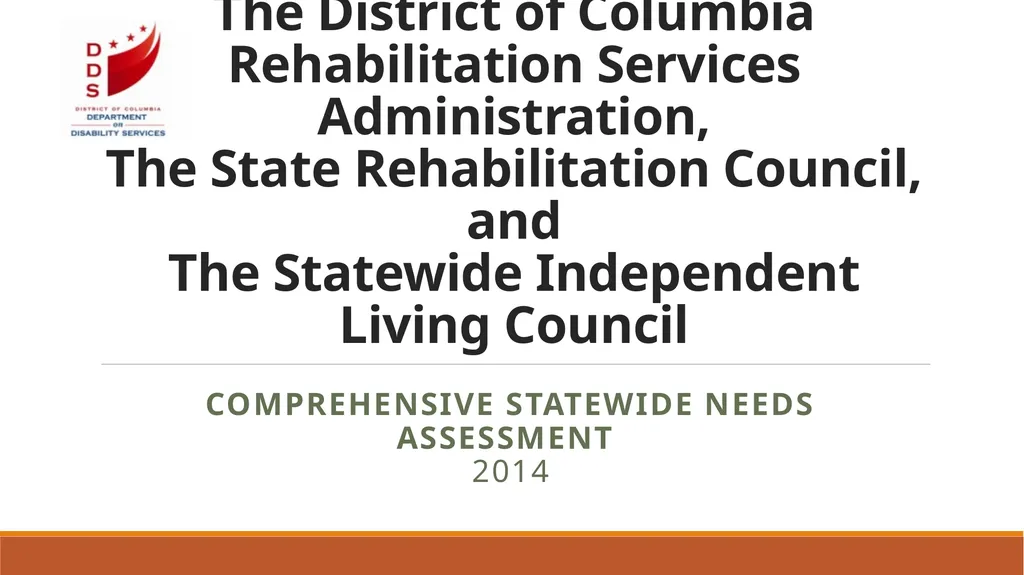
slide1. The District of Columbia Rehabilitation Services Administration, The State Rehabilitation Council, and The Statewide Independent Living Council Comprehensive Statewide Needs Assessment 2014<br>
slide2. What is a CSNA and Why is it Done? An assessment of the needs of persons with disabilities
Agencies are required to relate the planning of programs and services to those needs
Informs the annual State Plan
Required every three years by the Rehabilitation Act of 1973 as amended
34 CFR 364.42 requires a triennial State Plan for Independent Living
DCRSA included the IL needs assessment with the VR needs assessment
This CSNA fulfills the CSNA for the next three years<br>
slide3. A Note on This Report Included an assessment of needs like last year
Investigates some other areas that will be highlighted in this report
Includes an assessment of IL needs and the IL system in the District<br>
slide4. Thank You Andy Reese, Deputy Director
Dan Dougherty, Management Analyst
Romeo Ymalay, Project Manager
Shawn Callaway, SRC Chair
Sylvia Bailey-Charles, Supervisory Business Relations Specialist, DCRSA
Nicole Boykin, Business Services Supervisor (Acting), DCRSA
Anita Curry, DCRSA
Lavonne Chambers, DCRSA
Darnise Bush, DCRSA
Marsha Thompson, Secretary, Statewide Independent Living Council
Richard Simms, Executive Director, DC Center for Independent Living<br>
slide5. Areas of Investigation Overall Agency Performance
Needs of persons with the most significant disabilities including their need for supported employment
Needs of persons who are minorities or who have been unserved or underserved by DCRSA
Needs of persons in transition<br>
slide6. More Areas of Investigation Needs of persons served through the workforce development system
Need to establish, develop or improve community rehabilitation programs in the District
Needs of business relating to recruiting, hiring, accommodating and retaining persons with disabilities
Independent living needs<br>
slide7. Methods of Inquiry Electronic surveys of persons with disabilities, DCRSA staff, businesses, and community partners
Hard copy VR and IL surveys sent to persons with disabilities
Focus groups of persons with disabilities, DCRSA staff and community partners
Individual interviews with persons with disabilities (VR and IL focused), DCRSA and DCCIL staff, community partners and businesses
Analysis of existing demographic and agency-specific data<br>
slide8. Research Results<br>
slide9. Survey Return Rates<br>
slide10. Findings<br>
slide11. Section 1: Overall Agency Performance Recurring themes across all data gathering methods
Improved and increased community outreach by DCRSA
Improved quality assurance and review
Improved organizational culture
Need to broaden the range and diversity of jobs obtained for DCRSA consumers<br>
slide12. Overall Agency Statistics<br>
slide13. Range and Diversity of Jobs<br>
slide14. Repeat Cases Linked to types of jobs and self-sufficiency is number of cases<br>
slide15. Common Barriers to Employment Not enough available jobs
Not having enough education or training
Employer’s perceptions about hiring persons with disabilities
Lack of job search skills
Transportation
Lack of job skills
Lack of accommodations<br>
slide16. Provider and Staff Comments on Barriers Social skills
Lack of education and training (including literacy)
Housing
Criminal history
Mental health issues
Substance abuse issues
Childcare<br>
slide17. Barriers to Accessing Services Slow service delivery
Agency responsiveness
Inadequate assessment services
Accessibility of office
Difficulties completing the application and IPE
Difficulties accessing training or education programs<br>
slide18. Recommendations Continue training on improving program performance
Develop outreach and marketing materials for the general program
Improve the intake process
Broaden the range of jobs through:
Use of labor market information to improve career exploration and preparation
Expand evaluation criteria for staff – likely under WIOA
Consider placement in preliminary jobs as consumers progress in longer term plans
Develop and nurture partnerships for holistic approach including literacy, housing and short-term vocational training<br>
slide19. SECTION TWO: NEEDS OF PERSONS WITH THE MOST SIGNIFICANT DISABILITIES, INCLUDING THEIR NEED FOR SUPPORTED EMPLOYMENT<br>
slide20. Recurring Themes Improved relationship between DCRSA and The Developmental Disabilities Administration
Need for supported employment for persons with mental health impairments – lack of awareness of available services
Persons with multiple disabilities have multiple needs
The return to work behavior of SSI/DI recipients is affected by their fear of losing benefits<br>
slide21. Disability Types Served by DCRSA<br>
slide22. Increasing Significance of Disability<br>
slide23. Common Consumer Barriers Mental Health Impairments
Substance abuse and legal issues
Literacy concerns
Lack of job skills and training
Social and soft skills concerns
Housing<br>
slide24. Recommendations Further educate staff on availability of the Department of Behavioral Health as an extended service provider for supported employment
Utilize the Partnership Plus model for extended service provision for SSI/DI beneficiaries
Ensure that housing and literacy is assessed and resource information is available
Increase work experiences, possibly through temp agencies
Develop computer skills training in addition to the other workshops they provide to consumers<br>
slide25. SECTION THREE: NEEDS OF PERSONS WITH DISABILITIES FROM DIFFERENT ETHNIC GROUPS, INCLUDING NEEDS OF PERSONS WHO HAVE BEEN UNSERVED OR UNDERSERVED BY THE VR PROGRAM<br>
slide26. Recurring Themes Persons that are White, Hispanic and Asian may be underserved
Persons that are Ethiopian may be underserved but it is difficult to establish this based on the ethnicity recorded
Wards 5, 7 and 8 are served at the highest rate
Veterans are underserved
Different ethnic groups have similar needs and barriers to employment but also have language barriers
Persons with significant physical disabilities and those who are deaf-blind may be underserved<br>
slide27. Consumers Served by Ethnicity<br>
slide28. Socioeconomic Indicators by Ward<br>
slide29. Applicants by Ward<br>
slide30. Service to Veterans<br>
slide31. Recommendations Improved tracking of ward of residence and ethnicity to track service to groups like Ethiopians
Continued focused outreach to underserved groups and attempts to hire bilingual staff when possible
Outreach to programs serving persons with significant physical disabilities like rehabilitation hospitals
Outreach that is focused on information sharing and awareness as opposed to application only<br>
slide32. SECTION FOUR: NEEDS OF PERSONS SERVED THROUGH OTHER COMPONENTS OF THE STATEWIDE WORKFORCE INVESTMENT SYSTEM<br>
slide33. Recurring Themes America’s Job Centers (AJCs) continue to be inaccessible in many ways, especially for persons with blindness
The relationship between the department of Employment Services (DOES) and DCRSA is improving
AJCs and DCRSA’s relationship remains primarily one of referral rather than shared planning and resources
Services to youth by the workforce system needs to be improved
The passage of WIOA will effect dramatic change in the relationship between DCRSA and DOES in the next two years<br>
slide34. AJC Referrals and Numbers Served<br>
slide35. Recommendations WIOA’s requirements necessitate the exploration of more formal partnerships including co-location of staff and shared funding.
Develop customized training in partnership with DOES, local business and a training provider such as the community colleges
Request intensive or at least targeted TA from the new job-driven TA center to help develop customized training
The National Employment Team (NET) has developed customized training with the Hyatt. DCRSA should consult with the NET Point of Contact to determine if this program is possible to replicate in DC
Partner with AJCs for increased access to short-term vocational training programs for persons with disabilities<br>
slide36. AJCs and Youth Recommendation Connect youth with disabilities with the youth programs at the AJCs to increase their access to and utilization of these services
Site visits by transition programs
Co-presentations by DCRSA and DOES staff at the schools to demonstrate the partnership
Summer youth set-aside positions
Career exploration events with DCRSA<br>
slide37. SECTION FIVE: NEEDS OF PERSONS IN TRANSITION<br>
slide38. Recurring Themes The lack of work experience, education, training and knowledge of work remains the primary barrier to employment for youth in transition.
DCRSA has doubled the size of their transition resulting in improved and increased outreach to the schools and youth
Transition to postsecondary education and DCRSA’s level of support for postsecondary training needs to be clearly articulated in policy, understood by staff and translated to consumers and their families.<br>
slide39. Progress in Transition<br>
slide40. Barriers to Employment Very similar to the general population of DCRSA
These areas are compounded by age
Not having job skills
Not having education or training
Prior convictions
Poor social skills<br>
slide41. Postsecondary Education Support Approximately 60% of case service dollars are spent on postsecondary education. 50% on college tuition and 10% on vocational training, but short-term vocational training was reported as having better outcomes.
Current regulations need to be enforced and new ones developed
Most DCRSA consumers that start college do not finish (10% finish)
If they do finish, the outcomes are very good<br>
slide42. Employment by Education Level<br>
slide43. Average Weekly Earnings by Degree Level<br>
slide44. Recommendations Clarify policy for out-of-state tuition support – Articulate responsibility of consumer regarding share of cost if he/she chooses another option other than a DC school
Provide benefits counseling to SSI youth and include their families in transition planning. Encourage the family to have high expectations.
Provide self-advocacy training for youth in the school setting<br>
slide45. SECTION SIX: NEED TO ESTABLISH, DEVELOP OR IMPROVE COMMUNITY REHABILITATION PROGRAMS IN THE DISTRICT<br>
slide46. Recurring Themes A need to broaden the types and range of jobs that vendors develop for consumers – related to the need identified previously
A need for increased vendors to serve persons with sensory impairments
A need to continue to develop quality control and assurance measures for vendors<br>
slide47. Recommendations Follow-through with placing vendor performance summaries online to facilitate informed choice
Include measurable performance standards and deliverables in all Statements of Work in contracts
Consider providing Employment Services Certificate Training through the Association of Community Rehabilitation Educators (ACRE) for BRU and HCA provider staff to ensure competencies
Convene a group of DCRSA and HCA provider staff to identify ways to increase the quality and speed of services to person who are blind<br>
slide48. SECTION SEVEN: BUSINESS NEEDS, SERVICES AND RELATIONS<br>
slide49. Recurring Themes Businesses would like a partner to help them with their recruitment, hiring, retention and accommodation needs
Businesses need to be educated regarding disability awareness and sensitivity
Schedule A hiring is underutilized by DCRSA
The Talent Preview program is valued by employers and provides important opportunities for work experience<br>
slide50. Business Needs<br>
slide51. Business Needs of Applicants<br>
slide52. Challenges to Retaining Employees<br>
slide53. Common Services Provided by DCRSA to Businesses Recruiting qualified applicants
Education and training regarding disability laws
Training on disability types like Autism
75% indicated they were satisfied with the services they received<br>
slide54. Recommendations Educate employers on blindness
Expand partnership with the NET and the dual customer focus that the partnership embraces
Train BRU staff on how to perform a specific job analysis that functions as a service to employers, improves job matching and creates opportunities for job carving for those who can benefit from customized employment<br>
slide55. Part II Section 8: Independent Living Needs<br>
slide56. Recurring Independent Living Needs Affordable and accessible housing
Coordinated services not silos
Employment
Transportation
Language and cultural barriers
Stigma IL training, tools and skills development
Transition planning for youth
Personal care services
Advocacy
Resources<br>
slide57. Barriers to Accessing IL Services Ineffective information portals
Lack of service responsiveness
Service silos (DCRSA, DCCIL and other programs)
Lack of education and training
Lack of employment
Language barriers<br>
slide58. IL Services Received<br>
slide59. IL System Findings A lack of communication and coordination between DCRSA and DCCIL
Lack of measurable timeframes for numerous objectives on the State Plan for Independent Living, making progress hard to identify
An Executive Director is needed for the Statewide Independent Living Council (SILC)
Slow responsiveness
Bilingual staff is needed to reach underserved populations<br>
slide60. Recommendations Fulfill the goals and objectives in the State Plan for Independent Living
Conduct targeted and sustained outreach to underserved populations such as Hispanic persons by partnering with community groups and advocacy groups
Ensure that transition-aged youth are exposed to IL services in much the same way that they are engaging with DCRSA for vocational services
Improve and increase collaborative communication and action between DCRSA, DCCIL and other IL providers. It might be beneficial to engage the services of a facilitator to help the agencies work together in drafting the SPIL and conducting community events.
Make responsiveness to consumers a priority by establishing agreed upon timeframes for return of calls and e-mails and training for staff on providing excellent customer service
Develop a robust electronic information portal that provides information in an easily understood and accessible place regarding IL services. Re-establish the personal care registry.
Link employment services to IL services and integrate vocational services into the IL service system<br>
slide61. Questions<br>