
The Essential Contribution of Social Work with
MY
Published · 28 slides · 0 views

1 / 1
Description
The Essential Contribution of Social Work with Asylum Seekers in Europe Prof. Shula Ramon 16th March 2021 s.ramonherts.ac.uk Background I will be limiting my presentation to learning from social work experience in Greece, Italy, Slovenia,
Related Topics
Share
Embed code
Download this presentation From Below
"The Essential Contribution of Social Work with" is the property of its rightful owner. Permission is granted to download and print the materials on this website for personal, non-commercial use only, and to display it on your personal computer provided you do not modify the materials and that you retain all copyright notices contained in the materials. By downloading content from our website, you accept the terms of this agreement.
Presentation Transcript
01
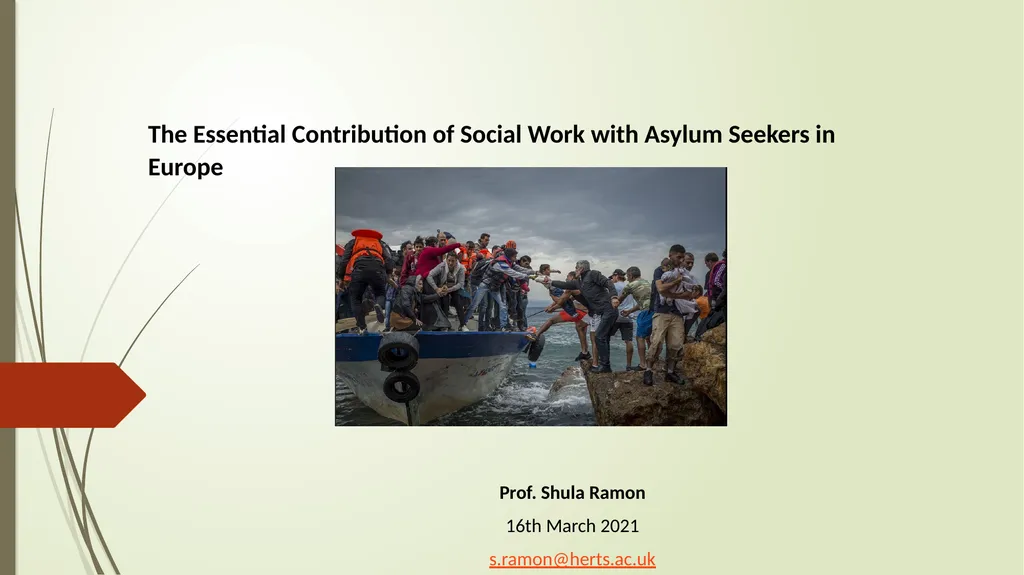
The Essential Contribution of Social Work with Asylum Seekers in Europe Prof. Shula Ramon
16th March 2021
s.ramon@herts.ac.uk<br>
16th March 2021
s.ramon@herts.ac.uk<br>
02
Background I will be limiting my presentation to learning from social work experience in Greece, Italy, Slovenia, England and Scotland.
I have engaged before in researching media representation of the 2015-2017 migration wave to Europe, together with colleagues from Greece, Italy and Slovenia.
I am currently engaged in a study of interviewing social workers and asylum seekers in North Greece and South Italy, which focuses on the experience of each group of their involvement in the asylum seeking process, with Elena Allegri, James Cox, Roberta di Rosa, Brian Littlechild and Theano Kallinikaki.<br>
I have engaged before in researching media representation of the 2015-2017 migration wave to Europe, together with colleagues from Greece, Italy and Slovenia.
I am currently engaged in a study of interviewing social workers and asylum seekers in North Greece and South Italy, which focuses on the experience of each group of their involvement in the asylum seeking process, with Elena Allegri, James Cox, Roberta di Rosa, Brian Littlechild and Theano Kallinikaki.<br>
03
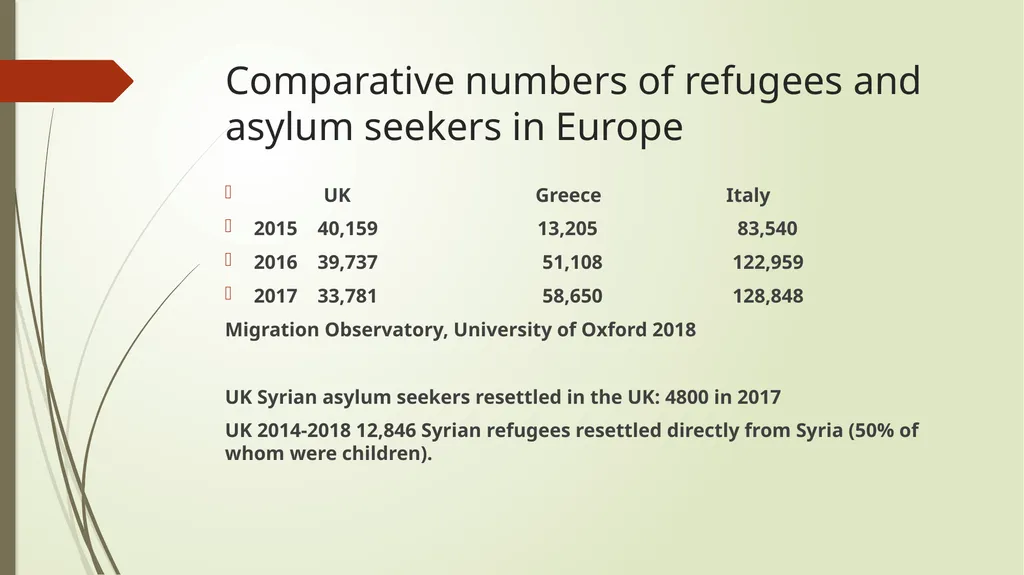
Comparative numbers of refugees and asylum seekers in Europe UK Greece Italy
2015 40,159 13,205 83,540
2016 39,737 51,108 122,959
2017 33,781 58,650 128,848
Migration Observatory, University of Oxford 2018
UK Syrian asylum seekers resettled in the UK: 4800 in 2017
UK 2014-2018 12,846 Syrian refugees resettled directly from Syria (50% of whom were children).<br>
2015 40,159 13,205 83,540
2016 39,737 51,108 122,959
2017 33,781 58,650 128,848
Migration Observatory, University of Oxford 2018
UK Syrian asylum seekers resettled in the UK: 4800 in 2017
UK 2014-2018 12,846 Syrian refugees resettled directly from Syria (50% of whom were children).<br>
04
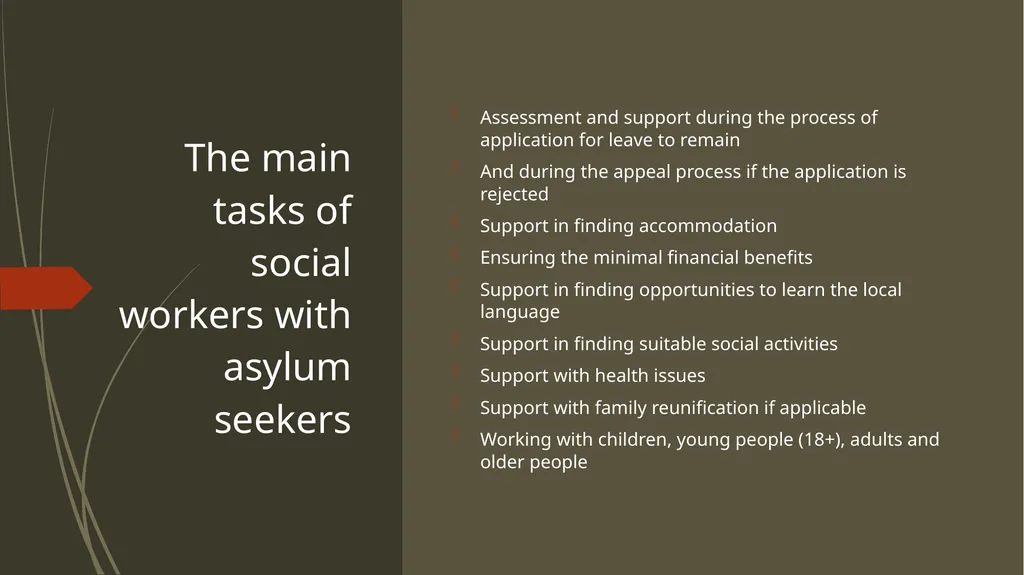
The main tasks of social workers with asylum seekers Assessment and support during the process of application for leave to remain
And during the appeal process if the application is rejected
Support in finding accommodation
Ensuring the minimal financial benefits
Support in finding opportunities to learn the local language
Support in finding suitable social activities
Support with health issues
Support with family reunification if applicable
Working with children, young people (18+), adults and older people<br>
And during the appeal process if the application is rejected
Support in finding accommodation
Ensuring the minimal financial benefits
Support in finding opportunities to learn the local language
Support in finding suitable social activities
Support with health issues
Support with family reunification if applicable
Working with children, young people (18+), adults and older people<br>
05
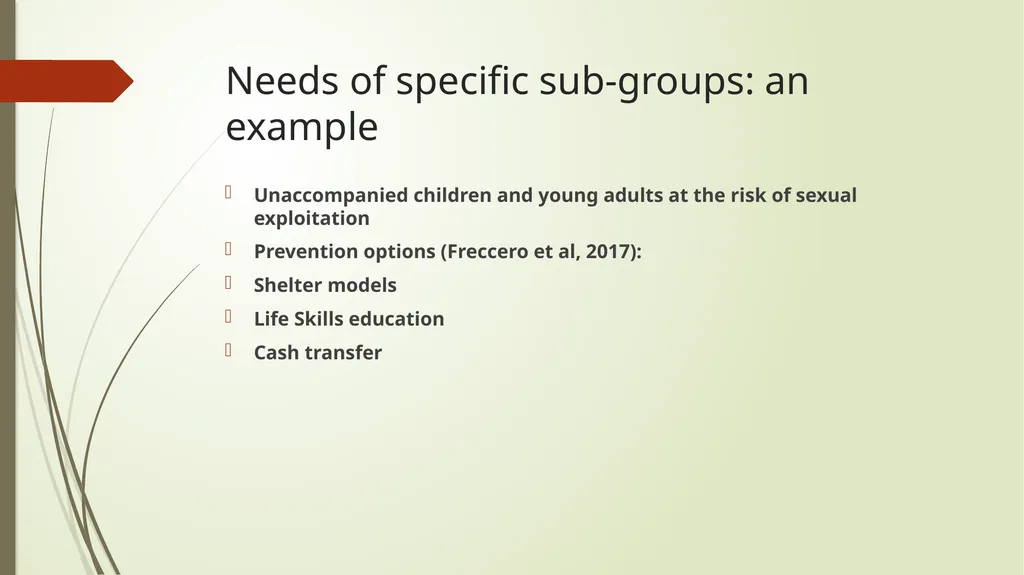
Needs of specific sub-groups: an example Unaccompanied children and young adults at the risk of sexual exploitation
Prevention options (Freccero et al, 2017):
Shelter models
Life Skills education
Cash transfer<br>
Prevention options (Freccero et al, 2017):
Shelter models
Life Skills education
Cash transfer<br>
06
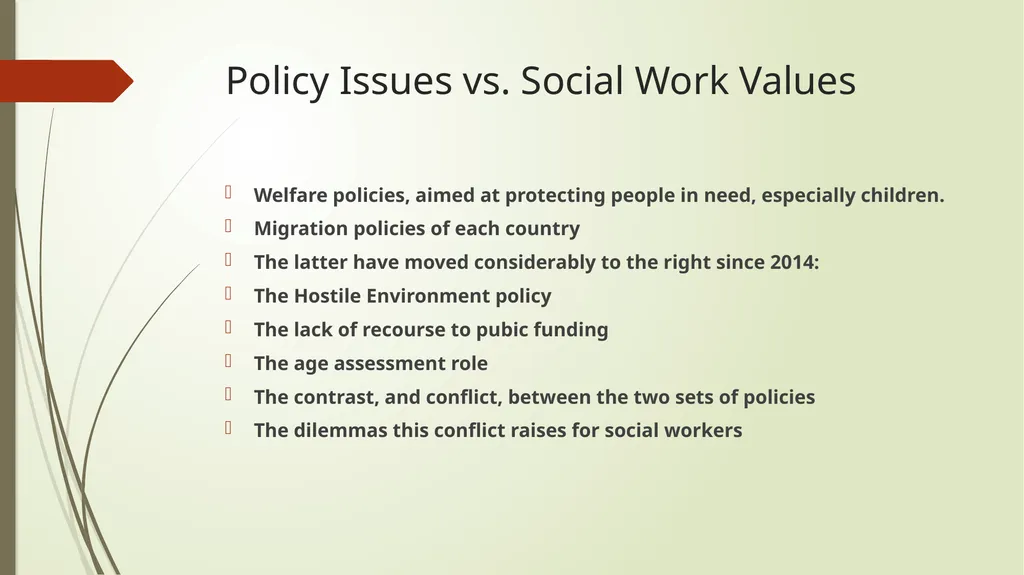
Policy Issues vs. Social Work Values Welfare policies, aimed at protecting people in need, especially children.
Migration policies of each country
The latter have moved considerably to the right since 2014:
The Hostile Environment policy
The lack of recourse to pubic funding
The age assessment role
The contrast, and conflict, between the two sets of policies
The dilemmas this conflict raises for social workers<br>
Migration policies of each country
The latter have moved considerably to the right since 2014:
The Hostile Environment policy
The lack of recourse to pubic funding
The age assessment role
The contrast, and conflict, between the two sets of policies
The dilemmas this conflict raises for social workers<br>
07
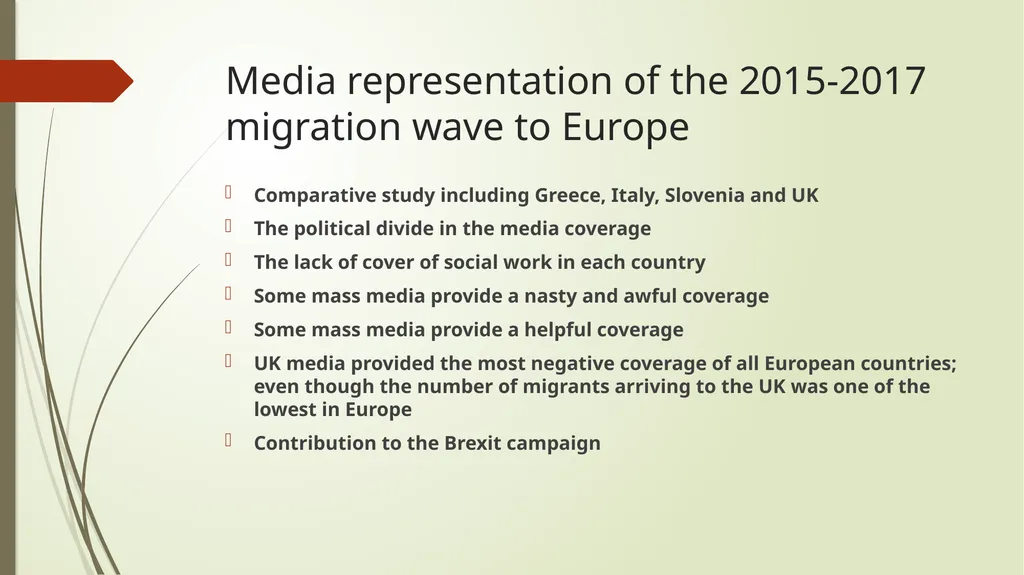
Media representation of the 2015-2017 migration wave to Europe Comparative study including Greece, Italy, Slovenia and UK
The political divide in the media coverage
The lack of cover of social work in each country
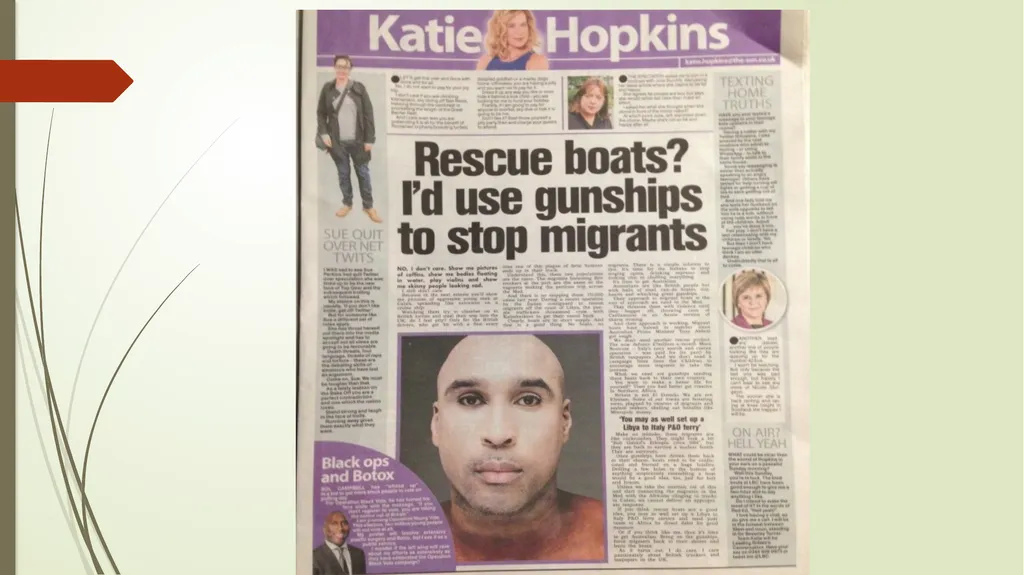
Some mass media provide a nasty and awful coverage
Some mass media provide a helpful coverage
UK media provided the most negative coverage of all European countries; even though the number of migrants arriving to the UK was one of the lowest in Europe
Contribution to the Brexit campaign<br>
The political divide in the media coverage
The lack of cover of social work in each country
Some mass media provide a nasty and awful coverage
Some mass media provide a helpful coverage
UK media provided the most negative coverage of all European countries; even though the number of migrants arriving to the UK was one of the lowest in Europe
Contribution to the Brexit campaign<br>
08
Who are the asylum seekers Most of them are young men coming from Afghanistan, Iraq and Syria
Few young women (Iran)
Relatively few families
From other armed political conflict backgrounds
Countries with a high level of corruption where basic earnings do not cover the cost of living
Many of them do not wish to remain in the first European country they arrive at, but to continue to travel to countries such as Germany, Sweden, and UK
The Calais asylum seekers
The resettled refugees: Syria only, special funding, and right to remain.<br>
Few young women (Iran)
Relatively few families
From other armed political conflict backgrounds
Countries with a high level of corruption where basic earnings do not cover the cost of living
Many of them do not wish to remain in the first European country they arrive at, but to continue to travel to countries such as Germany, Sweden, and UK
The Calais asylum seekers
The resettled refugees: Syria only, special funding, and right to remain.<br>
09
Working during the Covid-19 Pandemic Lack of face to face contact
Contact via the phone with people who do not speak the local language
Being locked in camps which are closed
Lack of most basic facilities
Continuing face to face contact with PPE (first assessment, hospital social workers, residential social workers)
The slow down of the functioning of most statutory migration services, and reduced availability of voluntary services (where many qualified social workers are based in countries such as Greece, Italy and Slovenia).<br>
Contact via the phone with people who do not speak the local language
Being locked in camps which are closed
Lack of most basic facilities
Continuing face to face contact with PPE (first assessment, hospital social workers, residential social workers)
The slow down of the functioning of most statutory migration services, and reduced availability of voluntary services (where many qualified social workers are based in countries such as Greece, Italy and Slovenia).<br>
10
The success of foster care for unaccompanied refugee minors Siraiyeh and Raghillagh (2018) looked at the usefulness of foster care for unaccompanied refugee minors in Ireland and England.
They did so from the perspective of the Recognition Theory, which postulates that emotional, social ,and legal recognition in human relationships is central to maintaining people’s wellbeing.
They have tested this hypothesis in two empirical studies, and found out that indeed foster care for refugee children has enabled them to make a successful transition to adulthood.
As social workers are central to reaching the decision that an unaccompanied child needs foster care, find a foster family, support eh child and the foster parents, and monitor the placement, these findings illustrate one important and crucial positive contribution of social workers to migration work.<br>
They did so from the perspective of the Recognition Theory, which postulates that emotional, social ,and legal recognition in human relationships is central to maintaining people’s wellbeing.
They have tested this hypothesis in two empirical studies, and found out that indeed foster care for refugee children has enabled them to make a successful transition to adulthood.
As social workers are central to reaching the decision that an unaccompanied child needs foster care, find a foster family, support eh child and the foster parents, and monitor the placement, these findings illustrate one important and crucial positive contribution of social workers to migration work.<br>
11
Continued: Empirical research Used mixed methods: documents analysis, focus groups, individual interviews, of foster parents, unaccompanied refugee minors, stakeholders (social workers, residential workers, managers, voluntary and statuary services)
Focus groups of 20 per each group
The findings demonstrate how much the URM valued their sense of belonging to the foster family long after leaving care.
Many stayed in contact with the foster parents after they left the foster care placement.
The foster parents too have had a largely positive experience.
Highlights the centrality of relationship-centred work<br>
Focus groups of 20 per each group
The findings demonstrate how much the URM valued their sense of belonging to the foster family long after leaving care.
Many stayed in contact with the foster parents after they left the foster care placement.
The foster parents too have had a largely positive experience.
Highlights the centrality of relationship-centred work<br>
12
The Peace school for children in
Asylum Seekers Camps in Lesbos, Greece Children come from a number of countries where there is an armed political conflict (e.g. Afghanistan, Iraq, Syria, North Africa).
The children’s traumatic past background, and current high level of uncertainty mixed with very poor living conditions, and considerable tension among the different national/ethnic groups based in the camps
Size of the two camps: 30,000 people!
There is a school in one of the camps in the morning, where formal schooling takes place.
Yet the formal school does not pay attention to the children’s need of learning to co-exist in the multi-national, multi-ethnic context within the physical, economic, and social conditions of the camps
Hence the role of the afternoon Peace School, led by informal teaching, use of art therapy, and specific attention to the co-existence of children from diverse background<br>
The children’s traumatic past background, and current high level of uncertainty mixed with very poor living conditions, and considerable tension among the different national/ethnic groups based in the camps
Size of the two camps: 30,000 people!
There is a school in one of the camps in the morning, where formal schooling takes place.
Yet the formal school does not pay attention to the children’s need of learning to co-exist in the multi-national, multi-ethnic context within the physical, economic, and social conditions of the camps
Hence the role of the afternoon Peace School, led by informal teaching, use of art therapy, and specific attention to the co-existence of children from diverse background<br>
13
The school is based in a community centre nearby, and it was decorated by the children who participate in the afternoon school.
This school is funded by an Israeli youth movement, which also sends small groups of volunteers for 3 weeks periods at a time, and pays for unqualified teachers from the camps for their work. Both Jewish and Arab (Moslem or Christian) young people are involved in this project (this is quite an unusual achievement in Israel itself!).
The children have also social and art therapy sessions every afternoon.
It is no mean feat to teach children from different countries/different languages jointly, and there are frequent quarrels among the children, usually divided by the different nationalities.
All staff are trained by Prof. Huss and colleagues to develop a democratic dialogue. She is professor of social work in Ben Gurion University , in the South of Israel, who has worked for a number of years with the Bedouin community, and has specialised in the application of art therapy to social work (and she is English born by her background…).<br>
This school is funded by an Israeli youth movement, which also sends small groups of volunteers for 3 weeks periods at a time, and pays for unqualified teachers from the camps for their work. Both Jewish and Arab (Moslem or Christian) young people are involved in this project (this is quite an unusual achievement in Israel itself!).
The children have also social and art therapy sessions every afternoon.
It is no mean feat to teach children from different countries/different languages jointly, and there are frequent quarrels among the children, usually divided by the different nationalities.
All staff are trained by Prof. Huss and colleagues to develop a democratic dialogue. She is professor of social work in Ben Gurion University , in the South of Israel, who has worked for a number of years with the Bedouin community, and has specialised in the application of art therapy to social work (and she is English born by her background…).<br>
14
What is taught School hours: 15.00-18.30 p.m.
Culture and language of their country of origin
Maths
English
Arts
Games
Sport
Being given a snack upon arrival and a hot supper at the end<br>
Culture and language of their country of origin
Maths
English
Arts
Games
Sport
Being given a snack upon arrival and a hot supper at the end<br>
15
Findings There are usually between 80 to 100 children each day (5 days per week)
Day 6 is given to staff meetings
Analysis of 100 drawings highlighted three themes:
From lack to normal community (e.g. decorating physically the school)
Creating a shared home
Creating a physical and relational setting that enables the children to engage in their studies and the community with pride.
Key lessons from this project which exemplifies a Community Social Work approach.<br>
Day 6 is given to staff meetings
Analysis of 100 drawings highlighted three themes:
From lack to normal community (e.g. decorating physically the school)
Creating a shared home
Creating a physical and relational setting that enables the children to engage in their studies and the community with pride.
Key lessons from this project which exemplifies a Community Social Work approach.<br>
16
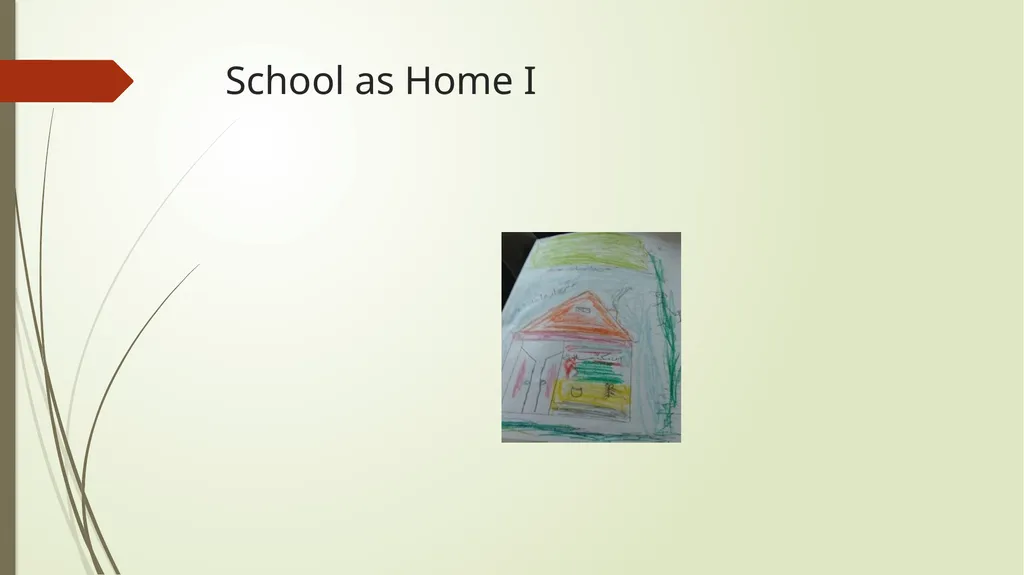
School as Home I<br>
17
School as Home II Positive issues of physicality- loving space of school.
The children drew many images of the school as a colourful, positive, house and place: These pictures express developmentally appropriate experiences of the environment as also stimulating and emotionally warm.
Interestingly in this theme that the school is drawn as a house, rather than as a school or institution; This may express the corrective element of school as a normative ‘home’ as compared to the institution of school or of the refugee camp they live in.<br>
The children drew many images of the school as a colourful, positive, house and place: These pictures express developmentally appropriate experiences of the environment as also stimulating and emotionally warm.
Interestingly in this theme that the school is drawn as a house, rather than as a school or institution; This may express the corrective element of school as a normative ‘home’ as compared to the institution of school or of the refugee camp they live in.<br>
18
A Greek social worker in a residential setting for unaccompanied adolescents Interviewed about the impact of the Covid-19 on her work
Qualified social worker 3 years ago, working in a residential co-operative.
Only social worker
Responsible for intake interviews, weekly group meetings of those sharing a room, weekly community meeting, individually educational planning, processing family unification and asylum seeking paperwork.
Creative individual plans – self care, language learning of their choice, music and video making, board games
Working with volunteers – residents got individual tablets and phone cards<br>
Qualified social worker 3 years ago, working in a residential co-operative.
Only social worker
Responsible for intake interviews, weekly group meetings of those sharing a room, weekly community meeting, individually educational planning, processing family unification and asylum seeking paperwork.
Creative individual plans – self care, language learning of their choice, music and video making, board games
Working with volunteers – residents got individual tablets and phone cards<br>
19
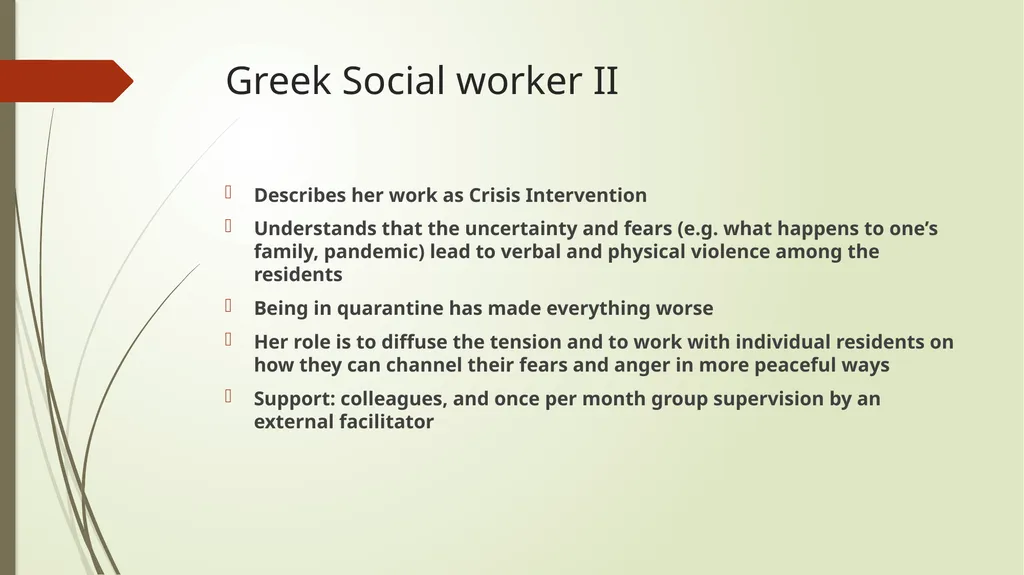
Greek Social worker II Describes her work as Crisis Intervention
Understands that the uncertainty and fears (e.g. what happens to one’s family, pandemic) lead to verbal and physical violence among the residents
Being in quarantine has made everything worse
Her role is to diffuse the tension and to work with individual residents on how they can channel their fears and anger in more peaceful ways
Support: colleagues, and once per month group supervision by an external facilitator<br>
Understands that the uncertainty and fears (e.g. what happens to one’s family, pandemic) lead to verbal and physical violence among the residents
Being in quarantine has made everything worse
Her role is to diffuse the tension and to work with individual residents on how they can channel their fears and anger in more peaceful ways
Support: colleagues, and once per month group supervision by an external facilitator<br>
20
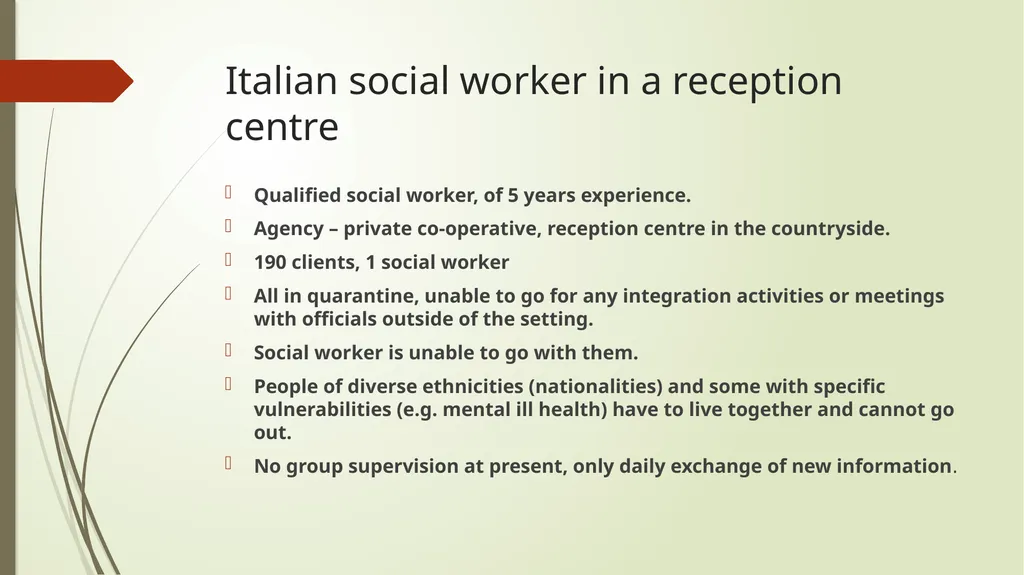
Italian social worker in a reception centre Qualified social worker, of 5 years experience.
Agency – private co-operative, reception centre in the countryside.
190 clients, 1 social worker
All in quarantine, unable to go for any integration activities or meetings with officials outside of the setting.
Social worker is unable to go with them.
People of diverse ethnicities (nationalities) and some with specific vulnerabilities (e.g. mental ill health) have to live together and cannot go out.
No group supervision at present, only daily exchange of new information.<br>
Agency – private co-operative, reception centre in the countryside.
190 clients, 1 social worker
All in quarantine, unable to go for any integration activities or meetings with officials outside of the setting.
Social worker is unable to go with them.
People of diverse ethnicities (nationalities) and some with specific vulnerabilities (e.g. mental ill health) have to live together and cannot go out.
No group supervision at present, only daily exchange of new information.<br>
21
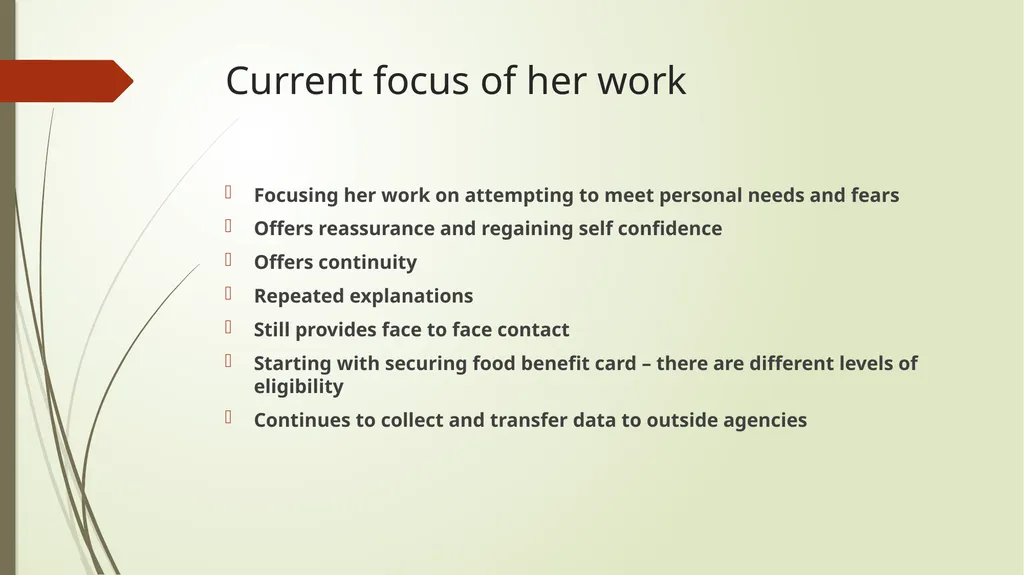
Current focus of her work Focusing her work on attempting to meet personal needs and fears
Offers reassurance and regaining self confidence
Offers continuity
Repeated explanations
Still provides face to face contact
Starting with securing food benefit card – there are different levels of eligibility
Continues to collect and transfer data to outside agencies<br>
Offers reassurance and regaining self confidence
Offers continuity
Repeated explanations
Still provides face to face contact
Starting with securing food benefit card – there are different levels of eligibility
Continues to collect and transfer data to outside agencies<br>
22
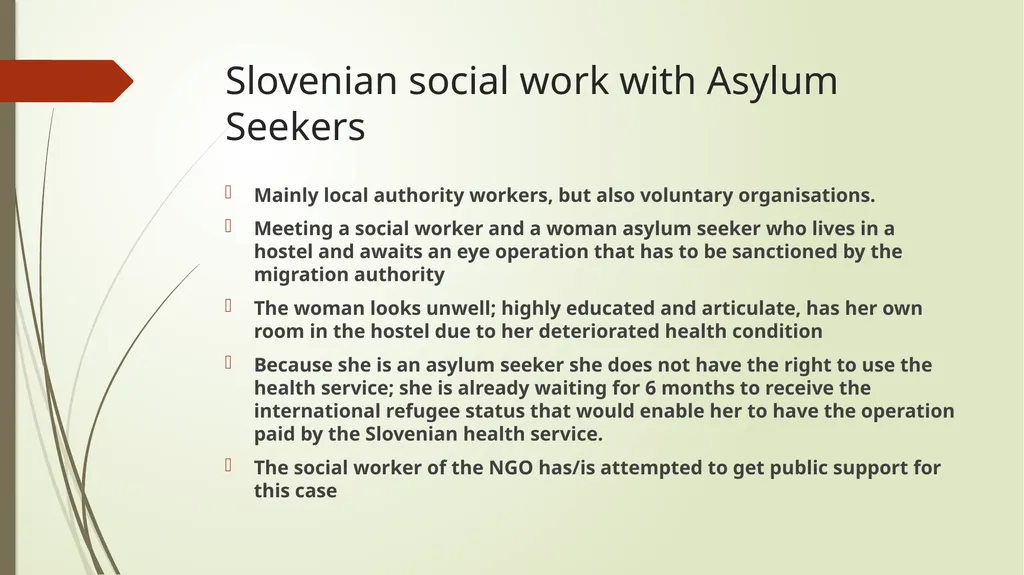
Slovenian social work with Asylum Seekers Mainly local authority workers, but also voluntary organisations.
Meeting a social worker and a woman asylum seeker who lives in a hostel and awaits an eye operation that has to be sanctioned by the migration authority
The woman looks unwell; highly educated and articulate, has her own room in the hostel due to her deteriorated health condition
Because she is an asylum seeker she does not have the right to use the health service; she is already waiting for 6 months to receive the international refugee status that would enable her to have the operation paid by the Slovenian health service.
The social worker of the NGO has/is attempted to get public support for this case<br>
Meeting a social worker and a woman asylum seeker who lives in a hostel and awaits an eye operation that has to be sanctioned by the migration authority
The woman looks unwell; highly educated and articulate, has her own room in the hostel due to her deteriorated health condition
Because she is an asylum seeker she does not have the right to use the health service; she is already waiting for 6 months to receive the international refugee status that would enable her to have the operation paid by the Slovenian health service.
The social worker of the NGO has/is attempted to get public support for this case<br>
23
Home for young children and adolescents This home has children and their siblings with an age range from a 2 year old child to 17 year old adolescents.
School age children go to an ordinary Slovene school; have friends outside the hostel, are invited to their friends’ families
The team consists of social workers and psychologists
The older siblings participate in the cooking
Many activities – music, dancing, a lot of hugging
Social workers are responsible for the family unification work, contacts with the school and other community settings, individual counselling.
The warmth of the relationships.<br>
School age children go to an ordinary Slovene school; have friends outside the hostel, are invited to their friends’ families
The team consists of social workers and psychologists
The older siblings participate in the cooking
Many activities – music, dancing, a lot of hugging
Social workers are responsible for the family unification work, contacts with the school and other community settings, individual counselling.
The warmth of the relationships.<br>
24
Integration work: Session with the police This session has been organised by a day centre social worker in an NGO for young adults asylum seekers
Aimed to reduce the fines they receive for riding un-licenced bikes
Translations from English (spoken by the police officer as the common language..) were provided into four other languages by somewhat older refugees (Pashtu, Farsi, Afghani, Iraqi Arabic)
Bikes are used instead of bus rides, due to lack of funding
The police is ready to allow an amnesty re existing fines, but not for future fines
About 25 young men, 3 young women<br>
Aimed to reduce the fines they receive for riding un-licenced bikes
Translations from English (spoken by the police officer as the common language..) were provided into four other languages by somewhat older refugees (Pashtu, Farsi, Afghani, Iraqi Arabic)
Bikes are used instead of bus rides, due to lack of funding
The police is ready to allow an amnesty re existing fines, but not for future fines
About 25 young men, 3 young women<br>
25
Social work without Borders SWWB has been established by UK social workers and became an international organisation, with branches in many other European countries.
It is based on voluntary activity of social workers, in their private, unpaid, time.
Age assessment
Calais
Securing legal advice
Supporting trafficked asylum seekers
Supporting tortured asylum seekers
Read: Wroe, L, et al (2019) Social Work with Refugees, Asylum Seekers, and Migrants. London: Jessica Kingsley Publishers.<br>
It is based on voluntary activity of social workers, in their private, unpaid, time.
Age assessment
Calais
Securing legal advice
Supporting trafficked asylum seekers
Supporting tortured asylum seekers
Read: Wroe, L, et al (2019) Social Work with Refugees, Asylum Seekers, and Migrants. London: Jessica Kingsley Publishers.<br>
26
In summary Without doubt, social workers are providing an essential, largely positive, contribution to the work with asylum seekers, largely un-thanked for.
As:
mediators between systems, agencies, and people
counsellors, a shoulder to cry on or be angry with
securing basic funding
family reunification
connecting to community resources (health, education, recreation)
provide crisis intervention
receive far too little support<br>
As:
mediators between systems, agencies, and people
counsellors, a shoulder to cry on or be angry with
securing basic funding
family reunification
connecting to community resources (health, education, recreation)
provide crisis intervention
receive far too little support<br>