
The Financial System and Interest Chapter 5 2 Read
Description: The Financial System and Interest Chapter 5 2 Read Ch. 5 (ch. 4 in the 4th edition) Possible test questions handed out in lab Interesting books on investing One Up On Wall Street : How To Use What You Already Know To Make Money In The
Related Topics
Download Presentation
"The Financial System and Interest Chapter 5 2 Read" is the property of its rightful owner. Permission is granted to download and print the materials on this website for personal, non-commercial use only, and to display it on your personal computer provided you do not modify the materials and that you retain all copyright notices contained in the materials. By downloading content from our website, you accept the terms of this agreement.
Presentation Transcript
slide1. The Financial System
and Interest Chapter 5<br>
slide2. 2 Read Ch. 5 (ch. 4 in the 4th edition)
Possible test questions handed out in lab
Interesting books on investing
One Up On Wall Street : How To Use What You Already Know To Make Money In The Market by Peter Lynch, John Rothchild
Take On the Street: What Wall Street and Corporate America Don't Want You to Know by Arthur Levitt<br>
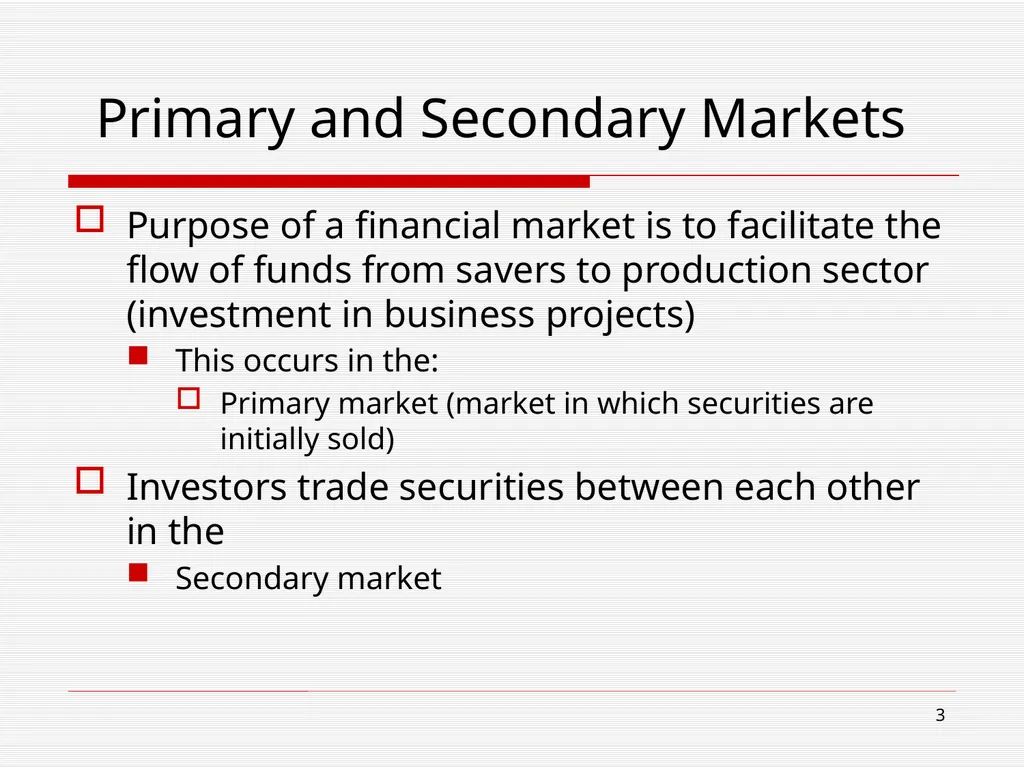
slide3. 3 Primary and Secondary Markets Purpose of a financial market is to facilitate the flow of funds from savers to production sector (investment in business projects)
This occurs in the:
Primary market (market in which securities are initially sold)
Investors trade securities between each other in the
Secondary market<br>
slide4. 4 Primary and Secondary Markets Corporations, even though they do not raise money in the secondary market, are interested in the stock’s price in the secondary market
Goal: Max. Stock Price
Influences how much money can be raised in future stock issues
Senior management’s compensation is usually tied to the stock price<br>
slide5. 5 The Stock Market and Stock Exchanges Stock market—a network of exchanges and brokers
Exchange—a physical marketplace (NYSE, AMEX, regional exchanges)
Broker—individual whose job is to assist people in buying and selling securities
Work for brokerage firms
Members of stock exchange<br>
slide6. 6 Exchanges New York Stock Exchange (NYSE)
Trades securities for 1,200 of largest, strongest companies in U.S.
Handles about 85% of trading activity
American Stock Exchange (AMEX)
Handles slightly smaller, younger firms than NYSE
NASDAQ
Regional stock exchanges (Philadelphia, Chicago, San Francisco, etc.)
Exchanges are linked electronically<br>
slide7. 7 Exchanges The Market
The stock market refers to the entire interconnected set of places, organizations and processes involved in trading stocks
Regulation
Securities are regulated under state and federal laws
Securities Act of 1933
Required companies to disclose certain information
Securities Act of of 1934
Set up Securities and Exchange Commission
Securities law is primarily aimed at disclosure<br>
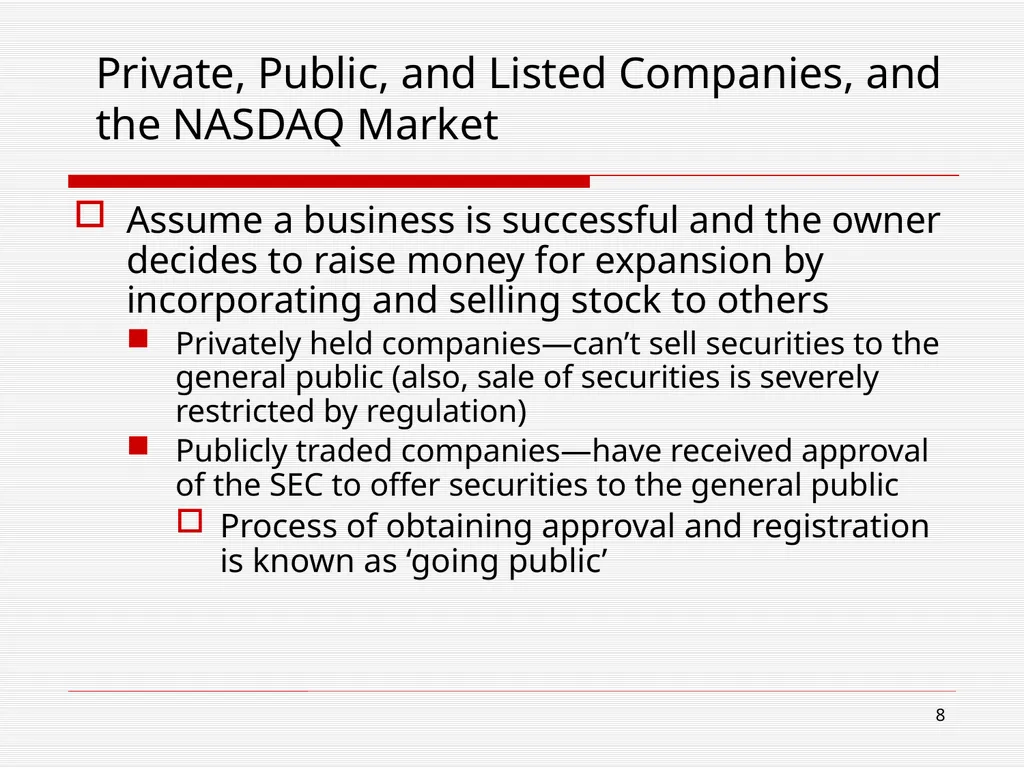
slide8. 8 Private, Public, and Listed Companies, and the NASDAQ Market Assume a business is successful and the owner decides to raise money for expansion by incorporating and selling stock to others
Privately held companies—can’t sell securities to the general public (also, sale of securities is severely restricted by regulation)
Publicly traded companies—have received approval of the SEC to offer securities to the general public
Process of obtaining approval and registration is known as ‘going public’<br>
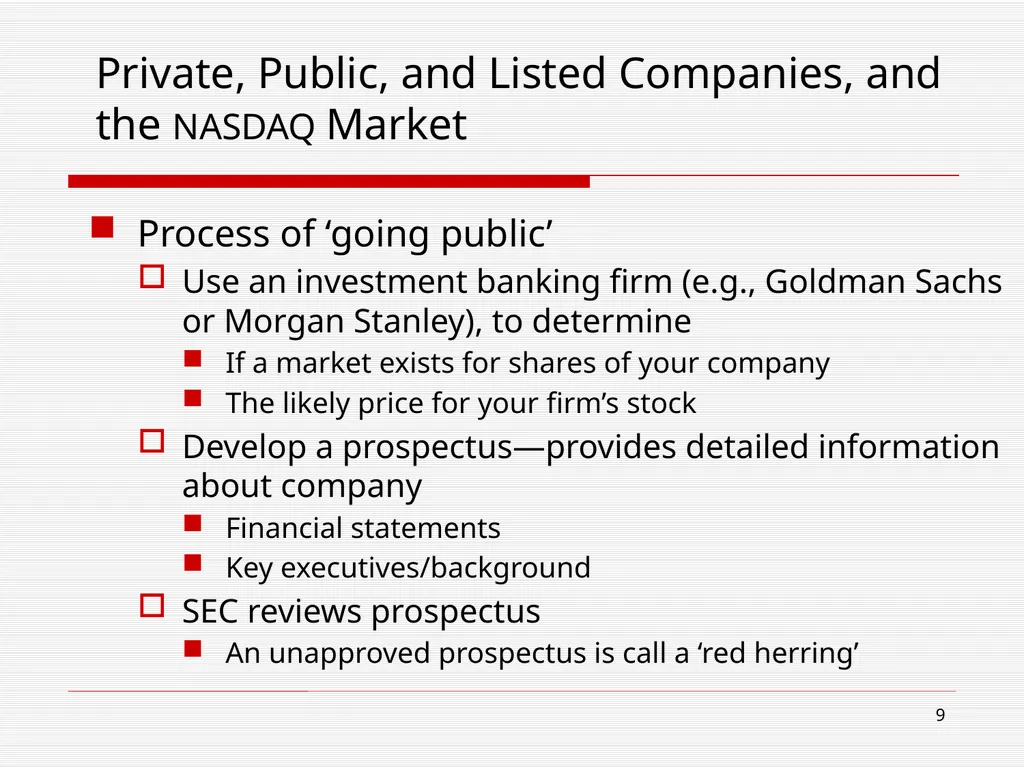
slide9. 9 Private, Public, and Listed Companies, and the NASDAQ Market Process of ‘going public’
Use an investment banking firm (e.g., Goldman Sachs or Morgan Stanley), to determine
If a market exists for shares of your company
The likely price for your firm’s stock
Develop a prospectus—provides detailed information about company
Financial statements
Key executives/background
SEC reviews prospectus
An unapproved prospectus is call a ‘red herring’<br>
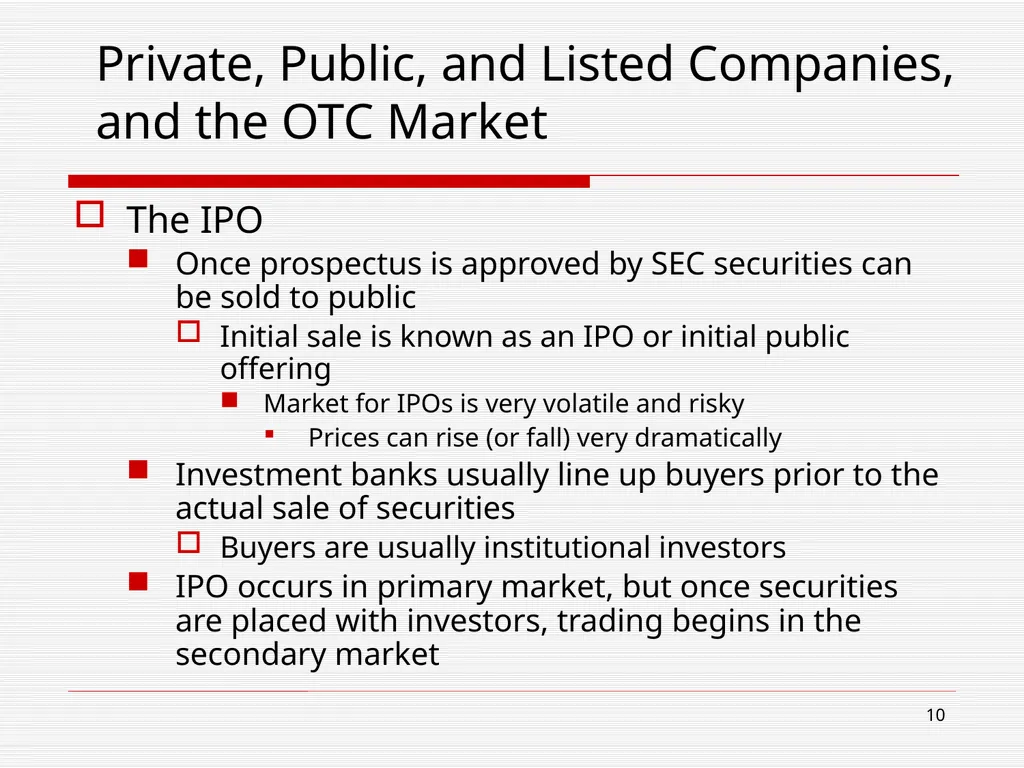
slide10. 10 Private, Public, and Listed Companies, and the OTC Market The IPO
Once prospectus is approved by SEC securities can be sold to public
Initial sale is known as an IPO or initial public offering
Market for IPOs is very volatile and risky
Prices can rise (or fall) very dramatically
Investment banks usually line up buyers prior to the actual sale of securities
Buyers are usually institutional investors
IPO occurs in primary market, but once securities are placed with investors, trading begins in the secondary market<br>
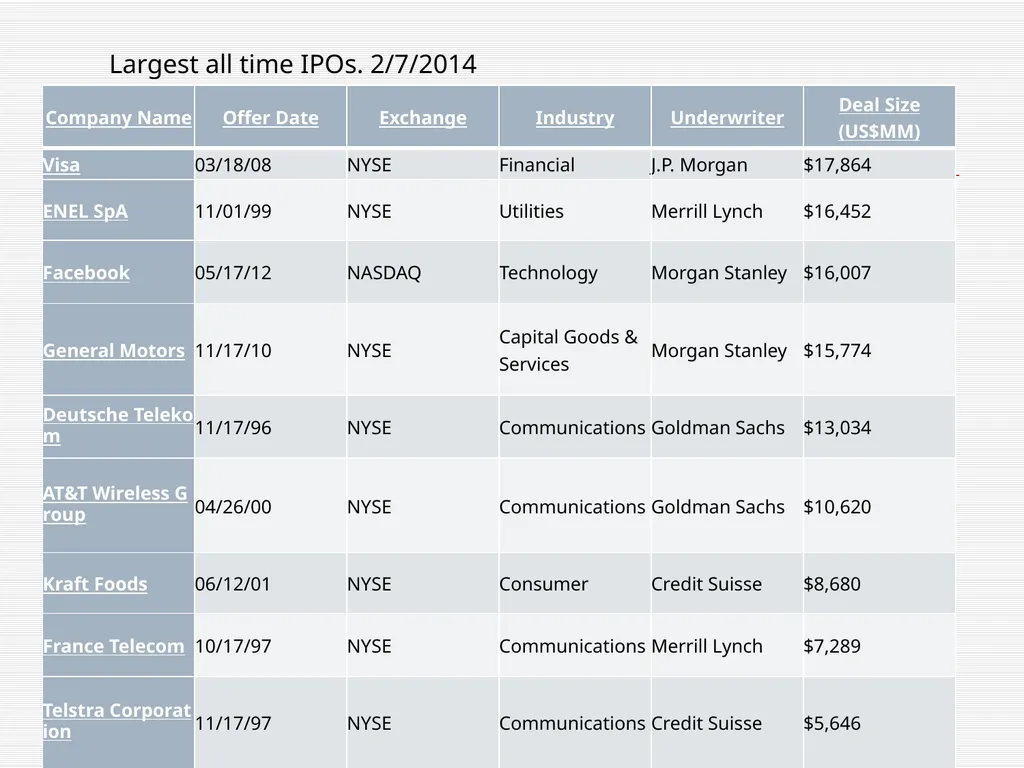
slide11. 11 Largest all time IPOs. 2/7/2014<br>
slide12. 12 myths about IPOs The general perception is that IPOs are a fail-safe way to make money and that if one invests money in an IPO returns are guaranteed. This is the greatest myth about IPOs. Many IPOs will result in losses for the investors, the prices of the same will go down because of several reasons like a weak company, over pricing, weak management or simply because the price fell along with the general markets.
http://www.19.5degs.com/element/19427.php<br>
slide13. 13 The NASDAQ Market After a company goes public, its shares are usually traded in the over-the-counter (OTC) market
Eventually a firm may wish to be listed on an exchange
Loosely organized network of brokers
The National Association of Securities Dealers Automated Quotation System (NASDAQ) is the market’s computer system<br>
slide14. 14 The NASDAQ Market The Nasdaq Stock Market is a computerized communication system that provides the bid and asked prices of more than 5,000 over-the-counter (OTC) stocks that have met the market's registration requirements.
Update. The current thinking is that Nasdaq is considered a stock exchange and its stocks are not OTC stocks.<br>
slide15. 15 Interest Interest rates typically refer to the rate charged on a debt instrument
There are MANY interest rates, including the prime rate, the federal funds rate, etc.
Interest rates tend to move in tandem<br>
slide16. 16 The Relationship Between Interest and the Stock Market The stock market reacts to changes in interest rates (even though interest rates are related to the bond market)
Stocks (equity) and bonds (debt) compete for investor’s dollars
Stocks offer higher returns but have more risk
If you could earn 10% by investing in a bond of IBM, what return would you want to invest in IBM’s stock?
ANS. More than 10% because the stock is more risky<br>
slide17. 17 The Relationship Between Interest and the Stock Market If interest rates were to rise to 12% on IBM’s bonds, what would happen to your required rate of return on IBM’s stock?
Your required return on IBM’s stock would rise and therefore, the value of IBM’s stock would drop in the market
Interest rates and security prices move in opposite directions
Good reason for us to have an interest in interest rates<br>
slide18. 18 Interest and the Economy Would you be more likely to buy a house/car when interest rates are high or low?
Interest rates have a significant effect on the economy
Lower interest rates stimulate business and economic activity
Businesses and individuals use credit a great deal
Interest rates represent the cost of borrowing money (credit)<br>
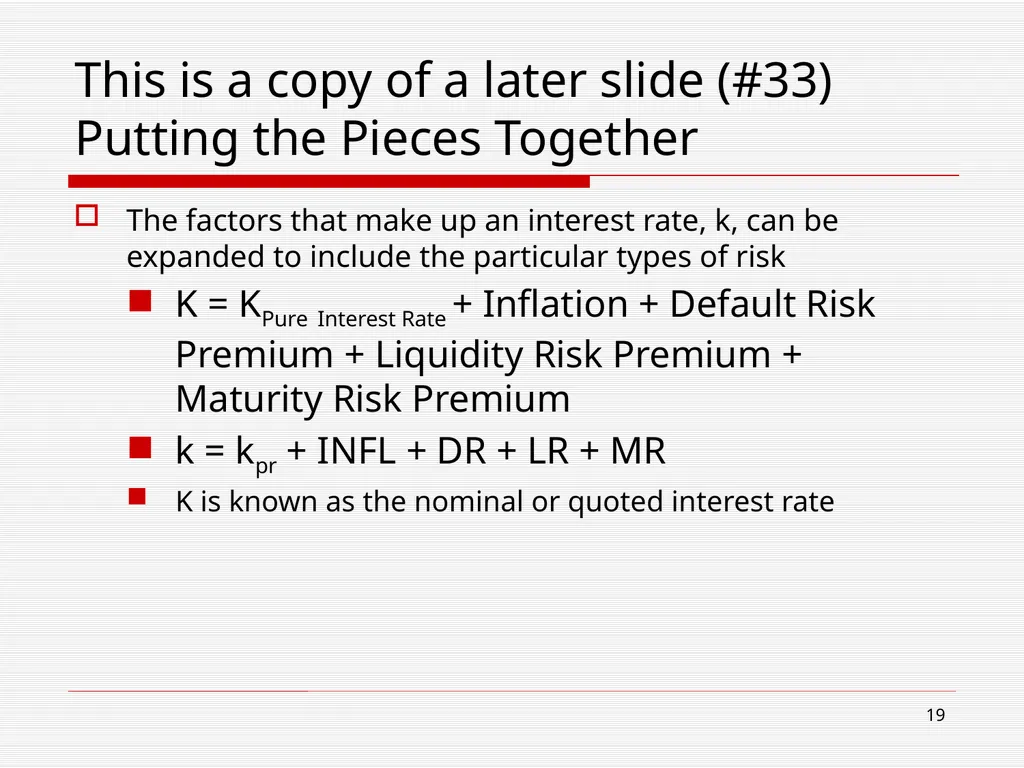
slide19. 19 This is a copy of a later slide (#33) Putting the Pieces Together The factors that make up an interest rate, k, can be expanded to include the particular types of risk
K = KPure Interest Rate + Inflation + Default Risk Premium + Liquidity Risk Premium + Maturity Risk Premium
k = kpr + INFL + DR + LR + MR
K is known as the nominal or quoted interest rate<br>
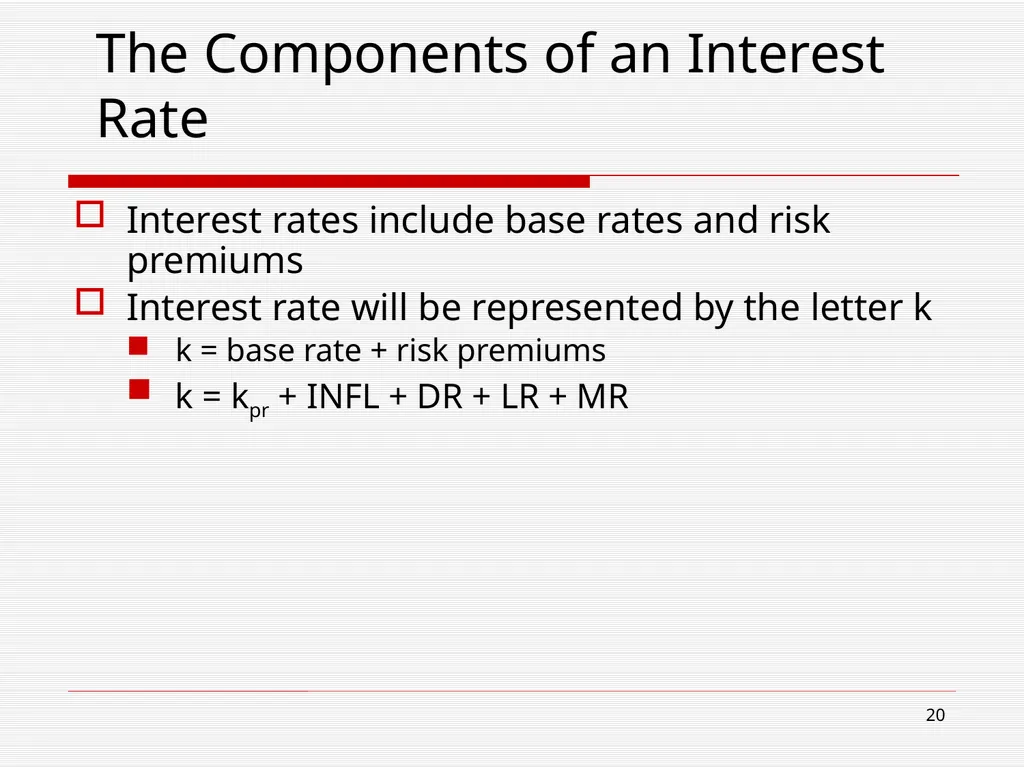
slide20. 20 The Components of an Interest Rate Interest rates include base rates and risk premiums
Interest rate will be represented by the letter k
k = base rate + risk premiums
k = kpr + INFL + DR + LR + MR<br>
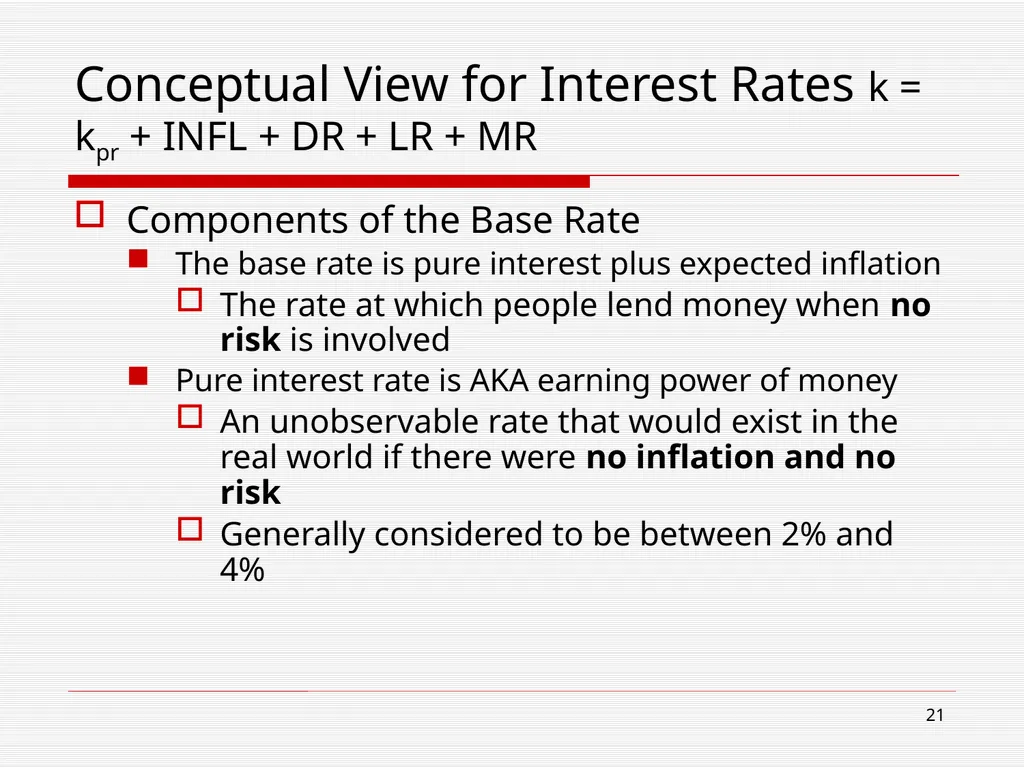
slide21. 21 Conceptual View for Interest Rates k = kpr + INFL + DR + LR + MR Components of the Base Rate
The base rate is pure interest plus expected inflation
The rate at which people lend money when no risk is involved
Pure interest rate is AKA earning power of money
An unobservable rate that would exist in the real world if there were no inflation and no risk
Generally considered to be between 2% and 4%<br>
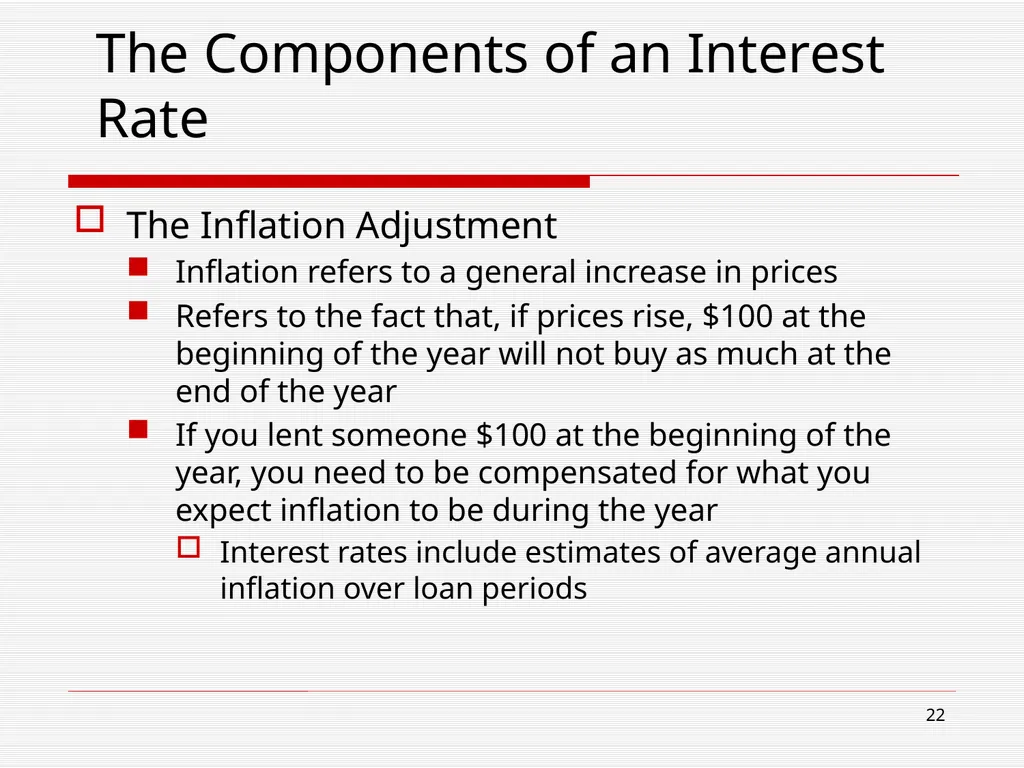
slide22. 22 The Components of an Interest Rate The Inflation Adjustment
Inflation refers to a general increase in prices
Refers to the fact that, if prices rise, $100 at the beginning of the year will not buy as much at the end of the year
If you lent someone $100 at the beginning of the year, you need to be compensated for what you expect inflation to be during the year
Interest rates include estimates of average annual inflation over loan periods<br>
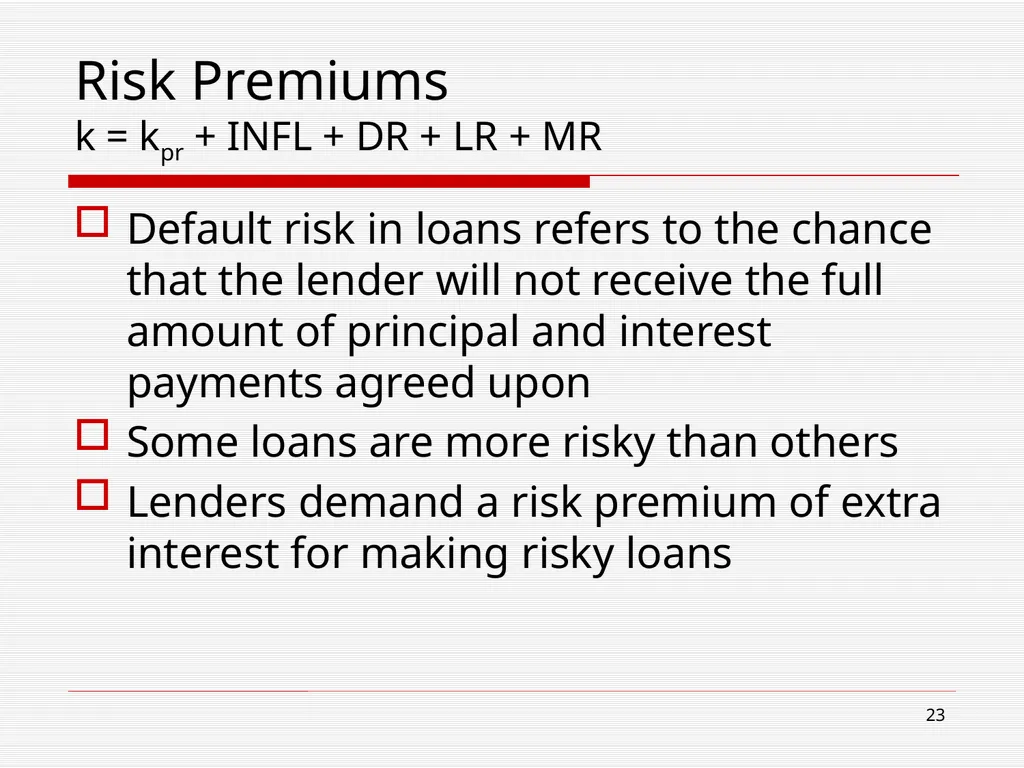
slide23. 23 Risk Premiums k = kpr + INFL + DR + LR + MR Default risk in loans refers to the chance that the lender will not receive the full amount of principal and interest payments agreed upon
Some loans are more risky than others
Lenders demand a risk premium of extra interest for making risky loans<br>
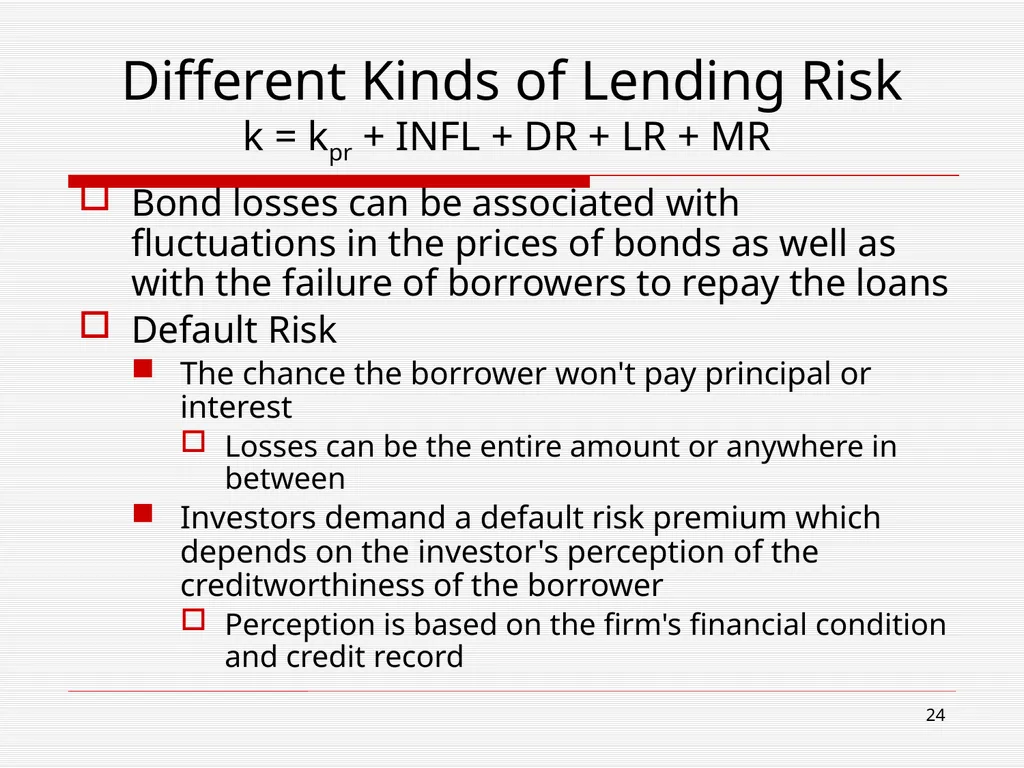
slide24. 24 Different Kinds of Lending Risk k = kpr + INFL + DR + LR + MR Bond losses can be associated with fluctuations in the prices of bonds as well as with the failure of borrowers to repay the loans
Default Risk
The chance the borrower won't pay principal or interest
Losses can be the entire amount or anywhere in between
Investors demand a default risk premium which depends on the investor's perception of the creditworthiness of the borrower
Perception is based on the firm's financial condition and credit record<br>
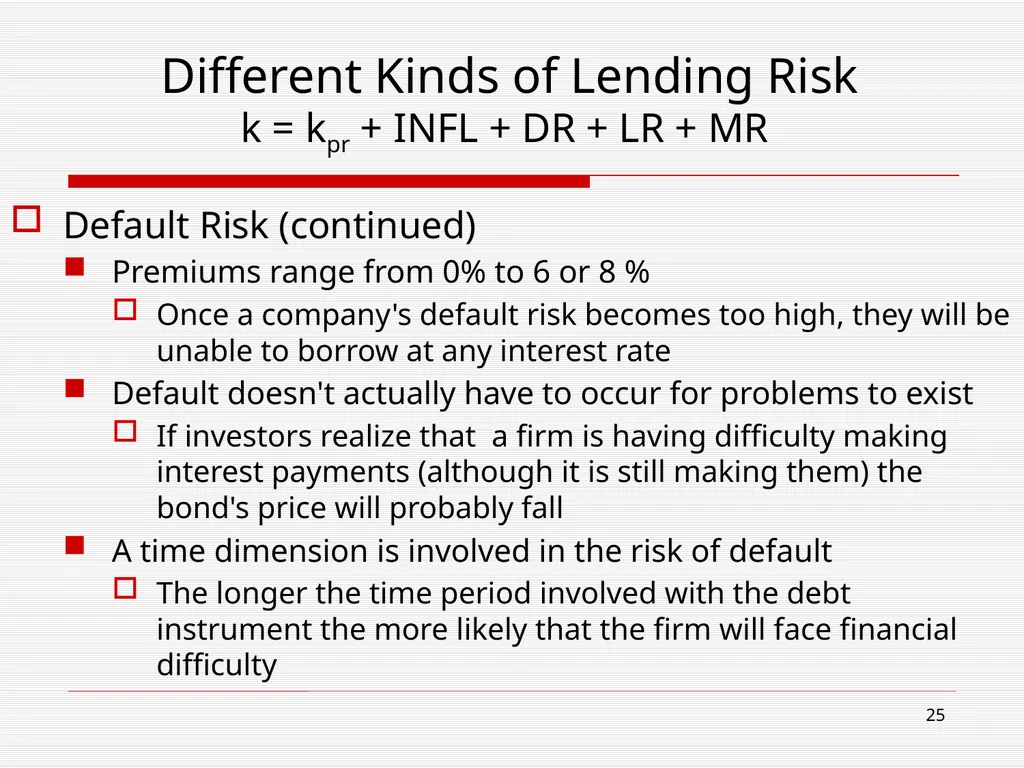
slide25. 25 Different Kinds of Lending Risk k = kpr + INFL + DR + LR + MR Default Risk (continued)
Premiums range from 0% to 6 or 8 %
Once a company's default risk becomes too high, they will be unable to borrow at any interest rate
Default doesn't actually have to occur for problems to exist
If investors realize that a firm is having difficulty making interest payments (although it is still making them) the bond's price will probably fall
A time dimension is involved in the risk of default
The longer the time period involved with the debt instrument the more likely that the firm will face financial difficulty<br>
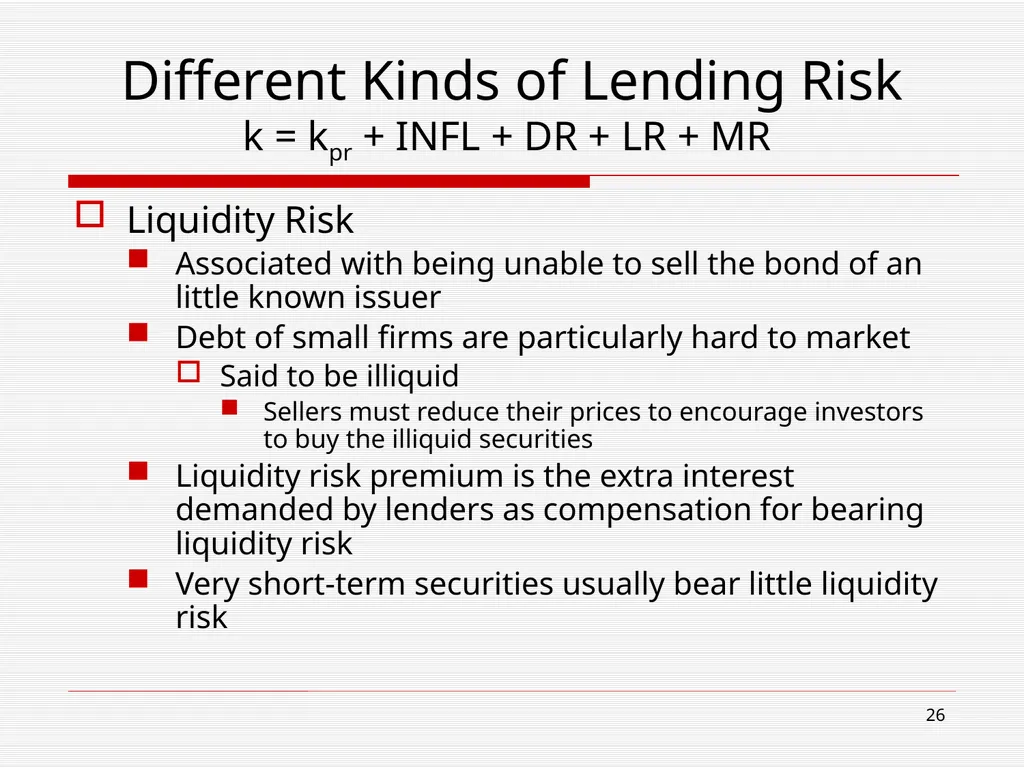
slide26. 26 Different Kinds of Lending Risk k = kpr + INFL + DR + LR + MR Liquidity Risk
Associated with being unable to sell the bond of an little known issuer
Debt of small firms are particularly hard to market
Said to be illiquid
Sellers must reduce their prices to encourage investors to buy the illiquid securities
Liquidity risk premium is the extra interest demanded by lenders as compensation for bearing liquidity risk
Very short-term securities usually bear little liquidity risk<br>
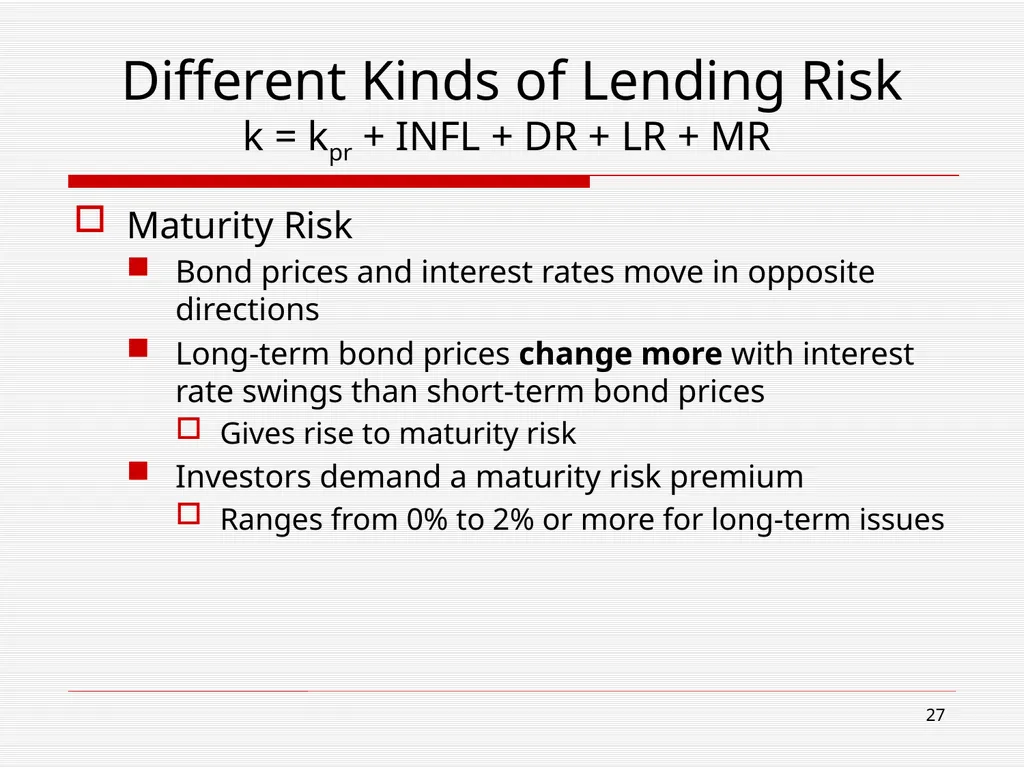
slide27. 27 Different Kinds of Lending Risk k = kpr + INFL + DR + LR + MR Maturity Risk
Bond prices and interest rates move in opposite directions
Long-term bond prices change more with interest rate swings than short-term bond prices
Gives rise to maturity risk
Investors demand a maturity risk premium
Ranges from 0% to 2% or more for long-term issues<br>
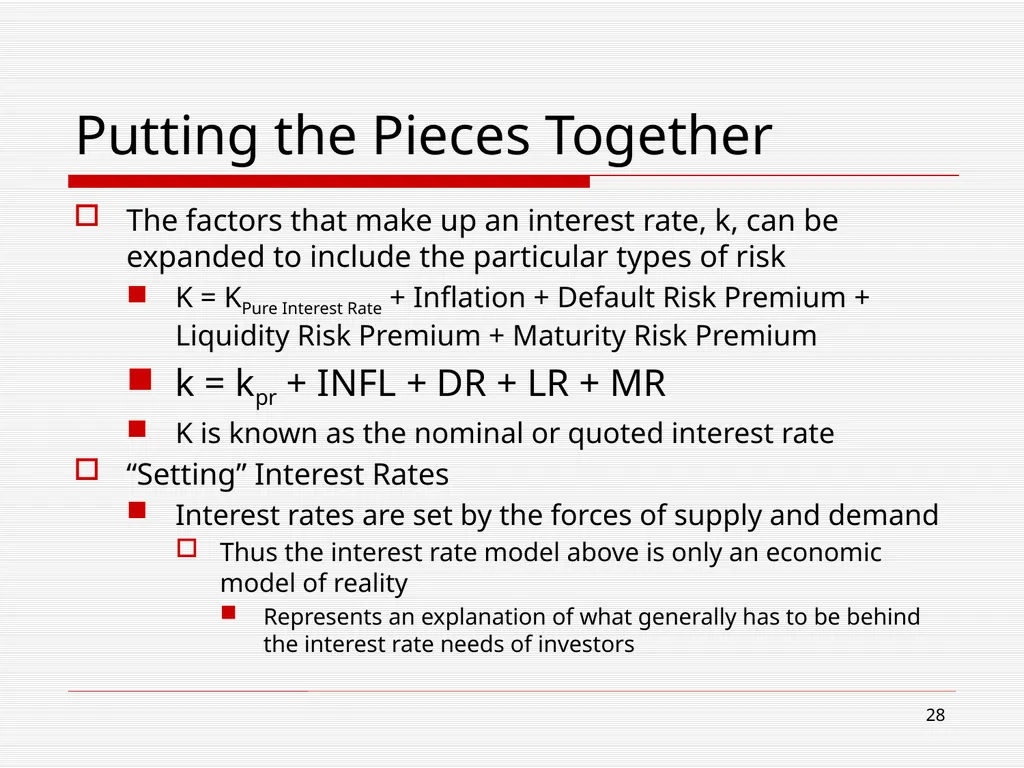
slide28. 28 Putting the Pieces Together The factors that make up an interest rate, k, can be expanded to include the particular types of risk
K = KPure Interest Rate + Inflation + Default Risk Premium + Liquidity Risk Premium + Maturity Risk Premium
k = kpr + INFL + DR + LR + MR
K is known as the nominal or quoted interest rate
“Setting” Interest Rates
Interest rates are set by the forces of supply and demand
Thus the interest rate model above is only an economic model of reality
Represents an explanation of what generally has to be behind the interest rate needs of investors<br>
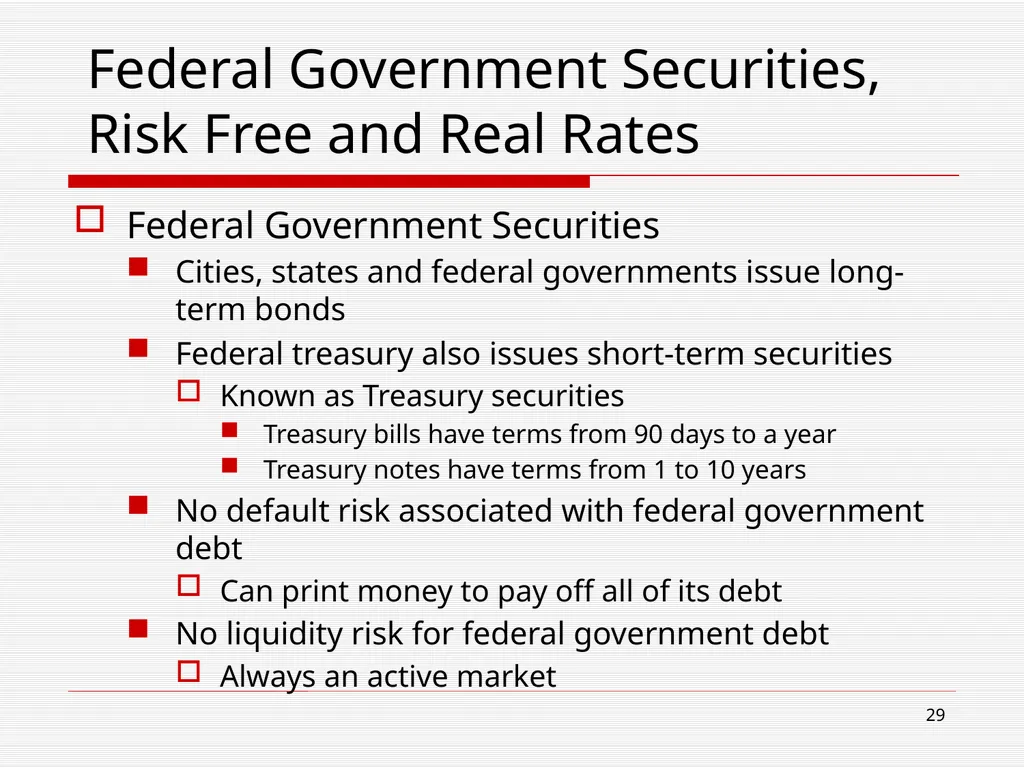
slide29. 29 Federal Government Securities, Risk Free and Real Rates Federal Government Securities
Cities, states and federal governments issue long-term bonds
Federal treasury also issues short-term securities
Known as Treasury securities
Treasury bills have terms from 90 days to a year
Treasury notes have terms from 1 to 10 years
No default risk associated with federal government debt
Can print money to pay off all of its debt
No liquidity risk for federal government debt
Always an active market<br>
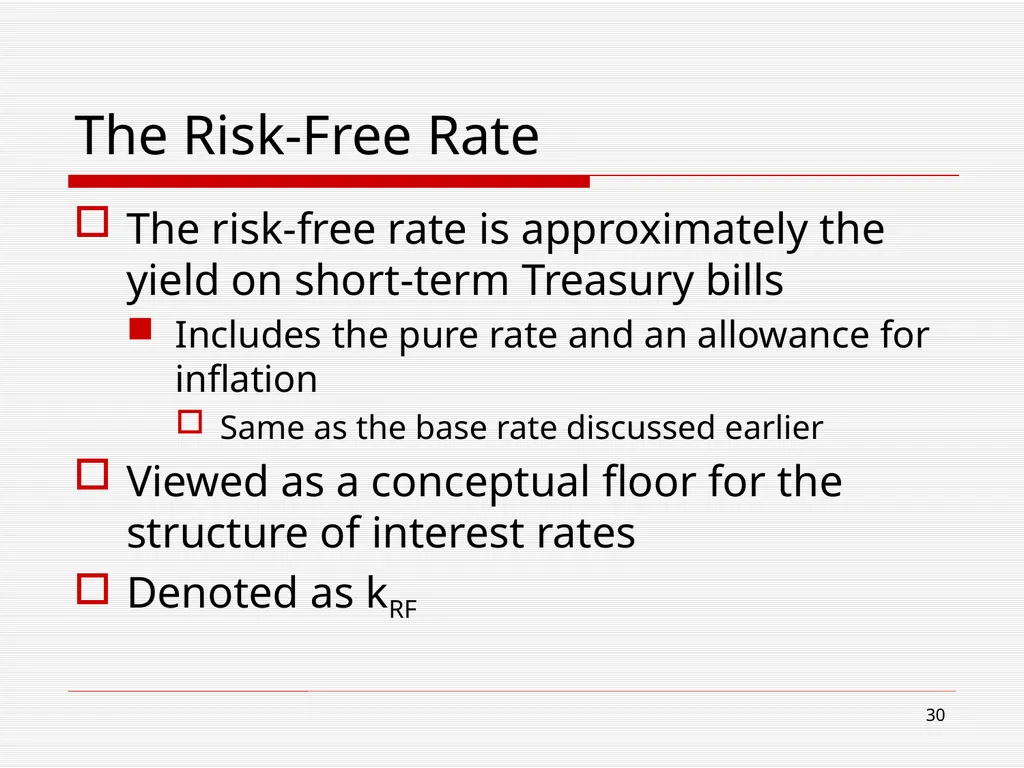
slide30. 30 The Risk-Free Rate The risk-free rate is approximately the yield on short-term Treasury bills
Includes the pure rate and an allowance for inflation
Same as the base rate discussed earlier
Viewed as a conceptual floor for the structure of interest rates
Denoted as kRF<br>
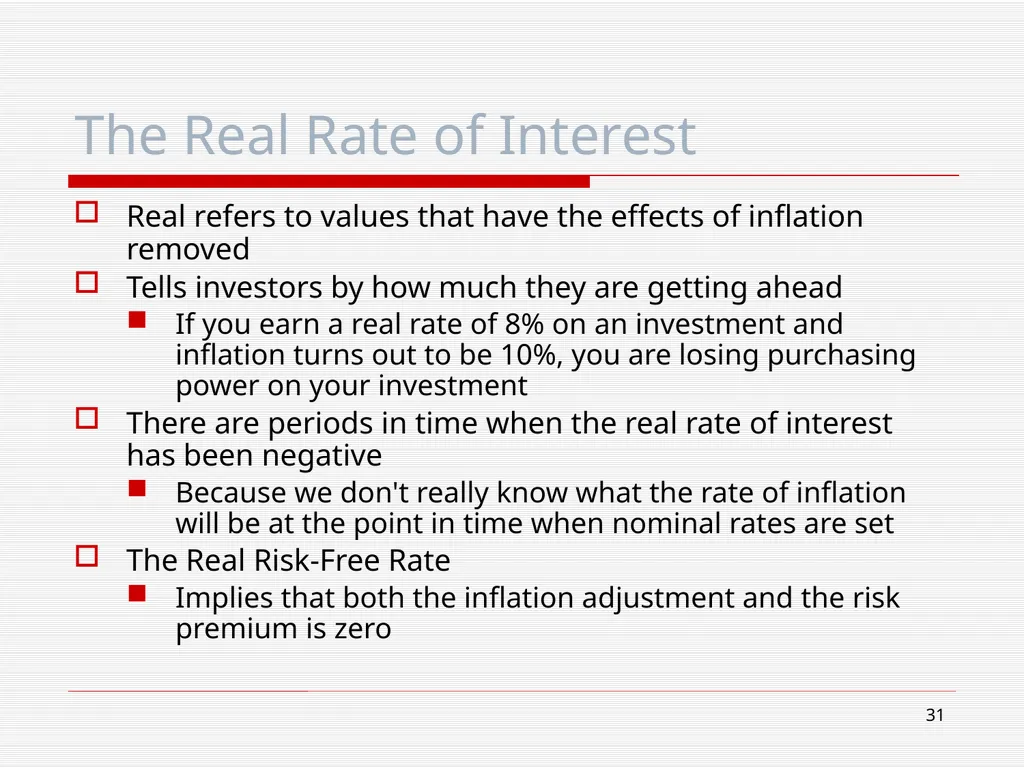
slide31. 31 The Real Rate of Interest Real refers to values that have the effects of inflation removed
Tells investors by how much they are getting ahead
If you earn a real rate of 8% on an investment and inflation turns out to be 10%, you are losing purchasing power on your investment
There are periods in time when the real rate of interest has been negative
Because we don't really know what the rate of inflation will be at the point in time when nominal rates are set
The Real Risk-Free Rate
Implies that both the inflation adjustment and the risk premium is zero<br>
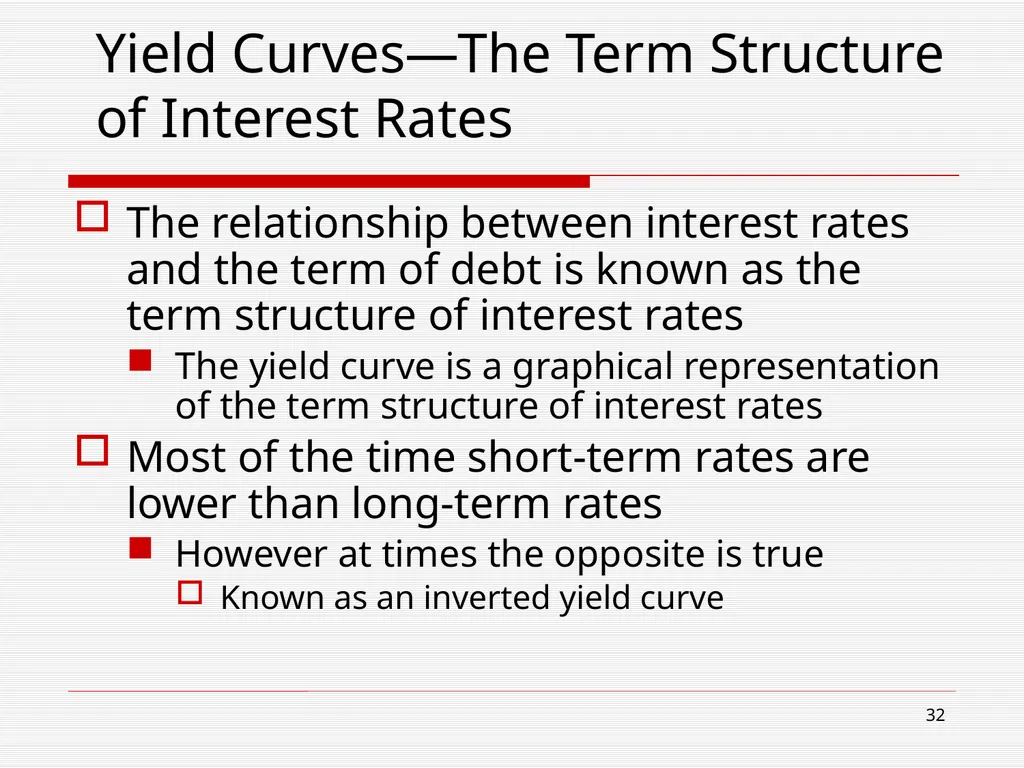
slide32. 32 Yield Curves—The Term Structure of Interest Rates The relationship between interest rates and the term of debt is known as the term structure of interest rates
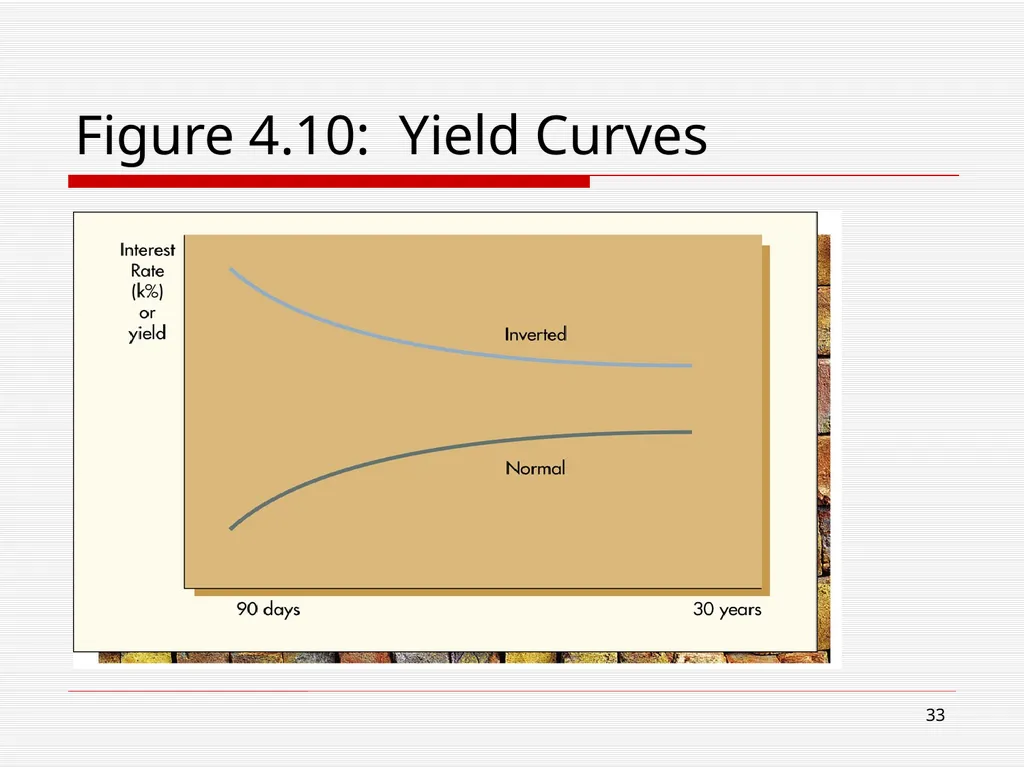
The yield curve is a graphical representation of the term structure of interest rates
Most of the time short-term rates are lower than long-term rates
However at times the opposite is true
Known as an inverted yield curve<br>
slide33. 33 Figure 4.10: Yield Curves<br>
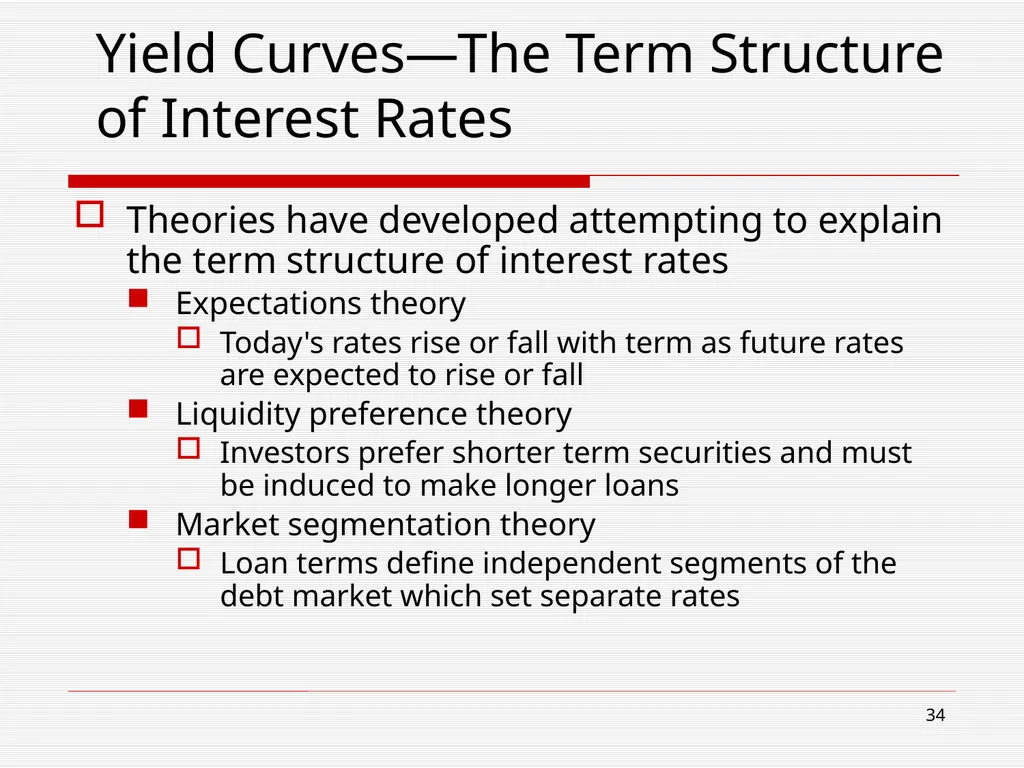
slide34. 34 Yield Curves—The Term Structure of Interest Rates Theories have developed attempting to explain the term structure of interest rates
Expectations theory
Today's rates rise or fall with term as future rates are expected to rise or fall
Liquidity preference theory
Investors prefer shorter term securities and must be induced to make longer loans
Market segmentation theory
Loan terms define independent segments of the debt market which set separate rates<br>
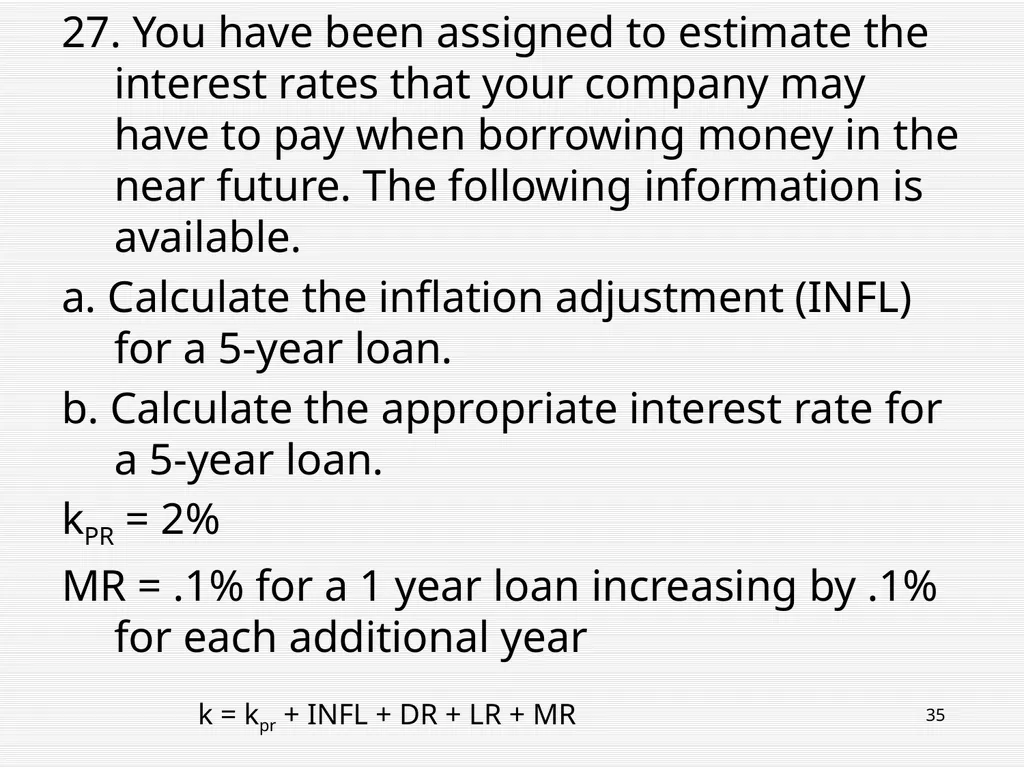
slide35. 27. You have been assigned to estimate the interest rates that your company may have to pay when borrowing money in the near future. The following information is available.
a. Calculate the inflation adjustment (INFL) for a 5-year loan.
b. Calculate the appropriate interest rate for a 5-year loan.
kPR = 2%
MR = .1% for a 1 year loan increasing by .1% for each additional year 35 k = kpr + INFL + DR + LR + MR<br>
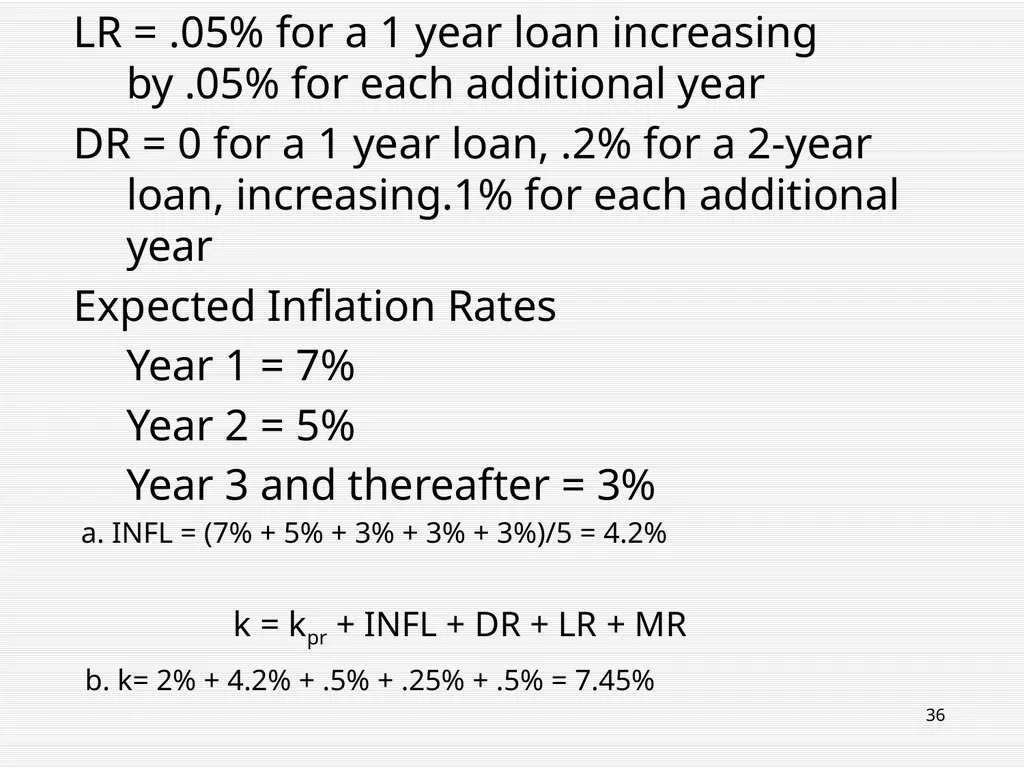
slide36. LR = .05% for a 1 year loan increasing by .05% for each additional year
DR = 0 for a 1 year loan, .2% for a 2-year loan, increasing.1% for each additional year
Expected Inflation Rates
Year 1 = 7%
Year 2 = 5%
Year 3 and thereafter = 3%
a. INFL = (7% + 5% + 3% + 3% + 3%)/5 = 4.2% 36 k = kpr + INFL + DR + LR + MR b. k= 2% + 4.2% + .5% + .25% + .5% = 7.45%<br>
slide2. 2 Read Ch. 5 (ch. 4 in the 4th edition)
Possible test questions handed out in lab
Interesting books on investing
One Up On Wall Street : How To Use What You Already Know To Make Money In The Market by Peter Lynch, John Rothchild
Take On the Street: What Wall Street and Corporate America Don't Want You to Know by Arthur Levitt<br>
slide3. 3 Primary and Secondary Markets Purpose of a financial market is to facilitate the flow of funds from savers to production sector (investment in business projects)
This occurs in the:
Primary market (market in which securities are initially sold)
Investors trade securities between each other in the
Secondary market<br>
slide4. 4 Primary and Secondary Markets Corporations, even though they do not raise money in the secondary market, are interested in the stock’s price in the secondary market
Goal: Max. Stock Price
Influences how much money can be raised in future stock issues
Senior management’s compensation is usually tied to the stock price<br>
slide5. 5 The Stock Market and Stock Exchanges Stock market—a network of exchanges and brokers
Exchange—a physical marketplace (NYSE, AMEX, regional exchanges)
Broker—individual whose job is to assist people in buying and selling securities
Work for brokerage firms
Members of stock exchange<br>
slide6. 6 Exchanges New York Stock Exchange (NYSE)
Trades securities for 1,200 of largest, strongest companies in U.S.
Handles about 85% of trading activity
American Stock Exchange (AMEX)
Handles slightly smaller, younger firms than NYSE
NASDAQ
Regional stock exchanges (Philadelphia, Chicago, San Francisco, etc.)
Exchanges are linked electronically<br>
slide7. 7 Exchanges The Market
The stock market refers to the entire interconnected set of places, organizations and processes involved in trading stocks
Regulation
Securities are regulated under state and federal laws
Securities Act of 1933
Required companies to disclose certain information
Securities Act of of 1934
Set up Securities and Exchange Commission
Securities law is primarily aimed at disclosure<br>
slide8. 8 Private, Public, and Listed Companies, and the NASDAQ Market Assume a business is successful and the owner decides to raise money for expansion by incorporating and selling stock to others
Privately held companies—can’t sell securities to the general public (also, sale of securities is severely restricted by regulation)
Publicly traded companies—have received approval of the SEC to offer securities to the general public
Process of obtaining approval and registration is known as ‘going public’<br>
slide9. 9 Private, Public, and Listed Companies, and the NASDAQ Market Process of ‘going public’
Use an investment banking firm (e.g., Goldman Sachs or Morgan Stanley), to determine
If a market exists for shares of your company
The likely price for your firm’s stock
Develop a prospectus—provides detailed information about company
Financial statements
Key executives/background
SEC reviews prospectus
An unapproved prospectus is call a ‘red herring’<br>
slide10. 10 Private, Public, and Listed Companies, and the OTC Market The IPO
Once prospectus is approved by SEC securities can be sold to public
Initial sale is known as an IPO or initial public offering
Market for IPOs is very volatile and risky
Prices can rise (or fall) very dramatically
Investment banks usually line up buyers prior to the actual sale of securities
Buyers are usually institutional investors
IPO occurs in primary market, but once securities are placed with investors, trading begins in the secondary market<br>
slide11. 11 Largest all time IPOs. 2/7/2014<br>
slide12. 12 myths about IPOs The general perception is that IPOs are a fail-safe way to make money and that if one invests money in an IPO returns are guaranteed. This is the greatest myth about IPOs. Many IPOs will result in losses for the investors, the prices of the same will go down because of several reasons like a weak company, over pricing, weak management or simply because the price fell along with the general markets.
http://www.19.5degs.com/element/19427.php<br>
slide13. 13 The NASDAQ Market After a company goes public, its shares are usually traded in the over-the-counter (OTC) market
Eventually a firm may wish to be listed on an exchange
Loosely organized network of brokers
The National Association of Securities Dealers Automated Quotation System (NASDAQ) is the market’s computer system<br>
slide14. 14 The NASDAQ Market The Nasdaq Stock Market is a computerized communication system that provides the bid and asked prices of more than 5,000 over-the-counter (OTC) stocks that have met the market's registration requirements.
Update. The current thinking is that Nasdaq is considered a stock exchange and its stocks are not OTC stocks.<br>
slide15. 15 Interest Interest rates typically refer to the rate charged on a debt instrument
There are MANY interest rates, including the prime rate, the federal funds rate, etc.
Interest rates tend to move in tandem<br>
slide16. 16 The Relationship Between Interest and the Stock Market The stock market reacts to changes in interest rates (even though interest rates are related to the bond market)
Stocks (equity) and bonds (debt) compete for investor’s dollars
Stocks offer higher returns but have more risk
If you could earn 10% by investing in a bond of IBM, what return would you want to invest in IBM’s stock?
ANS. More than 10% because the stock is more risky<br>
slide17. 17 The Relationship Between Interest and the Stock Market If interest rates were to rise to 12% on IBM’s bonds, what would happen to your required rate of return on IBM’s stock?
Your required return on IBM’s stock would rise and therefore, the value of IBM’s stock would drop in the market
Interest rates and security prices move in opposite directions
Good reason for us to have an interest in interest rates<br>
slide18. 18 Interest and the Economy Would you be more likely to buy a house/car when interest rates are high or low?
Interest rates have a significant effect on the economy
Lower interest rates stimulate business and economic activity
Businesses and individuals use credit a great deal
Interest rates represent the cost of borrowing money (credit)<br>
slide19. 19 This is a copy of a later slide (#33) Putting the Pieces Together The factors that make up an interest rate, k, can be expanded to include the particular types of risk
K = KPure Interest Rate + Inflation + Default Risk Premium + Liquidity Risk Premium + Maturity Risk Premium
k = kpr + INFL + DR + LR + MR
K is known as the nominal or quoted interest rate<br>
slide20. 20 The Components of an Interest Rate Interest rates include base rates and risk premiums
Interest rate will be represented by the letter k
k = base rate + risk premiums
k = kpr + INFL + DR + LR + MR<br>
slide21. 21 Conceptual View for Interest Rates k = kpr + INFL + DR + LR + MR Components of the Base Rate
The base rate is pure interest plus expected inflation
The rate at which people lend money when no risk is involved
Pure interest rate is AKA earning power of money
An unobservable rate that would exist in the real world if there were no inflation and no risk
Generally considered to be between 2% and 4%<br>
slide22. 22 The Components of an Interest Rate The Inflation Adjustment
Inflation refers to a general increase in prices
Refers to the fact that, if prices rise, $100 at the beginning of the year will not buy as much at the end of the year
If you lent someone $100 at the beginning of the year, you need to be compensated for what you expect inflation to be during the year
Interest rates include estimates of average annual inflation over loan periods<br>
slide23. 23 Risk Premiums k = kpr + INFL + DR + LR + MR Default risk in loans refers to the chance that the lender will not receive the full amount of principal and interest payments agreed upon
Some loans are more risky than others
Lenders demand a risk premium of extra interest for making risky loans<br>
slide24. 24 Different Kinds of Lending Risk k = kpr + INFL + DR + LR + MR Bond losses can be associated with fluctuations in the prices of bonds as well as with the failure of borrowers to repay the loans
Default Risk
The chance the borrower won't pay principal or interest
Losses can be the entire amount or anywhere in between
Investors demand a default risk premium which depends on the investor's perception of the creditworthiness of the borrower
Perception is based on the firm's financial condition and credit record<br>
slide25. 25 Different Kinds of Lending Risk k = kpr + INFL + DR + LR + MR Default Risk (continued)
Premiums range from 0% to 6 or 8 %
Once a company's default risk becomes too high, they will be unable to borrow at any interest rate
Default doesn't actually have to occur for problems to exist
If investors realize that a firm is having difficulty making interest payments (although it is still making them) the bond's price will probably fall
A time dimension is involved in the risk of default
The longer the time period involved with the debt instrument the more likely that the firm will face financial difficulty<br>
slide26. 26 Different Kinds of Lending Risk k = kpr + INFL + DR + LR + MR Liquidity Risk
Associated with being unable to sell the bond of an little known issuer
Debt of small firms are particularly hard to market
Said to be illiquid
Sellers must reduce their prices to encourage investors to buy the illiquid securities
Liquidity risk premium is the extra interest demanded by lenders as compensation for bearing liquidity risk
Very short-term securities usually bear little liquidity risk<br>
slide27. 27 Different Kinds of Lending Risk k = kpr + INFL + DR + LR + MR Maturity Risk
Bond prices and interest rates move in opposite directions
Long-term bond prices change more with interest rate swings than short-term bond prices
Gives rise to maturity risk
Investors demand a maturity risk premium
Ranges from 0% to 2% or more for long-term issues<br>
slide28. 28 Putting the Pieces Together The factors that make up an interest rate, k, can be expanded to include the particular types of risk
K = KPure Interest Rate + Inflation + Default Risk Premium + Liquidity Risk Premium + Maturity Risk Premium
k = kpr + INFL + DR + LR + MR
K is known as the nominal or quoted interest rate
“Setting” Interest Rates
Interest rates are set by the forces of supply and demand
Thus the interest rate model above is only an economic model of reality
Represents an explanation of what generally has to be behind the interest rate needs of investors<br>
slide29. 29 Federal Government Securities, Risk Free and Real Rates Federal Government Securities
Cities, states and federal governments issue long-term bonds
Federal treasury also issues short-term securities
Known as Treasury securities
Treasury bills have terms from 90 days to a year
Treasury notes have terms from 1 to 10 years
No default risk associated with federal government debt
Can print money to pay off all of its debt
No liquidity risk for federal government debt
Always an active market<br>
slide30. 30 The Risk-Free Rate The risk-free rate is approximately the yield on short-term Treasury bills
Includes the pure rate and an allowance for inflation
Same as the base rate discussed earlier
Viewed as a conceptual floor for the structure of interest rates
Denoted as kRF<br>
slide31. 31 The Real Rate of Interest Real refers to values that have the effects of inflation removed
Tells investors by how much they are getting ahead
If you earn a real rate of 8% on an investment and inflation turns out to be 10%, you are losing purchasing power on your investment
There are periods in time when the real rate of interest has been negative
Because we don't really know what the rate of inflation will be at the point in time when nominal rates are set
The Real Risk-Free Rate
Implies that both the inflation adjustment and the risk premium is zero<br>
slide32. 32 Yield Curves—The Term Structure of Interest Rates The relationship between interest rates and the term of debt is known as the term structure of interest rates
The yield curve is a graphical representation of the term structure of interest rates
Most of the time short-term rates are lower than long-term rates
However at times the opposite is true
Known as an inverted yield curve<br>
slide33. 33 Figure 4.10: Yield Curves<br>
slide34. 34 Yield Curves—The Term Structure of Interest Rates Theories have developed attempting to explain the term structure of interest rates
Expectations theory
Today's rates rise or fall with term as future rates are expected to rise or fall
Liquidity preference theory
Investors prefer shorter term securities and must be induced to make longer loans
Market segmentation theory
Loan terms define independent segments of the debt market which set separate rates<br>
slide35. 27. You have been assigned to estimate the interest rates that your company may have to pay when borrowing money in the near future. The following information is available.
a. Calculate the inflation adjustment (INFL) for a 5-year loan.
b. Calculate the appropriate interest rate for a 5-year loan.
kPR = 2%
MR = .1% for a 1 year loan increasing by .1% for each additional year 35 k = kpr + INFL + DR + LR + MR<br>
slide36. LR = .05% for a 1 year loan increasing by .05% for each additional year
DR = 0 for a 1 year loan, .2% for a 2-year loan, increasing.1% for each additional year
Expected Inflation Rates
Year 1 = 7%
Year 2 = 5%
Year 3 and thereafter = 3%
a. INFL = (7% + 5% + 3% + 3% + 3%)/5 = 4.2% 36 k = kpr + INFL + DR + LR + MR b. k= 2% + 4.2% + .5% + .25% + .5% = 7.45%<br>