
The Global North-South Debate Paper Name:
CP
Published · 15 slides · 0 views

1 / 1

Description
The Global North-South Debate Paper Name: Perspectives on International Relations (Core -7) By-Dr. Prabhat Ch. Mohanty Asst. Professor Department of Political Science Introduction The concept of Global North and Global South is used to
Related Topics
Share
Embed code
Download this presentation From Below
"The Global North-South Debate Paper Name:" is the property of its rightful owner. Permission is granted to download and print the materials on this website for personal, non-commercial use only, and to display it on your personal computer provided you do not modify the materials and that you retain all copyright notices contained in the materials. By downloading content from our website, you accept the terms of this agreement.
Presentation Transcript
01
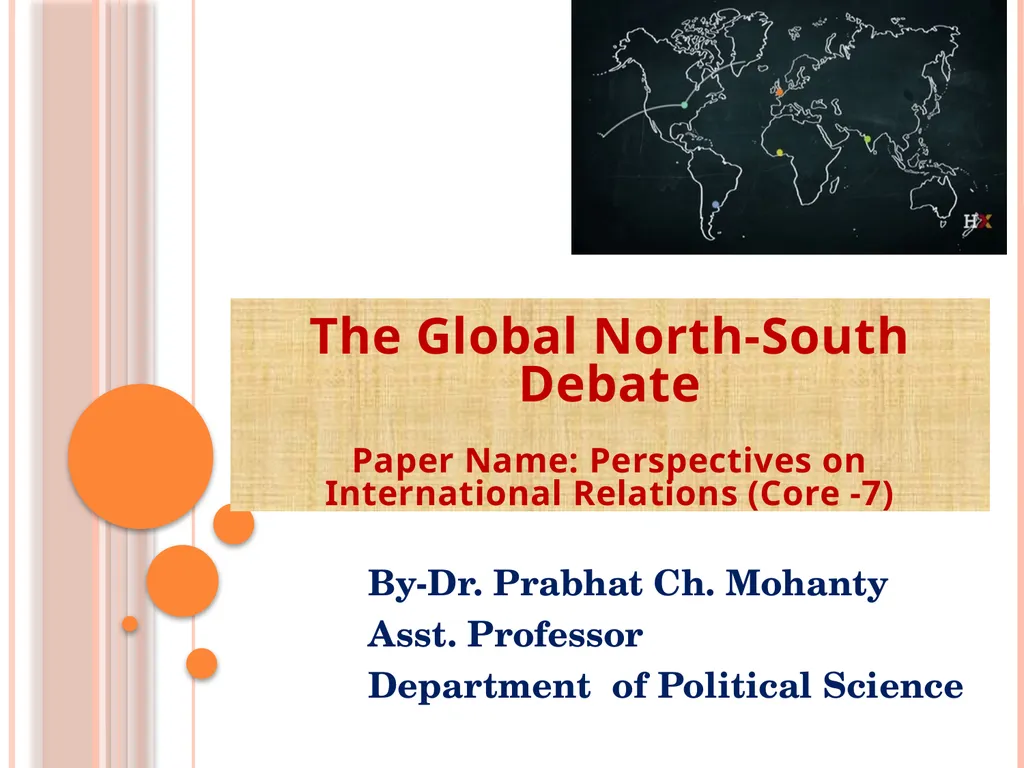
The Global North-South Debate
Paper Name: Perspectives on International Relations (Core -7) By-Dr. Prabhat Ch. Mohanty
Asst. Professor
Department of Political Science<br>
Asst. Professor
Department of Political Science<br>
02
Introduction The concept of Global North and Global South is used to describe a grouping of countries along socio-economic and political characteristics.
The Global south is used to refer the so-called developing countries, that includes Africa, Latin America and developing Asia including middle east. These are newly independent third-world nations in the era of post-Colonization.
The Global North is used to refer the so-called developed countries like Norway, Australia, New Zealand, Canada, US, Belgium, Iceland, Japan, Sweden, Netherlands and most of Western Europe. They were colonizers in colonial era.
The concept emerged to replace ideological-conflict based world system classification with developmental-conflict based classification of the countries. these terms are not strictly geographical.<br>
03
Development of the terms The first use of Global South in a contemporary political sense was in 1969 by Carl Oglesby, writing in Catholic journal ”Commonweal ” in a special issue on the Vietnam War. The term gained appeal throughout the second half of the 20th century, which rapidly accelerated in the early 21st century. It appeared in fewer than two dozen publications in 2004, but in hundreds of publications by 2013.
SSC (South-South Corporation) uses the term Global South to identify themselves and their objective to achieve mutual assistance and solidarity while radically altering world system to reflect their interest and not just interest of the North.
The term "Global South", in contrast, was intended to be less hierarchical. The terms were used by governmental and developmental organizations to introduce a more open and value-free alternative to “Third world” and similarly potentially ‘valuing’ terms like “developing countries”.<br>
04
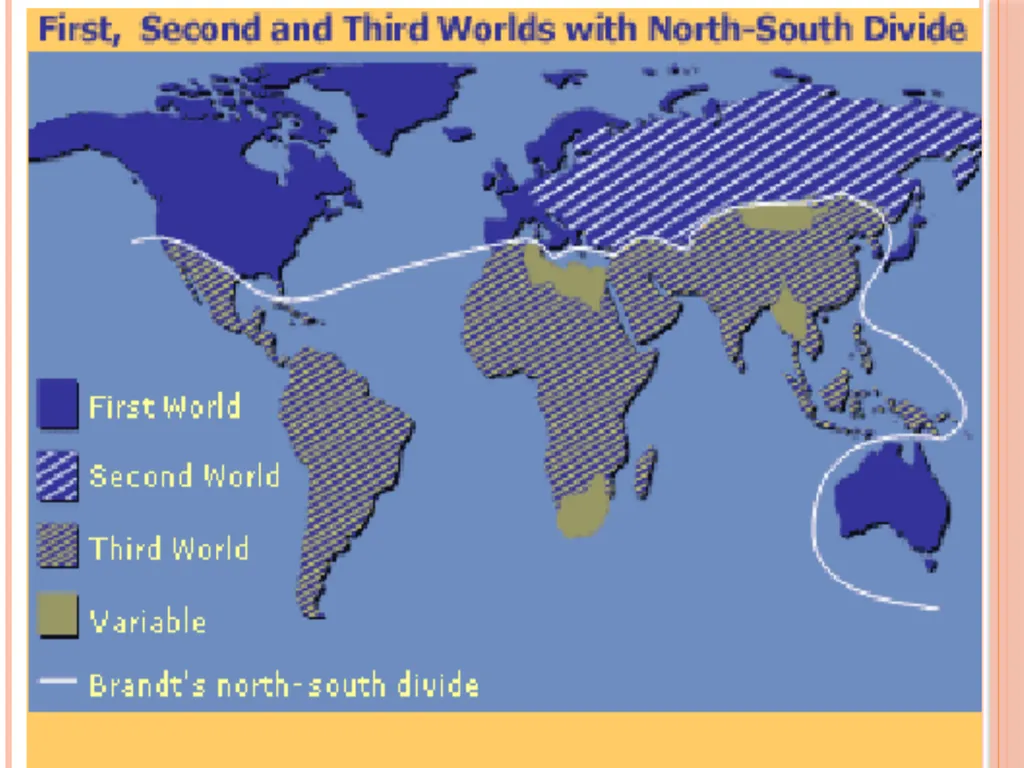
Brandt line The concept of a gap between the Global North and the Global South in terms of development and wealth was given by Williy Brandt in 1980s
In the 1980s, the Brandt Line was developed as a way of showing the how the world was geographically split into relatively richer and poorer nations.
According to this model:
~Richer countries are almost all located in the Northen Hemisphere, with exception of Australia and New Zealand.
~Poorer countries are mostly located in tropical regions and in the Southern Hemisphere.<br>
05
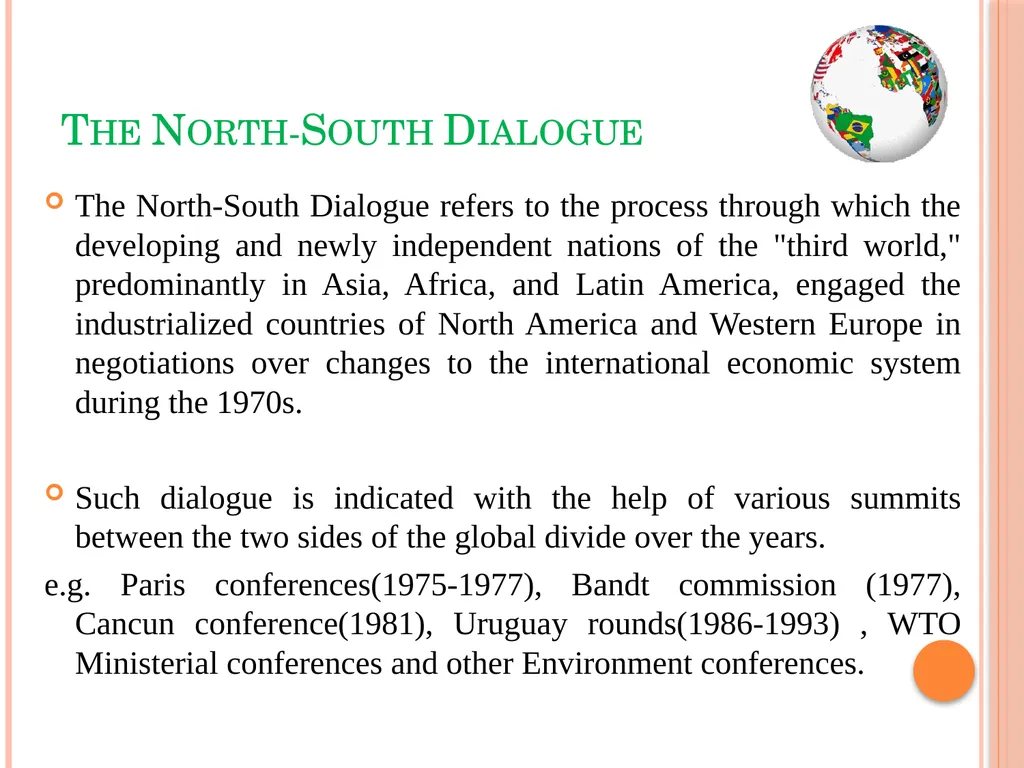
The North-South Dialogue The North-South Dialogue refers to the process through which the developing and newly independent nations of the "third world," predominantly in Asia, Africa, and Latin America, engaged the industrialized countries of North America and Western Europe in negotiations over changes to the international economic system during the 1970s.
Such dialogue is indicated with the help of various summits between the two sides of the global divide over the years.
e.g. Paris conferences(1975-1977), Bandt commission (1977), Cancun conference(1981), Uruguay rounds(1986-1993) , WTO Ministerial conferences and other Environment conferences.<br>
Such dialogue is indicated with the help of various summits between the two sides of the global divide over the years.
e.g. Paris conferences(1975-1977), Bandt commission (1977), Cancun conference(1981), Uruguay rounds(1986-1993) , WTO Ministerial conferences and other Environment conferences.<br>
06
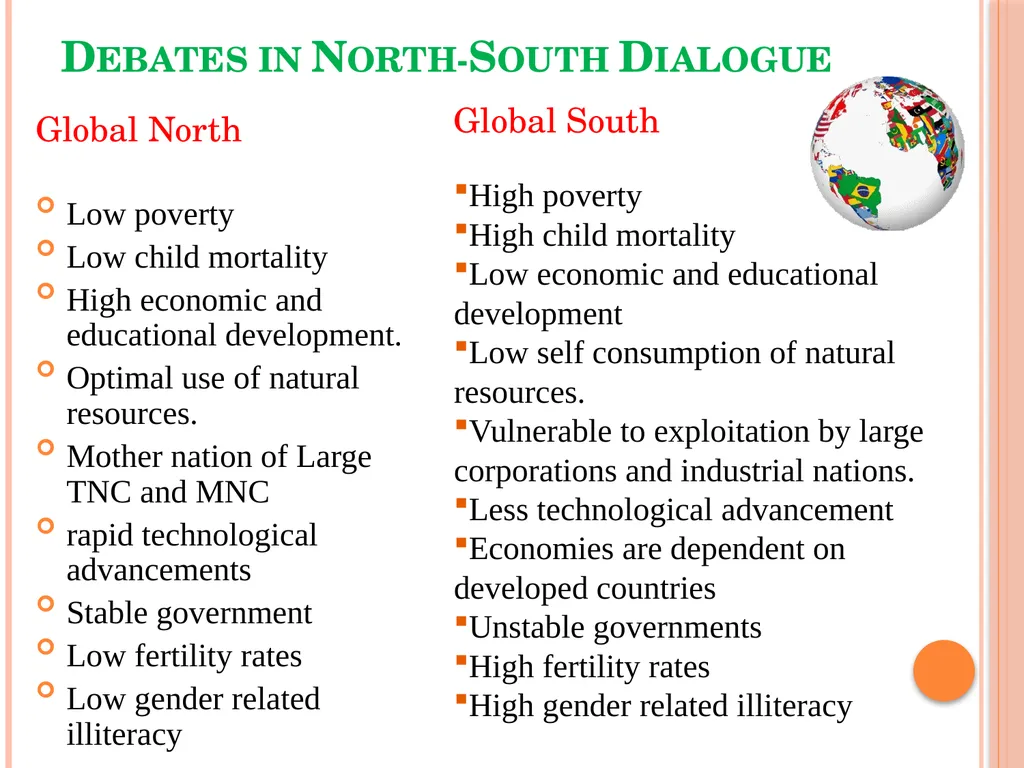
Debates in North-South Dialogue Global North
Low poverty
Low child mortality
High economic and educational development.
Optimal use of natural resources.
Mother nation of Large TNC and MNC
rapid technological advancements
Stable government
Low fertility rates
Low gender related illiteracy Global South
High poverty
High child mortality
Low economic and educational development
Low self consumption of natural resources.
Vulnerable to exploitation by large corporations and industrial nations.
Less technological advancement
Economies are dependent on developed countries
Unstable governments
High fertility rates
High gender related illiteracy<br>
07
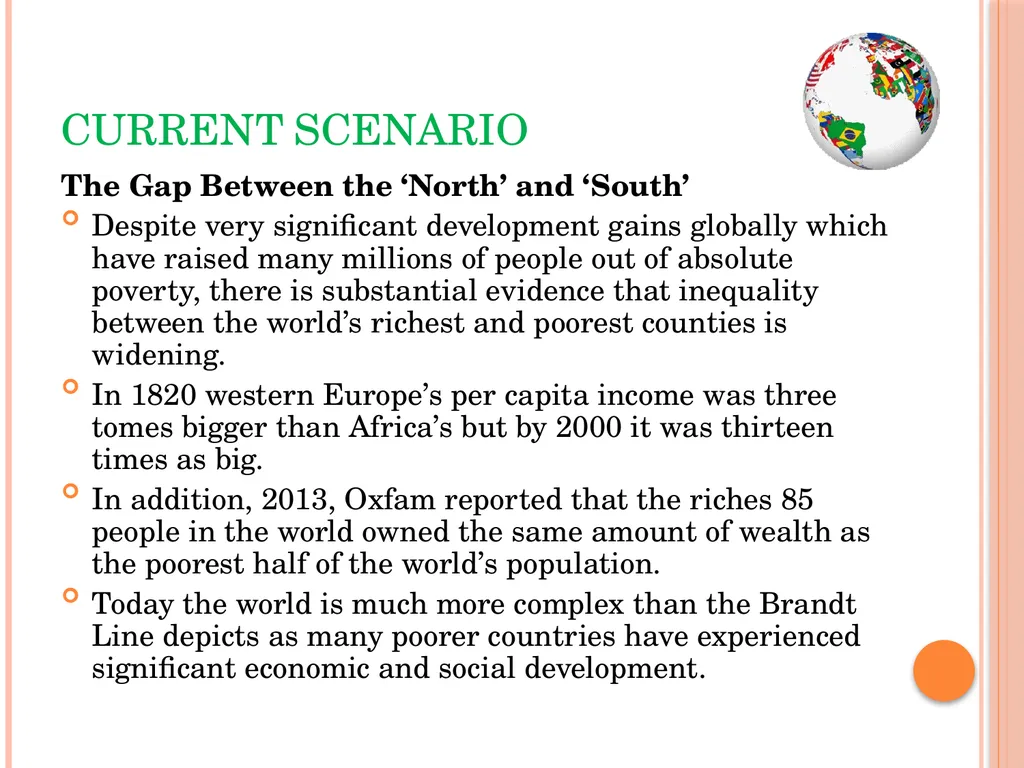
CURRENT SCENARIO The Gap Between the ‘North’ and ‘South’
Despite very significant development gains globally which have raised many millions of people out of absolute poverty, there is substantial evidence that inequality between the world’s richest and poorest counties is widening.
In 1820 western Europe’s per capita income was three tomes bigger than Africa’s but by 2000 it was thirteen times as big.
In addition, 2013, Oxfam reported that the riches 85 people in the world owned the same amount of wealth as the poorest half of the world’s population.
Today the world is much more complex than the Brandt Line depicts as many poorer countries have experienced significant economic and social development.<br>
08
CURRENT SCENARIO (Cont…) Global North and Global South
However, inequality within countries has also been growing and some commentators now talk of a ‘Global North’ and a ‘Global South’ refereeing respectively to richer or poorer communities which are found both within and between counties.
For example, whilst India is still home to the largest concentration of poor people in a single nation, it also has a very sizable middle class and a very rich elite.<br>
09
Factors Undermining North-South Dialogue Differences- differences in the political, economic and demographic make-up of the countries tend to complicate the idea of monolithic South.
Globalization-has also challenged the notion of two distinct economic sphere, following the liberalization of post Mao-China initiated in 1978,growing regional corporation between the national economies of Asia has led to the growing decentralization of the North as the main economic power.
Recent Military Growth in capacities of The North serves as an instrument for coercing South to behave the way North wants it to behave.
North pursing its national and business interests is almost always selfishly perceived.
Insincerity in north-south agreements and programmes
Poor leadership and corrupt practices in the south.<br>
10
RISING INFLUENCE OF GLOBAL SOUTH In recent times, the Global South has regained its importance and relevance, signifying a growing recognition of the region's significance in shaping the emerging global order. Several key factors are cited as contributing to this resurgence are-
Impact of Covid-19 Pandemic: The Covid-19 pandemic had a severe impact on many countries in the Global South, both in terms of public health and economic challenges. This crisis refocused attention on the vulnerabilities and needs of these nations.
Economic Downturn: The economic downturn resulting from the pandemic disproportionately affected countries in the Global South, highlighting the need for international cooperation and support.
Repercussions of Russia-Ukraine Conflict: The Russia-Ukraine conflict had a global economic impact. This had ripple effects on the developing world, further underscoring the interconnectedness of global affairs and the importance of the Global South in international diplomacy.<br>
11
RISING INFLUENCE OF GLOBAL SOUTH Establishment of the 'Loss and Damage Fund': At the COP27 Climate Change conference in Egypt, the establishment of the 'Loss and Damage fund' was celebrated as a significant win for the Global South.
It signifies a recognition of the disproportionate burden borne by countries in the Global South.
Global South in COP28: In the upcoming UNFCCC COP 28 in the UAE, it is anticipated that countries from the Global South will take a leading role in driving discussions on mitigating climate change.
G7 Inclusivity: Japan, as the host of the G7 summit, made a notable effort to involve developing countries such as India, Brazil, Vietnam, Indonesia, Comoros, and the Cook Islands in the discussions.
This was seen as an outreach to the Global South, indicating a desire for a more inclusive dialogue among the world's wealthiest nations.<br>
12
RISING INFLUENCE OF GLOBAL SOUTH BRICS Summit Expansion: The BRICS summit, held in South Africa, expanded its membership from five to 11 members. This expansion was attributed to a concerted effort to engage with and incorporate more countries from the Global South into the BRICS grouping, underscoring its growing importance.
G-77 Summit in Cuba: The G-77 summit held recently in Havana, Cuba showcased the significance of the Global South on the global stage, as it brought together a substantial number of developing countries to discuss key issues.
African Union's Inclusion into G20: The inclusion of the 55-nation African Union into the G20 is seen as a significant outcome of the conference indicating a growing recognition of the African nations in global affairs and the need to include their perspectives and contributions in shaping the emerging global order.<br>
13
Recommendations It is a clear fact that there is a stiff competition among states in the international system and no dominant state will like to help the another to its status. North never relied on North-South Dialogue to develop their economies. Therefore any aid expectation from North by the south has to be stopped.
Moreover, TNC/MNC continue to exploit to export their profits, corrupt southern leaders extradite national share of the profit in the form of diplomatic baggage to foreign banks. Such malpractices needs to be checked to strengthen sovereignty of the south.
SSC needs to show rigorous efforts in achieving its objectives and challenges north alignment of north-south agreements and programmes.
The Global South must recognize and support representation of their interest in North-south dialogue by emerging nation-states.<br>