
The Intersection of Library Science and User
CS
Published · 25 slides · 0 views

1 / 1
Description
The Intersection of Library Science and User Experience A presentation to LIS650: Passive Site Architecture and Design Palmer School of Library Information Science Prof. Thomas Krichel Dawn Bovasso, Content Strategist Razorfish Lynn
Related Topics
Share
Embed code
Download this presentation From Below
"The Intersection of Library Science and User" is the property of its rightful owner. Permission is granted to download and print the materials on this website for personal, non-commercial use only, and to display it on your personal computer provided you do not modify the materials and that you retain all copyright notices contained in the materials. By downloading content from our website, you accept the terms of this agreement.
Presentation Transcript
01
The Intersection of Library Science
and User Experience A presentation to LIS650: Passive Site Architecture and Design
Palmer School of Library & Information Science
Prof. Thomas Krichel Dawn Bovasso, Content Strategist @ Razorfish
Lynn Leitte, Sr. Content Strategist @ Razorfish February 8, 2009<br>
Palmer School of Library & Information Science
Prof. Thomas Krichel Dawn Bovasso, Content Strategist @ Razorfish
Lynn Leitte, Sr. Content Strategist @ Razorfish February 8, 2009<br>
02
Agenda Why We’re Here
About Us
What Is User Experience?
Roles Within User Experience
How Are UX/Content Strategy Related to Librarianship?
UX/Content Strategy Deliverables
What We Think
Questions Slide 2<br>
About Us
What Is User Experience?
Roles Within User Experience
How Are UX/Content Strategy Related to Librarianship?
UX/Content Strategy Deliverables
What We Think
Questions Slide 2<br>
03
Why We’re Here Aspiring librarians are introduced to career paths such as public libraries, academic libraries, and archives. Subject area specialists may go into medical or corporate librarianship. How many library programs are talking about web design or web development a skill set or career path? Do many librarians know that a career web development is even an option? Slide 3 Librarianship is a relevant – and important – skill set for a career in User Experience.
What careers can you have outside of libraries? What are the job titles? Where are they?<br>
What careers can you have outside of libraries? What are the job titles? Where are they?<br>
04
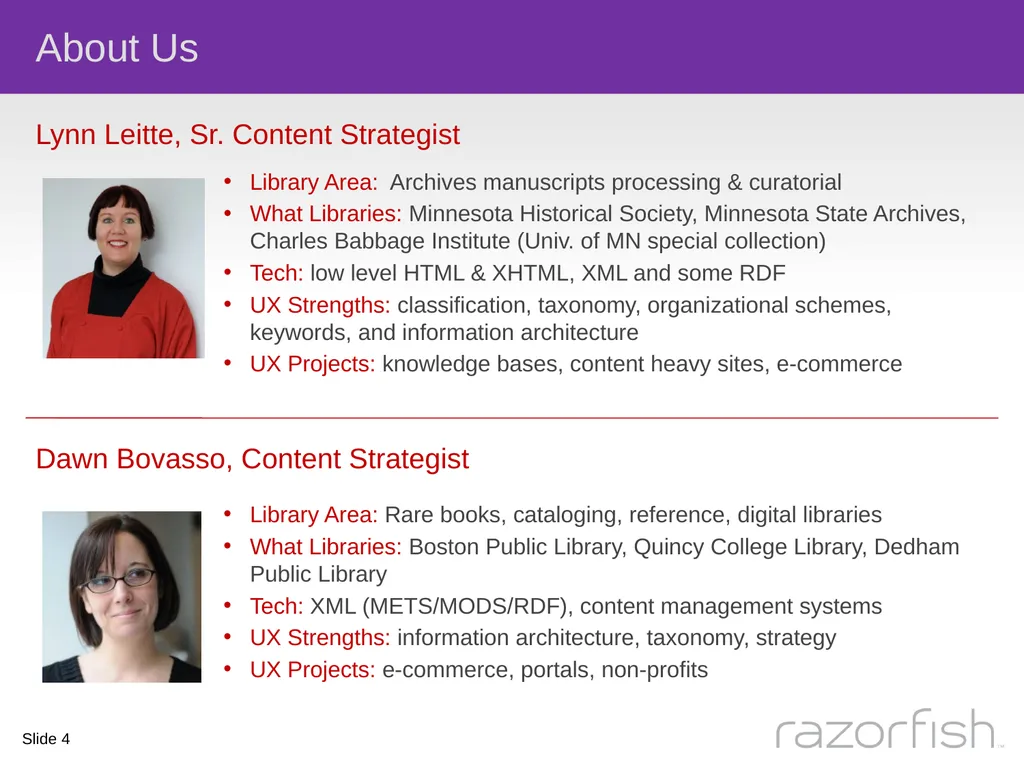
About Us Lynn Leitte, Sr. Content Strategist Dawn Bovasso, Content Strategist Library Area: Archives manuscripts processing & curatorial
What Libraries: Minnesota Historical Society, Minnesota State Archives, Charles Babbage Institute (Univ. of MN special collection)
Tech: low level HTML & XHTML, XML and some RDF
UX Strengths: classification, taxonomy, organizational schemes, keywords, and information architecture
UX Projects: knowledge bases, content heavy sites, e-commerce Library Area: Rare books, cataloging, reference, digital libraries
What Libraries: Boston Public Library, Quincy College Library, Dedham Public Library
Tech: XML (METS/MODS/RDF), content management systems
UX Strengths: information architecture, taxonomy, strategy
UX Projects: e-commerce, portals, non-profits Slide 4<br>
What Libraries: Minnesota Historical Society, Minnesota State Archives, Charles Babbage Institute (Univ. of MN special collection)
Tech: low level HTML & XHTML, XML and some RDF
UX Strengths: classification, taxonomy, organizational schemes, keywords, and information architecture
UX Projects: knowledge bases, content heavy sites, e-commerce Library Area: Rare books, cataloging, reference, digital libraries
What Libraries: Boston Public Library, Quincy College Library, Dedham Public Library
Tech: XML (METS/MODS/RDF), content management systems
UX Strengths: information architecture, taxonomy, strategy
UX Projects: e-commerce, portals, non-profits Slide 4<br>
05
How We Got Here After careers in librarianship, Lynn Leitte and Dawn Bovasso transferred their skills to the corporate world of metadata and web design. They are both currently Content Strategists at Razorfish, an interactive web design agency with a heavy emphasis on user experience.
Both have found that their background in library science is in high demand and greatly utilized. In this talk, they will provide an overview about careers in UX relevant to library science, discuss transferrable skills, and answer questions about how to get on a UX career path.<br>
Both have found that their background in library science is in high demand and greatly utilized. In this talk, they will provide an overview about careers in UX relevant to library science, discuss transferrable skills, and answer questions about how to get on a UX career path.<br>
06
What Is User Experience (UX)? Simply: “user-centered design.” Focuses on the user, not on what the owner of the site wants to push
The total subjective experience of the user of a Web site: positive, negative or in between
Is it easy to use, attractive and appropriate? Does it meet user needs? Slide 6<br>
The total subjective experience of the user of a Web site: positive, negative or in between
Is it easy to use, attractive and appropriate? Does it meet user needs? Slide 6<br>
07
Roles Within the User Experience Practice User Experience Associate (UXA)
This entry-level position is meant to introduce recent graduates to the industry. They may try all positions, much like an internship, to see which track to follow
Information Architect (IA)
Defines the structural design and interaction for websites, intranets, and online communities – similar to the way architects create blueprints for houses
IAs create sketches, diagrams, or prototypes for websites that determine the best practices for layout, as well as suggest interactions Slide 7<br>
This entry-level position is meant to introduce recent graduates to the industry. They may try all positions, much like an internship, to see which track to follow
Information Architect (IA)
Defines the structural design and interaction for websites, intranets, and online communities – similar to the way architects create blueprints for houses
IAs create sketches, diagrams, or prototypes for websites that determine the best practices for layout, as well as suggest interactions Slide 7<br>
08
Roles within the User Experience Practice User Research (UR)
Conducting customer research, field observations, and secondary research to identify user roles, the characteristics, needs
Content Strategy (CS)
Organizing and managing the content of a website. Requires expertise on nomenclature, taxonomy, navigation, editorial and copywriting, as well as content migration and content management systems Slide 8<br>
Conducting customer research, field observations, and secondary research to identify user roles, the characteristics, needs
Content Strategy (CS)
Organizing and managing the content of a website. Requires expertise on nomenclature, taxonomy, navigation, editorial and copywriting, as well as content migration and content management systems Slide 8<br>
09
About Content Strategy Content Strategy is an integral part of the UX design process
Figuring out how to use content to help people find content, achieve business goals, communicate strategic messaging, facilitate transactions and sustain branded experiences
Content Strategists work closely with IAs, UXDs, Strategists, Functional Analysts, Business Analysts, and clients Slide 9<br>
Figuring out how to use content to help people find content, achieve business goals, communicate strategic messaging, facilitate transactions and sustain branded experiences
Content Strategists work closely with IAs, UXDs, Strategists, Functional Analysts, Business Analysts, and clients Slide 9<br>
10
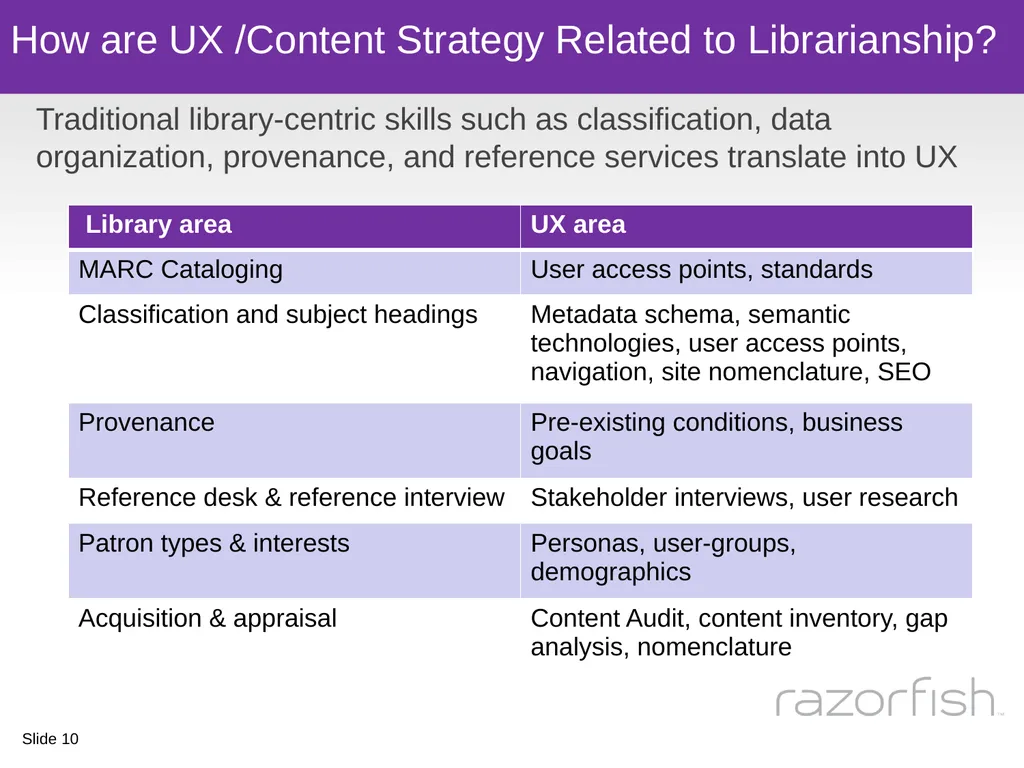
How are UX /Content Strategy Related to Librarianship? Traditional library-centric skills such as classification, data organization, provenance, and reference services translate into UX Slide 10<br>
11
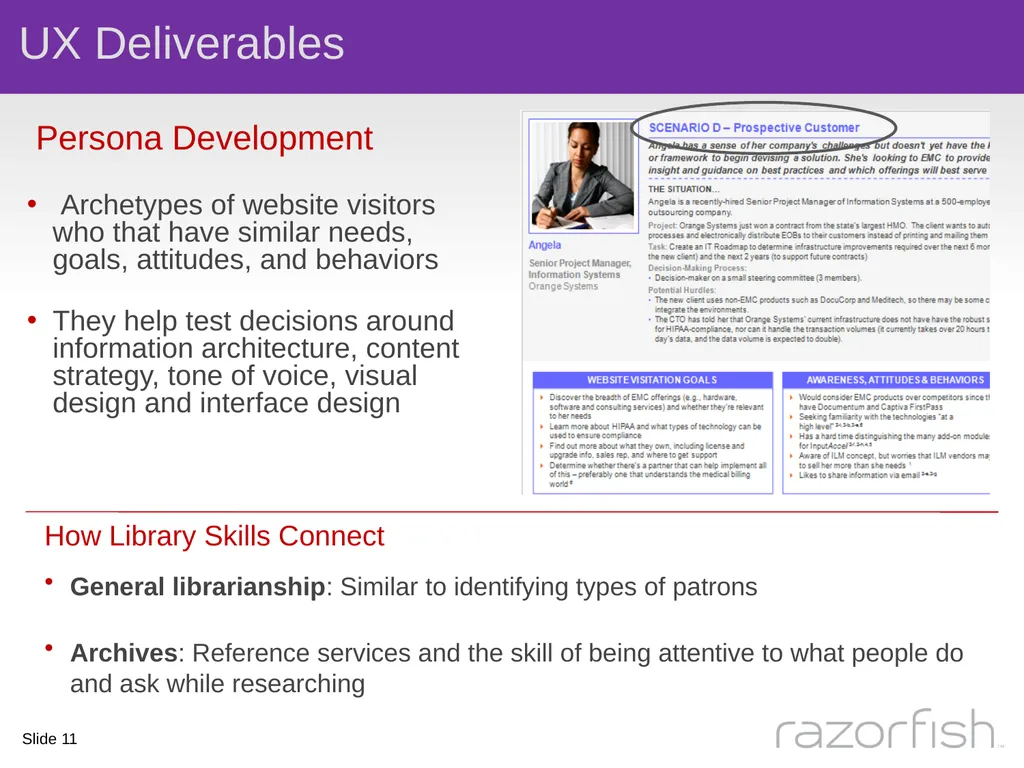
UX Deliverables How Library Skills Connect
General librarianship: Similar to identifying types of patrons
Archives: Reference services and the skill of being attentive to what people do and ask while researching Persona Development Archetypes of website visitors who that have similar needs, goals, attitudes, and behaviors
They help test decisions around information architecture, content strategy, tone of voice, visual design and interface design Slide 11<br>
General librarianship: Similar to identifying types of patrons
Archives: Reference services and the skill of being attentive to what people do and ask while researching Persona Development Archetypes of website visitors who that have similar needs, goals, attitudes, and behaviors
They help test decisions around information architecture, content strategy, tone of voice, visual design and interface design Slide 11<br>
12
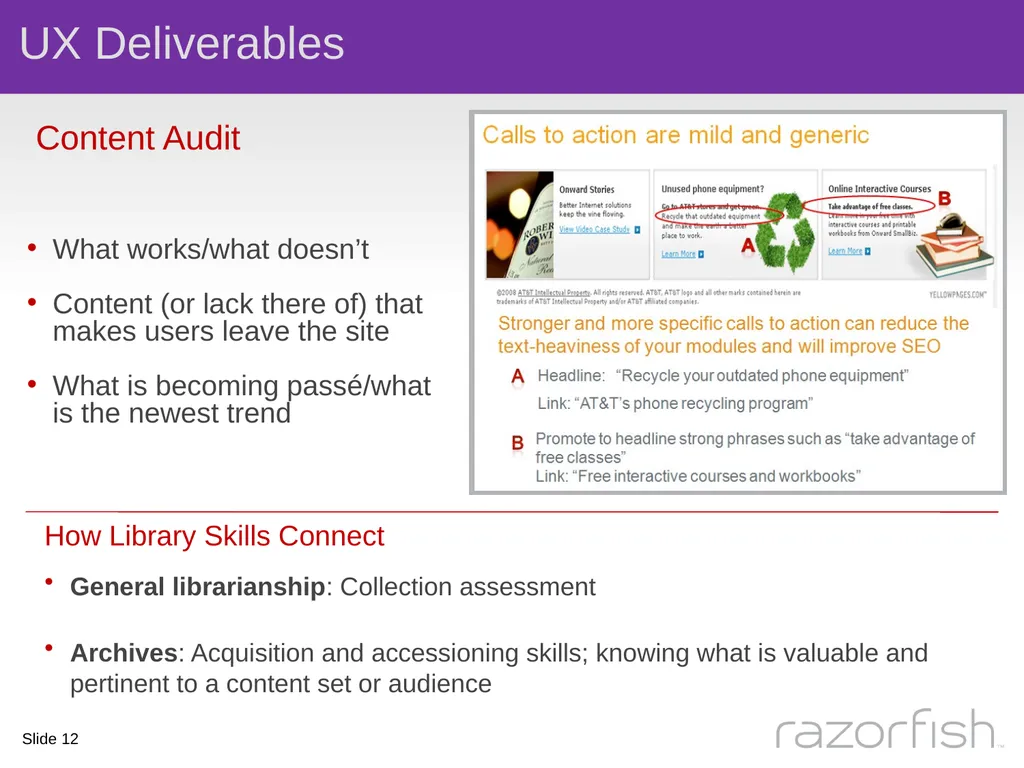
UX Deliverables How Library Skills Connect
General librarianship: Collection assessment
Archives: Acquisition and accessioning skills; knowing what is valuable and pertinent to a content set or audience Content Audit What works/what doesn’t
Content (or lack there of) that makes users leave the site
What is becoming passé/what is the newest trend Slide 12<br>
General librarianship: Collection assessment
Archives: Acquisition and accessioning skills; knowing what is valuable and pertinent to a content set or audience Content Audit What works/what doesn’t
Content (or lack there of) that makes users leave the site
What is becoming passé/what is the newest trend Slide 12<br>
13
UX Deliverables How Library Skills Connect
General librarianship: Flow of physical library space
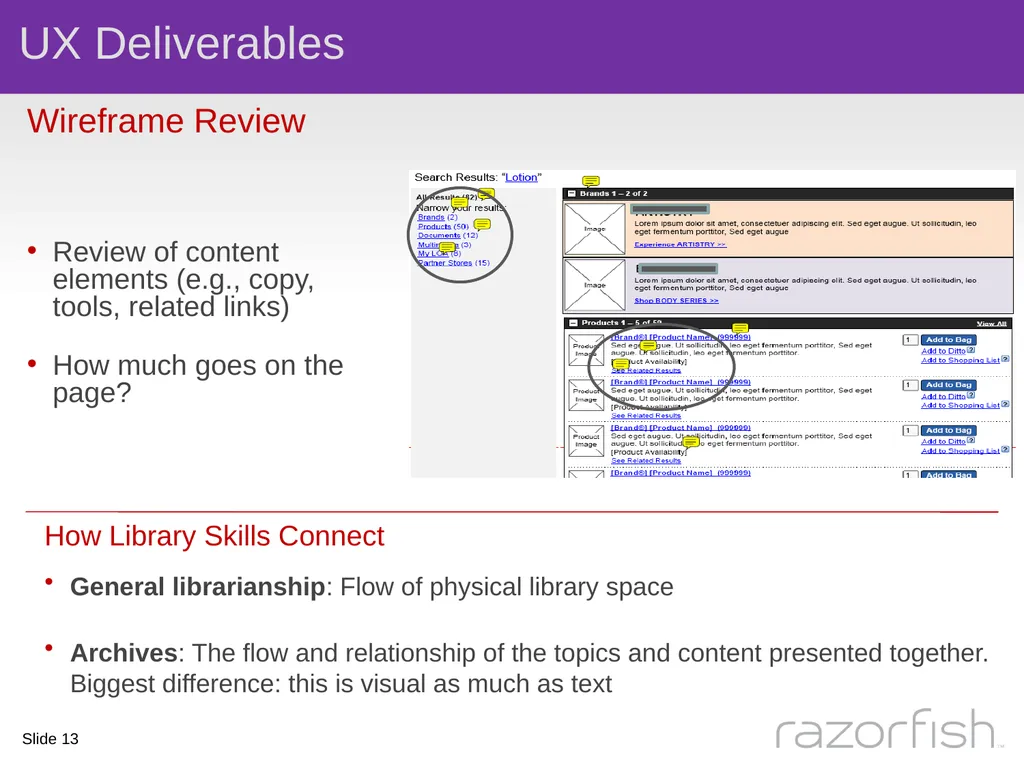
Archives: The flow and relationship of the topics and content presented together. Biggest difference: this is visual as much as text Wireframe Review Review of content elements (e.g., copy, tools, related links)
How much goes on the page? Slide 13<br>
General librarianship: Flow of physical library space
Archives: The flow and relationship of the topics and content presented together. Biggest difference: this is visual as much as text Wireframe Review Review of content elements (e.g., copy, tools, related links)
How much goes on the page? Slide 13<br>
14
UX Deliverables How Library Skills Connect
General librarianship: Flow of physical library space
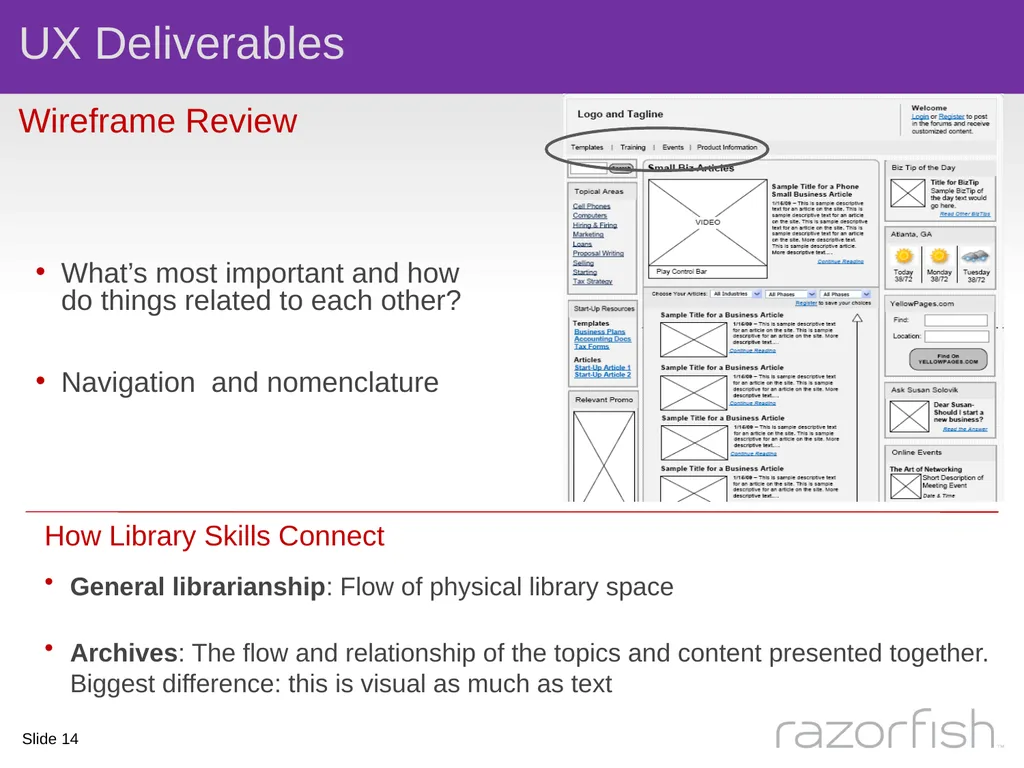
Archives: The flow and relationship of the topics and content presented together. Biggest difference: this is visual as much as text Wireframe Review What’s most important and how do things related to each other?
Navigation and nomenclature Slide 14<br>
General librarianship: Flow of physical library space
Archives: The flow and relationship of the topics and content presented together. Biggest difference: this is visual as much as text Wireframe Review What’s most important and how do things related to each other?
Navigation and nomenclature Slide 14<br>
15
UX Deliverables How Library Skills Connect
General librarianship: What does the patron look for when surfing/searching?
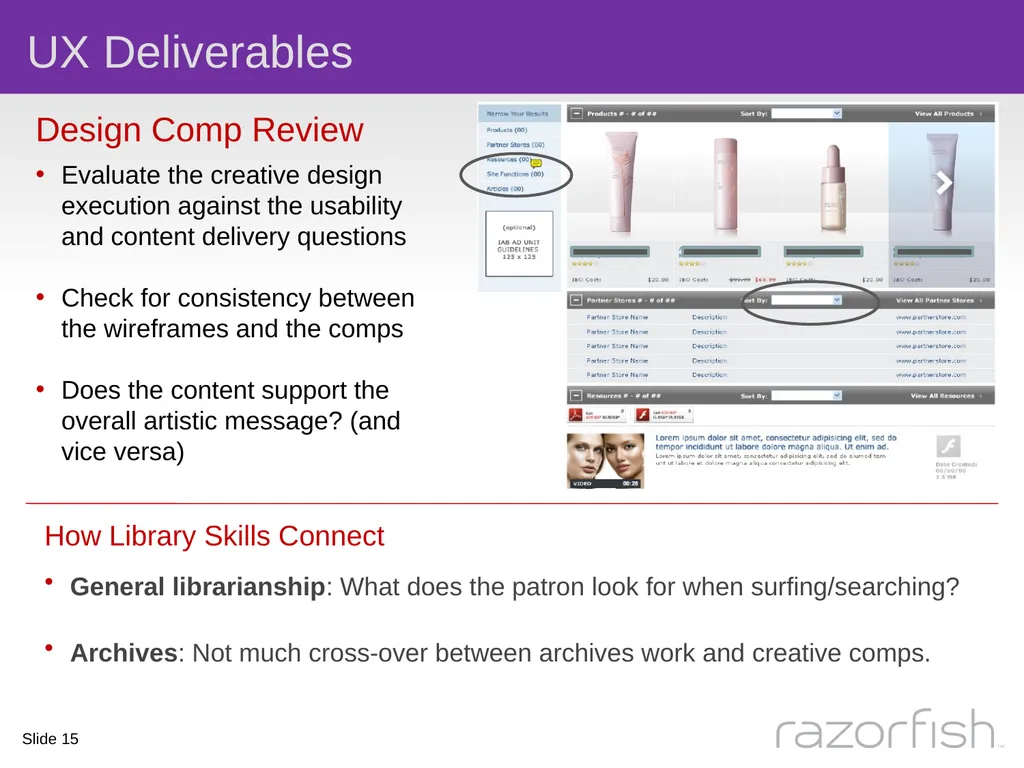
Archives: Not much cross-over between archives work and creative comps. Design Comp Review Evaluate the creative design execution against the usability and content delivery questions
Check for consistency between the wireframes and the comps
Does the content support the overall artistic message? (and vice versa) Slide 15<br>
General librarianship: What does the patron look for when surfing/searching?
Archives: Not much cross-over between archives work and creative comps. Design Comp Review Evaluate the creative design execution against the usability and content delivery questions
Check for consistency between the wireframes and the comps
Does the content support the overall artistic message? (and vice versa) Slide 15<br>
16
UX Deliverables How Library Skills Connect
General librarianship: Similar to determining LC Subject Headings
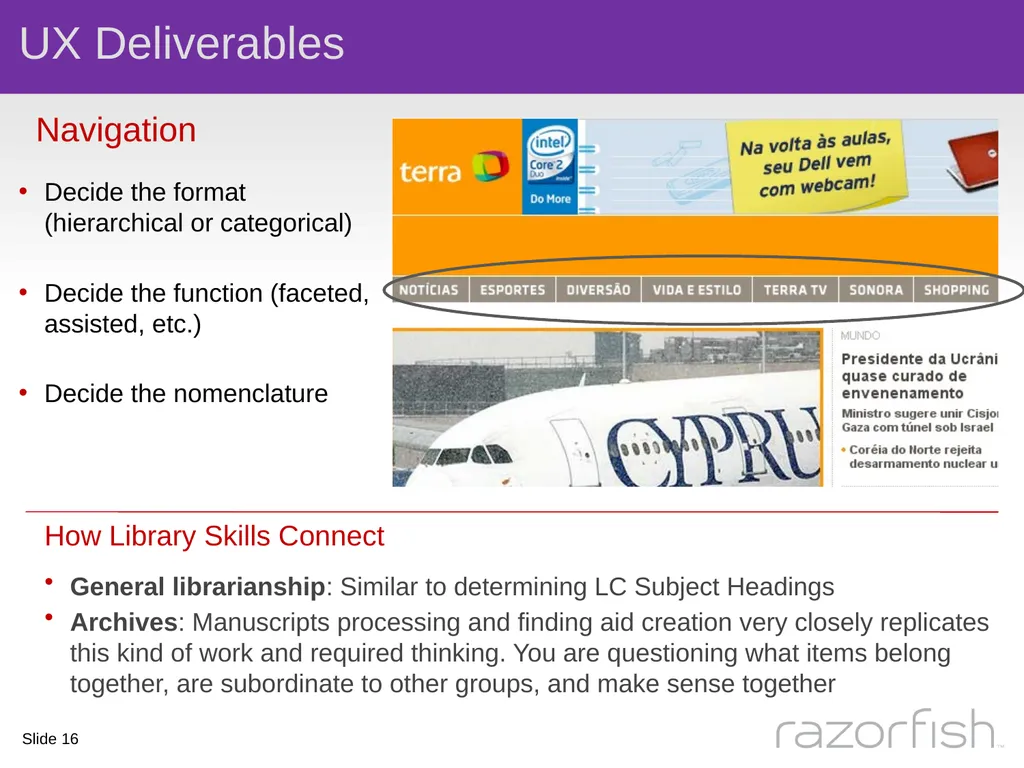
Archives: Manuscripts processing and finding aid creation very closely replicates this kind of work and required thinking. You are questioning what items belong together, are subordinate to other groups, and make sense together Navigation Decide the format (hierarchical or categorical)
Decide the function (faceted, assisted, etc.)
Decide the nomenclature Slide 16<br>
General librarianship: Similar to determining LC Subject Headings
Archives: Manuscripts processing and finding aid creation very closely replicates this kind of work and required thinking. You are questioning what items belong together, are subordinate to other groups, and make sense together Navigation Decide the format (hierarchical or categorical)
Decide the function (faceted, assisted, etc.)
Decide the nomenclature Slide 16<br>
17
UX Deliverables How Library Skills Connect
General librarianship: Developing metadata for digital libraries
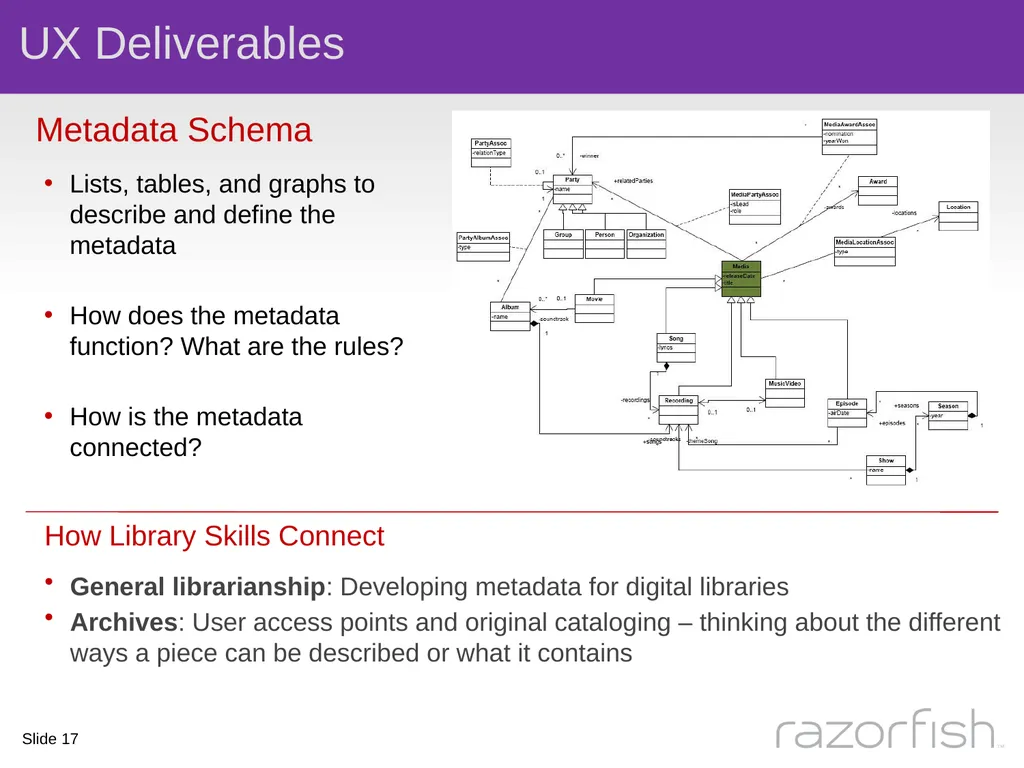
Archives: User access points and original cataloging – thinking about the different ways a piece can be described or what it contains Metadata Schema Lists, tables, and graphs to describe and define the metadata
How does the metadata function? What are the rules?
How is the metadata connected? Slide 17<br>
General librarianship: Developing metadata for digital libraries
Archives: User access points and original cataloging – thinking about the different ways a piece can be described or what it contains Metadata Schema Lists, tables, and graphs to describe and define the metadata
How does the metadata function? What are the rules?
How is the metadata connected? Slide 17<br>
18
UX Deliverables How Library Skills Connect
General librarianship: None?
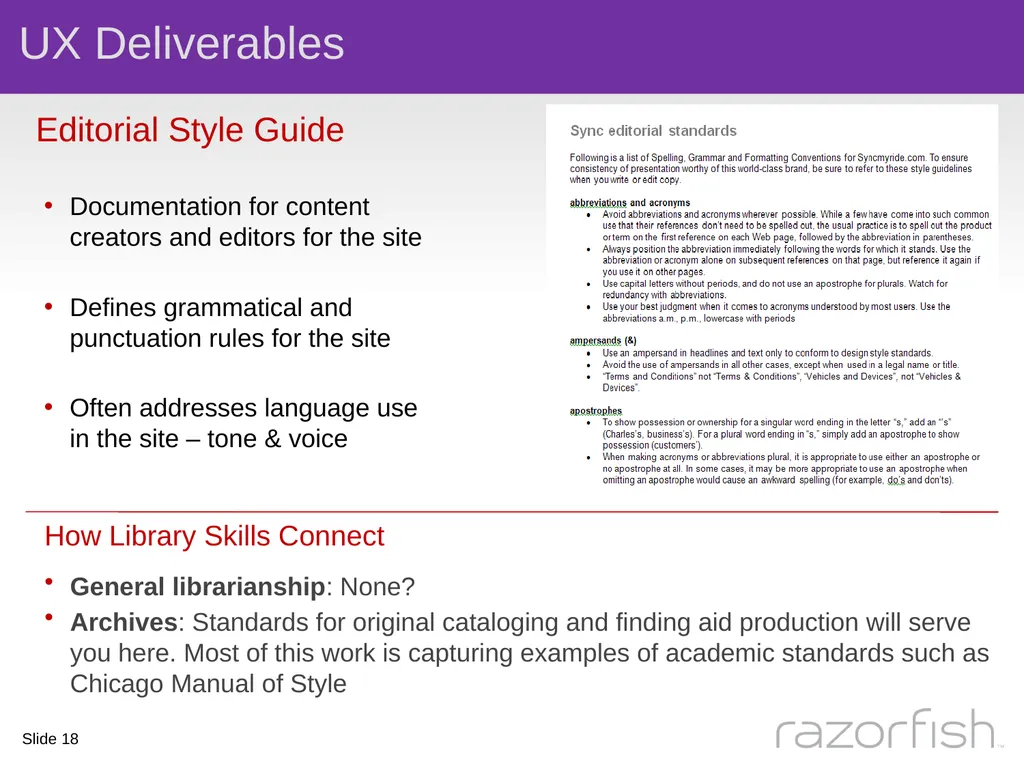
Archives: Standards for original cataloging and finding aid production will serve you here. Most of this work is capturing examples of academic standards such as Chicago Manual of Style Editorial Style Guide Documentation for content creators and editors for the site
Defines grammatical and punctuation rules for the site
Often addresses language use in the site – tone & voice Slide 18<br>
General librarianship: None?
Archives: Standards for original cataloging and finding aid production will serve you here. Most of this work is capturing examples of academic standards such as Chicago Manual of Style Editorial Style Guide Documentation for content creators and editors for the site
Defines grammatical and punctuation rules for the site
Often addresses language use in the site – tone & voice Slide 18<br>
19
UX Deliverables How Library Skills Connect
General librarianship: General reference materials indexing
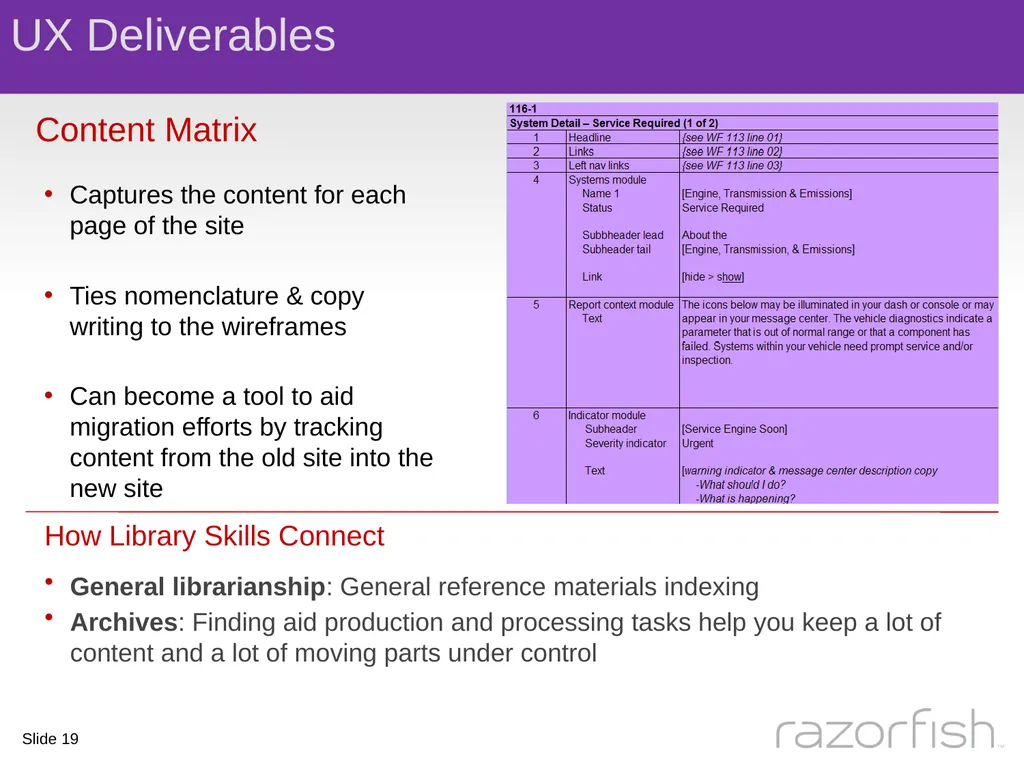
Archives: Finding aid production and processing tasks help you keep a lot of content and a lot of moving parts under control Content Matrix Captures the content for each page of the site
Ties nomenclature & copy writing to the wireframes
Can become a tool to aid migration efforts by tracking content from the old site into the new site Slide 19<br>
General librarianship: General reference materials indexing
Archives: Finding aid production and processing tasks help you keep a lot of content and a lot of moving parts under control Content Matrix Captures the content for each page of the site
Ties nomenclature & copy writing to the wireframes
Can become a tool to aid migration efforts by tracking content from the old site into the new site Slide 19<br>
20
What Do We Think: From Library to Corporate We love:
The broad range of skills we use:
Technology, creativity, organization, management
The pace, demand, and initiative
The pay
Collaborative teams
Bringing our skills to a place where they are needed and unique
We miss:
Primary materials
Patron interaction
Interest in existing standards for data
Academic endeavor
Regular hours What We Like, What We Miss Slide 20<br>
The broad range of skills we use:
Technology, creativity, organization, management
The pace, demand, and initiative
The pay
Collaborative teams
Bringing our skills to a place where they are needed and unique
We miss:
Primary materials
Patron interaction
Interest in existing standards for data
Academic endeavor
Regular hours What We Like, What We Miss Slide 20<br>
21
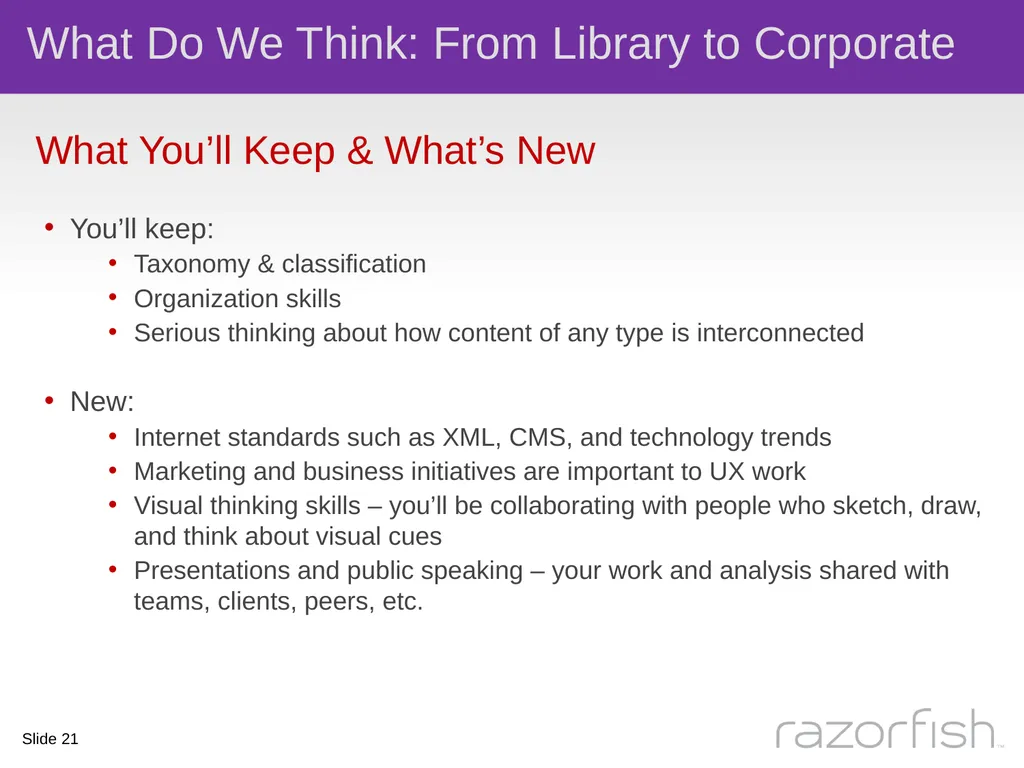
What You’ll Keep & What’s New You’ll keep:
Taxonomy & classification
Organization skills
Serious thinking about how content of any type is interconnected
New:
Internet standards such as XML, CMS, and technology trends
Marketing and business initiatives are important to UX work
Visual thinking skills – you’ll be collaborating with people who sketch, draw, and think about visual cues
Presentations and public speaking – your work and analysis shared with teams, clients, peers, etc. Slide 21 What Do We Think: From Library to Corporate<br>
Taxonomy & classification
Organization skills
Serious thinking about how content of any type is interconnected
New:
Internet standards such as XML, CMS, and technology trends
Marketing and business initiatives are important to UX work
Visual thinking skills – you’ll be collaborating with people who sketch, draw, and think about visual cues
Presentations and public speaking – your work and analysis shared with teams, clients, peers, etc. Slide 21 What Do We Think: From Library to Corporate<br>
22
Time for Your Questions? Questions about being a UXer? Questions about UX or website design? Slide 22<br>
23
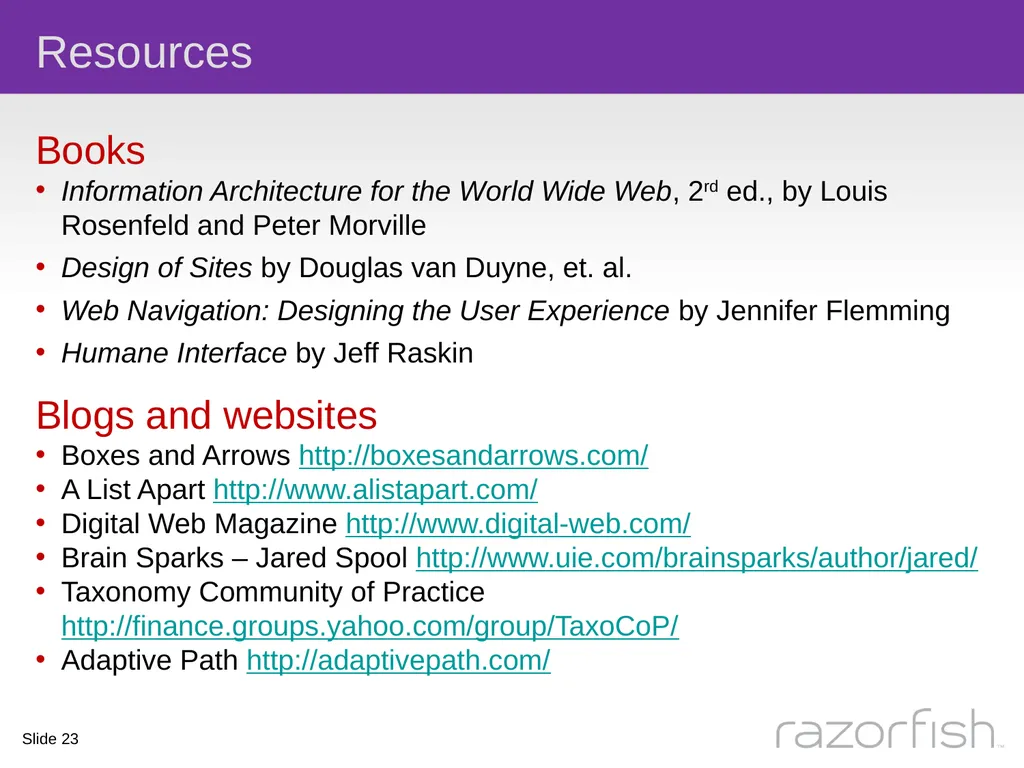
Resources Books
Information Architecture for the World Wide Web, 2rd ed., by Louis Rosenfeld and Peter Morville
Design of Sites by Douglas van Duyne, et. al.
Web Navigation: Designing the User Experience by Jennifer Flemming
Humane Interface by Jeff Raskin Blogs and websites
Boxes and Arrows http://boxesandarrows.com/
A List Apart http://www.alistapart.com/
Digital Web Magazine http://www.digital-web.com/
Brain Sparks – Jared Spool http://www.uie.com/brainsparks/author/jared/
Taxonomy Community of Practice http://finance.groups.yahoo.com/group/TaxoCoP/
Adaptive Path http://adaptivepath.com/ Slide 23<br>
Information Architecture for the World Wide Web, 2rd ed., by Louis Rosenfeld and Peter Morville
Design of Sites by Douglas van Duyne, et. al.
Web Navigation: Designing the User Experience by Jennifer Flemming
Humane Interface by Jeff Raskin Blogs and websites
Boxes and Arrows http://boxesandarrows.com/
A List Apart http://www.alistapart.com/
Digital Web Magazine http://www.digital-web.com/
Brain Sparks – Jared Spool http://www.uie.com/brainsparks/author/jared/
Taxonomy Community of Practice http://finance.groups.yahoo.com/group/TaxoCoP/
Adaptive Path http://adaptivepath.com/ Slide 23<br>
24
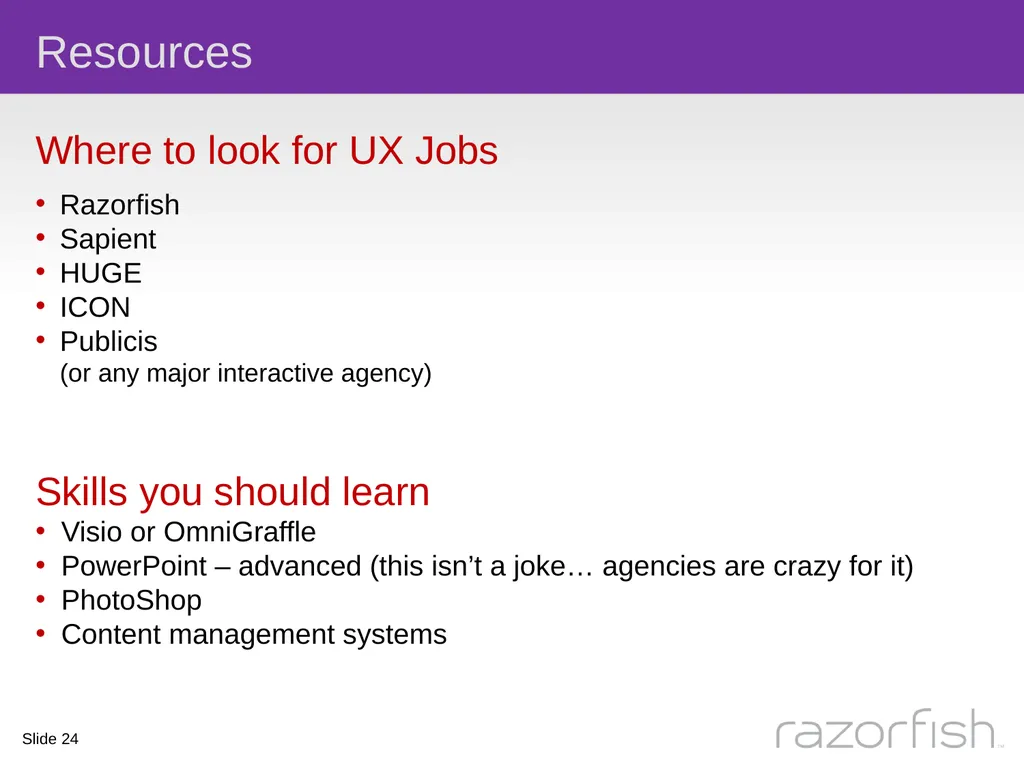
Resources Where to look for UX Jobs
Razorfish
Sapient
HUGE
ICON
Publicis (or any major interactive agency) Skills you should learn
Visio or OmniGraffle
PowerPoint – advanced (this isn’t a joke… agencies are crazy for it)
PhotoShop
Content management systems Slide 24<br>
Razorfish
Sapient
HUGE
ICON
Publicis (or any major interactive agency) Skills you should learn
Visio or OmniGraffle
PowerPoint – advanced (this isn’t a joke… agencies are crazy for it)
PhotoShop
Content management systems Slide 24<br>
25
Thank you Lynn Leitte
Sr. Content Strategist
Razorfish
212.798.7361
lynn.leitte@razorfish.com
LinkedIn: Lynn Leitte
AIM: javabird919 Dawn Bovasso
Content Strategist
Razorfish
212.798.6767 dawn.bovasso@razorfish.com Slide 25<br>
Sr. Content Strategist
Razorfish
212.798.7361
lynn.leitte@razorfish.com
LinkedIn: Lynn Leitte
AIM: javabird919 Dawn Bovasso
Content Strategist
Razorfish
212.798.6767 dawn.bovasso@razorfish.com Slide 25<br>