
The Jubilee Centre for Character and Virtues
AS
Published · 22 slides · 0 views

1 / 1


Description
The Jubilee Centre for Character and Virtues University of Birmingham, U.K. Phronesis as an Ideal in Professional Ethics: Some Preliminary Positionings and Problematics Kristján Kristjánsson Professor of Character Education and Virtue
Related Topics
Share
Embed code
Download this presentation From Below
"The Jubilee Centre for Character and Virtues" is the property of its rightful owner. Permission is granted to download and print the materials on this website for personal, non-commercial use only, and to display it on your personal computer provided you do not modify the materials and that you retain all copyright notices contained in the materials. By downloading content from our website, you accept the terms of this agreement.
Presentation Transcript
01
The Jubilee Centre for Character and Virtues
University of Birmingham, U.K.<br>
University of Birmingham, U.K.<br>
02
Phronesis as an Ideal in Professional Ethics:
Some Preliminary Positionings and Problematics Kristján Kristjánsson
Professor of Character Education and Virtue Ethics
Jubilee Centre for Character and Virtues
School of Education, University of Birmingham
Email: k.kristjansson@bham.ac.uk
Further reading, e.g.:
Russell, D. C. (2009). Practical intelligence and the virtues. Oxford: Oxford University Press.
Schwartz, B. & Sharpe, K. E. (2010). Practical wisdom: The right way to do the right thing. New York: Riverhead Books. 2<br>
Professor of Character Education and Virtue Ethics
Jubilee Centre for Character and Virtues
School of Education, University of Birmingham
Email: k.kristjansson@bham.ac.uk
Further reading, e.g.:
Russell, D. C. (2009). Practical intelligence and the virtues. Oxford: Oxford University Press.
Schwartz, B. & Sharpe, K. E. (2010). Practical wisdom: The right way to do the right thing. New York: Riverhead Books. 2<br>
03
Educating phronesis Complaints about the lack of opportunity to hone phronesis in teacher training are getting more vocal
For example, our large research project in the U.K., targeting aspiring and practising teachers at different career stages, seemed to reveal a strange mismatch between general ethics of education, where virtue ethics has become the theory of choice, and professional ethics of teaching which is still, in U.K. teacher training, focused almost entirely on formal rules, regulations and codes of conduct, or highly abstract deontological principles (such as respect for students’ multicultural backgrounds):
http://www.jubileecentre.ac.uk/userfiles/jubileecentre/pdf/Research%20Reports/The_Good_Teacher_Understanding_Virtues_in_Practice.pdf<br>
For example, our large research project in the U.K., targeting aspiring and practising teachers at different career stages, seemed to reveal a strange mismatch between general ethics of education, where virtue ethics has become the theory of choice, and professional ethics of teaching which is still, in U.K. teacher training, focused almost entirely on formal rules, regulations and codes of conduct, or highly abstract deontological principles (such as respect for students’ multicultural backgrounds):
http://www.jubileecentre.ac.uk/userfiles/jubileecentre/pdf/Research%20Reports/The_Good_Teacher_Understanding_Virtues_in_Practice.pdf<br>
04
Same for doctors... Complaints about the lack of opportunity to hone phronesis in medical education are also getting more vocal
For example, our large research project in the U.K., targeting aspiring and practising doctors at different career stages, seemed to reveal a strange mismatch between general medical ethics (bioethics), where virtue ethics has become the theory of choice, and professional medical ethics which is still, in U.K. medical schools, focused almost entirely on formal rules, regulations and codes of conduct, or highly abstract deontological principles (such as respect for patient autonomy):
http://www.jubileecentre.ac.uk/userfiles/jubileecentre/pdf/Research%20Reports/Virtuous_Medical_Practice.pdf<br>
For example, our large research project in the U.K., targeting aspiring and practising doctors at different career stages, seemed to reveal a strange mismatch between general medical ethics (bioethics), where virtue ethics has become the theory of choice, and professional medical ethics which is still, in U.K. medical schools, focused almost entirely on formal rules, regulations and codes of conduct, or highly abstract deontological principles (such as respect for patient autonomy):
http://www.jubileecentre.ac.uk/userfiles/jubileecentre/pdf/Research%20Reports/Virtuous_Medical_Practice.pdf<br>
05
More specifically... The respondents (in teaching and medicine, less in law) complained that the “moral middle” gets squeezed out – no chance to reflect upon real-life dilemmas – because all the emphasis is on very general principles or very specific rules from formal ethical codes (e.g. about dress codes, or “bedside manners”)
The respondents complained about being torn and pressured, not being able to “act out their real character”
The educators interviewed understood “character” very formalistically or instrumentally
Chimes in with Schwartz and Sharpe (2010) on ethical compliance secured through rules backed up by carrots and sticks...but does not work and is anti-professional!!!<br>
The respondents complained about being torn and pressured, not being able to “act out their real character”
The educators interviewed understood “character” very formalistically or instrumentally
Chimes in with Schwartz and Sharpe (2010) on ethical compliance secured through rules backed up by carrots and sticks...but does not work and is anti-professional!!!<br>
06
The phronesis bandwagon... Last 30 years:
Phronesis not only studied with more rigour in philosophy than ever before (Russell, 2009) within virtue ethics; it has also become a buzzword within pockets of social science, both socio-political theory (Flyvbjerg, 2001) and psychology (Schwartz & Sharpe, 2010)
Also acquired a status within formidable recent approaches of the virtue ethical kind to professional ethics, especially in the so-called ‘people professions’ (Bondi, Carr, Clark & Clegg, 2011), such as nursing (Flaming, 2001), law (Evans, 2014), business/management (Shotter & Tsoukas, 2014), social work (Banks, 2006), teaching (Dunne, 1993) and medicine (Pellegrino & Thomasma, 1993)
But this academic bandwagon does not seem to have entered the university classrooms where professional ethics is being taught!<br>
Phronesis not only studied with more rigour in philosophy than ever before (Russell, 2009) within virtue ethics; it has also become a buzzword within pockets of social science, both socio-political theory (Flyvbjerg, 2001) and psychology (Schwartz & Sharpe, 2010)
Also acquired a status within formidable recent approaches of the virtue ethical kind to professional ethics, especially in the so-called ‘people professions’ (Bondi, Carr, Clark & Clegg, 2011), such as nursing (Flaming, 2001), law (Evans, 2014), business/management (Shotter & Tsoukas, 2014), social work (Banks, 2006), teaching (Dunne, 1993) and medicine (Pellegrino & Thomasma, 1993)
But this academic bandwagon does not seem to have entered the university classrooms where professional ethics is being taught!<br>
07
Virtue ethics According to virtue ethics, an action is right not because it can be universalised in light of a rationalist principle (Kantianism) or because it makes the greatest number of people happy (utilitarianism), but because it enhances virtue and contributes to a flourishing (eudaimonic) life – as opposed to a languishing or floundering one
The focus is no longer on the correctness of individual actions, but rather on their role in the well-rounded life and their roots in the ‘inner world’ of the agent: in stable states of character that incorporate motivational and emotional elements
What matters in the end for moral evaluation is not merely observable behaviour, but the emotions with which an action is performed, the motivation behind it and the manner in which it is performed
-> Character education, with the emphasis on early habituation but subsequent development of good sense/practical moral wisdom, namely phronesis<br>
The focus is no longer on the correctness of individual actions, but rather on their role in the well-rounded life and their roots in the ‘inner world’ of the agent: in stable states of character that incorporate motivational and emotional elements
What matters in the end for moral evaluation is not merely observable behaviour, but the emotions with which an action is performed, the motivation behind it and the manner in which it is performed
-> Character education, with the emphasis on early habituation but subsequent development of good sense/practical moral wisdom, namely phronesis<br>
08
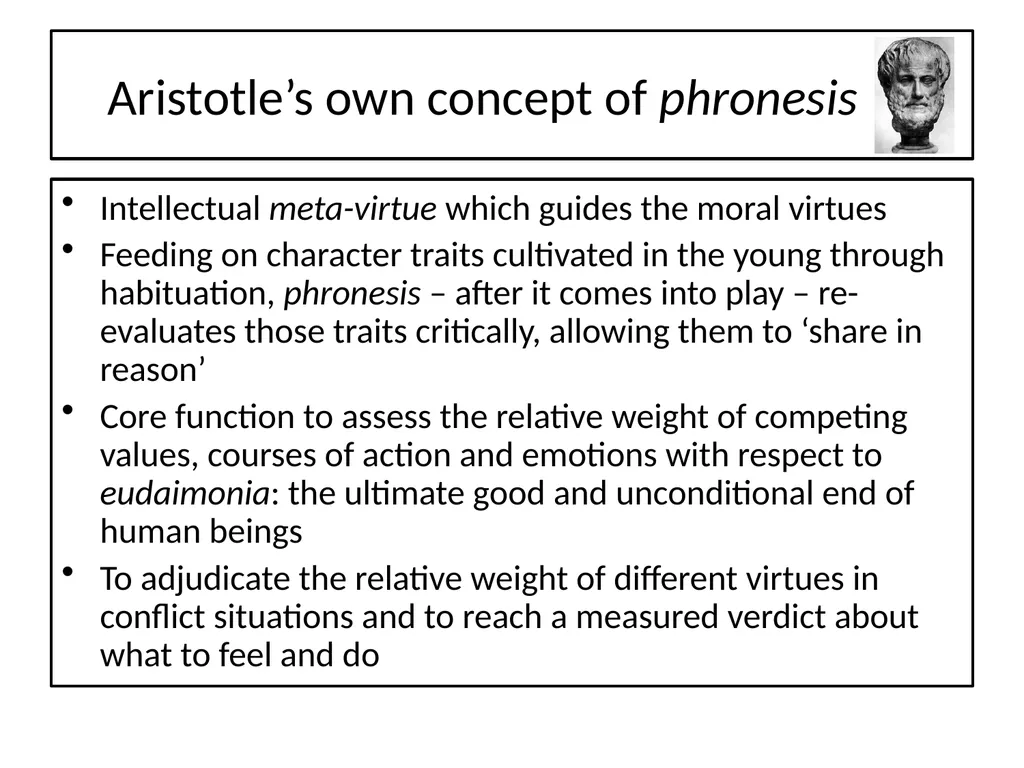
Aristotle’s own concept of phronesis Intellectual meta-virtue which guides the moral virtues
Feeding on character traits cultivated in the young through habituation, phronesis – after it comes into play – re-evaluates those traits critically, allowing them to ‘share in reason’
Core function to assess the relative weight of competing values, courses of action and emotions with respect to eudaimonia: the ultimate good and unconditional end of human beings
To adjudicate the relative weight of different virtues in conflict situations and to reach a measured verdict about what to feel and do<br>
Feeding on character traits cultivated in the young through habituation, phronesis – after it comes into play – re-evaluates those traits critically, allowing them to ‘share in reason’
Core function to assess the relative weight of competing values, courses of action and emotions with respect to eudaimonia: the ultimate good and unconditional end of human beings
To adjudicate the relative weight of different virtues in conflict situations and to reach a measured verdict about what to feel and do<br>
09
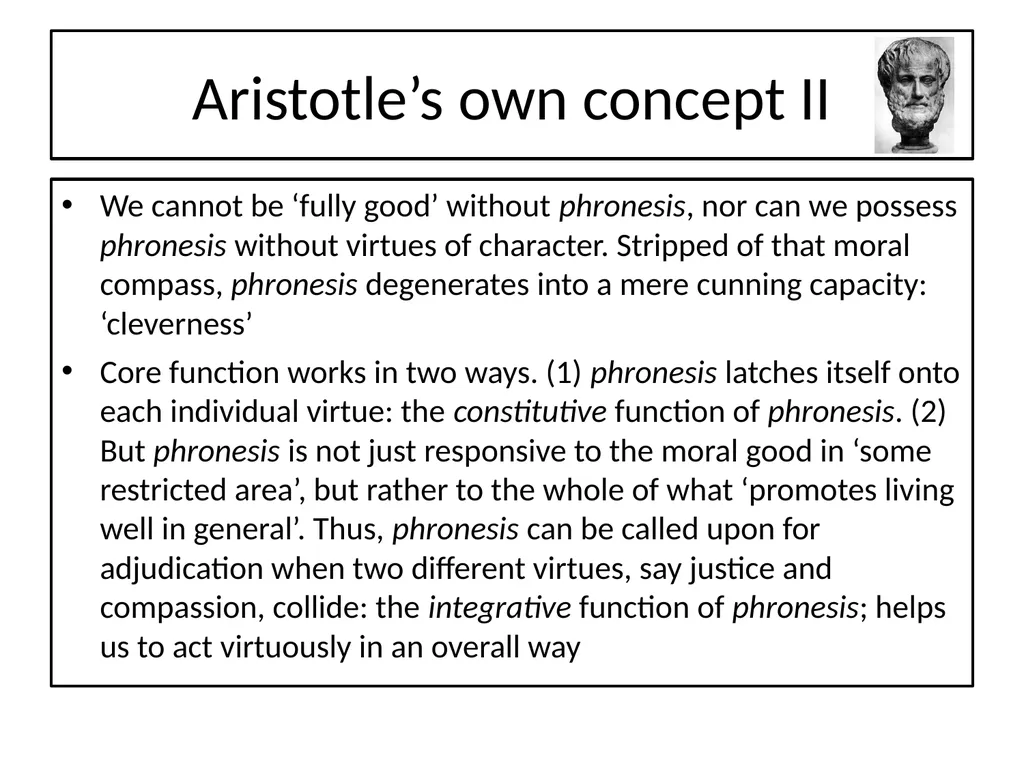
Aristotle’s own concept II We cannot be ‘fully good’ without phronesis, nor can we possess phronesis without virtues of character. Stripped of that moral compass, phronesis degenerates into a mere cunning capacity: ‘cleverness’
Core function works in two ways. (1) phronesis latches itself onto each individual virtue: the constitutive function of phronesis. (2) But phronesis is not just responsive to the moral good in ‘some restricted area’, but rather to the whole of what ‘promotes living well in general’. Thus, phronesis can be called upon for adjudication when two different virtues, say justice and compassion, collide: the integrative function of phronesis; helps us to act virtuously in an overall way<br>
Core function works in two ways. (1) phronesis latches itself onto each individual virtue: the constitutive function of phronesis. (2) But phronesis is not just responsive to the moral good in ‘some restricted area’, but rather to the whole of what ‘promotes living well in general’. Thus, phronesis can be called upon for adjudication when two different virtues, say justice and compassion, collide: the integrative function of phronesis; helps us to act virtuously in an overall way<br>
10
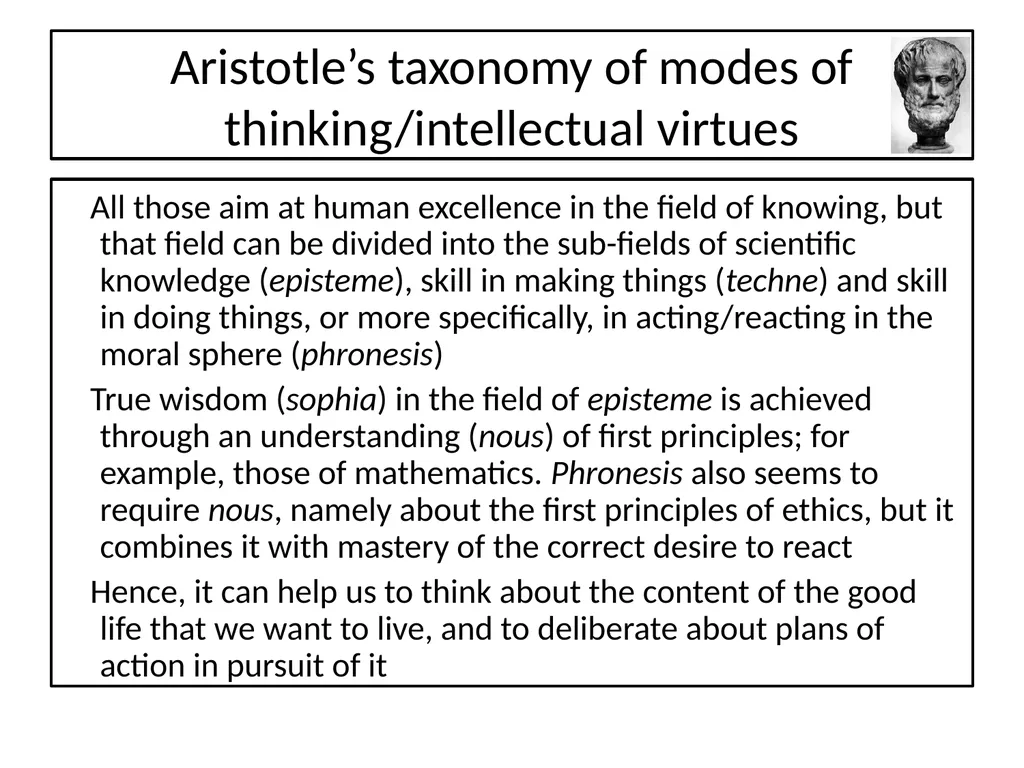
Aristotle’s taxonomy of modes of thinking/intellectual virtues All those aim at human excellence in the field of knowing, but that field can be divided into the sub-fields of scientific knowledge (episteme), skill in making things (techne) and skill in doing things, or more specifically, in acting/reacting in the moral sphere (phronesis)
True wisdom (sophia) in the field of episteme is achieved through an understanding (nous) of first principles; for example, those of mathematics. Phronesis also seems to require nous, namely about the first principles of ethics, but it combines it with mastery of the correct desire to react
Hence, it can help us to think about the content of the good life that we want to live, and to deliberate about plans of action in pursuit of it<br>
True wisdom (sophia) in the field of episteme is achieved through an understanding (nous) of first principles; for example, those of mathematics. Phronesis also seems to require nous, namely about the first principles of ethics, but it combines it with mastery of the correct desire to react
Hence, it can help us to think about the content of the good life that we want to live, and to deliberate about plans of action in pursuit of it<br>
11
Recent retrievals of
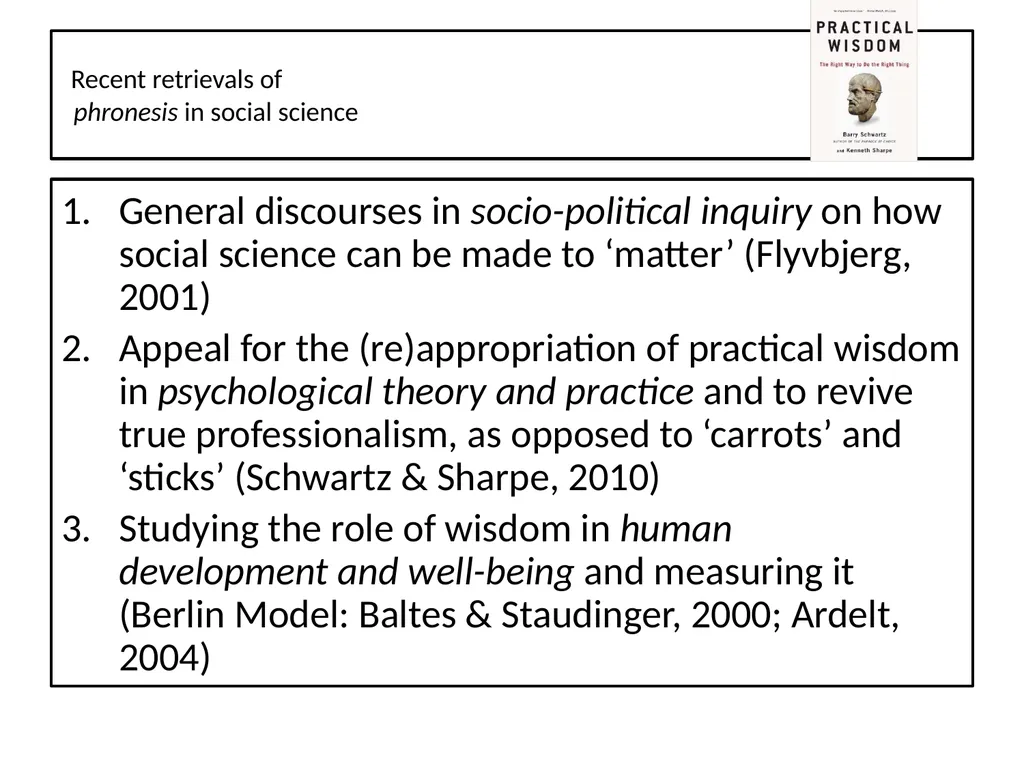
phronesis in social science General discourses in socio-political inquiry on how social science can be made to ‘matter’ (Flyvbjerg, 2001)
Appeal for the (re)appropriation of practical wisdom in psychological theory and practice and to revive true professionalism, as opposed to ‘carrots’ and ‘sticks’ (Schwartz & Sharpe, 2010)
Studying the role of wisdom in human development and well-being and measuring it (Berlin Model: Baltes & Staudinger, 2000; Ardelt, 2004)<br>
Appeal for the (re)appropriation of practical wisdom in psychological theory and practice and to revive true professionalism, as opposed to ‘carrots’ and ‘sticks’ (Schwartz & Sharpe, 2010)
Studying the role of wisdom in human development and well-being and measuring it (Berlin Model: Baltes & Staudinger, 2000; Ardelt, 2004)<br>
12
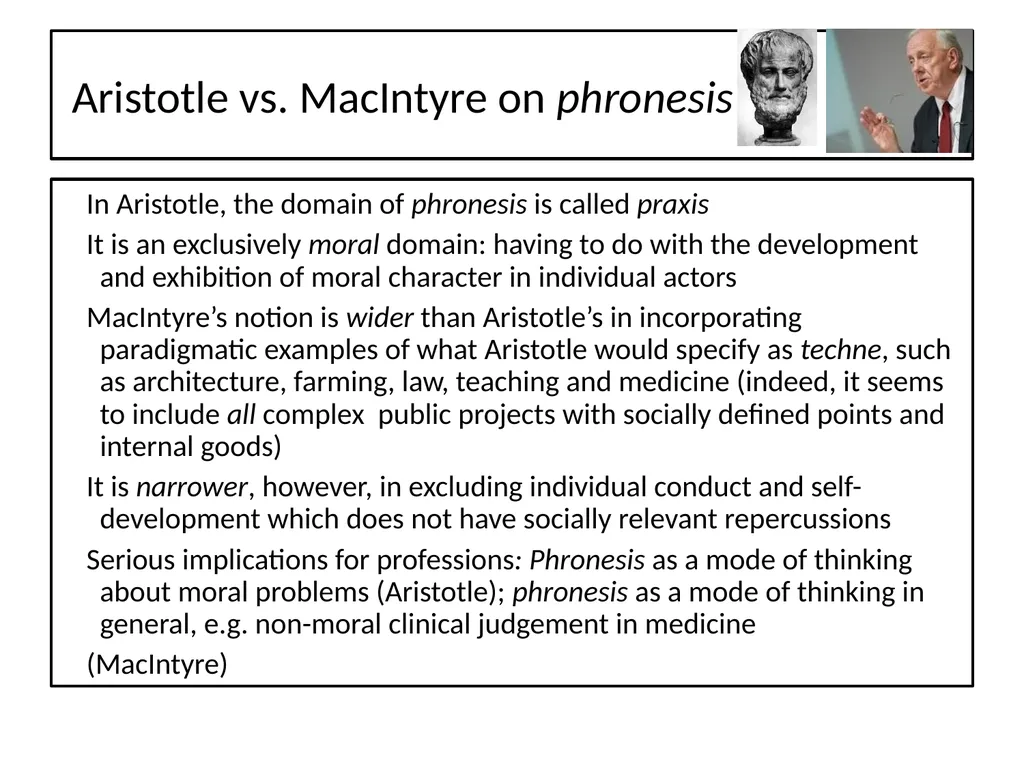
Aristotle vs. MacIntyre on phronesis In Aristotle, the domain of phronesis is called praxis
It is an exclusively moral domain: having to do with the development and exhibition of moral character in individual actors
MacIntyre’s notion is wider than Aristotle’s in incorporating paradigmatic examples of what Aristotle would specify as techne, such as architecture, farming, law, teaching and medicine (indeed, it seems to include all complex public projects with socially defined points and internal goods)
It is narrower, however, in excluding individual conduct and self-development which does not have socially relevant repercussions
Serious implications for professions: Phronesis as a mode of thinking about moral problems (Aristotle); phronesis as a mode of thinking in general, e.g. non-moral clinical judgement in medicine
(MacIntyre)<br>
It is an exclusively moral domain: having to do with the development and exhibition of moral character in individual actors
MacIntyre’s notion is wider than Aristotle’s in incorporating paradigmatic examples of what Aristotle would specify as techne, such as architecture, farming, law, teaching and medicine (indeed, it seems to include all complex public projects with socially defined points and internal goods)
It is narrower, however, in excluding individual conduct and self-development which does not have socially relevant repercussions
Serious implications for professions: Phronesis as a mode of thinking about moral problems (Aristotle); phronesis as a mode of thinking in general, e.g. non-moral clinical judgement in medicine
(MacIntyre)<br>
13
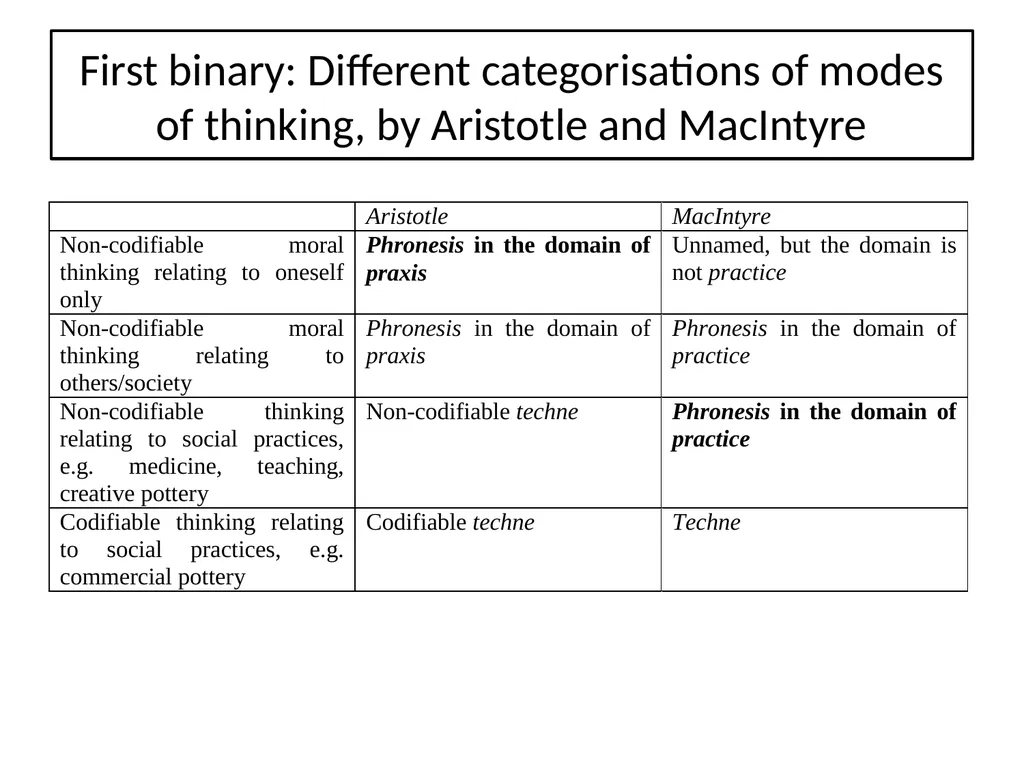
First binary: Different categorisations of modes of thinking, by Aristotle and MacIntyre<br>
14
Second binary: relativist vs. universalist phronesis MacIntyre’s relativist reading:
After virtue (1981): dramatic claims about the relativity of virtues and virtuous decisions to different – in the strong sense of incommensurable – moral and cultural traditions
Thus, two practically wise human beings may inhabit two mutually impenetrable moral worlds, to the extent that a phronetic decision reached by one of them would remain essentially opaque and incomprehensible to the other
The basic question to ask about phronesis, on this interpretation, is ‘Whose phronesis, which phronimoi?’<br>
After virtue (1981): dramatic claims about the relativity of virtues and virtuous decisions to different – in the strong sense of incommensurable – moral and cultural traditions
Thus, two practically wise human beings may inhabit two mutually impenetrable moral worlds, to the extent that a phronetic decision reached by one of them would remain essentially opaque and incomprehensible to the other
The basic question to ask about phronesis, on this interpretation, is ‘Whose phronesis, which phronimoi?’<br>
15
Second binary: relativist vs. universalist phronesis Nussbaum’s universalist reading: based on empirical transcultural comparisons of basic capabilities. That said, the constitutive circumstances of human life, while broadly shared, can be realised in different ways, allowing for ‘contextual particularity’
The phronetic decisions of a doctor operating in a war zone and a Manhattan plastic surgeon can be equally sound – albeit not simply, a la relativism, because they have been chosen as ways of life in incommensurable contexts, but rather because they happen to be equally fruitful realisations of the same basic capacities
The phronetic virtue adjudication of the two doctors would be mutually understandable and mutually condonable – if they made the effort to put themselves into each other’s shoes<br>
The phronetic decisions of a doctor operating in a war zone and a Manhattan plastic surgeon can be equally sound – albeit not simply, a la relativism, because they have been chosen as ways of life in incommensurable contexts, but rather because they happen to be equally fruitful realisations of the same basic capacities
The phronetic virtue adjudication of the two doctors would be mutually understandable and mutually condonable – if they made the effort to put themselves into each other’s shoes<br>
16
Third binary: particularist vs. generalist phronesis The particularist reading (dominant in professional ethics!)
No general, context-independent moral truths
Phronesis relies rather on the virtuous agent’s intuitive artistry in coping with situational demands
Phronesis seen as a dynamic, flexible and open-textured concept, with an emphasis on the intimate bond between phronesis and the perceptual particularities of human experience
Whereas phronesis incorporates practical knowledge, it is
not itself theory and neither is it the application of theory
to cases
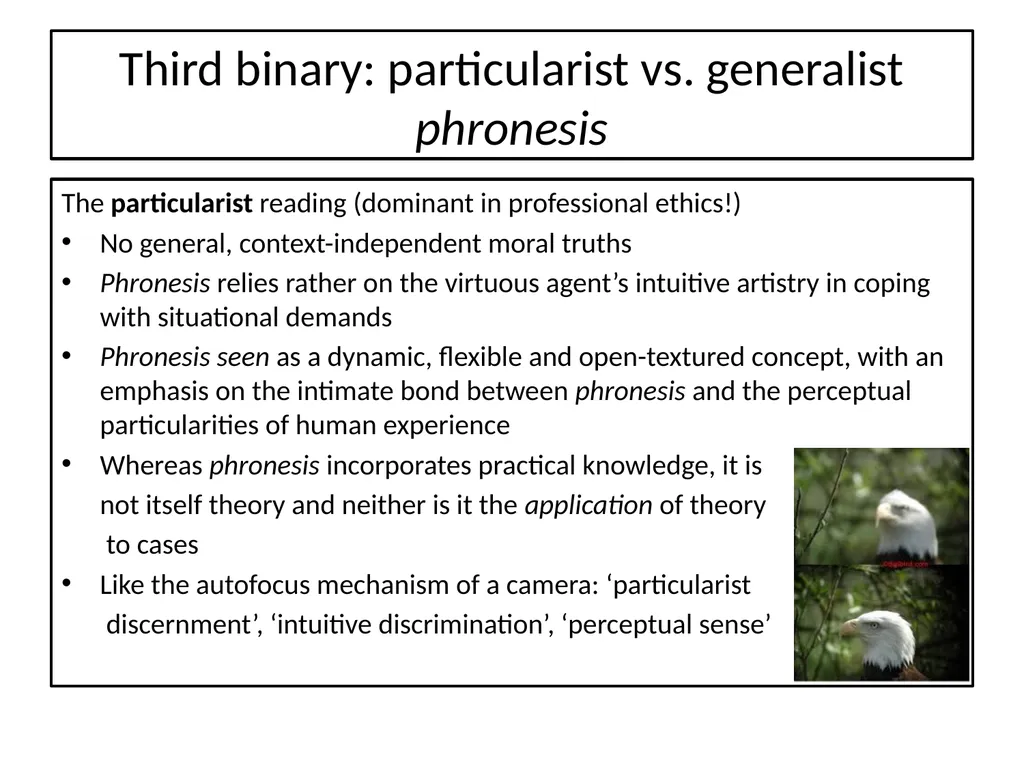
Like the autofocus mechanism of a camera: ‘particularist
discernment’, ‘intuitive discrimination’, ‘perceptual sense’<br>
No general, context-independent moral truths
Phronesis relies rather on the virtuous agent’s intuitive artistry in coping with situational demands
Phronesis seen as a dynamic, flexible and open-textured concept, with an emphasis on the intimate bond between phronesis and the perceptual particularities of human experience
Whereas phronesis incorporates practical knowledge, it is
not itself theory and neither is it the application of theory
to cases
Like the autofocus mechanism of a camera: ‘particularist
discernment’, ‘intuitive discrimination’, ‘perceptual sense’<br>
17
Third binary: particularist
vs. generalist phronesis The generalist reading:
The right (phronetic) thing to feel and do not only to be gauged by the facts of the given situation (the relevant thats) and the virtuous agent’s particularist ‘seeings-in-a-flash’, but also by overriding grand-blueprint truths (the relevant whys) about human eudaimonia that must be carefully applied to particular cases
‘Here, too, [as in medicine] there is a ruling [science]’ (Aristotle, 1141b22–23)
To be sure, phronesis is not ‘about universals only’ (1141b15), but it nevertheless takes its cue from a generalist theory about the nature of the good life<br>
The right (phronetic) thing to feel and do not only to be gauged by the facts of the given situation (the relevant thats) and the virtuous agent’s particularist ‘seeings-in-a-flash’, but also by overriding grand-blueprint truths (the relevant whys) about human eudaimonia that must be carefully applied to particular cases
‘Here, too, [as in medicine] there is a ruling [science]’ (Aristotle, 1141b22–23)
To be sure, phronesis is not ‘about universals only’ (1141b15), but it nevertheless takes its cue from a generalist theory about the nature of the good life<br>
18
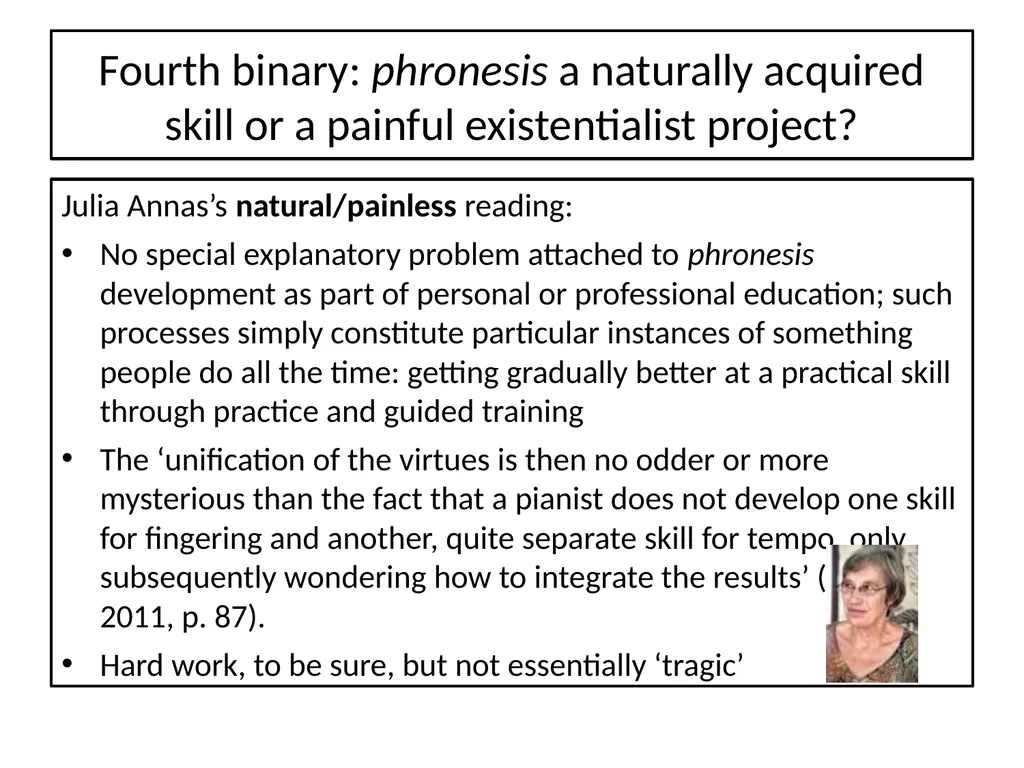
Fourth binary: phronesis a naturally acquired skill or a painful existentialist project? Julia Annas’s natural/painless reading:
No special explanatory problem attached to phronesis development as part of personal or professional education; such processes simply constitute particular instances of something people do all the time: getting gradually better at a practical skill through practice and guided training
The ‘unification of the virtues is then no odder or more mysterious than the fact that a pianist does not develop one skill for fingering and another, quite separate skill for tempo, only subsequently wondering how to integrate the results’ (Annas, 2011, p. 87).
Hard work, to be sure, but not essentially ‘tragic’<br>
No special explanatory problem attached to phronesis development as part of personal or professional education; such processes simply constitute particular instances of something people do all the time: getting gradually better at a practical skill through practice and guided training
The ‘unification of the virtues is then no odder or more mysterious than the fact that a pianist does not develop one skill for fingering and another, quite separate skill for tempo, only subsequently wondering how to integrate the results’ (Annas, 2011, p. 87).
Hard work, to be sure, but not essentially ‘tragic’<br>
19
Fourth binary: phronesis a naturally
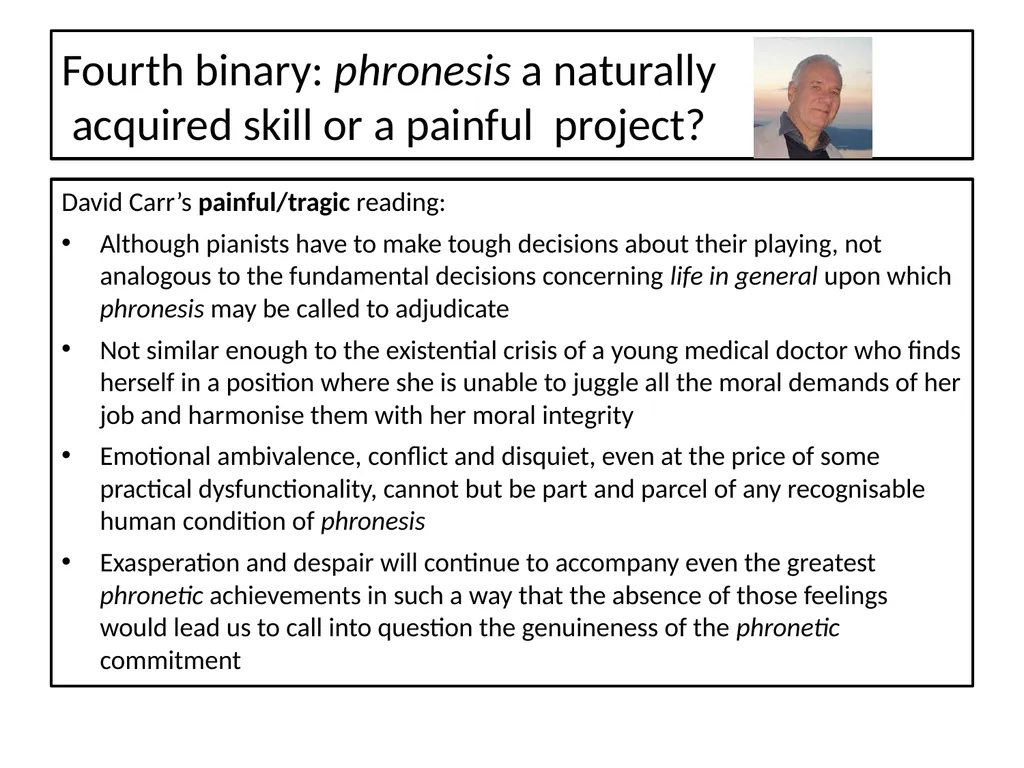
acquired skill or a painful project? David Carr’s painful/tragic reading:
Although pianists have to make tough decisions about their playing, not analogous to the fundamental decisions concerning life in general upon which phronesis may be called to adjudicate
Not similar enough to the existential crisis of a young medical doctor who finds herself in a position where she is unable to juggle all the moral demands of her job and harmonise them with her moral integrity
Emotional ambivalence, conflict and disquiet, even at the price of some practical dysfunctionality, cannot but be part and parcel of any recognisable human condition of phronesis
Exasperation and despair will continue to accompany even the greatest phronetic achievements in such a way that the absence of those feelings would lead us to call into question the genuineness of the phronetic commitment<br>
Although pianists have to make tough decisions about their playing, not analogous to the fundamental decisions concerning life in general upon which phronesis may be called to adjudicate
Not similar enough to the existential crisis of a young medical doctor who finds herself in a position where she is unable to juggle all the moral demands of her job and harmonise them with her moral integrity
Emotional ambivalence, conflict and disquiet, even at the price of some practical dysfunctionality, cannot but be part and parcel of any recognisable human condition of phronesis
Exasperation and despair will continue to accompany even the greatest phronetic achievements in such a way that the absence of those feelings would lead us to call into question the genuineness of the phronetic commitment<br>
20
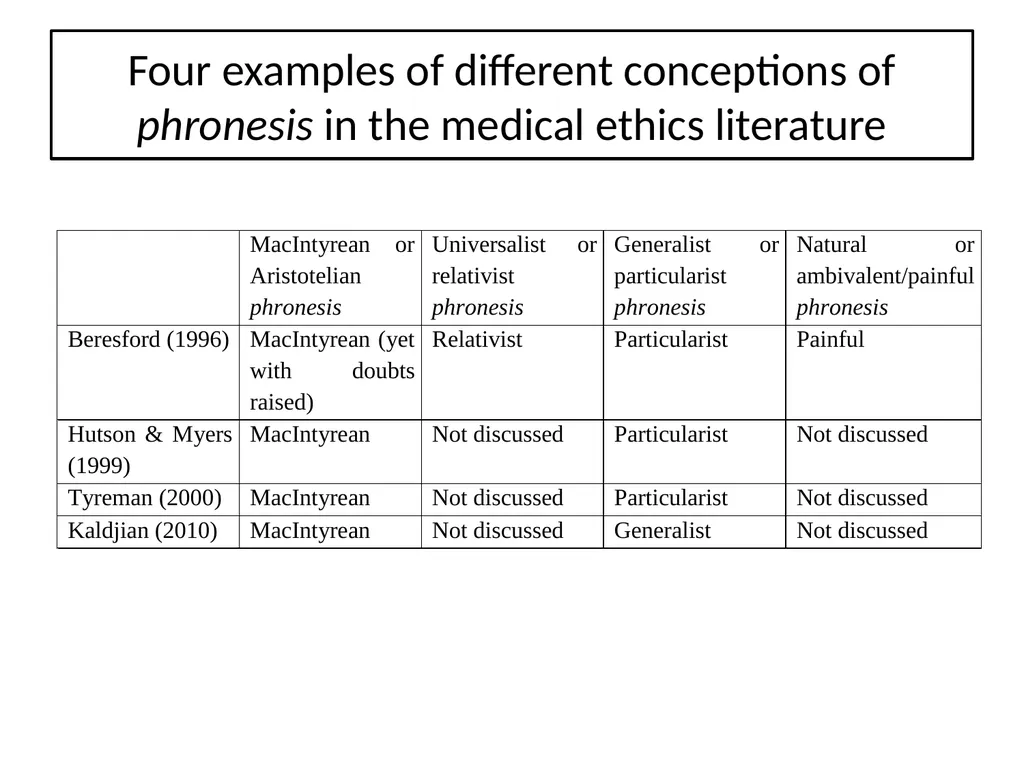
Four examples of different conceptions of phronesis in the medical ethics literature<br>
21
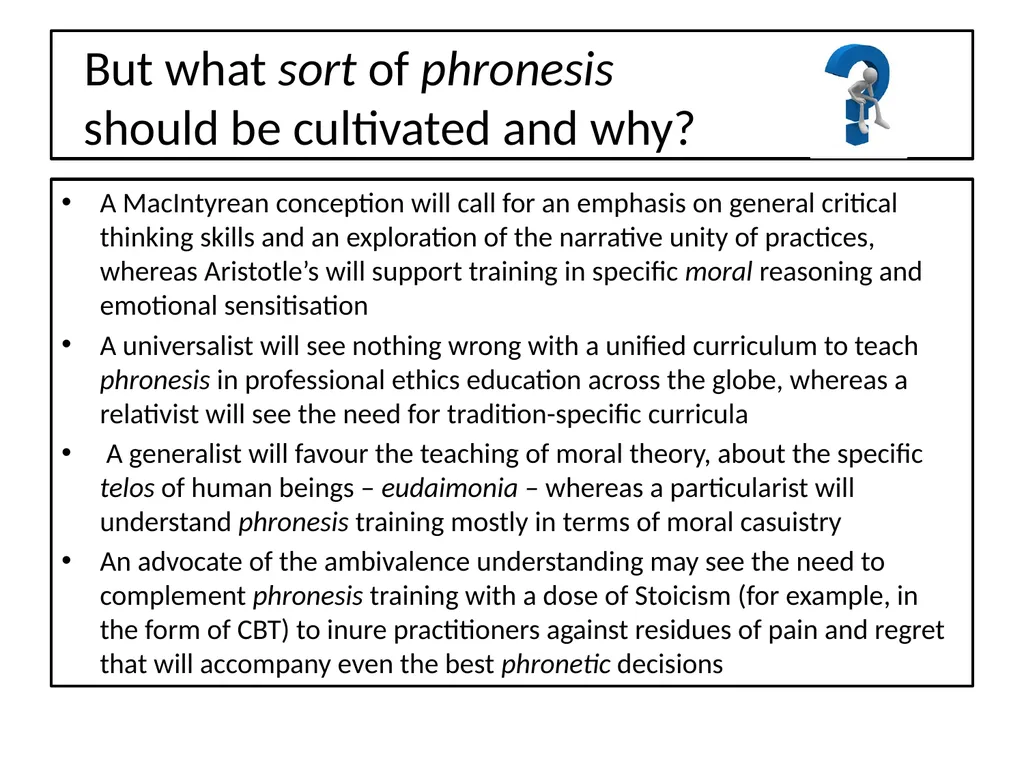
But what sort of phronesis
should be cultivated and why? A MacIntyrean conception will call for an emphasis on general critical thinking skills and an exploration of the narrative unity of practices, whereas Aristotle’s will support training in specific moral reasoning and emotional sensitisation
A universalist will see nothing wrong with a unified curriculum to teach phronesis in professional ethics education across the globe, whereas a relativist will see the need for tradition-specific curricula
A generalist will favour the teaching of moral theory, about the specific telos of human beings – eudaimonia – whereas a particularist will understand phronesis training mostly in terms of moral casuistry
An advocate of the ambivalence understanding may see the need to complement phronesis training with a dose of Stoicism (for example, in the form of CBT) to inure practitioners against residues of pain and regret that will accompany even the best phronetic decisions<br>
A universalist will see nothing wrong with a unified curriculum to teach phronesis in professional ethics education across the globe, whereas a relativist will see the need for tradition-specific curricula
A generalist will favour the teaching of moral theory, about the specific telos of human beings – eudaimonia – whereas a particularist will understand phronesis training mostly in terms of moral casuistry
An advocate of the ambivalence understanding may see the need to complement phronesis training with a dose of Stoicism (for example, in the form of CBT) to inure practitioners against residues of pain and regret that will accompany even the best phronetic decisions<br>
22
The JCCV‘s Aristotelian view... We should give students in professional education training in honing their generalist, universalist phronesis in order to deal with moral dilemmas
They need to be able to reflect upon the subtle and tenuous relationship between general moral truths and situational particularities
They need to have space and time to discuss with peers and teachers
They need to understand virtue competence as part of general professionalism – and to learn to go beyond the rule books (although this NOT mean ditching formalist and consequentialist considerations!)
They need to get adequate feedback on the quality of their decision-making skills<br>
They need to be able to reflect upon the subtle and tenuous relationship between general moral truths and situational particularities
They need to have space and time to discuss with peers and teachers
They need to understand virtue competence as part of general professionalism – and to learn to go beyond the rule books (although this NOT mean ditching formalist and consequentialist considerations!)
They need to get adequate feedback on the quality of their decision-making skills<br>