The KendallLee Notation for Queuing Systems Mohamad Ayache 16701680 The notation is used to describe a queuing system in which all arrivals wait in a single line until one of s identical parallel servers is free. Then the first customer in
"The Kendall–Lee Notation for Queuing Systems" is the property of its rightful owner. Permission is granted to
download and print the materials on this website for personal, non-commercial use only, and to display it
on your personal computer provided you do not modify the materials and that you retain all copyright
notices contained in the materials. By downloading content from our website, you accept the terms of this
agreement.
Presentation Transcript
01
The Kendall–Lee Notation for Queuing Systems Mohamad Ayache 16701680<br>
02
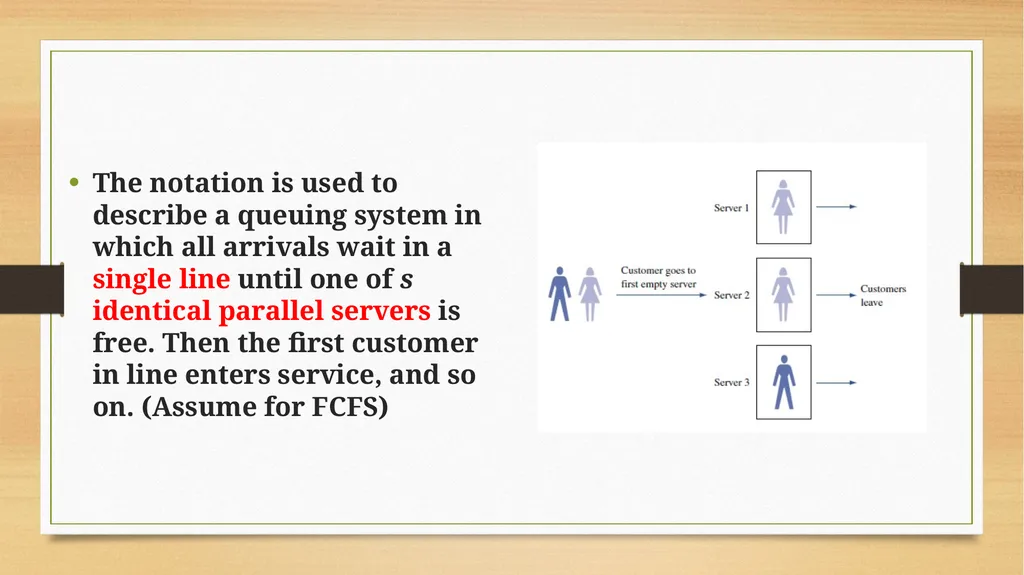
The notation is used to describe a queuing system in which all arrivals wait in a single line until one of s identical parallel servers is free. Then the first customer in line enters service, and so on. (Assume for FCFS)<br>
03
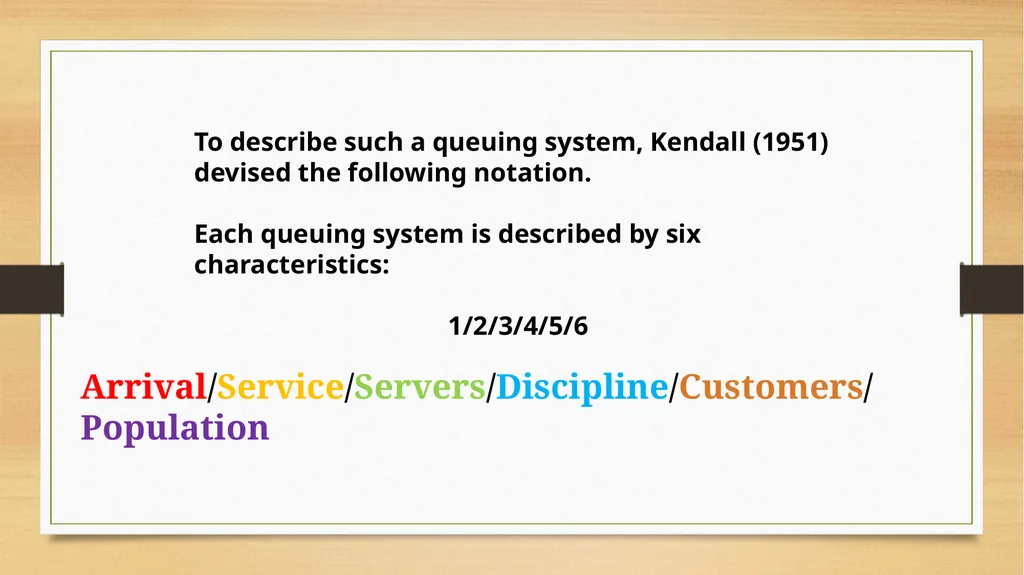
To describe such a queuing system, Kendall (1951) devised the following notation.
Each queuing system is described by six characteristics:
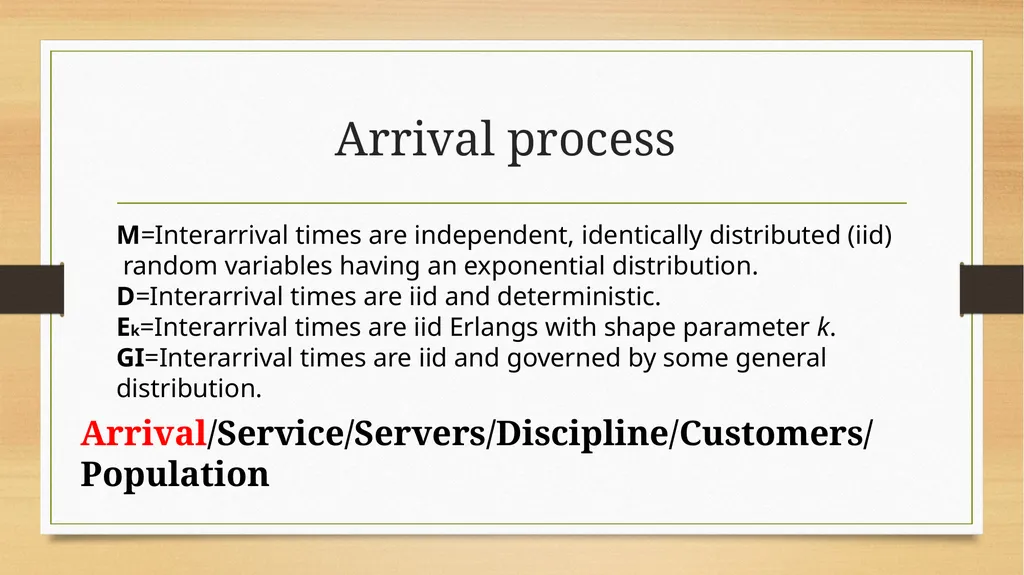
Arrival process M=Interarrival times are independent, identically distributed (iid)
random variables having an exponential distribution.
D=Interarrival times are iid and deterministic.
Ek=Interarrival times are iid Erlangs with shape parameter k.
GI=Interarrival times are iid and governed by some general distribution. Arrival/Service/Servers/Discipline/Customers/Population<br>
05
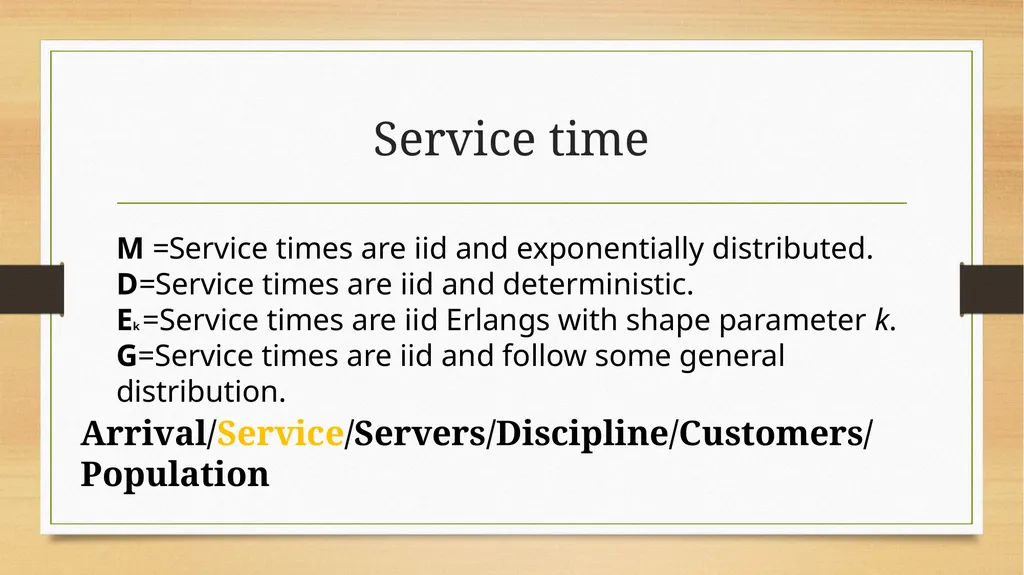
Service time M =Service times are iid and exponentially distributed.
D=Service times are iid and deterministic.
Ek =Service times are iid Erlangs with shape parameter k.
G=Service times are iid and follow some general distribution. Arrival/Service/Servers/Discipline/Customers/Population<br>
06
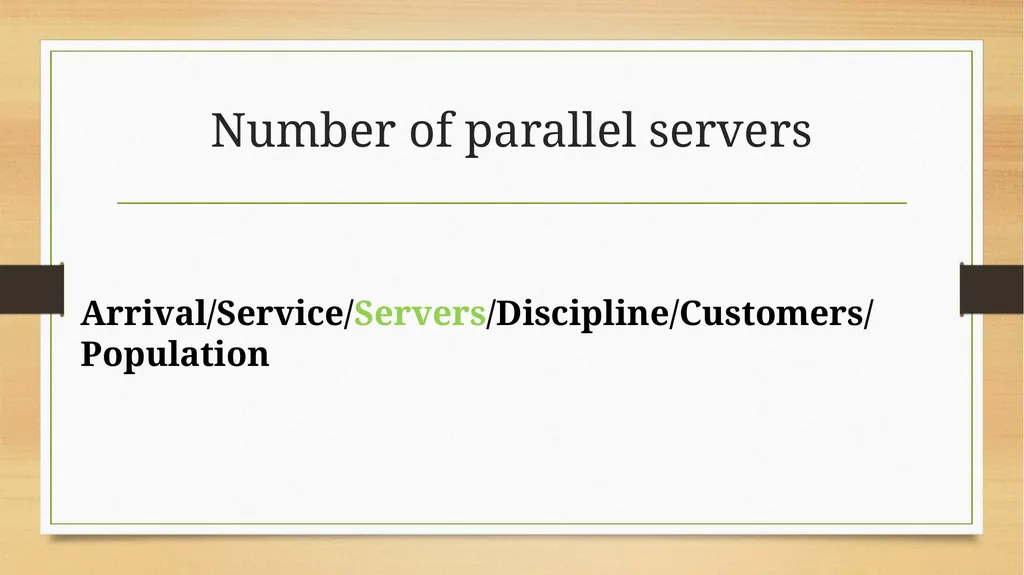
Arrival/Service/Servers/Discipline/Customers/Population Number of parallel servers<br>
07
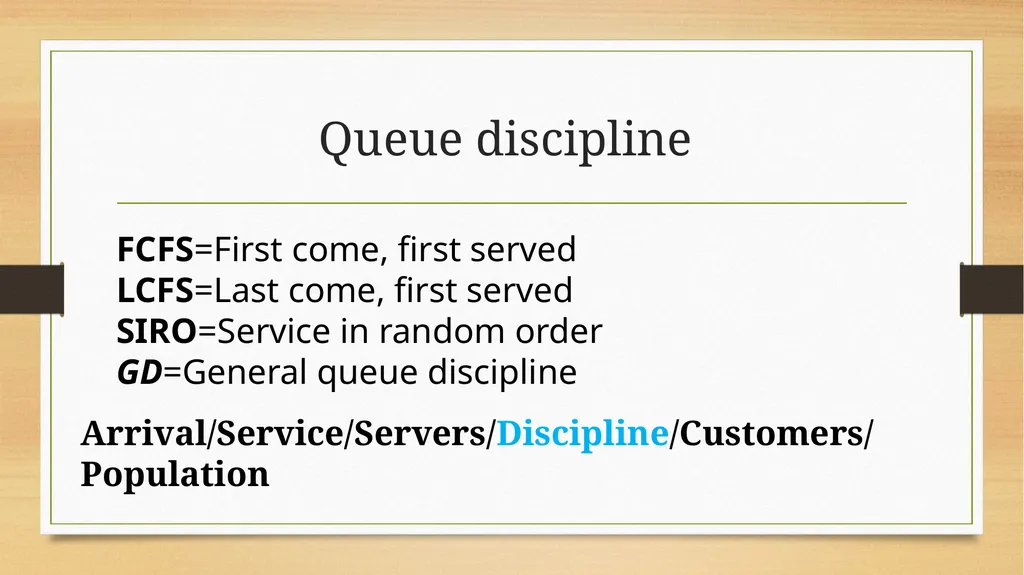
Queue discipline FCFS=First come, first served
LCFS=Last come, first served
SIRO=Service in random order
GD=General queue discipline Arrival/Service/Servers/Discipline/Customers/Population<br>
08
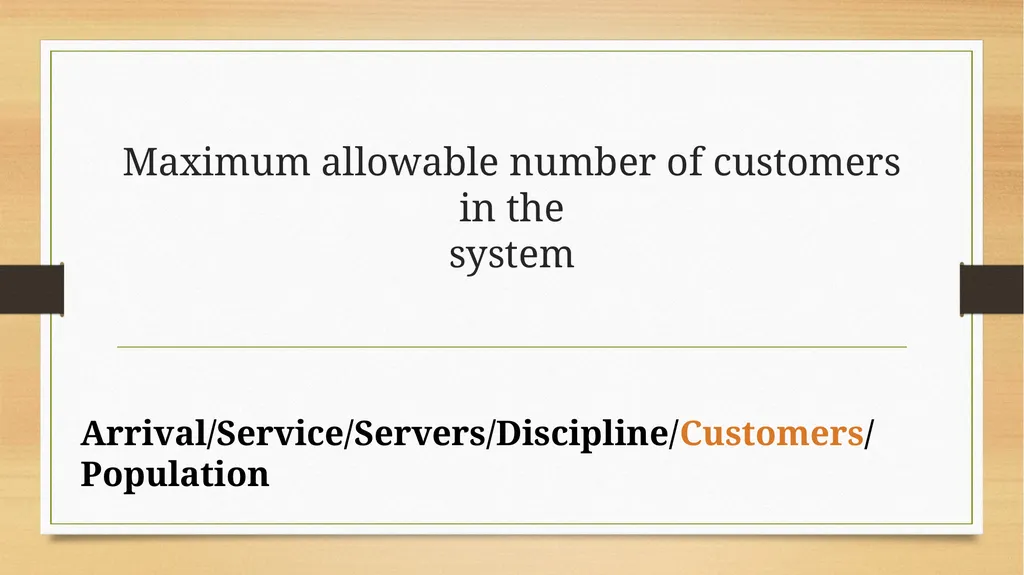
Maximum allowable number of customers in the system Arrival/Service/Servers/Discipline/Customers/Population<br>
09
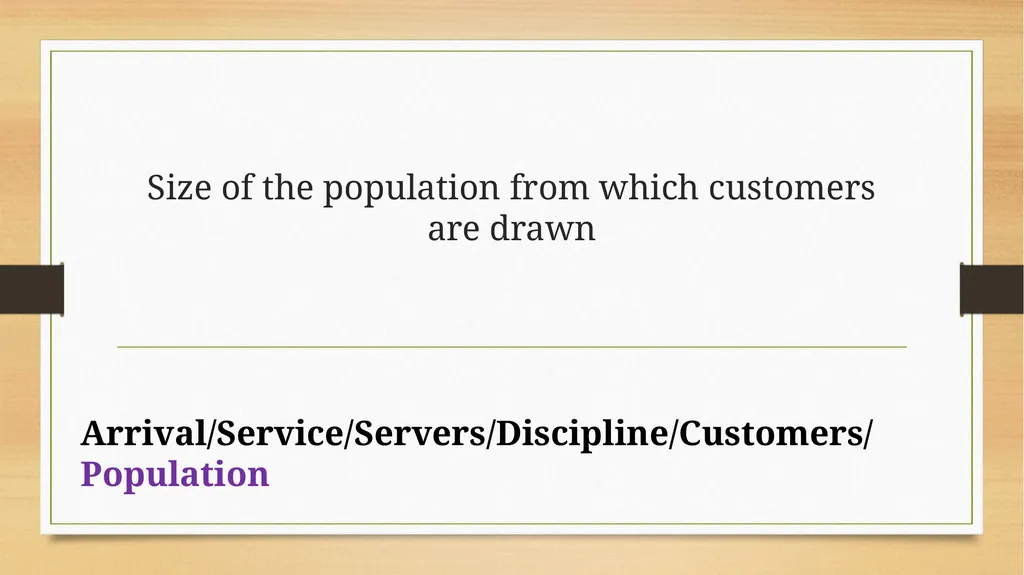
Size of the population from which customers are drawn Arrival/Service/Servers/Discipline/Customers/Population<br>
10
Company A has 1000 employees and 50% of them are workers. A queue system serves only workers. The arrival process is exponential. Service process have erlang distribution with shape parameter 3. First in first out. 5 servers are available. M/E3/5/FCFS/500/1000 Arrival/Service/Servers/Discipline/Customers/Population<br>
11
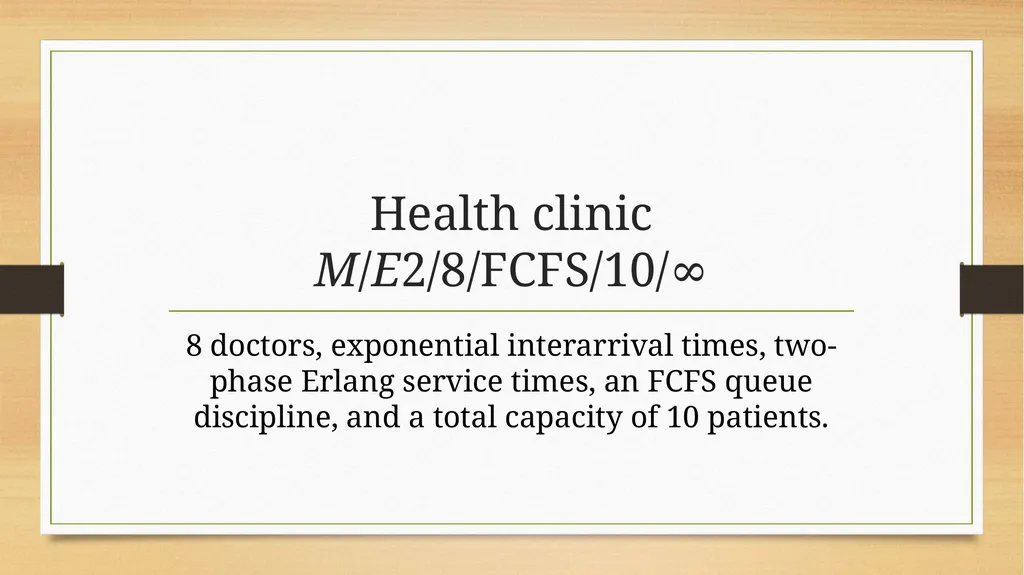
Health clinic M/E2/8/FCFS/10/∞ 8 doctors, exponential interarrival times, two-phase Erlang service times, an FCFS queue discipline, and a total capacity of 10 patients.<br>
12
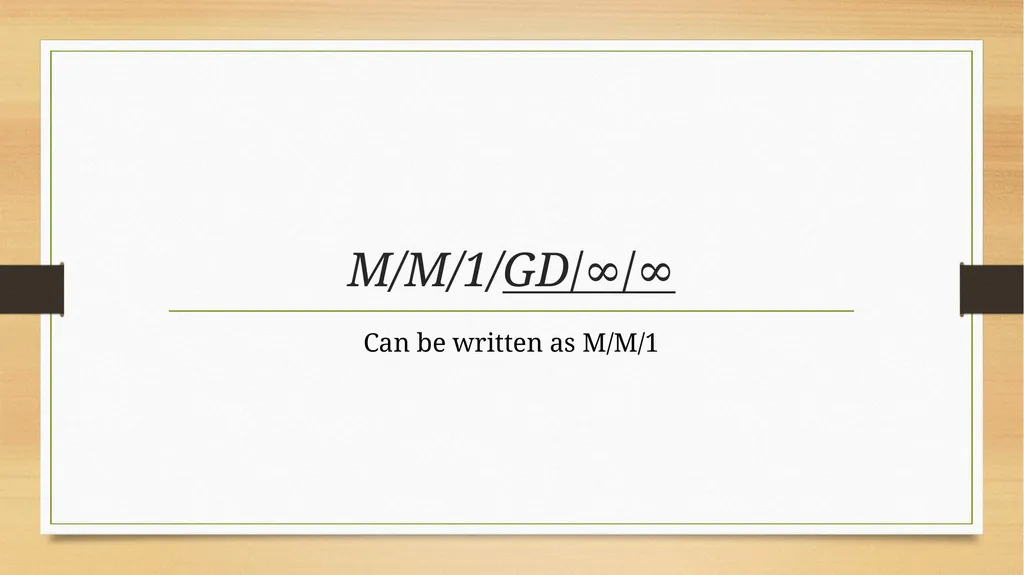
M/M/1/GD/∞/∞ Can be written as M/M/1<br>
13
Thank you Feel free to ask any questions related to the subject<br>