
The NebulaStream Platform: Data and Application
LV
Published · 25 slides · 0 views
1 / 1
Description
The NebulaStream Platform: Data and Application Management for the Internet of Things Steffen Zeuch (DFKI GmbH); Ankit Chaudhary (TU Berlin); Bonaventura Del Monte (Technische Universität Berlin); Haralampos Gavriilidis (TU Berlin);
Related Topics
Share
Embed code
Download this presentation From Below
"The NebulaStream Platform: Data and Application" is the property of its rightful owner. Permission is granted to download and print the materials on this website for personal, non-commercial use only, and to display it on your personal computer provided you do not modify the materials and that you retain all copyright notices contained in the materials. By downloading content from our website, you accept the terms of this agreement.
Presentation Transcript
01
The NebulaStream Platform: Data and Application Management for the Internet of Things Steffen Zeuch (DFKI GmbH)*; Ankit Chaudhary (TU Berlin); Bonaventura Del Monte (Technische Universität Berlin); Haralampos Gavriilidis (TU Berlin); Dimitrios Giouroukis (TU Berlin); Philipp Marian Grulich (Technische Universität Berlin); Sebastian Bress (TU Berlin); Jonas Traub (Technische Universität Berlin); Volker Markl (Technische Universität Berlin)
9th Biennial Conference on Innovative Data Systems Research (CIDR ‘19)
January 13-16, 2019 , Asilomar, California, USA.
http://cidrdb.org/cidr2020/papers/p7-zeuch-cidr20.pdf
University of Cyprus Department of Computer Science
EPL646 - Advanced Topics in Databases
By: Soteris Constantinou & Andreas Savva
Instructor: Dr. Demetris Zeinalipour<br>
02
Content Introduction
Break-down of the problem
NebulaStream(NES)
IoT application scenario
Description of NebulaStream Platform
Experimental Demonstration
State of the Art Systems
Conclusion<br>
Break-down of the problem
NebulaStream(NES)
IoT application scenario
Description of NebulaStream Platform
Experimental Demonstration
State of the Art Systems
Conclusion<br>
03
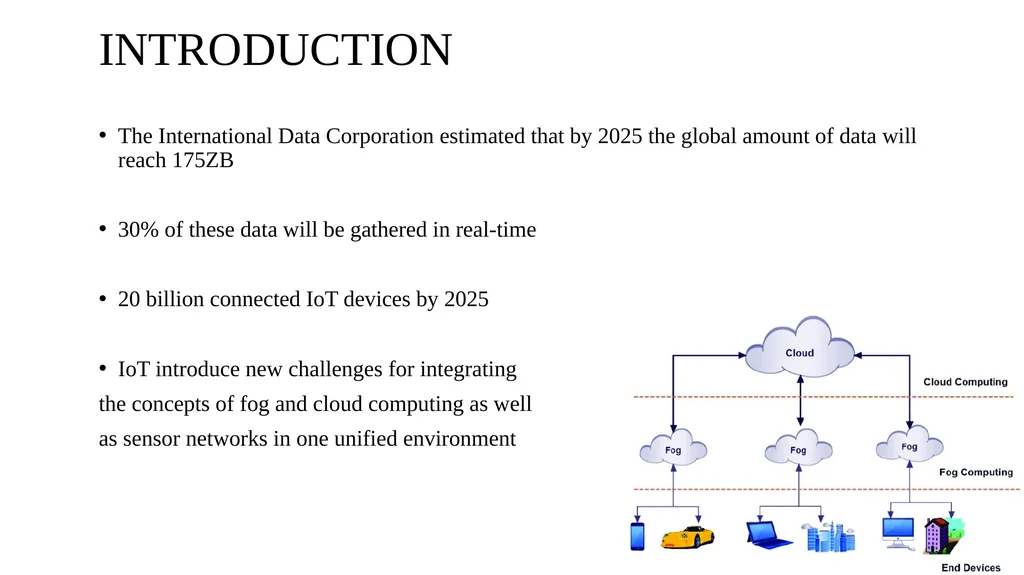
INTRODUCTION The International Data Corporation estimated that by 2025 the global amount of data will reach 175ZB
30% of these data will be gathered in real-time
20 billion connected IoT devices by 2025
IoT introduce new challenges for integrating
the concepts of fog and cloud computing as well
as sensor networks in one unified environment<br>
30% of these data will be gathered in real-time
20 billion connected IoT devices by 2025
IoT introduce new challenges for integrating
the concepts of fog and cloud computing as well
as sensor networks in one unified environment<br>
04
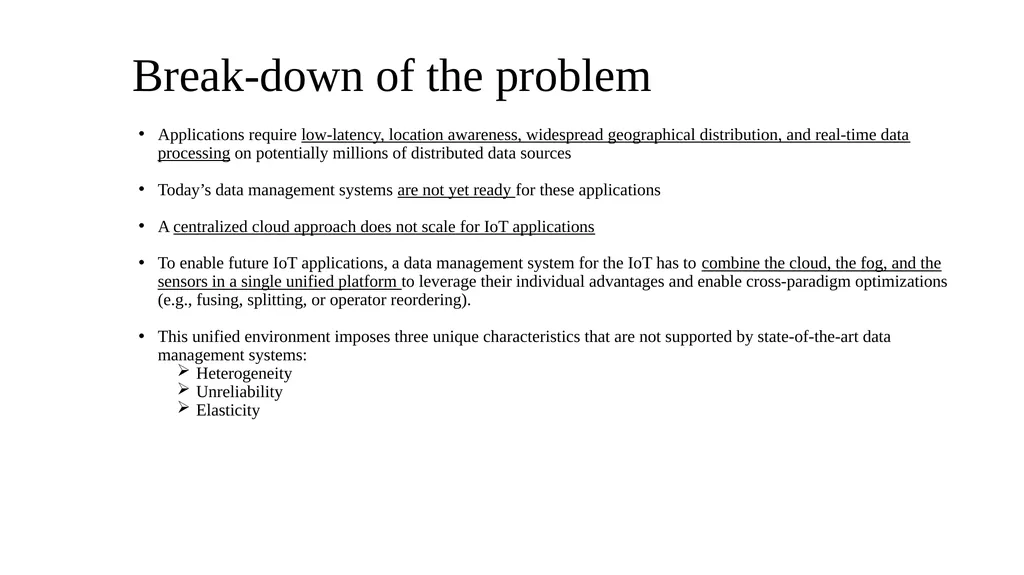
Break-down of the problem Applications require low-latency, location awareness, widespread geographical distribution, and real-time data processing on potentially millions of distributed data sources
Today’s data management systems are not yet ready for these applications
A centralized cloud approach does not scale for IoT applications
To enable future IoT applications, a data management system for the IoT has to combine the cloud, the fog, and the sensors in a single unified platform to leverage their individual advantages and enable cross-paradigm optimizations (e.g., fusing, splitting, or operator reordering).
This unified environment imposes three unique characteristics that are not supported by state-of-the-art data management systems:
Heterogeneity
Unreliability
Elasticity<br>
05
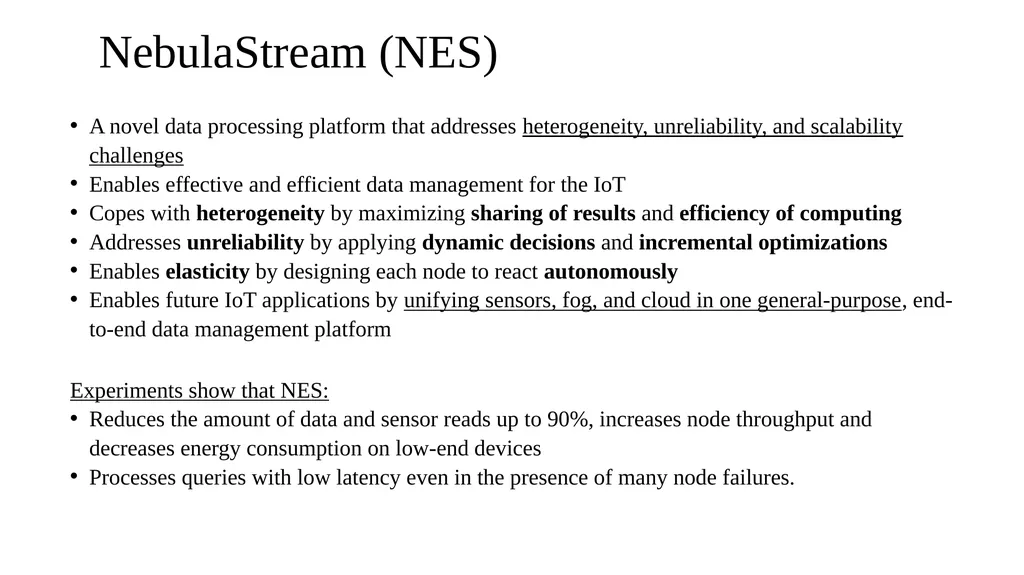
NebulaStream (NES) A novel data processing platform that addresses heterogeneity, unreliability, and scalability challenges
Enables effective and efficient data management for the IoT
Copes with heterogeneity by maximizing sharing of results and efficiency of computing
Addresses unreliability by applying dynamic decisions and incremental optimizations
Enables elasticity by designing each node to react autonomously
Enables future IoT applications by unifying sensors, fog, and cloud in one general-purpose, end-to-end data management platform
Experiments show that NES:
Reduces the amount of data and sensor reads up to 90%, increases node throughput and decreases energy consumption on low-end devices
Processes queries with low latency even in the presence of many node failures.<br>
06
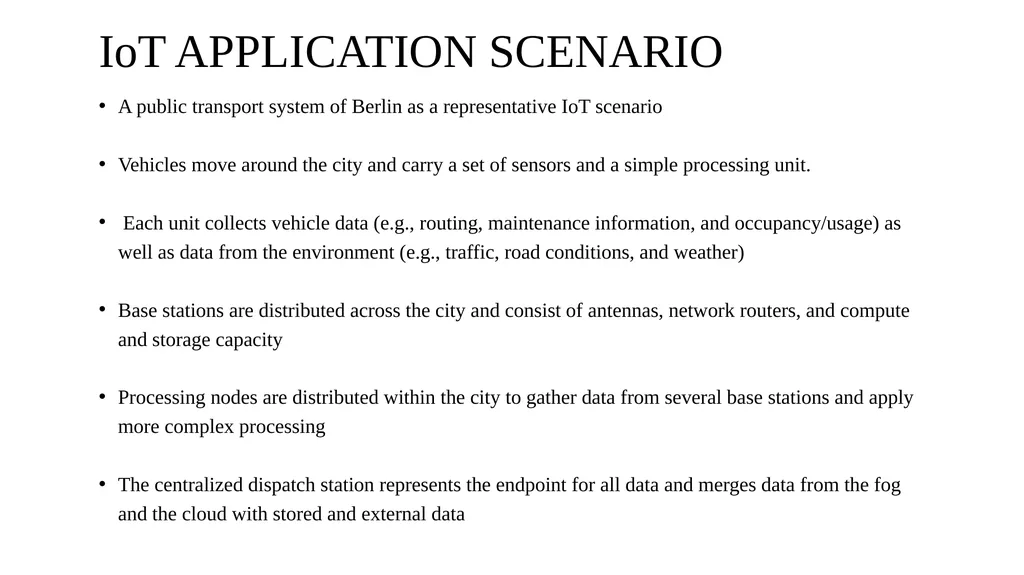
IoT APPLICATION SCENARIO A public transport system of Berlin as a representative IoT scenario
Vehicles move around the city and carry a set of sensors and a simple processing unit.
Each unit collects vehicle data (e.g., routing, maintenance information, and occupancy/usage) as well as data from the environment (e.g., traffic, road conditions, and weather)
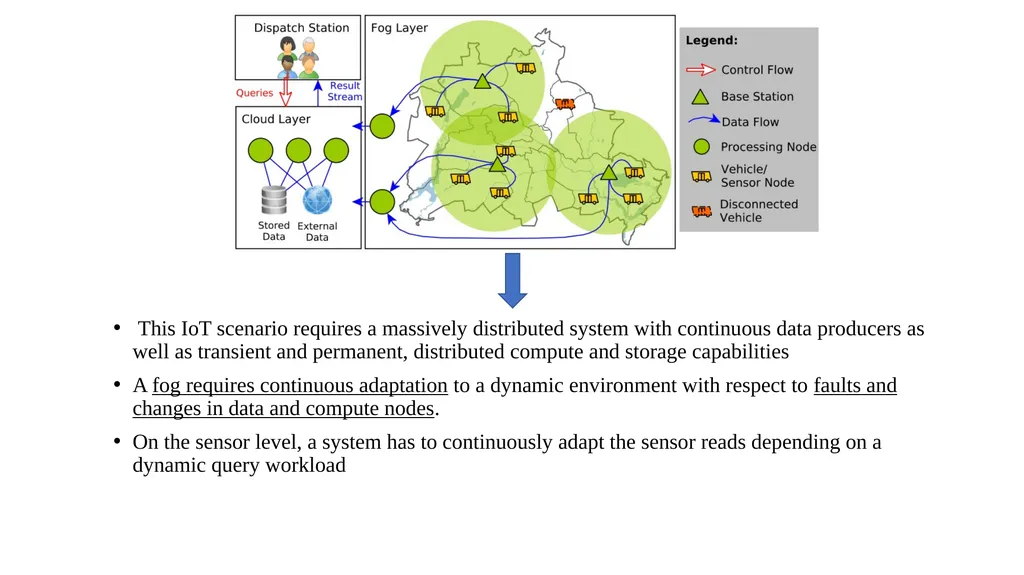
Base stations are distributed across the city and consist of antennas, network routers, and compute and storage capacity
Processing nodes are distributed within the city to gather data from several base stations and apply more complex processing
The centralized dispatch station represents the endpoint for all data and merges data from the fog and the cloud with stored and external data<br>
07
This IoT scenario requires a massively distributed system with continuous data producers as well as transient and permanent, distributed compute and storage capabilities
A fog requires continuous adaptation to a dynamic environment with respect to faults and changes in data and compute nodes.
On the sensor level, a system has to continuously adapt the sensor reads depending on a dynamic query workload<br>
A fog requires continuous adaptation to a dynamic environment with respect to faults and changes in data and compute nodes.
On the sensor level, a system has to continuously adapt the sensor reads depending on a dynamic query workload<br>
08
NEBULASTREAM PLATFORM<br>
09
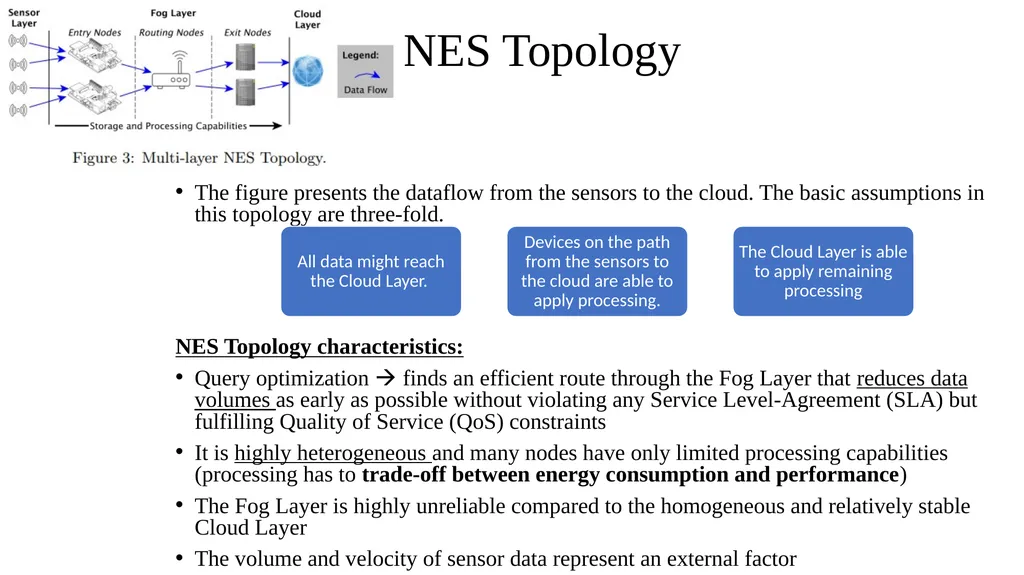
NES Topology The figure presents the dataflow from the sensors to the cloud. The basic assumptions in this topology are three-fold.
NES Topology characteristics:
Query optimization finds an efficient route through the Fog Layer that reduces data volumes as early as possible without violating any Service Level-Agreement (SLA) but fulfilling Quality of Service (QoS) constraints
It is highly heterogeneous and many nodes have only limited processing capabilities (processing has to trade-off between energy consumption and performance)
The Fog Layer is highly unreliable compared to the homogeneous and relatively stable Cloud Layer
The volume and velocity of sensor data represent an external factor<br>
10
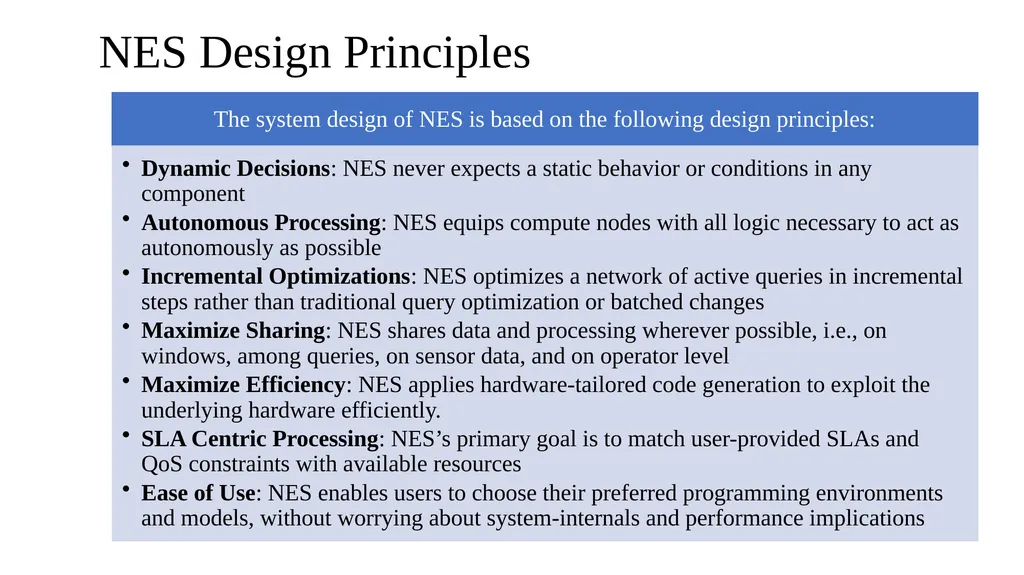
NES Design Principles<br>
11
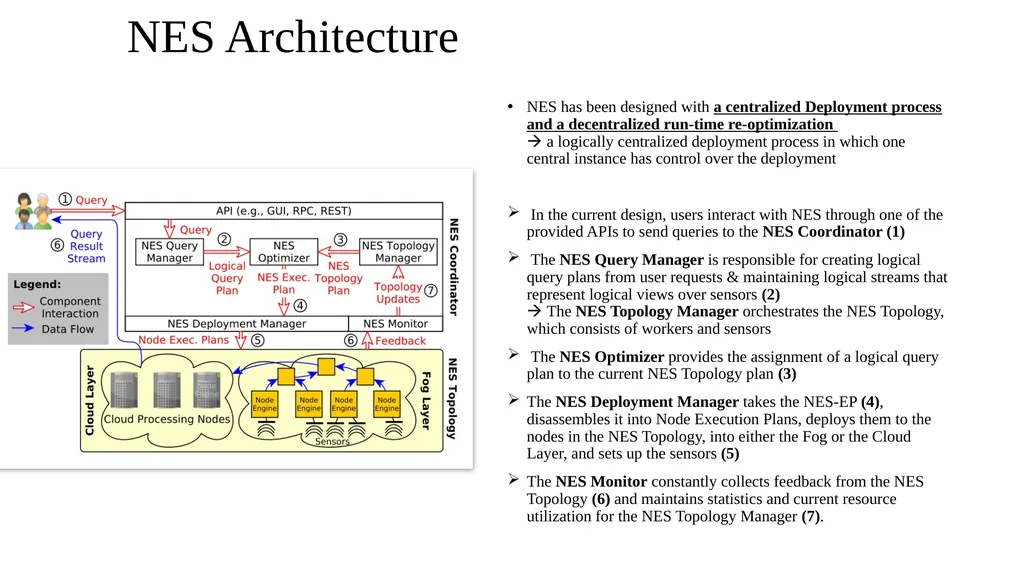
NES Architecture NES has been designed with a centralized Deployment process and a decentralized run-time re-optimization
a logically centralized deployment process in which one central instance has control over the deployment
In the current design, users interact with NES through one of the provided APIs to send queries to the NES Coordinator (1)
The NES Query Manager is responsible for creating logical query plans from user requests & maintaining logical streams that represent logical views over sensors (2) The NES Topology Manager orchestrates the NES Topology, which consists of workers and sensors
The NES Optimizer provides the assignment of a logical query plan to the current NES Topology plan (3)
The NES Deployment Manager takes the NES-EP (4), disassembles it into Node Execution Plans, deploys them to the nodes in the NES Topology, into either the Fog or the Cloud Layer, and sets up the sensors (5)
The NES Monitor constantly collects feedback from the NES Topology (6) and maintains statistics and current resource utilization for the NES Topology Manager (7).<br>
12
Volume of Data At-rest and In-Motion In the IoT world, data are generated by many different sources
Each source has different characteristics
Maximize Sharing principle on three different levels
Query Level: Share data among multiple streaming queries
Operator Level: Slice data streams to exploit sharing on stream aggregations
Sensor Level: Acquisitional Query Processing and On-Demand Schedule of Sensor reads and transmissions
This results in a reduction of data that are acquired, transferred and processed<br>
13
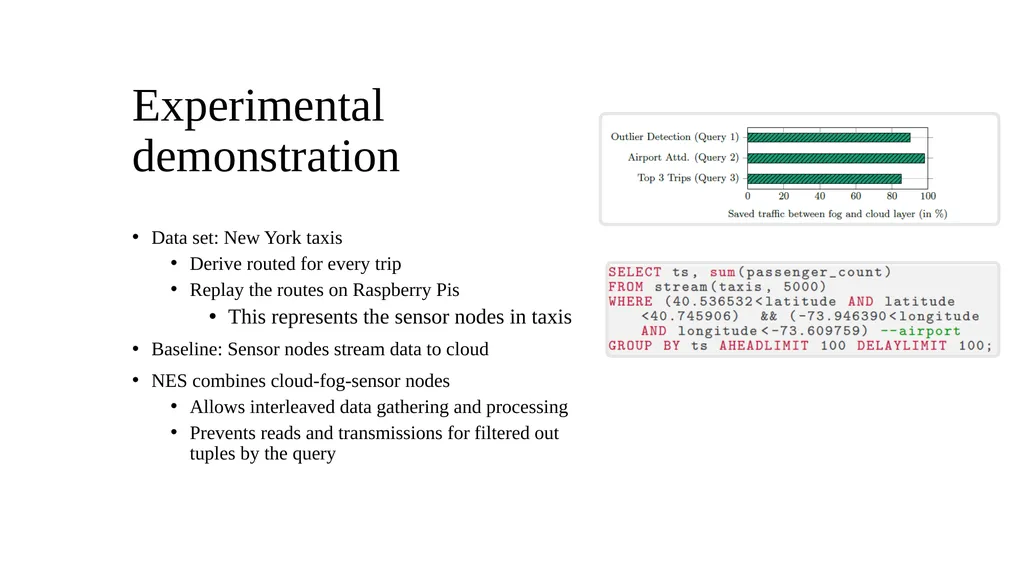
Experimental demonstration Data set: New York taxis
Derive routed for every trip
Replay the routes on Raspberry Pis
This represents the sensor nodes in taxis
Baseline: Sensor nodes stream data to cloud
NES combines cloud-fog-sensor nodes
Allows interleaved data gathering and processing
Prevents reads and transmissions for filtered out tuples by the query<br>
14
Volume of Compute Exploit the hardware resources of heterogeneous devices efficiently
Millions of devices in the fog topology
NES generates specialized code
Depending on query , hardware, data
Distributes query optimization
Global query optimization splits the query into segments for devices
Node engines use query compiler to produce hardware specific code
In-network processing to reduce the computation at the Cloud Layer<br>
15
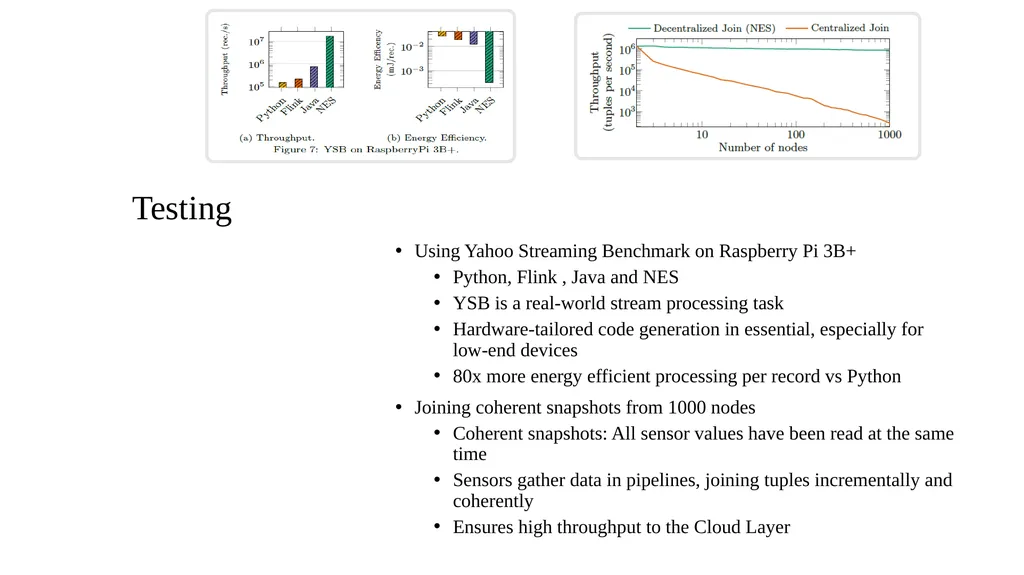
Testing Using Yahoo Streaming Benchmark on Raspberry Pi 3B+
Python, Flink , Java and NES
YSB is a real-world stream processing task
Hardware-tailored code generation in essential, especially for low-end devices
80x more energy efficient processing per record vs Python
Joining coherent snapshots from 1000 nodes
Coherent snapshots: All sensor values have been read at the same time
Sensors gather data in pipelines, joining tuples incrementally and coherently
Ensures high throughput to the Cloud Layer<br>
16
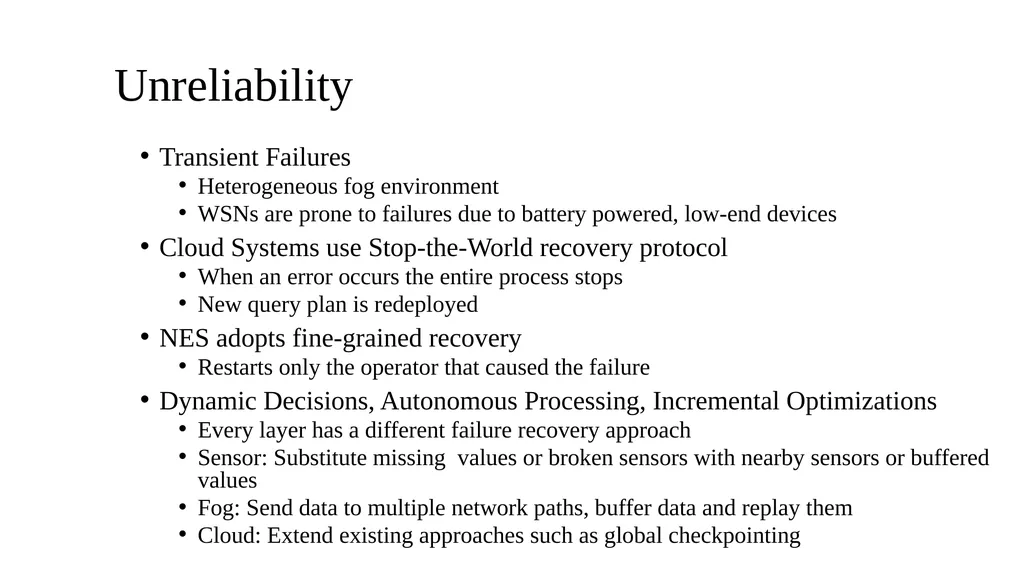
Unreliability Transient Failures
Heterogeneous fog environment
WSNs are prone to failures due to battery powered, low-end devices
Cloud Systems use Stop-the-World recovery protocol
When an error occurs the entire process stops
New query plan is redeployed
NES adopts fine-grained recovery
Restarts only the operator that caused the failure
Dynamic Decisions, Autonomous Processing, Incremental Optimizations
Every layer has a different failure recovery approach
Sensor: Substitute missing values or broken sensors with nearby sensors or buffered values
Fog: Send data to multiple network paths, buffer data and replay them
Cloud: Extend existing approaches such as global checkpointing<br>
17
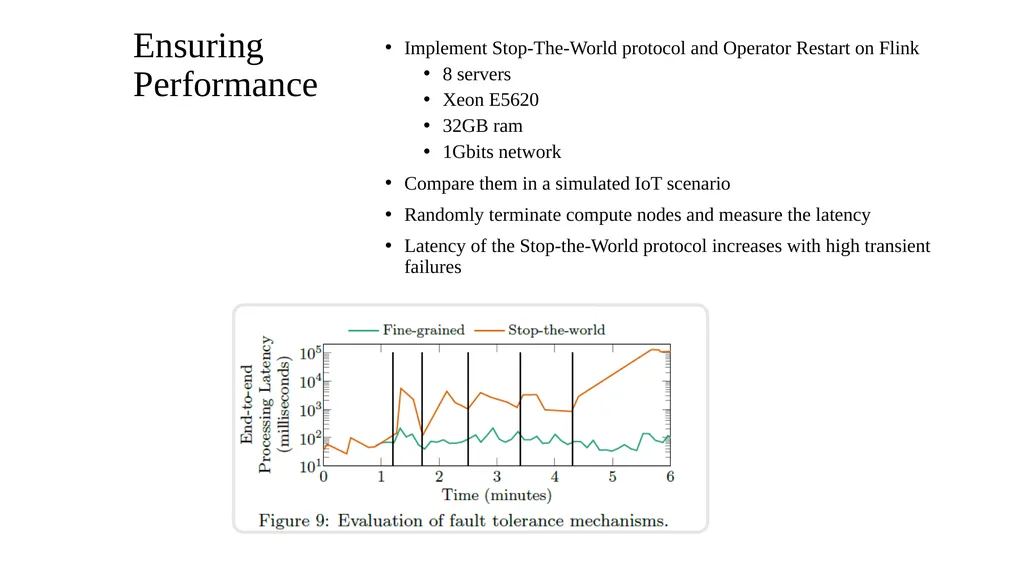
Ensuring Performance Implement Stop-The-World protocol and Operator Restart on Flink
8 servers
Xeon E5620
32GB ram
1Gbits network
Compare them in a simulated IoT scenario
Randomly terminate compute nodes and measure the latency
Latency of the Stop-the-World protocol increases with high transient failures<br>
8 servers
Xeon E5620
32GB ram
1Gbits network
Compare them in a simulated IoT scenario
Randomly terminate compute nodes and measure the latency
Latency of the Stop-the-World protocol increases with high transient failures<br>
18
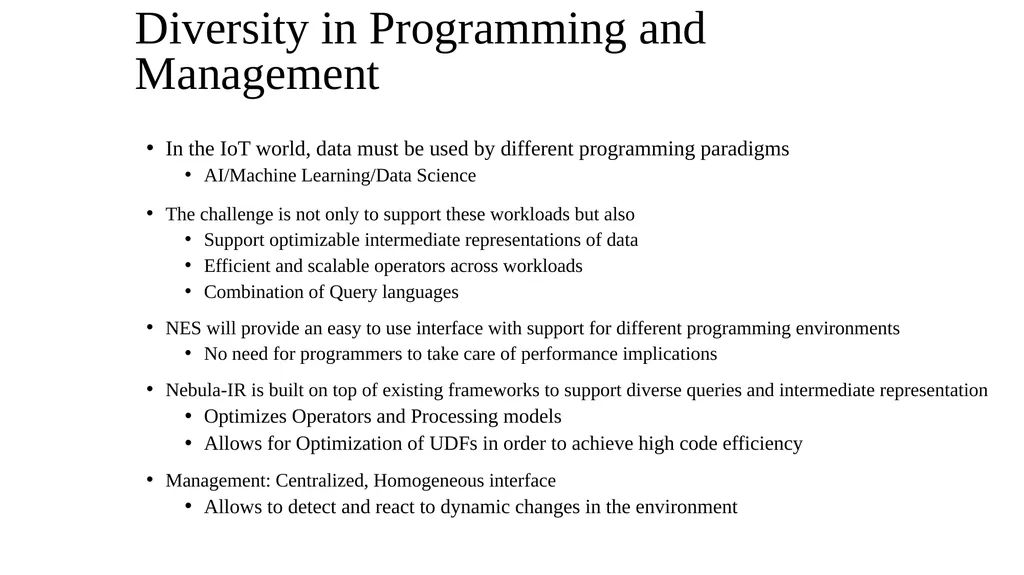
Diversity in Programming and Management In the IoT world, data must be used by different programming paradigms
AI/Machine Learning/Data Science
The challenge is not only to support these workloads but also
Support optimizable intermediate representations of data
Efficient and scalable operators across workloads
Combination of Query languages
NES will provide an easy to use interface with support for different programming environments
No need for programmers to take care of performance implications
Nebula-IR is built on top of existing frameworks to support diverse queries and intermediate representation
Optimizes Operators and Processing models
Allows for Optimization of UDFs in order to achieve high code efficiency
Management: Centralized, Homogeneous interface
Allows to detect and react to dynamic changes in the environment<br>
19
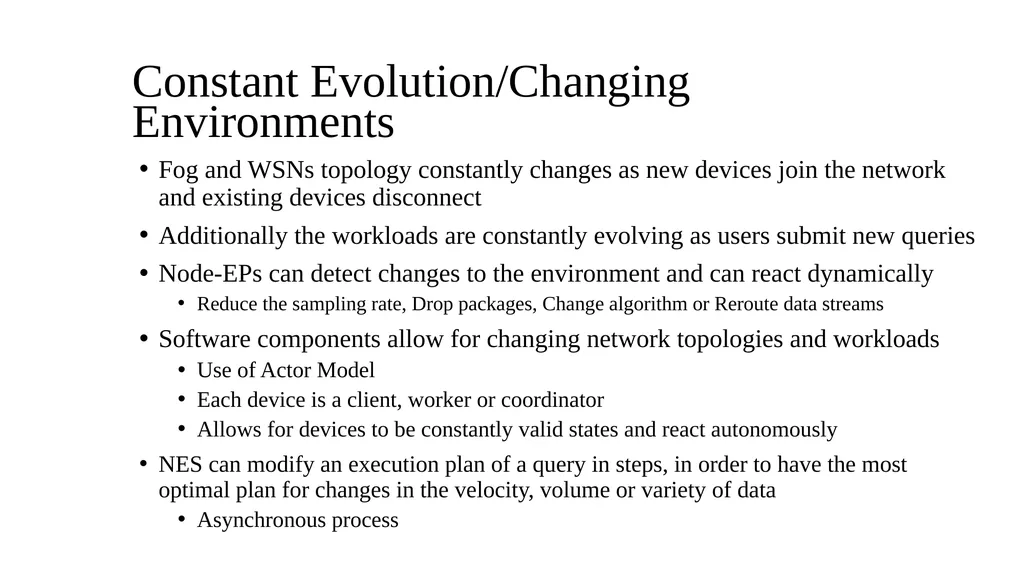
Constant Evolution/Changing Environments Fog and WSNs topology constantly changes as new devices join the network and existing devices disconnect
Additionally the workloads are constantly evolving as users submit new queries
Node-EPs can detect changes to the environment and can react dynamically
Reduce the sampling rate, Drop packages, Change algorithm or Reroute data streams
Software components allow for changing network topologies and workloads
Use of Actor Model
Each device is a client, worker or coordinator
Allows for devices to be constantly valid states and react autonomously
NES can modify an execution plan of a query in steps, in order to have the most optimal plan for changes in the velocity, volume or variety of data
Asynchronous process<br>
20
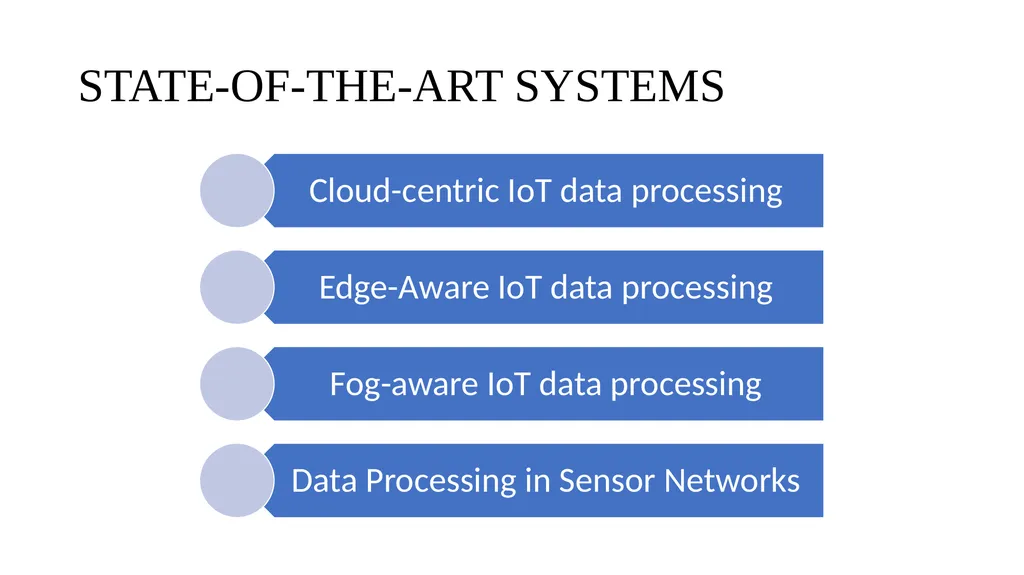
STATE-OF-THE-ART SYSTEMS<br>
21
Cloud-centric Approach A pool of sensors sends data directly to the cloud for further processing
Camera surveillance
Wearable cognitive assistance
Smart city Monitoring
Advantages: Fault-tolerance, Dynamic scaling of compute and storage resources
Disadvantage: Doesn’t take advantage of intermediate nodes
NES: cross paradigm optimization, in-network processing, hardware tailored code generation<br>
22
Edge-Aware IoT approach Hub devices placed at the edge of the fog topology in order to act as local control centers
Perform simple processing
Do not require stable connection the cloud
Hub devices still require a stable connection to the sensors and do not address dynamic changes in the topology
Existing systems do not offer efficient code computation or a multi-programming environment<br>
Perform simple processing
Do not require stable connection the cloud
Hub devices still require a stable connection to the sensors and do not address dynamic changes in the topology
Existing systems do not offer efficient code computation or a multi-programming environment<br>
23
Fog-aware IoT data processing NES combine the possible compute and storage capacities of the fog and the cloud
Additional research has been conducted on individual challenges in fog computing, which we will leverage in NES
Other researchers have proposed the following:
Operator placement techniques to partition queries across a fog topology
Exploit special capabilities of IoT hardware to improve efficiency and security
Solutions to partition the inference of deep neural networks across fog topologies to improve scalability<br>
24
Data Processing in Sensor Networks Sensor nodes form a network to transfer sensor values through multiple hops to a root node
Approaches in this area tackle efficiency by optimizing the computation for battery lifetimes and enable filtering and aggregation queries over sensor data They provide support for a dynamic execution environment
In NES, they leverage concepts from sensor networks and integrate them seamlessly across the Sensor, Fog, and Cloud Layers, resulting in a unified environment.<br>
25
CONCLUSION NebulaStream: a general purpose, end-to-end data management system for the IoT
The goal of the envisioned design is to handle the heterogeneity, unreliability, and elasticity of a unified sensor-fog-cloud environment
Presented first results that motivate the need of a new system design for upcoming IoT applications
NebulaStream Platform, aims to enable emerging IoT applications in different domains<br>
Presented first results that motivate the need of a new system design for upcoming IoT applications
NebulaStream Platform, aims to enable emerging IoT applications in different domains<br>