The OSU Research Office Supporting Faculty Success What Does Sponsored Programs Do? What Does Sponsored Programs Do? Office of Sponsored Programs OSUs Office of Sponsored Programs (OSP) Central proposal submission responsibility for
"The OSU Research Office Supporting Faculty Success" is the property of its rightful owner. Permission is granted to
download and print the materials on this website for personal, non-commercial use only, and to display it
on your personal computer provided you do not modify the materials and that you retain all copyright
notices contained in the materials. By downloading content from our website, you accept the terms of this
agreement.
Presentation Transcript
01
The OSU Research Office Supporting Faculty Success What Does Sponsored Programs Do? What Does Sponsored Programs Do?<br>
02
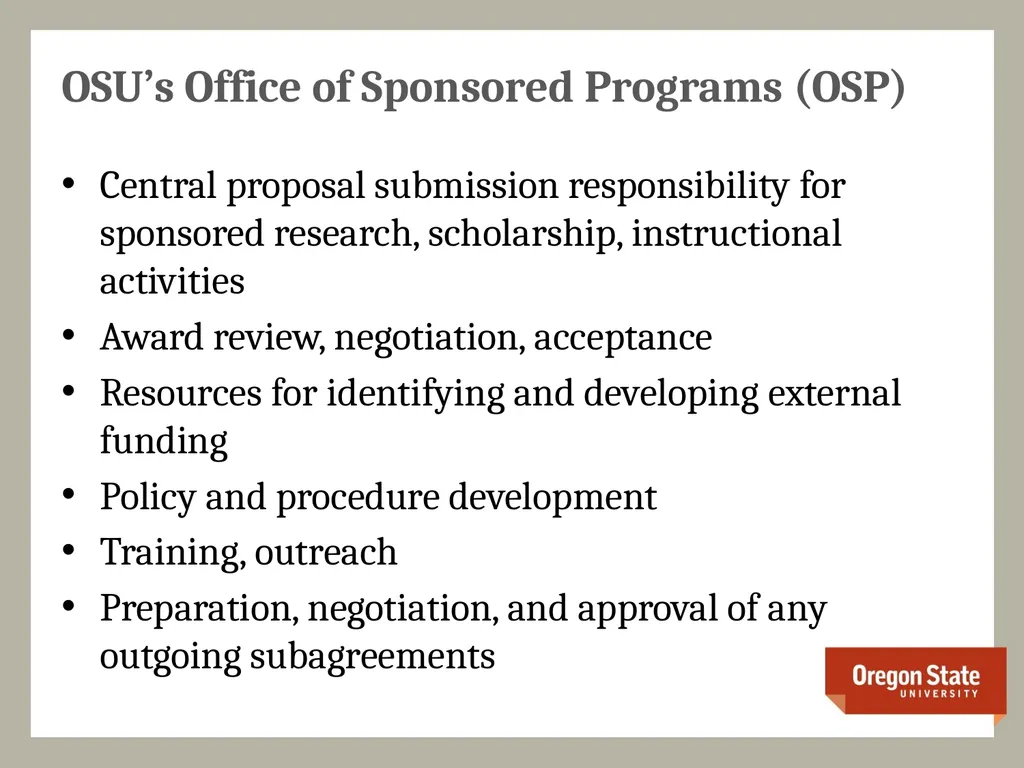
Office of Sponsored Programs OSU’s Office of Sponsored Programs (OSP) Central proposal submission responsibility for sponsored research, scholarship, instructional activities
Award review, negotiation, acceptance
Resources for identifying and developing external funding
Policy and procedure development
Training, outreach
Preparation, negotiation, and approval of any outgoing subagreements<br>
03
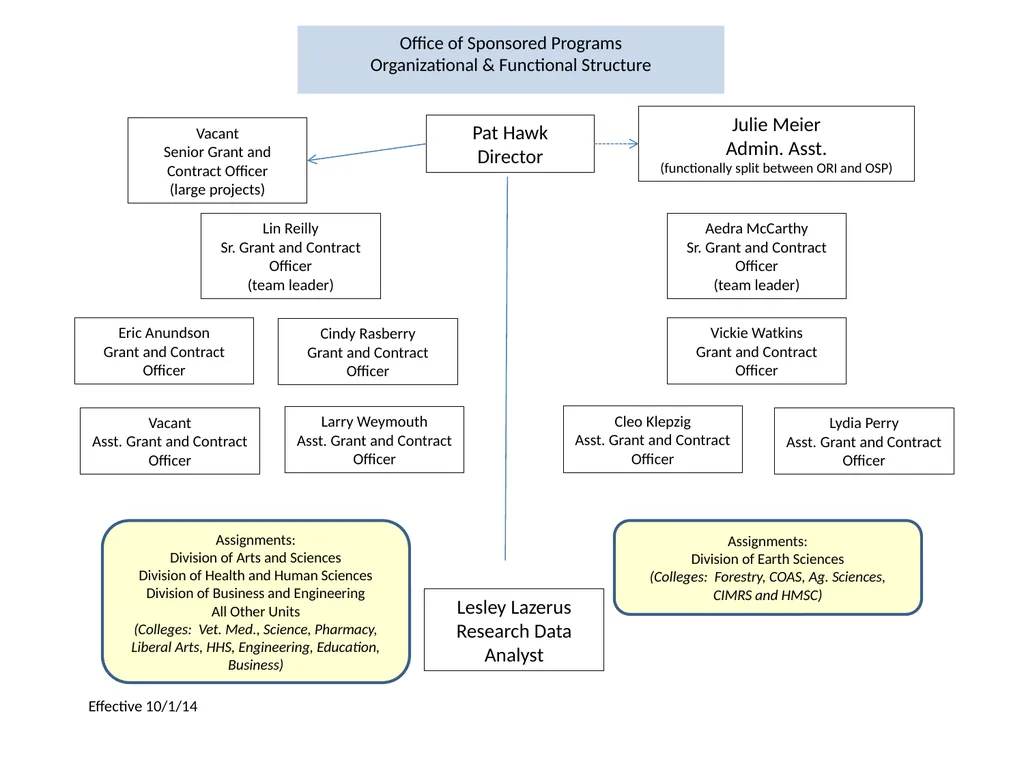
Office of Sponsored Programs Organizational & Functional Structure Pat Hawk
Director Cindy Rasberry
Grant and Contract Officer Lin Reilly
Sr. Grant and Contract Officer
(team leader) Aedra McCarthy
Sr. Grant and Contract Officer
(team leader) Vickie Watkins
Grant and Contract Officer Cleo Klepzig
Asst. Grant and Contract Officer Vacant
Asst. Grant and Contract Officer Lesley Lazerus
Research Data Analyst Effective 10/1/14 Assignments:
Division of Arts and Sciences
Division of Health and Human Sciences
Division of Business and Engineering
All Other Units
(Colleges: Vet. Med., Science, Pharmacy, Liberal Arts, HHS, Engineering, Education, Business) Assignments:
Division of Earth Sciences
(Colleges: Forestry, COAS, Ag. Sciences, CIMRS and HMSC) Larry Weymouth
Asst. Grant and Contract Officer Lydia Perry
Asst. Grant and Contract Officer Julie Meier
Admin. Asst.
(functionally split between ORI and OSP) Eric Anundson
Grant and Contract Officer Vacant
Senior Grant and Contract Officer
(large projects)<br>
04
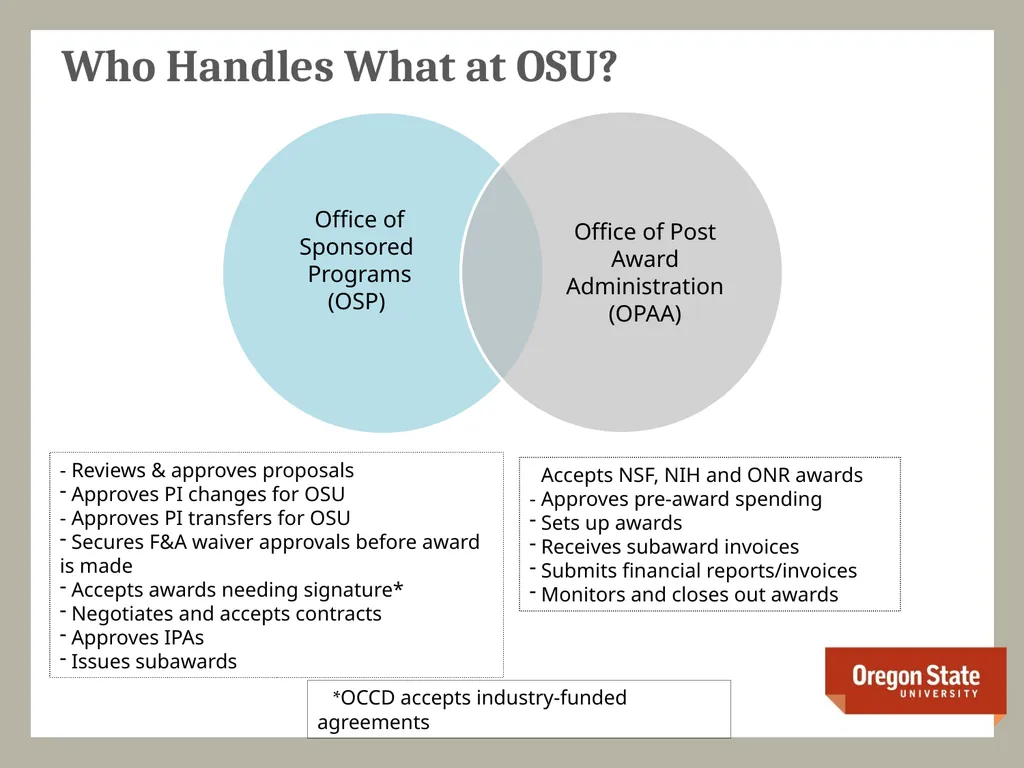
Who Handles What at OSU? - Reviews & approves proposals
Approves PI changes for OSU
- Approves PI transfers for OSU
Secures F&A waiver approvals before award is made
Accepts awards needing signature*
Negotiates and accepts contracts
Approves IPAs
Issues subawards - Accepts NSF, NIH and ONR awards
- Approves pre-award spending
Sets up awards
Receives subaward invoices
Submits financial reports/invoices
Monitors and closes out awards ***OCCD accepts industry-funded agreements<br>
05
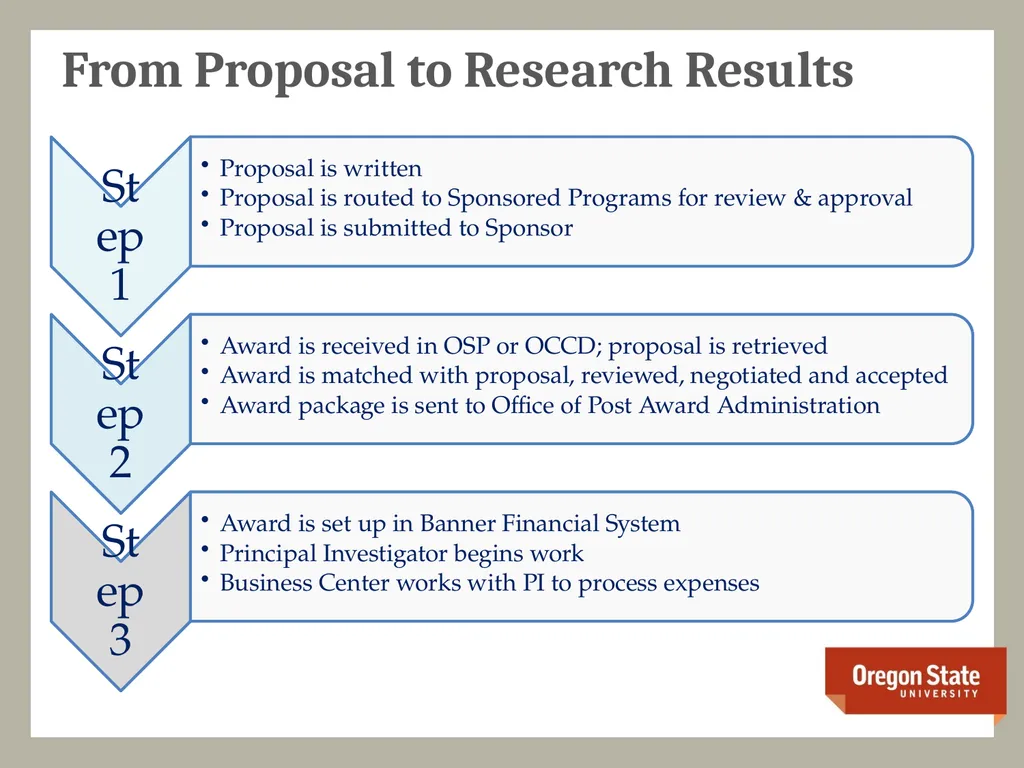
From Proposal to Research Results<br>
06
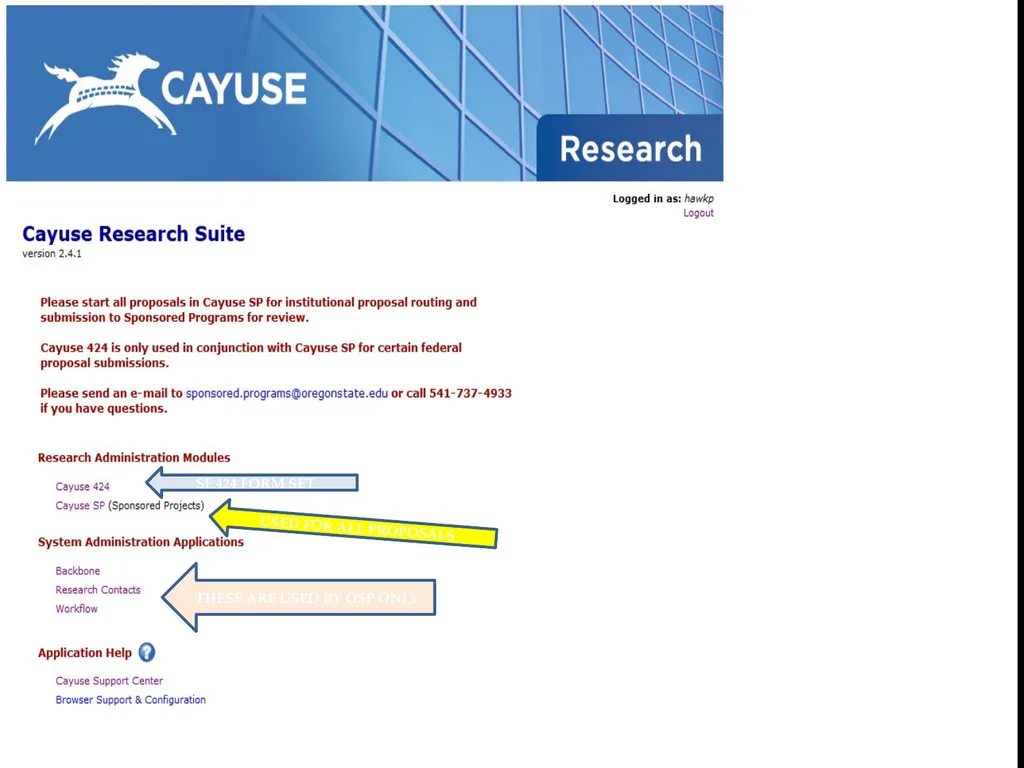
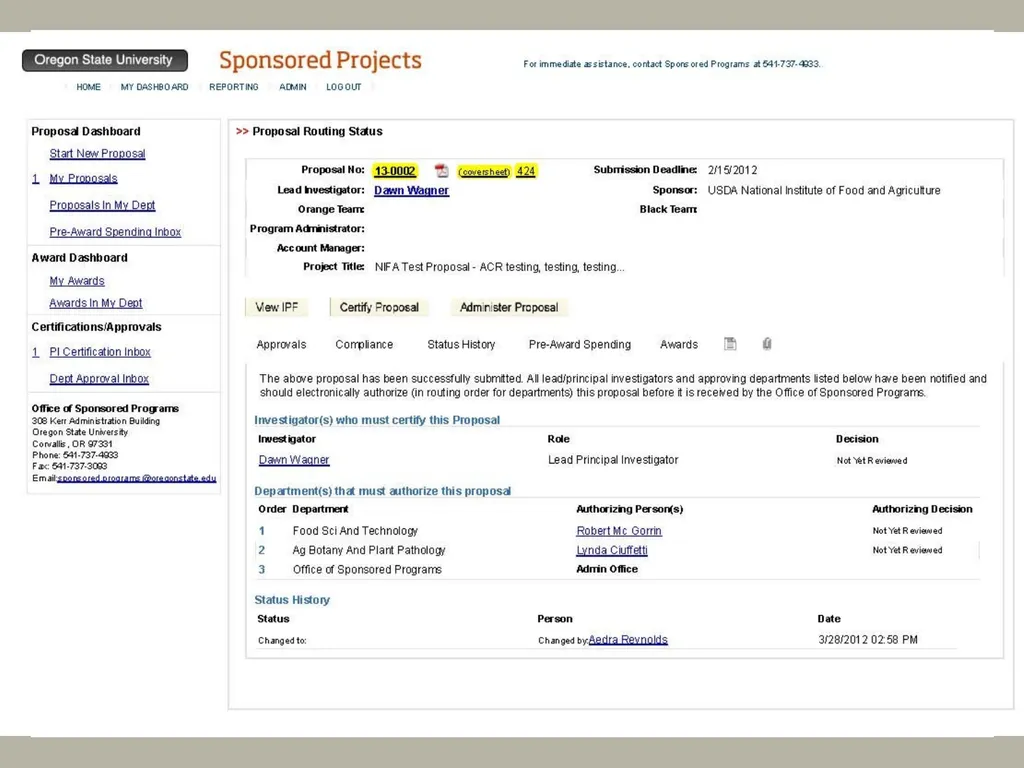
Office of Sponsored Programs Cayuse has come to OSU<br>
07
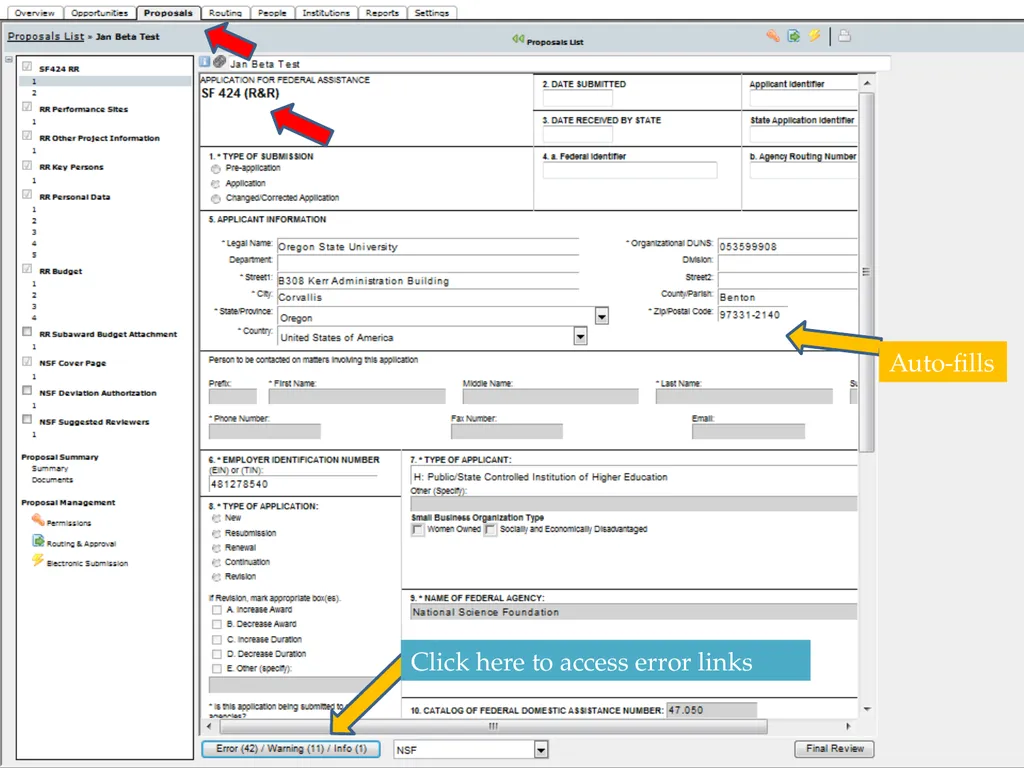
USED FOR ALL PROPOSALS SF 424 FORM SET THESE ARE USED BY OSP ONLY<br>
08
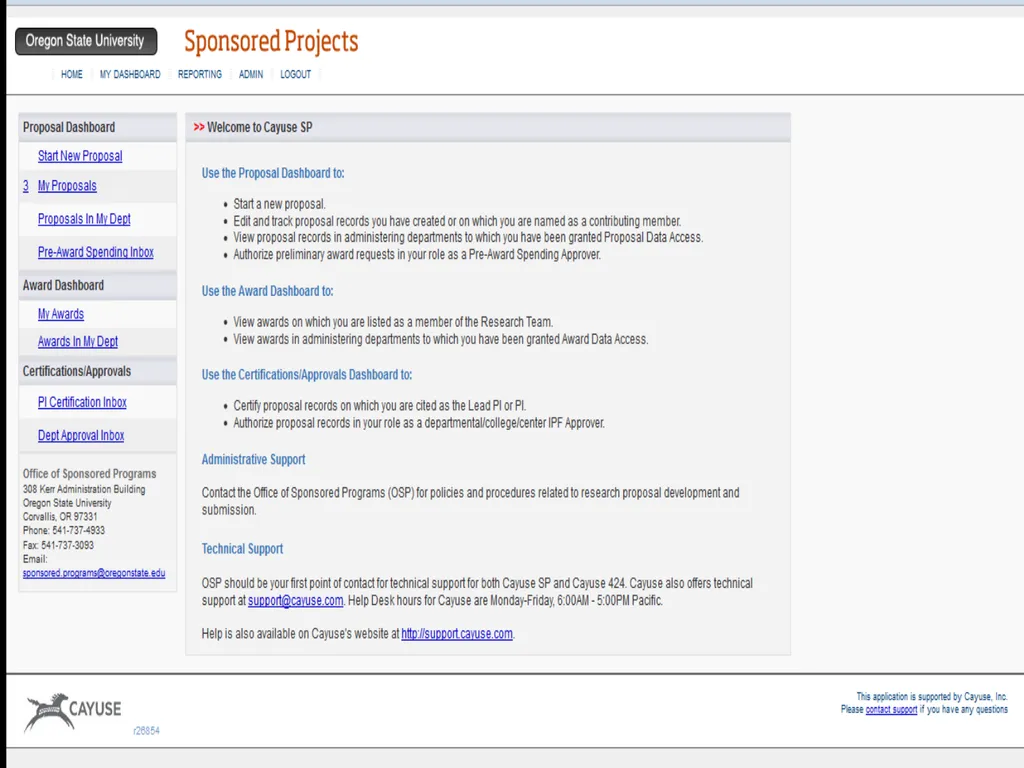
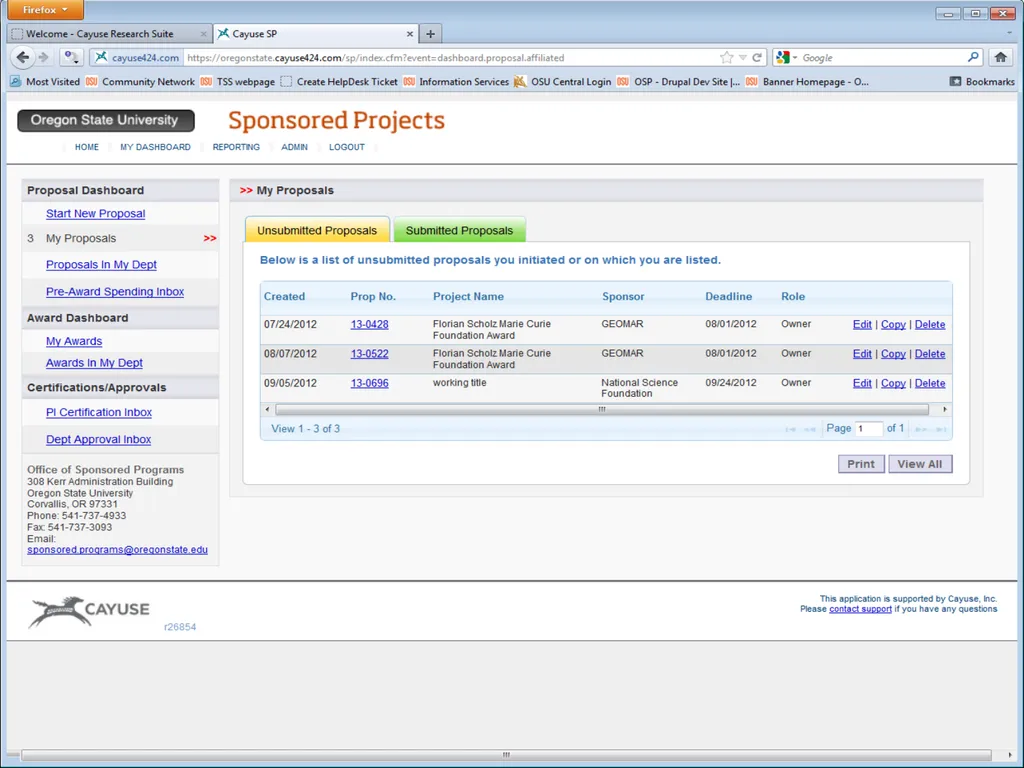
Auto-fills Click here to access error links<br>
09
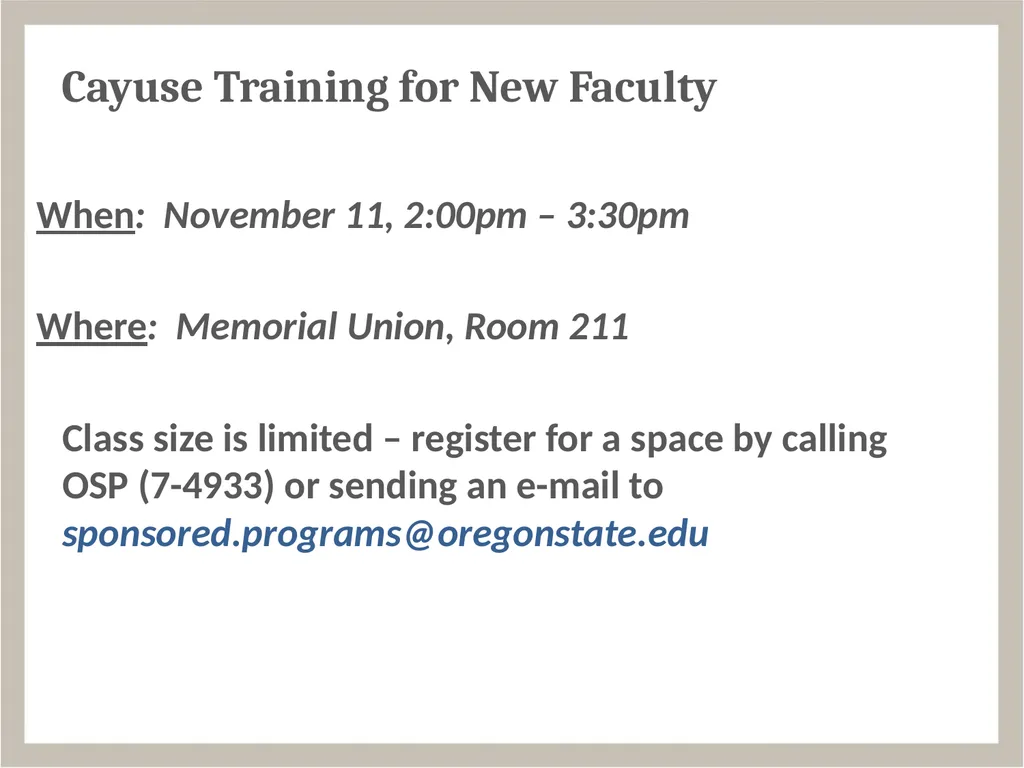
Cayuse Training for New Faculty When: November 11, 2:00pm – 3:30pm
Where: Memorial Union, Room 211
Class size is limited – register for a space by calling OSP (7-4933) or sending an e-mail to sponsored.programs@oregonstate.edu<br>
10
Guiding submissions, negotiations, awards
so your research is supported<br>
11
Tips from Vince – Tip 1 Be sure that you are set up on Cayuse, Fastlane and eCommons. Do this well in advance of even starting to write up your idea. It should be a straightforward process, but if you are time-constrained it is sure to be problematic instead. So hedge your bets and get signed up right away. Here’s the link to a good starting point: http://oregonstate.edu/research/osp/forms<br>
12
Tips from Vince – Tip 2 Prepare your budget early. When I started my academic career I had a habit of focusing intently on the new idea that I wanted to pitch in response to an RFP and leaving the budget part for later. “Later” usually turned out to be at the last possible minute. And invariably that’s when I’d find out that I did not have the latest data to inform me in preparing a draft budget. So, start early with a good general idea of what the budget will be. Then, when you are past the writing crunch and on to refining the budget, you know you will be starting from a solid set of numbers. An additional idea: Save this template and use it as your starting point for future applications – you can simply scale the personnel, supplies and equipment components to meet the needs of the proposed project, making it more likely that your budget will review well. Here’s a link to a good starting point: http://oregonstate.edu/research/osp/budget-development-0 Many times your Department or business office will have a template they can share with you as a starting point, too. It’s worth asking.<br>
13
Tips from Vince – Tip 3 The numbers – make sure you are using current rates. It’s frustrating to invest time and energy in preparing what seems to be a rock solid budget, only to have it reviewed and learn that the rates you used were not current. So, visit the OSP website early in the process (when you make that DRAFT BUDGET) to plug in the right values. Here’s a link to a good starting point: http://oregonstate.edu/research/osp/sites/default/files/current_rates_fy14.pdf<br>
14
Tips from Vince – Tip 4 Don’t be afraid to ask for help – just ask EARLY. Finding the right person to ask is pretty straightforward – start with your senior colleagues. Your colleagues are a great resource for “intelligence” on funding agencies, opportunities, and budget preparation. Getting together with a colleague for a discussion – over coffee or tea, or while taking a walk around campus, can be tremendously helpful. For budget preparation, a good first question is “Can you share with me an example budget for [name the funding organization] that I could use as a starting point?” Armed with that, you are more likely to be successful in assembling a budget.<br>
15
Tips from Vince – Tip 5 To review your budget, work with your business center [or College Grant Coordinator] first.<br>
16
Tips from Vince – Tip 6 When you are close to being ready to submit – ideally a couple of weeks prior to the deadline (go ahead, groan now, I know the feeling) – “punch the button” to trigger the OSP review. Recognize that OSP may be able to work with only a very rough draft of the technical part of the proposal (so long as it is a good match for the budget piece) and your best effort, using current rates, for the budget. By now, that part will have been reviewed by your business center, so it’s likely to be in reasonably good shape. Here’s a link to the OSP org chart, to guide you as to whom in OSP is your best point of contact: http://oregonstate.edu/research/osp/sites/default/files/osp_functional_structure_0.pptx<br>
17
Tips from Vince – Tip 7 Recognize that the person on the other end of the phone, or responding to your email, is also helping lots of other people with needs as dire as your own. They’ll be much more inclined to jump on your problem if it’s clear that you have done your part fully.<br>